TOLEDO – Northwest Ohio has everything in place for high-tech firms to build hyperscale data centers to meet the needs of the rapidly growing artificial intelligence market, according to state and local development officials.
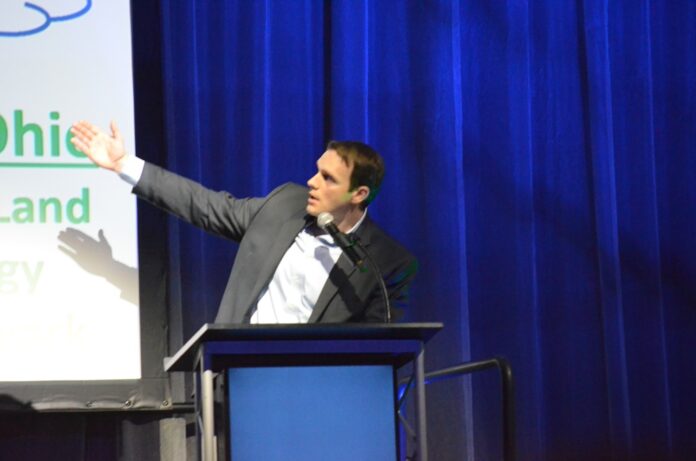
Citing Meta’s $800 million data center now under construction in Wood County as one notable success story, speakers at the Regional Growth Partnership (RGP) of Northwest Ohio’s annual meeting, held in the Glass City Convention Center on March 5, said they were concerned about the spread of “misinformation” regarding data centers.
Speakers spotlighted numerous job- and revenue-creating projects developed throughout the 17-county region in 2025, resulting in 4,895 new jobs, 16,177 retained jobs, and $3.3 billion in capital investments.
But they also focused on the future, stressing the potential positive impact of luring new large-scale data centers to the area.
“There has been an incredible amount of talk surrounding data centers recently, and unfortunately, much of that talk has been misinformation,” said Dean Monske, president and CEO of the RGP.
“RGP has diligently been trying to overcome that misinformation for well over a year now, and we thought it was extremely important to use this platform today to educate and inform all of you about the facts and benefits we see from our region,” he added.

More hyperscale data centers will be needed to meet the soaring AI market, which is expected to grow globally from $189 billion in 2023 to $4.8 trillion by 2033, according to Forbes magazine.
Monske introduced Gary Thompson, RGP executive vice president, who has been leading the group’s efforts on data centers for four years.
“Whether you like data centers or not, I hope you can at least see why our region is a suitable host for the industry,” Thompson said.
Among the factors cited in northwest Ohio’s favor:
-Flat, affordable land near power infrastructure
- -Abundant, cost-effective natural gas from multiple sources
- -70 million gallons a day of excess water capacity in Toledo alone
- -35-plus colleges and universities providing “a built-in tech talent pipeline”
- Thompson said he is “perplexed” by much of the opposition to hyperscale data centers, saying social media have given opponents “a very loud voice.”
One misperception, he said, is that data centers produce a loud, constant, annoying hum that can be heard throughout the neighborhood.
While that may be true of “chicken coop crypto mining” facilities, it is not true of the type of high-tech centers the RGP is seeking to attract, he said.
“I have stood in front of hyperscale data centers in the morning, in the afternoon, in the evening, in the sun, in the rain, in the wind, in the snow; they don’t make any noise,” Thompson said.
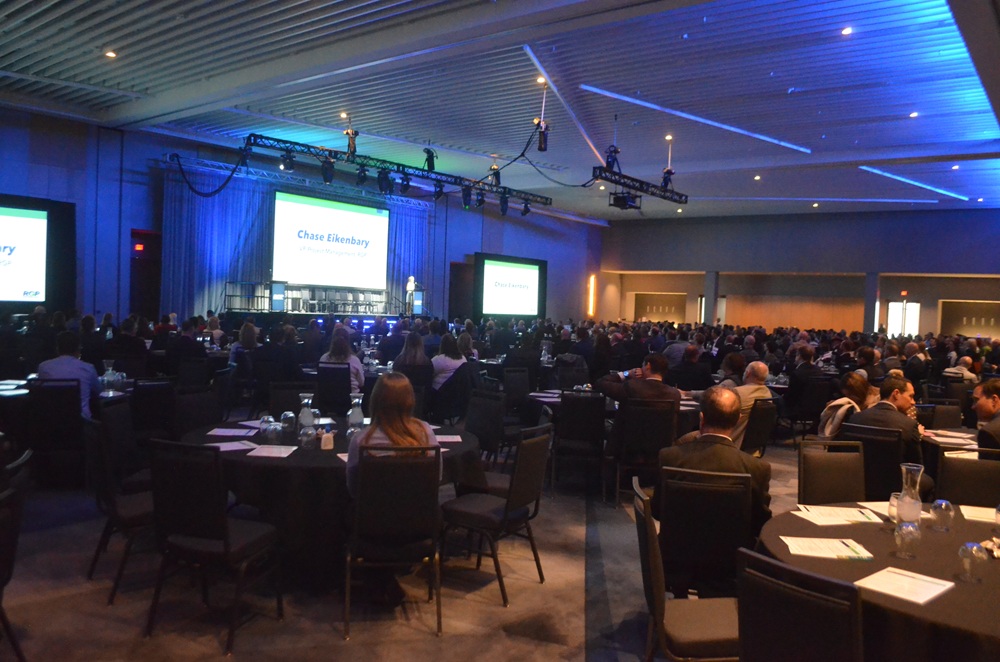
He showed the crowd of 700 a video of a crypto mining facility consisting of a series of pole barns with openings for fans that produced a constant noise registering 84 decibels on a hand-held device, equivalent to the noise level of a gas-powered lawn mower.
In contrast, he showed a sleek, self-contained modern building like the one Meta is building in Middleton Township, north of Bowling Green, adding that such facilities have sound buffers and barriers that keep noise levels low.
“I think we can all agree that the ‘chicken coop crypto mining operation’ in the video is loud, obnoxious, ugly, undesirable, it’s not creating any jobs, it’s unwelcoming, it’s a nuisance… Let me be very clear, no one at the RGP or our utility partners are looking to attract crypto mining.”
He asserted that every northwest Ohio community has zoning ordinances that would make such a facility illegal. “They would not be able to get a building permit.”
An RGP handout said the Meta facility will employ more than 1,000 construction jobs with work on the project extending for 10 years – “not a quick build-and-leave” project.
Data centers create between 100 and 150 high-paying jobs and draw additional white-color tech companies to the region.
The handout sheet said hyperscale data centers construct “behind-the-scenes power plants that are privately funded and don’t impact ratepayers – they can actually add resilience to the grid.”
Thompson added that the facilities use “closed-loop cooling” that circulates about 30,000 gallons of water a day. “That’s equivalent to two Hampton Inn hotels.”
He said hyperscale data centers require between 200 and 1,000 acres of land, and that there is no shortage of available land in Ohio.
“To put data centers in perspective, if northwest Ohio landed 10 hyperscale data centers that are built on 1,000-acre campuses, we would use only three-tenths of 1 percent of the total farmland in our region,” Thompson said.
Chase Eikenbary, vice president of project management for the RGP, said there were 13 new projects in agriculture and food sciences in Northwest Ohio in 2025, creating 384 new jobs and $421 million in investments.
“Everyone in northwest Ohio is a farmer, loves a farmer, or loves what they do,” she said.
She said Marsha’s Buckeyes, based in Perrysburg, has received a grant to expand.
In the field of advanced manufacturing, Eikenbary said there were 60 new projects that created 2,528 jobs and brought in $1.8 billion in investments. Among the advanced manufacturing companies listed were Whirlpool, Nooter, Revere Plastics, and First Quality.
Eikenbary also spotlighted SmartSolve Industries, which is building a 10,000-square-foot research and development facility in Bowling Green with an investment of $3.6 million, creating 30 new jobs.
J.P. Nauseef, president and CEO of JobsOhio, told the crowd that northwest Ohio led the state in creating new jobs in 2025. He praised local businessmen and developers for their “unity and willingness to come together and work together on common economic development efforts.”