Marsha's Buckeyes facility is in Perrysburg, and the operation has recently expanded to Walmarts nationwide. (TFP photo by Lucas Sells)
PERRYSBURG – Starting from the basement of the Smith house, Marsha’s Buckeyes has evolved from a simple home-based operation into a production line serving most of the country. Based in Perrysburg, Marsha’s got its start in 1984, when Marsha Smith wanted a way to make a bit of extra cash to support her family. To achieve this, she decided to monetize her hobby of making buckeyes. Fast forward to today when Marsha’s is now sold in over 2500 Walmart locations across the country.
An empty basket of Buckeyes decorates Brad Smith’s desk. Smith is president of Marsha’s Buckeyes. (TFP photo by Lucas Sells)
When Marsha’s business began, it served only a few local markets, but eventually, her business began to explode in popularity, with her buckeyes eventually reaching the corporate offices of Cracker Barrel. Seeing their potential, Cracker Barrel offered to sell her buckeyes in all of its stores nationwide. Today, Marsha’s Buckeyes are sold in every Cracker Barrel location across the country.
TFP video by Lucas Sells.
Spearheading the recent expansion into a nationwide market at Walmart is Brad Smith, one of Marsha’s sons. Brad is the president and owner of Marsha’s Buckeyes, and – along with his brother Mitch – oversees the production and distribution for the company. Growing up around his mother’s business, Brad and Mitch both had a desire to continue on what their mother had begun, and after attending OSU and graduating in 2009, the two began the process of taking over for their parents. In 2018, they officially purchased the business from them.
During this time, the brothers found ways to expand to match the newfound demand. In 2006, they began to use cookie dough machines to make the peanut butter balls. In 2018, they began working on a personalized dipping machine, something that they couldn’t find on the market. Being surrounded by the business since they were young, the brothers found that originally, the way that they made buckeyes was not much different than what many Ohioan families did as well.
“The original manufacturing process was no different than what everybody else does at home.” Brad reminisced. “Mixing the ingredients, putting them into a ball by rolling with your hands, and then dipping with a toothpick into a bowl of chocolate.”
Brad also found that demand would peak during certain periods of the year, with the college football season being an exceptionally busy time, and winter holidays also seeing another spike in demand. With buckeyes being a staple of statehood in Ohio, it’s no wonder that families across the state share an affinity for the treat.
Jacob Juhasz packs a tin with freshly cooled buckeyes. (TFP photo by Lucas Sells)
“It’s very much a tradition where you get together as a family and make buckeyes as part of your platters… that’s certainly the foundation of what we’ve been as a company.”
Reflecting on how his company gives back, Brad mentioned how the company serves the Perrysburg community, primarily through gifting their buckeyes for events. A notable example was the Buckeye Cruise for Cancer, an annual fundraising event that takes place every February. Marsha’s Buckeyes has been sponsoring the event for 15 years.
On the other side of Marsha’s headquarters lies the production facility, and leading the floor is Zakary Kern, E-Commerce and Logistics Coordinator for the company. Zakary, like many of the office workers, wears many hats, but his primary goal is to lead the company’s production line. A cousin of Brad and Mitch, Kern came into the company to help the brothers expand. To him, family has meant a lot in getting where he is today, and he sees that reflected in how the business is run.
“I wouldn’t be where I’m at without family, and [I’ve had] opportunities because of family. So, you know, it means a great deal to me,” he expressed. “The family aspect of this shows where, unlike larger corporations… It’s a lot more relaxed here… If you need to take time off, for whatever reason, it’s not so difficult and structured.”
Part of Kern’s job is to look forward, and like Brad, he believes that Marsha’s has the capability and needs to justify an expansion to meet the new demand that the Walmart deal has given them. From hiring new employees and increasing production lines, the expansion of their operation is something he’ll be spearheading.
The humble beginnings of a small business like Marsha’s is proof that entrepreneurship at the local level is pivotal to powering communities all over the country. With further expansions driving this company forward, they stand as a reminder that local business is the lifeblood of our economy, and that anyone seeking to make money from a hobby only needs the courage to take the first step.
Erin Lowe talking to fellow coworkers on the side of the product. (TFP photo by Lucas Sells)
TOLEDO — This year, Ohio voters will decide on their congressional representatives, who will hold one of the state’s two U.S. Senate seats, as well as who will replace Republican Mike DeWine as governor.
But before these big decisions are made in November, voters must decide on who the main candidates will be — as in some races — there’s more than one Democrat or Republican running for the same position. And that’s where a primary comes in: to reduce the field of candidates in any given race down to just two. So if you plan on voting in Ohio’s May primary, here are three things to know.
1. Registering to vote
While registering to vote can be done in person at your county board of elections office, or by mail, a quick way of doing it is through the secretary of state’s website. To complete this process efficiently, have both your driver’s license/state ID and Social Security number on hand. Keep in mind that, under Ohio law, those who’ve registered less than 30 days from an election are ineligible to vote in it. So simply put, April 6 is the final day to register to vote in the upcoming primary.
2. When, and how, to vote
Ohio offers both early and absentee voting.
Early in-person voting begins on April 7, a Tuesday — and from there — will only take place on certain days and during certain hours. Here are those dates and hours, per the secretary of state’s voting schedule:
Tuesday, April 7 – Friday, April 10 | 8 a.m. – 5 p.m.
Monday, April 13 – Friday, April 17 | 8 a.m. – 5 p.m.
Monday, April 20 – Friday, April 24 | 8 a.m. – 5 p.m.
Monday, April 27 – Friday, May 1 | 7:30 a.m. – 7:30 p.m.
Saturday, May 2 | 8 a.m. – 4 p.m.
Sunday, May 3 | 1 p.m. – 5 p.m.
Remember that if you choose to vote this way, you’d be casting your ballot at the county board of elections office — not your precinct location.
Absentee voting, or vote-by-mail, also begins on April 7. To vote this way, one must first request a ballot. That can be done by filling out the application online, printing it, and mailing it to the county board of elections office. Another way of requesting a ballot is to call the county BOE directly.
3. Figuring out what & who will be on the ballot
The Toledo Free Press will continue to interview the candidates you’ll see on your ballot, as part of the Toledo Free Press Voter’s Guide, which can be found on YouTube and Spotify. Consuming these interviews is a great way to gain an understanding of who candidates are and the policies they support. But if you’d like something of a replica of what your ballot will look like, many county boards of election provide a ‘sample ballot’ on their website.
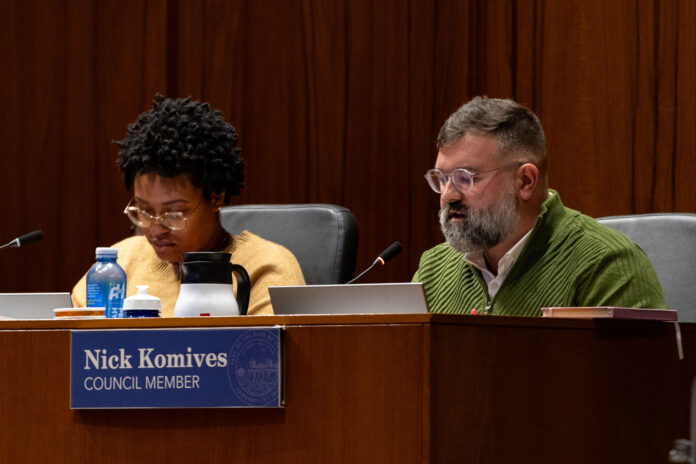
Nick Komives, Toledo City Council Member At-Large, during his closing remarks at a Toledo City Council meeting inside City Council Chambers at 1 Government Center on Tuesday December 16, 2025. (TFP photo by Stephen Zenner)
Toledo City Council met Tuesday, St. Patrick’s Day, with a few highly anticipated resolutions and ordinances concerning the role of the City of Toledo in federal immigration enforcement.
“We just really focused on making sure that we set some parameters and policies around the ways that the City of Toledo works with ICE, otherwise known as Immigration and Customs Enforcement,” said Nick Komives, Toledo City Council member At-Large.
“There is an agency, ICE, that has more money than God,” he said. “They do not need more resources from the City of Toledo. We believe that the limited resources that we have are already dedicated to important work, so we just made sure to outline exactly how we will spend our resources and what any type of alignment with ICE looks like.”
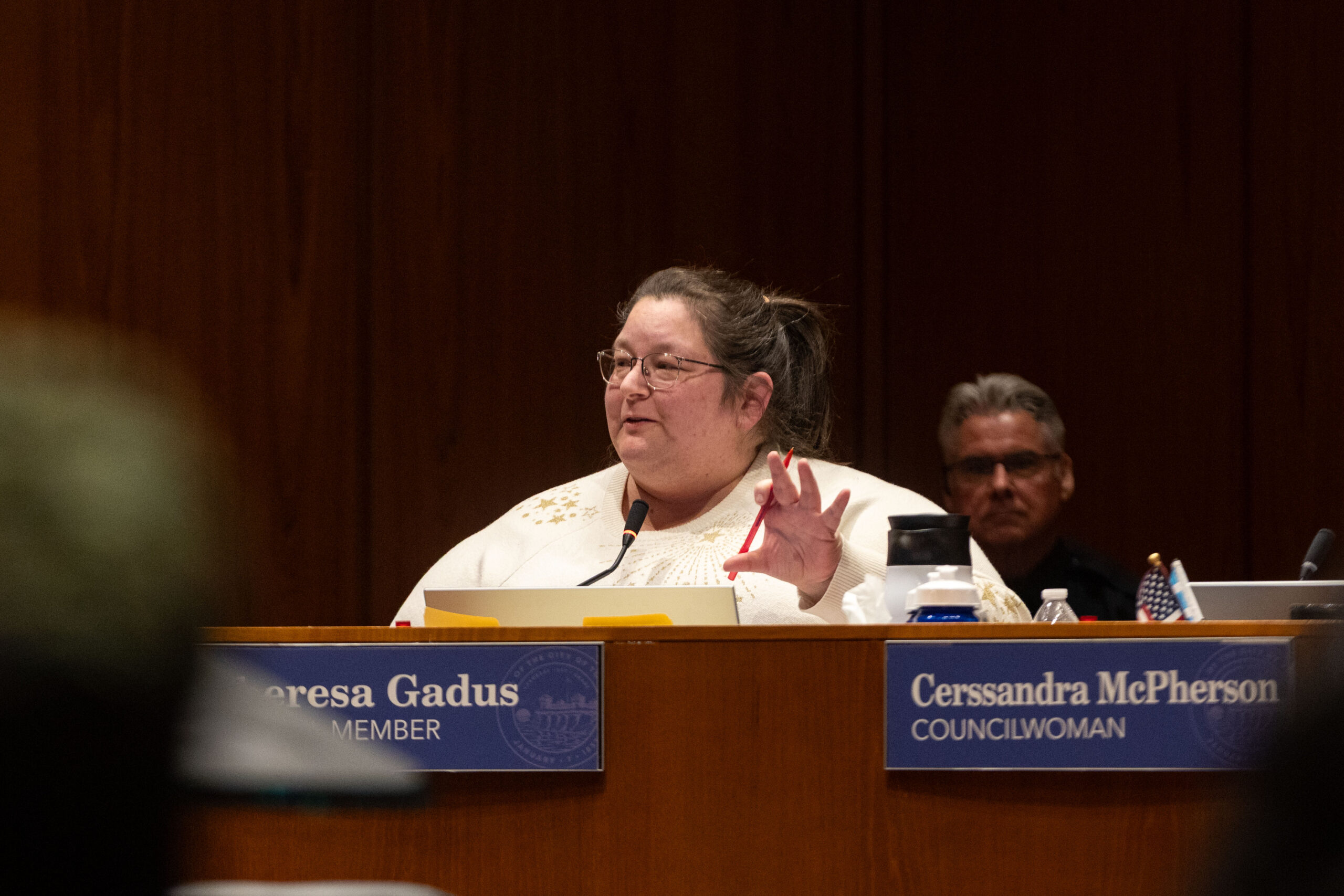
Theresa Gadus, council member for district 3. (TFP photo by Stephen Zenner)
Resolutions 093-26,094-26 and Ordinance 095-26 passed unanimously without issue, while Theresa Gadus, Council Member for District 3, said Ordinance 096-26 was held for more community feedback. Ordinance 096 dealt with protections for schools and childcare centers from immigration enforcement actions.
Council Members Mac Driscoll (At-Large), Gadus, Brittany Jones (At-Large), Komives, Erin Kramer (At-Large) and Adam Martinez (District 2) sponsored the five legislative measures surrounding federal immigration enforcement referenced during the Committee of the Whole a week prior to this council meeting.
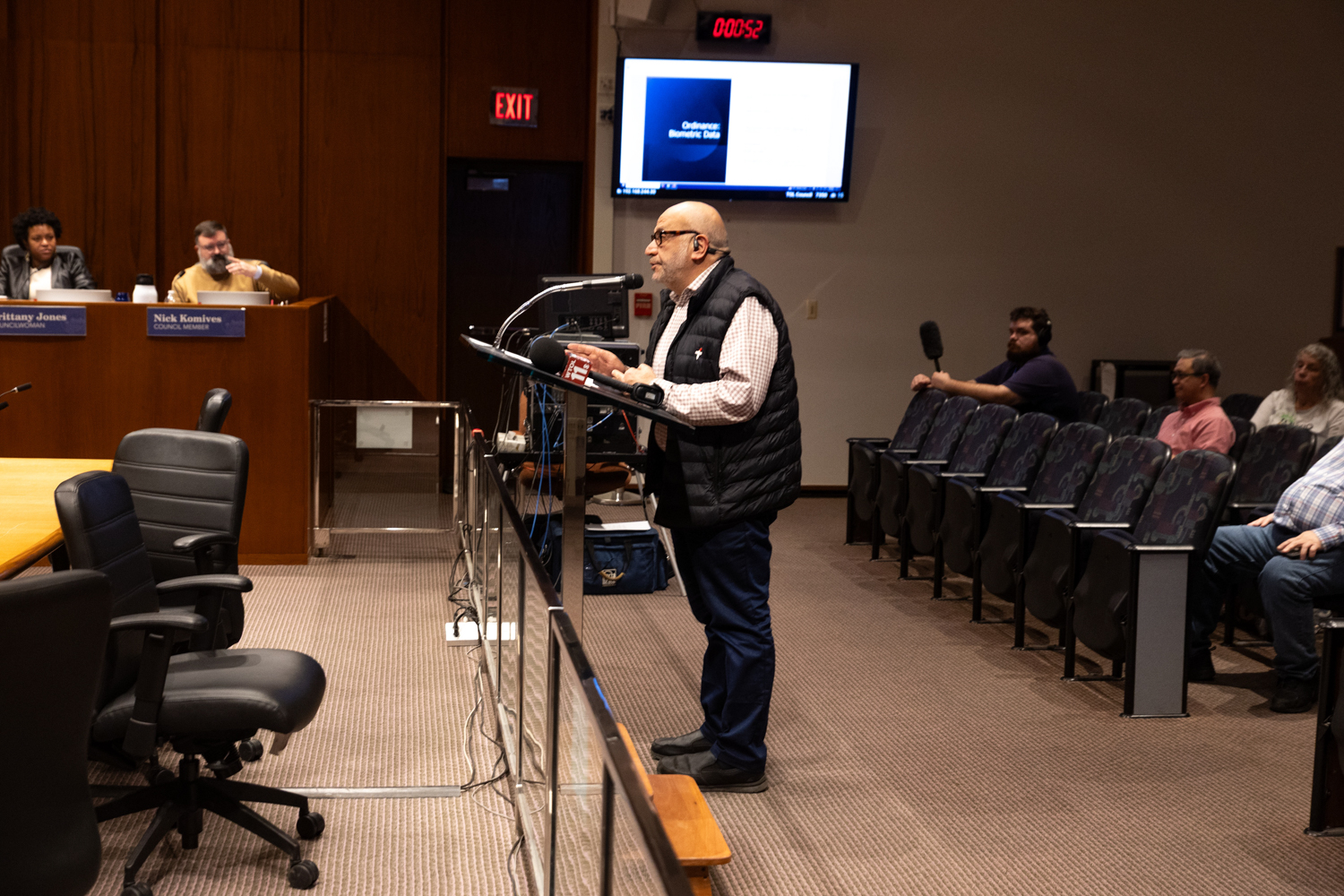
There was one proposed ordinance, dealing with biometric data security, which did not have a drafted appearance during the city council meeting.
Komives was available to give a brief summary of the two resolutions and one ordinance that passed.
“I’m just really proud of this community for stepping up. We did something that I think is quite brave,” he said about the three passed measures that day.
“We just don’t want to see them [ICE] coming here and violating people’s constitutional rights,” he said. “It is our job at the local level to do what we can to protect our residents, so we will continue to take a look at policies and procedures to make sure that we’re doing just that.”
A brief summary from Komives listed the some of the steps in place with the new resolutions and ordinance.
“We also requested that they properly identify themselves, no more of the hidden badges or wearing face coverings, things of that nature. We also made it very clear that our city employees are not going to be sharing the immigration status of individuals and residents who live here in Toledo,” he said.
“In no way is this us telling anything to ICE about what they can and cannot do. They have their legal parameters. We’d like them to especially stick to what those are. But more importantly, this legislation really touched on how city employees interact with ICE, and so we won’t be sharing immigration status, we won’t be providing them any data. We won’t be accompanying them on any raids or anything like that, unless they have the appropriate judicial warrant.”
Immigration legislation for Toledo
093 clarified the procedure and standard of detention facilities within the city.
Since detention facilities “require a unique set of public services,” the resolution recommended to the Plan Commission that a special use permit should be required for detention facilities. Special use permits are obtained by a vote by City Council, so a detention facility would not be authorized without a vote by city council.
The resolution requested a public hearing when this resolution is proposed to become an ordinance.
Resolution 094 formally asked the federal government to adhere to a certain set of standards when conducting immigration enforcement in Toledo.
Part of this standard was providing identification and transparency for themselves and their vehicles, including not wearing face coverings, except for medical reasons, while agents are conducting official immigration enforcement.
The resolution asked that Department of Homeland Security (DHS) agents deployed in Toledo and nationwide to have completed 22 weeks of training, the former standard before the onset of ICE surges across United States cities.
And finally, the resolution asked that DHS agents adhere to local, state, federal and constitutional law, maintain a civility when interacting with residents, refrain from lethal force and urged federal law enforcement to comply with the city’s ordinances for the safety and security of residents.
At the end of February 2026 DHS put out a statement clarifying the changes in their training practices.
“New ICE recruits receive 56 days of training and an average of 28 days of on-the-job training. No training requirements have been removed. Training increased from five days a week, eight hours a day to six days a week, twelve hours per day. It is the same hours of training officers have always received,” the statement said.
Regardless, the behavior of federal agents under the second Trump administration has been widely criticized for their unprofessionalism, including aggressive escalations against immigrants and United States citizens alike. Most prominent of the criticisms has been agents’ use of lethal force against Minneapolis, Minn. residents Renee Good and Alex Pretti.
Ordinance 095 lays out rules surrounding immigration enforcement and the City of Toledo’s personnel and resources.
It prohibits city employees and officials from restricting city services based on immigration status, except where required by law or court order.
It stops the city from using its resources to investigate individuals for suspected immigration status, except if required to by court order, a warrant, a criminal violation or during an arrest.
It stops city employees from holding secondary employment with Immigration and Customs Enforcement.
It requires Toledo City Council approval before local law enforcement assists in the enforcement of federal immigration law as defined by 287(g) Agreement, and prohibits city funds to be used in coordination with the 287(g) Agreement, federal immigration enforcement.
Unless given authority by the 287 (g) Agreement, and transitively city council, local law enforcement cannot “stop, arrest, or detain a person” based solely on an immigration detainer request, an administrative warrant for civil immigration enforcement or suspicion of unlawful presence/immigration violation.
The ordinance prohibits the use of city-controlled/city-owned areas like parking lots and garages for use as staging areas or processing locations for immigration enforcement.
If city employees are aware of city property used for immigration enforcement they are required to report the unauthorized use.
The mayor will put up signage to inform federal law enforcement of the area’s prohibited use.
Lastly, the ordinance restricts non-public and semi-restricted areas of city property from immigration enforcement, except in cases with a judicial warrant.
And the ordinance says that the mayor, or someone designated by the mayor, is the only one with the authority to consent to an immigration search or enforcement without a judicial warrant.
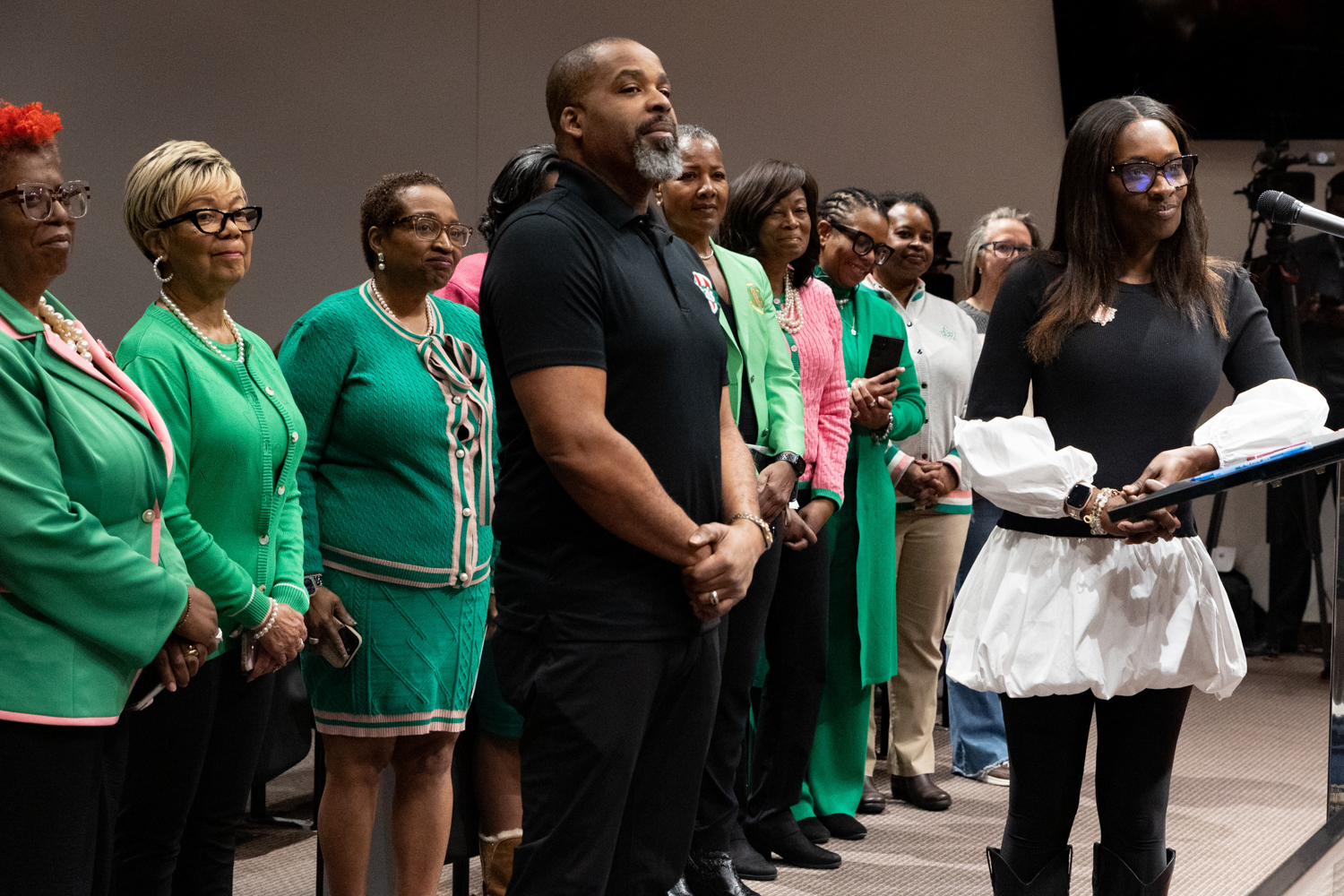
Brittany Jones, Toledo City Council Member At-Large, speaks as Trevor Diane Thomas Black is recognized in Celebration of Women’s History Month during a Toledo City Council meeting at 1 Government Center in downtown Toledo, Ohio on Tuesday March 17, 2026. (TFP photo by Stephen Zenner)Stephanie D. Kynard, owner of Rita’s Italian Ice and Custard, is recognized during Women’s History Month. (TFP photo by Stephen Zenner)
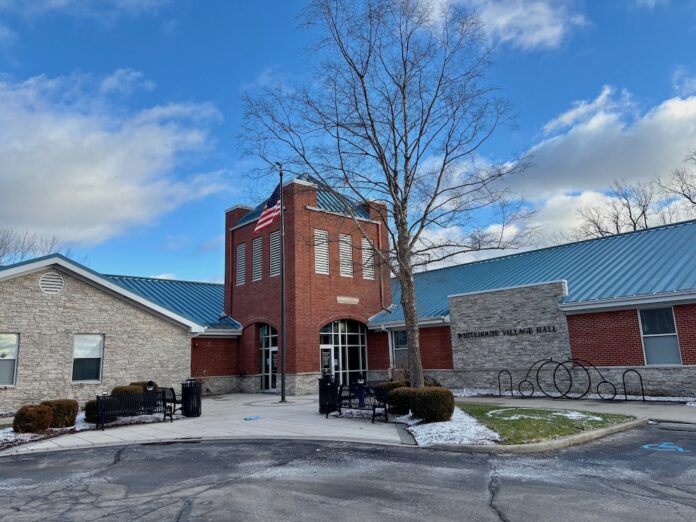
Whitehouse Village Hall. (AWFP photo by Karen Gerhardinger)
WHITEHOUSE – With little discussion, Whitehouse Village Council on March 17 held a first reading on an ordinance to rezone 37.99 acres for Country Meadows South – a proposed single family home subdivision at 11320 Archbold Whitehouse Rd.
Developer Charlie Grass of Artisan Craftbuilt Homes sat quietly, listening as two residents spoke against rezoning the farmland from S1 Suburban to R-2 Residential.
“The density of homes is too much for the traffic in the area, for Oakbrook and any of the other feeder streets,” said Centerville Street resident Jeff Heaney. “I’m mainly opposed to the curb cut on 64. I’m opposed to the variance on the lot sizes. The schools can’t handle the traffic. The village is not prepared for that kind of development.”
While a preliminary plat was presented to the village’s Planning Commission on March 2 to get feedback – showing 37 homes in Plat 1 – the exact layout and number of homes isn’t finalized, as Grass is waiting to find out whether he’ll get the R-2 zoning.
For 18 months, Grass has sought to rezone the property from S-1 Suburban, which has bigger lots. Grass initially asked for the more dense R-3, then R-2 with a Planned Unit Development (PUD) – both of which were denied. On March 3, the village held a public hearing on rezoning to R-2, which matches the zoning of Oak Brook.
“I know Oak Brook is R-2. We can’t change the past, but we can change the future,” Heaney said, encouraging the village to look at overall development and the impact on traffic.
“We’ll have at least 80 more cars. We’ll have problems with traffic. Waterville, Oakbrook, Temperance and West will be a mess,” Waterville Street resident Craig Whitman predicted.
Council Member Carrie Tuohy asked if Temperance Street, a stub street that will be extended into Country Meadows South, would get speed bumps and sidewalks.
“My road is taking the brunt,” she said of the development’s plans to utilize Temperance. Tuohy said children play and ride bikes in the streets because of the lack of sidewalks.
“What are we doing to keep children from getting hurt? I want to make this workable for everybody. I want to make sure we’re not punishing one group,” she said.
Council will hold a second reading on the ordinance during the Tuesday, April 7 meeting, then hold a third and final reading on Tuesday, April 21.
During the meeting, council also:
• Heard that the village is one of 10 communities out of 48 to receive both the Tree City USA designation and the Growth Award this year.
•Heard that the Tree Commission will host an Arbor Day event with Whitehouse Primary School third graders on Wednesday, April 29. A shellbark hickory, catalpa, American elm and swamp white oak will be planted at Whitehouse Park.
•Heard that a spring seminar featuring Paul Bauman speaking about mosquito control will be held on Wednesday, April 22 at 7 p.m. in council chambers.
•Awarded a $47,035 contract with Vodika to repair the maintenance building roof.
•Awarded a $207,303 contract for Bowers Asphalt to repave Cemetery Road between the Wabash Cannonball Trail and Weckerly Road.
•Learned that the Public Works Department staff is researching options and ideas for inclusive playground equipment to be added to Whitehouse Park.
•Agreed to update the conditions for no-bid contracts. If the purchase or project is not a line-item in the budget, it should be reviewed by the Committee of the Whole and then council. If the purchase is in the budget, and the bid is equal, less or within 15 percent of the budget, it can be brought directly to council.
•Discussed ways to meet residents’ requests to provide a village newsletter without printing and distribution, such as a short video posted online.
•Heard that the Saturday, March 21 Easter Egg Hunt will start at 10 a.m. at the Whitehouse American Legion, with staggered 15-minute start times for different age groups.
•Discussed a complaint about the electric outage on Field Avenue in an area where many elderly or disabled residents live. Toledo Edison was urged to give the area priority, said Mayor Rich Bingham.
•Heard that a resident asked whether trash pickup could be delayed on days with high winds, as trash and cans were blowing into the streets and yards. Tuohy thanked ARS drivers for picking up as much as the could. Delaying pickup could prove a hardship for those who fill up their bins each week, added Council Member Joe Bublick. Administration will reach out to ARS to see if a delay would be just one day or a week, and whether other options are available when inclement weather impacts pickup.
•Asked Law Director Kevin Heban to draft an ordinance mandating sidewalks in new neighborhoods, in order to encourage connectivity. Heban said such an ordinance already exists, but Council Member Dave Riggenbach said some neighborhoods do not have them.
•Heard that retiring firefighters Tom Vincent and Rich Snyder will be honored during the Whitehouse Fire Association meeting on Wednesday, April 1.
•Heard Fire Chief Jason Francis say the department is working through new DEA requirements for fire and EMS to lock up narcotics in special vaults.
In other Whitehouse news:
The Crust, a pizzeria at 6792 Providence St., is expanding into an adjacent storefront through a newly-created doorway. (Courtesy photo)
• TheCrust Pizzeria is expanding its operation into the adjacent vacant storefront, opening up a doorway from the existing space at 6792 Providence St. This will allow the addition of 26 seats and more room to operate, according to owner Tony Fronk.
• Plans for a collaboration between the Toledo Lucas County Public Library and the Metroparks for a new library and conservation center at Blue Creek Metropark have changed. Library leadership is now in conversation with Whitehouse administration to find an alternative location to the park, but plans to open a new library in the village within the next two years, according to library spokesperson Stephanie Elton. In the meantime, the nonprofit, independent Whitehouse Library remains open.
Toledo Junior Center Austin Parks (25) battles with Bowling Green center Troy Glover II (16) for a rebound during an I-75 matchup on Thursday March 12, 2026 at Rocket Arena in Cleveland, Ohio. (TFP photo by Logan Migliori)
CLEVELAND – The Mid American Conference tournament is held annually with the top 8 seeded teams in the conference qualifying to compete. This year, the Toledo Rockets finished their regular season with a record of 17-14 (9-8 MAC). This middle-of-the-line record earned them a 4 seed for this year’s tournament at Rocket Arena in Cleveland. They faced the 5-seeded Bowling Green for a third Battle of I-75.
Junior Guard Sonny Wilson (3) drives the ball during Toledo’s matchup versus Bowling Green. (TFP photo by Logan Migliori)
The Rockets faced Bowling Green on Thursday, March 12. Toledo, who was led in points by the freshman guard Leroy Blyden, narrowly escaped this game alive with a final score of 77-76. Bowling Green struggled to hold off Toledo’s guard play, as the backcourt composed of Blyden and Sonny Wilson combined for 35 points, five assists and four steals.
With this high scoring offense doing its job, Toledo rushed off to a 12-point lead, the largest of the night. Basketball is a game of runs, where one team can catch momentum and high energy scoring streaks, but with one play, that momentum can easily shift.
Bowling Green fired back before the half with a run of their own, taking the lead 38-37 at the break. The Toledo Rockets are high-powered with a consistent offense, averaging around 80 points per game.
BGSU and UT shot very similar percentages overall, averaging 50 percent on shots for the night, but what pushed Toledo out in front was also shooting a high 50 percent from three, while BGSU only shot 29 percent.
Despite the three-point shooting disparity, this game came down to three shots in the last few moments: two large free throws made by Wilson, which put the Rockets up one with under 10 seconds to play, and a missed layup from Bowling Green to seal their own fate as they were eliminated from the tournament.
Top Performers from Toledo were:
Blyden (23-6-2), Wilson (12-7-3), and three other players who finished with 10 points: Sean Craig, Austin Parks, and Mynor Strong (stats are in Points – Rebound – Assist order).
University of Toledo head coach Tod Kowalczyk takes questions from the press in a conference after his game against BGSU. (TFP photo by Logan Migliori)
With the rivalry win over BGSU, the Rockets went head-to-head against the Minutemen of Umass, who had just upset the number 1 seed – Miami, Ohio – the day prior. The Rockets came out of the gates strong, playing efficient offense and suffocating defense, going into the break up 43-34. With one half left to go to secure a championship berth, Toledo kept it rolling, but Umass didn’t give up the lead easily.
Toledo Rocket’s Freshman Guard Leroy Blyden (2) takes the ball up the floor during a MAC Tournament game versus the University of Massachusetts on March 13th, 2026. (TFP photo by Logan Migliori)
Even with the Minutemen’s valiant effort, the Rockets held them as UMass shot 41.3 percent from the field and 19 percent from behind the arc. On the other end, Toledo shot 57.4 percent from the field, and 35 percent from the three.
These numbers took Toledo near their average offensive stats, pushing them past UMass for a 10-point victory with a final score of 77-67. Top performers from this game included: Wilson (18-2-4), Strong (17-5), Craig (15-11-2) and Blyden (12-4-7).
Junior Austin Parks (25) shoots a small hook shot versus Akron in the MAC Championship game. (TFP photo by Logan Migliori)
Two wins into the tournament, Toledo was 40 minutes away from their first MAC Championship since 1980. They went up against the No. 2 Akron Zips, who had won the last two MAC Championships.
Toledo came out with energy, physicality, and precision. They ran the floor, grabbed rebounds against a physically larger Akron team, and hit big shots to give themselves a comfortable lead early in the first half.
Toledo took an early double-digit lead, forcing Akron into an uncomfortable spot. Despite best efforts from Akron to stop Toledo’s momentum, the Rockets head into the break up 12 points. Toledo could taste the win.
Early in the second half, Akron started heating up, getting stops, and getting to the basket with ease. The Zips closed the gap and forced Toledo to take a timeout and talk the situation over. Despite many attempts to cool down Akron, the Zips remained on fire. Toledo was still in it to win, but they were feeling the pressure.
While Akron had outscored Toledo by double digits, bringing the game back to one possession, Toledo was still battling, and, with a few seconds remaining, the score was 76-76; the Rockets need one stop.
Akron guard Shammah Scott found his spot: the left wing. With a few quick dribbles, Scott took a step back to 25 feet, threading a three-pointer straight through Toledo’s heart. The Rockets had under five seconds to tie this game back up.
Forward Sean Craig (7) and Guard Leroy Blyden (2) celebrate a three point make in their matchup with Akron. (TFP photo by Logan Migliori)
Blyden took the inbound and dribbled all the way to his own left wing where he lost control of the ball. Toledo’s center Austin Parks – on a prayer – shot the ball only to have it bounce off the back rim and out.
Akron made history with their win, as they are the first team to win three MAC Championships in a row, and Toledo will undoubtedly come back next season looking for their second title since the tournament’s founding.
Top performers of the Championship: Blyden (23-6-5), Parks (13-7-2), and Kyler Vanderjagt (13).
Senior Sean Craig (7) folds with emotions after a last second loss to Akron in the MAC Championship. (TFP photo by Logan Migliori)
WATERVILLE – Communities across the United States are gearing up for America’s Semiquincentennial celebration – better known as a 250th anniversary – with fireworks, displays and activities for all ages.
To keep up with local events, follow the Waterville Ohio 250th Celebrationpage on Facebook, where you’ll find photos of Waterville Primary School’s 250th-themed family night, profiles of area founders by Waterville Historical Society archivists, write-ups on local artists, and listings of upcoming events.
Some of the events planned in and around Waterville include:
•A video featuring community members around town – set to the music of Waterville’s own Oliver Hazard Band performing “Take Me Back.” Take a photo of you or your family and friends hanging out in Waterville – in the parks, library, school, restaurants and businesses, in front of historic or favorite sites, or enjoying a community event. Deadline to submit photos is Saturday, March 28. Email a jpeg photo (minimum 1 MB) to [email protected].
•The Waterville Library will celebrate its 100th anniversary on Saturday, June 6 from 11 a.m. to 3 p.m. at the library. Save the date and look for more information to come soon!
•Kids Dig History, hosted by the Waterville Historical Society and Anthony Wayne Area Arts Commission, will take place on July 14 from 5:30-8:00 p.m. at Conrad Park during the Eats and Beats Food Truck Tuesday event.
•The Waterville Historical Society will host a speakers series at Wakeman Hall, including the story of Ohio in the American Revolutionary War, the Wright Brothers and Waterville’s architectural legacy. Check out watervillehistory.org for details.
•A Forts of Ohio Tour, May 15-18, is hosted by Lou Ritten and takes guests on a three-day, expert-led motor coach tour that brings the post-Revolutionary War period to life.
•The Fallen Timbers Battlefield will host a Twilight on the Battlefield event on Saturday, July 11 from 6 to 9 p.m. with reenactors portraying those involved in the battle of 1794.
•The Waterville Historical Society will host a series of Haunted Waterville tours – horse-drawn wagon rides through town give guests insight into the spirits who still inhabit some of the city’s most historic homes.
•The Roche de Boeuf Festival, set for Saturday, Sept. 19 from 9 a.m. to 4 p.m. includes a 10 a.m. parade with a 250th theme, and plenty of music, exhibits and activities.
The pinnacle of these events is the Saturday, July 4 Independence Day celebration, featuring a bigger and better fireworks display, kids activities, food trucks and music, based at Waterville Primary School and Prairie Trail Park beginning at 5 p.m.
The list of activities is still unfolding, so consult the Facebook page often.
Waterville’s celebration is brought to you by the City of Waterville and organized by representatives from the Anthony Wayne Area Arts Commission, Anthony Wayne Local Schools, Anthony Wayne Rotary Club, Anthony Wayne Free Press, Anthony Wayne Youth Foundation, Fallen Timbers Battlefield Preservation Commission, Lake Erie Waterville Historical Society, Waterville Area Chamber of Commerce, the Toledo, Lake Erie & Western Railway and Museum, Toledo Public Library-Waterville Branch and Unify Marketing and Technology Solutions.
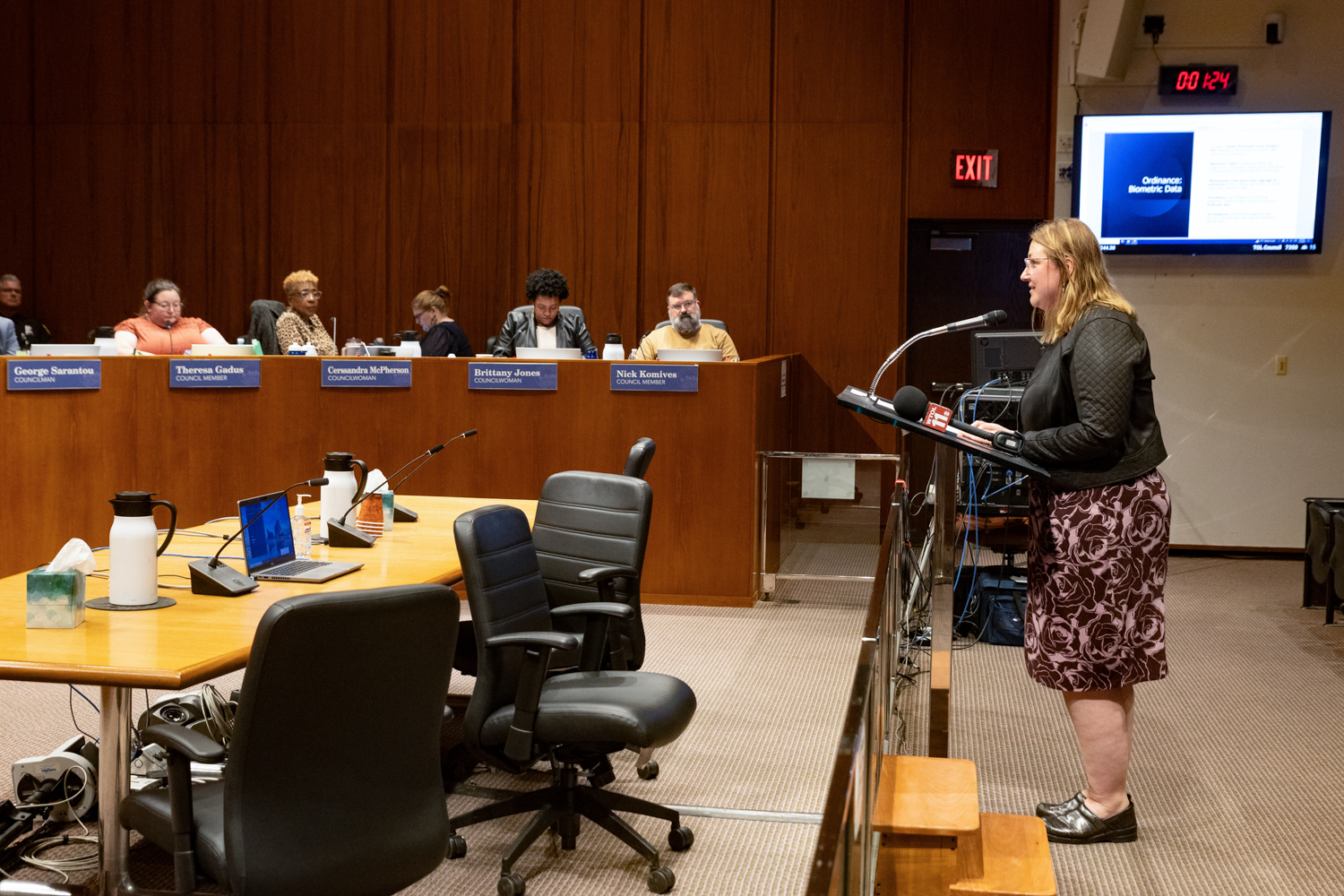
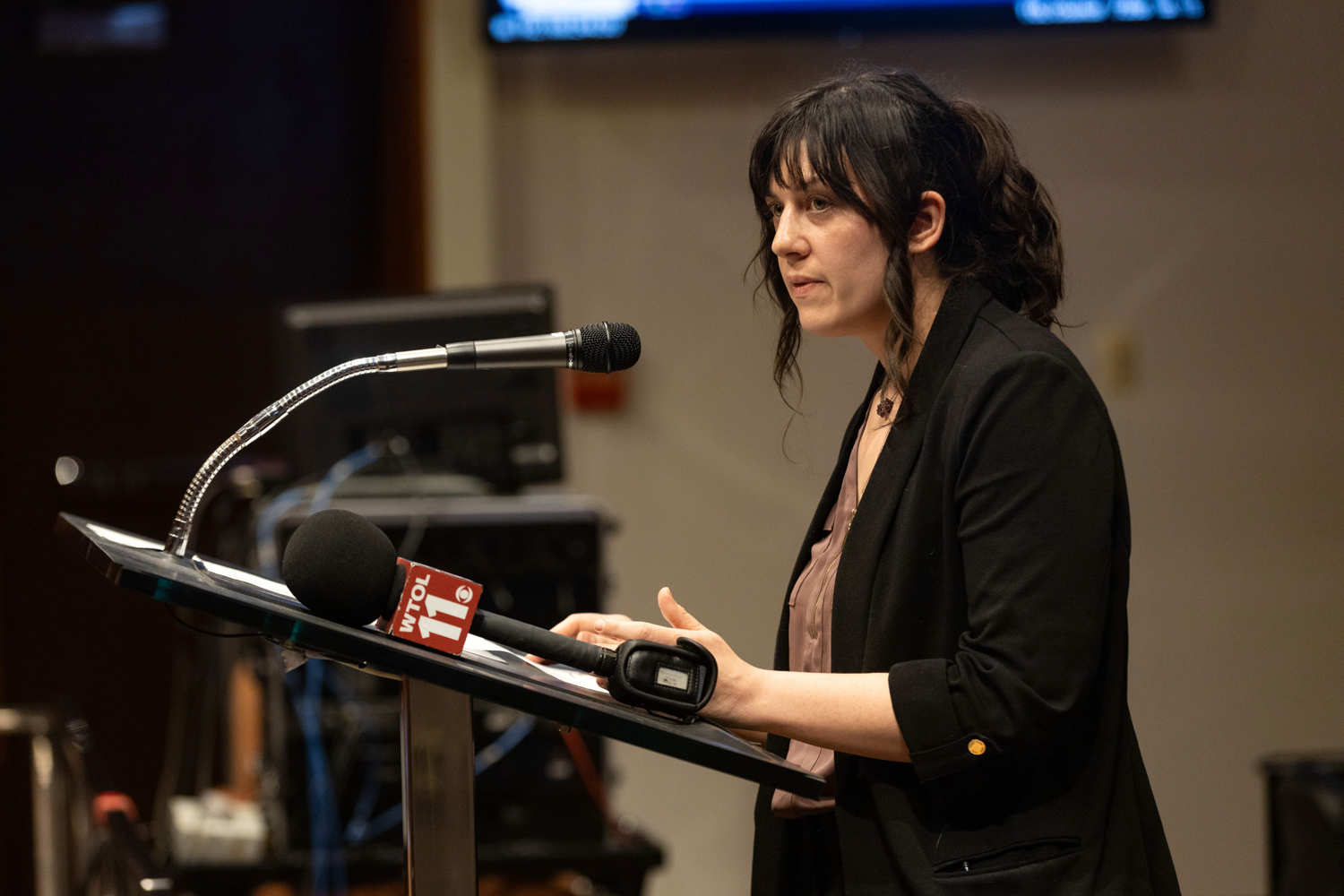
Jessica Molina speaks on behalf of the Farm Labor Organizing Committee during a Committee of the Whole: Federal Immigration Enforcement Legislation hearing with Toledo City Council at 1 Government Center in downtown Toledo on Tuesday, March 10, 2026. (TFP photo by Stephen Zenner)
TOLEDO – A special Committee of the Whole took place Tuesday, March 10, as members of Toledo City Council listened to public comment on a package of resolutions concerning immigration policy for the city.
Briefly, Theresa Gadus, Toledo Council member for District 3, presented the five drafts of legislation from the city, which would clarify the city’s role if Toledo experienced a heightened immigration crackdown.
The package of legislation made up of two resolutions and three ordinances can be found at the bottom of this article.
Why now?
Over a year into President Donald Trump’s second term, Immigration and Customs Enforcement (ICE) has become known for their highly visible raids in Los Angeles, Calif., Chicago, Ill. and most notably, Minneapolis, Minn..
Toledo has not had a strong, visible presence of immigration enforcement, until Jan. 29, 2026, when videos of men armed and dressed in tactical gear in downtown Toledo were shared across social media, pushing the issue of how local law enforcement might interact with ICE.
Jessica Molina sits with Austin Kuhlman, 10, during a Committee of the Whole: Federal Immigration Enforcement Legislation hearing with Toledo City Council. (TFP photo by Stephen Zenner)
Around this same timeframe, there was uncertainty around a heightened number of ICE agents making their way to Springfield, Ohio to make arrests as temporary protected status (TPS) seemed about to expire for the U.S. Haitian community on Feb. 3, 2026.
Springfield was made infamous for unsubstantiated claims that Haitian immigrants in the small suburb of Dayton were “eating” the cats and dogs of American citizens there, an unsubstantiated rumor spread by Trump during his debate with former Vice President Kamala Harris.
Ohio Governor Mike DeWine, the mayor of Springfield, and the Springfield Police all said the claim of Haitian immigrants eating the pets of the people of Springfield was false and a product of the internet.
Regardless, the tension for Springfield was high just preceding Feb. 3, when members of religious institutions gathered in St. John Missionary Baptist Church in Springfield to show solidarity with the Haitian immigrants, ahead of what some thought might be an Ohio surge of ICE activity.
On Feb. 2, a federal judge blocked the expiration of TPS for Haitian immigrants, and tensions subsided as the case moved to the Supreme Court of the United States, which has not decided whether they will see the case.
Toledo’s immigration presented by the Council
First to speak was Council Member Gadus, after reading off the new proposed legislative materials. “Fear is not public safety. Trust is,” she began. “It is the responsibility of local government to ensure that every resident in our community feels safe and protected under the law.
Across the country, we’ve seen and heard reports of ICE enforcement actions that extend beyond reasonable limits. These actions create fear in our schools, hospitals, workplaces, houses of worship and neighborhoods.
Toledo has not experienced a surge like Columbus; we want to proactively work together to establish guidelines for our resources and codify existing policies,” she said.
Council Member At-Large Nick Komives weighed-in.
“I think it’s important to note that what we’re doing is not unique,” he said. “We’re not doing something that’s radical; we’re not doing something that’s unheard of. We’re doing something that literally hundreds of communities across this country either already have done or are working on right now.
“While it’s true that we do not have the ability to tell ICE what they can and cannot do, we do have the ability to talk about how we use our resources, our employees, and our time to work to enforce immigration.”
Glenn Reihing speaks during a Committee of the Whole: Federal Immigration Enforcement Legislation hearing with Toledo City Council. (TFP photo by Stephen Zenner)
From this standpoint Komives referenced ICE’s $85 billion budget, dwarfing all other law enforcement agencies in the country, and proposed Toledo’s Police Department (TPD) should be used to help Toledo instead of assisting ICE, making the point that they had enough resources already.
“Because one thing is very clear,” he said. “And it was clear before any of this even began, the City of Toledo does not have an immigration-related crime problem. We just don’t. We don’t see a lot of crime coming from immigrants in our community. In fact, we see fewer crimes coming from immigrants in our community.”
Council Member Adam Martinez of District 2 made note of the ways he has personally invested in Toledo’s immigrant community, and went on to talk about the benefits of immigrants in Toledo.
“If you look at our council…our council is very diverse, and we come from immigrant communities, and diversity is not a bad word,” he said, and shunned categorizing people because of “legal status.”
“The number one reason why neighborhoods turn around is because of the immigrant population, the second is the non-traditional lifestyles, like the LGBTQ questioning community that help turn around neighborhoods, and then also what I refer to as ‘dinks,’ – double income, no kids – that really help put the cherry on top to make our neighborhoods vibrant and engaging and unique.
“And we should be celebrating that diversity, and we should not be creating impediments to helping individuals get the American dream.”
At-Large Council Member Mac Driscoll briefly stated he had been doing “work behind the scenes” with Toledo’s public safety forces for this package of legislation.
“We work closely with the chief, his deputies and the public safety director to ensure that this ordinance makes sure that TPD can continue to do their job, which I believe to be very important,” he said.
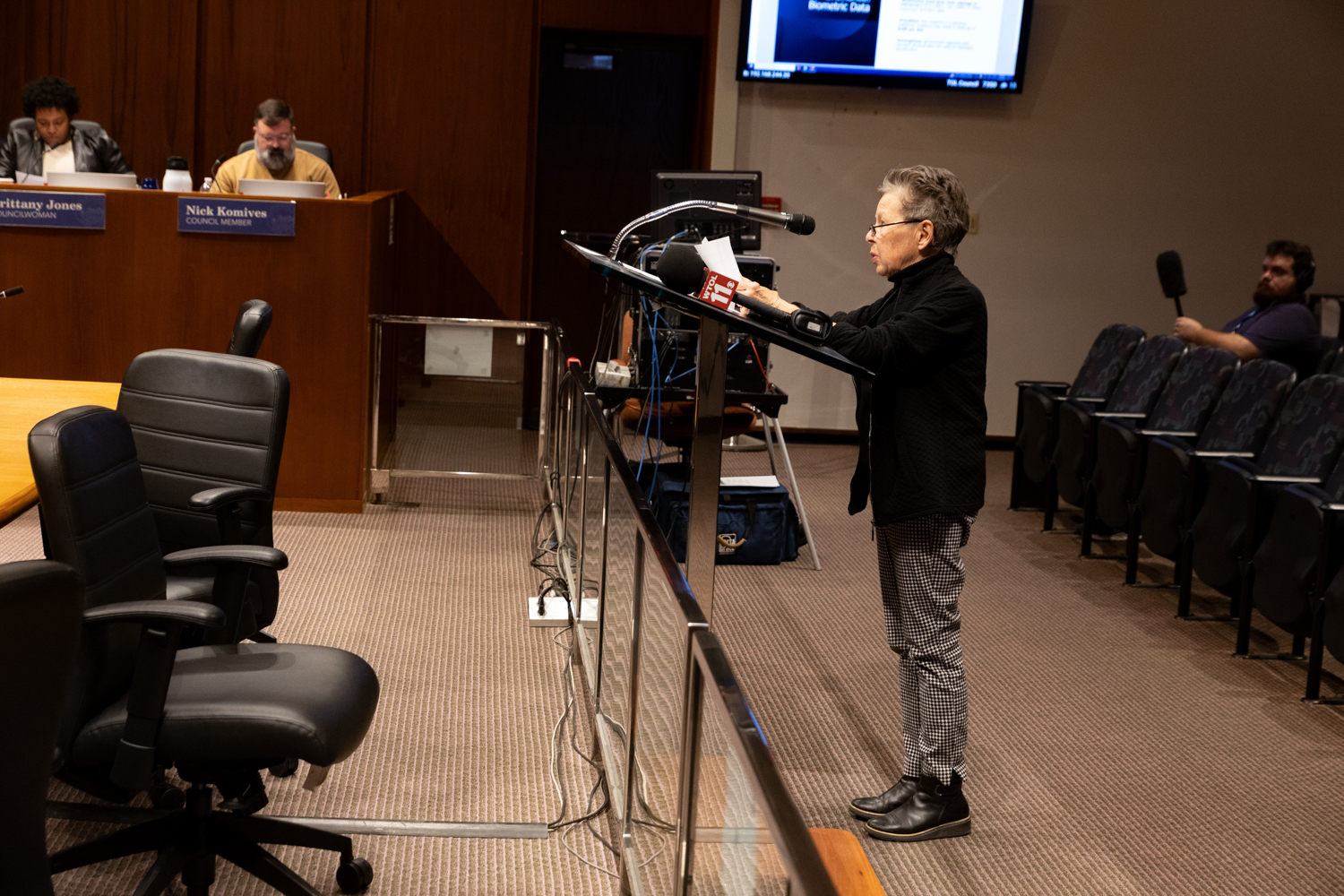
Peggy Daly-Masternak, spoke about her experience working with the Toledo Sister City program, taking in individuals from other countries. (TFP photo by Stephen Zenner)
Erin Kramer and Brittany Jones, both at-large Council members, talked about a reactive and proactive approach to the legislation.
Jones said, “It is not impeding on anything. It is not taking away any rights. It is literally adding protections and reaffirming us as a city that we support those who are coming from different backgrounds and wanting that quality of life, period.”
Members Cerssandra McPherson (At-Large), Sam Melden (District 5) and Theresa Morris (District 6) echoed previous sentiments, supporting immigrants and supporting local law enforcement.
Melden took a page from the Timothy Snyder book On Tyranny, and referenced the first rule in the book: “Do not obey in advance.”
Morris told the story of her grandfather immigrating to the United States, and talked about him working through the Bracero Program, emphasizing the need for comprehensive immigration reform and better immigrant work programs.
Public comment
A young man started the public comment section of the hearing, and introduced himself as Henry Garcia, then as Enrique Garcia.
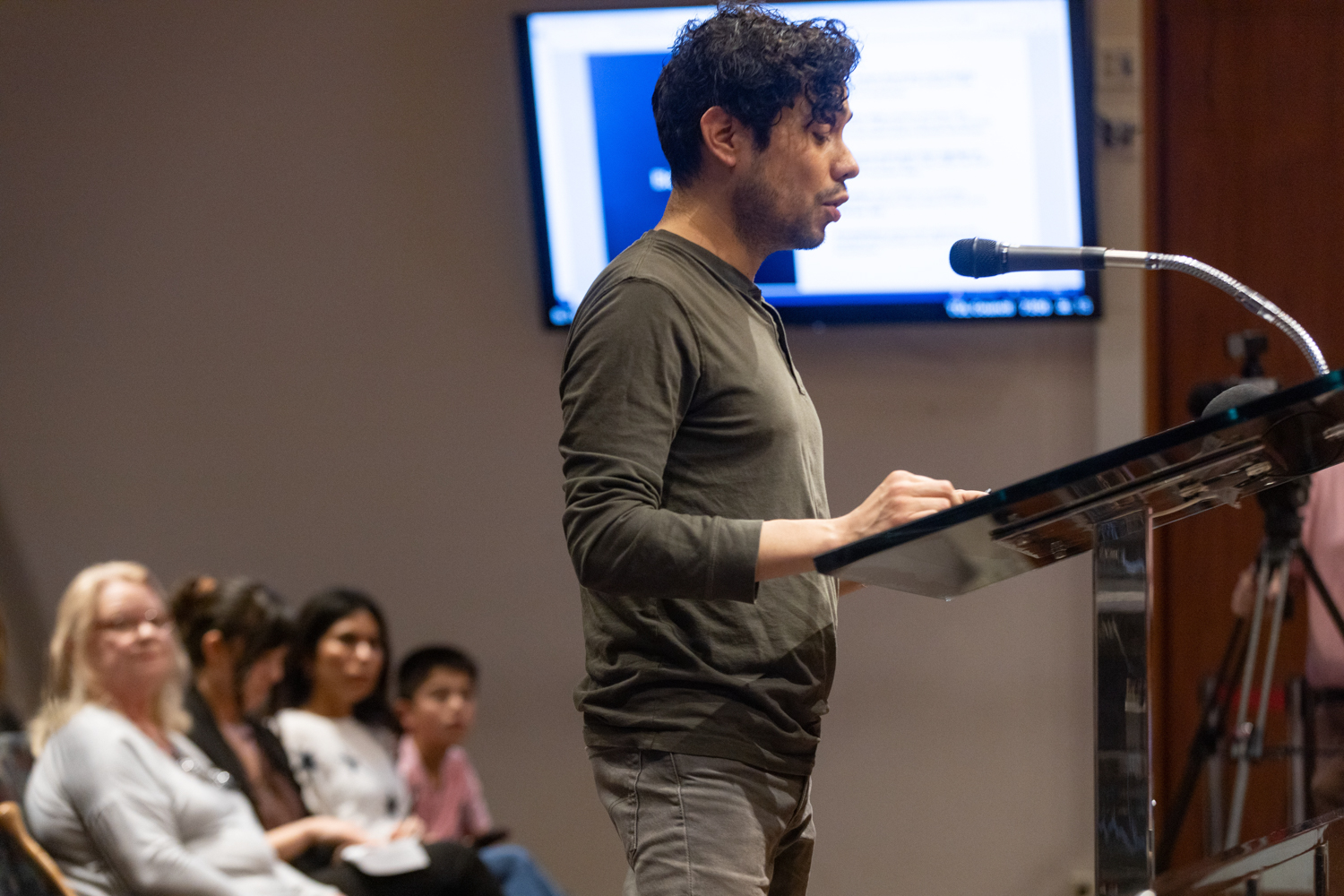
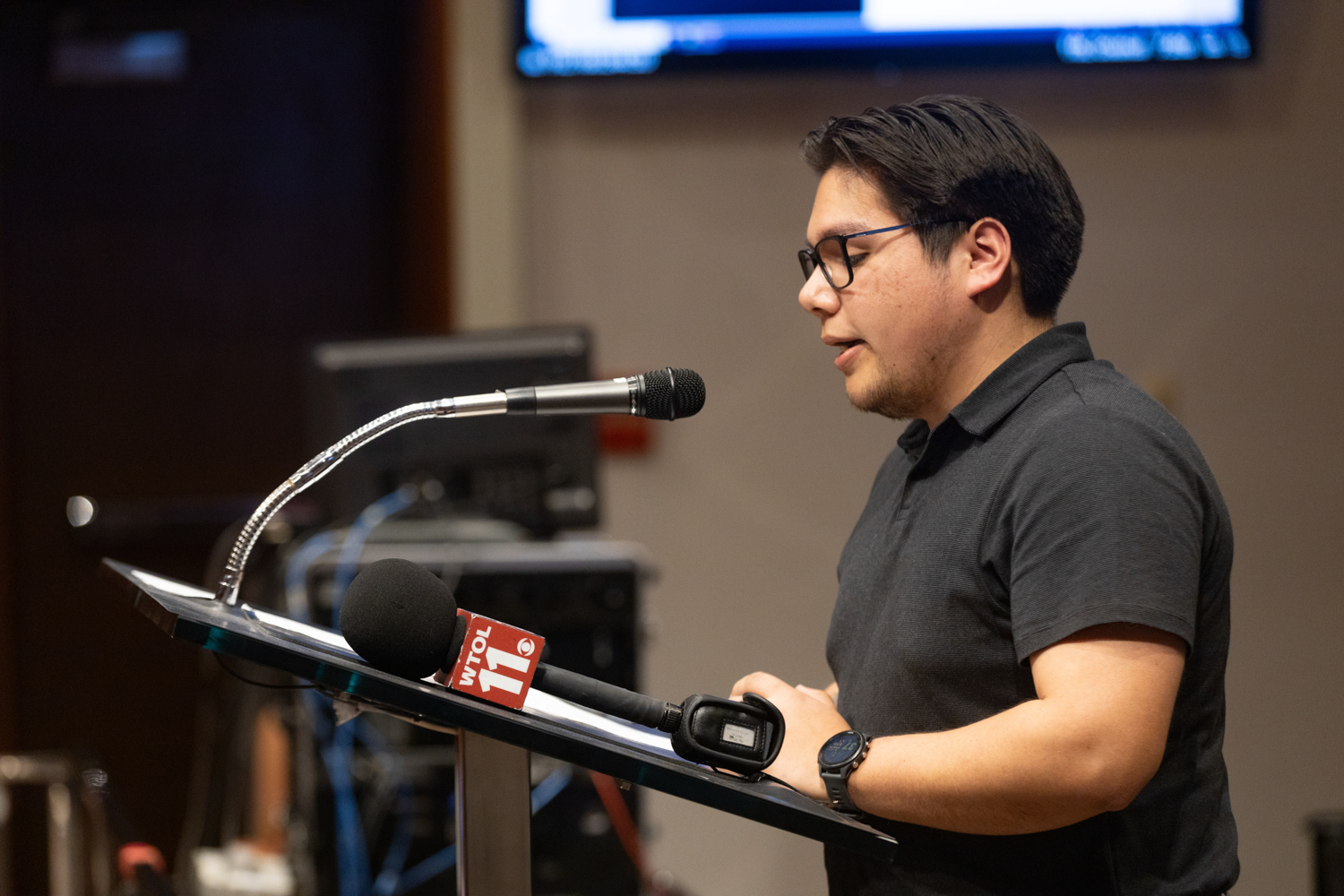
Enrique Garcia gives public comment on behalf of Abriendo Puertas Para Soluciones (APPS). (TFP photo by Stephen Zenner)
“I feel very encouraged after looking at the PowerPoint,” he said, referencing the resolutions and ordinances, and then shared that he was there to represent the organization Abriendo Puertas Para Soluciones (APPS), a local pro-immigrant organization.
Garcia’s main point, as many subsequent speakers would make, was that when immigrants are disenfranchised through fear of deportation or imprisonment, the entire community suffers, not just immigrants.
“We know of people not seeking medical attention when needed, avoiding assistance from local law enforcement, housing violations are underreported, and racial discrimination forcefully tolerated, and sadly, families not leaving their homes to enjoy a lovely day out,” he said.
“No one wants to deal with government overreach. No one wants to be targeted because of their name or the language they speak. We urge Toledo Council to pass the legislations that protect our constitutional rights.”
The next speaker, Nalix Otero, mentioned she was grocery shopping for her neighbors who were too afraid to go out.
Valentin Ornelas speaks during a Committee of the Whole: Federal Immigration Enforcement Legislation hearing with Toledo City Council. (TFP photo by Stephen Zenner)
Valentin Ornelas then introduced himself as a first-generation Mexican-American who grew up with a Laotian-American here in Toledo.
“We weren’t Hispanic or Asian. We were just kids,” Ornelas said. “That mix of cultures – Mexican, Laotian and so many others – is what makes Toledo a great city.”
During Ornelas’s public comment, Council member for District 1, John Hobbs III, joined the committee hearing.
On behalf of the Farm Labor Organizing Committee (FLOC), Jessica Molina spoke next, about the history of immigration raids on FLOC going back to the 1970s.
“They raided an entire tomato field, detaining all of the workers, many of which were American citizens,” she said. “The raids and the detentions have grown to such an indiscriminate amount that it begs for legal guidance that allow for proper procedures.”
Molina said FLOC requested “…constitutional protections and safety for all residents. Public Safety only works when people feel safe calling 911, reporting crimes, seeking medical care and sending their kids to school.” She referenced Border Patrol and ICE agents breaking up families during the raids.
Nalix Otero speaks during a Committee of the Whole: Federal Immigration Enforcement Legislation hearing. (TFP photo by Stephen Zenner)
The following speaker, Rebecca Bundy, spoke as an immigration attorney with Advocates for Basic Legal Equality (ABLE).
“Immigration has long been a convoluted area of law,” she said.
“I have witnessed the federal government rewrite the law against immigrants, revoke status of hundreds of thousands of people with lawful status, change the rules to undercut applications, even terminating proceedings at will, defy court orders and due process. I’ve seen attacks on green card holders, U.S. citizens and immigration attorneys, even judges favorable to immigrants.
“We have been told to concede rights, liberties and principles of humanity in the name of condemning violent criminals, but the government is not focusing on violent criminals,” Bundy continued.
“These are people determined not to be a danger, who have been working, paying taxes…people who support themselves, their neighbors and their communities; they now risk waiting for their case in facilities lacking access to medical care, food, water. They risk dying at rates higher than ever in immigration detention. They risk being detained and deported, whether the law supports it or not.
“We are not living in ordinary times. Immigration Enforcement has trampled discretion, court orders and constitutional rights. If there is ever a time to draw a line and stand up for our communities and our local systems. It’s now we all rely on humanity and reasonability in our laws and our systems before we sacrifice fellow humans we don’t know or fail to stand up for them. We need to consider what we’re really sacrificing.”
Brittany Ford speaks during a Committee of the Whole: Federal Immigration Enforcement Legislation hearing with Toledo City Council on March 10. (TFP photo by Stephen Zenner)
“We have very similar findings to the Cato Institute here in Toledo,” Ford said. “Immigrants in the City of Toledo earned $200.9 million with $30.3 million going to federal taxes, and $19.4 million, and this is just in 2017, going to state and local taxes,” she said.
“Immigrants are 4.6 percent of the workforce and nearly 10 percent of our STEM [Science, Technology Engineering and Mathematics] workers, including our engineers, nurses and doctors.”
Rebecca Bundy, an immigration attorney with Advocates for Basic Legal Equality (ABLE), speaks during a Committee of the Whole: Federal Immigration Enforcement Legislation hearing with Toledo City Council. (TFP photo by Stephen Zenner)
Rebecca Sillery brought a short anecdote about how her niece, who went to Denver, Colo., shared how diverse Toledo was in comparison, as a strength.
The simmered, even approach of Sillery was juxtaposed to the speaker following her, Rachel Davis, who roared, “The Constitution should be a bare minimum, and our government has already given ICE more money than God.”
“They don’t need to take resources from our city resources. We need to keep our resources for Toledo,” she said, in a Toledo First fashion, and then questioned why business owners were not being prosecuted instead of the immigrants they employed.
“Who is hiring all of these undocumented people if they’re so dangerous?” she questioned. “Why aren’t we going after some of these job creators that just somehow sit with their hands clean behind desks and are pulling the strings?”
Marcia Roby speaks during a Committee of the Whole: Federal Immigration Enforcement Legislation hearing with Toledo City Council. (TFP photo by Stephen Zenner)
During the whole hearing, there was only one individual, Marcia Roby, who spoke in favor of immigration enforcement in Toledo.
“We’re all 100 percent for immigration and diversity,” she said. “The issue, though, is illegal immigration. We are all immigrants. My grandparents were from Germany, on all sides,” she said. “I expect and desire all local officials and law enforcement agencies to uphold and enforce the law for the safety of its citizens.
“If ICE comes to Toledo to detain illegal immigrants, and in particular, criminal illegal immigrants – if there are any, maybe there are none – I want local law enforcement agencies to cooperate in the apprehension. Should protesters attempt to obstruct the lawful execution of ICE duties…local law enforcement has the responsibility to provide the necessary help in crowd control and so forth.”
In stark contrast, the gentleman who followed Roby, Glenn Ryan, asked what local officials and government can do when the federal government violates the constitution.
“What is our obligation as a state, and local community organizations, when the federal government breaks its own laws concerning legal due process and search and seizure,” he said.
“I ask you, what are we going to do?”
Susan Kuehn, co-chair of the Northwest Ohio Peace Coalition, talks about removing ambiguity surrounding some of the proposed ordinances and resolutions. (TFP photo by Stephen Zenner)
Northwest Ohio Peace Coalition Co-Chair Susan Kuehn followed Ryan and presented additions and revisions to the City’s compilation of ordinances and resolutions.
“We want a prohibition by law, not just resolution – ICE, Border Patrol, Toledo police – from wearing non-medical face coverings, including gators, balaclavas and other tactical face coverings while conducting civil immigration enforcement operations and otherwise interacting with residents,” she began.
“We want a prohibition by law for Toledo police complying with any and all ICE detainer request, even when accompanied by a judicial order.”
Kuehn also urged council to add an ordinance or resolution to remind TPD of their duty to enforce the law without bias, and that there would be no exception among the police force for breaking the law.
Terry Lodge, an attorney and activist in the area, spoke on the proposed ordinance that stops officials from asking legal status without a warrant. Lodge wanted the language to specify the warrant as judicial instead of administrative. And Lodge wanted to designate public parks as areas safe from immigration enforcement more clearly in the proposed legislation.
“We are in a very poor place when our local government is required to enact legislation and publicly declare that our federal government adhere to their sworn oath to the Constitution of this of the United States,” Harold Moseley said during his comment.
“You have confirmed, in my mind, that this is going to be a well-thought-out plan,” he said. “Both Councilman Driscoll and Jones talked about partnering with the local law enforcement officers, and I cannot overemphasize that they need to be at the table from beginning to end.”
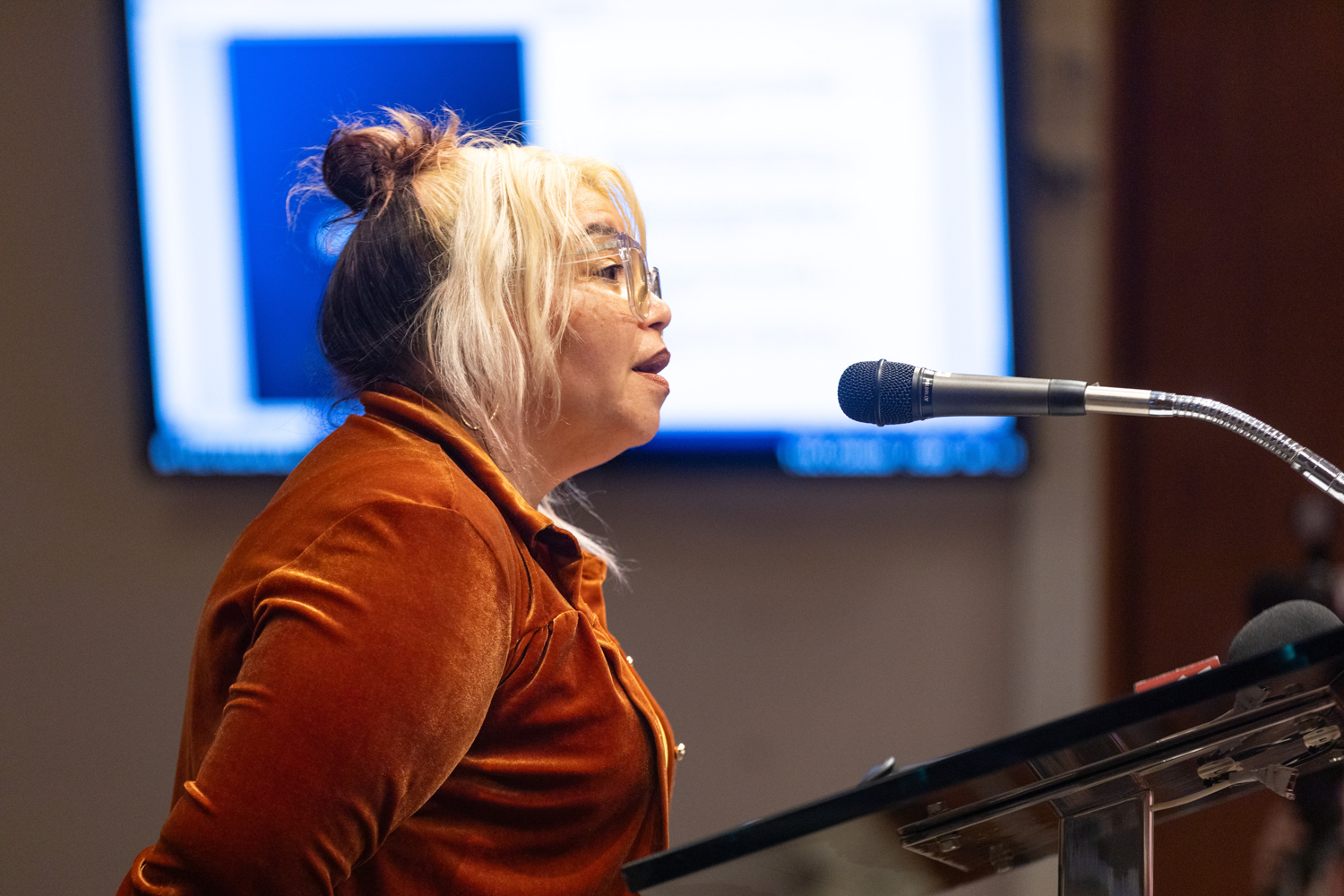
Ziad Hummos, a community organizer, spoke against the corruption of the federal government, via the Epstein files, and said if Jesus was alive today Immigration and Customs Enforcement would chase after him. (TFP photo by Stephen Zenner)
Local Pro-Palestinian organizer Ziad Hummos, spoke briefly on the corruption in the federal government.
“If they’re [ICE is] looking for criminals, just look at the Epstein files,” he said. “They’re looking for pedophiles; they are there [in the Epstein files].
“I mean, when Trump, he opened his mouth, he called the criminals the immigrants, he called them the Muslims, the Christians, the Africans.”
“The criminals…they live in the White House,” he said, clarifying against the narrative of immigrants as criminals. “If Jesus was among us today, he would be chased by ICE.”
Another attorney, Paul Redrup, spoke on the effort to “correct the mistakes of law enforcement’s past.”
“The reality is that immigrants, whether they are here illegally or legally, are less likely to commit crime, but more likely to be victims of crime, and we are seeing now, the data shows, even in the short time that this ICE enforcement action has been in place, that immigrant communities are less likely to report crime, and they’re less likely to show up to court, even if they bothered to report the crime to begin with,” he said.
“That, in and of itself, is making our communities less safe, and I appreciate the effort by this body to do something about that.”
Harold Moseley emphasized the need for coordination with law enforcement throughout the process of putting forth policy dealing with immigration. (TFP photo by Stephen Zenner)
After Redrup, three individuals gave an impromptu comment, without writing their names down.
Peggy Daly-Masternak spoke on her personal, life-changing experience sponsoring individuals through the Toledo Sister Cities Program.
“Our family was greatly enriched,” she said, by sponsoring the individuals from many different countries.
And she asked the council to think of the repercussions of a potential international debacle if ICE chose to detain members of the sister-city program.
Terry Lodge, an attorney and activist, asked for more precise language surrounding some of the proposed ordinances/resolutions during a Committee of the Whole: Federal Immigration Enforcement Legislation hearing with Toledo City Council. (TFP photo by Stephen Zenner)
Proposed legislation as presented at the Committee of the Whole
1. Resolution: Urging Constitutional Conduct During Federal Immigration Enforcement
* Calls on federal immigration agents operating in Toledo to identify themselves clearly and operate transparently.
* Encourages the use of body-worn cameras during interactions with residents.
* Recommends that federal agents avoid face coverings and clearly display agency identification.
* Urges federal agencies to restore full training standards for ICE agents.
* Calls for federal immigration enforcement to respect constitutional rights and operate in a civil and accountable manner.
2. Resolution: Sending Text Amendments Establishing Special Use Permit Requirements for Detention Facilities to the Toledo City Plan Commission for Study & Review
* Directs the Toledo City Plan Commission to review proposed amendments to zoning regulations.
* Defines “detention facilities” within the Toledo Municipal Code.
* Requires special use permits for any new, expanded, or modified detention facility.
Establishes standards requiring facilities to meet:
* Safety requirements
* Health standards
* Building code compliance
* Legal compliance
* Requires detention facilities to demonstrate adequate space for detainees
* Provides oversight of detention facility placement and operations
* Aims to address community health, safety, and operational impacts of detention facilities
3. Ordinance: Creating Protections for Access to Education and Preventing Harassment of Educators
* Establishes new local offenses prohibiting obstruction or intimidation at schools and childcare centers
* Creates protections preventing individuals from blocking or interfering with access to court facilities
* Makes it illegal to harass or threaten educators related to their professional duties
* Prohibits intimidation, harassment, or disorderly conduct within 15 feet of protected locations.
4. Ordinance: Establishing Immigration Status and City Resources Policies
* Ensures city services cannot be denied based on immigration status
* Prohibits city employees from asking about immigration status unless required by law
* Restricts the use of city funds, personnel, or equipment for civil immigration enforcement
* Requires City Council approval before entering any federal immigration enforcement agreements (287(g))
*Prohibits the use of city property as staging areas for federal immigration enforcement operations
* Bars city employees from secondary employment with ICE or Customs and Border Protection unless required for official duties.
5. Ordinance: Biometric Data
* Creates Toledo Municipal Code Chapter 557 regulating disclosure of biometric data collection by businesses
* Biometric data includes identifiers like fingerprints, voiceprints, retina scans, and facial or hand geometry used to identify individuals.
Businesses must post clear signage at entrances if they collect, use, retain, or share customers’ biometric data.
Penalties: first violation is a warning; additional violations may result in fines up to $150 per day.
Exemptions: government agencies and standard photos/video not used for biometric identification.
Megan McClellan, co-owner of Levi & Lilac’s in Maumee, prepares a specialty drink (TFP photo by Gaven Hafner)
MAUMEE – In the heart of Maumee’s uptown district, Levi & Lilac’s has built a reputation as both a whiskey destination and a gathering place steeped in history.
The historic 190-year-old building has been owned by Megan McClellan and her husband, Sean McClellan, for nearly seven years. When the space became available in Uptown Maumee, curiosity turned into commitment for the couple. “Through each step of the process, we were like, ‘Okay, well, let’s just go a little bit further,’ and next thing you know, we had a restaurant,” she said.
Guests are served the “Pub House Pretzel.” (TFP photo by Gaven Hafner)
The building itself acts as a cornerstone for Levi & Lilac’s distinct character. Constructed in 1836, it has served various roles throughout Maumee’s early development, from general store to post office. “It’s said to have housed pre-presidency Abraham Lincoln…[Ulysses S.] Grant,” McClellan said. Local lore also suggests ties to the Underground Railroad and Prohibition-era smuggling.
The building’s layered past ultimately inspired the name. “Often Sean and myself get asked if we are Levi and Lilac, and we are definitely not,” McClellan said.
Levi Beebe built the structure in 1836 but died about a year later and is said to be one of the spirits who still lingers there. Another of the famous ghosts for the location is known as the “Lilac Lady” who is said to leave the scent of lilacs in her wake. “So, we were tossing out names; we figured we may as well include the ghost.” McClellan said.
One of the various ghost-related questions that intrigued guests have asked is whether the staff adds the scent of lilacs to the building or not. “We definitely had guests ask us if we put the smell of lilacs into the building, and we don’t. But people do say that they smell it, which is what the lilac lady is said to do,” said McClellan.
While the history and tales of ghosts draw people in, the whiskey and food are what keeps them coming back. The bar typically stocks between 350 to 380 labels of whiskey.
“When we get a good amount of allocated items in, we can be pushing close to 400,” McClellan said. Besides whiskey, Levi & Lilac’s also has a variety of cocktails that change seasonally each quarter. One of the recent additions to the drink menu that will last till mid-April is their conspiracy-theory-themed drink list based on various well-known conspiracy theories.
While whiskey remains central to the brand’s identity, customers helped shape the food menu.
“It definitely evolved over the years,” she said. “But burgers have always been our thing from the beginning,” McClellan said. Seasonal features rotate quarterly, alongside changing appetizers, salads and cocktails.
Live music also plays a key role in the atmosphere. Performances are scheduled four days a week, featuring primarily local solo acts and duos. Mondays have become a draw thanks to half-off whiskey specials and a standing musical guest.
In a building that has served as a big presence in the community since 1836, blending commerce, community and a few unexplained happenings, Levi & Lilac’s continues to honor its past while pouring toward the future.
Levi & Lilac’s offers a variety of seasonal and non-seasonal food options for guests to enjoy like there “Plain Jane Burger” shown here. (TFP photo by Gaven Hafner)
Harbinger of Spring flowers in Hudson, Mich. (Photo by Metroparks Toledo nature photographer Art Weber)
The name says it all.
Harbinger-of-Spring are modest little wildflowers that are members of the carrot family. What sets them apart is their early spring timing. They’re spring ephemerals, small plants that emerge from a small tuber as a single stem and mature quickly, typically growing no more than nine or ten inches in height. Look for their tiny white-petaled blossoms – each petal is less than a quarter inch in length – in the rich, moist soils of our hardwood forests.
They may be small, but they lead the parade of wildflowers that will soon follow.
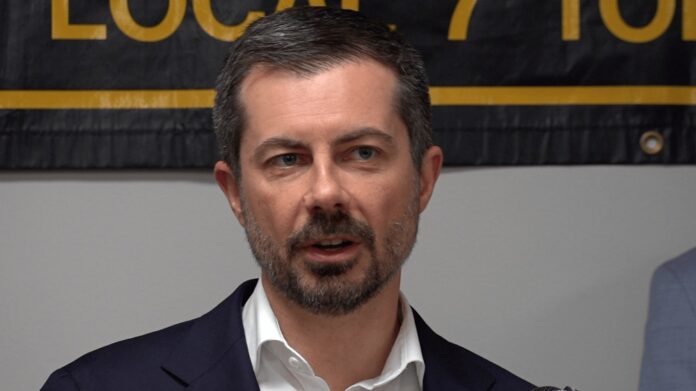
Pete Buttigieg, former U.S. Secretary of Transportation. (TFP photo by Jaden Jefferson)
Toledo officials joined by Biden Transportation Secretary Pete Buttigieg on issue
TOLEDO — It has been over four years since the Infrastructure Investment and Jobs Act was signed into law by former President Joe Biden. Before becoming law, the bill received bipartisan support in the Senate, passing by a vote of 69-30. The one-trillion-dollar package provided funding for roads, bridges, and highways; rail (both passenger and freight); EV charging stations; broadband expansion; and a number of other infrastructure types.
A sizable amount of dollars allocated by the legislation were set aside for projects in northwest Ohio, which is what local dignitaries — joined by Biden Transportation Secretary Pete Buttgieg — celebrated on Thursday, March 12. They spoke during a press conference at the East Toledo headquarters of the Painters & Allied Trades District Council 6 union. While the event was partly a celebration of the legislation, it was also a call for every dollar the region was allocated initially to be spent, as Congress had intended.
According to the office of Congresswoman Marcy Kaptur, the Toledo Democrat who represents Ohio’s 9th Congressional District, $155.7 million was due to be invested in projects across Northwest Ohio. But now, $48.5 million of that is in limbo: a Neighborhood Access and Equity grant of $28.5 million and RAISE grant of $20 million. The former was due to be spent on lighting and pedestrian improvements to Front and Main Streets in East Toledo, while the latter would have been spent on modernizing the Junction and Uptown neighborhoods, through “new water/sewer infrastructure, protected bike lanes, ADA sidewalks, a TARTA mobility hub, 2,300 trees, and LED lighting.”
The $28.5 million grant was eliminated last summer in the One Big Beautiful Bill Act passed by congressional Republicans. The $20 million grant, meanwhile, has been put on hold. Rep. Kaptur, in her remarks at Thursday’s press conference, voiced discontent with the Trump administration — Vice President JD Vance, in particular — who visited Toledo back in late January.
“He [Vice President Vance] stood at our port and talked about everything he’d done. In order to get to the port where he stood, he had to go over all the streets that he just took money away from,” she said.
Before Kaptur spoke, Mayor Wade Kapszukiewicz (D-Toledo) expressed his frustration over the Neighborhood Access and Equity grant’s cancellation, which he said was “the biggest federal grant the city ever got.” Adding, “with a change in political leadership in Washington, they took it away. They snatched it away from Toledo.”
Asked by the Toledo Free Press to discuss his engagement with the Trump administration on potentially restoring those dollars, Kapszukiewicz said that while in Washington back in January, he spoke to “the next rung below” current Transportation Secretary Sean Duffy. Their focus, he said, was the aforementioned RAISE grant for Toledo’s junction neighborhood — which hasn’t been completely cancelled — but put on hold.
“We had a conversation; I think it was relatively productive,” Kapszukiewicz reflected, adding that he, Deputy Mayor Abby Arnold, and Grant Commissioner Simon Nyi will be back in Washington, next week, “as part of a larger coalition from Toledo.” He said they will, once again, meet with Department of Transportation officials, as well as other members of congress from Northwest Ohio and both of Ohio’s U.S. senators.