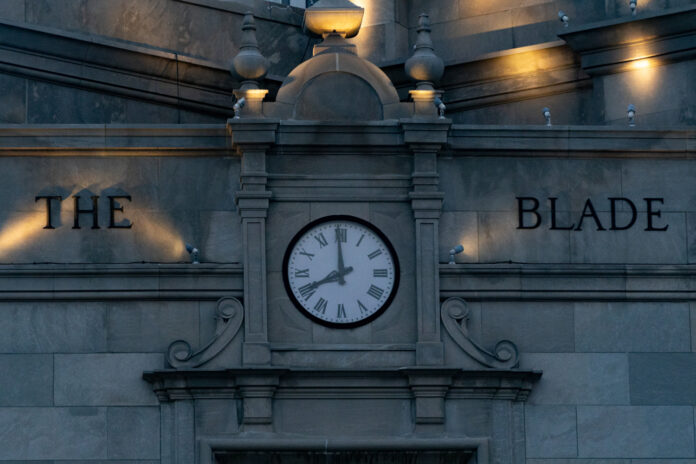
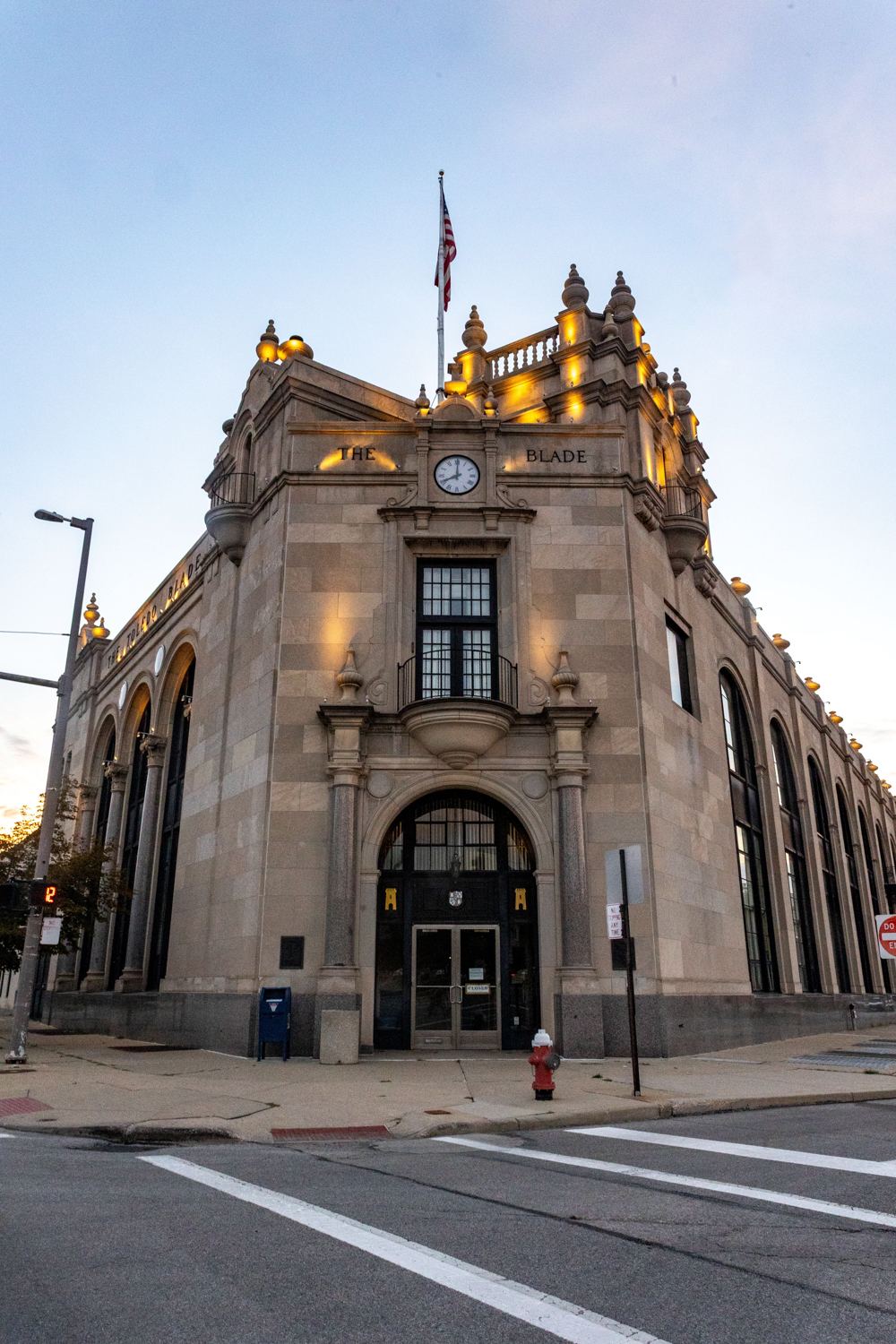
TOLEDO – As many returned to work post-Labor Day, Toledo learned that its longest continuously operational workplace, The Blade, announced – after a round of failed negotiations with its union – that it would either sell its assets or close by the end of 2026.
Corporate decision
“‘Unfortunately, an extremely difficult decision has been made,’ Jodi Miehls, president and chief operating officer of Block Communications [the parent organization of The Blade], said in an email to Blade staff on Tuesday morning,” according to an article by The Blade.
“The Block Family’s continued investment to keep the Blade open is no longer an option…Block Communications Board of Directors and the Block Family are truly disappointed to have reached this point. Unfortunately, the realities facing local journalism have left us in this situation,” she continued.
Miehls was the only voice in the article, which ended ominously with the words, “The Blade has 119 employees.”
Union reaction
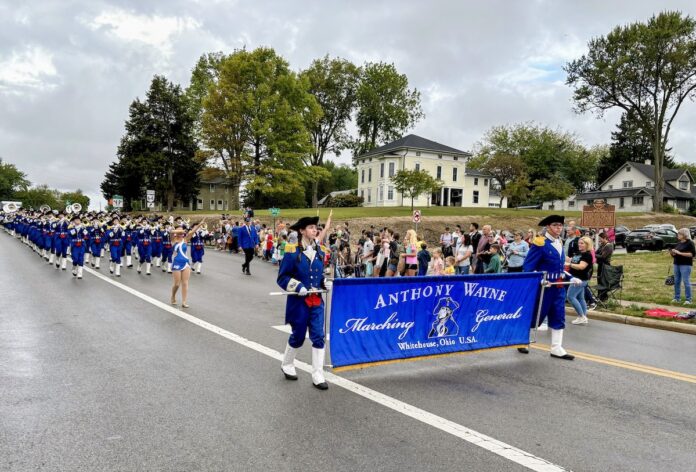
Absent from the decreed article were voices from those 119 employees, some of whom walked in the Labor Day Parade on Monday wearing shirts that read, “The Blade works because we do.”
Before noon on Tuesday, The Blade’s union, Toledo NewsGuild-CWA #34043, prepared a written statement in reaction to the announcement summarizing their side of the dispute:
“Prior to the announcement [sale/closing], the company [Block Communications] had asked union employees to vote for a contract proposal that would have cut their severance in half, in addition to greenlighting giving away their work to Al, among other outsourcing. Workers voted that down, 46-25.”
Lillian King, a features writer for The Blade, the Toledo NewsGuild bargaining chair and former president of the union, said in the statement, “It’s disappointing that Block Communications would rather shutter the paper than work toward an equitable contract. The Company’s proposal would have axed seniority, halved severance for its most experienced employees, and allowed the outsourcing of all Guild work. All content at The Blade could be created or edited with Al, with no protections for journalists or requirements to disclose Al usage to its readers.”
BCI getting out of news
Former and current Blade employees mentioned the announcement was disappointing, but not a surprise.
Block Communications, Inc. (BCI) had already started selling off its television stations in Kentucky, Illinois and Ohio to Gray Media, Inc. in August of 2025 with the help of Jones Day, an international law firm.
Then, earlier this year, BCI announced in January the closing/sale of The Blade’s sister paper, The Pittsburgh Post-Gazette, with a similar timeline of a few months to find a buyer or close.
“The realities facing local journalism have brought us to this sad moment,” Miehls said when the closure/sale of the Post-Gazette was announced, according to reporting by Public Source.
This announcement was made after the National Labor Relations Board (NLRB) ruled in favor of the Post-Gazette’s union, TNG-CWA Local #38061, who had been on strike for three years, the longest newspaper strike in United States history, beginning in October 2022 and ending in November 2025.
Union workers at the Post-Gazette returned to work in late November after the NLRB ruled as follows according to Public Source:
- “PG Publishing [a subsidiary of BCI], which owns the newspaper, bargained in bad faith by demanding that the union allow subcontracting, change work hours and scale back health benefits.
- The company prematurely declared an impasse and sought to impose its contract offer.
- The company unlawfully surveilled strike rallies.
- The NLRB has the authority to order the paper to compensate strikers for economic harms.”
A little more than a month after the NLRB ruling, Block Communications announced the Post-Gazette sale, and in April of 2026, the Venetoulis Institute for Local Journalism, the owner of the Baltimore Banner, announced its intent to buy the Post-Gazette, assuming ownership in May.
No more negotiations
Since 2017, both The Blade and The Post-Gazette’s unions have been unable to successfully negotiate new contracts with Block Communications.
“My surprise was that they, management, chose not to sign a contract that would be much more favorable to workers that would make it easier to sell the paper,” said TK Barger, senior minister at First Unitarian Church of Toledo and the former religion editor for The Blade from 2012-2017, when asked about the announcement to sell/close The Blade.
“I don’t know of any independents or nonprofit news corporations that would take it over at this time with the current mess that I see it seems to have.”
When speaking to the Toledo Free Press, Barger said he enjoyed the freedom he had to write the stories he wanted as the religion editor, but that even over a decade ago, management struggled with the union and with attempts to step into the digital age.
“The last raise was more than 20 years ago, so that’s terrible,” he said. “When I worked there, it [The Blade] was struggling to incorporate newer technology and to, I guess, to hold readership.”
The last across the union raise was in 2002, and the 2007 contract was summarized by the Guild in this way:
“The newly approved contract is concessionary, and includes pay cuts, a commission sales plan for sales staff that had been salaried, an even greater share of the cost of health care, longer work hours at the same pay, a second-tier wage scale for new employees, and two less paid days off per year for the duration of the contract.”
In 2014, The Blade stopped its in-house printing operation at 541 North Superior Street, and in 2019 it stopped printing on Monday and Tuesday. In 2020, the paper stopped printing on Friday and Saturday, and in 2021, it removed the Wednesday edition, only printing on Sundays and Thursdays, as they do now.
2024 brought instability, as an internal family feud led to an injunction regarding a possible sale of The Blade.
And in March 2026, workers said goodbye to the historic building at 541 North Superior Street, as reporters moved to remote work two months after the announcement of the Post-Gazette sale/closing.
“It’s a very sad situation for the Block family and for the newspaper guild, of which I used to be a part of,” said David Murray, a previous managing editor for The Blade, when asked for comment on its sale/closure.
Paper of record
“The story of The Blade is so closely interwoven with the story of Toledo that, as an earlier historian of the newspaper has observed, the two cannot be separated,” wrote John M. Harrison in the opening chapter of his book The Blade of Toledo: The First 150 Years, published in 1985.
“We hope it [The Blade] would always leap from its scabbard whenever the rights of individuals, or the community, shall be infringed,” reads an excerpt from the first editorial published on Dec. 19, 1835, under the oversight of Editor George Way, on page 5 of Harrison’s book.
Slightly older than the City of Toledo, The Blade has been a beloved institution regardless of its hardships entering the 21st century and the criticisms of some of its readership.
Comments were directed at the Facebook post on the official Blade page declaring the sale/closing. “Truly sad for the hard working people who day-in and day-out deliver us the news and a paper of record. Like it or not, the city and community is losing something truly special,” wrote Abner Krill in the comment section.
Toledo’s Blade has been one of the last holdouts from broad corporate ownership of news media in Ohio, and the historical record of Toledo may potentially receive new stewardship if sold.
“You hate to lose the history because history is so much of your legacy,” said Juanita Greene, the secretary and treasurer of the Toledo Community Coalition.
“I’m sorry to hear that they’re going to be closing. It’s a great institution…I know that they have helped in various organizational avenues within Toledo,” she said of The Blade and the Blocks and highlighted various community efforts made by both.
Just in Ohio, the Cincinnati Enquirer was sold to USA Today Co., Inc., or Gannett Co. as it used to be called, in 1979, then the Akron Beacon Journal was acquired by USA Today in 2018 and Columbus Dispatch was sold to USA Today in 2019. Just north, USA Today acquired the Detroit Free Press in 2018, and they bought the Detroit News in January 2026.
“There’s not local ownership of or really local control of broadcast media these days either,” Barger said. “We had the privilege of being a family-owned newspaper instead of a chain newspaper, and if a chain comes, we’ll see how that might help us to progress.
“Toledo is the fourth largest city in Ohio. Not to have a print publication, I think, would be a hindrance for Toledo’s growth, for Toledo’s ability to continue things.”
In their journal article “No News is Bad News: The Internet, Corruption, and the Decline of the Fourth Estate” Ted Matherly and Brad Greenwood studied the closure of 65 daily newspapers and wrote a brief summary in the Columbia Journalism Review: “All else being equal, the closure of a newspaper yielded a 6.9 percent increase in corruption charges, a 6.8 percent increase in the number of indicted defendants, and a 7.4 percent increase in cases filed.”
Those who remain hopeful for a buyer of the paper have stated that the Blocks’ era of ownership is ending, but that The Blade will live on.
“Mr. Block — grandfather of John Robinson Block, The Blade’s publisher and editor-in-chief, and his brother, Allan Block, CEO of the newspaper’s parent company Block Communications Inc. — was introduced to the newspaper staff on Aug. 30, 1926,” read the article by The Blade.
The end of 2026 will see the end of 100 years of ownership by the Block family, and time will tell if it is the end of The Blade.