Home Blog Page 29

Sister cities work to improve water quality

0
Raúl Urquiaga Cela, left, and Beatriz Larraz Iribas, both researchers at Tajo UCLM-SOLISS, discuss research plans on the edge of the historic downtown Toledo, Spain. (Toledo Free Press photo by Jake Zajkowski)

Two cities, continents apart, are both challenged with water quality — and how to govern it alongside farmers. In Toledo, Ohio, Lake Erie faces warmer temperatures, nutrient runoff from tributaries and harmful algal blooms. In its sister city, Toledo, Spain, the Tagus River suffers from downstream pollution from Madrid, low water flows and an uninhabitable river for citizens.

The relationship was formed in 1931 through Sister Cities International, the first partnership of its kind. Over the years, the cities have shared architectural influences, art exchanges and regional economies that are both driven by agribusiness. But a crisis in one city has accelerated research and solutions in many others. 

A tribute of the sister city relationship hangs in the middle of downtown Toledo, Spain. (Toledo Free Press photo by Jake Zajkowski)

Northwest Ohio’s 2014 water crisis jumpstarted measurable change in Lake Erie’s health. Harmful algal blooms threaten drinking water supply, caused by urban and agricultural runoff of phosphorus, in addition to poorly regulated industrial polluters.

Beatriz Larraz Iribas is a research faculty member at the University of Castilla-La Mancha in Toledo, Spain and directs the Tagus River researcher group called Tajo UCLM-SOLISS. Compared to Lake Erie, their approach to protecting waterways is proactive.

“I don’t need fire in the river. I don’t need more dead fish to begin to solve the problem. It’s enough,” she said.

In Spain, a lack of water flow in the Tagus River is caused by diverting nearly half of its supply to an agricultural region in the south. Then, waste water dumping caused a bathing ban in the early 1970s and ecological wipeouts. Citizens lost access to their river.

Requiring water to irrigate and fertilizer to grow, farmers found a seat at the negotiation table offering economic counterbalances in a rush for environmental solutions. But both cities stand, still knowing long-term solutions to struggling water systems and ecosystem health have not been found.

Safe drinking water at the cost of the environment

The majority of drinking water in central Spain comes from the Sierra de Guadarrama Mountains, deposited into reservoirs called Entrepeñas and Buendía. Safe and accessible, the water supply supports the seven million residents of Madrid, who are closest to the reservoirs and cities like Toledo directly south.

But the management of wastewater reflects the same downstream consequences seen around the world. Madrid’s six wastewater treatment plants lack modern infrastructure, resulting in the discharge of polluted water into the Jarama River, a major tributary of the Tagus. Flowing north to south, the Jarama meets the Tagus, which runs east to west through Toledo before emptying into the Atlantic along Portugal’s coast.

Consistent cases of dead fish and year-round foam are attributed to ammonium levels 50 times higher than the permitted limit. Nitrates exceed their maximum permitted level 56 percent of the time, and phosphate concentrations reach 25 times higher than allowed, the research team said.
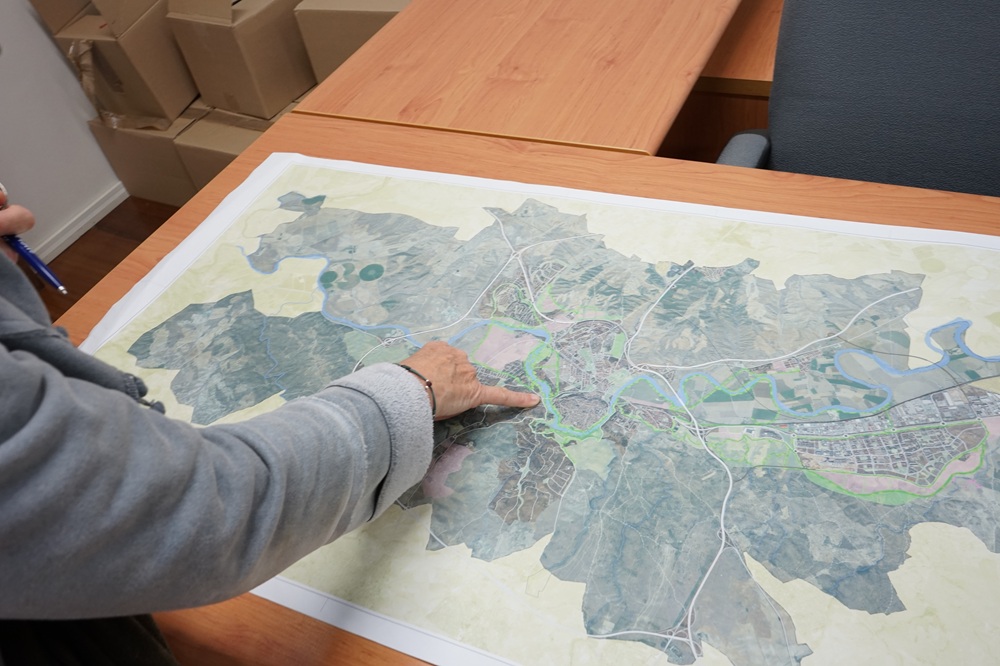

Left: Beatriz Larraz Iribas points to sites on the Tagus River where ecological transition is being tracked. Right: Foam develops on the shore of the river in Toledo, Spain. (TFP photo by Jake Zajkowski)

Although Canal Isabel II, Madrid’s public water company, has national mandates not to pollute, Larraz says, “They prefer not to invest in treatment plants and continue like that [pay endless penalties], and the governments permit it.” The Tagus River Basin Authority is in charge of such accountability.

Citizens were the first to notice the water dwindling, becoming more polluted. Warning signs were posted along the river that limited its use.

“It wasn’t activists, but it was people from the village,” Larraz said.

Safont Beach, an access point below the city of Toledo, Spain where Toledo Free Press interviewed the researchers, was once a regular bathing area. As water flow declined from Madrid to Toledo, authorities announced in 1972 that bathing in the river was prohibited due to health concerns. It wasn’t until 2009 that the Plataforma de Talavera de la Reina en Defensa del Tajo was formed, a civic group advocating against degradation and for increased river flow.

Later in 2012, researchers and watchdogs organized a research team led by Larraz to study the history, law, biology and chemistry of the Tagus River. Formed to create solutions and accountability for the deteriorating water system, the research team has grown to 40 members, following a 2021 partnership with the Soliss Foundation — a regional insurance company. 

Their work now studies emergent pollutants in the Tagus River. One project Beatriz explained involves “comparing with the rest of the rivers in the world that have recovered the water quality.” 

While researchers from the two Toledos haven’t worked together before, they are familiar with U.S. water issues, citing river fires in Cleveland — one of the origins of the Clean Water Act — in addition to algal blooms in Toledo, Ohio.
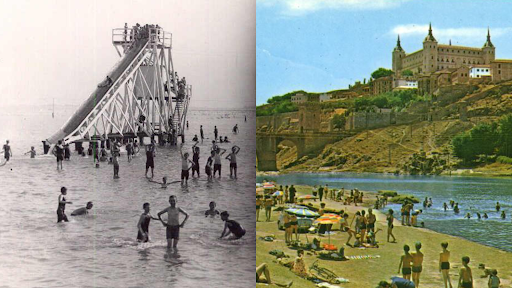
Left: Families swim at Toledo Beach in Temperance, Michigan 1923. (Toledo Lucas County Public Library) Right: Under Alcántara Bridge, locals bath in the Tagus River in 1965. (Photo by Luis Arribas).

For both cities, an early indicator of safe waterways was swimmability. What they share, like rivers across the world, are historical scenes of recreation rarely seen today. Regular swimming without concern occurred on the Maumee River and at the mouth of Lake Erie until about 1985, when the International Joint Commission designated it an Area of Concern due to contamination.

Agriculture and clean water trade-offs

The underlying cause of poor water quality in the Tagus River is the lack of flow. Hydroelectric dams slow the river’s natural east-to-west movement, and tributaries are diverted through a project more than a century in the making: the Tagus–Segura Water Transfer.

Producing one-quarter of Europe’s produce, southern Spain hosts one of the most concentrated, yet efficient, farming systems in the world. The region of Murcia supports outdoor, irrigated horticultural crops. In Almería, just east, low-tunnel greenhouses produce vegetables across 20 miles of plastic-covered land.

The Spanish state planned this water transfer in 1933, recognizing the region’s Mediterranean temperatures and sunlight perfect for produce growing. Construction finished in 1979, and the system — capable of transferring 158.5 billion gallons of water per year — became operational in 1991.

“This type of agriculture drinks whatever they want — no limits. They, without this water, couldn’t survive,” said Larraz. Water from the Entrepeñas and Buendía reservoirs is split, with nearly half sent to Murcia and Almería, and the rest flowing into tributaries and the Tagus River.

Exploitation rules limit how much water can be transferred. “In the national water plan it is said that the Tagus River has the priority to use the water before the water is transferred. But that law is not being followed. The farmers have a lot of power, because they are the ones that export to Europe,” she said. 

Tomatoes grow in Southern Spain, amongst top crops like broccoli, lettuce, citrus and stone fruits. (TFP Photo by Jake Zajkowski)

Beatriz’s team consistently reexamines solutions outlined in international policy papers but says economic trade-offs continually obstruct problem-solving. Europe is generally self-sufficient in produce, dairy and wheat. Prioritizing a reliable food supply for Europe has overshadowed environmental policy and equity for cities like Toledo, Spain. 

Parallel to U.S. policy, the Clean Water Act regulates point-source pollution, but nonpoint-source exemptions mean nutrient runoff, manure and pesticide applications fall outside federal authority — leaving local governments to develop solutions.

Regulating the watershed 

What one city avoids, the other confronts. In northwest Ohio, state-led governance has helped curb runoff into the Maumee River and Lake Erie since Toledo’s 2014 drinking water crisis.

Under protocols set by the International Joint Commission between Ohio, Michigan and Canada, phosphorus reduction targets were established, though they are not always met.

Jordan Hoewischer, director of water quality and research for the Ohio Farm Bureau, said in a statement, “OFBF, along with the rest of the agricultural community, has gone above and beyond to help solve the water quality challenges of our state and has committed millions of dollars to water quality and nutrient management research, as well as providing strong support of Governor DeWine’s H2Ohio program, and those efforts at the farm level are making a difference downstream.”

Over the past 30 years, farmers have reduced fertilizer use by 33 percent, and 65 percent of Ohio counties have recorded phosphorus declines through soil testing, according to OFBF. Acknowledging agriculture’s role in runoff alongside climate factors such as rainfall and warming lake temperatures, Ohio launched H2Ohio, investing $270 million in wetlands and conservation practices.

H2Ohio has 2.5 million acres enrolled across Ohio, supporting conservation agriculture in grain crops. (TFP Photo by Jake Zajkowski)

Participation in land management reforms remains voluntary in both Ohio and the European Union — an approach often criticized for uneven results. After seven years of H2Ohio subsidies, lawmakers continue to debate whether improvements in Lake Erie can be directly attributed to wetlands or on-farm practices. While environmental obligations persist, the urgency that followed the 2014 crisis has faded, and a long-term water bill has stalled repeatedly.

Globally, agriculture exerts outsized political influence — not due to population size, but because of its role in gross domestic product and food security.

In Spain, progress has been slower. Larraz said outreach to policymakers has fallen flat. “We speak with the politicians here in Castilla, Almanza and with the water authority in Spain or in the towers river, but they don’t listen.”

Under the EU Water Framework Directive, rivers must reach good ecological status by 2027. “This directive has a date, a final day to be in good status. And we are not going to obtain that,” said Raúl Urquiaga Cela, a researcher at Tajo Chair UCLM-SOLISS.

Environmental groups have succeeded in securing a minimum flow requirement for the Tagus River — previously the only major Iberian river without one. The decision sparked protests from farmers who argue drought conditions could threaten their livelihoods. AP News reported Lucas Jiménez, president of the Central Irrigation Union, telling a crowd, “Let them leave the water in the hands of those who understand water.” Spain’s minister of ecological transition warned the 2023 protests not to escalate into a “water war.”

Science alone has not shaped the policies around water, as Toledo, Spain advocates and scientists explain. But the political will, enforcement and governments’ willingness to confront the agricultural and economic forces will define watersheds.


Wild Side: Canada geese in winter

0
Art Weber is the nature photographer for Metroparks Toledo.

Canada geese are amazingly well-adapted for surviving our winters – provided they can find the open waters that they require for protection from predators, for preening to keep plumage clean for maximum insulation, for feeding in the shallows on underwater vegetation, and because, as cold as it might be, open water is warmer than bitter cold air.

Open water is at a premium these days, but it still can be found along the lake and bay at power plant discharges, for example, and in a few places along our waterways. One of those places is in the Maumee River at Side Cut Metropark where moving water, combined with geese movements, keep small areas open even in the deepest of winter. Find an open patch and watch geese working together, constantly moving in circles to keep the surface water from forming ice. 

Anthony Wayne news: Early February updates

0
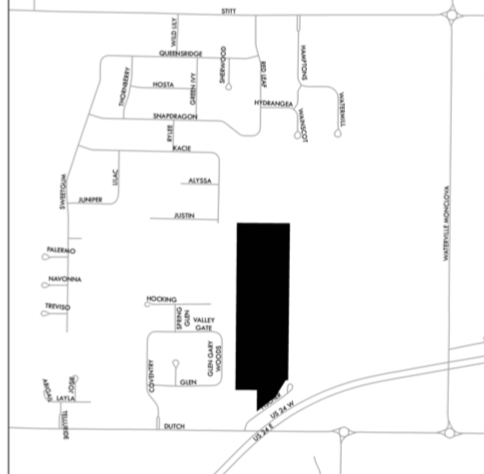
This property at 7010 Finzel Rd. is one of two Waterville Township properties whose owners petitioned the village to annex. (AWFP photo by Karen Gerhardinger)

Monclova Township is moving forward with fire department renovations. Whitehouse and Waterville Township leaders discuss petitions for annexation. Providence Township trustees consider opening up to additional public comments. These are a few of the highlights from meetings held in the Anthony Wayne area during the first week of February. Visit anthonywaynefreepress.com for the latest news.

Monclova

The men and women who staff Monclova Township Fire & Rescue will have more locker and sleeping space, as well as an updated kitchen, once renovations to the Albon Road fire station are complete.

During the Feb. 2 meeting, Monclova Township trustees approved a contract with JDI Group to renovate the fire station, including using an existing training room for dorms, installing a mezzanine in the vehicle bay for a workout room and storage, and adding a building behind the station for storage and training, said Fire Chief Matt Homik. With the increasing number of women serving as firefighters, EMTs and paramedics, separate dorms and lockers are needed, Homik added. 

The current facility was built in 2001 and linked two older, existing buildings together, Homik said, pointing out the slope in a hall that was a compromise to deal with a change in elevation. 

A separate contractor will be hired to do the work once JDI comes up with the plans, which will include how to maintain safety operations during construction, Homik said.

During the meeting, the trustees also:

-Listened to Fiscal Officer Gavin Pike explain the year-end financials and the basics of government accounting. All of the financials are available on the state auditor’s Ohio Open Checkbook site here.

-Passed a resolution opposing the execution of nondisclosure agreements (NDAs) with data center developers. Law Director Dawn Sanderson said trustees have not signed any NDAs during her long tenure, but the resolution is an effort to assuage the public’s concern about them. 

“Trustees cannot use an NDA to avoid or circumvent Ohio Sunshine Laws,” Sanderson said, noting that some matters – such as personnel or health – are exceptions to those laws. 

The trustees said they have not been asked to sign any NDAs, nor have they received any requests from data center developers.

-Asked Zoning Administrator Eric Wagner to begin changing the zoning resolution that outlines the notification process for zoning change requests. The Ohio Revised Code was changed in 2025 to allow townships to utilize their website and social media instead of a local newspaper. The township will also post a sign at the property that is being considered for rezoning. This will not change the process of a zoning change, which requires a total of three public hearings that include the county, the township zoning commission and the trustees.

-Agreed to move forward with a change that would specify permitted uses in the Monclova-Maumee-Toledo Joint Economic Development Zone (MMT-JEDZ) to those that bring in and create jobs.

“The reason for the creation of the JEDZ was to create economic development and jobs. There’s been some entities that have been interested in coming into the JEDZ area that have had a lack of employment creation and income production. We want to eliminate low- or no-impact use and bring in businesses that are going to create the development and jobs that we want. We want language that will detail better direction to our zoning boards,” Sanderson said.

-Agreed to update the personnel handbook to expand disciplinary actions for the misconduct of an employee even when not on the job.

“Because our employees represent the township, we don’t want to bring a bad reputation to the township,” Sanderson said. 

-Reappointed Michelle Hudson Ross to another 5-year term on the Board of Zoning Appeals, ending Feb. 21, 2031.

–Agreed that Swanton Township Trustee Matt Beil should represent both Monclova and Swanton Township on the Toledo Express Airport Joint Economic Development District (TEA-JEDD), filling in the remainder of former Swanton Township Trustee Jeff Michael‘s unexpired term on the JEDD board.

-Heard an update on the Toledo Metropolitan Area Council of Governments (TMACOG) winter general assembly from Trustee Chuck Hoecherl. The entity is now renamed the Lake Erie West Regional Council. The members discussed possible impacts if a statewide initiative to eliminate property taxes passes in November. Hoecherl said that 50 percent of the township’s funds come from property tax, and eliminating those funds would strain the township’s ability to provide services including police, fire and roads, as well as infrastructure projects.

“The state hasn’t figure out a way yet to replace that [property tax income]. If it passes, it will take a year to figure out how to fill a 50 percent hole,” Hoecherl said.

Information from Lake Erie West Regional Council on house bills, including the proposed property tax elimination, data centers, cannabis, cybersecurity and other issues is posted here

-Listened to Waterside residents Risa Sindel, Diane Stroshine and Linda Posodny speak about their concerns about a possible data center and ask for a moratorium to be put in place.

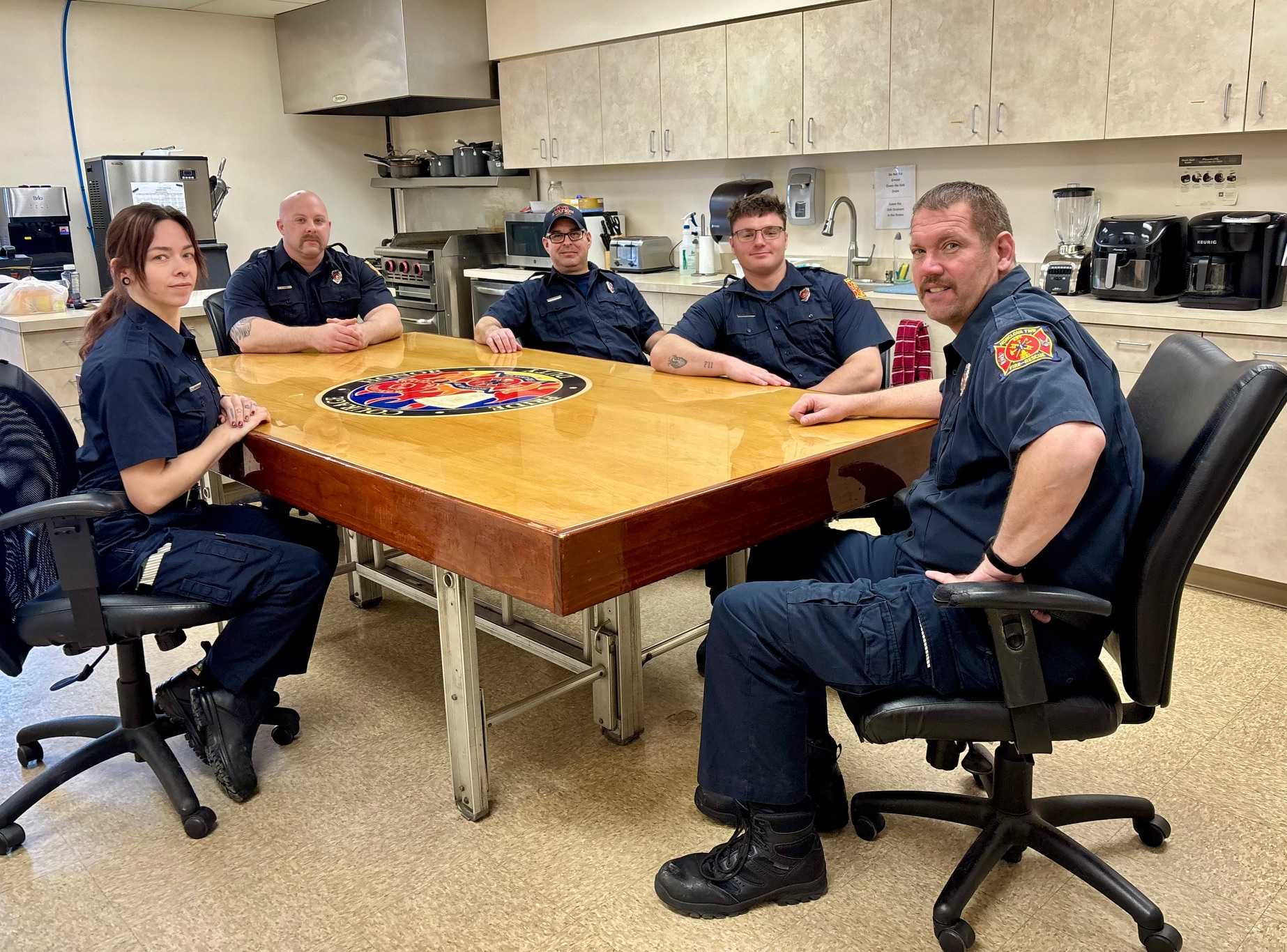
Monclova Township Fire & Rescue personnel (from left) Tracy Robertson, Mike Harris, Josh Stagner, Blake Reed and Bill Schultz sit in the kitchen of the fire station, which will undergo extensive renovations to provide more space for sleeping quarters, locker rooms and an upgraded kitchen. (AWFP photo by Karen Gerhardinger)

Whitehouse

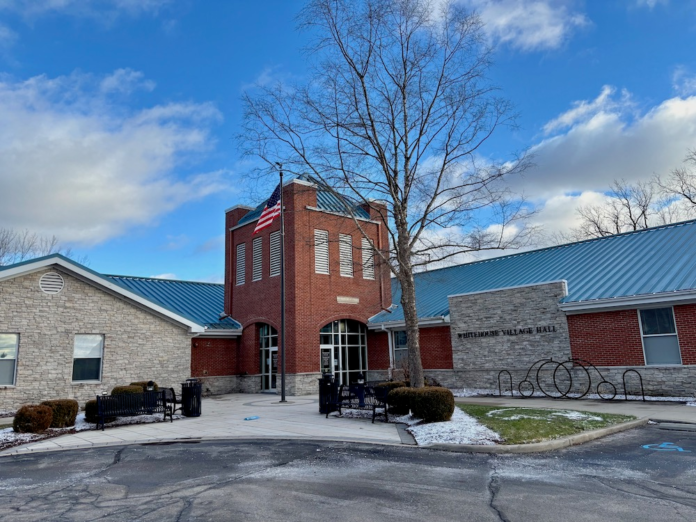
The proposed annexation of two Waterville Township properties into Whitehouse has township residents raising concerns.

In late December, the village received two petitions for annexation. One is for a two-acre parcel at 7010 Finzel Rd., owned by RF Assets LLC, represented by Josh Doyle. Is is empty except for two older outbuildings, since a home was razed in 2018. The other petition is for a home owned by Amanda and Travis Ratcliff on 2.18 acres at the northeast corner of Winslow and Whitehouse Spencer Road.

During the Feb. 3 Whitehouse Village Council meeting, former Township Trustee Brett Warner and newly-elected Trustee Toby Miller noted that if council were to accept the annexation agreements, they would be defying a 2006 annexation agreement between the village and township – as the two parcels are in what was then defined as a “non-annexation area.”

Warner shared how, in the early 2000s – after the village annexed several properties – there were many “angry disputes” between the two municipalities. So he and then-mayor Stan Wielinski sat down and hammered out an agreement with a map showing specific areas where annexation should not occur. The township made many concessions in an effort to make that agreement work, he added.

“It was something we saw of as the future for the two entities. It allowed us to work together on fire (services), and continue to give us working relations,” Warner told Council. “And now it’s come to my attention that there’s a possibility that the agreement is going to be ignored. I would greatly appreciate that the annexation agreement be honored.”

Trustee Miller, pointing to a red-shaded portion on a map from the annexation agreement, said the village has a “duty and obligation to deny the application.” A Columbus law firm agrees that the two properties cannot be annexed, he said, and he accused the village of other areas in the non-annexation area over the past several years.

At least three Finzel Road residents attended the meeting, including Ryann Miller. He’s concerned that an annexation would lead to water and sewer lines being extended, and property owners being required to tap in – even if they’ve invested thousands of dollars into septic systems or wells.

Whitehouse Law Director Kevin Heban, Mayor Rich Bingham and several council members pointed out that the village did not solicit the petitions for annexation – that it was the property owners who applied, most likely because they want to get lower rates on utilities. On the flip side, those property owners would also need to pay a 1.5 percent income tax rate.

“We are not pursuing Waterville Township properties. We received a request from the property owners. By law, we’re required to hear the petition,” said Council Member Dave Riggenbach.

When the village receives a request, it first goes to the Lucas County Commissioners, then back to the village, which had until Feb. 5 to meet a 30-day deadline to send the petitions back to the county. 

According to the Ohio Revised Code, if the petitions meet the statutory requirements, the village “shall” or “must” approve it and send it back to the county, Heban said. 

“In looking at the petitions, they all meet the statutory requirements. If you choose not to approve it and send it back to the county, we are subject to a possible lawsuit and liability because they meet the requirements,” Heban said. “At this juncture, our opinion is that because they meet the statutory agreements you have no option but to approve.”

But, Heban added, that doesn’t mean the annexation has to go through. Even though Council voted 5-1 (with Carrie Tuohy voting no) to approve ordinances on the two annexations, as well as two resolutions stipulating the village would provide services to those properties if the annexation proceeds, Council has one more chance to vote for or against the annexation.

Once the county reviews the petitions again, they will be sent back to the village for final approval. According to Ohio Revised Code, the village at that point “may” approve the annexation, Heban said quoting the code. The word “may” gives the village flexibility to turn them down.

Before the vote was taken, Council agreed to enter into mediation with the township. Miller said he wants to be able to work together without lawyers, as that will cost money.

Mayor Bingham and several council members reiterated their wish to maintain a good relationship with the township.

“We do want to work together. We’re following a process that wasn’t our choice,” said Council President Steve Fine. “We are looking forward to talking to Waterville Township and hope we can continue to work together.”

During the meeting, council also:

• Listened to Bingham’s state of the village address, which is available here.

•Heard that a Coffee With the Mayor and Council will be held on Saturday, March 14 from 8:30 to 10 a.m. at the Buzz Diner, 6670 Providence St. The annual Easter Egg Hunt will be held on Saturday, March 21 at 11 a.m. at the Whitehouse American Legion, 6910 Providence St. 

•Learned that a new Tree Commission member is being sought.

•Authorized Administrator Jordan Daugherty to apply for an Ohio Department of Natural Resources grant to install a multi-use path between the Wabash Cannonball Trail near the cell phone tower to Blue Creek Metropark, in order to keep e-bikes out of Whitehouse Park for safety purposes.

•Authorized Daugherty to seek bids for repaving Cemetery Road between the bike trail and Weckerly.

•Congratulated Nicholas Rupp for achieving his EMT certification.

•Learned that Officer Devin Lafferty will be leaving the police department – and the profession – to go back into the private sector. Chief Allan Baer said he’ll be seeking an officer to fill the full-time position.

(AWFP photo by Karen Gerhardinger)

Providence Township

Providence Township trustees are considering the placement of public comments on their meeting agendas.

During the Feb. 4 meeting, Manore Road resident Billy Goetz asked trustees to open up comments at the end of the meeting, after business has been discussed, rather than at the beginning of the meeting.

“We used to have it at the end of the meeting, and people didn’t like it,” said Trustee Steve Kendall, explaining that some residents wanted to make comments without having to sit through the entire meeting. “So that’s why we moved it up.”

Goetz sought information on the county’s plans to repave Manore Road, including the width and drainage tile. He also wanted to comment on bids being sought for replacing the electrical on the township’s diesel pump.

While the trustees agreed to allow public comment at the end of the Feb. 4 meeting, Kendall said they would need to discuss the option of moving comments to the end of the agenda.

“We’ve always had public comment, even though the state doesn’t require it,” Kendall said. “A lot of entities don’t.”

According to Lucas County Assistant Prosecuting Attorney John Borell, Ohio courts have held that the public has a right to attend public meetings but not participate.

“Comments by the public during a meeting are not legally required,” Borell said.

Jim Fischer, the zoning inspector for both Providence and Waterville townships, noted that Waterville Township only recently re-opened meetings to public comment after dozens of citizens came to ask about data centers. For over four years, public comments were not welcome in Waterville Township.

Trustee Jeremiah Floyd suggested offering two public comment sessions, at the beginning and the end of the meeting, just as offered by the village of Whitehouse.

The trustees agreed to revisit the topic during the Wednesday, Feb. 18 meeting and make a decision at that point.

During the meeting, the trustees also:

-Heard the at the Lucas County building regulations’ chief building official, David Golis, issued a stop work order on work that AE Electric did to wire a fuel pump next to the salt shed. The work was done without a permit. Plans for the work need to include a stamped engineer’s drawing. Trustees asked Road Superintendent Kevin Keifer to seek quotes from three contractors – ones that would provide a stamped engineer’s drawing. He brought quotes from Lake Erie Electric and GLIC Electrical during the last meeting, but didn’t ask for an engineer’s stamp to be included in the work listed in the quotes.

-Listened to Fischer say that he received a call from the Lucas County Health Department regarding the condition of a Meredith Street home in Neapolis. The property is in the non-zoned area of the township, and Fischer is limited in what he can do. A few years ago, the township filed an official complaint with the department, which declared the home unlivable. “It’s been in their court for a couple years. We were waiting for them to take care of it,” Kendall said.

-Heard that the Ohio Department of Transportation has certified that the township has 44.21 miles of roads.

-Discussed the impact on the township in the event that voters approve eliminating property taxes. While the township has a fire levy to cover fire and EMS expenses, property taxes help fund road improvements and other expenses.

-Agreed to postpone voting on a proposal to increase firefighter pay, citing concerns about big expenses on this year’s fire department budget and possible cuts in property tax funding.

-Spoke about the repaving of Manore Road. Because funds from the county are being used, the township needs to accept the county’s plans, which do not include widening the road. Goetz commented that, by not widening the road, the berm will deteriorate quickly as drivers get off the road to let other vehicles pass. 

-Agreed to not ask for a hearing for a liquor license request by Robertsims, a new golf simulator facility opening this spring in Neapolis.

Toledo Youth Symphony Orchestra: fostering young talent

0
TSYO Concert Strings orchestra, conducted by Betsy Cranston at the November 2024 concert. (Courtesy photo)

TOLEDO – The Toledo Symphony Youth Orchestra has 205 student musicians this season, and each one of those youths has a story to tell about their musical journey.

St. Ursula Academy junior Anika Brody, who took up the violin at age 5, is modest when asked about her talent as a musician. Make no mistake, however; she is very, very good.

Anika Brody, TSYO violinist and Toledo Ballet dancer en pointe with her violin. (Courtesy photo)

Brody, who is also involved with Toledo Ballet and has a 4.3 high school GPA, has been involved with TSYO for four years.

“I really like violin,” Brody said. “I was in kindergarten and my parents [Christine Angevine and Edward Brody] told me to pick up an instrument. The first one I could think of was the violin. My parents had me stick with it, and it’s been a part of my identity and who I am over the years.”

Sarah Schaefer, Director of Education for Live Arts Toledo, of which TSYO is a member, said all potential TSYO musicians must audition once per school year, in the spring, and are graded by a panel of judges from the Toledo Symphony.

“It’s kind of an honor to audition and be accepted, and we want students to have that experience year after year,” Schaefer said. “I manage these programs and take care of a lot of the logistics under Live Arts Toledo. I’m in communication with the students and the families of TSYO.”

Brody auditioned for TSYO four times and has been accepted all four times.

“The first year I auditioned was pre-Covid, in 2019,” she said. “I was in fifth grade. We had to prepare a piece we were comfortable playing. We had to go into a room and play our piece into a tape recorder, and we got our results weeks later.”

Schaefer has been involved with TSYO since 2023 and said she recognizes what the program means to the young musicians.

“Many different schools are represented, and all of these students get to come together once a week to make music together. A lot of students might not have an orchestra program of this size at their school, so this gives them an opportunity to participate in a full orchestra that includes wind instruments, strings and percussion.”

TSYO Philharmonic brass section at the November 2025 concert. (Courtesy photo)

Some of the more than 30 school districts from northwest Ohio and southeast Michigan that are represented in TSYO this season include: Anthony Wayne, Bowling Green, Bryan, Clay, Eastwood, Emmanuel Christian, Findlay, Lake, Maumee, Maumee Valley Country Day, Monclova Christian, Northwood, Notre Dame Academy, Oak Harbor, Ohio Virtual Academy, Otsego, Ottawa Hills, Perrysburg, St. Joseph Parish School, St. Ursula Academy, Sylvania, Toledo Christian, Toledo Public, and Washington Local.

Schaefer said, “A lot of times the students hear about TSYO from their [school] band or orchestra teachers, or if they are attending a Toledo Symphony concert out in the community. Many students take lessons from Toledo Symphony musicians.”

TSYO performs three times a year. Its first performance this season was in November at the Peristyle Theater at the Toledo Museum of Art. The next performances are March 15 in a side-by-side performance with the Toledo Symphony Orchestra at the Peristyle Theater, and May 11 in a Pops Concert at Bowling Green State University’s Moore Musical Arts Center.

All concerts are free to attend, but tickets must be reserved in advance here.

“We usually sell out,” Schaefer said.

TSYO Symphonic Orchestra woodwind section at the November 2025 concert. (Courtesy photo)

The ages of TSYO musicians this year range from 9-18.

“We’ve had younger students,” Schaefer said. “It’s rare, but it could happen.”

TSYO consists of three different orchestras: the Philharmonic, Symphonic, and Concert Strings. Each orchestra is designed for a different level of student.

Philharmonic consists of brass, woodwinds, percussion, and strings and is the most advanced orchestra. Symphonic is the same as the Philharmonic but at a more intermediate level.

Concert Strings consists of strings only and tends to feature the youngest musicians.

“It’s a special opportunity for young string musicians to play outside of school with players from other schools,” Schaefer said. “This will prepare them to play in the Symphonic and Philharmonic.”

TSYO, founded by Toledo high school student Joseph Henry in 1947, has been in existence for 75 years. It became an official orchestra in 1950, led by Toledo Public Schools teacher and Toledo Symphony violinist Cecile Vashaw, who conducted TSYO until 1965, when she became the director of music for the entire TPS system.

Brody said participating with TSYO “has been a great learning experience for me, especially through being a part of an orchestra.”

“Honestly, I think it’s special because it’s an opportunity for me or any student to get outside orchestra experience in an environment that is supportive and caring,” she said. “It has helped me to grow my skill. I have to do my part to learn my own music in order to come together with a group to make a sound together at a concert. It’s something you can do the rest of your life. There are musicians who will pursue this professionally for the rest of their lives.”

Waterville Scouts earn rare Supernova Award

0
Waterville Pack 101 den leader Jen Scharringhausen (back) joins den members (from left) Calvin Kleman, Ben Vicars, Logan Etherton, Goliath Sprouse and Jordyn Scharringhausen in celebrating their win of the Dr. Charles Townes Supernova Award. (AWFP photo by Karen Gerhardinger)

WATERVILLE – For Cub Scouts, earning a Supernova Award is rare. Having every member of the same den earn the STEM-focused award is …super rare. Yet, on Jan. 31, five Waterville Pack 101 Scouts were presented with the Dr. Charles Townes Supernova Award medal.

Taking a break after participating in the annual Pinewood Derby race, Logan Etherton, Calvin Kleman, Jordyn Scharringhausen, Goliath Sprouse and Ben Vickers posed for photos and shared more about the award – and the research, experiments and fun they had along the way.

“The statistics for earning one Supernova are less than 1 percent,” said den leader Jen Scharringhausen. “The statistics of earning two Supernova awards are unknown, but likely very slim; and having an entire den earn a Supernova is even more rare.”

After Jordyn earned the Dr. Luis W. Alvarez Supernova Award – available for Wolf and Bear Cub Scouts – when she was 8 years old, Jen, who has served as den leader for six years, began looking into opportunities for the entire den. The Dr. Charles Townes Supernova Award is available for Arrow of Light Cub Scouts, or those who are about to cross over from Cub Scouts to Boy Scouts.

To achieve their goal, the Scouts held extra meetings to complete a variety of activities, including earning the engineering adventure badge, building a bridge for Construction City, creating and studying an insect zoo, learning to check oil and tire pressure in a vehicle, earning the first responder adventure badge, building and launching model rockets, learning about Newton’s Third Law, creating a solar oven out of a pizza box, and researching five famous scientists, mathematicians and engineers.

“I liked checking the oil and tire pressure on my grandma’s car,” said Ben.

In the process, Calvin said his dad learned that he was overfilling his tires with air, and Calvin now understands the meaning of PSI – pounds per square inch.

“I liked the bridge competition,” said Goliath, explaining that the bridge they created out of cardboard for Construction City was the strongest – able to withstand 80 pounds of downward force.

The Waterville Pack 101 Arrow of Light den members, including (from left) Jordyn Scharringhausen, Ben Vicars, Calvin Kleman, Goliath Sprouse and Logan Etherton, stand in front of a bridge they made to withstand 80 pounds of downward force during Construction City. (Courtesy photo)

The team also learned that the triangle is the strongest geometric shape. That knowledge has helped as the fifth-graders are tasked with making a bridge out of paper at Fallen Timbers Middle School, Calvin noted.

Jordyn enjoyed the solar pizza experiment, in which they placed marshmallows in a pizza box lined with foil and facing the sun – which promptly was obscured by clouds.

“We used the scientific method to make a theory and test it. The marshmallows didn’t cook really well,” Jen said. 

While some of the projects were as a team, others required working at home, such as the bug zoos that each Scout created.

“I put stink bugs in mine,” Ben said.

“I could only find ants,” Jordyn said, noting that in September there weren’t as many bugs available. 

The Scouts did research on Dr. Townes and five scientists, engineers and mathematicians, then gave a verbal report. Townes was the co-inventor of the maser and laser, and famous for his research in microwave spectroscopy and in microwave and infrared astronomy.

The Scouts shared some other famous inventors, including the “father of algebra,” 9th-century Persian mathematician Muhammad ibn Musa al-Khwarizmi and Archimedes, a Greek mathematician, physicist and engineer. Marie Curie was a physicist and chemist who won the 1911 Nobel Prize in chemistry. Alexander Graham Bell is known for inventing the telephone, but was a scientist and engineer.

While doing the extra work to earn Supernova Awards, the five Scouts participated in regular den and pack meetings and activities, including making Viking chairs – pairing up with adults to use power tools to assemble the portable wooden chairs while learning about safety, following instructions and using a tape measure.

Some of the Scouts’ other favorite activities: Camp Miakonda for summer and winter camps, the Raingutter Regatta, the Pinewood Derby and pushcarts – a one-seated, four-wheeled vehicle pushed by a second and third Scout while another steers.

“Ours was the coolest. We had the music,” Goliath said of the playlist their den leader made for their pushcart races.

In the summer, the Scouts enjoy Camp Miakonda activities like the obstacle course, hikes and gaga ball, as well as earning badges in knot tying, adventure and fire building with flint and steel. Coming up is Winter Weekend, when they’ll stay in cabins at Camp Miakonda and work on badges and team building. Also on the calendar: a fishing derby at the Progressive Fishing Association (PFA) and attending a Birds of Prey program at Nature’s Nursery. They’ll also do community service, including cleaning up after the July 4 celebration in downtown Waterville.

In their final step as Cub Scouts, the five will cross over to become Boy Scout Troop 101 members and have the opportunity to earn even more Supernova Awards –  and enjoy the benefits of Camp Frontier in Pioneer, Ohio, or one of several high adventure camps.

For youth in grades K-5, Pack 101 is always welcoming new members. Visit watervillepack101.com for more information.

Cartoons by Don Lee: Nowhere Near Here, LLC

0
Cartoon by Don Lee

Local attorney shares “18 and the Law”

0
Bruce Boerst Jr., a Whitehouse resident and attorney practicing in criminal defense and personal injury litigation, spoke to Anthony Wayne High School seniors on Jan. 28 about the changes, legally, when they turn 18. (AWFP photo by Karen Gerhardinger)

WHITEHOUSE – As an attorney who handles criminal defense cases, Bruce Boerst Jr. has seen how one bad decision can derail a young person’s life plans.

Whether it’s drunk driving, sexting, drug possession or theft, the outcome – in terms of penalties – is much more severe for an 18-year-old than for those 17 or younger.

“Before 18, any kind of trouble you get into, you get a slap on the wrist. A prank at school or small theft at a carryout, or eating at a restaurant and running out without paying…the consequence is often that your parents show up at court, you write an apology letter and do community service. Your juvenile record is sealed. Future colleges and employers don’t have access to that,” Boerst shared during an “18 and the Law” presentation for Anthony Wayne High School seniors on Jan. 28.

“When you turn 18 and make a poor choice, it’s on your criminal record and it’s there forever. Before you do anything, ask yourself, ‘Is this something I will be explaining to a future employer? To my kids?'”

In his office, Boerst said he sees a lot of alcohol or minor drug charges. For those who are 18, a felony can jam up a future career, and bars opportunities such as federal grants or scholarships, he said. 

“I see young adults truly destroying their futures,” Boerst said. “No one sets out for the night and expects to get a DUI or cause an accident or harm someone else.”

He spoke about representing a young man who was home from college and, after attending a party, drove the wrong way on the highway and hit a vehicle, killing a family of five. 

“He will be in prison for the rest of his life. He was a great kid from a great family – no criminal history and not a big drinker. His life changed in an instant,” Boerst said. “Young adults don’t do well in prison. Those folks in prison, especially those lifers…they prey on you.”

Social media threats are, by far, the most common cases he sees in adults under the age of 25. He also sees the impact of sexting. In one case, a couple that had been dating for a long time ran into trouble when the boy turned 18. The girl’s father found graphic images sent from the male on her phone, and reported him to the police. While he didn’t receive jail time, the young man now has to register as a Tier II sex offender every six months for 25 years. He can’t live in a dorm or within 500 feet of a school, church or playground.

Often teens think they can delete information from their phones and it’s gone, Boerst said. Law enforcement has methods of extracting metadata, even information that scrubbing programs purport to erase. Burning, smashing the hard drive – those might work – but anything shared on social media is accessible forever. Even Snapchat, presented with a subpoena, can produce files that users often think are gone.

While the law becomes more strict, turning 18 also provides some other rights: to vote, sign contracts, serve on a jury, join the military, get married, sue or be sued, apply for a credit card and write a will.

“You still can’t buy or consume alcohol or marijuana,” he said. “And you can’t rent a car.”

While Boerst focused on the legal aspects of becoming 18, he also shared a story of how a local ice hockey player’s decision to bully a classmate stymied his dream of joining the NHL. When an offer was on the table, fans learned of the player’s history of bullying through social media and lobbied the team to turn him down.

“It stayed with him his whole life because of that one action, even though he was young,” said 17-year-old senior Nawres Abdulsamad after the presentation. “If you do something before you’re 18, it wouldn’t show on your record, but that small action still affected his reputation.”

Abdulsamad and senior Alina Stretavski both describe themselves as good students who haven’t been in trouble. 

“But hearing some of the situations…oh. I’m never in trouble, but when I’m 18, I’m going to be more careful,” Stretavski said.

Boerst’s presentation is part of an ongoing Adulting 101 series hosted by the high school over the past five years, said Assistant Principal Stephanie Buckenmeyer. The topics range from finances, branding and maintaining friendships post-high school to developing healthy habits and personal safety.

“Our goal is to provide students with information that will help them become future ready,” she said.

Toledo’s guide to Middle Eastern grocery stores

0
Pexels photo by Tahir Xəlfəquliyev

Toledo foodies looking to recreate their favorite dishes from Middle Eastern restaurants only need to look as far as one of the city’s Middle Eastern markets for authentic ingredients. The following guide should help you get a good start. Did we miss any of your favorites? Leave suggestions in the comments.

Jerusalem Market & Grill is the newest Toledo-based Middle Eastern market in town. (Courtesy photo)

Jerusalem Market & Grill
1465 Secor Rd.
419-318-7126
Monday-Sunday 10 a.m.-10 p.m.
In-store shopping
Accepts SNAP/EBT

Jerusalem Market & Grill, now in its sixth month of business, draws in students from the University of Toledo and combines a grocery store and meat market that offers fresh halal meats, authentic Mediterranean and Indian products, and produce. The Jerusalem Market & Grill specializes in high-quality beef, lamb and chicken along with a curated selection of imported goods like spices, cheeses, olives, breads, and pantry staples. The location features a deli, and will have a kitchen serving hot foods coming soon.

Middle East Market has been open since 2005. (Courtesy photo)

Middle East Market
4623 W. Bancroft
419-531-3999
Tuesday-Saturday 9 a.m.-7 p.m.; Sunday 10 a.m.-7 p.m.; Closed Monday.

Since 2005, the Middle East Market has offered Toledo’s tastiest Lebanese and Middle Eastern cuisine. The location offers halal meats, a deli, fresh-baked goods, fresh produce and an olive bar, to name a few. Originally a small market, this location expanded and contains nearly four times the groceries, fresh seasonal produce, food items and halal meat varieties that were present two decades ago. For those in the know, customers at the market can order freshly baked hot pita bread at the deli from the market’s own restaurant, Sidon, which is located next door. The deli also offers pre-made foods like hommus, baba ghannouj, fattoush, sfiha, and fatayer.

Offerings like fava beans, cracked wheat, various meats, and desserts can be found at Cedar Fresh Market. (Courtesy photo)

Cedar Fresh Market-Muna Market
5464 Monroe St.
419-214-0386
Monday-Saturday 9 a.m.-8 p.m.; Sunday 9 a.m.-7 p.m.
Accepts SNAP/EBT and credit cards

This family-owned market, which has been in business for eight years, offers Mediterranean grocery items, halal meats and a restaurant, bakery and meat market. Guests can also choose from salads and dips, sandwiches, burgers and pizza. Customers can pick up baklava and Turkish delight while ordering chicken shawarma sandwiches.

Authentic Arabic bread at Just Like Home. (Courtesy photo)

Just Like Home Mediterranean Mart
1250 Flaire Dr., Unit A
419-214-0717
Monday-Sunday, 10 a.m.-8 p.m.

Just Like Home Mediterranean Mart is a locally owned market and eatery that brings authentic Mediterranean and Middle Eastern flavors to the community. Known for its home-style cooking, the restaurant serves traditional dishes such as mansaf, maqluba, biryani, and kabsa, all prepared with quality ingredients and halal meats. In addition to its hot, ready-to-eat meals, the store offers a wide selection of fresh Mediterranean groceries. Just Like Home also provides professional catering services for events, celebrations, and community gatherings, making it a trusted destination for both everyday meals and special occasions.

What’s new in Anthony Wayne: Waterville recap from January

0
Waterville City Council listened to Dave Weber, of the Save the Bridge Association, ask for help in saving the Roche de Boeuf Interurban Bridge. (AWFP photo by Karen Gerhardinger)

WATERVILLE – Waterville City Council approved hiring a new law director and discussed the Roche de Boeuf Interurban Bridge. Waterville Township agreed to form a Data Center Advisory Committee, discussed an annexation request and heard about a state law change prompted by the township police. Below is a synopsis of meetings held the fourth week of January in the Anthony Wayne area.

Austin Klapp Named Waterville Law Director

Protecting Waterville and its citizens is top priority for the city’s new law director.

Austin Klapp is the new law director for the city of Waterville. (AWFP photo by Karen Gerhardinger)

“I will do the best job I can to make sure Waterville is following the law…and that I’m protecting the city as much as I can,” said Austin Klapp, who was named law director during the Jan. 26 Waterville City Council meeting. “I intend to utilize all resources as possible in order to ensure the best possible guidance for the city of Waterville.”

Council voted 6-0, with Wayne Wagner abstaining, to appoint Klapp to the position he’s filled since Kati Tharp resigned in November. Prior to Tharp, Phil Dombey served as law director for 18 years. 

A Toledo native, Klapp graduated from St. Francis de Sales and the University of Toledo Law School, then headed to Texas, where he practiced for three years. Upon returning home, he acquired his Ohio license and worked in family, collection and criminal areas of law. Along the way, he married Rose, raised five children and ran marathons. But he also was in need of a kidney transplant. After the second one failed, he was on dialysis for 12 years as he waited for a third try.

“I was lucky and blessed enough to get one in 2016. And I’ve been back in practice since 2017. The whole reason I went to law school was to have my own practice and I’ve been able to build a successful solo practice,” said Klapp, who is designated counsel with Ty Mahaffey and Associates of Sylvania, and has worked with John Spore, Dombey and Tharp.

“This is a very unique area of practice – there are only a few people in town that really know municipal law. I am tapping all of the resources, including our old law directors, who are very good friends, as well as other individuals around northwest Ohio that practice municipal law,” Klapp said. “I learned that, in law, the worst mistake you can make is believing that you have all the information and making the decision without  getting different voices and doing the research, going through those resources and just being thorough and prepared.”

Klapp has served as the city’s prosecutor, and that’s a role he will continue to hold in addition to being law director. This allows him to see issues that could affect the city financially or legally, even if it has nothing to do with whether someone has been convicted of a crime.

“I will be moving forward with addressing issues that we feel are important for the safety of all citizens,” he said.

During the meeting, council also:

-Listened to Dave Weber of the Save the Bridge Association urge Council to write a letter in support of efforts to save the Roche de Boeuf Interurban Bridge, which was granted a one-year reprieve from demolition by the state nearly a year ago. That year was for Ohio Department of Transportation (ODOT) to investigate alternatives, but Weber said they failed to investigate mothballing the bridge and keeping it safe, or doing a rehabbed for use as a bike trail. He said the city could take over administration of the state historic site and get reimbursed by the federal government. Mayor Tim Pedro said a professional engineer would need to substantiate some of he estimates Weber provided. ODOT is doing everything they legally need to do and are helping the city, Pedro said, adding that the state is seeking an owner for the bridge.

-Heard that elected officials from Waterville, Waterville Township and Whitehouse will meet in a joint session of the Fallen Timbers Union Cemetery District on Monday, Feb. 9 at 6 p.m. to appoint a cemetery board trustee for both the township and the city. 

-Heard that the city ended the year with a $12.2 million balance. Treasurer Steve Schult also announced that the state released its findings from the 2024 audit. Available on the state auditor’s website, the audit is clean with no deficiencies or material weaknesses and no management letter comments.

-Discussed the option of putting up cameras in the downtown area and along S.R. 64 near the Kroger and future Meijer store. 

-Heard Fire Chief Doug Meyer ask residents to clear three feet around fire hydrants so emergency personnel can easily locate them in the event of a fire.

-Discussed the list of street lights that are out or in need of repair. A master list shows 118 awaiting work by Toledo Edison.

-Heard that the city is looking for someone to work as a part-time zoning inspector, but also to work on other projects for the administration, including website updates, social media and events during slower times, such as during the winter.

Waterville Township

Waterville Township trustees covered everything from annexation and data centers to police officer pay during their Jan. 28 meeting.

Maumee Municipal Court Judge Daniel Hazard administers the oath of office to Nick Sargent, who is joined by his family. (AWFP photo by Karen Gerhardinger)

Data Center Advisory Committee

After approving a 12-month moratorium on issuing permits for data centers in December, Waterville Township trustees voted to establish a Data Center Advisory Committee comprised of one member from the Board of Trustees, Zoning Commission and Board of Zoning Appeals, along with eight to 10 community members.

Those who volunteer need to be willing to dig in and do research on the impacts of data centers and how the township might best prepare for one, Trustee Toby Miller said during the Jan. 28 trustees meeting.

“We want to get detailed ideas on what to put in place from an environmental and zoning perspective,” Miller said. “I don’t think we have the legal authority to ban them outright, but we can absolutely put in place all the things we feel are requirements to consider. We want the citizens to get everything of concern out on the table and creatively think of what we can reasonably do within our authority.”

Among the concerns are environmental impacts, noise, lighting, use of water.

“All of those things should be taken into consideration and incorporated into our zoning book. We can make it as prohibitive as we can – indicating that the community doesn’t want these things here – but not so prohibitive that it gets knocked down in the courts,” he added.

Anyone interested in serving on the committee should contact the trustees.

Annexation

The township received word that two property owners have petitioned to be annexed into the village of Whitehouse. One is a two-acre parcel at 7010 Finzel Rd., purchased in February 2025 by RF Asset LLC, represented by Josh Doyle. A home on the property was razed in 2018 and two outbuildings remain. The second request is from Amanda and Travis Ratcliff, whose home is on 2.18 acres at 11032 Winslow Rd. at the northeast corner of Whitehouse-Spencer Rd.

The property owners petitioned the village to annex, and the Lucas County Commissioners reviewed that request and approved it. Whitehouse Village Council had until Thursday, Feb. 5 to approve the annexation, according to village law director Kevin Heban.

“These parcels are actually not allowed for annexation per our annexation agreement,” said Miller, referring to a red-lined area on a map. He has noted the township’s objection to the annexation with the village, which met on Tuesday, Feb. 3.

While Miller said he’s had conversations with village representatives and believes they want to be amicable and work together, he believes that’s only temporary.

“I think we need to talk to council. I think we do have to formally stop the process with either a legal notice or an injunction,” Miller said.

“I already made our law firm aware of the situation,” said Theroux.

Walden Subdivision

The Lucas County Commissioners have approved two requests by developer Mark Rich to rezone 52 acres of land that spans Monclova and Waterville townships to build the 104-home Walden subdivision. During its December meeting, Waterville Township approved the rezoning with the condition that Monclova would agree to help pay for road maintenance – as the access point is Jewel Crest Lane in the Coventry Glen subdivision in Waterville Township.

Walden subdivision will move forward now that trustees removed a road maintenance agreement requirement.

But after speaking to Monclova’s solicitor, Dawn Sanderson, Lucas County Assistant Prosecuting Attorney John Borell, and Rich’s engineer, Greg Feller, Miller recommended removing that condition.

 “The understanding a lot of people had was that the only entrance or egress to this parcel was through Coventry Glen. That is not the case. There is access from Stitt,” he said, referring to a connection from Crimson Hollow in the north, via a circuitous route through the Monclova Township subdivision.

All traffic would drive on Jewel Crest Lane, which is in Waterville Township, to access Walden, but Jewel Crest is a short stub street with room for just a few houses, he said.

Miller added that the township has a similar situation with Telluride, which has areas that are only accessible through Crimson Hollow o the north. 

“The residents’ concern was the construction equipment moving in and out of their neighborhood,” Julie Theroux said, referring to comments about wear and tear and mud on the roads – and a petition signed by dozens of Coventry Glen neighbors who were opposed to the development.

Feller and developer Mark Rich agreed that the contractor could be instructed to have truck traffic come from the north and the south.

“As long as we work together to make sure we have minimal impact on the existing neighborhood,” Theroux added.

Trustees voted 3-0 to remove the restriction from the original motion to change the zoning.

Township prompts change in police training requirements

Every police department is struggling to find police officers, and the township – among the lowest-paying departments in the county – faces that same challenge, said Chief Kevin Smith. But over the past few years, Smith and Lt. Marty Przybysz – both Toledo Police Department retirees – have found success in attracting experienced officers, many also from TPD.

Waterville Township Police Lt. Marty Przybysz (left) worked tirelessly to change Ohio’s laws regarding training for experienced officers returning to the force after a break, said Chief Kevin Smith (right).(AWFP photo by Karen Gerhardinger)

One challenge Smith and Przybysz have found is the state’s training requirements for those who have had a break in service, either from retirement or a change in career. And with the township’s lower call volume, fully completing the field training criteria can be difficult.

“That’s why we don’t hire brand new people or people who we need to put through an academy. We stick with experienced people who specialize in certain areas,” Przybysz said, noting that their full-time staff includes officers with years of experience in detective work and accident reconstruction, for example.

When retired TPD Detective Diana Trevino wanted to join the department, Przybysz submitted details about her previous training and education to State Rep. Josh Williams (R-Sylvania), who worked to change the training requirements.

The new law eliminates the requirement to attend a basic academy due solely to a break in service for those who were previously certified by the Ohio Police Officers Training Academy (OPOTA). It also requires a 40-hour refresher training for those who have had a break in service of 1-4 years and an 80-hour refresher training for those with a break of four or more years. OPOTA is developing refresher curriculum that will serve as advanced training designed to get officers back in the field efficiently, according to a memo from Ohio Attorney General Dave Yost to Ohio school commanders, sheriffs and chiefs of police. High demand for these courses is expected.

“It was a great move for Ohio,” said Przbysz.

The township has five full-time officers and some part-time officers who haven’t received a pay raise in three years, Theroux said. While the levy that passed in November 2025 won’t bring in funds until 2027, she consulted with Fiscal Officer Jeanne Taylor and determined that the General Fund could absorb that increase.

The trustees voted to give full-time officers a $2.00 an hour raise, with a cap of $32.00 an hour, and part-time officers a 50-cent-an-hour raise beginning on their anniversary date. 

Billboard Signs

To discourage large signs in the township, the zoning book currently recommends a $10,000 nonrefundable fee to request a variance to erect a billboard sign. The owners of Dutch Road Self Storage are interested in erecting a 400-square-foot electronic billboard sign with messages on both sides to be placed on adjacent property that faces U.S. 24. – but they aren’t sure they want to “roll the dice” in asking for a variance from the Board of Zoning Appeals, Miller said. That $10,000 fee is collected whether the decision is yes or now.

Trustees want the Zoning Commission to look at the current language and update it, and the fee, to reflect the changes in the township.

“The issue is that the current zoning regulations related to signage of this this type were pre-24,” Miller said, referring to the U.S. 24 bypass that was completed in 2012. 

In addition to promoting the self storage facility, the sign could be used to share township messages – such as road closures and safety notifications – at no charge or be leased by others for appropriate messages. The message would change every eight seconds.

“This needs to be looked at from a zoning perspective,” Theroux said.

Zoning Inspector Jim Fischer agreed, noting that a U.S. 24 overlay district might also be appropriate.

During the meeting, the trustees also:

-Noted that it is now responsible for the maintenance of 13.165 miles of roadway, up from 12.62 miles last year.

-Discussed the need to recruit a resident or business owner to serve on the joint economic development district (JEDD) that the township has with Whitehouse.

Whitehouse reflects on accomplishments, plans for 2026

0
The Village of Whitehouse is focusing on five areas: downtown development, the S.R. 64 corridor, recreation, connectivity and transparency. (AWFP photo by Karen Gerhardinger)

WHITEHOUSE – When David Ludwig moved his home-based Ludwig Clock and Watch Repair into a small storefront in downtown Whitehouse last summer, his goal was to provide easier access for those seeking repairs – and to grow his customer base.

“Now I’m full of clocks, and I’m booking out until next year,” said Ludwig, one of several Whitehouse business owners to attend a recent information session about village resources for facade improvements. Later this year, he plans to add a brick front, new window and signage to the 10904 Maumee St. storefront.

Ludwig’s small but thriving business is one of several successes that Mayor Rich Bingham mentioned in his Tuesday, Feb. 3 state of the village address – focusing on business and residential growth, village projects and how the staff works to meet the needs of a growing community.

Residential Growth

The village issued 18 new home permits in 2025, mostly in Savannah Lake, Steeplechase and Whitehouse Meadows, but should see an uptick in housing in the next few years. Sitework for Whitehouse Square Townhomes has begun, with plans for 33 two-story townhomes on 3.5 acres just south of the commercial center at the corner of S.R. 64. Prices for the 1,500- to 2,000-square-foot homes with detached two-car garages are set at $350,000 to $400,000. 

Site work is underway for 33 townhomes in Whitehouse Square. (AWFP photo by Karen Gerhardinger)

Charlie Grass, owner of Artisan Craftbuilt Homes, is hoping for a zoning change on 38 acres on Archbold Whitehouse Road, just west of Oakbrook Drive, to construct single-family homes. 

Seeking balance

Like most growing communities, Whitehouse is continually looking for ways to raise revenue to support the increasing costs of providing services – public works, police, fire and EMS – without raising taxes. Attracting businesses that will fit in the community and contribute tax revenue is always on administrator Jordan Daugherty‘s mind.

“Every small town is a bedroom community, which means they have very limited commercial revenue streams,” said Daugherty, noting that the village has, in the past, hired consultants and teams to get their name out to potential businesses. “I think we’ve done it right in that we haven’t just let anything in. We have one shot at this. If it takes us a while to get there, it does.”

Repurposing existing spaces

Price Pro LLC General Manager and President Denny Walerius. (AWFP photo by Karen Gerhardinger)

Founded in 1972 as Don Scott Chevrolet, the 9830 Waterville Swanton Rd. has continuously served as a car dealership, including Yark Chevrolet, then Steve Rogers Ford. On Jan. 29, Maumee-based Price Pro LLC officially took ownership of the Ford dealership.

“Since 2014 we’ve sold around 25,000 used cars. We’ve been one of the top two pre-owned stores in northwest Ohio since then,” said President Denny Walerius. “This is our first franchise store. Our goal is to bring our expertise in pre-owned cars here and to grow the new car business and service business as well.”

General Manager Mindy Mason said the Whitehouse location will include a few hundred used vehicles that will be priced aggressively.

The majority of the staff has stayed on board for the change, although Mason said she’ll be looking to hire additional staff. Within the next month, a new Price Pro sign will be hung on the building. And both Mason and Walerius expressed plans to begin forging a strong partnership with Anthony Wayne Local Schools.

When the Waterville Rite Aid closed in 2024, Whitehouse residents were among those affected, so Daugherty and Bingham began seeking potential operators to open a pharmacy in the village.

This year, RX Solutions is expected to open in the former Spring Valley Business Solutions storefront at the corner of Providence and Toledo streets. Dr. Anwer Ali, a retired physician, teamed up with business partners and a pharmacist to move forward with the pharmacy, which will offer free delivery within a 100-mile radius. Daugherty and chief operating officer Josh Hartbarger are assisting Ali in navigating the county permit process, and Ali is hopeful that the pharmacy will open later this spring.

Last year, the village received inquiries from a bakery, two breweries, a wound care facility, a doctor’s office and independent business professionals looking for smaller, more unique spaces, said Hartbarger. One challenge faced by the village is the lack of available spaces, as often potential businesses prefer not to build new.

“People are willing to go in and do the work to spruce up downtown business spaces,” Daugherty said, noting that the village does what it can to assist in the process. 

Two new tenants moved into existing buildings last year. The toy company Flybar purchased the former Ardaugh facility, with plans to expand operations in the Midwest. Just down the road, Vision Ministries moved into the former Devonshire REIT office space in the Anthony Wayne Professional Building.

When Vision founders Joy and Josh Hester began looking for a larger home for their growing congregation, they investigated empty church buildings, storefronts and even the long-vacant Dollar General on Gilead Street before finding an opening at 10200 Waterville St.

Vision Ministries Pastor Josh Hester stands in front of the new Whitehouse campus at 10200 Waterville St. (AWFP photo by Karen Gerhardinger)

“This property was a godsend,” Pastor Josh Hester said, looking around the open area with space for 254 seats, as well as offices and classrooms. “During the process, we met some fantastic people who went to bat for us. And, since moving in, we’ve had neighboring businesses reach out.”

When the Hesters started Vision Ministries shortly after marrying in 2001, their focus was on the Broadway/South Avenue area. Last year, the church served 15,000 hot meals and provided Christmas gifts for 700 children, in addition to hosting services, Bible studies and youth groups.

In 2017, Vision moved to Waterville, occupying three different spaces until their move last September. Along the way, the Hesters say they have fallen in love with the peace and quiet of the rural community – but see just as much need here as they do in urban areas.

“There’s still hurt and heartache and divorce and pain and abuse and drugs and addiction,” he said. “It’s all the same stuff out here, it’s just packaged a little differently.”

With pastors Earl and Renee Harris leading Sunday worship in South Toledo, Josh and Joy (who recently became a licensed clinical counselor) are able to focus on meeting the needs of the Whitehouse community.

“We look at how we can be a blessing; how we can fit in, make an impact and love on people,” he said. “A couple in our church started a Grace and Goods ministry, providing items like soap, shampoo and toilet paper for the Anthony Wayne Food Ministry.

Joy and another member who is a life coach can help community members with mental health and spiritual needs.

“Being a church, we want to bring spiritual strength and health and life to families. We try to be a community serving church. If we can come in here and connect and be part of the solution, we would love to do that.”

DEWESoft is another example of a business that has expanded in the village. Andrew Nowicki launched DEWESoft LLC, the North American branch of a worldwide data acquisition company, in his garage in 2012. Then it was a 12,000-square-foot manufacturing facility on Logan Street. In 2023, DEWESoft built a three-story, 32,000-square-foot building on the site, and has grown to include 77 employees.

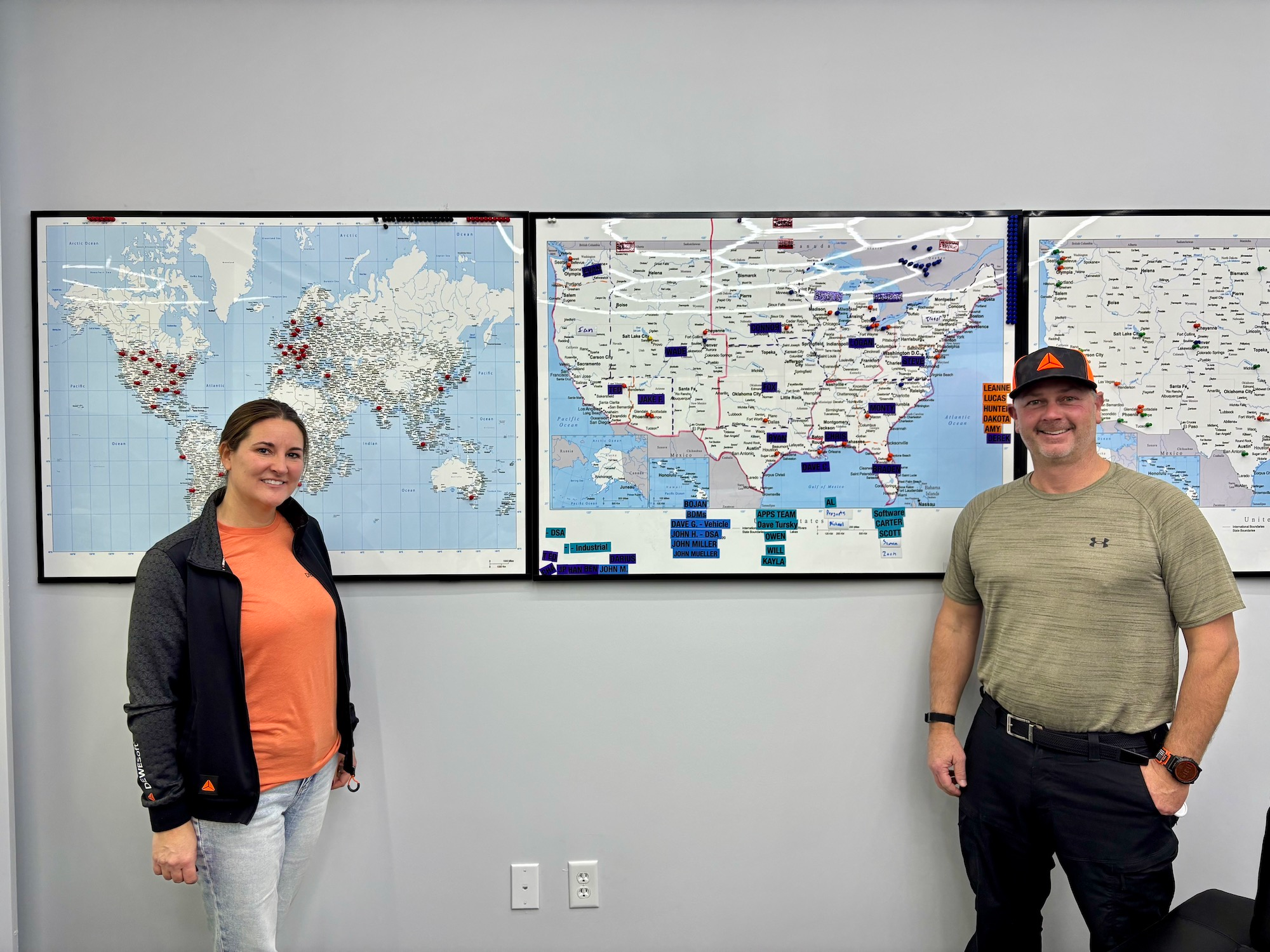
DEWESoft LLC chief marketing officer Christie Nowicki and president and CEO Andrew Nowicki stand next to a map that shows locations of DEWESoft team members worldwide. The AW graduates remain involved in the community while growing the Whitehouse-based business. (AWFP photo by Karen Gerhardinger)

“Whitehouse has been amazing. The community has been amazing,” Andrew said, noting that it made sense to grow his business in the community where he and his wife, Christie Nowicki, grew up and raised their three children.

Andrew, a 1996 Anthony Wayne graduate, is CEO and president, while Christie (a 1997 AWHS graduate) is the chief marketing officer. It’s not been easy, he admits, noting that entrepreneurship is a 24-hour job that can be exhausting, especially in the beginning.

“If you start a company, it’s your lifeblood, your family’s lifeblood, and it extends to all of our families,” he said. “When you look at what we’ve done – to come back to the community and start a business and push it to grow – it doesn’t happen that often because it’s not that easy to do.”

Looking over a world map and U.S. map, Christie and Andrew point to areas where DEWESoft has representatives who work with clients who rely on the company for testing and measurement software.

“We provide the tools to give data to the engineers and customers to improve on their products,” said Christie, who often travels to trade shows around the U.S. to explain how their hardware and software can aid in a variety of industries.

DEWESoft is among Whitehouse’s top 10 employers, said Daugherty, noting that Anthony Wayne Local Schools tops the list, which includes BASF Coatings LLC, Kennametal, Inc., the village, Matthew W. Padgett & Edward D. Jones and Co., Cynamar, Homes By Josh Doyle Coporation, KJAMS LLC and Anthony Fronk – who owns Whitehouse Inn and The Crust.

The Nowickis have tapped into the school system, often hiring graduates from Bowling Green State University and the University of Toledo. This summer, the company will hold a summer camp for recent high school graduates interested in data acquisition as a career.

Within the next five to 10 years, Nowicki expects DEWESoft to reach 100 employees and possibly expand its facility.

“Overall, we will continue to grow,” Andrew said. “We’re currently in a roughly $2 billion research and development market. The next market – where we supply control applications and engineer full test cells –- is a $100 billion market. If we get into that, we’re going to need more people and more space. Within the next 10 years we could get into that market.”

While DEWESoft has expanded all over the world, the Nowickis remain committed to supporting the Anthony Wayne Local Schools and Whitehouse, including sporting events, the new Generals for Generations foundation and providing toys for a village toy drive.

Building new

For most of its 29 years, AW Heating and Cooling has been housed on founder Kyle and Renee Hertzfeld‘s Waterville Township property. By this summer, AW Heating and Cooling will have a new home – taking up 11,000-square-feet in a 16,321-square-foot commercial building under construction on S.R. 64 just east of the Finzel Road roundabout.

“It was time to expand,” said Kyle, as he and Renee visited the site on Jan. 5 – before the steel beams were erected to form the shell.

Renee and Kyle Hertzfeld are watching the construction of a new home for AW Heating and Cooling on S.R. 64 just east of Finzel. (AWFP photos by Karen Gerhardinger)

The company’s 20 employees will now have more space, and the building will have 5,000-square feet that can be used by one tenant or divided for up to three tenants. Bingham already sees opportunities to match up tenants to that space, as he often gets inquiries.

Areas of focus

One guiding force when seeking out new business is the 2024 survey taken by 562 residents. What do they want to see? More restaurants, retail, recreational opportunities and walkability. That survey serves as a critical piece as the village works with Kleinfelder to determine its priorities for the coming years, which have been narrowed to four: downtown development, the S.R. 64 corridor, connectivity and recreation.

While the village limits end just beyond Steve Rogers Ford to the east, Daugherty said he hopes to continue working with Waterville Township on commercial development in a joint economic development district on township land. A JEDD offers income tax sharing opportunities for both as businesses and employees are added.

One challenge is the narrowness of the state route, which has ditches on both sides and utilities that cross over at Noward Road, which is slated to have a roundabout installed in 2028.

“We’re getting a lot of interest in Noward Road, and not a data center,” Daugherty said. “We want to work together to make sure the corridor is planned right. We want to support Waterville and Waterville Township. We trust they’ll support us to make a really good experience in that corridor.”

Once Meijer opens in Waterville in the next year, Bingham expects to see traffic along S.R. 64 into Whitehouse to increase beyond the 8,000 to vehicles a day that travel between the roundabout and Providence Street. That’s one reason why Kleinfelder and the village are working on a grant to install a pedestrian bridge over S.R. 64 between Whitehouse Park and the future public library and conservation center.

“The library is going to attract people from all over, and I think it will attract other entities as well,” Bingham said.

A one-of-a-kind partnership

Growth in western Lucas County was a driving factor in Toledo-Lucas County Public Library’s decision for a new Whitehouse branch to be added to the library’s master plan several years ago. Now, in collaboration with the Metroparks, planning is underway for a combined Whitehouse library and Oak Openings conservation center to be built in Blue Creek Metropark.

The project is still in the planning phase, inspired by public sessions held last year – in which residents shared ideas for the design, amenities and programming. A new timeline for construction should be announced later this year, said TLCPL Communications Strategist Stephanie Elton

The project is one of several library facility projects that will utilize $153 million in bond money approved by voters in November 2024 – before state legislators passed a biennium budget that included cuts to the Public Library Fund (PLF) in 2025. Bond funds cannot be used toward the lost PLF funds or operating costs, which have impacted hours at several libraries, including Waterville.

“We know it feels confounding and frustrating to be reducing hours while new construction continues, but we cannot use the bond dollars for any operating expenses,” Elton said. “This construction investment will allow us to preserve a strong library presence for Lucas County even in the face of uncertain funding.”

The Metroparks is developing a new master plan to create unique visitor experiences around the region’s first park-library campus, said Metroparks Director of Public Relations Scott Carpenter.

“Planning began with staff from Metroparks and the Library meeting in October, and a landscape architecture firm is now working on concepts for us to consider,” he said.

Connectivity and recreation

Blue Creek Metropark spans both Whitehouse and Waterville Township. The Whitehouse area includes the Nona France Quarry with kayaking, fishing, walking trails, a tall sledding hill and and recreation fields leased to Anthony Wayne Youth Foundation. On Schadel Road in the township is the Quarry Pond and a native plant nursery. Both sections will have improvements, this year, pending the approval of the park’s new master plan, Carpenter said. The park had 222,000 visitors last year.

The village continues to focus on connectivity and recreation as well, completing the Sandra Park Disc Golf Course, paving the trail around the small quarry in Whitehouse Park, and constructing the Sgt. Andy Eckert Memorial Bridge over Blue Creek last year.

Plans for a trail along Weckerly Road from downtown to the Finzel Road school campus are being submitted for grant funding, with the goal of providing additional options for those who want to walk, run or bike.

Transparency

One overarching goal for the village remains transparency, Bingham said, noting that the staff continually utilizes the website, social media, emails and the Access Whitehouse app to push out information.

“We’re  proactively working to get information out there to the people rather than waiting for them to ask for it, or just having it available,” Bingham said.