In January the Toledo Museum of Art announced that its guards would need to reapply for their jobs with Safeguard Security Services, a company contracted to manage protective services for the museum. The transition to Safeguard was completed March 1. (TFP photo by Laurie Bertke)
TOLEDO – After working in accounting for 35 years with one company, Rose Letherby thought she found her dream job as a protective services officer with the Toledo Museum of Art.
The position she took eight years ago allowed her to tap back into her roots as a college art major. “I love to talk to people, and I love to interact, and I love art,” said Letherby. “I thought I was going to be there until I was 75.”
Things changed for Letherby on Jan. 27 when museum leadership surprised employees with the news that the protective services officers — commonly referred to as PSOs or security guards — were being outsourced to a company called Safeguard Security Services.
The director of Protective Services and employees associated with the control room would remain as museum employees, but the rest of the protective services staff was told at the mandatory department meeting that they would need to reapply and interview with Safeguard if they wanted to continue employment with the museum beyond Feb. 28.
Letherby, who had just accepted a promotion from part-time to full-time with benefits two weeks prior to the announcement, said she and the other guards were “absolutely blindsided” by the news. She said she hadn’t even had time to complete the paperwork and begin receiving benefits.
“It’s almost like a slap in the face, is what it amounted to,” said Letherby. She interviewed and accepted a position with Safeguard, but left the museum for employment elsewhere the day before the transition to Safeguard was completed March 1.
Toledo Museum of Art (TFP photo by Laurie Bertke)
Museum has long history with Safeguard
The contract with Safeguard builds on what the museum’s director, Adam Levine, describes as an “incredibly close relationship” between the two entities.
The current director of Protective Services, Risa Smith, is a former Safeguard employee, and the president and owner of Safeguard, Josh Hardman, worked as director of Protective Services for the museum from 2014 to 2017 before leaving that post to purchase the Toledo-based security and investigations firm.
In a written statement, Hardman said the company has enjoyed a business relationship with the Toledo Museum of Art going back to 1999. During that time, Safeguard employees have staffed a variety of positions, including mobile patrols, parking lot security and control room operators.
Levine, who also serves as president and CEO of the museum, describes Safeguard as an organization that knows the institution inside and out. He said TMA’s leadership has been considering the transition to Safeguard for protective services for about two years.
With 61 employees, Protective Services was the museum’s largest department and the one with the highest rate of turnover. Managing such a large department in-house, including hiring and training new employees, took a large toll, particularly on human resources, according to Levine.
Adam Levine, TMA’s Edward Drummond and Florence Scott Libbey President, Director and CEO (TFP photo by Laurie Bertke)
Levine said the move was about efficiency and not about cutting costs.
“Finances were not a factor in this decision. We made the decision because of the value of time that was being allocated to administrative burden, administrative work related to turnover among frontline staff, among the guards,” he said. “So there are real savings there, but they’re not like dollars and cents savings. The time is going to be reallocated to other things.”
Thirty-eight employees in Protective Services were impacted, including eight full-time and 30 part-time positions. According to Levine, all but two of the guards initially chose to stay on with Safeguard.
Levine noted the museum has made concerted efforts over the past five years to increase hourly wages for protective services employees from $8.75 to more than $15, and the museum negotiated for employees making the transition to receive a slight raise from that amount.
But Liz Sullivan, a former Protective Services supervisor who left employment with the museum in mid-February, said full-time employees lost health care and retirement benefits and saw a significant reduction in paid time off as part of the move to Safeguard. Several other employees interviewed by the Toledo Free Press confirmed this assessment.
Hardman declined to share details about the benefits that Safeguard employees receive.
News met with shock, hurt
Sullivan was one of three Protective Services supervisors and her duties included scheduling hours for about 45-50 guards to cover the daily needs of the museum. She said she learned the news about Safeguard about an hour before the rest of the staff, during a meeting with the director of Protective Services and the chief financial officer.
She had worked for the museum a little more than six years, advancing from gallery guard to team leader and then supervisor.
“I love the museum. I thought this was my forever job,” said Sullivan. “I really did work very, very hard for them because I loved the things they were pursuing and the mission and so forth. I thought they were really living that, they were dedicated to that. And I feel like this has shown me it’s really much more all about the bottom line and who’s important and who’s not, I guess. And that was very heartbreaking for me.”
She wrestled with the decision of whether to apply for Safeguard for a few days, but ultimately did not interview with the company. “I just couldn’t allow myself to be treated that way — to give so much to something, believe in people and then have them just treat you with so little regard,” said Sullivan. “It was soul crushing.”
Other protective services employees who spoke to the Toledo Free Press expressed feeling similarly hurt, disheartened and shocked by the news they received that day. According to several people who attended the Jan. 27 meeting, one employee put their resignation in and was gone by the end of that day, and several others walked out of the meeting.
“Almost everyone was upset by this whole thing and feels that it was underhanded,” said another protective services employee who asked not to be identified. The employee said the decision reflects a broader trend of upper management disregarding the frontline workers who keep things running and interact with the public on a daily basis. “We’ve been made to feel unimportant, in many ways.”
Guards question decision’s timing
About two weeks after museum leadership announced the contract with Safeguard, Levine received a copy of a petition the International Union, Security, Police and Fire.
Professionals of America filed with the National Labor Relations Board seeking to represent the museum’s guards. The letter was dated Feb. 10. A Notice of Petition for Election was posted for employees to review, but the petition was withdrawn Feb. 26.
Levine said the letter dated Feb. 10 was the first he heard about any organizing effort among the guards, and he said it was “absolutely not a factor” in the decision to move the Protective Services department to Safeguard. He said the final decision to pursue the contract with Safeguard was made at the end of last year.
Several guards who spoke with the Toledo Free Press still expressed suspicion that the move was related to union talk among the staff that had picked up steam in January.
Earlier that month, Sullivan said she and two other supervisors were asked by the chief financial officer and the director of Protective Services to bring anything they heard about unionizing to the attention of management.
“During those conversations, we were told that the supervisors were very important, that we would be protected, that they were putting measures in place so that we would not have to be part of the union and that we would stay TMA employees,” she said.
Sullivan said she never spoke to Levine on the topic of unionizing.
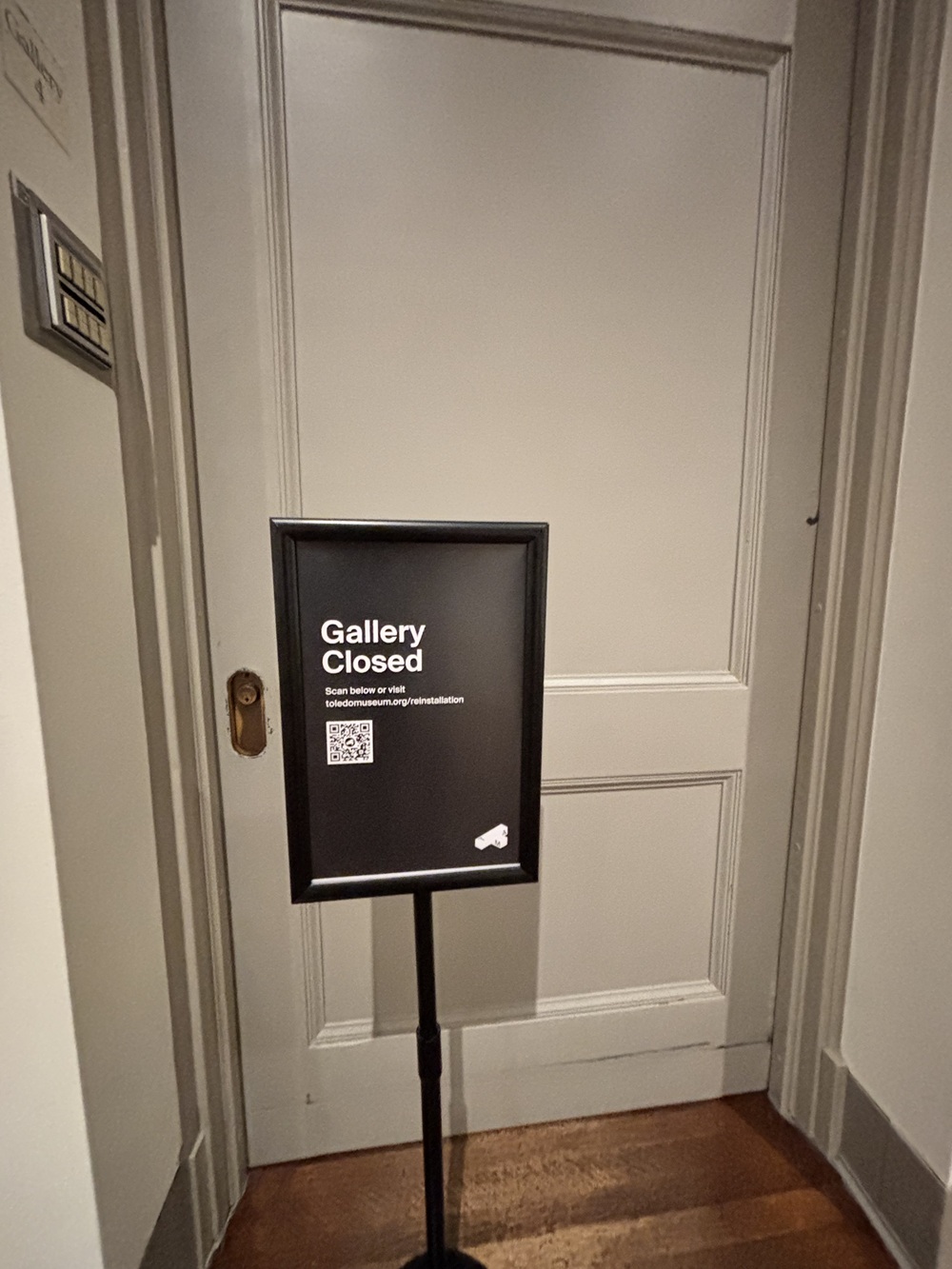
Letherby said safety concerns were among the reasons some guards were interested in organizing their own union. With more galleries temporarily closing as part of the museum’s reinstallation project, guards have spent a growing number of hours in construction zones.
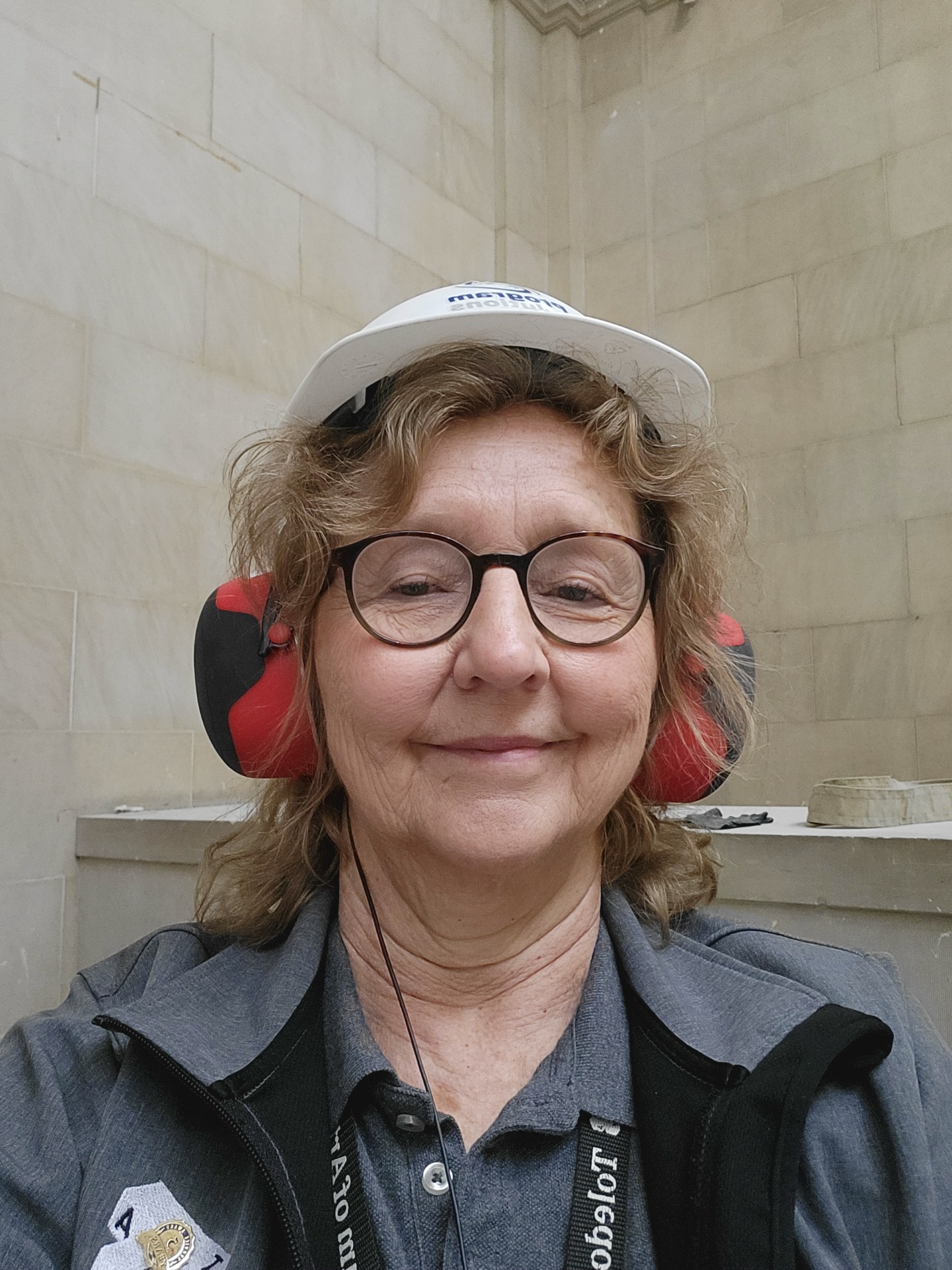
Rose Letherby left her job as a protective services officer with the Toledo Museum of Art at the end of February. In this photo she provided, she is pictured on the job guarding in one of the construction zones. (Courtesy photo)
Toward the end of her employment with the museum, Letherby said she was spending less time working in a public-facing capacity and more time in hardhat zones as a construction guard. Letherby said she often experienced dust, loud noise and extreme heat and cold, such as when she was standing at the open dock doors while items were being moved.
“But you want your paycheck, you put the hard hat on and you go to work,” she said.
Protective services officers are not a part of the union that other TMA employees formed in April 2025, which included educators, curators, visitor services staff, technicians and research personnel. The employees voted to form Art Workers United through AFSCME Ohio Council 8 to address concerns about “job security, equitable wages and better working conditions,” according to a news release from the council announcing the vote.
A representative of AFSCME Ohio Council 8 said the protective services officers were not included due to their employment classification. The council declined to provide further comment or connect the Toledo Free Press with a representative of Art Workers United due to contract negotiations that are currently taking place.
With more galleries temporarily closing as part of the museum’s reinstallation project, several guards said they have spent an increasing number of hours monitoring construction zones. (TFP photo by Laurie Bertke)
No changes to visitor experience
Acknowledging the difficulty of the situation, Levine emphasized the importance of managing the museum in a way that fulfills its mission of integrating art into the lives of people.
“These are not decisions that we take lightly,” he said. “But I do feel very confident that we made the right decision, not just for the museum, but also did so in a way that was right for that team.”
Levine said Protective Services has had different structures over the years and had not always been managed in-house. He added that the museum made every effort to ensure everyone retained their jobs who wanted to do so.
“People’s jobs have changed. And that is real,” he said. “So people did not lose their jobs, but people are totally entitled to the feeling of a sense of loss.”
Levine said he and the rest of the leadership team are keeping close tabs on the transition, and that visitors can expect the same customer service, friendliness and safety standards from the museum guards as always. “It was one of the criteria for us that visitors would not notice any difference, and I do not believe that they would,” he added. “We continue to receive great feedback on our guards.”
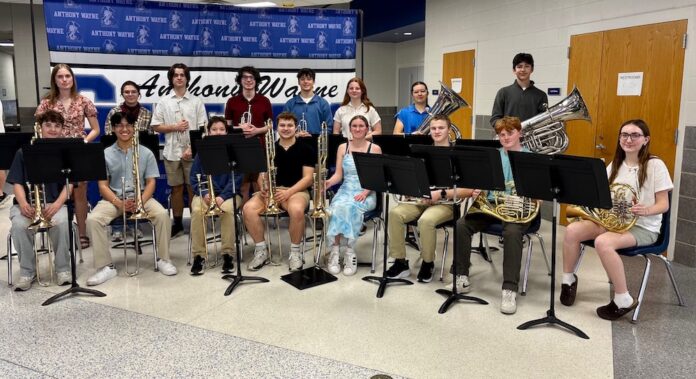
Members of the Symphonic Winds Brass Choir performed prior to the start of the April 13 Anthony Wayne Board of Education meeting. (AWFP photo by Karen Gerhardinger)
Anthony Wayne students recently underwent state testing – and Superintendent Kevin Herman is confident they will perform well. But student success goes beyond test scores, he told the Anthony Wayne Board of Education during its April 13 meeting.
To illustrate that success, Herman welcomed student athletes, musicians and other groups to speak to the board.
Athletics
During the meeting, Athletic Director John Snyder shared that 196 high school and 118 junior high athletes participated in athletics this winter. That’s 41 percent of all 7-12 students. Of those, 47 percent are female and 53 percent male.
Leah Pike made school history as the first female student-athlete to earn a spot on the AW All-Ohio wall, after she earned First Team All-Ohio in women’s basketball. She is also on the wall for volleyball. She and her twin sister, Mallory, are heading to Ball State University, where they will play collegiate basketball.
In addition, the dance team earned the OASSA state championship, and the cheer team earned the America’s Cheerleading Cup national championship and the OASSA state championship for game day build. The girls basketball team and girls swim and dive team both earned Northern Lakes League (NLL) championships. The boys swim and dive team ended the season as NLL runner-up and Ohio High School Athletic Association (OHSSA) state championship qualifiers. The gymnastics team were district runner-up and OHSSA state championship qualifiers.
Band
After a performance by the Symphonic Winds’ Brass Choir, Band Director Roy Young gave an update on the program, which has 456 students in grades 5-12 who are in band, including 161 in the high school, 120 in the junior high, and 175 in the middle school.
The 150-member Marching Generals perform in numerous parades throughout the community and will perform at Disney World this year. In total, band performances are held at least 60 times a year.
In 2026, 16 junior high and 10 high school students were chosen for the Ohio Music Educators Association (OMEA) District 1 Honors Band. Since 2009, 16 students have been selected for OMEA All State Ensembles. Evey Bringolf played with the All-State Band in Columbus.The band participated in 83 solo and ensemble adjudicated events, earning 58 superior ratings and 22 excellent ratings.
Showing a photo of five graduates who are now members of The Ohio State University Marching Band, Young said the best part of his job is seeing his students move on to take their band experiences to the next level.
DECA
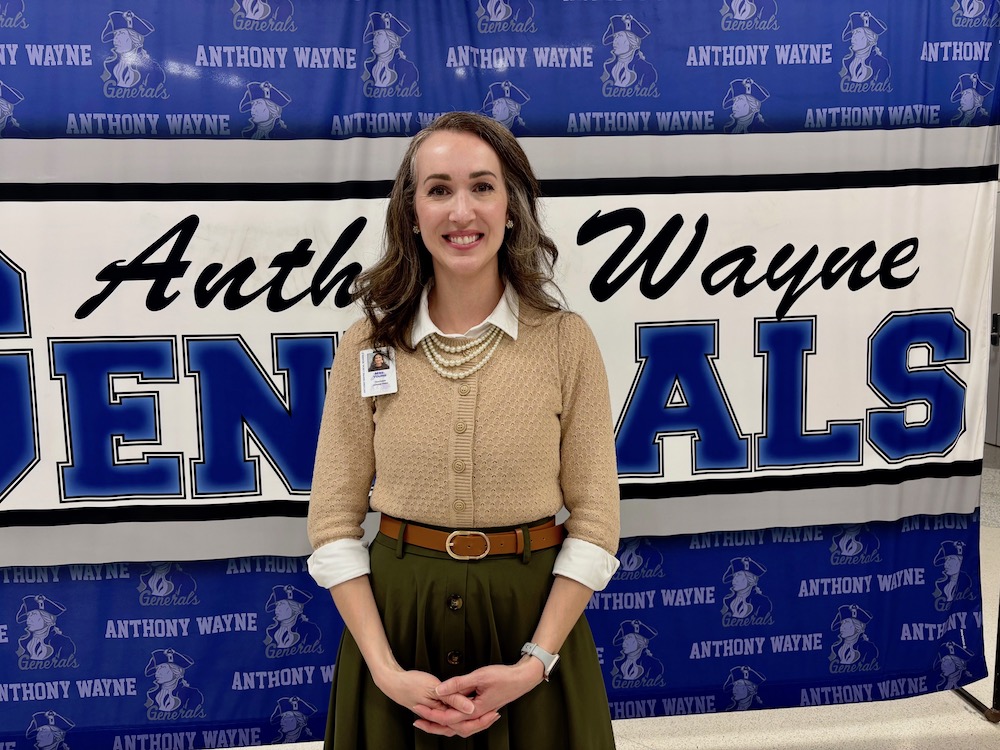
Becky Stutz, the Anthony Wayne-Penta teacher who is advisor for the student career tech organization DECA, shared how 18 students will be headed to Atlanta for DECA’s International Career Development Conference (ICDC) next week. Billy Dean, Alex Bischoff, Arjun Jayaraman, Aradhya Mutumula, AJ Rea ,Garrett Smith, Maddock Hires, Miley Denman, Lydia Fabian, Ellison Lopez, Sophia Huhn, Madeline Johnson, Dalia Shordt, Brady Wells, Brady Zare, Josie Phillips and Ava Wepler will compete with students from around the country. Stutz, a 1987 graduate who was involved in DECA during her high school years, has taught business and led DECA programs for 33 years and will retire next month.
Purple Star Generals
Christine Young, who serves as a liaison for military families in the district, shares how April is the month of the military child – a time to recognize and honor the role that the children of military members play.
Christine Young, who is the military family liaison for the district, shared that April is the month of the military child. (AWFP photo by Karen Gerhardinger)
“When a service member serves, the entire family serves. Our students carry that reality with them, and we are better for having them in our schools,” she said. “As conflicts arise around the world, many of our families face the reality of deployment, extended time apart and the uncertainty that comes with it. These moments are not just experienced by the service member – they are felt deeply at home, in our classrooms and throughout our community.”
The district supports 97 students who have a parent or guardian currently serving, along with 37 students who have siblings in the military. Another 247 have a parent who is a veteran, and four students have experienced the loss of a loved one in the line of duty.
“These are not just numbers – they are stories of resilience, sacrifice and unwavering dedication,” Young said.
To support these students, each of the district’s buildings has a Purple Star Liaison, who provides support for the students through programs that encourage understanding, empathy and belonging. Young asked the community – including neighbors and local business members – to support military families.
The community is welcome to attend a military signing ceremony on Friday, May 1 at 7 p.m. in the high school auditorium, as seniors who plan to serve in the military after graduation are recognized.
“Let’s come together to ensure these young men and women see just how proud we are of their decision and how deeply our community stands behind them,” she said.
Ray Greene named treasurer
Ray Greene will take over as treasurer of the district on July 31. He previously served as assistant treasurer. (AWFP photo by Karen Gerhardinger)
After nearly 20 years as district treasurer, Kerri Johnson announced her retirement effective July 31. Ray Greene, who has served as assistant treasurer since August 2022, was named treasurer during the meeting. As assistant, Greene helped manage the district’s financial operations, budgeting and fiscal planning.
“Ray has been an integral member of our financial team and has earned the trust and respect of staff, administrators, and the Board of Education,” Herman said. “His experience, professionalism, and dedication to fiscal responsibility make him exceptionally well prepared to lead the district’s financial operations into the future.”
Greene came to the district with a resume that includes teaching high school students in advanced economics, business law, marketing, accounting and web design; assistant baseball coach for NCAA Division I and II universities; a masters of education in educational technology and an MBA in general management.
Kerri Johnson is retiring after nearly 20 years as treasurer of Anthony Wayne Local Schools. (Courtesy photo)
The board thanked Johnson for her years of service and leadership. During her tenure, the district earned multiple Auditor of State Awards, recognizing the district’s commitment to accurate financial reporting, sound internal controls, and responsible management of public funds.
During the meeting, the board also:
-Authorized the treasurer to advertise for bids for the junior high kitchen and HVAC improvement project, with monies from the Food Service Fund.
-Approved the newly created job of behavior specialist. While the district contracts with the Educational Service Center of Lake Erie West to have an individual in that role two days a week, Herman said having a full-time specialist who is part of staff will be beneficial.
-Accepted the resignations of Whitehouse cafeteria/playground aide Nita Haas and high school science teacher Corbin Genson, and the retirements of high school teacher Lisa Ernsthausen and food service secretary Brenda Cohrs.
-Approved the hiring of Wendy Jacoby, junior high cook, and John Hursh, junior high physical education teacher.
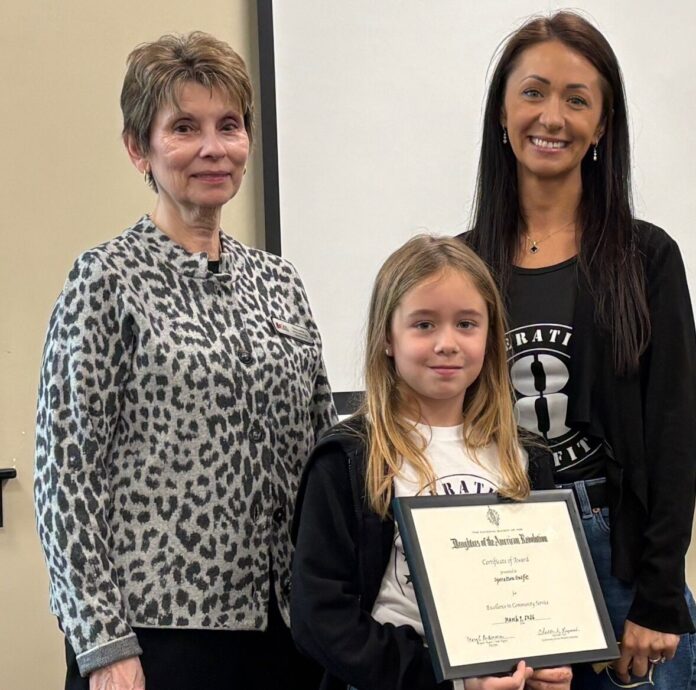
Paula Lauer, of The Fort Industry Chapter, National Society Daughters of the American Revolution, presents Operation Outfit founder Nikki Hernandez and her daughter with the National (DAR) Community Service Award. (Courtesy photo)
Operation Outfit – a local nonprofit that provides new clothing and shoes for veterans in nursing homes – was awarded the National Society Daughters of the American Revolution (DAR) Community Service Award, given to organizations or individuals who volunteer in areas including education, patriotism, humanitarianism and environmental conservation.
Operation Outfit was nominated for the award by the Fort Industry Chapter and selected for the award by the Ohio DAR state chairman. Founded in 2024 by Nikki Hernandez, a hospice nurse who visits many veterans in nursing homes and health care settings, Operation Outfit was her answer to helping men and women who are often unable to shop on their own for basic items like clothing.
“They’re the ones who don’t have family to bring in what they need – whether it’s comforters, clothing or socks,” she said.
While the facilities may provide some basics, often she would see veterans wearing hand-me-downs from former patients or doing without comfortable, warm socks or shoes that fit.
“I noticed so many requests for socks and shoes that I knew I needed to do something,” Hernandez said.
While she began raiding her husband’s closet in 2017 to find clothes, in 2024 she founded Operation Outfit as a nonprofit with a goal of providing dignity and comfort to veterans.
“Meeting veterans and hearing their stories really resonates with me,” said Hernandez, who has several family members who retired from the military. “They gave up so much. I heard them talk about missing years with their children, or having a marriage fall apart, because of their decision to serve in the military. They gave everything they had, so they deserve everything we can give them.”
While other organizations might host clothing drives, Operation Outfit is unique in that it provides new clothing and shoes that will fit the veterans – and then delivers those items directly to the veterans.
“We prefer new clothes. It doesn’t feel right to give a veteran someone’s giveaways,” Hernandez said. “And most veterans can’t get out to the store, so we bring it to them.”
Most of what Operation Outfit looks for are sizes large through 2X, along with shoes in sizes 10-13. Hernandez recommends items that are comfortable, such as stretchy sweatpants, zip-up jackets, loose and soft T-shirts, and warm socks. Not many veterans in homes want to wear jeans. Slip-on shoes are easiest for those who are not as mobile.
“When I make a delivery, their faces are like kids at Christmas,” Hernandez said. “I like that happy feeling. You don’t usually get that in hospice – usually, it’s tears. This is the sunshine I get to feel in between.”
The organization operates entirely on public donations, fundraising events and sales of merchandise like t-shirts, jackets and water bottles, all of which go directly toward serving veterans. In 2025, Operation Outfit was able to visit six facilities and serve 65 veterans. Hernandez hopes to scale up to at least two visits a month as donations and volunteer support grow.
For more information on how to become involved by fundraising, volunteering or donating can be found at operationoutfit.org.
The Fort Industry Chapter DAR is the 46th chapter in Ohio, organized by 16 founding members in 1909, and chartered with eight additional members in 1910, as the 887th national chapter. Fort Industry Chapter, NSDAR was named after Fort Industry, a block house stockade erected around 1800, on a high bluff near the mouth of Swan Creek on the Maumee River.
The chapter meets at noon on the first Saturday of the month, September through June, usually in area restaurants or country clubs. Any woman, 18 or older, who can prove lineal, bloodline descent from an ancestor who aided in achieving American independence, is eligible for membership. For more information, visit fortindustrydar.org.
Planned Parenthood, Toledo location. (TFP photo by Samantha Heywood)
TOLEDO– Planned Parenthood is often derided as simply an abortion clinic, but 25 percent of their 600 locations nationwide don’t even offer abortions. The Toledo location is one such example. Instead, the Toledo Planned Parenthood provides a range of reproductive and sexual health services to all demographics—services that foster safe, healthy lives.
An anonymous spokesperson from the Toledo Planned Parenthood health center further clarified their boundaries of care, emphasizing the organization’s attention to diverse services.
“We have abortion centers in Cleveland and Columbus, but do not perform the procedure in Toledo. Though it is often assumed that we only provide care to women, in reality, we provide a litany of services important for a healthy life, regardless of gender.”
These services include different types of birth control. The pill, the ring, IUDs, and the Nexplanon implant are available to patients via a scheduled visit. STI testing, pap smears, and gender-affirming care are also available during a scheduled appointment.
The Toledo location provides free condoms and Plan B to individuals on a walk-in basis. They are available for pickup at the health center or via a discreet mail-order program for Ohio residents aged 16 and older, with a limit of one order per 30 days. No parental consent is required for individuals 16 and older.
The organization’s vice president of community engagement seconded the misconceptions, highlighting that people often think that the Toledo Planned Parenthood does not provide parental support.
“We work with parents when it comes to assisting with reproductive health conversations. We support parental involvement… Anecdotally, we see a lot of patients for gender-affirming care. Approximately one-fourth of our total patient volume in January was here for gender-affirming care services.”
The Toledo Planned Parenthood offers gender-affirming care services to adults aged 18 or older. Puberty Hormone replacement therapy is provided to patients, and mental health support is a common practice too. The Toledo Planned Parenthood does not perform surgical procedures, including gender-confirmation surgery, but staff can refer patients to their preferred clinic if that is what they are looking for. Information on gender-affirming care services is available on their website.
Funding
Despite fighting back against these misconceptions, the Toledo Planned Parenthood and other Ohio-based Planned Parenthood health centers continue to face funding cuts. In January, The Toledo Free Press spoke with Erin Thompson, director of communications for Planned Parenthood Greater Ohio, argues that funding has been in flux due to targeted attacks from the Trump Administration.
“For example, we’ve been a recipient of Title X funds since 1971, just a year after the program was established, and have only been blocked from receiving those funds twice: during Trump’s first term and again last summer. Though these funds have been released to us again, there is uncertainty around whether we will receive them past March.”
Planned Parenthood was cut from the Medicaid program through Trump’s “Big Beautiful Bill” last summer, significantly impacting patients in the Toledo area and thousands of other patients in Ohio.
With the loss of Medicaid and other funding cuts, many patients in Toledo cannot access the healthcare that they need. The spokesperson from the Toledo location says that their staff have had to turn patients away daily.
“We have been referring patients elsewhere when possible, and we try to accommodate what we can.”
When patients are unable to be accommodated, Toledo Planned Parenthood refers them to the Toledo Lucas County Health Department—an organization that also offers affordable reproductive health care and birth control.
The Toledo Planned Parenthood still accepts private insurance, Medicare, and has a sliding fee scale for most services. The sliding fee scale is based on income and household size, which can significantly reduce costs for uninsured or low-income patients. The Toledo Planned Parenthood typically charges less than hospital-affiliated clinics, which often charge higher fees for office visits. They have more information on insurance and price of care on their website.
Community involvement
Although the national dialogue surrounding Planned Parenthood can be confusing, the staff the Toledo location say that simply paying attention to local changes, volunteering, and donating when possible helps them to continue their services. Their vice president of community engagement emphasizes:
“Donate, share your stories, pay attention to legislation and policy changes that impact us and ultimately harm patient access.”
The team at the Toledo Planned Parenthood is continually accepting patients when they can. Thompsonreiterates that their ultimate goal is to provide people with the comprehensive healthcare they deserve.
“We are here. Our doors are open. We remain as committed to providing healthcare to the communities who need us as we ever have… we’ve introduced new services, such as menopause care, ultrasound dating, pharmacy delivery, and more in 2025. This year, we look forward to providing these services to all of our patients.”
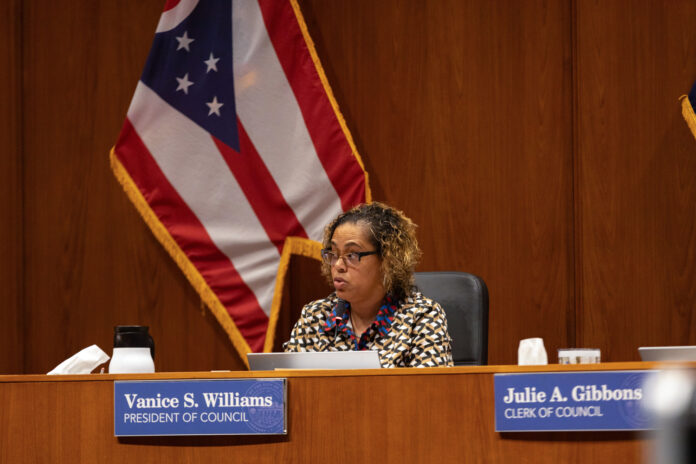
Vanice Williams, president of council and representative council member for District 4, speaks about the work that went into making the budget cuts during a special session of Finance, Debt and Budget Oversight Committee to approve the 2026 Toledo City Budget at 1 Government Center in Toledo on Tuesday, March 31, 2026. (TFP photo by Stephen Zenner)
TOLEDO – On March 31, the $1,009,612,154 total operating budget for 2026 Toledo city budget was approved after about a half hour of deliberation by Toledo City Council, and millions in cuts.
All members of Council were present for a special session of the Finance, Debt & Budget Oversight Committee to deliberate on amendments for the 2026 Budget Ordinance (O-125-26), with the exception of Council Member John Hobbs III, who was absent due to work commitments.
Clerical update, Exhibit A
First on the agenda, Exhibit A passed with unanimous approval.
The amendment was proposed from the mayor’s administration, and it moved an administrative assistant position, $103,633, from Building Inspection to Code Compliance and carried over the remaining funding for the Choice Neighborhood Planning Grant Consulting Services for the Vistula Neighborhood.
A bookkeeping measure was also part of this first amendment, and it corrected the Road and Bridge Maintenance projects to reflect amended budgeting within Street Construction Maintenance, Special Assessment Services Fund, and the Capital Improvement Fund.
Council Member Vanice Williams, District 4 and president of council, sternly addressed council after passing exhibit A, in the opening of the meeting.
“The biggest thing for us as a body is we did not recommend the removal of any positions that are currently filled,” she said. “We were not in the mind frame to take on laying off any staff that is currently working for the City of Toledo.”
This clarification from Williams came at the request of Council Member Adam Martinez, District 2, who wanted the objectives of the council to be clearly known before voting on Council’s proposed amendment, Exhibit B.
“No services lines were cut,” Williams said. “We cut an additional $120,000 out of the office supplies of various departments, and those are listed.”
In jest, Williams summed up her response and said the council did not cut positions but “we did cut pens,” referring to office supplies cuts.
Exhibit B was unanimously approved by all present council members.
$3,489,930.50 was cut from the General Fund through this amendment, which made good on Williams’ claims of cutting office supplies.
Fire & Rescue had 10 different items cut, the most separate designated cuts for a department, for a total of $422,599.00 reduction to their budget, including $30,788.00 of office supplies cut.
But even with less separate specifications the Police Department lost the most money of any department through this amendment. $943,801.00 was cut from the Police Department, which downsized an incoming police class of recruits from 25 to 20 ($526,600.00), got rid of funding for new uniforms ($150,000.00) and cut contractual services ($107,000.00), which included grass/snow removal expenses and GrayKey/Cellbrite software, used for unlocking and accessing data on cellphones.
Amendment for historical buildings
Council Member Theresa Gadus, District 3, proposed Exhibit C, $125,000 for a consultant for local landmark designations.
“The proposal is a community led initiative,” she said before voting began on this amendment to the budget. “Hundreds of residents, stakeholders and community leaders came together to ask this Council to take a proactive approach to preserving our historical structures, those architectural anchors that represent pride and identity across our neighborhoods.”
The loss of historical structures, Gadus said, go far beyond just losing a building, and negatively affect housing stability, public safety and economic development.
“Due to the transition in leadership within the plan commission, there was not sufficient time to bring forward the necessary legislation to authorize this expenditure before the end of the year,” Gadus said. “This amendment simply provides the commission the time and space needed to carry that work forward.”
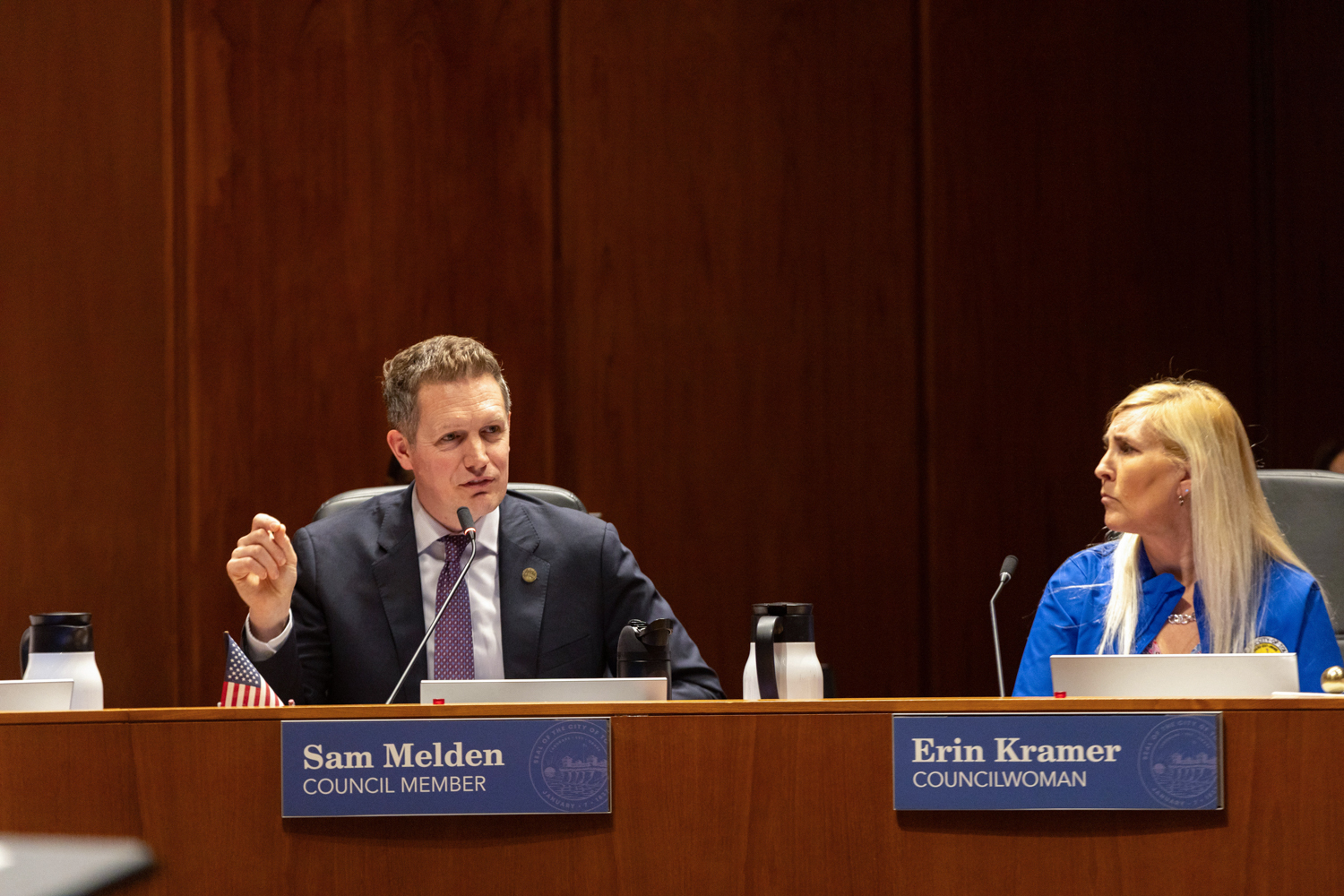
Sam Melden (left), council member for District 5, backs up President of Council and Council Member for District 4, Vanice Williams, as she asserted that cutting the budget this year was hard work. (TFP photo by Stephen Zenner)
Exhibit C passed as an amendment, but was opposed by Council Members Sam Melden, District 5, George Sarantou, At-Large, and Williams.
Jazz Fest
Funding for Jazz Fest was the subject of the next amendment to the budget, Exhibit D, proposed by Council Member At-Large Cerssandra McPherson.
Cerssandra McPherson, council member At-Large, speaks on getting funding for Jazz Fest through Exhibit D and amendment to the budget. (TFP photo by Stephen Zenner)
McPherson told council that Jazz Fest usually gets $50,000 from the city, but she cut the amount to $40,000 to help the budget.
The money for Jazz Fest, McPherson said, came from “the interest that we have from the ARPA [American Rescue Plan Act] dollars.”
Shortly after the amendment passed with all members voting yes except Council Member Melden.
Police substation
“Exhibit E is for the community police station to fill the gap left by the closing of the Northwest substation closure in 2025 that’s $500,000 by Council Member Melden,” said Julie Gibbons, the clerk of Toledo City Council.
Melden introduced this amendment, and told Council that it was not an initiative to replace the substation.
“This is about establishing a new community police presence, not just in District 5, not just in west Toledo, but in a strategic area,” Melden said, and defined the area as where districts one, four, five and six all come close to one another.
Maintaining a police presence in west Toledo was important for Melden, but he went further and said, “this is the potential pilot, a new way of having these outposts throughout the community.”
After Melden shared his thoughts, McPherson opposed Exhibit E, because she said it did not have enough structure.
“We should not approve monies without a plan,” she said, and compromised that the council could come back to this idea during the budget’s mid-year adjustments.
Both she and Martinez said they thought the police presence there was important, but wanted more definition for how money should be used. He also recommended bringing this issue back up at the mid-year budget review.
Defending the amendment, Melden said either council members could speak with the chief of police about their ideas, and resolved, “The beauty of this idea is that it is actually a new approach to community policing.”
Melden argued that not all the details in development are ironed out at the same time. “I’m not going to name a location and then have the price go up,” he said.
The amendment passed with four council members opposing it, Brittany Jones, At-Large, Martinez, McPherson and Williams.
ShotSpotter
Another police tool was the subject of the last amendment to the budget, Exhibit F, which Theresa Morris, District 6, sponsored in hopes of funding the city’s ShotSpotter, a surveillance technology by SoundThinking Inc.
Exhibit F would add $225,000 to the budget, but the claims made by SoundThinking about ShotSpotter include faster response times to dangerous situations and better evidence recovery after shootings.
“It’s one more tool that we can have in our toolbox to keep us safe in Toledo,” Morris said, and shared that this amendment doesn’t affect her district significantly. Morris said, “We don’t want to have [this summer], ‘Let’s name that sound: Is it a firework or a gunshot?’”
Council Member At-Large Nick Komives was the first to oppose ShotSpotter, after voting for the money to fill the gap left by the police substation.
“$225,000 is a lot of money,” Komives began, and said there was a good “feeling” of security that comes with ShotSpotter. But maybe $225,000 is not worth the feeling, he said.
“Since 2022, more than 45 cities have rejected or canceled their contracts with ShotSpotter,” he said, the foremost of these cities are Chicago, Dayton and Durham. “Public safety officials have determined the level of effectiveness of gunshot detection technology was incommensurate with the costs associated.”
Dayton’s decision to go without ShotSpotter was cited by Komives, and he said, “I believe that our police department felt the same, which is why they did not bring it forward, and I would encourage this body to reject the amendment. Thank you.”
At-Large Council Member Erin Kramer echoed Komives’ sentiments, and said that while she wants better gun safety, ShotSpotter might not be the best use of the city’s funds.
This is the only amendment on the agenda that failed, and was supported by Jones, Martinez, Morris and Gadus.
After the meeting, Morris expressed remorse at the amendment failing.
“I think that a lot of the neighborhoods that see high numbers of gunshots, I think they will continue and probably increase now that they know that there isn’t that monitoring system,” she said.
“So whether it’s a drone, whether it’s ShotSpotter, whether it’s a Flock camera, honestly, these are the things that when something happens, somebody says, ‘Where are the cameras?’”
Kramer spoke on her vote to not renew ShotSpotter.
“We have a lot of tools in our toolbox to prevent gun violence, and ShotSpotter is not one that we need to invest in anymore,” she said, and cited the efficacy of the technology and cost as restraints.
“We had to make a lot of really hard cuts in this budget, and so I don’t feel like it would have been responsible for us to then say, ‘Yes, we want to spend $225,000 on the software through this product.’”
The Toledo Free Press reached out to the Toledo Police Department for comment, and received this reply from Sargent Mohamad Nasser, the public information officer, on the cut to ShotSpoter.
“ShotSpotter will continue operating through the end of June. While that service will conclude at that time, our commitment to responding to gun violence remains unchanged. We will continue to use multiple tools and strategies, and we encourage residents to call 911 immediately if they hear gunshots so officers can respond quickly.”
Roads
Unanimous approval was given by all present to pass O-126-26. This ordinance approved the 2026-2030 Capital Improvement and Road Improvement Budgets, and authorized the appropriation of $77,447,820 for capital projects.
Reduce the budget
Last on the agenda for the special meeting of council was R-110-26, a proposal by all members of council “urging” the mayor to reduce the budget by $10 million per year for 2027 and 2028.
Sarantou spoke on behalf of this resolution. “I think it’s very important that we have this resolution passed unanimously, because we have some real budget challenges…and asking the administration to focus on $10 million of cuts from now for next year’s budget is absolutely critical.”
Public safety is Council’s number one responsibility, he said, but added, “We need to send a message to our taxpayers that we are serious about reducing expenditures in all the budgets as much as possible.”
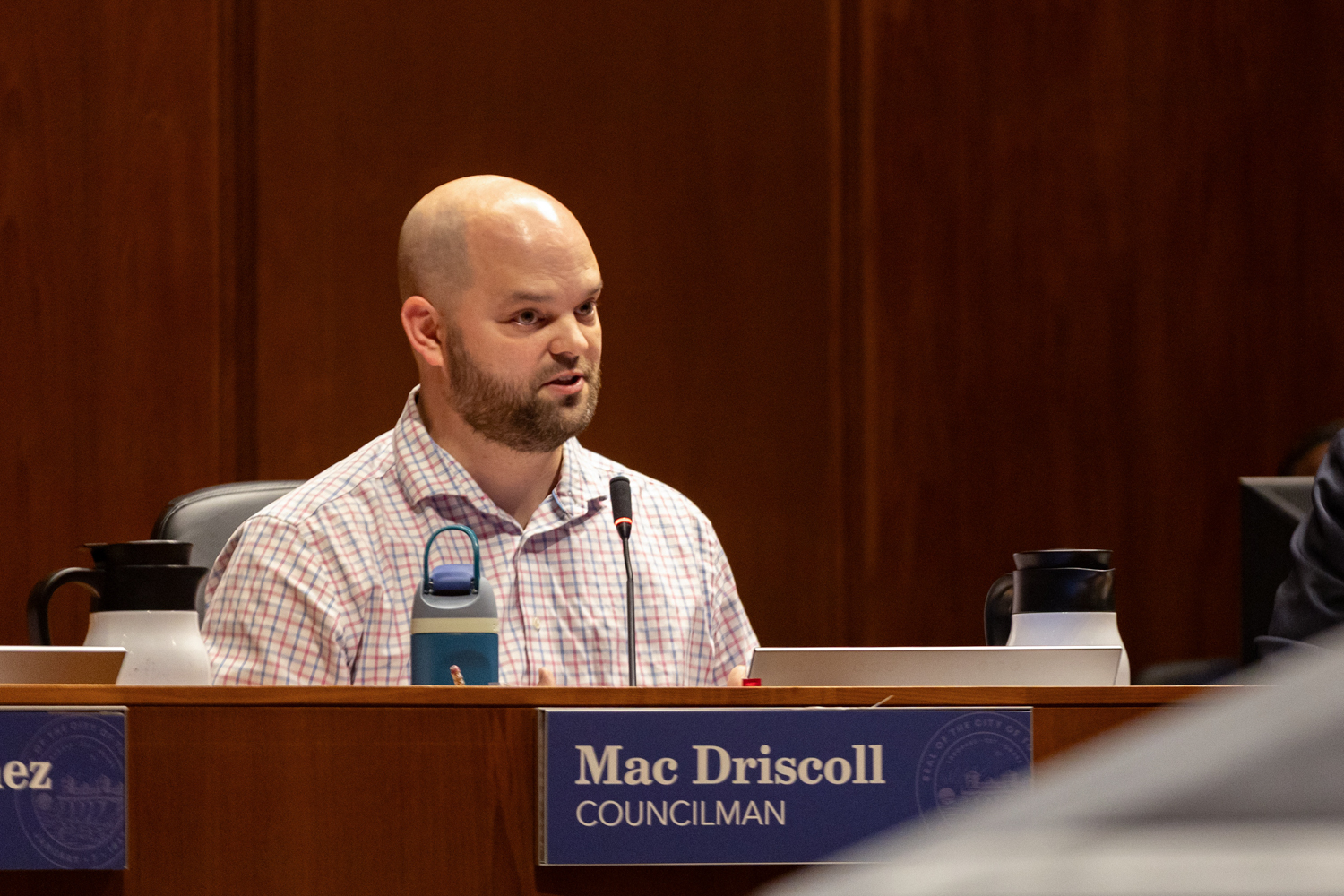
Mac Driscoll, council member At-Large, addresses council about resolution 110-26, an effort to decrease the budget each year by $10 million for two consecutive years. (TFP photo by Stephen Zenner)
Council Member At-Large Mac Driscoll weighed in on the heels of Sarantou, and cautioned about the budget next year.
“I would say much of the additional cuts that we found, that Council has found, working alongside the administration, represent really one time options,” Driscoll said, and warned that the same “low hanging” fruit would not be available to cut next year.
Driscoll warned that next year the city will be facing a structural deficit, and, “within three years, we will not have a rainy-day fund any longer.”
2025’s city budget came off of fresh American Rescue Plan Act (ARPA) dollars from the federal government, some of which have been cut, but a large feature of the mayor’s budget at that time was the $60 million “rainy-day” fund, allowing for an improved bond rating for the city.
“I want to be clear that we are having these conversations in a time of, at least at this point in time, a time of economic expansion, and also a time when we’re projecting revenue growth,” Driscoll said.
“If you’re expecting revenue growth, you should be banking money, not borrowing from our savings account to balance the budget.”
Driscoll was clear that Council has the power of the purse for the city, but that the budget document comes from the mayor and sets up the template for expenditure, with the oversight of Council.
With positive revenue growth, and the decrease of $10 million a year for the next two years, Driscoll was confident the stabilization fund would be secure.
President of Council, Williams, pushed back on the idea that the council waited until the last minute to pass the budget, and instead said that the council combed through the document from the mayor thoroughly.
She stated that it was a difficult year all-around, speaking as an owner of a small business, and said the same difficulties for her business were present in the city’s budget. And that it was work to go through it with the administration, while not cutting human labor.
“Just because you can do something doesn’t mean you should, and just because we can pass it early doesn’t mean that we should,” Melden said, defending Williams’ claim and the rest of Council passing the budget on the last day for it to be approved.
Instead, Melden said what happened with this year’s budget was a great effort to make the most of the taxpayers’ money, and said, “We took the time to get it [the budget] as right as we could.”
The resolution passed unanimously for all present, but without Hobbs III’s vote.
Williams said before the vote, “We have to put forth how serious we are to take on this task with the administration, and that’s what this resolution is saying.”
This special financial meeting started at 2 p.m., and Hobbs III and Mayor Wade Kapszukiewicz were present for the 4 p.m. city council meeting.
In this episode of Toledo Works, Jaden Jefferson speaks with Yaz Abu-Adiyeh, owner and proprietor of Baba’s Eats, a food truck that got its start during the early days of the pandemic. Then he speaks with Anneke Kurt, corporate manager of Kengo Sushi & Yakitori, about her work in the restaurant industry that inspired her memoir. Finally, he ends with a chat with Ray Orra, a barista from House of Coffee who speaks to the value of coffee shops for finding community.
Everywhere in Toledo, you’ll find people who play a role in making our city tick – from hospitals and factories to restaurants and art galleries – and behind every person is a story. Our program, Toledo Works, highlights those stories from workers’ firsthand accounts. Each week, Toledo Free Press hosts Jaden Jefferson and Stephen Zenner focus on a different topic within the Toledo workforce, exploring their day-to-day challenges and triumphs.
Below is a more detailed look at all of the candidates voters will get to choose from on their respective ballots during the May 5 primary election for Ohio’s 9th Congressional District.
Democrats for Representative to Congress (9th District)
Marcy Kaptur for Representative to Congress for Ohio’s 9th District * Kaptur is the only Democrat on her party’s ballot.
Marcy Kaptur
Lives in Toledo; from Toledo
Political Experience:
1983-Present U.S. Representative for Ohio’s 9th Congressional District
1977-1979 Urban Policy Advisor for the Jimmy Carter (D) administration
1975-1977 Director of Planning at the National Center for Urban Ethnic Affairs
1969-1975 Urban Planner for the Toledo-Lucas County Plan Commissions
Education:
1974 Master’s in Urban Planning from the University of Michigan
1968 Bachelor’s Degree in History from the University of Wisconsin
Professional experience:
1977-1979: Urban Policy Advisor for the Jimmy Carter (D) administration
1975-1977: Director of Planning at the National Center for Urban Ethnic Affairs
1969-1975: Urban Planner for the Toledo-Lucas County Plan Commissions
Jaden Jefferson sits down with Libertarian David Gedert, who goes by Sugar Vermonte while performing, to discuss his campaign to represent Ohio’s 9th Congressional District.
Matthew Althaus for Representative to Congress for Ohio’s 9th District
Matthew Althaus
Lives in Toledo
Political Experience:
No prior political experience
Education:
Bachelor of Business Commerce from Miami University
Associate’s Degree in General Business Administration and Management from Sinclair Community College
Professional experience:
2022-Present: Manufacturing Manager and previously H/E Supervisor for NSG Group in Rossford
2020-2026: Area Manager for Amazon in Toledo
2015-2020: Operations Manager for Unique Tool and Manufacturing in Temperance, Mich.
2011-2015: Inventory Specialist for International Laser Group in San Diego, Calif.
2010-2011: Chief Executive Officer for Smartcarts Inc. in San Diego, Calif.
Website and links: None
Republicans for Representative to Congress (9th District)
Josh Williams
Josh Williams for Representative to Congress for Ohio’s 9th District
Lives in Sylvania Township; from Toledo
Political Experience:
2023-Present: Ohio House Representative for Ohio’s 44th District
Volunteerism:
2008-Present: Board of Directors Member for South Toledo Area Rec Society
2008-Present: Program Director and Head Football Coach for South Toledo Area Rec Society
Education:
2018-2020: Doctor of Jurisprudence from the University of Toledo College of Law
2014-2017: Bachelors of Science in Paralegal Studies, Paralegal Studies/Prelaw from the University of Toledo
Professional experience:
2016-Present: Criminal Defense/Personal Injury Associate with Groth and Associates
Derek Merrin for Representative to Congress for Ohio’s 9th District
Derek Merrin
Lives in Monclova; from Monclova
Political Experience:
2024: Ran for Ohio’s 9th Congressional District. Merrin lost to Marcy Kaptur (D), and received 47.6 percent of the vote. Kaptur received 48.3 percent of the vote. Tom Pruss (L) received 4.1 percent of the vote.
2023-2024: Ohio House Of Representatives for Ohio District 42
2016-2022: Ohio House Of Representatives for Ohio District 47
2014-2015: Regional Liaison for the Ohio Auditor of State
2012-2013: Senior Performance Analyst for the Ohio Auditor of State
2008-2011: Mayor of the City of Waterville
2006-2007: Councilman for the City of Waterville
Education:
2012-2014: Public Performance Measurement Certificate from Rutgers University, Newark
2008-2009: Master of Public Administration, International Relations from Bowling Green State University
2005-2008: Bachelor of Arts from the University of Toledo
Professional experience:
2015-Present: Owner of Merrin Property Holdings, LLC
Jaden Jefferson speaks with Alea Nadeem, a Republican candidate for Ohio’s 9th Congressional District, as part of the Toledo Free Press Voter’s Guide. This interview is a part of our May Primary coverage for 2026.
Madison Sheahan for Representative to Congress for Ohio’s 9th District
Madison Sheahan
Lives in Columbus; from Curtice, Ohio
Political Experience:
2025-2026: Deputy Director of Immigration and Customs Enforcement (ICE) in Washington, D.C.
2024-2025: Secretary for the Louisiana Department of Wildlife and Fisheries in Baton Rouge, La.
2023-2024: Executive Director for the South Dakota Republican Party in Pierre, S.D.
2021-2024: Executive Director for South Dakota Governor Kristi Noem in Pierre, S.D.
2019-2021: State Election Operations Director for the Ohio Victory Campaign in Columbus
Education:
2015-2019: Bachelor’s Degree in Public Affairs, Public Management, Leadership and Policy from The Ohio State University
Professional experience:
All of Sheahan’s experience intersects with the Government/Politics
Nonprofit organization teams up with Toledo Spirits
TOLEDO -Earth Day (April 22) is an environmental movement designed to raise awareness, promote sustainability, and protect the planet’s natural resources. First initiated in 1970, it now mobilizes over 1 billion people every year.
One organization is getting a head start: Keep Toledo/Lucas County Beautiful (KT/LCB) and Partners for Clean Streams are teaming up for an Earth Day Litter Cleanup and Green Drinks Event on Tuesday, April 21. They hold numerous events like this throughout the year.
KT/LCB is a nonprofit 501(c)(3) organization that aims to provide a cleaner Toledo and Lucas County through services such as litter cleanup, recycling programs, educational programs, and tree planting and landscaping.
Adam Cassi, Executive Director of Keep Toledo/Lucas County Beautiful, standing outside their headquarters. (TFP photo by Steven Bieber)
Adam Cassi, Executive Director of Keep Toledo/Lucas County Beautiful, explained that these events are typically just social events, but the organization decided to take a step further and have a litter cleanup before the social event. Cassi explained that this time of year is litter season for the organization.
“Lots of litter builds up over the wintertime. Nobody likes to go out and pick up litter in the winter. So now that it’s warming up, there’s litter everywhere, especially if you drive around 475, 75, all the on-ramps and off-ramps. But that area along Summit Street in front of Toledo Spirits and TolHouse always collects a lot of litter, and we’ll be going along there and cleaning that up.”
According to a study from Keep America Beautiful, there are nearly 50 billion pieces of litter along U.S. roadways and waterways, and 88 percent of it is smaller than four inches.
While we hear about plastic in the oceans, the problem can be felt in our backyard. Cassi says that the goal is to collect the litter before it finds its way to the Maumee River and/or into Lake Erie. He also said that an estimated 2,500 tons of plastic flows into Lake Erie every single year.
While litter is bad for the environment, it is also an economic issue. Cassi explained that a city full of litter will see less business development and tourism. He also explained the socioeconomic impact of littering.
“You know, if a community is clean, they’ve typically got everybody a little bit more passion, and they are more connected.” He said, “They know that that’s socially unacceptable to litter there, and there’s a lot of pride in that neighborhood. There’s also a lot of research that says if an area is clean, it’s easier to keep it that way.”
On the other hand, if there is litter everywhere, people will be more inclined to think it is okay to throw out one more piece of litter.
Lastly, littering also poses a health risk, particularly when it comes to plastic. Cassi noted a study from the University of New Mexico that found that brain tissue carries about 4,800 micrograms per gram, which is equivalent to the amount found in a plastic spoon. Events like the one on April 21 are beneficial for the environment, the economy, and our overall health.
Cassi says that the Litter Cleanup and Green Drinks events are open to the public. He simply asks that people register ahead of time because Toledo Spirits is not usually open on Tuesdays. There is information available on their social media and on their website. He also noted that you do not have to go to the Litter Cleanup to attend the Green Drinks Event. If the cleanup is too early in the day, you are still welcome at the Green Drinks Event.
The event will be held on Tuesday, April 21, at Toledo Spirits (1301 N. Summit St.) from 4 to 5 p.m. for a litter cleanup, followed by a Green Drinks networking event from 5 to 7 p.m. There will be alcoholic and non-alcoholic beverages available. You can register for the event here.