Home Blog Page 270

Rathbun: Let’s get back to independence

0

As I contemplate Independence Day, I can’t help but think back to our Founding Fathers — what they were like and what they would think of us today.

My perception of them is of rugged individualists who wanted to be left alone to create and do for themselves. They came here to escape tyranny and oppression and knew the price to be self-reliant would be high.
They worked very hard through very harsh conditions. I can’t imagine how difficult it was to settle a chunk of land with nothing but hand tools, a horse and a strong back.
Banks back then were little more than depositories for people to store their money in a safe place. Loans from banks were nothing like they are today and the modern stock market didn’t exist.

There are days when I wish for these much simpler times even though it would be much more work.

Enough of waxing nostalgic. How can we be more independent today?
In advising my clients, one of the first  things I recommend is to get out of debt. Especially on non appreciating assets, e.g., cars and appliances but also on personal real estate, like your house.
There are many advisers who will recommend that you mortgage your home to the max for the longest period you can and lock in the interest rate.

The thought process is that we are due for some serious inflation and you will be able to pay off that debt with cheaper dollars in the future.
While mathematically this may be true, there is a psychological aspect tobeing debt-free.

It is very liberating when no one has a claim on you or your property. Owning your own home free and clear is the very foundation of personal property rights.
Personal property rights are the basis of all rights. If you don’t have the right to private property, you don’t have the right to much of anything else.
Secondly, those of you who have listened to me on the radio or read other columns know I am a believer in hard assets. Everyone should have some gold and silver investments.
I also think it is a good idea to own some physical precious metals, just in case. I doubt that the U.S. will ever get back to a gold standard for our currency but it doesn’t hurt to have some insurance in case we hit a serious stretch of inflation.
Thirdly, and maybe most importantly, we need to resist the temptation to look to the government for solutions to our problems. Each of us has the power to take controlof most aspects in our lives and we should strive to do so. You need to make arrangements to take care of any catastrophic needs you may have in the future that can’t be handled quickly and locally.
Don’t get me wrong; I am not predicting the collapse of the economy. Nor am I saying that you should build a bunker in the back yard and stock it with a couple of years’ worth of dehydrated food. What I am saying is think about how independent or dependent you are and what would you do in the event of a problem, either personal or community-wise?
When Benjamin Franklin was asked what he and the other Founding
Fathers had created in the meetings they were holding he answered, “A
republic, if you can keep it.”

Can we keep it? We are definitely at a turning point in history and it is up to us as individuals to keep the republic or lose it. As the German officer Otto Von Bismarck stated, “We march individually but we fight together.”
As you observe July 4 this year, think about where we came from and where we are going and what role do you want to play. Let’s truly celebrate our independence.
Gary L. Rathbun is the president and CEO of Private Wealth Consultants, LTD. 

Professor, librarian library collaborate on book

0

A Lourdes University professor and a local librarian collaborated recently on two projects related to veterans.
Lourdes University professor Holly Baumgartner and Amy Hartman, formerly adult services librarian at the Sylvania Branch Library, created a series of veteran’s writing workshops co-hosted by Lourdes and the library.
They collected the stories into a book, “In Our Boots,” which chronicles the experiences of veterans who served in Iraq, Korea, Vietnam and World War II, according to a news release.
The book is available at the Main Toledo-Lucas County Public Library andSylvania branch and has also been submitted as one of the many memorialized artifacts in the U.S. Army War College Library and U.S. Army Heritage & Educational Center.

New director: Zoos can ‘change lives’

0
Jeff Sailer took over as director of the Toledo Zoo in August 2012. Photo courtesy Toledo Zoo

Some children want to be firefighters when they grow up. Some want to be artists or the president of the United States.
Since Jeff Sailer was a child, he wanted to be a zoo director.
Sailer will continue living out his dream as he takes over for Anne Baker as executive director, effective Aug. 1, 2012.
“I’m one of those people that’s been blessed with doing what they have always wanted to do,” Sailer, 37, said.
The decision came after a nearly six-month search prompted by Baker’s decision to retire after six years as executive director, said Zac Isaac, president of the Zoo Board of Directors.
Baker will help Sailer transition into his new position, Isaac said.
“We engaged a search firm, Isaacson Miller, out of Boston and Washington, D.C., and they helped us through the search process,” Isaac said.
A search committee consisting of five board members, the past zoo chairman and three or four other community leaders worked through a process of evaluating resumes and
conducting interviews of the top five candidates, Isaac said. Once they narrowed it down to two finalists, the ZooBoard reviewed both resumes and conducted an extensive interview of each candidate before making the ultimate decision.
Isaac said Sailer is the “right person at the right time with the right experience” for the job with duties that include fiscal responsibility, animal welfare, conservation and education.
“It was [Sailer’s] experience and career, No. 1, also his passion for conservation and education in the zoo world,” Isaac said of the board’s decision. “He’ll bring great leadership
skills as well as great ideas to take us forward and make us an even better zoo than we are today.”
Fascination with animals

Sailer was born and raised in Indiana, where a fascination with animals was cultivated early on through a passion for birds.

Sailer began keeping birds when he was 7 years old. He lived on a small farmwhere his dad kept birds and eachof his siblings had their own hobby,
Sailer said.
“I always kept birds, not so much as pets but more like a garden in that I didn’t name each of them or anything,” Sailer said. “That interest really helped generate an interest in zoos.”
Sailer, being a “precocious youngster,” tracked down the names of the curators at his zoo and wrote letters to them about the birds, to which the curators responded with information. Little did they know the curious bird enthusiast was a 12-year-old boy.
“They were surprised when I showed up (at the zoo) with my father, who drove me,” Sailer said.
Sailer received his bachelor’s degree in biology from Ball State University before attending the University of Florida (UF) for graduate school.
While earning his master’s degree, Sailer traveled throughout the South Pacifi c and supported himself by teaching ecology classes to nonbiology students at UF.
“Those five years were some of the most rewarding work I’ve ever done,” Sailer said. “I was dealing with people [for whom] biology and ecology were new, so it was excitingto them. I was also getting them when they were out on their own for the first time and in school because they wanted to be there.”
Sailer said each year he had one or two students who, after taking
his class, switched their major to biology or at least decided to get more involved with biology. Sailer credits this to his hands-on approach to learning.

“I always thought, ‘who wants to do a paper or busy work?’ I gave them an option — they could either do a five-page paper or ten hours of volunteering,” Sailer said. “The hands-on stuff got them excited about biology; they got to meet actual scientists doing work. That would be a hook to get people to switch over to biology.”
Sailer’s teaching experience infl uenced his management style in future zoo careers, he said.
“Zoos have an amazing opportunity to do that as well,” Sailer said. “With projects and internships … [zoos] really can change lives.”
Upon receiving his master’s degree, Sailer took a position as curator of birds at the Miami MetroZoo. According to a news release issued by the zoo, because Hurricane Andrew had destroyed most of the bird department facilities in 1992, Sailer helped plan and build a 1.5-acre Asian-themed aviary with a world-class bird collection.

However, Sailer’s experience in Miami was not limited to birds.
“It may have seemed that way on paper, but with the way the zoo was broken up in Miami, my keepers were taking care of other animals in my area,” Sailer said, including rhinoceroses and crocodiles.
In 2006, Sailer moved to New York City to become the curator of animals for the Wildlife Conservation Society’s Central Park Zoo. Shortly after this, Sailer was promoted to director of the Central Park Zoo and later to director of city zoos.
“One of the reasons I went to New York was to get more experience with other animals. I have a great interest in fish, reptiles, amphibians and [many others],” Sailer said. “[Transitioning to director] was even more fun because now I was in the position to provide support to give others the opportunities I had. I really like birds but I really don’t work with birds anymore; but now I get to be the person that allows others to follow the passions they have.”
As director of city zoos, Sailer was responsible for overseeing Central Park, Prospect Park and Queens Zoos, which all together receive about 1.6 million guests a year.
“With every zoo, no matter where it is, you have an amazing amount of responsibility,” Sailer said. “…You have the responsibility for the public coming into the park, you have theresponsibility of animal collections and a staff that is usually putting in 150 percent for 100 percent pay. You have all those different things weighing on you and you want to do right by all of them.”
Sailer said that while it carries great responsibility, his career reaps great rewards.
“I get to see a toddler see their first elephant or see someone fuel their passion for conservation,” Sailer said. “It’s a lot of responsibility and stress, but also a lot of rewards.”
Great opportunity
Sailer said he is very excited to be moving to Toledo, which he said has everything he is looking for in a city.

“It’s a great opportunity and I will enjoy being closer to my family (in Indiana),” Sailer said. “It’s a smaller community where people know each other. … There’s an amazing amount of cultural and entertaining options here, and you don’t see that in a lot of small towns. … I think the region as a whole offers a lot to do, but in a community where everyone knows everyone.”
Once Sailer moves to the Glass City, he said his priorities are the aquarium and penguin projects at the Toledo Zoo because they are both pretty far along in design and are major exhibits that need to be completed.

Sailer also plans to emphasize education and staff involvement in zoo projects. “The education program will receive a lot from me,” Sailer said. “It’s one of the most important mission-related elements in a zoo. With a lot of facilities, it is not given the importance it deserves. [The Toledo Zoo] has a fabulous program, but there is always room to do more.”
One of Sailer’s main focuses in New York City was staff development, allowing the entire staff to take credit for zoo success. This success includes an increased revenue and attendance over the past six years, according to the news release.
“Whenever possible we did inhouse projects and really involvedas much of the staff as possible,” Sailer said. “With some of the animal-related programs, even if there wasn’t a direct role for maintenance and operations folks, they realized how important they were to the program. … They took pride because I pointed out to them that it’s not one-sided, it’s not all about the animal department.
“I’d like to see the same sort of programmatic [approach] here, by finding ways to draw in as many of the departments as possible,” Sailer said. “When the staff is building programs, they’re going to take pride in it because it’s something they built.”
Sailer said the Toledo Zoo staff is one of the positive points about his move to Ohio.
“You can see from the quality of the exhibits and the cleanliness of the parks, this group of employees feels very strongly about their zoo,”
Sailer said.
One of the most impressive and telling aspects of the Toledo Zoo is the longevity of its staff, Sailer said.
“When I was interviewing here, [the board] was telling me how long they’ve each been at the zoo and I was floored,” Sailer said. “Only two people have been here less than five years, and one person had been here for 42 years.”
Sailer said the variety in his daily duties keeps his zoo career interesting and exciting.
“What’s kept me in this career is that each day is different. Absolutely no two days are the same. … It’s an intersection of dealing with people, animals, weather and the community,”
Sailer said. “You can’t get bored doing that. It keeps your creativity high and keeps you young.”

Miller: Adios y Adios

0

Marsha Dunaway and Albert Flores were both born in 1948. They both taught at Libbey High School for more than 35 years, influencing thousands of students, including those in my 1985 graduating class. They both devoted much of their lives to community service. They both last week, within two days of each other.
It is dangerous to wax nostalgic about one’s high school teachers, three decades after daily interaction has ended; time has a way of smoothing rough edges. The gauze of sentimentality wraps itself around mundane recollections, muting the complexities that color every student-teacher relationship. Death is an additional scrubbing agent, transforming sinners into saints and saints into supersaints.
Flores was my Spanish language teacher, but he was much more than that. He was the first teacher I remember who wasn’t afraid to pull back the curtain on the education process, to reveal its flaws and limitations. I will always remember how, whenever a student would blow off an assignment or question the importance of a lesson, Flores would lustily sing the anthem from Pink Floyd’s “Another Brick in the Wall, (Part 2)”:

“We don’t need no education,” he would mock. “All in all you’re just another brick in the wall,” he would grin, and then redouble his efforts to teach the lessons.
I was a middling Spanish student; I loved the vocabulary, never fully grasped verb conjugation. But Flores, who seemed so wise and worldly to me, drilled the lessons again and again and taught me well enough to get me through my the foreign language requirements I later faced at the University of Toledo.
More importantly, Flores encouraged the questioning of authority, a revelatory philosophy that set me on the path to my life’s great interest in journalism.
I won’t raise Flores any higher than that, as I tend to glorify my intellectual inspirations and heroes, but there is this, from his obituary: “Albert A. Flores, 63, of Toledo … attended Heidelberg College where he graduated with degrees in Sociology and Spanish. Later, he obtained his Master’s degree in Gifted and Talented Education from Bowling Green State University. He served as a Spanish teacher for 36 years at Libbey High School. In 2008, he was awarded the Diamanté award for his leadership in the Hispanic community. He sat on the board of the University of Toledo EXCEL program as well as other community services.
He is survived by his loving wife of 34 years, Mary; sons, Antolin (Emily Flores) and Benjamin (Lisa Yearsin Flores), and daughter, Sarah Berlanga. Also surviving are his grandchildren, Hannah Berlanga and Cristian Flores; his sister, Gladys M. Flores, as well as many nieces and nephews.”
Dunaway taught American and world history at Libbey, with methodology far removed from Flores’ jabbing challenges. Reserved but not demure, she brought great context to her lessons, as a gifted storyteller who knew which elements of a tale would most appeal to her audience. That approach was another early puzzle piece in my eventual career choice; there were other teachers who added to the recipe, but they are alive and well and I am superstitious about linking them to a eulogy.
From Dunaway’s obituary: “Marsha graduated from Bowsher High School in 1966 and from the University of Toledo in 1970 with a Bachelor’s in Education. Marsha received her Master’s in Education in 1979. She was an American and world history teacher for 35 years at Libbey High School. Before retiring in 2005, Marsha helped to lead the Small Schools Initiative through the Bill Gates Foundation at Libbey. With her passion for history, Marsha made it her goal to travel throughout the world, with her most recent trips being to Northern Europe and Italy. Marsha was an active member of Olivet Lutheran Church; participating in the choir, Bookworms Group and Women’s Bible Study. Left to cherish her memory is her loving husband of 42 years, Gerald; children, Brian (Heather), Julie (Jason) Eaton; brother, Todd (Kathy) Rogers; grandchildren, Katherine and McKenna Eaton; step mother, Rosie Rogers; mother-in-law, Hilda Dunaway; and many other family members and friends.”
They are not the first of my Libbey teachers to pass away. Fred Wesolowski and Debbie Wilhelms left us long ago, and there are undoubtedly others I would be saddened to learn have died.
Dunaway and Flores’ lives were intertwined by birthdates, careers and dates of passing. And while their infl uence and memories will long live in the hearts and deeds of Libbey graduates, it is another painful reminder that the building in which they and so many others spent much of their lives has been reduced to rubble, nothing more than
bricks ground to dust.
That does not diminish the strength of the many foundations Dunaway and Flores helped build. Their places in the wall are now empty, but they left thousands strong bricks to continue the long, fruitful construction.
Michael S. Miller is editor in chief of Toledo Free Press and Toledo Free Press Star. Contact him at [email protected]

New Owens president marks first week on the job

0
Owens Community College President Mike Bower. Toledo Free Press photo by Joseph Herr.

Mike Bower started in Ohio, moved to Indiana, then hit Nebraska, Wisconsin, Michigan and North Dakota.

He’s learned that windmill technicians are rare and valuable, that testifying before state House and Senate hearings is rewarding and that, sometimes, bodies of water expand instead of shrink.

But now he’s back in Ohio. And a homecoming, he has learned, is sweeter than charting new territories.

“Our youth, they’re always looking for something different,” he said. “It’s amazing after living in six states, you find out it’s just as good here in Ohio as it is anywhere else. But it takes moving from one state to another state to another over a period of time to find that out.”

The week of July 1 marked his first few days as president of Owens Community College. Bower has been busy meeting with faculty and department heads, chatting with students and getting accustomed to the area again. While it’s a little too early for concrete plans, he intends to begin his new appointment by keeping collaboration with area universities on his to-do list, along with continuing credit transfer programs and keeping in close contact with students.

Mary Ellen Mazey, president of Bowling Green State University, wrote in a statement that Bower brings a “breadth of experience to Owens.”

“He is certainly well known and respected in higher education. His business acumen and his dedication to student learning and success will serve him well,” she wrote. “There are many opportunities for collaboration between BGSU and Owens, and I look forward to working with Dr. Bower in the future.”

Hard act to follow

Bower is Owens Community College’s sixth president. Chosen from a pool of 300 applicants, Bower will fill the position left open by former president Larry McDougle who retired for health-related reasons in September. The college’s board of trustees announced a national search last year and Vice President of Finance and Administration John Satkowski served as interim president while the board and a search committee tracked down candidates.

McDougle, who served for about a year and a half, brought stability to the campus by attending state meetings with other community colleges, meeting students and making himself approachable to faculty and staff. He also managed to preside over a tight budget without making layoffs, said Dee Talmage, chair of the search committee.

“Larry McDougle is a hard act to follow; we loved him — we adored him,” Talmage said.

The search committee chose Bower for his experience in community colleges and business, his leadership capabilities and his high energy. His teaching experience at an Indiana University branch campus is a bonus, Talmage said, because he can empathize with teachers about how administrative decisions affect the classroom.

“He has the ability to network and is very warm and everyone feels like you can stop and chat with him,” she said. “He’s very open and honest and a very nice, pleasant person to be around.”

Along with the challenge of filling McDougle’s shoes, Bower must face the growing problem all institutions must tackle: shrinking budgets, Talmage said. Cuts in state funding have pushed the 2012 college budget to $97.06 million, down from $103.86 million in 2011, according to information provided by Owens’ spokesperson Brad Meyer.

Although Bower most recently comes from a state that ranks high in economic growth because of oil drilling, he said the tight budget is nothing new because Nebraska state legislatures were frugal. And, thanks to his passion for wind energy, Bower knows all about wrangling on the House and Senate floor.

Devils Lake legacy

Bower testified for four years to secure a $7.1 million wind turbine project at Lake Region State College (LRSC) in Devils Lake, N.D. The structure is a 1.6 megawatt, 385-foot-tall future power source for the campus that will also allow the college to sell energy credits, he said.

Bower also started the college’s wind farm technician program. The classes start simply by challenging students to make it to the top of the wind turbine. He said if they make it, the next step is to send them to the top with tools. If they can achieve that, they enroll in the program and come out with a skill that can earn them a starting salary of about $46,000 a year, he said.

He also initiated the creation of an Office of Institutional Research, led LRSC to a longer-term planning processes, expanded the nursing program by adding a simulation lab learning environment, added a student career adviser role and led the college through a Higher Learning Commission visit in 2011, which resulted in a 10-year continued accreditation status, according to an email from Erin Wood, director of marketing and communications for Lake Region State College.

Aside from academics, Bower kicked off some of the LRSC’s first sports teams. Volleyball, baseball, softball, basketball and golf were new additions under his lead.

Bower said he’s happy to be near Lake Erie, where he can continue fostering his hobby of fishing. But that’s not because Devils Lake didn’t have enough fish. In fact, the lake is expanding at a rate crippling to homeowners and farmers who live at its shore. The body of water has quadrupled in size over the past 17 years, rising by 27 feet and consuming 150,000 acres of land by flooding. The region’s climate became wetter starting in the ’90s and has yet to shift back. The lake has no outgoing streams to drain it, according to accuweather.com.

How he got here

Bower served in the U.S. military from 1971-74, worked at the Ford Motor Lincoln Mercury Division in Cincinnati until 1980 and moved on to Thomson Consumer Electronics in Chillicothe, Ohio, and Marion, Ind., until 1994. He taught technical program classes at Ivy Tech State College and management classes at Indiana University’s Kokomo campus through the ’90s. He served as associate dean, and later became dean of Academic Education & Training Programs at Central Community College in Columbus, Neb., until 2001, when he moved to Eau Claire, Wis., to become campus dean at Chippewa Valley Technical College.

He headed back to the Midwest in 2004 for Mott Community College, where he was the executive dean for extension campuses, continuing education and corporate services. His last appointment was in Devils Lake, N.D.

Before finishing his doctoral degree at the University of Nebraska, he had previously earned a Master of Business Administration from the department of business at Indiana Wesleyan University and a Bachelor of Science in industrial supervision at Indiana State University.

Bower, who grew up in Chillicothe, was accepted to The Ohio State University but  didn’t have the money to go. He had secured a full ride to earn a two-year associates in applied science degree at Vincennes University in Indiana, so he decided to start there.

He said he can empathize with students concerned about affordable education. Semester tuition at Owens Community College ranges depending on number of credit hours, from $146 for one to $2,827.60 for 24 credit hours for in-state students. Out-of-state students pay $276.56 and $5,438.20, respectively.

“The most important degree I have was from a two-year school,” Bower said. “Why? Because I could afford it.”

Retirement Guys: Answers to top 10 pension questions

0

Mark and I have talked over the years about the importance of making a pension choice correctly the first time. In almost every pension, a retiree only gets to make the choice once. Once the choice is made it is final, no changes can be made. Yet, right now for nearly 42,000 GM retirees they are getting a chance to make a second choice, a pension “do over” if you will. GM retirees in the GM Salaried Retirement Program only have till July 20 to take advantage of this offer. So here is what those retirees and in fact anyone who may be eligible for a pension should know.

There is no one right choice for all retirees when it comes to picking a pension option. Everyone wants to give a retiree advice and I’m sure in most cases everyone is trying to help. Yet, it doesn’t matter what your poker buddies think, what you heard on TV that ALL retirees should do, what your brother in law who used to be an accountant said, or what the old boss thinks is best. You need to run your own numbers before a decision is made. So our first piece of advice is to slow down and get educated on what makes the most sense for you and your family after the numbers are run by an unbiased professional who specializes in retirement distribution planning.

Here are the basics on what needs to be considered on choosing a pension option:

  1. What is the age of the retiree? Assuming the retiree elects a lump sum rollover, different IRA rules apply to those younger than 59½ and those older than 70½.
  2. Are there other sources of income the family has and what are the monthly income needs, now and in the future? The lump sum pension gives the account owner a lot of flexibility to payments. But watch out: Spend too fast and the lump sum could run out.
  3. Are there other investment assets? In some cases it may be better to pull money from other accounts first and let the tax-deferred account continue to grow.
  4. How much income should be protected for a surviving spouse? Don’t forget about other potential losses of income like one of the Social Security incomes.
  5. What is the health of the retiree and his/her spouse? It is also important to take steps to protect the lump sum pension for a health care crisis.
  6. What are the family’s wishes to leave assets to children or others beyond the spouse? Most traditional pensions focus primarily on the retiree, with survivorship options, but can leave other wishes out.
  7. Does the retiree want more control over their retirement funds? If a monthly payout is selected, usually access to the lump sum is gone forever.
  8. What is the risk tolerance? The stock market can be risky and most fixed investment rates are at decade-level lows, so finding the right mix can be tricky if investing isn’t an area you are familiar with.
  9. What is the expected return on money? We recommend that conservative numbers be run, 3 percent to 6 percent.
  10. Who should manage the lump sum pension? To avoid a potential 20 percent tax trap you will need to rollover the money and open an IRA with a custodian. Then you will decide what to buy or hire an investment professional to help out.

Once a retiree takes a look at these top 10 pension questions, then the math can be run and a plan can be created to figure out if a lump sum pension or a monthly payout is the best choice. Making a pension decision is an extremely important choice in securing a long and happy retirement and often the choice isn’t as easy as it may seem. Take some time to get educated about how the various choices apply to your own family’s situation. It never hurts to get a second opinion. Don’t assume what everyone else is doing is right for you.

For more information about The Retirement Guys, tune in at 1 p.m. Saturdays on 1370 WSPD or visit www.retirementguysradio.com. Securities and Investment Advisory Services are offered through NEXT Financial Group Inc., member FINR/SIPC. NEXT Financial Group Inc. does not provide tax or legal advice. The Retirement Guys are not an affiliate of NEXT Financial Group. The office is at 1700 Woodlands Dr., Suite 100, Maumee OH, 43537. (419) 842-0550

EPIC Toledo to host T-Town Dash on July 12

0

EPIC Toledo will host its inaugural T-Town Dash on July 12, 2012.

The event will take place from 5:30-8:30 p.m. at Quimby’s at the Park in Downtown and will feature a scavenger hunt designed to help improve leadership, creativity and problem solving skills for young professionals in the Toledo area.

“Our goal was to get young professionals into Downtown Toledo,” said Desmond Strooh, EPIC Toledo communications coordinator. “We wanted to showcase what Downtown Toledo has to offer, why businesses are in Downtown, as well as to help young professionals improve their leadership skills.”

Participants in the T-Town Dash will be randomly assigned to teams of four. Each team will begin at Quimby’s, navigating to secret locations throughout the Downtown area by solving clues.

At each location, team members will have specific tasks to complete to garner points, with the ultimate goal of finding the final location where prizes will be awarded.

So far, there are 100 total points for the event, but all locations and activities are being kept secret.

“Speaking in broad terms without giving too much away, all clues are location-based and all activities may involve things like finding a specific person, taking a photo with them or doing an act of service for someone,” Strooh said. “It’s all very random. It’s a very cool event.”

EPIC Toledo is expecting 100 people to sign up. As of July 3, 67 people had registered for the event. Registration for the T-Town Dash is $5 per person and is open to anyone who wants to participate. Deadline for registration is July 11. All money received goes to food and drinks provided at the final location.

Last year, EPIC Toledo’s Leadership and Professional Development Committee hosted a similar scavenger hunt for committee members only. Katie Rofkar, committee co-chair and CEO of Nemsys, a technology support firm, said the success from that event lead to ideas for the much larger T-Town Dash.

“It went really well. The venues were wonderful and it was a lot of fun,” Rofkar said. “There were some people who rushed through to get their points, but there were a lot of teams who really took the time to talk to people. They didn’t care if they won or lost, they just loved being able to talk to the business owners and professionals and learn from them. Some of them said they got a lot more out of it than just winning.”

While the T-Town Dash is a point-based event offering prizes for winners, Strooh said the main focus of the event is networking and sharing ideas with fellow professionals.

“It is point-based, but it’s not point-based,” Strooh said. “It’s not so much about how many venues you go to, it’s about how many people you talk to.”

The geographic location for the T-Town Dash has expanded in relation to last year’s event. No longer just in the Warehouse District of Downtown, participants will navigate through Summit Street, onto Madison Avenue, to Michigan Street and down to Lafayette Street, among other locations, Strooh said.

Planning for the T-Town Dash began in February with committee co-chairs Rofkar and Blake Underwood, a professor at Bowling Green State University.

“It was originally just for the 30 people in our committee but we came up with the idea to open it up to all of EPIC and to make it so anyone can participate,” Rofkar said. “We have non-EPIC members, and even people from Akron and Cleveland. We have people from hairdressers to CEOs and businesspeople. It’s great exposure for Toledo.”

EPIC Toledo was created by the Toledo Regional Chamber of Commerce. The organization works to “attract and retain young professional talent” to Toledo. EPIC stands for “engaging people, inspiring change,” according to the organization’s website.

Currently, EPIC Toledo has more than 1,300 members.

“EPIC Toledo is an organization that seeks to accelerate the influence and leadership skills of young professionals in the greater Toledo area,” Strooh said. “We have three main pillars, which are networking, community impact and leadership and professional development.”

Quimby’s at the Park is located at 25 S. Huron St. Registration for the event can be completed online at www.epictoledo.com.

Obama touts auto loan success during Maumee stop

0
President Obama talked about the economy during a July 5, 2012, campaign stop in Maumee. Toledo Free Press photo by Joseph Herr.

At least 500 people packed the Wolcott House lawn Thursday morning but they hardly made a sound until about 11:30 a.m.

And then there was no silencing them.

The mere mention of President Barack Obama’s name ignited chant of “Four more years,” accentuated with much whooping, hollering and fist pumping. When Obama took the podium to kick off his “Betting on America” tour, he acknowledged that the chaotic nature of campaign season might make it tempting to tune out political news.

“I understand it’s not always pretty to watch,” Obama said. “There’s been more money flooding into the system than we’ve ever seen before, more negative ads, more cynicism and most of what you read about or hear about in the news has to do with who is up or down in the polls instead of what these issues actually mean for you and for America.”

The Republicans have raised more than $266.7 million for the presidential campaign and the Democrats have raised more than $255.2 million, according to the Federal Election Commission.

‘Betting on America’

Obama continued by saying that he believes in an America where hard work pays off and responsibility is rewarded through generations.

“I lived it, that’s my biography,” he said. “I had grandparents who served us in World War II… I had a hardworking mom who raised me and my sister right but also had some help so that we could end up going to the best schools in the country even though we didn’t have a lot of money.”

But, he said, this ideal was in jeopardy during the 2008 election. He commended his followers who joined him during that campaign, the folks who had witnessed people who “behaved irresponsibly make out like bandits” just before the economic crisis struck. He assured his listeners that the crisis did not change America’s character — and that his campaign’s mission is to bring back a sense of security that has been lost.

“What’s holding us back from meeting our challenges is not a lack of ideas, it’s not a lack of solutions, but we’ve got a stalemate in Washington between these two visions of where the country needs to go,” Obama said.

He said his opponent believes that prosperity comes from the top down.

“I think they’re wrong about their vision,” he said.

He pointed to loose regulation on Wall Street as the catalyst for the economic crisis. He also called out Romney for a statement he made about “letting Detroit go bankrupt” when the automobile companies nearly failed. The government provided General Motors and Chrysler about $80 billion in loans in 2008 to save them from collapse.

Since then, the companies have declared bankruptcy, begun repaying the loans, started to turn a profit and have rehired many of those laid off during the crisis. All of this came along with employee sacrifices and restructuring. Many of the rehires took pay cuts or surrendered bonuses and extra days off.

“I want goods shipped around the world stamped with ‘Made in America,’” Obama said, later adding, “As long as I’m president, I’m going to be waking up every single day thinking about how we can create more jobs for your families and more security for your communities.”

Obama outlined some of his successes in office, including passing health care reform with the Affordable Care Act, helping homeowners refinance their houses and pulling troops from the Iraq and Afghanistan Wars.

He invigorated the crowd by naming the reasons motivating him to run.

“I’m running because I believe, in America, nobody should go bankrupt because they get sick,” Obama said. “I’m running because after a decade of war, it’s time to do some nationbuilding at home.”

Above the din of cheering, Obama told his supporters he wants to use half the money the country has used in war to “put people back to work” by rebuilding roads, bridges and schools.

‘A Hell of a Job’

Former Ohio Gov. Ted Strickland, Sen. Sherrod Brown and Rep. Marcy Kaptur were among those who spoke before the president took the podium.

Strickland credited Obama for keeping the country out of a Great Depression-sized crisis and Brown asked his audience to find five undecided friends and “make them (their) projects” for the next few months.
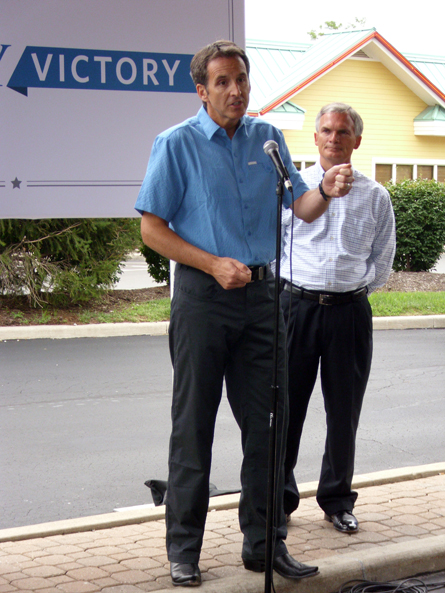
Tim Pawlenty and Bob Latta on July 5. Photo by Brian Bohnert.

Ina Sidney, a steering column manufacturer, introduced Obama. She has worked at the Toledo Machining Plant in Perrysburg for about 16 years but a few years ago she found herself out of a job. She said she and her co-workers were told to quit what they were doing and leave, and security personnel stood by as they packed up to make sure no one took anything. While that was heartbreaking enough, she said, the worst part was hanging in limbo during those few months before she got her job back. She credits the auto industry loans and Obama’s support of the middle class for her turnaround.

“I think he did, excuse my French, a hell of a job considering the mess he walked into,” she said.

Carol Myers, a 59-year-old Toledo-area resident, said she is also pleased with Obama’s performance thus far. She said he’s kept all of his promises by, for example, passing health care reform and pulling troops from the wars.

Janet Russ Jones, a Maumee resident, isn’t so sure she approves of all that the president has done. She is undecided as to whether she’ll vote for Obama in the election.

“We have to control the spending,” Jones said. “I like the programs he has in mind but sometimes we have to bite the bullet like we do at home.”

The Democratic Party has led presidential elections in Lucas County for years, scoring more than 60 percent of the vote for its candidate for at least the last two elections, according to records at the Lucas County Board of Elections.

‘Promise Gap Tour’

Hours before Obama spoke in Maumee, three prominent Republicans set up in an attempt to defy those numbers. Louisiana Gov. Bobby Jindal and former Minnesota Gov. Tim Pawlenty addressed supporters of Romney at the Courtyard Marriott hotel in Maumee. The two were joined by Republican Representative Bob Latta.

The event, dubbed the “Middle Class Promise Gap Tour,” began  around 8:30 a.m. and focused heavily on Obama’s perceived broken promises to middle-class Ohioans. The speakers discussed issues ranging from health care and the national debt to unemployment and what they described as China’s poor trade practices.

Obama noted during his speech that his administration filed a complaint with the World Trade Organization against China’s trade practices.

“[Obama] is dubbing his tour the ‘Betting on America’ tour. Well, of course, we should all bet on America, but we shouldn’t double-down on Barack Obama,” Pawlenty said. “His presidency has been a losing hand for Ohio and for America; and, I think we should dub his tour “The Broken Promises Tour’ for America’s middle class.”

Highlighted were economic promises the president made during a 2008 stop to the Buckeye State. Pawlenty addressed Obama’s promise to lower the nation’s unemployment rate in the United States and increase economic stability amongst manufacturing and agricultural jobs in the Midwest.

“When the President was running last time he said if he can’t get this economy turned around it should be a one-term proposition. We agree,” Pawlenty said. “He said he would cut the nation’s budget deficit in half. He didn’t cut it in half, he nearly tripled it. They predicted the unemployment rate nationally would go to about 5.6 percent. It went not just to 8 percent or 10 percent, but higher. Another broken promise … And now today  he’s going to come through Ohio and talk about the importance of manufacturing when during his time as president, 559,000 manufacturing jobs have been lost in America.”

Among the aforementioned suffering Ohio businesses is Nagle Companies, a local refrigerated truck business. Ed Nagle, CEO of the company, said Obama’s presidency has forced him to downsize from 80 to 28 trucks, taking both money and job security away from himself and his employees.

“[Obama’s presidency] has been detrimental, not only to us as a company, but also to all the families out there,” Nagle said.

Latta criticized the Obama administration for not exploring natural gas, oil, nuclear and electrical energy enough as energy sources.

Pawlenty bemoaned the Affordable Care Act, calling the future of health care in America bleak.

The stipulations of the Affordable Care Act include a personal health insurance mandate, (although certain low-income Americans qualify for subsidies), a law that allows grown children to stay on their parents’ insurance until they reach 27 years old and a clause that prohibits health insurance companies from discriminating against people with preexisting conditions.

Jindal expressed concern about  Obama’s “broken promises,” calling the president’s current tactics a distraction from his political shortcomings.

“The president cannot run entirely on his record so he’s going to try to distract us; but we’re smarter than that,” Jindal said. “We’ve had enough of broken promises. We can’t afford another four more years of on-the-job training.”

Many concerned Republicans shared the same sentiments. Frank Como, a Wood County resident for nearly 30 years, said he was not impressed with Obama’s first term. He said Romney’s background as a businessperson gives him the financial experience to lead the U.S. back to economic success.

“[Obama] spends money on anything and he throws money on anything,” Como said. “I think [businesspeople] have more care about money. In business, you have to have a plan or a policy put in place if you’re going to spend money. I think Romney will look at where money should be spent and how it should be spent.”

A Lucas County resident for most of her life, Sandy Boellner said her focus is less political and more social. While her vote will undoubtedly depend on a variety of social and political issues, she said her biggest complaint against the president is his “pro-choice” affiliation.

“If you don’t have a right to life in this country, what do you have?” she said. “There have been over 50 million babies since Roe v. Wade that would’ve been part of the workforce by now. They would have been a part of Social Security, or helping to support Medicare and contributing to our country.”

As for the Democrats’ historic success in Lucas County? Latta said he surmises that voters are ready for a change.

“We’ve got people between 18 and 29 with a 12.1 percent unemployment rate in this country, and people coming out of school with large debts on top of their heads and a 53 percent unemployment rate right now. What has this president done?” Latta said. “When I go out and talk to a lot of different groups, I’ll ask this one question a lot: ‘How many of you in this room think that your kids are going to have a better future than you?’ and I’ve been to meetings with over 200 people and not one of them raised their hands. This is the first generation in American history that doesn’t believe the next generation is going to be better off.”

After the Maumee stop, the Romney bus hosted a 12:15 p.m. rally in Parma, Ohio, followed by a stop in northeastern Ohio in the Mahoning Valley.

‘Exhilarating’

Obama left Maumee for Sandusky shortly after his speech. From there, his campaign traveled to Parma as part of the “Betting on America” tour.

At the end of his speech, many of the audience members ambled away looking dazed and bearing enormous grins. Susan, 70, and Patrick Grove, 71, of Sylvania said they waited in line for more than two hours beneath the blazing sun Monday to secure tickets. Patrick canvasses neighborhoods two to three times a week and Susan makes phone calls for the Democratic Party.

“He’s exhilarating,” Susan said. “He makes you feel rested and inspired, it makes me happy to hear him talk.”

Toledo Free Press writer Brian Bohnert also contributed to this story.

Toledo man recalls service as WWII Naval aviator

0
Naval aviator Alex Rapp, now 94, was stationed on the USS Yorktown and flew a Grumman TBF. Toledo Free Press Photo By Sarah Ottney

Toledoan Alex Rapp made it through World War II unscathed, but not for lack of action.

The Naval aviator, now 94, was stationed on the USS Yorktown and flew a Grumman TBF.

“That was a rugged airplane. It could take an awful beating,” Rapp said. “Our job was to sink ships, blow up hangars, blow up airfields, anything we could destroy. We were all over that ocean. I estimate I killed about 2,000 Japanese myself. It’s a big ocean. They had lots of places and we bombed them all.”

One place in particular he recalls is Truk Lagoon, now known as Chuuk Lagoon, in the Caroline Islands.

“Truk was a big installation in the middle of the Pacific,” Rapp said. “It made our Pearl Harbor look like a little hole in the wall. It was a powerful place. We attacked that four times. Oh boy, that was a dangerous place.”

Although never injured, Rapp had several close calls.

One came when he was lined up for takeoff too close to the end of the carrier’s runway.

“We were supporting landings at Saipan and I was the first of six planes to take off from the carrier, just after dawn. I got down to the end of the deck and I only had 69 knots. It takes 72 knots to fly, so I’m sinking down right to the ocean,” Rapp said. “It takes patience and nerve just to hold everything steady and I finally got that plane up in the air. The dangerous part was I had depth charges. If I would have hit the water, they would have blown me right up. When I came back, the flight officer came up to me and said, ‘I apologize to you. I only gave you 300 feet for takeoff and it should have been 330 feet.’ I could have punched him in the nose.”

Another time, Rapp left with a group of 150 pilots on a bombing mission to Kwajalein, an atoll in the Marshall Islands, but when they arrived at the specified location, the intended target was nowhere in sight. They soon located the ship further down the coast, but getting there used extra fuel.

“I got right down on the water, right at the ship, dropped the bomb and went over,” Rapp said. “I could see a guy shooting at me from the stern of the ship and, when I went over, why, he hit me underneath and blew a hole in the plane. But that was the easy part.”

Meanwhile, the group of carriers the planes had taken off from came under attack by the Japanese and radioed to say they were moving out. Already low on fuel from the miscalculated bombing location, the pilots would now have farther to fly to make it back.

“We were expendable,” Rapp said. “They left us, but we finally caught up with them. We all landed while the Japanese were attacking. We got aboard the carrier and had to find places to hide. I had 23 gallons of gasoline left and these other guys had less. They were patting me on the back saying, ‘Boy, you were terrific to save all that gas.’ So we made it back, but that was a rough day.”

TBFs were designed to carry torpedoes, but the pilots used bombs instead because it was safer. To minimize their chances of being shot down, the pilots would dive at more than 300 mph toward their targets.

“You’d try to get as fast as you could go,” Rapp said. “With torpedoes, you had to fly low and slow, but with bombs, you could go in fast and still have a lot of speed to get out of there.”

Rapp recalled dropping a torpedo only once, near Saipan.

“There were nine of us loaded with torpedoes and we chased this destroyer and caught up with it and attacked it,” Rapp said. “Five planes attacked from the port side and four planes came in from the starboard side and we bracketed that ship. They hit at almost the same time and it was the biggest explosion I’d ever seen. Just like that, it disappeared.”

One time, the pilots loaded their planes not with bombs or torpedoes, but with food. After helping Marines take control of Eneweitok Atoll in the Marshall Islands, Rapp’s ship had moved on to another mission when they got word the Marines had run out of supplies.

“We were about 1,000 miles away, but we sailed back there and loaded up 11 planes and brought them 11 tons of food,” Rapp said. “The runway was made out of coral and it was just as white as can be. I was flying in and thought to myself, ‘Boy, this is beautiful. I’ve never seen anything so beautiful.’ The food came from our ship. We ate a lot of rice after that.”

Rapp was the oldest of eight siblings. All four of his younger brothers also served in the military.

“We were all over the world,” Rapp said. “It must have been tough on our parents, all the boys being gone. I think about it once in a while, but my mother and father were tough people. They were immigrants from Europe.”

His brother Gene was drafted into the Army and was at Pearl Harbor when it was attacked.

“He said it was terrible and we were not prepared for anything,” Rapp said. “He was at Hickam Field and the Japanese shot up all the planes that were on the runways.”

Knowing they would soon be drafted, Rapp and another brother, Joseph, joined up.

Joseph served in the Army and Air Force with a B-29 photographic intelligence unit.

“His group had more pictures and knew more about Japan than the Japanese did,” Rapp said.

Rapp’s two youngest brothers later served during the Korean War.

Singer-songwriter Edwin McCain uses music to cope

0
Edwin McCain will perform at 8 p.m. July 12, 2012, at the Ark in Ann Arbor. Photo by Brian Nelson.

When life was blowing up around him, Edwin McCain found solace in song and wrote “Boom.”

“My mom got ovarian cancer, my wife got breast cancer, and my father got prostate cancer, all within about a six-month window, so it was all kind of piling up. And at the time, my son was injured in an accident. It was one of those kinds of moments where it tests your mettle,” he said.

“We just kind of bonded together, put our backs against each other and stood strong through it all, and that’s kind of what that song’s about. I wrote that line, ‘Love’s when it’s hard’ on a piece of paper in my truck when I was at the hospital, and it ended up being a song.”

“Boom” is on McCain’s 2011 disc, “Mercy Bound.” He worked with friend and songwriter Maia Sharp on the CD, which also features lighter moments, including “Strange Angel.”

“There’s a line about the Virgin Mary on a cinnamon roll. There’s a coffee shop in Nashville that had a cinnamon roll that looked like the Virgin Mary and then they actually ended up shellacking it and sending it on tour around the world. I found that ironic that there was a cinnamon roll that did considerably more touring then some musicians in Nashville,” McCain joked.

The singer-songwriter grew up in Greenville, S.C., and began singing early.

“I think church choir is pretty much like Southern day care,” he said and laughed. “And I sang along to my sister’s records, a lot of Earth, Wind & Fire, a lot of folk music, so that’s where I was influenced.”

It was the late 1990s when McCain’s breakthrough came with “I’ll Be” and “I Could Not Ask For More.”

“We were in a climate of the last hurrah of the music industry, and at the time, all of our cohorts — Dave Matthews, Hootie & The Blowfish, Kid Rock, all label mates — everybody was having huge success, so we were hopeful that that would happen for us and happy when it did,” he recalled. “I’m incredibly lucky and it was really great timing that was involved in the good fortune of our career.”

He’s amazed that the rain continues to fall “angry on the tin roof” with “I’ll Be.”

“How long that song has been on the radio and how it just continues to go and go and go, and how it’s spread to different parts of the world, that’s been the surprise,” he said.

McCain will perform at 8 p.m. July 12, 2012, at the Ark in Ann Arbor. Tickets are $20. Doors open at 7:30 p.m.

“We’re bringing the full Monty; we’re bringing the full band on this run, so it’s going to be a good time,” he said and laughed.