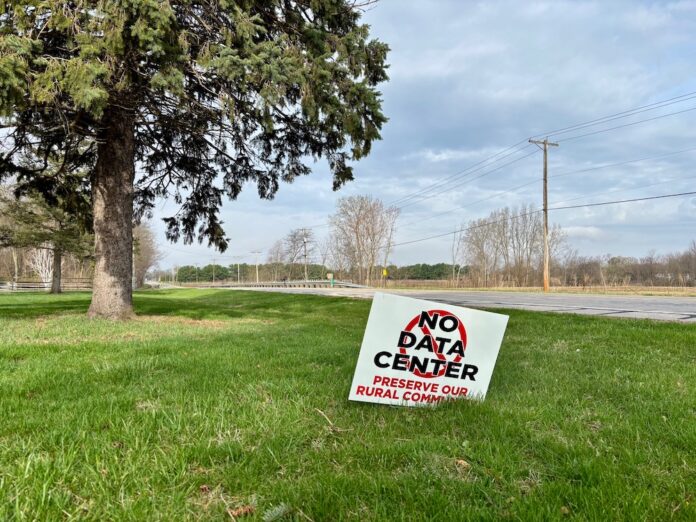
PROVIDENCE TOWNSHIP – Providence Township trustees are considering a moratorium on the construction of data centers.
“If we have one, it will gain us some time,” solicitor David Chamberlain told trustees during their April 2 meeting. He plans to review Waterville Township’s 12-month moratorium and create a similar resolution for Providence Township trustees to consider during their April 15 regular meeting.
If approved, trustees need to use that time to come up with language governing data centers to add to its zoning book, said Zoning Inspector Jim Fischer.
Providence Township’s zoning book does not currently mention data centers. Trustees Lee Bialecki, Jeremiah Floyd and Steve Kendall discussed options, including whether they could exclude, ban or just not include data centers in their zoning book.
“You can restrict it, but you can’t exclude it,” Kendall said, adding that while he’s not an attorney, he remembers discussions around attempts to ban adult-oriented businesses a decade or so ago.
Floyd wondered whether the township could only allow data centers on M-1 Manufacturing – a process that would require rezoning – or limiting them in size. If the township allows property to be rezoned to M-1 and a project falls through, the M-1 zoning would remain, and then it would remain open to any type of manufacturing with little control, Fischer said.
He recommends following Waterville Township’s lead, and requiring a conditional use permit for data centers to be allowed in A-Agricultural areas, which is the zoning for most of the township. The conditional use permit allows the township and the county to stipulate conditions related to setbacks, lighting, vibration, sound, landscaping.
“It’s bad enough if they end up being here, but at least we have some control in the process,” Fischer said. “The language better be in the book before we write permit No. 1.”
To add zoning language requires at least three to six months, as it gets reviewed at the county and township level, with opportunities for public input. A moratorium would allow time to pause any data center applications until that process is finished. The Providence Township Zoning Commission has been going through a full review of its zoning resolution over the past several months.
Fischer suggested looking at Waterville Township, for which he also serves as zoning inspector, for guidance. That township enacted a 12-month moratorium in December and appointed a committee of residents to study and make recommendations on data center language and conditions to be added to their zoning resolution.
“The wheels are turning in Waterville Township. That should help in Providence,” Fischer said, recommending that Chamberlain look at their moratorium language as a guide.
If approved, Providence Township would join a growing list of communities enacting moratoriums, also including Monclova Township and the City of Waterville. At the state level, Ohio Residents for Responsible Development learned last week that it can start collecting signatures to place on the November ballot a constitutional amendment to prohibit the construction of new data centers with a peak load of more than 25 megawatts a month. To get on the ballot, the group needs to collect 400,000 valid signatures from registered Ohio voters in the next 90 days.
During the meeting, trustees also:
-Discussed with Fiscal Officer Julie Ludwig how to handle the continued freeze on a $523,809.23 FEMA Assistance to Firefighters Grant to cover 95 percent of the cost of a new 3,000-gallon tanker/tender. The partial government shutdown is preventing the release of those funds, but Johnson’s Fire Equipment Company notified the township that it would begin charging 2 percent on the unpaid balance beginning April 3.
After a lengthy discussion on options, trustees agreed to pay the amount from the fire fund, and to replace those funds once the check comes through. If needed, the township can take out a loan from a bank to cover payroll and other expenses – much cheaper than the Johnson’s fine. The township also paid its portion of the truck and add-ons, for a total of $66,206.
-Heard an update on the county’s plans to repave Manore Road, and options for dealing with four concrete driveways that extend into the right-of-way.
-Listened to Floyd say that he spoke to the subcontractor installing boxes for Spectrum, as several were being incorrectly place on private property.
-Heard Kendall and Fischer say that they were contacted by residents concerned about a man living in an RV on a Meredith Street property that has a home deemed unsafe. Multiple agencies have reached out to the resident, who is a veteran, offering assistance, but he has not followed through. A case is currently pending in Maumee Municipal Court.
-Listened to Fischer say that the township’s land use plan was last updated in 2005 – before the rerouting of U.S. 24 and the addition of a S.R. 295 overlay district. The county recommends an update every 10 years. An update would require hiring a firm, estimated at more than $30,000. He noted that Waterville Township obtained a grant to cover their costs.
-Agreed to hire Glick Electric to correct the electrical hook-ups on the township fuel tanks, at a cost of $5,000. Bialecki abstained, as the original work was done by his brother’s company.
-Approved a contract with TrioTech of Whitehouse to provide cybersecurity services at $36 per month, in order to comply with House Bill 96 requirements.
-Heard that the 2024 ambulance wrecked in a February accident on Neapolis-Waterville Road is estimated to need $120,795 in repairs. A new one costs $230,000 to $310,000, said Fire Chief Rick Triggs.
The insurance company will only declare it totaled if repairs add up to more than 80 percent of replacement cost. While insurance will cover the repairs, Floyd said he’s concerned that the costs may increase when it comes time to recertify the equipment that was in the squad, including the lift cot system.
-Heard that the county is considering giving responsibility for outdoor warning sirens back to municipalities. In total, Providence Township has five, not including an old one at the fire hall that is “band-aided” together, Triggs said. If a siren needs to be replaced, he estimates the cost is $20,000 to $25,000. Kendall noted that sirens are becoming obsolete, as most people have cell phones that receive emergency alerts.