Family and friends of Chris Zimmerman are rallying to raise money for his children, who sadly saw too much of the tragedy that killed their father.
On July 5, Chris went on a seemingly routine task: to roll up his car windows before a fast-moving storm saturated the inside of his Ford Expedition. In an instant, a huge tree crashed onto the roof of his car, breaking his neck.
His children, Seth, 7, and Tawny, 4, came outside and started screaming.
While neighbors called 911 and took the children from the horrific scene, the family gathered outside of the house where Chris, 35, was living with his father on Dorcas Road in Springfield Township. His father, David, was not home at the time of the storm.
“Everything was so sudden. We got a call that Chris was trapped in his car because a tree had fallen, but we didn’t know how severe it was,” said his sister-in-law Christina Zimmerman. “It happened around 3 p.m. and he was pronounced dead at 4 p.m., although they weren’t able to get him out of the car for some time because of power lines.”
On top of the grief, Chris’ family immediately started worrying about paying for the funeral and providing for his children, who will now live full time with his wife, Kendra, from whom he was separated.
“Chris was recently laid off and he didn’t have any insurance or funds,” Christina said. “The family has nothing. They were struggling before he was laid off.”
The family set up an account in Chris’ name at KeyBank. The money will go toward funeral expenses and then to benefit Seth and Tawny.
Fortunately, Christina and her husband Troy had just seen Chris during a get-together on the Fourth of July. He played with their daughter, Cadence.
“It was a really good day,” she said. “Lately, Chris seemed like he was getting more peace in his life, he had a better attitude and was kind of making amends with people.”
Family and friends have been meeting near the tree stump, which has become a makeshift memorial.
“One of the great things about this neighborhood is the beautiful old trees, and the random storm knocked down so many … and then we lost Chris,” Christina said.
One solace has been the support of the community.
Since Chris’ death, a car wash and T-shirt sale have generated money for the memorial account, but his family still needs more help, especially the children.
“They are OK and then they aren’t. They are asking about Dad,” Christina said.
To help his children, donate money in Chris Zimmerman’s name at any KeyBank or send a check to ChristinaZimmerman in her name at 331 Shrewsbury St., Holland, OH 43528.
Gene Ritchings' "Winter in a Summer Town" is a story about journalism of 1970 that resonates today.
Eddie Bonneville, the protagonist in Gene Ritchings’ new novel, “Winter in a Summer Town,” is an authentic, vivid depiction of a modern journalist, even though his story takes place 40 years ago.
Only a journalist who has survived years of the field’s unkindest cuts could create a character like Bonneville, whose innocence is peeled away in aching layers as he navigates what he believes will be the story that makes his career.
Gene Ritchings
Ritchings fits that role — he was a New Jersey reporter from 1969-74 and currently edits and publishes nine weekly newspapers in Jersey’s Hudson County, managing news staff and supervising the development and editing of stories.
In “Winter in a Summer Town,” Bonneville, fresh out of high school and recovering from the violent end of his boxing career, bangs on a typewriter in a Jersey Shore newsroom, surrounded by career writers who view his enthusiasm with the weariness forged by a lifetime spent creating newspapers (those monuments to products that are blood, sweat and indispensable today, destined for the trash tomorrow).
Bonneville crusades to publish the tales of an oldschool gangster, “Matty The Mule” Esposito, and Ritchings is merciless in using his main character to reveal the basest impulses and unfair gantlets young journalists must survive to practice their craft.
It is rare to read a story that is simultaneously sentimental and clinically cold to its players, and Ritchings maintains a balance that is as bleak as it is inspiring.
The mechanics of the story weave threads from hard-boiled mysteries, clear-eyed love stories and torn-from-the-headlines crime tales with drifts of “The Sopranos” and a “Forrest Gump” touch with historical figures, but it is the implementation of journalism atmospherics that give the novel its soul.
Readers who have worked in journalism will recognize the slime that oozes around and threatens to drown Bonneville’s righteous fight; those who have never stepped inside a newsroom will have their preconceptions exploded — or confirmed — with often wrenching developments.
As Bonneville learns from Esposito, “Crime and politics are only two different ways of gettin’ the same thing. In fact, most of the time they are the same thing. Around here, you’re never done payin’ people off. County, local, doesn’t matter, there’s always somebody with his hand out. You want a liquor license? Fifty to a hundred grand. You need a zoning variance? Couple thousand split between board members. Make an inspector happy? Easy, twenty five to fifty dollars.”
Ritchings uses dialogue like that to impart his greatest insights; from the mouths of lowlifes come great truths.
Bonneville is put through paces in 1969 that young reporters still face. Anyone familiar with how journalism works in Toledo will recognize Eddie’s revelation: “The men that Eddie, as a young reporter, had interviewed so tremulously, impressed by their fancy government titles, and felt so lucky to rub shoulders with? How proud he’d been of himself, walking among the big shots!”
The story of reporters who cover VIPs and start to believe they are VIPs is a common one, from Toledo to Bonneville’s Jersey Shore.
Ritchings is similarly blunt hen spinning the webs of conflict that wrap around Bonneville’s commitment to truth, from his editor Frank to his closest family members: “He lands astory that lays bare forty years of organized crime and political corruption, and Frank isn’t impressed. But when the saloon where Frank drinks for free gets busted up, that gets his attention?”
A more experienced reporter in the story, Nick Poliandro, offers some sober advice to Bonneville.
“[Reporters] are always hearing things. Usually, somebody’s trying to use you and your newspaper to ruin somebody else. It’s all part of the political game, if you want to play it.”
In the same scene, Ritchings offers more insight into journalism than many textbooks even hint at.
“Journalism 101, man,’ [Nick said]. ‘In a story like this, for each thing Esposito claims, you need at least two more unrelated sources to corroborate it. Witnesses, documents, physical evidence. You need proof that’ll hold up in court if somebody sues the paper for libel.’
‘Sounds like an incredible amount of work,’ Eddie said, realizing both stories he’d written were inadequate and a longway from being ready for print, and he hadn’t even known it.
‘It’s tedious, it’s expensive, and it’s risky,’ Nick said. ‘Then once it’s published it’s a headache, because you’re under attack by people with real power to f**k you up. That’s one reason why so little of it gets done.’
“And in the end, is anybody really listening?’
‘I guess so,’ Nick said, ‘or we ought to be in another line of work’.”
Ritchings offers little solace and no promise of happy endings, for his fictional characters or his chosen field. In a book filled with memorable moments and resonating ideas, this passage should serve as a thunderclap for those invested in journalism — and that should be everyone who is invested in society, freedom and civil discourse.
Quoting President John F. Kennedy from a speech he made at Amherst College honoring Robert Frost, Ritchings writes, “The men who create power make an indispensable contribution to the nation’s greatness.
“But the men who question power, especially when the questioning is disinterested, make a contribution just as indispensable, for it is they who determine whether we use power, or power uses us.”
The important point, as Ritchings emphasizes, is that solitary word disinterested, which Ritchings defines as “the opposite of angry and selfish … Disinterested means instead of wasting time and energy on public tantrums, you apply it efficiently within the systemto change what’s wrong. You do what’s effective, not what feels good, because in the final analysis it always comes down to who has the most votes.”
As one of Ritchings’ characters remarks, “It’s hard to imagine a president even talking about suchthings now.”
That observation is made in Ritchings’ fictional 1970, but it applies exponentially more in our modern era.
The same can be said for Ritchings’ comments on journalism, politics and the often shady world where the two dance on the public’s expectations, entitlements and rights.
Ritchings has written a novel in which the story of a young man’s personal and professional coming of age is a mirror of its times, an oracle of its country’s future and a vivid tableau of our present.
“Winter in a Summer Town” is available for purchase at http://winterinasummertown.com/.
Michael S. Miller is editor in chief of Toledo Free Press and Toledo Free Press Star. Contact him at [email protected].
In a special meeting July 9, 2012, the Lucas County Board of Elections (BOE ) announced that the initiative to change the Lucas County form of government to a new county charter did not produce enough valid signatures in its petition drive to appear onthe Nov. 6 ballot.
The group of five co-leaders driving the initiative, which is titled “Better Lucas County,” submitted signatures to the board on June 29, Bob Reinbolt said in an email on June 29. Reinbolt is one of the co-leaders of the initiative, which formed after a study was produced in June 2011.
The board announced July 9 that 8,764 signatures were deemed valid and 13,685 were invalid.
Even though there were not enough valid signatures to certify the movement to the Lucas County Board of Commissioners, the BOE said the petition itself was deemed valid.
Per state law, the group will have until Aug. 28, 2012, 70 days prior to the election, to collect the remaining 5,719 valid signatures necessary to put the issue on the ballot.
A total of 14,483 valid signatures is required to place the initiative on the ballot. This number represents 10 percent of the total number of Lucas County citizens that voted in the 2010governor’s race, said Daniel DeAngelis, deputy director of the BOE . The group turned in 270 part-petitions and each part-petition could have various numbers of signatures on it, said Meghan Gallagher, director of the Lucas County BOE. Petition circulators could circulatemultiple part-petitions.
At the July 9 meeting, the board was presented with two specific partpetitions that came under question.
“For part-petitions 69 and 70, many of the signatures did not appear to be genuine and the addresses listed on the petition were for street segments thatdid not exist,” Gallagher said.
The board consulted its legal counsel for guidance on what to doabout those part-petitions, since notall of the signatures on them were invalid. It was confirmed that the entire part-petition must be thrown out if even a few of the signaturesare invalid.
Gallagher said it’s not uncommon for many signatures to be deemed invalid in large petition drives.
“A lot of times when you turn in a large number (of signatures) you have a percentage that’s going to be invalid. It’s not out of the ordinary,” Gallagher said. “If the group workshard enough they will be able to collect more signatures and repeat the process, and we will check the signatures and present it to the board like we did last time.”
Reinbolt said he thought they were going to have 12,000 or 13,000 valid signatures. Upon hearing that only 8,764 were deemed valid, the groupmet July 10 and decided to approach the BOE the next morning, July 11, toinquire about the invalidated signatures, Reinbolt said.
“We knew we were going to be a little short,” Reinbolt said. “But … we just want to give the voters the option to change or not to change (the government structure).”
Reinbolt said the board was helpful in informing the group why certain signatures were invalidated and it has agreed to take another look at at least one of the invalid part petitions.
He said one reason why many of the signatures were invalid is because citizens listed an incorrect address with their signature.
“Just over 5,000 people had signed it but didn’t have right address listed,” Reinbolt said.“Theymoved or got married and changed addresses … There’s not much we can do about that.”
On some of the part-petitions, the circulator wrote their name in the spot where the number of signatures on the part-petition was supposed to go. On others, the circulator wrote a lower number than how many signatures actually appeared on the part-petition.
Reinbolt said this was because in many cases, the circulator saw that a person had listed an invalid address with their signature, so the circulator left them out of the tally. At the group’s meeting with the BOE , Reinbolt learned the circulator must put a line through an invalid signature for it not to count.
Reinbolt said a circulator may write a greater number than the actual number of signatures they received, but if they record a lesser number, the board does not know which signatures to count and not to count.
“We’re going to go back and make sure our petitions are numbered,” Reinbolt said. “We will put a process in place to ensure that everything is double-checked.”
The group will have to collect about 2,000 signatures a week until Aug. 28, assuming some will be rejected, Reinbolt said. Reinbolt said the group will utilize a registered voters list and volunteers and paid circulators will go door to door seeking signatures.
“We need to work hard to go out there and get enough valid signatures,” Reinbolt said. “We have our work cut out for us, that’s for sure.”
For more information on the initiative and volunteering, visit the web site betterlucascounty.com.
There is no question that the Mental Health and Recovery Services Board of Lucas County deserves community support. As does Lucas County Children Services. As does the Toledo-Lucas County Public Library. As does Toledo Public Schools. As do the region’s Metroparks, and, separately, Toledo city parks and recreation facilities.
But when all of these organizations, along with Imagination Station and possibly others, are likely on the same ballot with levy requests, difficult choices will have to be made.
According to the Toledo Regional Chamber of Commerce, if all these levies pass, those living in the Toledo Public Schools district who own a home worth $100,000 would see a $345.21 per year increase in their taxes. If you own a home worth $150,000, your increase will be $517.81. If your home is worth $200,000, your increase will be $690.42. That represents more than a few dinners out, movies, zoo trips, Mud Hens games or other activities, not to mention such niceties as groceries, utilities and savings.
As a side note, be wary of media and levy-seeking groups that use the $60,000 home median instead of the standard $100,000 median. That is a disingenuous attempt to make the levies sound like less of an investment than they are.
During the 2008 presidential election, voters passed levies for the Toledo-Lucas County Port Authority, Imagination Station’s precursor COSI, Mental Retardation Board, Mental Health Board and Children Services and several school levies. But this deep into the economic recession, even these most vital of services may find themselves facing fewer voters willing to reach deeper into their pockets.
It may be seem logical that higher voter turnout may mean more support for levies, but that thesis will be tested this year as never before. Each of the organizations will need to work to educate the voting public on its services and needs; as unpleasant and distasteful as they may find the idea, these organizations are not only fighting the economy — they are fighting each other.
The idea has been floated to create an “umbrella” levy that would cover several human services, but that would remove voter accountability from the individual organizations and is therefore not an option scrutinizing voters are likely to support.
Toledo Free Press will endeavor to report on every ballot issue and levy as fall approaches, and each organization is invited to submit guest columns for publication. There may be four months until Election Day, but it is never too early to begin the education process when there are levies in question.
Thomas F. Pounds is president and publisher of Toledo Free Press and Toledo Free Press Star. Contact him at [email protected].
Robert Heindel's paintings capture the motion and mood of dancing.
Some of Robert Heindel’s dancers look as though they might peel themselves off the canvas to dance before your eyes. Loosely laced to thickets of hues and shapes, the figures compose their own nuances of sorrow and joy, love and attraction.
It’s typically not their faces that tell the story — for their features are often vague and blended — but it is the motion of their bodies that speaks, paused forever in a quiet universe where the beauty of the human condition is the only thing that matters.
You might hear the dancers’ whispers because Heindel labored over capturing each of their emotions and personalities when he painted them. He got to know them and stood in during rehearsals to study every move.
“He got under the skin of the person he was looking at,” said Colin Rawlings, Heindel’s former agent. “If they were having a bad day, you could see it in the drawing.”
Heindel’s work is permanently on display at the Smithsonian Institution, the Glasgow Museum and the National Portrait Gallery in the United Kingdom, and elsewhere. Before his death, his paintings sold for as much as $55,000; now they’re selling for the equivalent of $130,000 in the U.K., Rawlings said.
Heindel palled around with princesses and dignitaries, sold paintings to Princess Diana and become a household name among Japanese royalty during his life.
“He’s America’s best-kept secret,” Rawlings said. “He’s celebrated in Japan, he’s celebrated in Europe, but for one reason or another, America never really got it.”
And here’s a little-known fact: The late ballet-painting superstar was born and raised in Toledo.
Toledo exhibit
Heindel and his wife Rose moved away from Toledo after they married and started having children, but Rose and at least 30 of his paintings are making the trek home for a show starting July 18. Sur-Saint Clair, at the corner of Washington Street and St. Clair Street, will feature a range of Heindel’s artwork and many of them will be for sale, said Richard Rideout, who runs the gallery with his wife, Janet Albright.
Mood was key in a Heindel painting
The opening will commence with a 5 p.m. VIP reception, in which major donors will be able to meet Rose. The gallery opens to the public at 7 p.m. and the exhibit will continue through July 20, running from 7-9 p.m. There is a $5 fee to help cover expenses incurred by shipping paintings from all over the country, Rideout said. If you miss the show, you can call the gallery and make an appointment to see Heindel’s work July 21 and 22.
Rideout said he first saw Heindel’s art at a friend’s house in Florida. He was struck with Heindel’s ability to capture motion.
“His story is extremely intriguing and being from Toledo — and there’s the fact that he’s got all this fame and notoriety and talent and I’d never heard of him before and no one else in Toledo had really,” Rideout said.
The Beginning
Heindel was born to a single mother at St. Vincent’s Hospital in 1938. He was then adopted by a couple who could not have children. He started drawing at an early age, stealing time between classes at Central Catholic High School to jot down illustrations. But he also had another love at a young age: Rose.
She was attending Libbey High School but her sister, who went to Central Catholic, introduced Robert to Rose when they were in their early teens. Young Robert asked her out multiple times, but Rose’s parents wouldn’t let her date him until she was 16 years old. By then, the two were inseparable.
Heindel’s parents didn’t have the money to send him to art school, so he took correspondence courses through the Famous Artists School during high school. The East Coast-based company would send him assignments and he would complete drawings and send them back for judging.
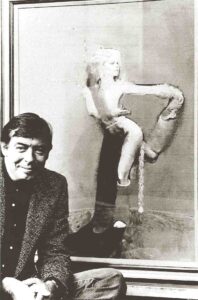
Toledo native Robert Heindel died in 2005. Photo courtesy Heindel Estate
The couple married shortly after high school graduation and they later moved to Akron. Shortly thereafter, they moved to the Detroit area, where Heindel put his modest training to work for an ad agency, drawing up advertisements for new car models that ran in print media.
But he wanted to go farther.
“I remember one day in the late 1960s, they lived in Detroit and were moving to Westport, Conn., and he said he needed an agent, someone in New York City that was privy to the illustrator world,” said longtime friend Jim Fisher.
“The next thing I know, a year or so later, his work is on the front cover of TIME magazine — and that was during the Watergate years!”
For TIME, Heindel sketched a portrait of Daniel Ellsberg, who released the controversial Pentagon Papers. He also sketched covers for Redbook and Ladies’ Home Journal.
Heindel knew, even as he was breaking into the commercial art world, that he wanted to eventually foray into fine art. But it wasn’t until Rose convinced him to join her at a ballet that he figured out how to get there.
Rose had always wanted to take ballet lessons as a child but her parents could never afford it.
“I wanted to go to the ballet and I remember saying ‘Why don’t we do this?’ and he did not want to do it,” Rose said. “He finally said ‘OK,’ and that was the beginning.”
International success
From then on, Heindel introduced himself to ballet troupes, earning their trust and spending hours watching the dancers rehearse, snapping pictures at just the right times.
“He rarely painted them in the performance,” recalled his son, Troy Heindel. “He thought that painting them while they were rehearsing was a more true reflection of the person because once they were out in front of the audience, guards went up and people were less exposed.”
Troy had two brothers: Todd and Toby. Troy said their images frequently made their way into his father’s paintings after long modeling sessions before a camera. But you’ll seldom see three boys together in Heindel’s renditions: He’d make Troy out to be the girl in the trio.
Heindel’s first big exhibit was in 1979, at the American Illustrators Gallery in Atlanta. The following few years he set up shows in Missouri, Texas, Washington D.C., California and Cincinnati. Then, in 1984, he made his big break in London at The Stables Gallery, followed by shows at The Royal Opera House and the Royal Festival Hall.
It was that show that landed him an opportunity to work with one of the theater’s most noted luminaries: Andrew Lloyd Webber. The composer saw his work at the hall and immediately asked Heindel if he would paint scenes from “Cats” and “Phantom of the Opera.”
Heindel’s resulting work is haunting: many of the Phantom pieces are laden with dark colors and
ghost-like figures that smear themselves across the canvas while leaving a heavy and frenetic afterglow.
A book called “Moving Pictures,” which celebrates Heindel’s life and works, describes Heindel’s “Jellicle Ball” painting as a “ferocious surge” from “Cats.”
“A mass of humanoid felines, cuddly and murderous, furry and psychotic, just baying for blood,” the book reads. “And that one pair of focused black eyes behind the marmalade hair, stares straight into yours. Stare back and you are lost.”
Heindel continued to paint ballet, garnering attention from the royal family in England, particularly as Princess Diana bought more of his pieces.
Rawlings said Heindel fans are drawn to the allure of his subjects.
“There’s a sexual charge in much of the work — it’s very subtle but it is there,” Rawlings said. “There are not many forms of art where you can legitimately go and enjoy bodies.”
But Heindel’s paintings took a turn when tragedy struck.
Somber paintings
His son, Toby, was diagnosed with cancer. He had been living in Los Angeles, working to become a movie director. He died in 1990 at 30 years old. Troy said his father’s way of working through the loss was to paint, and in his grief he created pieces that differed from much of his previous work.
“They’re very somber paintings,” Troy said. “One shows my brother’s head, and his beautiful face, and below the cancer is eating him up.”
Shortly after Toby’s death, Heindel helped design the set and costumes for a performance called “The Dance House,” which centered around the AIDS epidemic. The paintings portraying the performance are dark.
“The performance was sad … there are a lot of scary pictures in it that are about death and life,” Troy said.
But Heindel’s first major collection of work after Toby died consisted of paintings under the “Penguin Cafe” title. These paintings covered a ballet by David Bintley about endangered species. The dancers in Heindel’s pieces are wearing animal suits; one of his subjects stands off-kilter in a penguin suit, carrying a tray of drinks in a seemingly haphazard way. Another painting shows a human in a zebra costume blending into the back end of an actual zebra, twisting with pain.
Toby’s death also inspired the painter to call upon memories from a vacation to Africa that he and Rose had taken before Toby’s death. African wall paintings suddenly resonated with Heindel and he started creating his “Painted Wall” collection — his first and only images that were not born from dance or theater.
The “Moving Pictures” book quotes Heindel’s reflection on his wall paintings:
“The art is so primal, so basic to the human condition, that Toby’s death started to fit. They may look to the casual observer as mere decoration, but I hope people will recognize that there’s something more. I can’t stop painting figures, but I needed to paint these abstracts.”
Fear of rejection
Also somewhat different from Heindel’s typical ballet paintings are his depictions of noh and Kabuki, traditional styles of Japanese theater and dance. Some of these paintings contain no bodies or faces — just costumes and masks. These paintings were displayed multiple times in Tokyo and a couple of times in Nagoya. Members of Japan’s royal family purchased Heindel’s artwork, Rawlings said.
But, if you haven’t heard of Heindel, you’re probably not alone.
“He didn’t want to be rejected in his own country,” Rawlings said. “He couldn’t bear the idea of having a major show in New York City because he was so insecure in the fact that, in his home ground, he might get deflated and that is such a pity.”
Heindel hosted only one New York show and set up most of his U.S. exhibitions in California. During his initial shows in the states, he could never sell enough to make him feel as though he had succeeded, Rawlings said.
Heindel wasn’t out for the money; he judged success on sales because of his background in commercial art. When he started out, he could only make a living if he got his illustrations printed, Rawlings said.
The Rose stamp
Heindel died in 2005 after doctors diagnosed him with emphysema. Rose came home from running errands one day to find him inside his running car, within the closed garage.
“We had an amazing life,” Rose said. “He was on machines and he couldn’t work. He had to go around with oxygen [tanks] on his body and he just didn’t want to live like that.”
He was 66 years old.
Rose holds on to a number of her late husband’s paintings — especially the piece he completed after a trip to the beach. He took some photos of Rose walking in a wraparound cloth and later painted the image. This was one of his first pieces that wasn’t intended for commercial sale, she said.
Whether a painting portrays Rose, she is still present in nearly all of Heindel’s work in spirit. Heindel’s signature was a rose stamp, as a subtle symbol of adoration of his high school sweetheart.
Foreclosure cases are up in Lucas County compared to last year, but still below the record number seen during the recession in 2009, according to statistics from the Lucas County Clerk of Courts office.
As of July 10, there have been 1,553 foreclosure cases filed in Lucas County, 135 more than the 1,418 filed in 2011 by the same date.
“We’re up higher than we were last year already,” said Lucas County Clerk of Courts Bernie Quilter. “In 2011, we dropped to 2,946, which was great. We’re heading up a little bit, but we’re still not at the numbers we were at.”
The jump can be partially attributed to banks that have held off on foreclosing properties, but can’t wait any longer, Quilter said.
Lucas County saw a record number of foreclosure cases in 2009 with 4,160. There were 3,486 foreclosures in 2007, 4,093 in 2008 and 3,869 in 2010.
The 2,946 foreclosures filed in 2011 accounted for nearly 47 percent of the 6,273 civil cases filed in Lucas County that year. Foreclosures made up 51 percent of the civil cases filed in 2009 and 2010, 50 percent of the cases filed in 2008 and 47 percent of the cases filed in 2007.
Foreclosures make up 48 percent of the 3,207 civil cases filed so far in 2012. There have been five more civil cases filed so far this year compared to last year.
For Every Woman is a health initiative by Mercy. Photo courtesy Molly Luetke Datson.
Mercy has launched a program to unite women across Toledo in an effort to improve their health and spiritual well-being.
The program, “For Every Woman,” will start off on the Web with health pointers from the hospital’s nutritionist and physical therapist and will eventually grow out into exercise meetings at places such as Wildwood Preserve Metropark, said Andrea Price, president and CEO of Mercy.
“Women take on many, many roles: we are the mother, the daughter, the wife, the sisters, the counselors and even spiritual advisers and the list can go on and on,” Price said during a July 12 press conference. “We always talk about how do we balance, but it’s really not about balancing, it’s about juggling.”
This leads many women to neglect their personal needs, she said. Experiencing the juggling act herself, Price said she started thinking about the program about a year ago.
Mercy will use foreverywomanbymercy.org, (note: Website no longer active) Facebook and Pinterest to connect to interested women. The four areas that the program seeks to address are: stepping up exercise, strengthening work and life balance, enhancing spirituality and improving nutrition.
The program is free to users.
The idea is that a woman is more likely to engage in healthy activities if she is encouraged by a group of other women shooting for similar goals. And improving health doesn’t always have to mean logging endless hours at the gym, said Donna Copeland, a Mercy physical therapist. She offered a couple examples of small changes that might make a difference. These include parking as far away as you can from your destination to force yourself to walk more, pacing while you talk on the phone and doing jumping jacks during commercial breaks if you watch television.
The program’s kickoff took place at Wildwood Preserve Metropark.
“We recognize the importance of having not only a clean, balanced and protected environment but also recognize the importance of having a balanced, active lifestyle,” said Stephen Madewell, director of Metroparks of the Toledo Area.
The Town Center at Levis Commons turns into a beach July 13-15, 2012, for the second annual Sand-Tastic! Summer Festival.
Visitors can partake in live music, sand carving, inflatables, face painting, chalk art and other summer activities at the three-day funfest.
“Sand-Tastic! will offer fun for people of all ages. Kids will love the giant sandbox and clowns, while adults can unwind to the sounds of live music,” said Casey Pogan, marketing director for The Town Center at Levis Commons, in a news release. “The festival also showcases the talents of one of our area’s most accomplished sculptors, and allows amateurs to try their hand at sand carving too.”
Sculptor Chad Hartson and his team from Ice Creations plan to construct four 8-ton sand sculptures on patio areas around the center. Hartson and his team members will also present throughout Sand-Tastic! To try their own hand at sand art, eventgoers can play in a sandbox complete with shovels, pails and other tools.
The festival schedule:
July 13
Noon-8 p.m.: The sculpting team turns sand into masterpieces and the sandbox opens.
1-1:45 p.m.: Sculpting lessons/demonstrations in the sandbox.
4-7 p.m.: Sidewalk chalk artists.
6-8 p.m.: Live music by Groovemaster.
6:30-8 p.m.: Registration begins at 6:30 p.m. O 7-8 p.m.: Amateur Sand Sculpting Contest.
July 14
Noon-8 p.m.: The sculpting team turns sand into masterpieces and the sandbox opens.
Noon-2 p.m.: Craig Wise will present balloon-twisting on the boulevard.
1-1:45 p.m.: Sculpting lessons/demonstrations in the sandbox.
1-3 p.m.: Face painting by Tip-Top the Clown.
4-7 p.m.: Sidewalk chalk artist.
5-7 p.m.: Caricature artist.
6-8 p.m.: Live music by the Toledo School for the Arts steel drum band.
6-8 p.m.: Brodava Salon helps get your hair ready for the beach.
July 15
Noon-4 p.m.: Check out the finished sculptures and enjoy a final day of play.
For more information, visit the website www.shopleviscommons.com/.
Lt. Gov. Mary Taylor speaks at the Bowling Green Chamber of Commerce Mid-Year Meeting and Awards Program at Stone Ridge Golf Club. Toledo Free Press photo by Joseph Herr
Lt. Gov. Mary Taylor discussed Ohio’s economic progress, as well as the future of state’s health care and small businesses during a visit to Bowling Green on July 10.
Serving as the guest speaker for Bowling Green Chamber of Commerce’s Mid-Year Meeting and Awards Program at Stone Ridge Golf Club, Taylor addressed many key issues facing Ohio voters as they approach the upcoming election, mainly job creation and the Ohio government’s economic progress.
Most of her focus was on the current health care system throughout the United States and the passage of President Obama’s health care reform. After considering whether to implement a state-run health care exchange, Taylor said Gov. Kasich and his administration have decided not to pursue the option.
“At this point, we are not going to set up a state-based exchange,” Taylor said.
The governor’s office has until Nov. 16 to inform the federal government of any plans to start its own program or leave it up to the government to do so. In implementing a state-run health care exchange, Taylor said administrative and operative costs would range from anywhere between $30 million to $40 million a year, with no direct benefit to Ohioans due to the recent upholding of the health care mandate.
“Based on all the information we have available for us today, the reports we’ve done, the information that is scant out of Washington about how we are required to comply, we have made a decision that we do not think it is in the best interest of Ohio citizens to do a state-based exchange at this point,” she said.
Not only does President Obama’s health care reform impact individual households, but it also has an effect on small businesses. Taylor said for any small business that covers its employees through health insurance, premiums could rise anywhere from 5 to 150 percent, on top of the average increases that already take place.
Speaking as the director of the Department of Insurance, Taylor also expressed concern over the state’s the insurance industry, both as a means of job creation and as a means of health security for Ohio citizens. She said Ohio’s insurance industry is the 19th largest in the world, with 216,000 direct jobs in the field, as well as 270,000 agents and brokers, making a total payroll impact of $10.3 million.
“It’s a significant industry, one that is doing very well in Ohio; but, one that we’re very interested in growing and creating more jobs in the industry,” she said.
Going hand in hand with creating more jobs, Taylor is concerned with the future generations of Americans living under the weight of the heavy fiscal changes taking place. Thinking of her own family, Taylor said it is her duty to keep the prospect of the “American Dream” alive for all Ohioans.
“I have a 21-year-old and an 18-year-old son, and I know all of the opportunities I had here in Ohio and how important I have always felt to be able to achieve whatever it is I’ve wanted to achieve,” she said. “And I can commit to you today that I will do my part every day to make sure that every future generation of Ohio will have that same opportunity that I had.”
It started out as a sunny, sweltering summer day, an all-too-familiar scenario as of late. My children had friends over for the afternoon and we committed to inside play as temperatures threatened to hike their way up to the top of Mt. 100 Degrees.
By late afternoon, however, the weather gods had taken on an even more ominous tone of intimidation.
A few raindrops quickly boiled up into a fast and furious summer storm. Within a few minutes, the trees in front of our house were leaning at an awkward angle, decent-sized hail began to fall from the sky and our power was no more.
Despite the absence of tornado warnings, I decided to lead the little five-piece band of children at our house into the protective hollow of our basement for safety.
As we re-emerged from our zone of security, my son, Jack, quickly noticed a medium-sized tree branch, obviously out of place, sitting in the back corner of our yard. I peeked out for a better look and quickly discovered that our neighbors’ handful-of-trees yard now appeared fully forested due to a large, halved tree repositioned on its side.
Their grassy yard from earlier in the day had turned into a single chaotic vision of leaves and limbs. Whoa.
As it happened, my middle daughter, Laney, had knocked my cellphone out of commission earlier that day with the help of half a gallon of pink lemonade. I was actually rather
enjoying the day off from incessant beeping until I realized that, post-storm, we were now completely devoid of home-to-outside-world communication options.
Were my family and friends OK?
Were they wondering if we were OK?
Were we OK?
Each minute dragged on like an hour as I gathered my troops and quelled their morbid curiosities about our dire situation. Did this mean no TV? No Wii? No computer? Gasp! All we had left at that moment was whatever charge remained on our family’s lone iPod Touch. Still, no Internet capabilities. Alas!
We huddled together in group apprehension as we contemplated how we would ever manage to meet up with the outside world again. Do we go on foot? Do we go by car? Do we await a good knight in shining armor to stage a valiant rescue?
Ten minutes or so later my husband walked in from work, I snagged his cellphone and texted our guests’ mom to let her know that all was well. We then decided to indeed go exploring on foot.
The tree in our neighbors’ yard, which miraculously left anything of importance untouched, quickly paled in comparison to the tree that laid completely across our road about a block down. We ended up spending a good chunk of power-free time watching cars drive most of the way down our street, turn around and drive right back from whence they came.
There was no denying we had entered “Little House on the Prairie” mode.
We quickly learned that, electronic entertainment aside, there really is a lot to think about, or rather a lot we often don’t think about. Food without the ability to heat or cool, 100 degree days without air conditioning or fans, dirty laundry without the use of a washer and dryer and dark bathrooms with no light source were interesting pieces of the from-progress-to-primitive puzzle before us.
We also quickly realized how much everything we have ever learned is intimately tied to which era of modernization our world happened to be in when we entered
it.
Having that which has become second nature to us so quickly taken away leaves us, frankly, stupefied. I wandered around my house flicking light switches that I should have known wouldn’t work, “checking” a computer that wasn’t on and then, conversely, walking outside to wonder if my car would still function during the power outage. Having to switch gears is all very confusing at first.
Still, it can also be for the better in some respects. We enjoyed talking to neighbors as we all desperately sat in our hot cars trying to restore charges to our all-important cellphones and other miscellaneous devices. We spent time checking on family and even invading the homes of the “lucky” ones still running on electronic juice.
It was an eye-opening and not completely horrific 27 hours, yet I am fine living another five years or so in the metaphorical dark before I need another reminder of just how good I have it. Shannon and her husband Michael are raising three children in Sylvania.