Home Blog Page 249

Sharp: You decide

0

After eight years of a Republican president, two wars, the Patriot Act, financial meltdown,bailouts and uncontrolled government spending and borrowing, just to start a list, Americans wanted a new course. They wanted hope and change.

They elected President Barack Obama and they got expanded military action in at least three other countries (Libya, Yemen and Syria), the National Defense Authorization Act (NDAA), continued bailouts, more quantitative easing (printing money) and more government spending and borrowing, just to start.

Now we are told that our choices are four more years with Obama or to elect Republican Mitt Romney.

Both candidates are openly hawks on Iran. Both openly support the NDAA, which includes the indefinite detention of American citizens without trial. Both support drone strikes, which have been used to assassinate American as well as foreign citizens (though no kills yet on American soil).

Both would increase the deficit significantly, even projected over a large time span. Both have gained significant campaign contributions from Goldman Sachs, Citigroup and other bailout recipients. Both follow crony capitalism instead of free markets.

Both want federal control of health care (your body). Granted, the levels are slightly different. Romney calls for repeal and replace.

Both condone mass incarceration for nonviolent offenses that have led us to imprison more of our citizens than any other nation. A great portion of that includes incarceration for nonviolent offenses like marijuana, which 100 years ago would not have even been a crime and that many Western nations feel is a health rather than criminal issue.

Obama has admitted to marijuana and even cocaine use and says he supports the reform of drug laws, yet his Justice Department has conducted more raids on medical marijuana dispensaries than did the Bush administration.

So in states where the citizens have voted to allow their neighbors relief from chronic pain etc., Obama is using federal law and agents to stop and arrest them. Obama is using the IRS in a similar fashion.
Both candidates have similar immigration policies. Again, Obama talks one game and plays another. His administration touts a record number of deportations while Obama courts the Hispanic vote with the promise of gateways to citizenship. Both see gridlock as advantageous in blocking the opponent and yet see government as the solution.

Both parties like to divide us as it guarantees their election. They win and we lose.

Our future is evident across the Atlantic. California and Illinois will be our first Greece and Spain. Calls will come for more bailouts, printing more money (without regard to the inflation that must accompany it) and for more regulation. The insistence on raising taxes (only on the rich … to start), the need for more or continued wars to improve GDP output and to lessen the labor pool that causes social unrest at home are just the start.

We have become too good as consumers. We accept their marketing. We believe what they say and not what they do. We project our desires onto candidates and do not see how they are part of a bigger machine.

I have heard people complain about the loss of jobs, money and liberties and then they turn around and say they cannot support a candidate who will actually obey the Constitution or end corporate/government cronyism like the bailouts.

They say now is not the time to vote on principles like illegal detentions, drug reform, TSA at airports, the sale of raw milk, warrantless searches and seizures or the deficit. This I hear from both sides of the aisle.

Guess what? It is still the same aisle. An aisle doesn’t really have sides, just edges.

The time to vote principles, not party, is now. It has always been now. It is how we should have voted in the last election, the one before that and so on.

There are more than two viable candidates for president, not that they would let you know. It is up to you to do the research and find who actually supports your values. Then vote for them.

For me that ticket is Gary Johnson/Jim Gray, the Libertarian candidates. I have given you only a short list of how the two major parties are no different. Only their marketing makes them seem far apart.

We can continue to be good nonthinking consumers — to be led and be servants of the state — or we can be critical thinkers and act for ourselves, to lead and be citizens of the state. Where is America heading?
You decide.

Harley-Davidson hearse offers bikers one last ride

0

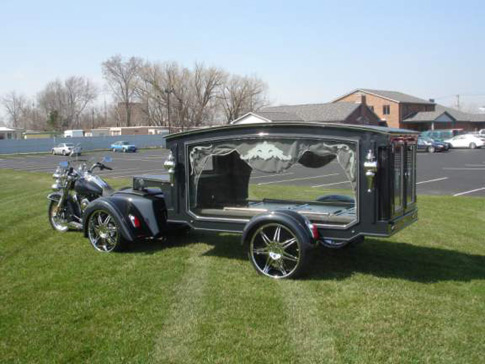
A local funeral home is giving motorcycle enthusiasts a chance to have one last ride in a Harley Davidson hearse.

Sujkowski Funeral Home Northpointe on Alexis Road bought a Harley Davidson three-wheeled motorcycle with a custom-made hearse trailer at the beginning of the summer, said Hilary Sujkowski, one of the funeral home’s owners. Sujkowski said he bought the motorcycle hearse from the Tombstone Hearse and Trike Company to give people a more personalized experience.

The hearse is made of fiberglass and steel in a design that Sujkowski calls “timeless.” He said he plans to keep the hearse in good condition so he can keep it for a long time just like the other cars used for the home. The motorcycle hearse costs $300 to use, which is the same price as a normal hearse at the funeral home.

The Harley Davidson hearse is offered by Sujkowski Funeral Home.

There are at least two motorcycle hearses in the state of Ohio and about 45 across the United States, said Clint Marlin, the president of the American Motorcycle Hearse Association.

Marlin, who has ridden motorcycles his whole life, said he started the organization to provide standards for motorcycle hearses. Although he is not in the funeral home or hearse profession, he was offended when he saw people using the vehicles for parties and other events.

“The reason we started the association is to promote legitimate, respectful motorcycle hearses,” he said.

Motorcycle hearses are not common, but they are gaining popularity, he said.

Families of police officers and firefighters who have died in the line of duty often choose to use motorcycle hearses, Marlin said.

So far, the Sujkowski Funeral Home has not used its Harley Davidson hearse for a funeral, but Sujkowski said he has been to different bike rides to promote it.

“Even the hard bikers appreciate it and give me comments on it,” he said.

Sujkowski said he expects more interest in the hearse once more people hear about it.

“I think a lot of people don’t know it’s here, but I think when people see it, it sparks a lot of interest,” said Jan Eckel, the funeral director.

Cope and Allegrini: Choose Freedom

0

Liz Cope and Scott Allegrini

The divisions facing America today are the greatest of our generation. At the core of this division is the question: Is man capable of ruling himself?

We, as a unified nation, have to answer this question, and determine the direction America will take and the country we want to leave to the future.
What do we mean by “ruling himself ”? Bythis phrase we mean the desire to control and  define one’s own destiny regardless of demographic. From the earliest age, to be encouraged to seek success and take pride in personal achievements. To govern the mind and body, rather than rely on another. To take advantage of equal opportunities, rather than expecting others to supply equal outcomes. To rely on self.

If we believe man is not capable of ruling himself, and does not desire these things, then from cradle to grave man will need a big government to provide for and, thereby, controlhim. Because when the government provides, it can also take away. When the government can take away something a man needs, or wants or values, he loses his independence.
Recently, President Obama, on his campaign website, introduced “The Life of Julia,” a slideshow portraying how Obama’s policies could help a woman throughout her lifetime. It began with Julia going to Head Start, then progressing through public school and on to college. The president ensures that she will get “birth control and preventative care, letting her focus on her work rather than worry about her health.”

The story goes on and on, telling us all the wonderful things that Julia can do, without worry, because of the numerous government programs that provide for her every step of the way. The implication is that none of these things would be possible without the government, and specifically, Obama.
But worse, the message is that Julia isn’t capable of doing for herself. She is deficient in some way, and needs constant care and assistance. The slide show does not, however, point out that government “help” also comes with real costs.
The U.S. is $16 trillion in debt and even if the rich were taxed at 100 percent of income, the bill could not be paid. And so, the burden will fall on the next in line — the middle class. The ones who pay for the programs but don’t qualify for them; the ones who say to their kids, “We can’t afford it,” but watch as debt after debt is piled on at the federal level.

This path for America is bankrupt both financially and morally, but under Obama’s vision, this is where America is headed.
Conservatives have a different philosophy.

Conservatives believe that man is capable of rulinghimself, and, like our Founding Fathers, believe that his rights consist of “Life, Liberty and Pursuit of Happiness,” not excessive entitlement programs. We believe many Americans are afraid to try, because they are afraid to fail.

But failure is the greatest teacher. Thomas Edison failed while inventing the light bulb hundreds of times, but each failure was a lesson that brought him one step closer to success. Apple has invented and launched numerous products that have flopped, only to learn from those failures and go on to create global winners like the iPod and iPad.
We also believe that some Americans do not choose to try, because they don’t have to. With the big government programs we have today, and more on the way, there is little incentive. What would you rather do? Struggle, do without and work long hours while you invent a product or launch a new business, or collect a check?

If you replaced the word “government” with “parent,” what would you want your kids to do? Sit on your couch and eat the food you worked to provide, or get a job and pay for their own lives?
Following the belief that man can manage himself is the desire for limited government.
Like a meddling in-law or controlling parent, too much government is oppressive. Some government is good and necessary, such as police and fire forces, or military for national defense and border patrol, but other interventions, such as health care, need to be weighed carefully before they become an obstacle to freedom.
This November, Americans have a choice: the government-run “Life of Julia” or the personally managed life and destiny. A government “of the people” and “for the people” that rewards self-reliance, or a government of entitlement?

We choose freedom — freedom to build our lives with our own hands; freedom that encourages individuals to become anything they dare to be. And this is the America we hope others will choose and our future will inherit.

Baumhower: Sunday mornings get grayer

0

In a world of corporate radio, syndication and voice tracking, Suzanne Carroll is a beacon of light. Her irreplaceable energy has been filling Toledo’s homes for the past 17 years on Sunday mornings with her “Jazz Brunch” heard on 101.5 The River. On Sept. 9, Carroll shocked and saddened her audience when she announced she was taking a five-month leave of absence for health reasons.

Carroll is the not your normal everyday radio personality type and her “Jazz Brunch” is not your typical show, but don’t tell her legions of loyal listeners — they already know. Her soft voice and genuineness has made her a Sunday morning staple for many in Northwest Ohio.

Want to know the key to and greatest part of Carroll’s longevity? She pays for her time on the air. Not only is Clear Channel getting a top-notch, authentic jazz show, it is making money on top of it. Her 17-year arrangement allows her to sell her own advertising and this is where her true talents shine. Carroll is one of the very best at promoting, supporting and endorsing those businesses that have stood by and financially supported her show all these years, with sponsors that include Yark BMW, Jamiesons Audio/Video and The Optical Shop. Carroll proudly boasts that “‘The Jazz Brunch’ is The River’s No. 1 client.”

The “Jazz Brunch’s” last day before the five-month hiatus will also be the show’s 18th anniversary. This was not by accident, as Carroll is a big believer in meaningful dates and karma. In fact, an even bigger anniversary occurs the very same day she has planned her return. March 17, St. Patrick’s Day, will mark 19 years since Carroll was diagnosed with multiple sclerosis and that is the very day she plans to relaunch her “Jazz Brunch.”

“Starting ‘The Jazz Brunch’ just months after my diagnosis with MS has been an amazing thing. Interacting with the music and our community over these bumpy health years has lifted me up and carried me through some very difficult times. I am sure these years would not have been the pleasure they have been without ‘The Jazz Brunch.’ I am looking for that to continue in the Spring,” stated Carroll via Facebook.

Carroll and I had worked together for a couple of years before she brought David Lander, aka Squiggy from “Laverne & Shirley,” into 1370 WSPD’s studio in the early 2000s to promote an upcoming MS event on the “Mark Standriff Morning News Show.” I had no idea that she was battling MS, or any disease; it floored me. When people dream of Sunday mornings, they often think of sunny, blue skies and warmth. This is the way Carroll had always been in the hallways of Clear Channel. I had no idea of the struggles and battles she was privately fighting, nor could I.

During a recent phone conversation, Carroll promised me that the “Jazz Brunch” will return. I made her promise. I never asked, nor wanted to know, what health scare could possibly keep this woman from her show, especially for five months. So if you are one of those who pray, I please ask you to think of her.

In a business filled with narcissists, egomaniacs and the mentally ill, Carroll’s absence on air and behind the scenes will be felt. Her upcoming five months of silence will be deafening.

On a personal note, Carroll was the person who made it “OK” in my mother’s eyes for me to work in radio. The very fact I knew and worked with her made my very low-paying job all right. For the past 17 years, Carroll’s voice has been the backdrop of my Sunday morning visits with my parents — my mother rarely misses a show.

Until St. Patrick’s Day, get well soon and hurry back.

Local author pens Heisman biography

0

At least once a week, John M. Heisman is asked if he is related to the legendary football coach.

“I’ll go to a checkout, plop my card down and [the clerk] will say, ‘Oh, Heisman. Like the trophy.’ About 50 percent of the time, they’ll say ‘You’re not related, are you?’ Then I have a decision to make. Do I lie and say no or do I tell the truth and, if they are a sports fan, get into a time-wasting discussion? If I got back all the time I’ve spent answering that question, I’d have another year of my life.”

The answer, of course, is yes.

John W. Heisman, for whom the Heisman Memorial Trophy was named, was the Toledo resident’s great-uncle. The trophy is awarded each year to the nation’s most outstanding college football player. Heisman has spent the past several decades researching and writing a book about his relative.

John M. Heisman of Toledo wrote a book about his great-uncle, John W. Heisman, for whom the Heisman Memorial Trophy is named. Toledo Free Press Photo by Sarah Ottney

“Heisman: The Man Behind the Trophy” will be published Oct. 2 by Simon & Schuster. The book was co-authored by ESPN’s Mark Schlabach with a foreword by University of South Carolina coach Steve Spurrier. A prerelease book-signing is set for 2-8 p.m. Oct. 1 at the Ward Pavilion at Wildwood Metropark, 4830 W. Central Ave.

“One of the things we tried to bring out in the book was the fact that his innovation created the American college football game as we know it now,” Heisman said. “There were other contributors — we’re not taking away from them — but he was a catalyst at a critical time in its development.”

Spurrier, who won the Heisman Trophy in 1966, said he was surprised to learn just how much Heisman contributed to the sport.

“Among other innovations, Heisman introduced the center snap, audible ‘hike’ signal, hidden ball trick and lateral passes,” Spurrier wrote. “Much of what Heisman invented nearly 100 years ago is still very much a part of the game today, which is quite remarkable.”

The book was also endorsed by a dozen other Heisman winners, including former University of Michigan receiver Desmond Howard, who won the Heisman in 1991.

“As recognizable as the statue is, many do not know the storied history of the man it was named after,” Howard wrote. “This book explores the life of a legend.”

Coach Heisman played football for Brown University and the University of Pennsylvania, from which he graduated with a law degree.

“He was going to be an attorney, except for an injury to his eyes that kept him from reading for long periods, so he went to his next love — or actually his first love — which was athletics and football,” Heisman said.

His first coaching job was at Oberlin College in 1892. Heisman also coached at Buchtel College in Akron (now the University of Akron), the Agricultural and Mechanical College of Alabama (now Auburn University), Clemson College (now Clemson University), Georgia Tech, which he led to a national championship in 1917, the University of Pennsylvania, Washington & Jefferson College and Rice Institute (now Rice University).

Grades and character were just as important to the coach as playing ability, Heisman said.

“If they used profanity, he pulled them out of the game and sent them to the showers. They were done,” Heisman said. “He expected them to be gentlemen first, football players second.”

Heisman never met the coach, who died before he was born, but remembers a visit from Heisman’s wife, Edith. He grew up listening to his father talk about Heisman, whom the family called “Uncle Bill,” after his middle name, William.

“When Dad wanted to give a lesson in character, I heard a story about Uncle Bill. When he wanted to impart a story of manhood, I heard a story about Uncle Bill. When he wanted me to understand good sportsmanship, scholastic effort or gentlemanly behavior, I heard an Uncle Bill story,” Heisman wrote. “These stories were effective, entertaining and always hit the mark.”

The coach died in 1936. When his wife died in the 1960s, the coach’s personal effects were passed to Heisman’s father. Heisman started going through the papers in the 1970s, but stopped to marry and raise a family before beginning work again in earnest in 2003.

“I went through his trunks and put it all together. It took decades,” he said. “It’s so very surreal [to be finished]. I don’t know that my psyche has allowed me to acknowledge it yet. It feels like I’m still working. I haven’t really slowed down to enjoy this yet.”

Heisman played football for Genoa High School in the 1960s, where he said he was “outstandingly average,” and then played rugby at Ohio State University, experiencing a game much like the college football his great-uncle knew.

“It gave me an appreciation for where the sport came from,” Heisman said. “If you take away Heisman’s contributions, you basically have an orphan-child blend of soccer and rugby … and basically without the fan base we have now. It’s not the game we have now, not anywhere close.”

Heisman said the most surprising thing he learned was how active his great-uncle was in theater — regularly acting in plays as well as managing an acting troupe during the offseason.

“For years he actually made more money on stage than he did coaching,” Heisman said. “He was very shrewd and quite an entrepreneur. This guy went out, sized up opportunities and seized them. That was reflected in his coaching, in his acting and in how he went into communities and picked up sports columns and wrote for newspapers. He was sort of a Renaissance man.”

Although Heisman doesn’t usually attend the ceremony, he said he has become good at predicting the winner.

“I’ve been able to call it for the last several years, probably the last decade,” he said. “There’s only been a few surprises.”

He’s also met many of the winners.

“It would be easier to tell you the ones I haven’t met,” he said.

One of his most memorable interactions was with quarterback Tim Tebow, who won the Heisman in 2007.

“Tim looks you right in the eye. He’s very genuine. He wants to know what you have to say,” Heisman said.

Heisman was 12 years old the first time he saw a Heisman Trophy.

“It was pretty neat, but I’ve never been in awe of it because, if this is a memorial, then basically I’m looking at a tombstone,” Heisman said. “That’s the way I’ve always looked at it. It’s too bad everyone has forgotten what the memorial is for and who they are honoring.”

Heisman said he hopes the book sheds light on the history of football and the man behind the trophy.

“It’s going to give a depth and a richness to the heritage and the tradition,” John said. “I want people to understand a sense of history, a sense of the fact that this game we take for granted was basically a sandlot game back in the day.”

Heisman also hopes the book will clear up his connection to the coach.

“Hopefully I won’t be stopped at stores anymore and asked about my name,” Heisman said, smiling. “That’s my personal reason for writing this.”

For more information, visit www.coachheisman.com.

Barhite: Social media guru wants Toledo to be ‘benchmark’

0

The hiring of Toledo’s new digital and social media specialist took some by surprise. LOL

But it shouldn’t be surprising this newly created position went to Andrew (Aj) Rinaldi who has worked part time for the city in the past. OMG

For his master’s degree research, Rinaldi studied three municipalities using social media to engage citizens.

He hopes to use that research to shape a social media strategy for Toledo.

The Bowling Green State University graduate talked with me via email (how appropriate) after starting his job in September.

“I have a passion for what I do with social media and the City of Toledo, and I bring with me relationships with other cities who are willing to partner and help with our social media efforts and the knowledge of best practices to ensure we are successful right out the gate,” Rinaldi said.

His goal is for citizens, media and employees visiting Toledo’s social media and website to get information about what the city is doing before they get it from other resources, he said.

Rinaldi has been on Facebook since December 2004, just 10 months after the social media site was officially launched.

His first tweet was in July 2009, with his current Twitter handle, ajrinaldi.

“The inspiration was to keep it easy and simple enough for a person to remember and professional,” he said.

This practical guy has 484 Facebook friends, which demonstrates he is rather selective. But he tries not to take himself too seriously. For instance, he hasn’t untagged himself in any pictures he finds embarrassing or unprofessional.

“I was out with a few friends and we decided to go dancing. A couple of friends thought it would be funny to snap a picture of me and post online and tag me without my knowing till after it was taken,” he said.

Rinaldi said there are a number of contenders for the next big thing in social media. Google+ is still new and he expects to see more creative platforms like Pinterest and Instagram.

He also anticipates a platform to merge all social networks into one stream. He just started using Glos.si, which is a living magazine for social networks.

These new platforms could eventually be intertwined into Toledo’s social media strategy.

“I would like Toledo’s social media to become a benchmark, where other cities want to come and see how we do it, to learn and improve their social media,” Rinaldi said.

Children with progeria show improvement from drug trial

0
Carlee Kudzia and Kaylee Halko. Toledo Free Press photo by Joseph Herr.

The Halko family of Monclova Township was happy to hear the news: Results of the first drug trial for children with progeria showed improvements in weight gain, bone structure and the cardiovascular system.

Kaylee Halko was one of 25 children with the rare, rapid-aging disease who participated in the study from 2007-09.

“I have not heard just Kaylee’s results. But as her mom, watching her, I think she’s doing good,” Marla Halko said. “Just seeing her every day, she doesn’t slow down, she doesn’t tire; I think she’s doing well.”

“I was glad the results were finally released. People have been asking us for a while, and we weren’t allowed to say anything,” said Tim Halko, Kaylee’s dad. “We could tell though that the drug was helping.”

The results were published Sept. 24 in the Proceedings of the National Academy of Sciences. Funded by the Progeria Research Foundation, the study was conducted by researchers from Boston Children’s Hospital and the Dana-Farber/Children’s Hospital Cancer Center.

“[The initial drug trial was] a wonderful first step. It’s not a cure, it’s one treatment and it helped certain things and it didn’t help others, but it’s the first of hopefully many, many wonderful successes with other drug trials,” said Audrey Gordon, president and executive director of the Progeria Research Foundation, a nonprofit organization dedicated to discovering treatments and a cure for the fatal genetic condition.

Kaylee and the other children in the study were treated with a farnesyltransferase inhibitor (FTI), a drug originally developed to treat cancer.

“To discover that some aspects of damage to the blood vessels in progeria can not only be slowed by the FTI called lonafarnib, but even partially reversed within just 2.5 years of treatment is a tremendous breakthrough because cardiovascular disease is the ultimate cause of death in children with progeria,” said Dr. Leslie Gordon, lead author of the study, said in a news release announcing the trial results.

In 1998, Gordon learned her son, Sam, had progeria. After finding out there was no research being conducted, she and her sister, Audrey, and family and friends founded the Progeria Research Foundation. Gordon is the medical director of the foundation and a staff scientist at Boston Children’s Hospital and Harvard Medical School.

Since 1999, the foundation has discovered the LMNA gene causes progeria; established a test to determine if children have the disease; started a cell and tissue bank; and raised funds for two drug trials and are planning a third study.

“To go from nothing to a drug treatment in 13 years is the kind of progress that we need for these kids because we are in a race against time,” Audrey said.

Children in the first drug trial showed improvement in at least one of three areas: weight, bone structure and the cardiovascular system.

Researchers found that one in three children posted a greater than 50 percent increase in annual rate of weight gain or switched from weight loss to weight gain due to increased muscle and bone mass.

“Children with progeria have highly abnormal bone structure, and we believe this contributes to their bone fragility. So for the children that could be tested, that severely abnormal skeletal rigidity achieved normal level overall with treatment,” Audrey said.

Arterial stiffness, often a predictor of heart attack, stroke and atherosclerosis in those aging, decreased by 35 percent, according to the study. Vessel wall density also improved with treatment.

“This really does give true hope to the families, to others and perhaps the more general population, but we’re really excited for the courageous families that are out there helping with these trials and being ready, willing and eager to participate in future ones,” Audrey said. “This is wonderful news, but we’re going to keep on going.”

The foundation plans to launch a third drug trial with rapamycin, which decreased the disease-causing protein progerin by 50 percent in mice, according to a 2011 study published in Science Translational Medicine.

“To see [the results] on paper and just with the treatment being successful and knowing that the third trial is coming up, it really gives me hope that it’s going to be successful as well, and it’s one more step to actually getting the FDA to approve the trial,” Marla said.

The Kudzia family of Whitehouse is waiting for the third drug trial to start; Carly, 2, is set to participate.

“It’s proven now that there is a treatment that provides a benefit for kids with progeria,” Heather Kudzia, Carly’s mom, said. “It’s not a cure, but I would say step one, check. Now give me some!”

“We’re very excited about the next trial. The doctors and researchers have come a long way,” Tim said. “Our hope is that each new drug added helps prolong these kids’ lives until eventually a cure is found.”

Christ Child Society hosts shower to collect supplies

0
Members of the Christ Child Society with some of the gifts they collected for area children. Photo courtesy CCS.

“Nothing is too much to do for a child.”

The slogan of the Christ Child Society (CCS) is echoed by the more than 200 women in the Toledo area who have dedicated themselves to the welfare of children.

“In my five years with the organization, the most rewarding experience I have had was during our Clothe a Child Program,” said Membership Chairman Jane Larsen. “When I gave a young boy a brand-new winter jacket, it was one of the most satisfying experiences of my life and I will never forget his enthusiastic reaction.”

The CCS is a national volunteer organization that has spent more than 125 years serving children. The Toledo chapter was organized in 1990.

The Red Wagon Shower is one of the CCS’s annual community outreach programs. The CCS of Toledo will host its 10th annual member-only Red Wagon Shower event on Oct. 9 at Sylvania Country Club.

“The CCS signature red wagons will be used in loving memory of our founder, Mary Virginia Merrick,” said Director of Public Relations Kitsie Valiton. “The famous Red Wagon raffle will feature many items donated by generous area sponsors. Many of the wagons will be filled with fantastic items for the raffle and the remaining red wagon centerpieces will be filled with beautiful fall flowers.”

Members are encouraged to attend the event for lunch and to donate diapers for the organization’s layette program. A layette is a package of newborn essentials including clothing, blankets, diapers, toys, books and other infant necessities. The organization collects materials to make and distribute hundreds of these packages each year.

The Red Wagon Shower is one way CCS members’ help make a difference in the community, President Cecile Bennett said.

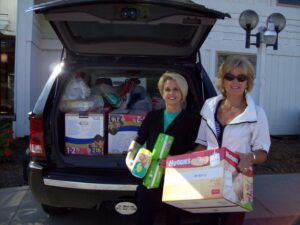
“Last year we were able to distribute more than 800 layettes to help mothers with newborn babies in many different hospitals in the Toledo area,” Bennett said. “Our last event collected mountains of diapers and it was enough to fill up five SUVs.”

Since its inception, the organization’s outreach has expanded to include educational programs to help address the needs of today’s children.

“With the help of more than 200 members in our organization, we are able to administer many different programs a year ranging from tutoring children to distributing layettes and winter clothing.  Working with CCS has been one of the most gratifying experiences of my life,” Bennett said.

The CCS has an annual informational meeting introducing the goals of the organization and discussing how to become a member. Following the informational meeting, the organization trains new members and gives them a preview into the work of CCS.

The Toledo chapter was recently recognized with two national awards: one for its program, “Parenting Today’s Kids,” and a second award for the greatest increase in membership.

For more information on becoming a member, visit christchildsocietytoledo.org.

Local ballet director is real-life ‘Billy Elliot’

0
Artistic Director Nigel Burgoine, back middle, and some of the male dance students at the Ballet Theatre of Toledo. Photo Courtesy Nigel Burgoine.

When Nigel Burgoine settles into his seat in the Stranahan Theater on Oct. 2 for the opening night of “Billy Elliot,” he will be watching a musical that eerily mirrors his own childhood.

Nigel Burgoine, artistic director of the Ballet Theatre of Toledo, grew up in England and started dancing at age 4. Photo Courtesy Nigel Burgoine.

At 58, Burgoine has enjoyed a diverse career as a professional dancer, choreographer, director, classical ballet instructor, dance advocate and artistic director of three Ohio ballet theaters. This is his sixth year as artistic director of Ballet Theatre of Toledo, a company established in 2006 by the dancers and parents of his Toledo Ballet students who wanted to keep Burgoine from leaving Toledo.

Burgoine grew up in Wavendon, a village of about 500 people in Buckinghamshire County in southeast England.

Like Billy, who is motherless at age 11 when the “Billy Elliot” musical begins, Burgoine began life motherless when his birth mother left him at the hospital only hours after giving birth. Three weeks later, he was adopted by Marjorie Brooks, a mother he said “worked herself stupid to take me to a private kindergarten when I was 4.

“Every week, she took me down to ‘Musical Movement,’ and this lady would play the piano. If the music was loud, we leapt around. If it was soft, you had to creep and hide.

“Well, the teacher said to my mother, ‘The moment the music plays, Nigel leaps around. We can’t stop him. You should really put him into dancing.’

“And my mother said, ‘I can’t even afford this private school. We can’t put him into dancing.’”

Burgoine said his childhood teacher intervened.

“‘I know the teachers at the ballet school,’” she said. “Let me have a word with them because they’re always looking for dancers, for boys.’

“So I went down there and I did skipping for two weeks. I just skipped up and down to see how the rhythm was. And then they started with dancing, and I didn’t stop.”

Nigel Burgoine, artistic director of the Ballet Theatre of Toledo. Photo Courtesy Nigel Burgoine.

From age 4 to 10, Burgoine studied dance and performed in festivals around England, the equivalent to dance competitions in the U.S., where he almost always won first place.

When he was 10, a member of the Buckinghamshire County Council who was friendly with Sir Anton Dolin, England’s leading dancer at the time, invited Dolin to watch Burgoine dance.

“I had been auditioned to go and dance at the Princess Grace School of Ballet in Monaco,” Burgoine said. “And he came and saw me and said, ‘Nope. You’re going to go to the Royal Ballet School in London.’

“I auditioned and was accepted, and I left home, like Billy Elliot did, at the age of 11 and I was a boarder at the Royal Ballet School from the age of 11 to 16. Then at the age of 17 and a half, I joined the London Festival Ballet.”

In 1965, when Burgoine left home, “all the governments wanted to make the arts something that people could do,” he said. “So I had a complete scholarship from the age of 11 to 17 at the Royal Ballet School, which was about $15,000 a year back then. Can you imagine?”

Children of the ’60s were no different than children today and Burgoine said he was often bullied growing up.

An English boy who danced ballet in 1965 was called a sissy, a poof and a pansy, Burgoine said, just like many American boys who dance ballet today are called “fags, or that sort of thing.”

“Yep. Yep. You’re gay. You’re a girl. You do what girls do. You’re not a boy like us,” Burgoine said.

“So you just have to learn to fight. It was like, ‘Fine. Let’s go outside and fight.’ And the minute it was over, you had another friend.”

Burgoine said although his current male students do get teased, the situation has gotten better than it was when he was a child.

“With television programs like ‘So You Think You Can Dance’ and all of that, it’s sort of making dancing quite cool now,” he said. “It’s gotten a lot better. I think it’s respected a lot more. But in those days, it was only ignorance.”

Burgoine said the bullying stopped when he returned to his village at age 17 as a professional dancer.

“When I can back, it was, ‘Oh, you’re famous now, aren’t you?’” he said.

Burgoine graduated from London’s Royal Ballet School in 1972 to become a world-renowned performer.

From 17 to 33, Burgoine performed as the principal dancer with the London Festival Ballet, dancing 26 principal male roles in 22 ballets. He also performed 21 additional roles in 19 ballets and made 15 guest artist appearances in 15 ballets in four international ballet companies.

His career has taken him to 57 cities in 16 countries on six continents. He has also performed on three television shows and in two films and has worked as a guest teacher at 10 schools in Brazil, England, Japan, New Zealand and the U.S.

“Billy Elliot” opens in Toledo on Oct. 2 with 8 p.m. performances through Oct. 6. The final two days of the show, Oct. 6-7, will have 2 p.m. matinee shows as well. The evening show Oct. 7 is 7:30 p.m.


Miller: Men vs. food

0

Overwhelmed with emotion, teary-eyed, I gently ran my fingers along the skin of my old ally.

“Goodbye, Old Friend,” I said, caressing and connecting for the very last time.

My stomach purred in response.

I lay back on the gurney, an IV needle embedded in my right hand.

I was sedated, holding my wife’s hand, just minutes from the surgery that would remove 85 percent of my stomach in an effort to control my dangerously rising weight.

The physician’s assistant asked what I did for a living, and when I told him I was an editor at a Toledo newspaper, he assumed I meant The Blade and began an enthusiastic monologue about reading the daily newspaper online. I did not correct him; it did not seem wise to piss off the man with the long needle.

My surgeon stopped by the curtained area and asked, “Ready to rock and roll?”

I said I was, but inside, as the sedatives took effect, I felt more like a light waltz.

I was wheeled into the operating room and transferred to the main table. The anesthesiologist leaned over me with a mask and lied, “I’m going to give you some oxygen.”

I nodded and glanced at the large TV with my name and case details on the screen.

It was 10:02 a.m. Sept. 18.

Baby steps

The journey to bariatric surgery began Jan. 3 with the first of six monthly visits to my primary care physician, or “doctor,” as I call him. Each of the visits focused on my progress, or lack thereof, with breaking bad habits. Fast food, carbohydrates, soda, a sedentary lifestyle. Between those visits, I worked with clinicians at the University of Michigan Adult Bariatric Surgery Program. This included visits with nutritionists, physical therapists, support groups, chat rooms with former and future patients, psychiatrists and more doctors.

There are three main options for bariatric surgery. It is a huge decision, and being immersed in the culture for six months, often with mandatory spousal attendance, helped me prepare mentally and begin making necessary changes.

As described by the UM program, “LAP-BAND Surgery, also known as laparoscopic gastric banding, is a restrictive surgical procedure whereby the size of the opening from the esophagus to the stomach is reduced by a silicone band, decreasing the amount of food that can be comfortably eaten.”

The most drastic option is “Roux-en-Y gastric bypass: First, the surgeon creates a small stomach (permanently reduced to an egg-sized pouch) to restrict food intake. Next, a Y-shaped section of the small intestine is attached to the pouch to allow food to bypass the lower stomach, the duodenum (the first segment of the small intestine), and the first portion of the jejunum (the second segment of the small intestine).”
So the LAP-BAND is the least invasive and is technically reversible. The gastric bypass is common, but all that rerouting made me nervous. I also did not like the idea of my disconnected stomach slowly atrophying in my abdomen for the rest of my life. Like Goldilocks looking at two extremely opposite options and seeking a middle ground, I gravitated to the sleeve gastrectomy.

“Gastric Sleeve Resection is a restrictive form of bariatric surgery that helps with weight loss by limiting food intake and controlling hunger sensations. The procedure calls for removing about 85 percent of the stomach, while keeping both ends of the stomach intact.  It does not involve cutting or rerouting the small intestine and it does not require an implanted weight loss device.”

Choosing sleeve surgery would mean more work for me, but I wasn’t looking for a panacea, I was looking for a tool to help me turn my personal Titanic around.

To accomplish the surgery laparoscopically, with six small incisions instead of one big abdomen slice, I was required to lose enough weight to shrink my liver down so it would not be an obstruction during surgery. I was supposed to embark on a 14-day liquid diet, but I’m an orderly man, so I chose to start Sept. 1. That would give me four extra days and an easy way to keep track of the liquid diet. That daily diet consisted of three 8-ounce, sugar-free, high-protein drinks, with between-drink small servings of oatmeal, nonfat yogurt and sugar-free mini pudding cups.

In other words, I was consigning myself to the Gulag, not just for 18 days before surgery, but for the four weeks following it as well.

The Goodbye Tour

Knowing that tremendous sacrifices awaited, I decided to say goodbye to my favorite foods in style. I asked three of my closest friends, all of whom enjoy a good repast as much as I do, to join me on my Goodbye Food Tour.

We started at noon Friday at Tony Packo’s, enjoying the multiple Mother of All Dogs for the final time. That afternoon we went to Rave Cinemas at Levis Commons to see a movie and enjoy one last feedbag bucket of movie theater popcorn with a depth-charge size soda. For dinner, we visited Fricker’s for a plate of my favorite deep-fried, honey barbecue chicken wings, with curly fries and more soda.

I went to bed overfull but determined to soldier on.

Saturday started with an early breakfast at a local diner, with a skillet full of scrambled eggs, hash browns, a number of selections from our pal the pig and a pile of shredded cheese. Lunch was at Burger Bar 419, where we shared fried cheese and some of the best gourmet cheeseburgers in Toledo.

After another movie (with another bucket of popcorn and another large soda), we went to Five Guys Burgers and Fries in Rossford for another version of my favorite burger. I knew I was slowing down when I did not finish my fries. Nonetheless, we traveled to Mr. Freeze for a large turtle sundae, which should be the final ice cream I enjoy, on that scale, for the rest of my life. After a few hours, we met at Buffalo Wild Wings on Central Avenue, for a last round of appetizers and chicken wings.

For the first time in my adult life, I left the table with uneaten wings on my plate.

Sunday morning was a last order of our neighborhood bakery’s best doughnuts. A late lunch took place at Olive Garden, with an endless pasta bowl order that ended midway through a third bowl.

There were still days before Sept. 1, but I used those days to start getting used to the protein drinks, with one solo goodbye stop each day during the week: The Blarney Irish Pub, McDonald’s, Spaghetti Warehouse and Wendy’s.

I will spare you those gastronomic details.

That left Friday, Aug. 31, as an opportunity for one final meal. That night was reserved for my wife and me, and I knew where I wanted to go: Final Cut at the Hollywood Casino Toledo. Not only did a steakhouse date night appeal to me, I thought the name was more than appropriate. And I knew exactly what I planned to order — the 64-ounce porterhouse, a cut of steak so big it comes with its own Final Cut dog tag, which I planned to carry with me as a talisman against the upcoming hunger and fight.

Every bite of that steak was exquisite. I lingered on the final cut as long as I could. Swallowed. Paid the bill. Went to bed knowing that the next 30-plus days would be the biggest challenge of my adult life.

The liquid diet

It turned out to be even more difficult than I expected. The 8-ounce liquid medical protein drinks, Unjury, come in flavors of chocolate, vanilla, strawberry and chicken soup. It would be easy to mock and deride Unjury, but it’s not the company’s fault. The drinks could have tasted like Willy Wonka’s Special Oompa Loompa Extract and it would still curdle under the heat of the resentment, despair and ravishing hunger I brought to the table. Each day for 18 pre-surgery days, as the rest of the world around me ate what it wanted, my self-exiled liquid diet had my betrayed stomach roaring like a lion with thorns in all four paws. Not consuming was one thing; not chewing was another. If I met my protein goals for each day I was allowed a few celery sticks or cucumber slices, but for a man used to eating cheeseburgers for snacks, every day was like a crawl through a desert.

The only solace was from my wonderful wife, who, in sympathy, went on the 18-day liquid diet with me. It was a major help to look across the table and see her grimacing as I did. I was moody, depressed, angry at myself and restless without meat, bread, pasta, potatoes, all of the glorious food I centered my life around.

But on Day Five, an interesting thing happened. I took that restless energy and began walking. Just a few blocks at first, then a mile, then two miles a day. We took long family walks with our young sons, spending an hour or so together on sidewalks, nature trails and park walking paths.

And while I did not at first see a difference, I started to feel … better. I quietly tried on one shirt size smaller and found it fit. Walking got easier. I still missed eating, but I did not feel as empty as I once did.

Throughout the 18-day diet, I intentionally stayed away from our bathroom scale, which wasn’t meant to weigh anyone my size. I believed it held only false promises.

So it wasn’t until the morning of the operation that I stepped on the hospital scale.

The end of the beginning

I weighed 380 pounds on Aug. 31. The morning of Sept. 18, I was down to 339.8 pounds, a 40-pound drop.

My smile was so wide, my Blade-loving IV inserter said I looked like I won the lottery.

I was wheeled into the operating room and transferred to the main table. The anesthesiologist leaned over me with a mask and lied, “I’m going to give you some oxygen.”

I nodded and glanced at the large TV with my name and case details on the screen.

It was 10:02 a.m. Sept. 18.

When I woke up at 2:30 p.m., I looked down to see six small incisions where 85 percent of my stomach used to be.

I tried to swim to consciousness, but kept falling back asleep.

The first words I heard were from a nurse, who was talking to another nurse. About me.

“His blood pressure is way up,” she said. “At 190. We’re giving him meds to try to get it down.”


Michael S. Miller is editor in chief of Toledo Free Press and Toledo Free Press Star.