Home Blog Page 248

Complaint against former Willard & Kelsey CEO associate in court Sept. 18; seeks return of property

0

The “concealment of assets” complaint filed by the estate of William R. Mitchell, former CEO of Willard & Kelsey Solar Group, LLC, returns to Judge Jack R. Puffenberger’s Lucas County Probate Court, Sept. 18, 2012, at 9:30 a.m. 

The case centers on James Muller’s claim that Helen Hart, of 2203 Glenview Drive, Maumee, and a former associate of Mitchell, has, according to Probate Court documents, “concealed, embezzled or conveyed away money, goods, chattels, things in action or effects belong to the estate” of Mitchell “in fraud of the rights” of Muller and others interested in the estate. Muller, Mitchell’s former stepson and the estate’s executor, is represented by attorney David Dennis. 

A second interested party, Willard & Kelsey, filed a separate case Feb. 13 in Combined Court (LaPlanta County District Court and Denver Probate Court) in LaPlata County, Colo. requesting repayment of $591,743 Mitchell owned the firm at the time of death, July 26, 2011.  

The Colorado court document states that during his employment, Mitchell “took draws from” Willard & Kelsey and created “a receivable due to the company. Mr. Mitchell directed the accounting firm that he retained to show the [$591,743] he received as advances, and not income, obviously for the purposes of avoiding federal and state income taxes” on his earnings. 

The case is filed in Colorado since the estate was first established there. 

Muller’s complaint in Lucas County requested the court to order Hart to return property including a 2004 Nissan Armada SUV, three computers, jewelry, credit cards, living room furniture, two flat screen televisions, a pool table, two exercise machines, golf clubs, phones, and clothing. 

Of particular interest to Muller are the three computers, one of which allegedly contains proprietary information belonging to Willard & Kelsey that Muller acknowledged Mitchell smuggled out of the company after he was terminated, Oct. 10, 2010, with the intent of trading that information for payment he believed he was due. Muller further contends that The Blade published information it obtained after one of its reporters met with Hart after Mitchell’s death. 

In a email he wrote to The Blade April 25 and provided to the Toledo Free Press Aug. 6, Muller informed an editor and reporter that Mitchell died owning computers now in the possession of his “supposed girlfriend” and that Muller “understand[s] that she has leaked to you certain confidential information relating to the affairs of Willard & Kelsey Solar Group, LLC and Mr. Mitchell’s personal business that belong to” Mitchell. 

Muller informed The Blade the information may be the product of a privileged attorney-client relationship that Mitchell did not waive during his lifetime and that the estate is not waiving in his death. Muller claimed “your use of that information is illegal, a breach of ethical duties, and transgress[es] upon property rights.” Mueller email “demand[s] a return of all information you have that belongs to William Mitchell, and that you not use any information obtained from his computer for any further publications” without Muller’s authorization. 

Muller said he never received a response to his email, but that the newspaper refrained from publishing anything else after receiving his email about the information Muller alleges it obtained from Hart.    

The Blade did not respond to repeated requests for a response to Muller’s statements. 

Hart’s lawyer, however, denied that his client, who he said had been engaged to Mitchell for five years, ever provided information she gathered from a computer. 

“She may have spoken to The Blade, but she didn’t take any information off [their one jointly-owned] computer,” attorney Sol Zyndorf said. “She doesn’t know whether or not the computers contained documents from Willard & Kelsey, but she assumes they did. 

“If she did give the The Blade information, it was off the top of her head from [what she knew] having spoken to him. You know, she and Will used to talk.” 

However, Robon said it is reasonable to assume Hart took possession of the computers since she and Mitchell were the only two living at the Glenview Dr. address when Mitchell died, and it is equally reasonable to assume she turned that information over to the Toledo Blade. 

“Here’s the situation in a lump shell,” Robon said. “There was information alleged to be on the computer that Mitchell was trying to use to create a basis for a lawsuit. And the Blade got the information. OK?  

“Now, did The Blade pay his ex-girlfriend for it? Did she volunteer it? Did they somehow squeeze it out of her unknowingly? I don’t know. But that’s the only way they would have gotten that information …” 

Zyndorf, who has repeatedly denied that Hart provided anyone with any computer data, said once Hart received the Probate Court’s “Citation to Produce Assets,” two of the three computers were placed in Mitchell’s vehicle, located at Hudson’s Automotive, 6415 Angola Rd., Holland, along with Mitchell’s personal property that Zyndorf said Hart and her daughter discovered in the attic of Hart home three months after Mitchell’s death. 

“The truck went to Hudson’s,” Zyndorf said. “She had those documents [on his side of the jointly-owned computer] downloaded professionally, and they are in the truck. And the two other computers that may have that information on them have also been out there since November, 2011. His attorney knew the computers were in the trucks because I sent emails” with verifications. 

Zyndorf also said Hudson’s Automotive’s owner assured him that all the property can be picked up without paying the SUV’s 14-month storage fee.    

“They know,” Zyndorf said. “We told them. She testified in Probate Court. Everything is there in the truck, but we don’t know how long they’re going to keep the truck there. It’s well over a year. 

According to a tow order, which Mitchell did not sign, the SUV was towed from Hart’s Maumee home to Holland July 20, 2011, although Muller contends Mitchell drove himself to St. Luke’s Hospital in that same truck, July 23, three days before his death. Muller also contends that he has phone records of three calls from Hart’s home to the Maumee Police Dept. on July 26 documenting that the truck that was allegedly towed July 20 was in Hart’s garage July 26. 
Barhite: Early voting in Ohio creates ‘Election Month’

0

I prefer to vote on Election Day. Call me nostalgic, but it feels traditional to vote on the actual day prescribed for this democratic process.  

I also like to keep my options open during the entire campaign season just in case something is uncovered about an issue or my preferred candidate. 

But for those who can’t – or don’t want to – vote on Election Day, early voting is a becoming a popular option. 

Convenience voting is a newer trend that will likely become more accommodating. Scholars even suggest that all of America might eventually have an “Election Month.” 

This year, the Lucas County location for in-person early voting was in limbo until just recently. Finally, under a deadline from the Ohio Secretary of State, the Board of Elections selected the Summit YMCA, 1500 N. Superior St. 

Good thing, too, because early voting in Ohio starts Oct. 2 – 35 days before the Nov. 6 election. 

Who is eligible to vote early? All registered voters in Ohio can vote early, no excuse necessary. Just show up with proof of identity. If a person isn’t registered to vote, the form must be postmarked or received by Oct. 9. To get the form, go to http://www.sos.state.oh.us/. 

Those who want to vote early should note that voting hours aren’t always 8 a.m. to 5 p.m. For instance, people can vote from 8 a.m. to 9 p.m. Oct. 9, or 8 a.m. to 7 p.m. Oct. 22 through Oct. 26. Don’t forget that Oct. 8 is Columbus Day so early voting at the YMCA will be closed for the holiday.  

The hours are convenient for those who work later hours and need the extra time to get to the YMCA. Early voting also appeals to those who are disabled.  Kim McConnell, spokeswoman, for the Ohio Legal Rights Service, said her agency doesn’t advocate for or against early voting rights, but wants everyone to have an equal chance to vote. 

Many times those who are disabled need to make arrangements that some voters take for granted. 

“It enables them to arrange for transportation and for those who can’t wait in long lines, early voting helps them,” McConnell said.  

Absentee ballots are also popular options for those who worry about weather on Election Day, will be out of the country on vacation, serve in the military or just want to get their ballot cast so they don’t have to worry. Here are some important dates, according to the Secretary of State, to make sure votes get counted in this election: 

  • Sept. 22: Military and overseas ballots will be sent. 
  • Oct. 9: Voter registration deadline to vote in the Nov. 6 election. 
  • Nov. 3: Application for absentee ballots to be mailed, emailed or faxed must be received by the boards of elections office by noon. 
  • Nov. 6/Election Day. Military and overseas ballots must be signed and mailed by 12:01 a.m. 
  • Nov. 16: Military and overseas ballots for general election must be received by the Board of Elections.  

Mount Carmel gravestones in disrepair

0
Gravestones sit slumped or fallen at Mt. Carmel Cemetery in Toledo. Photo by David Yonke

Thomas Syzch has many relatives buried at Mt. Carmel Cemetery. 

“Both parents. Grandparents. Great-grandparents. Uncles. Aunts. Cousins.” 

He shrugs. “This my family cemetery.” 

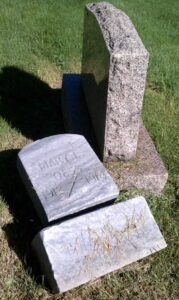
Syzch is hoping his loved ones’ graves don’t wind up like that of Mary Oess, whose short life began in 1912 and ended in 1914. Her simple gray tombstone, marked with a cross, is lying on its back beside another Oess family grave marker. 

Or like that of John Cook, who died at age 35 in 1887. His tombstone is lying flat on its back. 

Peter and Emilie Ettl’s dual gravestone is about foot off its plinth, bumped up against that of Maria Eggl. One marble gravestone has been tilted by the thick trunk of a weed growing between the base and the marker. 

More than three dozen gravestones are lying on their sides or backs or at odd angles in the rear southeastern corner of Mt. Carmel, Toledo’s oldest Catholic cemetery. 

Syzch, 43, who lives in North Toledo just a few minutes form the North Toledo cemetery, finds the disarray disturbing. 

“It shows no respect for the dead,” he said. “It makes me sick.” 

He said he his daughter Leslie, 20, visits her grandparents’ graves at Mt. Carmel every week, and Syzch often brings his 6-year-old son, Kadin, to show him the importance of paying respects to deceased relatives. 

It was on a recent visit with his son to the back corner of the cemetery that he came across the chaotic scene. He called the Toledo Catholic Diocese’s downtown headquarters to report the damage and was told that the diocese doesn’t have the funds to fix the grave markers. 

Syzch said he could not recall the name of person to whom he spoke, but he remembers telling the diocesan official that he does not expect the diocese to fix markers that are broken, only to pick up and put back in place the ones that are supposed to be upright. 

He acknowledged that some of the centuries-old gravestones could have broken off from their bases because they became brittle with age. And some of the oldest ones are on the side of a small hill, he said, where gravity and time could have pulled top-heavy markers off their bases. 

Someone had taken a stone cross that had snapped off its pedestal base and stood it up against the side of the monument. 

 “I understand they’re old. Some have been here since the 1800s. But this is just terrible,” Syzch said. 

Some of the gravestones are completely toppled and broken. Photo by David Yonke

But it’s clear, he said, that many of the fallen markers were knocked off their pedestals by lawnmowing equipment. He pointed to tire tracks that led directly to some of the fallen tombstones. 

“I used to work in lawn care and you can see where a riding lawnmower struck these,” Syzch said. 

Frank Cappiello, a family service adviser at Mt. Carmel Cemetery, said he is aware of the problem and told a reporter that the diocese is planning to fix all of the fallen tombstones. 

“They’re going to put them back on the pedestals,” Cappiello said. “They’re certainly going to fix that.” 

Cappiello said there is no timetable yet for the repairs. 

He blamed vandals, assuming that people scaled the four-foot chain link fence surrounding the cemetery and knocked over the tombstones. 

Located at Langrange Street and Manhattan Boulevard in Toledo’s Old North End, Mt. Carmel has long been the cemetery of choice Toledo’s Polish Catholics.  

One of three Catholic cemeteries in Toledo, Mt. Carmel was originally known as St. Mary’s and St. Francis de Sales Cemetery until it was renovated and consecrated as Mt. Carmel by Bishop Karl J. Alter in November, 1936.    

The contracts that family members sign with Mt. Carmel promise perpetual care of the grave sites, Syzch said, citing his parents’ burial papers.  

But with nearly 40 tombstones lying helter skelter around the grounds of Mt. Carmel, Syzch is reconsidering whether it will still be his “family cemetery” in years to come. 

“I told my daughter, ‘I don’t want you to bury me here if this is how it’s going to be,’” Syzch said. 

* * * 

David Yonke is the editor and community manager of ToledoFAVS.com, a website that provides in-depth, nonsectarian news coverage of religion, faith and spirituality in the Toledo area.  

Rusted Root to play Acoustics for Autism show in Maumee

0
Rusted Root was on the playlist for the Autism benefit by Project iAm. Photo courtesy Duane Rieder

To make “The Movement,” Rusted Root got creative — more creative than usual.
“[The forthcoming disc] was pretty much fan-funded. We had a campaign called Fortunate Freaks Unite, and we have a bunch of different packages from the website, and you can actually still donate at rustedroot.com,” said bass player Patrick Norman.
“And with the donations, you get various things, like you get your name on the credits of the album thank-yous. The packages range from that to we’ll come and play a show for you at your house if you want.”
Norman said it was nice to not rely on a record company and added, “We feel it’s a good way to reconnect with the fans, to help the fans feel more involved with the band.”
The Pittsburgh group has a reputation for fusing all kinds of music.
“We all are pretty much audiophiles. I’ve listened to music my whole life, and there’s no particular style of music that I’m into,” Norman said during a call from the Steel City. “It’s natural to take what you hear and what you are inspired by through life and listening to music and incorporate them in songs. A lot of times, it happens subconsciously.”
Rusted Root is best known for the song “Send Me on My Way” from 1995.

“It’s a really innocent song with a very positive message. And the fact that it was used in a couple of famous movies didn’t hurt, being on the soundtrack for ‘Matilda’ and ‘Ice Age’ was a really big thing because it keeps young fans coming,” Norman said.
“They’ll grow up and share it with their brothers and sisters, and they grow up and share it with their children or brothers’ and sisters’ kids; we’ve been very blessed to be part of some great art.”
The band — Norman, singer and guitarist Michael Glabicki, percussionists Liz Berlin and Preach Freedom, and guitarists Colter Harper and Dirk Miller — is on its way to Maumee, where it’ll play an Acoustics for Autism…Plugged In! show at the Shops at Fallen Timbers on Sept. 21. Doors open at 5 p.m.
Special guests will be Arctic Clam, Dave Carpenter and Kyle White. Tickets are $10 in advance at the Village Idiot, Doc Watson’s and Ye Olde Cock n’ Bull Tavern and $15 at the door. All proceeds will benefit Project iAm, a nonprofit organization that raises funds for local families with autistic children.
“Michael had done some solo shows with [Project iAm], and he introduced [the band] to the cause, and we jumped right on board,” Norman said. “It helps families with children with autism; it helps get them some money that they might need because there’s special needs for autistic children and some thingsthat most people wouldn’t even think about. And this way, somebody’s going to get a little bit of help directly.”

Project iAm founder balances work, music, philanthropy

0
Attorney Nicole Khoury founded and runs Project iAm and is a member of the band Arctic Clam. Toledo Free Press photo by Brigitta Burks

Nicole Khoury’s look reflects her multiple roles in the Toledo community.

She is wearing a classic suit — but her hair is streaked with blue.
Khoury has her own law practice and also works part time for the public defender’s offices in Sylvania and Maumee.

And when she isn’t working, Khoury is rocking out with her cover band, Arctic Clam.

Plus, she runs her own nonprofit, Project iAm, a charity that provides funds to Toledo-area children with autism for various needs.
“I love what I’m doing right now. This is a great time in my life. I can’t imagine changing anything, except maybe I’d like to sleep a little more than I do,” Khoury said with a laugh.
Khoury, a University of Toledo law school grad, grew up in Toledo’s South End with her three younger sisters. From the beginning, music has been
a big part of her life.
“My dad’s whole side of the family is vocally very talented. My dad was in a band his whole life. He’s an amazing guitar player, a great harmonica player. My mother’s side of the family sang and played the piano and choirs and everything like that. So from being born, I always say I knew about Jimi Hendrix before I knew about math,” she said.
The singer/guitarist began playing acoustics with Mick Mason since 2006, before getting more band members and officially becoming Arctic Clam in 2011. Music serves as Khoury’s respite from her busy work schedule.
“The law is so hard on the heart, and it’s so hard on your soul and the mind,” she said. “So you throw in something like music, that really balances it out and lets me go up and have a great time and lose a lot of energy and that stress.”
Still, Khoury emphasized how much she values her day job.
“If I didn’t love what I did though, I wouldn’t do it. I’m very lucky to love
my job,” she said.
Part of what made Khoury stick around Toledo is its criminal defense community, she said.
“It is amazing. You walk into another courtroom somewhere else and … it’s not the feeling you have here. Everyone really works together here,” she said.
Toledo in general has allowed Khoury to flourish.

“It would take a lot to pull me away because I’m not going to be able to move to a big city and make the money that I make in the time that I make it and be able to be a rock star and have a charity,” she said.
Khoury has big hopes for her city’s Downtown.

“I want to see more people living down here and once we get all this going, then the stores will start coming and we’ll start to have our own little mini-Chicago,” she said, adding that she believes that is the direction the city is headed.
“I would love to see Downtown what it is on a Friday or Saturday night or what it is after a Mud Hens game all the time,” she said.
Khoury is bringing Pittsburgh band Rusted Root to the Shops at Fallen Timbers for a Sept. 21 benefit concert.

Advance tickets are $11 ($15 at the door) and are available at http://aboutprojectiam.com/.

Khoury started Project iAm after talking with her best friend, whose child has autism, about the struggles families can face when it comes to finances.
“I don’t ever want a family not to get their kid tested or not seek a treatment,” she said.

Letter to the editor, Sept. 16. 2012

0

A message for TARTA and the city of Perrysburg

I consider myself an independent guy…if I’m being honest … probably leaning Democrat. 

But no matter my political affiliation I’m 100 percent pro Toledo and the “Burbs.”  That’s why I’m compelled to write this post after seeing the report that Tarta and the city of Perrysburg have opened up talks to at least continue service on an interim basis.  

I’m not going to take sides because I really can see both sides of this disagreement…citizens of Perrysburg feel there’s too much waste in TARTA and they are being charged too much for service.  This current agreement was struck during better economic times.  

On the other hand, we must look after our less fortunate in Northwest Ohio, even though they may be a minority in the “burbs”, without a loud voice or political clout.  We need reliable transportation to take these folks to jobs, Dr. Appointments and to shuttle people in and out of Toledo.  This is never going to be a profitable business but providing this transportation is just the right thing to do! 

TARTA already has the infrastructure already in place and a track record of getting the job done.  Let’s not bring in another company that’s going to have to re invent the wheel … and hope that they can get the job done. 

I suspect there are some Perrysburg city council members that listen to a little too much Right wing nut job AM radio… 

And I’m sure TARTA could find some ways to “cut costs” and lower the amount it costs to run the service to Perrysburg. 

We need “The Adults in the room” to take charge and figure this thing out…maybe even a person that doesn’t have a dog in this fight to mediate the negotiations.  I would even offer my services for free. I just want to see the best for our area and anyone looking at this situation, reasonable and without bias, would agree getting this deal worked out is best for our area! 

Andrew “Z” Zepeda 

Perrysburg

Miller: Remembering to remember

0

The 11th anniversary of the Sept. 11, 2001 terror attacks passed with little of the intensity the 10th anniversary produced. Th is is partially because the media loves nice, round anniversaries, and because time is doing what time does — taking the edge off the pain.
It is incumbent on those who understand the impact of that day — through the loss of a loved one, the loss of security, the loss of freedom — to keep some of the memory alive. Not as a historical artifact but as an active reminder of the evil men can do when ideology trumps humanity (as the Sept. 11 attack on the U.S. consulate in Libya fatally demonstrated).
During the immediate aftermath of Sept. 11, 2001, I corresponded with a man who was helping secure the Ground Zero site. That column is reprinted here, as a reminder that no matter how many anniversaries fade into history, we have a responsibility to honor the lost.
Monroe Mann at Ground Zero
Three hours after two planes struck the World Trade Center towers, Monroe Mann journeyed into Manhattan to find his sister, who had been stranded on a subway train. Mann, a lieutenant in the National Guard, wore his uniform, knowing it would give him broader access in the search. He found her, and after arranging to get her home, he walked to the site of the fallen towers and volunteered for the “bucket brigade,” the line of rescuers removing rubble, one pail at a time.
At breaks during his three-day ordeal, Monroe used armory equipment to email to me firsthand accounts of what he saw. The following excerpts are his unedited diary of events.
Wednesday, Sept. 12, 2001
I got a ride to the site with NYPD this morning. We stopped at the NFL headquarters. They were donating boxes of NFL caps, sweatshirts, windbreakers, pants, etc. for the relief effort. We went to the precinct and unloaded all the boxes of NFL gear.
I can’t believe it, but building 7 is still on fire, still smoldering. It was such an incredible sight to see the three fire hoses sticking out from the windows spraying the rubble from the adjacent building … yet their efforts yielded no positive results as smoke continues to pour up into the sky.
PLEASE, don’t read any more if you are awaiting news from your loved ones.
There aren’t likely any more people alive, though of course, we are hoping for miracles. We expect only bodies to be coming out in the coming weeks. Most of the buildings’ rubble has been pummeled many stories underground. We are still doing bucket brigades standing on TOP of the rubble, which in some cases, lies more than three stories up. The rubble goes six stories down.
Spray painted in red paint right on the side of the building right across from the epicenter: “Morgue full, new morgue two blocks south.”
It is so sickening. The new morgue is in the Brooks Brothers store. The new downtown police headquarters is in a Burger King.
Walking through the streets, I looked into a building that had a window crashed out, and found the feet of someone sticking out on a couch. I went in only to find it was NYPD, sleeping, collapsed from exhaustion. I am so glad he wasn’t dead.
In speaking with a cop, he told me that he had to leave and stop helping when he pulled a body out that was frozen rigor mortis with a mouth in fear, eyes wide open, and her hands covering her face.
“This is too much for me,” he told me.
We were helping in trying to pull another of the bodies out. It was stuck. In order to get it out, the doctor regrettably had to cut the body in half with a pocket knife. They pulled the torso off , and put his wallet in the body bag with it.
We’re standing at the end of the world.
Papers from the buildings are strewn everywhere on the ground … papers that must have seemed so important to everyone just days ago. I picked one up and read part of it, “Th is then marks the close of the deal. We look forward to doing business with you.” How sad. How terrible.
One restaurant is totally intact except for one window that was blown out. I went in to look around and on one table, found a bag of Skittles, open, with two left . Someone had been eating them. Someone had been eating them.
My friend, who worked at the WTC, didn’t have to go in on Tuesday. He was a tour guide there. He told me that if there’s a problem on the upper floors, they go to the roof and wait for a helicopter. He fears that the tour guide who took his place that day probably did just that, and went to the roof with those on the tour.
The church that is in the middle of lower Manhattan, in the epicenter of carnage, remains wholly unscathed. God is indeed with us.

Thursday, Sept. 13, 2001
I’ve been down at the Family Support Center, which is at the 69th Infantry Armory. I’m still on standby, and am waiting to soon be activated.
So many are walking around with poster board on their chest and back with pictures of their loved ones. Walking aimlessly around inside, aimlessly, aimlessly, aimlessly, aimlessly, aimlessly, aimlessly:
WHAT THE HELL ARE THEY SUPPOSED TO DO?
It is so sad:
“He’s my dad.”
“She’s my mother.”
“Those are my brothers.”
“My aunt.”
And it is so sad to still hear everyone talking in the present: IS IS IS IS IS IS. My mom is … my dad is … my sister is …
Even on the missing person signs that are EVERYWHERE,
“She IS wearing black shoes. She IS an employee of …”
I called my mom last night and she told me to come home.

She didn’t want me there. I told her I was fine, and I stayed the night until this morning. I didn’t think it was really affecting me.

But I’ll be honest. I really don’t want to go back there.
But the fact that I have access to the closed off areas tells me I should, because I know there are so many others who WOULD go if they could. But part of me wants to just stay home, for fear that I am going to soon be more knee deep into this than I could ever imagine.

Friday, Sept. 14 , 2001
I woke up this morning … I was so happy. I jumped out of my own bed, saw the sun shining through the window, and the first thing on my mind was to see what auditions were on for me today …
Then reality hit me like a brick: It wasn’t a dream. I am so sad. I wish this were a dream. I WANT to wake up and go back to my silly pursuit of acting, and shoot for that silly Oscar. I would like nothing more than to go back in time to the way things were. But I can’t.
I WAS THERE.

How many of you have seen the rubble, destruction, body bags, the crying families, the wandering weak?

YOU STILL HAVE NO IDEA WHAT HAPPENED! YOU STILL HAVE NO TRUE IDEA WHAT HAPPENED IN LOWER MANHATTAN!

Yeah, maybe I’m in shock, but it’s a shock to the reality of this situation.

Postscript: Mann has continued his writing and acting career. Follow his work at www.monroemann.blogspot.com. ✯

Michael S. Miller is editor in chief of Toledo Free Press and Toledo Free Press Star. Email him at mmiller@ toledofreepress.com.

Rathbun: 11 years later

0

This week was the 11th anniversary of the terrorist attack on American soil in which close to 3,000 of our citizens were murdered. As I reread some of the accounts and watched the documentaries on television I could not help but think about what the terrorists have done to this country since the attack. I know we have not had a similar attack since and I am thankful for that, but I can’t help but look at all of the costs, in terms of lives and liberty.

Dealing with economic issues all day every day I want to look back over the last eleven years to some important economic statistics. I took these statistics from zerohedge.com.

Silver has risen from $4.18 to $33.52. Gold from $271.40 to $1,731.00. Crude oil from $25.03 to $105.28. Corn from $89.74 to $332.17 per metric ton. Gasoline from $1.51 to 11 years later, $3.85 per gallon. Unemployment from 6.88 million to 12.5 million. Unemployment rate from 4.9 percent to 8.1 percent. Total government spending as a percentage of GDP from 33.05 percent to 40.27 percent. Number of people on food stamps from 17.85 to 46.7 million.

Now, there are few of these items that I can directly connect to previous terrorist attacks on the U.S., but certainly a significant part of the national debt can be attributed. The wars in Iraq and Afghanistan account for more than 1.3 trillion of debt. (Before anyone writes to me, I know that President George W. Bush is responsible for a large portion of this debt.) It is probably impossible to calculate all of the peripheral costs, i.e., TSA costs, airplane and airport regulations and hypersensitivity to any perceived threat like an abandoned grocery bag on the street corner.

As far as giving up my liberty, I don’t know where to start. We face Internet monitoring, street corner cameras, frisking and being X-rayed before flying, metal detectors in most office buildings in New York City and other major cities and everyone looking suspiciously at everyone else. This is not the type of society that is most desirable for me.

The past 11 years have been very good in many ways and very disconcerting on other ways. I rarely fly anymore because I feel the TSA routinely violates my Fourth Amendment rights. In my career there have been years where I would routinely fly 60,000 to 65,000 air miles. Needless to say, I am no longer a preferred flier with membership to the Sky Club.

The most disturbing statistics are for the cost of food and energy, unemployment and the number of people on food stamps and disability. All of these indicators tell us that the path ahead is going to be long and bumpy.

The question is, “What can we do now to move in a positive direction?” I think a lot will depend on the results of the election. The economy needs to go in a completely different direction than we are headed now.

Profit needs to be designated a positive term again as well as low taxes, self-reliance, and the greatness of America. Sept. 11 is a time to never forget and reflect on what happened then and why, but also to reflect on the time in between anniversaries.

The Sept. 11 tragedy brought out the best in the American people and a commentator on TV made a great statement when he said, “America may sometimes choke on a gnat but we can swallow a tiger whole.”  Never forget.

Gary L. Rathbun is the president and CEO of Private Wealth Consultants, LTD. 

Pounds: Rhetorical challenge

0

Toledo Free Press was recently approached by the organizers of the Northwest Ohio Conservative Coalition, which comprises the Children of Liberty, Perrysburg Patriots, Back to Basics and We By For. TFP has covered the group since its inception, with collaborations and contributions from Scott and Anna Allegrini, Thomas Berry, Robert Densic and others.

Anna recently proposed a pre-election “point/counterpoint” feature that would allow the conservative group and a liberal writer to explore election-year topics.

“In the tradition of Toledo Free Press being balanced, what if you offered a question or policy position for each week,” wrote Anna Allegrini. “The answer then would be given by two writers in their own philosophy and principle, thereby offering points for a voter to ponder before going to the polls in November. This would provide a stark contrast … and a personal one that moves beyond the political rhetoric and sound bites of the politicians and offers a local perspective from citizenry on both sides.”

Anna’s proposal led to a spirited email discussion about the definitions of conservatism, the role of local media and how such a series could educate voters.

As Densic offered, “This is the heart of the Tea Party movement. We have those who apply their talent and passion toward changing the bodies holding elected office, and we have those who apply their talent and passion to changing the hearts and minds of their fellow citizens. As it is obvious Scott, Anna and I are in the ퟀ�?change the hearts and minds’ long-term camp, we welcome the debate. We will be silent no more. We will rise up and talk about those founding principles of our nation. Why we have a Constitution.  Why we should learn from our history and the history of nations throughout time. Why we need to relearn and return back to the basic principles that made our nation great.”

There was really no question as to whom TFP would turn to take up the liberal side of the debate. Longtime TFP columnist Don Burnard has been silent for a while, but he has agreed to return to the debate and offer a contrasting viewpoint to the election’s most pressing issues. Readers should expect his no-holds-barred writing to more than rise to the challenge.

Toledo Free Press has always kept its opinion pages open to all points of view, and this new feature will provide intelligent, thought-provoking and civil commentary. Watch for its debut.


Thomas F. Pounds is president and publisher of Toledo Free Press and Toledo Free Press Star. Contact him at [email protected].

State texting ban focuses on younger drivers

0

Ohio lawmakers and police officers aren’t LOL-ing about texting and driving, especially when it comes to younger drivers. The state texting/driving ban, featuring harsher rules for those younger than 18, went into effect Aug. 31. The City of Toledo has had a ban since 2010.

However, the bans differ and it is up to police whether to charge drivers under the state or city code.

“Both laws are on the books so the officer has the option to cite under whichever code the officer feels is appropriate,” said Toledo Police Sgt. Joe Heffernan, adding that most officers are inclined to charge under city code. The city fine is $130. The state fines are up to $150 for adults and up to $300 for those younger than 18.

No officers will enforce the statewide ban during the six-month warning period, which began Aug. 31. After six months, officers can charge any driver younger than 18 for using any electronic wireless communication device outside of the ban’s exemptions. Texting and driving will be considered a primary offense, meaning the officer needs no other reason to pull the teen driver over. Talking on a cellphone is also included in the ban for the teens.

For drivers older than 18, the ban prohibits driving while using devices to write or read a text-based communication. However, texting while driving is a secondary offense for adults — meaning officers need another reason to pull texters over.

The Fremont-area state Rep. Rex Damschroder, who sponsored the bill that led to the ban, said he originally intended texting and driving to be a primary offense for everyone.

“My full intentions are to go back and revisit [the ban] in the next general assembly,” Damschroder said. A 16-year-old was texting and driving in Damschroder’s district when she crossed the centerline and killed a motorcyclist, he said.

Damschroder

Exemptions

There are also several exceptions to the state ban. Drivers younger than 18 can use their cellphones for emergency purposes and when their vehicle is in a stationary position and outside of the travel lane. Young drivers can also use navigation devices so long as they are hands-free or voice-operated and not programmed while driving.

There are 10 exemptions for adults, including using devices for navigating and hands-free texting. Adult drivers can also use their devices for emergencies and when their vehicle is in a stationary position and outside of the travel lane. They are also permitted to enter a name or phone number to make a call and to receive messages or navigation alerts regarding safety, emergency traffic, weather and the vehicle’s operation.

In Toledo, the city ban enables officers to pull over anyone they see texting as a primary offense.  However, in 2011, Heffernan estimated there were about four citations for texting and just one as of April 2012.

That may be because the ban has encouraged drivers to put down their phones, Heffernan said.

“One of the main values of the ban is the awareness part of the law, to get people thinking, ‘Wow, I used to do this, but it’s against the law now,’” he said.

Officers are also more likely to write citations for something other than texting. For instance, if a driver is texting and rear-ends someone, the officer would write a ticket for “assured clear distance.” The texting is also usually done by the time the citation occurs.

Joe McNamara, City Council president, said the lack of citations could be because the police are focused on other things and lacking in manpower.

“You enforce the dangerous things more vigorously than traffic issues,” he said, adding however, “It’s still a danger; it’s still a problem.”

Councilwoman Lindsay Webb voted against the ban in late 2009.

“There was a reason I voted no, because I thought the enforcement was sort of difficult,” she said, adding that the different city borders and laws could have made things tough.

Webb said at the time that she felt the issue needed to be addressed on a statewide basis. Now that it has been, “Hopefully, we’ll raise a new crop of drivers who don’t text and drive,” she said.

Drivers between 16 and 20 are traditionally the leading group in terms of fatal traffic accidents, said Lt. Anne Ralston of the Ohio State Highway Patrol (OSHP).

“Those are the most dangerous years without texting, but to throw texting in with a beginning driver, it’s just a real dangerous combination,” Damschroder said.

When Damschroder started his term, “I was kind of surprised to learn Ohio didn’t have a ban against [texting],” he said. “There is no way you can safely drive your car and take your eyes off the road and text. You just can’t do it.” Ohio is the 39th state to have a texting ban.

The representative had bigger hopes for his bill. “I can’t understand why [the Ohio Senate] would want to weaken the bill, but they succeeded,” he said, adding that maybe Senate members didn’t want to get pulled over themselves.

Personal freedom was one reason politicians gave Damschroder for not wanting a ban.

“[Texting and driving] infringes on the personal freedom of drivers coming down the opposite side of the highway, those Ohioans who expect the safest possible highway you can make,” he said.

Ralston said other distracted driving behaviors — from tending to a child to picking something up off the floor to eating —  also pose a threat.

“There’s a wide variety of things that can distract,” she said. From 2009-11 in Ohio, there were 31,231 crashes, including 74 fatal crashes and 7,825 injury crashes, that were caused by distracted driving, according to the OSHP. Numbers for how many accidents are caused by texting aren’t kept yet.

On average, sending or receiving text messages takes a driver’s eyes from the road for 4.6 seconds. At 55 mph, this is enough time to go over the length of an entire football field, according to the OSHP.

For more information, visit www.distraction.gov.