Home Blog Page 247

Pounds: Sarantou for Recorder

0

There are many difficult choices facing Lucas County voters on Nov. 6. Who should be elected Lucas County Recorder is not one of them.

Republican George Sarantou is the clear choice over Democrat Phil Copeland, and it has nothing to do with party affiliation; it has everything to do with experience, competence and what is best for Lucas County.

The recorder’s office is responsible for indexing and maintaining land records like deeds, liens and mortgages in addition to military records. Voters do not hear much about the office because it has been run smoothly and without controversy by Recorder Jeanine Perry.

Copeland, an at-large councilman since 2005 who decided to run because he will be termed out of City Council at the end of his current tenure, captured 57 percent of the March 6 Democratic primary vote to top James Seaman and Kevin Eff.

Copeland did not attend the Feb. 27 recorder candidate forum to tell the public what he would bring to the office. Prior to his primary victory, he told Toledo Free Press, “I want to go and be a part of it and I may have some ideas when I get in there.”

The recorder position is important beyond its modest level of public recognition; Copeland’s vague goals should be a red flag to informed voters. So should his choice to decline a public appearance at a forum at the Sylvania Branch Library, a nondebate event organized by the League of Women Voters, Sojourner’s Truth and Toledo Free Press.

Copeland’s pattern of not facing voters is inexcusable and should be one factor in costing him the office.

Sarantou is also an at-large councilman near the end of his term limit. Sarantou, who works for 212 Capital Group, cited his love of public service and experience.

“For the last 30 years, I’ve been in the financial services and I’ve handled thousands of documents,” he said. He also serves as Council’s financial committee chairman. Sarantou said he would continue the efficiency displayed by Perry and move forward to modernize the office with a focus on security.

Finances and organization are Sarantou’s strengths; he is clearly prepared to take the office and move it forward. The recent Toledo Free Press report that Sarantou has one of Council’s best attendance records, while Copeland has one of its worst, is another compelling reason to believe the office will be in better hands with Sarantou.

Toledo Free Press strongly endorses Sarantou for Lucas County Recorder.

Thomas F. Pounds is president and publisher of Toledo Free Press and Toledo Free Press Star.

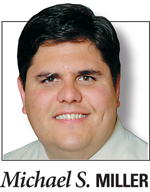
Michael S. Miller is editor in chief of Toledo Free Press and Toledo Free Press Star.

Forum discusses Ohio’s role in alternative energies

0

One Ohio Senate and three Ohio House of Representative candidates joined four area business entrepreneurs Sept. 25 to discuss their political positions on solar, wind, biomass, fossil fuel and nuclear energy projects. These projects were offered as solutions to establishing the best clean and alternative energy technologies for the state’s economy at the “Ohio Clean Energy Economy Meet the Candidates” forum at the University of Toledo’s Scott Park Campus auditorium.

The 90-minute panel discussion addressed how Ohio in general, and the northwest area of the state specifically, would best be served by its elected officials in meeting Senate Bill 221’s (SB221) requirements. SB221 says utility companies that do business in Ohio secure 12.5 and 25 percent of all their energy from clean and alternative energy technologies, respectively, by 2025. The remainder of energy in Ohio is derived from coal, oil and natural gas.

The Ohio legislature defines clean energy sources to include solar, wind, biomass, geothermal and hydroelectric energies. Alternative energy sources are defined to also include nuclear power.

And this is the area in which the four candidates in attendance — incumbents Randy Gardner (Republican, Senate District 2) and Matt Szollosi (Democrat, House District 46), and first-time candidates Jeff Bunck (Democrat, House District 47) and Dave Kissinger (Republican, House District 46) — differed most dramatically.

Bunck, who retired from teaching high school social studies after a 35-year career, describes himself as a lifelong environmental activist who strongly supports SB221, clean energy technologies and energy conservation. Bunck was the only candidate to receive applause for his proposals to a room of more than 60 UT students, faculty and staff members and local businessmen.

Wind turbines in Northwest Ohio

Gardner, a House representative who touted his role in passing SB221, noted that he holds the same energy positions as presidential candidates Barack Obama and Mitt Romney. He said Ohio, and the nation, must continue to utilize coal and oil as energy sources in addition to solar, wind and other clean energy technologies currently in the research and development stages.

Kissinger, a retired registered nurse with a military career that included monitoring the radiation levels of shipmates at sea for six- to 12-month deployments, is a firm believer in the “absolute” safety of nuclear energy. He is an outspoken advocate for legislating subsidies for Ohio energy companies research and development of nuclear power to meet SB221’s requirements.

Szollosi, a House incumbent who represents citizens of Jerusalem Township, Oregon and West Toledo, followed Gardner example in describing how hard he worked to pass SB221. Szollosi also took the opportunity to point out additional work in the Ohio legislature when he congratulated business participants Al Compaan (Xunlight 26 Solar), Praveen Paripati (SuGanit Systems, Inc.), Aaron Valentine (Emersol) and Keith Walters (One Energy, LLC) for taking advantage of some of the legislation he said he was instrumental in passing in past years.

Support for subsidies

All four candidates said they would support subsidies for the development of offshore wind energy projects on Lake Erie with one qualification. Bunck said his support was contingent upon a guarantee that Lake Erie’s “many other uses, including recreational fishing and boating, would not be ignored or lessened because of its use for wind energy R&D.”

Subsidies to the coal industry, fracking operations and the Davis-Besse nuclear power plant in Oak Harbor did not receive the same kind of support wind energy enjoyed.

Gardner said he would demand the legislature keep coal and oil in the debate when the Senate “scrutinizes all government involvement in the subsidizing of businesses.” Szollosi’s biggest concern was not eliminating coal from the discussion because, he said,  “We’re in a period of transition, and there are a lot of people in Ohio whose livelihood is tied to coal production, including the producers themselves and construction workers as two examples.”

Bunck jumped on Szollosi’s use of the word “transition” to discuss the U.S.’s need to transition from coal to “clean, natural energy,” a discussion of climate change and “our obligation to protect the future of our grandchildren.”

Kissinger told stories about his experiences as an RN in the armed services to tell the audience that the “health care of pollution is near and dear to my heart and I will do everything to ensure the ongoing reduction in pollution” as a legislator.

The discussion of Republican Gov. John Kasich’s interest in fracking did not follow party lines. Szollosi, a Democrat, agreed with Gardner that the jobs the natural gas industry has created with fracking have boosted Ohio’s economy and “had a significantly positive effect on the economies of northern and eastern Ohio, especially the Appalachian area.”

It was at this point the audience applauded Bunck’s rebuttal to Szollosi when he condemned companies’ drilling practices. Bunck said that as long as a drilling company “declares what they use is a trade secret, they don’t have to report what chemicals they put into the ground when they frack. They can legally throw the records away after two years, and we will never be able to hold them financially responsible if the people who live in the region develop health problems.”

Bunck said that, as a legislator, he would demand the government require more transparency in the fracking procedure and that “trade secrets have to go.”

The discussion of Davis-Besse gave Bunck an opportunity to question the legislature’s wisdom in subsidizing nuclear power R&D when the cost of energy is about $114 per nuclear megawatt and only $50 per wind megawatt.

Bunck said any subsidizing of nuclear energy should explore the safety issue, citing the near catastrophe at Three Mile Island as a warning to what could happen in Oak Harbor.

Szollosi, his fellow Democrat, disagreed, saying that since the nuclear industry “is very heavily regulated and there is full and complete transparency in everything they do, I have confidence that this facility is being very closely monitored.”

Gardner said he would support keeping nuclear power a part of the state’s energy program because “it seems to have bipartisan support in both the Senate and the House.”

Kissinger again told stories of his experiences as an RN in the service as a way of leading into his position of being “very pro-nuclear power. It is a great source of energy, and I would support any legislation that would foster the growth of nuclear energy.”

Miller: Me vs. food

0

I was wheeled into the operating room and transferred to the main table. The anesthesiologist leaned over me with a mask and lied, “I’m going to give you some oxygen.”

I nodded and glanced at the large TV showing my name and case details on the screen. I had chosen to undergo bariatric sleeve surgery to gain control over my dangerously ballooning weight. After six months of preparation and an 18-day liquid diet, I was seconds away from the operation.

It was 10:02 a.m. Sept. 18.

When I woke up at 2:30 p.m., I looked down to see six small incisions where 85 percent of my stomach used to be. I tried to swim to consciousness, but kept falling back asleep.

The first words I heard were from a nurse, who was talking to another nurse. About me.

“His blood pressure is way up,” she said. “At 190. We’re giving him meds to try to get it down.”

I groggily glanced over my left shoulder and saw the red flashing digital 190, which closely resembled the numbers on the hospital scale.

“Wow,” I said with a mushy mouth, “I went into surgery at 350 pounds and I’m down to 190! Nice!”

The nurse smiled and said, “No, that’s your blood pressure. We just gave you Lopressor to help get it back down.”

Even at my heaviest weight, I had been blessed with relatively healthy inner workings. No diabetes and blood pressure that reliably hovered at 120 over 80. The 70-point spike should have alarmed me, but I wasn’t quite awake and I had one finger on a morphine trigger.

I slipped back into darkness. When I opened my eyes, I was staring at Adam Richman, who hovered several feet over my hospital gurney, wearing jeans, a black jacket and a T-shirt with a cartoon pig chowing down on a rack of barbecued ribs.
“Adam?” I asked.

“That’s right, this is Adam Richman, host of Travel Channel’s ‘Man v. Food.’ I travel the country looking for the greatest pig-out spots, and today I am in beautiful Ann Arbor, Mich., where the wolverines fight and the students devour some of the Midwest’s biggest and best sandwiches and burgers,” Richman said.

“Did you bring me anything to eat?” I asked.

“No, dude, your pig-out days are over,” he said, smiling sympathetically.

“You know, I watched an hour of your show every day while I was on my presurgery diet,” I said, still hoping he was hiding a cheeseburger, plate of honey barbecue chicken wings or even a loaf of Zingerman’s fresh bread.

“Wasn’t that tortuous, watching me eat a 6-pound burrito while you were choking down 8-ounces of medical protein?” he asked.

“It actually made me feel better, seeing all those eats and vicariously watching you destroy a 10-patty burger and 4 pounds of fries,” I said. “I can’t explain it, it just helped.”

“Well, good for you, dude,” Richman said. “I just stopped by to wish you well and let you know you can do this. It’s an important decision and you are doing a proud thing for yourself and your family. It will be tough, but I and many others support you.”

“Thanks,” I croaked, teary-eyed. “Have you ever thought about losing a few pounds through diet or surgery?”

“F*ck that,” he said. “Now, I’m off to Boston to eat a 10-pound lobster and 2 gallons of ice cream!”

I shook my head, and he was gone.

“Adam,” I mumbled, fighting to wake up. “Pig-outs. Travel Channel. Dagobah System.”

Another hour had passed and my blood pressure numbers were down to 160.

I vaguely remember my wife and surgeon stopping by to check on me. Everything had gone smoothly, I was assured.

The nurse patted my hand and two assistants said hello as they began to wheel my bed toward the elevator and to my room. On the 10-minute journey, both women talked nonstop about what they were having for lunch and what their dinner plans were.

Solitary confinement

When my head was mostly clear, I took stock of my surroundings. I was in a small private room. I had an IV in my right hand, heart and vital signs monitors taped to my chest, oxygen tubes in my nose and a catheter draining urine from my body.

“Huh,” I thought. “I wonder how that is hooked up.”

Then I remembered/realized the catheter tube had been inserted through (for the purposes of this discussion, I will refer to the organ as “Sinbad”) and up into my bladder. I had been asleep for the unnatural act of insertion and tried to dwell on less excruciating details, like the severe pressure I felt in my chest, as if someone were leaning on my sternum with both elbows.

When the first nurse appeared, I described the pain and asked if I were having a heart attack.

“No,” she said, “that is from the CO2 they pump into your body while they operate. It takes a day or two for that pressure to dissipate.”

Between the needles, pressure, soreness and that catheter, which had taken on a Stephen King quality of evil in my head, all I wanted to do was sleep. Until the nurses woke me up to take a blood sample. And then when they woke me up to take my vital signs. And then when they woke me up to ask how I was sleeping.

In addition to those challenges, I had last taken a drink of water and eaten some plain low-fat yogurt at 6 p.m. Monday. It was now 8 a.m. Wednesday and even what remained of my stomach was wondering what the hell was going on.

The IV was keeping me hydrated, but the direct oxygen was drying out my mouth to the point where I was ready to start spitting up tumbleweeds. The nurses brought me little swabs my wife could dip in water to keep my lips from cracking like the roads in South Toledo, and eventually a nurse hooked up the oxygen to the CPAP breathing machine I brought from home. That handy device has a built-in humidifier, so I was much more comfortable.

TLC

A quick word about the nurses. The two primary nurses working with me were responsive, empathetic and absolutely helped me make the most of a tough situation. One of the nurse’s husbands had undergone bariatric surgery, so she knew exactly what road I was on and was a wonderful sounding board. I know not everyone has the same experience, but every nurse and assistant that aided me was a great help and a tremendous presence.

20 seconds of weirdness

Which is why I can forgive my main nurse for lying to me about the catheter. About 24 hours after the surgery, the IV, oxygen and monitors were removed. All I needed was to have the catheter taken out and I would be able to start walking to avoid blood clots and to keep the weight loss moving. She came in with an assistant (it seemed like every time I was at my most naked/vulnerable/grossly displayed, the assistant was some gorgeous young woman. I suppose a little humiliation is good for the soul). She took Sinbad in hand and said, “OK, this is going to feel weird for about 20 seconds.”

Then, she did the Band-Aid Yank and pulled the entire catheter from my bladder, out my urethra and on its long(ish) journey to freedom. She pulled it like a falling man pulls a ripcord on his parachute. She yanked it like an angry man trying to get his lawnmower started.

Later, when my wife joined us, the nurse said, “Your husband cried like a baby when I removed his catheter.”

“I did not,” I defended myself. “I screamed like a little girl. There’s a difference.”

Going home

About 48 hours after the surgeons reduced my stomach to about the size of a small peeled banana, I was released from the hospital. The liquid diet finally ended at 30 days, when cottage cheese and one scrambled egg were introduced to my diet. I never dreamed I would be so excited about cottage cheese. Low-fat cottage cheese. I have been blessed with tremendous support from friends, family and that strange family of friends on Facebook. I have cried randomly, been moody and missed more work than I wanted to.

For one short period, I would stare at the fridge or pantry, take a bite of something I could not have, and do what I called “The Clinton” — chew it until every atom of flavor had been savored, then spit it out in the sink without swallowing anything.

I started Sept. 1 at 380 pounds. As of this writing, Oct. 2, 14 days after the surgery, I am at 315 pounds. I am wearing shirts I haven’t taken out of the closet in two years. I am walking two or more miles every day.

I get tired, but I feel … better.

When my pal Adam Richman beats a food consumption challenge, he makes a capital “M” with his fingers and declares, “Today, in the eternal struggle between man vs. food, man wins!”

I am nowhere near ready to declare that victory yet, but when I break 300 pounds, and then 250, I am going to make a lowercase “m” and declare temporary victory in my eternal struggle.

And I will have earned it.


Michael S. Miller is editor in chief of Toledo Free Press and Toledo Free Press Star. 

Pounds: Honors roll

0

Between a narrow New York Giants loss, a Detroit Lions debacle and the Americans losing the Ryder Cup, Sept. 30 was a terrible sports day for me. But for a Sunday, it was a great workday.

Toledo Free Press Editor in Chief Michael Miller and I drove to Cincinnati for the 17th annual Ohio Society of Professional Journalists (SPJ) Awards, where we heard TFP’s name called a record six times. The lunch and ceremony took place at the club suite of the Cincinnati Reds’ Great American Ballpark, a beautiful facility even if it was built with a mediocre view of the Ohio River instead of what could have been a spectacular view of the city’s impressive skyline.

Hosted this year by SPJ Secretary-Treasurer Tom Moore of Clear Channel Media and SPJ Cincinnati Chapter President Alex Coolidge, the awards honor Ohio’s best journalism in print, broadcast and online media. This year, TFP was honored with the following awards:

“Best Weekly Newspaper” for the fourth year in a row (circulation over 100,000).

Because of our 100,000 circulation in 2011, TFP competed in writing categories against the state’s daily newspapers.

Miller won first place in Ohio for Best Defense of First Amendment for “Was it something I said?” in his “Lighting the Fuse” column.

Miller also received first place in Ohio for Best Media Criticism for the column “Monkey Business.” Miller deconstructed a Jan. 8, 2011, Blade story, “WSPD host compares TPS students, monkeys; Wilson denies racism.” SPJ awarded TFP second place for Children’s Issues Reporting to Patrick Timmis for stories on Feed Lucas County Children, a nonprofit that has prepared more than a million meals for hungry children.

Vicki L. Kroll, also the director of internal communications for the University of Toledo, received second place for Best Rock and Roll Feature Writing.

Jeff McGinnis, TFP Star’s pop culture editor, received second place for Best Arts Reporting (circulation under 100,000).

The Blade received eight awards, including a first place for explanatory journalism to David Yonke, who is now editor of ToledoFAVS.com and a Toledo Free Press contributor.

The awards judging this year was conducted by journalists in Chicago, Detroit, Hawaii, Florida, Milwaukee and Washington, D.C.

We are proud of the unchallenged standards SPJ represents and the high values the industry places on its honors. Congratulations to SPJ for another fine program and to all the winners of its honors.

Thomas F. Pounds is president and publisher of Toledo Free Press and Toledo Free Press Star. Contact him at [email protected].

Oregon woman wins casting championship

0
Pamela Peters, casting champion, poses next to a display of fishing reels in the lobby of Bass Pro Shops in Perrysburg. Toledo Free Press photo by Don Lee

Fishing rod cocked backwards and ready to let fly, Pamela Peters’ mind is on a hundred different things.

Did the breeze play with the lure back there, twitch it this way instead of that? Have to account for that in the cast. Is the lure flying differently because today is more humid than yesterday? “Bump” the reel — that is, put on the brakes just a little, once, twice, maybe three times — to make the lure fly right. Ripples in the square of water that’s the target? That’s to be accounted for as well.

Do all of that and more, and do it enough times, and you’re a national champion, as Peters is.

For all that, says the Oregon woman, fishing’s just a hobby.

Technically, she’s right — her job in loss prevention puts food on the table and keeps the roof overhead in repair — but the art and science of fly fishing and bait casting is what switches the analytical part of her mind to the full “on” position and keeps it there.

That mindset has earned her multiple national and international titles and a handful of records, including some that are the best posted by any angler, man or woman.

It also means Peters “can go anywhere in the world and (know how to) fish any way I want,” she said.

It meant she could make good on a promise to a friend that she’d pull three salmon out of a river during one morning’s fishing, even though she threw the second and third back after realizing she’d have to carry the 35-pound fish a couple of miles back through the woods. She found someone at the fishing lodge to clean the fish, which provided a few meals over the next couple of days.

Peters enjoys fishing for steelhead because that fish puts up a good fight, and she likes catching lake perch “to fill up the freezer.”

Her interest in fishing started innocently enough, when she was a girl.

“I have three brothers and we had a cottage and that was the thing we did,” she said.

From the shore, then from a boat, then from a boat with a motor, “We went all over the place,” she said, laughing.

Her dad, William Peters, a dedicated caster himself, worked with his daughter on her technique and soon she was taking part in competitions, winning and finding new things to learn, often from the top competitors.

At an early competition, the men’s champion, Steve Rajeff, asked her why she wasn’t in the fly-casting events; she replied that she didn’t have a the proper type of rod for fly-casting.

“That evening … I was presented with my first fly rod. Fifteen years later, I shot a perfect score at national (competition) with that rod,” Peters said.

That gift was one of the first instances of a competitive kind of cooperation among casters, Peters said. The rod was made by the Loomis Co., for which Rajeff worked as a designer. Besides wanting to help, Peters said, there’s competitive value in being able to say someone succeeded with a tool you provided or a technique you taught.

It also furthers the sport and the industry, she said.

Pointing to a display case full of old reels inside the entrance to Bass Pro Shops in Rossford, Peters talked about how each improvement in design came about from a caster wanting to give himself or herself an edge.

“There’s a lot of history here,” she said, looking at the rows of reels, many worn with use but still gleaming like jewels inside the display case.

So far, Peters said the most technical thing she’s done is to take apart each new reel she’s bought and clean it, replacing the heavy oil used by the manufacturer with a lighter-weight oil such as WD-40, so the reel spins more freely.

She’s come full circle as a mentor and teacher, too, helping casters both competitive and casual study their forms and techniques, figuring out how to make sure the lure lands where they want it, with the greatest possible likelihood it will come back out of the water with a fish attached.

She and her father have even taken part in a study at the University of Toledo, attaching targets to their limbs and bodies so cameras could track and analyze their body motions to see what makes a cast a winning one.

The circle may become even more complete if one day she takes over from her dad — a retired millwright — designing and tying flies for herself and other anglers.

“But for now,” she said, eyeing the row of gleaming reels one more time before heading into the shop to see what’s new, “it’s just a hobby.”

Photographing the fall: Colorful advice for shutterbugs

0
Diffused light from a cloudy sky brings out the subtle colors in sassafras leaves as they turn color in the fall. Photo by Art Weber.

By Katie Gorman

Special to Toledo Free Press

Autumn has arrived, bringing with it some of the most gorgeous color nature has to offer. To capture the stunning sights, Metroparks resident photographer Art Weber offers tips and advice to those hoping to capture the season at its best.

The first rule of fall photography — or photography any time of year: It’s all about the light.

“Light can be filtered by fog and mist, a favorite hallmark of fall,” Weber said. “Start by checking out stream and river valleys where the chilly air of autumn nights blankets water still warm from summer, condensing the humid air into fog that can hang thick like a blanket or rise in magical wisps.”

Those magical wisps, he said, can become “downright spiritual” when the sun forces its way through the fog and mist in dramatic shafts of light. “Photographers even have a spiritual name for them — God rays,” he said.

If it is color you want, Weber, a Toledo Free Press contributor, offers some timely advice, as the first signs of the season are becoming obvious.

“If you wait for our last dominant trees to turn — the oaks, in the case of Metroparks off the river and in the western part of the county — you’ve missed the show.”

Start with the blackgum, a tree easy to overlook most of the year, but not as September rolls around.

“It dots the Metroparks woodlands here and there with its small, rich, red leaves,” Weber said. “Also look on the woodland edges, where sumac and sassafras can be spectacular, along with poison ivy and Virginia creeper.”

Fall offers more for the photographer than just colorful leaves. Weber suggests photographers also remember:

  • The full moon, or a scene lit by the full moon.
  • The Milky Way shot through the crisp fall air.
  • The last wildflowers of the meadow and prairie.
  • Migrating birds or mammals prepping for winter survival — squirrels, for example.
  • Insects and spiders, at their largest and most obvious this time of year.

“Fall is like a symphony of ebbs and flows, reaching several crescendos before a dramatic all-in finish, then gently fading and ending, finally, with the first floating flakes of snow,” Weber said.

A technique that’s particularly effective in fall, said Weber, is backlighting. “Placing a translucent fall leaf or spray of leaves between the sun and the camera can be stunning,” he said. “Imagine a red maple leaf with the sun behind it, setting the leaf virtually on fire. It’s so red, with the bonus of revealing all the veins and even cell structure of the leaf. It can be a truly memorable shot.”

Fall in the Metroparks

Oak Openings Preserve is Weber’s favorite Metropark to visit in autumn.

“It is, well, simply one of the most special places on Earth,” he said. “Flowers, leaves, dunes, tracks in the dunes, tiny plants etched in frost, ravines and streams. It’s all good. Secor Metropark is the last bastion for color; when all else is finished, almost every year Secor is still hanging on with the last yellows and golds of the season into the first week of November and sometimes beyond.”

But when asked what his favorite spot was to shoot in the fall, Weber replied, “The big black oak in the meadow at Wildwood Preserve. Catch it right and there’s not just the colors of the trees, but the wildflowers that grow in and just outside its shade.”

Autumn Adventure nature walks sponsored by Metroparks are an excellent way to see the best sights each park has to offer, according to Weber. Another favorite, he said, is the Canal Experience at Providence Metropark. “The blend of history — the mill and canal boat — with the river valley and fall colors is just great.”

Weber is director of nature photography at Metroparks of Toledo Area, and a member of the staff at the National Center for Nature Photography, located inside Secor Metropark. To learn more about Autumn Adventure or the photography center, visit MetroparksToledo.com.

Running back focuses on family for inspiration

0
David Fluellen carries the ball for the University of Toledo during a recent game. Photo by Vincent D. Scebbi/Courtesy The Independent Collegian

Family has always been a strong presence in David Fluellen Jr.’s life.

In fact, it was a family member who helped ignite the University of Toledo junior running back’s desire to use football as a conduit to better himself.

David Fluellen

As a kid, Fluellen watched his brother Jhamal, who is seven years his senior, earn First Team All-State honors at Lockport High School in New York.

When Fluellen was given his own chance to roam Lockport’s backfield, Jhamal was garnering All-Colonial Athletic Association and All-American accolades at the University of Maine.

“It was definitely an influence for me, to see how my brother was playing and how he could earn a Division I scholarship,” Fluellen said. “I knew that was something I wanted to do to help my family out. I knew that was something my parents would be proud of.”

Unsurprisingly, Fluellen turned to his family for guidance last season when he was struggling to cope with receiving limited touches behind senior running backs Adonis Thomas and Morgan Williams.

“In all honesty, it was a little bit frustrating, but I knew I had to wait my turn,” Fluellen explained. “I would talk to my parents and my dad always told me to keep my head on straight.”

David Sr. reminded his son that Barry Sanders, arguably the greatest running back in history, had to wait for his chance behind fellow Hall of Famer Thurman Thomas when the pair played together at Oklahoma State in the ’80s.

“After that, I just tried to go out there and take advantage of every opportunity,” Fluellen said. “Now that it’s my turn, I’m taking every rep like it’s my last.”

Fluellen has indeed stepped into the limelight this season and his numbers are indicative of the reckless abandon that stems from his father’s advice.

Through five games Fluellen has rung up 500 yards and six touchdowns on 90 carries (5.6 yards per carry). He ranks fourth in the Mid-American Conference with an average of 100 rushing yards per game, fifth with 7.2 points per game and seventh with 123 all purpose yards per game.

And it would seem Fluellen is only just hitting his stride.

On Sept. 29 at Western Michigan he turned in his best performance to date, ripping off a career-high 213 yards rushing on 21 carries (10.1 yards per carry) for three touchdowns. The output earned Fluellen the MAC West Division Offensive Player of the Week honors and National Performer of the Week Honorable Mention.

Of course, Fluellen gave credit to his offensive line, but he said watching film of Thomas’ 216-yard rushing performance against the Broncos last season was instrumental as well.

“I saw how patient he was, letting the offensive line develop holes,” Fluellen said. “I thought that a huge part of my success [last Saturday] was being more patient and letting the offensive line get off the block to help me get to the second level where the linebackers are.”

Ironically, the All-MAC tailback whom Fluellen studied tape of before the Western Michigan game was the same teammate who used to encourage him to hit the film room in order to gain a competitive edge.

“Adonis told me it wasn’t all about physical ability,” Fluellen said. “Everyone in Division I football has physical ability, that’s why they got a scholarship. You have to have the mental aspect and become a student of the game to take your game that much further.”

Fluellen got a chance to put that lesson in action last fall when Thomas went down with a broken arm in a 33-30 loss to Syracuse. Starting two of three games in Thomas’ absence, Fluellen compiled 208 yards on 32 rushes for an outstanding 6.5 yards per carry.

He attributes the success he is having this year as UT’s primary ball carrier, in part, to the experience he gained while starting last season.

“To know that I could go out there and contribute was a huge confidence builder for this year,” Fluellen said. “So there wasn’t any pressure coming into this season.

“Now what I try to do is take the knowledge of the game Adonis and Morgan Williams passed on to me, use it, and install it in the younger guys.”

After last weekend, the Rockets’ high-powered offense may need that edge more than ever.

Adding to an extensive list of injured Toledo defensive players, All-MAC performer T.J. Fatinikun was lost for the season to a torn Achilles tendon and fellow defensive end Christian Smith is out indefinitely after suffering his own lower leg injury.

For some, the plethora of injuries might be cause for concern.

Fluellen, however, has been enlightened by a particular bit of fatherly wisdom — the next player on the depth chart might just need the opportunity to shine.

“We have to have faith that the next guy who steps up at that position can make the plays,” Fluellen said.  “It’s like the same thing that happened with Adonis and I. The next guy just has to step up.”

Burnard: Looking at the future

0

The task at hand is to present a vision for the future of our nation based on the outcome of the 2012 election. This election is probably the strangest election season I’ve seen in my 60 years, and the stakes for the average middle-class American couldn’t be higher. The moneyed class has got the bit in its teeth, and with the help of the religious right, and in spite of the help of a crowd of self-styled constitutional experts and economists, they’re going for the whole enchilada, a corporate-led takeover of the governance of this country.

The aforementioned groups can be summed up as angry, white and mostly males. Unfortunately, they haven’t picked the best person for their candidate. Mitt Romney has turned out to be an arrogant apostate who doesn’t seem to connect with most people in the real world most of us live in.

Romney has tried, between faux pas, to come across as someone who has our best interests at heart and a secret plan to create jobs for everyone by basically returning to the same failed policies of the past. For 40 years or so, we’ve been told that if we give tax breaks to the rich and get rid of those pesky regulations that keep companies from reaching their full potential, jobs will come pouring into the workplace and everything will be hunky-dory. Well, we’ve basically tried that, and it still hasn’t worked! All it has done is crash the economy and taken away 40 percent of the middle class’s worth. But still, they keep doubling down on it, and why shouldn’t they?

In the past 50 years, Republicans have held the presidency for 28 years and the Democrats for 22 years. During the GOP terms, they created 24 million jobs, while the Democrats created 42 million. The stock market returns: GOP, 109 percent vs. Dems, 992 percent. Annualized stock market returns: GOP, 2.7 percent vs. Dems, 11 percent. GDP growth: GOP, 2.7 percent vs. 4.1 percent. And finally income growth: GOP, 0.6 percent vs. 2.2 percent. These figures come from the Dept. of Labor, Bloomberg and Politico.

Am I missing something here? In virtually every economic indicator, this country has done substantially better under Democratic governance than under Republican rule. How is it then, that even after the crash of the economy and the Great Recession, so many people are willing to clearly vote against their own best interests? Well, if they can gin up enough of a smoke screen to get the attention off their clearly failed policies, maybe they have a chance. That’s where issues like gay marriage, race baiting, so-called socialism and all those angry white guys come in. We’ll just channel the Founding Fathers in spite of what the true history is, and while we’re at it we’ll rewrite the Constitution, ignore even the most basic economic theories and blame everything on the profligate socialist black guy in our White House.

Let’s look at Obama’s so-called profligacy. In the President’s first real budget, spending was down 1.8 percent to $3.46 trillion. In 2011,  it rose 4.3 percent to $3.6 trillion and for 2012 is set to rise 0.7 percent to $3.63 trillion. The 2013 budget, his final for his first term, is scheduled to fall 1.3 percent to $3.58 trillion. These figures are hard to follow for the average layman so perhaps a little perspective is in order. Obama has been accused of running up the debt more than any other president in modern times. Let’s see how he stacks up against his predecessors in annualized growth in federal spending. We’ll start with Ronald Reagan:

  • Reagan ’82-85: 8.7 percent
  • Reagan ’86-89: 4.9 percent
  • Bush I ’90-93: 5.4 percent
  • Clinton ’94-97: 3.2 percent
  • Clinton ’98-01: 3.9 percent
  • W. Bush ’02-05: 7.3 percent
  • W. Bush ’06-09*: 8.1 percent
  • Obama ’10-13: 1.4 percent

*2009 budget was reassigned to Obama. It took effect four months before he took office.

These figures come from the Office of Management and Budget, the Congressional Budget Office and Haver Analytics, and were published by Rick Ungar on Forbes.com in his column “Token Lefty” (I can relate). He pointed out that Obama is the smallest government spender since Eisenhower. Another right-wing myth bites the dust.

So if you want to look at the future, look at the past through cold hard facts, not through the rose-colored glasses the right uses to sell its lies and innuendoes.

Muslims thankful for support after arson at mosque

0
Crime scene tape closes off part of the parking lot at the Islamic Center of Greater Toledo while an arson fire is investigated there. Toledo Free Press photo by Joseph Herr

Toledo-area Muslims are reeling from an arson fire at the Islamic Center of Greater Toledo, but are grateful for an outpouring of support from the local interfaith community.

“All the support we get is very welcome because if you are going through a tragedy and you have a friend who is holding your hand it means a lot,” said Dr. S. Zaheer Hasan, a spokesman for the United Muslim Association of Toledo.

Perrysburg Township police said Oct. 2 that a suspect has been arrested and is in custody in Fort Wayne, Ind., for the Sept. 30 arson blaze at the highly visible mosque just south of Toledo. Surveillance footage from the Islamic Center, located at the junction of I-475 and I-75, showed a “person of interest” — a white middle-aged male wearing a camouflage sweatshirt and hat — at the mosque’s entrance shortly before the blaze, which was reported about 5 p.m.

Suspect in custody

Det. Sgt. James Gross said Perrysburg Township police and the Ohio State Fire Marshal have identified the individual in custody and are continuing an investigation with help from the FBI and the Department of Alcohol, Tobacco and Firearms. Gross did not name the individual but the Ft. Wayne Journal Gazette reported that Randy T. Linn, 52, of Saint Joe, Ind., was arrested at his workplace on Tuesday and was being held at the Allen County Jail until an extradition hearing. He faces charges in Ohio of aggravated burglary, carrying a concealed weapon and two counts of arson.

Mahjabeen Islam, president of the Islamic Center, said the suspect poured gasoline in the center of the main floor where men worship at the mosque. Women pray on the same main floor, but in an area separated by a low divider.

“It was set in the men’s prayer area and the sprinklers turned out the fire. There is a lot of water damage from the sprinklers,” Islam said. “The Islamic Center is uninhabitable for easily three months.”

She said the Islamic Center is making plans for an interfaith prayer session on the mosque’s grounds at 1:30 p.m. Oct. 5, the time Muslims normally hold Juma prayers, their main service of the week.

“All the faith communities are invited to come and join us in solidarity,” Islam said.

Outpouring of support

The mosque has received many phone calls and emails of support from non-Muslims in the Toledo area, Islam said. The outpouring reminded her of when Toledo Christian radio station YES FM organized a prayer rally at the mosque a week after 9/11. In the wake of 9/11, someone had fired a bullet from the road through one of the mosque’s stained-glass windows.

More than 1,500 people of all faiths turned out on Sept. 18, 2001, holding hands as they encircled the Middle Eastern-style mosque and prayed for the safety of those who worship within.

Rev. Steve Anthony, executive director of Toledo Area Ministries, said he and his organization that represents 125 Christian churches and faith-based agencies are outraged by the arson attack and will do what they can to help local Muslims.

“Any attack on a house of worship, no matter what faith, is deplorable and should be condemned,” Anthony said. “And there’s no room for that in a pluralistic society. We should respect each other’s houses of worship.

“I want to be a part of whatever [local Muslims] are doing to support them,” he said.

Islam said there is no information yet on a possible motive for the blaze.

“It’s difficult to draw a conclusion as to whether it’s connected to world events, or a simple case of Islamophobia, or if this is someone who is a pyromaniac,” she said. “Unless we find him and talk to him we don’t know.”

But the damage to her house of worship is heart-rending, she said.

“It’s so painful to see. It goes to my heart to see the prayer area where there is now a crater, a black crater.”

She said the fire reached high enough to shatter lightbulbs on a chandelier hanging from the ceiling.

“You can smell the gasoline. The main damage is in the prayer area but the rest of the Islamic Center has water damage,” Islam said.

There were no services or organized activities taking place at the mosque at the time of the fire, Islam added.

Islam said mosque officials are discussing what they will do until the center is repaired. Insurance officials inspected the building.

Members of the Islamic Center will likely worship under a tent on the mosque grounds as long as the weather permits, according to Islam.

The Pew Forum on Religion and Public Life has reported community opposition to 53 mosques and Islamic centers across the United States in the past several years, including one in southwestern Ohio.

Rathbun: On the sidelines, not out of the game

0

Those of you who read my columns consistently or listen to my radio show know that I feel the market is being held up by fumes and we need to be very cautious. Due to being extra cautious, I sometimes have quite a bit of money in cash. Currently, we have between 33 and 58 percent in cash in most of our accounts due to this market uncertainty.

I often find myself in the conversation that the cash account doesn’t earn any interest to speak of and shouldn’t we get that where it could earn more. My answer is always the same: Just because we are on the sideline doesn’t mean we are out of the game.

Using a football analogy is new for me but let me explain my reasoning. If you are an NFL team you have an offense and a defense. Both cannot be on the field at the same time. When you are playing defense your offense is on the sidelines doing virtually nothing. Does this mean that your offense is not worth its money when it is not out on the field? Of course not! Your offense is there waiting to go in when needed and it will perform at that time.

If your defense has done its job, you will have better field position for the offense and a much better chance of scoring.

This strategy will protect your end zone from the other team and ultimately win the game.

Let’s leave the analogy for now and see where we are in real life. By keeping our cash on the sidelines instead of in the market 100 percent of the time we are protecting our capital from decline. It may earn nothing but it will not lose anything either. Cash sitting on the sidelines will gain if the market goes down. If you don’t lose it you gain it. Better field position is your cash getting back into the market after it has declined.

This is the opposite of what is commonly called the “buy and hold” strategy. Buy and hold is the equivalent of having your offense on the field the entire game. Sure they get pushed clear back to the goal line by the other team but, hey, they can fight back the way they always do. This idea does not work in football and it doesn’t work in investing either.

When the market is going against you, as with the opposing team, you want your offense on the sideline and your defense on the field. You want to minimize the loss of yardage and money. In 2008, when the market went down 40 percent, where would you have rather been, on the sidelines or riding the ride down and not recovering until 2012?

This is not market timing. This is playing defense or offense as indicated by the market trend.

Offensive strategies include carefully using options, e.g., calls and puts, as well as stop limits and limit orders. Additionally, equity collars, private options and several combinations of option contracts will allow you to be on defense or offense when needed.

Convincing people to invest in something and hold on to that investment, regardless of what the market does, is the equivalent of hoping for a neutral outcome in the football game.

There is a lot of research that says that a buy and hold strategy consistently outperforms market timing, and I agree, but playing defense when appropriate or offense when appropriate is neither buy and hold or market timing. Cornell University recently did a study looking at the past 100 years that validates the strategy of defense/offense hedging and proving it greatly outperforms both previous schools of thought.

Give it some thought and your own study, then decide.


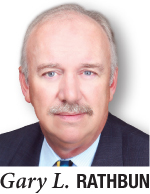
Gary L. Rathbun is the president and CEO of Private Wealth Consultants, LTD. He can be reached at (419) 842-0334 or email him at [email protected].