Comfort music — that’s the specialty of Holly Golightly & The Brokeoffs.
“There’s something nice about songs that are instantly familiar if you’ve heard them or not; there’s a format that’s recognizable to most people who have any knowledge at all of the last 30 or 40 years of music,” Golightly said. “Everybody knows the standard arrangement of things and if you don’t, you can guess it.”
When it comes to music, the singer-songwriter-guitarist is a traditionalist.
“It’s exactly what it says on the can,” she joked. “Making things less complicated is quite good. … Songs don’t really need to be six minutes
long; there’s no benefit to it. Keep things short and sweet.”
Golightly and multi-instrumentalist Lawyer Dave use that recipe to whip up the duo’s fifth release, “Sunday Run Me Over,” which will be released Oct. 9.
Holly Golightly & The Brokeoffs bring a traditional, comfortable approach to music to Mickey Finn’s.
Holly Golightly & The Brokeoffs will play at 8 p.m. Oct. 13 at Mickey Finn’s Pub. Daniel Wayne and 33 1/3 will open. Tickets are $8 in advance and $10 at the door.
The rootsy rockers serve up three cover songs and nine rollicking originals with dashes of humor on their album.
Dave is featured on lead vocals of the cover of Mac Davis’ 1980 song, “Hard to Be Humble,” which begins with he and Golightly making Facebook posts about how much they hate each other.
“It’s a ridiculous song,” Golightly said during a call from the couple’s farm near Athens, Ga. “It’s one of Dave’s favorite songs; he really likes playing it.” She shared the story behind “This S*** Is Gold.”
“I wrote the lyrics to that one. It was aimed at like KISS , you know, the stuff that happens that’s all about the merchandise and how you go and see a band and you get out of the place by going through the gift shop,” Golightly
said. “It was really tongue and cheek.
“You have bands that have action figures of themselves. The thing that’s funny about that to me is that most of the people who have action figures, they themselves don’t do anything. So they’re action figures of people who don’t do much action. They should make action figures of [Dave and me]; we never stop,” she said and laughed.
In addition to making music, the couple rescues horses — and they have five dogs and eight goats, along with geese and chickens.
“We have to load 400 bales of hay this afternoon,” Golightly said. “There’d be sort of lumberjack days and horse trainer and all these other action [figure] versions of us. … We should be marketing this stuff; people love farm sets.”
People love Golightly’s moniker.
Born in London, the vocalist said she was named after the character in Truman Capote’s “Breakfast at Tiffany’s”: “I think [my mom] put the book down when she went into labor and that was the first name that came to mind.”
The duo won an Independent Music Award for best Americana album for 2008’s “Dirt Don’t Hurt.”
And the Brit has sung on The White Stripes’ disc “Elephant.”
“[Our music] doesn’t have any cryptic messages in it. You’re not going to find anything massively deep or meaningful in it,” Golightly said. “It’s just music and it’s fun.”
Michael Keedy, manager of special events for the Toledo Walleye. TOLEDO FREE PRESS PHOTO BY SARAH OTTNEY
Walleye hockey returns to Toledo on Oct. 13 and fans are invited to celebrate the start of a new season at FinFest, a free Opening Night pregame party.
FinFest is set for 4:30-6:30 p.m. outside the Huntington Center on Huron Street, weather permitting, said Michael Keedy, manager of special events for the Walleye.
“That’s how we kick everything off,” Keedy said. “We’re going to have live music [from local band 56DAZE], live ice sculptures, street performers and all kinds of fun stuff going on. We’ve done this every year and we usually get a great turnout.”
FinFest drew about 300 fans last year and more are expected this year, Keedy said.
Another pregame opportunity is OctoberFeast, which includes a game ticket and all-you-can-eat buffet for $45. The buffet will be available 5-6:30 p.m.
The game starts at 7 p.m. Gates open at 6 p.m. and the first 4,000 fans will get blue and gold glow wands.
“As part of our introductions, we turn all the lights out in the building for several minutes and it will be just a great effect to see all the blue and gold glow wands waving around at once, so we do encourage people to get in their seats early,” Keedy said.
There are still game tickets available but they are going fast, Keedy said.
“Every year, we’ve had sell-out crowds and it’s starting to become the routine in Toledo that this is really the place to be so we just urge fans to get their tickets now,” Keedy said. “We’ve always sold out and we anticipate the same thing this year, so the sooner the better.”
There is also a post-game party with the Walleye players in the Club Level Lounge, open to anyone with a ticket, Keedy said.
No matter what they choose to do, people who come out for Opening Night can expect to have fun, Keedy said.
“Everything we do is going to be entertaining,” Keedy said. “Opening Night is really meant to be a celebration, just as it is for Mud Hens Opening Day.”
Theme nights
Walleye fans can also look forward to various theme nights and promotions planned throughout the season, Keedy said.
Jersey auctions, in which game-worn jerseys are auctioned off for local charities after the game, are always popular, Keedy said. This season will feature Captain America jerseys on Nov. 10, Boy Scout-themed jerseys on Jan. 5, Toledo Blades throwback jerseys for Toledo Hockey Heritage Night on Feb. 16 and pink jerseys on March 2 during Pink in the Rink, benefiting breast cancer research.
Nov. 10 will also feature an appearance by Captain America and a giveaway of 1,500 Captain America shield frisbees, Keedy said.
Also on Nov. 10, Toledo police and firefighters will square off in their second annual hockey game at 3 p.m. called the Battle of the Badges. A portion of proceeds will benefit the Toledo-Lucas County Police Athletic League, a youth sports organization, and the Toledo Firefighters Local 92 Charities, which benefits a number of area charities. Admission is free with the purchase of a Walleye ticket for Nov. 10.
“It was a huge success last year,” Keedy said.
Nov. 11 is Veterans Appreciation Night.
Nov. 17 will feature an appearance from former Red Wings player Joey Kocur, who will also be signing autographs on the main concourse during the game.
Nov. 17 will also kick off a four-part poster series, starting with a lifesize Spike growth chart, Keedy said. Other posters will be given away on Dec. 16, Feb. 17 and Feb. 24.
The annual Teddy Bear Toss is set for Dec. 1.
“That’s always a big one,” Keedy said of the event, in which fans throw new or gently used stuffed animals onto the ice for Lucas County Children Services. “It’s a lot of fun and we get an incredible amount of people who participate in that.”
Dec. 1 will also feature an appearance from the Hanson brothers, stars of the hockey movie “Slap Shot,” including an on-ice skit and free autographs.
Dec. 16 will feature “an assortment of chocolate-covered goodies,” in honor of National Chocolate Covered Anything Day, Keedy said.
Hockey and Hops is a pregame craft beer-tasting event on Dec. 28. Cost is $45, which includes a souvenir glass, all-you-can-eat buffet and game ticket.
Jan. 6 will feature a Spike “bobble-body” giveaway to the first 2,000 fans, Keedy said.
Feb. 24 is Mascot Mania Night and will feature more than 20 mascots from local businesses and professional sports teams, Keedy said.
“Anybody planning to come to that game is going to see a lot of characters walking around and a lot of opportunities for autographs and photos,” Keedy said.
Pink in the Rink supports the fight against breast cancer. Photo by Steve Dempsey.
Pink in the Rink, a popular annual promotion that raises money for breast cancer research, will be March 2-3, with both games played on pink ice.
Every Friday night home game will offer a post-game party with the players in the Club Level Lounge for anyone with a ticket. Every Sunday home game offers a free post-game open skate. One Sunday per month Walleye players will join fans during the open skate, Keedy said. Every Sunday home game also features the Chuck-A-Puck game, in which fans purchase foam pucks and try to throw it closest to center ice. Proceeds benefit local youth hockey organizations.
Promotions are subject to change.
“We’re constantly adding new promotions, new giveaways and new events and we update the page frequently,” Keedy said.
For more information, visit www.walleyetoledo.com/promotions.
Fanwear
Those looking for new Walleye fanwear will have plenty of options this season as well as a new location to buy it.
A new retail area will be located near sections 104-105, said Craig Katz, director of merchandise and licensing. There is also the Swamp Shop near the ticket windows and The Tackle Box outside section 121.
“We’re really excited about that,” Katz said. “We now have three areas at Huntington Center for fans to purchase their new Walleye wear and we encourage people to come check it out. It has some very cool aspects.”
The new gear for men, women and children includes 40 new styles of T-shirts, 30 new styles of sweatshirts, two dozen new hat styles and three dozen new novelty items, Katz said.
Among the new items Katz expects to be popular are “Tufgloves,” giant “Hulk hands” with a cup-holder built into the fist, Katz said.
“We’ve had a lot of success with them over at the Mud Hens,” Katz said. “Fans can use them to high-five and pump up the crowd as well as enjoy their favorite beverage.”
Also new this year is foam hockey helmets, similar to the popular foam fingers and “puck heads,” Katz said.
“Those are some of our most popular items every year, so we’re always looking to broaden that line,” Katz said.
Closer to the holidays, the shop will offer a style of knit hat that looks like a hockey helmet, Katz said.
“We have lots of new items and new designs,” Katz said. “We’re excited to get the season going.”
For more information, visit www.toledowalleye.com.
Food
Among the dozen new food items on the menu at Walleye games this season will be homemade white cheddar macaroni and cheese.
Rib tips
“Kids will love it,” said Andi Roman. “You can get it plain, but if you’re a little more adventuresome, create your own by adding bacon, caramelized onions, Italian sausage, peppers and onions, chives, bleu cheese and barbecue pulled pork.”
Walleye fans can also get boneless wings and wraps, including “The Winger,” “Full Strength” and “Cross-Chick.” For dessert, fans can try the Fun-Dae (funnel cake topped with soft-serve ice cream, hot fudge, chopped peanuts, whipped cream and sprinkles), S’more Sundae (vanilla soft-serve ice cream, graham cracker, and hot fudge with marshmallow topping) or Chocolate “Heath Bar” Sundae (soft-serve ice cream, caramel, and whipped cream topped with crumbled Heath bars).
Social media
Fans can expect to see more photos on Walleye social media sites this season, said Nathan Steinmetz, manager of online marketing.
“It’s all about photos now,” Steinmetz said. “That’s one focus we’ll have moving ahead.”
The team already shares photos on Facebook and Twitter and plans to start an Instagram account soon.
“Over the last few months, there’s really been a change in focus from a description or a link back to our website to an album of photos,” Steinmetz said. “That’s what people want to see. That’s what’s interesting. That’s what stands out and catches your eye. We have tons of photos — of players, games, fans, behind-the-scenes — and for us, it’s a no-brainer to share those with our fans. We even have some fun with caption contests and guessing contests. It’s a neat way to engage with fans. It’s fun for them and always gets a lot of commentary.”
Last season, the Walleye started posting photos of fans wearing Walleye gear and fans loved it, Steinmetz said. People started sending in their own photos.
“The whole program started with social media and grew from there,” Steinmetz said. “It’s really neat to be able to see fans decked out head to toe. It really emphasized the team pride and the camaraderie and the spirit of wearing your Walleye wear at games. We’re looking to continue that this year.”
Although the team’s popular but short-lived iPhone app folded over developer issues, the team’s mobile website allows fans to browse news, stats, rosters, seating charts, dining options and more, Steinmetz said.
“Mobile is the way to go,” Steinmetz said. “A lot of fans are looking for information that way. I look on my phone more than I look at a computer anymore.”
Fans can also download the iheartradio app to their smartphones and listen to Walleye games live on their phones, Steinmetz said.
The third annual social media night will be March 24.
“The last two years have been a lot of fun,” Steinmetz said. “We get an incredible amount of participation from fans at games. We get hundreds of tweets, hundreds of posts on our Facebook wall. Tons of people send us pictures of themselves and their family and friends. We sift through those and put them on the video board throughout the game along with trivia questions and prizes.”
The Walleye also maintain a continuous dialogue with fans during games.
“There’s always somebody watching Twitter feeds and someone paying attention to Facebook during games, so if you mention the Walleye, there’s a great chance to hear a response really quick,” Steinmetz said. “We encourage fans to ask questions and get involved in the conversation.”
David Walker, left, and Doug Clarkson. Photo by Vincent Scebbi courtesy of the Independent Collegian
During the offseason, the Walleye added some age and experience to its lineup.
While last year’s team had 14 players under age 23, only six Toledo players are younger than 25 this season, according to the roster.
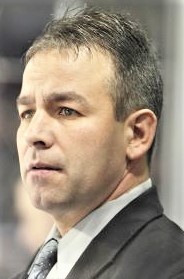
Head coach Nick Vitucci hopes the extra years will give the Walleye the edge to push the team back into playoffs after missing the postseason the past two years.
“We’re just going to be a team that has a little more whiskers and experience under our belts, that in the long run we hope will equate to success,” he said.
Walleye coach Nick Vitucci. Photo by Paul Nelson
Defensive help is on the way
Offensive production has decreased during the past three seasons.
The Walleye scored 254 goals in the 2009-10 season, their first year in the league and their only postseason trip.
In 2010-11, the Walleye finished with 239 goals and 72 points (33-33-6), just two points shy of claiming the eighth and final playoff spot.
Last season, goals dropped significantly, to 189 and 62 points (28-38-6), 10 points higher than the basement-dwelling Trenton Titans.
Older players will add stability to the lineup, something Vitucci said will lead to chemistry on the ice and more goals scored.
“Our locker room door has been a revolving door, players coming in and out and not having an opportunity to just get to know each other on the ice, which is what certainly leads to goals,” he said. “Our chemistry was never set because of all the players that were moving because of recalls and being sent down because of injuries.”
Wes O’Neill. Photo courtesy The Independent Collegian
While the team traded fan favorite and former Bowling Green State University defenseman Kyle Page to Kalamazoo, the Walleye picked up former Detroit Red Wings captain Wes O’Neill as well as 33-year-old defender David Walker.
O’Neill played 21 games last season with Kalamazoo and spent most of his career with the American Hockey League’s Lake Erie Monsters and Bridgeport Sound Tigers.
Walker, who was captain of Ontario Reign during the 2010-11 season, recorded 19 goals and 89 assists in three seasons there.
“The players we signed are going to be huge for us,” Vitucci said. “I think at times we’ve been inconsistent back there and [now] we have some good veteran leaders back there that’s going to settle things down for us. We’re going to be a good defensive team, which is where we struggled in the past.”
In addition, the Walleye re-signed forward Joey Martin, who led the Walleye with 49 points (22 goals, 29 assists) last season.
With this lineup, Vitucci said the team will look to implement a more aggressive, puck-possessive style of play.
The downside to this system, Vitucci said, is if the team is caught out of position, they are left more exposed on the other side of the rink.
“But we believe with the team we’ve got and the experience we have, especially on defense, that we should be in good shape,” he said.
NHL lockout
Despite the possibility of no NHL this season, the ECHL should be minimally affected, said Joe Babik, director of communications for the ECHL.
The NHL lockout began Sept. 15 over disputes in the collective bargaining agreement between the National Hockey League and National Hockey League Players Association.
Exhibition games are already canceled and regular season games will be called off if no progress is made on a new deal. The first NHL game is scheduled for Oct. 11.
Babik said that, while players in the ECHL work to get noticed by the American Hockey League (AHL) and NHL, they are part of a different union.
Vitucci said he is optimistic a compromise will be reached before the whole season is canceled.
“I am hoping that cooler heads will prevail and they will come together on all of these hot topics and we will have hockey this season,” he said.
However, the lockout could help bring stability to the Walleye roster.
Because the ECHL is a AA league, players move between it, the AAA AHL and the NHL.
“Whenever there’s an injury in the NHL with the Red Wings or the Blackhawks, they’re going to get a call-up from their American League teams and we’ll lose a player,” Vitucci said. “[Now] with only one team playing above us, you’re looking at 20 guys you run the risk of injury instead of 40 players you run the risk of injury. Hopefully, there won’t be that much movement once the season starts.”
With no NHL, more pro scouts could make their way to minor league games, giving Walleye players more opportunity to be noticed, Vitucci said.
“It’s a great opportunity for players at our level to really promote themselves as far as the type of players they are and character they are,” he said.
Vitucci said he did not recall any surge in attendance to ECHL games during the last NHL lockout, which canceled the 2004-05 season.
Vitucci called the lockout a “possible catch-22” in the sense that fewer people may be thinking about hockey.
“Without hockey in the NHL, you’d think people who would want to get their hockey fix, they’re going to want to come down here, but there’s also no hockey in the NHL and families aren’t home on a Friday night watching a game and getting an urge to come to Toledo to watch a game the next night,” he said.
New ECHL teams
The ECHL welcomed four new teams to the league this year.
Joining the Walleye’s North Division are the Fort Wayne (Ind.) Komets and Evansville (Ind.) IceMen.
The Walleye will square off against Fort Wayne 10 times and Evansville 11 times in the upcoming season.
“We expect them to be very good teams right out of the gate,” Vitucci said. “Fort Wayne is a team that has won championships at every level they’ve played at and Evansville is a team that has been good in the Central Hockey League. We expect them to be contenders right out of the gate and we are going to have to play our best hockey to compete and battle with them every night.”
The Orlando Solar Bears will play in the Eastern Conference’s South Division and the San Francisco Bulls are in the Western Conference’s Pacific Division.
Toledo hosts the Solar Bears at home Jan. 5.
The Walleye season kicks off Oct. 13 when Toledo hosts the Kalamazoo Wings. The puck is slated to drop at 7:05 p.m.
For more information, visit www.toledowalleye.com.
Wouldn’t it be frustrating to get a nice big expensive box from your mom and dad and open it up to find there is nothing inside? You would probably wonder what they were thinking when they took the time to acquire such a nice box and then forget to put anything in it. And now they are not around anymore to explain it to you. After further investigation, you find that because they did not put anything in the box, a bunch of their money is now going to lawyers. You don’t know what to think. Should you be angry? Sad?
The situation being described here can be used to point out what I (Mark) consider one the biggest and most common mistakes when setting up a revocable living trust. Many folks opt to use a living trust as a way to pass on assets to heirs in what they think will be a cost- and time-efficient manner. It can work very well if you take all the necessary steps, but if you don’t, it can end up being a big waste of time and money. The big mistake is the failure to “fund” the trust.
First, let’s talk generally about what one of the most common goals is when setting up a revocable living trust. This is typically the avoidance of probate. What is probate and why would anyone want to avoid it? The simplest way I can describe it is, to get things that were in your name while you were alive, into the names of the people that you intended to leave them to after your death. Obviously, you are not around to sign any paperwork transferring the assets to your loved ones. What usually happens at this point is the probate process takes over. If you have signed a last will and testament, the local probate court oversees the process to make sure your wishes are carried out. Your will is filed with the court, which then appoints an executor who is responsible for administering your estate. There are a series of steps that the executor takes, such as notification to the heirs, and inventory of all date of death assets and at the end a final accounting and distribution of the assets. Probate sounds like a nice orderly process, right? That is because it is. Probate is not necessarily a bad thing. Its intent is good. It is a process to get done what needs to get done. As a lawyer, it requires expertise to know what steps need to be taken in what order, etc. So why do people want to avoid it? The answer is mainly cost savings.
The probate court has a schedule that lawyers can use as a guideline on what to charge for their services to help administer an estate. It is typically a percentage of the value of the probate asset. There is also a percentage that is charged for nonprobate assets that is typically lower. Nonprobate assets can directly pass to the heir either by a living trust or perhaps a beneficiary designation such as on retirement accounts, annuities or life insurance. Back in 1965, a guy by the name of Norman Dacey wrote a book on how to save money by avoiding probate. Ever since then it has become popular to use a living trust as a mechanism to transfer assets. The most common mistake is paying a lot of money to set up a trust and then not following through and transferring assets into it. This is critical in order to avoid probate. The trust is like a box, and whatever you put in the box avoids probate.
What should you do?
1.) Everyone should do an assessment of his or her current estate plan, whether it is a will or a trust. If you don’t have anything in place, you should get it done right away.
2.) This is also a good time to review all of your beneficiary designations to make sure they are correct and up to date. I can remember when a lady came to my office to have me review her plan. I informed her that she had made the big mistake of not putting things in the box. I felt bad because it reduced her to tears. She said, “You mean that if I would have died, my assets would have gone through probate?” Yep.
As always The Retirement Guys wish you a happy retirement. Oh, and one more thing — don’t leave your family an empty box.
Securities and Investment Advisory Services are offered through NEXT Financial Group Inc., Member FINRA / SIPC. NEXT Financial Group, Inc. does not provide tax or legal advice. The Retirement Guys are not an affiliate of NEXT Financial Group. The office is at 1700 Woodlands Drive, Suite 100, Maumee, OH 43537. 419-842-0550
Dealing with end-of-life planning is never fun; even the financial portion is a long conversation that no one wants to have. Let’s first stress that we aren’t attorneys or accountants, and that it’s best to consult those professionals when finalizing a strategy for transferring wealth between generations. Nevertheless, we’re often asked questions about this process, and may be able to offer some insight on the subject.
First understand that, while a trust may be the first thing most people think of when they think about transferring wealth, not everyone needs a full-blown trust. Almost everyone, on the other hand, does need a will and should have one prepared.
For most assets — especially those that are more liquid — there are some great ways to transfer money to heirs. While each has different tax consequences (hence the need to consult an accountant), simply avoiding probate court can be extremely helpful when the time comes.
Another qualification I need to make at this point is that there isn’t much that can be done with regard to 401(k) accounts, IRAs and other tax-deferred accounts. All that anyone can do when it comes to transferring these types of assets is to make sure he or she has updated beneficiaries on file with their accounts. Likewise, there isn’t much to be done to reduce tax consequences for heirs since the principal holder of the account has been receiving a tax benefit for deferring income.
Taxes and transfer of nonretirement assets can be trickier. This is where some of those more fortunate families and individuals employ trusts with varying degrees of complexity. For most people, however, Transfer on Death or Payable on Death accounts can make the transfer of assets to heirs fairly straightforward and certainly help avoid the hassles of probate.
Joint accounts with rights of survivorship are another great way for investors to steward assets until they are left to heirs. Investors can establish joint accounts with anyone — not just a spouse. Joint accounts can be established with kids, grandkids, nieces, nephews, cousins, neighbors, friends or even your favorite weekly columnist as the surviving account holder.
Sometimes it’s better to start early — and that’s certainly an option. While most of us never need to worry about the $5 million exemption to inheritance taxes, sometimes things come up that make it nice to start the process of transferring accumulated wealth to heirs before the end of life. Current tax law allows gifts of $13,000 per spouse per child per year without gift tax implications (example: a married couple could transfer $26,000 to each of their children every year without paying gift taxes).
For others who want to schedule early transfers to help children, grandchildren or other minors save for college or a down payment on a home, UGMA/UTMA (Uniform Gift/Transfer to Minor Accounts) can be extremely helpful for nonretirement assets. Of course, like anything else there are drawbacks, especially for those who don’t think their heirs have the maturity or responsibility to handle money.
Consider the UGMA/UTMA example: when the minor (account beneficiary) reaches the age of majority, any money in UGMA/UTMA accounts is legally theirs to use however they’d like — assuming, of course, they know where it is and who to call to get their hands on it. However, it’s illegal for parents gifting assets through these types of accounts to rescind their gift if they doubt their child’s decision-making skills.
When it comes to estate planning there are lots of options, and no two cases are alike. It’s always best to consult multiple advisors to get a list of options from each and their respective implications. Afterward, every investor needs to sit down and figure out what’s best for them. Like so many things in the investment world, there is no black-or-white, right-or-wrong answer; there are options. The challenge is to understand those options and determine the most comfortable solution.
Dock David Treece is a partner with Treece Investment Advisory Corp (www.TreeceInvestments.com) and is licensed with FINRA through Treece Financial Services Corp. He provides expert content to numerous media outlets. The above information is the express opinion of Treece and should not be construed as investment advice or used without outside verification.
Millions of Americans suffer from hearing loss and there are several signals of auditory issues, says one local doctor.
“It can be a significant sign or it can be very subtle,” said Dr. Randa Mansour-Shousher, director of the Northwest Ohio Hearing Clinic. Mansour-Shousher has been an audiologist for 32 years and also employs two other doctors.
“Socially, you could be asking [others] to repeat frequently. You could have trouble following conversations,” she said.
Hearing background noise is also more difficult. People may have more difficulty hearing women or children because higher frequencies are lost first, Mansour-Shousher said. Voices can also seem muffled or like the speaker is mumbling.
In the United States, about 17 percent (36 million) of adults report some degree of hearing loss, according to the National Institute on Deafness and Other Communication Disorders. Across the country, hearing loss affects 18 percent of 45-64-year-olds, 30 percent of 65-74 year-olds and 47 percent of those older than 75.
Damage from noises, medical conditions or medications can contribute to hearing loss, Mansour-Shousher said.
People who work in jobs with exposure to loud noises more frequently experience hearing loss. These jobs can include auto-industry workers, dentists, beauticians, firemen, miners and musicians.
One-time exposure to loud noises can also damage nerves, Mansour-Shousher said.
“July 4, firecrackers go off; July 5, they’re in the office,” she said.
Hearing loss affects all ages and there is no standard age for screening like for mammograms.
“I would think it would be [good] if we said everybody above 50 should go through hearing screenings annually, but there’s not a rule of thumb,” Mansour-Shousher said.
Another sign of damage is tinnitus or ringing in the ears. Mansour-Shousher said 30 million people suffer from tinnitus, a sign of inner ear damage.
“Tinnitus can affect people in different ways. It can affect their emotional status, their concentration,” she said.
Hearing loss can be a sensitive issue.
“I had someone that was in here crying because her coworkers were calling her stupid,” Mansour-Shousher said. In reality, the woman just had difficulty hearing.
“I like to educate people on hearing loss and tell them not to be scared and know that it’s prevalent among all of us,” Mansour-Shousher said. “There’s easy solutions. Take advantage; have a better life.”
These solutions can include hearing aids if the patient is a candidate. With technological advancement, phone calls or television sounds to be played through the hearing aid.
Wearing protective items like earplugs while around loud noises is also crucial for prevention, Mansour-Shousher said. She also recommended getting iPhone headphones that block out background noise so the device can be played at a lower volume.
In addition, it’s vital to keep the volume down.
“If I can hear the music from your headset while I’m sitting next to you, it’s too loud,” Mansour-Shousher said.
Sometimes, family members need to encourage their loved ones to get checked out by a doctor.
“Men are really hard to get in here,” Mansour-Shousher said. “A lot of times, family members have to be the one to say, ‘I’m not mumbling or you have the TV on too loud for me; it’s stressful.”
Northwest Ohio Hearing Clinic has locations at 1601 Brigham Drive, Suite 160inPerrysburg and at the University of Toledo Medical Center, 1125 Hospital Drive, Suite 50. Office hours are 8 a.m. to 4:30 p.m. Monday through Friday. For more information, visit http://www.nwohc.com.
Gretchen Brell-Schroeder and her husband Richard Schroeder are the creative force behind Glass Whispers, which use the cremated remains of loved ones to become part of artistic glass mementoes. Toledo free press photos by Matt Liasse
Before Gretchen Brell-Schroeder creates her glass art pieces, she says a prayer. Not in hopes that the piece will come out nicely, but over the cremains she is using.
With Glass Whispers, Schroeder and her husband, Richard, use ashes of clients’ loved ones to create art pieces. She said the process is spiritual for her.
The teardrop is the newest shape offered by Glass Whispers. Toledo Free Press photo by Matt Liasse
“It’s really a huge privilege to do this for people,” Schroeder said. “I feel very honored. We also feel very obliged to do a really good job on them. I want to do my best work on these pieces. It’s something that’s very important to us.”
Glass Whispers makes sculptures in a few shapes, including hearts, globes, rubbing stones and teardrops, the newest design. Schroeder puts the ashes inside the sculpture, creating a work of art that keeps a loved one close by.
“It’s just a way of having that person in front of you every day,” Schroeder said. “It’s a way of keeping that person near and dear to your heart.”
Schroeder has been creating glass art for six years, but recently started working with cremains. Her work has been featured in art shows.
“I took up glass-blowing in my middle-age and just fell in love with it,” Schroeder said. “It was kind of therapy for me during a difficult time in my life. I was hooked from the first gather of glass.”
In 2010, Richard gave heart-shaped glass sculptures as gifts for his colleagues at the Cleveland Clinic. A co-worker approached him and asked if he ever tried putting ashes inside the glass. He returned home and asked Schroeder for her thoughts.
While researching online, Schroeder found artists doing it on the West Coast.
The heart shape is the most popular with Glass Whisper’s customers. Toledo Free Press photo by Matt Liasse
“So I thought, ‘Well gosh, if they’re doing it, I don’t know why I can’t,’” Schroeder said.
She began to experiment using the cremains of Richard’s mother.
“She’d think it’d be cool to be a piece of art,” Schroeder said.
Schroeder said the first creation came out well, and the color of the cremains inside the glass astonished her the most.
“We were stunned at how beautiful they came out,” Schroeder said, who said she loves how the cremains sparkle when held up to light. “I can remember the first time I looked at them I was blown away at how beautiful they looked.”
Richard carries his mother’s cremains inside a rubbing stone in his pocket most of the time.
“It’s a piece of artwork that has deeper meaning than just a piece of artwork,” Richard said. “It takes [loved ones] out of the box. It gets them off of the bookshelf.”
Now, about half the glass art Schroeder makes contain cremains. Glass Whispers can also use the cremains of pets. Schroeder has made one for her daughter’s dog.
But the business comes with some challenges, Schroeder said.
“The biggest challenge about this is marketing,” Schroeder said. “Right after somebody dies, it’s too soon. They are not ready to make a decision like that, which is really understandable.”
Although the clients are told to expect a two- to four-week wait, depending on when the artists can get studio time, the process of making the pieces takes 40 minutes.
The process is the same as standard glass-blowing. Taking a rod with a heated end, Schroeder gathers molten glass from a furnace. She rolls this with a gather of glass on a table to cool and smooth it out.
Most of Schroeder’s designs are three-gathered designs, so the same step is repeated three times. On the second gather, she gathers the color and cremains. After the third, she manipulates the glass into a shape.
After removing the glass from the rod, the piece is put into an annealing oven for 24 hours.
“It’s all a chemical process,” Schroeder said. “It has to cool down very slowly in order for it to keep its shape.”
Schroeder performs these steps with Richard acting as her assistant. Richard hopes to one day make his own work with Schroeder assisting him.
“You can’t guarantee how it’s going to come out,” Schroeder said. “It’s different every time. The humidity in the air can affect how it flows.”
The pieces are presented in white boxes with tissue paper. Cost is $180-230, depending on the size and shape, except for rubbing stones, which are less.
Schroeder has worked with diverse clients. One person’s cremains made 18 pieces for extended family members. She said she likes to sit down and meet clients before handling the cremains of their loved ones.
The process takes only half a teaspoon of cremains, Schroeder said. She never uses all of the cremains provided to her and unused portions are returned to the clients.
“Some people are not at all comfortable handling the cremains, so I often will say, ‘Just give me the whole box and I’ll take what I need out of it,’” Schroeder said. “That’s been quite common.”
For more information, contact Schroeder at (419) 265-9639 or visit glasswhispers.net.
When a loved one dies, family members are often left to plan and pay for the funeral and burial arrangements — unless that loved one has preplanned.
It’s never too early to preplan your final resting place, said Jim Mocek, sales manager at Toledo Memorial Park, a cemetery in Sylvania. Typically, a life change spurs preplanning.
“People don’t wake up in the morning and say, ‘Hey, honey, let’s go to the cemetery and plan.’ It’s usually something that has happened. They went to the doctor; there might be something wrong with them or a family member or friend passed away,” he said.
Preplanning also saves family members stress — and cash.
“Not only are they under the stress of somebody passing away, but then they have to make the decisions and then they have to figure out how they’re going pay for a lot of stuff too, which just compounds the problem,” Mocek said. At Toledo Memorial Park, clients lock in current rates and can pay off their bill in 60 months.
“Once you contract it, you lock in the prices. You’re considered paid in full the day you pay off your contract,” Mocek said.
While preplanning, customers can also learn about options for the cremation remains, like burial or niches, if they chose to go that route.
“Everybody thinks that it’s OK just to be cremated and have nothing permanently done with the remains as far as final disposition,” Mocek said. “We have so many affordable options for cremation burial.”
Preplanning seems to be on the rise, he said. About ninety percent of customers at Toledo Memorial Park have selected their grave spaces ahead of time.
“The big population that’s in that baby-boomer category is now getting into that age where they really need to start thinking about stuff like this,” Mocek said.
Megan Coyle Stamos, director and prearrangement specialist at Coyle Funeral Homes, agreed.
“[Baby boomers] are the much more practical, plan-ahead generation,” she said.
Coyle Stamos said she will make house calls and do whatever is needed to make clients comfortable for preplanning meetings. She also said she tries to inject “humor and smiles” into the meeting.
“When someone decides to come in and get more information about prearrangement, I take the time to really listen to what’s going to be important to them,” she said. This means educating people about their many options — like burial, cremation, religious aspects of the ceremony, loved ones’ involvement, items like caskets or even “green” ceremonies.
When customers prepay for their funeral, the money is held in an account and cannot be touched by the funeral home until after the individual passes, Coyle Stamos said.
The account, aka a funeral insurance irrevocable trust, features a flexible payment plan and also has built-in payments in case someone dies before he or she pays off the balance. The rates are also locked in and unaffected by inflation. If a person moves away, the trust can be transferred to other funeral homes.
By allowing customers to lock in rates, the funeral home assumes the risk, said Keith Walker, owner of Walker Funeral Homes. He said about 30 percent of his clients preplan while Coyle Stamos estimated about 60 percent of her customers do.
“What we try hard to do is to get the word out that it’s an easy process. It makes a lot of sense and it would be best that everybody did,” Walker said.
Walker said it isn’t uncommon for children of elderly parents to preplan for their mom or dad’s funerals.
Funerals are a chance to celebrate a person’s life, he said.
“One thing about a funeral, it’s probably the one time people come to commemorate everything that person was from start to finish,” Walker said.
Sometimes the survivors don’t necessarily know their loved ones’ wishes or plans, said Hilary J. Sujkowski, owner of Sujkowski Funeral Home. When a customer comes in, a file with that pertinent information is started.
Preplanning also allows for a more accurate obituary because a person can spell out all he or she wants publicized, Sujkowski said.
Although some families consider preplanning morbid, they are thankful when it comes down to it.
“They talk like that when they hear about [preplanning], but it’s totally different when they’re faced with it,” Sujkowski said.
Survivors seem appreciative when their loved ones preplan, he added.
“The survivors always seem to be happy that it’s done,” Sujkowski said. “It goes so much smoother.”
Grief is a personal journey and no two journeys are exactly alike, area counselors say.
“There are people who come in and say, ‘I’m grieving, but I don’t think I’m doing it right,'” said Mary Macek, a clinical therapist at Harbor in Toledo. “Some of what we do with folks is just to normalize the grief process, to reassure people they are not going crazy for being in as much pain or distress as they are in.”
One of the biggest misconceptions about grief is that it follows a certain timetable, said Dawn DeFalco, a licensed counselor and team leader for bereavement at Hospice of Northwest Ohio.
“Grief is a lifetime journey and the journey ebbs and flows,” DeFalco said. “Many people feel they’ve come to terms with it, but then they are surprised months or years later when something triggers a special memory of a loved one. It is normal to have a reaction to a stimulus like a smell, taste, the different seasons of the year, an anniversary, a birthday or their favorite holiday.”
Macek agreed.
“Grief is a funny process. Even in its natural resolution, there are ups and downs and sometimes people have periods of time where they think, ‘OK, I’m doing better’ and then all of sudden they are overwhelmed by grief again and say, ‘OK, what did I do wrong?'” Macek said. “But I think it’s in the nature of grief to have those times when grief is more distressing again, so I don’t think it’s necessarily strictly a liner process even when it’s going well.”
Many people are familiar with psychiatrist Elisabeth Kübler-Ross’ Five Stages of Grief — denial, anger, bargaining, depression and acceptance — but not everyone experiences every stage and the stages don’t necessarily happen in that order, Macek said.
“It’s just to give a model to something that seems pretty overwhelming and out of control to a lot of people, but I like to think of grief as something that is normal and adaptive,” Macek said. “It’s the process by which we resolve some pretty intense feelings and take into ourselves information that for the most part we don’t want to take in.”
Many people who have lost a loved one feel lost after the funeral, Macek said.
“The funeral’s over, you’re back to work, everything is supposed to be fine and dandy and it’s not,” Macek said. “We don’t have a lot of visible markers in our culture beyond the funeral for dealing with loss. There are some countries in which the bereaved person is relieved of all the things they have to do on a daily basis for a year. We don’t seem to have some of those cultural norms any more.”
Many people seek help from a counselor or support group when they feel “stuck,” Macek said.
“Sometimes people get stuck on guilt. They think, ‘Boy, there should have been something else I could have done to prevent it,'” Macek said. “Some people get stuck in depression. They think that if they start to get happy, if they start to live their life again, they are going to lose their connection to the person who’s died. And some people get stuck because of the trauma. If a loved one has died in a sudden or violent way, there is some trauma associated with that that can impede their ability to resolve grief issues. A caregiver who has provided care for several years to someone whose condition has gotten progressively worse, I think those folks are somewhat traumatized too.
“The places where people get stuck are usually places where they are afraid to go near their own pain,” Macek said. “If you’re stuck and you’re not getting unstuck that may be an indication it’s time to talk to somebody.”
Harbor and Hospice of Northwest Ohio both offers individual and family grief counseling. The Hospice sessions are free. Hospice also offers free grief support groups, including Kids Grief Support, Mid-Life Spousal or Partner Loss, Young Families in Grief, Men in Grief, Supportive Spouses, After Your Parent Dies, Coping with Any Loss and Pathways, which includes a spiritual element. Everyone starts with Grief 101, a one-time session that addresses expectations.
“The support groups help people normalize what they have experienced so they don’t feel so alone,” DelFalco said. “We learn from each other and we can be supportive of others and receive that support. It’s about getting back to some kind of normalcy in their life even though it’s going to be new normal for most people.”
When Maryellen Schmidt’s 20-year-old son died in a car accident, she sought help from GriefShare, a free Christian-based group offered through CedarCreek Church’s LifeSupport series. The 13-week program is open to anyone who has lost someone close to them through death. People can join at any time and work through the series as many times as they need, Schmidt said.
Schmidt participated in GriefShare for two years before becoming a group leader two years ago.
“Those who have not experienced grief are often uncomfortable around those who are grieving and often shut the bereaved person down,” Schmidt said. “When you have a loved one who has died, you don’t just get over it and get back to work. It takes time. It might take two or three times through to even begin to heal.”
Some GriefShare groups meet at a church; others meet in homes, Schmidt said. GriefShare leaders facilitate the sessions through videos and workbooks.
“The leaders are not counselors. We’re just people who have experienced the death of a loved one and have dealt with grief,” Schmidt said. “I would encourage people to step forward to get help. Choking that grief and pushing it down leads to all kinds of other problems. As painful as it is, it’s most helpful and most beneficial to face it and deal with it.”
Schmidt also operates the Northwest Ohio chapter of The Compassionate Friends, a nonprofit organization for parents who have lost a child “at any age, from any cause.”
The group meets at 7 p.m. on the first Thursday of every month at St. James Lutheran Church, 4727 W. Sylvania Ave., but is not affiliated with any faith. The group host a fundraiser called Walk to Remember on Oct. 13. Registration is $5. For more information, visit www.compassionatefriends.org or email [email protected].
Most people think of grief as a response to the death of a loved one, but there are many other situations that cause grief, Macek said.
“People who have experienced trauma as children, when they are resolving that they are in part grieving the childhood they didn’t have. If someone has a difficult relationship with a parent, part of the adjustment to a healthier relationship with that parent may be grieving the loss of the parent you didn’t have so you can actually have a relationship with the parent you do,” Macek said. “There is some aspect of grief work in most forms of counseling.”
Counseling isn’t the right fit for everyone. Some people, including many men, are “functional” grievers, Macek said. Instead of wanting to talk about it, they want to be doing something.
“For some people, talking is probably not the best way of accomplishing things,” Macek said. “They want to work on a project and while they are working on things, sometimes their grief can resolve that way. To force someone who is a much more functional griever into talk therapy can be misguided and nonproductive.”
Even after resolving issues found in acute stages of grief, there are still adjustments to be made.
“Then there is the part about how do I rebuild my life and move on without this important person,” Macek said. “People have had expectations about how their life was going to look going forward and all of a sudden it doesn’t look that way and they have to make a new plan. That’s kind of a longterm consequence of grief.”
This week’s topic for our pre-election roundtable: If we could talk to President Barack Obama, what would we say to him? To be honest, many times in the past three years or so, I’ve wished I could have a discussion with the president about what was happening in Washington, and his handling of it. In his zeal to try to lift the tenor of governance, the president bent over backwards to try to foster bipartisanship in Congress.
From the start and for the next three and a half years, obstruction was the name of the game for the GOP, both in the House and the Senate. Even with bills that at one time had wide support from Republicans and, in many cases, had even been proposed by Republicans, the obstruction was complete.
In the words of Senate Minority Leader Mitch McConnell, the No. 1 priority for the next four years for the GOP was to make sure that Obama was a one-term president.
To that end, they blocked any legislation they thought might give the president a “victory” and used the filibuster in the Senate more times in this time period than in all the history of the filibuster. The wheels of governance ground to a halt.
Their abhorrence for the man in the White House completely overrode any of the needs of the populace in the throes of the worst economic downturn since the Great Depression, and they fiddled while Rome burned. They refused to confirm many of the appointees the administration needed to address this dire situation, and offered no plans of their own to help the American public — commonly referred to as the 99 percent. The House couldn’t even be controlled by John Boehner, its own speaker.
If I could say something to the president, first it would be to ask him why he didn’t call them on their atrocious behavior and use his bully pulpit to try to force these so-called public servants to do their jobs. This could very well be the most do-nothing Congress in history. It is certainly in the top two. Instead of trying to remain above the fray, why not get in their faces and challenge them to do the job they were elected to do? Use your pulpit to explain the facts to the people, and to point out the many fallacies the GOP and its big-money backers foisted on us.
Much has been made of the Right’s obsession with Ayn Rand’s works. To put it in its most basic form, there are the producers (job creators) and the takers (the 47 percent of the population Mitt Romney referenced). Most of the people who fawn over Rand’s every word know nothing about her real life. If the Religious Right were to notice that she had no use for religion and didn’t believe in God, it might not be as enamored with her as Paul Ryan seems to be.
My impression is that a more appropriate analogy to the Romney and other GOP campaigns’ beliefs would be Nietzsche’s will to power and his concept of a superman. Good is anything that helps him reach his potential and Evil is anything that stands in the way of him doing so. Therefore, if lying and distorting facts help him reach the presidency, it is Good, and if the facts get in the way, they must necessarily be Evil.
A number of other GOP candidates and their backers seem to have taken this to heart. Romney’s campaign adviser even said they weren’t going to allow their campaign to be run by fact-checkers.
As the Obama campaign got into full gear this summer, it began to push back at the Karl Rove/Koch Bros./FOX News cabal’s lies and distortions, but it needs some personal input from the president. The perfect opportunity was the first presidential debate. Fact-checkers pointed out that Romney told 27 lies in 38 minutes, and the president did an incredibly ineffective job of calling him on his constantly changing positions and outright lying. My next talking point would be “Mr. President, you are an incredibly intelligent and skilled speaker. Will you use your talents in the next debate to call them on this and not let them frame the debate? You are the most powerful man in the world. It’s time to act like it.”
Lastly, I would ask why he chose to tackle health care reform before focusing on jobs. I know that rising health care costs are one of the most costly items for people and corporations, but it would have been better suited to a second-term agenda, when it could have been addressed in an even more effective manner.






 “We’re really excited about that,” Katz said. “We now have three areas at Huntington Center for fans to purchase their new Walleye wear and we encourage people to come check it out. It has some very cool aspects.”