I recently had a lone, simple sentence suddenly pop up on my Facebook chat: “Why is your life so damn funny?” Without thinking about it too long and taking myself by surprise, I promptly responded, “It’s actually not funny, I’m just funny.”
The question came from someone who is somewhere between an acquaintance and a friend and, consequently, had no idea that I’ve just been through seven or so of the least funny months of my life. I’m usually overly cautious to remain modest, but the reality of how unfunny my life has been as of late compelled me to finally give myself a little credit. I’ve had little to laugh about, but for some reason I decided to keep on trying.
The craptacular theme that has defined the better part of my 2012 can unfortunately best be summed up as loss. The loss of loved ones. The loss of friendships. The loss of whatever few ounces of innocence I had managed to carry with me into my adult years. Hasta la vista, baby.
The amazing, counterintuitive thing I’ve discovered in the aftermath of loss, however, is just how much opportunity there is for gain in such situations. Perspective, wisdom, appreciation and love are all there for the taking if you open yourself up and let them in. As one friend told me, sometimes losing something creates a space for something there simply wasn’t room for in the past, something even better.
I’m now experiencing such space-filling on a regular basis. So many remarkable people have been flying around in my midst yet I am just now catching them on my radar. Others I have been aware of for some time but never fully understood their depths until now. In both cases, it was only through unexpected instability that I was able to recognize the most stable of those who surrounded me.
In fact, contradiction seems to be a recurring theme in questionable times. Out of murkiness comes clarity. Out of darkness comes light. Out of doubt comes confidence. And out of the extraordinarily unamusing comes a renewed gratitude for humor in the world.
Even when a situation isn’t itself funny, being able to find humor in other everyday matters can greatly take the edge off. When my life was at the height of unfunny this year, I made a conscious decision to remember to pay attention to the fun, happy stuff. Yes, I did have stints as Debbie Downer and Stressed-Out Sally, but thankfully I was able to rein Happy Harriet back in when needed. In whatever ways the post-weddings-and-babies midlife adult world may tend to crumble around us from time to time, rays of light and humor always remain close enough for us to grab onto for dear, wondrous life. Sunshine never seems more beautiful than when it’s randomly poking through the clouds.
The truth is that life isn’t inherently funny; we learn to make it funny in order to get by. Comedians don’t often reference their uncomplicated relationships, healthy bank accounts and unbelievably good fortune. In fact, most of them make a living by honing in on what isn’t decent or doesn’t make sense in the world and then detailing all of the ways we can laugh it off.
I’ve found the best way to laugh off my own struggles and runs of bad luck is to view my life from an outsider’s perspective. A baby suddenly covered in feces as you’re ready to walk out the door doesn’t always feel funny, but it no doubt has potential for the comedically open-minded. If giant messes, stretches of miscommunication, ill-conceived plans and flat-out irony are hilarious when they happen on “Three’s Company,” “The Cosby Show” and “Modern Family,” why can’t we just find humor when the same happens to us?
No matter what difficulties we may be facing, there are always enough rose-colored glasses, half-full glasses of lemonade and humorous undertones just sitting around and waiting to minimize the pain, ease the stress and help us move on. If we allow it, even the worst of times can be so damn funny.
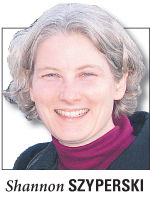
Shannon and her husband, Michael, are raising three children in Sylvania.
I was raised to believe that anyone could be president of the United States. Certainly in my lifetime, the ascendencies of Bill Clinton and George W. Bush seemed to bolster that theory.
But with the news that President Barack Obama is nearing $1 billion in campaign funds, with challenger Mitt Romney not far behind, I wonder how true that once-bedrock American belief is. Would either of my two sons ever be in a position to access $1 billion? By the time they will be old enough to run, 30 years from now, $1 billion will seem like a quaint little figure.
Would I ever want either of my sons to be president? To experience the rancor, the lies and the open hatred many of our politicians endure?
Would I want to open a newspaper every day and see attacks, lies and attempts to destroy their characters and neutralize any chance they had at effectiveness?
As the election nears, media bias is an ongoing and legitimate concern. As a working journalist, I pay close attention to how local media cover politics. The inexorable acrimony that divides so many Americans has become an accepted element of the discussion; that is clearly seen in the rise of such media outlets as FOX News and MSNBC. More people seem to gravitate to news sources that present the side they believe in, thus depriving themselves of opposing viewpoints and messages.
How does this division and side-taking translate to local media? To investigate, Toledo Free Press commissioned researcher Mary McCartney to study the LexisNexis database and local media websites (The Blade, Toledo Free Press, 13abc, WTOL/FOX and WNWO NBC) to determine whether our hometown media have taken sides in Obama vs. Romney.
Our research studied the period from June 1, 2012 — the week Romney sewed up the GOP nomination with a Texas primary win — through Oct. 3, 2012, just after the first presidential debate. The focus was on which candidate dominated the reporting of each published or broadcast story — which candidate was discussed in more depth, with more words — than his opponent. Each story was determined to fall into one of three categories: Balanced, Obama or Romney. We focused on campaign-specific stories, discounting news coverage of Obama’s presidency if the story did not invoke the campaign. We included opinion columns and analysis pieces alongside news stories, under the belief that total presentation of each candidate was important.
We did not attempt to characterize the tenor of the coverage; judging slant, positive or negative, takes the conversation down a subjective road, far from any empirical analysis. Our study guides you through each media outlet’s volume of coverage. It is up to you to determine if that coverage is fair to your chosen candidate.
Television stations
The broadcast media were firmly entrenched in balanced reporting. All three stations relied on Associated Press reports for website pieces of any depth (as defined by word count); local reporting was limited to local candidate visits.
WNWO NBC presented 34 Balanced stories, 34 Obama stories and 34 Romney stories, a perfect balance for a total of 102 stories. A check of the Federal Elections Commission (FEC) database shows WNWO President/CEO Chris Topf has donated to the National Associaiton of Broadcasters Political Action Committee (PAC), but not to any specific candidate.
WTOL/FOX Toledo included 11 Balanced stories, 17 Obama stories and 24 Romney stories, leaning GOP in its total of 52 stories. An FEC check shows WTOL General Manager Bob Chirdon has donated to the Liberty Corporation Federal PAC, but not to any specific candidate.
WTVG 13abc offered 8 Balanced stories, 11 Obama stories and 8 Romney stories, leaning slightly Democratic in its total of 27 stories. FEC records do not show that WTVG General Manager John Christianson has donated to any specific candidate.
Adding it all up, Toledo’s TV stations offered 53 balanced stories, 62 Obama stories and 66 Romney stories for a relatively fair total of 181 stories.
Toledo Free Press
Although Toledo Free Press is certainly more conservative-leaning than The Blade, I was surprised to see the results of our study. Toledo Free Press presented 4 Balanced stories, 5 Obama stories and 12 Romney stories for a total of 21 articles. I was surprised because, working with Toledo Free Press Managing Editor Sarah Ottney and News Editor Brigitta Burks, we have striven to cover Obama and Romney appearances equally. Looking at the details, the source of the disparity is clear. Opinion pieces by conservative writers Tim Higgins, Thomas Berry, Gary Rathbun and Dock David Treece tip our content way in Romney’s favor. I do not apologize for any of our writers’ opinions, but it does help to be aware of the specifics in the gap in our opinion content.
The FEC database shows no donations from Toledo Free Press Publisher Tom Pounds or Toledo Free Press Editor in Chief Michael S. Miller.
The Blade
Given Blade Publisher and Editor-in-Chief John Block’s open endorsement of Obama (remember the 2008 Page One Blade photo of Block giddily reaching to embrace then-candidate Obama?), his 2008 donation to Obama for America and his attendance as one of very few guest list media people at the March 14, 2012 State Dinner for U.K. Prime Minister David Cameron, combined with his newspaper’s stalwart liberal philosophy, it would not be surprising to see Obama dominate The Blade’s campaign coverage. And the numbers do show a disparity.
During our study, The Blade reported 56 Balanced stories, 86 Obama stories and 62 Romney stories for a total of 204 articles. The total contains some interesting trends by reporters, presumably covering specific beats. Blade reporter Jim Provance has been credited for 8 Balanced stories, 28 Obama stories and 9 Romney stories; reporter Tom Troy has a byline count of 22 Balanced stories, 25 Obama stories and 36 Romney stories. All other Blade writers had numbers relatively evenly divided between the two candidates.
FEC records do not show any candidate donations by John Block during this election cycle. Block Communications Chairman Allan Block has donated to Romney for President Inc. and the National Republican Congressional Committee. He is also a contributor to Republicans Sen. Rob Portman, Rep. Bob Latta and U.S. Senate candidate Josh Mandel, and Democrat Rep. Marcy Kaptur.
WSPD 1370 AM
This guy right here
In tracking WSPD (disclosure: I host a pop culture radio show for WSPD, for no compensation), which features a conservative lineup led by Rush Limbaugh, Glenn Beck, Sean Hannity and local hosts Brian Wilson and Fred LeFebvre, an interesting trend emerges. Obviously, the station mentions Obama and Romney with a frequency too great to count during the course of four months. FEC records do not list any donations from General Manager Andy Stuart. But WSPD is the only local news source that consistently covers Libertarian Party candidate Gary Johnson. Johnson has been a guest on the station’s local shows and his platform has been regularly discussed in-depth on its airwaves.
To contrast, Toledo Free Press has mentioned Johnson once during the study period. Another review of The Blade for the four-plus months examined showed only three mentions of the Libertarian candidate. Two of those mentions were in passing; one article reported on the visit to Toledo by his vice presidential candidate, Jim Gray, and the main theme of the story was the candidate’s position on same-sex marriage. A study of local television websites shows a number of Associated Press articles.
Summation
Across all media reporting in Toledo, it appears the press tends to slightly lean in favor of the president, with an attempt at balanced reporting across all the organizations. There were 406 stories total: 113 Balanced, 153 Obama and 140 Romney. So while national media may clearly be divided by bias, at least locally, in this study, we can be pleased to have a relatively balanced media.
Unless you’re a Gary Johnson fan.
Michael S. Miller is editor in chief of Toledo Free Press and Toledo Free Press Star. Email him at [email protected].
Earlier this year I tried to bet 1370 WSPD’s Brian Wilson a dollar that the unemployment rate would be below 8 percent by November because no president has been re-elected with unemployment over 8 percent. Brian, being the student he is of politics and economics, wouldn’t take the bet.
This past week, the government came out with the unemployment rate for the month of September. The number surprised most people, coming in at 7.8 percent compared to 8.1 percent for August. I should be a dollar richer now.
Now, I don’t normally lean very strongly toward conspiracy theories because I’m not sure you could get two bureaucrats to agree that it is daylight outside, let alone agree to cook a large set of numbers with many people involved and publish the results. That being said, there is something fishy about these numbers. Even by the most liberal standards of the mathematically inept, the sum simply doesn’t add up.
Let’s take a look at some of the data surrounding the conclusion.
A survey of 50,000 households is used to determine the rate.
78.8 percent of the 2.184 million household jobs created this year happened in the months of January and September.
September’s number was 873,000, of which exactly 66 percent were part-time for “economic reasons.”
The sampling error for the above number is plus or minus 280,000 jobs.
Households in inner cities are purposely not surveyed due to higher minority unemployment.
The Obama administration announced that 114,000 jobs were created last month.
The U-6 number was unchanged at 14.7 percent.
The sampling error for U-6 is plus or minus 100,000 jobs.
The Bureau of Labor Statistics (BLS) had new software installed in August to seasonally adjust the numbers.
The labor force shrank by 2.648 million year over year in September.
The age 20-24 sector had a September positive increase of 310,000, seasonally adjusted to 380,000, for the first time in history. Until 2012, this has always been a negative number.
Does all of this add up to a conspiracy to get President Obama re-elected? I don’t know. I doubt it. But it does add up to a series of changes in how the numbers are put together that make it possible to skew the results.
They just don’t add up. The BLS publishes the numbers used to determine the U-3, and yet they must be using different numbers. The size of the labor force grew by 418,000 in September. In 2009 the labor force was about 160 million people, today it is about 155 million. As Mitt Romney stated, “If the same share of people were participating in the workforce today as on the day the president got elected, our unemployment rate would be around 11 percent.”
If you start to count all of the people who are “permanently discouraged workers” we reach a rate of close to 24 percent!
So to sum up, the U-3 number is 7.8 percent, the U-6 number is 14.7 percent and the total number of all of the above plus the permanently discouraged is 24 percent.
Recently, it also came out that a couple of the economists and the BLS both contributed to President Obama. I don’t give this any thought because 1) they can contribute to whomever they want, 2) it would take a lot more than two people to manipulate all of this data and 3) I am sure there are economists out there who probably contributed to the Romney campaign as well.
Finally, why am I talking about all of this and what does it have to do with how you invest your money and plan for the future? The most important aspect of this is to not let numbers and headlines such as these influence your decisions without digging deeper into the reports and the numbers. I know that not many people are math geeks but it doesn’t take any more math than balancing your checkbook to see through these numbers and know that they don’t add up.
Look at how the market reacted when the news hit. First it was up significantly and then it came back down as the day went on. First it was a reaction to the headline and then the action based on the reality (or the un-reality) of the numbers. Most importantly, look around you and see what the economy is doing and form your judgments from there.
Gary L. Rathbun is the president and CEO of Private Wealth Consultants, LTD. He can be reached at (419) 842-0334 or email him at [email protected].
Beth Mooney, CEO of Keycorp, and Jim Hoffman, president of the banking company's Michigan and Northwest Ohio District. Toledo Free Press photo by Joseph Herr
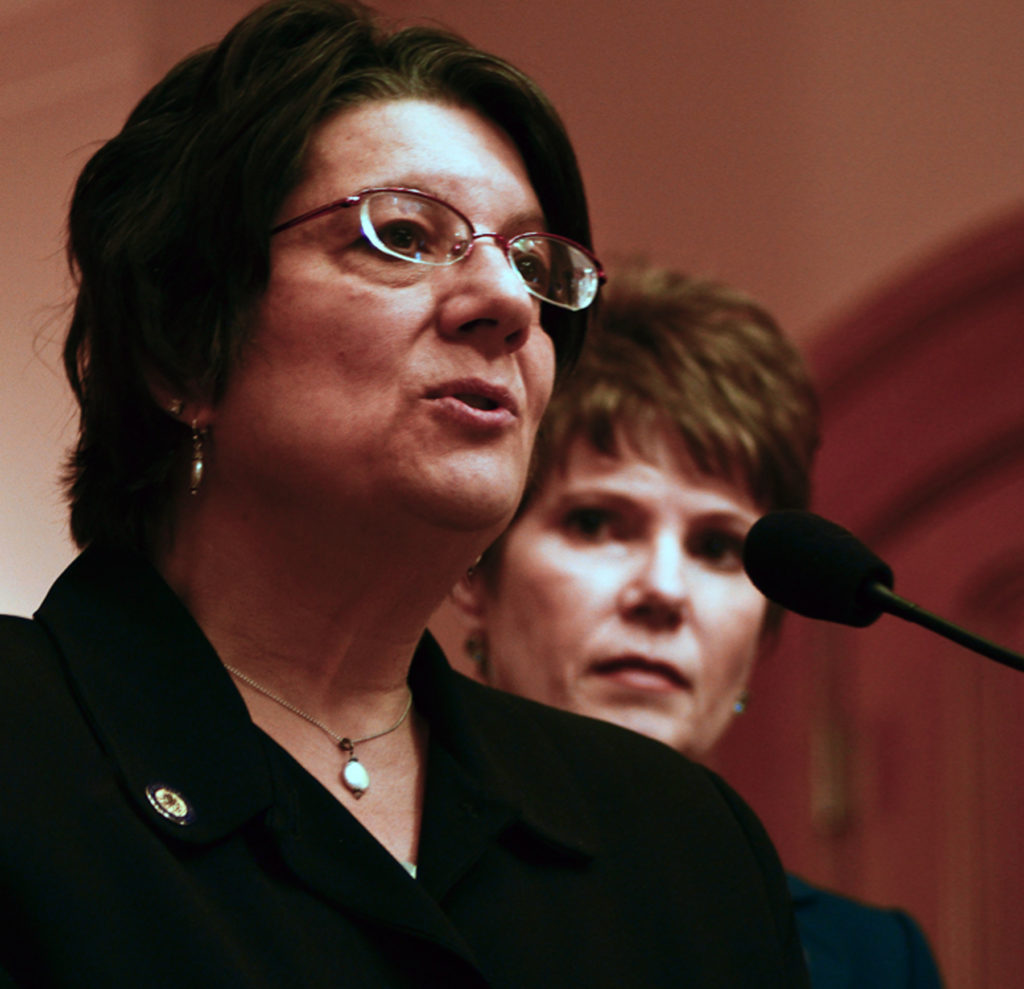
When Cleveland-based KeyCorp made Beth Mooney its new CEO in 2011, the Michigan native became the first — and so far only — female CEO of a Top 20 American bank.
“When I got that job it was clearly a headline because I was the first female in an industry that has been dominated by men, so it was a big deal,” Mooney, 57, told Toledo Free Press during a recent visit to the Toledo area, where KeyCorp operates 22 KeyBank branches. “It would be a great statement if, when I retire, the fact that I was the first female is a footnote, not the headline.
“It’s a tremendous opportunity, but also, in the best sense of the word, a tremendous obligation to be the first female CEO,” Mooney said. “I take that very seriously. I want to do this well because it reflects on women in our industry and it will make it easier for the next woman to have this opportunity. I think about that every day. And perhaps if I work a little harder, it’s not to prove myself [to men], but to make sure it’s a good example for others to follow.”
Secretary to CEO
While in Toledo, Mooney met with a group of female KeyBank employees, sharing with them her personal journey “from secretary to the corner office” and reflecting on how much the workplace has changed in only one generation.
“I graduated from the University of Texas — Phi Beta Kappa, summa cum laude — and as I went looking for jobs, people asked me if I could type,” Mooney said. “I would like to believe that doesn’t happen anymore. While there are always still challenges for people as they build their careers, it has become a totally different world and, I believe, a fundamentally fair world within 30 years.”
After college, Mooney worked as bank secretary until she was able to persuade a reluctant Dallas bank manager to place her in his management training program.
“Actually I refused to leave his office until he hired me,” Mooney said. “Most places wouldn’t even let me pass go. In that day, at least in Texas, there weren’t a lot of women in the training programs. I was in his office for three hours. I begged, I bullied, I just wasn’t going to go home without a job.”
When he finally agreed, Mooney looked him in the eye and said, “You will never regret it.” She entered the training program, enrolling in night school at Southern Methodist University to earn her MBA.
KeyCorp CEO Beth Mooney and Jim Hoffman, president of Keybank’s Michigan/Northwest Ohio district.
“I’ve been told I’m relentless from time to time,” Mooney added. “I guess that three hours was the beginning.”
Years later, Mooney looked him up and thanked him.
“We reminisced. He said he indeed remembers me,” Mooney said, laughing. He told her he thought he would “send her packing” within five minutes, but her persistence eventually convinced him to give her a chance.
“Your story in life is always shaped by the people who give you opportunities and then the other half of the story is what you do with them,” Mooney said. “I’ve always been grateful I got a chance to tell him what an opportunity he gave me.”
Mooney was recently ranked No. 49 on Fortune magazine’s list of the 50 most powerful women in business, one spot in front of Oprah Winfrey. Last year, she was ranked No. 96 on Forbes’ list of the 100 most powerful women.
Natural leader
Jim Hoffman, president of KeyBank’s Michigan/Northwest Ohio district and a University of Toledo graduate, said Mooney is a natural leader.
“Beth can analyze situations and see solutions clearly and quickly,” Hoffman said. “She’s got a great staying power around things that need to get done.”
Mooney’s leadership at the helm helped KeyCorp weather the economic recession.
“I’m very proud of the decisions our company made and how we are positioned at this point in time,” Mooney said. “Our future is bright.”
KeyBank has been profitable for nine quarters, Mooney said, and was one of five large U.S. banks and the only large bank operating in Northwest Ohio to earn a five-star rating from BauerFinancial, which rates the financial strength and stability of financial institutions each quarter.
“Our lending this year is up 75 percent over last year — and it’s in consumer lending, small business lending, commercial banking — so it’s very broad,” Hoffman said. “We think that’s the role of a bank, to recycle dollars and help this economy get on its feet, which leads to jobs, which leads to prosperity for everyone.”
Community focus
KeyBank is committed to community banking, Hoffman said.
“Key is one of the few large banks that decentralizes and pushes the decision-making for hiring, staffing, loan decision-making and anything to do with the customer down to the local level,” Hoffman said. “It allows us to better understand the customers’ needs and make the decisions that serve those needs best. Very few large banks do that. Key is very different and we think that difference is so noticeable.”
The company is also committed to supporting the communities it serves. KeyBank Foundation recently donated $1 million to Susan G. Komen for the Cure. The grant trained volunteer community health advisers to help minority and medically underserved women gain access to breast screenings and cancer treatment.
“It’s already helped six women discover they have cancer and they are getting help,” Mooney said. “That’s in the first month. It’s a wonderful program.”
KeyBank Plus
On Oct. 1, the company debuted its KeyBank Plus program in 34 Northwest Ohio branches. The program allows people without bank accounts to cash checks, offering a low-cost alternative to payday lenders, Hoffman said. Free financial literacy classes are also available.
“One part of the community that has always found it difficult to access financial services is the low- to moderate-income population in the community, sometimes referred to as the unbanked or the underbanked,” Hoffman said.
The program was launched in Cleveland in 2004 and has since been introduced in nine other markets, including Akron-Canton. The program has served nearly 55,000 clients, educated more than 22,000 people through financial education and cashed more than 300,000 checks totaling $200 million, according to a news release.
The check-cashing fee is 1.5 percent of the value of the check, lower than the 3 to 7 percent most Toledo check-cashing businesses charge, according to the release. Clients can also use up to five fee-free money orders each time a check is cashed.
“It really hits the tone of the times,” Mooney said. “It says, ‘We will meet you where your need is. We will help teach you how to use the financial system and then as you either grow in your comfort level or your capacity, we will introduce you to more traditional products.’ It really is bridging a whole population. It’s something I think we’re doing that’s very distinctive.”
Hard work ahead
Although she sees a bright future, Mooney acknowledged there is still hard work ahead.
“Part of what I think is great about being a banker is we’re in a position to really influence the strength of the economy, the ability for people to expand and grow, to hire people, to buy homes, to educate their children,” Mooney said. “I believe in this country and I believe we will get through it. We are still in a slow period, but that’s a whole lot better than being in a recession. Slow and steady will get us there.
“There will never be a stable and sustained recovery in this country without a strong banking system, so that’s part of why I think it was so important for banks like Key to return to such a position of strength. This is the part of the cycle where we will help the economy recover and start growing again.”
A Toledo woman who worships at the Perrysburg mosque isn’t who you might expect to see huddling under the tent to pray.
But her fair skin actually doesn’t matter because her husband, Wesam, and the Muslim community he grew up in, are as welcoming as Islam professes to be.
“I didn’t convert until three and a half years after we were married and I was pregnant with our first child,” said Lisa Hawary, who previously worshipped in a Presbyterian church. “This is the most open-minded, broad-based humanitarian religion I could see myself raising my children in. You learn about religion from the beginning of time. It isn’t about just being a Muslim; it is being a well-rounded person.”
Hawary said worshipping in a tent outside the mosque since last month’s arson has been uplifting. She is surrounded by many cultures and voices.
Still, she said it is upsetting that an Indiana man allegedly set fire to the mosque’s prayer room, intentionally.
“It hurts your heart,” she said. “When you are in prayer with God, it is a personal moment and a loving moment in the day. You want that space back; you want that time back.”
Many people don’t understand what Islam’s philosophy entails.
“I couldn’t grasp having that much animosity and hate in my heart. It is a huge cry for help. It is a cry for knowledge. It is cry for understanding. It is a cry for love,” she said. “If this happened at a temple, a synagogue or at CedarCreek, I would say the same thing. That person is searching for love and understanding.”
Hawary was interested in Islam even before meeting her husband, whose family is from Lebanon.
“I was learning about Islam before meeting him. I was going from church to church and not finding what I was looking for. I was left struggling with concepts I didn’t understand.”
Her husband and mosque members answered her questions and gave her material to read. Even when Hawary was fairly certain she wanted to convert, they advised her to wait.
“If Islam is something you are thinking about, wait six months and think more. Make sure this is truly what you want to do in your heart,” she said they told her.
She wasn’t even Muslim when she was married in the mosque, but the imam (leader in the church) was open-minded and wanted to get to know her spiritually. He told her marriage is a partnership and she has the right to stand up to her husband.
Hawary said she didn’t change her first name as customary when converting to Islam, and she doesn’t wear a hijab.
Once a classmate asked one of her three children, “Why isn’t your mom wearing one of those black things?”
The PASSPORT program enabled Stella Bailey, right, to stay in her own home until her death at age 104. Also pictured: Her husband Jay, left, and home health aide Lori Kott. Photo courtesy Area Office on Aging of Northwest Ohio
When 104-year-old Stella Bailey died Oct. 9, she was exactly where she wanted to be — at her Rossford home of 90 years, with her husband and family close by.
“She didn’t suffer none. That’s the good part,” said 96-year-old Jay Bailey, Stella’s husband of 60 years.
Family members had visited just before she died, Jay said.
“She was laughing and joking with the little baby,” he said. “She lived a ripe old age.”
Stella was able to remain at home with the help of PASSPORT, a state Medicaid waiver program funded through the Ohio Department of Aging and the Ohio Department of Job and Family Services.
The program, administered in Northwest Ohio by the Area Office on Aging of Northwestern Ohio (AOoA), links Medicaid-eligible seniors with long-term care services, such as home health aides, home-delivered meals, medical equipment, medical transportation, adult day care and more.
PASSPORT services usually supplement care provided by family members, said Pam Wilson, AOoA’s vice president of long-term care.
“Many of the people we serve do have families who are dedicated to keeping them at home and are actively participating and assisting with the care,” Wilson said. “Our services wrap around that family unit and provide support in places where the family may be struggling.”
Stella started using PASSPORT in 2003. Home health aides assisted Jay in caring for Stella seven hours a day, seven days a week.
“She’s been real good,” Jay said of primary aide Lori Kott of Maumee-based Nursing Resources. “I wouldn’t have made it without her.”
Most older adults prefer to stay home as long as possible, Wilson said.
The PASSPORT program helped 104-year-old Stella Bailey stay at home until she died. Also pictured is her husband, Jay Bailey, and home health aide Lori Kott.
“It’s often where they’ve lived for many years and a place where they are comfortable and want to stay,” Wilson said. “Being in the home lets you feel more a part of your family and a part of your community. It’s just that familiarity. Every time someone makes a physical move, it’s disruptive to the person, it’s disruptive to their health. It’s very common that people become disoriented, even though they may not have been disoriented in the past, if they end up in the hospital or they go from hospital to a nursing home. It’s trauma.”
PASSPORT also helps the health and well-being of caregivers, Wilson said.
“If you have those supports in place, families can often be caregivers for longer periods of time because they have the support and don’t burn out as they may if they were doing all the care themselves,” Wilson said. “It’s not uncommon that we hear, ‘Gosh, I wish I knew about you a couple years ago.’”
If the primary caregiver is a spouse, PASSPORT gives them more time together, Wilson said.
“A lot of times it’s stressful on the caregiver to make those regular trips to the nursing home when they want to go every day and stay for hours,” she said.
PASSPORT services are also cheaper than a nursing home, saving taxpayers money, said Justin Moor, AOoA’s vice president of planning and program development. A year of nursing home care in Ohio costs about $62,000 on average, whereas a year of PASSPORT services costs about $21,000, Moor said.
“PASSPORT is about a third of the cost to taxpayers, so for each senior that gets their care through PASSPORT, the savings to taxpayers is about $40,000 a year,” Moor said.
When PASSPORT started in July 1990, about 90 percent of Medicaid dollars for long-term care went to nursing homes and 10 percent to home care services. Today, it’s closer to 60-40, Moor said.
“It’s working well. It’s been growing every year,” Wilson said. “We do feel it’s one of those cost-saving options to help with state budget issues.”
About 2,800 Northwest Ohioans participated in PASSPORT in 2011 and the program has served more than 20,000 Northwest Ohioans since 1990, Wilson said. Statewide, more than 31,000 Ohio seniors participate in PASSPORT each year.
To qualify, applicants must be 60 or older, need help with at least two daily living activities such as bathing, dressing or walking, and meet Medicaid’s financial eligibility guidelines, which include an income of no more than $2,090 per month and no more than $1,500 in assets, not including their home.
AOoA’s nurses and social workers oversee the service plans and perform the initial eligibility assessment. The services are provided by more than 120 contracted agencies.
PASSPORT does not negate the need for nursing homes, Wilson said.
“We certainly support the need for nursing homes. We know we can’t do all the care in the community,” Wilson said. “We want people to get the care they need and nursing homes are doing a wonderful job with rehab after illnesses and surgeries, but we don’t want them to feel like they are going to be stuck there.”
Wilson said too many people don’t know about PASSPORT and the AOoA.
“Our goal is to make sure people know we’re here and not to wait to call for help,” Wilson said. “A lot of people don’t look for the kinds of services we offer until they need help and then generally they need it immediately. Having a little support in place lets us be able to add some additional supports when something happens. Whether Medicaid-eligible or not, we’re always willing to help connect people with those community resources that can help a person stay at home.”
For information, visit www.areaofficeonaging.com or 2155 Arlington Ave., or call (419) 382-0624.
Comfort music — that’s the specialty of Holly Golightly & The Brokeoffs.
“There’s something nice about songs that are instantly familiar if you’ve heard them or not; there’s a format that’s recognizable to most people who have any knowledge at all of the last 30 or 40 years of music,” Golightly said. “Everybody knows the standard arrangement of things and if you don’t, you can guess it.”
When it comes to music, the singer-songwriter-guitarist is a traditionalist.
“It’s exactly what it says on the can,” she joked. “Making things less complicated is quite good. … Songs don’t really need to be six minutes
long; there’s no benefit to it. Keep things short and sweet.”
Golightly and multi-instrumentalist Lawyer Dave use that recipe to whip up the duo’s fifth release, “Sunday Run Me Over,” which will be released Oct. 9.
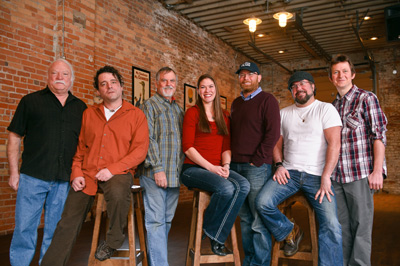
Holly Golightly & The Brokeoffs bring a traditional, comfortable approach to music to Mickey Finn’s.
Holly Golightly & The Brokeoffs will play at 8 p.m. Oct. 13 at Mickey Finn’s Pub. Daniel Wayne and 33 1/3 will open. Tickets are $8 in advance and $10 at the door.
The rootsy rockers serve up three cover songs and nine rollicking originals with dashes of humor on their album.
Dave is featured on lead vocals of the cover of Mac Davis’ 1980 song, “Hard to Be Humble,” which begins with he and Golightly making Facebook posts about how much they hate each other.
“It’s a ridiculous song,” Golightly said during a call from the couple’s farm near Athens, Ga. “It’s one of Dave’s favorite songs; he really likes playing it.” She shared the story behind “This S*** Is Gold.”
“I wrote the lyrics to that one. It was aimed at like KISS , you know, the stuff that happens that’s all about the merchandise and how you go and see a band and you get out of the place by going through the gift shop,” Golightly
said. “It was really tongue and cheek.
“You have bands that have action figures of themselves. The thing that’s funny about that to me is that most of the people who have action figures, they themselves don’t do anything. So they’re action figures of people who don’t do much action. They should make action figures of [Dave and me]; we never stop,” she said and laughed.
In addition to making music, the couple rescues horses — and they have five dogs and eight goats, along with geese and chickens.
“We have to load 400 bales of hay this afternoon,” Golightly said. “There’d be sort of lumberjack days and horse trainer and all these other action [figure] versions of us. … We should be marketing this stuff; people love farm sets.”
People love Golightly’s moniker.
Born in London, the vocalist said she was named after the character in Truman Capote’s “Breakfast at Tiffany’s”: “I think [my mom] put the book down when she went into labor and that was the first name that came to mind.”
The duo won an Independent Music Award for best Americana album for 2008’s “Dirt Don’t Hurt.”
And the Brit has sung on The White Stripes’ disc “Elephant.”
“[Our music] doesn’t have any cryptic messages in it. You’re not going to find anything massively deep or meaningful in it,” Golightly said. “It’s just music and it’s fun.”
Michael Keedy, manager of special events for the Toledo Walleye. TOLEDO FREE PRESS PHOTO BY SARAH OTTNEY
Walleye hockey returns to Toledo on Oct. 13 and fans are invited to celebrate the start of a new season at FinFest, a free Opening Night pregame party.
FinFest is set for 4:30-6:30 p.m. outside the Huntington Center on Huron Street, weather permitting, said Michael Keedy, manager of special events for the Walleye.
“That’s how we kick everything off,” Keedy said. “We’re going to have live music [from local band 56DAZE], live ice sculptures, street performers and all kinds of fun stuff going on. We’ve done this every year and we usually get a great turnout.”
FinFest drew about 300 fans last year and more are expected this year, Keedy said.
Another pregame opportunity is OctoberFeast, which includes a game ticket and all-you-can-eat buffet for $45. The buffet will be available 5-6:30 p.m.
The game starts at 7 p.m. Gates open at 6 p.m. and the first 4,000 fans will get blue and gold glow wands.
“As part of our introductions, we turn all the lights out in the building for several minutes and it will be just a great effect to see all the blue and gold glow wands waving around at once, so we do encourage people to get in their seats early,” Keedy said.
There are still game tickets available but they are going fast, Keedy said.
“Every year, we’ve had sell-out crowds and it’s starting to become the routine in Toledo that this is really the place to be so we just urge fans to get their tickets now,” Keedy said. “We’ve always sold out and we anticipate the same thing this year, so the sooner the better.”
There is also a post-game party with the Walleye players in the Club Level Lounge, open to anyone with a ticket, Keedy said.
No matter what they choose to do, people who come out for Opening Night can expect to have fun, Keedy said.
“Everything we do is going to be entertaining,” Keedy said. “Opening Night is really meant to be a celebration, just as it is for Mud Hens Opening Day.”
Theme nights
Walleye fans can also look forward to various theme nights and promotions planned throughout the season, Keedy said.
Jersey auctions, in which game-worn jerseys are auctioned off for local charities after the game, are always popular, Keedy said. This season will feature Captain America jerseys on Nov. 10, Boy Scout-themed jerseys on Jan. 5, Toledo Blades throwback jerseys for Toledo Hockey Heritage Night on Feb. 16 and pink jerseys on March 2 during Pink in the Rink, benefiting breast cancer research.
Nov. 10 will also feature an appearance by Captain America and a giveaway of 1,500 Captain America shield frisbees, Keedy said.
Also on Nov. 10, Toledo police and firefighters will square off in their second annual hockey game at 3 p.m. called the Battle of the Badges. A portion of proceeds will benefit the Toledo-Lucas County Police Athletic League, a youth sports organization, and the Toledo Firefighters Local 92 Charities, which benefits a number of area charities. Admission is free with the purchase of a Walleye ticket for Nov. 10.
“It was a huge success last year,” Keedy said.
Nov. 11 is Veterans Appreciation Night.
Nov. 17 will feature an appearance from former Red Wings player Joey Kocur, who will also be signing autographs on the main concourse during the game.
Nov. 17 will also kick off a four-part poster series, starting with a lifesize Spike growth chart, Keedy said. Other posters will be given away on Dec. 16, Feb. 17 and Feb. 24.
The annual Teddy Bear Toss is set for Dec. 1.
“That’s always a big one,” Keedy said of the event, in which fans throw new or gently used stuffed animals onto the ice for Lucas County Children Services. “It’s a lot of fun and we get an incredible amount of people who participate in that.”
Dec. 1 will also feature an appearance from the Hanson brothers, stars of the hockey movie “Slap Shot,” including an on-ice skit and free autographs.
Dec. 16 will feature “an assortment of chocolate-covered goodies,” in honor of National Chocolate Covered Anything Day, Keedy said.
Hockey and Hops is a pregame craft beer-tasting event on Dec. 28. Cost is $45, which includes a souvenir glass, all-you-can-eat buffet and game ticket.
Jan. 6 will feature a Spike “bobble-body” giveaway to the first 2,000 fans, Keedy said.
Feb. 24 is Mascot Mania Night and will feature more than 20 mascots from local businesses and professional sports teams, Keedy said.
“Anybody planning to come to that game is going to see a lot of characters walking around and a lot of opportunities for autographs and photos,” Keedy said.
Pink in the Rink supports the fight against breast cancer. Photo by Steve Dempsey.
Pink in the Rink, a popular annual promotion that raises money for breast cancer research, will be March 2-3, with both games played on pink ice.
Every Friday night home game will offer a post-game party with the players in the Club Level Lounge for anyone with a ticket. Every Sunday home game offers a free post-game open skate. One Sunday per month Walleye players will join fans during the open skate, Keedy said. Every Sunday home game also features the Chuck-A-Puck game, in which fans purchase foam pucks and try to throw it closest to center ice. Proceeds benefit local youth hockey organizations.
Promotions are subject to change.
“We’re constantly adding new promotions, new giveaways and new events and we update the page frequently,” Keedy said.
For more information, visit www.walleyetoledo.com/promotions.
Fanwear
Those looking for new Walleye fanwear will have plenty of options this season as well as a new location to buy it.
A new retail area will be located near sections 104-105, said Craig Katz, director of merchandise and licensing. There is also the Swamp Shop near the ticket windows and The Tackle Box outside section 121.
“We’re really excited about that,” Katz said. “We now have three areas at Huntington Center for fans to purchase their new Walleye wear and we encourage people to come check it out. It has some very cool aspects.”
The new gear for men, women and children includes 40 new styles of T-shirts, 30 new styles of sweatshirts, two dozen new hat styles and three dozen new novelty items, Katz said.
Among the new items Katz expects to be popular are “Tufgloves,” giant “Hulk hands” with a cup-holder built into the fist, Katz said.
“We’ve had a lot of success with them over at the Mud Hens,” Katz said. “Fans can use them to high-five and pump up the crowd as well as enjoy their favorite beverage.”
Also new this year is foam hockey helmets, similar to the popular foam fingers and “puck heads,” Katz said.
“Those are some of our most popular items every year, so we’re always looking to broaden that line,” Katz said.
Closer to the holidays, the shop will offer a style of knit hat that looks like a hockey helmet, Katz said.
“We have lots of new items and new designs,” Katz said. “We’re excited to get the season going.”
For more information, visit www.toledowalleye.com.
Food
Among the dozen new food items on the menu at Walleye games this season will be homemade white cheddar macaroni and cheese.
Rib tips
“Kids will love it,” said Andi Roman. “You can get it plain, but if you’re a little more adventuresome, create your own by adding bacon, caramelized onions, Italian sausage, peppers and onions, chives, bleu cheese and barbecue pulled pork.”
Walleye fans can also get boneless wings and wraps, including “The Winger,” “Full Strength” and “Cross-Chick.” For dessert, fans can try the Fun-Dae (funnel cake topped with soft-serve ice cream, hot fudge, chopped peanuts, whipped cream and sprinkles), S’more Sundae (vanilla soft-serve ice cream, graham cracker, and hot fudge with marshmallow topping) or Chocolate “Heath Bar” Sundae (soft-serve ice cream, caramel, and whipped cream topped with crumbled Heath bars).
Social media
Fans can expect to see more photos on Walleye social media sites this season, said Nathan Steinmetz, manager of online marketing.
“It’s all about photos now,” Steinmetz said. “That’s one focus we’ll have moving ahead.”
The team already shares photos on Facebook and Twitter and plans to start an Instagram account soon.
“Over the last few months, there’s really been a change in focus from a description or a link back to our website to an album of photos,” Steinmetz said. “That’s what people want to see. That’s what’s interesting. That’s what stands out and catches your eye. We have tons of photos — of players, games, fans, behind-the-scenes — and for us, it’s a no-brainer to share those with our fans. We even have some fun with caption contests and guessing contests. It’s a neat way to engage with fans. It’s fun for them and always gets a lot of commentary.”
Last season, the Walleye started posting photos of fans wearing Walleye gear and fans loved it, Steinmetz said. People started sending in their own photos.
“The whole program started with social media and grew from there,” Steinmetz said. “It’s really neat to be able to see fans decked out head to toe. It really emphasized the team pride and the camaraderie and the spirit of wearing your Walleye wear at games. We’re looking to continue that this year.”
Although the team’s popular but short-lived iPhone app folded over developer issues, the team’s mobile website allows fans to browse news, stats, rosters, seating charts, dining options and more, Steinmetz said.
“Mobile is the way to go,” Steinmetz said. “A lot of fans are looking for information that way. I look on my phone more than I look at a computer anymore.”
Fans can also download the iheartradio app to their smartphones and listen to Walleye games live on their phones, Steinmetz said.
The third annual social media night will be March 24.
“The last two years have been a lot of fun,” Steinmetz said. “We get an incredible amount of participation from fans at games. We get hundreds of tweets, hundreds of posts on our Facebook wall. Tons of people send us pictures of themselves and their family and friends. We sift through those and put them on the video board throughout the game along with trivia questions and prizes.”
The Walleye also maintain a continuous dialogue with fans during games.
“There’s always somebody watching Twitter feeds and someone paying attention to Facebook during games, so if you mention the Walleye, there’s a great chance to hear a response really quick,” Steinmetz said. “We encourage fans to ask questions and get involved in the conversation.”
David Walker, left, and Doug Clarkson. Photo by Vincent Scebbi courtesy of the Independent Collegian
During the offseason, the Walleye added some age and experience to its lineup.
While last year’s team had 14 players under age 23, only six Toledo players are younger than 25 this season, according to the roster.
Head coach Nick Vitucci hopes the extra years will give the Walleye the edge to push the team back into playoffs after missing the postseason the past two years.
“We’re just going to be a team that has a little more whiskers and experience under our belts, that in the long run we hope will equate to success,” he said.
Walleye coach Nick Vitucci. Photo by Paul Nelson
Defensive help is on the way
Offensive production has decreased during the past three seasons.
The Walleye scored 254 goals in the 2009-10 season, their first year in the league and their only postseason trip.
In 2010-11, the Walleye finished with 239 goals and 72 points (33-33-6), just two points shy of claiming the eighth and final playoff spot.
Last season, goals dropped significantly, to 189 and 62 points (28-38-6), 10 points higher than the basement-dwelling Trenton Titans.
Older players will add stability to the lineup, something Vitucci said will lead to chemistry on the ice and more goals scored.
“Our locker room door has been a revolving door, players coming in and out and not having an opportunity to just get to know each other on the ice, which is what certainly leads to goals,” he said. “Our chemistry was never set because of all the players that were moving because of recalls and being sent down because of injuries.”
Wes O’Neill. Photo courtesy The Independent Collegian
While the team traded fan favorite and former Bowling Green State University defenseman Kyle Page to Kalamazoo, the Walleye picked up former Detroit Red Wings captain Wes O’Neill as well as 33-year-old defender David Walker.
O’Neill played 21 games last season with Kalamazoo and spent most of his career with the American Hockey League’s Lake Erie Monsters and Bridgeport Sound Tigers.
Walker, who was captain of Ontario Reign during the 2010-11 season, recorded 19 goals and 89 assists in three seasons there.
“The players we signed are going to be huge for us,” Vitucci said. “I think at times we’ve been inconsistent back there and [now] we have some good veteran leaders back there that’s going to settle things down for us. We’re going to be a good defensive team, which is where we struggled in the past.”
In addition, the Walleye re-signed forward Joey Martin, who led the Walleye with 49 points (22 goals, 29 assists) last season.
With this lineup, Vitucci said the team will look to implement a more aggressive, puck-possessive style of play.
The downside to this system, Vitucci said, is if the team is caught out of position, they are left more exposed on the other side of the rink.
“But we believe with the team we’ve got and the experience we have, especially on defense, that we should be in good shape,” he said.
NHL lockout
Despite the possibility of no NHL this season, the ECHL should be minimally affected, said Joe Babik, director of communications for the ECHL.
The NHL lockout began Sept. 15 over disputes in the collective bargaining agreement between the National Hockey League and National Hockey League Players Association.
Exhibition games are already canceled and regular season games will be called off if no progress is made on a new deal. The first NHL game is scheduled for Oct. 11.
Babik said that, while players in the ECHL work to get noticed by the American Hockey League (AHL) and NHL, they are part of a different union.
Vitucci said he is optimistic a compromise will be reached before the whole season is canceled.
“I am hoping that cooler heads will prevail and they will come together on all of these hot topics and we will have hockey this season,” he said.
However, the lockout could help bring stability to the Walleye roster.
Because the ECHL is a AA league, players move between it, the AAA AHL and the NHL.
“Whenever there’s an injury in the NHL with the Red Wings or the Blackhawks, they’re going to get a call-up from their American League teams and we’ll lose a player,” Vitucci said. “[Now] with only one team playing above us, you’re looking at 20 guys you run the risk of injury instead of 40 players you run the risk of injury. Hopefully, there won’t be that much movement once the season starts.”
With no NHL, more pro scouts could make their way to minor league games, giving Walleye players more opportunity to be noticed, Vitucci said.
“It’s a great opportunity for players at our level to really promote themselves as far as the type of players they are and character they are,” he said.
Vitucci said he did not recall any surge in attendance to ECHL games during the last NHL lockout, which canceled the 2004-05 season.
Vitucci called the lockout a “possible catch-22” in the sense that fewer people may be thinking about hockey.
“Without hockey in the NHL, you’d think people who would want to get their hockey fix, they’re going to want to come down here, but there’s also no hockey in the NHL and families aren’t home on a Friday night watching a game and getting an urge to come to Toledo to watch a game the next night,” he said.
New ECHL teams
The ECHL welcomed four new teams to the league this year.
Joining the Walleye’s North Division are the Fort Wayne (Ind.) Komets and Evansville (Ind.) IceMen.
The Walleye will square off against Fort Wayne 10 times and Evansville 11 times in the upcoming season.
“We expect them to be very good teams right out of the gate,” Vitucci said. “Fort Wayne is a team that has won championships at every level they’ve played at and Evansville is a team that has been good in the Central Hockey League. We expect them to be contenders right out of the gate and we are going to have to play our best hockey to compete and battle with them every night.”
The Orlando Solar Bears will play in the Eastern Conference’s South Division and the San Francisco Bulls are in the Western Conference’s Pacific Division.
Toledo hosts the Solar Bears at home Jan. 5.
The Walleye season kicks off Oct. 13 when Toledo hosts the Kalamazoo Wings. The puck is slated to drop at 7:05 p.m.
For more information, visit www.toledowalleye.com.
Wouldn’t it be frustrating to get a nice big expensive box from your mom and dad and open it up to find there is nothing inside? You would probably wonder what they were thinking when they took the time to acquire such a nice box and then forget to put anything in it. And now they are not around anymore to explain it to you. After further investigation, you find that because they did not put anything in the box, a bunch of their money is now going to lawyers. You don’t know what to think. Should you be angry? Sad?
The situation being described here can be used to point out what I (Mark) consider one the biggest and most common mistakes when setting up a revocable living trust. Many folks opt to use a living trust as a way to pass on assets to heirs in what they think will be a cost- and time-efficient manner. It can work very well if you take all the necessary steps, but if you don’t, it can end up being a big waste of time and money. The big mistake is the failure to “fund” the trust.
First, let’s talk generally about what one of the most common goals is when setting up a revocable living trust. This is typically the avoidance of probate. What is probate and why would anyone want to avoid it? The simplest way I can describe it is, to get things that were in your name while you were alive, into the names of the people that you intended to leave them to after your death. Obviously, you are not around to sign any paperwork transferring the assets to your loved ones. What usually happens at this point is the probate process takes over. If you have signed a last will and testament, the local probate court oversees the process to make sure your wishes are carried out. Your will is filed with the court, which then appoints an executor who is responsible for administering your estate. There are a series of steps that the executor takes, such as notification to the heirs, and inventory of all date of death assets and at the end a final accounting and distribution of the assets. Probate sounds like a nice orderly process, right? That is because it is. Probate is not necessarily a bad thing. Its intent is good. It is a process to get done what needs to get done. As a lawyer, it requires expertise to know what steps need to be taken in what order, etc. So why do people want to avoid it? The answer is mainly cost savings.
The probate court has a schedule that lawyers can use as a guideline on what to charge for their services to help administer an estate. It is typically a percentage of the value of the probate asset. There is also a percentage that is charged for nonprobate assets that is typically lower. Nonprobate assets can directly pass to the heir either by a living trust or perhaps a beneficiary designation such as on retirement accounts, annuities or life insurance. Back in 1965, a guy by the name of Norman Dacey wrote a book on how to save money by avoiding probate. Ever since then it has become popular to use a living trust as a mechanism to transfer assets. The most common mistake is paying a lot of money to set up a trust and then not following through and transferring assets into it. This is critical in order to avoid probate. The trust is like a box, and whatever you put in the box avoids probate.
What should you do?
1.) Everyone should do an assessment of his or her current estate plan, whether it is a will or a trust. If you don’t have anything in place, you should get it done right away.
2.) This is also a good time to review all of your beneficiary designations to make sure they are correct and up to date. I can remember when a lady came to my office to have me review her plan. I informed her that she had made the big mistake of not putting things in the box. I felt bad because it reduced her to tears. She said, “You mean that if I would have died, my assets would have gone through probate?” Yep.
As always The Retirement Guys wish you a happy retirement. Oh, and one more thing — don’t leave your family an empty box.
Securities and Investment Advisory Services are offered through NEXT Financial Group Inc., Member FINRA / SIPC. NEXT Financial Group, Inc. does not provide tax or legal advice. The Retirement Guys are not an affiliate of NEXT Financial Group. The office is at 1700 Woodlands Drive, Suite 100, Maumee, OH 43537. 419-842-0550