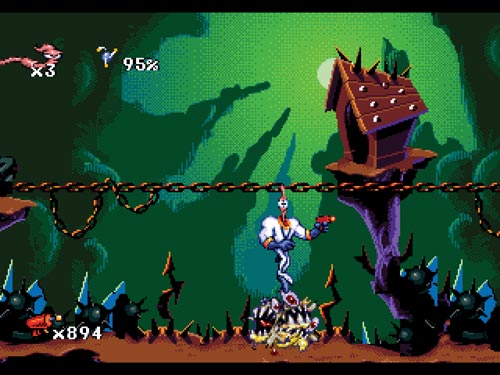
“Earthworm Jim,” Doug TenNapel, original concept, character designer and voice actor; Tommy Tallarico, composer; Steve Crow, lead artist; David Luehmann, producer, SEGA Genesis, 1994. Interplay Entertainment Corp.
For more than a century, the Toledo Museum of Art (TMA) has served as one of the most prominent jewels in the Glass City’s artistic crown. Wandering its galleries, visitors are treated to a representative sampling of the works of some of the greatest names their mediums had ever known. Rubens. Rembrandt. El Greco. Miyamoto. Kojima. Levine.
“Earthworm Jim,” Doug TenNapel, original concept, character designer and voice actor; Tommy Tallarico, composer; Steve Crow, lead artist; David Luehmann, producer, SEGA Genesis, 1994. Interplay Entertainment Corp.
If those last few names seem out of place, perhaps the newest exhibition at TMA will help to change your mind. Beginning June 19, the museum’s Canaday Gallery became home to a show that spotlights the creative output of a canvas which has heretofore been left unchronicled within many galleries: Interactive media. Playable narratives. “The Art of Video Games.”
“The key to what the exhibition is about is in the title,” TMA Director Brian Kennedy said during a news conference with reporters on June 17. “It’s about, in a sense, in question, to what extent do you believe that video games are art, and what is the art form in video games?”
Smithsonian debut
“The Art of Video Games” exhibit is in many ways the brainchild of Chris Melissinos, former chief evangelist and chief gaming officer for Sun Microsystems. Working with the Smithsonian Institution, Melissinos crafted the show to demonstrate the evolution of gaming over a 40-year period, emphasizing how games grew, not just graphically, but artistically.
“A whole new culture has been established,” Kennedy said in an interview with Toledo Free Press. “Gaming is a usage of technologies to do something that we’ve never been able to do in this way before. And then, out of that, come certain artists that become very, very well known. And yet most of them, I don’t think, have yet emerged. This is such a new format.”
The exhibit was designed to tell the story of game development by dividing it into individual eras, with kiosks representing 20 different platforms. Art and videos showing examples of games that defined their time period are on display at each station. These representatives were voted on by the public, with players around the world choosing which titles best exemplified each era.
Five games are made available to be played by visitors: the original “Pac-Man,” “Super Mario Bros.,” the adventure game “The Secret of Monkey Island,” the groundbreaking point-and-click title “Myst” and the offbeat and beautiful PlayStation 3 title “Flower.”
“The Art of Video Games” was wildly popular during its initial run at the Smithsonian American Art Museum. “This exhibition was one of the most successful exhibitions in Washington at the Smithsonian — actually, the most successful exhibition they’ve had,” Kennedy said.
“And it just attracted people because there hadn’t been an exhibition on the art of video games.”
Back in time
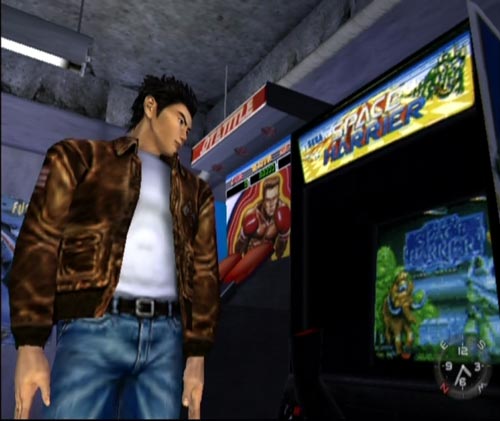
“Shenmue,” Yu Suzuki, director and producer; Yoichi Takahashi, designer; Eiji Ogawa, writer, SEGA Dreamcast, 2000. Courtesy SEGA
Stepping into the exhibit, as it now stands in the Toledo Museum of Art, is less like walking into a gallery and more like traveling back in time to an arcade. The first sight is a 10-foot-high projection screen, showing Pac-Man wandering his trademark maze. The sounds of Mario collecting coins and stomping on enemies dominate the space as you wander the gallery. The entire experience is like being inside echoes of gaming’s past.
The look and feel of the show is quite deliberate, explained Amy Gilman, the museum’s associate director and point curator for “The Art of Video Games.” “I just have to give a little shout-out to our exhibition’s designer, Claude Fixler, who is the one who really works with each curator on the different shows, to come up with different ways of displaying for that show. And we do, we spend a lot of time thinking, ‘What is the best way for this show to be seen here in Toledo?’
“And with this exhibition, we had seen it in other venues, and the place that we saw it last was in a much larger space, it was more spread out. And we thought that, actually, for us to really make it more of a tight show, [we kept it] enough like an arcade that you immediately go there in your mind. We wanted it to be a little loud, we wanted it to feel a little visually crazy and all of that. And that’s a really important quality to video games, but it’s also an important quality to the experience of the exhibition.”
It’s a little jarring for someone familiar with the space — and with the museum in general — to see the transformation. Just a few months ago, the Canaday Gallery was home to a showing of works from the Tuileries Gardens of the Louvre. To see it as it is now might strike some as a vulgar offense to their delicate ideas of what “art” is.
But to Gilman, that contrast is crucial to the museum’s mission.
“For the museum, it’s really important that over time we have a really broad range of offerings for our visitors,” Gilman said to the gathered reporters. “And that means reaching out into communities that are not necessarily served by being our core audience, but it also means that we like to provide all our visitors with really different experiences.”
For anyone who lived through the console eras represented, the exhibit is certainly a genuine shot of nostalgia — a factor Gilman and her colleagues recognize.
“The fact that we chose to use Mario and Pac-Man as our graphics for this show is about the nostalgia for that period in video gaming that is very much alive today. So one of the things that’s very important to know is, this exhibition isn’t about showcasing the next latest game from Nintendo, or Wii or whatever, and being the launch for that. It’s actually about looking at the progression in a way that we who play video games in our basements probably don’t get a chance to do.”
“The Legend of Zelda: Twilight Princess,” Shigeru Miyamoto, Executive Producer; Eiji Aonuma, Director and Producer; Satoru Takizawa, Art Director; Satoru Iwata, Producer, Nintendo Wii, 2006. Courtesy Nintendo of America, Inc.
It’s against the nature of the show — and indeed the medium it represents — to only dwell on the past, however. The four corners of the room are dominated by large projection screens where visitors can play one of the interactive titles, arranged chronologically. To see the progression of play — from “Mario,” where the goal is to stomp enemies and save the princess, to “Flower,” where you flutter on the breeze to invigorate a dying landscape — it’s hard not to see how narrative and genuinely artistic ideas have taken root for players the world over.
“With heightened, almost virtual reality, or hyperrealism in video capability now, we understand that it is more visually complex and that narratives are more complex, etc. But you don’t actually see how different it is in that progression, because we don’t actually look at it in that way,” Gilman said.
“So bringing them in here, and you being able to, start with the most pixelated, some of the most beloved, like Pac-Man. And you progress, and you can see them next to each other, you really get a sense of … not just the technical advances, but really, how visually and narratively complex things have become.”
“The Art of Video Games” is on display at the Toledo Museum of Art from now through Sept. 28. Admission is free.
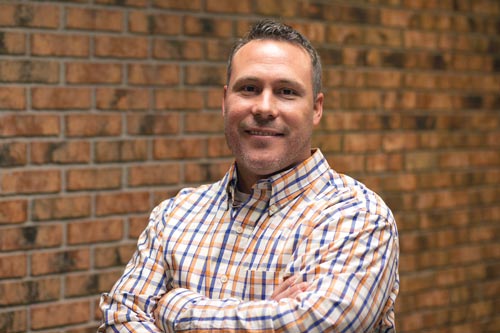
new creative director Randy Phipps. Photo courtesy Hart
An executive creative director at an advertising company as far-reaching as Hart must possess a mix of passion, creativity and leadership.
Randy Phipps said he fills all those criteria. The former senior art director for the company took over the creative director slot June 2.
“It’s coming home, but, at the same time, it’s a fresh start,” Phipps said.
New creative director Randy Phipps. Photo courtesy Hart
President and CEO Mike Hart said he is glad to have Phipps back at the company.
“We’ve followed Randy’s career and are pleased to have him back to lead our creative team,” Hart said in a news release. “Long ago, I learned that beneath Randy’s easygoing nature is a talented dynamo.”
Phipps grew up in Butler, Pennsylvania, just north of Pittsburgh. His mother was an artist, and her creative inclination inspired him to pursue an artistic career.
“She did it because she was passionate about it and she passed that passion on to me,” Phipps said. “Ever since I was young, I did a lot of drawing, a lot of creative thinking. It naturally kind of fell into place for me when I got to college.”
Phipps attended Kent State University, where he majored in visual communication design. He found his calling when he joined Hart as a young businessman.
“There’s a competitive nature to who I am, so that fits well into the advertising world,” Phipps said.
From 1998-2006, Phipps worked at Hart as senior art director.
“It was a little more hands-on, the day-to-day of creating designs and messages (compared to his new role),” Phipps said.
In 2006, Phipps decided to transfer to Toledo-based brand agency NORTH, which sent him across the globe for assignments.
“Pretty much, you can put a dot on a map and I’ve been there,” Hart said. “There was a lot of world travel. That was intriguing.”
During his time abroad, Phipps worked on material and communications for the Sochi Olympic Games, the Australian Open and the 2018 FIFA World Cup in Russia. Once he had explored the world, he decided he needed a change of pace.
“I was ready to move past that and move into a stronger role,” Phipps said. “The travel was exciting, but, once I fed that need, it was nice to be back. I can focus on doing great work and being with family.”
As executive creative director, Phipps has broader control and an overseer role.
Phipps’ goal at Hart is simple: Bring out the best in the company.
“It’s really to bring the creativity to a higher level and bring a little bit of international feel and flavor that I’ve gained through my previous job to Hart,” Phipps said. “It’s not a whole lot more difficult than that, elevating the level of work.”
Phipps said he sees a few challenges ahead of him.
He said Hart has one of the largest teams and one of the largest client bases in Northwest Ohio.
“Being on top of design, marketing and messaging trends across a vast number of clientele is probably the biggest challenge,” Phipps said.
Phipps said his positions at Hart have been ideal, because the company offered him the opportunity to do what he loves and meet quality people.
“Being in a great town where I can raise my family but at the same time do tremendous work and work with tremendous people, this would be my dream job,” Phipps said.
Phipps’ family includes his wife and son, who he said were very excited about the career move.
“They were glad that I came back,” Phipps said. “They know a lot of people here and we’ve made a lot of connections with people here at Hart over the years.”
Phipps prides himself on both his work and his ability to maintain healthy social relationships outside of the workplace.
“There’s a sense of professionalism that comes with being in the position that I’m in,” Phipps said. “To be able to be in this position and to maintain a good working relationship and friendships is what I’m most proud of. My job is what I do, but it doesn’t define who I am. The friendships I have built, that’s what I’m most proud of.”
Phipps said young professionals should consider all ideas before deciding to act in professional situations.
“Always keep an open mind,” Phipps said. “Great ideas can come from anyone, anywhere at any time. To have an open mind and always listen before you speak, that would be one of the best pieces of advice.”
Phipps said he is grateful Hart gave him such a warm welcome.
“I missed being here after I had left,” Phipps said. “Even though I had some great experiences and great professional times and I grew in those times, I always had a longing to go back.”
Newspaper people measure time not just by hours and weeks and months, but issue to issue. So it should not surprise me that our editorial staff is assembling our third annual Military Yearbook issue, but somehow that “third” is a jarring reminder of how quickly time passes.
.
Compiling these annual Toledo Free Press Military Yearbooks has been a humbling experience. Talking about service, dedication and sacrifice is easy; working with the men and women who live those ideals inspires gratitude and humility.
We are soliciting photos and messages from regional servicemen and servicewomen — at no charge to the families — to be compiled in our special issue.
To be included, email a high-resolution photo of the military member along with a short message to [email protected] by June 24. Also include the member’s full name, rank and military branch with each photo. Submissions can be of current military members or veterans.
There are an estimated 80,000 veterans in the eight-county area served by our regional Veterans Affairs offices. Add to that the number of active military members and guardsmen and you have more people to thank than you will ever be able to reach one at a time. In the Military Yearbook, to be published June 29, you will see scores of local men and women who proudly wear the uniform of the United States military. You will see photos of service members in faraway deserts, a world removed from their family and civilian lives. As the father of a serviceman, Army Cpl. Austin Pounds, I know we pray for the safe return of each and every one of them.
The stories in this upcoming issue — the brainchild of Toledo Free Press media writer Jeremy Baumhower and the product of Managing Editor Sarah Ottney and Project Editor Amanda Tindall — offer a glimpse into the services offered to our active military members and our veterans by several groups run by people who approach their work with the same righteousness and generosity as the people they serve.
We greatly appreciate the people who will share stories, send in photos and bare their souls to impart their wisdom. We thank the advertisers who are signing up to support this issue, especially Newsradio 1370 WSPD, Columbia Gas of Ohio and the American Red Cross of Northwest Ohio. Each of these groups made time and brainpower investments that helped us plan this special coverage.
On the verge of our country’s July 4 birthday, we stop to reflect on our freedoms, liberties and the countless lives cut short so that we may carry on.
We stop to think about the families without fathers and sons, without mothers and daughters. We stop to think about the bodies without limbs and minds without peace. This issue is our modest effort at saying thank you.
Thank you for your service, your dedication and your sacrifice.
Thomas F. Pounds is president and publisher of Toledo Free Press. Contact him at [email protected].
After compiling nearly a dozen CDs of local music for charity, the question I am most frequently asked is, “Aren’t you running out of local bands to include?”
As this summer’s “Red, White & You, Too!” CD demonstrates, the sonic answer is a resounding “No!”
.
There are some musicians I lean on because I am a fan and it is an honor to work with them, even as a passive facilitator; Kerry Patrick Clark, Kyle White, Pat Dailey, Jeff Stewart, Carmen Miller, Mike “Mad Dog” Adams and TAPESTRY are just a few of my favorites. Another, Eddie Boggs, passed away this year, but will still be represented on the CD.
Many of those stalwarts are included on “Red, White & You, Too!” (100 percent of sales benefit the area’s Red Cross military services and disaster relief services) but it is exciting to report the CD is rife with artists making their Toledo Free Press CD debut: Fish Fisher, Birds of Chicago, Nathan Roberts
& The New Birds, Tropic Bombs, Zak Ward, Thirsty Houligans, Bob Stevens and Scott Fish and Distant Cousinz.
For last summer’s inaugural Red Cross CD (which includes tracks by Chrys Peterson, The Bradberries, Crystal Bowersox, Alyson Stoner and several more artists and is also available in limited quantities this summer), I relied mostly on cover tunes. But as local bands began submitting songs this year, it became clear that the quality of their original recordings was so strong, the material could stand on its own; it may sound odd, but I am proud of each track, from its writing to its production. You will hear songs on “Red, White & You, Too!” that are better than most of what you will hear on mainstream radio this summer.
The official cover for the “Red, White & You, Too!” charity CD.
Among the many highlights of the 21-track CD are two songs by Fish and Distant Cousinz that highlight a recent local story that made international headlines. “Marlee’s Freedom” and “Lucky Day” are about the children of Tiffany Eckert and Army Sgt. Andy Eckert, who was killed in Iraq in 2008. The story of daughter Marlee’s connection to freedom and the tale of son Myles finding $20 and “paying it forward” to Lt. Col. Frank Dailey are recounted on the CD’s bonus tracks, both with the blessing and input of Tiffany. It’s a fun and summery CD, but these two tracks serve to remind us why it exists.
I always appreciate Put-in-Bay’s “Christmas in July” weekend, so a brief interlude on the disc provides music for that event; the rocker “Christmas in Killarney” by Extra Stout and the original “Xmas in Jail” by Thirsty Houligans linger on the season just long enough to make you want to take a sprig of mistletoe to the beach.
In two weeks, Project Editor Sanya Ali will present a special issue with stories on the musicians who contributed to the CD and a look at the work of the local Red Cross. In the meantime, stop by any area Big Boy or Ralphie’s restaurant starting next week and get your copy; it’s $10 for 21 tracks, and there’s a $4 Big Boy/Ralphie’s coupon inside.
Great local music, great local meals and a great local cause … is there a better way to enjoy summer?
Michael S. Miller is editor in chief of Toledo Free Press and news director of Newsradio 1370 WSPD. Email him at [email protected].
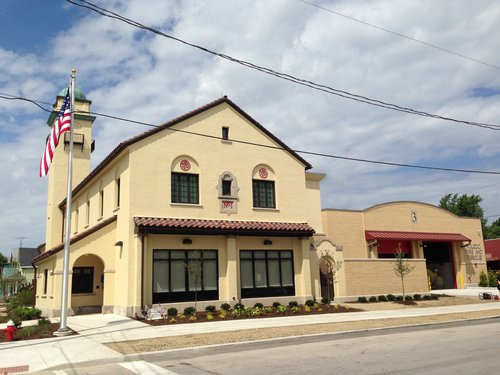
TFD Fire Station No. 3 on Bush Street in North Toledo was rededicated during a ceremony on June 16. Toledo Free Press photo by Sarah Ottney
Fire Station No. 3 in North Toledo was rededicated June 16. But the celebratory mood at the station that many fought hard to save was tempered by the fact that two of its members, Stephen Machcinski and James Dickman, won’t be there when the renovated station returns to service.
TFD Fire Station No. 3 on Bush Street in North Toledo was rededicated during a ceremony on June 16. Toledo Free Press photo by Sarah Ottney
“It’s a day of mixed emotions, but we’re trying real hard to make it a good, positive, happy day,” said Toledo Fire & Rescue Department (TFD) Chief Luis Santiago. “Having the families of Steve and Jamie here, that’s what really helps.”
RELATED: View more photos from the rededication ceremony
The two Toledo firefighters were killed Jan. 26 from injuries sustained while fighting an apartment fire in North Toledo.
The owner of the building, Ray Abou-Arab, is facing charges of arson and murder.
The $2.8 million project, located on Bush and Erie streets, renovated the existing firehouse and added a 7,000-square-foot addition. The station contains sleeping quarters, a dual-purpose lounge area/training room, a full kitchen and dining area. The station’s former garage doors were transformed into large bay windows. It’s the only TFD station to have an elevator.
“The blend between the old and new is just amazing,” Santiago said after the ceremony.
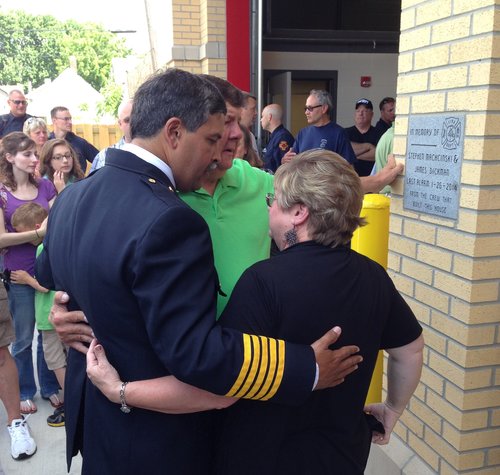
Remembrances of the fallen firefighters pervaded the ceremony, and the station is full of permanent reminders. Each speaker referenced them, a memorial plaque hangs in the kitchen and another memorial plaque, donated by the builders, was unveiled during the ceremony.
TFD Chief Luis Santiago embraces Greg and Linda Dickman, the parents of fallen firefighter James Dickman, in front of a stone plaque unveiled at Station No. 3 in North Toledo on June 16. The plaque was purchased and placed by the workers who built the building. Toledo Free Press photo by Sarah Ottney
The plaque in the kitchen features photos of the two fallen firefighters and the words “We Remember.” A carved stone plaque placed in the back wall of the garage bay by the site’s work crews reads, “In Memory of Stephen Machcinski and James Dickman, Last Alarm 1-26-2014, From the Crew that Built This House.”
“It’s beyond description,” Santiago said of the stone from the builders. “They did that out of their own initiative. They really took our loss hard as well.”
Mark Pitchford of Toledo-based Willson Builders recalled frequent interactions with the firefighters of engine company No. 3. The crew has operated out of Station No. 13 on Front Street in East Toledo since the Bush Street station was closed in September 2012 over safety concerns due to a buckling floor and other structural issues.
“On any given day it was not uncommon to see the No. 3 drive by two, three, sometimes more times a day on their way to or coming back from a run, always looking and waving as we would all do the same back to them,” Pitchford said during the ceremony.
“The Monday of Jan. 27, it was different. It was quiet inside this house. They drove by, still responding to calls, but no one was waving, not in the trucks or on the job site. On the job site we all felt the loss as well. We all felt we needed to do something to honor them.”
The workers decided to place a plaque between the back garage doors “to show that Jamie and Steve are watching this place until you get back home safe,” Pitchford said.
Among the speakers was Mayor D. Michael Collins, who began his remarks by addressing the Machcinski and Dickman families.
“This is a very challenging moment for each of you, collectively and independently,” Collins said. “However, I think if we look into the recesses of our hearts we will know that two brave men are smiling and looking down upon us today with a sense of pride.”
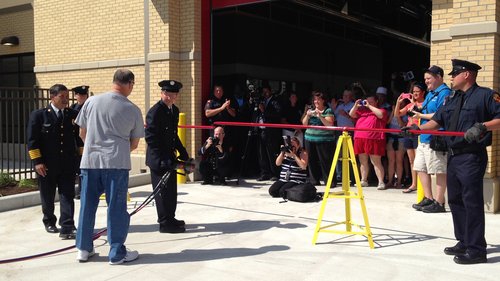
Instead of a ribbon-cutting, firefighters used the Jaws of Life to cut a red metal bar.
Former Toledo Mayor Mike Bell, a retired TFD chief who was once stationed at Station No. 3, was also in attendance. North Toledo residents Miriam Miller and her son-in-law Harold Gibson made paper signs they placed in front of the station that read: “Ladder #3, In Memory of Our Fallen Heros” and “Welcome Home No. #3, Thank You!”
Pvt. Steve Stainbrook cuts a metal bar with the Jaws of Life — TFD’s version of a ribbon-cutting — at the rededication ceremony for Station No. 3 in North Toledo on June 16. Toledo Free Press photo by Sarah Ottney
“It’s heartwarming,” Miller said of the station reopening. “It feels so good to have our firefighters back, but so hard to lose two of them.
“It’s so beautiful,” Miller said, of the refurbished structure. “It was so terrible looking [before].”
Another nearby resident, Tina Petersen, said she attended the dedication ceremony to check out the new building as well as express her gratitude to the Machcinski and Dickman families in person. Petersen had a seizure in January and a TFD EMT crew responded. A few days later, one of her neighbors recognized the EMTs who had come to her house in a news story about the fatal Jan. 26 fire.
“I wanted to let them know what it meant to me,” Petersen said.
“It’s going to be so much better [in the neighborhood] with the fire station back,” she added.
Santiago called the station an “anchor” of the neighborhood.
“This is a very proud section of Toledo,” Santiago said. “They thought it was very, very important to have this not only maintained but refurbished and updated.”
TFD initially planned to repurpose the Bush Street station and build a new Station No. 3 at Jamie Farr Park in North Toledo, Santiago said. However, many community members along with several Toledo City Council members and then-Mayor Bell fought for the station to be repaired and reopened.
“We didn’t think that made sense,” said United North CEO Terry Glazer, who called the renovation and upcoming reopening “a great victory.”
“Not only did we save an old historical building, but kept a fire station at that location where there will continue to be a relationship between firefighters and neighbors,” Glazer said.
More positive changes will soon come to the neighborhood with construction plans for a new No. 12 fire station in North Toledo and the purchase of the nearby Summit Street YMCA by Toledo Public Schools (TPS), Glazer said.
“We’re gaining two fire stations as part of the solution and now TPS is buying the YMCA. That’s happening right down the block,” Glazer said. “It all just dovetails into a bigger strategy so we’ve had some real victories in that neighborhood.”
As artists line the streets of Toledo with their work June 26, guests of EPIC Toledo’s latest event will be meeting, racing and finding clues they’ll use to explore the city.
Sara Swisher, director of EPIC, said the T-Town Dash will provide an environment to foster social and professional connections. Cost is $15.
“The T-Town Dash is an opportunity for young professionals in the community to come down and experience Downtown Toledo in the summer during an Art Walk,” Swisher said. “There’s a lot of people down here and it’s a good opportunity to learn about the different things Downtown has to offer.”
Swisher said she wants interns and employees who have not yet discovered Toledo, especially those who are from out of town, to take advantage of this occasion.
“I hope they take back to everyone that there are great things going on in Downtown Toledo,” Swisher said. “It’s a very vibrant and exciting place to be.”
As advisory council chair for the dash, Jessica Sloan is in charge of a lot of the delegation and planning of the event. She said her goals are similar to Swisher’s.
“[Toledo] is really a place you can make a life,” Sloan said. “It’s a great town. I’d really like a lot of people to come and see what Toledo has to offer.”
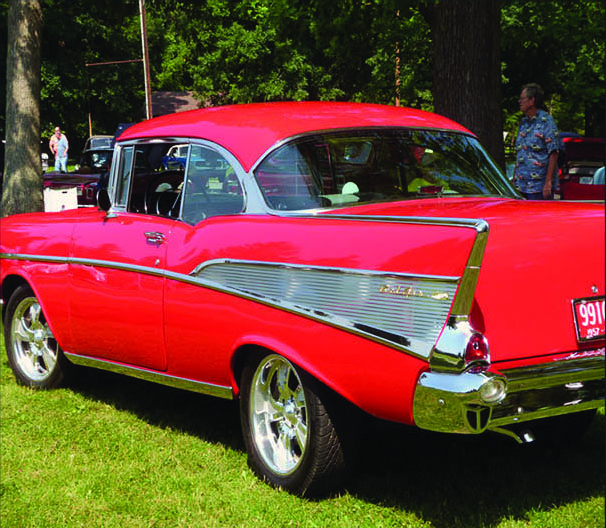
The Cops and Rodders Car Show will be held June 22. Photo courtesy Toledo Police Museum.
A troupe of cars and antique emergency
vehicles will soon make a pit stop at the Toledo Police Museum.
The “Cops and Rodders Car Show,” which
the museum inaugurated last year, rides into town June 22 from 9 a.m. to 2 p.m.
It will take place at Ottawa-Jermain Park next to the museum, which is located
at 2201 Kenwood Blvd.
Museum Director Shay Carlson said the
venue is perfect for this show.
“The Ottawa-Jermain Park Board has been very
generous to us,” Carlson said. “We can park the cars anywhere we need to. It’s
a beautiful venue, it’s shady and it has the shelter house with tables.”
The purpose of the show initially was
to garner publicity for the museum.
“We have several retired and current
active duty police officers who are car fans,” Carlson said. “It seemed like a
nice way to have an event at the museum that would raise awareness of the
museum and that would draw our police family to the museum for an event.”
Jeff Hauden, a local car enthusiast, said
he was inspired to suggest the show to museum staff after helping in a
restoration last year. Hauden noticed the spacious park next door and thought
immediately of a car show.
Hauden has been a car aficionado since his youth.
The Cops and Rodders Car Show will be held June 22. Photo courtesy Toledo Police Museum.
“It started as a teenager,” Hauden said. “I built
car models growing up, went to the racetracks and the dragways. I’ve always
been interested in cars.”
Hauden will display his 1967 Chevelle at this year’s show.
Accompanying the vehicle display will
be music by DJ Cruisin’ Zeake, coffee and doughuts, door prizes donated by
local businesses and a 50/50 raffle. Because of the turnout at last year’s
event, Carlson said she is optimistic they will have a good crowd this year.
“We hope that we get a lot of repeat participants
and, if we were to get 300-350 cars, we would feel like we had established
ourselves as an event that people want to participate in as well as attend,”
Carlson said.
The event led to a partnership with the
Cleveland Police Museum. The Cleveland museum’s show, which takes place June
21, will feature only antique police vehicles. Some of those vehicles will also
be shown at the Toledo show the following day.
“The Cleveland police vehicles are an added attraction,”
Carlson said. “We don’t have any limits or criteria on what kind of vehicle can
participate in the car show. If you want to show your car, you can show your
car.”
Carlson said the community of antique
car collectors has been instrumental in the event’s success.
“We expected somewhere between 30-50 cars, [but] we
ended up with over 200 cars and we were told that we could expect even more
this year,” Carlson said. “The car show community is pretty tightly knit and
they really like our venue in the park.”
Museum President Beth Thieman said last year’s event left her
pleasantly surprised.
“We were just praying for 100 cars to show up for our first
show,” Thieman said. “As the cars kept rolling in and the count went over 200,
I looked around at the scene that had unfolded. The weather was perfect, cool
classic cars everywhere, people smiling and strolling around under the trees,
visiting with each other – it was just a great day.”
Carlson said she fondly remembers the
feeling of family fun that last year’s event garnered.
“My favorite part was the atmosphere of a reunion
for a lot of our police officers, as well as discovery of the museum by people
who had not yet had the opportunity to visit,” Carlson said.
Carlson said she hopes people take the opportunity to
socialize and learn about the police department while they examine classic cars.
“It’s just a gorgeous opportunity to get out with the family,
see people you know, meet people you don’t know yet, see vehicles and see the
museum,” Carlson said.”
Hauden said all of the opinions he heard at last year’s show
were positive.
“It seemed like everybody that I talked to enjoyed
themselves,” Hauden said. “A lot of these shows are in parking lots or open
fields with no shade, so that’s why I thought this would be a great place to
have a show. With the museum open, it was a great venue.”
Hauden said he and the staff at the museum are thankful the
community was so prepared to help.
“Without everyone’s support, the participants of the show and
the companies that have donated, this wouldn’t have been possible,” Hauden
said.
The deadline to pre-register cars for $8 is June 13. The
first 100 to pre-register will receive a T-shirt and dash plaques. From June 14
to the day of the show, tickets will be $10.
In case of rain, the
show will be pushed back to June 29.
For
more information, visit toledopolicemuseum.com
By now, most people recognize that over the past several decades there has been a marked shift in the financial industry. These changes have not been limited to the names of the industry’s leading firms, the structure of products, the number of disclosures to be made or how fees are charged. There have also been significant shifts in psychology, specifically how financial firms and industry professionals perceive their relationships with clients.
Recently — especially within the past several years — we’ve been hearing more and more stories about advisers pushing unsuitable investments on clients, or becoming indignant at the loss of all or even part of an account. In sum, advisers seem far less focused on their clients’ needs. It is as if these service professionals have forgotten that they work for their clients — not the other way around.
It’s no secret that the culture of large wire houses and Wall Street firms has been undergoing a similar shift over an even longer time frame. By now, it seems Wall Street banks have almost zero interest in serving their clients, let alone making money for those they serve. Instead, the name of the game is to move as much money as possible from their clients’ pockets to their own before clients wise up.
Then, when things go bust, they fleece taxpayers to refill their coffers and start all over again, having never missed a bonus check in the meantime.
Investors need to be mindful of these attitudes in finance. No, advisers won’t always make money for clients, but there are bigger issues to consider. One is whether an adviser properly understands his or her relationship with a client, i.e., that he is an employee who can be fired at will. And he should be fired if a client ever becomes concerned about either of two things:
The person who is managing their money.
The system being used to manage the client’s money.
There are some managers today, although they are becoming a smaller and smaller minority, who manage their own money the same way they do their clients’ — who eat their own cooking, so to speak. This is a great benefit for most clients, who can rest easy knowing that their adviser is in the same boat. If they’re losing money, so is their adviser; if clients are having sleepless nights, likely their financial adviser is as well.
An even more important concern, though, is that a financial adviser never forgets whose money he or she is managing. Clients select advisers to provide services (e.g. managing money, helping a client with problems they have, assisting with account administration, moving money across generations) and advisers are compensated for services rendered. In the event a client ever decides to make a change that leaves no room for an adviser in their new financial plans, the adviser should be willing to do everything they can to make a client’s move away from their firm as easy as the move into it.
During these transitions, an adviser should hope that the client finds a satisfying relationship that helps them achieve their financial objectives and that the client is better off for having been with that adviser.
Dock David Treece is a partner with Treece Investment Advisory Corp (www.TreeceInvestments.com) and is licensed with FINRA through Treece Financial Services Corp. He provides expert content to numerous media outlets. The above information is the express opinion of Dock David Treece and should not be construed as investment advice or used without outside verification.
The rose was my mother’s favorite flower. She grew them in abundance in our yard when I was growing up and one of my favorite songs is “The Rose” by Bette Midler. I was thinking about that song and the rose as it pertains to those who are challenged in life with invisible mental and physical injuries and wounds. Yes, that is how my brain works!
The rose consists of many parts, including the petals, the filaments, the ovaries and a part I found very interesting — especially with my comparison to people who have invisible challenges — the stigma. When all the petals fall away, the stigma remains. It sits atop the style rising from the center of the petals and originating from the ovary.
I share this comment often in my speeches and trainings: “Stigma does not breed in the hearts of our veterans; it breeds in the hearts of the members of the community and organizations.” Invisibly wounded veterans get blamed for the stigma. It would be like saying that the stigma grows from the petals of a flower, when clearly science has shown that not to be true.
Veterans only have issues with stigma from their invisible wounds because the community is not educated thoroughly. By community, I mean the general public, employers, the people who work at social service agencies, government entities, schools, etc. The comments and attitudes many people have when approached by someone who looks “normal” in the world’s view of what is normal, meaning no visible signs of disability, reflect impatience, judgment and a curt attitude that shows no attempt at understanding.
Those seeking services are expected to do more and understand more than those with clearly visible wounds because they don’t look disabled. The services for them don’t match their needs. Just because they can walk into the office to seek help doesn’t mean they have an easier time than someone who can’t walk in that does not have mental or physical changes to their brain. You can’t just ask for an assistance tool for your brain and walk away with newfound freedoms to live life with invisible wounds.
As my doctor said to me, “We don’t do brain transplants, you just have to learn to live your life.” Really? Guidance would have been a lot more helpful than just an empty comment when my life was falling apart due to my own severe brain injury. My budding new life did not create its own stigma. Those surrounding me, especially those I sought help from, made it clear the services I reached out to were for people with all other disabilities except the one I had — residual deficits from a traumatic brain injury.
I learned over a period of nine years, that if I wanted to have any kind of purposeful life again, it would not be because of some outside provider. No matter how much money was spent by the government or given in donations to nonprofits, that did zero to help me find my path in life once again, though they talked a good game.
This is the same struggle our veterans face in mass numbers every day. In your community, there are veterans who are falling through the cracks. They are silently suffering because they know they are ridiculed for needing help because they don’t look the part. They are cast aside from events and benefits because those with more visible wounds look more “worthy.”
Sometimes the veterans create thorns, those things that keep people away so they don’t have to be hurt again by the lack of understanding and services. Their thorns are isolation, substance abuse, anger and, far too often, suicide and homelessness.
Just as the petals of a rose don’t all fall off at once, the veteran begins to lose one petal in life after the other, until hope for a better life is diminished. All the while, other veterans get trips, homes, health care services and benefits. Why? Understanding is the sustenance that begins new growth and emboldens our veterans to the hope that leads to better lives!
Pam Hays is president and founder of The Arms Forces, www.thearmsforces.org; (419) 891-2111; Facebook.com/thearmsforces.
A chorus of 5- and 6-year-old children prepared to serenade their guests, stumbling through English lyrics and giggling at each other’s singing voices. Today was a special day in Vietnam’s Quang Tri Province, an area ravaged decades before during the Vietnam War. The kids knew from the plaque at the schoolhouse entrance that Americans had built their elementary school. And today the Americans were coming.
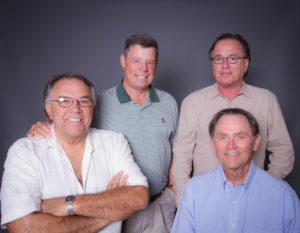
From left, Tom Treece, Fred Grimm, John Abbey and Dan Gregg (seated) are Vietnam veterans and volunteers with Toledo-Based nonprofit The D.O.V.E. Fund, which provides humanitarian assistance to Vietnam. Toledo Free Press photo by Christie Materni
“On the wings of a dove / We will rise high above / All our differences, so far in the past / Through the eyes of the children / See the bridges we’re building / Hope will find a way / Love will save the day, and peace will last …”
The Americans never knew what to expect on trips to Vietnam. But when their 18-person envoy stood outside the elementary school and heard the kids singing “Dove,” they knew why they kept coming back.
Dan May said he wrote “Dove” from the perspective of a former U.S. soldier who returns to Vietnam with the intention of helping his former enemies and rebuilding the land he once helped destroy. He wrote it for a group of Vietnam War veterans who have dedicated their lives to helping the people of Vietnam through The D.O.V.E. Fund.
Founded in 2000, The D.O.V.E. Fund is a Toledo-based organization that aims “to provide humanitarian and development assistance to areas in Vietnam, to provide communication, education and cultural exchanges that reflect the best qualities of both cultures. To create an environment brightened by hope and sustained by peace,” according to its mission statement.
“So many times after we go in and destroy a country, we forget about it,” May said. “These Vietnam veterans have taken it upon themselves to mend the fences.
“That’s what’s great about this organization: It rises above the past and looks toward the future.”
The D.O.V.E. Fund is comprised of mostly Vietnam War veterans who raise money to build schools, complete community projects and provide material items to impoverished areas in Vietnam.
After hearing children sing the “Dove” song during the group’s January trip, D.O.V.E. members said they “are more inspired than ever” to share their story and spread some dove love.
The nonprofit organization relies 100 percent on volunteers with the exception of one employee in Vietnam, a liaison who coordinates the logistics of projects on the ground and communicates with The D.O.V.E. Fund on a daily basis.
During the past 14 years, The D.O.V.E. Fund has raised more than $2.5 million in donations, almost all of which has funded its various humanitarian projects. Its members pay for their own trips to Vietnam and help cover 95-100 percent of operational costs. Last year, this group of a couple dozen veterans and their families fundraised $200,000.
However, D.O.V.E. veterans said that The D.O.V.E. Fund has accomplished feats far beyond pumping investment capital into Vietnam: It has helped them mend the wounds of war with former enemies and regain meaningful lives by making peace with their past.
One school at a time
John Abbey came home in 1970 as a “closet veteran with an anti-war spirit” who participated in several major Washington, D.C., demonstrations and not much else.
Abbey’s youth had been hardened by the realities of life as a soldier. He spent the next five years finishing his education and attempting to reintegrate into civilian life. As far as he was concerned, 18-year-old Abbey in a U.S. Army uniform had never existed. It was only begrudgingly that he revealed his past to the few people who ever asked about it. One weekend in 1975 shattered the charade.
“I was working at a private psychiatric hospital when a depressed woman with reoccurring issues was readmitted,” Abbey said. “We had a policy that someone had to be with you every second of the day for the first 24 hours. She convinced the person with her to leave the room so she could go to the bathroom. Once alone, she hanged herself on the sprinkler with a nightgown.”
That’s when the nightmares started. The suicide reminded Abbey of how “some things happened overseas” and he couldn’t cope.
Abbey spent the next two years seeing a psychiatrist twice a week in Boston, who eventually convinced him to fill out paperwork for post-traumatic stress disorder (PTSD). But the Veterans Administration turned Abbey’s application down, saying that PTSD “didn’t really exist.”
“That’s when I threw in the towel and went into even greater anger and denial,” Abbey said.
“I disappeared for a year, traveling on my bike and living in the woods. I eventually rejoined society on a conditional basis and got hired at Ford Motor Co., where I worked for 30 years. But I wasn’t OK. My first marriage didn’t last — which had a lot to do with my inability to handle this whole thing — and I wasn’t an honest person.”
Everything changed again when Jim Taylor, a D.O.V.E. Fund member and then HR manager for Ford’s former Maumee plant, walked through the door of Abbey’s office in 2005.
“Are you a Vietnam veteran?” Taylor asked, pointing to a small poster of the Vietnam Veterans Memorial on Abbey’s wall. The two men chatted briefly and Taylor convinced his new friend to confront the angry 18-year-old soldier at a D.O.V.E. meeting. At the time, Abbey said he didn’t believe that the shadows of his past or the nightmares of his present could ever go away. Today, he’s the first to admit he was mistaken.
“I never set out for redemption but that’s what I’ve found with The D.O.V.E. Fund,” Abbey said. “Reconciliation. Healing. Making a difference in a world that I had long given up on because I was consumed by tremendous survivor complex and guilt. As soon as I joined D.O.V.E.’s board of trustees, my life completely changed.”
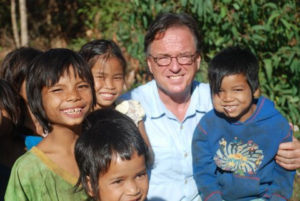
John Abbey with children in a leper village near Pleiku, Vietnam. Source: The D.O.V.E. Fund
.
Since 2005, Abbey has returned to Vietnam with The D.O.V.E. Fund about 10 times, dedicating the majority of his efforts to funding school projects, helping leper colonies and administering scholarships.
The D.O.V.E. Fund collects donations and asks Bui Cam Nhung, its lone employee, to secure a local contract bid within its budget before D.O.V.E. leaders inspect and sign off on the project.
One of the largest school builders in Vietnam, The D.O.V.E. Fund has constructed about 50 schools, including a school for the blind in both Hue and Cam Lo. These two schools provide vocational training and advanced computer systems for visually-impaired students.
“We realize that we can’t build enough schools. There’s always a new one that’s needed,” Abbey said. “We meet with government officials every year and they tell us that lots of people come to Vietnam and some people donate lots more money than we do. But what’s different about us is we come back and check every time.”
The D.O.V.E. Fund also finances $100 high school and $250 college scholarships, which pay for a year of tuition in Vietnam. Last year, it gave away about 180 high school scholarships and 20 college scholarships. D.O.V.E. members said they hope to match those numbers this year.
“When I first joined The D.O.V.E. Fund my life was really, really bad. I couldn’t escape reality anymore and these guys saved my life,” Abbey said. “Happiness isn’t the right word for this story, although I am happiest when I’m there. The Vietnamese have no evident animosity toward Americans even though we attacked them. When your enemy can forgive you, maybe it’s time to forgive yourself. Forgiveness is the word I’d use. That’s what I’m learning one trip at a time, one school at a time.”
Microfinance and PET carts
Fred Grimm had been in Vietnam for a couple of months when the vehicle he was driving got sprayed with bullets. One round shattered the windshield. Another missed his torso to the left. One caught the dusty mirror inches above his head.
“I never shot at a Vietnamese soldier but I was ready to and I wanted to. I could feel myself changing,” Grimm said. “Then one night we were attacked. My buddy and I caught a lot of shrapnel and I blew out my left eardrum.”
It was a warm night in 1969 when Grimm, wounded after only four months of duty, left Vietnam on a U.S. medevac. Today, he has returned to the former battleground 15 times, amassing eight months of volunteer time.
“I’ve been back with The D.O.V.E. Fund every year since it was founded. That’s eight months of helping, which about doubles the time I spent raising hell,” Grimm said.
Grimm serves as the vice chairman of Vietnam projects and coordinates The D.O.V.E. Fund’s ventures, including a new microfinance initiative that helps poor women who ask for a small loan to jump-start a business.
“For example, we met a young seamstress and lent her $150. We went back the next year, and her whole little hut was full of beautiful fabric worth $800,” Grimm said. “She had another brand-new sewing machine at home, too. We were all impressed, and this is just one of many stories. We’ve had huge success with microlending to these women.”
Another woman, who Grimm called the “queen of the market,” developed a method of buying fresh food items in bulk that she would sell to street vendors in the morning on a loan. Others raise chickens or pigs, sell eggs or fruit, or become seamstresses.
In addition, Grimm said he was particularly proud of The D.O.V.E. Fund’s recent partnership with PET (Personal Energy Transportation) International, an organization that makes special carts that allow disabled people to travel on rugged terrain. PET International provides the approximately $300 carts for free and D.O.V.E. members have paid to distribute more than 300 of them.
“We hope to send another shipment of these amazing PET carts this year because a wheelchair won’t be of any real use to these people with lower limb loss. The Vietnamese people are so appreciative and that makes it all worthwhile,” Grimm said. “I just want to thank all the people in the U.S. who have donated money and believed in what we’re doing. I guarantee you that I make sure every dollar is spent wisely. In fact, I’d put our organization up against anybody’s.”
John Abbey with children in a leper village near Pleiku, Vietnam.
Leper colonies
He didn’t want to be “that coward” who opted to go to jail and shame his country. So Tom Treece put on his camouflage and clenched his teeth for a war that he said “would never make sense.”
“I was raised in a loving Christian family then got plucked out of life, trained on all the ways you can kill another human being, sent to the other side of the planet and handed a weapon to go do it,” Treece said. “When it was over, there was no deprogramming except ‘Thanks for your service, sir.’ You hand in a uniform, get a free dinner and you’re on a plane back to your hometown.”
At 21 years old, Treece came home in 1969 without knowing what home meant anymore. His friends were watching movies at the theater. Some other guy was dating his girl. Life had carried on without him. And he didn’t have much use for it, either.
“I felt like a worm on a hot tin; everything had changed, I didn’t fit in anymore and I couldn’t sit still,” Treece said. “I was an angry young man who lost so many of my dear friends. And somewhere along the way, I lost myself.”
From 1969-2000, Treece traveled around the United States, bouncing from job to job. He hitchhiked to Madison, Wisconsin, and lived on the streets for a couple years before forming a rock ’n’ roll band. There was something therapeutic about rolling into a town, jamming out for a few hours and leaving again without ever having to confront himself in the mirror.
“I was screwed up and had so much hate in my heart,” Treece said. “It had eaten me up and I could never figure out how to get rid of it. When I was recruited by The D.O.V.E. Fund in 2000 all that hate started to melt away. For the first time in a long time, I felt like my life had purpose.”
After his first return trip to Vietnam in 2003, Treece wrote a three-and-a-half page article for Michigan’s Monroe News. He said he was shocked when they printed the entire story, and “even more shocked” when the first $100 check arrived in the mail one week later.
In three months, Treece’s article about his trip generated $50,000, including one $35,000 donation. That’s when Treece decided to write “The Ghost Closet,” an autobiographical account of his healing process “on the wings of D.O.V.E.” All profits from the book have been donated to The D.O.V.E. Fund.
“To be able to go back to where I spent 13 months of my life and saw so much death — there’s just nothing like it,” Treece said. “I believe that we are called to be like the good Samaritan who couldn’t walk by and see trouble without stopping to help.”
To date, D.O.V.E. members have built water purification plants and latrines, installed solar lights for villages without reliable electricity and distributed hundreds of pairs of shoes. But “nothing tested the group more” than their recent work with leper colonies, Treece said.
Treece got an unusual call one day from a California woman named Linda Stocker who had found his dog tag in a Ho Chi Minh City jewelry store. The two became friends and Stocker’s volunteer group, the Bandage Brigade, became a close partner with The D.O.V.E. Fund. The Bandage Brigade crochets bandages for Vietnamese lepers and since 2008, D.O.V.E. members have delivered 12,000 of these bandages.
“We’ve taken a special interest in people with leprosy who are unattended, stigmatized and isolated in rural villages,” Treece said. “They wear their clothes until they fall off. Many can’t remember what village they grew up in because they’ve been isolated for so long, grinding it out every day to survive.”
The lepers are the outcasts of society, isolated in rural mountain or coastal villages away from most of the population. Many are missing arms and legs, infected by disease and covered with sores. But D.O.V.E. members say the lepers’ disfigured faces always share one thing in common — they never seem to stop smiling.
Story in a story
As a 22-year-old soldier in the U.S. Army, Dan Gregg frequently traveled in an armored personnel carrier down a dirt road with a schoolhouse nearby. After his tank broke down one day, Gregg went inside the school.
“The kids came up instantly, thinking that I had all kinds of food,” Gregg said. “I handed out some stuff from my C-ration kit … canned peaches or whatever. I made friends with some of them and made it a point to stop there once in a while.”
After returning to the United States, Gregg saved several photos of the school in a photo album, hoping that he could “someday see it again.”
He got his chance more than four decades later. In 2013, Gregg stood outside of the same school, now barely recognizable except for a familiar flagpole at the front entrance.
“I met with teachers to tell them my story and about how much this school meant to me,” Gregg said. “Vietnam was really the most transformative period of my life. I saw it in a totally different way than I do now. Now I see the transformation of a country slowly coming out of war. I like to be part of the rebuilding process because I played a role in the destruction process. It’s life-affirming.”
Gregg, who said he feels inspired by civil rights activists like Mohandas Gandhi and Nelson Mandela, is currently writing a book about how he turned his negative experience as a soldier in Vietnam into a positive experience as a returning veteran. In addition, Gregg said he plans to include his perspective on coping with PTSD and what it’s like to “reconnect with the young soldier that you were years ago.”
“My PTSD didn’t form until 2003 when we invaded Iraq,” Gregg said. “I saw images of bombs on TV and planes exploding … and that brought back a lot of bad memories. Soon afterwards, I joined The D.O.V.E. Fund.”
His book, “Return to Tay Ninh,” describes the guilt of a soldier who remembers seeing Vietnamese civilians suffer — orphans crying for their fathers, a child’s skin blackened by burns — and the overwhelming experience of reconciling with a former enemy.
“I never thought I’d get rid of those images. I still haven’t but they don’t debilitate me like they once did,” Gregg said. “I’m struck by the amazing sense of forgiveness from people who have every reason to hate us. I cried a lot when I went over. I still do. But it’s a good cry because it means my heart is opening up and being repaired. I’m not afraid of the tears and the feelings because I know it’s healing me.”
Embracing peace
The stories of Abbey, Grimm, Treece, Gregg and other D.O.V.E. members may not be unusual. But what they do with those stories sets them apart.
“We were young and far away from home / Cast into a world we’d never known / In a time, so surreal / Oh … now / There’s a chance to go back and repair / Damage that was done when we were there / Pain we feel, scars we heal …”
D.O.V.E. veterans say that May’s words “perfectly encapsulate” how their organization helps repair both the physical destruction in Vietnam and the emotional pain that many veterans continue to suffer from.
“We all shared the same experiences. We all went through the same things. Even though we didn’t serve shoulder to shoulder, we all know the smell of gunpowder,” Gregg said. “We’ve seen men put in body bags, dead people, arms separated from bodies. There’s a certain understanding among us that this is why we do what we do. We love each other and we would do anything for each other.”
The group has tentative plans to make its next venture overseas on New Year’s Day 2015. In addition, a group of university students from Wisconsin and Minnesota will be traveling to Vietnam with medical supplies as volunteers at The D.O.V.E. Fund’s Hai An Medical Clinic.
“The D.O.V.E. Fund has turned into one of the most important things in my life,” Treece said. “First is my salvation. Second, my wife —the delight of my life. And three or four is without a doubt going back to Vietnam and shedding off that old skin of hate that I had from the war. This group has done more to win the hearts and minds of the Vietnamese people than 15 years of war. No one cares about how much you know until they know how much you care — and believe me, we care a lot.”