A group of politicians, civic and religious leaders is standing up
to oppose a controversial bill they say limits the rights of Ohio voters.
At a news conference May 8, a group called Ohioans for a Voter
Bill of Rights gave its point of view on the bill and proposed one of its own.
According to Toledo City Councilwoman Lindsay Webb, voters in Ohio
are being unfairly treated by the political system. Her group hopes to change that.
“We want to make sure every citizen has the opportunity to vote,
that they can cast a vote, and that they can have their vote counted,” Webb said.
“That is the end game.”
Webb said the issues within the current voting system started with
the introduction of House Bill 194 in 2012.
“House Bill 194 basically took a number of I would say issues that
have net effect of creating a chilling atmosphere,” Webb said. “It’s almost
like a voter suppression act.”
House Bill 194 outlined a number of regulations to the voting
system and gave the final decision on absentee and early voting dates,
locations and times to the Secretary of State. Some of the rules, Webb said,
seemed specifically designed to make voting more difficult for citizens in more
rural cities around Ohio.
Rev. Pastor Talmadge Thomas of the City of Zion, the Mt. Zion
Church, disagrees with the restrictive hours outlined in House Bill 194.
“The bill is very unfair and very unfriendly,” Thomas said.
Members of the community signed a petition against House Bill 194
at its conception, and the Ohio House of Representatives passed a referendum
repealing the bill later that year.
Opponents of the bill rejoiced, Webb said, and felt the issue
would need no further observation.
Webb said no sooner had the referendum passed than the bill slowly
began to reemerge. Part by part, the original resolutions went through the
House. The content and goals of the legislation were the same as before, but
the process was slowed to divert attention.
“What ended up happening then was that the majority in the
statehouse began to pass HB 194 resolutions piecemeal,” Webb said. “Instead of
having one gigantic repressive bill, they passed it piecemeal over the last one
and a half or two years.”
Once the bill full resurfaced, many Ohio politicians and community
members fought back. State Representatives Alicia Reece and Vernon Sykes, along
with John Smith and Rev. Dr. Otis Moss, formed a committee to represent
petitioners at the news conference. The new goal was no longer limited to
stopping House Bill 194.
“They want to take certain things that people expect about voting
and write it in a constitution,” Webb said. “Rather than have it subjected to
will and whim of elected officials and Secretary of State.”
Thomas said that a new bill of rights would be a step in the right
direction in terms of proliferating the spirit of democracy in Ohio.
“It speaks to the heart of the original Voter Bill of Rights
giving people opportunity without being disenfranchised, without being
inhibited,” Thomas said.
One specific issue Webb said she hopes the proposed bill of rights
can alleviate is unfair vote counting practices. Under the model of House Bill
194, if a citizen votes in the wrong precinct of the correct voting location,
their vote may not be counted.
Thomas said arriving at incorrect voting stations is quite common
amongst his parishioners and that conveying voter station information is often
too slow.
“I have several people who went to places they voted previously to
find their place had been moved,” Thomas said. “Information not disseminated
properly. If you’ve been voted in the same place for several years, you have
reason to believe you’ll be voting there.”
Webb said her experience as a clerk for the Lucas County Board of
Elections during the Bush versus Gore campaign showed her how necessary proper
vote counting is in a state with as much political leverage as Ohio.
“I have seen firsthand how chaotic these types of elections can be
and, considering Ohio’s place in the federal election cycle, it’s important
that we get it right,” Webb said.
Thomas said he feels a sense of confidence in voting. He said he
believes local elections are that necessary first step and perfecting that
system will lead to better understanding of what the public wants.
“I really believe that this bill helps to promote democracy,”
Thomas said. “It’s not about telling people who to vote for, that’s what we
think is most important. I believe that local places are what really move the
ball.”
This month we honor our military members who have died in
war and have in recent years extended the honor to all military members and
veterans who have died and place a flag on those graves too.
Memorial Day is a day to remember the many sacrifices made
by our citizens who have served and the families who have supported them who
have lost their loved ones. Dying of “war wounds” has changed meaning in the
past few years. Though many still die on the battlefields where war is fought,
many more are now dying from the outcomes of war wounds right here in the towns
and cities of the United States.
Traumatic brain injury and post-traumatic stress, the
Invisible Wounds, are taking our military and veterans’ lives by suicide and
substance-abuse at astounding numbers. Seldom do these families get to be
included in honor events. Seldom do the deceased ever get honor; instead they
get criticism due to “how they died” because of the misconceptions about
invisible wounds.
This long weekend, bands will march in parades. Children along
the parade routes will anxiously await for candy to be tossed in front of them.
Burgers will be on the grill and some will take advantage of a military holiday
and light up some fireworks. Beer will be consumed and families will gather.
But, I wonder how many will take the time to reflect on what
Memorial Day truly means. I wonder if caring thoughts will be expressed to
families left behind. I wonder if parents or grandparents will spend time
sharing not only the “celebration” during Memorial Day Weekend, but share the
history behind it and the “why” still to this day it has deep meaning for every
US citizen.
As a Grandma, I know my grandchildren are keenly aware of
what I do to assist veterans and families through The Arms Forces nonprofit I
founded. I wondered in the past if my example and my talks with them were
making a difference in their lives. They
have shared things before and this recent text I received from my sweet 13 year
old Parris assures me it does matter. Here is an excerpt from the text: “As a granddaughter I want to tell you I am
very proud of my Grandma. I love every second watching you help other
people…….You teach me so much about not giving up and working hard. I love you
so much and let me know if you need any more help at all with The Arms Forces
because I always love to help. I love you Grandma.”
I think you will agree with me that children do pay
attention. Even the younger ones like my Espn and Reign who when they see the
American Flag when we are together always say “Look Grandma! For you!” They equate our Nation’s colors with me giving
back to our military, veterans and families.
I love this!
Today, share with a child what it means to sacrifice by
serving in the military. If you don’t know how to approach the subject with
them, let us know and we can assist you. When civilians and military/veterans
come together in communities it fosters understanding. Understanding lowers
perceived stigmas that civilians sometimes have about military members and
veterans. Reduced stigma benefits the entire community.
How can you reach out to help your community
understand more fully? The Arms Force nonprofit assists veterans by educating
communities. Let us know if you have a group, school or workplace that would
welcome a speaker from The Arms Forces. Take the time to send a note, shake a
hand, volunteer for and support those who are supporting our military and
veterans.
The best way for all of us to honor our military who have
lost their lives in warzones, or on the streets of our Nation’s communities, or
under a bridge lost and broken, is by ensuring that those who remain are
adequately cared for and are given the BEST possible chance of a quality life.
“Freedom is not free” is more than a slogan. It is the truth that is so easy to
brush off in our everyday lives.
As you go about your days think about the freedoms that are
taken for granted that someone had to put on a military uniform to defend. It is more than religion, free speech and the
right to bear arms. It is the ability to have a super store loaded with choices
and always having food on the shelves. It is the ability to send your child to
a private school and the right for you to pursue your career choice. It is the
right for you to make your decisions with how you spend your earned monies.
It is even the right to participate in honoring our fallen
this weekend, or to ignore it; one freedom I hope none of you will choose.
Freedoms are so much more evident in our daily lives than maybe some of us have
given much thought to. I ask you today to reflect on the day; share the meaning
of the day; and take action to ensure those who still today fight for our
freedoms and those who fight the battle of visible and invisible wounds at home
have the freedom to receive timely and assessable care and are honored for
their service by having their basic needs met and are remembered not only on celebratory days, but 365 days a year!
Birds of Chicago with newest member, photo by Chris Hamilton
A lot has changed since the last time Birds of Chicago played in Toledo. Band member and Toledo native Jeremy Lindsay welcomed a baby girl with fellow vocalist Allison Russell. Their daughter, Ida Maeve, was born in December.
Birds of Chicago with newest member, photo by Chris Hamilton
“She’s our little road dog. She’s been touring with us since she was 4 weeks old,” Lindsay said. “She’s got 28 states under her belt and after [the current] tour she’ll be up to 34.”
The band began touring the Netherlands with their newborn in January.
“That’s her normal, you know? She sleeps in the car. She can sleep at night no matter what hotel room we’re in.” Lindsay said.
Lindsay said he never imagined raising a family on the road until they were forced to think about it.
“It occurred to me that the only way we can live like this … if you’re not bringing your family, you’ll just never see them,” Lindsay said. “I couldn’t handle that.”
Birds of Chicago will play at 9 p.m. May 28 at The Village Idiot, 309 Conant St., in Maumee. Tickets are $12 in advance or $15 at the door.
The show comes after the release of their live album, “Live from Space,” which includes 17 tracks recorded live in Evanston, Illinois.
The collection of music features new songs and new arrangements of older songs.
Lindsay first started playing music in a jam band while in college. Some of his earliest music memories consist of him seeing indie bands at Frankie’s Inner-City on the East Side.
Birds of Chicago is the union of Lindsay’s Chicago band JT & The Clouds with Russell, who was originally from the band Po’ Girl. Their self-titled debut, which was released in 2012, consisted of mostly acoustic tracks including “Trampoline,” “Cannonball” and “Flying Dreams.” The band will be recording a second studio album later this year and will perform new tunes on the road this summer.
Back in September, Lindsay told Toledo Free Press it’s important for him to return to his hometown once a year.
“[There’s] a lot of people I love there and it’s where I’m from. … There’s always a little extra anticipation when I come back to visit my hometown,” Lindsay said. “Anytime you’re in a homecoming situation, it’s special.”
During the visit, like every time he comes home, Lindsay will get a pizza from The Original Gino’s Pizza.
“Nothing is certain but that,” he said.
Birds of Chicago has contributed a song, “All The City Girls,” to the upcoming American Red Cross charity CD, “Red, White & You, Too.”
For more information, visit the website birdsofchicago.com.
Thirteen Toledo-area high school seniors just got $1,000 closer to achieving their career goals. The Toledo Police Command Officers Association (TPCOA) announced the recipients of the Rose Reder Memorial Scholarship award May 13.
Award recipient Madeline Sulewski, center, with her father Lt. Jeff Sulewski, left, and Rose Reder Scholarship Board Member Lt. Dan Gerken, right. Photo by Sgt. Laurie Renz
As a requirement for the scholarship, which was established in 1999 in memory of Toledo Police Sgt. Rose Reder, the recipients are required to display an interest in pursuing a career in law enforcement.
One of these recipients, Lucas Elfreich, will study political science at Miami University in Ohio next year.
Elfreich said there were two people who inspired him in the field of law enforcement — his grandfather, who was a sergeant in the Toledo Police Department, and one of his history teachers, Corri Helldobler, at Central Catholic High School.
“I always had a deep fascination with law,” Elfreich said. “My grandfather always said, ‘Don’t study what other people tell you to do. Study what you love, what you’re passionate about.’ In my history class, it was just the one subject I always loved. It’s just naturally what it is. It’s what I like to learn about. It’s what I like to read about.”
With the application form, each student was required to submit two letters of recommendation, a transcript and an essay detailing the student’s future career plans.
Rose Reder Memorial Scholarship Chairman Laurie Renz said the TPCOA was looking for more than academic excellence.
“The scholarships are given based on their application,” Renz, who is also a Toledo police sergeant assigned to internal affairs, said. “Students must have an interest in pursuing some sort of studies related to law enforcement — law, police work, or sociology or another area dealing with law enforcement. We’re looking for well-rounded individuals.”
Because the students are presented a scholarship certificate at their local schools, ceremonies are still ongoing with Clay High School scheduled for the evening of May 20 and Lake High School on May 22.
The Rose Reder Memorial Scholarship recipients for 2014 are:
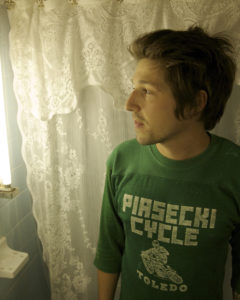
Shane Piasecki will play gigs this summer at Reel Bar on Put-in-Bay.
Photo Courtesy Landstar Entertainment
Gorgeous brown eyes. Light tan hair with a striking white streak. Boundless devotion.
Shane Piasecki will play gigs this summer at Reel Bar on Put-in-Bay. Photo Courtesy Landstar Entertainment
These attributes inspired the title track of Shane Piasecki’s new disc, “Set You Free.”
“In the middle of the night or in the light of day/I run through the streets and I call your name/Patient and kind I will try to be/I love you too much, can’t set you free,” the Liberty Center native sings.
It’s for Jack.
What, you don’t know Jack?
“I love my dog. He’s a boxer pit bull mix; his name is Jack. I’d been in the studio all day. I’d have my friends help me walk him,” Piasecki said. “When we were done, I took him out at night — he’s on the leash — and I let go because we’re in this courtyard of the building.
“And I didn’t think he’d get away, and he comes barreling by me and he gets out, and I was chasing him down the street and that song just came in my head.”
He was sharing the story during a call from his home on Music Row in Nashville, Tennessee.
“I think [‘Set You Free’] strikes a message with anybody, but for me, it was really deeply aimed at my feelings about love and my dog. I’m pretty sentimental, so letting go of anything is necessary sometimes, but it’s not always welcomed. It’s hard to do,” he said.
Piasecki’s 12-track debut on LandStar Entertainment mixes pop, folk, rock and blues. The singer-songwriter offers his trademark heartfelt acoustic numbers with “New to Town” and “Wings of Wax,” and plugs in the electric guitar and rocks with “Feels Alright” and “Night Like This.”
“I like the blend of everything; it’s got a little bit for everyone,” he said. “I go for a lot of the soul, pop, blues, country, old roots music and definitely pop too. I love pop, not like Christina Aguilera pop, more like John Mayer, Jason Mraz, more focused on the guitar.
“I want to be a raw dog like Bob Dylan was and make stuff that’s rootsy like Muddy Waters. I really had to learn to play ball for this record. My producer [Nathan Meckel] is amazing; he taught me a lot of things.”
The 27-year-old has been turning heads since moving to Music City.
“I had some opening dates for Howie Day on tour, and I’ve been asked to come back and do more because he liked me,” Piasecki said.
When he isn’t on the road, the musician does a lot of writing.
“I’ve got a publishing deal, so I keep writing songs for people to sing or put in movies or I can sing and then they’ll use the tracks,” he said.
“Sometimes I think songwriting is like farming: You can’t control what you get out of it,” he said. “In the end, you have to learn to make the most of it, like the seasonal harvest.”
This summer, Piasecki will play a couple of dates each month at Reel Bar (formerly Tony’s Garage) on Put-in-Bay. He and Jack will motor north for gigs June 13 and 14, July 11 and 12 and Aug. 15 and 16.
“When my first disc [‘All for Coffee’] came out, I was 17 and I wanted success real bad then. And here I am now, and I sacrificed a whole lot more, and I still want it just as badly,” he said. “Life’s been really good to me for being a musician. Music is a good thing for me to follow because it’s never let me down.”
Local Medicaid health care providers are fighting funding cuts that will lower their reimbursement and decrease the number of people who qualify for their services.
Representatives from Harbor, one of four Medicaid Health Home providers in Northwest Ohio, attended a meeting to address the cuts at the Ohio Statehouse on May 15. The other providers are Unison Behavioral Health, Family Services of Northwest Ohio and The Zepf Center.
Jean Drees, marketing director for Harbor, said the purpose of the meeting was to ask the Department of Medicaid to extend funding for Health Home.
“The state is now trying to restrict and change the program, and that’s what we’re opposing,” Drees said.
Drees said she fears the repercussions of cutting funding this early. She said although progress may be slow at first, the Health Home providers are seeing success.
“We would no longer be allowed to offer the services if the funding does get cut,” Drees said. “What we would have then is what we’d be undoing, going back to basic services.”
Drees said the basic services threatened by the cut include primary health care. Under the improved Health Home model, patients would be granted more efficient primary care.
Detrimental decisions
Catina Harding, executive director for the Great Lakes Collaborative for Autism, said she feels cutting funding now would be detrimental.
“There’s just a ton of consequences,” she said. “Through Medicaid Health Home you have continual communication with doctors, schools, and it allows families to focus on being healthy rather than focusing on crisis.”
Harding’s organization does not directly deal with patients, but works on behalf of struggling families to look for solutions to their financial issues. In her testimony, Harding described the challenge an autism diagnosis presents to the average family.
“[Families] are told their child has autism, insurance does not cover the services they will need, and good luck finding the programs that will work for your family, because each child, adolescent and adult with autism is very different with very unique needs, behaviors and challenges,” Harding said.
Many of the over 3,000 beneficiaries of Harbor’s services qualify as having a “severe and persistent mental disorder,” which makes taking medications for routine issues such as diabetes a challenge.
“What [cutting funding] would mean is we would not be able to help them the way we’re currently helping them,” Drees said. “People with this diagnosis die 25 years earlier than the rest of the population. Not because they’re depressive, have anxiety disorders or bipolar disorders. They die because they cannot manage primary care issues.”
Drees said people who qualify for the type of aid available under the program can forgo more expensive emergency room visits thanks to on-call health consultants who manage vitals for clients.
“The data shows that this group of clients are extremely expensive to the system,” Drees said. “Their care is not very good, so it’s a new delivery service approach that we’re taking with a better serving of the population that needs help coupled with a better cost outcome.”
Harding said she sees cost benefits of maintaining the Health Home program, and urged board members to look at the numbers.
“They should put the criteria changes on hold until they look at the data out there to see what makes the most sense for the families in terms of serving their needs,” Harding said.
Drees said she believes the system Harbor uses is “in total line with where health care is going” on a national level.
“This is the right way to serve this population from a cost-effective perspective,” Drees said. “We’re moving them toward well-health, otherwise they’ll ride Medicaid for the rest of their lives.”
Looking forward, Drees said she hopes the higher powers in health care take a careful look at their priorities and see that the program will flourish with more time.
“We need to be able to prove outcomes and we’re only 18 months into the pilot,” Drees said. “The whole health care system is changing. For people who have never managed their primary care needs, it takes a while to make them healthier.”
Harding said she is unsure of whether her speech made the impact she wanted, but hopes that someone can provide a reason for funding cuts.
“It does not make any sense that you would take a model that was working for our most challenged community members just to cross a few numbers out of the budget,” Harding said. “And there’s no good explanation for that either. There’s no legitimate, good explanation for why that decision is being made.”
A ceremony in our nation’s capital on May 24 will mark the 10th anniversary of the dedication of the National World War II Memorial.
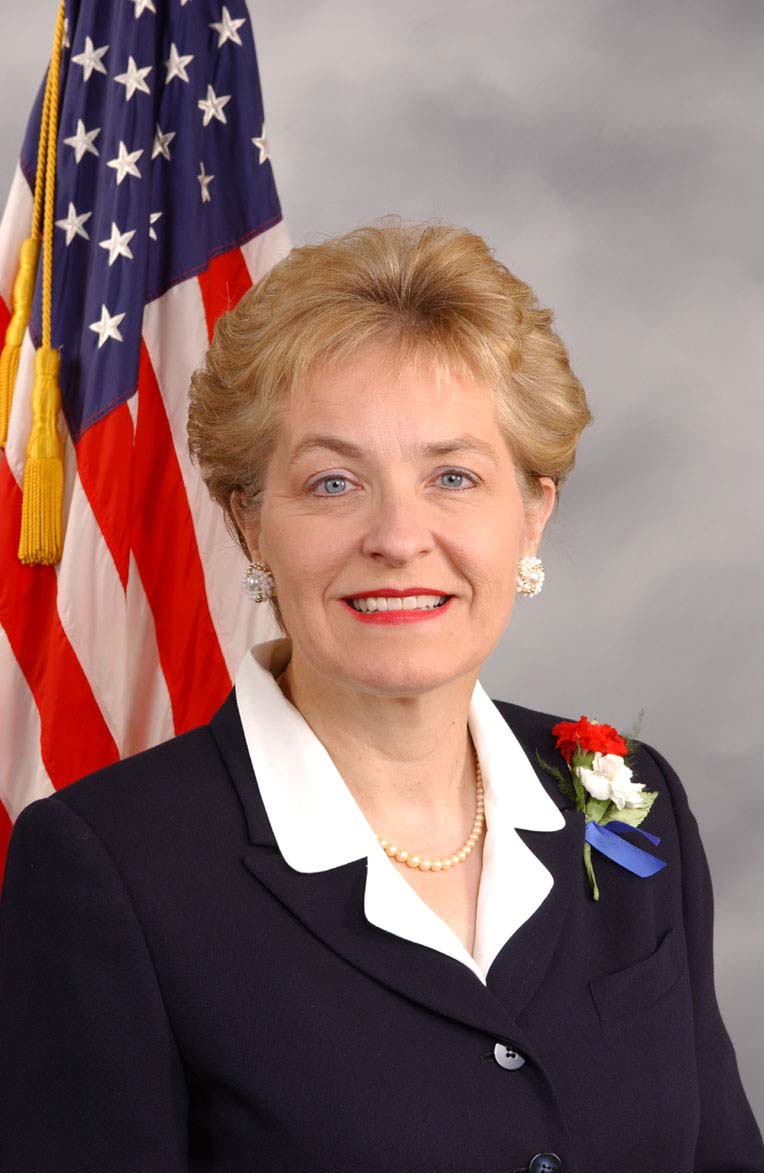
Representative Marcy Kaptur
The memorial, of course, is a testament to the vision and determination of a humble man from Berkey. Roger Durbin was an Army veteran who had fought in the Battle of the Bulge, played his role in the victory effort, and then returned home to his family and his community with no fanfare.
He was a seemingly ordinary man, a rural mail carrier — but a man with a big dream. His postwar mission was to correct an oversight — the lack of a memorial to the victory over tyranny. Although Roger Durbin never saw the World War II Memorial — he died in 2000 — his family did. And his granddaughter, Melissa Durbin, will participate in the celebration.
A decade has passed since President George W. Bush formally dedicated the memorial to everyone who participated, overseas and stateside, in the war effort. But since that day in May 2004, the National World War II Memorial has become one of the most popular tourist attractions among the many sites in our nation’s capital. It has been the destination for dozens of Honor Flights from around the country, allowing veterans to see the memorial to their accomplishments and for millions of individual tourists on the National Mall who come to pay homage.
Something remarkable happens every single day at the memorial: The beneficiaries of that great victory get the chance to meet these aging warriors from the Greatest Generation. Every day, without fail, people come up to visiting veterans, now in their 90s and many now in wheelchairs, simply to say “thank you.” It is touching in its own right to see people whose main experience of World War II has been to study it in school or see it portrayed on television get the opportunity not only to see the memorial, but also to meet real, live heroes.
But that will not always hold true. When we dedicated the memorial in 2004, more than 4 million of the 16 million American veterans of World War II were still alive. Today, fewer than a million remain. We lose more than 500 of them every day. And 10 years from now, at the 20th anniversary ceremony, only 80,000, roughly, will survive.
At the memorial, what President Abraham Lincoln called “the mystic chords of memory” are played with grandeur and grace. And that is what the memorial is all about. It was built to preserve:
The memory of gallantry and devotion, of honor and sacrifice, of dedication to a cause bigger than oneself.
The memory of a generation of ordinary Americans who did something extraordinary — answered duty’s call, saved democracy and then modestly returned to their communities and their families, to work in the factory, to work on the farm … or simply to carry the mail.
The National World War II Memorial will be there long after the World War II veterans are gone. While they are still with us, take the opportunity to let them know that a grateful nation will always pay tribute to their courageous service and they will always be remembered as heroes.
Marcy Kaptur (D) is the U.S. Representative for Ohio’s 9th Congressional District. She has served since 1983. Her Toledo office phone number is (419) 259-7500.
Toledo has many talented rappers, but few are as consistent and successful as Clemmye. He hails from the legendary rap group The Hollow Boys from the Hill area of Toledo.
.
Throughout the years, talented MCs have come and gone from the group, but Clemmye has managed to maintain and build his local fan-base while touring as a solo artist with national acts. He has consistently made music that represents the labor-intensive process he puts into making sure each track will pull his listener into the next.
He recognizes the value of face-to-face contact in business as well as with his biggest fans. An active rapper since 2000, he is a humble soul, a clever lyricist and a family man who understands the nature of the music business. His wordplay and flow has caught the attention of major artists like Freeway, Beanie Sigel, D12 and more. Clemmye’s latest mix-tape, “First 48,” is currently selling well and he is gearing up to release an album.
He has been a signed national act, only to watch his deal fall through the cracks when labels started merging. He is wise and open to sharing his knowledge and lessons while remaining committed to delivering music you can feel.
Clemmye, The First 48 Mix Tape
Clemmye has also discovered that you can make money performing and touring while putting out quality music. He is a serious businessman, just a few credits shy of completing a business degree from the University of Toledo. The knowledge he has acquired over the years is amplified by his work ethic. Clemmye lives in the moment, soaking it all in as he continues to assist other artists while on his journey to deliver great music.
Martini Rox: You have been on the local rap scene since 2000, how has your hustle changed?
Clemmye: Back then our goal was selling CDs. We would put them in stores on consignment for $10 a CD and sell out every day. It was crazy, we didn’t know and (we had sales) from all sides of town. It spread so far and I don’t even know how far it spread. We didn’t expect it to be like that. I put out the “First 48” and I’m older, I’m 31 now and so I’ve got some younger rappers under me some 18-, 19-year-olds and they’re like “The game is different, people don’t pay $10 for a mixtape no more.” I just told them to watch, it’s different. I sold maybe the first 200-300 CDs at $10 a pop and I never went to the clubs and asked them to buy it, I didn’t tag anybody on Facebook or anything.
Everybody who called wanted the CD and the young rappers are like “How are you doing that? It’s hard to get $5 or $3 or $2!” I’m like, people like good music, people don’t mind — like I don’t mind — paying for good music.
Martini Rox: What did you learn while touring with Freeway and being signed to Jay Z and Dame Dash’s Roc-A-Fella Records?
Clemmye: Everything. The maturity, the connections … business. Everything that could come from it came from it. I had a chance to be around the best label of our time, maybe ever, some of the best rappers ever, you know? The way they handled business, I learned from that. I learned what not to do.
We kind of got blindsided from Roc-A-Fella falling because we didn’t see that coming. When that went down I was staying out there with Freeway and Free was big and the second album was coming and we had signed with 50 [Cent’s G-Unit] so we thought we were going to be larger than life and the rug kind of got pulled from under us. It’s a learning experience man, you learn how the business is, you know? It’s always business at the end of the day and you got to be the one in control of your business.
Listen to Clemmye’s music at www.clemmye.bandcamp.com/album/first-48-the-mixtape.
For the first time, Springfield High School students are competing in the National History Day competition in Washington, D.C.
.
It also happens to be the first time they entered the contest, thanks in part to grant money from the Springfield Schools Foundation.
In the fall, U.S. history teacher Andrew Screptock requested $1,143 to buy video cameras for his students to use for the competition.
“These opportunities might not have happened without foundation seed money,” said foundation president Cynthia Beekley at a breakfast honoring the grant winners.
Most recently, the board (of which I am a member) provided matching funds for Springfield’s parenting associations, which with the help of the board of education, will result in the purchase of 120 new laptops.
Ambitious parents and innovative teachers like Screptock are the reason the foundation wants to continue to offer grants.
Screptock said he decided to give his AP U.S. history class an extra credit assignment of competing at the National History Day competition. Next year, he will open up the project to the whole high school since there are no history-related extracurricular activities at Springfield.
“Every year they have a theme for the nation and this year’s theme was ‘Rights and Responsibilities,’” Screptock said. “You have to pick a topic that relates to the theme and there are five ways you can present it: live performance, 10-minute documentary, written paper, exhibit or you can do a website.’”
Nearly everyone in his class decided to give it a try.
“They are really competitive and want their grades to be as high as possible,” Screptock said.
On March 22, the students competed at districts. Three Springfield groups advanced to state on April 26. There, more than 80 schools competed and one group of Springfield students advanced to nationals.
Casey Wong, Lily Taplin and Kristen Kuras will present their project, “‘A Jap’s a Jap’: Denying Japanese Americans the Right to Claim Citizenship,” on June 15. The students’ exhibit on Japanese internment in World War II includes a process paper and annotated bibliography. Screptock said the students are still trying to raise money for the trip. To donate, visit http://www.gofundme.com/shsnhd.
“I was really excited they advanced to nationals,” Screptock said. “We got to see the other exhibits and we knew we were going to do well. A lot of the exhibits looked pretty good, but a lot is based on the content.”
In the past decade, Beekley said Springfield Schools Foundation has given more than $200,000 toward innovative teaching ideas. This past school year, it funded 12 grant requests, totaling about $9,609. The maximum classroom award from the foundation is $1,500, and applications are considered twice during each school year.
One of the projects was called “Busy Bodies.” The board provided $1,418.44 for the purchase of special iPad cases that bounce when dropped, along with headphones to allow students to work on projects without getting distracted.
“The grants committee looks for innovative and creative projects that will enrich and enhance student learning beyond the scope of normal required school expenditures and the required course of study,” said Judy Gorun, foundation member. “The foundation exists for the purpose of facilitating the implementation of creative ideas and talents of teachers. As board members, we know that the teachers are appreciative of our support in helping their students go beyond the typical classroom learning experience.”
Beekley said initial grants from the board created partnerships to support outdoor education, which now exists for middle-school students in the school’s grove.
“In addition to the science that students learn, the projects also foster mentorships between high school students and young elementary students, some realizing for the first time their love of science, plants, bugs and the outdoors.”
Beekley said the foundation wants to continue to award grants, but that will depend on donations.
“We haven’t spent a lot of time telling our story, nor have we asked people for money. The only reason we don’t give more is because we don’t have more funds to give.”
Superintendent Kathryn Hott said she is proud of the teachers who submitted grant applications and received money. She believes the foundation is a great asset to the district.
“The teachers went above and beyond by seeking out engaging and innovative initiatives for our students and taking the time in a very busy school year, especially this year, to write a grant application and make it happen,” Hott said.
Editor’s note: Brandi Barhite is a new board member on the Springfield Schools Foundation.
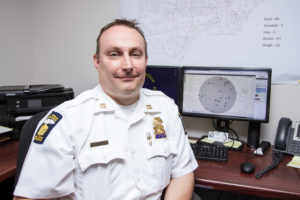
Capt. Mike Troendle of Toledo Police Department’s Strategic Response Bureau with TPD’s interactive crime map. Toledo Free Press photo by Christie Materni
Gone are the days of filing cabinets stuffed with overlooked incident reports and other troves of underutilized data. For the past several years, police departments across the nation, including Toledo Police Department (TPD), have been transitioning to an “intelligence-led” model of crime-fighting, utilizing tools like interactive crime mapping and digital data-crunching to track trends, analyze statistics and make more effective use of department resources.
TPD has used online crime mapping internally since 2012. Now much of that same data is at the fingertips of area residents through a public version of the department’s interactive map, which launched May 15 at crimemap.toledo.oh.gov.
Capt. Mike Troendle of Toledo Police Department’s Strategic Response Bureau with TPD’s interactive crime map. Toledo Free Press photo by Christie Materni
To access the map, users enter an address and from there can browse nearly all crimes reported within a half-mile radius within the past two months. Users can also sign up for email alerts and submit anonymous tips. The map is refreshed three times a day, at 6 a.m., 2 p.m. and 10 p.m. shift changes.
“What we’re trying to do is allow the public to see what’s happening in their neighborhood or their business area so they can be more informed,” said Capt. Mike Troendle, a 20-year TPD veteran who heads the department’s strategic response bureau.
“We cannot be in every neighborhood at the same time and, even if we’re in that neighborhood, we don’t always know what’s normal and what’s not, so having an active, involved citizenry is the best way for us to police. There is no question about that. By getting this out to them, we’re educating them more and in turn we’re helping ourselves.”
The map is also expected to reduce the time TPD spends handling public information requests, Troendle said.
“This allows people to go out there and basically do a self-service on it, freeing up my analysts to actually analyze more of the crime for our internal purposes and hopefully solve more crime,” he said.
The public map cost $6,200 through Dayton-based Optica Consulting, the same company that developed the department’s internal mapping system. Work on the public map started in October.
Public access to the data has always been the end goal, Troendle said.
“One of the things we wanted to do was satisfy our needs internally first, making sure our commanders and our officers were getting the information they need and setting it up the way they want it, and then it was the natural progression to go public,” he said.
Crime reports are listed by block, not exact address. Data for rapes, sexual assaults and juvenile-specific crimes such as curfew violations are excluded for privacy reasons, Troendle said.
TPD doesn’t differentiate between tips left through the map and tips left via TPD’s website, but Troendle said he knows people have used the map when leaving tips because some have referenced map data. The number of people who have signed up for email alerts was not immediately available.
One disappointment for some users is the map uses Flash, so it cannot be accessed on most tablets or smartphones. Troendle said that may change in the future.
“The company we work with is in development of an app, but we didn’t want to wait for that to come out,” Troendle said. “We wanted to get the information out there. We figured providing some sort of information for the public is better than not giving them any information at all.”
Data-driven
Former TPD Chief Derrick Diggs implemented the intelligence-led policing model when he became chief in late 2011, the most obvious change being the installation of surveillance cameras — although that’s only a small piece of the overall strategy, Troendle said.
“We collect data from every kind of source out there, from the mundane crime reports to social media. We take everything we can get intelligence-wise and we analyze that,” Troendle said. “Basically what we’re doing is putting our people where they need to be based on what the data is telling us.”
Since the shift, TPD has reduced its burglary rate by at least 30 percent, Troendle said.
That’s because a small percentage of people are responsible for a majority of the crime, he said, citing research from Temple University criminology professor Jerry Ratcliffe, an expert in intelligence-led policing and crime mapping, who concluded about 6 percent of the population is responsible for 60 percent of crime.
“It’s about working smarter, not just harder,” Ratcliffe told Florida’s Sarasota Herald-Tribune in 2011. “It’s about focusing resources. In the end, there are only so many police officers.”
Heather Buford, who along with her husband Cory are citywide co-chairs for Toledo Neighborhood Block Watch, said she’s excited as the map means members will now have access to statistics udaily as opposed to once a week from The Blade or once a month from TPD at block watch meetings.
“We love it. We think it’s great. With block watch being the eyes and the ears of the neighborhoods, it’s very helpful,” Heather said. “My husband and I have been pushing for something interactive for residents for years.
“I’m also thinking this will be a great way to get the younger generation involved,” Heather said. “If they could go on iPhones and iPads that would be even better.”
Other cities
Toledo is the last of Ohio’s four largest cities to launch an interactive public map of crime data. Thirty-one police departments in Ohio, including Akron, Columbus, Cincinnati, Waterville and Youngstown, use a free online mapping service called RAIDS (Regional Analysis and Information Sharing) Online. Crime information is updated daily and email alerts are available.
Cleveland Police Department (CPD) uses mapping technology developed by the City of Cleveland that integrates crime statistics into other city informational maps such as permits, licenses, capital projects, bikeways and land status, said CPD crime analyst Todd Wiles. Crime information is updated daily, but email alerts are not available.
Dayton Police Department uses technology nearly identical to Toledo’s as its map was also developed by Optica. TPD already had a relationship with Optica, which had developed its internal technology, so it made sense to stick with the company for the public site, Troendle said.
“For us to go with RAIDS Online, we would have to set up all kinds of new rules and processes to give them the data,” Troendle said. “With Optica those rules and processes were already in place, and it was just a matter of us creating a public-facing website to display the data. It was a much easier process to do it this way.”
Sgt. Eric Paull, who heads Akron Police Department’s (APD) crime analysis intelligence unit, met Troendle through the Northern Ohio Violent Crime Consortium (NOVCC), which also includes Akron, Toledo, Canton, Cleveland, Elyria, Lorain, Mansfield and Youngstown, as well as county, state and federal agencies.
Advantages to RAIDS are that it’s free and it’s a national system, incorporating data from more than 40 states, Washington, D.C., and two Canadian provinces, Paull said.
Disadvantages include that it’s not able to be customized, he said. For example, what APD would call breaking and entering is classified in the RAIDS software as “burglary commercial.”
“For free, [RAIDS is] the best thing that’s out there. But if you build something like Toledo [did], you’re going to get more functionality and a better system,” Paull said. “What Mike was able to do is much more customized. Those guys came in there and built that just for Toledo.”
Game changer
Such technology has revolutionized law enforcement, Paull said, recalling a serial rape case that required a detective to manually page through hundreds of old files looking for information.
“What he did in weeks we can now do in 10 minutes,” Paull said. “It makes a police department a ton more effective.”
Paull also recalled a serial burglar who was caught after data analysis revealed the day and time of day he typically struck.
“We could never do that kind of stuff before. It just wasn’t possible. We didn’t have the data,” Paull said.
However, technology doesn’t replace police work, Paull said.
“You can’t replace crime analysis with that. I’ve still got four full-time crime analysts,” he said.
But officers have faster access to information that is more up-to-date and more useful than in the past, said TPD Public Information Officer Sgt. Joe Heffernan.
“The information given to the commanders of where to direct their resources is so much better and that’s been really the main driver at reducing our crime in my opinion,” Heffernan said.
Geographical context
Esri, an international supplier of geographic information system (GIS) software, powers Toledo’s map developed by Optica.
“We add the geographical context to any type of intelligence,” said Communications Manager Brian Peterson. “Police departments were an early adapter of the technology.”
The main goal is crime prevention, said Mike King, Esri’s national law enforcement manager, who retired as a Utah police chief after a 30-year career in law enforcement.
“Anyone can throw a dot on a map and say a burglary happened here,” King said. “Esri not only puts the dot on the map, but helps explain why this dot is important to all the other dots. The real secret is the analysis behind the scenes. What can we do to forecast where events are going to happen based on history?
“Ten years ago, crime analysts would walk into a chief’s office with 50 sheets of paper, all the burglaries that month, sheets and sheets of data in tabular form. But if you can give someone the ability to visualize, people can understand that tabular data much more quickly.”
Giving the public access to crime data also helps create a partnership between police departments and the public.
“That’s the large and long-term goal, to form those partnerships so police have thousands of sets of eyes on the street,” King said.
Heffernan agreed.
“They always say, ‘Knowledge is power,’” Heffernan said. “This just enables us to do our job better and we can do our job even better when the public can assist us.”