Home Blog Page 194

Maumee native raises school test scores, wins national award

0
Maumee native Kelly Zunkiewicz is a math teacher in Florida. She recently won the prestigious Fishman Prize. Photo courtesy Tampa Bay Arts & Education Network and Hillsborough School District.

Kelly Zunkiewicz knew from early childhood that she was destined to teach. She said her mother, an elementary school teacher for 35 years, provided her with her initial inspiration.

“I witnessed firsthand the impact that incredible teaching can have and realized that there was no reason for students to hate math,” Kelly said. “As a teacher, I would have the ability to change how students thought and felt about math which is an integral part of our lives.”

This experience gave Kelly the drive needed to teach at Dr. Earl J. Lennard High School, a school with previously low passage rates. She worked tirelessly to help improve the students’ standings, and those efforts have finally paid off.

Kelly recently found out she is the one of four winners of the Fishman Prize for Superlative Classroom Practice and $25,000.

Eddie Zunkiewicz, Kelly’s father, said he and Kelly’s mother, Lauri, have been elated since they found out about her award.

“I’ve been skipping around with a mental lollipop,” Eddie said. “We knew that she went to New York to be in the top 10, and we found out ahead of time that she did win it. She was number one out of the 10 finalists.”

Kelly said the moment she received the award was full of emotion due to her parents’ appearance at the surprise presentation.

“I will never forget the moment the door opened and everyone poured in,” Kelly said. “Teaching is full of emotion and I was overwhelmed with it in that moment. My parents even flew down from Maumee for the surprise. I have not stopped smiling since.”

Ana Menezes, vice president for New Teacher Effectiveness who observed Kelly for the prize, said the environment of Kelly’s classroom was completely unlike the environment in the halls of Lennard High School.

“It was so stark between what was happening outside of her classroom with kids, teenagers, talking to each other… and in her classroom where it was productive, respectful and really focused,” Menezes said.

Menezes said her impression of Kelly’s teaching was twofold.

“The first impression that I had was that kids were immediately working as soon they walked into the door. There was something to do,” Menezes said. “The second was that she clearly has really great relationships with her students. She greeted them when they walked through the door and it was clear she cared about them personally.”

Menezes said part of Kelly’s dedication to her job came through in the application phase.

“She’s incredibly thoughtful about her practice,” Menezes said. “She is constantly seeking improvement. She is never satisfied with the work she is doing; she is hungry for feedback and hungry to improve. She is a model in terms of looking to improve and better what she does.”

The Fishman Prize selection committee reviewed over 820 teachers from around the nation. Of those, 21 were selected as semi-finalists and only 10 reached the final interview stage.

Kelly’s improvements at Lennard speak for themselves. Her AP Calculus passage rates rose 11 percent to 80 percent since she started at Lennard High School. Her students recently earned a 93 percent average on their first semester exam.

“I knew how amazing the students were and, over time, have been able to change their expectations and perceptions of themselves and the county’s perception of them too,” Kelly said. “We have 27 high schools in Hillsborough County and Lennard traditionally is not known for outstanding test scores, but we have been able to change this.”

Kelly attended St. Ursula Academy for the first two years of high school and graduated from Anthony Wayne High School in 2003. Kelly found inspiration in many of her teachers, but two who stood out were Sister Mary Crumb of St. Ursula, now deceased, and Dr. James Berta, a former Anthony Wayne teacher.

“Sister Mary Crumb or, as we affectionately called her,

‘Sister Chem’ from St. Ursula Academy opened my eyes to the possibilities that the fields of mathematics and science could hold,” Kelly said. “Every day was interesting and something new.”

Eddie said he found Kelly’s decision to move down to Florida funny, because she had previously turned down the opportunity to attend university in the state.  

“When she was in high school, she got a basketball scholarship from the University of Florida and she refused,” Eddie said. “She went to Ohio Dominican University, majored in Math. All of a sudden, she got interviewed [in Florida] and the school district said come on down. She fell in love with these kids.”

Kelly said she shares this award with all the children she has worked with and that they are her true motivators for the future.


“The reward in teaching is not the paycheck or the summers off, it is working with such wonderful young men and women and seeing their progress over the years,” Kelly said. “My students are phenomenal and are making connections in the material and pushing one another to new heights every day. Their eyes have been opened to the infinite possibilities that the future can hold if they work hard and work together.”

Flagg: Tough choices

0

Having just lived through arguably the worst winter in the past 50 years, and considering that Toledo Public School (TPS) Board of Education members in the last election cycle made promises to parents to restore busing and that the fiscal year ended in June, you had to be wondering how long it would be before the board proposed restoration of student transportation.

Steven Flagg

Steven Flagg

In a perfect world without limits on resources, the primary mission of public education to assure that all students have the most favorable academic outcome possible could be expanded to include other objectives. In a time of limited resources, the primary mission requires laser-like focus without distraction.

If successful student academic outcomes are the objective, just how does restoring transportation for students impact this objective? Will this expenditure raise test scores? Will it improve reading and math comprehension? Will it improve attendance rates? There is no evidence nationally or locally to support such a claim.

TPS district attendance rates for the past eight years covering periods before and after transportation cuts show little change; the attendance rates remain in a narrow band averaging about 94 percent. The year transportation was cut to state minimum requirements there was little change from the previous year.

In fiscal year 2011, when transportation was cut to the state minimum requirements, enrollment dropped by 1,462 students. Still, enrollment losses in 2011 were actually lower than in previous years and not all the “lost” students per TPS data showed up attending charter schools or receiving vouchers. TPS enrollment does not appear to have suffered from the elimination of student transportation.

Test scores for TPS students have been on a slow but steady rise — although with the changing reporting practices and standards it is very difficult to compare year to year. Still, there is no evidence in yearly test scores to suggest restoration of transportation would improve state test scores.

Transporting students at an estimated startup cost of $6 million with annual operating costs of $4.4 million ($3.4 million for high school students) is not justified especially when compared with programs and practices that have proven records or show promise to improve student academic outcomes.

During the past brutal winter, it is doubtful that busing would have decreased in any meaningful way the number of days TPS missed due to weather. For days, many of the city streets were impassable to cars, let alone lumbering school buses. This past winter was a statistical aberration, that by itself provides little justification for restoring transportation.

It certainly is harsh to think of kindergarteners walking up to two miles to school in the brutal cold, but it’s not happening. Parents and caregivers have adjusted over the past four years, as evidenced by students getting to school at the same rates as in the past. Is spending $4.4 million every year an effective way to address a few weeks of inclement weather?

If the concern is primarily safety, it’s time to talk with Mayor D. Michael Collins, the police and our community. The safety of the neighborhoods around our schools is not the responsibility of TPS. Creating additional costs for our schools because neighborhoods are unsafe assures fewer resources to improve student academic outcomes and does not resolve safety concerns.

Whether you repurpose existing funds or pass a new levy, there are myriad ways to spend taxpayer dollars that have measurable impact on student achievement, such as improving teacher quality and development; actively engaging parents; integrating technology and adaptive learning algorithms into the curriculum and classroom; improving classroom management and student discipline; as well as teacher and principal evaluations.

Those elected to oversee our public schools must understand that in a time of limited resources, the focus of their efforts and our resources, must be on relentlessly improving student outcomes and educational achievement and not satisfying campaign promises or appropriating parental responsibilities.

Steven Flagg is a community activist with more than 20 years of experience in education advocacy including monitoring Toledo Public Schools’ policies, practices and operations.

Escuela de inmersión en Español abrirá este otoño

0

Cuando eran jóvenes, hablar Español era como decir malas palabras o maldiciones.

Robert Torres, director ejecutivo de la Cámara de Comercio Hispana del Noroeste de Ohio, fue uno de 13 hermanos que crecieron en Swanton: “Todo lo que sabía era español. El caso era sobrevivir,”  dijo al Toledo Free Press el 22 de julio. Para sus hermanos no fue fácil aprender el idioma y pasaron trabajos. Todos ellos aprendieron a ocultar su cultura y hasta a sentirse avergonzados de su herencia Hispana.

Maria Gonzalez, David Ibarra y Robert Torres en Toledo SMART Elementary School. Toledo Free Press foto de Christie Materni.

RELATED: Click here for the English version of this story

El desaliento que sentían en los años 1960 y 1970, está cambiando ya que la segunda y tercera generación de los hispanohablantes experimenta un resurgimiento en el orgullo Latino el cual no puede ser más evidente que en la próxima apertura de la nueva escuela bilingüe Toledo SMART Elementary School (TSES) localizada en el 1850 Airport Hwy. al sur de Toledo.

TSES es una escuela charter bilingüe y multicultural para los grados K-2 sirviendo a las familias en el sur y el este de Toledo. Una escuela charter es una escuela pública financiada con el dinero de los contribuyentes. Los estudiantes tendrán un día completo de escuela y se les proveera transportación gratis.

En TSES, altamente cualificados maestros bilingües han sido reclutados, dijo Torres. Ellos enseñarán un currículo de matemáticas, ciencias, lectura, artes del lenguaje, incluyendo actividades extracurriculares. La escuela comenzará con K, 1 y 2 y luego se añadirá otros grados en los próximos años, dijo Torres.

Por más de 10 años el deseo de una escuela bilingüe ha sido latente en nuestra comunidad.

Y si nos fijamos en los porcentajes de población, la necesidad está ahí. El trece por ciento de la población de Toledo es Hispana y los niños Hispanos constituyen el 25 por ciento de esa cifra, añadió Torres.

“La comunidad ha estado hablando acerca de hacer una escuela de inmersión en español desde hace mucho tiempo. Por lo general se hablaba y nada pasaba. Siempre hubo miembros de la comunidad que han tratado de mantener el proyecto en marcha,” dijo Linda Alvarado, directora ejecutiva del consejo de relaciones de la Ciudad de Toledo.

Alvarado ha estudiado e investigado Latinos en la educación desde hace varios años. Sus hallazgos son sorprendentes. A pesar de que no tenía estadísticas, Alvarado ha encontrado que los Hispanos tienen las tasas de graduación de escuela superior más bajos y la tasa de terminación más bajo para un título de licenciatura. Los investigadores han encontrado definitivamente un vacio en los niveles de éxito académico. “No hemos logrado encaminarlos,” dijo.

Su diagnóstico comienza desde el útero, dijo Alvarado. Los hispanos carecen de atención prenatal y luego los niños no atienden el preescolar. Cuando llegan a la escuela, el hecho de que vienen de un hogar de habla Hispana se convierte en un obstáculo. Los padres, por no hablar Inglés, están propensos a no involucrarse en la educación de sus hijos.

Incluso hoy en día, la administradora de la escuela TSES, Maria  Gonzalez, cuyo idioma nativo es Español, dijo que sus nietos sólo hablan Español con ella o en privado.

Contrario a la vergüenza persistente, Torres y  Gonzalez hablaron sobre las ventajas de ser bilingüe. La mayor ventaja es en el mundo de los negocios donde muchas empresas están reclutando a personas bilingües. Dijeron que es cierto que al fortalecer sus habilidades en Español, sus conocimientos de inglés se agudizarán también. Eso va para todas las asignaturas, dijo Gonzalez.

“Me dijeron en la escuela (hace 30 años) que no hablara Español  en la casa”, recordó  Gonzalez. “Eran ignorantes. En TSES los niños se sentirán  cómodos hablando Español con los miembros del personal.”

La escuela será una alfombra de bienvenida para los inmigrantes procedentes de países de habla Hispana, dijeron. “Estamos creando un ejemplo de cómo invitar a los inmigrantes,” dijo Torres.

Estados Unidos fue fundado y construido por inmigrantes, dijo  Gonzalez.

Encienda la TV, escuche la radio, los hispanos están representados hoy en gran número, dijeron. Las comunidades ahora celebran los días festivos como el Cinco de Mayo; se siente la presencia Hispana, dijeron.

Gonzalez ha estado visitando a las familias hispanas alrededor de Toledo para reclutar a sus hijos para TSES para la apertura de otoño. Ella ha ido aumentando  la confianza en la escuela, dijo. Los padres se sienten muy orgullos y están entusiasmados con la nueva escuela.

El objetivo de TSES es “mejorar el resultado educativo de los estudiantes latinos”, dijo Torres. En 2010, la tasa de deserción escolar hispana en Toledo estaba cerca de la de  Cleveland — alrededor del 70 por ciento. Es esa estadística que los organizadores tienen la esperanza de que mejorará cuando los estudiantes están inmersos a temprana edad.Torres utilizó escuelas de inmersión en Dayton y Columbus como su guía en la estructuración de la nueva escuela, pero lo calificó como un esfuerzo “de toda la comunidad.”

“No queremos que los demás pasen por lo que Robert atravesó y lo que yo pasé”, dijo Gonzalez. “No somos parte del problema; somos parte de la solución.”

Maria Rodriguez-Winter, director ejecutivo interino del Sofia Quintero Art and Cultural Center en el sur de Toledo, se sorprendió cuando ella viajó a la tierra natal de su marido en Suiza y Alemania, donde todo el mundo hablaba Inglés y miembros de la familia habló tres o cuatro idiomas. Y cuando ella viaja a México, ella visita con amigos que hablan Italiano, Francés e Inglés.

Vivimos en un mundo plurilingüe multicultural, dijo, y los Estados Unidos se ve a veces como “provinciano”, ya que no se habla más de un idioma. Así Rodriguez-Winter ve la nueva escuela de inmersión como un paso en la dirección correcta.

“Creo que es un programa fabuloso. Soy una firme creyente en enseñar a nuestros hijos más de un idioma,” dijo. “Cuanto más joven se inicien, más rápido aprenden y cuanto más retienen. Cuanto más son capaces de comunicarse fuera de este país desde una perspectiva social y política y los negocios, mucho mejor.”

Guisselle Mendoza, director ejecutivo de Adelante, conoce de primera mano los retos de ser una persona de habla Hispana en una cultura de habla Inglesa. Ella es una inmigrante de Nicaragua y tuvo que aprender Inglés en los Estados Unidos. Ella vivía en Miami por un tiempo y luego se trasladó a Toledo.

Estuvo de acuerdo en que la comunidad necesita una escuela como TSES que puede romper las barreras para los Hispanos en el lenguaje y el transporte. Ella dice a menudo en las escuelas públicas, si un evento o una conferencia de padres y maestros está programado, el aviso se envía a los padres en Inglés. Ella cree que la nueva escuela charter ayudará a eliminar esas barreras de comunicación.

“Mi posición como director ejecutivo de Adelante es servir a nuestra comunidad y nuestra comunidad necesita una escuela donde nuestras necesidades se cumplan en cuanto a la barrera del idioma y el transporte”, dijo Mendoza. “Lamentablemente, nuestros clientes no han recibido ciertos servicios en los sectores privado y público e incluso las escuelas charter. Esta escuela, (TSES) creo que es su objetivo servir a las necesidades de las personas de habla Hispana.”

Dos nuevos programas de Head Start de inmersión en Español comenzarán en el otoño para atender a niños en edad preescolar.

Los rumores de que TPS abrirá, este otoño, toda una escuela dedicada a la inmersión en Español son falsas, dijo Jim Gault, líder transformacional ejecutivo y director del programa de estudios para TPS. Sin embargo, el distrito está estudiando la creación de un programa de inmersión en español en 2015-2016, dijo.

“Creemos que hay una necesidad. Sabemos que hay una necesidad en Head Start; en cuanto a cubrir  todo el distrito y a cubrir  toda una escuela, no tenemos la respuesta para eso todavía,” dijo Gault en una entrevista telefónica reciente. “Vamos a estudiar la viabilidad de contar con un programa …. No nos vamos a apresurar en esto. Vamos a hacer las cosas bien. Vamos a asegurarnos, si hacemos esto, que sea de calidad.”

Traducido por Maria Gonzalez.

Family still grappling with auto shop owner’s death

0
Ricky Arnaz Layson, 35, was a father of three and ‘all-around good guy.’ Photo courtesy the Layson family via Facebook.

Two weeks after Toledo business owner Ricky Arnaz Layson was fatally shot during a robbery at his auto sales shop, his family is still struggling to come to terms with his death.

The father of three was an “all-around good guy” who loved cars and his family, two of his brothers said.

Layson, 35, was shot twice in the chest on July 8 by an armed robber at R&D Auto Sales on Lewis Avenue. He made it to Mercy St. Vincent Medical Center, but died in surgery.

“He was just an all-around good guy who tried to help people,” his brother and business partner Donnell Wynn, 33, said. “A good brother, dad, uncle, cousin, friend, son. So many people called on him for things. Advice. Favors. Just whatever.”

The pair opened the shop in 2007 after Wynn returned from the military.

“Rick always messed around with cars. He had a passion from a young age,” Wynn said. “Not having no money, young and growing up poor, he finally got a car but couldn’t afford nobody to work on it. He always did a little work to his own car and eventually it became something he was getting good at. Whatever was wrong with it, he tried to fix it.”

After graduating from Waite High School in 1998, Layson worked at Arby’s and Norfolk Southern Railway before going into business for himself. He scoured auctions for cars and then fixed them up to sell.

“Monday through Saturday, he would be sitting at the desk, maybe watching cars out front, or talking to a mechanic trying to figure something out,” Wynn said. “We don’t advertise our business. Just by word of mouth pretty much we sell our cars.”

‘Someone shot me’

On July 8, Layson was at the shop alone. A mechanic had just left to pick up some parts and a notary had just left to pick up some titles. Wynn was on his way to the shop when he got a call from Layson.

“He said, ‘Someone shot me,’” Wynn said.

“I asked him where he was hit. He said, ‘I don’t know.’ I hung up the phone and called 911, then hung up on 911 and called him back. Shortly after he answered, a police officer started asking him questions. I don’t know what he said. It was like a blur.”

According to a police report and documents filed with Toledo Municipal Court, a black male armed with a handgun entered the shop around 11:25 a.m. July 8, confronted Layson and the two exchanged words. The man then backed away from Layson and fired at least two shots from the handgun, striking Layson twice in the chest, and fled the business carrying what appeared to be a soft-sided computer case.

A memorial for Ricky Layson outside R&D Auto Sales on Lewis Avenue. Toledo Free Press photo by Sarah Ottney.

When police arrived, Layson was lying on the floor talking to Wynn on the phone, which was next to him. By the time Wynn pulled up, Layson had already been loaded into an ambulance. Wynn followed it to the hospital and got to see Layson one more time before he went to surgery, but couldn’t talk to him.

Layson’s brother Raymond Grier, 38, recalls seeing news stories on Facebook about a shooting, but didn’t click the links. Later that day, his mom called him.

“She asked me, ‘Doesn’t your brother have a car lot over on Laskey and Lewis? That’s where that shooting was at,’” Grier said. “After she told me that, I was just calling and calling and calling him and not getting no answer. Probably about an hour later, I looked on Facebook and saw someone say, ‘RIH Ricky.’ I broke down. I drove to the car lot and sat out there. It was a sad moment.”

Wynn is Layson’s half-brother and Grier is Layson’s stepbrother but Grier said they never made those kinds of distinctions.

“We never used the word ‘stepbrothers.’ That’s just my brother,” Grier said.

Grier last saw Layson about two weeks before he died. He stopped into the shop one day just to visit.

“He was just a fun person to be around and an easy person to talk to,” Grier said. “There’s not a better person you could want as a brother, as a friend. He just tried to give the best advice he can. He was a good person to talk to. That’s what me and him did a lot. Just talk.”

Big heart

Layson and his fiancée had two teenage daughters. He also adopted one of his brothers after their mom died, Wynn said. He is also survived by his father, grandmother and siblings.

When Layson’s mother died in 2007, he took in four of his siblings plus a grandchild she was raising, adopting one of them, Ricardo Smith, Wynn said.

“He didn’t have a son, but that was kind of like his son,” Wynn said.

Layson would regularly drive to Findlay to watch Smith, a Whitmer High School graduate, play basketball for the University of Findlay, Wynn said.

“He didn’t have to bring his brothers and sisters into his home,” Wynn said. “But he was really involved.”

Layson also stayed busy taking his daughters to their track meets and softball games and helped coach one of their softball teams.

“He was just really involved with his kids’ sports,” Wynn said. “That was pretty much everything for him. It was either work or kids.”

A void

Wynn has been at the shop every day since the shooting, cleaning up and getting things in order. He’s not sure if the business can stay open without Layson, or if he wants to try.

But Wynn said the biggest thing Layson taught him was not to give up.

“Don’t ever give up. Just keep going. Keep pushing. No matter what happens, no matter what the storm brings, keep pushing,” Wynn said.

“He cared about people and where they came from. Maybe they might not be the best to you, but you don’t treat them wrong because they treat you wrong. He taught me to just be fair.”

Before he died, Layson told police he didn’t know the man who shot him.

Terry Hayes, 48, was identified through surveillance video. He was later arrested and charged with aggravated robbery and aggravated murder. He pleaded not guilty to both charges during an arraignment at Lucas County Court of Common Pleas on July 22. A pretrial hearing is set for September.

Grier said it’s been difficult to process the loss.

“Rick was just an all-around good person,” Grier said. “He cared about making sure he provided for his family. He made sure everything got done. Having it kind of hard growing up, he just wanted to be that provider. He was a good man, period.

“I just want it to be known that he was a good person, a good man, a good husband, a good father,” Grier said. “I just want people to know that.”

Spanish immersion school to open this fall

0

When they were young, speaking Spanish outside the home was akin to speaking a dirty word. Robert Torres, the executive director of the Northwest Ohio Hispanic Chamber of Commerce, grew up one of 13 children in Swanton: “All I knew was Spanish. It was sink or swim,” he said. His brothers couldn’t pick up English and struggled. All of them learned to hide their culture and to feel ashamed of their heritage.

Maria Gonzalez, David Ibarra and Robert Torres at Toledo SMART Elementary School. Toledo Free Press photo by Christie Materni.

RELATED: Haga clic aquí para la versión española

The discouragement they felt in the 1960s and 1970s is changing as today’s second- and third-generation Spanish speakers experience a resurgence in Latino pride. That new sense of self-worth can’t be more evident than in the new Spanish immersion school set to open this fall at 1850 Airport Hwy. in South Toledo.

Toledo SMART Elementary School (TSES) for grades K-2 is a bilingual-multicultural Spanish-Latino charter school, serving families in South and East Toledo. A charter school is an independently operated school funded with taxpayer money. Students at TSES will have a full day of school and buses will drop them off at their doorstep.

Bilingual teachers have been recruited from a qualified pool across the city and nationwide, Torres said. They will teach a core curriculum of math, science, reading and language arts, including extracurricular activities. The school will begin with K-2 and then add grades in the coming years, Torres said.

The desire for such an immersion school goes back about 10 years. And local demographics show the need is there. Thirteen percent of Toledo’s population is Hispanic and children make up 25 percent of that number, Torres said.

“The community has been talking about doing a Spanish immersion school for a very long time. It’s usually talked about then tabled, talked about and tabled. There’s always members who have tried to keep it going,” said Linda Alvarado, executive director of the City of Toledo’s Board of Community Relations.

Alvarado has studied and researched Latinos in education for several years. Her findings are startling.

Though she did not have statistics, Alvarado has found that Hispanics have the lowest graduation rates and the lowest completion rate for bachelor’s degrees. Researchers have found a definite gap in achievement levels.

“We can’t get them through the pipeline,” she said.

Her diagnosis begins with the womb, Alvarado said. Many Hispanics lack prenatal care and then children are often not put into preschool. When they do reach school, the fact that they come from a Spanish-speaking home becomes a hindrance. Parents, because they don’t speak English, are less likely to get involved in their child’s education.

This can cause Hispanic children to downplay their heritage. TSES school administrator Maria Gonzalez, a native Spanish speaker, said that to this day her grandchildren will only speak Spanish with her and to no one else.

Despite the lingering shame, Torres and Gonzalez stressed the advantages of being bilingual. The biggest advantage is in the business world where many companies are recruiting bilingual workers. They said if you strengthen your Spanish skills, your English skills will sharpen as well. That goes for all subjects, Gonzalez said.

“They told me (30 years ago) not to speak Spanish at home,” Gonzalez recalled. “They were ignorant. [At TSES] the kids can feel comfortable talking to staff members.”

Torres and Gonzalez hope the school will be a welcome mat for immigrants coming from Spanish-speaking countries.

“We’re creating an example of how to invite immigrants,” Torres said.

America was founded and built by immigrants, Gonzalez said.

If you turn on the TV or listen to the radio, Hispanics are represented today in great numbers, they said. Communities celebrate holidays like Cinco de Mayo and the Hispanic presence is felt.

Gonzalez has been visiting Hispanic families around Toledo to recruit their children to TSES for the fall opening. She has been building trust, she said. The parents have a lot of pride and are excited about the new school.

The goal of TSES is to “improve the education outcome of Latino students,” Torres said. In 2010, the Hispanic dropout rate in Toledo was close to Cleveland’s — about 70 percent. It’s that statistic that organizers are hoping will improve when students are immersed at a young age.

Torres used existing immersion schools in Dayton and Columbus as his guide in structuring the new school, but called it a “community-wide” effort.

“We don’t want others to go through what Robert went through and what I went through,” Gonzalez said. “We are not part of the problem; we are part of the solution.”

Maria Rodriguez-Winter, the interim executive director of the Sofia Quintero Art and Cultural Center in South Toledo, was amazed when she traveled to visit her husband’s family in Switzerland and Germany where everyone spoke English and family members spoke three to four languages.

And when she travels to Mexico, she visits with friends who speak Italian, French and English.

We live in a multicultural, multi-lingual world, she said, and the United States is sometimes viewed as “parochial” in that we don’t speak more than one language. She sees the new immersion school as a step in the right direction.

“It’s a fabulous program. I am a strong believer in teaching our kids more than one language,” she said. “The younger they start the quicker they learn and the more they retain. The more they are able to communicate outside this country from a social and political and business perspective [the better]. It is our responsibilities as parents and community leaders to educate our children the best way we can, so I think it’s a positive step in Toledo. And for our population to think that English is the only language that can be spoken is a very parochial way of thinking.”

Guisselle Mendoza, executive director of Adelante, a Latino community resource center, knows firsthand the challenges of being a Spanish-speaking person in an English-speaking culture. She was an immigrant from Nicaragua and had to learn English in the United States. She lived in Miami for a time and then moved to Toledo.

She agreed the community needs a school like TSES that can break down the barriers for Hispanics. She said often at public schools, if an event or a parent-teacher conference is scheduled, the notice is sent to parents in English. She believes the new charter school will help bust those barriers.

“My position as executive director of Adelante is to serve our community and our community needs a school where our needs are met in regards to language barrier and transportation,” Mendoza said. “Unfortunately, our clients have not received certain services in the private and public [sector] and even charter schools. This charter school, I think it’s their goal to serve the needs [of Spanish-speaking persons].”

Two new Spanish immersion Head Start programs will begin in the fall that cater to preschool-age children.

Brightside Academy on Lagrange Street is currently working with TSES, Torres said. The Spanish program at Brightside will serve children from birth to age 4 and will act as a precursor to children entering TSES, he said.

Toledo Public Schools (TPS) will also open a Head Start classroom with a bilingual teacher dedicated to 4- and 5-year-olds who are Spanish-speaking. As at TSES, the classroom is also open to English-speaking learners.

Rumors that TPS will open an entire school this fall dedicated to Spanish immersion are false, said Jim Gault, executive transformational leader and director of curriculum for TPS. However, the district is looking into creating a Spanish immersion program by the 2015-16 school year, he said.

“We believe there’s a need. We know there’s a need in Head Start; as far as district-wide and covering an entire school, we don’t have the answer for that yet,” Gault said. “We’re going to look at the feasibility of having a program. … We’re not going to rush into this. We’re going to do it right. We’re going to make sure, if we do this, it’s quality.”

Fundraiser at Freeze Daddy’s slated for Kaylee Halko, progeria research

0
Kaylee Halko serves up a cone at Freeze Daddy’s. Photo courtesy Ron Loeffler

She’s been featured on a TLC documentary, charmed Dr. Mehmet Oz on his TV show, questioned Barbara Walters on “20/20” and last year stole the spotlight again in a commercial for the Make-A-Wish Foundation.

July 28 is your chance to meet that little star with the ginormous personality: Kaylee Halko will work the window at Freeze Daddy’s, 8060 Monclova Road, Monclova.

“We let her take the orders,” said Ron Loeffler, owner of the ice cream shop. “We have her standing up on milk crates, and she’s up at eye level there with the window. She’ll take some of the orders, and she’s got a tip jar out.

“The last time, two years ago, she made about $150 in tips for herself. That’s why she likes doing it. She’s the center of attention, and she makes a few bucks,” he said and laughed. “She’s something else, that’s for sure.”

Loeffler is another fan of the spunky girl who has progeria, a rare rapid-aging disease.

“From 11:30 a.m. until 10 p.m. [July 28], I will donate 30 percent of our revenue to the Progeria Research Foundation,” he said.

Starting at 7 p.m., there’ll be classic wheels on display courtesy of the Glass City Corvette Club and the Oak Park Gang. Vic and his guitar will provide live music, a silent raffle will be held, and Kaylee will work the window in the evening.

Loeffler said a 2012 event raised $700 for the nonprofit dedicated to discovering treatments and a cure for the fatal genetic condition.

“We just want to do everything we can to help the Halkos because they’re a great family,” he said.

“We’re excited about this event,” said Marla Halko, Kaylee’s mom. “It’s a fun way to raise awareness and funds for progeria. We’re lucky to have a friend who wants to help us with the cause.”

Asked what the best part of the fundraiser will be, Kaylee, who turned 11 this month, shouted, “Ice cream!”

If you can’t make it to the event, stop by any time and order a Kaylee cone.  The kid-sized treat has been on Freeze Daddy’s menu since it opened in 2010.

“We donate around 20 cents of each Kaylee cone to progeria research,” Loeffler said. “I usually donate about $1,200 a year; most of it’s from the Kaylee cones.”

Earlier this year, Loeffler took a photo of Kaylee eating ice cream and posted it on Freeze Daddy’s Facebook page.

“Our posts will get maybe 100 people see them or 200 is good,” he said. “The photo of Kaylee I put up got more than 700 likes. It’s just amazing the amount of people that follow her and care about her.”

Husted heralds ‘new era’ at BOE; Hill elected chair

0
Ohio Secretary of State Jon Husted greets, from left, BOE members John Irish, Mark Wagoner Sr., Brenda Hill and Peter Handwork, Interim Deputy Director LaVera Scott and Interim Director Gina Kaczala. Toledo Free Press photo by Sarah Ottney

Ohio Secretary of State Jon Husted traveled to Toledo on July 22 to personally welcome and deliver his vote of confidence to the members of the newly reorganized Lucas County Board of Elections (BOE).

It was the first official meeting of the board since Husted removed three of the four members last month, citing a culture of “dysfunction.”

Calling it a “new era” for the Lucas County BOE, Husted said he was confident in the board’s ability to restore voter trust.

“I thought it was important for me to be here today on the occasion as you begin the process of restoring public trust to the Board of Elections,” Husted told the board. “And I thank you very much for your willingness to serve.”

“This is in my view a new and better day,” he said, encouraging the members to create “a climate and a culture of cooperation and competency.”

The new board is comprised of Democrats John Irish and Brenda Hill and Republicans Mark Wagoner Sr. and Peter Handwork. Hill was quickly and unanimously elected chairperson during the meeting, which lasted about half an hour.

Husted acknowledged it’s unusual for a secretary of state to make a personal appearance at a county BOE meeting, but said he felt it was warranted in this case.

“This is no ordinary occasion,” Husted said outside the meeting. “This is a board that’s been troubled for a number of years. It’s been our biggest problem spot in the entire state. And today is a new day for it. I wanted to make sure they knew they had my confidence and support and that we would provide the resources they needed to make sure they got off to a good start.”

Husted also announced July 22 that training for the November general election would be mandatory for all poll workers statewide. In the past, new workers have been required to go through training but returning workers only had to be trained every three years.

To help offset costs, Husted announced $760,000 in extra grants to be distributed amongst Ohio’s 88 counties based on the number of registered voters. Lucas County will get $30,720 and Wood County will get $9,442.

Interim Director Gina Kaczala, a Republican, expressed confidence in the new board.

“I think we have the possibility of a real dream team,” she said. “They really seem to want to be a team. They are here to solve problems, not create problems. … Everyone is here just to serve the voter.”

All four members said they felt confident they could work together and pull off a smooth election.

“That’s what I think the board of elections’ goal is, not to fight and feud with each other. I just don’t think we’re going to do that,” Wagoner said.

“In previous boards, we had some hidden agendas,” Irish said. “These are team players.”

“I am very encouraged and very excited about where this board is headed,” Handwork said. “I honestly feel we are going to work very well together to do what needs to be done to restore in the voters of Lucas County confidence in our process.”

Hill, a retired teacher, said she was chosen as chairperson because of her past experience as president of the Toledo Public Schools Board of Education and because traditionally the board chairperson is from the opposite party of the director.

“We have all said we are working together and our goal is to have this run smoothly and correctly,” Hill said.

“In my opinion [problems in the past] was mostly just differences in personality and I think sometimes there might have been bad feelings about what might have happened years back. But with [Husted’s] mandate that the new members have nothing to do with the board of elections all of that is gone. We don’t have anything to do with it. We’re all new except Mr. Irish.”

Removed from the board in June were Republicans Jon Stainbrook and Anthony DeGidio and Democrat Ron Rothenbuhler. Only Irish was left in place. Husted has said he allowed Irish to stay because he was newest to the board and because he made attempts to implement suggestions made by the transparency committees.

Kaczala’s job was in danger as well, but Husted kept her as interim director. He said July 22 it would be up to the board whether she would remain in the position. No timeline was established for making that decision, but Kaczala said she believes the board will focus on the upcoming Aug. 5 special election first. Elections Services Manager LaVera Scott is serving as interim deputy director in place of Dan DeAngelis, who resigned.

Earlier this month, Husted approved the appointment of Hill, but rejected two Republican nominees, saying Kelly Bensman and Benjamin Roberts were too closely tied to the former board culture. Instead he appointed Wagoner, a lawyer, and Handwork, a retired judge, to fill the vacant positions.

A lawsuit is pending before the Ohio Supreme Court to reverse the rejected appointments, which were chosen during a meeting of the Lucas County Republican Party, chaired by removed BOE member Stainbrook.

If the court sides with the county GOP challenge, Husted said he will comply.

“We’ll certainly follow the court order, but as far as I’m concerned, this is the new board, this is the new day, this is the new start and this is the direction we’re going,” Husted said.

Husted said he looks forward to a smooth election season — and spending less time in Lucas County.

“This is not hard. It happens every day in 87 other counties with very little problem,” Husted said outside the meeting. “I’m sure that this new board will get things back on track.

“This is a new day in Lucas County and we’re excited to get it started.”

Los Dos Gallos: Mexican restaurant opens on Dorr Street

0
Jesusa “Jessie” Rojas and her cousins opened Los Dos Gallos in October. Toledo Free Press photo by Kim Sanchez.

It wasn’t that long ago when Jesusa “Jessie” Rojas would drive two hours in the snarled traffic of Los Angeles just to drop her son at day care and then get to her work as a housekeeper. Today, as a Toledo transplant, her commute is 10 minutes.

“Los Angeles is really loud and too much traffic — traffic is really bad there,” Rojas said. “I used to have two to three houses daily and I was really picky with myself in cleaning the houses. I have to be perfect. I used to hire people working for me but I wasn’t really happy with them so I do the houses by myself.

“Sometimes I used to get home really late, depending on how big the house. When I told people I was going to move they say, ‘No.’ Now they call me and say ‘When are you going back?’ and I say ‘No, I’m not going back.’

She loves the change, she said. And her 9-year-old son loves his new school.

Rojas moved to California from Mexico when she was 17. For 26 years, it was home. She became a Toledo resident on the urgings of her four cousins who already lived there. Together, the five of them opened an authentic Mexican Restaurant, in October. Los Dos Gallos, which translates as “the two roosters,” can be found  at 5327 Dorr St., the site of a former Mexican restaurant called Amigos.

“Now, it takes me 10 minutes to get to the restaurant and my son can be with me at the restaurant. It’s a lot better. Now I live in my own house. In the beginning, when I came, I used to live with one of my cousins.”

Three years ago, Rojas, 44, came to Toledo to visit her cousins in Toledo, who moved here from California about seven years ago. They worked at other Mexican restaurants around Toledo and wanted to open up their own.

The restaurant has a steady stream of customers and Rojas recently hired a part-time worker to help her with customers and serving food. Her four cousins — Gilberto Contreras, Ramon Duarte, Gersain Rojas and Dalvomero Rojas — are chefs.

The restaurant begins serving at 10 a.m. daily and seats 225 people. A room in the back is perfect for meetings and to celebrate birthdays, Rojas said.

“We have a lot of customers that come at least once a week. They bring their friends and family to our restaurant,” Rojas said. “My cousins, they know how to cook Mexican restaurant food — authentic Mexican food. Everybody loves it.”

Miller: Sacred day in the bayou

0
Cullen at his baptism at St. Elizabeth of Hungary Church, Paincourtville, Louisiana, July 20. Photo courtesy Rachel.

St. Elizabeth of Hungary Church in Paincourtville, Louisiana, is an unassuming brick building with a modern metal roof and a smattering of trees providing scant shade in its parking lot.

.

.

Inside, it is an overwhelming architectural achievement — 50 stained glass images of saints and the Passion, statues of key figures of faith and meticulous columns and arches embraced by stunning hand-painted flourishes from floor to ceiling. It’s impossible to describe the artistry of the church interior as a separate entity from spirituality, as every dab of paint and inch of wood is infused with the glory and promise of  faith. The church’s founding priests are entombed near the altar, silent witnesses to the testaments of generations.

Founded in 1840, St. Elizabeth is one of the oldest parishes in its region and has been in the same building since 1902. Described as “The Gem of the Bayou” on its website, “the beautiful gothic building was designed by the LeSaicherre brothers, who were priests at the parish in the 1880s.  From the magnificent Italian marble high-altar to the hand painted images painted on the cypress ceilings, St. Elizabeth Church is a glorious sight to behold.”

The interior was painted by two Mexican refugee brothers on sections of burlap feed sacks, which were then sewn together and hung on the walls.

It is a magnificent place of worship, but the baptism that brought us there July 20 could have taken place in a broom closet with one dim light bulb and the spiritual impact of the sacred event would not have been diminished one iota.

We traveled to Paincourtville for the baptism of Cullen, first-born son of our friends Will and Rachel. I have known Will for more than 20 years, since our University of Toledo days. We have seen each other in times triumphant and disastrous, hilarious and mournful.

Will and I are not always fans of happy endings, but it has been gratifying to see Will and Rachel build a life together, especially in the context of my jaundiced disdain of some of the less pleasant people he has spent time with. To see Will build a family has been amusing, as his contempt for romantic conventions in general and children in particular has softened into an understanding that one does not have to compromise intellect to engage emotionally.

My family shared with the arrival of Cullen just a bit more than a year ago, trading visits to strengthen our relationships and making sure our sons will know Cullen.

When Will asked if I would serve as Cullen’s godfather, I hesitated long enough to do some inner searching and evaluating of my own faith and qualifications to mentor and guide. I came up short but accepted anyway.

I am Lutheran, not Catholic, so even though I took a class on being a godparent to a Catholic child, I am officially Cullen’s “Non-Catholic Christian Witness,” a title Cullen will one day appreciate as a perfect title for my sense of humor and askance approach to organized religion and the complications of bureaucratic thinking.

We gathered with a large number of Rachel’s family after Mass to celebrate the baptism under the auspice of the Rev. Andrew Merrick, a pastor who seemed as young and irreverent as his church is old and authoritarian.

Father Merrick struck the right note of comfort and adherence to tradition, walking us through the understanding of our responsibility and a renouncement of Satan (I have renounced that particular entity before but not with as much conviction as I did that morning).

Cullen, a blue-eyed, curious child with his father’s still-waters-run-deep demeanor, marveled at every moment of the sacrament and did not cry once. Surrounded by a loving family and a loving God, the little boy glowed in the light of the spirit and the purity of Christ’s embrace.

I remembered the baptism of our sons Evan and Sean and how precious it was to be surrounded by our earthly family and our heavenly one.

In his life, Cullen will know good and bad, great love and great evil. He will experience the complexities of life, the whims of love and the mysteries of faith.

All that was miles and years away as Father Merrick anointed Cullen and let the holy water welcome him into the faith. For those few minutes it was only about family, faith and love.

As godfather, it is my responsibility to help Will and Rachel as they guide Cullen. If we can retain the spirit and momentum of that brief confluence in St. Elizabeth, that responsibility will be a joy, not a chore, a celebration, never a burden.

Michael S. Miller is editor in chief of Toledo Free Press and news director for Newsradio 1370 WSPD. Email him at [email protected].

Hays: Nurture resilience

0

Each of us reacts differently to problems. Whether it’s a job loss, an illness or a death of a loved one, people with resilience are able to harness inner strengths and rebound more quickly from a challenge, stress or traumatic event. People who are less resilient may dwell on problems, feel victimized, become overwhelmed and turn to unhealthy coping mechanisms. They may even be more inclined to develop mental health problems.

.

.

Being resilient won’t make your problems go away, but it can give you the ability to see past them, find some enjoyment in life and handle future stressors better. We all know people who are able to bounce back from almost anything and others who seem to fall apart over the simplest of things.

Resilience is the ability to adapt well to challenges and trauma; it is not about toughing it out or living by old clichés, such as “making lemonade out of lemons.” It doesn’t mean denying your feelings of sadness or loss. Nor does it mean you have to always portray yourself as strong by not asking for support from others. Being willing to reach out to others is a key component of being resilient.

There is a misunderstanding about resiliency and how resilient people should act or feel. You can’t tell someone to not feel a certain way. Yelling “Stop your crying” at a frustrated child rarely works to stop the flow of emotions and all you are teaching them is to hide their feelings. Honest feelings that are suppressed can manifest themselves in ways that have a negative impact, including on our ability to relate to others beyond what is superficial. When we work through our emotions and don’t label them “good” or “bad,” we can find balance and resilience.

If you can adapt to change easily and feel in control of your life; if you have close, dependable relationships and remain optimistic and keep trying even if things look hopeless; if you can think clearly and logically under pressure, have a healthy self-esteem and a good sense of humor under pressure; or if you can “bounce back” after pressure or trauma, you are on the right path to becoming resilient. The more of these attributes you possess, the more resilient you are according to a resiliency rating scale by the Mayo Clinic. If you don’t see yourself in these traits, it is not too late to nurture resilience.

Becoming more resilient can lead to a life filled with more forgiveness, less bitterness, more focus and direction, increased passion for life and emotional buoyancy. Picture a balloon filled with helium. The balloon can float and bounce through the winds to reach new heights and the lowest of lows during its flight. Now, picture a balloon filled with just air, not helium. That balloon will never reach the heights it could have if it were more buoyant. The balloon falls and stays grounded until completely deflated. You are the balloon; resilience is your helium.

Do things you enjoy and nurture your body so when you call on it to respond to stressors, it will respond positively. Make your conversations with yourself as caring as you would for others. Be your own best friend.

Life is not a straight line; when you lose your rigidity and expect a certain amount of uncertainty, you can accept, adapt and overcome! Take action when needed and don’t ignore the problems facing you. Don’t give more weight to your problems than they deserve. Mountains can turn into molehills if you change your focus and direction.

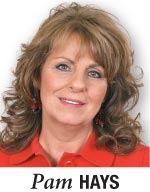
Pam Hays is president and founder of The Arms Forces, www.thearmsforces.org; (419) 891-2111.