Mia Hammond. (Photo courtesy of EPSON Tour and Legends Tour)
TOLEDO – The Greater Toledo Classic, which will be held July 17-19 at Highland Meadows, hosted their annual Media Day, highlighted by an appearance from defending champion Mia Hammond.
Hammond visited patients and their families at Ronald McDonald House of Northwest Ohio, one of the tournament’s beneficiaries; plus, she was on hand for media interviews and concluded the day with a youth clinic featuring four patients from Nationwide Children’s Hospital – Toledo and ProMedica Russell J. Ebeid Children’s Hospital.
Joining Hammond as sponsor exemptions in this year’s Greater Toledo Classic are Ohio State University graduate Kary Hollenbaugh and University of Illinois graduate Anna Ritter. The trio will compete alongside a field of 141 Epson Tour professionals.
“The sponsor exemptions represent an important opportunity to showcase exceptional talent while providing fans with compelling stories to follow throughout tournament week,” said Tournament Director, Judd Silverman. “We are excited to welcome Mia back as defending champion and to provide Kary and Anna the opportunity to compete in their home state of Ohio.”
Beneficiaries of the 2026 tournament include the Jamie Farr Scholarship Fund of the Greater Toledo Community Foundation, Maumee Valley Habitat for Humanity: Women Build, Nationwide Children’s Hospital – Toledo, ProMedica Russell J. Ebeid Children’s Hospital, and Ronald McDonald House Charities of Northwest Ohio.
Through the support of hundreds of volunteers and local businesses, the Greater Toledo Classic continues to make a meaningful impact throughout northwest Ohio and southeast Michigan. In 2025, the tournament distributed $337,000 to five northwest Ohio children’s charities and awarded college scholarships to five area high school seniors. Since its inception in 1984, Toledo Classic has raised over $14.6 million for more than 200 children’s charities.
TOLEDO — “I no longer believe the death penalty is a deterrent to murder.”
Gov. Mike DeWine (R-Ohio), in a news conference last week, declared that he no longer supports the state having a death penalty — despite, as a state senator, being one of the law’s original authors. Proof that, even with less than a year remaining in his final term as governor, DeWine still has the ability to influence moral and political discourse in the state.
“For the state to take a human life,” said DeWine, “there must be evidence that, in doing so, it will protect the public.”
DeWine argued that, equally as important, there must be evidence that someone will be deterred from committing a murder, knowing they could face the death penalty.
“The legislature can take this action, and I believe they should take this action,” said DeWine, calling for a ban on capital punishment. “But if the legislature does not want to make that decision,” he said lawmakers should “leave it up to a vote of the people of the state of Ohio.”
While the governor said “the moral justification” he had in supporting the death penalty “no longer exists,” not all of Ohio’s elected officials shared in his change of heart. State auditor and Republican candidate for attorney general, Keith Faber, made clear his disagreement with DeWine in a Facebook post.
“While I appreciate that Governor DeWine has come to his new position on the death penalty earnestly, I believe he’s wrong on this issue,” wrote Faber. “The current law has not been utilized. It should be. I’ll work with the General Assembly to identify constitutional methods of execution that can be implemented immediately.”
Faber is referring to the fact that, since DeWine took office in 2018, no executions have occurred in the state of Ohio. As Cleveland.com reported back in May, the governor “has maintained a moratorium” on executions, concerned that “pharmaceutical companies will retaliate” upon discovery of their product being utilized in an execution. While legislation to prevent that from happening has been proposed, it hasn’t been passed.
Ohio’s sitting attorney general, Andy Wilson, also differed from the governor — by whom he was appointed.
“Having personally handled several death penalty trials, I understand the value of the death penalty as an option for prosecutors and victims in very limited circumstances,” a statement from Wilson read. He said, in his experience, pursuing the death penalty is not a choice made “lightly” by prosecutors in the state. Wilson’s statement goes on to call the death penalty, “in a small percentage of cases,” the “only option” that can bring “a measure of justice and closure” to victims’ families.
Wilson’s statement continued, “I’m relieved that the governor didn’t use the power of commutation to undo the decisions of the prosecutors, juries and judges who are closest to the facts and evidence in these cases.”
He closed by saying that with the death penalty still law in Ohio, his office will continue to “uphold” it.
Wilson’s position received the endorsement of his predecessor, former Ohio Attorney General Dave Yost, who resigned back on June 6 to join Alliance Defending Freedom, a conservative legal group. In a post on X (formerly Twitter), Yost wrote: “I wondered how the new guy would react to his former boss’ public repentance on the death penalty. He stood his ground, and proved up again his prosecutor chops.”
In his remarks last Tuesday, DeWine, also a former prosecutor, prosecuted his case for the death penalty’s abolishment. He argued that the years-long gap between one’s sentencing and execution, if they even make it to that point, poses no immediate threat to perpetrators, and therefore, is a non-deterrent.
Additionally, while the governor acknowledged that the families of victims have varying views on capital punishment — from those who see it as a just consequence to others who find it an offense to the victim — a “universally held” feeling, he said, is that the long wait for someone to be executed drags out the pain of families.
One other pillar of the governor’s argument is the toll executions take on those tasked with carrying them out. Via his prepared remarks, the governor painted a picture of what it means to carry the weight of that feeling, quoting Gary Mohr, former director of the Ohio Department of Rehabilitation and Corrections (2011-18). DeWine read out Mohr’s recounting of an experience he had during the practice for an execution.
“On my first execution, I played (it was not play) the role of the condemned. As the process concluded, the team called for the medical staff to respond as I was experiencing extreme anxiety symptoms. Other team members in that role had similar experiences.”
The governor, as an alternative to the death penalty, said “our money and energies are much better spent” on keeping “repeat violent offenders out of society.”
While a number of high-profile Ohio Republicans publicly disagreed with DeWine, he did have a noteworthy supporter: U.S. Senator Bernie Moreno. In response to a question from the Statehouse News Bureau’s Sarah Donaldson, Moreno said: “I’m a believer that life begins at conception, all the way through natural death, so I’m, personally, not somebody who feels like the death penalty is something that humans should do. So, I support his moral point of view.” He added, “I believe it’s only up to God to end life, not humans.”
Advocates against the death penalty have also pointed to the potential for — and real-world examples of — wrongfully-convicted individuals dying for a crime they didn’t commit. According to the American Civil Liberties Union (ACLU), “Since the modern death penalty era began in 1973, at least 200 people have been exonerated from death row across the United States. At least 21 others who were likely innocent have already been executed.”
That same ACLU report found “official misconduct from police or prosecutors,” such as witness coercion, excluding key evidence, filing false reports, or allowing perjury, to be “the single most common factor in wrongful death penalty convictions” — a finding that was particularly true for Black death row exonerees. False testimony and eyewitness misidentification were cited by the ACLU as other common reasons for wrongful death penalty convictions.
So far, the governor’s push is unlikely to go anywhere in the Ohio General Assembly, at least according to House Speaker Matt Huffman (R-Lima), who told the Statehouse News Bureau that while some House Republicans support ending executions, they’re not the majority. But with lawmakers out on break until November, any legislative effort would be forced to wait, regardless.
The 160,000-square-foot Meijer store on S. Pray Boulevard in Waterville is expected to open on Memorial Day 2027. Nearby, Buffalo Wild Wings plans to open a restaurant that same day. (AWFP photo by Karen Gerhardinger)
WATERVILLE – South Pray Boulevard is undergoing a change as Meijer continues construction of a 160,000-square-foot retail store and 3,600-square-foot gas station and convenience store on 25 acres. Plus, Buffalo Wild Wings is planning a 7,600-square-foot restaurant next to the O’Reilly Auto Parts. Both are expected to open by Memorial Day 2027, said Municipal Administrator Jon Gochenour, who was the guest speaker for the June Waterville Area Chamber of Commerce luncheon.
“It’s a significant investment in the city,” Gochenour said of Meijer, noting that the property value is estimated at $32 million, and that will provide tax revenue to both the city and Anthony Wayne Local Schools. In addition, Meijer expects to hire 300 to 350 employees, who will contribute income tax revenue to help pay for city services.
Waterville municipal administrator Jon Gochenour presented an update on city progress to the Waterville Area Chamber of Commerce during its June 16 meeting. (AWFP photo by Karen Gerhardinger)
Meijer is investing in significant roadway improvements as well, including a 600-foot eastbound right turn lane on the south side of S.R. 64; a 480-foot westbound right turn lane on the north side of S.R. 64 to access U.S. 24; and a traffic signal on the east side of the bypass that will allow traffic to flow more easily around the interchange and down to Waterville-Monclova Road.
Meijer has two outlots – one along S.R. 64 west of the gas station and one on the south end of the Meijer property – that have garnered a lot of interest.
With 30,000 people in the Anthony Wayne area, Gochenour said he’s heard particular interest from medical and retail sectors about available space.
Farnsworth Industrial Park is another area seeing significant growth. Kaufman Engineered Systems is set to finish its 52,000-square-foot addition to its 66,000-square-foot facility, adding 16 full-time jobs and $1 million in payroll.
The industrial park is also home to the main manufacturing facility for Surface Combustion, a 110-year-old company with 675 patents and 75 trademarks.
The Toledo-Lucas County Port Authority recently completed a 48-acre expansion of Farnsworth Industrial Park, installing an 1,800-foot road, Big Lucas Drive, with a cul-de-sac, retention pond and all utilities. The shovel-ready site was made possible with a $1,182,760 Ohio Department of Development grant. The Port Authority is also looking at adding another 50 acres to create opportunities for manufacturing and industry.
“The Port Authority has had a lot of luck in redevelopment,” Gochenour said, pointing out the Overland Industrial Park in Toledo, which added 600 jobs. “This is a great opportunity for the city.”
When the Gordie Howe International Bridge between Canada and Detroit opens, it will spur more growth in northwest Ohio, especially in areas with easy access to highways – and that includes Waterville, Gochenour said. The city has other areas open for business, including the Riverbend Flex Industrial Park on Choctaw Drive, which has seven lots of 1 to 6.5 acres in size.
Improving the downtown area was one of the most-mentioned comments in a survey of residents when updating the city’s land use plan last year, and the city is working to do just that, Gochenour said. Using a $428,000 Ohio Department of Development grant, the city will remove the tanks and building from what was most recently a Sunoco gas station at Farnsworth and the Anthony Wayne Trail.
“We will remarket this for private economic development,” Gochenour said.
Across the AW Trail, the city is also using an $85,000 grant to pave the parking lot for Waterville Historical Society’s Wakeman Hall.
The downtown area will get a boost from a Downtown Redevelopment District designation, which will allow a portion of the increase in tax revenues generated from improved property values to be be reinvested in the area.
Waterville’s residential sector continues to grow as well, with three Waterville Landing subdivisions – Columbian Village, Farnsworth Village and Stonewood Village – containing 40 buildable lots. In 2025, 25 new homes were built in the city, adding a construction value of $9.9 million.
While the housing market sees its highs and lows, the allure of Anthony Wayne Local Schools‘ excellent reputation continues to draw people to the area to live, Gochenour said.
“In 2012, we were predominantly a bedroom community, with taxes coming primarily from residential. In 2025, the city received 76 percent of its taxes from non-residential development.”
Supporting residents takes funding from a strong business sector, and that growth is allowing the city to expand its services. The fire department now has nine full-time firefighter/paramedics and the police department is up to 13 full-time officers. This year, the city will add two public works employees.
The city is investing more on roads projects than ever this year, with $2.1 million toward widening Waterville-Monclova to three lanes for a continuous left-turn lane from Michigan Avenue to Pray Boulevard; filling in gaps in the shared use path system; and resurfacing Canal Road. The city will also replace 234 panels of sidewalk in the areas of Second, Fourth and Fifth streets. In all, the city received $1.7 million in grants for these improvements.
One of the most significant projects is costing the city $1 – taking over ownership of the Roche de Boeuf Interurban Bridge once the contractor, Kokosing, is finished with a partial demolition. Kokosing is expected to begin removing the spandrel walls, fill dirt and fallen debris in July, leaving the city with the piers and arches so that Save the Bridge Association (STBA), the city and other partners can work together to raise funds to install a pedestrian and bike patch over the arches.
“As they get into the partial demolition, it could collapse or something could go wrong,” Gochenour admitted. “If they’re working on it and they can’t save it… the city is not taking over a structurally unsound bridge.”
The purchase of the bridge includes the right-of-way in Wood County, providing access to S.R. 65 near Forst Road and the Bowling Green water plant that supplies water to the city. Owning that right-of-way will give the city more access to maintenance of the waterline that runs through that space.
“It’s not a bridge to nowhere,” Gochenour said, explaining that connecting Lucas and Wood counties will open up opportunities to work with a variety of partners and extend the Slippery Elm Trail from North Baltimore into Waterville. That in turn would connect cyclists and pedestrians to the Towpath Trail that is connected between Farnsworth and Providence metroparks.
The city already has a $557,625 grant to do the first phase of revitalization, installing a 12-foot wide bridge over S. River Road and an overlook on the river from the south pier and wing wall. The city also owns space on Anthony Wayne Trail, a small parking for the overlook is planned.
Once the bridge is stabilized, plans call for a prefabricated bridge system – like the one over the Anthony Wayne Trail by the Fallen Timbers Monument – that would put the load on the piers, not the arches.
“We could have a pedestrian path and recreational facility that is 25 miles long from Waterville to North Baltimore,” he said. “It will require a lot of cooperation from public and private partners and take several years to complete. Will it be easy? No. Will it take a lot of hard work? Yes. Is it impossible? Absolutely not. I think we can do this. It’s just amazing that we were able to be in this position to have a plan to rehabilitate this historic structure. In Waterville, anything is possible.”
Waterville and Whitehouse are hosting Independence Day celebrations befitting a 250th anniversary. Put on your red, white and blue, bring a lawn chair or blanket, and head to one of these area events.
June 26
Friday, June 26 from 5 to 10:30 p.m., Browning Masonic Community is hosting a Community Fest, featuring food, games, live music and fireworks. The event is free and held at 8883 Browning Dr. in Waterville. Enjoy walking tacos, hot dogs, hamburgers, an ice cream bar, lemonade station and Snowie Summers snow cone truck. Bring a towel to dry off after throwing water balloons or running through sprinklers. Silver Songbirds will perform a concert at 4:30 p.m. in Harmony Hall, followed by live music by John Pickle at 5 p.m. Fireworks will began around 9 p.m. Bring a lawn chair.
July 2
Whitehouse will celebrate its 162nd birthday and America’s 250th on Thursday, July 2 at Blue Creek Metropark and Whitehouse Village Hall.
Beginning at 5 p.m., the area next to village hall will be filled with a kid’s inflatable area – available at no cost thanks to a sponsorship by Whitehouse American Legion Post 384 and Cub Scout Pack 384. Eight food trucks will also open up for business at 5 p.m., including K&K Concessions, The Loaded Chicken, Naan Stop Kebap, Mr. Popper’s Kettle Corn, Outlaw Attitude BBQ, Snowy Station, Susie Lynne’s Lemonade and Uncle Louie’s Food Truck.
Live music by The 25’s will take place from 6:30 to 9:30 p.m.
The Whitehouse Historical Society will be set up to share information on local history, and the Anthony Wayne Free Press will be passing out free copies of the America 250th Commemorative Edition – a printed paper featuring articles on the Anthony Wayne area.
Fireworks begin at dusk, and the best viewing area is facing east over the quarry, off of Providence Street. Bring a blanket or lawn chair.
July 4
Waterville is hosting its biggest fireworks display ever on Saturday, July 4 at dusk, with viewing available from Prairie Trail Park, Waterville Primary School and many neighborhoods.
Sponsored by the City of Waterville, Waterville Cub Scouts Pack 101 and Susie Lynne’s Lemonade, an Independence Day celebration will begin at 5:30 p.m. behind Waterville Primary School, 457 Sycamore Lane. Enjoy live music and entertainment by Touch the Sky DJs, free inflatables from Air Extreme Ohio, and food trucks including Detroit Mini Donut, El Padrino Street Tacos, Hot Dogs 2 Go, Mr. Popper’s Premium Kettle Corn, Susie Lynne’s Lemonade and Wanna Make ‘er Loaded.
Dilworth Strong Real Estate and Property Management is providing free play all night long from Hoop Toledo, a mobile pop-a-shot gaming experience. Chick-fil-A will reward free food for a year to whoever gets the highest score in the month of July. The Waterville firework celebration festival is one of the participating locations.
Waterville United Methodist Church, 7115 Waterville-Monclova Rd., is hosting its Pop, Pop, Pop celebration from 7 to 10 p.m. with a cookout, popcorn, popsicles, games and a great view of the fireworks. The event is free and open to the public.
During the evening, the Anthony Wayne Free Press will be passing out free copies of the America 250th Commemorative Edition – a printed paper featuring articles on the Anthony Wayne area.
Doug Hinebaugh — better known as Dougie Fresh — is the photographer documenting what makes Toledo cool. In this episode, he sits down with host Michael Vanderpool to talk about getting sober, leaving Toledo and finding his way back, building a full-time freelance photography career out of COVID, and why “showing up” is the key to everything.
We get into his volunteer work with the Toledo Streets newspaper and the homeless community, what actually makes a good photo, his first solo gallery show “One City, Many Moments,” and Techledo — the free electronic music festival during Watershed Weekend.
If you’ve ever thought “nothing happens in this town,” this one’s for you.
Ohio Gas crews work on preparing lines for a mini roundabout that will be installed at Waterville Monclova and Monclova roads later this summer, following the construction of a roundabout at Monclova and Albon Roads – set to start on June 22. The delay will cause construction of the roundabout in front of the school to continue after school begins Aug. 17. (AWFP photo by Karen Gerhardinger)
Those were Monclova Township trustees’ decisions regarding four proposed zoning resolution amendments – including two relating to data centers – that landed on their desk for final approval on June 15.
After the trustees enacted a one-year moratorium on data centers in February, Zoning Administrator Eric Wagner began working on zoning resolution changes to send to the Lucas County Planning Commission, which reviewed them in April. Currently, if a data center developer wants to locate in the township, the zoning resolution requires applying for a conditional use permit, with the township Board of Zoning Appeals (BZA) setting the conditions.
The first proposed change looks at how much flexibility the BZA would have in setting those conditions. The county approved the language and forwarded it to the township zoning commission, which made its own recommendations – including replacing the word “shall” with “may” when it comes to requiring conditions, including landscaping, screening, parking, hours of operation and lighting. Law director Dawn Sanderson said “may” would give the BZA more flexibility, while “shall” would limit what the BZA could do.
“It’s to add protection to the community, letting the BZA, in their hearings, create additional parameters,” she said. “When you put in ‘shall,’ then suddenly you have limited what the BZA can do. ‘May’ gives them expression on each case-by-case review.”
Resident Ed Ciecka prefers “shall,” saying that too much discretion could be given to the BZA on a big issue such as a data center. Resident Lyn Cox agreed that “may” weakens the section and that she would suggest “require” plus another sentence to describe where the BZA does have flexibility.
“It’s not clear at all,” said Trustee Debbie Stevens-Laux, getting agreement from Trustees Chuck Hoecherl and Barbara Lang, who proposed tabling the issue and having it get further review.
A section defining auxiliary electric generators was also tabled. The recommended language states that these generators can only use natural gas or propane, and that use of other fuels must be approved by the BZA. Units must be in a free-standing enclosure for noise protection. And portable units are only allowed for emergency purposes. Such generators – if for commercial, industrial or multifamily units – would be allowed 300 feet or more from the nearest lot line of adjacent residential areas, and 20 feet if for residential use.
Resident Risa Sindel pointed out that the language doesn’t regulate how many are allowed, and that a data center could have hundreds of generators 300 feet from a home. She also noted that the language about the decibel levels coming from those generators is weak. Wagner said the site plan review process would allow the township to limit the number of generators.
Other residents spoke about the public health impacts of the noise and emissions from multiple generators. Lang said the verbiage should define what constitutes an emergency that would permit a generator, and referred to time when Brandywine used portable generators to run their sprinklers for an extended period. Hoecherl also recommended looking at outlining how many generators should be permitted based on the size of the facility. And Stevens-Laux said commercial and residential generators should not be lumped into the same code.
The trustees asked Wagner to seek more information and return with suggestions.
A third proposed change, meant to limit the types of business in the Maumee Monclova Toledo JEDZ to those that would generate income tax, was tabled as well in order to better define what number of employees would be required. The purpose of the JEDZ is to generate income, but automated businesses like self-storage or car washes with kiosks do not meet that goal.
“We have colleagues that have figured this out,” said Administrator Mike Hampton. “We’ll do some homework.”
The fourth component of the public hearing focused on how to best notify residents of Zoning Commission meetings. A change in state law now allows the township flexibility to not use a newspaper, which Sindel pointed out limits the information to only those who have a subscription. She encouraged trustees to use their website and Facebook, and resident John Langevin said including the meeting notices on the MyMonclova app would reach more residents. Trustees agreed that these methods of getting the word out to residents would work best, except when it comes to public notices for Ohio Public Works Commission projects. To get reimbursed, Hampton said he would need an affidavit, and that’s not available by posting online.
Trustees approved of the language for the zoning notifications, but tabled the other three.
During the meeting, the trustees also:
-Discussed taking a second look at becoming a limited home rule government. In Nov. 2024, the issue was put to voters, but it didn’t pass. Becoming limited home rule would allow the township to retain control over zoning and expand its ability to handle nuisances – such as noise, junk cars and tall grass – more effectively, Hampton said. The trustees agreed and asked Hampton to come up with a plan to move forward. Getting it on the ballot in November would require board approval in July.
-Heard that roundabout construction for Albon and Monclova Road is expected to begin on Monday, June 22, which is much later than the mid-May date originally planned. This is due to delays in getting utility poles moved. Hampton said the project is expected to last 45 days, during which time a detour will be posted. This will delay the start on the Monclova and Waterville-Monclova road mini roundabout until early August, and Hampton is in discussions with the county, post office and schools about the impact of construction. The first day of school is Aug. 17. With the delay for the two projects, Hampton said plans to install a roundabout at Albon and U.S. 20A are in jeopardy of being delayed until next year.
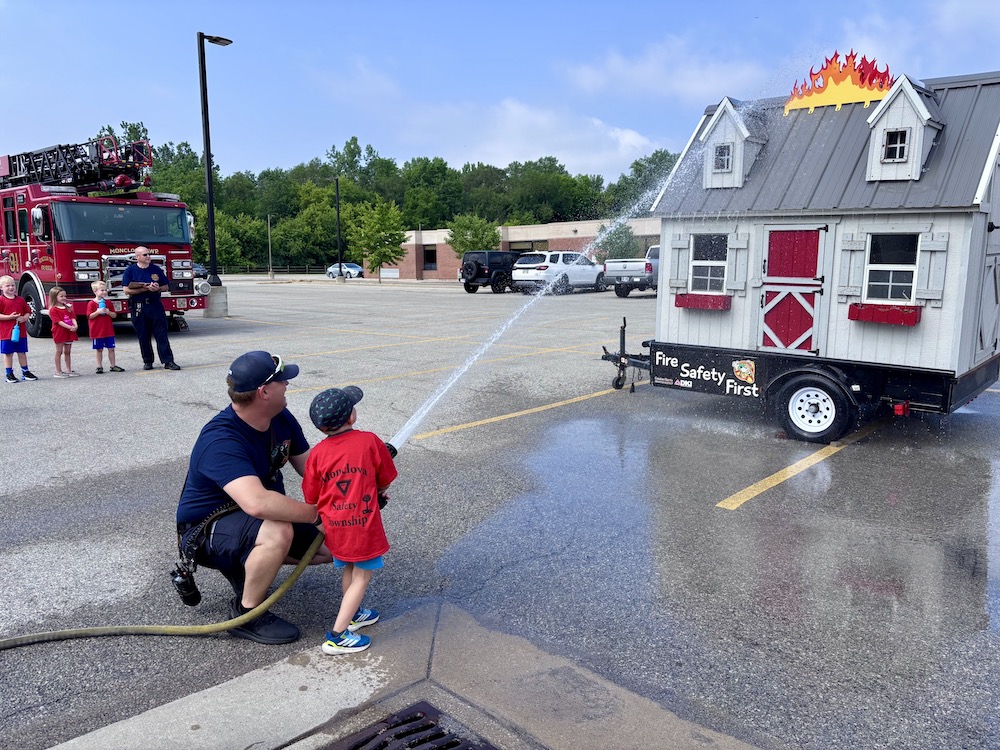
Justin Zwyer and firefighter/EMT Cody Griss apply water to a house fire during the recent Safety Township program for incoming kindergarteners. (AWFP photo by Karen Gerhardinger)
-Approved the 2027 budget as presented by Fiscal Officer Gavin Pike. The budget is due June 30 and reflects collections of just under $15 million and proposed expenditures of $17.5 million – although not all of the items in the budget will be purchased in 2027, Pike noted. Projects and purchases in the budget include approximately $1.7 million for Strayer Road resurfacing; $100,000 to repave the maintenance facility parking lot; $240,000 for 911 dispatching; $900,000 for the Lucas County Sheriff’s Office; $1.2 million for garbage collection; and $115,000 for refurbishing the tennis courts. Also included in the budget are funds for another full-time administrative aide, a full-time maintenance worker, and full-time firefighter/EMTs. As it did last year, the budget also contains $2 million for land acquisition, but no properties have yet been identified specifically, Pike said.
-Learned that the fire department handled 193 incidents in May.
-Heard Cox ask trustees to share their position on data centers. Hoecherl said he’s publicly shared that he’s not in favor of a hyperscale data center but doesn’t want to put the township in a position of being litigated into bankruptcy for just opposing any proposed project. Lang echoed her previous statements that she will not state an opinion, as that would show bias and therefore require her to recuse herself from a vote.
Noah Sauber tees off from Hole 6 as teammate Sean O’Donnell watches. (Courtesy photo)
PERRYSBURG – There was a golf outing on June 8 unlike any other. Oh, the object was still to get the little white ball in the cup, but the reason for being on the links was a first: to raise funds to allow people who’ve lost a loved one to get the counseling they want and need.
The Monarch Grief Center hosted its inaugural Monarch Open Golf Outing that day at Belmont Country Club in Perrysburg. After a noon lunch, the scramble event teed off at 1 p.m. with 52 golfers in 13 foursomes.
Monarch Grief Center is a nonprofit providing professional, compassionate grief support to those who need, as it says on its website, “a place to turn so they feel less alone in their grief journey.”
Amy Rowe and Tim Polakowski, Monarch’s co-founders and grief counselors, enjoy the scene from a golf cart as 52 golfers took to the links in a scramble start. (Courtesy photo)
Few want to admit they need help because “it’s kind of a taboo subject,” said Amy Rowe, cofounder and grief counselor, about seeking grief counseling. She said there are those who can get by in their own time and move on, but for the ones who are struggling, the center is available to them.
Monarch accepts Medicare, Medicaid, and other forms of major insurance, but realizes that not all have insurance and that others may have high deductibles. One of Monarch’s founding principles, Rowe said, is that the center doesn’t want finances to be a burden. “Our mission is to provide support to those who are grieving.”
To that end, Monarch has hosted three Sunset Soirees in the fall which, through patrons’ tickets and sponsorships, raised money for the center’s Monarch Fund. That fund provides copay and deductible assistance for patients with insurance and a sliding fee scale for private-pay clients, as well as the center’s support groups and community events.
Tim Polakowski, Monarch Grief Center co-founder, executive director, and grief counselor, welcomes golfers with Beth Wong, Monarch’s development coordinator and a grief counselor. (Courtesy photo)
To add to the Monarch Fund through a new and different source, the grief center came up with the golf outing.
Why golf?
“I wanted to take something fun that people enjoy doing for the joy of it and make it an opportunity to support [our] mission,” said Beth Wong, the center’s development coordinator, the outing’s originator and point person, and a grief counselor. “As a first-year outing, we are very pleased with the number of golfers, sponsors, and donors who have committed to the event.”
Wong added, “As a counselor and development coordinator, I know the importance and impact of the precious work we do and the need to support it.”
The first-ever event raised $25,000 for the fund.
“We had a great time that was made better by the good cause we were supporting,” golfer Noah Sauber said. “We know Monarch directly helps so many in Northwest Ohio.”
Monarch Grief Center marked its three-year anniversary this past February. Rowe and fellow cofounder Tim Polakowski, the center’s executive director and a grief counselor, called upon their experiences as social workers at a local hospice to develop Monarch.
Monarch provides specialized support groups based on the nature of the death, the deceased’s age or stage of passing, and led by licensed professionals.
Monarch Grief Center is at 314 Louisiana Ave., Perrysburg, and can be reached at 567-331-8601, at monarchgriefcenter.org, Facebook and Instagram (@monarchgriefcenter).
Danny Watson (middle), Hannah Sellers (far right) and their son, Azel, play a round of min golf at last year's event on Huron St. (Photo courtesy of Epilepsy Center of Northwest Ohio)
The Epilepsy Center of Northwest Ohio hosts fundraiser event
TOLEDO– The Epilepsy Center of Northwest Ohio will turn part of Promenade Park into an 18-hole mini-golf course for the annual Practically Golf (presented by Erie Home). It will take place on Friday, June 26, and part of the event will coincide with Party in the Park. The event used to be held at N. Huron Street near The Blarney Irish Pub.
The event will start at 1 p.m. with the corporate tournament, which features businesses from around the area competing in a shotgun-style tournament. The mini-golf event will be open to the public from 5 to 10 p.m.
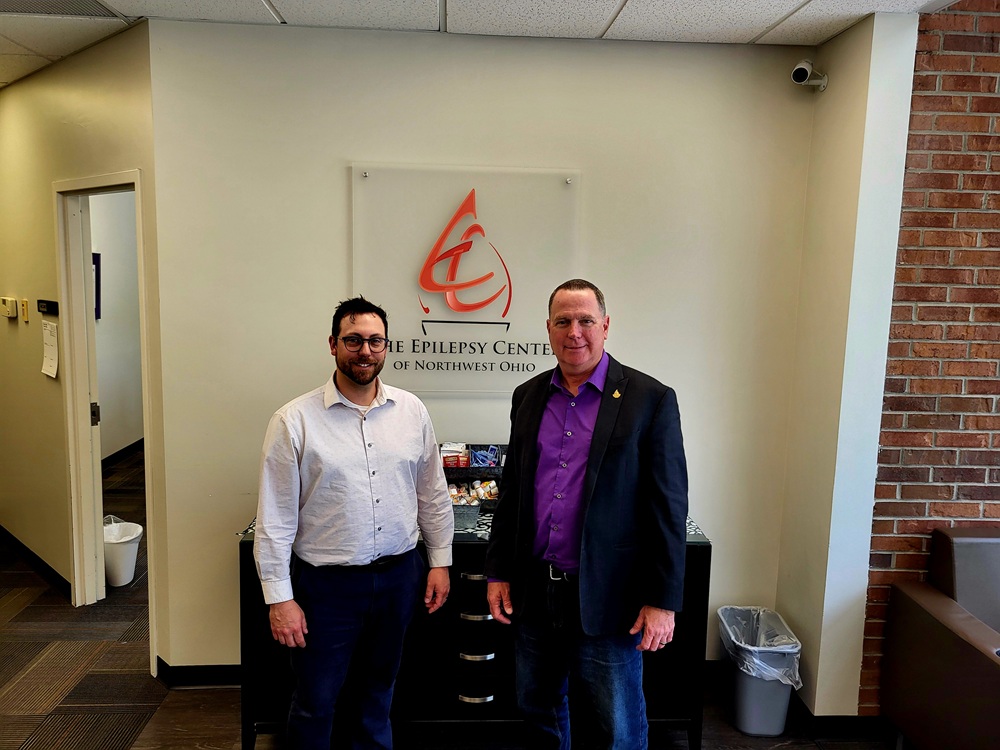
Epilepsy Center of Northwest Ohio Director of Development Nate Reid (left) and CEO Roy Cherry in the corporate office in Maumee. (TFP photo by Steven Bieber)
Roy Cherry, CEO of The Epilepsy Center of Northwest Ohio, said the center has been running Practically Golf since 1989. Since its creation, it has moved to several locations, including Franklin Park Mall, Erie Street Market, Levis Commons and others.
In the past, Practically Golf was a two-day event. This year, it will only be held on Friday night.
“What we found over the last couple of years is that it just wasn’t that busy, and there was a lot of energy to have it for that number of days,” said Cherry. “So when we moved to Promenade Park, tied in with Party in the Park, having it that one day made sense.”
A mini golfer at last year’s event on Huron St. (Photo courtesy of Epilepsy Center of Northwest Ohio)
Cherry also noted that Promenade Park is not a high-traffic area on a Saturday afternoon.
Since it was founded in 1977, The Epilepsy Center of Northwest Ohio has worked to improve the lives of children living with epilepsy, but it also supports individuals living with developmental disabilities.
The money raised from Practically Golf will go toward the services the organization provides. Every August, Cherry said, the organization brings families affected by epilepsy to Camp Frontier in Pioneer, Ohio for a free weekend. This is just one example of the services provided. Some others include medication assistance, transportation and one-on-one support. Cherry mentioned that the organization helps people with disabilities who live on their own but are looked after 24/7.
If you cannot make it out to play golf but still want to help, there are plenty of options to support the organization.
Nate Reid, director of development, works to gather support from organizations, individuals, and anyone who wants to get involved.
“Basically, my role is connecting people who want to be involved in whatever ways they can and then continuing to grow their ways that they can participate.”
Reid said anyone can volunteer, donate or do both. Organizations can also make corporate gifts and provide grants.
There is still time to volunteer for Practically Golf. To get involved, simply visit the volunteer page on the organization’s website, where you can also make a donation.
For the first time, participants can purchase tickets online in advance. Tickets may also be purchased at the event. They cost $10 for adults and youth 13 and older, and $5 for children 12 and under. Discounts are available for groups of four.
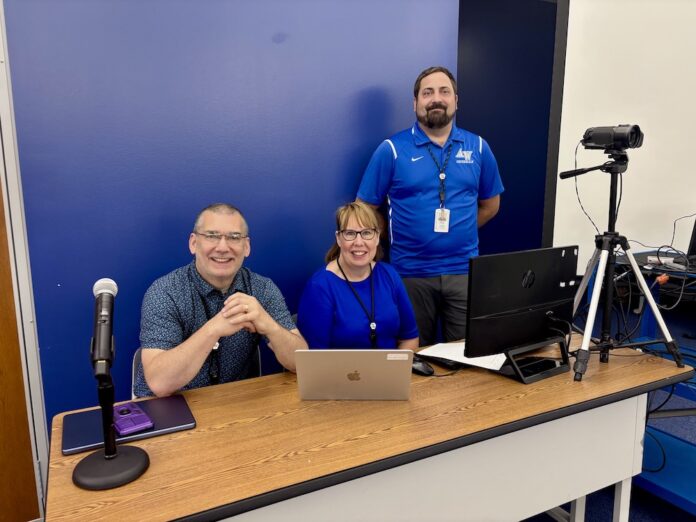
The Anthony Wayne Local Schools' Technology Department includes director Chris Hamady, technology supervisor Nickie Sattler and lead technology supervisor Devin Filip. (AWFP photo by Karen Gerhardinger)
Anthony Wayne Local Schools, like all Ohio school districts, is working to meet the needs of House Bill 96 – which sets cybersecurity requirements for public entities.
And while the district has already adopted an AI policy and – during its June 10 meeting – a new cybersecurity plan, the work is not done, said Chris Hamady, director of technology for the district.
“It will never be done. Because as information technology changes, we’re constantly going to be adapting our procedures to address new changes and new technologies that come out. So this is going to be an organic and dynamic plan,” Hamady said as he presented the six-part plan to the board.
The cybersecurity plan is based on the National Institute of Standards and Technology (NIST) Framework. NIST is a non-regulatory U.S. federal agency within the Department of Commerce that promotes innovation and industrial competitiveness by advancing measurement science, standards, and technology.
When creating a plan, the district has to balance risks and security with the need for team members’ ability to use technology. That includes the teachers, staff and students who utilize Chromebooks.
As Hamady and his staff, including Devin Filip, Nickie Sattler and David Hadley, worked on the plan, they began with creating a list of every website, app and other technology usage at every level, in order to identify critical functions and risks.
“We had to figure out which ones are critical and which ones could be a target for a breach,” Hamady said. “We went to the departments and spoke to people.”
As part of the plan, the team identified potential impacts if a system was breached, including payroll and records, and detailed how that would affect day-to-day operations. Threat detection mechanisms are also now in place, but these are kept under wraps for security reasons. The plan also includes establishing incident response procedures to identify the breached system – whether it’s software, hardware, bank accounts or payroll – and who should be notified and how to recover those systems.
The cybersecurity plan includes detailed plans for recovering data and systems and getting the district resources back to normal as quickly as possible. The plan includes regular training for staff to learn best practice work habits that lead to the safe and effective use of technology, data and systems.
Implementing a cybersecurity plan and adopting the AI policy are just a few of the HB 96 requirements, Hamady said. Other regulations include obtaining board approval before responding to a ransom demand and reporting any cybersecurity incidents to the state within specific guidelines.
During the June 10 meeting, the board also:
-Heard Superintendent Kevin Herman explain the reason for an executive session: to discuss a possible change to a TIF (Tax Increment Financing) agreement related to the sale of the Shops at Fallen Timbers. A developer is working on finalizing the sale with the current owners, who have not been able to pay all of the requirements of the TIF. Herman said it’s in the best interest of the community and the district to see the mall do well. After the session, the board approved a first amendment to the compensation agreement with the city of Maumee and Penta Career Center for the TIF exemption in the agreement.
-Approved donations of over $27,000, including: $9,000 from the Waterville Parents Association to Waterville Primary School; $1,000 from Rosemary Yanik to the junior high for media center furniture upgrades; $3,000 from the Dollar General Literacy Foundation for the Waterville Primary summer reading program; Mud Hens tickets from Strause Refrigeration and Silco Fire to the AW Operations Department; $918.40 from Whitehouse Parents Club to the principal’s fund for art supplies; and donations by Pour Soul Art and Waterville Sweets for the high school 3D printer filament to create the Generals key chains that will be hidden during Family Week.
-Approved membership in the Alliance for High Quality Education for $4,000 and Ohio Schools Council for $904.88.
-Approved a new job description for assistant treasurer, which was formerly named as assistant to the treasurer. Ray Greene is taking over as treasurer and Meagan Conroy as assistant treasurer effective July 1, when treasurer Kerri Johnson retires.
-Set the next meeting at Monday, June 29 at 7:30 a.m. and moved the Aug. 4 meeting to Aug. 10 at 8 a.m.
-Learned that the preliminary results of test scores show the students did very well on state testing. The official results will be released this fall.
– Listened to an update on the Business Advisory Council from Jim Conner, director of teaching and learning. The group is a partnership with the Educational Service Center of Lake Erie West, and includes other school districts and businesses that work to create opportunities for students as they prepare for the future workforce.
-Approved a memorandum of understanding between the board and the Anthony Wayne Education Association to create new special education chair positions for Monclova, Waterville, Whitehouse and Fallen Timbers. Herman explained that these supplemental positions will serve as a liaison between the buildings and the special education director to help with communications and details.
-Adopted the enVision Math program for seventh and eighth grade math courses.
-Approved the use of a supplemental text for the junior high: Code Talker: A Novel About the Navajo Marines of World War Two.
-Approved new tutor pay rates, increasing from $125 to $130 per day.
-Approved athletic fees and ticket prices and discussed how the General’s Pride Pass is available for anyone living in the district ages 60 and older to get into sporting events and performances for free.
-Heard that the district is still seeking certified and classified substitutes in all areas.
Golden Ragwort at Mallard Lake. (Photo by Metroparks Toledo nature photographer Art Weber)
It’s such a wonderful time to hit the trails in one of your Metroparks. The colors are fresh and vibrant, the weather cooperative.
It’s late spring on Mother Nature’s calendar. Spring woodland wildflowers have done their thing, though a few have moved into their place providing some eye candy before the super wildflower show moves out into the meadows and tallgrass prairies.
Golden ragwort is a star right now, especially at Oak Openings Preserve where this multi-rayed yellow beauty is easily seen in the wet woods that come right up to the roadsides near Mallard Lake, for example.
Look for it growing through the big broad beautiful leaves of skunk cabbage which loves the wet woods as much as the ragwort.
Think of golden ragwort and the equally impressive marsh marigolds as emissaries for the explosion of yellows that will surely follow come summer.