Home Blog Page 186

Treece: What makes a market?

0

In their infancy, financial markets looked far different than they do today. When markets and securities were brought about, they were created in order to provide capital to companies just starting as well as liquidity to owners and executives of existing companies. Many going concerns were becoming absolutely gigantic companies, and many owners and managers wanted to sell their shares for cash to do other things. At the same time, there were plenty of people who wanted to buy portions of these companies to share in the future earnings.

Back in those days FDIC didn’t exist and there simply weren’t safe places to put money. People fortunate enough to accumulate some savings often invested it in things like ships or timer land. Being able to buy into a company that was being run by knowledgeable, professional managers and might make investors even more money seemed like a great idea.

From the markets’ early days there has always been a segment of pure speculation – people who didn’t know anything about companies or economies, but were simply chasing hunches or tips. Over time, the amount of this “dumb money” has increased to such a degree that now most of the world’s financial markets are little more than gambling pits.

These developments have left individuals with little chance of success in investing. Some may have an edge if they work for a company and know its culture and direction, or if they are studious people, willing to analyze the fundamentals of companies and industries in order to make informed decisions. Otherwise they’re willing to put in such work, or to hire someone who does, “investors” might as well take their savings to a roulette table.

Over time, though, an entire industry has sprung up that has focused on helping to guide people with savings through the markets. Unfortunately, many of these advisors have had little more knowledge than their clients about how markets work. Quite often they’ve been more focused on finding clients than finding good investments. As a result, many have lost money for their clients.

And so, oddly enough, whole new theories have evolved to vindicate advisors. Concepts like diversification or modern portfolio theory have tried to explain why it’s OK – even good – that advisors routinely pick SOME losing investments. These theories and their proponents postulate that every GOOD portfolio should have some winners and some losers.

Meanwhile, few members of the investing public have been told just who should be talking to for guidance. Few realize that there is a difference between a financial advisor/planner and a money manager. Many work with an advisor, who provides guidance and takes care of client needs; while few investors use a money manager, who spends their time researching the markets to makes strategic, informed decisions on investments.

In the world of finance, a financial plan is the equivalent of a road map, while investments are vehicles. A financial planner, in this world, is a map maker. They may be very good at making maps, but that doesn’t mean they know what they’re doing when they get out on the road. Conversely, a money manager is a driver who knows the lay of the land. They may not be a great map maker, but they can help avoid the speed traps and potholes.

Many of these managers “eat their own cooking” – that is, buy the same investments as they recommend to clients. Admittedly, they may not always be right when picking investments, but they certainly put in the time on research to improve their odds. The hope is that, over time, a money manager can outperform the shotgun approach of diversification. At the very least, they can help their clients to avoid the perils of the pit, and ignore the jawboning of stockjobbers.

Dock David Treece is a partner with Treece Investment Advisory Corp (www.TreeceInvestments.com) and is licensed with FINRA through Treece Financial Services Corp. He provides expert content to numerous media outlets. The above information is the express opinion of Dock David Treece and should not be construed as investment advice or used without outside verification.


TFP delinquent land tax ads yield $3.9 million more than Blade average at nearly half the cost

0

Each year, the Lucas County Auditor’s Office is required by law to publish a list of delinquent land tax notices in a local publication.

In December, the notices were published in Toledo Free Press, the first time a free weekly newspaper has published the Lucas County list.

Toledo Free Press was the only publication to submit a bid and published the notices at a cost of $168,025.

Between January and March, $10.7 million in late and delinquent land taxes was collected, according to county records. That’s $3.9 million more than the average amount collected for the past four years at almost half the cost to taxpayers.

Between 2009-12, the notices were published by The Blade at an average cost of $321,000. An average of $6.8 million in taxes was collected each year between January and March following the publication of the notices.

The county paid The Blade $339,935 to run the notices in 2009, $287,135 in 2010, $347,272 in 2011 and $309,870 in 2012. Taxes reported collected between January and March of the following years were $6.8 million in 2010, $6.4 million in 2011, $6.9 million in 2012 and $7.1 million in 2013.


Toledo Free Press became eligible to publish legal notices with the signing into law of Ohio House Bill 153 by Gov. John Kasich in October 2011.

The legislation eliminated the link between charging for newspapers and being permitted to publish legal notices and opened the legal publication business to any “newspaper of general circulation” that publishes at least once a week and meets other criteria, including at least 25 percent editorial content, being published continuously for at least three years and the ability to add subscribers to its distribution list. The bill also requires the newspaper to offer its best classified rate.

“Before 2011, it really was tied strictly to whether you had a valid U.S. Postal Service mailing permit and generally those mailing permits are whether you’re a paid circulation newspaper,” said Dennis Hetzel, executive director of the Ohio Newspaper Association (ONA). “In 2011, the qualifications, you could argue, were relaxed. The postal permit requirement is still there, but there are other paths by which a newspaper can qualify.”

In October 2012, Lucas County Auditor Anita Lopez sought an opinion from the Lucas County Prosecutor’s Office, which ruled, “[Toledo] Free Press would now qualify as a paper of general circulation.”

That year, The Blade’s bid to publish the delinquent land tax notices was $330,617 and Toledo Free Press’ bid was $86,100.

Lopez recommended the 2012 contract be awarded to The Blade, citing Toledo Free Press’ lower circulation in areas such as Neopolis and Curtice. The Lucas County Commissioners, who have the final say, agreed.

“For me, this comes down to covering areas,” Lopez said. “I thought it was important to go with the broader circulation because of what we were doing. Our Constitution in our country protects property rights. Property is something sacred in our country. The most important reason why this ad has to occur is to protect property rights. That goes beyond the bottom line dollar. You have to balance that, but when we’re saying, ‘You’re delinquent to the point where we can take your property,’ this becomes the last call to the public to get in here and pay your taxes. That, to me, is lost in the process. Those were my concerns. That’s important to me as a lawyer. At the end of the day, I have to make my decision based on what I think is best for citizens and stick to my guns.”

Hetzel said statewide there are both dailies and weeklies that publish legal notices and awarding such contracts is “a local government decision.”

“The first thing they have to establish is if the newspaper that gets it is qualified in the law,” Hetzel said. “Then they have to compare and contrast competing bids and decide what’s going to serve the public best. The theoretical basis of a published notice is that it should be in a publication that is invited into people’s homes, that is wanted and not ignored. Like anything else in life, there are many factors involved that government officials need to consider. It’s not always based on price.”

Toledo Free Press Publisher Tom Pounds said that the “perceived shortcoming” in circulation has been addressed and said he still believes, as he has discussed in numerous columns, that TFP offers advantages beyond cost savings to those publishing legal notices.

“While a daily newspaper comes and goes in one day, our paper is on racks in 432 locations for seven days in addition to our 70,000 home-delivered copies,” Pounds wrote in December 2012. “It is worth noting that taxpayers who wish to see the information they have paid to publish would get that information at no cost in Toledo Free Press; they would have to pay for it (again) to read it in a daily newspaper.”

Lopez said she agreed TFP had addressed the circulation concern and that last year’s numbers showed “good results.”

“The numbers speak for themselves. We are saving money,” Lopez said. “It’s very hard to argue with that.”

The Village of Ottawa Hills, City of Toledo, City of Sylvania, Monclova Township, Lucas County Metropolitan Housing Authority, Toledo Public Schools, Washtenaw County and Metroparks of Toledo Area have also published legal notices in Toledo Free Press.

Lopez said she was approached last year — she declined to say by whom — after the bidding period on the delinquent land tax notices had closed and asked to re-open bidding since only one bid had been submitted, but she said no.

“I would like to make it very clear that I was definitely asked to reconsider, asked would I object to re-advertising the bid or allowing this bidding to be reopened last year and I said, ‘No, I think we move forward,’” Lopez said. “We had an eligible paper that met the qualifications, that had met the concerns from 2012. And the numbers had already been made public, so whoever would compete against that bid would know how to lowball them. You just can’t do that. That undermines the entire process of a public bid.”

Recent legislation will bring another change to the publication of legal notices. Starting in March, all notices printed in Ohio newspapers will also be required to be posted on www.PublicNoticesOhio.com, a free website operated by the ONA.

The change comes after Kasich signed House Bill 483 in June, which included the ONA-backed measure. ONA has operated PublicNoticesOhio.com for more than 10 years, but posting there hasn’t been mandatory until now, Hetzel said. PublicNoticesOhio.com will replace a state-run site created in 2011.

Notices will still be required to be printed in newspapers first, but uploading to the site will be required in order to continue to qualify to publish Ohio public notices.

In a June blog post announcing the new online requirement, Hetzel said it may save money for agencies as notices that are required to be published twice may publish a shortened version in print for their second run if the full list will be going online. The shortened notice option does not apply to all types of notices, including the delinquent tax list, he said.

“It’s good for everyone to have them all aggregated on one website, in the private sector and not a government website,” Hetzel told Toledo Free Press. “We worked hard on that and think it’s for the long-term good of our industry and the public.”

Employment First Initiative helps find jobs for people with developmental disabilities

0

Gov. John Kasich’s Employment First Initiative helps people with developmental disabilities in Lucas County land jobs with local companies.

The initiative, created by an executive order signed in March 2012, changed how services are provided to people with developmental disabilities by making it a priority to expand employment opportunities for about 80,000 such individuals in Ohio.

The goal of the initiative is to enhance the individual’s self-determination and offer opportunities for greater wealth, quality of life and a sense of self-worth, said John Martin, director of the Ohio Department of Developmental Disabilities (DODD).

Kevin Tyree replaces price stickers for merchandise at Best Buy in Toledo. He was hired through Gov. John Kasich’s Employment First Initiative, a rehabilitation program that provides funds to help individuals with developmental disabilities get jobs. Toledo Free Press photo by Duane Ramsey

Lucas County was one of the counties selected by the state to suggest how the initiative will be implemented in the community. The emphasis is focused on job development with area businesses, said Sharon Helle, senior director of board services and supports for the Lucas County Board of Developmental Disabilities (LCDD).

“The initiative said we should look at employment first and help prepare them for that. It’s shifting the way we think about things. We are working together, collaborating with businesses and communities on the program,” Helle said.

The Employment First Initiative is a rehabilitation program that provides funds to help people in a sheltered workshop or day program to get jobs. The LCDD received a $25,000 grant from the Ohio DODD to support the program in fiscal year 2015.

“There are lots of benefits and positive results from this program,” Helle said.

Many employers who were having trouble filling entry-level jobs are finding LCDD’s pool of candidates a solution, she said. Research has shown that attendance is better and turnover is lower among people with developmental disabilities in the workforce, Helle reported.

“They can be a valuable addition to your workforce,” she said.

Kevin Tyree works as a merchandise associate at the Best Buy store on Monroe Street. He stocks product, cleans displays, and changes the signs for merchandise in the store. His experiences there have helped him gain confidence to keep branching out.

“I’m ready for another job,” Tyree said. “I have put in an application for maintenance work at the Toledo Zoo.”

“Diversity and inclusion are part of Best Buy’s culture to provide an open environment for everyone,” said Aaron Haury, general manager of the Monroe Street Best Buy store.

“You have to keep an open mind. They must be qualified like any other candidate for hire. It’s about finding the right fit for them. Sales isn’t usually right but stocking product works,” said Haury, who has worked for Best Buy for nine years.

More than 200 people in Lucas County have been helped through the efforts of the LCDD working with the Opportunities for Ohioans with Disabilities, Ohio Department of Education, Department of Job and Family Services, Department of Mental Health & Addiction Services and Ohio Rehabilitation Services Commission.

The LCDD is providing support for 89 people working jobs with local businesses and organizations and 111 people working in small groups at business locations while preparing 14 additional people searching for jobs in the community, Helle said.

Opportunities for Ohioans with Disabilities is a partner agency in the Employment First Initiative with the Ohio DODD.

For more information, visit www.ohioemploymentfirst.org.

Gala of Royal Horses to parade into Toledo

0

Manes flying, hooves sparkling — 15 magnificent, bold horses will dance and prance Sept. 13 at Huntington Center.

Gala of Royal Horses photo courtesy of TCG Entertainment

By chance, 2014 is the Year of the Horse, according to the Chinese calendar.

It’s just by coincidence that Rene Gasser brought the Gala of the Royal Horses to the States for its American debut eight months ago.

“The audiences have been absolutely fantastic,” he said. “The people are so grateful for us to bring these horses to the United States because usually you only see these in Vienna or Spain or Holland.”

Historically, these horses of Europe were associated with nobility.

“You’ve got those beautiful Andalusian, Friesian horses, Lipizzaner — it’s that regal look. And when they perform, people just can’t get enough of them,” Gasser said.

And the horses turn it on when they gallop into the spotlight.

“A lot of people ask me, ‘Do they like performing?’ And oh my god, yes. The audience can actually tell when they watch them,” Gasser said. “The horses are definitely characters.”

During a call from a tour stop in Stillwater, Oklahoma, Gasser’s love for the animals was evident.

“We have 15 horses on one big trailer and I drive it myself. It’s 53 feet long, and it’s been specially made. It’s got all air-ride suspension, so you can’t feel any bumps in the road,” he said. “And it’s got special vents on it so it’s all nice and cool for them.”

Cameras in the trailer allow for constant monitoring of the four-legged athletes.

“They’re the rock stars of the horse world, so we try to give them that treatment,” Gasser said and laughed.

Headliners set to perform in Toledo are Lipizzaners Ringo, Mozart, Maestro, Baby, Bona and Bonavista; Friesians Gharred, Armani and Rico; Andalusians Jerano, Quintero, Habano, Bandero and Coco; and the Arabian Marcus.

“My family goes back seven generations working with horses,” said Gasser, a riding master who created the show. “The traditional movements for the horses of war all have been for the military, and we are using it for the living art. But at the time, all of the movements had a purpose.”

He offered an example.

“The air above the ground is where the horse goes up on its back legs and he jumps up into the air and kicks out with all four legs. That would be used to, if you were surrounded by your enemy, the horse would actually jump up in the air and kick all its legs out at once and that would make room for you to get away,” Gasser said.

That spectacular showstopper is usually performed by Lipizzaners, he added.

“Horses are very, very sensible animals. You can’t push [training] on them too hard. If it’s done correct, it’s so beautiful to watch,” Gasser said. “It takes a long time and a lot of energy and patience.”

There will be music and flamenco dancers to accompany the display of equine artistry and grace.

The Gala of the Royal Horses will take place at 7:30 p.m. Sept. 13 at Huntington Center. Tickets range from $40 to $90.

New photography book captures rock, blues stars

0

By Barbara Floyd

Special to Toledo Free Press

Were you lucky enough to see Elvis Presley when he performed at the University of Toledo’s Centennial Hall in 1977? How about KISS at the Toledo Sports Arena in the 1980s? Or Bob Dylan at Savage Hall in 1989? Or Richie Havens at the Poe Ditch Festival in Bowling Green in 1975?

“Can I Get a Witness” book cover

If you missed any of these amazing musical events, do not worry. John Gibbs Rockwood was there, taking photographs that captured the once-in-a-lifetime moments. Not only was he there, but he was often backstage or in the first few rows, where he was able to capture these performers in candid, up-close shots.

More than 150 of Rockwood’s best photographs from the past four decades have been assembled in “Can I Get A Witness,” a recent publication of The University of Toledo Press.

“The reason I got up close was because I got a camera. And the reason I got a camera was, of course, so I could get up close. I was never afraid of getting right in the face of the performers, leaning down at their feet to feel the shot. I wanted the lines, the wigs and brims, the tear ducts, the sand, the life story in their faces,” Rockwood said.

To get his photographs, Rockwood worked as a driver, roadie and messenger for the musicians, often also becoming a confidant. Not trained as a photographer, Rockwood nevertheless showed considerable skill in framing the expressions of many of the best-known musical stars of the day, and many who were less known but no less talented.

The book of black-and-white images includes not only rock stars, but also many blues and jazz performers: Muddy Waters performing in UT’s Student Union Ingman Room in the 1980s, B.B. King at the Sports Arena in the 1970s and Howlin’ Wolf at Eastern Michigan University in 1973.

In addition to working odd jobs for musicians, Rockwood also played with many of them.

“John has introduced us to a nearly uncountable number of rock ’n’ roll, blues and jazz musicians, sometimes performing with them, sometimes accompanying them on his camera like a musical instrument. He works in black and white the way Monet worked in pastels,” wrote Walter Salwitz of The Dynatones in the book’s introduction.

Other performers photographed by Rockwood and featured in the book include Bruce Springsteen, The Rolling Stones, Tiny Tim, Jerry Lee Lewis, Dave Brubeck and Stevie Ray Vaughan.

Since most of the photographs were taken during concerts performed in and around Toledo, “Can I Get A Witness” also captures the history of the musical scene in Northwest Ohio.

Rockwood was born in Cleveland, but has lived most of his life in Toledo. He has been a bandleader, a blues singer and a harmonica player who performs under the stage name Johnny “Porkchop” Dupree, fronting the band Voodoo Libido. He estimates he has taken more than 26,000 photographs over the past four decades. He selected his best for this book, which was designed by recent UT graduate Andrew Grady.

“Can I Get A Witness” is $22.95 and is available from the UT Press website at utoledopress.com, at the UT Barnes & Noble Bookstore, or by contacting UT Press Director Barbara Floyd at (419) 530-2170.

Night Ranger still motoring

0

Fans of Night Ranger will notice the cover of the new disc, “High Road,” looks familiar.

Night Ranger will play at Hollywood Casino Toledo on Sept. 13. Photo courtesy B.R.P. Entertainment

Night Ranger will play at Hollywood Casino Toledo on Sept. 13.

Photo courtesy B.R.P. Entertainment

“We wanted to put little bits of our past in there, all the album covers and all the titles. We thought it’d be interesting, kind of like find Waldo or whatever,” drummer and singer Kelly Keagy said and laughed. “It’s fun.”

Even more fun is cueing up the CD which was released in June.

On “High Road,” singer and bass player Jack Blades sings: “See the sun come up, it’s a beautiful day to be dreaming/ Well, you don’t need us/ What you need is a mind of your own…/ I’m on the high road after midnight/ And I don’t think I’ll ever go home/ I’m on the right road, got the freedom/ And I’ll never, no never, give up.”

“We always try to write songs that are in a positive light,” Keagy said during a call from a tour stop in Detroit. He said he and Blades started writing the song, which was finished thanks to Blades’ son, Colin.

With “Knock Knock Never Stop,” the band lives up to its 1983 song: They can still “Rock in America.”

“There’s always going to be those songs on Night Ranger albums. We just love those feel-good, party and you’re in your car [songs] because that’s how we got started,” Keagy said. “Music’s supposed to make you feel good, whether it’s just like a melody or whether it’s something it’s saying that catches you.”

And there’ll always be a ballad or two on their discs. It was Keagy who wrote the 1984 monster hit “Sister Christian” for his younger sister who was graduating from high school.

“I had the chorus, which is ‘Motoring,’ but the beginning of it, I was singing ‘Sister Christy,’ and the guys were like, ‘What are you singing there?’ And I was like, ‘I don’t really know, I don’t have it all written, Sister Christy,’” he recalled. “And they were like, ‘Christy? We thought you said “Christian.”’

“And then we kind of looked at each other and said, ‘That sounds better.’”

Night Ranger also scored in the ’80s with “Don’t Tell Me You Love Me,” “When You Close Your Eyes,” “Sentimental Street,” “Four in the Morning,” “Goodbye” and “The Secret of My Success.”

“We were kind of making it up as we were going along, so the fact that we had success — I think it was all about the songs and how we performed them as a band because it’s really a band, you know, everybody has their own musical stamp on it,” Keagy said.

Night Ranger — Keagy, Blades, guitarist Brad Gillis, keyboardist Eric Levy and guitarist Keri Kelli — will play a sold-out show at the Hollywood Casino Toledo at 9 p.m. Sept. 13. Also taking the stage will be 38 Special.

“When we came out with ‘Midnight Madness’ [in 1983, 38 Special] put us on this big tour they were doing, and we got a chance to play a whole lot of shows with them,” Keagy said. “They’re good old friends of ours, and we really enjoy playing with them.”

Pounds: Doesn’t hold water

0

Someone sees a firefighter at Costco buying bottled water and the rumor spreads that a water ban must be imminent.

Someone in line at a grocery store hears half of a phone conversation about a news report and the rumor spreads that a water ban must be imminent.

.

.

Someone says he has a friend who has a cousin who knows a man who works with a guy who knows a contact at the water treatment plant who says tests are off-the-chart toxic, and the rumor spreads that a water ban must be imminent.

While it is understandable that people’s confidence in the quality of local water has been shaken, it has been disturbing to see how quickly rumors of water bans have spread and how persistent those rumors are. Like a dog chasing its tail, social media whips itself into a flurry of rumors and outright lies about the region’s battle with toxic algae.

To its credit, after an initial shaky start, the D. Michael Collins administration is visibly working to keep the public informed and the rumors of another ban at bay.

The City of Toledo started posting tap water test results on its website. The “daily water pumpage” for the Collins Park Water Treatment Plant is also posted on the site.

There has also been a management change. Tim Murphy was named the interim commissioner of water treatment on Aug. 26, one day after commissioner David Leffler resigned.  Collins said he asked for the resignation because he’d lost confidence that Leffler could rectify his policies or facilitate the city’s vision for the future.

Following criticism over how the city shared information during the water crisis, Collins hired a new public information officer. Stacy Weber worked for the Toledo-Lucas County Health Department and Lucas County Emergency Management Agency. She’ll be in charge of the city’s social media accounts, as well as communicating with the media.

All of these steps (along with a long overdue media tour of the Collins Park Water Treatment Plant Aug. 28) add up to a clear effort to keep the process transparent and the public informed. There is no way to guarantee Toledo can avoid another water shutdown as the algae season progresses. But Collins has apparently learned from his early mistakes, made some major course corrections and is working to restore our confidence in the city’s ability to navigate any potential crisis.

Hopefully our fellow citizens will remember that most rumors of imminent disaster simply do not hold water.

Thomas F. Pounds is president and publisher of Toledo Free Press. Contact him at [email protected].

Retirement Guys: Is your retirement safe?

0

How many people do you know who have lost money to some unfortunate circumstance, situation or event? We have all heard sad stories of people making fortunes and then losing them overnight. Or, working a lifetime to accumulate a nice nest egg only to lose it or have it severely damaged by theft, bad spending habits or an ill-timed stock market decline.

.

.

Don’t be lulled into a false sense of security. We are not all that far removed from the severe stock market decline of 2008, which caused many, poised to retire to change their plans and delay retirement it due to lack of sufficient resources after the market crash. The stock market has been rolling along nicely since then and it is only human nature to not think about the reality that what goes up must eventually come down. The biggest concern The Retirement Guys see while working with those planning their retirement years is that of “outliving my money.” There are several important tips we can offer to help you not outlive your money and to have a better chance at a happy and comfortable retirement. Here are a few.

Five tips — plus one — to avoid outliving your money

  1. Understand the different types of risk and your tolerance for each. There are many types of risk that can affect retirement including stock market risk, interest rate risk, liquidity risk, purchasing power risk, etc.
  2. Make sure each of your accounts has a specific purpose. Don’t just throw money in investment accounts and hope they do well without a defined purpose for each.
  3. Manage the different types of risk based on time frames. Determine what you will need your money for and when you will need it.
  4. Do what grandma and grandpa told you. Don’t put all your eggs in one basket. Diversification can help reduce overall risk.
  5. Understand where the income allowing you to live out the rest of your life comfortably will come from and protect it. Think about any possible events that could damage any income stream.

Plus one: The biggest and most important tip of all is to create and implement a plan (a good one).

The Retirement Guys call this good plan The Retirement Game Plan. I (Mark) have a tendency as a sports fan to relate to things in sports terms. A game plan can be used to help win the game of retirement.

Whether you are a sports fan or not, you probably can relate to being part of a team.

Each team member has an important role to help the team achieve the goal of winning the game. These team members can help you with important issues such as investment allocation, taxes, insurance, income flow, estate planning, etc. The problem is that in many cases the different team members don’t all work together. This can be a classic case of the right hand not knowing what the left hand is doing.

You may have your investment person, insurance person, attorney, etc., each all with a different agenda. At The Retirement Guys we like using what we call the “comprehensive approach.”

These many issues have a tendency to overlap. What you do with your investments, taxes, health care planning and estate planning can all have an effect on each other.

Factoring as many of these issues as we can into the plan can better help us manage the different types of risk we mentioned earlier.  If you can get the different team members and parts of your plan to synchronize, the more likely you are to achieve success.

A big key is not procrastinating but rather taking action. Do you have a false sense of security? It is likely that the next big market crash is coming at some point. Are you prepared for it? How will you be affected if we have to relive 2008?

Do you have any types of circuit breakers on your investment accounts to potentially reduce stock market losses? Do you have a retirement game plan? You can take a little bit of action by getting information. Visit www.retirementguys.com and request your free copy of The Retirement Game Plan Summary. Start to take steps before the next bomb hits.

For more information about The Retirement Guys, tune in every Saturday at 1 p.m. on 1Newradio 370 WSPD or visit www.retirementguysradio.com. Securities and Investment Advisory Services are offered through NEXT Financial Group Inc., Member FINRA / SIPC. NEXT Financial Group, Inc. does not provide tax or legal advice. The Retirement Guys are not an affiliate of NEXT Financial Group. The office is at 1700 Woodlands Drive, Suite 100, Maumee, OH 43537. (419) 842-0550.

Collingwood Arts Center offering tours, chance to hunt ghosts

0

Collingwood Arts Center (CAC) has long had a reputation for being haunted, with many former residents, students and visitors reporting hearing or seeing unexplainable things.

Local ‘ghost communicator’  Chris Bores leads  ghost tours at the  Collingwood Arts Center. Photo courtesy Chris Bores

Local ‘ghost communicator’ Chris Bores leads ghost tours at the Collingwood Arts Center. Photo courtesy Chris Bores

“There are stories about people being buried in the basement. There are stories about a nun hanging herself,” said Interim Executive Director Sarah Kurfis, who has been with CAC for about a year. “I researched this all when I started and can’t find anything that’s historical on this, but a lot of people have stories.”

Kurfis attended a reunion for Mary Manse College graduates and many students from the school once housed in the building shared their stories, including one of a nun who sits in the balcony.

“Apparently they used to always see someone in the balcony, which some of the old residents had told me about as well,” Kurfis said.

To capitalize on the creepiness, CAC began offering ghost hunts with local ghost hunter Chris Bores earlier this year.

Kurfis connected with Bores after he rented the CAC auditorium to screen his documentary, “Pursuit of the Paranormal,” last year.

“He came in and was hunting around before his event and said we had activity here,” she said.

Kurfis asked Bores if he’d be interested in leading ghost hunt tours at CAC and he agreed. He has done about one a month since spring and CAC now plans to launch a full series of tours for the Halloween season.

Upcoming hunts will be 8 p.m. to 1 a.m. Sept. 13 and Sept. 27. October hunts will be 8 p.m. to 2 a.m. Oct. 4, 11, 12, 17, 18, 24 and 25.

Ghost hunts are for ages 18 and older and participants will need to bring ID and sign a waiver. Check-in starts at 7:30 p.m. Doors will lock at 8 p.m.

A limited number of tickets are sold per hunt. Cost is $35. If available, tickets at the door are $45. Tickets for the Sept. 27 session will be sold via LivingSocial.

Starting in October, cider and snacks will be provided “to keep you rared up and ready to find more creepy things,” said Lexi Staples, CAC special events coordinator.

Collingwood Arts Center Interim Executive Director Sarah Kurfis and Special Events Coordinator Lexi Staples have fun dressed as ghosts to promote CAC’s upcoming ghost hunts. Toledo Free Press Photo by Christie Materni

Collingwood Arts Center Interim Executive Director Sarah Kurfis and Special Events Coordinator Lexi Staples have fun dressed as ghosts to promote CAC’s upcoming ghost hunts.

Toledo Free Press Photo by Christie Materni

To kick off the October hunts, Bores will offer a lecture Oct. 3 sharing tips and tricks for novice ghost hunters. Cost is $5.

“I’m going to talk about all the evidence we collected here, the tools we use and end by playing a video I got here, a 60-minute conversation edited to 15 minutes, where people will be able to see the interaction with one spirit,” he said.

Lecture attendees will get a coupon for $5 off one of  CAC’s October ghost hunts. An optional ghost hunt will take place after the lecture from 10 p.m. to 2 a.m. Cost is $35.

Free mini ghost tours will also be offered during CAC’s upcoming Food Truck Festival on Sept. 20 at 2:30 p.m., 3:30 p.m., 4:30 p.m., 5:30 p.m. and 6:30 p.m. CAC historical tours will be offered at 3 p.m., 4 p.m. and 5 p.m.

Full-length ghost hunts always start with an hour-long historical and paranormal tour of CAC, Kurfis said.

“After that, it’s kind of a ghost hunting free for all,” she said. “We turn everybody loose in the building and they can do their own independent investigations. Some who are more novice ghost hunters will do the tour, poke around and leave. Others stay all the way up to the end.”

“The offices and rented studios are locked, but other than that it’s pretty wide open. It’s the first time the building has really been open to the public in the last five or six months. So we get a lot of people who come to the ghost hunt, I think, just to see the building and have tours, too.”

Kurfis said she knows ghost hunts aren’t “arty” but she feels they fit CAC’s new mission “to provide an outlet for creative community involvement while preserving a historic space.”

Money raised by the ghost tours currently goes to basic operating costs, but Kurfis hopes it will soon be able to go toward capital improvements to save the building.

“We’re in a lot better position than we were even a year ago or a few months ago, but we’re still digging ourselves out of a hole caused by mismanagement,” Kurfis said.

“One of the tours reported walking across the stage and hearing somebody walking behind them. One of our staff members is taking credit for that. He said he went around the building and told the ghosts to be really active because we’re trying to save the building. He said, ‘If you’re here, we need you to be really super creepy tonight.’”

Bores, a Sandusky native who now lives in Toledo, said his favorite place to investigate at CAC is the former nuns’ living quarters on the fourth floor.

“I’ve gotten EVT (electronic voice phenomenon) there, voices you don’t hear at the time of the recording but when you play it back, you will hear it,” Bores said. “I was in one of the nuns’ rooms asking what year it was and this older woman, as if very perturbed by my question, just said ‘Jesus.’ Like she was really annoyed by the question.”

Bores also said he’s been “attacked” in the basement by “something more malevolent.”

“The meter spiked dark red, which means a lot of energy, and I felt a weird tingly sensation at the back of my neck, like needles. Very discomforting,” Bores said. “The only reason that happened was I was kind of provoking it. It told me to get out and I said, ‘Make a noise and I’ll leave.’ It got to the point where I said, ‘OK, we’re leaving.’”

Bores said he first got into paranormal investigations about seven years ago, his interest sparked by the TV show “Ghost Hunters.” He specializes in “spirit communication.” He formed a paranormal team called Haunted Investigators in 2006 and gained a YouTube following. His 2013 documentary, “Pursuit of the Paranormal,” includes a 90-minute conversation with a spirit at the St. Augustine Lighthouse in Florida, among the most well-known haunted places in the U.S., Bores said.

Bores said he’s been ghost hunting at Collingwood Arts Center all winter and was able to talk to all the residents before freezing temperatures and outdated heating and electrical systems forced an end to the residency program  in February.

“It seemed like all of them had something weird happen to them,” Bores said. “One guy said he was cleaning up and closing some of the doors in the building and a voice from the other side of the door said, ‘Get out.’ I haven’t had anything like that happen, but I have heard voices, like someone talking at the end of a corridor and you run down there and there’s no one there and it stops.

“Some nights are very quiet, some nights are crazy,” Bores said of the tours. “I just hope they have a good time.”

Pat Tansey, CAC founder and longtime unofficial building caretaker, said he’s also had a few unsettling experiences over the years, especially in the early 1980s after the nuns moved out.

“In the early years I was pretty much alone, trying to make things work here,” Tansey said. “Being in a building this big all alone, you heard every noise, creak, crack. I might be on the stage alone at night trying to build a platform for a choral performance or graduation ceremony and the lights would be on on the stage but not in the auditorium.

“You know how you sometimes look around because you feel like someone’s watching you? That happened to me four or five times. I’d turn the lights on and there’d be nothing there. But pretty soon I’d have that hair-raising feeling on the back of my neck.

“I don’t know if there’s any truth to it. It’s like the people who say they saw UFOs and no one believes them, but to me that was real.”

Private ghost hunt rentals of the CAC are also available. Cost is $350 for the first five hours and $50 for each additional hour.

For tickets or more information, visit www.collingwoodartscenter.org or call (419) 244-2787.

Upgrades planned at Collins Park Water Treatment Plant

0

At the Collins Park Water Treatment Plant, chemists and engineers transform Lake Erie water into drinking water for nearly 500,000 people. Fish are removed and contaminants are purged — including enemy No. 1, the toxin microcystin that comes from the blue-green algae clogging the lake. It was concern surrounding those microcystins that caused a “no-drink” water advisory for the Toledo region Aug. 2-4.

Soon after, the Collins Park Water Treatment Plant came under scrutiny when the Ohio Environmental Protection Agency claimed it had plans to take over operations if the city failed to improve the plant’s conditions. It seemed the 73-year-old plant was to take at least partial blame for Mayor D. Michael Collins’ administration’s failure to protect the city’s drinking water.

But city officials refute that, saying it was a harmful algal bloom at the water intake site, not conditions at the plant, that caused the advisory.

Collins Park Water Treatment Plant Administrator Andrew McClure, photographed Sept. 3, 2014. Toledo Free Press photo and cover photo by Christie Materni

Collins Park Water Treatment Plant Administrator Andrew McClure, photographed Sept. 3, 2014. Toledo Free Press photo and cover photo by Christie Materni

“There’s a perception that this is a 70-year-old plant on its last leg,” said Andrew McClure, the Collins Park Water Treatment Plant administrator. That couldn’t be further from the truth, he said.

RELATED: Algae crisis is ‘game changer’ for region’s water supply

That’s why McClure and program manager Warren Henry wanted to give the media a tour inside the plant, built in 1941, to show reporters that walls are not falling down, paint isn’t peeling and all filters and pumps are working properly. They want Toledoans to know their tax dollars are hard at work bringing safe drinking water to their taps.

“We want to be good stewards of public funds,” Henry said Aug. 28.

The plant is slated to undergo millions of dollars of repairs and an expansion. Officials are looking into ways to combat the algae, but wouldn’t specify what new technology they would use. Overall, they were optimistic that the plant would be operating for many years to come.

Treatment process

In Lake Erie, raw water enters what’s called an intake crib through 16 underwater ports. The intake crib is 83 feet in diameter, 24 feet below the surface of the lake and two and a half miles offshore.

The water travels from there to a pump, which sends the water eight miles to the Collins Park Water Treatment Plant. The water has been in pipes from Lake Erie up until it reaches the chemical feed room at the plant.

Here, chemicals are added, including activated carbon, aluminum sulfate, potassium permanganate, chlorine and fluoride to soften the water and remove contaminants.

From the chemical feed room, the water flows to the flocculation and sedimentation rooms. Here, residue is removed as large particles bond and fall to the bottom of the basin and fine material that doesn’t settle is filtered out. At this point, the water looks good enough to drink but isn’t safe yet, Henry said.

The water, which had been open to the air since entering the plant, now flows into pipes below ground level. This piping is 30-50 years old, Henry said, and is slated for upgrades.

The water flows from the pipes to water reservoirs, then high-service pumps send it through the distribution system and finally to customers’ faucets.

The administrators of the system call it a “barrier” system, in which several safeguards are put in place to protect the water, beginning with the chemicals added at the low-service pumping station where contaminants such as fish are removed to the high -service pumping station at the end of the line where filters continue to remove contaminates before pumps move it to customers.

Cost of repairs, expansion

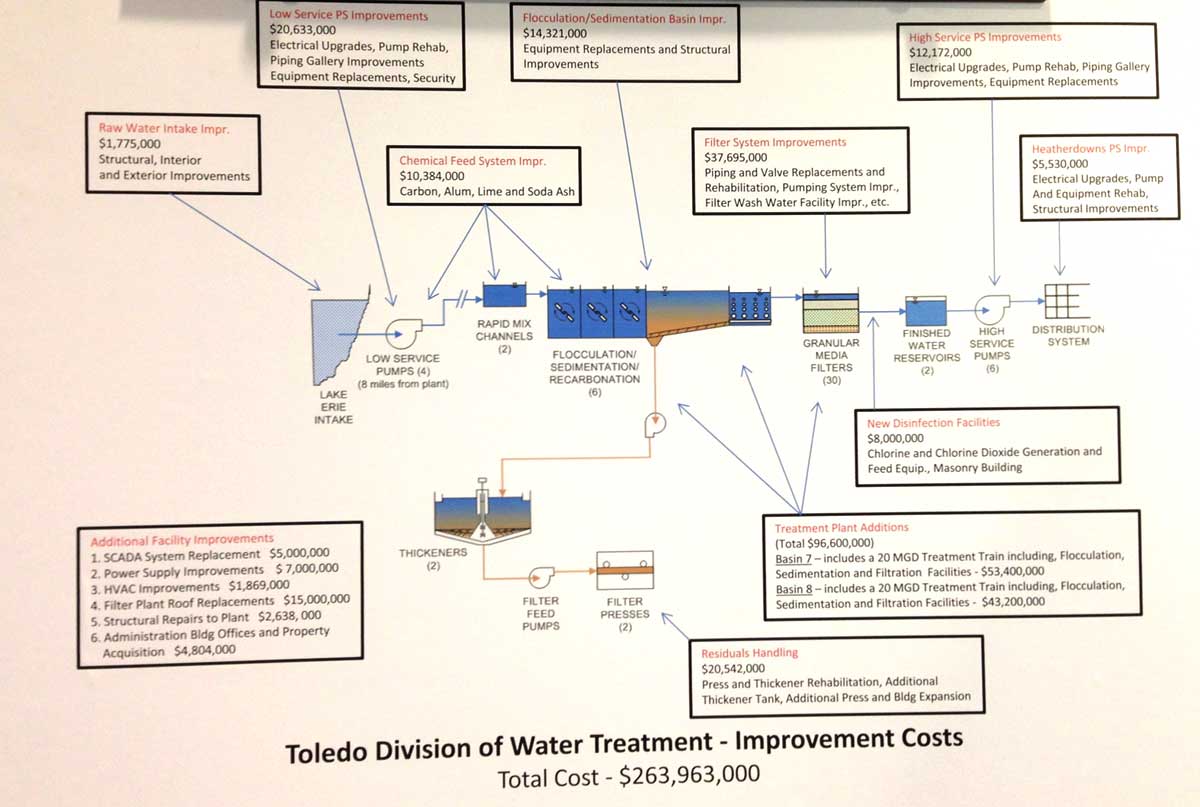
Administrators during the tour discussed “improvement costs” to the plant, totaling about $264 million over five years. Some of those expenditures include $1.7 million for structural repairs at the intake crib, about $30 million for pump upgrades, $37 million for filtration improvements and about $100 million in basin upgrades.

“It’s easy to throw away the old,” Henry said. “Just because something has aged doesn’t mean you throw it away. Repairs can last a long time.”

Improvement costs for Collin Park Water Treatment Plant. Click to enlarge. Photo courtesy City of Toledo.

Improvement costs for Collin Park Water Treatment Plant. Click to enlarge. Photo courtesy City of Toledo.

Media members asked whether it would be more cost-effective to build a brand-new facility. Henry likened the plant to an automobile.

“I don’t believe in buying a new car because it needs a new set of brakes,” he said.

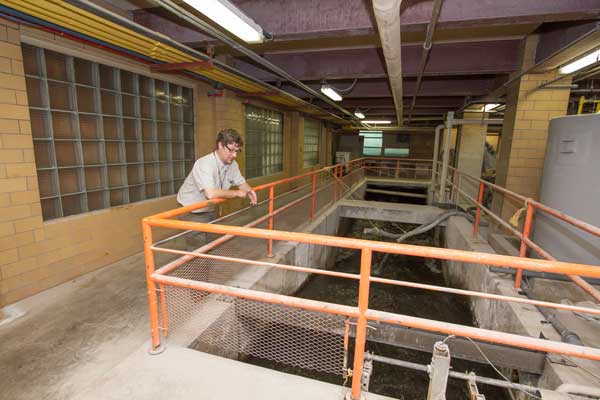
During the tour, it was evident that the building was old but in good  repair, at least cosmetically. The ceiling that hangs over the open drinking water looked clean and fresh with shiny gray paint. The new roof has been worked on in sections and is nearing completion, McClure said.

The age of the structure was apparent in art deco filtration control panels, which are no longer in use.

“We’re rehabbing everything and with the new addition, we’ll get another 70 years,” Henry said. “I have no hesitation saying this at all.”

McClure and Henry discussed the expansion while standing on the location of the planned site, saying the “redundant expansion” will give them a potential 160-million-gallon capacity. Currently, they are using a 120-million-gallon system — six treatment basins, each with a 20-million-gallon capacity.

The expansion will allow portions of the plant to be shut down for heavy maintenance instead of trying to make repairs in a working section of the plant or having to wait until winter when water use is lower, McClure said.

The repairs will be phased in within the next four years and the expansion is about two years out, they said.

“We’ve operated this facility successfully for 70 years,” Henry said. “We’re the only plant for the area.”

In other costs, the treatment plant is paying about $1.7 million more for chemical treatments since the algae crisis, administrators said. They have a $3 million to $4 million budget for chemicals.

Administrators say they do not  know how much they’re going to use because they can’t predict the condition of the lake water. The chemical budget for this past year was $4.7 million, which won’t change despite the conditions of the lake, because they have a three-year contract with suppliers.

The algae

Administrators are looking to technology to deal with the algae.

They said there are a number of different options they could use at the plant to protect the water against microcystin, including membranes, ozone or granulated carbon. They are looking at augmenting the chemical and/or the filtration process. Henry called these options “barriers,” and said they are not just concerned about the microcystin but about all contaminants.

“We hope to have another barrier by next year,” Henry said.

In the meantime, McClure said the plant, with its chemists, engineers and 30 licensed operators, is working in partnership with the Ohio EPA.

“Everyone has their role to play and we’re working hand-in-hand,” he said.