Home Blog Page 186

Algae crisis is ‘game changer’ for region’s water supply

0

By Sarah Ottney and Danielle Stanton

Toledo Free Press Managing Editor, Toledo Free Press News Editor

[email protected], [email protected]

When a toxin was detected in Toledo’s drinking water last week, triggering a do not drink advisory affecting up to half a million people, it was called a crisis, a disaster and a nightmare.
.

Toledo Free Press photo by Christie Materni

It’s also being called a game changer, a tipping point and an eye-opener.

Toxic algae in Lake Erie is not new. Scientists have been studying it for decades and environmentalists and politicians have been raising the alarm for years, only to be largely ignored.

Western Lake Erie Waterkeeper Sandy Bihn is one of those who has  been pushing for action.

“This is like my worst nightmare, not being able to drink the water,” Bihn said. “But maybe it’s an opportunity to find the solutions we need.”

Last year, Carroll Township in Ottawa County issued a water advisory after detecting unsafe levels of microcystin in its water; the same toxin caused Toledo’s issue.

“After Carroll Township, I thought there would be major changes, but there were not,” Bihn said. “That was the first time in Ohio, but [Toledo] is kind of the unthinkable — a major city. That was 2,000 people; this is half a million. I’m hoping the scale will begin to inspire the changes we need. We need to keep the pressure on.”

RELATED: VIDEO: Experts address Lake Erie’s toxic algae at forum

RELATED: Water coverage: Toledo makes national headlines

RELATED: City asks residents to conserve and reduce water usage for algae season

A microcosm of Lake Erie is Grand Lake St. Marys State Park in west-central Ohio, hit hard by algae the past three years, resulting in lost tourism, recreation and business, Bihn said.

“The thing about Grand Lake St. Marys that people should look at is … year after year it’s gotten earlier and worse. So once this stuff gets in your watershed it seems to be a devil to get rid of,” she said.

Lake Erie, the shallowest and warmest of the Great Lakes, is the most susceptible to algae blooms and the “dead zones” they can cause.

Algae growth peaked in the 1970s, when measures were taken to control the problem. By the mid-1980s, phosphorus loadings had been reduced by more than half and the lake’s recovery was a globally known success story, according to a report released in February by the International Joint Commission.

However, by the early 2000s problems with excess nutrient enrichment appeared again in Lake Erie, and have continued to worsen.

Algae has again been a major issue in Lake Erie since about 2003, with the worst year in 2011.

The blue-green algae that can be seen lapping many of western Lake Erie’s beaches is called cyanobacteria, which contains the toxin microcystin. When the cyanobacteria dies it splits apart, dumping its toxic load, referred to as lysed. Whole, or unlysed, cyanobacteria is still dangerous to drink because it will break open during digestion.

Municipal sewage plants were the primary sources of phosphorus runoff into Lake Erie in the decades leading up to the 1970s. Today, it comes mainly from “nonpoint” sources, such as runoff from fertilized farm fields, over-applied manure, lawn and garden activities, construction activities and more, all exacerbated by natural effects like sunlight, warm temperatures, rainfall and more.

Both natural and chemical fertilizers contain high levels of phosphorus, which encourage growth of crops — and algae. One problem today, Bihn said, is that there are still excessive levels of phosphorus found in sediment, so even if new runoff could be held to zero, there would still be algae problems in the lake for years.

“In many cases we just don’t have good data,” Bihn said. “We really don’t know where we’re at or how much we’re gaining or losing on this problem. We really need an annual report card.”

New technology

One local company that could help find a solution is Blue Water Satellite, a startup founded in 2009 in Bowling Green and now based at the University of Toledo’s LaunchPad Incubation Program. CEO Milt Baker said he agrees with Bihn that a report card is needed, but points out one already exists — in the form of satellite images.
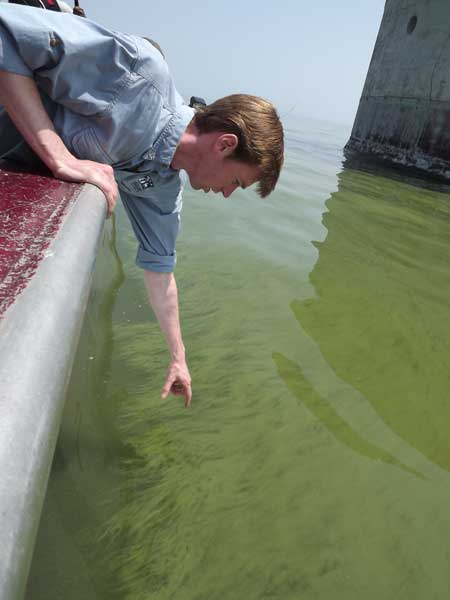
n National wildlife federation President and CEO Collin o’Mara points to an algal bloom in Western Lake Erie near the city of Toledo’s Water intake facility. Toledo Free Press photo by Sarah Ottney

n National wildlife federation President and CEO Collin o’Mara points to an algal bloom in Western Lake Erie near the city of Toledo’s Water intake facility. Toledo Free Press photo by Sarah Ottney

Baker and his team use patented algorithms to extract digital data embedded in satellite images to track phosphorus and the growth of harmful algal blooms. Similar technology is utilized by the federal government, military and some universities, but Baker believes Blue Water is the only for-profit company using it.

Satellite images over the past 20 years show western Lake Erie getting “nothing but worse,” he said.

“We’ve tried a lot of things and now is the time to try new things because Lake Erie treatments have not produced the results that people expected,” Baker said. “We need to start looking at new technology.”

The goal is early detection and efficient sampling. The traditional method of scooping a water sample and testing it at a lab gives researchers a single data point; looking at a satellite image offers 200,000 data points per satellite sweep, Baker said.

“What we say we’re doing at Blue Water is we move the lab to the sky,” Baker said. “Five to 10 years from now no one will ever do it that way.”

Unlike many other countries, testing for microcystin is not mandated by the state or U.S. Environmental Protection Agency (EPA).

“You have to give Toledo credit because a lot of these water bodies are not even looking for the toxin,” Baker said. “In America we only react to crises. We don’t worry about prevention. It was always a theoretical thing that the toxins could get in the water and we might have to shut the water down.

“Now you have a major metropolitan area with 500,000 people that can’t use water. That’s a totally different perspective. So I think things are going to be completely different from here on out. I might be totally wrong, but I think as a result of this we’re going to see federal regulation and we’re going to pay a lot more attention to it.”

Environmentalists

National Wildlife Federation President and CEO Collin O’Mara happened to be in Michigan near Lake Huron when Toledo issued its water advisory. He decided to check it out for himself.

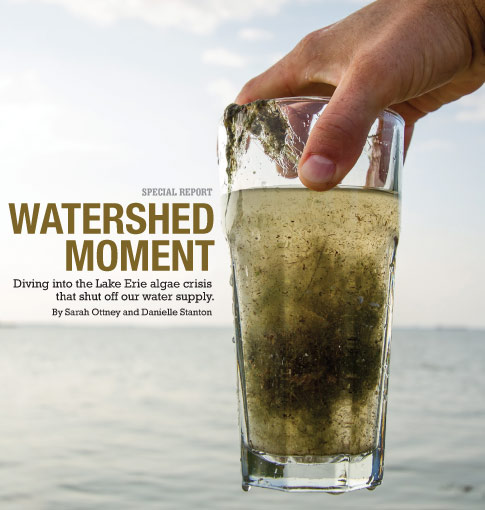
On Aug. 3, he and Bihn took a boat three miles off shore to Toledo’s water intake facility, where he examined a glass of water scooped from the lake, thick with green algae from top to bottom.  Such stratified algae can’t simply be skimmed off the surface, making it more complicated to clean up, O’Mara said.

Bihn said she was surprised the algae was so thick so early in the algae season, especially considering that July was cool and dry.

“If it was 100 degrees I don’t know how we would deal with that,” Bihn said. “Boy, when it explodes in hot temperatures, that’s a scary thought. We really need to get ahead of this.”

Toledo’s recent crisis was caused by a perfect storm of excess nutrients exacerbated by environmental conditions.

“There’s a systemic challenge that we face here in the Great Lakes that’s actually much bigger than this one crisis,” O’Mara said. “And unfortunately, this crisis could just be the tip of the iceberg unless we begin to address it.”
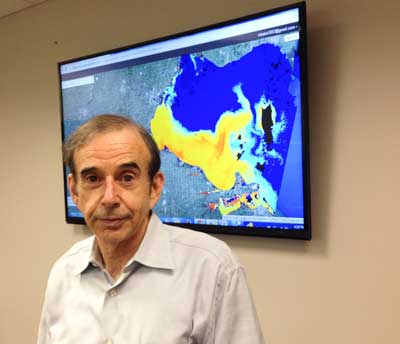
Milt Baker, CEO of Blue Water Satellites. Toledo Free Press photo by Sarah Ottney

Milt Baker, CEO of Blue Water Satellites. Toledo Free Press photo by Sarah Ottney

O’Mara said although algae is a known problem, it can be hard to predict or control.

“The turning points can happen fairly quickly and all of a sudden you’ll see these fairly broad explosions, where you kind of hit a tipping point and then all of a sudden you have a challenge,” he said.

Bihn called Lake Erie’s algae a “warning sign” for the other Great Lakes, which sometimes appear healthier because they are deeper and appear bluer.

“What happens here will happen to the rest of the Great Lakes,” Bihn said. “Here, the lake turns over every 2.6 years. Other lakes are like 75 to 100 years so once it gets there it’s really too late. If we can solve the problem here, they can get ahead of it.”

To have a freshwater drinking supply impacted so extensively by something other than a single industrial disaster is rare, O’Mara said.

“It wasn’t a single facility that failed that caused this event. This is a series of individual decisions over many, many years,” he said. “The work we do today isn’t going to actually solve this problem overnight. It’s going to take years of this work to try to reduce the amount.

“If we don’t get a handle on these problems, folks are going to start having questions about whether it’s safe to enjoy the incredible recreation that is all around us in Lake Erie,” he said.

“It’s going to be a huge challenge that Toledo can actually lead on,” O’Mara said. “What you do here in response to this crisis could become a bit of a national model. Folks are struggling with these algae challenges in a lot of places. If we can figure out how to solve this issue right here in Ohio we can create a model that can be replicated across the country.”

Timeline

The first inkling something was amiss started with an elevated microcystin reading at Collins Park Water Treatment Plant between 5:30 and 6 p.m. Aug. 1. Although the reading of 0.6 microgram per liter was still within the acceptable level of 1.0 microgram per liter for safe drinking water, the city contacted the Ohio EPA, which advised more testing. That test came back around midnight and the city issued a do not drink advisory around 1:30 a.m. Aug. 2.

In all, about 500,000 people were affected by the advisory as Toledo’s Department of Public Utilities provides drinking water to 125,000 residential, commercial and industrial accounts in Lucas, Wood, Fulton and Monroe counties.

Around 9:30 a.m. Aug. 2, Collins said additional tests had been ordered and urged residents to remain calm.

At 11:40 a.m., the Toledo-Lucas County Health Department recommended restaurant and food facilities using city water close. Throughout the day, amid reports of price gouging and bottled water shortages, water distribution points were organized by both public and private entities.

At 9:15 a.m. Aug. 3, Collins announced test results were still delayed. “Factual info will be relayed when we have it,” he posted to Twitter. Ohio Gov. John Kasich arrived in town that afternoon.

Throughout the day, test results were promised and then delayed with little explanation, causing frustration for many residents. At 3 a.m. Aug. 4, Collins said two of 30 tests came back “too close for comfort.” He said the two could be anomalies, but wanted to be sure and wouldn’t “isolate part of the city” by lifting the advisory for anyone until he was sure it was safe for everyone. The two areas were later reported as East Toledo and Point Place.

“The majority of areas are satisfactory, but we still have two spots of concern,” he said. “I’m not going to take any chances with this community’s well-being and health.”

At 9:30 a.m. Aug. 4, Collins announced the final tests had come back clean and the advisory was lifted.

“Our water is safe,” he said, before sipping a glass of tap water. “Here’s to you, Toledo. You did a great job.”

New standard

Toledo City Councilwoman Lindsay Webb, chair of the Utilities & Public Service Committee, said the advisory forced city, state and federal officials into “uncharted scientific territory.”

“Before this happened there was no agreement on how to accurately test for this toxin,” Webb said.

Toledo Mayor D. Michael Collins at an Aug. 4 news conference. Screenshot via Toledo News Now

Toledo Mayor D. Michael Collins at an Aug. 4 news conference. Screenshot via Toledo News Now

Collins said the Ohio EPA, the U.S. EPA and other agencies were initially “territorial.” Each used its own testing methodology, yielding different and confusing results, he said, but in the end they came to a consensus for a standard test, which will now be implemented throughout the state.

“I’m absolutely convinced we have set the stage for what will now be the state standard related to how to test for this particular toxin as well as laid the foundation for what I believe will be pending USDA regulations related to his particular toxin,” Webb told City Council on Aug. 4.

“Unfortunately, it took a disaster to get us to that point,” said Department of Public Utilities Director Ed Moore.

The two-and-a-half-day situation cost the city an estimated $207,000, said City Finance Director George Sarantou, which includes $73,000 for Department of Public Utilities overtime pay, $52,000 for Department of Public Services overtime pay, $48,000 Toledo Police Department overtime pay, $10,000 in Sheriff’s Department overtime pay and $10,000 to fly water samples to Cincinnati, Columbus and Michigan’s Upper Peninsula for testing. [Editor’s Note: City’s estimated cost has been updated with new figures.]

That’s not including costs from the Ohio Department of Transportation, the Lucas County Sheriff’s Office or the cost of flying samples out of the city to testing sites in Cincinnati, Columbus and the Upper Peninsula of Michigan.

Lucas County Health Commissioner Dr. David Grossman said reports of illness Aug. 2 were “a little elevated but nothing outside the ordinary,” but quickly returned to normal levels.

Between Aug. 2-5, Mercy and ProMedica health systems reported a total of 229 cases of nausea, vomiting and diarrhea, although hospital spokespeople said it’s not possible to conclusively link the cases specifically to water ingestion.

On Aug. 4, the Lucas County Commissioners started the process of applying for government aid by retroactively declaring a state of emergency for Lucas County. If approved, local governments and businesses could be reimbursed for costs.

Commissioner Carol Contrada sees the crisis as a timely “window of opportunity” to restart discussions among jurisdictions about ways to make the regional water system more efficient and equitable.

“We have several proposals that have been developed and haven’t really been seriously looked at by all the participants because they are relatively new,” Contrada said. “There have been a lot of other things that have taken precedence, but now this is a very timely report.”

On Aug. 5, officials announced one of the Collins Water Treatment Plant’s six flocculators — paddles that mix water drawn from Lake Erie with chemical treatments — was broken. Moore said the damage occurred after the water advisory was lifted and played no role in the advisory. He also insisted the damage was not caused by stress on the system after the advisory was lifted.

Political response

Lucas County Commissioner Pete Gerken called the water advisory a “clarion call.”

“The plant wasn’t the problem; the lake is the problem. We have not for a decade collectively, as a country or a community, addressed the assault on Lake Erie that’s been going on,” Gerken said. “If this isn’t a clarion call … I don’t know what is.”

Rep. Marcy Kaptur, whose 9th  Congressional District stretches for 141 miles along Lake Erie’s coastline encompassing Toledo, Port Clinton, Sandusky and part of Cleveland, agreed.

“It’s a wake-up call because it alerts people across the entire region as to the condition of our lake and how we are all connected to it — our lives depend on it,” said Kaptur, a ranking member on the House Subcommittee on Energy and Water.
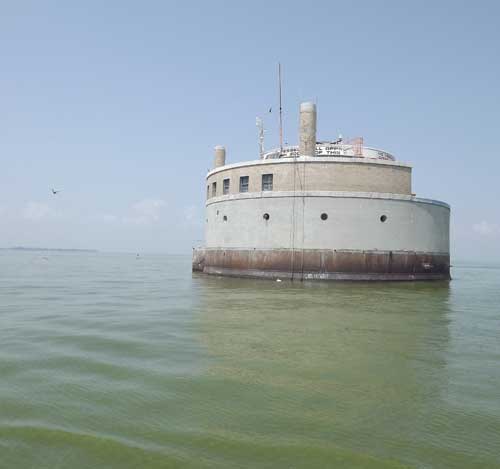
The water intake facility for the City of Toledo is three miles off-shore in Lake Erie. Toledo Free Press photo by Sarah Ottney

The water intake facility for the City of Toledo is three miles off-shore in Lake Erie. Toledo Free Press photo by Sarah Ottney

One solution Kaptur advocates: Push more money into the Western Lake Erie Basin (WLEB) partnership. The partnership is a conservation group formed in 2006 by the USDA and U.S. Army Corps of Engineers comprised of local, state, regional and federal groups who track the Lake Erie watershed and look for solutions to its problems.

The WLEB partnership needs more funding, political power and authority to carry out its work, Kaptur said. The partnership could use more water monitoring devices, for example, that track the flow of water. When the flow is reduced, algae blooms grow.

Kaptur said she has told state officials, including Kasich, about the WLEB partnership and the need to expand it; however, the governor has a lot of catching up to do, she said.

“He doesn’t come from this part of the state, so we have a lot of learning to do,” Kaptur said.

Kasich said the state will conduct an investigation into what happened in Toledo, which includes taking a look at the city’s aging water treatment system and figuring out how to reduce pollution that feeds the algae in the western end of Lake Erie.

Asked if Kasich planned to sponsor any new legislation in light of the recent crisis, press secretary Robert Nichols wrote in an email: “The governor always refers to Lake Erie as Ohio’s crown jewel, and as such, we have implemented a number of new, strict policies to better protect it. When it comes to the lake, we remain vigilant, and as we do our after-action review of the events in Toledo, we’ll be looking for any new ways and ideas to continue to improve policies that impact the lake.”

Sen. Rob Portman talked to reporters during a conference call Aug. 4, five hours after Toledo’s no drink advisory was lifted. He said the first step toward a solution is to identify how elevated toxic levels entered Toledo’s water supply in the first place, calling for more federal oversight and continued cooperation among all levels of government.

Portman then pointed to a bill he co-authored last year, the “Harmful Algal Blooms and Hypoxia Research and Control Amendments Act of 2013,” which calls on federal agencies to make Lake Erie algae blooms a “priority,” from monitoring and research to reduction efforts.

“This legislation takes critical steps toward protecting Lake Erie and Grand Lake St. Marys from harmful algae that has become a tremendous problem for fresh water bodies in our state,” Portman said last year. “For the first time, we will prioritize the protection of Ohio’s fresh bodies of water, which is critical for our tourism and fishing industries.”

Portman called on the EPA and National Oceanic and Atmospheric Administration (NOAA) to develop an action plan to foresee, control and reduce the algae blo

oms. He said NOAA has the ability to use satellite technology to view the algae and could use this technology to predict and prevent the algae blooms as well as pin-point cause and effect.

“It can be a bipartisan issue,” Portman said. “It’s a complicated issue. That’s why it’s critical we have the very best science to come up with the best information on why these blooms are happening. And that we are using the right technology.”

Asked whether there would be any additional federal regulation, Portman said there needed to be further study.

The federal government may be passing legislation and looking at the problem, but that isn’t enough, some local officials have criticized. Collins’ administration has come out shouting that higher-up officials have been making promises they haven’t been able to keep in regards to cleaning up the lake.

“I don’t think it’s any question that this crisis has elevated the concern,” Ohio Sen. Randy Gardner said in response to the criticism. “People have a right to be frustrated and upset about what happened and we need to answer every question and do everything we humanly can to see it doesn’t happen again.”

It’s still unclear how microcystic toxins showed up in Toledo’s water supply and those questions need to be answered, Gardner said. In the meantime, he is investigating whether other plants in the region need to improve their systems to prevent a similar crisis.

A day after the advisory was lifted, Gardner visited treatment plants in Sandusky, Oregon and Port Clinton. People are still asking the question, ‘Is my drinking water safe to drink?’ he said.

“It’s not all about Toledo: We’ve got Oregon, Carroll Township, Huron, Sandusky, all within my Senate district. We need to care about every treatment plant,” Gardner said.

If there is a way to test lake water before it reaches the intake to the treatment plant we should be doing so, Gardner said. That would tell us sooner whether the water has toxins from an algae bloom and treatment could begin. Gardner is currently working with the EPA to provide funds to treatment plants so they can afford such preventative testing.

In January, state lawmakers unanimously passed Senate Bill 150, which aims to reduce the amount of nutrient runoff that is a major cause of algal blooms. Farms of 50 or more noncontiguous acres would have to get state certification to apply chemical fertilizer. However, the rules laid out in the bill will not be mandatory until 2017 and it does not regulate manure as a fertilizer on frozen ground.

State Rep. Michael Sheehy tried to introduce an amendment that would have acknowledged manure as a fertilizer, but there was no support for it and it failed to pass, he said. Sheehy hasn’t given up, though, and is currently looking for a co-sponsor.

“Green” farmers have been cooperative and responsive with limiting the amounts of fertilizer they use; however there are some “bad actors” out there, Sheehy said. So-called CAFO farms — concentrated animal feeding operations — are the biggest culprits, he said.

“It’s like a farm factory — enormous amounts of pigs and chicken,” Sheehy said. “They’re trying to maximize the number of product that can be developed on the minimum amount of land and resources. One of the byproducts is a bad thing — it is excess amounts of manure.”
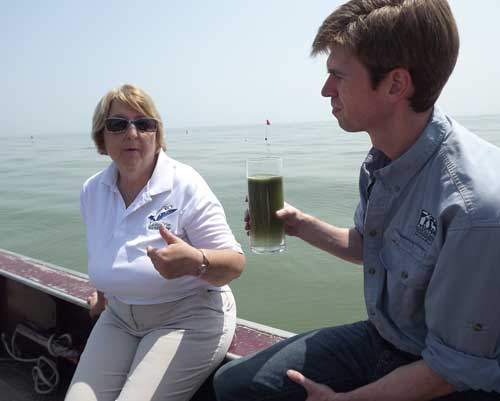
Western Lake Erie Waterkeeper Sandy Bihn, left, and National Wildlife Federation President and CEO Collin O'Mara with a glass of water scooped out of Lake Erie in the heart of the algae bloom near the City of Toledo's water intake facility three miles off short. Toledo Free Press photo by Sarah Ottney

Western Lake Erie Waterkeeper Sandy Bihn, left, and National Wildlife Federation President and CEO Collin O’Mara with a glass of water scooped out of Lake Erie in the heart of the algae bloom near the City of Toledo’s water intake facility three miles off short. Toledo Free Press photo by Sarah Ottney

Rains wash manure into the water basin and from there into Lake Erie, where algae forms. It’s a problem that has been identified but these farms have not been cooperative in reducing their manure, Sheehy said.

A decade ago, many officials wouldn’t acknowledge phosphorus caused the algae blooms, Sheehy said. Now, committee heads are meeting to address the issue and Sheehy believes something big will come from it.

“State government is going to do something very serious and very effective and very long-standing to correct the phosphorus load in the Maumee River region,” he said.

“This crisis has brought into focus for people in this region how fragile Lake Erie is, and simply put, you can’t continue to abuse the lake when you depend on it as your lifeblood,” said Kaptur spokesman Steve Fought. “This didn’t happen overnight but by the same token we have no reason to believe that it will markedly improve overnight. It’s like that Joni Mitchell song: ‘You don’t know what you’ve got till it’s gone.’”

Toledo City Councilman Larry Sykes said there have been a lot of questions and “balls in the air” since the advisory. Mayor Collins plans to form a committee, Sykes said, but the issues are nothing new.

“How long have you been talking about it? Twenty years? And it hasn’t rung a bell?” Sykes asked Sheehy on Aug. 3. “I think that bell has been rung.”

Sykes said Toledo has been “ducking a bullet” for years.

“We have known for 20 years or more that we’ve had a problem with our water system and algae. We’ve known that,” Sykes said. “I go back to a couple years ago, we tried to address this problem then and [Council] was voted down. [Former Mayor Carty] Finkbeiner fought with the EPA and the city lost and we were forced to go out and build a new water system. We’ve been dealing with water for God knows how long now. If we had looked at this earlier, it would have been less costly.”

The city is approaching the final leg of a $521 million sewage project called the Toledo Waterways Initiative. The initiative began in 2003 after a decade of litigation between the city and the federal government for Clean Water Act violations. The violations are against the city for decades of sewage spills into the Maumee River, Ottawa River, Swan Creek and other tributaries that feed into western Lake Erie.

Sykes said a big problem is the antiquated system in Toledo. Collins Park Treatment Plant is at least 80 years old, he said.

While acknowledging the issue is a difficult one, Collins promised he wouldn’t let it drop.

“This is not the simplest of all issues. It is a problem that is really created by a variety of things. There’s no one simple answer to it,” Collins said. “It’s going to take the best science, it’s going to take the best engineering and it’s going to take political will. I can’t, seven days from now, look back over at this weekend and say, ‘That was then and this is now,’ and go on to my new problem. This is my problem and I fully intend to engage.”

But environmentalists like Bihn and O’Mara hope politicians do more than just talk or haphazardly allocate more money.

“This isn’t just passing a law or finding a little bit of money, this is actually having folks across the region think about the contributions they are making,” O’Mara said. “A lot of these folks might live miles away from the water itself but that extra fertilizer you’re putting on to get your grass just the right color, that’s contributing to this problem.”

Farmers

No one disputes runoff from farms is one major cause of algae growth. However, many farmers, like fourth-generation Northwest Ohio farmer Todd Kapp, 27, were left feeling “a little aggravated” by online commentary during the advisory blaming farmers alone.

Most farmers strive to be environmentally responsible, said Kapp, who farms with his father Robert and brother Joe in the Curtice area.

“Why would a farmer want to waste their hard-earned money by ‘dumping’ fertilizer into the ditches?” he posted to his wife’s Facebook page Aug. 4. “Lets not just blame the farmers here. EVERYONE including the farmer, city guy and everyone in between needs to step up and help fix this problem.

“Our farm has been soil sampling for several years,” Kapp wrote. “We variable rate our fertilizer and place [it] where it needs it. We plant cover crops, we use no-tillage practices when we can. We do not spread fertilizer or manure on frozen ground. I am not saying every farm does this, however every farm has the opportunity to work with local soil & water conservation district like we do to implement better practices on farms.”

Reached by phone, Kapp said his livelihood is tied to the land so he wants to protect it and preserve it for the fifth generation, including his 2-year-old son.

“Some aren’t as aggressive with it, but I’d say in general everyone is trying to do their share,” Kapp said. “There are a few farmers that still fertilize [with the old methods] and aren’t into the cover crops. They don’t see the benefit, but maybe this will help open their eyes.”

Mike Libben, district program administrator with Ottawa Soil and Water Conservation District, said he’s seeing growing interest from farmers in conservation programs.

One of the easiest methods to reduce farm runoff is the USDA’s Lake Erie Conservation Reserve Enhancement Program.

The program pays farmers to plant grass filter strips and buffers next to streams, rivers and drainage ditches on their property, creating a border between fields and water, he said.

In the past, farmers would apply a blanket amount of fertilizer to the whole field, sometimes enough to last several years. Today, variable rate technology — a process by which soil samples are taken and fertilizer applied only where needed — is rapidly becoming a standard procedure.

“Instead of putting 200 pounds of fertilizer across the whole field, you put only 25 pounds here, 300 here or nothing here,” Libben said. “It’s like a prescription for the field.

“Five years ago, it was a retailer here and there, but in the last few years it’s really ramped up and everybody’s using that technology. We’re definitely seeing more interest.”

The Western Lake Erie Watershed extends from Fort Wayne, Indiana, to the west, Sandusky Bay to the east, Findlay to the south and three lower Michigan townships to the north. It encompasses 6 million acres of land drained by the Maumee, Portage and Ottawa rivers, as well as the open waters of Maumee Bay.

“For farmers here around the lake, [conservation programs are] an easy sell,” Libben said. “The farther away from the lake, it’s out of sight, out of mind. They don’t have as close a tie as we do.

“If we held back every drop of fertilizer, we’d still have algae bloom. That sediment is in the lake already. Those conditions are already there. It’s going to take some time for the lake to heal itself,” Libben said. “Zero percent [runoff] will never happen, but we can do everything possible to minimize that. It’s been a wake-up call that we need to make some changes and do some work.

“I just want people to realize farmers aren’t doing anything intentionally. They are doing things they were taught over the years. Sometimes it’s just something else we need to be taught about and learn and change.”

The future

Could the crisis happen again?

“It’s not debatable. It absolutely could,” Moore said. “This is Mother Nature we’re dealing with. There is nothing we could have possibly done different that would have prevented this.”

Blooms will remain a threat until algae season is over, typically by late September. Officials have asked residents to use water conservatively until then.

“The slower we process the water, the greater the opportunity we give the chemicals that are involved to clean it out,” Collins said. “I don’t want to go through this again so I have to take a step of prevention in order to create a pound of cure.”

The city has increased the amount of activated carbon and chlorine added to water and is currently testing daily for microcystin. All levels have been undetectable.

The challenge will be fixing the problem, not just the symptoms, Gerken said.

“We can fix pipes. It’s going to take a whole lot of people and some time to fix a lake. And that’s where we’ve got to go now,” he said.

Everyone agrees making forward progress will require teamwork.

“The idea that any single entity can solve this problem is simply wrong,” O’Mara said. “We’re all going to have to do our part to get at these challenges and I’m absolutely confident the good people in this part of Ohio can come together and do just that.”


Put-in-Bay faces media scrutiny over alleged date-rape drug use

0

At Put-in-Bay, one of Northwest Ohio’s favorite summertime destination spots, 15 women who thought they were having an innocent drink may have been given the date-rape drug Rohypnol.According to reports by the Put-in-Bay Police Department from May 5 to July 25, police responded to reports of “possible rape,” “intoxicated female” and “possible drugged female” 15 times at several locations on the island, mainly taverns but at least one bed and breakfast.

Each of the police reports had a similar vein: The women were either violently ill or passed out when police arrived and those conscious could not remember the circumstances or events that led to becoming ill. Upon further investigation, police found that the women had received drinks from a stranger or acquaintance in many of the cases.

At least two of the victims may have been raped and two others had to be transported via helicopter to Mercy St. Vincent Medical Center in Toledo. One man has been questioned and another detained, but no arrests have been made.

Put-in-Bay Police Chief Ric Lampela has come under scrutiny and criticism recently. About one fourth of the officers are in their first year of service and four more seasoned officers are slated to leave in about a week. More inexperienced officers will replace them.

Negative attention was fueled anew July 30 by a Cleveland Scene article, shared widely via social media, that refers to Put-in-Bay as “Roofie Island.”

READ: Cleveland Scene article: “Roofie Island: A Summer of Reported Druggings and Rapes on Put-in-Bay, Lake Erie’s Party Destination”

Lampela was not available for comment July 31. An officer at the station reached via telephone said Lampela was off. However, a faxed media statement from the department noted none of the incidents have been proven to involve drugs.

“There have been 15 reported incidents in 2014 (as of 7/31/2014) where the person believed that they were possibly drugged while at Put-in-Bay,” stated a fax to reporters. “To this day, none of the cases have been positively confirmed as a drugging incident.”

A police report from June 15 states that after a woman got off work, “she was picked up by a male named Kevin and was taken to St. Hazards [on Middle Bass Island] for a drink. (The woman) says she was later dropped off at her house and about an hour later, she started feeling funny and her parents noticed she was acting differently…” It’s not clear from the report whether Kevin is a suspect.

On May 5, police reported that a woman got off work from Mr. Ed’s Bar and Grille about 1:30 a.m. and then had drinks with a man whom police would not identify. They consumed alcohol at three establishments. She did not remember anything until later. She then recalled the man lying on top of her “yelling for her to ‘take her f***ing clothes off’.” The man then raped her, she told police.

Lampela has said it’s hard to find quality candidates because of the job’s seasonality and low pay and that he is competing with other departments.

Put-in-Bay is a summer resort and tourism destination on South Bass Island in the western end of Lake Erie. Only about 140 residents live on the island year-round, but thousands throng to its shores every summer for the boating, fishing, gift shops, caves and national monument as well as its bar culture. The island recently celebrated one of its busiest annual events, the 12 Days of Christmas in July, in which the island is decked out in Christmas decorations and businesses offer drink and food specials.

Some island residents and business owners are upset by the media coverage.

In a letter to the editor to the Sandusky Register, Ken Benjamin, owner of Stonehenge Estate on Put-in-Bay, said the negative coverage was hurting tourism.

“Your daily negative front page drum beat of South Bass Island issues needs to be reviewed,” he wrote. “All of this lazy, space filling reporting negates the positive work of the Lake Erie Shores & Islands organization and various chambers (of commerce). Your ‘National Inquiry’ reporting destroys the money and time spent encouraging visitors from all over the country to share this wonderful part of Ohio with us. Our industry is tourism and we all have to deal with thousands of visitors in a short 110-day period. Most of us in the islands business comunnity wish that 1 percent of those thousands who cause most of the trouble’s would go somewhere else. The picture you continue to paint every day of our community is ugly. Not so and it needs to stop!’

In an editor’s note, the newspaper defended its coverage, responding that to “censor news information to create a better local business climate does not align with better journalistic practices.”

A call to the Put-in-Bay Chamber of Commerce & Visitor’s Bureau went unanswered July 31.

Hollywood Casino launches 12-day ‘Poker Challenge’

0

In a windowless office below the gaming floor of Hollywood Casino

Toledo, poker room manager Ken Lambert Jr. was keen to talk up his latest and most ambitious project: The Hollywood Poker Challenge.

Hollywood Casino Toledo Poker Room Manager Ken Lambert, Jr. will host Hollywood Poker Open in May. Toledo Free Press photo by Dave Willinger.

Hollywood Casino Toledo Poker Room Manager Ken Lambert, Jr. will host Hollywood Poker Open in May. Toledo Free Press photo by Dave Willinger.

Lambert, the veteran Las Vegas poker tourney organizer, was brought to the Glass City’s gambling emporium by Penn National Gaming about five months ago. Now he’s ready to “bring something to the Toledo area that’s never been here before.”

The Hollywood Poker Challenge includes 12 days of poker tournaments beginning Aug. 21 and will feature twin marquee No Limit Hold ’em events with respective guaranteed payouts of $50,000 and $100,000.

Lambert has structured the Poker Challenge “to drive the numbers” of players, in his words. Poker aficionados can win seats at either main event through multiple feeder tourneys with buy-ins as low as $15 and $35 running from Aug. 21 to Aug. 31. For example, Super Satellite events, which cost $20 to enter, guarantee 10 seats for the $125 buy-in Mega Satellite tournaments, which in turn feed into the main event, a $1,070 per seat tournament.

In order to have success, “a guy doesn’t have to win [the Super Satellite],” Lambert said. “Just make the final table.”

“We’ve been very generous with our guarantees,” Lambert said, conceding recent poker room losses due to poorer than expected participation this summer. For example, a $15,000 guaranteed payout for the recent Fourth of July weekend tournament fell short, he said, costing the casino about $4,500.

“I haven’t figured out this market yet,” admitted Lambert, who is licensed to run gambling operations in eight states and has worked in poker rooms from Las Vegas to Mississippi. Still, Lambert, who has a reputation for putting players first, ultimately believes in the “goodwill” those guarantees create.

Lambert, a stylish yet low-key presence at the casino, makes a sincere impression. As a teenager, he earned extra cash after getting off work as a bus boy at Binion’s Horseshoe casino in Las Vegas by crossing Fremont Street with ice cream for the high limit players at the poker tables in the Golden Nugget. In the years since, he has built lasting friendships throughout the professional poker world.

While detailing the Poker Challenge, Lambert was repeatedly interrupted by texts coming into his phone, including a message from Todd Brunson, son of legendary Poker Hall of Famer Doyle Brunson and an accomplished pro in his own right. Todd Brunson was replying to an invitation by Lambert to come to the Hollywood Poker Challenge. “That’s right before my tournament but let me see if I can swing it,” Brunson texted, according to Lambert.

One poker notable who has already committed is Chris Moneymaker, the 2003 World Series of Poker winner. Moneymaker will host a pre-event meet and greet on Friday evening, Aug. 29, before joining area players at the tables that weekend for the main event.

Also scheduled as part of the Poker Challenge are Ladies Only and Seniors Only No Limit tournaments, a Seniors Only Pot-Limit tournament and an Omaha 8 or Better tourney.

The Aug. 30 Ladies Only tournament is co-sponsored by Ladies International Poker Series (LIPS), a Las Vegas-based organization whose founder and CEO Lupe Soto will be on hand. According to its website, LIPS seeks “to promote and provide poker tournament venues for women poker players seeking opportunities to challenge other women in comfortable, friendly and yet competitive environments.” Lambert called it a “strategic move” to involve LIPS, a 10-year-old organization with promotional resources and an established reputation.

Seniors-only tournaments “are a big deal out there” in the national poker world, Lambert said. The idea is to gear an event toward those who enjoy playing poker “with guys who grew up playing old-school,” in contrast to the overwhelmingly online experience of many of today’s younger players. Hollywood Casino’s seniors-only events are open to those 50 and older.

To accommodate the event, for about two weeks Hollywood’s 20-table poker room will be expanded into pit six, where roulette and craps tables will be replaced by 10 poker tournament tables trucked in from Hollywood’s sister property in Lawrenceburg, Indiana. Additional poker dealers will come up from Hollywood Casino Columbus to help staff the tournaments. Players at the two final tables of the championship will be seated on the H Club stage and their play will be live streamed online, pending approval of the Ohio Casino Control Commission.

“Nobody has done a tournament like this in this market,” said Lambert, who is already working on a follow-up event to be held the first half of December.

Lambert expects the Poker Challenge’s economic impact on the area to include “a couple hundred” hotel bookings for each of the two weekends involved. He said Hollywood Casino is working with the Grand Plaza Hotel Downtown, as well as several Perrysburg properties, including Candlewood Suites, Comfort Suites and Hampton Inn & Suites, to provide special rates for tournament players.

One local man who plans to play in the $100,000 main event is Miles Reinhard of Wood County. Reinhard was one of 20 area players who traveled to the M Resort Spa Casino in Henderson, Nevada, in June to play in the Hollywood Poker Open (HPO). He is the only area player who finished in the money.

Miles Reinhard of Wood County. Toledo Free Press photo by Dave Willinger.

It was his first time in a major live poker tournament, Reinhard told Toledo Free Press, although he said he had success online before the U.S. government banned its residents from gambling on the Internet about four years ago.

At the HPO, Reinhard lasted two 12-hour days at the poker tables, even surviving a day-one table with four pros, including Dennis Phillips, the third place finisher in the 2008 World Series of Poker. Close to midnight on the second day, Reinhard’s pocket kings got cracked when an opponent with pocket 10s made a set on the flop. Reinhard exited 45th out of a field of 682 and cashed for $7,188.

“I was totally spent mentally after each day,” said Reinhard, 43, noting he tried to pay attention at all times, even when not in a hand, in order to better figure out his opponents.

That success at the M “gave me a little confidence,” said Reinhard, who noted he “did real well last year” at dice.

“Now I got the taste [for poker].”

Donations sought for Owens’ ‘Backpack to the Future’ drive

0

Like many families, it was a tradition for Laura Moore’s daughters to get new backpacks at the beginning of each new school year.

“Their dad loved to take them to get new backpacks,” said Moore, director of alumni relations for Owens Community College. “Their backpacks were perfectly fine, but it was their fun thing to do together. But then I had these perfectly good, gently used backpacks. That’s how this started.”

Owens’ 11th annual “Backpack to the Future” drive will collect backpacks and school supplies for low-income kindergarten students in Northwest Ohio.

“Without the necessary tools, entry to school is difficult,” Moore said. “Kindergarten is the first entry kids have to school and we want it to be a really positive one.”

Last year, 17 schools in Lucas, Wood and Hancock counties received supplies, including five from Toledo Public Schools.

“The donation by the Owens Alumni Association came at a great time,” said Michelle Pelz, principal at  Samuel M. Jones at Gunckel Park Elementary, in an email. “Most of our students are living below the poverty level. Their parents are doing the best they can, but so many of our students still start school in need of just basic school supplies.”

Since 2004, the Owens Alumni Association has given away 3,410 backpacks and 62,370 school supplies. The collection runs through Aug. 18. Drop-off points include:

  • Books-A-Million (2105 Levis Commons Blvd., Perrysburg).
  • Directions Credit Union branches (5121 Whiteford Road, Sylvania; 3000 Tremainsville Road, Toledo; 3321 Briarfield Blvd., Maumee; 4150 Brockway Drive, Perrysburg; 3312 Dustin Road, Oregon; 2533 S. Reynolds Road, Toledo; 3450 W. Central Ave., Suite 128, Toledo; 27427 Crossroads Pkwy., Rossford;  and 1 Owens Corning Pkwy., Toledo).
  • Great Lakes Credit Union branches (6600 Sylvania Ave., Sylvania and 580 Craig Drive, Perrysburg).
  • Genoa Bank branches (801 Main St., Genoa; 3201 Navarre Ave., Oregon; 703 Conant St., Maumee; 24950 W. State Route 51, Millbury; and 9920 Old U.S. 20, Rossford).
  • Owens’ Office of Alumni Relations in Perrysburg, Education Center Atrium in Findlay or the Learning Center in Maumee.
  • Items needed include gently-used or new backpacks, crayons, markers, bottles of glue, glue sticks, colored pencils, pencils, pink erasers, school boxes, pocket folders, marbled covered composition books and Kleenex tissues.

“The community support has been tremendous over the past 10 years,” Moore said.

Rabid fan base: Mike ‘Mad Dog’ Adams contributes to summer Red Cross benefit CD

0

Mike “Mad Dog” Adams has enjoyed a successful 40-year musical career and, with this year’s 35th anniversary of the Put-in-Bay regular’s show at the Round House, he’s looking for a change of pace.

Mike ‘Mad Dog’ Adams

“Lots of guys put out CDs frequently,” Adams said. “I find working in the studio to be very tedious. I like to get the direct response back from the audience immediately. That’s what I’ve done all my life.”

With his donation of a track to this year’s American Red Cross benefit CD “Red, White & You, Too!” Adams feels he has contributed to something great.

“It’s nice to be able to help out something like Red Cross,” Adams said. “I also donated a guitar to the Red Cross [that was auctioned off in July].”

The $10 benefit CD is available at all area Frisch’s Big Boy and Ralphie’s restaurants.

Adams’ song, “Sundown Friday Evening,” is from an album he released 10 years ago. He said his father, who was a steelworker in Cleveland, inspired the tune.

“I was trying to capture the spirit or feeling of what it’s like for people who are on their way to the island or anywhere when you’re getting away on the weekend,” Adams said. “Leaving work behind, troubles behind, going to the island.”

In the past year, Adams has traveled extensively, going as far away as Ireland to visit a pocket of fans. He also hosts an hour-long radio show once a week for WPCR in Port Clinton.

Looking forward, Adams wants to release another album.

“I do all kinds of things but primarily I’m a performer,” he said. “I’ve done two comedy projects and I’ve done four to five music projects. I don’t do [records] frequently, but I’m due for one.”

Adams said he hopes his fans take the time to appreciate life and not worry about minor inconveniences.

“My philosophy of life: Live. Every day above ground is a good day,” he said.

Adams also wants success to follow this and other charity projects.

“Let’s get some of these local artists from Toledo heard and generate some money for the Red Cross,” Adams said.

Girl Develop It Toledo offers bargain tech classes

0

Google recently published a diversity report that revealed 30 percent of its employees are women. The company said that number is “miles from where we want to be,” and began offering vouchers for free coding lessons to any female interested in learning.

Google’s national initiative to close the gender gap in technology has already begun on a local level with the recently launched Girl Develop It Toledo.

Girl Develop it Toledo is a national coding initiative. Shown above is a Girl Develop it class in Pittsburgh. photo courtesy Girl Develop It!

Toledo is one of more than 30 locations for its parent organization, Girl Develop It. The international nonprofit aims to provide affordable and accessible programs to women who want to learn software development.

Lindsey Danforth and Angel Thomas, Girl Develop It Toledo co-founders, said the group’s emphasis on one-on-one mentorship and hands-on instruction sets it apart from other educational programs.

“Anyone can come — you don’t have to know anything about coding,” Thomas said. “It’s basically instructor-led exercise programs where we explain a concept then walk through the process of doing it. We want to give women in our community an opportunity to learn … and the best way to learn is a very hands-on approach.”

In addition, Girl Develop It Toledo provides a comfortable classroom environment where women of all coding skill levels can learn and ask as many questions as they want. Cost for each class varies from free to $50.

“I never felt encouraged to ask questions in school. It wasn’t so much the instructors but I felt awkward being usually the only female in my class,” Thomas said. “Girl Develop It classes are very inclusive. You can learn at your own pace and there are no stupid questions here.”

Class topics range from website building and customization to HTML and CSS for beginners. Interested women should go to meetup.com and search for Girl Develop It Toledo, where they can RSVP for upcoming events, find other “nerdettes” on Facebook and sign up for the Girl Develop It Toledo email list.

“Right now is a good time to be a woman and get into programming — companies like Google are looking for you,” Danforth said. “We want to bring more women into the tech world because there’s a lot of jobs out there for people who learn even a little bit of programming. We can help build the economy and reduce disparity between men and women.”

Girl Develop It Toledo classes have an average attendance of about four students, but could accommodate about 20. Regular attendees said they hope to see a dramatic increase in turnout by the end of the year.

“Just come! Come to the intro classes because they give you such a good foundation. You may not come out as an expert but you’ll learn a lot,” said Julie Woods, who has attended about a dozen Girl Develop It classes. “It’s really learning a new language, almost like Spanish or French. It’s really just another form of art. Some people draw or play a musical instrument. I create a website.”

All classes are held at Seed Coworking, 25 S. St. Clair St.

The Girl Develop It community also meets outside of the classroom on a monthly basis. “Code and Coffee” is an opportunity for women to network, get programming advice and talk about their tech projects.

“We just want to get the word out about coding,” Danforth said. “We’re trying to make it less nerdy. That’s the whole goal: To learn, have fun and find a way to show that coding is actually cool.”

City of Toledo active with Southwyck development

0

Though still early in the process, the City of Toledo now has fewer than 120 days in which to market its recently purchased 58 acres at the site of the former Southwyck Mall along Reynolds Road in South Toledo.

Spokesperson Lisa Ward said the city is “not making public any information on calls or contacts concerning the property,” yet there is much at stake between now and mid-November. Southwyck’s location remains relevant and strategic, situated near the Ohio Turnpike and I-475, and still has a strong commercial and residential mix in the surrounding area.

RELATED: Six years since Southwyck closed, but future of site still unclear

“It’s an important site, in an important section of town,” said Larry Dillin, president of Dillin Corp., a developer who once attempted to revitalize the site until the banking environment took a downturn in 2008. “I think it’s potentially a good location and with new investment, because new investment brings more investment.”

Photo by Shawn Rames / Exploring Northwest Ohio from the Sky

Photo by Shawn Rames / Exploring Northwest Ohio from the Sky

The 120 days is a “due diligence period” whereby the City can do their own investigation and homework of the property — much in the same way any citizen might investigate a home purchase, according to Matt Sapara, director of the city’s department of development.

“We had a very good deal that’s very fair,” Sapara said. “We need to be very good stewards of the public funds. We take this very serious, and it’s a good deal to the Mayor.”

Right now the city is “marketing the heck out of it,” Sapara said. “We have already had a couple of discussions since last Monday.” When day 121 arrives, the city must then commit and will have 30 days to finalize the sale. Any time prior to this, the city may back out of the deal.

Two conceptual drawings for possible future development on the site were revealed July 20, but those were merely ideas, and its eventual use remains an unknown.

“The city is open to the needs of businesses interested in this property,” Ward said. “We have not defined a specific preferred use.”

The city has spent more than $7 million to update the infrastructure surrounding the mall, including a landscaped and redeveloped Rey-nolds Road and a rebuilt Southwyck Boulevard. It will also spend $434,000 to raze the former Clarion Hotel.

Private investment in the area is significant.

A total of $29.5 million has been spent among several ventures, some who were around during Southwyck’s tenure, and others who are new: Maumee Valley Country Day School, Lyden Oil, At Home superstore and Genesis Village.

Many businesses near Southwyck “have expressed support of our action,” Ward said.

“We’ve had many in the community reach out to us and tell us they’re glad we’re taking an aggressive stance, rather than hoping others do it on their own,” Sapara said.

“We’re all excited because our location is just a dying location,” said Shana Bryant, Goodwill assistant manager, whose store is situated directly across from the former mall property. “If they do bring in something really nice it would bring more business around here.”

Nearby residents also express hope that the city can attract another positive force onto the land that once housed one of Toledo’s most popular malls.

“I’m pretty excited,” said Mary Witt, who lives not far from the site in Maumee. “I’m hoping it will be something that will bring business to the area. Personally, I don’t think we need office buildings. We have those all around the (Southwyck Boulevard.) circle and many of them are empty.”

For now, Sapara said the city will continue to seek tenants.

“I think people are very, very happy that they’re seeing an aggressive approach by the city,” he said.

UT med student recognized for video tutorials

0

A University of Toledo medical student is hoping to help future medical students across the country the same way he’s now helping current students in Toledo.

John Luckoski, 24, recently returned from a video-making workshop in Mountain View, California, after winning an academic contest sponsored by Khan Academy, a nonprofit organization that offers free educational videos.

The contest was part of an initiative to provide free, online resources for students preparing for the revised Medical College Admission Test (MCAT) to be administered in 2015.

“It was sort of like a boot camp for making videos,” Luckoski said. “It was pretty intense. But as tough as it was, I’m really glad I went. I learned so much. Now I feel like I have to go back and fix all [my old videos].”

When he entered the contest, the Dayton area native, a volunteer tutor at the Academic Enrichment Center (AEC) on UT’s Health Sciences campus, was working on an initiative to create a library of tutorial videos on biochemistry, cellular and molecular biology, genetics and more for first-year medical students.

“When I got an email about the contest, it seemed right in line with what I had already been doing,” Luckoski said.

Twelve winners were selected in the video contest and 20 winners were selected in a question-writing competition. Luckoski was one of only two who won both contests.

Luckoski started making videos with his cellphone and drawing paper. Now he has a Macbook laptop, microphone and drawing tablet from AEC.

He plans to specialize in trauma surgery because he’s “drawn to intensity,” he said.

However, his experience at AEC made him realize he also wants to teach.

“There’s a limited number of lives I could save in my own life span, but if I get to teach students how to take care of people, I feel like that perpetuates my ability to help others far beyond what I could do with my own two hands,” Luckoski said in a news release.

“I’m just thrilled for him,” said AEC Director Joni Trempe. “He put the hard work in and he deserves the award.

“As an educator, to see someone find something they’re so passionate about, it’s great. A year ago, he would never have thought this was something he would be passionate about. Now he sees it as part of his medical future.”

Casino plans events for Responsible Gaming Week

0

Dining specials, a fundraiser for a local behavioral health nonprofit and special appearances from “Beti,” a character emphasizing safe betting, are among the activities planned for Aug. 4-8 at Hollywood Casino Toledo to mark Responsible Gaming Education Week.

The 17th annual initiative, held the first full week of August, is a program of the American Gaming Association.

Hollywood Casino Toledo will mark  National Responsible Gaming Education Week  Aug. 4-8. Toledo Free Press File photo by James A. Molnar

Hollywood Casino Toledo will mark National Responsible Gaming Education Week Aug. 4-8. Toledo Free Press File photo by James A. Molnar

Each day will feature a special meal at Scene sports bar, including Winner Winner Ranch Chicken Dinner on Aug. 5 and Know Your Limit Beef Lasagna on Aug. 8, said Brian Hopkins, slot manager at the casino who is leading Toledo’s effort.

The casino will also donate $1 from each Epic Buffet meal purchased on Aug. 4, 7 and 8 to Unison Behavioral Health Group in Toledo.

Beti, a character based off of Progressive Insurance mascot Flo, will emphasize making safe bets. She will appear at the casino, including at the Smokey Robinson concert Aug. 8, as well as at the Wood County Fair on Aug. 4 and the Northwest Ohio Rib-off and Mud Hens game on Aug. 7.

Each year, properties owned by Hollywood Casino Toledo’s parent company Penn National Gaming compete to see who can come up with the most fun promotions while not diminishing the seriousness of the subject, Hopkins said.

Also as part of the week, all casino employees will be retrained to spot warning signs of problem gambling.

“Hollywood Casino Toledo takes responsible gaming very seriously,” Hopkins said. “It’s not just one week of the year; it’s an everyday commitment.”

As stipulated by state law, 2 percent of the tax on Ohio’s gross casino revenue goes to problem gambling resources.

“It was very important to lawmakers that money be set aside to help people who might have a problem,” said Tama Davis, director of communications with Ohio Casino Control Commission (OCCC).

Scott Anderson, gambling disorder treatment specialist with the Ohio Department of Mental Health & Addiction Services (Ohio MHAS) Bureau of Problem Gambling, has been working with problem gamblers for years.

“Gambling isn’t new to Ohio. It’s only the casinos that are new,” he said.

Horseshoe Casino Cleveland and Hollywood Casino Toledo opened in May 2012. Hollywood Casino Columbus opened in October 2012, followed by Horseshoe Casino Cincinnati in March 2013.

Gambling addiction was recently reclassified by the American Psychiatric Association as a substance-control addiction rather than an impulse-control disorder, Anderson said.

“Gambling addiction is 90 percent the same as any other addiction, but 10 percent very, very different,” Anderson said. “It doesn’t have the component of toxicity. You can’t overdose. If you gamble, gamble, gamble, you won’t pass out or get sick. If I were high or drunk, you would probably be able to tell, but there’s no way to tell that someone lost $10,000 over lunch.

“It’s a pathological relationship with mood-altering experience.”

Resources

One resource is the Ohio Problem Gambling Hotline (1-800-589-9966). A total of 16,431 people have called since January 2012, including 10,176 in the past year. From January to June 2014, the hotline received an average of 650 calls per month.

Another resource is the state’s Voluntary Exclusion Program (VEP). More than 1,000 people from 12 states and one Canadian province, including 155 in Lucas County, have voluntarily banned themselves from entering Ohio’s casinos.

More than 85 percent of the 1,032 people currently on the list are from Ohio. As of July 14, there are 879 participants from Ohio, 116 from Michigan, 21 from Kentucky, four from Indiana, three from Ontario, Canada, two from Pennsylvania and one each from Arizona, Florida, Georgia, Illinois, Missouri, New York and Wisconsin. Twenty-four are from Wood County, four from Fulton County and three from Ottawa County.

The list includes 758 men and 274 women. More than half are 40 or younger, with about a quarter of the applicants 30 or younger.

Thirty-one percent of applicants placed themselves on a lifetime ban list, 22 percent excluded themselves for five years and 47 percent for one year.

To be added to the list, an application must be filled out in person at an OCCC office, located at each of Ohio’s four casinos as well as the agency’s headquarters in Columbus. The list is confidential and only accessible to certain OCCC employees via a secure database, Davis said.

Those on the list are removed from all direct marketing and his or her player card is deactivated. They are also excluded from entering any property operated by Penn National Gaming or Caesars Entertainment Corporation. Penn operates the casinos in Toledo and Columbus while Caesars operates the casinos in Cleveland and Cincinnati.

“From a psychological standpoint, the Voluntary Exclusion Program would be a step in taking some self-responsibility during recovery,” Anderson said. “It’s a move in the direction of abstinence, a move to minimize life-damaging consequences.”

Nothing electronic flags a person on the VEP list from entering a casino. They must be recognized by a staff member. However, if they try to cash in a jackpot or use their player card, they will be flagged.

“The downside of it is it’s completely up to the individual to police themselves,” Anderson said. “Unless they run into someone at the casino who knows them or they win a jackpot or use their player card, they would go undetected, so it’s not really foolproof. It’s a voluntary exclusion program with the key word being voluntary.”

Those on the VEP list found at a casino are asked to leave and could be arrested and charged with trespassing.

For the fiscal year ending June 2014, 91 people were charged with criminal trespassing in Ohio’s casinos, 73 of them from the VEP list, Davis said. Thirty-three were at Hollywood Casino Toledo, with 25 of them from the VEP list.

Four state agencies — Ohio MHAS, OCCC, the Ohio Lottery Commission and the Ohio State Racing Commission — make up Ohio for Responsible Gambling, an initiative aimed at promoting responsible gambling in Ohio.

“We were the first state in the country to bring state agencies under one umbrella [to focus on problem gambling prevention],” Davis said. “There is a big concentrated organized push in Ohio under this collaboration to really understand who’s at risk, to target prevention messaging and help make resources available to help any Ohioan who may face a gambling problem.”

“This is something we take very seriously,” Anderson added. “We’ve taken a very proactive approach to it.”

Toledoans join state rally to support marriage equality

0

The Cincinnati-based 6th Circuit Court of Appeals will determine the future of marriage equality in four states on Aug. 6, but supporters will rally outside the courtroom the day before.

Gays, lesbians, bisexuals, transgendered people, straight allies, faith leaders, business owners, elected officials and more will be present at the rally, said Michael Aremo, campaign manager of Why Marriage Matters Ohio. Speakers at the rally will include State Rep. Nickie Antonio, Cincinnati City Councilman Chris Seelbach and former Ohio Gov. Ted Strickland.

The rally is a time to show that “Ohio is ready for marriage equality,” Premo said.

“This is the most important day in the legal fight in marriage equality in Ohio’s history,” Premo said. “When you have this many people who are willing to get in their cars and drive down to Cincinnati to participate in this rally … it’s incredible.”

The rally will be 5:30 p.m. Aug. 5 at Lytle Park, in Cincinnati and Toledo locals will be traveling to the location. Brent Rabie, volunteer and Equality Toledo board member, will lead a caravan and carpool to the rally. The group will leave from the Collingwood Arts Center, 2413 Collingwood Blvd., at 1 p.m. Aug. 5.

Supporters are encouraged to wear red the day of the rally to show support because red is the color of love, Premo said.

“The fight for marriage equality is about love and commitment,” he added.

On Aug. 6, oral arguments of five landmark cases will be presented in front of a three-judge panel, representing four states: Ohio, Michigan, Kentucky and Tennessee.

Premo said the five cases focus on different issues. The plaintiff couples from Ohio and their attorneys will make the case that the refusal to recognize legal marriages performed in other states is unconstitutional.

After the arguments, the three-judge panel will issue their decision, upholding or overturning the lower court’s ruling that Ohio’s ban is unconstitutional, Premo said. He added that whoever does not get the decision they want has the option to appeal to the Court of Appeals or directly to the Supreme Court.

“The oral arguments, I believe, will reinforce how harmful and widespread marriage bans really are,” Rabie said. He added that this event can change the lives of many in the area.

Premo, who is a straight ally, has worked with Why Marriage Matters Ohio since December, and he said support for marriage equality has grown. Since Why Marriage Matters Ohio was founded in September, Premo said there has been a nine-point increase in public opinion in favor of marriage equality.

“Momentum is clearly on our side and we want to make that clear at this rally,” Premo said. “What we’ve been encouraging people to do since the beginning was to have conversations with their family and friends about marriage equality and why they support it and why it’s important to them. Those conversations have been bearing fruit in that people are starting to think about marriage equality in a way that they haven’t thought about it before.”

He also added that two polls from this year show 50 percent of Ohioans support marriage equality, which is a five-point increase from last year. Opposition has dropped four points as well.

Before working in Ohio, Premo worked with the marriage equality campaign in New Jersey, which he said was “tremendously gratifying.”

“I wanted to bring that experience here to Ohio,” he said. “Marriage equality is coming to Ohio. It is no longer a question of if; it’s a question of when.”

For more information on the rally, visit action.wmmoh.org/page/s/rally-for-marriage-equality. To RSVP for the carpool, visit marriageoh.org/rally.