Home Blog Page 178

Media couple cope with loss of son through Gabriel’s Gowns

0

As a cast member on 92.5 KISS FM’s “The Morning Rush,” and husband to 13abc newscaster Shaun Hegarty, Sara Hegarty is used to sharing intimate details of her life with the listening public. But one day last year, she was terrified about the prospect of doing so.

Just a few weeks prior, Sara and Shaun’s son Gabriel had been delivered stillborn.

“I remember directly after having him, wanting to hide in the house for as long as possible and never have to talk about what had happened publicly,” Sara said in an interview with Toledo Free Press. “I hid away for quite a while. And when I felt like I was strong enough to go back to work, I never dreaded going on air as much as I dreaded it that day.”

Now, more than a year later, Sara is sharing her story as part of a drive to help other families who went through what hers did. Throughout October, the Hegartys, along with the March of Dimes Northwest Ohio Division, are holding a drive for Gabriel’s Gowns, a project that provides burial clothes for stillborn children or babies who die shortly after birth.

The idea for the gowns, which are crafted from donated wedding dresses, was inspired by a Texas group whose YouTube account caught Sara’s eye.

“It was one of those viral videos where you just couldn’t open up Facebook or YouTube without seeing it,” she said. “And so I watched it, and I watched it a few times. And then, I went back a week later and I watched it a few more times, and I sent it to people I thought would appreciate it. And one of those people was my husband.

“At night, after the kids would go to bed, I would tell him, ‘I just wish we had something like that here. … I wish we could have it everywhere — every family deserves something that special.’ I kept talking about it and talking about it and he would just listen and look at me. And all of a sudden, it dawned on me that if I wanted it here, I was going to have to do it here.”

Sara began to discuss the idea with Dawn Lyman, the executive director of the Toledo branch of March of Dimes. (Hegarty is on the group’s board of directors.)

“She jumped on it,” Hegarty said. “She had two little boys who died at 21 weeks — twins. And so this project means just as much to her as it does to me. And she said, ‘Of course, let’s do this.’ And so over the summer, she was the one who went out and spoke to the hospitals. And it didn’t take much convincing — the hospitals were ready to go.”

Every donated dress can be crafted into 10-12 burial gowns. ProMedica and Mercy hospital systems will distribute the garments upon their completion, which Hegarty estimates will happen sometime around the new year.

Hegarty said she has been amazed at the outpouring of support, from those who have donated dresses to those who have given their time and expertise to make the gowns.

“I’ve gotten emails upon messages, and emails through Facebook and people have called me to tell me their story. Because they thought, ‘She shared with me her story. I want to tell her my story, of my child.’ Whether they lived for a few hours, or whether they died and were born sleeping, like Gabriel was, they share these very personal stories with me, and I am so honored and touched. This has been more than I ever could have expected.”

The sharing of those stories — and her own — is a big part of what makes this project so important, Hegarty said.

“I can’t remember another time in my life where it felt like Shaun and I were the only two people in the world going through this pain. And in actuality, we’re not. One out of every 160 births is stillborn. That’s one baby every 20 minutes who is born sleeping. I mean, you don’t know that — that emotional time, you think that nobody else will ever feel this pain. So I just want them to know that they’re not alone.”

Dresses can be donated at March of Dimes, 3450 W. Central Ave., Suite 352. Drop-off times are 1-6 p.m. Tuesdays, 8 a.m. to noon Thursdays, or by appointment. For more information, visit gabrielsgowns.org.

Scare Masters: Fremont’s Haunted Hydro marks 25th season with ‘Os-Scares’ theme

0

In a world saturated with electronics, it’s easy to think that more is better. In the case of haunted attractions, electronically triggered lights, bursts of air and elaborate animatronics do add to the scares. However, evolving and adapting age-old scare tactics in conjunction with today’s technology is a cumbersome task.

Haunted Hydro features a Hollywood-inspired theme, “Night at the Os-Scares.”

Photo by Katie Feher

Fremont’s Haunted Hydro is celebrating its 25th anniversary this Halloween season and it’s hardly showing any age. An attraction some people might call “classic,” Haunted Hydro relies on old-fashioned scare tactics while making sure to add something fresh each season.

While it may be difficult to imagine how the same space can be re-imagined season after season, owners Bob and Beth Turner draw annually on what seems to be endless creative imagination.

This year, Hydro guests are treated to a Hollywood theme. “A Night at The Os-Scares” begins with a short film just before guests are immersed in the dark space that is the Haunted Hydro.

There is little time to let your eyes adjust before being pushed along what seems like endless nooks, crannies and corridors, all inspired by film and television.

In addition to revamped rooms, Hydro guests also navigate the haunt in reverse this year, making old and familiar corners and rooms feel unusual and spooky once more.

So as not to spoil the final event that precedes your successful departure from the haunted concrete cage, let’s just say that if you choose to get out “alive,” you’re going to need to spend some time in a small, small box.

Featured too this year is “Crazy Bob’s Sanitarium and Psycho-Path.” The outdoor combination haunt and maze is quite good. While a well-constructed haunt can raise the hairs on your arms, the addition of natural wooded areas on the edge of a river create a very true-to-life, daunting knot in the stomach.

The horrifyingly mutilated dead that inhabit this part of the Haunted Hydro property know very well how to use the natural foliage and white noise to cover their approach and inevitable attack. There are some parts of the Sanitarium and Psycho-Path that are better than others, but overall it’s more than worth a walk, or run.

The Haunted Hydro is open weekends through Nov. 2 and visitors can experience both Haunted Hydro and Crazy Bob’s Sanitarium and Psycho-Path for $19.

For hours, directions and full ticket information visit thehauntedhydro.com.

Flagg: Student outcomes first

0

This is the third in a series about the Toledo Public Schools (TPS) levy. The first, “Tough choices,” was published July 26. The second, “TPS’ pig in a poke,” was published Oct. 19.

An obvious professional goal for any teacher is to assist students in meeting their academic potential. The primary objective for a teachers union is to represent and protect its dues-paying members. While these two objectives can be compatible, students rarely come first in this equation.

TPS K-8 Elementary Schools

TPS K-8 Elementary Schools

Albert Shanker, a past president of the American Federation of Teachers, is reputed to have said, “When schoolchildren start paying union dues, that’s when I’ll start representing the interests of children.” Toledo Public Schools’ unions appear to have taken this quote as gospel.

Over the past 40 years, TPS’ collective bargaining agreements have become longer and more complex, control of vital resources has been taken from the community’s elected representatives and the inflexibility of many work rules have raised costs.

While there are provisions in bargaining unit contracts besides the Toledo Federation of Teachers’ (TFT) that require change, it is the TFT contract that has provisions that most egregiously hamper improving student academic outcomes beyond the considerable improvement manifested with the change to K-8 elementary schools.

Seniority provisions in the TFT contract provide for five different types of seniority that control teacher classroom and school assignments, system-wide assignments for specialty teachers, transfers due to layoffs and department chair assignments. The process is complex and strips TPS administration of a key component in improving student outcomes: deployment of quality teachers.

Steven Flagg

Steven Flagg

I used information obtained from the Ohio Department of Education and TPS via open records requests to test my speculation that this process has put at-risk students in central city and underperforming schools at a disadvantage. Sure enough, something is going on and it’s impacting minority and poor students the most.

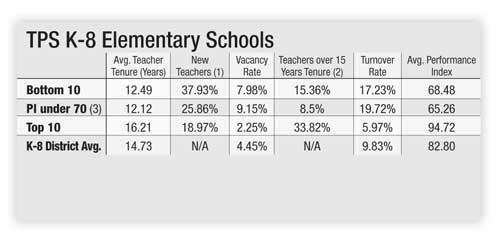
TPS has 40 K-8 elementary schools. The chart below compares the 10 best performing schools versus the 10 worst performing schools based on the performance index (PI) score from 2013 state report cards. The seven schools with a PI below 70 (D or worse letter grade) are further examined as well.

We can see a disturbing pattern. TPS’ underperforming schools have the most new teachers, the greatest vacancy and teacher turnover rates, and the lowest percentage of teachers with more than 15 years’ tenure compared to TPS’ highest performing schools.

This can only be due to seniority — the only criteria for teacher assignment — and the single salary schedule in the TFT contract. It seems that the contract has created a system where the highest paid, most senior teachers get the easiest positions without the challenges associated with lower performing schools. What effective organization survives and thrives under these conditions?

Besides the seniority and salary schedule, there are numerous other onerous provisions that impact student outcomes and increase operational costs, including the preference for long-term substitutes, hourly teachers, tutors and home instructors for full-time positions before an outside hire; placeholder substitutes for the 77 teachers on special assignment (some of the highest tenured TPS teachers); and professional development practices.

It’s not possible to comment on all of them in this column. But one point is clear: Changes are drastically needed now. The past 40 years of negotiations and most recently the lack of progress on performance audit recommendations demonstrate how difficult it will be to get the TFT and other union leadership to negotiate any changes without the appropriate leverage.

A yes vote on Issue 1 ensures the problems will never be negotiated. Voting no sends a message to the board and union leadership that this community wants student outcomes to be the first priority before a levy funding salary increase is passed.

Steven Flagg is a community activist with more than 20 years of experience in education advocacy. For more of his writings, visit tpsinfo.com.


Toledo’s eighth bishop installed in ‘magnificent’ ceremony

0

The Most Rev. Daniel E. Thomas was installed as the eighth Roman Catholic Bishop of Toledo on Oct. 22, promising to follow the example of devotion to Jesus Christ set by the late pope, St. John Paul II, whose papal inauguration took place 36 years ago that same day.

Daniel E. Thomas was installed as bishop of Toledo during an Oct. 22 ceremony at Rosary Cathedral. Photo by Stephanie Schweller / courtesy Catholic  Chronicle

Daniel E. Thomas was installed as bishop of Toledo during an Oct. 22 ceremony at Rosary Cathedral. Photo by Stephanie Schweller / courtesy Catholic Chronicle“I thought it was magnificent,” Thomas said in an interview with Toledo Free Press the following day. “The whole church was gathered together as one.”

The installation took place inside a filled-to-capacity Our Lady, Queen of the Most Holy Rosary Cathedral on Collingwood Boulevard, and was broadcast live on TV, radio and Internet both locally and nationally.

Catholic leaders from across the United States were in attendance, including New York Archbishop Cardinal Timothy Dolan.

Archbishops Carlo Maria Viganò, the Apostolic Nuncio to the United States, and Cincinnati’s Dennis Schnurr were the installing bishops.

Former Toledo Bishop and current Archbishop Leonard Blair of Hartford and Philadelphia Archbishop Charles Chaput, along with Schnurr and Viganò, all concelebrated the Mass, with Thomas serving as the main celebrant.

Installation homily

Thomas, the former auxiliary bishop of Philadelphia, offered the homily and used a chalice and paten his parents gave him upon his 1985 ordination. St. John Paul II used the chalice and paten during a private 1995 Mass in Philadelphia, and Thomas frequently mentioned the former pope in his homily.

Thomas was overcome with emotion and had to pause when speaking about St. John Paul II, who during a Philadelphia visit was found prostrate alone, praying in front of the Eucharist after a long day when most had already retired for the night.

He also delivered a message to Pope Francis, via Viganò:  “Please tell Pope Francis that we love Christ, we love the church and we love him.”

Thomas also thanked his Toledo predecessor, Blair, who is now serving the Diocese of Hartford, Connecticut, as archbishop.

“Thank you archbishop, for 10 years of fidelity, apostolic zeal and witness,” Thomas said. “We are grateful.”

In addressing his fellow priests, Thomas referenced a rectory-owned stained glass window depicting Jesus as the “Good Shepherd,” and offered:

“I love you. I can’t wait to get to know you and I can’t wait for you to get to know me. The task of each bishop, together with the people, is to announce the good news and proclaim Christ. My dear brother priests, I am one with you in the priesthood. I pray that we may always be one in heart and mind in the priesthood.”

Thomas offered similar words of comfort to everyday lay Catholics, hoping to work together for Jesus.

“I love you, and I hope that in your daily lives as husbands and wives, moms and dads, sons and daughters, each day you will live in Christ so that together we might announce the new evangelization,” Thomas said.

The rosary, a popular form of Catholic prayer and meditation long promoted and beloved by previous popes, was also referenced by Thomas.

“To pray the rosary is to hand over our burdens to the merciful hearts of Christ and his mother,” Thomas said. He also pledged to add a depiction of the relatively newer Luminous Mysteries to the Cathedral; the five mysteries focusing on the public ministry of Jesus were added to the Rosary by St. John Paul II in 2002.

He also specifically addressed the youth and elderly, asking the youth to be his “wings” and the elderly the “roots” of his ministry.

Background

Thomas said he first considered becoming a priest at as young as 7 years old, but the thought of becoming a bishop never entered his mind, even as a young adult.

“Never,” he said. “I certainly thought of being a priest. The one thing that I kept in my heart was being a priest. I answered that call as a senior in high school.”

Thomas was born and raised in Philadelphia, and attended Catholic schools through high school. He earned bachelor’s and master’s degrees from Saint Charles Borromeo Seminary in Wynnewood, Pennsylvania, and later a licentiate in sacred theology in 1989 from the Pontifical Gregorian University in Rome.

He was ordained a priest in Philadelphia in 1985 and served as a parish priest until 1990, when he was assigned to serve the Holy See as an official of the Congregation for Bishops, the section of the Roman Curia that coordinates the selection of candidates for the episcopacy. There he also served as adjunct spiritual director at the Pontifical North American College seminary in Rome.

In 1995 he was named Monsignor by Pope John Paul II, who in 2005 also named him a Prelate of Honor. That same year he returned to Pennsylvania as a parish priest, and in 2006 was ordained auxiliary bishop of Philadelphia.

Thomas has also served on several archdiocesan boards and remains a member of the United States Conference of Catholic Bishops’ Committee on Clergy, Consecrated Life and Vocations, the Ad Hoc Committee on Catechism and the Committee on Divine Worship. He is also a member of the National Advisory Council for the Saint John Vianney Center in Downingtown, Pennsylvania, and the Episcopal Advisory Board for the National Conference of Diocesan Vocation Directors.

Impression of Toledo

Bishop Thomas exits Rosary Cathedral Oct. 22 followign his installation  eighth bishop.. In the foreground is Master of Ceremonies  Daniel Demski  Flanked by the Knights of Columbus  on the steps. Photo by Scott Grau / Courtesy Catholic Chronicle

Bishop Thomas exits Rosary Cathedral Oct. 22 followign his installation eighth bishop. In the foreground is Master of Ceremonies Daniel Demski Flanked by the Knights of Columbus on the steps. Photo and Cover Photo by Scott Grau / Courtesy Catholic Chronicle

The Diocese of Toledo differs from the Archdiocese of Philadelphia in many ways, the greatest of which may be the need for a reliable vehicle if Thomas plans to visit the diocese’s 319,907 Catholics as he intends.

In Toledo, he shepherds a flock smaller in size, yet much more widespread.

The Diocese of Toledo measures 8,222 square miles across 19 counties, compared to Philadelphia’s 2,202 square miles in just five densely populated counties; Toledo’s diocesan population is 1,465,561 residents, compared to Philadelphia’s 4,050,793.

Parishes and priests are also easier to come by in America’s fifth-largest city. Toledo has 124 parishes and 159 priests, compared to Philadelphia’s 235 parishes and 523 priests.

Toledo has 58 diocesan elementary schools and 10,778 students; Philadelphia has 128 schools with 45,613 students.

Certainly no two dioceses are the same, but Thomas said he embraces the switch in locale and believes Toledo and Philadelphia are more alike than it first may seem.

“I had an experience of moving to a foreign country,” he said. “Those differences weigh in comparison.”

Once, Thomas said, while having dinner in Italy with his parents and friends, his mother expressed regret for not being able to speak the local language. An Italian friend countered with an assurance that instantly made the world seem smaller: “No, no, we speak the language of love. We are a family of faith.”

A bishop for others

While the new bishop’s primary focus is to serve those who are Catholic, he is in a sense here for all of Northwest Ohio. Thomas said he was sent by Pope Francis to serve the local church — the Toledo Diocese — by caring for those who are Catholic and helping them “to get to heaven.”

But he also hopes to work with other denominations and share in the task of spreading the Gospel.

“For everyone else, [the bishop is] charged to proclaim the Gospel and be the face of Christ,” Thomas said. “My outreach is to every single person. The reality is my task is to treat them all as Christ would treat them.”

As for now, he said he’s excited to have a busy schedule, meet as many people as he can, learn the area and eventually enjoy some of the local sights, including Tony Packo’s, where he has already been asked to sign a hot dog bun.

“The best advice I was given when I came to Toledo was ‘Just be yourself,’” Thomas said. “Be the person God intended you to be.”

Baumhower: Tricks and treats

0

One of the slowest hours of the year for a kid is 5-6 p.m. on Halloween.

  .

.

For me, it seemed the second hand of our living room clock would stop moving as soon as we were cleared to put our costumes on. Jeannine Lauber, Stan Stachak and a mustachioed Jerry Anderson would be on the television reminding kids of the times and rules of the special “all-you-can-grab candy dash” while informing parents of the weather forecast for the upcoming two hours.

It was always cold; if we were lucky, it was dry. There was nothing worse than having to pull the already-too-small vinyl one-piece, one-size-fits-all costume over your winter coat. The plastic mask with two holes for eyes and one slightly larger opening to allow your lungs air clung uncomfortably to your face and head.

Store-bought costume choices were limited back in the day — there were no Halloween stores, no Internet, no Pinterest. Boys got to pick between G.I. Joe, Star Wars, Spider-Man or Superman. For the girls it was Barbie, Jem of the Holograms, maybe a Shirt Tale or Rainbow Brite.

It was always a question of which bad thing would happen first — ripping your costume or breaking your mask. My winter coat — not Cobra — was GI Joe’s worst enemy that night.

The worst costume was always Casper the Friendly Ghost; the show hadn’t been on the TV for decades and I doubt it was ever liked. No kid in their right mind chose to be Casper on Halloween; it was the parents who wanted their baby to be safer and to wear a bright costume.

I also felt bad for the children who had a plastic pumpkin to collect the night’s rewards. You couldn’t visit more than 10 houses before the thin black strap on that contraption would break.

At 6 p.m. the TV would give us the go-ahead and the dash would begin. We had two hours to fill our full-sized pillowcases with as much candy as possible.

My dad was always our chaperone, working on an unagreed-upon commission. My mom was the designated person to stay back and hand out candy to those who knocked on our door, something she still enjoys to this day.

My West Toledo neighborhood was not built for Halloween. We had neither sidewalks nor curbed streets and the lighting was inadequate. To meet our goals we had to combat puddles, piles of leaves and slower and younger siblings who had not properly selected a costume based on speed, but rather prettiness. We battled tall grass, crazy dogs and sometimes crazier neighbors.

In that neighborhood, houses not decorated for Halloween were scarier than ones that were. It took courage to knock on the often poorly lit doors, especially on those homes featured in neighborhood folklore where children were allegedly kept in the basements. We had no idea that every house was a ranch with no sub-dwelling. We were kids, we were stupid — but that night, we were brave.

The reward for our bravery would hopefully be a Reese’s Peanut Butter Cup, Twix or Kit Kat. Sometimes we would strike gold and stumble on a home giving away full-size bars. I remember the feeling of pure joy when you saw an old lady making it rain regular-sized delicious treats. I also remember the times we would strike out and get pennies, a toothbrush or — worse — a coupon. What the hell is a kid going to do with a free ice cream? We couldn’t drive, we could barely ride a bike. Halloween was one of the few times I was allowed to cross certain roads.

I couldn’t remember my multiplication table or state capitals, but I could tell you which house gave what candy away on every street we ventured. Over the following nights, fantasies of revenge would fill our heads for those who left their lights off. How dare they!

As we tackled street after street, and our stash got larger in size, new thoughts and fears would start to arise. Would someone try to snatch our bag of candy?

The neighborhood near McGregor and Clover lanes is known for a lot of good things, like providing quarterbacks and point guards for generations of Whitmer sports teams and a big empty field net to the then-recently built library to hang out and “park.” But it was also known for legendary bag-snatching stories — all completely unfounded — where children would have trick-or-treated for an hour and 55 minutes only to have a squad of goons lay down a beating and take their hard-earned bag. I later realized why my sister and I had always remain unscathed from such unprovoked attacks — my dad would be dragging a wagon full of beer while wearing his dirty work clothes, looking like one of the crazies I mentioned earlier. Imagine Jason from “Friday the 13th” without the mask, having a slight buzz and sore feet. That was my dad, Dave.

The second slowest hour of the year was when Dave would play Candy TSA Agent and painstakingly over-evaluate every piece of candy we collected. He was looking for needles, pinholes, any signs of tampering. He would use this safety check processing time to get first pick of anything he liked in the bag, a nonnegotiable cost of business that was repeatedly stated with every piece of candy his fingers touched. It was pure childhood torture.

But he never seemed to pick any of my or my sister’s favorites. He would choose the awful Tootsie Rolls, Necco Wafers or Bit-O-Honey chews, which was surprising because this man loves his chocolate and peanut butter.

After 20 years of Halloween as a parent, I now understand why Dad never selected our favorite pieces.

After watching my children carry a heavy sack around a dark neighborhood for 90 minutes, all while being forced to say “hello,” “trick or treat” and “thank you” to countless weird-looking strange neighbors, my kids earn every single piece of candy tossed in their bags.

Now I’m the Candy TSA Agent who painstakingly touches every Whatchamacallit, Red Vines and Bazooka Joe bubble gum. I have learned to take inventory, noting which child collected which piece, and play commissioner to facilitate candy trades. I’ve also become the Halloween villain who informs my overly ambitious children that they cannot eat more than a couple of pieces that very night and every day that follows. I am now the guy who hides their bowls of candy on top of the refrigerator.

The times and costumes may have changed, but Halloween has stayed the same.

Halloween’s ultimate “treat” is quality time with your family. It’s carving pumpkins, costume selections, Linus waiting all night in a pumpkin patch, classroom parties and school parades.

Halloween “tricks” us into being a good neighbor one night a year, with the promise of smiling faces hiding behind a plastic mask, children reluctantly wearing their winter coats stuffed inside a vinyl costume while screaming “trick or treat,” a parent pulling a beer wagon — all in the hopes that you answer the door without a coupon in your hand.

So turn on your light because Halloween is an opportunity for you to be a part of someone’s memories.

And to the nice lady at Airedale and Armada: Thanks for the full-sized Twix.

Email columnist Jeremy Baumhower at [email protected] or follow him on Twitter at @jeremytheproduc.

Double trouble: ScreamAcres, PanDEMONium combine into one ‘top-notch haunt

0

Leaders Family Farms in Napoleon is more than just an amazing place to spend a fall day with your family. It’s home to a pair of haunts that can only be described as legendary.

One of the spooks at Leaders Family Farms in Napoleon. Photo by Katie Feher

One of the spooks at Leaders Family Farms in Napoleon.

Photo by Katie Feher

Once separated by admission lines and location, PanDEMONium and ScreamAcres have been combined into one massive, top-notch haunt. According to Kristin Leaders, “Combining the haunts has led to much less time waiting to get into the haunts. This year people buy one ticket for both haunts and get to experience them together.”

While the combination of haunts may have been designed to speed up the admission line, it’s far surpassed its that initial purpose and has created an incredible haunted attraction.

Many of the best haunts take 15 or more minutes to navigate and quite often guests are left satisfied, horrified and ready for a break. The combination of the Leaders family haunts has created an impressively disturbing 45-minute experience.

Everything about ScreamAcres screams grade-A professional design. Organization, production value, cleanliness, easy access to facilities and gobs of things to do outside of the hardcore haunts all make for very happy visitors.

What’s most impressive about ScreamAcres is how quickly you forget where you are as soon as you enter the haunts. Many guests won’t make it 3 feet into the first part of the haunt without an elevated heart rate and a good starter scare.

Navigating ScreamAcres is awesome, plainly put. The set construction and the timing of the actors are both spot-on. The combination of indoor space and outdoor paths through titanic corn fields not only enhances a sense of disorientation and isolation, but it also provides for entirely unpredictable jump-scares and ambushes.

The transition into PanDEMONium, the second haunt, is seamless. The use of light and dark in this haunt is expert. While navigation is clear and quite simple to figure out, any false sense of security this may afford is quickly destroyed as guests realize the scare style has adapted.

Like ScreamAcres, PanDEMONium boasts indoor and outdoor territory for zombies and other dead things to roam. The use of strobe lighting and other light-motion effects throughout creates a visceral, disorienting sensation, heightening the level of each successive scare.

Those brave enough to face the attractions at Leaders Family Farms each fall need only drive a short distance to the Napoleon area. The haunts are more than adequate and those with little monsters of their own will find a full day’s worth of fun things for the kids.

Pictures of Leaders’ world-class corn maze, video of their professional pumpkin launcher “Big Jack” and much more information can be found at facebook.com/screamacres. For ticket pricing, hours and directions, visit screamacres.com.

Local, state agencies being proactive with Ebola precautions

0

The threat of the Ebola virus hit close to home this month after an infected nurse in Dallas boarded a plane to Cleveland. So far, no one in Ohio has been infected with the disease, but local and state agencies are preparing themselves for the possibility.

Statewide, there are 164 people who came in contact with an infected person and are being monitored until Nov. 4, the last day of the 21-day period in which a person can come down with the virus after being exposed, said Dr. Mary DiOrio, the state epidemiologist with the Ohio Department of Health (ODH). At least three people are under quarantine.

DiOrio was part of a conference call with reporters Oct. 22 that gave a status report on Ohio’s Ebola response one week after the Ebola threat in the Cleveland/Akron area. Also on the call were Dr. Christopher Braden, the Ohio lead of the U.S. Centers for Disease Control and Prevention (CDC); Richard Hodges, director of the ODH; and Michael Abrams, president and CEO of Ohio Hospital Association (OHA).

“This is significant in Ohio because we’ve never had to deal with Ebola, but we do have experience. We just had a measles outbreak recently,” DiOrio said. “We have protocols. We began our Ebola preparations over the summer and were quickly able to implement a response with state and local agencies.”

Braden told reporters that the state’s reponse to Ebola is in good shape but not yet “out of the woods” a week after the threat.

“When we first came (to Ohio) it was obvious that the rapid and aggressive response was started and well under way,” Braden said. “When we reflect back on a week of very hard work as an assessment, we are in a very good place. We have some time before we are out of the woods [but] we are at a place in the reponse where we can take a deep breath and reflect on the week to go forward.”

Federal authorities said Oct. 22 that everyone traveling into the U.S. from Ebola-stricken nations will be monitored for symptoms for 21 days. That includes returning American aid workers, federal health employees and journalists, as well as West African travelers.

Dallas nurse Amber Vinson was part of a team that treated Liberian Thomas Eric Duncan, who contracted the disease in Liberia before coming to the United States. Duncan died Oct. 8, eight days after diagnosis. Nurse Nina Pham contracted Ebola while caring for Duncan after he was admitted but before he was diagnosed. Vinson, the second nurse to be infected, boarded a plane from Dallas to Cleveland on Oct. 10. She had been monitoring herself for symptoms, but was not restricted from traveling because she was not a risk according to CDC guidelines. The condition of both nurses has improved, and Vinson recently tested negative for the virus.

Toledo response

In Toledo, the Lucas County Health Department has taken the lead on the area’s response to a potential Ebola outbreak and has been holding meetings and discussions with first responders, local hospitals and others, including the Lucas County Emergency Management Agency, the Lucas County Sheriff’s Office, the Toledo Express Airport, the Ohio Air National Guard and the mayor’s office.

“The situation that happened in the Cleveland/Akron area got us thinking it could be something we could be faced with. It’s always better to be prepared,” said Samantha Eitniear, Lucas County community response coordinator.

Stephen Arnold, Toledo Express Airport manager, said his agency is following the lead of the county and the Transportation Security Administration. The likelihood  of Ebola arriving in Toledo from Africa by plane is small, because most international travelers are checked at O’Hare International Airport in Chicago before arriving in Toledo, he said. But if someone were to be suspected of infection, the 180th Fighter Wing of the Ohio Air National Guard would be the first responders. A guardsman would don protective gear and board the plane to question the person further.

“Everyone is standing back and taking a good look at this thing. We’re in the right position to handle this,” Arnold said. “We feel confident around here because there’s been so much discussion (of procedure) so we’re probably in better shape than Cleveland or Dallas. People here are taking notice of what could happen.”

ProMedica was “ahead of the game” and began Ebola preparations this past summer, said Brian Biggie, a nurse and ProMedica’s system coordinator for disaster preparedness.

“Aug. 2, our system brought together a small functioning team to work on our Ebola response plan before it had hit the United States,” Biggie said. “We take these things very seriously.”

However, when Duncan became the first Ebola patient diagnosed in the United States and Vinson flew to Cleveland, the “landscape” changed dramatically in Ohio, he said.

To be prepared here, the ProMedica team has conducted drills, established routes of communication and practiced patient management.

The ODH and the OHA have both required hospitals to hold drills and the CDC has released new guidelines on how to “don and duff” personal protective equipment (PPE). ProMedica has adopted those requirements.

“We have confidence in our PPE stance,” Biggie said. “We’re reacting as quickly as we can to every changing disease process. It’s a moving target.”

The ODH requested emergency funding from the state, which allocated $800,000 for protective gear to send to any area of the state that may have an outbreak, said Bill Teets, spokesman for Ohio’s Emergency Operations Center.

“Most health care providers have some supply of PPEs on hand because they’re used in a variety of situations,” Teets said. “But because of a large number of PPE required for an Ebola patient, we would go through supplies pretty quickly. So we have them ready and available.”

The Ebola virus, which is found in several African countries, was first identified in 1976 near the Ebola River in what is now the Democratic Republic of the Congo. The 2014 Ebola outbreak is the largest Ebola outbreak in history, according to the CDC’s website.

Ebola spreads from direct contact with body fluids of an infected person. Symptoms appear within 21 days of exposure. People exposed are not contagious unless they have symptoms of the virus, which include fever, severe headache, muscle pain, vomiting, diarrhea, stomach pains or unexplained bleeding or bruising. Ebola does not spread through water or food, except for infected bushmeat.

For more information, go to www.odh.ohio.gov, www.cdc.gov or call the CDC at (800) 232-4636.

Lake Erie Fearfest awaits thrill-seekers and horror fans

0

Lake Erie Fearfest, located at Ghostly Manor Thrill Center, 3319 Milan Road

Sandusky, Ohio 44870 is a world-class, five-haunt complex awaiting thrill-seekers and hardcore horror fans alike.

PIctures by Katie Feher

PIctures by Katie Feher

Listed as one of the country’s “Top-Ten” Haunts by Forbes magazine in 2013, the Criscione family has only improved upon what earned them national accolades last year. According to Ghostly Manor Thrill Center’s Director of Operations Billy Criscione, “The haunts are updated and revised each season.” With Ghostly Manor operating all year, more time annually, is spent updating the four seasonal haunts. Some haunts get weeks of updates and revisions, others get several days.”

Between “Darkmare”, “Quarantine”, “Caged”, “Eerie Chateau” and the year-round “Ghostly Manor”, guests will find every kind of scare imaginable. From the classic jump scares and poorly lit corners, to impressive automated light and effect sequences combined with unusual textural environments.

Guests of Lake Erie Fearfest and Ghostly Manor can experience all five amazing haunts for only $25. At $5 per haunt it’s an impressive value and a great way to spend a chilly fall evening.

What’s more is each haunt plays to different fears and each feels unique and expertly themed.

 “Quarantine” provides an eerily surreal catastrophic medical disaster environment. Chain link fencing contains deadly freaks and strobe lighting provides glimpses of lurking patients, creating an entirely immersive experience.

  “Eerie Chateau” feels a bit familiar but far from ordinary. The ‘Chateau’ feels expansive and deep and guests should expect to be challenged from impressive angles and heights.

 Some people find haunts less than scary because they can see the scare coming. However, “Darkmare” is thoroughly dark. So dark that even after the 10-15 minutes it takes to navigate, your eyes will not adjust to absence of light. This creates a visceral fear based on complete lack of sight. Walking arms-out is the only way to make it through ‘alive’.

LakeEerie-Fear-Fest_DSC_0459_WEB

PIctures by Katie Feher

 The newly revised “Caged” is smaller this year, but no less frightening. The combination of walls constructed from heavy gauge cage and the perfect amount of fog and light create a very tense situation. While guests can ‘see’ what’s ahead, it’s impossible to tell when you’re actually in harms way.

 Lastly, but certainly not least is “Ghostly Manor” itself.  The year-round attraction takes more than 20 minutes to navigate and is densely packed with scares. Expertly crafted and full of classic haunting elements, the indoor/outdoor attraction has something for everyone. While a ‘catch-all’ haunt may not sound exceptionally impressive, the attention to detail and quality of the actors that occupy this massive haunt make for a thoroughly satisfying experience.

 For directions, hours of operations and a full list of attractions offered at Ghostly Manor Thrill Center visit ghostlymanor.com.

“Satanarium” Spooks at Collingwood: Glacity Theatre Collective creates immersive horror for Halloween

0

Theater can provoke a myriad of emotions from its audience. It can inspire laughter, tears, provoke a new way of thinking about the world, instill joy or anger. And sometimes — just sometimes — it can scare the living daylights out of you.

Satanarium Poster

For the second October in a row, members of Toledo’s own Glacity Theatre Collective (the GTC) are hoping to inspire the latter emotion in those who attend their latest creation. “The Satanarium,” billed as an “Immersive Horror Performance,” will take place every Friday through Sunday beginning on October 17 in the basement of the legendary Collingwood Arts Center.

“‘The Satanarium’ consists of a group of women who seek to spiritually awaken outsiders through the guise of a sanitarium,” said Megan Aherne, co-writer/director of the piece and Assistant Artistic Director of the GTC, in an interview with Toledo Free Press.

“It is unclear whether they are really nurses, doctors, or even patients themselves. These women encourage their visitors to appreciate and accept the existence of the dark forces that they worship, by exposing them to their ritualistic ways. Audiences are taken on a ‘tour’ of the Sisters’ practices as they are guided through the space at the Collingwood.”

This is the GTC’s second excursion into tales of immersive terror. Last year the group presented “For the Devil Tells Me So,” also co-written and directed by Aherne, an experience chronicling a young woman’s demonic possession. So wildly successful was the piece that the group began planning this year’s show almost immediately after the first one ended.

“After ‘For The Devil’ we felt that we should have gone bigger-that seemed to have been the lesson learned,” Aherne said. “Every show sold out, we even had to add performances and it received excellent reviews from those that attended.

“After working with the T-Town Tassels this summer and seeing what the CAC was trying to accomplish, I knew I wanted to have this year’s horror show in that building. I took a tour of the space and found, what I think to be, the perfect area for an immersive horror performance.”

The bowels of the Collingwood certainly fit the bill as a creepy setting for terror. Aherne noted how the show — just like “For the Devil” — was constructed to fit and compliment the space.

.

“Any script begins with an idea, which Ed Lingan and I came up with after watching an old 1970s horror flick called ‘Don’t Look In The Basement.’ When we found the space in which we wanted to perform, that’s when the writing began.

“When writing this type of play, it is essential to understand the way your space functions, as the audience doesn’t just sit in one spot and watch, they follow the action throughout the space. I used this same method when writing ‘For The Devil’ — I wrote the outline for the play, based on the space in which we were performing. So really, first I considered the space, then how the audience is going to move, then we filled in the plot from there.”

Of course, the legends and ghost stories surrounding the Collingwood don’t exactly hurt the production. Aherne noted how she and her co-author were unaware of such tales when they were creating the performance, but they certainly add a whole new level to the atmosphere their work will create.

“For the audience it’s not so much about taking in information as it is about sharing a piece of the experience — which was something taken into consideration in not just the directing, but also in the writing of the piece,” Aherne said. “The structure of this performance is similar to that of a haunted house, but there is a storyline and a clear divide between acting and audience arenas — however that barrier can and will be broken here and there.”

No matter what draws the audience into “Satanarium,” however, Aherne stated that her hopes are that the experience proves a positive one for all involved — attendees, her theater company, and the historic building which will house the horror.

“For me, it is vital that this plays draws attention and raises funds for the CAC. It is a beautiful building with so much potential and faith in our artistic community — I am happy to be a small part in its revitalization — [as well as] similar sentiments, different contexts for Glacity Theatre Collective. I’d love to see our company have a stronger presence on the map of Toledo theatre.”

For more information on “Satanarium” and the Glacity Theatre Collective, visit www.glacity.org.

Conference to help pre-health students navigate choices

0

Monik Jimenez did not arrive at her position as a professor at Harvard Medical School via the traditional route, from high school to four-year college to graduate school. Rather, the Har v ard- educated instructor of public health attended continuation school after dropping out of high school, joined the Navy and then enrolled at a community college.

Shortly after she had started her undergraduate work, she became the primary caretaker of her mentally ill mother and took over custody of her sister who was just a baby at the time.

Jimenez, who will be a keynote speaker at the 2014 Midwest Pre-Health Conference at Bowling Green State University on Oct. 25, said some people looked at her as if she were crazy for enrolling at Harvard during such a difficult personal time, but she saw education as the key to her family’s salvation.

“I think a lot of times I felt overwhelmed and questioned whether I should stay in school,” Jimenez said during a telephone interview. “Long-term I knew it was for the best but short-term I was financially strapped and the caretaker for my entire family. So there was a lot of pressure on me to work. I resisted it — some people looked at me like I was crazy, but it was the only key to get out of our situation. I strongly felt that getting an education was the only way I could secure my situation and my future. Every challenge makes you stronger and you can’t grow if you’re not pushed.”

Jimenez called her path to her Ph.D. “strange” and “nontraditional.” The key qualities that helped keep her on that path are the qualities she will speak about at the conference: perseverance, discipline, self-initiative and motivation.

“I’m going to talk about qualities that are not typically measured in academics that I believe are key qualities in helping students succeed,” she said. “I’m giving, if you will, an unconventional recipe for success.

”The conference will bring medical and dental students together with admissions and medical professionals. The aim is to help students prepare for professional and graduate-level programs in medical, dental and pharmacy schools.

The conference takes place at Bowling Green State University Bowen-Thompson Student Union from 8 a.m. to 5 p.m. Registration is free to all students. To register or for more information, go to www.mwprehealth.com.

The two keynote speakers and 14 panelists are medical professionals from Ohio State University, University of Findlay and ProMedica, among others, and from Ivy League schools Harvard, Yale and Columbia.

Jimenez has worked hard over her career to try and break the stereotype that an Ivy League school is inaccessible.

Creator and organizer of the event, Shermaine Hutchins, who is a pre-med student at BGSU, couldn’t agree more. He’s attempting to bring the Ivy League to the masses. After attending programs at Harvard and Yale, he wanted to give students opportunities to make themselves more competitive and show that the Ivy League is reachable.

“We’re really excited about the turnout,” Hutchins said about the conference. “There’s a lot of misinformation about going into community college and taking credits there and doing community service. After I finished the programs, I was sitting there [thinking] ‘Man, I’ve got so many friends who would benefit from this type of information.’ So I decided, ‘You know what, how about I do it myself?’ So I started making calls and emails. And fortunately we’ve had some really great response — to have Harvard, Yale and Columbia interested in coming to Ohio to share this information is really overwhelming.”

The MD/Ph.D. program at Yale School of Medicine started in 1973. About 70 percent of graduates are in full-time academic positions and 75 percent have research funding, most of it from the National Institutes of Health.

However, only about 10 out of 100 students interested in a doctorate program are interested in the MD/Ph.D. program, said panelist Dr. Fred Gorelick, the program’s deputy director. These doctors don’t earn as much as physicians, but the rewards are “enormous,” Hutchins said.

Dr. Louito Edje, director of the Family Medicine Residency Program at ProMedica Toledo Hospital, was sought out by Hutchins — as were all the other speakers and panelists — who gave her the key word for her keynote address: perseverance.

“There’s actually a significant amount of focus that needs to happen to achieve our goals in medicine,” Edje said. “We have to remain focused to get toward that goal. And as you persevere, you surround yourself with experts and those who have energy to move forward.”