Home Blog Page 176

BBB honors five organizations for ethics

0

The Better Business Bureau (BBB) of Northwestern Ohio and Southeastern Michigan honored four local businesses and one nonprofit for exemplary and ethical business practices at its annual Torch Awards, held Nov. 5 in Perrysburg.
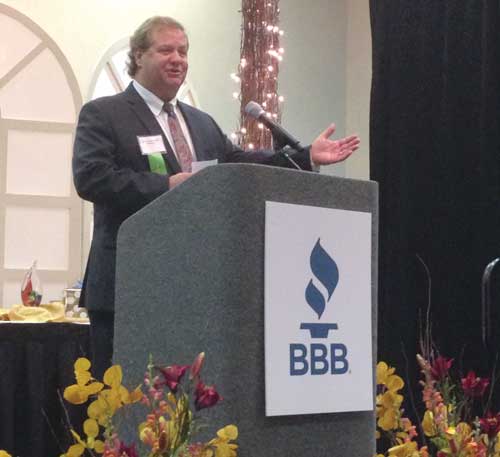
Brad Lay Sr. of Lay's Transmission speaks at the BBB Torch Awards after winning a business ethics award in the small business  category. Toledo Free Press photo by Sarah Ottney

Brad Lay Sr. of Lay’s Transmission speaks at the BBB Torch Awards after winning a business ethics award in the small business category. Toledo Free Press photo by Sarah Ottney

Winners have demonstrated business practices that exemplify ethics, integrity and exceptional customer service and are chosen by an independent panel of volunteer community leaders, based on criteria established by the BBB, said Mollie Tyrrell, the organization’s director of special projects.

Tyrrell said the BBB received about 100 nominations for this year’s awards. Winners received a trophy created by Toledo glass artist Mike Wallace.

This year’s keynote speaker was Dennis Johnson, a Toledo native and president of Brooks Insurance Agency.

Also revealed at the ceremony were the two winners of the Jim Smythe Memorial Student of Integrity Scholarships, a $500 scholarship awarded to area high school seniors.

For more information or to make a nomination for next year, contact the BBB at (419) 578-6000 or at bbb.org.

Small business: Lay’s Transmission

Lay’s Transmission won in the small business (one to nine employees) category.

The family-owned business has been an industry leader in drive train manufacturing and service in Northwest Ohio and Southeast Michigan since 1956. Owned by Bradley Lay Sr., Lay’s Transmission provides complete drive shaft, differential, rear end and transfer case repairs and rebuilds. It utilizes its on-site machine shop and state-of-the-art diagnostic equipment to get vehicles back on the road as soon as possible.

“This award is huge for us, especially in the automotive transmission business,” Lay said. “There’s a lot of complaints in our industry. But we’re going on 60 years in business and the reason for that longevity is honesty and integrity. A lot of it is what was instilled in me as a kid. My father taught me the Golden Rule, that if you treat someone right they will come back and that’s what we strive to do. I use biblical principles daily in business. I want to do the right thing in every situation and not sacrifice the future for the present.”

The company requires all employees to conduct themselves according to its code of business conduct and ethics, and maintains ties to the community through its support and involvement with 1Matters, Tent City, Food for Thought, YWCA’s Encore Plus program, University of Toledo athletics, holiday food baskets, Race for Hope, Ronald McDonald House, Vets Helping Vets, the Make-a-Wish Foundation and others.

The business is located at 378 Phillips Ave. For more information, call (419) 476-4088 or visit laystransmission.com.

Medium business: Roemer Insurance

Roemer Insurance won in the medium business (10-49 employees) category.

The company was started in 1934 by Wellington F. Roemer with the motto, “He profits most who serves best.” The business remains a family affair, with Wellington’s son, W. Thomas “Tommy” Roemer, serving as vice chairman of the board, and his grandson, Wellington F. “Rocky” Roemer III, serving as president and CEO for the past 20 years.

The 35-employee company maintains a 98 percent client retention rate by maintaining strong communication with a focus on customer service.

The company offers health insurance, vision, dental, life, disability and client services, as well as Medicare for individuals. Among the staff are eight expert health insurance professionals, who assist employers and individuals with personalized health care coverage. Roemer Insurance also offers services for truckers, one of its specialties from its inception. It offers liability insurance for long-haul truckers in the Midwest.

The company puts an emphasis on taking care of its staff, with amenities such as massage days at work, discounts to health clubs and an on-site gym. Roemer is dedicated to the community as well, with employees involved with organizations such as The Rotary Club of Toledo, The Victory Center, YMCA and JCC of Greater Toledo and The Ohio State University Alumni Association.

“This is very exciting,” Roemer III said. “We’re a longstanding business in this community and we owe our success to those who came before us. This is really a tribute to all those who have worked so hard over the years for this company.”

The business is located at 3912 Sunforest Court. For more information, call (419) 475-5151 or visit roemer-insurance.com.

Large business: Garner Transportation

Garner Transportation Group won in the large business (50-149 employees) category.

The family-owned and operated business was started by Vernon E. and Regina Garner in 1960 and has been under the direction of their daughter Sherri Garner Brumbaugh as president since 2008.

The company originally focused on transporting agricultural products. Today, it has shifted focus to general commodities, with shipments transported regionally (east of the Mississippi River). More than a trucking company, Garner’s services now include transportation, expediting, warehousing, logistics management, third-party services, contract maintenance and transportation consultation.

“We started with one truck, one driver — that was my dad — and one back office person — that was my mom,” Brumbaugh said.

Today, the company has 100 trucks, 400 trailers and more than 100 employees, she said.

“For my Garner employees and their families, what I work hard at every day is for them to be proud of whom and who they work for,” she said. “Ethical behavior is a very important component of a sound business practice.”

The company’s commitment to the community is evident through its involvement with Hancock Leadership, Findlay Race for the Cure, The Ohio State University Melanoma Research Foundation, University of Findlay and the Humane Society of Hancock County.

The business is located at 9291 County Road 313, in Findlay. For more information, call (419) 422-5742 or visit garnertrucking.com.

Extra-large business: Taylor Automotive Group

Taylor Automotive Group won in the extra-large business (150-plus employees) category.

The family of seven vehicle dealerships — with locations in Toledo, Perrysburg, Findlay and Lima — prides itself on putting customers first.

The business, which formed in 1979, has developed a list of five core values: personal growth and development, attitude, respect, teamwork, and the five Es — energy, enthusiasm and excitement equals more effectiveness and efficiency.

Many sales team members begin their morning by reciting the company’s “Dealer FOR the People Pledge.” The company also asks employees to write personal essays on what its core values mean to them, and potential employees to rate themselves on the five core values on its employment applications.

The dealership’s mantra of “Locally Owned, Locally Committed” is evident by its community involvement and numerous charitable donations. Owner Steve Taylor has implemented the “Driven To Succeed” program, where a new Hyundai vehicle is given to a graduating senior from high schools in Lucas, Hancock and Allen counties, as well as Perrysburg. Further, the automotive group’s “12 Days of Christmas” helps nearly 40 families in need during the holiday season.

“Really this honor is for [my dad],” Taylor said. “What I always learned from him were hard work, ethics and the importance of giving back to the community. It’s something he’s obviously passed on to me. He always said the secret to success is to do the right thing.”

For more information, call (419) 246-5693 or visit taylorauto.com.

Nonprofit: Toledo Fair Housing Center

The Toledo Fair Housing Center won in the nonprofit category.

The nonprofit civil rights agency is dedicated to the elimination of housing discrimination and to the expansion of neighborhood choice for all people. It was established in 1975 by The Women of the Old West End and The League of Women Voters in response to blockbusting and other housing discrimination practices.

The center has investigated more than 11,500 complaints of discrimination, recovering more than $30 million in damages. Its staff has conducted workshops for fair housing organizations, government agencies and housing industry professionals. The center has demonstrated a talent for setting national precedents in the enforcement of fair housing laws, while expanding housing opportunities for millions of Americans.

In 2009, the center was one of four private fair housing organizations in the United States to be featured in the Annual Report on Fair Housing published by the U.S. Department of Housing and Urban Development.

Members of the center participate in a variety of community service efforts, including the City of Toledo Department of Neighborhoods’ Community Development Block Grant Spring Sweep Cleanup, Pride Festival, International Festival, United Way Day of Caring, African American Festival, Latino Festival and its sister agency Northwest Ohio Development Agency’s Homeownership Fair.

“We absolutely have to live and work by high standards of ethics if we’re going to hold other entities accountable under fair housing regulations,” said President and CEO Michael Marsh.

The agency is gearing up for its 40th anniversary celebration next year and will be featured in one of WGTE’s “Toledo Stories” documentaries.

For more information, call (419) 243-6163 or visit toledofhc.org.

Toledo Free Press Editor in Chief Sarah Ottney contributed to this report.
Hays: Homing veterans

0

I became deeply aware of the difference between having a roof over your head and feeling at home when in 2011 I met a young mother whose husband, an officer in the military, had shot himself on the front lawn of their $250,000-plus home while she and their children were inside.

He seemed to have everything to live for: the love of a good woman, three healthy children, financial success, stature in the civilian and military community and a place to call home. But what does it really mean to be “at home”?

.

.

I sold real estate in the past and have also worked as a home builder and a decorator. I helped others make a brick-and-mortar house feel like a home. But although colors, textures and design matter, it is really the people inside and the memories they make that transform the structure from house to home.

I guess you could say I am still a home builder and decorator because of my work with our military and veterans. Though many do have a physical place to call home, they are missing the accessories — the pieces in their lives that allow them to find laughter and lightheartedness, interest in activities, comfort and familiarity, a sense of safety and trust that new memories can be made. They don’t believe the pieces of themselves they left behind and the pieces that remain can be brought together cohesively to bring beauty and peace to their human spirit where they feel at home with themselves.

Many people think veterans don’t feel comfortable with others and want to be left alone, so there is a lot of discussion about isolating veterans in structures or villages as a solution to some of their “issues.” So, they are built. There is also a lot of talk about how jobs are the main solution for veterans’ issues with reintegration in their communities. So we have job fair after job fair with nowhere near the success rate we should see based on dollars spent.

We may get veterans employed, but do they remain employed and are their lives changed long-term? Have their spirits been healed? These types of generalized, fix-it-fast solutions seldom succeed in reintegrating the veteran with himself or herself. And that, my friends, is the missing piece. It would be like building a home with no front door.

Our veteran reintegration process must help veterans feel at home with the people they are today and build on that to become who they want to be tomorrow, next year and 10 years from now. The ability for veterans to reach out for services and make lifelong changes is diminished if they never feel at home with themselves. Programs to help families will never resolve relational issues if the veteran has a broken relationship with his or her own spirit. Programs that aim to stop suicides will not be as effective if we only seek to solve the “act” and not the lack of services to match needs, which leads to feeling a black hole after hope is gone.

It isn’t easy to build a house. But with skilled workers and a great blueprint, one can go from houseless to housed within six months or so. But the blueprint to make that house a home is not so easily mapped out. It isn’t about skilled trades; it is the emotions, the life skills, the past experiences that add to the beauty rather than distract, like the ability to bring just the right antique into a modern home and have it fit right in. To bring our veterans all the way home, they have to love themselves.

They have to make peace with their pasts and find a purpose for their futures. I am a home builder for veterans. You can be too. It is what we do at The Arms Forces and it is the right thing to do for all generations of veterans.

Nov. 11 is Veterans Day. Beyond saying “Happy Veterans Day,” let’s spend time this year with a veteran and get to know his or her story without judgment or preconceived ideas of what they need or what they did or why they did it.

Let’s spend time getting to know the person behind the labels. Let’s reach out as one human being to another, not veteran to civilian or civilian to veteran. Let’s pursue what the human spirit is capable of as we drive down the barriers and lift up the possibilities.

Imagine the difference you could make, but also imagine the difference those you reach out to can make in your life. I know. I am blessed!

Pam Hays is president and founder of The Arms Forces, www.thearmsforces.org; (419) 891-2111; Facebook.com/thearmsforces.

Trapped Toledo: Spy-themed interactive thrilled experience ‘Rescued’ to debut Nov. 12

0

You are locked in a laboratory, surrounded by strangers. The room is filled with the basic accoutrement of research — books, a microscope, file folders. It would not seem unusual except for a gruesome addition: Across from you, chained to the wall, is a ravenous, flesh-eating zombie. Every so often, its chain gets a little bit more slack. It’s coming closer and closer. There is a way out of the room. But you must all work together to find it in time.

If this sounds fun, you may be ready to join the hundreds of players who have experienced Trapped Toledo since its inception this past summer. The interactive thriller experience located on Key Street hosts a pair of themed “rooms” designed to test players’ nerves, wits and ability to keep a level head in an effort to triumph.

Slightly secluded in the shopping plaza next to Burger Bar 419, Trapped Toledo has nevertheless become one of the hottest tickets in town for players looking for a unique and special gaming experience. Whether they come to test their skills in the zombie-themed “Infected” room, or to still their wits in the bomb-themed “Blown Away” experience, groups of ten-to-twelve come together to try and solve each scenario’s devilish puzzles before it’s too late.

A team tests its skills at Trapped Toledo's

A team tests its skills at Trapped Toledo’s “Infected” room. A new room, spy-themed “Rescued!,” will debut Nov. 12. Toledo Free Press photo by Christie Materni

It’s a basic concept that has fascinated Kimmer Callahan, Trapped’s chief marketing officer, and his fellow team members ever since they first learned of other interactive games of its ilk. “We did a ton of research on other models like this,” Callahan said in an interview with Toledo Free Press. “It started in Asia, it kind of came across the pond, it was done pretty badly in the States, thus far. … We don’t have any competition in Toledo, but as we expand, we’re going to have competition in some of our other areas that we’re targeting. ”

Their love for the idea of an experience that would merge puzzles, role-playing and thriller elements inspired Callahan and his friends — mostly former UT and BGSU grads — to launch their own version. They were also convinced they could do it better than anyone they had seen before.

“We’re all puzzle people. We love puzzles, games, board games. I used to do murder mysteries for friends,” Callahan said. “And Chris and I — Chris is my nephew — and he and I have talked for years about starting a business together. And when this came over, we were like, ‘This is fun!’

“And then we went to one, and we were like, ‘That was awesome!’ Then we walked out, and we were like, there were a thousand things we would change, to make that better. And by the time we left that table — there were ten of us in the room — by the time we left that table, everybody except for two invested in this business. And Chris and I — and Tiffany, who’s my wife — just took it the rest of the way.”

Part of the growth of the business has been keeping a constant eye out for new ideas, mainly from cast members and other collaborators. A new room will debut on November 12, from a script written by a member of the Trapped cast, and both of the current scenarios have seen a wide variety of changes and additions, courtesy of the feedback from attendees and cast alike.

“We have no experience in theater. We rely on others that have experience,” Callahan said, pointing to Misty Young, assistant manager at Trapped, who often plays the research assistant in the “Infected” scenario. “I think just getting in here and having them help us learn, as well as having us learn on the fly — I think that’s just what business is all about anyway. Just making mistakes and fixing it, making it better, messing up again and doing it again.”

They’ve also learned some surprising things about the makeup of their audience during their first few months. One might expect that if fans enjoyed one scenario the team offered, they would be ready and willing to try the other — but Callahan estimated that only about 10% do.

“There’s something about the immediate — being able to see the danger — that some people don’t like,” Young said, referring to the “Infected” room. “Those would be the same people that maybe don’t like haunted houses, things jumping out at them. Knowing there’s a bomb there is one thing, but actually having somebody, the immediate [danger] … some people just don’t like that. So it’s kind of like two sides of the same coin.”

But no matter what the tastes of their audiences are, the Trapped crew are prepared to keep working and evolving their fiendish scenarios to give audiences a thrill like no other. The Halloween season and its ever-present haunted houses may soon be over, but at Trapped Toledo — and wherever expansion may take them — the fun screams will just keep right on rolling.

“I feel like this one’s much more of a guttural, fear-based thing,” Callahan said. “It’s not like, �?Oh my God, there’s a guy with a chainsaw!’ Like, jump-scary. This has, like, periodic screams, but it’s a constant, building tension.”

Letters to the Editor, Nov. 9, 2014

0

Arrogance and disrespect

Mr. Pounds,

I read your Publisher’s Statement in the Oct. 19 issue of Toledo Free Press, and the last sentence made me shake my head: “The company owes us that much at least.” You were referring to the Chrysler Corporation and, sir, you could not be more wrong.

A company does not owe any community anything. They are in business to make a profit while producing a product or service. Why do you think a huge company the size of Chrysler owes Toledo, Ohio, anything? That is a very arrogant statement to make. Do you really think that Toledo, Ohio, is so special that Chrysler would never consider moving their business somewhere else?

I  was born, raised, educated and lived in Toledo for 25 years. When I married and moved to the suburbs and then eventually away from Lucas County altogether I was given a real eye-opening view of how ridiculous Toledo is. (I actually think all of Lucas County is, but that’s another letter!)

Since I left Toledo, the idiot leaders have torn down my high school (Bowsher); demolished a beautiful, historical gem of a school that was built to honor the founder of industry in Toledo, Edmund Drummond Libbey; allowed the Southwyck and Woodville malls to fall into ruin and demolished them too. The Old South End, where I bought my first home, is unsafe, lined with boarded-up homes. Because of this, I seldom go back to visit Toledo because it is not the place I remember. 

Regarding the number of jobs in Toledo, this is Toledo’s biggest problem: The two biggest employers in Toledo are Jeep and ProMedica. And unfortunately, Toledo has put all its eggs in those two baskets. City leaders don’t care about moving any new industry into Toledo or creating anywhere else to work because they think Jeep and ProMedica will be there forever. Have they ever heard of Flint, Michigan? Flint never thought GM would ever leave either. They were wrong. When GM left a few years ago, Flint never recovered. I don’t know many doctors who can build cars and I don’t know any auto workers who can perform surgery, but if Toledo doesn’t diversify itself it’s going to be in the same mess if the Chrysler Corporation decides to move on.

Toledo leaders need to have some self respect for the Glass City and open up their minds to new industry. Stop depending on what was and look at the future of what is to come. Chrysler doesn’t owe Toledo anything. It is free to move on and demolish the Jeep plant when it’s done with it. Actually, that would fit right in with what Toledo is used to doing: Use it up, disrespect it and then demolish it! O

MARI GILBERT, Bowling Green

Publisher’s Response: Toledo Free Press shares your belief in the importance of supporting and encouraging new businesses, but I think you misunderstood my meaning in the column you mention. I didn’t intend to imply Chrysler owes Toledo to stay in Toledo. Chrysler is of course obligated to make decisions based only on what’s best for Chrysler. No number of years in Toledo or devotion from Toledoans toward the product will, or should, sway Chrysler’s decision. But I do maintain local leadership and union officials deserve to be part of the conversation. The full statement from my column reads: “Businesses can’t survive on legacy or devotion alone, but Toledo deserves to be part of the conversation. Given Jeep’s history in Toledo, the company owes us that much at least.” Jeep has been made in Toledo for 70 years. No one, besides Chrysler itself, knows the product better. Perhaps there is a solution that would keep Jeep, or another product, in Toledo while also satisfying Chrysler’s needs. Losing Jeep would be a huge blow to Toledo both economically and morally. But at the end of the day, of course the decision is Chrysler’s and Chrysler’s alone.

The art of seeing: TMA to offer eight free speakers during visual literacy conference.

0

Toledo Museum of Art (TMA) Assistant Director Adam Levine believes in boosting fluency in “visual literacy.”

Pinaree Sanpitak's

Pinaree Sanpitak’s “Anything Can Break,” pictured on display in Bangkok in 2011. Photo Courtesy Toledo Museum of Art

“We’re pivoting back to a world that communicates predominantly through images,” Levine said. “This obsession with the written word, with textural literacy, is only a few hundred years old. There’s been this 500-year window from Gutenberg’s invention and the advent of the Internet where the word dominated. Now more than ever it’s really important to be able to extract meaning from the visual world.”

Adam Levine

Adam Levine. Photo Courtesy TMA

From Nov. 5-8, TMA will host the International Visual Literacy Association’s 47th annual conference, “The Art of Seeing: From Ordinary to Extraordinary.” Organizers are expecting around 300 people per day with attendees hailing from at least four continents.

While most of the conference is for paid attendees only, TMA is presenting eight keynote speakers to the public free of charge.

The speakers — innovators from fields as varied as medicine, film and education — will each address the rise of visual language.

“We’re trying to sketch this world of possibilities for how visual literacy can be applied,” Levine said. “We think we’re going to generate some real momentum around this.”

The eight speakers are:

  • 9 a.m. Nov. 6: Anthropologist David Howes is a professor of anthropology and the director of the Concordia Centre for Sensory Studies at Concordia University in Montreal. His research focuses on how senses are formed by culture and what the world is like to societies that emphasize touch or hearing rather than sight. Howes has conducted field research on the cultural life of the senses in Papua New Guinea, Northwestern Argentina and the Southwestern United States.
  • 3 p.m. Nov. 6: International ceramic artist Magdalene Odundo is known for her distinct hand-built anthropomorphic vessel forms. Odundo is an expert in the history of pottery and its meaning to societies through the ages, her own work being inspired by the creations of Nigerian and Kenyan potters of the past.
  • 9 a.m. Nov. 7: Through his specialty in polytrauma (multiple devastating injuries), plastic surgeon Joseph Rosen, a Dartmouth Medical School professor, examines the role of the face as an essential part of the human identity. His reconstructive work on patients who have suffered devastating injuries from bullets, bombs, infection and disease has led him to his role as a U.S. Department of Defense department consultant on a team evaluating uses for regenerative medicine and transplantation for wounded soldiers. His interests include biomedical engineering, international medical relief work and virtual reality stimulators in education.
  • 2:15 p.m. Nov. 7: Philip Yenawine has been engaged in museum education for 30 years, 10 of them spent as director of education at the Museum of Modern Art (MoMA) in New York City. He is co-founding director of Visual Understanding in Education, a nonprofit educational research organization that develops and studies programs using art to teach thinking and communication skills.
  • 3:40 p.m. Nov. 7: Comic book artist and educator Nick Sousanis wrote and drew the dissertation for his 2014 doctorate in education at Teachers College, Columbia University, entirely in comic book form. Titled “Unflattening,” the work’s form embodies its argument for the importance of visual thinking in teaching and learning. A book version will be published by Harvard University Press in March. Before coming to New York City, he was immersed in Detroit’s arts community, where he co-founded the arts and cultural site thedetroiter.com and became the biographer of legendary Detroit artist Charles McGee.
  • 9 a.m. Nov. 8: Documentary filmmaker Stephen Apkon founded the Jacob Burns Film Center in Pleasantville, N.Y., with a vision of establishing a hub for independent, foreign and documentary films and education. The center has grown to become a major cultural destination and a national leader in the field of visual literacy, including programming for underserved children. More recently, Apkon founded Chakana Media, a documentary production company developing films focused on critical societal issues.
  • 11:50 a.m. Nov. 8: Educator Lynell Burmark is a passionate advocate of using visuals to better educate students of all ages. Burmark’s extensive teaching experience spans kindergarten through graduate school, while her visually enhanced presentations inspire educators across the globe.
  • 3 p.m. Nov. 8: Ohio artist Aminah Robinson combines traditional art materials with found objects such as buttons, cloth, leather, twigs, shells and music box workings to create 2-D and 3-D works of art, including books and rag paintings. Many of them are about her family, community and the stories she has been told by her elders. She also researches and depicts the lives of abolitionists, civil rights leaders, musicians and writers. Robinson’s art is grounded in her belief in the African concept of Sankofa, which means learning from the past in order to move forward.

“This is a group of people who, though they come from very disparate fields, share a forward-thinking approach to their work,” said TMA Director Brian Kennedy in a news release. “They have used visual language to advance disciplines from medicine to education. What they have to say is crucial as we navigate a world where people have begun to communicate with pictures as frequently as with words.”

TMA is also offering two free exhibitions affiliated with the conference. “Speaking Visual: Learning the Language of Art” opened Oct. 31 and features works culled from the TMA collection. “InSight: Contemporary Sensory Works” opens Nov. 5 and will feature work by Robinson, Odundo and Pinaree Sanpitak.

For more information, visit toledomuseum.org or www.vislit.org.

Sparks: Issue 7, a vote for kids

0

Elections are a time when you, as voters, get to say what is important to you.

Hopefully, the safety of Lucas County’s children is important to you and you will make that commitment clear by voting for Issue 7 on Nov. 4.

Issue 7 is a 1.75-mill levy to support Lucas County Children Services (LCCS), the county agency responsible for protecting children from abuse or neglect. Of this levy, 1.4 mills is a renewal; the additional 0.35 mills will cost the owner of a $100,000 home only $12.25 a year — about the cost of a pizza.

Issue 7 really is a vote about kids — it’s about the growing number of children we serve who are on the autism spectrum, or who have developmental disabilities or serious mental health or behavioral issues and need services from our agency to keep them safe.

It’s also about finding safe homes for children who are victims of the well-documented heroin epidemic in our community, including newborns who were born drug exposed.

Issue 7 is also about providing services to the 100 or so teen victims of human trafficking in Lucas County, deemed the fourth-largest center for human trafficking in the nation. New state legislation — which we support — placed the responsibility for minor victims of human trafficking into the hands of agencies like LCCS.

Finally, Issue 7 is about providing services to parents to help them recover from the problems in their lives so they can safely raise their own children. The families we work with overcome substance abuse, domestic violence, mental and physical health problems, unstable housing and other issues.

LCCS has responded to the tight economy by slashing more than $6 million from its budget and leaving 50 positions unfilled. The agency has reduced and, in some cases, eliminated contracts and services. Without the additional funds that Issue 7 provides, the agency will need to cut an additional $1.8 million from its 2015 budget, potentially putting children and families at risk.

At the same time, funding at the federal, state and local levels has declined. The federal government has slashed critical funding for child welfare. The State of Ohio has been ranked last in the nation in its support of child welfare. Even the income from the agency’s tax levies is down as a result of the 20 percent decline in local property values. Due to the way child welfare is funded, the less our agency spends in local dollars the less it receives in federal reimbursements, cutting our budget even further.

Despite these cutbacks, LCCS has continued to excel, maintaining accreditation by the Council on Accreditation, adding programs to help parents more successfully reunify with their children, and finding adoptive families for more children than any other county in Ohio. More youth emancipating from foster care complete their education and move on to productive lives.

We recognize that Lucas County has only recently begun to turn the corner economically, and social issues continue to plague many residents and neighborhoods. However, our agency’s mandate is to protect children from abuse or neglect. We are not in a position in which we can simply not respond. We are deeply concerned that our resources will soon be stretched so thin that children will be at risk. You have come to expect more, and our county’s children deserve more.

Lucas County Children Services is, and will continue to be, transparent in its service to the community and our 350 employees are committed to ensuring the safety and well-being of the county’s most vulnerable citizens. We ask for your vote for Issue 7 on Nov. 4.

Dean Sparks is executive director of Lucas County Children Services.

Pounds: For Issues 8, 9

0

Toledo and Lucas County voters who head to the polls Nov. 4 face choices on numerous levies, including three for local social service agencies.

.Last week, I expressed support for Issue 7, a seven-year, 1.75-mill property tax levy that would help Lucas County Children Services care for local children at risk of abuse or neglect. Two other local agencies that serve vulnerable populations are also deserving of our support on this ballot.

The Mental Health & Recovery Services Board of Lucas County (MHRSB) is asking voters to approve Issue 8, a 10-year, 0.5-mill renewal levy expected to generate $3.4 million per year, or about 14 percent of the board’s annual discretionary funds, Executive Director Scott Sylak recently told Toledo Free Press.

The MHRSB helps fund 21 area organizations that provide mental health treatment and drug and alcohol recovery services. Together those agencies provide direct services to about 26,000 Lucas County residents each year.

Issue 8 is not a new tax and would continue to cost the owner of a $100,000 home about $15 annually. The failure of the levy, coupled with an expected $2.6 million drop in state and federal funding — about 11 percent of MHRSB’s budget — would amount to a 25 percent reduction in funds at a time when MHRSB continues to see an increase in the number of people seeking treatment, Sylak told TFP.

“It would be devastating,” he said.

By covering more types of treatments, Medicaid expansion has helped relieve some financial strain on MHRSB, Sylak said. However, the program doesn’t cover vital transition services such as housing or vocational programs, and is set to expire next year unless Congress steps in.

“So many other things in our clients’ lives are destabilized,” Sylak said. “The one thing they really need to be able to count on is there’s going to be help here when they need it most.”

Also on the ballot is Issue 9, a five-year levy renewal with a small increase expected to provide $4.3 million annually for services for area senior citizens. The total cost to the owner of a $100,000 home would be about $19 per year. Lucas County’s senior population has increased 11 percent since 2010 and is expected to increase another 11 percent over the next five years, Area Office on Aging  (AOOA) of Northwestern Ohio President and CEO Billie Johnson recently told TFP.

As many as 40,000 seniors are served by AOA each year, through home-delivered meals, home care, senior center programming, day and respite care for caregivers, transportation to medical appointments, assistance with insurance questions and more.

“With such a modest increase, it just seems like a great investment for our community to do for the older citizens who have given so much to this community,” Johnson said.

We are all being asked to do more with less and being asked to support numerous levies might feel like a hardship. However, the delayed costs and negative consequences of not supporting them would be higher. I urge you to support Issues 7, 8 and 9, all of which fund worthwhile agencies that care for our fellow citizens in times of need.

Thomas F. Pounds is president and publisher of Toledo Free Press and Toledo Free Press Star. Contact him at [email protected].

Slate of candidates includes many incumbents, familiar names

0

From Lucas County Auditor Anita Lopez to longtime Congressional representatives Marcy Kaptur, Bob Latta and Teresa Fedor to Lucas County Commissioner Carol Contrada, area voters will find plenty of familiar names on the Nov. 4 ballot, with a few new challengers thrown into the mix and several races unopposed.

Polls are open on Election Day 6:30 a.m. to 7:30 p.m. Early voting is available at BTC Properties, 1946 N. 13th St., 8 a.m. to 4 p.m. Nov. 1, 1-5 p.m. Nov. 2 and 8 a.m. to 2 p.m. Nov. 3.

County Commissioner

For the lone open Lucas County Commissioner seat, incumbent Democrat Contrada, the board’s president, squares off against Republican challenger Kevin Haddad.

“I am coordinating regional economic development initiatives to bring jobs to Lucas County, ensuring a strong economic future; fighting to restore Lake Erie and protect our local water supply; and championing criminal justice reforms to keep our neighborhoods safe,” Contrada said. “I am committed to solving these critical issues and will continue to provide strong leadership and get results for the citizens of Lucas County.”

Haddad is a former trustee for Sylvania Township and longtime owner of Kevin Haddad Design Group on Monroe Street.

“I’m running because there’s been no balance on the county courts for 12 years and no one’s overlooking the funding,” he said. “When you have three people who agree on 99 percent of everything, their view on funding is not necessarily in the people’s interests. I’m looking out for the taxpayers’ dollars to see that things are paid for correctly.”

Lucas County Auditor

In the race for Lucas County auditor, incumbent Democrat Anita Lopez faces Republican John Navarre.

Navarre has worked in the Lucas County Auditor’s office for the past 12 years, most of that time as a state-certified licensed appraiser. Navarre also has experience in residential and commercial property departments.

“My main goal is to make sure that everyone’s property is valued fairly and equitably without any bias,” Navarre said. “I want to make sure that no one in Lucas County is paying more than their fair share.”

Lopez has served as auditor since 2006, and ran for Toledo mayor last year. Previously, she served as Lucas County recorder from 2004-06, worked for the City of Toledo under Mayor Jack Ford, and has served on the Toledo Public Schools Board of Education. Lopez did not respond to an interview request.

Ohio House — District 44

In the race for 44th District Ohio House of Representatives seat, Democrat incumbent Michael Ashford faces Republican challenger John Insco.

Ashford is serving his second term in the Ohio House. Prior to that, he was appointed to Toledo City Council in 2002 and served as president in 2007. He could not be reached for comment.

Insco is a drugstore chain district manager who believes that experience will translate well into government.

“Business people understand government. We deal with the excess regulation, overreach, bloated rules and regulations, and most agree that if the presidential election was run today, [Mitt] Romney would win by a landslide,” Insco said. “As a district manager, I have ran over 30 major chain drugstores with sales over $100 million and overseen a staff of well over 200. Compare that in the real world to a community organizer.”

Ohio House — District 45

In the Ohio House’s 45th District, Democrat incumbent Teresa Fedor will square off against Republican challenger James Nowak.

Fedor has represented the 45th and 47th Districts since 2010. She previously served in the House from 2000-02, and in the Ohio Senate from 2002-10. Fedor also served in the Air Force and Ohio National Guard.

Nowak has worked as a Toledo attorney for the past 30 years, and ran unsuccessfully for a Toledo City Council seat last year.

Neither Fedor nor Nowak responded to a request for comment.

Ohio House — District 46

In the Ohio House’s 46th District, Democrat incumbent Michael Sheehy faces Republican Drew Blazsik.

Sheehy is serving an unexpired term in the seat vacated by former state Rep. Matt Szollosi. Sheehy has served in municipal government for nearly two decades, including several terms as president of Oregon City Council and most recently on Oregon Council’s Public Utilities and Environment Committees, as well as being chairman of Oregon Council’s Safety Committee.

“One of the things I’m concerned about is the water crisis,” Sheehy said. “I have legislation which will help reduce the nutrient load that goes into the Maumee River system. I have been very involved, so I’m pretty well versed in what’s going on. I’m also very keen on the fact that our jobs and quality of life are protected in Northwest Ohio.”

Blazsik has worked in business for the past 11 years. He graduated from the University of Toledo and is currently pursuing a master’s degree in economics.

“My vision for Ohio is to utilize my economics background to make Ohio the most competitive state for jobs and the best place for raising a family,” Blazsik said. “I got into politics because I felt like the free market is under attack in this country. I feel like it’s imperative for Ohio to have strong leaders that have the ability to explain how the free market system has lifted people out of poverty and created the greatest wealth seen in history.”

Ohio House — District 47

Republican incumbent Barbara Sears is running unopposed for the Ohio House’s 47th District seat.

Ohio Senate — District 11

Democrat incumbent Edna Brown, the minority whip, is seeking to retain her Ohio Senate District 11 seat against Republican challenger Ernest McCarthy.

Brown was elected to her position in 2010, previously serving in the Ohio House from 2002-10. She also worked for 32 years with the City of Toledo, followed by an eight-year tenure on Toledo City Council (1994-2002).

“My vision for the next General Assembly is to work in a bipartisan manner to address critical issues such as cuts to local governments and schools; adequate treatment and access to mental health treatment, addiction services and substance abuse, particularly the heroin and opioid epidemic,” Brown said.

McCarthy is hoping to win by spreading his message by foot.

“As your senator, I will truly promote economic development and small business growth in the Toledo area,” McCarthy said. “We truly need our elected officials promoting jobs and the benefits of the Toledo area. When elected, you can be certain I will work to bring jobs to the Toledo area and truly promote small business growth.”

U.S. House — District 5

The 5th District finds Republican Bob Latta, now in his fourth term, facing competition from Democrat Robert Fry and Libertarian Eric Eberly.

Latta, a lifelong resident of Northwest Ohio, served as a Wood County commissioner from 1991-96 before serving in the Ohio Senate from 1997-2001, and the Ohio House from 2001-07.

“I am constantly in the district meeting with my constituents and listening to their concerns on how federal laws and regulations affect them, and I take these views with me when I cast my votes in Washington,” Latta said. “Throughout my tenure in Congress, I have worked to foster an environment where individuals and businesses can succeed.”

Fry, a Navy veteran, has served as a minister in Maumee for 29 years.

“I’ve lived and worked a lifetime for the people in District 5, and I don’t like what I’m seeing in Washington,” Fry said. “People need represented, and I’ve only seen the corporations represented. There must be a balance between the corporations and the people. Our working middle class is being pushed into the working poor.”

Eberly, a real estate agent and chef, has lived in Bowling Green for over 12 years. He has served as executive committee treasurer and secretary of the Libertarian Party of Wood County since 2010.

“My campaign has been focused on changing mindsets and changing methods in Columbus,” Eberly said. “The hyperpartisan legislature and state offices have not had the best interest of our local communities in mind, and we have seen mostly continued campaigning from officeholders, and less work toward solid ends that benefit Ohioans long term.”

U.S. House ­— District 9

In District 9, Democrat Marcy Kaptur is serving her 16th term, the senior-most woman in the U.S. House of Representatives. She faces independents Cory Hoffman of Huron and  George Skalsky of Cleveland and Republican Richard May of Cleveland.

“I have been privileged to serve the people of Ohio’s 9th District in robust and lean economic times,” Kaptur said. “Throughout these years I have delivered results and a proven track record of service. The life of our family here in northern Ohio mirrors the struggles of families throughout the region. A desire to serve others, a diverse educational background, experience in urban planning and development, and the experiences I have gained as a senior legislator, provide a strong base from which I seek to continue to serve.”

Hoffman, an attorney who joined the Navy Reserve while a student at Bowling Green State University, is running in his first campaign.

“I’m tired of living in a bad economy and we don’t have to,” Hoffman said. “Congress has the power to fix it and they don’t either out of ignorance or malevolence.”

Skalsky said he doesn’t think he’s going to win, but hopes his candidacy calls attention to issues.

“I am a write-in candidate in order to focus my attention on calling for a broad ‘pro-big-D democracy in America’ movement,” Skalsky said.

May worked for 23 years as a warehouse circulation manager for the Cleveland Edition and Plain Press newspapers, and said he believes that helps him in understanding working-class voters.

Lucas County — Judicial

In Lucas County, Democrat Jay Feldstein and Republican Lisa McGowan are vying for Common Pleas Judge, Domestic Relations Division, and either Democrat Ian English or Republican Mark Davis will be elected Common Pleas Judge, General Trial Division.

A lifelong Toledoan, Feldstein has practiced law for 35 years. He’s also practiced extensively in domestic relations proceedings as well as other areas of law, including criminal defense and civil litigation.

“If elected, it would give me an opportunity to make a difference in people’s lives, while also giving back to the legal profession,” Feldstein said.

McGowan is a magistrate with the Lucas County Court of Common Pleas, Domestic Relations Division, where she has served since 1999.

“Once I started hearing cases as a judicial officer, I knew that I could do so much more for our court and the families we serve,” McGowan said.

English has worked for the Lucas County Prosecutor’s Office since 2001 and has also taught at the University of Toledo as an adjunct professor.

Davis has practiced law and taught classes at the University of Toledo for the past 10 years, in such varied topics as environmental, construction, criminal, contract, fraud and medical malpractice law. Prior to his law career, Davis was involved in business, having worked in Europe and traveled to over 60 countries.

Both English and Davis support the formation of a drug court.

State — Judicial

Two state justices of the Supreme Court will be elected: Democrat Tom Letson is challenging Republican incumbent Sharon Kennedy, and Democrat John O’Donnell is challenging Republican incumbent Judi French.

Letson, who has practiced law for 20 years, is currently in his fourth term as a state representative in Trumbull County. He is not eligible to run for another term there.

Prior to her 2012 election to the Ohio Supreme Court, Kennedy served at the Butler County Court of Common Pleas, Domestic Relations Division and as administrative judge of the Court of Common Pleas, Domestic Relations Division. O’Donnell is a judge in the Cuyahoga County Court of Common Pleas.

Neither Letson nor Kennedy responded to an interview request.

French was appointed to fill a vacancy on the Supreme Court by Gov. John Kasich.

“Having been a judge on the 10th District Court of Appeals for eight years, I was ready to jump into this position when Gov. Kasich appointed me to fill a vacancy in January 2013,” French said. “Now I have a 10-year record as a judge who defines my role in a limited way and does not legislate from the bench.”

O’Donnell said the most important trait for a judge is independence.

“Public confidence that courts are independent may wane if judges are seen as too closely connected to the powers that be in the political branches,” he said.

More statewide races

Republican incumbent Josh Mandel faces Democrat Connie Pillich for State Treasurer.

Republican incumbent Dave Yost faces  Democrat John Patrick Carney and Libertarian Bob Bridges to retain his State Auditor position.

For attorney general, incumbent Republican Mike DeWine will face Democrat David Pepper.

Incumbent Republican Jon Husted will face Democrat Nina Turner and Libertarian Kevin Knedler in the race for Secretary of State.

Barhite: The race that never was

0

Quick! Who is running for governor?

That’s what I thought.

But I’m not judging since this is the quietest gubernatorial race in recent history. The race is so nonexistent I saw a Facebook post that summed up the nonexistent race nicely: “I really wish I did not have to Google to find out who is running against [Gov. John] Kasich.”

Most years, I would say that people aren’t paying attention. But this year, I have to agree with the Google comment.

.

My home phone isn’t ringing with campaign calls. I saw my first two political signs for the race a few days ago. I received only a couple of campaign mailings. And no gubernatorial debates were hosted for the first time in decades.

I tried to interview the candidates via telephone, but I got no response from Ed FitzGerald’s campaign. Kasich’s people tried to get me a few minutes with the governor … it just never worked out.

In the end, I don’t blame the incumbent. When you are up 22 points in the polls, why risk saying too much? Heck, Kasich didn’t even wear a tie to an endorsement interview with Cleveland’s The Plain Dealer and the Northeast Ohio Media Group. His body language indicated victory.

Lucas County Democratic Party Chairman Steven Steel said it comes down to money — and FitzGerald doesn’t have any. It’s too bad, he said, because FitzGerald is “right on the issues for Toledo.”

The Cuyahoga County executive has been campaigning on raising the minimum wage, including the wage of tipped earners. He also has been pushing protecting workers’ rights, while citing Kasich’s Senate Bill 5 on collective bargaining, which was rejected by Ohioans.

But alas, Steel received only 600 signs to distribute for the whole region, which is probably why I am not seeing a sea of signage. That’s not nearly enough, he said, but signs cost money — money the FitzGerald campaign does not have.

Meanwhile, I have seen a few Kasich commercials; however, I certainly haven’t been bombarded with gubernatorial messages like I have in the past.

On-air ads, the governor has been lauded for tougher penalties for human trafficking. He is given credit for transforming Ohio from its dismal condition four years ago, erasing an $8 billion budget shortfall without raising taxes and helping Ohio create nearly 250,000 private sector jobs.

“It’s only halftime, Ohio. The best is yet to come,” he said.

The Columbus Dispatch reported Kasich has 18 times the cash on hand as FitzGerald. Since 2013, Kasich’s campaign has garnered nearly $20 million, compared with $4.6 million for FitzGerald’s.

However, the money issue might be overshadowed by FitzGerald driving without a license for 10 years. That major mishap is pushing Kasich’s campaign right into the winner’s circle.

An editorial cartoon encapsulated the situation perfectly. Kasich, FitzGerald and Green Party candidate Anita Rios of Toledo are sitting at a table. FitzGerald has a thought bubble above his head that reads, “My driver’s license is newer and in better shape than theirs.” And that’s the campaign, folks.

In some circles, it seems like Democrats have given up on FitzGerald, which in turn has given Kasich more time to run the state because he doesn’t need to campaign.

In an Associated Press story, Ohio Republican Party spokesman Chris Schrimpf said, “It’s been the worst campaign in the last 20 years,” while Ohio Democratic Chairman Chris Redfern blasted FitzGerald when telling The New York Times he wouldn’t trust the company that vetted FitzGerald “to clean out my bird cage.”

Which leads us to Rios, who did return my call for comment. She won’t win and she knows it, but her motive to run for governor remains the same.

“I do not believe the Democrats or Republicans are governing us in a way that serves my community,” she said. “I don’t feel that the solutions we are getting from the Democrats or Republicans are really solutions. They play politics.”

Rios, the daughter of Mexican-American farm migrants, said she’s taking a long-term perspective. She wants to sees the Green Party become part of a grassroots movement that changes the landscape of the two-party system she believes has failed.

For many years, she cast ballots that were mostly blank because “I simply could not vote for those people,” she said.

Around 2000, she started to look for alternatives.

Rios and her running mate, Bob Fitrakis, support establishing a state-chartered bank, legalizing marijuana and industrial hemp production and lowering the cost of college tuition by putting a limit on administrative spending.

Midterm elections tend to have low voter turnout. However, Rios said people might not vote for a reason.

“I think many people vote with their feet; they don’t walk in the door. They have lost heart,” she said.

Steel said even if this election seems quieter than most, citizens need to educate themselves.

“We can’t have a democracy if people don’t go out and vote,” he said.

It’s time to figure out who is running, what they stand for and how you plan to vote, if you haven’t already. It is no excuse to be ignorant just because we aren’t receiving phone calls, getting fliers in the mail or being subjected to commercials.

Brandi Barhite has voted both Democratic and Republican in past gubernatorial races. Contact her at [email protected].

Durant: Support ‘TPS Proud’

0

October’s just ended, but this has already been an exciting period for Toledo Public Schools because of several innovative programs we have implemented this school year.

Perhaps the biggest initiative is the start of the Jones Leadership Academy, a high school based on single-gender school models. Boys and girls are educated in separate wings of a former elementary school and then interact at scheduled times.

The curriculum emphasizes leadership, community service and entrepreneurship/financial literacy. Students join either the Young Women Of Excellence or Young Men Of Excellence leadership group and partnerships have been formed with organizations such as the Toledo Regional Chamber of Commerce.

A second piece of exciting news came with the awarding of a grant from the Obama administration as part of a national program that focuses on making high school students ready for the workforce.

U.S. Secretary of Education Arne Duncan and Secretary of Labor Thomas Perez visited Toledo in late July to learn more about the district’s plans to implement the new Pathway to Prosperity program. The grant funds programming associated with energy, manufacturing and electronics and is available to students who attend five TPS high schools.

As part of the grant, TPS has developed partnerships with local businesses and colleges to provide support for students, including student liaisons, career coaches and  college coaches.

Along the same lines, we’ve expanded our award-winning Toledo Technology Academy (TTA) to include seventh- and eighth-grade students. Students at TTA — along with our students at Toledo Early College High School — take college-level courses and earn college credit as they fulfill their high school curricular requirements.

This emphasis on making students college and career ready is also reflected in the array of career technology programs the district offers, which allow students to graduate with a diploma and skills for today’s workforce.

Another feather in our cap came when TPS received  federal funds to run a large portion of the Head Start program in Lucas County. Partnering with WSOS Community Action and the Lucas County Family Council, we are providing services to almost 900 children, ages birth to 5, at  TPS and carefully selected childcare locations.

Our progress is being recognized locally, regionally and nationally. Toledo Public Schools was the only urban district in the state of Ohio to receive an A rating on the state report card for Value Added Education. That means our students are gaining two years of knowledge in one school year. In addition, TPS received top grades for meeting the needs of both gifted and special education students.

As you can see, TPS teachers and staff are busy working to make a difference in our community. But now we need your help. We are asking you to vote “yes” on Issue 1,  a new 5.8-mill levy that will cost a homeowner with a $60,000 home approximately $10 per month. Of that total amount, 4.3 mills are designated for operations and the remaining 1.5 mills would be designated for permanent improvements.

The levy funds will be used to:

O Restore the bus transportation for K-12 students that was eliminated in 2010. Bus transportation will improve student attendance and safety and also benefit parochial and charter school families.

O Support competitive salaries to attract and retain the most qualified teachers, administrators and staff. TPS is currently the lowest-paying urban district in Ohio and among the lowest in our region.

O Pay for ongoing maintenance and repairs to existing facilities and updating our instructional technology.

The approximately $13.3 million that would be raised would be the first new money for the district since 2001. The levy is for five years and we have identified specific goals against which the community can measure outcomes.

If Issue 1 passes, TPS will not be on the ballot again until 2018 when current tax levies are due to be renewed.

I pledge to you that I will continue to implement the district’s highly acclaimed transformation plan and expand on programs that are allowing our students to excel.

I want to continue the momentum we have started so ALL of our students and graduates can say, “I am TPS Proud.”

Romules Durant is CEO and superintendent of Toledo Public Schools and a TPS Proud graduate of Waite High School, Class of 1994.