The Toledo-Lucas County Port Authority Board of Directors approved a lease agreement Feb. 26 with The Andersons Inc. to acquire and construct an approximately 130,000-square-foot corporate headquarters facility in Northwest Ohio through a number of Port Authority financing mechanisms totaling up to $50 million.
“The Port Authority was able to secure the necessary financing in order to help move The Andersons’ headquarters relocation project forward,” said Paul Toth, president and CEO of the Toledo-Lucas County Port Authority, in a news release. “By relocating and expanding its headquarters due to the financing mechanisms in place, The Andersons will be able to not only retain existing jobs in the community, but will also be able to create new ones.”
The Port Authority will issue up to $10 million in taxable development revenue bonds through its Northwest Ohio Bond Fund program and up to $35 million in lease revenue bonds that will be sold to a commercial bank or into the capital markets.
JobsOhio is recommending a $5 million 166 Direct Loan, contingent upon the State Controlling Board’s approval, bringing the total to $50 million to be used by the Port Authority to construct the new facility.
The Maumee-based company hopes to begin construction this spring and to occupy the new headquarters building by the end of 2016, according to corporate communications manager Debra Crow.
The Port Authority will lease the facility to The Andersons under a 15-year capital lease in exchange for lease rental payments to pay the debt service on the Northwest Ohio Bond Fund bonds, the lease revenue bonds and the 166 Loan recommended by JobsOhio. Upon retirement of all debt, The Andersons will have an option to acquire the facility.
About 450 employees of The Andersons currently working in its leased Maumee corporate office will move to the new location. The firm’s other 700 employees will remain working in Maumee, Crow said.
The Andersons announced plans in November to move its headquarters to a 55-acre site in Monclova Township located north of Salisbury Road and west of I-475.
Do you have old electronic items taking up space and collecting dust? Bring them to the University of Toledo’s community electronic recycling drive.
The e-waste event is 10 a.m. to 1 p.m. March 21 in parking lot 28, located off East Rocket Drive by the Transportation Center near the Dorr Street entrance to Main Campus.
Electronics that can be recycled at the drive include computers, laptops, printers, cameras, radios, cellphones, electronic games, VCRs, DVD players and power tools.
Televisions will not be accepted because they require a different recycling process, according to Brooke Mason, UT sustainability specialist.
Affinity Information Management, an R2-certified recycler, is collaborating with the university during the drive to ensure all electronics are recycled in an environmentally safe manner and in accordance with Department of Defense standards.
The drive is part of RecycleMania, an eight-week national recycling competition that runs through Saturday, March 28.
UT is competing against schools across the United States and Canada to see which can collect the most recycled materials as measured by weight.
Participating in the competition and the e-waste event are part of UT’s Sustainability, Energy Efficiency and Design Initiative.
For more information, contact Mason at [email protected] or (419) 530-1042.
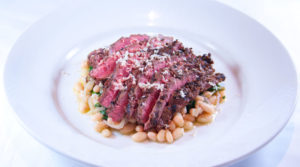
The Wagyu flank is one of the new menu items at Revolution Grille developed by chef Wesley Wright. Wright, who has been at the Monroe Street eatery for eight months, looked for influences from around the globe for the new dishes. Photo Courtesy Revolution Grille
Eight months into taking over the kitchen at Revolution Grille, chef Wesley Wright is introducing some ethnic creativity to the menu.
Wright, who is also general manager at the 2-and-a-half year-old eatery at 5333 Monroe St., debuted nine new items to diners in February. Despite his eight years at Ciao!, those assuming Wright would lean heavily on his Italian dining background would be mistaken.
The Wagyu flank is one of the new menu items at Revolution Grille developed by chef Wesley Wright. Wright, who has been at the Monroe Street eatery for eight months, looked for influences from around the globe for the new dishes. Photo Courtesy Revolution Grille
Instead, the classically trained Wright has sought inspiration from all corners of the globe for his latest offerings, including Canada, Africa, India and Asia. New additions to the menu include: beef bourguignon poutine, chipotle tamarind pork, grilled Caesar salad, croque-madame, curried potato flatbread, Wagyu flank, root beer pork, cauliflower steak and Meyer lemon tart.
“[At Ciao!] I was immersed in Italian ingredients, creating Italian specials, working with Italian foods, but I’m classically trained from all around the world,” Wright said. “People thought Revolution Grille was going to go Italian now. I can assure you, that’s not the case.”
While Wright has gotten a favorable response to many items on the list, there are a couple of dishes that have become quick favorites.
Many people are starting their meals off with the beef bourguignon poutine ($10.95), he said. Poutine, which originated in Quebec, Canada, is traditionally French fries topped with brown gravy and cheese curds.
“We’ve taken that and elevated it into a little bit more of a nicer dish where we take fingerling [potatoes], roast those with some herbs, cut them in half and sear them,” Wright said. “So you get that crunchy texture but it’s not a deep-fried, French-fried product. It’s different, a little more classic.” A beef bourguignon short rib gravy is placed atop the dish.
The Wagyu flank ($23.95) is also attracting a lot of attention, Wright said.
Wagyu is “the king of beef,” as Wright explained it. When it comes to Japanese beef, people know Kobe beef but “this is Papa,” he said with a laugh.
“The thought process behind this beef was that this cow is going to live the most relaxed lifestyle possible,” Wright said. “They would feed it a high-fat diet, they’d give it beer, they’d massage it with sake. This animal would live like a king. What this did is enhance the fat, the marbling in the meat.”
Even while serving the king of beef, Wright looks to shake things up for customers.
“I try to do something different with that set too, because people are like ‘steak and potato, steak and potatoes, steak and rice,’” he said. “I get away from that.”
The meat is placed atop Great Northern beans tossed with bone marrow vinaigrette.
For the non-meat crowd, Wright presents the cauliflower steak ($11.95). Here, it’s presented with a harissa tomato sauce and olive-caper-raisin salad.
“We always try to offer something vegan. Not just vegetarian, but vegan,” he said. “Harissa, you see it more and more. It’s a growing ingredient used in sauce a lot. It’s very flavorful.”
Even something as commonplace as a Caesar salad can use a twist.
Revolution Grille creates a grilled Caesar Salad ($7.95) by seasoning and grilling a wedge of Romaine lettuce and adding crispy parmesan, prosciutto crumbles and polenta croutons. The dish may still raise some eyebrows, Wright admits.
“I think people are still at the point where it’s like, ‘A grilled salad? Whoa,’” he said with a laugh.
To finish off the meal, Wright has added a twist of local citrus, of all things, with the Meyer lemon tart ($4.95).
He gets lemons from Hoen’s Garden Center & Landscaping in Holland, where a large Meyer lemon tree grows inside the greenhouse.
“It’s local, and it’s something that’s not going to sit heavy at the end of the meal,” Wright said of the dessert. “I really try to stay with the seasons, and with local ingredients.”
As for the future, Wright is hoping to implement some ideas he brought back from Hawaii, where he recently got married.
He hopes to introduce a little of the 50th state’s flourishing fish scene to Revolution.
“Of course, we don’t want to copy and paste, but we’ll get some ideas and influence and take it back and twist it our way,” he said. “I’ll be bringing some ideas from there, looking at some of the applications they do there.”
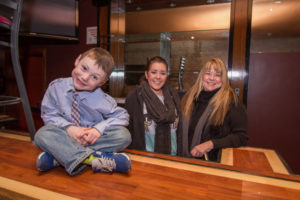
Cheryl Jiannuzzi, owner of Martini & Nuzzi’s, right, with her grandchildren Tiana Moore and Anthony Jiannuzzi at the restaurant’s second location on North Huron Street Downtown. Toledo Free Press Star Photo by Christie Materni
Martini & Nuzzi’s, already known for the food, martinis and live music it offers at 6023 Manley Road in Maumee, will soon have a second location open Downtown.
Cheryl Jiannuzzi, owner of Martini & Nuzzi’s, right, with her grandchildren Tiana Moore and Anthony Jiannuzzi at the restaurant’s second location on North Huron Street Downtown. Toledo Free Press Star Photo by Christie Materni
Owner Cheryl Jiannuzzi said she hopes to have the new location at 329 N. Huron St. open in late March, just in time for the Mud Hens season to begin. The expansion is coming at a time when Downtown is revitalizing, she said.
“I just thought that Downtown is picking up and I think that right now is the right time to get in on it,” she said. “We have a lot of different ideas. We have a lot of good entertainment. We have loyal customers.”
Jiannuzzi fell in love with the location, which formerly housed The 329, Ole Taco & Tequila and Diva.
The new location underwent renovations (including new floors) before Jiannuzzi chose it. She said she fell in love with the brick walls and wood floors.
“It’s nice,” she said. “It looks like our bar.”
Its proximity to the Huntington Center made the new location appealing as well. Jiannuzzi plans to capitalize on the business they get from those events.
The neighboring bars and restaurants have been welcoming to Jiannuzzi. She has plans to work with them in the future.
As is the case at the Maumee location, the Downtown bar will host live entertainment. Local acts like Noisy Neighbors, Joe Woods and Chris Shutters have been known to play at the Maumee location.
The new location will also have valet parking and an “Express Menu” for people on lunch breaks who have limited time.
Jiannuzzi planned the menu and the martinis. Some martinis include the Abra Cadabra, the Bananarama and the Green Eyed Monstor. Food items on the menu include paninis, pasta, pizza and burgers, but Jiannuzzi is particularly fond of the meatballs.
The restaurant is intended to be a family business and Jiannuzzi said she hopes to pass it to her kids when she is gone. She helped work in her own parents’ restaurant when she was a kid.
“I’ve always wanted to do it,” she said. “I’ve been doing this since I was 10 years old at my parents’ restaurant. I made homemade candy.”
Jiannuzzi started to make bigger decisions about her life after a health scare.
“I was in the hospital, I had gangrene of my appendix and my doctor said, ‘Five more minutes and you would’ve been dead. Whatever you plan on doing, you better do it now,’” she said.
The restaurant plans to shut down the street to celebrate Mud Hens Opening Day on April 16. The event will include a tent and live music.
Consumers are always looking for tips on navigating the often overwhelming wine departments
.
As a result, I’m often asked for some “insider intel.” Like many wine industry professionals, I’m currently quite enamored by Beaujolais.
It’s a name you undoubtedly recognize. Maybe you’ve had Beaujolais Nouveau (more on that later), or maybe you just recognize it from older pop culture references. Either way, Beaujolais is making a comeback in a big way right now and sommeliers all over the world are tapping into its diversity and adaptability.
Beaujolais is a French appellation, technically located within Burgundy, but it’s so far south that the distance between Beaujolais and the rest of Burgundy is greater than the entire remaining appellation.
The villages of Beaujolais occupy the rolling hills and countryside just north of the gastronomic capital of Lyon. Beaujolais is typically a red wine, made from the Gamay grape.
Gamay is an offspring of pinot noir, the great red grape of Burgundy (and now California and Oregon). It shares much in common with its parent, Pinot Noir, except it ripens about two weeks earlier. Those are two crucial weeks.
Great pinot noir is a balancing act, with tragic vintages sprinkled in every so often. The most volatile time for any grape is in the final weeks before harvest.
Because it comes in earlier, it has a different character than red Burgundy. It tends to be, for lack of a better term, quite grapey. We often discuss wine flavors in colors — red fruit, blue fruit, black fruit — things you associate with the analogues of berries or other fruits.
Well, Beaujolais is fairly unique in that it tastes almost purple. Along with that you can, of course, expect to find all of the other colors, but there is a really charming underlying “purpleness” to Beaujolais that is very appealing.
When shopping for Beaujolais, there are three distinctions you will find on the label: Beaujolais Nouveau, Beaujolais-Villages or Cru Beaujolais (with one of 10 allowed villages included on the label).
Nouveau is immensely popular and is meant to be consumed chilled and immediately. These wines are made quickly and released to celebrate the end of the harvest in the third week of November, coinciding with a huge festival of the same name.
While certainly a fun tradition, you can buy the next step up — Beaujolais-Villages — for very close to the same price and get a much better wine. Beaujolais-Villages is one of my go-to great values. You can expect to spend between $15-$20 for a bottle.
From good producers, these wines show a ton of depth and are quite fascinating. The third step up, Cru Beaujolais, tends to isolate specific styles and differentiates the terroirs. Each of the appellations is a little different. The most famous are Brouilly (light and fruity), Fleurie (richer, with more red fruit), Morgon and Moulin-à-Vent (the last two are both earthy and need a little time).
Also available, although less common, are: Régnié, Chénas, Juliénas and Saint-Amour. Great Cru Beaujolais can be found for $20-$25.
About 90 percent of Beaujolais (like most things it seems) is made by about a half-dozen négociants.
Négociants are basically large companies that buy fruit on the open market and blend it all together to make a final product.
Their wines can be good, but you’re much better off looking for a grower/ producer. There shouldn’t be a huge price difference between the two and you’ll get much more reward with the grower.
Beaujolais has long provided the bistro wines of Paris, which might suggest they are simple. While they are not simple, they are versatile and dependable. They work with a wide range of foods from salads and fish to meats and stews.
I know of at least one great local restaurant that has replaced their pinot noir by the glass with a Cru Beaujolais (hint: it’s Downtown). You can tweet wine pairing or wine shopping questions to @ampelography
Adam Mahler is the founder of Ampelography, a wine sales and marketing company based in Toledo (ampelographywines.com). He can be reached at [email protected]. You can tweet wine pairing or wine shopping questions to @ampelography.
Forest and Aaron San Filippo created their own company, Flippfly, which recently released the fast-paced ‘Race the Sun.’ Photo Courtesy Flippfly
It’s like playing the greatest old-school arcade game that never existed. You are in control of a small aircraft, flying just above the ground, whipping across a landscape at blinding speed. The areas you traverse are littered with simple objects like cubes, cones and spheres. You hit any of them and kaboom — it’s a fast end for your fast ride.
Forest and Aaron San Filippo created their own company, Flippfly, which recently released the fast-paced ‘Race the Sun.’ Photo Courtesy Flippfly
This is “Race the Sun,” a new independent video game that combines arresting visuals with endlessly exciting flying and a thrilling chase against the clock. The concept is deceptively simple, yet wildly addictive. It’s the kind of tremendously fun title that small indie developers specialize in, and they don’t get much smaller than “Race” creators Flippfly — a team comprised of two brothers, Forest and Aaron San Filippo.
“[I] started out doing graphic design, first for an established retail business and then as an independent freelancer,” Forest said in an interview with Toledo Free Press.
“And my brother was working for Raven Software here in Wisconsin, which was — and still is — a subsidiary of Activision. So he was working making games like ‘Call of Duty’ and all that stuff. And he was getting to a point in his career — he’d been doing professional game development for about eight years, and he was ready to do his own thing. …
“So he came to me with this, and he said, ‘We’ve always talked about it. … Let’s give it a shot.’ And so I jumped onboard,” Forest said.
Though the San Filippos never owned a gaming console growing up, the occasional weekend rental of a Super Nintendo gave them the chance to sample a slew of classic games during the 1990s — including the iconic flying game “Star Fox.”
“That aesthetic just got imprinted on us. We just thought that was the coolest game in the world, and I don’t know how many times we played through it,” Forest said.
When the brothers first started developing their own titles in 2012, their different points of view and areas of expertise began manifesting themselves in the process by which their work began to develop — Forest on design, Aaron on programming.
“We had just finished up a little children’s app,” Forest said. “Although we liked that, we wanted to make games. … And at one point, my brother drew this picture in a Google SketchUp. And it was this big, open area, with a couple sparse buildings in there. And he said, ‘Wouldn’t it be fun just to fly through this, really, really fast?’ And that was really the beginning of it.”
The modest success of “Race” on PC has allowed the production of a version for PlayStation systems.
“One of the strong ethics that we have in our statement there is, we are really focused on fun,” Forest said. “It’s a little difficult as an indie these days to compete in a market where there’s a lot of manipulative gameplay design. And this is nothing new, this goes back to the arcade era. In the arcade era, they were trying to get you to pump in one more quarter. In our era, they’re trying to get you to buy that in-app purchase, or pay to get you a little stronger, whatever that happens to be.
“And for us, we just want players to be able to jump in and feel free. That sense of, ‘I’m just here to enjoy this.’ That’s really what we experienced as kids.”
At their Jan. 20 meeting, the Board of Lucas County Commissioners voted unanimously to authorize a continuous (permanent) 0.25 percent increase in the Lucas County sales tax rate, which will go into effect on April Fools’ Day. This was the final step in a process that was first revealed by local media Dec. 1.
Sales taxes are a revenue stream used to fund government operations. The Ohio legislature and the governor determine the tax rates and which goods and services are subject to the tax and which are exempt.
An area’s sales tax has three possible components. The first is the state’s portion, which is currently 5.75 percent in Ohio (a proposal to increase this rate by 0.5 percent has been advanced by Gov. John Kasich). The second is a county sales tax, which can range from 0.25 to 1.5 percent. The third is a transit authority tax used to fund transit authorities and mass transit districts. The transit tax can range from 0.25 to 1.5 percent. For every $100 spent in Ohio, you might be subject to a sales tax of $5.75 to $8.75 depending on the county in which you make your purchase. County sales taxes can be levied by a vote of the electors or imposed by the county commissioners. Transit taxes must be levied by the electors, but do not need the permission of the commissioners to appear on the ballot.
On Dec. 21, the Lucas County Commissioners announced they had started the process to have this tax increase completed and available for a vote at the Jan. 20 commissioners meeting. There were three public hearings held for information and the airing of comments from residents. The hearings began with a presentation stating the case for support of the tax rate increase. Four residents spoke at the first meeting, none at the second and about a dozen at the third. The third public meeting ended less than two hours before the vote on the resolution.
I attended the first and third meetings. Only one speaker was in favor of the tax. Others voiced concerns about what the money would be spent on or gave suggestions on how the new revenue should be used. Suggestions were given on increasing government efficiency and cooperation between other government units. The overall impression I took away was that 80 percent of the speakers were flat-out against the increase and would vote against it if given the chance.
After seeing the PowerPoint presentation at the first meeting, I did some research on the information it provided and found errors. A claim that 48 Ohio counties are already charging the maximum 1.5 percent rate was outdated because a temporary 0.5 percent tax in Erie County expired Sept. 30. A county administrator, not a commissioner, told a speaker that the transit tax rate in Cuyahoga County was 0.5 percent when the tax rate is actually 1 percent. There were also math errors and discrepancies in cited staffing levels for Lucas County, which were reduced between 2008 and 2014.
Examples showing how major county revenue streams have been affected since 2007 did not provide the source of the numbers being used. Relying on the official 2013 “Comprehensive Annual Financial Report for Lucas County, Ohio,” I could not find dollar amounts that correlated to the figures used in the charts. A U.S. Census report or a State of Ohio publication can be used to check and verify the county’s numbers. When no sources are given for the data used, should a questioning person just accept those figures as fact when he has found errors in other information provided by the same people?
The commissioners presented a comparison of Lucas County sales tax rates with those of other urban counties. Cuyahoga (8 percent), Franklin (7.5 percent), Hamilton (6.75 percent) and Montgomery (7.25 percent) counties were selected to show how the new Lucas County tax rate (7.25 percent) would not be out of line with these urban counties.
The misleading part of the comparison is that each of these counties’ tax rates, except for Hamilton County, includes a transit tax.
To compare apples to apples, exclude the state sales tax and any transit taxes. Comparing only the county sales tax for the top Ohio counties by population shows a less favorable comparison of sales tax rates:
Summit (No. 4) and Stark (No. 7) counties have a 0.50 percent sales tax rate.
Butler (No. 8) and Lorain (No. 9) counties have a 0.75 percent sales tax rate.
Hamilton (No. 3), Montgomery (No. 5) and Mahoning (No. 10) have a 1 percent sales tax rate.
Cuyahoga (No. 1) and Franklin (No. 2) counties have a 1.25 percent sales tax rate.
Lucas County (No. 6) will have a 1.50 percent sales tax rate.
In addition Warren (No. 11), Trumbull (No. 12) and Clermont (No. 13) counties have a 1 percent sales tax rate.
Ohio counties that have a transit tax are:
Cuyahoga: 1 percent
Franklin: 0.5 percent (0.25 percent permanent and 0.25 percent temporary)
Montgomery and Summit: 0.50 percent
Lake, Mahoning, Portage and Stark: 0.25 percent
Will TARTA seek a levy and try to make Lucas County the ninth Ohio county with a transit tax?
Those residents who attended the public hearings and saw the commissioners’ presentation were given three minutes to respond. Without prior knowledge of what the commissioners had prepared and with little time to form a response, the public was not given an adequate opportunity to form a reasoned rebuttal. If a few evenings with a laptop doing Google searches, taking notes and printing off some articles during TV commercials gave me the information I have accumulated, there is likely much more that a focused group with proper time to prepare could accomplish in rebutting the commissioners’ presentation.
Did the commissioners make a case to raise the sales tax rate? They must have, because they took less than two hours after the final public hearing ended to unanimously pass the rate increase.
This was the only course available to them because they were up against the clock, and any delay could have collapsed the whole operation. If this group had made their presentation to the panel on “Shark Tank” do you think the entrepreneurs would invest in or pass on Lucas County?
The commissioners did show that, when properly motivated, they could improve government efficiency. It took less than 30 days to impose a permanent sales tax increase that will go into effect at the earliest possible date while following all rules and regulations and avoiding opposition or negative publicity that could have doomed their efforts.
What were some other options available to the commissioners? They could have:
Submitted the tax to a vote by county residents prior to enactment.
Enacted the tax followed by a referendum at the next general election.
Made the tax increase temporary for one to three years.
Dedicated the monies raised by the tax increase to certain operations or functions instead of just dumping it into general operations.
Capped the amount of new revenue to a specific dollar amount ($2.5 million per quarter and $10 million for one year) which could be used immediately. Additional revenue could be reserved for a specific time (one year) before being used and transferred only at a predetermined rate (25 percent of the surplus balance per quarter) for predetermined purposes.
None of this was done. The commissioners need to be questioned and made to explain specifically why they disregarded each of the above options. Local print, radio, television and other media must pursue answers on this issue with the same zeal they use to report toxic algae blooms, speed traps or the shooting of a dog by a small-town police officer.
Fiat Chrysler Automobiles (FCA) has announced it has 28 open salaried positions and numerous hourly positions at its Toledo Assembly Complex in North Toledo.
A spokesperson said there’s no need to read between the lines about what may or may not happen next with Jeep production in Toledo — the open positions are part of its normal business practices.
“These openings are just in order to keep up the business,” said Jodi Tinson, manufacturing and labor communications manager for Chrysler. “It’s fairly standard, and there’s also attrition because there are folks leaving or retiring.”
Among the salaried openings are positions such as maintenance supervisors, dimensional controls specialists, controls engineers and unit leaders. Basic qualifications for these include a bachelor’s degree in a related field. Hourly openings are in skilled trades, such as electricians, millwrights and pipe fitters. Qualifications for these include a high school diploma or equivalent and appropriate certifications. Complete details and qualifications for all positions can be found at chryslercareers.com under “Search Jobs” followed by “Manufacturing Jobs.”
Rogers High School graduate Tyler Wiley of Toledo inspired Toledo Public Schools to offer tyler’s travel pass to district residents with disabilities, allowing free entry to regular season games and other events. Toledo Free Press Photo by Ashley McMahon
“Don’t underestimate the things that I will do.”
Rogers High School graduate Tyler Wiley of Toledo inspired Toledo Public Schools to offer tyler’s travel pass to district residents with disabilities, allowing free entry to regular season games and other events. Toledo Free Press Photo by Ashley McMahon
British singer Adele sings this line in her hit single “Rolling in the Deep.” Tyler Wiley of Toledo — arguably the 26-year-old star’s biggest fan — lives by the same motto. Anyone who’s met Wiley quickly finds out he should never be underestimated.
Wiley, 22, said he adores Adele for her beauty, voice and charisma. He also models her positivity and grace through his own actions. When he’s not listening to music, he’s busy knitting hats for children in need and painting scenes to sell at Shared Lives Studios, a collaboration with Lott Industries in Downtown Toledo.
A graduate of Rogers High School, Wiley has been an active member of the Toledo Public Schools (TPS) community since he was in elementary school. Living with Down syndrome, he inspires and encourages others to respect the disabled community through communication and interaction — as well as his wit and charm.
His mom, Sandy Wiley-Steward, said she had Wiley start speaking at TPS board meetings in fifth grade to help give him exposure to a diverse group of individuals.
“I started taking him to meetings and he would read one little sentence about what he’s doing. Something positive,” Wiley-Steward said. “It was simple, but I was doing it to help him learn to speak publicly.
“If he has something prepared and written, he can read in front of a thousand people. It doesn’t bother him,” she said. “He overcame a lot of obstacles by practicing.”
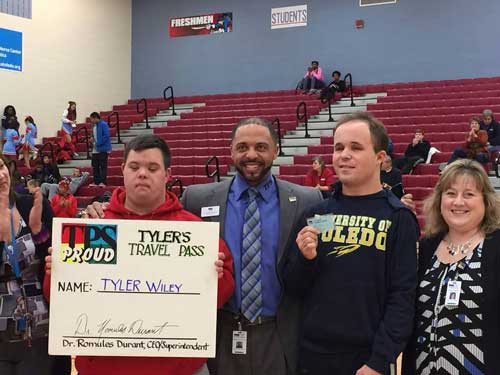
Wiley put that practice to great use in November when he presented an original idea to the TPS Board of Education. Wiley inspired TPS to create Tyler’s Travel Pass in collaboration with the Lucas County Board of Developmental Disabilities (DD).
The program aims to improve the lives of those in the district living with disabilities. This pass allows disabled community members to attend school activities, including sports games and plays, free of charge.
Wiley’s love for sports and the desire to watch his brothers, Aaron and Ian Steward, play basketball inspired the idea.
“He wanted to go to these three games in one week, and I was like, ‘Buddy, you got a check for $18 for two weeks. It’s $6 every time you want to go.’ He said, ‘I’m going to change that,’” Wiley-Steward said.
Wiley’s favorite sports are basketball, baseball and volleyball and he loves watching his brothers participate on the court. Aaron is in ninth grade and plays for Bowsher High School; Ian is in seventh grade and plays for Beverly Elementary.
Support from his family allowed Wiley to move forward with his initiative.
“His family is so supportive of him. They back him up and don’t just accept things how they are. They allow him to chase his dreams,” said Steve Mentrek, manager of Tyler’s Travel Pass distribution with the Lucas County Board of DD.
“Tyler has a lot of family support. When he has an idea, he can run with it,” added Lon Mitchell, manager of public information for Lucas County Board of DD.
Wiley thought the pass would offer the perfect opportunity to enrich not only his own life, but also the lives of all disabled community members living within TPS’ district.
Tyler Wiley, left, with Toledo Public Schools Superintendent Romules Durant and BJ Axe. Wiley and Axe are the first two recipients of Tyler’s Travel Pass. According to the Lucas County Board of Developmental Disabilities, about 10 people have applied for the pass so far. Photo Courtesy Toledo Public Schools
After the initial meeting in November, Wiley used his persistence to ensure his idea came to fruition.
“He was emailing people every day. He’s very persistent,” Wiley-Steward said.
Wiley’s dreams came true when TPS teamed up with the Lucas County Board of DD to approve the resolution for the pass within one month of his presentation, thanks to the essential need for a program of this nature, said Linda Meyers, transformational leader of community relations for Bowsher and Rogers learning communities.
“Tyler’s incredible,” Meyers said. “He made a huge impact on the board and we all thought this was a great idea.”
“The board embraced it. There is not another district in the region or state, maybe even nationally, that is doing this,” Wiley-Steward said.
This is the only free pass program for disabled community members offered within the Northwest Ohio region, and Wiley-Steward hopes other school districts take notice.
“This is setting the bar,” Wiley-Steward said. “I would love to see all the school districts provide this service for people with developmental disabilities.
“Anything to help them get out in the community. That’s one of the biggest struggles and, financially, it’s tough.”
Mentrek said he’s thrilled to get these passes distributed.
“I think it’s great,” Mentrek said, “As Tyler’s mentioned, fixed income makes it difficult to do fun, recreational events. Especially with the price tags. Just like you and I, they want to be a part of the community as much as possible.”
Mitchell said integration for those it serves is the ultimate goal of the Lucas County Board of DD and Tyler’s Travel Pass is the perfect way to help achieve it.
“We would like to see more people with developmental disabilities sitting in the stands, sitting beside people who don’t have a disability,” Mitchell said. “The mission of the board is to make sure people with developmental disabilities have the same opportunities as everybody else.”
Currently, there are 655 students in kindergarten through 12th grade who have a disability in the TPS district, Meyers said. There are also hundreds of alumni living in the TPS district who are eligible to receive the pass.
Community integration is highly beneficial for the city, Mentrek said.
“It gives the general community an opportunity for exposure to individuals with disabilities, which is a huge advantage,” Mentrek said. “When community members have contact and interactions with people with disabilities, it allows opinions and attitudes to positively change.”
This program allows those with disabilities to have a voice and for people to pay attention, Mitchell added.
“It’s a new world for people with developmental disabilities,” he said. “This is something different than we would have experienced in the past, say 10, 15, 20 years ago. It’s a positive change. An opportunity for individuals to interact more with the general public.”
Wiley’s program is already improving the lives of fellow community members with disabilities.
“Tyler is a wonderful example of a self-advocate. [He’s] out there trying to make life better for all,” Mitchell said.
Wiley’s friend BJ Axe, 25, received his Tyler’s Travel Pass last month and said he is excited to take advantage of the opportunities available though TPS.
“I think it’s great that Tyler took the initiative to create the pass,” Axe said.
He said he plans to use the pass for sporting events at Bowsher High School, including basketball, baseball and football.
The pass also increases school spirit, according to Meyers and Wiley. Wiley loves leading the cheering section at high school basketball games, his mom said, and the fans follow his lead.
“The cheerleaders love him,” Wiley-Steward said. “He’ll get up and say, ‘Let’s Go, Rebels,’ and then everyone in the stands will start cheering.”
The Lucas County Board of DD is distributing Tyler’s Travel Passes now. Any community member living in the district who is registered with the board is eligible to receive a pass. People can contact their service and support specialist through the board to fill out a referral form and get approved, Mentrek said. For more information on receiving Tyler’s Travel Pass, contact the Lucas County Board of DD at (419) 385-5771.
“We have roughly 10 requests so far, but with it just being released I am sure we will see that number rise over the next few months,” Mentrek wrote in an email to Toledo Free Press.
According to TPS, the pass will allow the holder to get into all TPS home athletic events for free (excluding All-Star games, City League championships or state tournaments), as well as plays and musical performances at TPS schools by TPS performers.
It was a surprise to Wiley and his family when TPS decided to name the pass after him.
“The fact that they named it after him was completely a surprise. We had no idea,” Wiley-Steward said.
Meyers said Wiley’s charisma and enthusiasm were the driving force behind this passion project, which is why TPS made the pass his namesake.
Leonard Nimoy directing 1994’s “Holy Matrimony.” Photo via imdb.com / Courtesy Aurora Productions LLC
In the world of pop culture, there are few characters more distinctive and memorable than the alien named Spock.
Leonard Nimoy directing 1994’s “Holy Matrimony.” Photo via imdb.com / Courtesy Aurora Productions LLC
His face is the first many think of when they think of “Star Trek.” But beyond his presence as an iconic figure, Spock’s importance to the franchise as a guiding force and symbol for tolerance, nonviolence and, above all, an unwavering curiosity cannot be overstated.
That is who Spock is as a character. But Leonard Nimoy, as an actor, artist and man, was far more than that. He was a living icon and an inspiration. He was kind to his fans and aside from a few bumpy moments here and there, he was remarkably comfortable with being eternally identified with the role that made him famous. The role that he had made famous.
Nimoy had been obsessed with acting long before “Star Trek” came to him. A Jewish kid from Boston, the young Nimoy came to Hollywood in the 1950s, and found work in small roles on TV and film. He said he often relished playing roles that made him feel like an outsider or misfit, like the misshapen boxer he played in his first starring role, “Kid Monk Baroni.” Who among us cannot identify with feeling as though the universe was rejecting them?
Eventually, Nimoy’s talents caught the eye of producer/writer Gene Roddenberry, who had a plan for a sci-fi series called “Star Trek.” Roddenberry felt it was crucial to the show that one main character be obviously alien, to give the audience a sense of the show’s universe-spanning themes. In Nimoy, he saw a performer who could embody this central role while still betraying a core of humanity — or half-humanity, at least.
Spock would become the breakout character of the series, drawing in loyal fans from across the spectrum of demographics and leaving his mark on pop culture long after the show’s initial cancellation in 1969.
As the “Trek” cult endured and grew through its airings in syndication, Nimoy admitted to feeling a level of resentment toward the character, because no matter what he did elsewhere, the pointy-eared Vulcan seemed to be close by.
The implication that he “hated” Spock, however, was almost certainly overblown, a byproduct of public misinterpretation of the title of his 1975 memoir “I Am Not Spock.” Twenty years later, he named his follow-up book “I Am Spock,” as a way of reconciliation.
It was Spock who opened doors for Nimoy in the years following the franchise’s resurrection on the big screen. Nimoy would direct the series’ third installment, which saw Spock return from an untimely death. He took the helm again for arguably the best movie of the series, “The Voyage Home,” which demonstrated Nimoy’s deft touch as a comedic filmmaker. It was this aspect that led to Nimoy’s helming the wildly successful 1987 comedy “Three Men and a Baby.”
Following his pseudo-exit from “Star Trek” in 1991’s “The Undiscovered Country,” Nimoy continued to explore artistic pursuits that brought him joy — poetry, photography, etc. As before, Spock was never far behind; but by this time in his life, it was plain any resentment Nimoy had for that aspect of his existence had long been reconciled.
He appeared as Spock on episodes of “The Next Generation,” acting as a bridge that helped unify fans of classic and new Trek. His role as an older Spock in JJ Abrams’ rebooted “Trek” series gave those films much needed gravitas. And as he interacted with fans via his wildly popular Twitter account, he ended most every tweet with the signature line “LLAP”: Live long and prosper. Sp
It was through his Twitter feed that Nimoy announced that anyone interested could consider him their honorary grandfather. Appropriate, since to many, he already was. At a time when those passionate about geeky issues found themselves becoming more mainstream, Nimoy helped pave the way via his wildly popular character who embodied and ennobled many of geek culture’s traits — not least of which was that sense of being the eternal outsider, something Nimoy himself so identified with.
That’s why the loss of Nimoy cuts to the bone for so many. He, and the character he created, was one of the first steps toward acceptance for geeks everywhere. And by being an intellectual figure in a universe of brainless action heroes, he inspired countless individuals to study science and technology, paving the way for those who continue to change the world.
For millions, Leonard Nimoy was indeed a grandfather, a role model, a respected artist and a gracious and kind man. And in that spirit, he will never be forgotten.
Jeff McGinnis is pop culture editor of Toledo Free Press. He can be reached at [email protected].