Toledo is a messy place. Gritty. It exudes a special energy. One in which its people will raise hell when things go awry but maintain pride in the town all the same. One that gives those who spring from its tangled web a tough backbone and a zeal for real talk.
Having been forged in the city’s belly, Toledo Free Press has come to embody those things over the years. It has broken stories of sorrow and abuse, stories of joy and amusement.
I launched my journalism career more than six years ago in that second story office on Monroe Street, and I can thank TFP for many of the skills I use today as a journalist.
The paper taught me to question everything — and not to be intimidated by big competition, but to thrive on it. It made me realize that the quality of news reporting does not rest in the resources you’re given, but by the drive to demand answers and make the world a better place.
I’m now an investigative reporter at The Arizona Republic who digs through public records, analyzes massive data sets, builds charts and maps and talks to experts to get to the bottom of complicated stories. I’m about 2,000 miles away, but I’ll never be too far to feel that Toledo and TFP pride.
Caitlin McGlade is an investigative reporter at The Arizona Republic. She interned at Toledo Free Press in 2009 and returned as a staff writer from 2011-12.
Toledo Free Press gave me my first college internship in 2005 — back when the newspaper was virtually brand-new and still getting its swagger.
I started learning there what it takes to be a crime reporter. One of the first times I knocked on strangers’ doors in pursuit of a story came when I was working on a cover piece about two Jeep workers involved in murder-suicides.
A decade later, I’ve knocked on more doors than I can count while on various law enforcement beats at The Washington Post. That’s where I work now, covering federal courts in the Eastern District of Virginia. I started at The Washington Post young; it was my first job out of college. But I never felt unprepared or inadequate, and I think my experience in Toledo is a big reason for that.
My family still lives in Toledo, and I visit the city regularly. I’m so happy to see two newspapers still surviving and competing there, and I hope that continues for years to come.
Matt Zapotosky is a federal courts reporter at The Washington Post. He interned at Toledo Free Press in 2005.
I never exactly wanted to be a writer. I wanted to take care of children as my life’s work, so I did. As I started to become an old pro at motherhood, however, I thought I had a few minutes to spare somewhere in my crazy life and decided that I might try my hand at writing an article or two for the local parenting magazine.
.
As luck would have it, I made acquaintance with then-Toledo Free Press editor, Michael S. Miller, and thought he would be the perfect resource to proofread my rusty prose. I felt slightly ridiculous, afraid he might view my request as an aspiring singer trying to slip her demo to a successful producer, but I really just needed someone to make sure I had crossed all of my T’s and dotted all of my I’s before I leapt unsophisticatedly into the great writing abyss.
He kindly obliged without so much as a hint of condescension for such a naive newbie. Much to my surprise, instead of handing back the red-marked pages I expected, he handed me the opportunity to write my own weekly column. Upon reflection, he handed me a new way to experience the world, a new way of life.
Having the professionalism to realize I had absolutely no idea how to be a writer, Miller gave me a crash course. He didn’t explain grammar or tell me what to write; he explained growing a thick skin, having to write even when you don’t want to and getting stared at in public by people who can’t put their finger on how they don’t quite know you — the things I truly needed as I was just starting out.
I didn’t need to know how to write; I needed to know how to be a writer. Attempts to give credit to Miller and Toledo Free Press for making me a writer are quickly dismissed by the named parties.
TFP isn’t a place where you are molded into a certain likeness; it’s a place where everyone shows up with their individual talents and we all make something great together. Even as a writer, it’s difficult to express ample appreciation for such a place, a place that makes you feel like you have a voice and your words have a home.
If I’ve learned anything after almost seven years as a professional writer, however, it’s that simply stated is usually best. Thank you, Toledo Free Press, for giving Toledo a choice and me a chance. Happy 10th!
This week marks a proud milestone for Toledo Free Press. Ten years ago, on March 16, 2005, we published our first issue.
.
As I look back over the 10 years we have been in business, I marvel at all that has occurred in that time. The vision I had for a community-focused weekly newspaper was matched when I found Editor in Chief Michael S. Miller up in Adrian, Michigan. He was what I called “lightning in a bottle.”
Michael agreed to come to Toledo to work on a “glass half-full approach” to this city. He was very adamant I stay out of his way. I agreed and let him do his thing while I ran the rest of the business. That arrangement never changed.
The five straight “Best Weekly Newspaper in Ohio” designations from the Ohio Society of Professional Journalists say all you need to know about what talent Michael brought to the table. Now Sarah Ottney, who was mentored by Michael for four years, sits in that seat and has already shown similar skills.
I’ve watched tremendous writers come through our doors, including Brandi Barhite, whom Michael often called one of the best journalists and feature writers he’s ever known; Caitlin McGlade, who never backed down from a challenge and is now an investigative reporter with The Arizona Republic; Jeremy Baumhower (who can forget Myles Eckert?); and Matt Zapotosky, who’s now covering federal courts for The Washington Post. Duane Ramsey has been writing business and economic development stories for most of those 10 years and Jeff McGinnis brought his unique pop culture voice to us five years ago.
For our first two years, we were based out of the Toledo Edison building Downtown. Jim Murray, then-president of Ohio Edison, gave us the space to start the business.
It has been wonderful to watch the growth of Downtown’s Warehouse District from our front-row seat on Monroe Street, where our offices now stand. When Blarney Irish Pub owner Ed Beczynski and I bought this building from Dave Ball (another visionary) in 2006, we had no idea what would happen around us. From the Huntington Center, Table Forty4 and PizzaPapalis sprouting up nearby to M Osteria recently opening, Black Cloister Brewing Co. coming this month and Veritas Cork & Craft right around the corner — what a hot corner we’re on where virtually nothing stood before we moved in!
One thing TFP has done from the beginning is support local nonprofits (at least the ones that are not bullied into staying away from us). The latest effort, Dine 419, partnered with local restaurants to raise money for Veterans Matter to house homeless veterans (you will never find a more passionate advocate then its founder Ken Leslie).
TFP has been a proud media sponsor of Holiday with Heart Charity Gayla since 2010 and Toledo Pride (started in 2010 by the just-as-passionate Lexi Staples) since 2011. As its media sponsor for the first four of its five years, we helped Leadership Toledo’s Restaurant Week Toledo grow into the immensely popular fundraiser it is today.
Then there were the six charity CDs we produced for Make-A-Wish Ohio, Kentucky & Indiana, American Red Cross of Northwest Ohio and Project iAm — Michael’s babies — which raised more than $70,000.
Lucas County Children Services’ (LCCS) Wear Blue Day, which asks people to take a stand against child abuse, is one of the most touching nonprofits we have supported in our years. Same with the organization’s holiday gift drive. LCCS is a wonderful organization that has taken some unfair hits from other media in town; it does not deserve that.
Food for Thought’s Jam City and Food Fight 419 were also causes we got behind. Smoke on the Water, benefiting the Red Cross, was always a good time.
In January 2007, we shifted publication from Wednesday to Sunday. On our fifth birthday, we launched Toledo Free Press Star, a standalone Wednesday publication covering arts and entertainment, which, in 2013, was absorbed back into the Sunday TFP.
Throughout it all, loyal advertisers like ProMedica (from issue No. 1), Monroe Dodge (Ralph Mahalik Jr. has also been with us from the beginning), Fifth Third Bank, TARTA, Mercy, Hollywood Casino Toledo, Owens Community College, Estate Jewelers, Toledo-Lucas County Port Authority, the Town Center at Levis Commons and Fat Fish Blue have been our lifeblood. Without advertisers who had guts like these companies (and so many more) we would have never made it 10 years.
We have taken our share of punches to the gut as well. Despite an unbelievable lawsuit from a newspaper that wants to step on us and disloyal employees stealing from us, we have found a way to fight through. The loyal and hardworking employees of the paper are the reason we have lasted this long. James A. Molnar is one of the most talented artists I have had the pleasure to know. Chick Reid, who has been working for me for years (first at The Blade and now here), is one of the best-known sales people in town and just a great guy. My now longest-tenured employees, Renee Bergmooser and Pam Burson, are loyal to the bone and some of my best friends.
Many of our columnists have been with us for years. Our cartoons and crossword puzzles are created locally too.
Last but not least are you, our readers. Thanks for sticking with us and thanks for reading.
It’s the people who have made us and who are the key to our success. This is the reason we are still the largest Sunday paper in Lucas County and in my opinion the best.
Thank you, Toledo!
Thomas F. Pounds is president and publisher of Toledo Free Press. Contact him at [email protected].
FIRST ISSUE
The first issue of Toledo Free Press, published March 16, 2005, featured a cover story on crime statistics in Toledo, Maumee, Perrysburg and Sylvania. The story by Dave Wasinger, “Criminal Divide: Beyond the good news of falling numbers, Toledo crime stats offer a glimpse of two very different realities,” remains relevant today.
Toledo Free Press’ first issue
The article featured Maumee shop owner David Swesey, who said he felt safe, and block watch leader Sally Hampton who said it seemed like crime reports dominated the news, and even though statistics showed crime had dropped, she didn’t feel safe. According to the article, crime dropped in Toledo by 5.6 percent in 2004, a drop then-Toledo Police Chief Mike Navarre called “significant” compared to the drops of 1.5 and 1 percent in 2003 and 2002. Arsons, auto thefts and thefts all dropped. Rapes and robberies dropped too, but overall violent crimes — murder, manslaughter, robbery, aggravated assault and rapes combined — rose 3 percent. At the time, Mayor Jack Ford said the increase of block watch programs from 59 to 144 since his election had helped curb crime.
Also covered in the first TFP were the opening of The Market on St. Clair, a former fresh bread, produce and “upscale groceries” store in the Warehouse District, “Meet the Mayor” meetings with Ford, a profile of Toledo-Lucas County Public Library Authors! Authors! series guest Edward P. Jones, the grand opening of Dr. Scott’s Pinball at its new location on Conant Street, a community feature on former drug addict Derek Feniger who turned his addiction to running marathons, a business feature about Toledo-based GatewayDefender offering “new age tactics in the war on spam,” sports features on high school basketball standouts Ben “B.J.” Raymond of St. John’s Jesuit and Ali Wallace of Sylvania Northview and an Arts & Life review of DC Comics’ Gotham Central.
Republished online are Miller’s first column along with Pounds’ first column. Staff writers Vicki Kroll and advertising sales manager Renee Bergmooser have been with the paper since the first issue.
STILL IN THE NEWS
A few of the hot topics we covered 10 years ago are still in the news today.
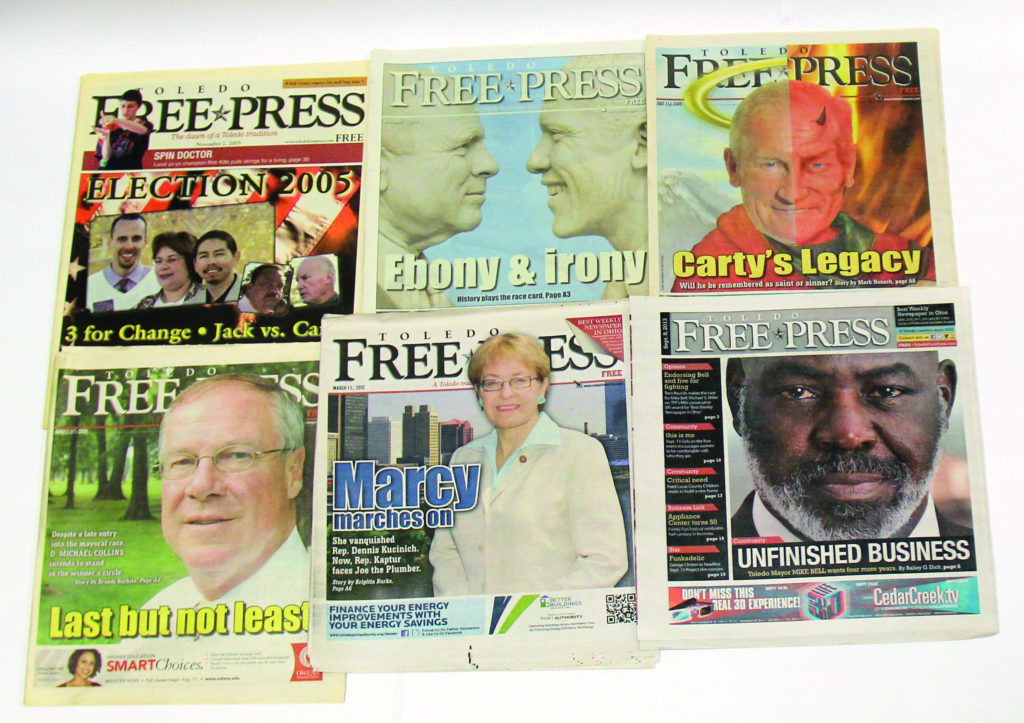
TFP covers in May, June and July 2005 and August 2006 featured developers David Ball and Jimmy Jackson’s plans for the Downtown steam plant. These days it’s ProMedica who has big plans for the space as its new Downtown headquarters. Our Oct. 19, 2005, issue about rioting in Toledo following a visit from the National Socialist Movement (NSM) featured a double cover — one with a black man and another a white man. In October 2006, we revisited those affected one year later, including Lou Ratajski and Terry Rybczynski, whose Mulberry Street bar Jim and Lou’s was looted and burned. NSM recently announced it would return to Toledo next month to host a rally.
POLITICS
Five people have held the office of Toledo mayor since Toledo Free Press first saw print: Jack Ford, Carty Finkbeiner, Mike Bell, D. Michael Collins and Paula Hicks-Hudson. Collins and Bell are tied for most cover appearances, with nine each.
Politicians from all parties and levels of government have been featured in our pages, from mayoral and City Council candidates to members of Congress like Marcy Kaptur, Paul Gillmor and Rob Portman. Presidential candidates Barack Obama and John McCain were covered during their 2008 race as were Obama and Mitt Romney in 2012.
In July 2005, we ran a never-before-published interview with Supreme Court Justice Sandra Day O’Connor. On Jan. 3, 2007, we published Bob Taft’s final print interview as governor.
On Feb. 22, 2009, we spoke to unlikely political firebrand Samuel “Joe the Plumber” Wurzelbacher, the Holland resident who rose to national prominence several months earlier when he asked Obama how his tax plan would affect his plumbing business.
We’ve covered issues such as public breastfeeding (September 2007), when we talked with an area woman asked to leave PacSun at Westfield Franklin Park Mall for breastfeeding her 1-year-old son. In October 2009, we looked at Issue 3, which passed that November, allowing casinos to be built in Toledo, Cleveland, Columbus and Cincinnati. There were two attempts to unseat Finkbeiner and years of well-documented “dysfunction” at the Lucas County Board of Elections.
Younger readers may have a hard time believing smoking in bars and restaurants was once commonplace. But plenty of business owners got quite heated about the issue when it first came to light a decade ago. From 2005-08, TFP featured cover stories about the smoking ban issue at least four times, with owners of Delaney’s Lounge and The Distillery among those vowing to fight the ban, saying it would keep customers away and irrevocably hurt their business. Both bars are still in business.
.
BUSINESS
The heartbeat of a vibrant community is its business environment, and Toledo Free Press has consistently strived to cover business matters as they affect both corporations and the average resident.
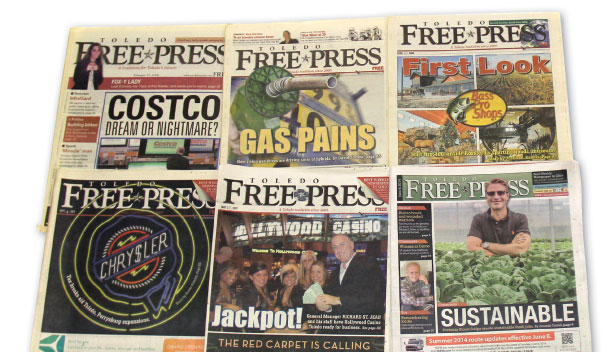
In early 2006, we covered the contentious battle between Toledo Mayor Carty Finkbeiner and Toledo City Council over bringing Costco to Westgate Village Shopping Center.
We celebrated Tony Packo’s 75th anniversary in February 2007, Owens Corning’s 75th anniversary in 2013 and Sam Okun Produce’s 100th anniversary in 2014.
We looked at how rising gas prices were driving sales of hybrids in May 2007, explored attempts to save Downtown science and technology museum COSI in December 2007, offered a tour inside the new Bass Pro Shops in April 2008 and got to know Randy Oostra as he began his position as president and CEO of ProMedica in 2010. We also interviewed personal finance guru Suze Orman in March 2011, provided a look inside the new Hollywood Casino Toledo in January 2012, took an in-depth look at the city’s vital and ongoing attempt to keep production of Jeep Wrangler in Toledo and more.
.
SPORTS
From high school football to college basketball to minor league baseball and hockey, Toledo is a proud and fanatical sports city, and Toledo Free Press has featured a vast array of athletes and sports figures on our pages over the years — many gracing our covers.
TFP’s biggest issue of every year is the Mud Hens Opening Day special section. We also dedicate space each year to the beginning of the Toledo Walleye season as well as the Marathon Classic LPGA golf tournament.
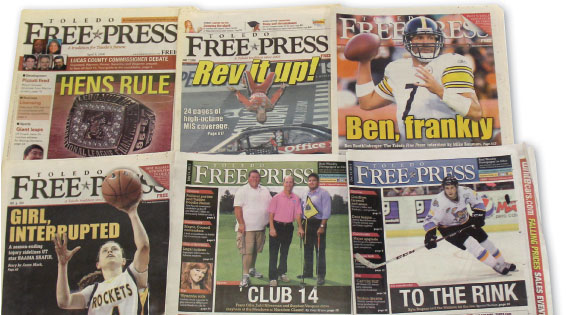
Football has been the cover story 12 times, including four NFL features. Anyone remember Rex Grossman leading the Bears to the Big Game against Peyton Manning in 2007? Or the Steelers vs. Seahawks’ 2006 Super Bowl throwdown in Motown? TFP also featured former University of Toledo star Lance Moore, bound for the Super Bowl with the New Orleans Saints in 2010, and a 2011 interview with Findlay native Ben Roethlisberger when he was QB for the Pittsburgh Steelers.
There was also Ohio State coach Jim Tressel; Dick Cromwell leaving the sidelines after 26 years at St. Francis de Sales; Linda Jefferson, who took the National Women’s Football League by storm as a running back for the Toledo Troopers in the 1970s; UT legend Chuck Ealey, who led the Rockets football team to 35 straight victories from 1969-71; and the OSU-Michigan rivalry game in 2006 between the two undefeated teams.
We’ve run five hockey covers: two featuring the Storm, including owner Barry Soskin in 2006, two for the Walleye and one of the Toledo Cherokee. We’ve also featured NASCAR’s Danica Patrick heading into a 2010 race at Michigan International Speedway; deemed Ealey, Jamie Farr, Christine Brennan and Jim Leyland the “Northwest Ohio Mount Rushmore of Sports”; and covered Toledo’s own William Buford of Libbey High School being named an All-American basketball player in 2008 and then leading his Ohio State team in 2011.
.
POP CULTURE
In March 2010, we launched Toledo Free Press Star, a weekly publication focusing on arts and entertainment — but TFP has been covering since the beginning. Star was the natural progression. From musicians to television to summer blockbusters to Star Wars, we’ve covered it all. Our June 29, 2009, issue featured “The Simpsons” including “Simpsons”-ifying all our columnist headshots and other Springfield-esque touches throughout the issue. “Star Wars” made its first cover appearance in May 2005. Harry Potter was featured in July 2007, Spiderman in April 2007, Superman in July 2008 and the first of many Batman covers in November 2009. Musicians, both national and local, have been featured in TFP over the years, including Bob Dylan in May 2007, John Tesh in October 2008 and Bootsy Collins and David Cook in April 2009. Local artists are also a major part of our coverage, with Kyle White, Empire Drift and Johnny Knorr all featured on the cover in 2009.
.
BRAIN GAIN
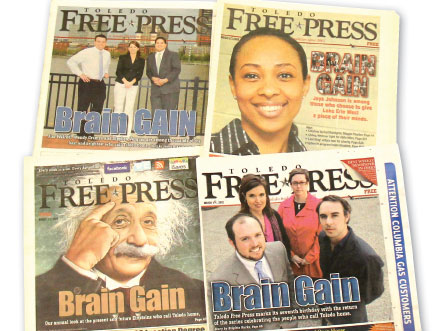
Brain Gain is one of those Toledo Free Press legacy series that perfectly meshes with the paper’s mission of community-focused journalism focusing on the positive while not simply being a mindless cheerleader.
“Few phrases irritate me as much as ‘brain drain,’” TFP president and publisher Tom Pounds wrote in a column when the series was launched in May 2007. “I have heard that concept discussed since I moved to Toledo, not stated as theory, but accepted as fact.
.
“It’s insulting to imply that all young smart people exit Toledo as fast as they can, leaving behind only mentally deficient bumblers. Do some young people leave our area when they finish college? Of course; that happens in every city, coast to coast. But to imply that our future is bereft of talented young minds is not only inaccurate, it’s demoralizing to the people who choose to stay. …
“With this week’s cover story, we are beginning a regular series of profiles of young people who are choosing to stay in Toledo, to live here and make a difference. These are tomorrow’s business leaders, politicians and parents.”
Former TFP Editor in Chief Michael S. Miller also addressed the new series in a column in that issue.
“Once I was a ‘brain drain’ statistic. But I, like legions of others, came home,” he wrote.
Me too.
TFP has always been quick to point out that the series is not an attempt to ignore the problem of so-called brain drain, but rather to shed a positive light on those who choose to stay.
In all, more than 70 people were profiled for the series, which ran, from what I can tell, through most of 2007 and 2008 and periodically in 2009 and 2012.
Our first Brain Gain profiles featured Jim Walrod, Wendy Gramza and Stephen Vasquez. All three are still living and working in Toledo. In fact, at least seven of the eight area residents featured on our covers during the series are still living and working in Northwest Ohio. (One could not be reached.)
In fact, a not-exhaustive followup with as many subjects as I was able to track down found the years had brought weddings, children, houses and job changes — but most are still in Northwest Ohio and loving life here.
Walrod is still with The Image Group. Wendy Gramza is still with the Toledo Regional Chamber of Commerce — it’s first female president, in fact — and Vasquez is transitioning to a role in business development with the chamber.
“I love Northwest Ohio more than I did when the first article was written,” Vasquez said. “A lot changes from age 23 to 33 and all of it has been positive and would not have been possible anywhere but in Northwest Ohio.
“While there will always be work to be done, we are growing as a city — not in numbers, buildings, houses, etc., but rather in an attitude. It feels like Northwest Ohio is finally starting to realize what we have and where we want to be.”
Vasquez, a St. Francis de Sales High School graduate, returned to Toledo after working for a while in Cincinnati, he told TFP in 2007. It’s all a matter of getting involved, he said.
“The more you know about the city around you, the better off you’re going to be,” he said. “New York or LA could be boring if you just sit there.”
Unlike those who believe young people leave Toledo because it lacks job opportunities and things to do, Gramza told TFP in 2007 she believes some individuals simply want to experience other areas of the country.
“I don’t think it’s all about a negative perception of Toledo,” she said. “I think they want to spread their wings.”
After experiencing other areas, many find themselves appreciating the things Toledo offers, often returning to raise a family, she said.
“Why do I stay in Toledo?” Gramza told me recently via email. “I like challenges and I like to think that the work I am doing is making a difference. The Toledo region has been an excellent place for my family and I. We love the affordability and accessibility of the Toledo region.”
Walrod still believes, as he told TFP in 2007, that Toledo is big enough to always find something to do, but small enough to offer great quality of life.
“You can always make more money somewhere else, but then what’s your quality of life?” he asked.
“As a young professional, I have had the opportunity to work with, and learn from, the greatest and most respected business leaders in our area,” Walrod told me. “I seldom wait in traffic. My wife and I enjoy taking our girls to the Toledo Zoo, Imagination Station or the closest Metropark. I fish in the Maumee and Lake Erie. I could go on and on. … Point is, this area offers so much I couldn’t imagine living anywhere else.”
Tamara Bumpus has lived all over the country, but said she keeps coming back to Toledo. “Like a boomerang,” she told me recently, laughing. She said she stays because it’s inexpensive, offers lots to do and her family is here.
Bumpus, who was a nurse at the University of Toledo Medical Center when TFP profiled her for the series in 2007, now works with the Neighborhood Health Association (NHA).
“I am really excited about what I perceive to be the beginning of the Downtown renaissance — the influx of new restaurants, ProMedica moving Downtown and NHA building a new clinic in UpTown,” she said.
John Smythe, featured on our cover in March 2012, is still president of Habitec Security. His wife is expecting their first baby this summer.
“Toledo is a great place to live and do business,” he said. “There is still value in being a local company that is involved in their community. I think this gets lost in bigger cities.”
Shawna Woody, profiled in January 2008, is still with the Boys & Girls Clubs of Toledo, now as director of program operations.
“I never thought I would stay in Toledo, but I often tell others that I was meant to be here,” Woody said. “Every time I try to leave, I get promoted. I love my job, but I love my family even more.”
Those I talked to who have moved to other areas said they miss family, friends in Toledo as well as the food.
Brian Weinblatt, who worked in the University of Toledo’s alumni relations office in 2007, has since moved to Florida, where he works at the University of Miami. But he still visits Toledo regularly — including this weekend.
“Nothing compares to the kind, generous nature of Midwestern people,” Weinblatt said. “I guess you take it for granted growing up there that everyone is friendly. The other things I miss most about Toledo are my favorite tastes of the city, namely Barry Bagels and the pizza.”
Todd Davies, who was transitioning from the city to the Regional Growth Partnership in 2008, has since relocated to West Virginia, where he works at Marshall University. He said he misses the food in Toledo but was discouraged by local politics.
“We in Toledo had a tendency to make things harder than they have to be,” Davies said. “Everybody talks about the resources or potential, but whenever someone tries to do something with it, people get in their way because they’re not doing it their way or they just want to complain.”
Willie Williams, formerly of Owens Community College at The Source, now works at Central Piedmont Community College in Charlotte, North Carolina.
“Toledo gave me such a wonderful background, but I wanted to utilize that skill set in a larger city,” Williams said. “I’ll always miss Toledo because of the family feel you get.”
Brian Babcock, profiled in 2008 and still a senior Industrial Engineer with GM, perhaps sums it up best.
“I stay because of the good work environment and family and friends that are here,” Babcock said. “Basically, it’s home.”
Sarah Ottney is editor in chief of Toledo Free Press. Contact her at [email protected]
Brain gain issues
CRIME
Toledo Free Press has covered crime in a variety of ways: from examining cold-case murders in October 2005, to considering questions raised by the family of Andrew VanHorn, an 11-year-old boy found dead in July 2009, to profiling John Tharp in 2013, when he became Lucas County’s first new sheriff in nearly 30 years.
In January 2007, we looked back at the 1992 slaying of University of Toledo student Melissa Herstrum by UT police officer Jeffrey Hodge, talking with her family members about how they still struggled to deal with her murder. We covered the on-duty death of Toledo Police Det. Keith Dressel in February 2007 amid his pursuit of 15-year-old Robert Jobe.
In January 2007, we talked to advocates seeking a legal showdown over conceal-carry gun laws. A controversial photo illustration of a gun pointed at UT’s iconic bell tower on an April 2007 cover garnered plenty of letters to the editor as we considered what local universities were doing to prepare themselves for school violence in the wake of the Virginia Tech shootings.
In November 2007, we detailed Toledo Police Department’s effort to join a statewide fight against gangs and youth violence. In October 2013, we offered insight into underage drinking by talking with local teens after the drunken driving death of Ottawa Hills teenager Brian Hoeflinger. In August 2014, we reported on the spike in heroin deaths in Lucas County.
Few local crimes got as much attention from local and national media as the June 2013 disappearance of 18-month-old Elaina Steinfurth, often referred to as “Baby Elaina.” Her remains were found in the garage behind her home that September, with Elaina’s mother, Angela Steinfurth, and Angela’s ex-boyfriend, Steven King, pleading guilty to the murder. They’re serving 15 and 25 years to life in prison, respectively.
.
HEALTH
Health issues have been and continue to be important areas of coverage at Toledo Free Press.
This year, we launched our “Eye on Health” special section, which focuses on a particular area of health each month. So far, we’ve covered diet and fitness, heart health and cancer, and will cover seniors and aging in April. Each section features a variety of stories about programs from the area’s leading health centers, columns from patients and health experts in each field, as well as listings of upcoming health-related events.
The section may have a new name, but we began covering health issues long before this year. We explored the childhood obesity epidemic in May 2005, looking at why more and more youth are dealing with hypertension, diabetes, depression, coronary disease and high cholesterol. In October 2008, we dug into the drive to immunize Lucas County’s children, a topic that still bears cultural discussion today with the recent measles outbreak in the U.S.
A couple of months later, in December 2008, we covered the last Christmas of Beverly Kanthak, a 61-year-old woman with terminal cancer. We investigated what Northwest Ohio was doing to protect itself against swine flu in May 2009.
A cover story in December featured area women struggling with infertility, but we also covered that topic in June 2007 with a look at the fertility drug Clomid. On numerous occasions we’ve featured Kaylee Halko and Carly Kudzia, two children with an extremely rare rapid-aging disease who happen to live within minutes of each other in Lucas County.
We featured an interview with Dr. Oz Mehmet in January 2012 as the famous TV physician offered tips for Toledoans looking to live healthier lives. TFP has told many stories on area residents fighting various health situations, from obesity to cancer to amputation to those waiting for organ donations.
As we reflect on the 10-year milestone of Toledo Free Press, we cannot help but review the last decade in the investment business.
Tumultuous does not begin to describe what the U.S. economy, debt and equities markets have experienced during that time. Some of the statistics are troubling, while others are rather impressive, but altogether they have helped shape where our economy currently stands and how we expect to go forward.
In the past 10 years, the Dow Jones Industrial Average increased about 70 percent from 10,800 to around 18,000; the NASDAQ increased about 150 percent from 2,000 to almost 5,000; the S&P increased 76 percent; the U.S. dollar recently hit a 14-year high; 30-year U.S. treasury bond yields dropped from 4.5 percent to near 2.7 percent; we witnessed one of the worst global financial catastrophes the world has ever seen; and history’s largest Ponzi scheme was unraveled.
We have been through two presidents and three Federal Reserve chairpersons, all of whom pursued similar economic policies. Lastly and perhaps most significantly, the federal debt has risen from $7.5 trillion to over $18 trillion, due in large part to quantitative easing, TARP and interest rate policies.
That is a lot of numerical and statistical data to analyze in one paragraph. It is important also to remember that the gains and losses were by no means steady. For example, the Dow was valued at 10,800 in March 2005, but dropped to 6,600 in 2009, then went on a bull market that saw us reach 18,200.
While it is important to understand where we have been and how investments have performed, we cannot act on that information. The only way you made money on the 70 percent rise in the Dow over the past decade is if you invested in the Dow before the rally. However, all the information detailed above has significant value in determining where the economy is heading.
We believe equities are overvalued and have only been experiencing gains due to corporate stock buyback programs and investors who typically purchase debt instruments entering the equity arena in a search for yield. That is not to say that equities will not continue higher in the near term, but we urge extreme caution.
At some point, inflation will become an issue. An economy cannot create the amount of currency that the U.S. has over the past five years with no repercussions. Once velocity picks up and money begins turning over in the economy (which low gas prices may encourage), we expect to see inflation surpass the Fed’s 2 percent target and rates rise in an effort to keep inflation at reasonable levels. The rise in rates will likely increase the value of the U.S. dollar, which will continue to negatively impact the United States’ ability to export.
Congress and the SEC are not doing nearly enough to deter the “Madoff types” or to police large institutional firms in both the commercial and investment banking sectors. At present, leverage is at an all-time high and we have replaced subprime mortgage loans with subprime auto loans. However, regulators have displayed a willingness to fine large firms, extort their fee and allow them to continue to play their dangerous game. It is difficult to say what the results of these reckless actions will be, but it is all too similar to the years leading up to 2008.
The national debt does not concern us nearly as much as it does others. While the number is daunting at $18 trillion, rates are so low that the debt service is not unmanageable. Further, once rates begin to rise, the Fed will likely utilize the Federal Open Market Committee to enter the bond market and buy up the old debt with proceeds from newly issued debt, essentially refinancing the national debt at a more reasonable level. If we fail to address the rise in the national debt and take no action at all, however, then we will have a problem on our hands down the road.
We believe above all else that the next 10 years will present major opportunities to investors, if they know where to look. We expect to see an economic recovery and a stable Dow, but not until after some troubling times. Timing is everything. If you remain calm and patient, the next 10 years will be filled with prosperity and gains.
Ben Treece is a partner with Treece Investment Advisory Corp (www.TreeceInvestments.com) and licensed with FINRA through Treece Financial Services Corp. The above information is the opinion of Ben Treece and should not be construed as investment advice or used without outside verification.
This week marks a proud milestone for Toledo Free Press. Ten years ago, on March 16, 2005, we published our first issue.
.
As I look back over the 10 years we have been in business, I marvel at all that has occurred in that time. The vision I had for a community-focused weekly newspaper was matched when I found Editor in Chief Michael S. Miller up in Adrian, Michigan. He was what I called “lightning in a bottle.”
Michael agreed to come to Toledo to work on a “glass half-full approach” to this city. He was very adamant I stay out of his way. I agreed and let him do his thing while I ran the rest of the business. That arrangement never changed.
The five straight “Best Weekly Newspaper in Ohio” designations from the Ohio Society of Professional Journalists say all you need to know about what talent Michael brought to the table. Now Sarah Ottney, who was mentored by Michael for four years, sits in that seat and has already shown similar skills.
I’ve watched tremendous writers come through our doors, including Brandi Barhite, who Michael often called one of the best journalists and feature writers he’s ever known; Caitlin McGlade, who never backed down from a challenge and is now an investigative reporter with The Arizona Republic; Jeremy Baumhower (who can forget Myles Eckert?); and Matt Zapotosky, who’s now covering federal courts for The Washington Post. Duane Ramsey has been writing business and economic development stories for most of those 10 years and Jeff McGinnis brought his unique pop culture voice to us five years ago.
For our first two years, we were based out of the Toledo Edison building Downtown. Jim Murray, then-president of Ohio Edison, gave us the space to start the business.
It has been wonderful to watch the growth of Downtown’s Warehouse District from our front-row seat on Monroe Street, where our offices now stand. When Blarney Irish Pub owner Ed Beczynski and I bought this building from Dave Ball (another visionary) in 2006, we had no idea what would happen around us. From the Huntington Center, Table Forty4 and PizzaPapalis sprouting up nearby to M Osteria recently opening, Black Cloister Brewing Co. coming this month and Veritas Cork & Craft right around the corner — what a hot corner we’re on where virtually nothing stood before we moved in!
One thing TFP has done from the beginning is support local nonprofits (at least the ones that are not bullied into staying away from us). The latest effort, Dine 419, partnered with local restaurants to raise money for Veterans Matter to house homeless veterans (you will never find a more passionate advocate then its founder Ken Leslie).
TFP has been a proud media sponsor of Holiday with Heart Charity Gayla since 2010 and Toledo Pride (started in 2010 by the just-as-passionate Lexi Staples) since 2011. As its media sponsor for the first four of its five years, we helped Leadership Toledo’s Restaurant Week Toledo grow into the immensely popular fundraiser it is today.
Then there were the six charity CDs we produced for Make-A-Wish Ohio, Kentucky & Indiana, American Red Cross of Northwest Ohio and Project iAm — Michael’s babies — which raised more than $70,000.
Lucas County Children Services’ (LCCS) Wear Blue Day, which asks people to take a stand against child abuse, is one of the most touching nonprofits we have supported in our years. Same with the organization’s holiday gift drive. LCCS is a wonderful organization that has taken some unfair hits from other media in town; it does not deserve that.
Food for Thought’s Jam City and Food Fight 419 were also causes we got behind. Smoke on the Water, benefiting the Red Cross, was always a good time.
In January 2007, we shifted publication from Wednesday to Sunday. On our fifth birthday, we launched Toledo Free Press Star, a standalone Wednesday publication covering arts and entertainment, which, in 2013, was absorbed back into the Sunday TFP.
Throughout it all, loyal advertisers like ProMedica (from issue No. 1), Monroe Dodge (Ralph Mahalik Jr. has also been with us from the beginning), Fifth Third Bank, TARTA, Mercy, Hollywood Casino Toledo, Owens Community College, Estate Jewelers, Toledo-Lucas County Port Authority, the Town Center at Levis Commons and Fat Fish Blue have been our lifeblood. Without advertisers who had guts like these companies (and so many more) we would have never made it 10 years.
We have taken our share of punches to the gut as well. Despite an unbelievable lawsuit from a newspaper that wants to step on us and disloyal employees stealing from us, we have found a way to fight through. The loyal and hardworking employees of the paper are the reason we have lasted this long. James A. Molnar is one of the most talented artists I have had the pleasure to know. Chick Reid, who has been working for me for years (first at The Blade and now here), is one of the best-known sales people in town and just a great guy. My now longest-tenured employees, Renee Bergmooser and Pam Burson, are loyal to the bone and some of my best friends.
Many of our columnists have been with us for years. Our cartoons and crossword puzzles are created locally too.
Last but not least are you, our readers. Thanks for sticking with us and thanks for reading.
It’s the people who have made us and who are the key to our success. This is the reason we are still the largest Sunday paper in Lucas County and in my opinion the best.
Thank you, Toledo!
Thomas F. Pounds is president and publisher of Toledo Free Press. Contact him at [email protected].
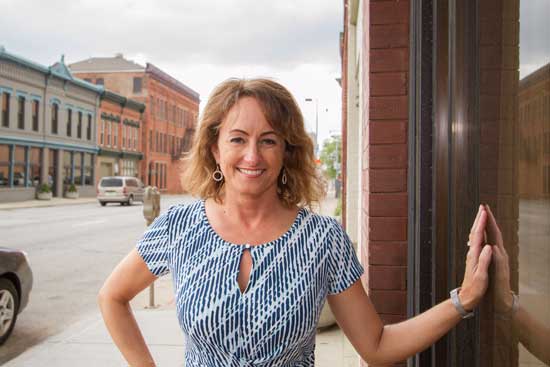
For a neighborhood that has existed for more than 125 years, 10 years seems like a blip.
Diane Keil-Hipp is president of the Toledo Warehouse District Association. Toledo Free Press photo and cover photo by Christie Materni
Part of what I lovingly accept in my role as Toledo Warehouse District Association president is that I am just a caretaker of something that has existed long before me and will exist long after me.
That being said, I am mighty proud of what our little volunteer association has accomplished in 10 years’ time, and more significantly, what the Warehouse District has become in the past 10 years.
The best part of the renovation of the Warehouse District is precisely that it took 10 years to get here. Each building was restored one at a time, by a committed owner with a dream. Slowly and steadily, building by building, was the Warehouse District rebuilt. This careful pace and individual commitment are two important ingredients for long-term success.
As you walk the streets, you are energized by the colors and creativity that flow out of these buildings. Restaurants, offices, lofts, and art galleries all call the Warehouse District home. Now, blocks of buildings have been renovated and repurposed. Twenty-first century businesses operating in 19th century buildings — what a wonderful blend of modernism and history.
By no means are we done. More projects are in the works: Hensville, the Berdan Building, Erie Street Market, Foundry Square. These renovations are all catalyst projects; they will spur even more energy and excitement in the Warehouse District.
The history of the Warehouse District is unduplicated. To know that the floors we walk on were built and walked on by people 100 years before us gives us pause. Our lives have depth and meaning when we realize we are just stewards of this great neighborhood, and our legacy is caring for these buildings and passing them on to the next generation.
Diane Keil-Hipp is president of the Toledo Warehouse District Association.
My relationship with Toledo Free Press began with a simple email asking then-Editor in Chief Michael Miller if he had a job opening.
I was a reporter who had just relocated from Sandusky and I liked the scrappiness of the weekly paper. I was interviewed and hired that day. That is the pace of the Free Press.
.
But in honor of TFP’s 10th birthday, I wanted to slow down and reflect on 10 stories that most resonated with me.
In no particular order:
Derek Merrin
Merrin was the 21-year-old Waterville resident who ran for mayor and beat the incumbent in 2007. He was one of the youngest mayors in Ohio history. He was also one of my first interviews as a reporter for TFP. He was engaging and had a great sense of humor. He told me he planned to continue to live with his parents because he wanted to stay true to his campaign promise. “I am a fiscal conservative. I want to save money,” he said, laughing. After finishing his four-year term as mayor, Merrin was hired by the state to conduct performance audits for local governments. He is now the regional liaison for the Auditor of State. Impressive.
Dominick Kaple
Kaple was part of a larger series that I worked on called Brain Gain. This series celebrated people who were making their careers in the Toledo area. Kaple was a gym teacher concerned about the rise in childhood obesity. He worked to show his kids that there is life outside of technology. Unfortunately, Toledo’s gain would be temporary. Kaple has since become an assistant principal for Lorain High School. While that is sad, that’s the point of writing about those who stay in Northwest Ohio. It seems like it is rare. When someone does stay, we want to celebrate it.
Africa
In 2009, I traveled with the Toledo International Youth Orchestra (TIYO) to Tanga, Tanzania, which is Toledo’s sister city. The young students were raising money to build a music room for the Toledo Secondary School in Tanga. The poverty we witnessed was indescribable. The unsanitary conditions led to many of the locals’ health problems, which were addressed by the medical team that came with us. It would have been an otherwise dismal trip had it not been for TIYO performing for the natives who in exchange performed for us. Music is truly universal.
Tornado
On June 5, 2010, a tornado destroyed parts of Millbury and leveled Lake High School, where my husband is a teacher and coach. The tornado twisted my roles as wife and reporter. I was uncomfortably close to the story and decided to venture even closer. For a whole year, I followed a family who had lost everything in the tornado but each other. Brick by brick, I followed their rebuilding process, which included guilt for surviving. Three members of the family next door had died. Writing 52 stories forced me to rethink the notion that a story is done just because the media has moved on.
D. Michael Collins
I interviewed Collins in August 2009 when the councilman was running for mayor the first time. Some of the best stories are the ones that contain information never meant to be published. During the interview, Collins shared with me that his son had committed suicide. I wanted to publish it; Collins refused. A few days later, I called and asked again. I told him his life experiences were a reason he had empathy for the people he wanted to serve. He agreed and let me use this quote: “I will never see life the same way again, I can tell you that,” he said. “For the first couple of years, I would see something on the street that would automatically register in my head and I would have an emotional experience over my son.”
My family
I don’t like to write about my family or myself. I prefer to tell stories about other people, but I wrote about my dad losing his job and my mom shattering her leg. I wrote about my sister’s boyfriend losing his brother. Every time I write about my family I am amazed at how many people are interested. It shows me that readers appreciate when journalists become introspective.
Suzanne Carroll
I have written many stories about people suffering from diseases, but no one described her condition as vividly as Carroll, the former host of radio show “The Jazz Brunch.” In 2013, Carroll shed light on multiple sclerosis (MS) in a way that will forever leave me humbled by those who suffer from this incurable disease that affects the brain and spinal cord. She called one of her MS attacks a “slow slide down into hell.” She was so fatigued she was tired 10 minutes after a full night’s sleep. Her subsequent nerve pain was so painful she often had to sit unclothed with her arms in the air.
Underage drinking
Is your student drinking? That was what I wanted to find out and the answers were alarming. Teens told me that it isn’t hard to get alcohol; it’s all about the connections. Some teens even buy fake IDs. The impetus for this story was the underage drinking death of Brian Hoeflinger in February 2013. Within weeks, his family, in particular his father, Dr. Brian Hoeflinger, started a nationwide conversation about underage drinking. “Parents need to talk about it; they need to start a line of conversation,” Brian’s dad said. “Millions of parents don’t think of talking about it because they don’t think their kids are doing it.”
Father’s Day is every day
Craig Schuele was one of the happiest people I have ever interviewed. His optimism and joy for life were so contagious that I left the interview thinking that adopting six kids from Lucas County Children Services was the secret to lifelong happiness. “I get a lot of love all the time. They are really great kids,” he told me. “Obviously, we have our moments and we have our days, but Father’s Day is just like every other day. We might have a soccer game; we might have a baseball game. It might be the only free day I have that weekend and I might have to cut the grass, and obviously that hasn’t happened in a while,” he said, laughing. And then he got serious. “You think about where they could have been growing up. They wouldn’t nearly have the opportunities they had had,” Schuele said. “I am proud that I am able to give them that chance, even with six of them.”
Insert your story here
Toledo Free Press only exists because of you. The best stories are yet to be told. Without your ideas and your willingness to be interviewed, our publication would not exist. While I could come up with dozens more stories that I have enjoyed writing, I am wise enough to know that some of the best stories are the ones that we haven’t even thought of yet.
Brandi Barhite is community ombudsman at Toledo Free Press.
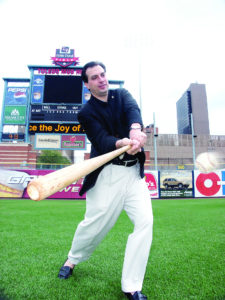
Mud Hens General Manager Joe Napoli, photographed at Fifth Third Field for Toledo Free Press in June 2005. TOLEDO FREE PRESS FILE PHOTO
It’s hard for Joe Napoli to stick to sports when discussing the past 10 years.
Mud Hens General Manager Joe Napoli, photographed at Fifth Third Field for Toledo Free Press in June 2005. TOLEDO FREE PRESS FILE PHOTO
As general manager of the Toledo Mud Hens, Toledo Free Press placed Napoli atop its list of the “25 most influential people in Toledo sports” in 2005. He’s arguably more influential now, serving as president and general manager for both the Hens and Toledo Walleye.
By spearheading the Mud Hens’ move Downtown prior to the 2002 season, he’s also had a direct impact on revitalizing the center of the city.
“Nope, not much going on,” Napoli joked about the past decade from the fifth-floor executive office space at Fifth Third Field.
Looking out the window overlooking the southeast corner of the ballpark, Napoli said the stadium has exceeded all expectations he had when the relocation process from Ned Skeldon Stadium in Maumee began at the turn of the century.
“I think we had established some pretty high standards, but it’s really gone beyond that,” he said. “It’s almost fairy tale-like when you really think about what we hoped would happen and what has happened — it’s even better. You take a look at the Warehouse District: $12 million in annual payroll, up from virtually nothing. Seventy new businesses of all varieties. … Those are the things that we hoped would happen, and that they have happened is very gratifying.”
Napoli realizes the Mud Hens and Walleye are staples in the community, and he doesn’t plan on letting that change.
“Our mission is to be affordable, family-oriented and deliver what we internally call a fanatical experience,” he said. “So as long as we keep delivering on the mission and treat all of our fans like they’re our guests, I think we’ll always be one of those institutions or attractions in town that people point to with pride. But we don’t ever rest on that, because it’s easy to take your fans for granted, and we’ve seen other organizations do that. Once you do that, it’s just going to be a recipe for disaster.
“We always try to reinvent or refresh the experience,” he said.
The Hensville project is one way Napoli is attempting to do just that.
The effort to rehabilitate three Warehouse District buildings into dining, retail and office space recently received nearly $4 million in Ohio Historic Preservation Tax Credits from the Ohio Development Services Agency. The project has an estimated cost of $18.8 million.
Hensville is part of the Mud Hens’ commitment to refreshing the game experience for fans, Napoli said.
“It’s going to remind people of Wrigleyville,” he said. “There will be some dining options, there will be some shopping options, there will be rooftop decks, just like across the street at Wrigley [Field]. We’re also adding a park just beyond right field wall, with an acre of open space, for concerts, festivals and theater in the park — all of these things that encourage social interaction.
“The goal is to encourage even more people to come Downtown,” Napoli said. “Between the two franchises, we bring about 750,000 people a year Downtown. We want to raise that to between 850,000 and 900,000 with Hensville.”
A decade ago, Napoli began to see his dream of revitalizing Downtown through the Mud Hens come to fruition.
“We really positioned the team and the location of Fifth Third Field for success,” he said. “We really felt like we had the right location. We thought that being part of the Warehouse District was important. Hindsight being 20/20, when you look at other communities that have had success at the major league or the minor league level, it’s because the adjacent properties and real estate were the type that could be renovated and rehabbed successfully.
“So when you look at the Warehouse District and even the Business District in Downtown, it’s ripe for redevelopment. We have the good structure — we just needed a catalytic event.”
The Mud Hens were that event.
Looking to the future, Napoli sees Downtown continuing to grow. A couple of blocks to the north of Fifth Third Field, development around Huntington Center has been slower than anticipated. He blames that on bad timing.
“The only thing Huntington Center suffered from originally was bad timing, going into the recession,” he said. “But with ProMedica coming in two blocks away, I think we’re going to see a lot of things happen around that building that we thought would have happened by now.”
With these projects, along with Downtown riverfront property to become the next Toledo Metropark, investment in the area is approaching $200 million.
“When we fast-forward 10 more years, and we look back, I think we’ll be talking about how ProMedica’s move to Downtown was the tipping point,” Napoli said. “The last 10 years have been wonderful. I think the next 10 years are going to be even better.”
As for his placement on that Toledo Free Press Top 25 list?
Napoli takes the humble approach, laughing when he thinks back on the designation. Others on the list included Tom Amstutz, Jimmy Jackson, Stan Joplin, Jamie Farr, Christine Brennan and Bruce Gradkowski.
“It’s flattering, but when you go through that list, there are a whole bunch of men and women on that list that could be No. 1,” he said.
“I have always appreciated the fact that they picked me to top the list, but I never really thought that it was deserved, because in order to be successful, you have to have so many people involved that do things very well. We’ve been very fortunate that we’ve been surrounded by good people. Not only internally, but everyone that’s supported the team, from local government to sponsors and season ticket holders and the like.”
It seems clear the New York native has no plans to leave Toledo any time soon. He smiles as he reflects on why he enjoys living here.
“When you think about living an active life, you can do that in Toledo,” he said. “What I mean by that is you can go to work, and love your job and enjoy your time at work. You can be home in 10-15 minutes and participate in the lives of your family [members]. When you look at recreation, you’ve got a river, a lake, a parks system that’s amazing, all the attractions. And you have that all wrapped up in a midsized community full of very nice people.”
I never imagined my words would appear in a newspaper, especially on a regular basis. I’m fairly certain my family was equally shocked to find them in their driveways or even in a grocery store.
My words did not come from years of education nor from a lifelong love affair with writing. They appeared as a survival method from a heart that was drowning in things it needed to say.
I don’t remember what sparked the conversation between former Toledo Free Press Editor in Chief Michael S. Miller and myself. But I do remember my motivation in asking. After spending 10 years on the radio, an occupation and lifestyle that cost me a marriage, I wanted to show my family the person I was, not the one I was pretending to be.
As a father of four, I fear a retirement with weekends spent primarily in a car or on a plane — trips to visit my grandchildren if this city cannot attract jobs to retain the younger generations.
I was tired of living in a city being bullied by its daily newspaper. I was tired of being shown, via front-page “special reports,” how bad and ugly my hometown was. I never understood how the publisher of a city’s newspaper could live in a completely different state, hundreds of miles away. The irony of a newspaper publishing repeated editorials offering advice to local politicians on how to run city government while itself losing millions of dollars a year is beyond rich.
I wanted to highlight and showcase Toledo’s greatest export: its heart. I knew that if I shared stories of Toledoans at their finest, it could be contagious. I think it has been.
Toledo Free Press has spent the past decade battling the one thing that has kept this city down since the last episode of “M*A*S*H” aired, and it isn’t the economy. The Blade is close to crippling this paper with behind-the-scenes influence and legal bills from an insulting lawsuit.
If you can’t beat ’em, sue ’em. If they dare to point out the emperor wears no clothes, sue ’em some more. “One of America’s Great Newspapers (For Law Firms)” would be a more accurate description.
TFP dedicates its ink to news without a hidden agenda while highlighting the heart of a city learning how to walk again. It provides a vehicle and voice for many previously unrepresented communities, and people dreaming of change. It’s helped champion the “You Will Do Better in Toledo” campaign, which now welcomes all those who visit the Glass City.
I come from a proud union family full of carpenters, welders and UAW members. I can take my children anywhere around the city and show them things our family has built, from Fifth Third Field to the new I-280 bridge. I have discovered my talents lie in my voice, rather than my hands.
The love and support of those who read my column has been overwhelming. This paper has served as my heart’s bucket, allowing me to dump its words one column at a time. It’s given me the opportunity to effect a positive difference. Since I don’t possess the ability to cut a straight line, this column offers my children a chance to see my work.
As a child, my grandparents Pete and JoAnn Zunk would give me these beautiful personal tours, where they would drive throughout the city to show how rooted our family is in Northwest Ohio.
After writing and appearing in this paper for over a year, I learned they were secretly keeping a scrapbook of my columns. My grandma was painstakingly cutting the paper and gluing the pieces into a photo album. Who needs Google when you have glue?
It was at this moment I knew my words had reached their targeted audience — a nice older couple from Point Place.
Thank you Toledo Free Press for being the jobsite of my work and home to my heart.
I read, with curiosity, loyal Toledo Blade soldier Keith C. Burris’ Sunday front-page hit piece on Woodville, Ohio (“Woodville: Worst little town in Ohio?” Feb. 15).
Little Woodville has been a notorious speed trap since I’ve had any memory and I’m over 50 years old. Is The Blade finally going to stand up for citizens against government oppression and overreach by going after “tax collectors with guns”?
It would seem out of character for an organization that has no problem with red-light cameras, public smoking bans, restrictive yet symbolic gun control and the IRS being in charge of health care.
So, as my wife’s stepfather, the old redneck, would say, “That’s the excuse; what’s the reason?”
There is no problem with any tax or government program, big or small, with the editor of The Blade. No, the unforgiveable sin of the authorities in Sandusky County is harming a dog.
So, little guy, you’ll have to look elsewhere for any support. It won’t come from the editorial front page of “One of America’s Great Newspapers.”
— Charles Zsarnay, Monclova
Woodville is home
I just read Sarah Ottney’s column about our town (“Bully Pulpit,” Feb. 22) … outstanding! I am thrilled that you were encouraged to enter it into The Blade and help the current bullying going on in Woodville. You are a very good writer and it was very evident that you wrote from your heart. I do not live in Woodville and haven’t for quite some time, but I will always call it home! A job well done! Thank you so much, Sarah.
— Christine M. Rodman, Port Clinton
Blade column uncalled for
I just wanted to thank you for the excellent column titled “Bully Pulpit” in the Feb. 22 Toledo Free Press. The Feb. 15 column, “Woodville: Worst little town in Ohio?” by Keith Burris in The Blade, was totally uncalled for and you did a very nice job of putting him (and The Blade) in their place.
I wish Toledo Free Press could go to a daily publication. I get so tired of reading about dogs, courthouses and now the Woodville police.
Unfortunately, The Blade is currently the only (daily) in town and they can do whatever they arrogantly wish to do. I think if you guys went to a daily, you would put them out of business in six months.
— Richard Martin, Bowling Green
Breath of fresh air
The Toledo Free Press is a breath of fresh air for the Toledo/ Maumee area. Sarah Ottney’s “Editor’s Statement” was right on in the “Bully Pulpit” column Feb. The Blade and columnist Keith Burris overexercise with their supply of ink on paper, trying to persuade the community of their biased views. Thank you for working to keep the community informed in a straightforward journalistic newspaper.