Home Blog Page 144

Pounds: Leading ladies

0

Last week, the Toledo Free Press staff was knee-deep in 10 years’ worth of old papers, getting our anniversary issue ready to print. Thank you for all the kind words and well-wishes this past week on our milestone!

.

.

I’m a bit late, but I wanted to take the time to say congratulations and welcome to the University of Toledo’s new president, Sharon Gaber.

Gaber, 51, was announced March 12 as the search committee’s unanimous choice and has the distinction of being UT’s first female president.

Currently provost and vice chancellor for academic affairs at the University of Arkansas, Gaber has repeatedly pointed to her urban planning background as a strength that sets her apart. The field is a synergy of many disciplines, an approach that considers the whole greater than the sum of its parts. That could be a great mindset with which to approach UT.

Collaboration, communication and community are three buzzwords Gaber seems to favor. That’s promising.

“I am about community,” she said during a community forum last month. “That’s what excited me about my discipline. That’s what excites me about this opportunity.”

Leadership means being a doer, she told UT’s Independent Collegian: “Anybody can come in and say, ‘Here’s what we’re going to do.’ Well, you want people that are working alongside you. You want them bought into the concept.”

Sounds a lot like the attitude of another local leading lady, Mayor Paula Hicks-Hudson — Toledo’s first black female mayor — who chose a North Toledo neighborhood pool this week to announce her plans to run for mayor this November.

Hicks-Hudson also takes a greater-than-the-sum-of-its-parts approach to governance, commenting that “livable, workable, safe, strong neighborhoods” are building blocks that create “livable, workable, safe, strong cities.”

Also during her visit last month, Gaber said she is impressed by UT’s comprehensive programs, which uniquely situate the school, and by extension the city, to attract students from “across the street, across the state and across the globe.” She wants to work to connect the university more with its namesake city.

“All the pieces for our continued success are right here,” she said.

That’s what Toledo’s late Mayor D. Michael Collins believed with his “You Will Do Better in Toledo” mantra. It’s a mindset Hicks-Hudson also champions.

Gaber has admitted she’s just begun to scratch the surface at UT and intends to be active, visible and involved in the community. That’s key. Boots on the ground is the only way to truly get to know a community.

As they move forward in their new roles, hopefully both these leaders can continue to think independently and avoid becoming beholden to any institution, media entity or self-serving string-puller of any ilk. TFP columnists in the past have been critical of former UT president Lloyd Jacobs and his ties to Blade President and General Manager Joe Zerbey, who serves as president of the university’s board and who was chair of this presidential search committee.

Both Gaber and Hicks-Hudson strike me as independent and self-assured so I’m cautiously optimistic. In the meantime, join me in welcoming Gaber to UT and wishing Hicks-Hudson well as she continues her unexpected journey.

Thomas F. Pounds is president and publisher of Toledo Free Press.

Toledo art showcased at zoo’s revamped aquarium

0
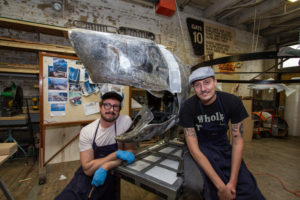
Douglas Kampfer and Jeremy Link of Graphite Design + Build in Downtown Toledo crafted two sharks for the Toledo Zoo’s renovated aquarium. Toledo Free Press Photos Christie Materni

Thousands of eyes will soon be looking into the tanks of the Toledo Zoo’s renovated aquarium.

Douglas Kampfer and Jeremy Link of Graphite Design + Build in Downtown Toledo crafted two sharks for the Toledo Zoo’s renovated aquarium. Toledo Free Press Photos Christie Materni

The handiwork of Toledo artists will demand attention is also given to objects outside of the water-filled exhibits — nearly two tons of glass tiles and an overhead, 18.5-foot-long man-eating fish will make sure of that.

Two businesses on Huron Street in Downtown Toledo — Gathered Art Gallery & Studios and Graphite Design + Build — created the two largest pieces of artwork featured in the aquarium, which opens to the public March 27.

Shark art

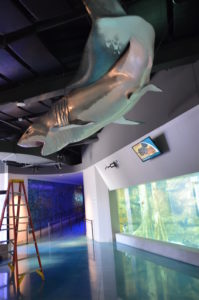
Like any good shark this side of Steven Spielberg’s 1975 classic film “Jaws,” Graphite’s great white cannot be overlooked. Hanging in the aquarium’s entrance lobby, the creature is a realistic-looking piece of epoxy-coated Styrofoam.

“The shark is probably, overall, our best, realistic sculpture to date,” said Jeremy Link, who co-owns the three-year-old business with Douglas Kampfer. “Not taking anything away from anything we’ve done earlier, but it’s the most attention to detail that we’ve done to date.”

For Kampfer, it was a chance to pay homage to the shark sculpture that used to hang in the zoo’s aquarium. That shark, made of chicken wire and foam, was disintegrating after years on display.

A shark made by Graphite Design + Build hangs from the ceiling at the Toledo Zoo’s renovated aquarium, opening march 27. Photo by Andi Norman / courtesy Toledo Zoo

“I fell in love with it when I first saw it, and I really never stopped thinking about it when I was at the zoo,” Kampfer said. “Everyone kind of sought it out, especially around Christmastime when it had the Santa hat on.”

Working with the zoo is nothing new to Link and Kampfer, who were finishing work on a Quetzalcoatlus northropi — the large prehistoric flying animal sculpture in the zoo’s reptile house — when they were approached about doing the dorsal-finned aquarium centerpiece.

“We’ve had a lot of history with the zoo the last couple of years. We’ve had a lot of different projects with them,” Link said. “I think from the beginning, they really liked our attention to detail and the way we could capture the realism of the animals we were sculpting.”

Link and Kampfer also created for the zoo a large saltwater crocodile and the animal masks children have enjoyed standing behind while getting their pictures taken.

The life-sized shark, which the creators unofficially named Betty White, weighs about 250 pounds — considerably less than the approximate 5,500 pounds an actual shark that size would weigh. They spent about two months on the beast, and another two and a half months on the rest of their works for the aquarium, including an octopus that will double as a hand sanitizer near the hands-on touch tank, as well as a circular piece showing the complete life cycle of a salmon, from an egg to a spawning adult.

They’re also creating a mechanical great white shark bust with exposed insides, where visitors can crank a wheel to see how jaw movement works on a muscular and skeletal level.

“It’s so kids can learn a little bit about the anatomy of a shark,” Link said. “We’re putting it at a height where kids can reach it and it’s easy enough to turn. You do eight turns and it will do a whole bite. It’s a slow thing so you can watch it happen.”

Being a part of the new aquarium is an honor not lost on Kampfer, who grew up coming to the zoo.

“We’re a part of that entire aquarium project,” he said. “We’re not just visiting the aquarium, we’re part of it.”

The aquarium is also a special place for Link: He’s having his wedding reception there later this year.

Glass oceans

Also located near the entrance lobby, across from the Gulf of Mexico exhibit, is a mosaic of the Earth consisting of 1,368 6-by 6-inch glass tiles. Measuring 38 feet in length and 9 feet in height, the creation from Gathered Art Gallery & Studios consists of 18 rows, each containing 75 tiles.

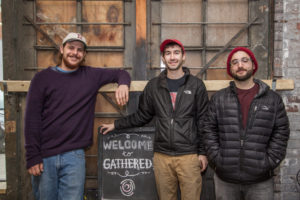
Eli Lipman, Mike Stevens and Adam Goldberg of Gathered Art Gallery & Studios in Downtown Toledo made the glass tiles for a mural at Toledo Zoo’s renovated aquarium. Toledo Free Press photo  Christie Materni

The glass in the mosaic weighs 3,800 pounds, said Adam Goldberg, who co-owns Gathered with Mike Stevens and Eli Lipman.

“It’s not a perfect map, but it’s a mosaic that focuses on the oceans, since we’re in an aquarium,” Goldberg said.

Stevens said visitors may notice something unique about their version of the Earth’s surface.

“It’s also different in that most maps have the Atlantic in the middle. We put the Pacific in the middle,” he said. “Hawaii is pretty much in the middle of the map.

“I think [zoo officials] were trying to show the vastness of the oceans compared to land. When you look at it, clearly, most of the world is oceans,” Stevens said.

The project presented challenges the trio had not faced before. The scale of the mosaic, by far the largest they had worked on, presented a huge challenge.

“It was tough to initially conceive working on it and planning to work on a project that big, but then as moved along, it kind of became second nature,” Goldberg said.

Due to the project’s scope and need for Gathered to maintain personal projects and instructional classes at its location across from Fifth Third Field, the hot work for the glass was done at the Toledo Museum of Art’s Glass Pavilion. Assembly, gluing and preparation were done at the studio.

“We were able to maintain stuff we do here on a regular basis, and because the museum was an affordable rate, it made perfect sense to do all the work there and save our furnace for stuff we do here,” Goldberg said.

When it came time to put nearly two tons of glass up on the wall, the three artists (and sometimes an assistant) spent six to eight hours a day for one month, going back and forth from the zoo to their studios, where they would adhere more tiles to plastic brackets before going back to the zoo the next day and doing it all over again.

Now that the project is complete, the artists are looking forward to seeing their work at the aquarium’s grand opening.

“[The zoo] put lights on them that almost look like the reflection of moving water, so it kind of looks like moving water,” Lipman said.

“It looks better [than I envisioned],” Stevens said.

In addition to the mosaic, Gathered also made glass jellyfish at the aquarium located near the reef tank.

Ripple drawing

Also featured at the aquarium is a chalk drawing of a stingray created by Marjorie Ripple at Shared Lives Studio  on North St. Clair Street. Shared Lives, a division of Lott Industries, is a nonprofit art studio that employs adults with developmental disabilities.

“We are thrilled that we are on a list of artists that will have work displayed at the new aquarium,” said art director Lori Schoen. Shared Lives artists are working on having a show in the zoo’s community gallery later this year and artists have been creating pictures of marine life, Schoen said. The studio will also celebrate the aquarium’s opening with a show of their own featuring artwork of fish and aquatic life.

“Our artists have been having a ball working on this and are very excited to see the new aquarium,” Schoen said. “I know when our work goes on display there in the future it will be an amazing accomplishment and source of pride for them. When you see your work in a public place like the zoo it makes you a part of community and gives your work validation. The exposure for us will be huge and I know it will be truly exciting for our artists here at Shared Lives.”

A mural of glass tiles made by Gathered Art Gallery & Studios is displayed at the Toledo Zoo’s new aquarium. Photo by Andi Norman / courtesy Toledo Zoo

Jeff Sailer, executive director of the zoo, said it was important to feature local art in the aquarium.

“It’s really an elegant exhibit,” he said. “Coming from outside of Toledo to Toledo, I hadn’t really been made aware before coming here how vibrant the art scene is here. We have a lot of really great local artists and they produce some amazing work and I thought, here’s a great opportunity to get some art installed in what is going to be seen by over a million people.

“We bring in a lot of people from outside Lucas County as visitors, so being able to expose them to all Toledo has to offer is very, very important to us. The city has an amazing amount going for it, and I like taking every opportunity we can to reinforce to our visitors here that it’s really fun coming to Toledo.”

Other art featured in the aquarium was created by Sayaka Ganz, Commercial Flooring/Midwest Tropical and Benchmark Woodworking, as well as the zoo’s graphic and exhibit department.

For more information, visit graphitedandb.com, gatheredglass.com and shop.lottindustries.com/studio.html.

Zoo aquarium ready for grand opening

0
The grand opening of Toledo Zoo’s $25.5 million aquarium renovation will be March 27 with events lasting all weekend. Photo By Andi Norman / photo and cover photo courtesy Toledo Zoo

It takes a county to raise an aquarium.

The grand opening of Toledo Zoo’s $25.5 million aquarium renovation will be March 27 with events lasting all weekend. Photo By Andi Norman / photo and cover photo courtesy Toledo Zoo

The Toledo Zoo’s $25.5 million aquarium renovation is almost complete, two and a half years after closing for the project. The aquarium will be unveiled March 27 at the beginning of a weekend full of events dedicated to the 178,000 gallons of water containing more than 3,000 animals.

“The Lucas County public loves that aquarium,” said Jeff Sailer, the zoo’s executive director. “They loved their old aquarium and I think they’re going to love their new aquarium. It’s beautiful inside and there’s a lot more interactivity that guests can be involved in. There are a lot of exhibits that allow hands-on experience. It’s a really cool space.”

The public has a large stake in the aquarium — 80 percent of the total cost for the project comes from the zoo’s 2006 capital improvement levy approved by Lucas County voters. The remaining 20 percent came from private donors.

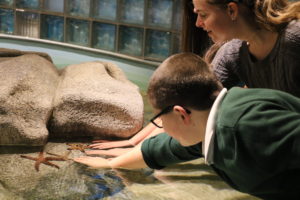
Aquarium-wise, it doesn’t get much more interactive than touching a shark. Visitors will get up-close opportunities at the new aquarium, as well as chances to interact with rays, sea stars and other animals of the ocean.

“None of this could have happened without Lucas County voter support,” Sailer said. “We are very, very grateful to have the support we have from the local community. We couldn’t offer these great exhibits otherwise.”

The numbers tell the story of progress. In October 2012, when the aquarium closed for the renovation, it contained 46,000 gallons. Today it holds 178,000. The largest exhibit, the reef tank (supported by Owens-Illinois) holds 90,000 gallons of water, or nearly twice the old aquarium’s total capacity. Formerly, the largest exhibit was 7,600 gallons. The building’s exhibits were previously 37 percent saltwater; that number is now 87 percent.

Despite the massive jump in tank capacity, the building’s “footprint” taking up about 30,000 square feet remains the same.

The 1939 building was a Works Progress Administration (WPA) building. The WPA was one of President Franklin D. Roosevelt’s New Deal agencies, employing millions of unemployed Americans to build public buildings. The building was crafted from river shale, salvaged clay brick and lumber, cement and new glass block. The foundation materials were selected to support the massive weight of thousands of gallons of water.

At the time, it was the world’s largest freshwater aquarium. Over time, as interest in marine species and the oceans grew, saltwater exhibits were added. The corrosive saltwater was not friendly to piping and other systems in the aquarium.

“Eighty-some years from opening, the saltwater did a real number on the tanks and infrastructure of the building,” Sailer said.

However, the building itself remained in excellent condition.

“Basically, we kept the outside the same,” Sailer said. “The only thing that’s changed is the entrance, which has been relocated back to its original location at the center of the building.”

Creative use of existing space, coupled with more efficient, less bulky life-support systems, allowed for the significantly larger tank capacity.

For Sailer, who came to the Toledo Zoo from New York City’s zoo system just months before the aquarium renovation began, the transformation was a thing to behold.

“It was really interesting because I was only able to see it a couple of times before we closed it in 2012,” he said. “I never would have guessed that we had all this space there that we did.”

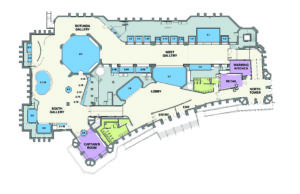
Aquarium Map. Source: Toledo Zoo.

The largest exhibit, the 90,000-gallon reef tank, is located in what was originally the rotunda, where the old shark model was hanging from the ceiling.

“Now, the rotunda itself, that round room, is the tank and you’re on the outside of it looking in,” Sailer said.

The 30-by-16-foot tank contains sharks and colorful tropical Pacific reef fishes, and offers opportunities for visitors to communicate with an aquarium keeper and trained volunteer divers through an underwater microphone.

The second largest tank will be the Gulf of Mexico exhibit, featuring black nose and bonnethead sharks, rays and a sea turtle, which is part of a conservation education program to assist in the protection of wild turtles.

Other highlights include exhibits dedicated to South America’s Amazon ecosystem, the zoo’s new electric eel, deep-sea creatures such as giant Japanese spider crabs and aquatic life from the Lake Erie islands and Ohio waterways.

The grand opening weekend, sponsored by Kroger, is the culmination of work initiated well in advance of the aquarium’s closing, Sailer said.

“People think of it as being a two-and-a-half year project,” he said. “It’s been in the works for over six years with the design, planning all of the infrastructure and what the interior would look like.

“I’m really excited. I can’t wait to be here opening weekend and see people’s reaction to it. I’m floored by how beautiful it is and I’ve gotten to see it as it’s been developed and built. I’m really excited to show it off to others.”

The renovation was not the first time the aquarium closed.

On Thanksgiving 1982, fire tore through the roof, killing 104 display fish and 500 feeder fish. Among the fish lost were arapaima and a pacu which was among the largest of its species in the U.S. The aquarium was closed for three months for repairs.

On April 13, 1987, an inch-thick glass tank panel split open, sending 20 tons of water onto the aquarium’s floor. Zoo employees were able to save two lemon sharks by placing them in a secondary saltwater tank in the basement, but many smaller fish were lost.

Sailer said the economic impact of the renovation was significant, as 27 prime contractors and nine prime consultants were utilized in the project, resulting in 114,600 hours of on-site labor (not including work by zoo staff). Despite the unique and specialized nature of aquarium design and expertise, more than 50 percent of the architecture and engineering team used is from within 30 miles of the zoo.

The addition of the modern aquarium only adds to the value of the zoo to the community, Sailer said.

“We’re able to offer both a world-class zoo and an aquarium for one low price,” he said. “A lot of stand-alone aquariums are over $20 for a ticket.”

Zoo tickets are $17 for adults and $14 for children 2-11 years old.

In a September 2012 news release, Sailer said, “We realize 2015 seems far away, but we’re confident that, once you see the new aquarium, you’ll agree it was worth the wait.”

Time to find out, Lucas County.

For more information, visit www.toledozoo.org.

Council approves creation of maintenance plan for city-owned structures

0

Toledo City Council is trying to plan its maintenance of the nearly 200 structures the city owns, rather than simply “putting out fires” as they come up.

Council voted 9-1 March 17 to develop a standardized 20-year plan for all facilities owned by the city of Toledo. The term of 20 years was specified because roofs — a major expense for any building — typically last 20-25 years.

“This is so basic it’s shocking it didn’t exist,” said Councilwoman Lindsay Webb, chairwoman of Council’s Utilities and Public Service Committee, which met March 11 to discuss the plan.

The 195 city-owned structures include everything from fire and police stations to Imagination Station and park shelters. The list also includes buildings that are no longer used by the city and have no tenants.

“I was really quite surprised to find that we didn’t have that kind of a plan on any of the properties,” Councilwoman Sandy Spang said after the March 11  meeting. Spang spearheaded the effort to bring the plan before Council.

RELATED: Click here for a list of city-owned properties.

“I am bringing this forward as a support to the facilities department so that they have a tool to do regular maintenance on these properties and avoid the kind of large emergency repairs that we often encounter,” Spang said. “We often are not able to fund, in our CIP (Capital Improvement Program), all the projects that need to come forward. There are so many emergency projects, so obviously we need to do a better job of long-term maintenance.”

At the March 11 meeting, Kevin McCarthy, commissioner of facility and fleet operations for the city, said he agrees about the value of a long-term maintenance plan, but wasn’t sure where the funding will come from.

“The CIP is slim this year at best and we do address our needs on an annual basis, and it’s a pretty austere year to get any money for improvements. A perfect example of that is the transportation building. We’ve had a roof report done — it’s sorely in need of replacement. It’s not going to happen this year. That happens to be my director’s (Bill Franklin, director of public services) office — he has an umbrella in it right now.”

After more investigation into the matter, Spang said March 19 that the city’s risk management budget had allotted $70,000 for valuations of the properties. Many vendors doing that valuation work can also assess buildings’ mechanical systems and provide maintenance plans.  Spang is hopeful the maintenance plan can be developed for about $100,000.

Spang said she is in favor of having an outside company develop the maintenance plan, as it could do it more efficiently than the city, due to all of the different operating systems in the 195 structures.

Terry Green, risk manager for the city, said there may be $70,000 in grant money available for the city to pay an outside company to perform valuations of these structures, which is key to determining a maintenance plan. He said he believes this same company, which was not named, could also develop the maintenance plan, a dovetailing practice Spang hopes would reduce the cost.

A piece of the legislation states an annual report must be presented to Council, outlining the maintenance completed, as well as which department was charged for the maintenance and the amount spent.

“These 195 structures represent millions of dollars of assets that the citizens own and they have every right to an expectation that we’re maintaining them,” Spang said.

“This is the kind of report that I want to see us have so that we know what needs to be done monthly, biannually, annually to our properties so that we can avoid having so many emergency repairs. … Also, I believe this is going to cause us to take a hard look at the facilities that we own and which ones are appropriate for the city to own.”

After the plan was approved, Spang said, “It’s really a move toward generational change in the way that we take care of our assets. I’m very proud of this legislation.”

‘Expect the best’: First-year Scott coach leads team to titles

0
Scott High School’s Chance Hawkins goes for a shot against Cleveland JFK. The team finished its season with league and sectional titles. Photo by Danielle Thomas / JP Dynasty Photos

By Yaneek Smith

Toledo Free Press Staff Writer

[email protected]

When Fred Coogler was hired as the head basketball coach at Scott High School with just one week remaining before the team’s first scrimmage, it would’ve been reasonable to assume the club would suffer a setback for having such uncertainty at the top spot for so long.

Fred Coogler
Fred Coogler. Photo Courtesy Wakeso Peterson

Quite the opposite happened.

Previous head coach Chris Dames resigned Sept. 15, leaving the program in limbo before Coogler, a team assistant, was given control.

The Bulldogs, led by guard Chris Darrington, forward Jay Wells and center Chance Hawkins went 21-4, winning the City League championship and a Division II sectional title before falling to fifth-ranked Defiance, 44-37, in the district final March 15.

Coogler, who works as the building operator at the high school and serves as the pastor at Faith Temple Ministry on Ewing Street, led the team to a successful run this season by relating to them and getting to know them on a more personal level. He related to his players in the way that a pastor relates to his parishioners.

“They called me Pops, and I call them my sons,” Coogler said. “Once per week, we had a huddle, where we’d come together for about an hour, an hour-and-a-half, sometimes two hours. We talk about life, we talk about anything.

“Our subject was forgetting those things that are behind, looking forward to the things before you. The reason being that anything that’s from last year or before is behind us. For us to accomplish the goals that were set, we needed to look forward, and we did that. Each week, we had something different. As their coach and an ordained pastor, I prayed and I got direction from God. We were directed from God, first and foremost.”

n  Scott High School’s Chance Hawkins goes for a shot against cleveland JFK. The team finished its season with league and sectional titles. PHOTO by DANIELLE THOMAS / JP DYNASTY Photos
Scott High School’s Chance Hawkins goes for a shot against Cleveland JFK. The team finished its season with league and sectional titles. Photo by Danielle Thomas / JP Dynasty Photos

And he brought in alumni to help the players understand and appreciate the program’s previous accomplishments, which includes a state championship in 1990 and nine appearances in the state tournament.

“One of the things I did was bring in a lot of the alums [to speak] to the kids,” Coogler said. “I had old players come into the gym and talk with the guys each week. Just after the City League Championship [a 56-52 overtime victory over Rogers High School], some alumni came in and bought the team shoes. They showed a lot of love and that’s one of the things that I wanted to bring back to Scott basketball. That richness of the alumni, they appreciated that and they showed their appreciation, they showed their support.”

But Coogler was also tough on them and demanded a lot. He scheduled 6 a.m. practices, a decision that he hoped would ultimately help them to value their time more.

“The 6 a.m. practices did a lot for the young men,” said Coogler. “My thinking was I needed to change the mindset of the guys. By doing that, that got them some discipline. If you’re going to get up at 5 a.m. and be at practice by 6 — it was time for school [afterward] and we would still have practice after school. I was thinking that brought a sense of self-motivation to them. I thought, ‘Let’s not let this 6 a.m. practice go in vain. I don’t want to get up that early, but since I’m up, let’s make the most of this.’ And it worked out well. It got to the point where they enjoyed 6 a.m. practices.”

He also expected them to take their studies seriously.

“Academics is a must,” Coogler said. “They all know that I will sit you down and you will not play if you don’t have things together. I will lose [a game] and not pass up the chance to teach you life lessons. If that comes with me losing games, then we’ll lose. They knew that, and they didn’t try me.”

Coogler, a 1984 graduate of Macomber High School, was an assistant on the 1989 team that Jim Jackson led to the Division I state championship.

“I wear my ’89 [championship] ring every day,” he said. “[But] I put my wedding ring on first.”

In addition to three wins over Rogers, which came by a combined eight points, the biggest victory of the season came in a 75-56 win over Lake in the district semifinal.

Darrington led Scott with 23 points, Hawkins scored 14 and Larry Green chipped in with 11 as Rogers shot 27-of-42 (64.3 percent) from the floor and 16-of-22 (72.7 percent) from the free-throw line. Holding a 44-40 lead just over one minute remaining in the third quarter, the Bulldogs put the game away by going on a 23-8 run.

Darrington, who led the City League with 23.9 points per game and was also good for 6.5 rebounds and 5.0 assists, earned District Player of the Year honors, and scored 38 points in Scott’s win over Rogers in the City League final. A first-team district selection last year, Darrington scored 40 points in the team’s 62-60, season-opening win over Delaware Hayes High School, and eclipsed the 1,000-point mark for his career, too.

Wells, who is 6-foot-3-inches, averaged 9.3 points and 10.0 rebounds, and Hawkins, who stands 6-foot-5-inches, averaged 8.5 points and 9.5 rebounds. They helped form a potent scoring trio with Darrington. Senior DeAngelo Blanchard, a 6-foot-5-inch center, Green, a 5-foot-11-inch point guard, along with guards Jaleel Carey, Aa’Ren Dinkins and Malik Brooks, forward Eli Belmon and center Damien Spearman helped to round out the rotation.

Coogler credited his players for their performance and for adjusting to his system, which required them to employ a full-court press.

“My guys did extremely well, I couldn’t be more proud to have coached these awesome young men,” he said. “It was wonderful because it was a totally new system, nothing from the previous year was kept. I take my hats off to these guys.

“As a coach, it was a joy to see the guys come together. Our motto was ‘Expect the best.’ We always expect the best not just of ourselves but of each other. Not just on the court but off the court.”

ODOT announces $2.4 billion in construction projects

0
Ground was ceremonially broken March 16 at the I-75/I-475 interchange widening project near Jeep Parkway. Toledo Free Press Photo by Sarah Ottney

The Ohio Department of Transportation (ODOT) officially kicked off the 2015 construction season March 16 with the ceremonial groundbreaking of the I-75/I-475 interchange near Jeep Parkway.

ODOT announced $2.4 billion in construction, including $0.5 billion in Northwest Ohio. That’s the biggest construction season in Northwest Ohio history and the second biggest in Ohio history.

“At ODOT we have two seasons: Ice and snow — which I still think there’s a little bit of snow here on the ground — and then we also have construction,” said Theresa Pollick, public information officer for ODOT’s District 2. “Some would argue this past contruction seasion did not end with all the major work. … We at ODOT see this as a very positive thing.

“[Construction] is a good thing because it’s needed in the area. We’ve been dealing with a potholes, we have been dealing with infrastructure that needs safety improvement. So all this work here is a very, very, very good thing for the area.”

ODOT will construct 990 projects — up 50 from last year — including 297 bridge and culvert projects totaling $398 million, 278 pavement projects totaling $523 million, 219 safety projects totaling $250 million and 38 major construction projects totaling more than $1 billion as well as 19 county bridge replacements through Gov. John Kasich’s Bridge Partnership Program, according to a news release from ODOT.

In Northwest Ohio, those projects will include the I-75 and I-475 interchange widening project, the I-75/I-280 interchange widening project and the Central Avenue interchange upgrade project.

Ground was ceremonially broken March 16 at the I-75/I-475 interchange widening project near Jeep Parkway. Toledo Free Press Photo by Sarah Ottney

Christmas billing mix-up turns to charity

0

The billing snafu that lost Whitehouse Christmas Tree Farm $9,300 this past season was “just a mistake” that owner Duke Wheeler is turning into a blessing for veterans and military families.

Wheeler is still missing $5,723 after an employee mistakenly refunded hundreds of Christmas tree and wreath purchases while using a new credit card app, Square. The employee thought he was practicing with the app, but made 352 actual refunds totaling $9,300 on Dec. 30, Wheeler said.

Duke Wheeler

Duke Wheeler

A media storm on television, radio and Facebook notified customers and 27 percent of those who were mistakenly refunded returned the money, totaling $3,577, Wheeler said. The remaining amount he is owed he plans to donate to Heroes in Action, a local nonprofit that serves military members and their families.

“We’ve reached more of them. Some customers are from Fremont. One customer took a tree back to Chicago,” Wheeler said. “It was a mistake. No question I was upset in the beginning. Yes, [our employee] is still going to be working for us next year.”

When media first heard about it, Wheeler’s customers hadn’t even gotten their statements yet, so they were not aware. He was by then closed for the season. Then, his Facebook page had some 80,000 hits and he received 95 checks.. He’s still working on getting the word out to those remaining 73 percent of customers who haven’t returned the money.

Wheeler said he doesn’t believe it’s a matter of dishonesty that more than half of his customers have not returned the proceeds.

“The families that come to our farm are very special and they are very honest. I believe if we are able to reach them we will [get] 100 percent [back],” he said. “The ones who are not honest probably stole their Christmas tree in the first place. My rationale is that not everyone is on Facebook. They’re not aware.”

Wheeler held a contest on Facebook that ran for a few weeks in February. The person who guessed the percentage of how many people would return the money won a free Christmas tree this year. One person guessed the closest at 25 percent. Second place won eight Butterfly House passes and third place won passes to the corn maze, both of which Wheeler owns.

“It’s more a hurt of pride than hurt of finances,” Wheeler said. “I’ve lost money before in the stock market. We’ve all made mistakes where you lose money. It’s more that I was embarrassed.”

Once the word got out, Wheeler said he received $2,000 in check donations from as far away as Florida and Los Angeles from people who did not buy a tree. He said he returned the checks because he didn’t believe it was appropriate to accept the charity. Then he got the idea to team up with an agency and contacted Heroes in Action.

The Toledo-based organization sends letters and care packages to service men and women overseas and also helps military families at home with services and donations.

Checks can be mailed to Wheeler or directly to Heroes in Action, Wheeler said.

“Our volunteers are the core focus of our continued success. This extends to our community events, fund raisers and individuals such as Mr. Duke Wheeler,” Heroes in Action director Dawn Heisler wrote in an email to Toledo Free Press.

“If we can generate some money it will go toward that charity and it will help them and help me establish that my customers are honest,” Wheeler said.

Wheeler said he doesn’t plan to use the app, Square, next year, but will go back to his older and more familiar method of a standard credit card machine. Square is a small, white device that is plugged into an Apple phone or iPad, allowing a credit card to be swiped and information read directly into the phone.

Wheeler said the swiping device is convenient on the tree farm, but the only problem is it doesn’t leave a paper trail, so he couldn’t track his customers.

The app company did give Wheeler the last four digits of the customers’ credit card numbers. He considered publishing an ad with that information, but wants to protect his customers’ privacy at the same time.

Despite the snafu, he feels the past season was a success with the number of families that came through, the wagon rides, the hot chocolate served, and all the fun that was had.

“It was a great year at the farm. I don’t even consider this a big problem. One year an employee killed 4,000 trees, 4-foot tall. He sprayed a wrong chemical. That was a bad year,” Wheeler said.

Jeep globalization grows; Wrangler future in Toledo still unclear

0

Whether or not the Jeep Wrangler remains in Toledo has yet to be determined, but one thing is clear: the brand is selling well everywhere, and Fiat Chrysler Automobiles (FCA) plans to take Jeep global like never before.

But what might that mean for Toledo?

“The Toledo plant has all the demand it can handle,” said spokeswoman Jodi Tinson.

The 2015 Jeep Wrangler. Photo Courtesy FCA

The 2015 Jeep Wrangler. Photo Courtesy FCA

Last year, the Toledo Assembly Complex produced 511,466 vehicles, the most ever, and FCA has been exporting Jeeps to more than 100 markets outside North America for years. In fact, Jeep global vehicles sales increased 39 percent in 2014 to an all-time annual record of 1,017,019 units.

“The Jeep brand has been sold internationally for years, but some markets, like China, require local production,” Tinson said. “Also, local production helps avoid exceptionally high tariffs that drive up the price of a vehicle.”

FCA has ambitious plans for 2015, as it looks to open Jeep plants in Brazil and China. All told, it will increase production capacity by 590,000 units in 18 months, a goal that appears unprecedented, Tinson said.

“I don’t know that FCA, or Chrysler, has ever done that, but that additional capacity is primarily coming through localized production,” Tinson said, indicating that its U.S. plants are already at or near full capacity.

To have that many more Jeeps made in Toledo is impossible.

“Producing over 500,000 vehicles there last year was an exceptional accomplishment,” Tinson said. “The plant is already running 20 hours a day, seven days a week.”

Tinson did offer that the knowledge gained and lessons learned from the Toledo Assembly Complex would certainly be shared around the world.

UAW Local 12 President Bruce Baumhower said Toledo had many employees involved when Jeep expanded to Beijing in the 1980s.

“We had a lot of people that worked in China for six months,” Baumhower said. “I have some management friends that went there for two to three years, but I don’t anticipate that now.”

Matt Sapara, the city’s director of economic and business development, believes Jeep’s increased global presence is positive news.

“It absolutely is,” he said. “[The reason FCA is] going global is that the Wrangler is still being built here. The Wrangler is a huge selling product, so that’s why they want to increase capacity. If we can increase the efficiency and capacity at this site, that really helps our community.”

Sapara said the city is in its final stages of presenting its incentive package to FCA, and “we’re guardedly optimistic” about what the future holds with Jeep production in Toledo.

The Jeep Renegade will be produced at a new state-of-the art plant in Pernambuco, in the northeast Brazil, with sales starting during the second quarter of 2015.

“One of the biggest opportunities for the future growth of Jeep is in Brazil,” said Mike Manley, President and CEO of the Jeep brand with Chrysler Group. “We now have a locally built vehicle that perfectly fits Latin American roads, with the capability and technology features that are unique in this segment. The all-new Jeep Renegade perfectly matches the spirit of adventure and can-do attitude of Brazil and will attract thousands of new customers to our brand.”

Jeep will also return to China this year for the first time in almost a decade.

“While achieving 1 million vehicle sales in 2014 was certainly a milestone, 2015 will be a transformational year in the globalization of the brand, as we begin local manufacturing in Brazil and return to local manufacturing in China after an absence of nearly a decade,” Manley said.  “We will strive to continue our sales momentum in 2015 with a full lineup of capable and efficient SUVs – including the all-new 2015 Jeep Renegade, as it arrives in showrooms in markets around the world.”

In addition to its 39 percent global increase, Jeep sales rose 41 percent in the U.S. in 2014, with a record 692,348 total sales.

Jeep sales rose 40 percent in the Europe, Middle East and Africa region and 42 percent in the Asia-Pacific region in 2014. In China — the world’s largest automobile market — sales rose 49 percent.

Jeep vehicle sales were led globally and in the U.S. by Grand Cherokee (279,567 global; 183,786 U.S.), Cherokee (236,289 global; 178,508 U.S.), Wrangler (234,579 global; 175,328 U.S.), Compass (134,629 global; 61,264 U.S.) and Patriot (122,387 global; 93,462 U.S.).

2014 marked the fifth consecutive year of increased Jeep sales, both globally and in the U.S.  In 2013, the brand recorded increases of 4 percent globally and 3 percent in the U.S.

The Jeep vehicle lineup consists of the Cherokee, Compass, Grand Cherokee, Patriot, Renegade, Wrangler and Wrangler Unlimited. Wrangler and Cherokee are built in Toledo.

Retirement Guys: Have A Written Retirement Income Plan, Part 2.

0

In part 1 of our columns on having a written retirement income plan we outlined a number of the tools that can be used as part of the planning process.  Specific tools can incorporate everything from stocks, bonds, mutual funds, annuities, banking products, etc.  We also highlighted the fact to focus on what is really important in life.  The tools are just the vehicles to help an investor reach the experiences he or she wants in life.  We stressed the importance of creating a written retirement income plan as the first step.  In today’s column we are now going to outline the steps to create that plan.

.

.

Mark and I recently sat down with Dan Couture.  He is what we would consider a business coach and a national speaker on the matter of retirement income.  A few phrases he said stood out to us.  First, “there is no retirement without income.”  And “to stay retired you need to have reliable and sustainable income.”  What he said reinforces the important message that we promote all of the time, all investment decisions need to be made based upon current and future cash flow.

The challenge numerous people face is those are not often the messages investors hear and in turn can focus on.  Here are a few of the financial headlines this week and judge for yourself what the headlines are encouraging investors to do. “The only 5 investments you need to own” or “Big money is moving to cash and so should you.”   Reading each of these headlines may damage an investor’s confidence in their current plan leading them to want to change what they are currently doing.  But, is this a smart idea?  Probably not, chasing results and headline news can be a costly mistake.

Mull it over for a minute, what are the majority of people saving and investing for?  In the majority of cases the goal is to save up sufficient assets to generate enough income to fund a goal like retirement.  If income is the goal, then the headlines of today or the short term up’s and down’s of the market are much less important.  Develop an income plan if the number one goal is to have income to fund what is important.  Or what we call The Independent Income Plan.

In creating a written retirement income plan, what an individual will need to complete is write down the sources and amounts of both reliable and variable incomes.  Reliable incomes are social security, pension income, and lifetime income from annuities.  Reliable income is payments that generally stay the same for life.  Variable income is the money that is expected from investments.  This money can vary from month to month or year to year.

Now review each source of income and identify specific ways to increase the predictable income that is being generated.  For example, a married couple has over 700 possible combinations of when to draw social security benefits.  The decision between the best and worst case can often times cost hundreds of dollars a month of missed income.  Pension income can be affected based upon factors such as lump sum payouts or survivorship options.  Just because everyone else at work took this option, does not mean that is best choice for your family.  At times what you thought was the best choice could actually end up being a costly and irrevocable mistake.

Variable sources of income can usually be improved as well.  One of the main ways to accomplish this is to perform a yield analysis.  Yield is the amount of income that is being generated by dividends and interest.  Identify lower interest earning accounts and investments and consider alternatives that create additional predictable income.  Both safe and risky strategies are available.  For example, instead of having mainly growth stocks that pay little to no dividends, consider adding several high quality dividend paying stocks.  A 2% increase for a retired couple with $300,000 of investments would generate $500 extra a month of income.

A third area to focus on in creating the written retirement income plan is keeping more of what you earn.  As income is produced there is usually a person or entity trying to take a portion of that income.  That usually comes in the form of fees, expenses, and taxes.  Eliminate excess fees and expenses as much as possible and avoid paying commission to buy and sell investments.  Consider the options that are available that can be used to reduce and eliminate the taxable income paid in retirement.  Don’t assume that is your “fair share.”  Get a second opinion if needed.

For more information about The Retirement Guys, tune in every Saturday at 1 PM on 1370 WSPD or visit www.retirementguysnetwork.com.  Securities and Investment Advisory Services are offered through NEXT Financial Group Inc., Member FINRA / SIPC.  NEXT Financial Group, Inc. does not provide tax or legal advice.  The Retirement Guys are not an affiliate of NEXT Financial Group. The office is at 1700 Woodlands Drive, Suite 100, Maumee, OH  43537. 419-842-0550 

Headline sources:

http://www.marketwatch.com/story/the-only-5-investments-you-need-to-own-2015-03-03

http://www.marketwatch.com/story/big-money-is-moving-to-cash-and-so-should-you-2015-03-02


Local group seeks to decriminalize marijuana in ballot measure

0

Alaska, Colorado and Washington recently legalized marijuana and many believe Ohio could be next.

Four groups based out of Columbus are working to make marijuana legal in Ohio by amending the state constitution.

Meanwhile in Toledo, a local group is working to decriminalize marijuana in the Glass City. The Sensible Marijuana Ordinance recently made it onto the ballot and will go before voters in September.

The Northwest Ohio Chapter of the National Organization for the Reform of Marijuana Laws (NORML) collected around 13,000 signatures between May and early August 2014; they needed about 6,000 to be valid.

Sean Nestor of Northwest Ohio NORML said Ohio is considered a “decriminalized state” because it has a history of being more lenient with marijuana offenses than many other states.

“We’re saying we want to be as lenient as possible,” Nestor said. “Since Colorado and Washington has legalized, everyone is revisiting the issue and we can be on the cutting edge of that to reduce penalties. It’s not legalization, but decriminalization.”

All misdemeanors would be made fifth-degree misdemeanors, and all felonies would be fifth-degree felonies, Nestor said. The ordinance would lower all marijuana penalties to the lowest level possible and still remain in compliance with state law. There may still be a charge and a court appearance required, but there would not be a fine for marijuana use and no jail time would be given.

“Even though this does not make it legal, it takes away the penalty and gives people the ability to take control of their own lives,” said Mary Smith, president of Northwest Ohio NORML. “We’re not talking about cartels, we’re talking about cancer patients and soccer moms who want to live to see next week. These people have been medicating themselves for years up until this point. Let them do it.”

Toledo Police Department (TPD) Public Information Officer Sgt. Joe Heffernan declined to comment on the proposed ordinance.

“We don’t like to get involved in legislation,” Heffernan said. “Our job is simply to enforce laws the legislators make.”

In 2013, TPD seized 373,796 grams of marijuana and 781 plants, and through November 2014, seized 359,852 grams of marijuana and 1,262 plants. Misdemeanor amounts of marijuana are not tracked by TPD; these numbers include only felony seizures.

Supporters

Nineteen states and the District of Columbia have eliminated jail time for marijuana possession, according to a March 6 article in Hemp News, a publication based out of Portland, Oregon.

Six other cities in Ohio are also planning a ballot initiative to decriminalize marijuana, Nestor said, and his group plans a grassroots effort to help them.

NORML’s reasoning for supporting the change in law goes to the heart of the science behind the marijuana plant.

Smith touts hemp as a wonder drug capable of multiple uses, from biodiesel fuel to plastics. The science is controversial, but its use as a medical plant is gaining nationwide appeal.

In addition to helping cancer patients, decriminalizing marijuana will cut down on jail overcrowding, Smith said.

“There are so many benefits to this plant, not just on a medical or industrial level — this plant can do so much,” Smith said. “People sometimes don’t take us seriously; they think we are making up the story, but it really is the facts.”

Even one of our Founding Fathers, President Thomas Jefferson, grew the hemp plant and didn’t worry about which strain to grow because the plant was not regulated in the 1700s, Smith said.

The U.S. Navy still uses ropes made of hemp because it’s the strongest fiber available, she said.

Negative propaganda against the hemp plant began in the 1930s, she said. Rumor has it that DuPont, a leader in plastic products, put the squash on it because it was found that the hemp plant could make biodegradable plastic, according to Smith.

Marijuana is said to be the least harmful drug compared to alcohol, heroin or meth, given that hundreds of people die from alcohol-related vehicle accidents and dozens overdose on heroin every year.

Smith believes marijuana users should not be considered criminals.

“We’re Americans. We’re adults. Let us live our lives,” Smith said. “We’re not the people out causing all the problems.”

Ohio NORML has seven chapters across the state.

Legalization

Four states have adopted laws that regulate and tax marijuana similarly to alcohol. Three of them, Alaska, Colorado and Washington, have established regulated systems of marijuana cultivation and sales. Oregon is in the process of implementing a similar system, according to Hemp News.

ResponsibleOhio, a Columbusbased organization, plans to collect signatures to get their initiative to amend the state’s constitution on the November ballot. Their goal: to make marijuana legal in the state of Ohio for medical and personal use.

Ohio Attorney General Mike DeWine signed off on their ballot language March 13. In order to be on the ballot, the Ohio Ballot Board needs to give their approval next and then they will need to gather 305,591 valid signatures from at least half of Ohio’s counties.

ResponsibleOhio is made up of wealthy investors who plan to establish 10 grow sites that will compete with one another for quality and price. These 10 wholesale sites will ship their product to retail sites. The group plans on approving more than 1,000 retail permits.

Those 21 years of age or older would be able to use the drug and also grow it at home. Growers could have up to four flowering plants.

The system would have a 15 percent flat tax through the supply chains and the retail stores would pay a 15 percent tax on all gross revenue, said Lydia Bolander, spokesperson for ResponsibleOhio. The consumer would pay 5 percent tax at the retail store in addition to sales tax.

The estimated total tax revenue once the market is fully established by 2020 is $554 million, Bolander said.

Monopoly?

Smith and John Pardee of the Ohio Rights Group, a Columbus-based organization that is also collecting signatures to legalize marijuana, said ResponsibleOhio will create a monopoly on the industry in Ohio, a negative that will be hard to reverse if the constitution is amended.

“It’s not a good idea for Ohio. [ResponsibleOhio] is a bunch of privateer businessmen,” Smith said. “They want to make $1 million on marijuana. They don’t know anything about the industry. The organization wants such drastic control on the plant. They just want money and they don’t care about the benefit to the country.”

“Down the road, federal prohibition will fall. When it falls, we’re still stuck with a bad state law,” Pardee said.

Bolander said that the initiative brings the potential for more jobs and an increase in the tax revenue which will sway voters.

“First of all, each of these 10 companies have to compete with each other. They have to run a good business to make a profit. Anyone can be a producer of their own marijuana as long as they’re over 21 and registered with the commission, which ResponsibleOhio will establish” Bolander said. “It’s fundamentally not a monopoly if everyone has the ability to take part in it. There’s so many ways people can be involved in this market.”

The other two organizations working on legalizing marijuana in Ohio are Responsible Ohioans for Cannabis and Ohioans to End Prohibition.

Ohio Rights Group

Pardee’s organization wants to legalize marijuana for medical and industrial use.

Eighty-seven percent of Ohioans favor legalizing marijuana, according to a 2014 poll, Pardee said.

His team is “working themselves to the bone” to gather enough signatures to get the measure on the ballot. They need more than half a million valid signatures and have collected 150,000 as of March 9.

Ohio Rights Group will establish a commission to regulate the new law, much like the way alcohol is regulated.

Pardee called ResponsibleOhio a “corporate effort” whereas he is organizing a “grassroots effort.”

“The term David and Goliath has been used quite often, and remember who won that battle,” Pardee said. “We have the message and most of the people are backing us. I think we have a pretty good chance.

“We don’t want to have [marijuana] in vending machines. We want to make sure going forward the industry is developed with health and safety in mind. We want to make sure it’s not going into the hands of children. We want to make sure it’s kept behind the counter at stores and only for those legally allowed access.”