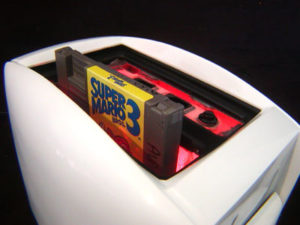
Richard DaLuz is the originator of the Nintoaster, a unique hybrid that allows classic Nintendo games to be played by inserting them into a toaster. Photo Courtesy Richard DaLuz
The CNET article was titled “Nintoaster stuffs a Nintendo console into a retro toaster.”
The story was celebrating — virtually gushing — over the creation of a unique hybrid that allows classic Nintendo Entertainment System (NES) games to be played by inserting them into the slot of a toaster. The author treated this chrome-and-orange invention as the greatest thing since, well, sliced bread.
Richard DaLuz is the originator of the Nintoaster, a unique hybrid that allows classic Nintendo games to be played by inserting them into a toaster. Photo Courtesy Richard DaLuz
As delightful a piece as this particular Nintoaster is, it isn’t a brand-new idea. Not that the Nintoaster’s original creator minds that other people have begun putting their own stamp on his concept, though. Far from it.
In fact, when modder and games enthusiast Richard DaLuz first made one — over six years ago — that was exactly what he wanted people to do. He even made an incredibly entertaining YouTube video offering viewers instruction on how to build their very own.
“My first impression was, I see this Nintoaster and I was like, ‘Wow! This is good! Good on ’em. This guy built a really nice looking Nintoaster,’” DaLuz said of the CNET article, in an interview with Toledo Free Press. “This is exactly what I hoped would happen when I released the instructional video — kinda like, boom, this is how you make it. And they turn around and make their own, put their own spin on it and make a better version of it. So I’m not mad at the guy that built it — absolutely not. Quite the opposite.
“The way that the article was handled, though, I think was a little — I felt like there was a lot of praise being heaped on this one guy. … I don’t know how much research they did, but it doesn’t sound like a whole lot. They kinda glossed over the fact that this is in no way a new thing at this point.”
Indeed, the CNET article does give DaLuz a bit of credit for originating the idea — in the last paragraph, by linking to his page (stupidfingers.com) but never actually mentioning him by name. Saying that the model they’re discussing is “arguably the best looking,” the writer even wonders aloud when someone will make a Nintoaster that still makes toast — ignoring (or ignorant of) the fact that one modder, following DaLuz’s lead, has already done so.
For DaLuz though, it’s not about credit or monetary gain. He doesn’t make Nintoasters to order or anything; it’s really about the joy of creating. He first began tinkering with old consoles around the turn of the century, inspired by a desire to revisit the beloved games of his youth.
“I guess I wanted to relive some of my childhood,” he said. “I remembered the Nintendo that broke a decade previous, and I wanted to get one back again and start a collection. This is still around the time where you could walk into a GameStop and they’ve got the huge bin full of cartridges,” DaLuz said.
“I bought a system from them …it kind of worked as good as you remember them working back in the day. And I thought I would be kind of clever and go buy a replacement connector on eBay. Which I installed, and it worked great for about a week, and it started acting up again.
“And it sort of clicked, like, ‘OK, here’s the problem. This is clearly the problem, is this connector. Why?’ So I started thinking of ways this could be redesigned.”
Next thing he knew, DaLuz was not just tinkering with classic consoles but improving upon them and creating new ways to experience them, like a gaming version of Dr. Frankenstein. He modified an original NES into a handheld model he called the “Fatboy.” He created the ultimate all-in-one system — the “Super Genintari” — which played Atari 2600, NES, Super Nintendo and Sega Genesis games.
But his most popular creation came about, perhaps fittingly, in the midst of a drunken rant.
“I was working on the Fatboy, the portable, was just about done with that. And with all the learning that I had to go through to rework all that crap, by the time I was finished with it, I was joking with friends, like, ‘Man, at this point, I could build anything. … I could build an NES into anything. I could build it into a shoe; I could build it into a toaster.’
“And then, I kind of stopped and said, ‘Wait a minute. That’s actually doable. The toaster chassis is actually big enough that you could fit the full-size board in there. And then, there are those slots, it’s already there.’ If you were going to build it into something, that would be the kitchen appliance to do it with.”
Although it started as a joke, DaLuz said he’s thrilled that the Nintoaster continues to make people smile — and inspire them to try their hand at making one themselves.
“I’m so glad that people have taken off with it on their own. It’s perfect. Just take this idea — like, I don’t own it, I don’t have any copyrights on it. Just take it and build one! They’re going to learn so much in the process. Take my idea, improve upon it, make it yours.”
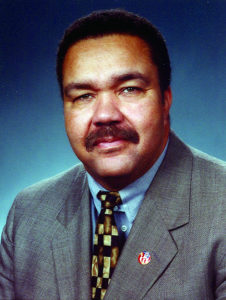
Toledo City Council member Jack Ford died at ProMedica Toledo Hospital on March 21. He previously served as Toledo's first black mayor, state representative, Toledo Public Schools board member, college instructor and social worker. He was a champion for minority inclusion and involved with many community organizations and social programs. File photo.
“A mighty tree has fallen.”
That’s how Jack Ford’s close friend and former co-worker John L. Edwards Sr. described the death of the Toledo City Councilman and Toledo’s first black mayor.
John Marshall “Jack” Ford, 67, died March 21 at ProMedica Toledo Hospital, where he was transported after going into cardiac arrest at his Toledo home. Ford had been in poor health for years, battling kidney disease, diabetes and high blood pressure. But he remained an active voice in the community and local government, where he was serving as an at-large City Councilman.
Toledo City Council member Jack Ford died at ProMedica Toledo Hospital on March 21. He previously served as Toledo’s first black mayor, state representative, Toledo Public Schools board member, college instructor and social worker. He was a champion for minority inclusion and involved with many community organizations and social programs. File photo.
Ford is the third Toledo mayor to die this year. Former Mayor John McHugh, who served 1990-93, died Jan. 30 and sitting Mayor D. Michael Collins died Feb. 6, also from cardiac arrest.
Edwards, who is executive director of Urban Minority Alcoholism and Drug Abuse Outreach Program (UMADAOP) Lucas County, met Ford in the 1970s when both worked for the Ohio Youth Commission.
“He was a career social worker,” Edwards said. “I maintain he always was at heart, even though he had other things on his resume. He was always wanting to help people.”
In lieu of flowers for his funeral, Ford’s family suggested donations to UMADAOP, whose mission is to provide prevention, treatment, recovery support and re-entry services in order to help children, families and communities have healthy and productive lifestyles, Edwards said.
“In addition to the fact that he and I were very, very close friends for almost 40 years, he sort of bonded with our agency not only because of the ups and downs we experienced and managed to overcome over the years, but because we always tried to maintain ethics and provide good stewardship over the public trust,” Edwards said. “Those are things that really, really, really meant a lot to Jack.
“Our service work is committed to providing community-based services that attempt to reach people without giving thought to their ability to pay for services, or where they live or their race, gender or any of those things. We’re come as you are. I think that meant a great deal to him.”
A common perception of Ford as sleepy or slow-moving may have been true of his appearance, but wasn’t true of his mind, Edwards said.
“It was certainly part of his personality, but I think he used that. I think it kept people off balance,” Edwards said. “They thought of him as this slow-moving, half-asleep guy. But beyond that outside persona, this guy was moving at light speed.”
Ford was also funny, Edwards said.
“What I will miss most personally is something many people rarely had a chance to see or experience, and that was his sense of humor,” Edwards said. “He could have you literally on the floor with laughter.”
Both avid readers and Ohio State football fans, Ford and Edwards forged a quick and lasting friendship.
“I say unashamedly he was one of the most intelligent people I’ve ever known,” Edwards said. “He would challenge me with things he had read. He’d do a pop quiz right on the spot.”
Ford especially enjoyed reading about President Abraham Lincoln.
“He was a student of Lincoln,” Edwards said. “I think it was that his presidency occurred during the period that the country began to experience a great wave of change. And the fact that he came from very humble beginnings but managed to rise to become president of the nation.”
Mayor Ford
Ford was born in Springfield, Ohio, in 1947. He played football for Woody Hayes at The Ohio State University, where he graduated with a bachelor’s degree in social work. He later attended the University of Toledo, where he earned a law degree and a master’s degree in public administration.
He was elected mayor in 2001. Among his proudest accomplishments were helping to establish CareNet, a health care program for low-income county residents, and balancing the city budget despite tough economic conditions, Edwards said.
“He was proud of the fact he saw the city through some tough times in terms of the budget,” he said. “He felt he steered the city through some very murky waters.”
“We balanced the budget without raising taxes, cutting essential services or by laying off safety personnel during very tough economic times,” Ford told Toledo Free Press in 2005. “We are spending $10 million less than my predecessor spent in 2001. If I was a corporate CEO, I would be getting a bonus for this performance.”
Ford was also proud of the city’s increased block watch presence.
“We have increased the number of block watches in Toledo from 59 to 180 since I took office,” he told TFP in 2005.
During his administration, Ford also initiated a controversial citywide indoor smoking ban in 2003, which was later enacted statewide.
In 2013, while running for City Council, Ford told TFP he believed voters would be attracted to his years of government experience.
Ford served on Council from 1988-94, serving as president in 1994. His career also included time on the Toledo Public Schools Board of Education and in Columbus as a member of the Ohio House of Representatives. He also taught at the University of Toledo and other local colleges.
“I have experience working at different levels of government, and I’m going to use that experience to make informed decisions while I am on Council, in relation to policy decisions and budget,” Ford said.
In 2005, during his bid for a second term as mayor, Ford told TFP he had come to realize perhaps he hadn’t trumpeted his mayoral accomplishments enough.
“I have not spent enough time pointing out our successes,” he said. “I always assumed that my accomplishments would speak for themselves; this campaign has taught me that the message does not always get out on its own.”
Ford said he decided to run for Council in 2013 after seeing prevailing issues facing Toledo.
“I saw the deterioration of housing in the older neighborhoods, and no one else was talking about it. I decided to make blight a big issue in my campaign, and in a way, it has become one of the big issues in this election,” Ford said in 2013. “Financial management of taxpayer funds is always a big issue. Cutting red tape is a big issue for business people who want to start or to continue to grow a business inside Toledo. And we don’t have coordinated efforts on youth programs and crime reduction.”
While pointing to the advantage of his experience, Ford was quick to point out fresh ideas are needed in government as well.
“I’ve had the broadest experience of anyone running, and experience counts. Some of the decisions made in the future need someone with history to base their decisions on. My experience will help with that, but you need a mix of experience and new people with new ideas,” Ford said.
Blight Authority
One of Ford’s more recent focuses was battling blight in the city.
He spearheaded the formation of a Blight Authority, made up of a dozen or so members of the community from real estate agents to lawyers. The group had its first meeting in October and will continue to meet.
Ford attended many of those meetings, said chairman George Thomas, a lawyer.
“He was very, very encouraging and tried to challenge us and move us forward as much as possible,” Thomas said. “When he came to the meeting he was actually the leader in the room. He had a deep understanding of how the city works and how politics work and he could move the meeting forward.
“I definitely had that sense that he was a force when he wanted to get something done. He was very encouraging and helpful to move it forward.”
The Blight Authority is charged with eliminating blight, encouraging citizens to take responsibility for improving their neighborhoods and being a source of resources for citizens, Thomas said.
The group is broken into three committees: best practices, which looks at other cities and how to get citizens involved; programs; and fundraising. Progress has been made, but there’s still a ways to go, Thomas said. Ideas and action plans have been developed, but there’s no budget or staffing.
“So far, the process has been focused on identifying some realistically best practices we can work on,” he said.
Some ideas the committee has been working on include outreach to connect to community volunteers, education, forming a “blight boot camp,” renting a trailer that can be used to store tools for cleaning up neighborhoods and working with school kids.
Group members are also working with the city’s Department of Neighborhoods on how they might collaborate with existing programs.
“We need to be realistic about what we can achieve,” Thomas said.
The group wants money allocated by the city, but there is no money earmarked for the Blight Authority in this year’s budget, Thomas said.
CareNet
Many in the city and state have been affected by Ford’s work, but Jan Ruma can pinpoint exactly how many, at least in her corner of the world — 27,823.
That’s how many individuals have been assisted by Toledo/Lucas County CareNet, where Ruma has served as executive director since November 2002.
“The reason there is a CareNet is because of Jack Ford,” Ruma said. “If there wasn’t a Jack Ford, there wouldn’t be a CareNet. He’s a man of his word.”
During Ford’s first State of the City address as mayor in 2002, he challenged area hospitals to come together for the uninsured. Hospitals were already doing a lot, but Ford galvanized each to do more, Ruma said.
What resulted was an innovative approach to offering health care for low-income citizens. Now with President Barack Obama’s Affordable Care Act in place, CareNet’s mission has changed slightly, but its focus on helping and serving the uninsured remains, she said.
“He very successfully used his role as mayor to address a serious health care issue,” Ruma said. “So I think that of any elected official, definitely in this area and possibly this state, that Jack Ford has had the biggest impact on accessibility to health care. He was all-in.”
The program is designed to have Toledo’s mayor serve as chairman of the board, and thus Ford was its first.
Ruma recalled having less than two months before CareNet would first be made available to the public Jan. 1, 2003, and she didn’t think it was possible to have it ready in time. Ruma was hoping for much longer than the extra 15 days Ford would ultimately offer, but “he was very kind, and we could have thought of all kinds of reasons not to do it. He didn’t take ‘no’ for an answer. His philosophy was ‘Just do it, we can’t make it any worse.’ And his philosophy was right.”
Even after he left office, Ford remained active in CareNet’s mission, often attending fundraising events but remaining out of the limelight, Ruma said.
“He made it his passion and role, and you can’t say no to Jack Ford,” Ruma said. “Jack was just the champion that brought all those organizations together.”
Adelante
Another organization Ford proudly supported was Adelante, a social service agency that specializes in serving area Latinos.
“Personally, the man was a visionary and saw potential in the Latino community,” said Guisselle Mendoza, who has served on staff for seven years and as executive director since February 2014.
Adelante’s mission is to serve and empower individuals throughout Northwest Ohio through education, prevention, health, economics and other social services.
Mendoza said Ford was involved with its operation since the start, and even before its founding in 1995. During a meeting Mendoza had with Ford in September, Ford recalled Adelante’s beginnings in the late 1980s, when he was asked to create a treatment program for Hispanic adults suffering from heroin abuse.
Just after its inception, Ford wanted to expand the program beyond counseling, and turn it into the lifestyle center it is today, but he was met with opposition by others on staff. Once Ford helped to create an advisory board, the center started a program for youth and then abused women, and Adelante really took off, Mendoza said. Adelante has served 800-1,000 people in the past five years, she said.
“I will be forever thankful to him for paving the way for Adelante,” Mendoza said. “I hope that others like him, given the opportunity, can create change and opportunity within our community. I was very saddened to hear of his passing and he will never be forgotten by me or Adelante.”
Family House
Ford was also a strong supporter and friend to Family House for many years, director Renee Palacios said.
When he discovered the city had cut funding for the food service program at the organization — the largest homeless shelter for families in Northwest Ohio — he took action, she said.
“When [Ford] found out that under the [Mayor Mike] Bell administration, money for our food service was eliminated, he basically did not stand for that,” Palacios said. “He wanted to know what was going on and how were families being fed. He brought me to City Council to explain that.”
Posted to Family House’s Facebook page is the message: “Thank you, Mayor/Councilman Ford for your years of support for Family House. Your spirit, compassion and advocacy will be missed.”
Palacios said Ford learned of the cut funds two years ago during the polar vortex, when temperatures regularly dipped below freezing. Funds were cut because the city determined Family House residents could use other food programs in the area, Palacios said. Young mothers, children and pregnant women were having to walk in the freezing temperatures just to get a meal, she said, and Ford did not stand for that.
“He made it his mission to resurrect feeding people at Family House. He thought homeless families should not be walking around looking for a meal,” Palacios said.
Ford, along with Councilwoman Sandy Spang, found a commercial stove and negotiated its price from $10,000 to $3,000 for Family House so they could continue cooking and serving food to their homeless families, Palacios said.
“He was the first one to pause and say ‘Wait a minute, this isn’t right,’” she said. “He wasn’t a politician who just pushed it through, pushed it through. He stopped and said ‘Wait a minute. Why is this going on? That’s not fair.’ That’s the kind of man he was.”
Ford had lunch many times at Family House and always paid, she said. He got to know the families and always came to talk to people.
“We’ve had important people in Family House many times and he was not here to be seen and be important,” Palacios said. “He came in and went straight to the lunchroom and talked to every single family he could talk to while he was here, especially the kids. He would sit at their level as they came into lunch. He was truly a gentle giant.”
Ford came to his last meal at Family House at Christmas. The organization’s board members had prepared a meal to say ‘thank you’ for the stove, she said.
Family House serves 300 families every year and is the second-largest family shelter in Ohio.
“[Ford] jump-started the program for us and put it on the radar,” Palacios said.
Minority inclusion
Ford was also a strong advocate for minority inclusion, often advocating for certain percentages of city contracts to be awarded to minority-owned businesses or minority contractors.
Unanswered questions about the percentage of minority contractors to be employed during building was among the reasons Ford cited in January for casting Council’s lone “no” vote on ProMedica’s move Downtown.
“Jack was one of the few politicians in Toledo’s history who truly understood that the best way to revitalize an under-served community economically was to give members of those communities a fair shot at public contracts,” said Jay Black Jr., president of the Toledo African American Chamber of Commerce. “I remember him holding a one-person press conference opposing the construction of the Mud Hens stadium unless they were willing to include minorities during its construction phase and committing to hire minorities after its completion.
“As mayor, a centerpiece of his platform was to include more minorities and women in the City of Toledo’s contracting process. He felt so strongly about this issue of fairness that he was willing to risk his political career over it. Many believe he lost his mayoral re-election bid largely because of this issue,” Black said. “He continued to challenge the status quo on this issue in other political positions he held after being mayor.”
Visitation and funeral
Visitation will be 3-6 p.m. March 29 at Warren AME Church, 915 Collingwood Blvd., with a program from 6-7 p.m. The funeral service will be noon March 30 at the church. Doors open at 11:15 a.m.
Another visitation and funeral service will take place in Springfield on March 31 followed by burial. All services are open to the public. Cards may be sent to Ford’s family in care of The House of Day Funeral Service, 2550 Nebraska Ave., Toledo, OH 43607.
What’s next
City Council has 30 days to appoint someone to fill Ford’s vacant at-large seat. Letters of interest and resumes must be submitted by April 2. Council plans to vote April 14. The appointed person will serve until November, when a new Council member is elected during the general election.
Toledo Free Press Editor in Chief Sarah Ottney, Managing Editor Joel Sensenig, News Editor Danielle Stanton and Associate Editor Tom Konecny contributed to this report.
“It is with great sadness that we learn Toledo City Councilman and former Mayor John Jack Ford has passed away on March 21. His loss leaves our community as well as his family with great sadness.
Toledo not only lost a great Councilman and former mayor, but a past state representative, House minority leader, Council president, dedicated public servant, father and grandfather. Our city will deeply mourn his loss.
It is with compassion that we remember Jack Ford passed away doing what he loved, serving the people of this great city. In all his time as a public servant, John Jack Ford fought for equality, health care and access to the basic needs for our citizens. We give our hearts and our thoughts to his family and friends during this time.”
“Jack was a shrewd politician who knew how to reach across the aisle and engage allies to accomplish his political objectives. He would often tell me to make sure you ‘count the votes’ when trying to move a piece of legislation through the process.
He had an uncanny ability to know when to compromise and when to stand his ground. For instance, he knew that his stand on the smoking ban would not be popular, but his vision told him that others would follow the City of Toledo’s lead. He held his ground on the issue and Toledo was one of the first cities in Ohio to enact a smoking ban. (The State of Ohio ultimately followed.) Also, because of Jack’s vision and leadership, Toledo’s CareNet program model was a forerunner of the U.S. Affordable Care Act.
Jack was one of the few politicians in Toledo’s history who truly understood that the best way to revitalize an underserved community economically was to give members of those communities a “fair shot” at public contracts. I remember him holding a one-person press conference opposing the construction of the Mud Hens stadium unless they were willing to include minorities during its construction phase and committing to hire minorities after its completion. As mayor, a centerpiece of his platform was to include more minorities and women in the City of Toledo’s contracting process. He felt so strongly about this issue of fairness that he was willing to risk his political career over it. Many believe he lost his mayoral re-election bid largely because of this issue. He continued to challenge the status quo on this issue in other political positions he held after being mayor.”
— Jay Black Jr., President, Toledo African American Chamber of Commerce
“Jack Ford has been my very close friend for 35 years. Although we ran against each other for mayor in 2005, once that election was over our friendship resumed and got stronger. As able a community leader as Jack was, I considered him to be much more a friend than a fellow politician. I will miss him as a friend very much.”
— Former Toledo Mayor Carty Finkbeiner
“I am deeply saddened by the passing of Toledo City Councilman and former Toledo Mayor Jack Ford — a public servant I have known for over 35 years.
Some will remember him as a fine mayor for the City of Toledo. I choose to remember him as a person whose life’s vocation was to help all people. Jack was a politician and politics can be a rough game. But Jack always seemed to take the high road, even at the end when it came time to name a new president for Toledo City Council.
There were those he helped along the way who turned their backs and did not support him. I am proud to say I was not one of those.
I wish to express my condolences to Jack’s family. He left his mark on our world and he will be missed.”
— Theresa Gabriel, Toledo City Councilwoman At Large
“I have numerous remembrances of Jack Ford. Three that stand out are:
1. How he organized the first 12-member City Council under the strong mayor form of government. He told us, ‘District members better listen to your constituents and perform or lose re-election. You are closer to them than we at large.’
2. He grew up in Springfield, Ohio, and my wife Elaine and I graduated from Wittenberg University in Springfield, so we shared a special bond there and had numerous conversations about his hometown.
3. While he was mayor working through the smoking ban legislation together, there were many meetings and harsh words, but Council, with Jack’s direction, passed it unanimously. Soon after, the entire state banned smoking in public places, much for the betterment of public health.”
— Rob Ludeman, Toledo City Councilman At Large
“I am so sorry to hear of [former] Mayor Jack Ford’s passing. I send my condolences to his wife Cynthia and their whole family. Jack was a caring public servant throughout his life, a statesman. We will all miss him.”
— Sandy Drabik, widow of Toledo Mayor D. Michael Collins
“It is with a heavy heart that I extend my deepest sympathy to the Ford family: his wife Cynthia, his children, and his friends and associates. Our community and citizenry holds an abiding gratitude for his lifetime of dedicated and honorable service to us. He was one of a kind.
Mayor Jack Ford gave his life, decade after decade, to our entire community. As newly elected president of Toledo City Council, he just kept the beat of the city close to him. With every step, he directed himself to move our community and America forward.
He made history. As an educator, health professional and political activist, Mayor Ford became the very first African-American mayor elected in Toledo. He served in the state legislature and understood the interconnections of our city to the world beyond it. His knowledge was hard-earned and unique. With his election as mayor, he elevated our community to a more inclusive and progressive place. He made us proud. Jack was all business. He always demonstrated a hands-on, can do attitude.
He was a master of the city budget and directed his administration to make long-neglected improvements.
Even when not feeling well, he carried forward his duties in a soldierly and persevering manner, earning respect from all who knew him.
I particularly appreciated his genius and wry sense of humor. He never missed a beat. Our entire region has benefited from his generous and focused life on behalf of others.
May the angels carry him to a place of peace and rest. He has been truly a good, faithful and honorable servant.”
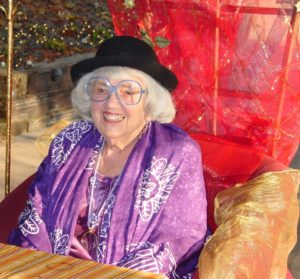
Toledo native Selma Rubin, who died in 2012, was an environmental activist who helped inspire the creation of Earth Day. She would have turned 100 March 28. Photo courtesy Paul Wellmann / Santa Barbara Independent
Behind every movement is a person, and for the wide-reaching effort known as Earth Day, it was none other than a Toledoan who helped create momentum for its introduction to the world.
In the late 1960s, when “being green” meant only a color to most people, California transplant Selma Rubin “basically terrified a lot of people,” according to Nick Welsh, executive editor of Santa Barbara (California) Independent.
Toledo native Selma Rubin, who died in 2012, was an environmental activist who helped inspire the creation of Earth Day. She would have turned 100 March 28. Photo courtesy Paul Wellmann / Santa Barbara Independent
Some Internet sources cite Rubin as the co-founder of Earth Day, but that label appears to be slightly inaccurate. Clearly, her initial environmental efforts were enormous, but actual credit for the Earth Day name and official celebration point elsewhere.
Still, her far-reaching contribution to what led to the formation of Earth Day is documentable, and nearly a half-century later, its effects are still felt.
Toledo born and raised
Rubin was born March 28, 1915, and would have turned 100 this year. She died March 9, 2012, at age 96 at her home in Santa Barbara. Her body was cremated; half of her ashes remain in Santa Barbara, while the other half are in Mexico with her friend and fellow activist, Rogelio Trujillo.
She and her husband Bill moved to Santa Barbara from Los Angeles in 1964, but it was Toledo she originally called home.
“I knew she was from Ohio,” said Linda Krop, chief counsel with the Environmental Defense Center, located in Santa Barbara. “She would talk proudly about her past. She was very, very feisty.”
In 1901, Rubin’s father, Morris Newman, came to the United States with his father and two brothers as Russian immigrants, eventually finding their way to Toledo. Newman had previously made hats for the Russian army, so in Toledo he also became a cap maker and owned a variety store Downtown at Huron and Adams streets. Throughout her life, Rubin was rarely seen without a hat.
“Her strength, her forcefulness and her passion grew out of the legacy that was our family’s roots in Russia,” said Michael Newman, Rubin’s nephew, who spoke via phone from his home in Modesto, California.
Rubin attended Scott High School and then the University of Toledo, where she majored in home economics before answering the call to serve in the U.S. Women’s Army Corps — then the women’s auxiliary unit branch of the U.S. Army — during World War II from 1943-45.
After the war, her entire family moved to Los Angeles, all seeking new opportunities. It was there she married her first husband in 1948, who died unexpectedly in 1955. Then, she met and married Bill Rubin in 1962.
Mother of Earth Day
The warm, supportive and tactical Rubin, a professional bookkeeper and accountant who some consider one of the “Mothers of Earth Day,” took action at the Santa Barbara oil spill of 1969, the largest in U.S. waters at the time.
Up to 100,000 barrels of crude oil spilled into the Santa Barbara Channel and onto its beaches over 10 days, killing thousands of sea birds, dolphins, elephant seals and sea lions.
Outrage ensued, and as good can arise from bad, it was then that Selma Rubin the activist was born. Although she had been involved in environmental causes prior to 1969, Rubin kicked her activism into high gear at that point, and never stopped until the day she died, according to Dave Davis, president and CEO of the Community Environmental Council, based in Santa Barbara.
Earth Day’s origins are somewhat widespread because the action-minded, community event we know today started more as an educational forum.
The name is credited to a former U.S. senator and Wisconsin governor, Gaylord Nelson, who was moved by the ’69 oil spill and announced his idea to national media, working with another congressman to promote events nationally.
Nelson summoned Denis Hayes to organize the first event April 22, 1970. It focused on American environmental issues as a teach-in at 2,000 colleges and universities, 10,000 primary and secondary schools and hundreds of communities. That event later morphed into what we know today as Earth Day.
However, also in 1969, peace activist John McConnell proposed a day to honor the Earth and promote peace, to be celebrated March 21, 1970, the first day of spring in the Northern Hemisphere. His pitch to the UNESCO Conference in San Francisco resulted in an Earth Day proclamation by that city.
“[Rubin] was the ‘mother’ of the 20 million-person national event only in the sense that Rachel Carson was or Margaret Mead or Anne Ehrlich — allied people who wrestled with issues that became strands in the fabric that Earth Day helped weave into a unified ‘environmental’ cause,” said Hayes, who now serves as president of the Bullitt Foundation in Seattle, an organization devoted to protecting and restoring the environment of the Pacific Northwest.
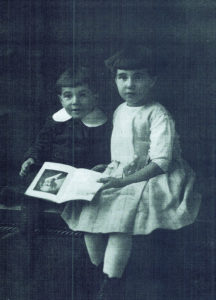
Toledo native Selma Rubin, right, at age 5, with brother Seymour, age 2. Photo Courtesy Mike Newman
“There were lots of folks fighting against [many problems] before Earth Day, but they mostly didn’t think of themselves as connected by shared values. Earth Day helped them realize that they were all part of the same community — something that Selma, with her wide range of interests, doubtless already knew.”
But even before Nelson’s and McConnell’s events was a Rubin-led affair that likely paved the way for Earth Day as we know it today.
In the wake of the Santa Barbara oil spill, Rubin enlisted thousands of others who responded with grassroots action against a consortium of oil companies, resulting in environmental legislation that formed the framework for the modern environmental movement.
“On the anniversary — Jan. 29, 1970 — there was, if you will, an anniversary celebration which was held here which we all considered basically being the birth of the modern day environmental movement,” Davis said. “Selma was there and organized that as part of the Jan. 29 committee, and invited a number of people, including those folks that basically started Earth Day. And so yes, you could consider her almost the mother of Earth Day in many, many ways.”
After these events, Hayes founded the Earth Day Network and served as event chairman for anniversaries in 1990 and 2000. Earth Day is now the world’s most widely observed secular holiday.
A force of nature
If Mother Nature is a force to be reckoned with, then Rubin was its sidekick.
“Selma was involved with the Community Environmental Council the entire period of her life, up until the day she died,” Davis said. “But Selma never retired. Even when she was [in her 90s] she was sitting on boards for over 25 nonprofits locally. She was an incredible force to be reckoned with.”
“Selma was a force of nature,” agreed Welsh, who met her in 1983.
Besides the oil spill response, another of Rubin’s major efforts came in 1970, when she thwarted a developer from building 1,500 condos along the Gaviota Coast in California. Such action was unusual, as there were no applicable environmental laws at that time, and she won despite facing accusations of petition signature forgery and election fraud — convictions for which could have resulted in 28 years in prison. The Gaviota Coast eventually became a natural preserve, where Rubin has a special park bench marked in her honor.
“Her political genius was to be able to take the energy of the moment and being very good at having an organizational response,” Welsh said. “She wasn’t into big money, but she knew big money. Santa Barbara has a lot of rich, wealthy people who are interested in saving the world, and they’re also concerned about how their money is spent. She provided that assurance, and directed things toward competent people. She helped create what everybody here now takes for granted.”
Beyond the environment
Rubin devoted much of her energy to the environment, but she also cared for people, Newman said. He recalled a story about Rubin when she was just a teenager.
“One time, another fellow [student] didn’t have a coat, so Selma took hers off and gave it to her,” Newman said. “She never did anything for herself.”
When her husband Bill died from Alzheimer’s disease in 1989, it was again Rubin who felt a need to support others who were suffering. After President Ronald Reagan announced in 1994 that he had been diagnosed with Alzheimer’s, Rubin ended up working closely with the Ronald and Nancy Reagan Research Institute to find a cause for the disease.
Her close political ties led to an invitation to attend President Bill Clinton’s 1997 inauguration, but a broken leg prevented her attendance.
In all, Rubin helped start over 40 organizations that were dedicated to the environment and social justice.
Though Rubin had no children of her own, she spread her love of people and issues wherever she went, Newman said.
With Jack Ford’s death, Toledo has now lost three men who served as mayor in the past three months.
John McHugh, 84, who from 1990-93 served as the last mayor under the city manager form of government, died Jan. 30. D. Michael Collins, 70, died Feb. 6, five days after going into cardiac arrest while driving. Ford, 67, Toledo’s first black mayor, died March 21, at ProMedica Toledo Hospital after going into cardiac arrest at home in Toledo.
.
Ford had been in poor health for years, battling kidney disease and diabetes. But he remained an active voice in the community and local government, where he was currently serving as an at-large City Councilman.
Ford and Toledo Free Press didn’t always get along over the years, but we respect his decades of dedication to public service.
His friend John L. Edwards Sr., executive director of Urban Minority Alcoholism and Drug Abuse Outreach Program Lucas County, described Ford to TFP as passionate, brilliant, hilarious and ethical.
“He was one of the most intelligent people I’ve ever known,” Edwards said. “[People] thought of him as this slow-moving, half-asleep guy. But beyond that outside persona, this guy was moving at light speed.”
A social worker by training and at heart, there’s no question Ford improved the lives of low-income citizens through the establishment of Toledo/Lucas County CareNet and his work with community organizations. He was also known as a passionate advocate of minorities, fighting for percentages of city contracts to be awarded to minority-owned businesses or minority contractors.
But Ford’s naturally taciturn personality probably hindered his public perception. In 2005, during his bid for a second term as mayor, Ford told TFP: “I always assumed that my accomplishments would speak for themselves. This campaign has taught me that the message does not always get out on its own.”
Whatever Ford’s legacy, we must now contend with the void he leaves on Council. City government, which briefly resettled earlier this month with the appointment of small business owner Scott Ramsey to the District 4 City Council seat vacated by Mayor Paula Hicks-Hudson, is again shaken.
Some may dismiss Ramsey as just another dubious character after the recent revelation that he’s behind on taxes, but he’s reacted with class. He hasn’t ducked or gotten defensive. He even posted the story on his personal Facebook page.
“Being a passionate small business owner doesn’t mean that you have all the answers or will navigate every curve perfectly,” Ramsey wrote on his Facebook page. “We are able to say that we have survived a rough economy, through communication we are making payments on past obligations and have made it nearly 10 years as a new startup business. The lessons we have learned and challenges we have faced have made us stronger, taught us humbleness and developed character. There is learning in our experiences for ourselves and others, always glad to discuss.” For whatever reason, some people weather controversy better than others. I wouldn’t write him off just yet.
Good leaders are hard to find. But as we move forward, we must keep trying to do so. As cartoonist Don Lee pens on this page, McHugh, Collins and Ford each “worked from the basic idea that an individual mattered, that the individual made a difference. In fact, that the individual was sometimes the only one who could make a difference. And that we can’t let die.”
Thomas F. Pounds is president and publisher of Toledo Free Press. He can be reached at [email protected].
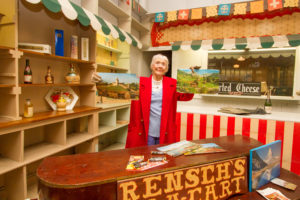
Angela Rensch Ligibel, former owner of A. Rensch & Co., a specialty food market at 607 Monroe St. Downtown from 1888-2005, goes through some items still remaining in the building. Ligibel sold the building in February to developer dave ball, who is selling the first floor to ed beczynski, who owns the blarney Irish pub. The pub, which shares a wall with the former market, will use the back half of the floor as a kitchen. Beczynski plans to open a delicatessen in the front, offering cheeses, meats and other specialty items. He hopes to have the business open this summer. Toledo Free Press Photo by Christie Materni
Before one could find imported cheeses and gourmet foods at everything-under-one-roof stores, there was A. Rensch & Co.
After being in the family of a Swiss immigrant for 127 years, the building at 607 Monroe St. — four doors west of Fifth Third Field — was sold for $103,500 to developer Dave Ball.
Despite the change in ownership, the location’s tradition of selling specialty food items will continue. Ed Beczynski, owner of The Blarney Irish Pub, which shares a wall with the building, is purchasing the first floor from Ball with plans of turning the front half into an Old World-style delicatessen this summer. The back half will be used for additional kitchen space for The Blarney, while the upper two floors will be renovated into a loft apartment.
Angela Rensch Ligibel is the granddaughter of Benedict Rensch, who began selling food from the building in 1888. Ligibel sold the building, listed in the National Register of Historic Places as part of the Monroe Street Historic District, on Feb. 10.
Angela Rensch Ligibel, former owner of A. Rensch & Co., a specialty food market at 607 Monroe St. Downtown from 1888-2005, goes through some items still remaining in the building. Ligibel sold the building in February to developer dave ball, who is selling the first floor to ed beczynski, who owns the blarney Irish pub. The pub, which shares a wall with the former market, will use the back half of the floor as a kitchen. Beczynski plans to open a delicatessen in the front, offering cheeses, meats and other specialty items. He hopes to have the business open this summer. Toledo Free Press Photo by Christie Materni
“At that time, there were a lot of [businesses] in Downtown Toledo, so there were many, many places he could sell his wares with horse and buggy, which was how he sold his cheese,” she said. “It grew and grew and grew, and he started handling all kinds of imported cheeses, gourmet jellies, caviar, smoked eel and all kinds of things like that.
“We were one of the few places you could get those imported items at that time,” she said. “Now, you can go anywhere, you can go to Walmart and get them. That’s kind of what ended our business.” Ligibel started noticing the public’s shift to larger stores in the late 1980s and early 1990s.
Ligibel, who took over the store in 1984 when her father died, said she relished the chance to operate the family business.
“I enjoyed every minute of it,” she said. “It’s sad to see it go, but time marches on, as they say. That’s what happens.”
The business was largely closed in 2005 and the building had been on and off the market since then.
Ligibel wasn’t going to sell it to just anyone, however.
“I was very particular about what might be in there,” she said. “You sort of fall in love with your building, and it’s hard to see just any name go in there. Of course there were offers made over the years, but I kind of hung in there because I thought, “This is not [what I wanted].”
Beczynski Market is exactly what she wanted.
Although he’s not quite certain on the name yet, Beczynski believes the Old World delicatessen model will play well in the neighborhood.
“With all the people living Downtown, I’ve been racking my brain with ‘What does Downtown really need?’” he said. “You hear it all the time: grocery store. Well, this would be a specialty-type store selling different meats by the pound, cheeses and specialty items.
“I think it’s another piece of the puzzle for all of Downtown,” Beczynski said. “Hopefully there will be a big grocery store that comes Downtown. I hope there’s a pharmacy that comes Downtown. We need those things, but even with that, having a specialty market like this, making our own pierogi and kielbasa and all that kind of stuff, I think this will be a nice add-on to what’s happening Downtown.”
He compared his market to a scaled-down version of Zingerman’s Deli in Ann Arbor. Plans call for the market to contain a bakery and offer beer and wine to go.
Ligibel’s son, Ted, said his memories of working in the shop during the 1950s and 1960s remain strong.
“The sale of A. Rensch & Company is definitely bittersweet for our family, all of whom have worked there at one time or another, including our spouses,” he said in an email. “After 127 years at the same location and in the same building, a city record, it is difficult to say goodbye to a place we grew up with, knowing that this was where our grandparents and great-grandparents spent the entirety of their working careers.”
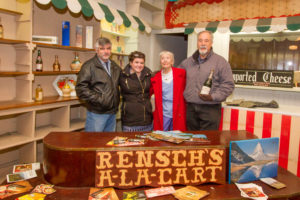
Jim Dandar (Angela’s son-in-law), Colleen Tankoos (Angela’s granddaughter), Angela Resnch Ligibel and Ted Ligibel (Angela’s son). Toledo Free Press Photo by Christie Materni
Ted said the store’s legacy will live on due to the exhaustive records kept by the family.
“Also preserved were many photographs, articles and food containers that had been saved over the years, including records going back to the 1880s,” he said. “In order to ensure that this history would be preserved, we donated some records to the Local History and Genealogy Department of the Toledo-Lucas County Public Library and to the Canaday Center at the University of Toledo. The Henry Ford Museum took dozens of vintage food jars and tins to add to their retail goods holdings, noting that these were items never before available in their collections.”
Obtaining the extra space will allow The Blarney to better serve its customers during peak times, Beczynski said. Since opening in 2006, he purchased the building behind the bar to use as The Blarney Event Center, which hosts private parties. The pub has also begun offering catering services.
“We’re going to be able to put food out so much faster,” he said. “When it gets crazy down here, it’s just hard with the kitchen we have. It’s going to give us the ability to really pump out the food.”
Ligibel is glad to have found the right buyer at the right time.
“This is kind of what I’m looking for, because they’re going to carry on a deli, in sort of the theme of the business as it was,” she said.
Although she no longer owns the building, Ligibel is glad to see the neighborhood coming to life after years of dormancy.
“To see all of this happening, it’s very exciting,” she said. “I never could have imagined that the Mud Hens would draw the crowds like they do. It is just awesome the way Toledo has come around to the Mud Hens and the Walleye. To see all of that happening, it makes me feel good.”
Beczynski expects to begin interior demolition work within a few weeks and hopes to have the market open this summer.
The Neighborhood Health Association (NHA) will hold a groundbreaking ceremony at the site of its new medical clinic at 11 a.m. March 31. The date was rescheduled due to the funeral of Toledo City Council member and former Mayor Jack Ford.
The $11 million facility, to be called Nexus Healthcare, will be built on the site of the former Taylor Cadillac building at 1415 Jefferson Ave., at the corner of 14th Street.
During the ceremony, Toledo Mayor Paula Hicks-Hudson, Lucas County Treasurer Wade Kapszukiewicz and Lucas County Commissioners Pete Gerken and Tina Skeldon-Wozniak will speak about the new facility and what it means for the community.
Services provided at the new 43,000-square-foot medical center will include adult and pediatric dental, retail pharmacy, adult primary care, women’s health, pediatrics, lab services and vision care. The facility will also include the Harry Brown Sr. Urgent Care Center, a branch of the Toledo Urban Federal Credit Union and a café to be used for workplace training for NHA patients.
“The new clinic will offer access to bus lines and facilities designed to directly address the complex needs of our patients,” said Harry Brown, NHA board president, in a news release. “The best part is that this is an effort undertaken by the community, for the community.”
The NHA is a nonprofit agency that provides medical care and educational and support services to the community. The organization currently manages 11 sites, a pharmacy, two dental clinics and two senior centers.
Several current NHA clinic locations will be consolidated into the new site. NHA provides care to everyone regardless of their ability to pay and accepts most insurance plans.
The new medical facility is being built with funds from a $5 million grant from the Health Resources and Services Administration, which is an agency of the U.S. Department of Health and Human Services, and $6 million from the Local Initiatives Support Corporation (LISC).
The new medical clinic will take about a year to build.
In the March 8 Toledo Free Press, you wrote about “The day the Nazis won.”
In your column, you attempt to demonize the National Socialist Movement (NSM) by calling us “Nazis” and “people who hate.” These types of unflattering portrayals have been so often inaccurately bandied about that their inflammatory use is almost laughable. However, you do make one grave mistake.
While April 19 (the day after our rally) also celebrates “419 Day,” you make a false comparison to the events of 2005. This was not the day of violence “inspired by a group of people who only hate.” More correctly, this was the day that communists and anarchists motivated the black citizens of Toledo to rise against their own community in hate.
You write that, “We in the media choose whether to make hate groups coming to Toledo a news story.” Fine. However, if you chose to consciously ignore the underground motivations that engulfed your own community, which was anarchist and communist-inspired looting and rioting, you are obviously missing the whole point. The “Nazis” did not win that day — it was the communists and the anarchists who inspired the hate, destruction and violence. There is no winner when communist-inspired rioting brings destruction upon any city.
Again, ignoring this part of the story stops people from analyzing the negative contributions made by communists and anarchists in your own town.
Instead of stooping to their level (and denigrating the journalistic trade) by vulgarly calling us “the lowest pieces of s*** this country has ever known?” why not make some meaningful exploration into the underlying historic issues and present concerns?
It is not the NSM, or any other prowhite movement for that matter, that your town has to fear. It is those who want to ruin a peaceful way of life.
The greatest love a journalist can show is to bring out the truth in issues he feels are somewhat discomforting.
Furthermore, we in the NSM are often misrepresented by the mainstream press, as you so eloquently demonstrated. I wonder what it is about a white civil rights organization that you find to be so hateful?
The NSM is made up of countless men and women who have served this nation in the military, as well as others who work in public service and many other professions. Stereotyping an entire group of people is true hate, and it’s wrong. It would be like us saying every black person in Toledo is a rioter and criminal; that is certainly not true and we do not stereotype in such a manner. The NSM is highly active on the U.S. borders, and abide by an America First platform. If standing up for white civil rights, defending our nation’s borders, and taking a nationalist, America First political stand is considered low and hateful, then so be it.
I doubt this letter will see the light of day, or be published as a rebuttal to your hate-filled diatribe against the NSM in the Toledo Free Press, as I am quite certain the media would love to continue demonizing the NSM.
Anyone who is interested in our political platforms should simply check out our website at www.nsm88.org. We have a lot more support in Toledo than I think you realize.
Respectfully submitted, — Cmdr. Jeff Schoep National Socialist Movement
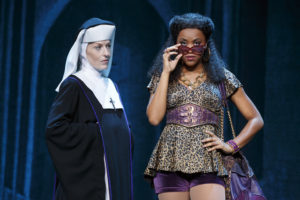
Kerissa Arrington, right, plays Deloris Van Cartier in the Broadway adaptation of “Sister Act,” which makes its way to Toledo’s Stranahan Theater in April. The stage version of the 1992 movie starring Whoopi Goldberg is produced by the actress herself. Photo Courtesy Sister Act
In 1992, Academy Award winner Whoopi Goldberg starred as Deloris Van Cartier in “Sister Act.” The Broadway adaptation, produced by Goldberg, will make its way to Toledo in April.
Kerissa Arrington, right, plays Deloris Van Cartier in the Broadway adaptation of “Sister Act,” which makes its way to Toledo’s Stranahan Theater in April. The stage version of the 1992 movie starring Whoopi Goldberg is produced by the actress herself. Photo Courtesy Sister Act
“To hear people laugh and cheer the way they do at ‘Sister Act’ — a show people think they know but are pleasantly surprised to discover is not what they are expecting — is a magical experience for a producer,” Goldberg said in a news release. “Happily, audiences across the country are able to get in on the fun as Deloris and her fabulous sisters spread the love nationwide.”
Kerissa Arrington, who is playing Van Cartier, had the daunting task of stepping into to the role.
“Of course, Whoopi Goldberg — she’s an icon,” she said.
This is Arrington’s first touring production. She acted in high school and professionally at theme parks in her hometown in Texas.
“This is pretty much the biggest thing I’ve ever done,” she said.
Arrington said she was familiar with the movie and watched YouTube clips of the Broadway version before taking over the role.
“I really just let it be my own,” she said. “I read the script over and over and over … what I admire the most is the realness of the character. She’s not afraid. She’s really, really confident in who she is.”
“Sister Act” follows Van Cartier after she witnesses a murder and is put into protective custody in a convent disguised as a nun.
“I love playing her because she’s so different from me,” Arrington said. “She’s very loud and glamourous and in your face. It’s really fun to take on that character. … It’s just fun to tell her story every night.”
During Van Cartier’s escapade, she inspires a choir with disco, R&B and gospel music. The play features an original score by Academy, Grammy and Golden Globe Award-winning composer Alan Menken.
The musical will be at the Stranahan Theater for a limited engagement. Performances are 7:30 p.m. April 8-9, 8 p.m. April 10-11 and 2 p.m. April 11-12.
Tickets are available online at theaterleague.com and stranahantheater.org, at the Stranahan Theater box office at 4645 Heatherdowns Blvd. or by calling (419) 381-8851.
The first time Toledoan Keith Bergman performed stand-up at an open mic, he was so nervous he almost walked out.
Toledo comedian Keith Bergman recorded comedy album “Disheveled” during local comedy showcase “Two Buck Yuks” last year. Photo Courtesy Keith Bergman
More than four years later, Bergman has released his first comedy album “Disheveled,” recorded during the comedian showcase “Two Buck Yuks” (produced by Bergman) last year at The Blarney Event Center.
The album, which he calls “highbrow stupid,” is available online and in physical form, something he said is nice, even though consumers seem to be moving away from CDs.
“It’s a little terrifying when you get boxes of them shipped to you,” Bergman said. “I wasn’t 100 percent sure I was going to put it out until after I heard it but the show went really well.”
Bergman said the album is a stepping stone. He plans to continue writing and hopes to keep improving.
Bergman doesn’t like to dwell on past mistakes but wishes he had got into comedy sooner.
“I wish I hadn’t made excuses or put it off because it’s something I’ve always wanted to be,” he said. “I’m having so much fun now and it’s going so well. It’s one of the most fun things I’ve ever done with my life.”
He said that he uses his career as an example for his kids to learn what it takes to make a career out of being creative.
Comedy has been part of Bergman’s life from an early age.
“I would listen to George Carlin before I even got 90 percent of the jokes,” Bergman said.
The hometown feel is obvious in “Disheveled”: the album opens with Bergman talking about the Polar Vortex last year which interfered with a lot of the “Two Buck Yuks” dates. He added that bad weather affected him while on tour this winter as well.
“You don’t create any kind of art in a vacuum; it’s definitely a product of where you live and where you travel,” he said.
Bergman selects his material (one track on his album is titled “Elderly Racists”) purposefully. In his act, he uses real-life experiences in a way similar to Louis C.K., one of his comedy inspirations.
“Having a lot of different things to talk about is good because you never know what kind of audience you’re going to get,” Bergman said. “With the elderly racists thing, that’s a whole topic that you could have a serious discussion about and [you] could really open a can of worms about why people think a certain way and how silly it is. That’s another discussion for another place. I feel like my job is to air that out and try to find the humor in it. It’s still a serious topic but maybe you can take some of the venom out of it by poking fun at it.”
The album name describes Bergman, he said, and the sketch on the album cover captures that spirit. He’s always got a “just rolled out of bed look” to him, which is never intentional, he said.
“Once I saw that little sketch with me and the coffee cup and everything, [‘Disheveled’] popped into my head,” Bergman said. “It’s just a word I’ve always liked the sound of. There’s certain times that I will use a bigger word or a weirder sounding word just because I like the way it sounds. And that word’s one of them; you know what that word means even if you don’t.”
In the future, Bergman would be open to doing something like “Two Buck Yuks” again.
The Toledo comedy scene is “surprisingly vibrant,” Bergman said. “There [are] actually multiple generations,” he said.
For more information, or to purchase “Disheveled,” visit keithbergman.com or Twitter.com/KeithBBergman.