Every 13 seconds, an older adult is rushed to an emergency department because of a fall. In fact, so many older adults are falling that it’s now the leading cause of accidental death among the elderly. However, most of these accidents can be prevented.
From 2000-12, Ohioans aged 65 and older experienced a 167 percent increase in the number of fatal falls, according to the Ohio Department of Health (ODH). On average, about three older Ohioans suffered fatal falls each day in 2012. The ODH reports falls among older adults cost the state and its residents $646 million in 2012.
The costs can be psychological, too. As a physical medicine and rehabilitation physician at The Ohio State University Wexner Medical Center, I’ve seen that patients who have fallen before often develop a fear of falling, which puts them at an even higher risk of falling again.
There are many reasons why patients fall, including vision or medication problems, or even conditions like diabetes and low blood pressure.
That’s why it’s so important for doctors to assess patients from head-to-toe, examining their history of falls and medical history, along with testing their gait and balance.
The following tips may help reduce the risk of falling at home:
Remove clutter to create clear paths for walking in the home.
Remove throw rugs or use double-sided tape to keep rugs from slipping.
Install handrails and lights on staircases.
Install grab bars inside and outside the shower and by the toilet.
Use nonslip mats in the bathtub and on shower floors.
Extend the chain on ceiling fans to make them easily reachable.
Get up slowly and turn on a light before walking across the room.
Wear shoes both inside and outside the house. Avoid wearing slippers.
Falling is not an inevitability that comes with age.
There are steps doctors, patients and caretakers can take to help prevent falls.
Dr. Joe Rosenthal is a physical medicine and rehabilitation physician at The Ohio State University Wexner Medical Center.
Last month, Blade ombudsman Jack Lessenberry addressed some of the negative feedback regarding Blade writer Keith Burris’ Feb. 15 column, “Woodville: Worst little town in Ohio?” in his March 1 column, “Additional info would have bolstered Woodville column.”
.
“You don’t have to be a dog lover to think there is something seriously wrong when a policeman shoots a Labrador retriever who is just walking up to him, something that eventually caused the dog to lose a leg,” Lessenberry wrote. “Blazing away with a gun at a dog ambling toward you is few people’s idea of farsighted police work.”
As has been stated numerous times in The Blade and elsewhere, Officer Steve Gilkerson’s statement about the Nov. 3 incident reads that the dog — an unleashed, unlicensed chocolate lab named Moses that approached him during a traffic stop — “did not stop when yelled at,” “continued toward me, with a look in its eyes that I would describe as focused on a target” and “did not seem interested in veering from its set path.” That doesn’t sound like ambling to me.
Granted, three witnesses to the incident — two from the stopped vehicle and one employee of Moses’ owners’ business — gave statements saying they saw the dog simply walking toward the scene. Two noted in their reports the dog was “just smelling the ground and wagging its tail.”
But when there are two versions of a story, either of which may or may not be factual and neither of which will ever be proven, why should either one be presented as fact? The he said-she said situation that was decided by four police chiefs, a firearms instructor and the Sandusky County prosecutor in favor of the officer was apparently decisively overturned by The Blade in favor of the witnesses.
A few weeks ago, I got some ribbing from co-workers after TFP ran several positive letters to the editor about my column (“Bully pulpit,” Feb. 22) responding to Burris’ column. It’s not that I didn’t also get criticism; I did. But those people declined permission to run their letters. One emailer stated: “You are not any better than The Blade if you don’t look into the dog and the dog’s history of attacks. Sugarcoat what you want. That is easy. True investigation, true reporting takes guts and persistence. Maybe the truth just isn’t what Toledo papers are interested in.”
Fair enough. For whatever reason, it’s never been reported that there is at least one prior incident on file with local law enforcement involving Moses. On Sept. 11, 2011, Ron and Kimberly Taylor, who live near Moses’ owners’ business on Route 20 called police after a dog without identification came onto their property. A sheriff’s office report states that the dog — later identified as Moses — “was acting aggressively” and “causing issues” with the Taylors’ animals. The report also states the dog had been seen on other occasions.
I recently spoke with Ron, who said he remembers the incident well as it happened during his daughter’s 7th birthday party. He said the dog attacked his female Great Dane, which caused his male Great Dane to jump in. “It had my female down and by the throat when my other dog came at it,” Ron told me.
He got all the kids inside before approaching the dog, which he said jumped at him and then chased him into his dogs’ kennel, where he managed to jump the fence and secure the dog inside before calling police.
When a sheriff’s deputy arrived, the dog was “barking and going nuts” inside the kennel, Ron said. The deputy advised Ron to keep it in the kennel overnight and notify animal control the next day. However, Ron said he became aggravated by the dog’s continuous barking so he decided to let it go. When it wouldn’t leave, he shot at — but didn’t hit — the dog with a paintball gun to drive it away. He said he watched the dog go to another neighbor’s property, where he saw owner Thomas Bischoff pick it up later that night.
Ron said the dog returned to his property weeks later and attacked his female dog again, but he didn’t call police. After that, he said he didn’t see the dog again for years until he recognized Moses on the news after the shooting.
Ron said he is friendly with Moses’ owners, Bischoff and Lauren Meyer, and has done business with them. But he’s frustrated Meyer blamed the incident on his dog being in heat rather than apologize for their dog being on his property. Bischoff is a “good guy,” he said, but needs to keep his dog on his own property. He also disputes “the narrative of poor innocent Moses.”
“The dog I saw that day, that was not a nice little puppy you were going to walk up and pet,” Ron said. “It was growling and barking like crazy. I don’t know [Gilkerson] but I see people trying to get a guy fired over a dog I’ve seen be very aggressive.”
Ron said someone from The Blade left a voicemail message last fall asking about the 2011 report.
“I called them back and left them a message, telling them the story I just told you,” he told me. “I never got a call back.”
The now-6-year-old dog is also once again unlicensed. According to the county dog warden, Moses was first licensed in 2011 and then again on Nov. 12, 2014. That license expired Dec. 31.
Moses’ owners did not return a phone call seeking comment. I guess I can’t say I blame them. This doggone story is getting mighty played out. But that’s a whole new (old) story.
Sarah Ottney is editor in chief of Toledo Free Press. She can be reached at [email protected].
George Burns — who lived to be 100 years old — used to say, “If I knew I was going to live this long, I would have taken better care of myself!”
It’s true that some individuals are blessed with good genes. For the rest of us who might be concerned with quality of life as we age, exercise is one of the keys.
Burton Rogers Jr.
Muscle mass decreases as we age. Beginning in the fourth decade of life, adults lose 3-5 percent of muscle mass per decade, and the decline increases to 1-2 percent each year after age 50. Muscle keeps us strong; it burns calories and helps us maintain our weight, and it is also an essential contributor to our balance and bone strength.
The good news is that muscle mass can increase at any age in response to exercise. In an important study of strength training and older adults conducted with 100 male and female residents of a nursing home in Boston (average age 87), subjects lifted weights with their legs three times a week for 10 weeks. At the end of the study, there was an increase in thigh mass of 2.7 percent, walking speed increased 12 percent, and leg strength increased 113 percent. In a similar study of adults 65-79 years old, subjects who lifted weights three times a week for three months increased their walking endurance by 38 percent (from 25 minutes to 34 minutes) without appreciable increases in mass.
Additionally, the literature is voluminous with evidence defining geriatric improvements in cardiovascular, musculoskeletal and neurological health. The inclusion of carefully constructed exercise regimens may slow down the osteoporotic process. Additional studies show a reduction in hip fractures in women who undertake regular exercise regimens. The factors leading to this reduction are improved strength, proprioception and maintaining of greater bone density.
The rate of hip fractures increases dramatically within the geriatric population. Therapeutic exercise may reduce this risk. The evidence supports improved strength and endurance. Additionally, all therapeutic exercise regimens must include activities that sharpen proprioceptive skills, as most hip fractures are fall-related. Your fall risk can be estimated by your physical therapists.
While exercise cannot vaccinate against or eradicate dementia, evidence suggests therapeutic exercise can slow the rate of or reduce the onset of dementia while promoting mental health improvements.
Set an appointment with your physician to determine your capabilities to proceed with an exercise regimen. The physician may in turn refer you to physical therapy for balance assessment. The physical therapist will prescribe specific therapeutic exercise, which is capable of improving functional strength, endurance, balance and range of motion. The physician and physical therapist may also refer you to an exercise physiologist, who will consider your current physical status and issue a specific exercise prescription.
All of these services are available through Mercy. To find a physician, call (419) 251-4000.
Burton Rogers Jr. is regional administrative director for Mercy Sports Medicine.
Lucas County Children Services (LCCS) is preparing to implement what it calls a game-changing, systemwide training program this summer, thanks to a $72,800 grant from the State of Ohio.
The grant will allow the agency to pinpoint areas of trauma in the lives of parents and children and develop individualized treatment plans.
Behind antisocial behaviors, including crime, sexual abuse and the abuse of drugs and alcohol, is often a trauma the person suffered early in life, said Laura Neal, assistant manager of family services at LCCS.
Parents who were traumatized often pass their pain to their children. LCCS wants to help nip issues in the bud by helping parents heal their trauma so they don’t repeat it, Neal said.
“Now we’re taking that next step and looking at what’s going on behind the problem,” said Julie Malkin, LCCS public information officer. “We’ve become so much more attuned to the needs of our families.”
LCCS, a countywide social service agency based in Toledo, works with families to place children in foster care, facilitate adoption, prevent child abuse and offer a host of other treatments through its partners in the children services sector.
LCCS wants all its supervisors, managers and caseworkers to be trained under the new grant. Multiple partner agencies, including the courts, mental health services, substance abuse prevention and counselors for emotional and physical abuse, will also undergo the training.
There are two types of trauma — acute and chronic, Neal said. Acute may be the loss of a loved one, whereas chronic might be ongoing physical or emotional abuse.
Neal said most parents who come to the agency have unresolved trauma issues and have learned to cope with them through maladaptive behaviors including criminal behavior, physical or sexual abuse or substance abuse.
“I’m really excited about this. We’re the only county in Ohio who is embracing this and trying to be a trauma-informed agency and the benefit is to the family,” Neal said. “The federal government is recommending that trauma is a huge part of child welfare. We’re ahead of the game here.”
The training is offered by the National Child Traumatic Stress Network, which has worked with the Chadwick Center for Children & Families out of San Diego. They were the first to implement the training program 10 years ago and it’s now being implemented across the country, Neal said.
“Traditional counseling doesn’t work,” Neal said. “We need counselors to understand. Traditionally, we see parents using drugs and it’s because they have some problem in their life. Now we’re going to be able to delve into what drove this parent to be using drugs.”
Training will occur in phases starting this summer and ending in December, Neal said. A kickoff two weeks from now will feature a trauma survivor based out of Washington, D.C., who wrote a book based on her experiences. A communitywide kickoff will happen June 23, and will include court employees and foster parents.
The training will change LCCS’s current practices, Neal said. The agency may have more pre-placement visits where children use art therapy in addition to a “whole continuum of things” they will do differently, she said.
“It’s more like a deepening empathy and a deeper level of understanding,” Neal said. “Once they become trained they will have a deep understanding for the parent and patience for them as well.”
Gone are the days of the stereotypical social welfare agency that only swoops in and takes away children, Malkin said.
“Our goal is that we have children going home and staying home in a safe environment,” Neal said.
As part of the grant, a trauma coalition is being formed and its committee will meet at 2 p.m. the second Tuesday of every month at United Way of Greater Toledo, except for April 14 when it will meet at the EMS Building. The meetings are open to the public. Coalition and committee members will include those from the schools, LCCS, courts and mental health providers.
Maggie Dziubek, left, of Glass City Stories and Silke Goudos of 419 Tales are part of the growing movement of those interested in sharing and archiving the stories of Toledoans. Toledo Free Press Star Photo by Christie Materni
Over the past few months, Toledo has started to open up and share its stories.
Taking cues from public radio programs and podcasts like “The Moth,” “This American Life” and StoryCorps, creative residents of Toledo have begun establishing their own live storytelling events — opportunities for people in the community to congregate, converse and connect through shared experiences.
Organizers say the aim is to gain glimpses into the lives of others, creating a unique emotional experience for storytellers and audiences alike.
Glass City Stories
Inspired by live “Moth” storytelling events she attended while living in Chicago, Glass City Stories founder Maggie Dziubek said her program is based on making storytelling fun.
Maggie Dziubek, left, of Glass City Stories and Silke Goudos of 419 Tales are part of the growing movement of those interested in sharing and archiving the stories of Toledoans. Toledo Free Press Star Photo by Christie Materni
“I want to keep it accessible to everyone,” Dziubek said. “People can be a part of it without having some kind of qualification as a storyteller.”
Held once a month at The Moxie on Adams Street, each Glass City Stories event is based around a theme. The inaugural Glass City Stories took place on Valentine’s Day with a theme of New Love. On March 13, the theme was Good Luck/Bad Luck and an April Fools event is set for 7 p.m. April 16.
Dziubek said the best moments are the most unexpected.
“We’re always up for spontaneous storytelling,” she said. “It’s really exciting when someone takes a leap of faith and tells a story off the cuff.”
Dziubek, a Toledo Free Press contributor, said she sees the rising popularity of storytelling as an important development for Toledo, offering new creative and social opportunities for the city.
“It’s different from your usual night out,” she said. “There’s a real sense of intimacy because it’s people sharing something about themselves. That vulnerability makes it unique.”
Spoken
Spoken Toledo held its inaugural event March 12 at the Ohio Theatre and Event Center. Co-creator Ryan Bunch said he is pleased with how the evening went.
“People really opened up and got into the spirit of things,” he said. “Some of the speakers I had known for years, but hadn’t heard their stories.”
Ryan Bunch
The program featured four guest speakers and six volunteers, all sharing stories loosely based on “beginnings and endings.”
Attendees were treated to stories of first heartbreak, journeys to new places and disastrous hair-dye jobs. Bunch said another edition of Spoken is in the works.
“If not this summer, definitely in the fall,” he said. “The great thing about these events is that they don’t need to be too overthought or grandiose. Keeping the focus on the people and their stories will always make it fun.”
All proceeds from Spoken go directly toward programming at the Ohio Theatre, and Bunch encourages anyone with an idea to get involved.
“We welcome any support we can get,” he said. “It’s inspiring for me to see people come together. I hope people continue to support the space so we can put on more events for the community.
Frogtown Storytelling Guild
Founded in 1994, the Frogtown Storytelling Guild is Toledo’s oldest collective of storytellers, dedicated to perfecting and preserving the ancient art of storytelling. The group meets every second Saturday at Reynolds Corners Branch of the Toledo-Lucas County Public Library. Member Tari Miller said anyone interested is welcome.
“We are open to people of all walks of life,” she said. “You can come listen to our members or practice telling a story of your own.” A retired educator, Miller joined the guild in 2004 after reading a call for story enthusiasts in the paper.
“My heart dropped when I read that,” she said. “I had found a marvelous group of people that loved stories. It was exactly what I needed.”
Once a year, the guild partners with the National Storytelling Network to put on Tellabration!, a large-scale event bringing in guest storytellers from around the country. Miller said events like this keep the tradition of storytelling alive.
“Something happens when you share a story face to face,” she said. “Being able to take someone on a journey where they never expected to go. What’s more powerful than that?”
419 Tales
In addition to live events, creators are looking to showcase Toledo’s stories using other mediums as well. 419 Tales is an upcoming podcast series dedicated to exploring and archiving the city’s oral histories, featuring personal interviews as well as candid recordings from community happenings. Creator Silke Goudos, who was a recent finalist for a Toledo SOUP microgrant, said her goal is to inspire curiosity in the everyday.
Tari Miller, left, of Frogtown Storytelling Guild and Josh Nagel of Tribute to Toledoans are part of the growing movement of those interested in sharing and archiving the stories of Toledoans. Toledo Free Press Star Photo by Christie Materni
“I’m interested in the town I live in,” she said. “We’ve got a lot going on here. I want to fight apathy toward Toledo.”
Goudos is currently running a GoFundMe campaign to fund professional audio equipment to produce the podcast, which she hopes to launch in the next two to three months. She said programs like hers will always be in demand.
“Storytelling is how we preserve history,” she said. “It’s an art form that stimulates conversation and allows us to connect with others, something that we are craving nowadays.”
Tribute to Toledoans
Utilizing moving pictures to capture the city’s stories, Tribute to Toledoans is an ongoing video series produced by Charles Boyk Law Offices. Videographer Josh Nagel said the videos are a way to highlight the positive aspects of the city and bring stories of exceptional residents before the public eye.
“When I was a kid, Toledo was the go-to place,” he said. “It’s still that go-to place. This is our way of showing what Toledo is all about.”
The short, documentary-style pieces feature interviews with people who have impacted the community in different ways. Nagel said the series has received overwhelming positive feedback, and he is proud to see the city beginning to recognize its storytellers.
“It’s getting people excited about Toledo again,” he said. “We have so many great things that we often overlook. These events change the way people feel about being Toledoans.”
With so many projects popping up at once, Toledo is quickly gaining acceptance into a much larger creative network of storytelling. Dave Sabol, founder of Cleveland-based storytelling event Told, said it’s exciting to see more cities embrace the art form. “As humans we have an innate ability to tell stories,” he said. “We are forming a community of storytellers. It’s something that won’t go away.”
The Toledo Retiree Golf League has organized a golf league for senior golfers since 1971. They travel to several courses around the Toledo area and compete as two-man teams.
Fred Altvater
Golf is great exercise and walking nine holes can be one of the secrets to a long and healthy life. Hitting that perfect drive, sinking a long putt and taking a couple of bucks from your buddies are also good for one’s mental health.
Gary Player is a 79-year-old poster boy for an active healthy lifestyle, with golf as the centerpiece of his physical activity. He still competes regularly in exhibitions — why not you?
The Toledo Retiree Golf League allows you to walk in the great outdoors on verdant fairways and at the same time enjoy the companionship of your golf buddies. What could be better?
The league pits two-man teams in weekly nine-hole matches from May to September. Various local golf courses are included in the rotation throughout the summer — Bedford Hills, Detwiler Park, Giant Oak, Heather Downs, Maple Grove, Ottawa Park, South Toledo and Whiteford Valley will all host matches in 2015.
Don’t say you are too old. The average Toledo Retiree Golf League participant is in their 70s.
Any golfer aged 55 years or older is encouraged to sign up. Space is limited to the first 160 golfers. You can bring your own partner for your two-man team or be assigned a partner.
A scramble, followed by the annual banquet that recognizes the winning teams from the four divisions, is held at the end of each season.
To sign up or to get more information on the Toledo Retiree Golf League, contact one of the following individuals:
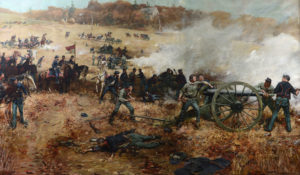
Gilbert Gaul’s ‘Battery H 1st Ohio Volunteers Light Artillery in Action at Cold Harbor,’ depicts Northwest Ohioans in battle. The oil painting is on loan from the Oregon Jerusalem Historical Society. Photo Courtesy Toledo Museum of Art
As battles waged between Northern and Southern troops — smoke clogging the air, muskets firing and artillery shells booming — artists sat amidst the carnage with their sketchbooks, capturing the images to send back to communities eager for information about the Civil War.
These artists and photographers, called “specials” in the 1860s, worked for newspapers and magazines to give Americans an accounting of the war and were often embedded with the troops.
To mark the 150th anniversary of the Civil War’s end, the Toledo Museum of Art (TMA) has gathered renderings, photographs and artifacts created by Civil War artists for a free exhibit called “The American Civil War: Through Artists’ Eyes,” which opened April 3 and runs through July 5.
Gilbert Gaul’s ‘Battery H 1st Ohio Volunteers Light Artillery in Action at Cold Harbor,’ depicts Northwest Ohioans in battle. The oil painting is on loan from the Oregon Jerusalem Historical Society. Photo Courtesy Toledo Museum of Art
The exhibit’s curator, Ed Hill, has spent nine months collecting works from the William L. Clements Library at the University of Michigan, the Rutherford B. Hayes Presidential Center in Fremont and the Oregon-Jerusalem Historical Society as well as works from private collectors. The exhibit also contains 50 objects from TMA’s own collection.
“I wanted to do a show not to celebrate the war, but to acknowledge and remember it,” said Hill, who also curated the museum’s 2013 exhibition, “Perry’s Victory: The Battle of Lake Erie.”
“I wanted to show how many different ways artists look at the Civil War,” he said.
During a reporter’s tour of the exhibit March 31, Gallery 28 and 29 still contained boxes of artifacts waiting to be placed. Sketches and renderings adorned the walls.
The focal piece of the exhibit is a large 1893 painting titled “Battery H 1st Ohio Volunteers Light Artillery in Action at Cold Harbor,” by Gilbert Gaul, on loan from the Oregon-Jerusalem Historical Society. The piece, commissioned by the soldiers years later, depicts Northwest Ohio soldiers in a brutal clash with Southern troops.
The soldiers paid $2,000 to commission the painting, Hill said. They didn’t want a granite monument like many of the battalions and regiments of the time.
Other objects in the exhibit include a portrait of President Hayes when he was a colonel, a sword he carried in battle, a bronze cast of President Abraham Lincoln’s hand, “Gardner’s Photographic Sketch Book of the War” and a Civil War toy made about 20 years after the war.
The exhibit is divided into subjects that include hospitals, prisons, Lincoln, artists’ drawings, satirical prints, music, photography and people from Northwest Ohio, Hill said.
Photography was an important medium of the time, although photographers were limited because they couldn’t take live action shots, Hill said. Oftentimes, the dead soldiers were posed in the field to create the image the artist wanted.
Manuscript letter to “My Dear Wife Mary” from “Your Loving Fritz,” Philadelphia, June 1, 1861. Lent by the William L. Clements Library of the University of Michigan. Photo Courtesy Toledo Museum of Art
Photographer Alexander Gardner’s “Gardner’s Photographic Sketch Book of the War” from TMA’s collection will be on display in the exhibit. It was published in two volumes, becoming one of the most important books published in American history and one of the most significant works of photojournalism, according to a news release. The fragile volumes are rarely on display.
The museum is also hosting several free events during the exhibit, including two military re-enactments, performances by an old-fashioned American brass band, lectures and a film series.
On June 6, the Fifth United States Colored Troops Co. G, a local group of African-American re-enactors, will visit. Eight soldiers and eight women “camp followers” will be on the museum grounds from 10 a.m. to 5 p.m. to discuss the lives of black soldiers and the black women who followed them.
On June 19 and 20, the modern Battery H Civil War re-enactors will be at the museum to give cannon demonstrations. They represent the artillery battalion in Gaul’s painting in the exhibit. Eighteen re-enactors will set up and demonstrate an authentic Civil War cannon.
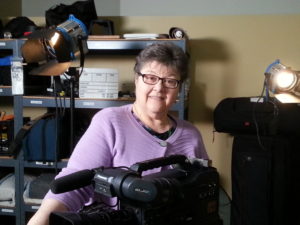
Sister Judy Zielinski decided to have joint replacement surgery on both of her knees in January after dealing with arthritic pain for a decade. Dr. Craig Assenmacher performed the surgeries within the same week. Photo Courtesy Judy Zielinski
Sister Judy Zielinski’s knees hadn’t felt right for a decade.
But during the past two years, they began intruding on her personal life more than the 66-year-old Sylvania Franciscan sister was willing to simply chalk up to old age.
“I had a couple arthroscopic surgeries, and they gave me some relief but I knew they were a Band-Aid,” Zielinski said. She is currently stationed in South Bend, Indiana, working for a TV production company, a job that requires her to travel frequently from city to city and also from site to site while working on a particular assignment.
“I was struggling to keep up with the crew from point to point,” she said. “Last spring and summer, I knew I had to do something. [The pain] was affecting not only work, but also my personal life.” She found herself putting off simple errands like going to the grocery store because she didn’t want to go through the pain.
Sister Judy Zielinski decided to have joint replacement surgery on both of her knees in January after dealing with arthritic pain for a decade. Dr. Craig Assenmacher performed the surgeries within the same week. Photo Courtesy Judy Zielinski
She began seeing Dr. Dennis Assenmacher, who operates Assenmacher Orthopaedics with his sons, Drs. Joseph and Craig Assenmacher out of locations at ProMedica Bay Park Hospital and ProMedica Wildwood Orthopaedic and Spine Hospital. She tried Synvisc-One shots, meant to provide up to six months of osteoarthritic pain relief by lubricating knee joints. The injection was successful on her right knee, but largely ineffective in her left knee.
Dennis Assenmacher referred her in October 2014 to his son, Craig Assenmacher. After seeing him, she discovered she had no cartilage remaining between her upper and lower knee bone plates in the left knee, nor was her ACL tendon intact.
“He wasn’t sure how I was working,” Zielinski said.
Although her left knee was in far worse shape than the right, Craig Assenmacher told her both knees would be candidates for joint replacement surgery. The surgeries could be performed three days apart, putting her in the hospital for about one week.
Although it would be her first hospital surgery experience, Zielinski decided to go for it.
“My schedule is very complicated,” she said. “I wanted one-stop shopping. I wanted to do rehab for both at the same time.”
Dr. Craig Assenmacher
She had the complete knee replacement surgeries Jan. 27 and 30 at ProMedica Bay Park Hospital.
Assenmacher, who also performs hip-replacement surgeries, said Zielinski’s understanding of the procedure and her willingness to get back a part of her life she had lost made her an ideal candidate for joint replacement surgery.
“The main reason we do joint replacement is to try to keep them active and even improve their ability to maintain an active lifestyle,” he said.
“Usually by the time patients have come to me, they have tried injections, steroids, lifestyle modifications such as weight loss, braces, cane, walker and physical therapy,” Assenmacher said. He said he advocates patients trying a number of nonoperative measures before considering joint replacement surgery.
Obesity is often the single largest factor in the need for joint replacement operations, he said.
“Most of our epidemic in this region is larger patients,” he said. “It’s a simple biomechanical thing — [more weight, more wear]. … “My whole thing is always ‘intake/output.’ Count your calories. Try to burn more than you take in, but that’s not easy for a lot of people.”
Unfortunately, for those carrying extra weight and suffering from arthritis, exercise is not easy.
“If someone comes in and they have horrible arthritis and they’re a larger patient, it’s highly unlikely they’re going to lose weight,” Assenmacher said.
He prefers to perform surgery on patients with a body mass index of 40 or below.
While the target range of joint replacement patients is in patients 50 to 70 years of age, Assenmacher has performed one on an 87-year-old woman.
“Most patients say they wish they would have done it earlier,” he said of those on the upper reaches of that age range. Most knee replacements will last 20-25 years, depending on how active the patient is. Innovations with the plastic used in the knees are extending that timeframe, he said.
Zielinski is pleased she opted for the surgeries when she did.
“Recovery has been so smooth and almost seamless,” she said seven weeks after the surgeries. “I’m delighted I did it and delighted I did both at once. It was not easy to spend five days in the hospital. Now that it’s done, I’m very, very happy I don’t have to go back.”
One month after surgery, she was walking around without assistance. After five weeks, she was back to work.
“I’m very aware I don’t have any of the arthritic pain in my right knee,” she said. “Not that I’m completely pain-free — I can feel [soreness] when I get up in morning.” She is able to manage the pain with Tylenol.
Zielinski is not shy about crediting her doctor for any success she’s experienced with her new knees.
“I’m really very pleased with the experience,” she said. “I just feel he’s an extremely competent, reflective surgeon.”
Assenmacher’s goal is for his patients to make the decision that is best for them and their life.
“I usually give them the pros and cons, and the percentages of what the risks are with surgery and say ‘You have to make an informed decision,’” he said.
“The patient should feel comfortable with their surgeon and be able to discuss what they want.”
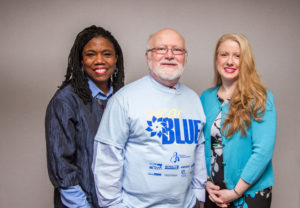
Among those supporting Wear Blue Day are, from Left, Marian Brannon, strengthening families coordinator with Lucas County Family Council; Lucas County Children Services Executive Director Dean Sparks; and Christie Jenkins, CEO of Family and Child Abuse Prevention Center. Toledo Free Press Photo by Christie Materni
April is National Child Abuse Prevention Month and April 8 is Wear Blue Day. The gesture is meant to raise awareness and acknowledgment that it takes a whole community to keep kids from being abused or neglected, said Dean Sparks, executive director of Lucas County Children Services (LCCS).
In 2014, LCCS received 4,271 referrals for suspected child abuse involving 6,419 children. Physical abuse allegations accounted for 51 percent of those reports, followed by neglect (35 percent), sexual abuse (12 percent) and emotional abuse (2 percent).
LCCS substantiated 40 percent of all reports received for physical abuse in 2014. That’s up 7 percent from 2013.
Among those supporting Wear Blue Day are, from Left, Marian Brannon, strengthening families coordinator with Lucas County Family Council; Lucas County Children Services Executive Director Dean Sparks; and Christie Jenkins, CEO of Family and Child Abuse Prevention Center. Toledo Free Press Photo by Christie Materni
Memorial service
As part of National Child Abuse Prevention Month, LCCS also hosts a memorial service for Lucas County children killed by abuse, neglect or street violence during the past year.
This year’s ceremony, set for 11:30 a.m. April 29 at LCCS, 705 Adams St., will memorialize four children: Kevin Troutman, 2 months, and Delayno Oliver, 2, who both died of traumatic injuries, and Tyler McIntoush, 16, and Carter Coley Jr., 17, who were both shot.
Corporal punishment
One topic LCCS is focusing on this year is discouraging corporal punishment, Sparks said.
“We’re not going to say people can’t use corporal punishment on their kids,�? Sparks said. “[However,] we draw the line between child abuse and discipline.�?
LCCS does not advocate spanking children and believes parents should use other, more effective alternatives to deal with their child’s behavior, Sparks said.
“There’s always been that line between how much is discipline and how much is too much,�? he said. “When does this become child abuse? We need people to think about that when using physical discipline — how much danger there is. For example, if you use a cord to spank a child, it’s probably abuse. You’re risking that line between abuse and negligence.
“There’s smacking versus hitting,�? Sparks said. “We have to help people figure it out. To pat on the bottom is a different thing than hauling off and hitting them in the face. You get a smart aleck at 13 and you have to really help people think about what the consequences are.�?
Sparks had his own personal experience with corporal punishment. His father was raised in Kentucky “the old-fashioned way�? and spanked Sparks when he was growing up in Columbus. However, Sparks did not spank his own children, he said.
“It’s not against the law. You’re allowed to spank children. I don’t think it’s the best way to teach things, personally,�? Sparks said. “I never spanked my kids and they all turned out to be responsible adults.�?
Spanking actually teaches about the ways in which adults deal with their frustration, anger and stress, he said. Parents who spank often “put up barriers�? between themselves and their children, he said.
Marian Brannon, strengthening families coordinator with Lucas County Family Council, agreed.
“Corporal punishment is when parents don’t have the skills or nothing has been modeled for them as a way to affect the child’s behavior,�? Brannon said. “A lot of folks are raised with that: ‘This is what my grandmother did.’ But we don’t do anything else your grandmother did so why are you holding on to that? Everything has to evolve.�?
Brannon’s work at Family Council focuses on parents because “children don’t abuse themselves,�? she said. The group’s ACT Raising Safe Kids programming comes into play when parents are abusing their children through discipline, she said.
The programming helps parents identify what violent discipline is and includes a piece on self-reflection to discover in themselves why they are being violent toward their children, Brannon said.
Brannon said she has run into many professionals who say, “I was spanked and I’m OK,�? but “they’ve been through three marriages,�? and have a host of other issues that may affect their children.
Christie Jenkins, CEO of the Family and Child Abuse Prevention Center, focuses on trauma, cognitive therapy and advocacy. In her 20 years working with survivors of abuse, she said she has witnessed some pretty horrific sights concerning violence against children.
“A little boy was beaten with an extension cord. Because of the nature of his injury, his clothes were seared to his wounds,�? Jenkins said. “Many times we as counselors, as teachers, as social workers have suspicions but we really can’t prove it. If you feel that way, it’s important to report it. We don’t have to prove it; we just have to report it.�?
An important aspect of her work getting resources and education to the parents. One way she does this is through the public library. The other part of her job is training people how to protect children.
Adults generally put the responsibility on the child for their own safety, as when telling a child “don’t talk to strangers,�? but her program teaches the parent how to keep children safe.
There are a number of conscious actions parents can take to avoid corporal punishment.
First is simply to make a decision about how you’re going to discipline your kids, he said.
“I’ve always said you will raise your child exactly as you were raised unless you make a conscious effort to do it differently,�? he said.
One way is to use positive reinforcements. You have to teach children how to act properly, and when you catch them doing something the correct way, praise them. What is “absolutely critical�? is leading by example, Sparks said.
Parents can give timeouts to their children or redirect their child’s behavior, Jenkins said. Parents say they don’t have enough time or that they work too much, but Jenkins says five or 10 minutes with a child makes a big difference in their behavior. Play cards or watch a YouTube video together.
“Show you are invested in them,�? she said. “Find out what is behind the behavior. They’re acting out because negative attention is better than none at all. Spend time with your children.�?
Part of the problem is that many parents in today’s society are under great amounts of pressure, Brannon said. They are struggling at work, living in poverty and lack education.
“We don’t talk about [parents] until the child does something. They need support,�? she said.
Family Council’s programing considers five pillars: social connection, resiliency, knowledge of child development, social and emotional competency and concrete support. Brannon works to support parents in each of the categories.
“My whole umbrella is about building supports,�? she said. “[Parents] need resources. They’re on a hamster wheel of trying to get their needs met. … We just really help parents understand there’s other ways to affect behavior. [Abusers] are essentially modeling bullying. And we wonder why we have problems with bullying.�?
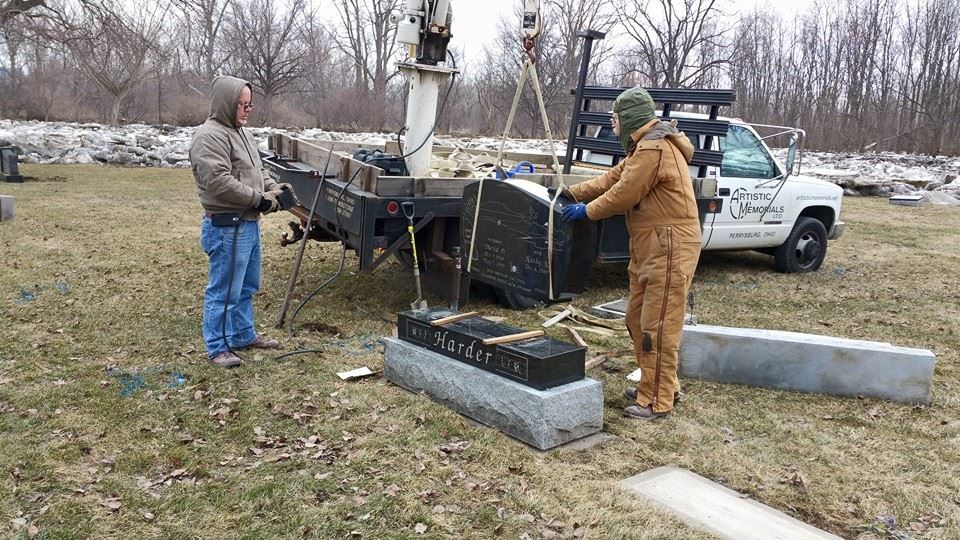
Workers with Artistic Memorials of Perrysburg help reset monuments March 23 at Riverside
Cemetery, which was damaged by ice from the Maumee River. Free Press Photo by Fred Altvater
Workers with Artistic Memorials of Perrysburg help reset monuments March 23 at Riverside Cemetery, which was damaged by ice from the Maumee River. Free Press Photo by Fred Altvater.
When the Maumee River flooded two weeks ago it sent huge chunks of ice careening into Riverside Cemetery in Maumee, knocking over monuments, destroying trees, fences and anything in its path. In all nearly 90% of the 1,900 monuments in the cemetery were toppled over, moved off their foundation, or require some repair. Area residents were amazed by huge sheets of ice covering River Road from Side Cut Park to Stitt Road as the total damage has been estimated at over $1 million.
Two local monument companies, Artistic Memorials from
Perrysburg and Maumee Valley Memorials from Waterville are volunteering their
equipment, manpower and time to reset the monuments and restore the cemetery to
its original condition.
On Monday both companies sent crane trucks and crews to the
cemetery to upright headstones and identify those in need of repair. Some
stones had been moved as much as 25 feet from their original locations, while a
small percentage remain untouched.
Jeff Pettit, owner of Artistic Memorials, told the Toledo Free
Press,
“This work will take several days and may even span months
to complete. On Monday the two crews were only able to upright approximately
100 of the nearly 1,700 monuments dislodged.”
“The work is also hampered with nearly 50% of the cemetery
still covered in 3’-4’ of ice,” he added.
Alan Taraschke, Supervisor of Operations for the City of
Maumee expressed his gratitude for the additional help from Artistic Memorials
and Maumee Valley Memorials,
“The time and effort they have donated to the city of Maumee
thus far has been invaluable. The city normally only uprights 10-15 stones
annually. A job of this magnitude requires the expertise of these two companies.
I cannot express how much their help means to the city.”
There is still much remaining to accomplish at Riverside
Cemetery and the two local companies have committed to continue to help restore
it to the original condition.
Fishing, boating, picnicking and hiking the many trails
along the banks of the Maumee River provide many hours of outdoor recreation
for area residents. Every few years the river reminds us of the awesome power,
hidden behind its normal tranquility.