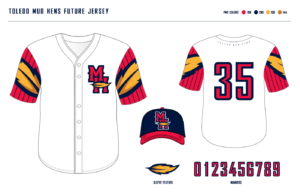
The Mud Hens will wear throwback jerseys from the late 1970s and early 1980s for ‘Back to the Future’ night on July 11. the Hens will then wear futuristic jerseys, above, For the second game of that night’s doubleheader. illustration courtesy Toledo Mud Hens
2015 marks the 30th anniversary of the science fiction classic, “Back to the Future,” and the Mud Hens will celebrate the film in a unique way.
The Mud Hens will wear throwback jerseys from the late 1970s and early 1980s for ‘Back to the Future’ night on July 11. the Hens will then wear futuristic jerseys, above, For the second game of that night’s doubleheader. illustration courtesy Toledo Mud Hens
“We could have done a themed jersey based on graphics and characters in the movie, but instead we are honoring the movie by doing our own interpretation of going back in time and going into the future,” Toledo Mud Hens Creative Director Dan Royer said in an email.
The “Back to the Future” theme debuts July 11, during a scheduled back-to-back doubleheader.
“We will go back in time during the first game, wearing throwback uniforms featured in the late ’70s/early ’80s. We will go into the future during the nightcap with our interpretation of what we think a Hens jersey will look like in the future,” Royer said.
“Back to the Future” isn’t the only blockbuster being celebrated at the ballpark this summer: There will be a “Jurassic Park” theme night June 6 as well in anticipation of “Jurassic World,” releasing June 12.
“Our Marketing [and] Promotions group has to constantly have a pulse on popular culture [and] current trends to provide the best entertainment value to our fans,” Royer said.
Once themes are chosen, Royer begins to design multiple concepts. He and his team will discuss ideas and choose designs for jerseys. This is a time for the team to be creative.
“Sometimes it’s best to try something literal with the design, creating a look that’s a spinoff of an item or apparel used in the show, movie or theme. We went very literal with our Bacon & Eggs jersey this year. Stay tuned for that design. It’s buzzworthy,” Royer said.
“There are other times where it’s more exciting to try to represent the spirit of the theme in our own way. ‘Back to the Future’ night is a good example of that. We could have created a jersey that looked like something that Marty McFly would have worn. But instead, we decided to have fun with our doubleheader by doing a past and future jersey.
“The past jersey was a redesign of an actual Hens jersey used in the past. For the future jersey I had to try to envision what a Mud Hens jersey might look like in 15-20 years,” he said. “I wanted to make it look futuristic, but still look like a baseball uniform.”
Jerseys worn during the “Back to the Future” games will be auctioned off and proceeds will go to charity. Other themed nights this season include Veterans Appreciation Night with camouflage jerseys on May 23 and the Bacon & Eggs night with the “Egg” themed jersey on Aug. 6.
“Overall our hope is that the jerseys are fun for the fans and help to tie in to the fun theme nights we have during the summer,” Royer said.
The Mud Hens’ popular Annual ‘Star Wars’ Night is set for May 9. Toledo Free Press File Photo by Joseph Herr
Every self-respecting baseball executive knows that promotions are part of the game, a necessary lifeblood in order to sell tickets.
The Mud Hens’ popular Annual ‘Star Wars’ Night is set for May 9. Toledo Free Press File Photo by Joseph Herr
Thankfully, an offbeat nickname like the Mud Hens lends itself perfectly to sensible silliness, and the team’s upcoming promotional calendar will not disappoint the inner child in anyone.
“We focus on all of the opportunities during the game to entertain the fan,” said Mike Keedy, Toledo Mud Hens manager of special events. “And we always try to keep that fresh, and to be unique.”
So, can we expect bat days and dollar dogs in 2015? Please, that’s amateur night. These days it takes dinosaurs, time travel and yolk-covered uniforms to raise the promotional bar.
“‘Jurassic Park’ and ‘Back to the Future’ are probably our two biggest theme nights,” Keedy said.
During those games on June 6 and July 11, respectively, fans will see their home team dressed in movie-specific jerseys, which attendees can bid on during an in-game silent auction. Guests will also enjoy movie-themed food and drinks.
At “Back to the Future” night — which also happens to be a doubleheader — the first game will feature ’80s music, themed scoreboard graphics and an overall old-school experience, while the second will transport fans into how the Hens might look decades from now, no DeLorean required.
But perhaps its most innovate night will involve some teamwork with the opposition. That’s because frying pans are set for “Bacon & Eggs Night” on Aug. 6, where the visiting Lehigh Valley IronPigs will sport their nationally recognized bacon-themed jerseys, accompanied by what else — a new Hens egg-centric uniform.
Even the IronPigs’ front office can’t wait to see bacon facing eggs in, say, a force-out at second.
“I think [the fans] are going to laugh and get a kick out of it,” said Lindsey Knupp, IronPigs director of promotions and entertainment, who was approached by the Hens about the theme night collaboration. She agreed, figuring the Pigs-bacon vs. Hens-egg connection was too good to pass up.
“It makes too good of sense,” she said.
If looking at nearly edible uniforms wasn’t enough, your taste buds can do something about it at two food-centered specialty events this season.
One hot ticket will be the Taste of Fifth Third Field on May 8, when fans can sample featured dishes from around the stadium.
Then on July 10, the Hens are elevating the classic ballpark hot dog to a place of prominence it has never known.
“Fans can make their own [hot dog] creation with over 50 different toppings, and several different buns,” Keedy said. “The cool thing is that you can then submit your recipe, and if it wins, it will be on the menu at games next year.”
The team also unveiled new peanut-free sections for two games in April — a small step toward possible stadium-wide peanut-free games in the future.
“That hasn’t been done here,” Keedy said. “As you can imagine, logistically, it’s a difficult thing to do. So far the feedback has been great. We’ve had a lot of requests from fans.”
Speaking of Hens supporters, Keedy said they’re the ones who help shape the team’s promotional lineup each year, as every offseason it solicits requests for what fans would like to see.
“We’ve had hundreds of ideas [from fans], and if anybody ever wonders if we look at it, we absolutely do,.
“It’s all a part of immersing yourself in the community,” he said.
The 2015 promotional lineup also includes a dose of still-admired bobbleheads, “Star Wars” night, scout sleepovers and the ever-popular postgame fireworks.
To view a complete list, visit mudhens.com and click on “Tickets & Promotions.”
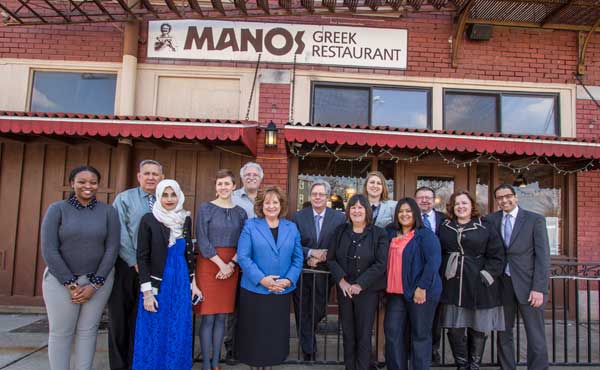
Among those involved with the Welcome Toledo-Lucas County initiative include, from left, Welcome TLC committee member Desiree Sakho, Jesus Salas of Advocates for basic legal equality (ABLE), Americorps member Salma Barudi, Americorps member Sarah Allan, Manos Greek Restaurant owner Manos Paschalis, Lucas County Commissioners Carol Contrada, Pete Gerken and Tina Skeldon Wozniak, board of Lucas County Commissioners Executive Assistant Brittany Ford, Adelante executive director Guisselle Mendoza, Lucas County Chief of Public Policy and Legislative Affairs Peter Ujvagi, Toledo City Councilwoman Lindsay Webb and Eugenio Mollo Jr. of ABLE. Toledo Free Press Photo Christie Materni.
During a recent visit to Toledo, Steve Tobocman, director of Global Detroit, an organization that helps immigrant families, spoke about creating economic growth by embracing immigration.
“There are lots of opportunities to connect the dots to better attract, retain and utilize the talents, resources and energy that immigrants and refugees can bring to a community like Toledo and Lucas County,” Tobocman said during a March 30 presentation at Toledo’s Park Inn by Radisson.
The visit marked Tobocman’s second visit to the area as part of a collaboration to bring a similar initiative to Toledo.
Tobocman was invited to speak by the Lucas County Commissioners as part of the new Welcome Toledo-Lucas County (TLC) initiative, which aims to make Lucas County more welcoming to immigrants.
The initiative works with a variety of organizations to celebrate the region’s migrant and immigrant heritage while supporting social and economic opportunities for all communities, including minority communities, LGBT communities, disabled communities and more.
Among those involved with the Welcome Toledo-Lucas County initiative include, from left, Welcome TLC committee member Desiree Sakho, Jesus Salas of Advocates for basic legal equality (ABLE), Americorps member Salma Barudi, Americorps member Sarah Allan, Manos Greek Restaurant owner Manos Paschalis, Lucas County Commissioners Carol Contrada, Pete Gerken and Tina Skeldon Wozniak, board of Lucas County Commissioners Executive Assistant Brittany Ford, Adelante executive director Guisselle Mendoza, Lucas County Chief of Public Policy and Legislative Affairs Peter Ujvagi, Toledo City Councilwoman Lindsay Webb and Eugenio Mollo Jr. of ABLE. Toledo Free Press Photo Christie Materni
Tobocman, a former Michigan State Representative in Detroit’s 12th district, is an expert on immigrants and their economic impact. He helped create Global Detroit and, for the past five years, has been executing strategies to improve immigrant integration within the community.
Through his work with Global Detroit, Tobocman helped launch a number of community initiatives, including ProsperUS Detroit (which helps immigrants start small businesses) and Welcoming Michigan (the 13th state/local affiliate of Welcoming America, which promotes respect between foreign- and U.S.-born citizens). Global Detroit also launched the region’s first online searchable database of traditional integration services.
Global Detroit has worked with close to 20 cities across 10 states, each recognizing the necessity of making immigration more welcoming.
Welcome TLC and Global Detroit have similar mission statements, Tobocman said. “They seem to align quite nicely.”
The initiative
Welcome TLC is led by the Board of Lucas County Commissioners, headed by Commissioner Pete Gerken and staffed by Executive Assistant Brittany Ford, Peter Ujvagi, who is Lucas County Chief of Public Policy and Legislative Affairs, and two AmeriCorps members, Sarah Allan and Salma Barudi.
Welcome TLC has five key objectives: to “identify and support economic development and neighborhood revitalization strategies”; to “host community and neighborhood-based conversations”; to continue the service through outreach, education and collaboration; to support art; and to broaden the network of support.
Welcome TLC partners with other local organizations, including Advocates for Basic Legal Equality (ABLE), Adelante, Toledo City Council and Local Initiatives Support Coalition (LISC) Toledo.
“As we started working with our partners and looking at neighborhood revitalization, our concept was [to ask] what’s happening out there in the United States and the world that we need to be a part of. Welcome TLC initially became a part of a very broad strategy to [create welcoming communities] in Lucas County,” Gerken said.
Initiatives like Welcome TLC are being put into action across the nation. Welcome Dayton and Global Detroit work with immigrants to revitalize former Rust Belt communities.
There was a void locally, he said, a need for an initiative like Welcome TLC.
“[Welcome TLC] is such an obvious answer from our history,” Gerken said. “Toledo is a city and county that was built on immigration. This is like waking up and seeing the obvious, for me.
“I wish we could say that we thought of this all on our own, but what we are doing, to our credit, is seeing an opportunity and capitalizing on it very quickly.”
Gerken said the initiative is an attempt to revitalize Lucas County.
“When Lucas County was in its heyday … is when the immigrant and refugee communities were strongest,” he said. “I’ll go back to the post-World War II and industrial era. Our factories and manufacturers were populated with diverse immigrant communities.”
Gerken, a retired Jeep worker, said he walked into the Jeep plant in 1976 and worked with people from Lebanon, Mexico, Africa and Asia.
“With 6,000 people working there, [it] was like walking into the United Nations,” Gerken said. “And they were all working together side by side to make a product that was representative of Toledo.”
When people from multiple backgrounds work together, they begin to understand different cultures, Gerken said.
“Before very long, everyone knew everyone else’s cultural holidays, their food, a little bit of their language,” he said. “That’s when Toledo had strong and vibrant neighborhoods and a healthy middle class. It had diverse equality.”
Gerken said that’s changed over time.
“World trade became what it is, the middle class became what it is,” he said. “If we want to go back to where we were when we were in our heyday, let’s do the things we did then that made sense.”
Gerken said there are many opportunities to make Lucas County more welcoming today.
“Immigrants and refugees are not only coming, they’re here,” he said. “You do get the best from people when you make them feel welcome to the community.”
The film festival
In January, the Ohio Theatre and Event Center screened seven foreign films as part of the Toledo International Film Festival.
The event was the first effort of the Welcome TLC initiative, which worked in collaboration with the theater and United North, a neighborhood improvement organization, to offer the films. The purpose of the festival was to expose Toledo to cultural diversity through films like “Shaolin Soccer” and “Juan of the Dead.”
Gerken said the success of the multiweekend festival pleased him.
“[It] was amazing and went beyond our expectations. You never know with the first time you do these,” Gerken said. “[It] was one action of a movement.”
United North’s Senior Manager of Community Programming Nikki Morey said the collaboration was a positive experience.
“[The collaboration] is really going to be helping, not only economic development, but also helping provide some alternatives for entertainment in Toledo that we otherwise might not get,” she said.
Added value
Bringing cultural diversity to local neighborhoods is important, Gerken said.
Immigrants own 6.7 percent of Ohio businesses, even though they account for about 4 percent of the state’s population. In 2010, new immigrant businesses in Ohio generated $1.3 billion in net business income, according to the American Immigration Council.
“Immigrants don’t take away resources from a community, they bring resources to a community,” Gerken said.
Ujvagi, who immigrated from Hungary as a child, agreed, pointing out that immigrant-owned businesses create jobs for others in the community.
“We need to make the case for people to understand it’s in their benefit as well,” he said.
“If you look at the history of Toledo and every other urban area, between immigration and migration, those are the folks that have really built this community. [Nationally,] 28 percent of all main street businesses are run by immigrants. The numbers are just overwhelming. We’re behind the curve in Toledo. We really need to build on it.”
There are also hundreds of overseas nationals who live and work in the Toledo region as employees of the more than 175 businesses in Northwest Ohio that were started or owned by people or companies outside the United States, said Paul Zito, vice president of international development with the Regional Growth Partnership. Two-thirds of the businesses are from European nations followed by Japan, Canada and others, he said.
Attraction, retention, building a welcoming community and not leaving anyone behind are the goals, Ujvagi said.
“The tragedy sometimes is people come as immigrants and then they want to close the door behind them,” he said. “We need to get people to understand how important talent attraction, talent retention and small business entrepreneurs are.”
Manos Paschalis, a Greek immigrant and owner of Manos Greek Restaurant in UpTown, said he supports Welcome TLC because he wants to help other immigrants achieve the success he’s found in Toledo. He also wants to share his story with local government officials to help them better understand the immigrant experience.
“The welcome I had, it was incredible,” Paschalis said. “They made me feel successful the first minute I stepped in the Government Center.”
“When I came here, I didn’t understand the phrase ‘The customer is king.’ We don’t have that so much in Europe. But when I first encountered government officials, with Lucas County and the city, back in the ’80s, I felt like a king. They treated me like one. I felt that, and I try to pass it along to my customers.
“I’m hoping [government] will be as welcoming to others as they were to me about 30 years ago because people from other countries that come here, they try to be successful, they create success, and success breeds success.
“The more successful people in a city, in a county that you have, you help create more success,” Paschalis said. “If you have a successful business environment, by proxy other people get successful sometimes.”
“Local governments should treat citizens as customers and kings. Because if the customer is successful, the government will be successful.”
Paschalis thinks the growth of government over the years has made it more challenging for those looking to go into business.
“Things have changed. We need to retrofit ourselves a little bit and we need to readjust a few things,” he said. “It’s not the people that changed, but the government itself has grown up through the last years. There’s so many roadblocks that make it a little more difficult for people to do business.”
Starting a life in a new country is courageous, Gerken said.
“It’s probably the most entrepreneurial and courageous act that any individual will take, by going somewhere else and taking their skills with them,” Gerken said. “They bring economics, they bring intelligence, they bring education and they bring the entrepreneurial spirit. Why wouldn’t we want more people [like that] here?”
The Welcome TLC initiative will evolve over time, Gerken said.
“Every day there’s an action that we talk about,” he said. “This is not a program that we’ll launch in September and stop the next September and measure everything in between. This is going to be a live and robust initiative … and we have a broad range of partners.”
The collaborations
In September, Welcome TLC collaborator Eugenio Mollo Jr. gave a TEDxToledo talk called “I’m Not Supposed To Be Here.” In it, he discussed his family’s immigration story and the challenges that come from beginning a new life in America.
“I’m not supposed to be here today and I bet many of you aren’t supposed to be here either,” he began. “The only reason I am here, here in this country, is because everything lined up just perfectly to allow me to be here — a hodgepodge of laws and circumstances that I had no choice or control over.”
Mollo grew up in an immigrant community in Chicago. His family would have conversations about immigration struggles around the dinner table when he was growing up. Because of that, immigration issues are part of him.
“I think it’s important for people to recognize under what circumstances either they or their family members before them were able to come to the United States,” Mollo said in an interview with Toledo Free Press. “What laws were in place that allowed them to come to this country? What circumstances out of your control allowed those individuals to come? Because I think when you learn about your own immigration story, you recognize on a personal level that we’re not in a position to pass judgment on why people are here currently, regardless of their immigration status.”
Mollo is a managing attorney at Advocates for Basic Legal Equality (ABLE), a nonprofit law firm servicing low-income individuals in 32 counties. Through its collaboration with Welcome TLC, Mollo said, he hopes to make anyone with an immigration status “feel comfortable tapping into available resources.”
Following President Barack Obama’s executive action on immigration reform, Mollo and Jesus Salas, a senior attorney at ABLE, began giving presentations on immigration executive actions.
“Even though some of the immigration actions were temporarily stopped by a district court judge in Texas, many parts of the president’s executive actions are still moving forward,” Mollo said. “We’re seeing individual successes that are a direct result of ABLE’s outreach and presentation efforts.”
Salas added that the water emergency that affected Toledo in August was a “big indicator of the gaps of the services” for immigrants because of, in part, a language barrier. ABLE helped address those issues as well.
“As the county and the city are bringing in new immigrants to repopulate the region, there is a culture shock of how we talk to this new population,” Salas said. “That’s why we’re trying to work together as a team, as a county.”
ABLE also has an office in Dayton and helped launch Welcome Dayton, another initiative Welcome TLC has collaborated with.
“A lot of lessons that are being learned in Dayton are being applied here in Toledo and Lucas County and vice versa,” Salas said. “We are learning from each other how to better make ourselves adaptable.”
Near the end of his TEDxToledo talk, Mollo spoke about the importance of people feeling at home in their community.
“People are at their happiest when they belong,” Mollo said. “They’re better employees, they’re better community members [and] they’re more likely to help other people in need. This is the way to build communities.”
TEDx follow-up forum
Mollo will be the featured speaker at a TEDxToledo follow-up forum on immigration set for 9-11 a.m. April 10 at Downtown’s One SeaGate (Fifth Third Bank building). Other panelists at the forum will include Ford, Shane Lakatos of Social Services for the Arab community, Guisselle Mendoza of Adelante and Joe Wells of The S.A.I. Group.
The event is free but space is limited to 75 guests. Those interested in attending should RSVP at the TEDxToledo Facebook page or at http://bit.ly/1CdCxLf.
I did something … wrong the other day. No, not
illegal or anything like that — I would never even consider doing something
against the law (and then admitting to it in print). Nor was it ethically
wrong, as my basic state of being is a crushing sense of guilt and anything
that adds to that would just be pouring salt on the open wound of my psyche.
No, in no real sense of the word was what I did “wrong,” really. It
just felt that way.
I bought $14.68 in gasoline.
Really. That’s it. Now you might justifiably be
scoffing at this and turning the page to another one of our fine, fine writers
here at Toledo Free Press, and I wouldn’t blame you one bit if you did. I’m
sure Jim Beard is covering some fascinating happenings in the world of print
and paper. But if you’ll stick with me a bit, I’ll try to explain and examine
just why this particular purchase felt so unshakably off-kilter.
Still here? Okay, good.
So here’s the thing — I didn’t purchase $14.68
in gas because that was the exact amount that topped off my tank, or because
that was the exact amount of available cash I had on hand. (Truth be told, of
these two possibilities, the latter is far more likely than the former. My
car’s gas tank has been full exactly twice in the whole time I have owned it, I
think.) No, I was putting gas in the tank and just…stopped. At $14.68.
And for some reason, this choice has annoyed me
ever since, like I broke some unwritten code of gasoline purchase — because it
wasn’t an even dollar amount. I hadn’t chosen to stop at $14.00, nor squeezed
just a hair longer and ended up with a much more pleasing $15.00. No, my
fill-up had ceased at exactly fourteen dollars and sixty-eight cents. And this
bizarre, inconsequential choice has somehow stuck in my craw.
It hadn’t really occurred to me until this
incident (if what happened can be termed an “incident,” which I would
argue is far from the case) how obsessed I have been with the idea of pumping
gas to a round number. A self-pumping stop at the station just seems so much
more satisfying if the amount ends in an even double-zero. $10.00. $20.00. Once
in a blue moon, $30.00. Heck, back in my lean college days when I was scraping
together every spare penny to get fuel into my Chevy Nova, even a simple $5.00.
(Yes, children, there was a time when $5.00 in gas wasn’t enough to barely get
you to and from the gas station.)
But no matter what the number at beginning of the
amount, the thing that really mattered was the two zeroes at the end. And when
I would miss this mark — squeezing just a hair too long and ending up with
$20.01 or .02 — it would, bizarrely, feel like failure. Failure of what? I
have no idea. But I would unmistakably shake my head and feel a pang of
disappointment, like a track runner who hadn’t hit his or her target time.
Maybe next race.
Is this superstition? I don’t consider myself the
sort who puts stock in such things, beyond being cultural artifacts that tell
us more about the human condition than they do actual supernatural influence.
If I had to nail it down, I’d say it was more a simple habit — but what is
superstition if not a habit given some reason for existing?
But a habit that serves no real purpose does
nothing but drag us down into mindless routine, doesn’t it? Perhaps at a time
when we had to pay in cash after pumping ourselves, or when keeping track of
finances was considerably harder than it is nowadays, keeping my gasoline
purchase rounded to the nearest dollar had some utility. But now? When every
gas station has you pay in advance and every penny you spend is easily
accounted for online? The utility is almost non-existent. All that’s left is
that nagging feeling that a round number is somehow desirable, with no real
purpose behind it.
I dislike the idea of being chained to a pattern
of behavior just because that’s the way it always has been. In my mind, I had
been wasting precious seconds of my life precariously squeezing the pump to
reach that even number. No more. By god, from this day forward, I shall fill my
tank until *I* feel it’s full enough. To hell with the arbitrary pricing
numbers on display! If I want to buy $14.68 in gas, I will, and I won’t feel
bad about it!
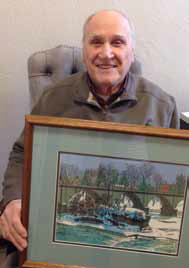
Rudolph Schroeder with his recent painting of the Interurban Bridge in Waterville. Toledo Free Press Star photo by Sarah Ottney.
Rudolph Schroeder with his recent painting of the Interurban Bridge in Waterville. Toledo Free Press Star photo by Sarah Ottney.
Rudolph Schroeder is living proof that it’s never too late to pursue one’s passion.
The 84-year-old turned his lifelong passion for art into a second career. Schroeder has had artwork displayed in the White House and at Ellis Island. Now, he’s hoping his rendering of a well-known Northwest Ohio bridge will generate more attention for the region.
After the end of his career as a textile engineer, Schroeder entered retirement and began focusing on his art, which before retirement had simply been a hobby.
About 30 years ago, he started drawing with pen, often rendering the tall ships he recalled from the “swashbuckling” pirate films he loved watching as a child.
His most acclaimed moment as an artist occurred in 2000 when Schroeder created a piece using his favorite technique of starting with a base of acrylic paint and finishing with details using pen and ink. The patriotic piece, titled “History and Peace in the Millennium,” shows the Statue of Liberty alongside an American flag and a tall ship.
“It did very well because it was timely and people cared. They were really drawn to it,” Schroeder said.
It received attention from around the country and was displayed in the White House during President Bill Clinton’s time in office. The former president sent Schroeder a thank you letter after receiving a signed copy.
The piece was also displayed on Liberty Island, New York, for visitors of the Statue of Liberty to view. It later received Best in Show honors at the 2000 Marine City Art Fair in Michigan.
Schroeder found new inspiration recently in the Interurban Bridge, which spans the Maumee River beside the Roche de Bout landmark in Waterville. The spot was used as a meeting place by Native American tribes in the 1700s.
According to the Ohio Historical Society, the bridge was constructed in 1908 by the National Bridge Company of Indianapolis. It’s also referred to as the Ohio Electric Railroad Bridge and was designed with steel-reinforced concrete filled with dirt and mud.
He created a rendition of the bridge using his acrylic, pen and ink technique. Now he plans to sell prints of the painting, and hopes to bring more business to local frame companies and art studios.
“A lot of artists do a picture and they put it up with a price tag,” he said. “The difference with me is I make something that is historically significant and make prints. So I not only sell my work, but I also make more business for the picture framers and the matting companies. It makes me feel good.”
Schroeder is currently selling 11-by- 14-inch prints of the bridge for $30. To purchase a print, call (419) 367-1332.
Among the battles faced by
families with a loved one with Alzheimer’s disease or dementia is deciding if
and when to take them out of their own home to a facility.
In March, Alzheimer’s expert
Susan Scanland visited Senior Star at West Park Place Toledo to give a seminar
titled, “Seniors: When to Make The Move.” Scanland has given more than 500 such
seminars on Alzheimer’s and dementia in more than 40 states in her 30-plus year
career. She currently consults at a long-term care center
in Scranton, Pennsylvania, where she evaluates residents and can make dementia
recommendations for the medical and nursing staff.
There are a number of reasons
it’s hard for both the patient and family to “make the move” from the home to a
care center, Scanland said.
“Number one I think is the
hesitancy to leave one’s homestead, where one’s been for many years,” she
said. “Number two is often the negative
stereotype of community senior living. … Many families fear they are
institution-like.”
Scanland, who has spoken at
West Park Place several times, said that is often the furthest thing from the
truth.
“It’s not the nursing home,
but people often have that negative stereotype,” she said, explaining many
places offer the ability for a couple to stay under the same roof but still
provide the needed care for the partner with Alzheimer’s.
“Very often there are so many
emotions when an older person has to put their loved one in a nursing home
because they can’t take care of them,” she said. “But they can live together,
and contract to bring private-duty nurses in. So a couple can be more
independent longer and live together longer than if they were at home.”
The third reason it’s hard to
move a loved one from their home into a care center could actually be higher on
the list for many families, Scanland admitted.
“Guilt is a huge emotion when
it comes to placement,” she said. “So many families have told me that this is
the hardest decision they ever had to make in their lives. The problem is,
often they’re making it without adequate information. … Often too, there are
disagreements between adult children about what to do about mom and dad because
there’s a lack of information.”
In her Toledo talk, Scanland
said her purpose was simple — to educate about existing options.
“There are reasons why home
sweet home may not be as safe or as wise a choice as they think it is,” she
said.
Scanland identifies seven
areas to consider when determining if it’s indeed time to “make the move” or
“kiss the guilt good-bye.”
• Pedestrian and driving risks
— Even persons with mild dementia are more likely to makae decisions that can
result in them getting hit by a vehicle, Scanland said.
“Having fender benders,
getting lost while driving are huge red flags,” she said. Oftentimes, dementia
patients may depend on another passenger’s “copiloting” to get them from one
place to another while driving, Scanland said.
• Nutrition and hydration —
Scanland did house calls on dementia patients for years and would often find
freezers full of ice cream and other junk food, with no vegetables. Older
people often lose their sense of thirst and don’t get enough to drink, she
said.
• Medication mixups — People
over 65 are four times more likely to have reactions to medications than
younger people, Scanland said. Dementia patients are more likely to confuse
medications — blood pressure and diabetes drug mixups can be particularly
dangerous, she said.
• Falls — “Often older people
think it’s OK if they fall,” Scanland said. “It’s not OK that they fall.” Falls
contribute to 16,000 deaths in the elderly each year, she said. One out of
three people over the age of 65 are at risk for falling, while half are at risk
if over 80 years old, she said. She has seen many cases where dementia patients
were lying on the floor for one to two days after falling.
• Elopement (walking/driving
away from home) — 75 percent of dementia patients wander from their home at
least once, Scanland said.
• Isolation/loneliness —
People who get depressed after the age of 65 are at a higher risk of developing
Alzheimer’s, Scanland said.
“Just because you have
dementia, sitting in front of the TV all day with no social interaction and no
people, it’s not good for the brain,” she said.
• Financial exploitation —
Scanland called it a silent epidemic, pointing out studies suggest four or five
unreported cases of elderly scams to go along each one that is reported.
Kirsten Pickle, executive
director of West Park Place, said the program on the seven areas to consider
was well received by both seniors and their families.
“I think those things are
important because nobody wants to leave their home, but it’s also hard to be
objective on reasons why you should,” Pickle said. She said the average age of
a West Park Place resident is 86. She pointed out statistics suggesting 80
percent of people over the age of 85 have some form of dementia, even if just
mild cases.
“The most important thing
that people need to understand is to move them earlier,” Pickle said. “The
earlier the move, the easier it is on the senior and the more successful they
will be in their new surroundings. … If they move here earlier, they’re usually
able to stay here a lot later because they’re settled in so well. If you wait
too long, your loved one usually ends up in a nursing home.”
Scanland said the purpose of
her visit to Toledo was to replace confusion with information.
“When you look at the facts
and gather information, it does take a lot of the guilt out of the equation
because then the whole shift can be an incredibly positive experience,” she
said.
For more information, visit
dementiaconnection.com or call West Park Place at (419) 972-2280.
It’s no secret that music has an undeniable connection to
personal memories.
Just one song has the power to call back vivid recollections
of everything from that first kiss under the stars to that one late-summer road
trip spent racking up miles down Interstate 75.
In an effort to enable those suffering from cognitive
diseases like Alzheimer’s and dementia to reconnect with the world through
memories triggered by their favorite songs, several local nursing homes are implementing
the “Music & Memory” program.
Founded in 2010 by Dan Cohen, “Music & Memory” is a
non-profit organization that provides personalized music to the elderly through
digital music platforms in order to improve the overall quality of life.
The organization teaches nursing home staff, as well as
family caregivers, how to create personalized playlists for residents on
digital music devices like Apple iPods.
“Music means so much to everyone’s lives,” said Katie
Gulgin, administrator with Otterbein Senior Lifestyle Choices. “One song to me
may not mean the same thing to another person. It’s about finding those songs
that mean something special to someone.”
According to the “Music & Memory” website, songs
associated with important personal events can trigger memory of the physical
experience connected to the music. As a result, the music can often calm
“chaotic brain activity” and enable the listener to “focus on the present
moment and regain a connection to others.”
Each of Otterbein’s locations throughout Ohio – including
its Perrysburg and Monclova communities – completed “Music & Memory”
certification training as of March 5.
The Perrysburg site, located at 3529 Rivers Edge Drive, has
already begun testing the effects of “Music & Memory” on one of its
residents.
Gulgin said the resident – a woman who suffers from “severe
dementia” – has communication limitations but has become more vocal and
responsive since beginning the therapy.
“It’s something her son puts on for her,” she said. “When
she’s feeling agitated, it calms her down; or, if she’s having trouble eating,
it helps her eat better.”
Gulgin said Otterbein is still trying to work out how each
of the individual facilities is going to implement “Music & Memory” into
its activity regimen.
The smaller facilities may be able to provide enough iPods
for each resident, while the larger, more traditional facilities might only
allow access to the devices when an activity professional is on site.
“We should have a good portion of our facilities using the
program by mid year,” Gulgin said.
Administrators with Foundation Park Alzheimer’s Care Center
completed their “Music & Memory” training March 19 and are preparing to
train the rest of the staff in the coming weeks.
Kathy Kuhlman, social service director with Foundation Park,
said the facility currently only has 10 iPods, but is seeking donations to help
obtain a music player for each of the 125 residents housed in the extended-care
facility.
“We want to expand access to activities for residents who are
normally unable to take part in (traditional) activities while, at the same
time, decreasing negative behaviors and mood outbreaks,” Kuhlman said.
Kuhlman said Foundation Park has already decided which
residents will receive the first 10 iPods and staff is in the process of
contacting residents’ loved ones to obtain information about their favorite
music.
“When residents hear the music they listened to at a younger
age, it brightens their days,” she said.
On Dec. 15, 2014 the state Controlling Board approved a
request by the Ohio Department of Aging (ODA) for the Office of the State
Long-Term Care Ombudsman to use protection funds to contract with Music &
Memory, Inc. to allow Ohio nursing homes to become “Music & Memory”
certified.
According to a news release from the ODA, the funding will
be used to underwrite costs associated with training and certification, equip
the state’s regional long-term care ombudsman programs to support the
expansion, and provide start-up kits and supplies for participating facilities.
As the mind and body age, we commonly think it is time to slow down and do less. However, the opposite is true.
It’s important to exercise both the mind and body to maintain mental function, reduce the risk of disease, stay physically active and maintain flexibility and balance.
There are options for individuals of all health and fitness levels to begin or maintain an exercise regimen.
If you don’t currently have a fitness plan, or begin to experience challenges with your current routine, it’s important to consult with your physician. Have a discussion about your goals and current challenges so you can work together to develop a plan that will work for your lifestyle.
There are four important focus areas for staying active as we age:
Aerobic exercises are fundamental for a healthy heart. Try walking or biking with a friend, swimming or low-impact group fitness classes that will elevate your heart rate but are relatively easy on your joints.
Strength training produces dramatic results but is also important to prevent muscle loss as we age. Lifting light weights can help to maintain strength in the arms, legs and core.
Stretching and balance exercises can help relieve some symptoms of arthritis and prevent falls. Try a yoga class or tai chi. The classes provide added benefits of peace and relaxation to help manage stress.
Stimulating the brain is important to help prevent the loss of mental function and some forms of dementia. Crossword puzzles, word games, Sudoku, conversations with friends and family, learning new skills and traveling are all ways to keep your mind active.
It’s important to set yourself up for success, both to maintain a high quality of life and to achieve measurable results with your personalized fitness program.
Make exercise a regular part of your day. You’ll be less likely to stop if it’s a part of your everyday routine, like brushing your teeth. If you are interrupted for travel, illness or injury, you’ll find it easier to start up again when you’re ready.
Stick with it. If you can maintain your exercise routine or physical activity for at least six months, it’s a good sign that you are on the way to making physical activity a regular habit and way of life.
Make it fun. Exercise doesn’t have to be an exhausting, sweaty chore to dread. Try a new sport, go dancing or visit walking trails in the Metroparks of the Toledo Area system. If you enjoy what you are doing, you’re more likely to look forward to your workout and stick with it.
Use the buddy system. Exercising with a friend helps you both be accountable and gives you someone with whom to try new things and laugh!
Roseanna Mosiniak is a certified personal trainer and certified group fitness instructor at ProMedica Wildwood Athletic Club, where she specializes in senior fitness. For more information, visit www.wildwoodathleticclub.org or call (419) 539-0235.
It was a bitterly cold January morning when I climbed the stairs of the Toledo Free Press offices for a first ever meeting with then-Editor in Chief Michael Miller.
Though normally I tend to let the cards fall as they will in my life, this day I was stepping out with a “nothing ventured, nothing gained” attitude. I approached Michael with the idea of writing a weekly history column about the events that occurred in the Northwest Ohio region during the War of 1812, because 2012 was the bicentennial of the event.
I didn’t have to wait long for Michael’s reaction to my nervously pitched idea. He smiled away the winter chill, and I knew it was going to work out, but never did I imagine how well. In fact, within moments he said we should make the first column the feature story in one of the next issues. It took a few minutes for me to understand that meant the cover story! Over the next two years, I was blessed to have over 25 columns accepted.
Having only written a book about this historical period, I was a little unsure of the correct stylistic approach to take for a weekly column. Michael promptly advised that I put myself into it, and let the reader get to know me personally, as well as the history I was sharing. I took that suggestion to heart and it worked, even though some unflattering moments of my life are now public knowledge.
Since then, new doors of opportunity have opened and my circle of history-nut friends has greatly expanded, triggered because they read the column offered me by the gracious Michael Miller. My instincts told me Toledo Free Press was the fitting venue for history-oriented stories. Thank you, readers, and happy 10th anniversary to one of America’s most relevant newspapers.
Frank Kuron is author of the War of 1812 book, “Thus Fell Tecumseh.” Email him at [email protected].
For 10
years, I have been traveling to Ohio to perform in Skate for Hope. Out of all
the events I do each year, Skate for Hope has a special meaning to me. The
reason for that is because Skate for Hope supports cancer research as well as
friends and family of those impacted by cancer. My mother was diagnosed with
breast cancer when I was 8 years old and in many ways, skating helped me and my
family through my mother’s diagnosis and treatment.
Soon
after my mother’s diagnosis and multiple rounds of treatment, she watched my
sister Sarah win her first national medal as National Junior Champion.
Her diagnosis put everything in perspective, but Sarah’s win was a celebration
for the whole family. Skating gave us all a chance to forget about cancer,
hospitals and chemo for even a few moments.
By the
time Sarah became the 2002 Olympic Champion and I represented the U.S. in the
2006 Olympics, my mother had scored a victory that dwarfed anything ever done
on the ice. She watched all our triumphs cancer-free.
I recognize
that the story of my family is only one of millions of stories in the battle
against cancer. Having the chance to perform again at Skate for Hope, I feel as
though I get the chance to do something I love and give back to the community.
Skate for Hope has already raised over $540,000 for research, but the show is
more than a fundraiser. It’s the experience for the seven year old whose mother
was just diagnosed with breast cancer and the teenager skating for their
recently diagnosed uncle, and the thirty-something year old skating for herself
after overcoming a diagnosis.
Skate
for Hope began over 12 years ago. The founder, Carolyn Bongirno, had
overcome stage three breast cancer, and set out to create an event that would
empower people of all ages to better cope with a friend or family member’s
cancer diagnosis and to teach the importance of giving back to one’s community.
This
year, I will be joined by World Professional Champion Dan Hollander, Elsa from
Disney on Ice’s “Princess on Ice” Alexe Gilles, two-time National Champion and
Bowling Green native Alissa Czisny, four-time National Champion Jeremy Abbott,
and National Pairs Champions Alexa Scimeca and Chris Knierim.
Skate
for Hope is a one of a kind skating show where the community comes together. On
May 2nd, Skate for Hope will bring together world class figure skaters, brave
cancer survivors and their loved ones in a show that dazzles and inspires. I
hope to see you at the Bowling Green arena!
Tickets start at just $11 and are sale at the door, online and at all Ticketmaster locations. For more information, visit www.skateforhope.org.
Emily Hughes is the 2007 U.S. National silver medalist and was a member of the 2006 U.S. Olympic team. She is the younger sister of Sarah Hughes, who won gold at the 2002 Olympics.