Caffeena Coffee House is a Dearborn-based chain that is expanding to Toledo in the coming months. (Courtesy photo)
TOLEDO – Caffeena Coffee House is a Dearborn-based café that is expanding to the Glass City. Guests will have the opportunity to try authentic Yemeni coffee and enjoy fresh pastries at the several new locations that the company will be opening in the coming months. The Toledo location will be at 2903 Dorr St., near the University of Toledo campus.
Simon Saleh, managing director of Caffeena Coffee House and a real estate broker, came to the United States from Yemen when he was 11 years old. He got started in the coffee business by helping others open shops across the country. Now, he finally gets to open his own.
While coffee enthusiasts sometimes run into the same old concepts, Saleh says Caffeena will offer something different.
Simon Saleh, managing director of Caffeena Coffee House, came to the United States from Yemen when he was 11 years old. (Courtesy photo)
“What we do is in all of our coffee shops, we try to make sure that they look very presentable in a luxurious experience,” he said. “We put a lot of high-end stuff inside the coffee shop, such as nice finishes, tiles, marbles. When you walk in there, it’s going to look really nice.”
Depending on the square footage, the shops will feature conference rooms and meditation rooms that will be available for anyone to use for meditation, prayer, or private reflection.
Another way Caffeena seeks to differentiate itself from other coffee shops is through its focus on community needs. This means they’ll be partnering with nonprofit organizations.
The third, and possibly most important, difference between Caffeena and chain coffee shops is the coffee itself. Saleh says the coffee beans are grown in Yemen and sent directly to Caffeena. The coffee may be stronger than others because the beans are harvested by hand, sun-dried in the mountains, and not power-washed. When the beans arrive at a shop, the only step is to remove the leaves from the top of the beans, keeping them natural.
A brief history of Yemeni coffee
The word “mocha” comes from the port city of Mocha in Yemen. It is located on the Red Sea coast and has been known for centuries for its coffee trade. According to Saleh, Yemen began exporting coffee in the early 1700s. He said it has traditionally been transported from Yemen to the Middle East, then to Europe, before finally reaching the United States. It was not well known in the U.S. until Yemeni coffee shops began to open.
While the shop is located near the University of Toledo, Saleh says everyone is welcome.
“Our coffee shop is open for everyone, no matter what you want. Our audience [is] going to be the community.”
One thing that helps the company run smoothly is that Caffeena is an all-in-one business. The coffee shop has its own wholesale company to provide supplies and training for each new location.
Saleh can open so many locations at once because of the people he has partnered with.
“Once I became part of Caffeena, and we brought the whole team together. One of the first things that I did is I found people who had the same vision, who had the same mindsets, and wanted to do the same basic goal.”
That goal, he said, is to provide a unique coffee experience for customers. His team consists of friends, family, and colleagues. He said his brother-in-law is in Toledo and will manage the location.
The Toledo location is expected to open within the next couple of months. Check in on their website to check in on the grand opening, and to learn more about what they serve.
A tiger swallowtail new hatch eating an egg for chitinous protein. (Photo by Metroparks Toledo nature photographer Art Weber)
It’s time for the next generation of swallowtails to get started.
Tiger swallowtails, for example, are hatching from eggs laid on leaves of the tulip trees and black cherries that the larva will rely on for food. But before eating leaves – and they do not eat enough leaves to harm the trees – their first food is the egg case they hatched from, consuming it for the chitinous protein that insects rely on for both flexibility and stiffness.
The fascinating process that takes them from the egg to the adult butterfly progresses through five instars over a period of about 40 days. During the first three instars they have the appearance of a bird dropping. For later instars before forming a chrysalis, the caterpillars take on a bright green appearance with two markings that appear to be eyes, thought to make would-be predators mistake them for snakes.
The doubles team of Will Black and Brody Sutto placed third in the state men's tennis championship this year. Will, now a senior, and Brody, who just graduated, were recognized by the board. (AWFP photo by Karen Gerhardinger)
This year’s 339 Anthony Wayne High School graduates are pursuing a wide range of opportunities after graduation, including higher education, military service, workforce, apprenticeships and gap year exploration, Superintendent Kevin Herman reported to the board of education during its June 29 meeting.
The 68.7 percent who plan to attend a four-year college and the 7.7 percent enrolled in a two-year college or professional school received were offered $17.2 million in scholarships.
Of that, 382 scholarships totaling $8.5 million were accepted. Of those, 92 scholarships were funded by area organizations and individuals, for a combined value of $120,000.
The top 5 percent (15 students) earned $5,000 Governor’s Merit Scholarships and 13 received athletic scholarships. One student earned the $20,000 National Coca-Cola Scholars Scholarship; one received the full-tuition The Ohio State University Eminence Scholarship; and one was awarded the Ohio Association of Secondary School Administrators Scholarship.
Students were accepted into 164 colleges and will attend 52 this fall, including top picks of Bowling Green State University, the University of Toledo, Owens Community College and The Ohio State University. The most popular major is nursing, followed by programs in business, engineering and education.
At least 10 percent of graduates plan to enter the workforce, while 4.1 percent will enter a job training or apprenticeship program. This year, 3.5 percent are joining the military as active duty or National Guard service members, and one student, Garrett Smith, was selected to join the U.S. Naval Academy. About 2.6 percent are taking a gap year before pursuing higher education.
“Whether they’re looking at additional education, enlistment or employment, we are working to build programs to help them meet these goals,” Herman said. “It’s really important to us that we support students where they are at and give them the skills to meet those goals – and we’re looking at new ways to do that. I’m excited about the futures of all of our graduates. It’s a great group of kids.”
During the meeting, the board also:
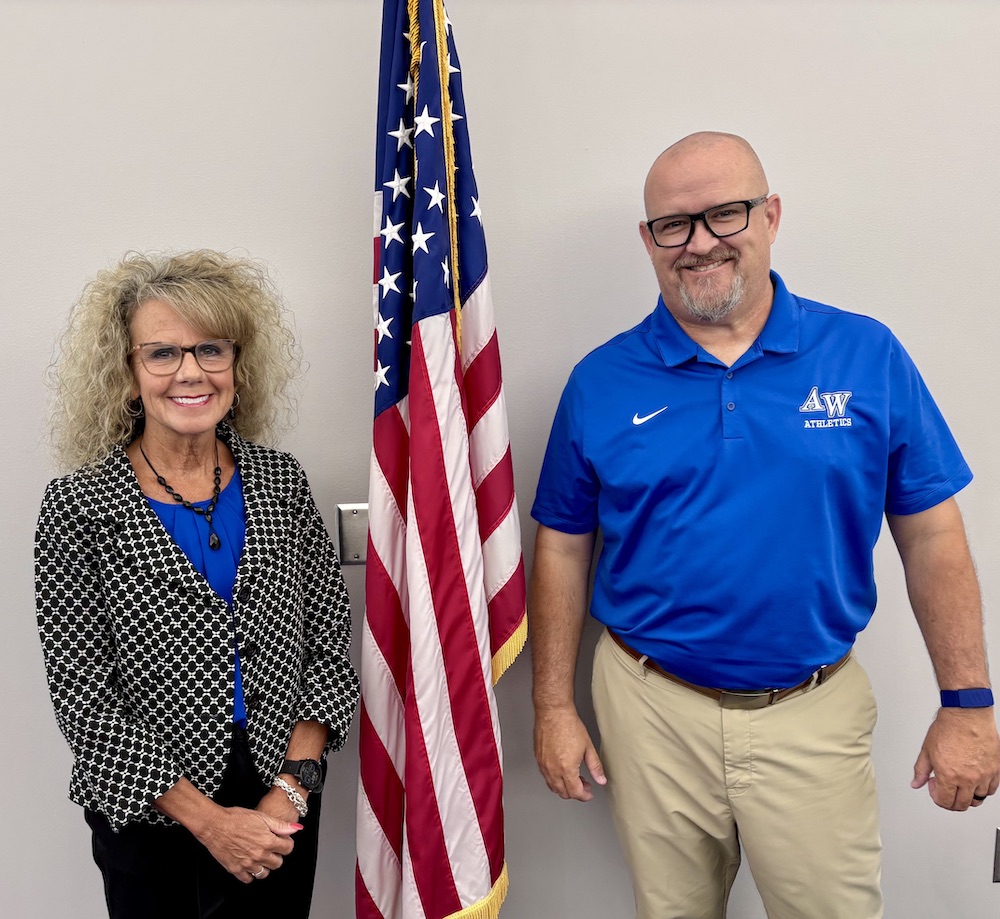
Kerri Johnson is retiring at the end of the month after 34 years in school finance, including 20 with Anthony Wayne Local Schools. She is being replaced by Roy Greene. (AWFP photo by Karen Gerhardinger)
-Congratulated the boys tennis doubles team of Brody Sutto and Will Black for finishing third in the state tournament and earning OHSAA All-State honors. Sutto just graduated and is heading to the University of Findlay while Black will be a senior and continue as a member of the team.
-Thanked outgoing treasurer Kerri Johnson for her 20 years of service with Anthony Wayne Local Schools. Johnson is retiring after 34 years in school finance on July 31. Ray Greene is taking over as treasurer.
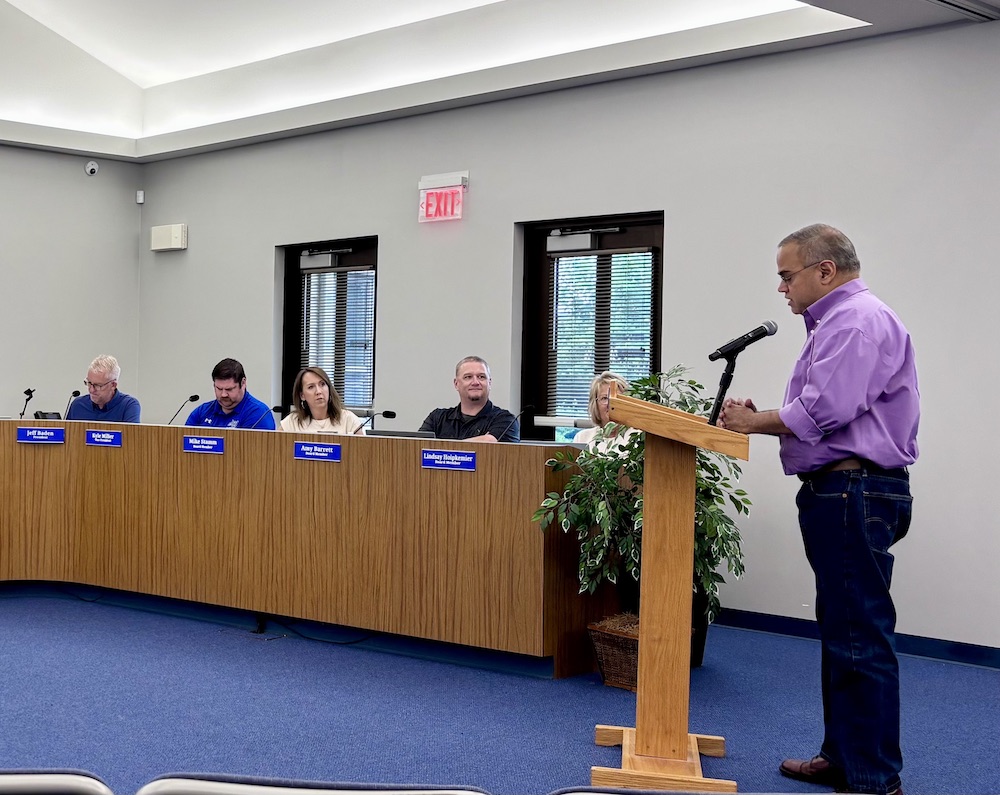
-Listened to parent Roy Collaco encourage the use of data, facts and critical thinking in decision-making, rather than the opinions of a small, vocal minority. In 2021, when the board voted to utilize hybrid and remote learning during the pandemic, some predicted that it would impact student performance and test scores, he said. A Stanford Educational Opportunities report shows that a decline in reading and math scores began in 2015 and, in the decade since, resulted in 83 percent of districts losing ground in reading scores and 70 percent in math scores. However, Anthony Wayne students, during that period, gained 1 grade level in reading and 1.5 grade levels in math.
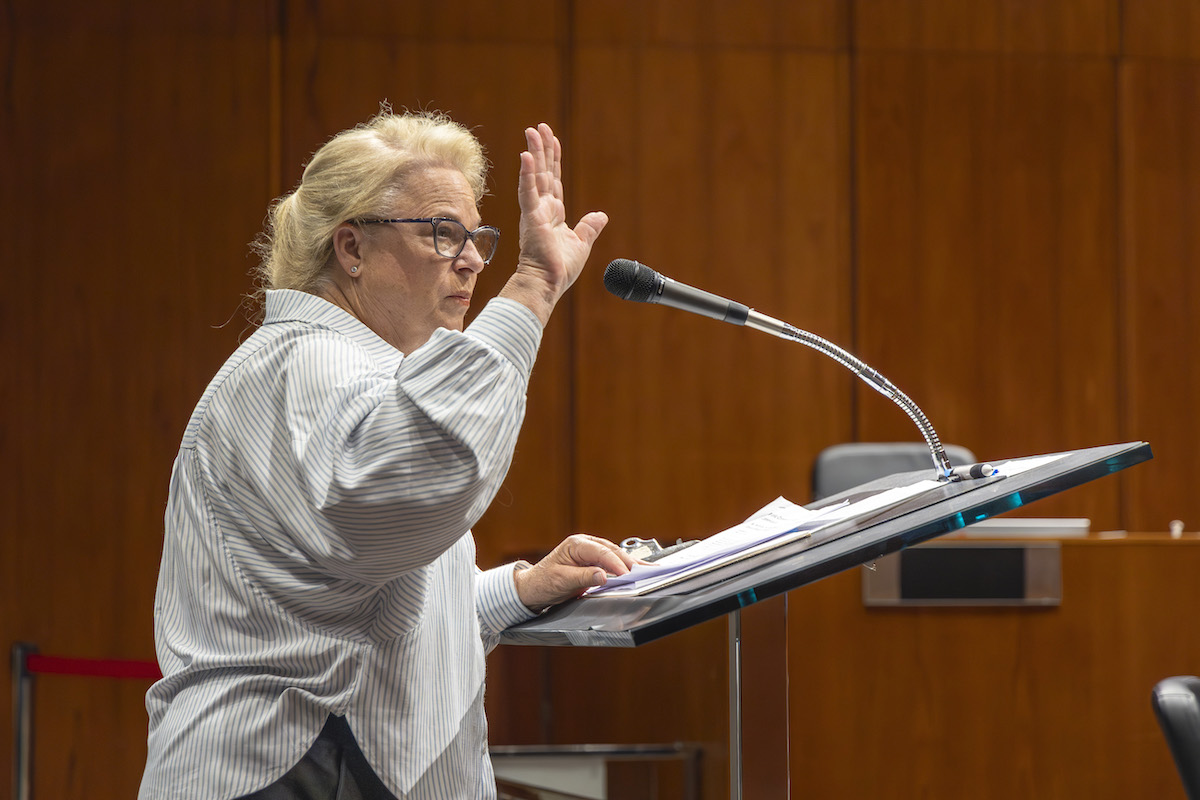
Resident Roy Collaco speaks to the Anthony Wayne Board of Education during its June 29 meeting. (AWFP photo by Karen Gerhardinger)
Collaco also pointed out that a small group accused the district of financial mismanagement in 2023, but that AWLS was one of just 8 percent of Ohio districts to receive the Ohio Auditor of State’s Award for accounting excellence.
He thanked Johnson and Herman for their diligence in preparing students for the future, and encouraged the board to continue paying attention to facts, not online conjecture.
-Approved extending Herman’s contract for one year.
-Heard Johnson say that real estate revenue is up about $3 million because of the 20-mill minimum required by the state for school funding. Even with the lowest cost per-pupil compared to other county schools, AWLS still operates paycheck to paycheck. Johnson said she believes the district has kept spending in check but that increases in costs have impacted the bottom line.
-Approved the hiring of special education aides Kimberly Smucker, Rebecca Meeker and Ashton Hooley; intervention specialist Autumn Cornell; food service workers Matthew Hoffer and Penny Sledge; and custodian Myranda Portentoso. New staff members will be present during the August meeting.
-Approved property, fleet and liability insurance with the Ohio School Plan through Hylant for $164,772 and cyber insurance with Crum & Forster for $8,500.
-Approved six federal grants totaling $1.4 million.
-Approved overnight trips for the girls soccer team to Camp Michindoh for a team camp and to Strongsville for the Adidas National Showcase. Parents are responsible for transportation and other costs.
-Approved educational agreements with Wood County Juvenile Detention Center and with Special Transportation Service Company to provide transport for students who have an education plan that requires service outside the district.
-Heard that the district is always looking to hire classified staff, including custodians, groundskeepers and food service workers.
-Heard that the next meeting will be on Monday, Aug. 10 at 8 a.m. at the board office.
Jaden Jefferson spoke with both Tom Pruss (Libertarian) and Allison Russo (Democrat) about their run for Ohio Secretary of State. You can find more information on candidates here in our most recent voter’s guide from the May 2026 primary, though a more current guide with all the remaining candidates is forthcoming.
After the May 5 primary election, Jaden sat down with Tom Pruss, the Libertarian nominee for Ohio Secretary of State.
In this one-on-one interview, Pruss discusses his experiences as a third-party candidate, redistricting, the role of advanced technology in the secretary of state’s office, how he’d respond to potential federal intervention in the state’s elections, if elected, and more.
Jaden spoke to State Rep. Allison Russo (D-Upper Arlington), the Democratic nominee for Ohio Secretary of State, following the May 5 primary election.
In this one-on-one interview, Rep. Russo offers her perspective on election accessibility, increasing voter turnout, Ohio’s redistricting process, how she’d approach the process of crafting ballot language, if elected, and more.
Rabona Casino y sus slots con jackpots para giros épicos
Entré a Rabona Casino con una idea bastante simple: encontrar tragamonedas que no se sintieran iguales después de diez giros. Lo que buscaba no era solamente un premio grande, aunque claro, eso siempre llama la atención, sino una combinación de ritmo, funciones especiales y jackpots que hicieran que cada sesión tuviera algo de expectativa. En mi primera visita me tomé unos minutos para explorar el catálogo en lugar de pulsar directamente el botón de jugar, y creo que fue una buena decisión.
La plataforma de rabona me pareció cómoda para filtrar juegos y descubrir títulos por proveedores, temática o popularidad. Yo suelo fijarme antes en la ficha de una slot que en sus colores o animaciones. Puede sonar un poco obsesivo, pero me ayuda a evitar esa sensación de haber apostado sin entender qué estaba ocurriendo. En especial, reviso el RTP, la volatilidad y la manera concreta en que funciona el jackpot.
Mi primera impresión fue clara: una tragamonedas con jackpot puede ser entretenida, pero sigue siendo un juego de azar. El premio potencial nunca debe confundirse con una garantía.
Mecánicas de jackpots que encontré
No todos los jackpots se comportan igual, y esa diferencia importa más de lo que parece. En algunas tragamonedas el bote es fijo, es decir, ofrece una cantidad predeterminada que se activa mediante una combinación concreta o dentro de una ronda especial. En otras, el jackpot es progresivo y aumenta a medida que se realizan apuestas. Ese segundo formato tiene un atractivo evidente, porque la cifra puede crecer hasta niveles muy llamativos, aunque normalmente también es más difícil de activar.
Probé varias clases de juegos y me di cuenta de que los jackpots locales me resultaban más fáciles de entender. Suelen estar vinculados a una única slot, así que puedo ver con claridad qué símbolos, minijuegos o ruedas necesito alcanzar. Los jackpots de red, en cambio, conectan a muchos jugadores y posiblemente a varios casinos. La cifra suele ser mayor, sí, pero también hay mucha más gente persiguiendo la misma oportunidad.
El detalle de la apuesta mínima
Una cosa que tardé un poco en detectar fue la relación entre el importe apostado y la elegibilidad para ciertos premios. Algunas slots permiten participar en un jackpot con cualquier apuesta, mientras que otras exigen un nivel concreto, una apuesta máxima o la activación de una función adicional. No conviene asumir nada. Una tarde jugué una slot de temática aventurera, acumulé varios símbolos especiales y solo después vi que el premio principal requería una configuración de apuesta distinta. No fue una tragedia, pero sí una lección bastante útil.
Por eso ahora prefiero leer la sección de información antes de girar. Parece un paso pequeño, incluso aburrido, pero me evita interpretar mal lo que veo en pantalla. Las reglas suelen explicar cuándo entra el jackpot, si hay una rueda aleatoria, si depende de símbolos scatter o si se activa en una bonificación.
Tipo de jackpot
Cómo suele activarse
Mi percepción
Fijo
Combinación concreta o función bonus
Más directo de comprender
Progresivo local
Ronda especial, símbolos o evento aleatorio
Buen equilibrio entre expectativa y reglas
Progresivo de red
Evento poco frecuente, a veces aleatorio
Premio enorme, probabilidad más incierta
RTP y volatilidad, dos datos que miro antes de jugar
El RTP, o retorno teórico al jugador, es uno de esos conceptos que se mencionan mucho y se interpretan mal. Cuando una slot indica un RTP del 96%, no quiere decir que vaya a devolver 96 euros por cada 100 apostados en una sesión corta. Es una cifra estadística calculada sobre una cantidad enorme de partidas. Durante veinte, cincuenta o incluso cientos de giros, cualquier cosa puede ocurrir. A mí me sirve como referencia, no como una previsión de resultados.
La volatilidad sí afecta más a la sensación inmediata de juego. Una slot de baja volatilidad suele entregar premios pequeños con más frecuencia, mientras que una de alta volatilidad puede pasar muchos giros sin nada especialmente relevante y, de repente, lanzar una ganancia más notable. Los jackpots suelen aparecer mucho en títulos de volatilidad media-alta o alta, por razones bastante evidentes. El premio máximo necesita espacio dentro de la estructura de pagos.
Para mí, un RTP competitivo no elimina el riesgo. Solo aporta una pieza más para comparar juegos y decidir cuánto tiempo quiero dedicarles.
En la práctica, intento no mezclar dos expectativas distintas. Si quiero una sesión más relajada, me inclino por volatilidad media y apuestas moderadas. Si quiero probar una slot con una función de jackpot más ambiciosa, reduzco el presupuesto y acepto de entrada que la partida puede ser irregular. Esta segunda opción puede ser emocionante, pero no siempre es divertida, depende del día y de la paciencia que tenga.
Funciones especiales que hacen que los giros cambien de ritmo
Las funciones especiales son la parte que más transforma una tragamonedas moderna. Los giros gratis siguen siendo mis favoritos, especialmente cuando incluyen multiplicadores crecientes o símbolos expansivos. Hay algo muy sencillo pero efectivo en ver que una ronda que parecía normal empieza a encadenar premios. No siempre sucede, por supuesto, y ese es precisamente el punto que conviene recordar.
También encontré mecánicas de cascada, donde los símbolos ganadores desaparecen y dejan sitio a otros nuevos, y formatos de compra de bonus en los juegos donde esa opción está permitida. Personalmente, la compra de bonus me genera opiniones mezcladas. Ahorra tiempo, eso es cierto, pero concentra una cantidad considerable en una sola ronda. Prefiero llegar a la función de manera normal, aunque entiendo por qué algunos jugadores quieren saltarse la espera.
Lo que me llamó la atención en las rondas bonus
Durante una sesión corta, una rueda de premios se activó después de reunir tres símbolos scatter. No conseguí el jackpot, ni estuve particularmente cerca, pero la pantalla ofrecía varios niveles de premio y el suspense funcionó bastante bien. Ese tipo de diseño convierte una función breve en un momento memorable. Aun así, procuro no perseguirla después. Si la ronda no aparece dentro del presupuesto que había decidido, cierro el juego y ya está.
Estas son las funciones que normalmente valoro al explorar el catálogo, no porque garanticen nada, sino porque hacen que la experiencia sea menos plana:
Giros gratis con multiplicadores que aumentan durante la ronda.
Símbolos wild expansivos, pegajosos o que se desplazan por los carretes.
Rondas de selección, ruletas y minijuegos vinculados a jackpots.
Cascadas o avalanchas que permiten varias combinaciones en un único giro.
Modos de riesgo, cuando las reglas y el presupuesto permiten usarlos con calma.
La presentación visual también cuenta, aunque intento no darle más importancia de la necesaria. Hay slots muy vistosas con mecánicas simples y otras menos espectaculares que esconden una tabla de pagos interesante. Una música intensa puede hacer que un giro se sienta enorme aunque el resultado sea modesto. Me ha pasado, y por eso a veces bajo un poco el volumen. Es un detalle mínimo, pero cambia mi manera de tomar decisiones.
Cómo elijo una slot antes de hacer un depósito
Antes de jugar con dinero real, suelo aprovechar el modo de demostración cuando está disponible. No sirve para medir si una slot “paga”, porque los resultados siguen siendo aleatorios, pero sí para entender el ritmo, la cuadrícula, las apuestas mínimas y la frecuencia aparente de las animaciones bonus. También reviso los métodos de pago disponibles y las condiciones de posibles promociones. Un bono puede parecer atractivo a primera vista, pero el requisito de apuesta cambia mucho la experiencia, sobre todo si el juego elegido contribuye de manera limitada.
No tengo una fórmula perfecta, y quizá eso sea mejor. Mi rutina es sencilla: defino un importe que puedo perder, elijo una slot por sus reglas antes que por su publicidad y fijo una duración aproximada. Si consigo una ganancia que me deja satisfecho, la retiro o dejo de jugar. Parece evidente al escribirlo, aunque en el momento no siempre resulta tan automático.
Para no improvisar demasiado, me apoyo en unos criterios concretos antes de empezar una partida:
Compruebo el RTP publicado y la volatilidad indicada por el proveedor.
Leo cómo se activa el jackpot y si existe una apuesta mínima obligatoria.
Empiezo con el importe más bajo que me permita conocer el juego sin presión.
Evito aumentar la apuesta solo porque una ronda bonus lleva tiempo sin aparecer.
Reviso límites personales de depósito, tiempo y pérdidas si voy a jugar durante más de unos minutos.
La última regla es probablemente la más importante. Una slot no “debe” una bonificación por llevar muchos giros sin activarla. Cada tirada es independiente dentro de la mecánica del juego. Entenderlo no quita emoción, al menos a mí no me la quita, pero evita que la emoción se convierta en una mala decisión.
Conclusión personal sobre los jackpots y giros épicos
Conclusión: mi experiencia con las slots de Rabona Casino fue más interesante cuando dejé de buscar el gran golpe inmediato y empecé a comparar mecánicas. Los jackpots progresivos aportan esa posibilidad remota que hace que una sesión se sienta distinta, mientras que los giros gratis, multiplicadores y minijuegos añaden ritmo incluso cuando el premio máximo no llega. Para mí, el mejor enfoque es elegir juegos con reglas claras, entender el RTP y la volatilidad, y mantener límites realistas. La emoción funciona mucho mejor cuando no depende de recuperar nada.
Reseñas y valoración final
Mi reseña personal es positiva en cuanto a variedad y navegación. Me resultó fácil pasar de slots más clásicas a títulos con jackpots, filtros y funciones especiales más complejas. Aprecio que pueda revisar la información del juego antes de decidir, porque no todos los jugadores buscan la misma volatilidad ni tienen la misma tolerancia a las sesiones irregulares.
Si tuviera que resumir mi valoración, diría que es una plataforma adecuada para quien disfruta explorando tragamonedas y entiende que los jackpots son una posibilidad, no un objetivo asegurado. Yo volvería a jugar de forma puntual, con un presupuesto definido y algo de curiosidad por probar nuevos bonus. Pero si algún día noto que juego por frustración en vez de por entretenimiento, prefiero cerrar la sesión. Esa, curiosamente, ha sido mi función especial más útil.
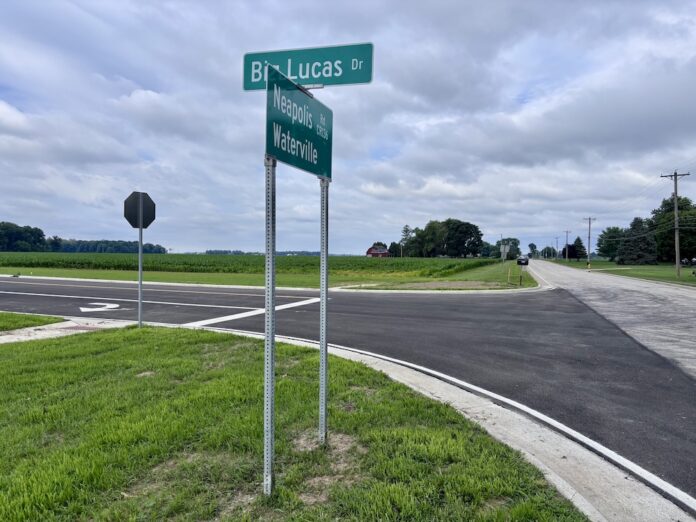
The Toledo-Lucas County Port Authority just completed infrastructure improvements to 48 acres of land in the city along Neapolis-Waterville Road as an expansion of the Farnsworth Industrial Park. Now the port is petition to annex another 48 acres from the township into the city, just west of the existing site. (AWFP photo by Stephen Zenner)
WATERVILLE TOWNSHIP – Waterville Township received notification that the Toledo-Lucas County Port Authority has applied to annex 48 acres on Neapolis-Waterville Road out of the township and into the City of Waterville.
The two parcels are just west of 48 acres of land in the city that the Port purchased and completed improvements on this year – including the construction of the 1,800-foot Big Lucas Drive, and the installation of a retention pond and all utilities. The land, an extension of Farnsworth Industrial Park, is being marketed on the Port’s website for industrial development.
The land is in the annexable zone per the township’s agreement with the city, Trustee Toby Miller said during the June 24 trustees’ meeting.
“Is there a data center going in somewhere?” asked Cari Arellano, who lives on Farnsworth Road across from the industrial park.
Miller said that he’s heard that the property owners who were contacted about a possible data center development in the township are now hearing that interest has cooled due to opposition to such projects, but that the trustees are continuing to put new zoning rules in place in the event that another developer comes along. However, the land proposed for annexation is not among the properties being targeted for a data center, commented Waterville Council Member Mary Duncan, who was in the audience.
“We already have businesses that want to be there, and they have nothing to do with data centers. They want utilities,” she said.
Resident Terry Beam asked about progress in annexation talks with Whitehouse, after two property owners – one on Finzel Road south of S.R. 64 and another at the northeast corner of Texas/Whitehouse-Spencer and Winslow – petitioned for annexation into the village earlier this year. The township and village have a longstanding agreement on areas that are “red zones” that don’t allow annexation. Miller said talks are underway, but it’s likely that the Winslow property will be declined and the Finzel property accepted, as it’s sandwiched by other village properties.
“We have a tentative agreement,” Miller said, adding that trustees would discuss the matter in executive session.
During the meeting, the trustees also:
-Heard that the Lucas County Planning Commission made no recommendation in its review of a proposed 67-page amendment to the zoning resolution, and that the next step will be for the township Zoning Commission to review the language governing data centers during its July 20 meeting.
-Agreed to obtain general liability insurance to cover work done by Amish workers hired to restore the 1911 barn at the corner of Dutch and Waterville Monclova road. The township purchased the property and will have the workers install aluminum siding on the barn, which will be used to store equipment. Work is expected to begin the week of July 20.
-Approved a resolution stating that trustees and zoning officials will not sign any non-disclosure agreements. While Miller said it’s already illegal to sign an NDA, the resolution is an effort to show transparency.
-Agreed to hire a part-time seasonal worker to mow township roadsides and property using equipment purchased by the township. The position will not include benefits.
-Heard Police Chief Kevin Smith say that he’s had people ask him whether the township has any Flock cameras. While one is located in the county outside of the township and one is located in Waterville, the township does not have any.
-Welcomed 2025 Anthony Wayne graduate Marissa Galton, who – because of taking college classes while still in high school – is now a junior majoring in criminal justice at the University of Cincinnati. She is an intern with the police department this summer.
-Heard Miller say that Nexus has updated the contact information on its website with correct phone numbers to call if residents have questions about the Moosman Road compressor station or the pipeline. He was also advised that Nexus will now notify the township of planned “blowdowns” that clear the lines but cause a lot of noise.
-Listened to Russ Schifferly ask about utilities being placed along township roads. Trustee Kyle Hertzfeld said it is a new ATT fiber optic line that is being run all over the county.
-Heard Schifferly ask about whether there are any regulations on what type of items can be stored outside of self storage facilities, and about lighting regulations. Zoning Inspector Jim Fischer said he would drive by Greenlock Storage to look at the light. The items placed outside of the Dutch Road Storage are likely spools of fiber optic cable.
TOLEDO – If a movie were to be made of FilmToledo, it might be called Miracle on Madison Avenue or Home At Last.
That’s because the nonprofit, after years of trying to establish itself as the go-to agency to promote making movies in the greater Glass City, is moving into its own brick-and-mortar office space.
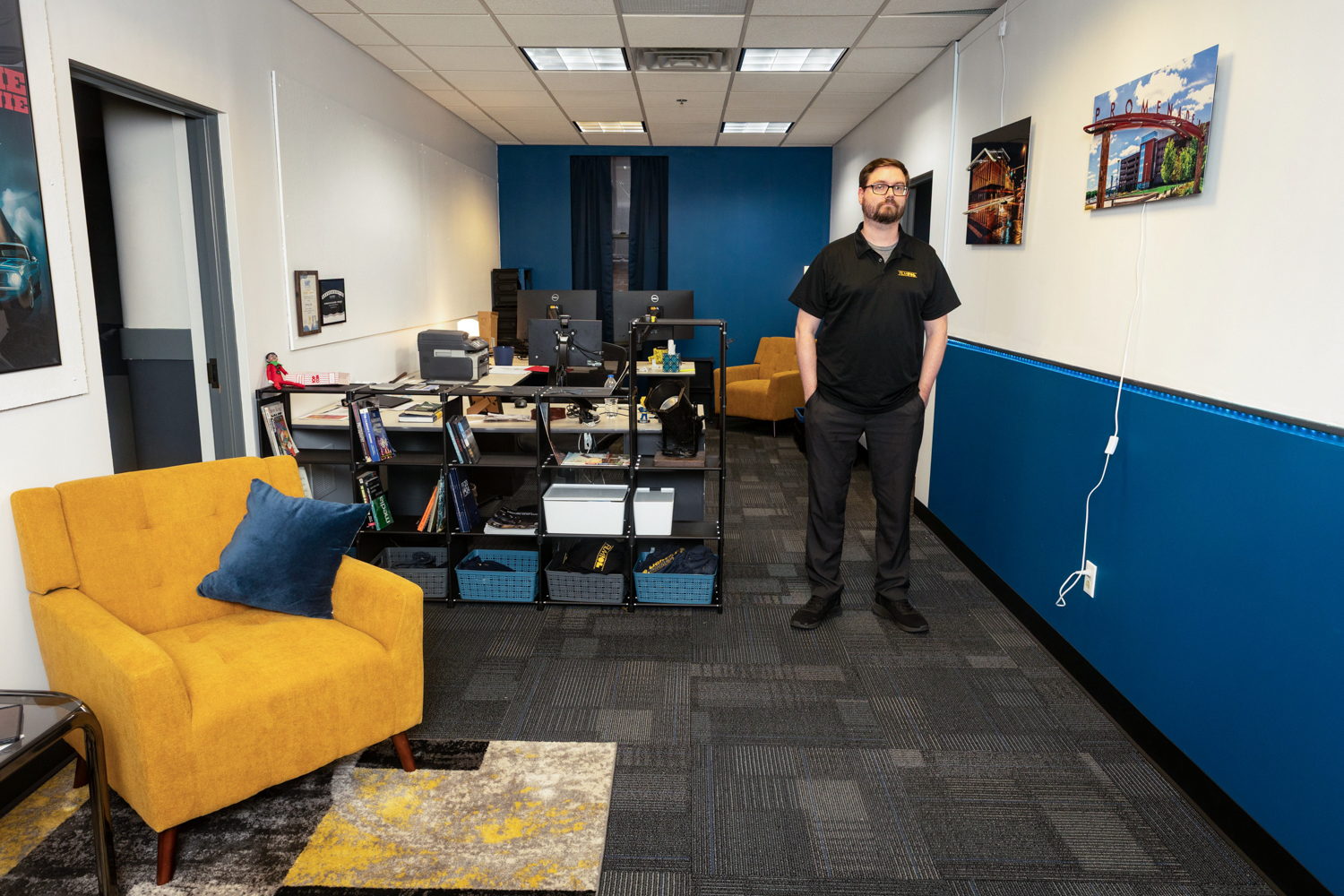
Michael DeSanto, president of FilmToledo, at the nonprofit’s new physical headquarters at Suite 201, 500 Madison Ave. (The Gardner Building) in downtown Toledo. (TFP photo by Stephen Zenner)
“We’ve been looking for a space to call our own,” said Michael DeSanto, FilmToledo’s executive director. FilmToledo, staffed by volunteers who have day jobs, has been operating out of shared spaces in the city and using other venues, like libraries, for workshops and activities. “This came about by necessity. Now we can be in one centralized location.”
That location is the historic Gardner Building at the corner of Madison Avenue and Superior Street downtown. FilmToledo’s offices are on the second floor; their neighbors in the 130-year-old-plus building, which is on the National Register of Historic Places and was home to the Toledo Museum of Art from 1901 to 1903, are art galleries (and the Toledo Free Press).
“We have two main goals,” DeSanto said. “Attract more film productions, and educate and train people in the film industry.” (TFP photo by Stephen Zenner)
FilmToledo is relatively new. Formed in 2018 as a film commission representing Toledo and 17 counties in northwest Ohio, its progress stalled during the pandemic, then by the film industry’s writers and actors strikes. Life in the film community ground to a halt, DeSanto said. But lately, he added, film activity is on a roll.
And with that upswing, FilmToledo is poised to perform its mission. “We have two main goals,” DeSanto said. “Attract more film productions, and educate and train people in the film industry. We’re an economic development organization. I like to tell people we’re the boring side of film. We’re more about crew training, not the acting side.”
FilmToledo is a resource for local filmmakers. “It’s a tight-knit community,” DeSanto said. The nonprofit conducts quarterly mixers and other networking events. (TFP photo by Stephen Zenner)
The training is done through workshops; for example, one is about being a production assistant, which is an entry-level position on a film set. Another is about being a first assistant director, the next level up. Another is about on-set etiquette, for background actors who’ve not been in a production before.
“We’re the business side of film,” DeSanto said. To that end, the nonprofit arranges for locations, crew, vendors, and support services, and communicates with government agencies to secure permits for use of property for filming.
Vendors include hotels, caterers, tent and sanitation rentals, security, and local police and fire departments to block streets.
FilmToledo also is a resource for local filmmakers. “It’s a tight-knit community,” DeSanto said. The nonprofit conducts quarterly mixers and other networking events.
Its role in economic development is recognized and welcomed. “We’re excited to see FilmToledo continue to grow and develop as an organization,” said Lance Woodworth, president and CEO of Destination Toledo, the not-for-profit agency that markets Toledo. “Having a dedicated film commission with a knowledgeable team is quite valuable as Toledo strengthens its place in the film and television industry.”
Woodworth added, “In recent years, projects like Eenie Meenie [a streaming-service film] and The Paper [a situation comedy on Peacock] choosing Toledo for parts of their filming or storyline have helped raise the city’s profile.
“FilmToledo has played an important role in making that possible by helping productions get what they need and ensuring they have a great experience doing business in the Glass City.”
FilmToledo is in a fundraising drive to finish renovations to its offices to have a proper grand opening. Its website – filmtoledo.com – includes a “donate” button and a link to its merchandise site. (TFP photo by Stephen Zenner)
“Toledo isn’t known as a film town,” DeSanto said. “That’s something we’ve been working on for years, to build the infrastructure we need.”
Toledo is behind other Ohio commissions in Cleveland, Columbus, and Dayton, which are well-established. “We’re playing catch-up to build up our industry. That’s been our goal. We’re trying to bring more film productions here so that people can build a career here and not have to travel around the country.”
DeSanto added, “We’re not getting paid by donors or film companies. It’s the community that supports us.” The organization is in a fundraising drive to finish renovations to its offices to have a proper grand opening. Its website – filmtoledo.com – includes a “donate” button and a link to its merchandise site.
In short – if a movie were to be made of FilmToledo – it’s ending would be: To be continued…
FilmToledo will have a ribbon-cutting ceremony to mark the opening of its offices, Suite 201, on Monday, July 20.
Originally published by Jessica Molina of La Prensa. Find the article here.
“911 services would put you on hold,” was how Lisa Sobecki chose to illustrate opponents’ concerns about the proposed Ax the Tax amendment. Reduced access to fire and emergency services, library closures, township governments potentially going under, and schools no longer having enough funds to pay staff are among the possible consequences if the Ax the Tax Property Tax proposal were to go into effect, according to opponents.
Opponents argue that these potential consequences could significantly impact everyday life. So, how did the Ax the Tax petition gain so much attention?
La Prensa contributor Jessica Molina. (Courtesy photo)
The Property Tax constitutional amendment started as a “Save Our Seniors” campaign led by Brian Massie. Massie shared that owning private property is how citizens gain or inherit wealth. Yet, while his mortgage was paid off, he was still required to pay an increasing property tax on a fixed income. In fact, his property taxes increased 40 percent over the past ten years. He felt like the government was putting his earned wealth at risk by continuing to tax him.
Massie set out to learn more about property taxes and how they were calculated. He started by learning more about mills, the mill floor, and other concepts that typically have taxpayers going cross-eyed and giving up in overwhelm.
As he continued to research property taxes, he learned that his county was using a third-party appraiser for the sexennial reevaluation process. He asked the appraiser how property values were calculated. According to Massie, the appraiser would not disclose how homes were appraised because the formula was proprietary information. Massie took this interaction as evidence that public funds were being used in a way he felt was not accountable to the taxpayer.
Massie began meeting with elected officials. He scheduled meetings at the statehouse and even rented a room there in an attempt to draw more legislators into the conversation. He consistently came away disappointed, often meeting with young staffers instead of the legislators he sought. In response to the lack of engagement from lawmakers, Massie recalled a politician telling him that the government tends to “protect itself and grow,” while legislators focus primarily on “protecting themselves and getting reelected.”
It was then clear to Massie that he was not going to be able to influence legislators through traditional channels. So, he became part of an effort to rewrite the Ohio Constitution through a citizen-led amendment.
The Property Tax Amendment currently circulating through the “Ax the Tax” petition aims to rewrite the way Ohio uses property taxes. More specifically, it would abolish taxes on real property and prohibit any future taxes on real property.
While the proposal may sound attractive to taxpayers, opponents warn that eliminating property taxes could come at a significant cost. A community panel hosted by the Alliance of Northwest Ohio Public Service Advocates included researchers, data analysts, attorneys, farmers, local officials, and public servants. Collectively, the panel argued that property taxes need reform, but not a complete overhaul. According to panelists, a full elimination would be detrimental to everyday public services.
To communicate the potential lasting effects, panelists shared information from their respective fields. Panelists from the Ohio Farm Bureau argued that farmland could become more vulnerable to development if current CAUV-related tax protections disappear. Sobecki shared that Lucas County could lose approximately $20 million from its budget if the amendment passed. Melissa Petrea explained that townships could lose the majority of their funding. A common concern among panelists was that eliminating property taxes would likely lead to significant increases in income or sales taxes, which some feared could push residents and consumers out of Ohio.
Despite strongly opposing the amendment, several panelists acknowledged that Ohio’s current school funding system is heavily dependent on property taxes and in need of reform. Panelists shared that approximately two-thirds of property taxes go toward schools. Ohio’s school funding system has previously been ruled unconstitutional by the Ohio Supreme Court, in part because of inequities tied to its dependence on property taxes. Panelists argued this concern is compounded by the fact that approximately $1.6 billion goes toward charter schools, which they said account for more than half of the F grades issued by the Ohio Department of Education and Workforce. While panelists expressed concern about the current structure of school funding, they argued that completely abolishing property taxes would create even greater instability for public education.
Surprisingly, Massie raised similar concerns about the current structure of public education in Ohio. He argued that the state has too many school districts and administrative costs, while student proficiency rates continue to struggle. He specifically pointed to concerns surrounding Third Grade Reading Guarantee proficiency as evidence that the current funding system is not producing the outcomes taxpayers expect.
Despite their disagreements, both sides expressed frustration with Ohio’s current funding model. However, if Ax the Tax passes, where will the government get the money from? That answer remains unclear. Any replacement funding model would require action from state lawmakers.
Panelists emphasized that lawmakers should already be working across party lines to develop more equitable and sustainable funding solutions, rather than allowing the issue to become politically polarized. Meanwhile, Massie’s movement appears to be rooted in a similar frustration: the belief that lawmakers have failed to seriously address rising property taxes and housing affordability concerns.
If the proposal passes this November, the Ax the Tax amendment would go into effect Jan. 1, 2027. From that date forward, institutions that rely on property taxes would no longer be able to collect new property tax revenue. According to Massie, because property taxes operate in arrears, meaning 2026 property taxes fund 2027 budgets, legislators would effectively have at least one year to develop a replacement funding model. Massie also suggested that legal challenges could potentially delay implementation of the amendment while lawmakers work toward alternative funding solutions.
Ohio allows citizens to bypass the legislature and attempt to amend the constitution directly through petition signatures. The Ax the Tax campaign plans to release an update in mid-June announcing whether it secured enough signatures to qualify for the November ballot.
El debate sobre los impuestos de propiedad en Ohio muestra que muchas personas están frustradas con el sistema actual
Por Jessica Molina
“Los servicios del 911 te pondrían en espera,” fue la manera en que Lisa Sobecki explicó las preocupaciones sobre la propuesta Ax the Tax. Menos acceso a servicios de bomberos y emergencias, cierres de bibliotecas, problemas económicos para los townships y escuelas sin suficiente dinero para pagar a sus empleados son algunas de las preocupaciones mencionadas por quienes están en contra de la propuesta.
Quienes están en contra dicen que estas posibles consecuencias podrían afectar mucho la vida de todos los días. Entonces, ¿cómo ganó tanta atención la petición Ax the Tax?
La propuesta comenzó como una campaña llamada “Save Our Seniors” (“Salvemos a nuestros adultos mayores”), liderada por Brian Massie. Massie explicó que tener una casa o propiedad es una manera en que muchas familias construyen riqueza y ayudan a futuras generaciones. Sin embargo, aunque ya había terminado de pagar su casa, seguía teniendo que pagar impuestos de propiedad cada vez más altos con un ingreso fijo. De hecho, sus impuestos aumentaron un 40% en los últimos diez años. Él sentía que el gobierno estaba poniendo en riesgo lo que había logrado con años de trabajo.
Massie comenzó a aprender más sobre los impuestos de propiedad y cómo se calculan. Empezó investigando temas como los “mills”, el “mill floor” y otros conceptos que, según él, terminan confundiendo a muchas personas.
Mientras seguía investigando, descubrió que su condado estaba usando una empresa externa para reevaluar propiedades. Él preguntó cómo calculaban el valor de las casas. Según Massie, la empresa no quiso explicar el método porque la fórmula era información privada de la compañía. Massie tomó esta situación como una señal de que el dinero público se estaba usando de una manera que, según él, no era transparente para las personas que pagan impuestos.
Massie comenzó a reunirse con políticos. Programó reuniones en la legislatura estatal e incluso rentó un salón para intentar atraer a más legisladores a la conversación. Según contó, muchas veces terminaba reuniéndose con asistentes jóvenes en lugar de los legisladores que quería conocer. También recordó que un político le dijo que el gobierno tiende a “protegerse y crecer”, mientras que muchos legisladores se enfocan principalmente en “protegerse y reelegirse”.
Fue entonces cuando Massie decidió formar parte del esfuerzo para cambiar la Constitución de Ohio mediante una propuesta creada por ciudadanos.
La propuesta Ax the Tax busca cambiar completamente la manera en que Ohio usa los impuestos de propiedad. Más específicamente, eliminaría los impuestos sobre bienes raíces y prohibiría futuros impuestos sobre propiedades.
Aunque la propuesta puede sonar atractiva para muchas personas, quienes están en contra advierten que eliminar los impuestos de propiedad podría traer consecuencias importantes. Un panel comunitario organizado por la Alliance of Northwest Ohio Public Service Advocates reunió a investigadores, analistas de datos, abogados, agricultores, funcionarios locales y trabajadores del servicio público. En general, el panel coincidió en que los impuestos de propiedad necesitan cambios, pero no una eliminación completa. Según los participantes, eliminar completamente estos impuestos afectaría seriamente los servicios públicos.
Para explicar los posibles impactos, los panelistas compartieron ejemplos desde sus distintas áreas. Representantes del Ohio Farm Bureau dijeron que las tierras agrícolas podrían quedar más vulnerables a proyectos de construcción si desaparecen ciertas protecciones actuales. Lisa Sobecki comentó que el condado de Lucas podría perder aproximadamente $20 millones de su presupuesto si la propuesta se aprueba. Melissa Petrea explicó que los townships podrían perder la mayor parte de su financiamiento. Otra preocupación común fue que eliminar los impuestos de propiedad probablemente llevaría a aumentos importantes en impuestos sobre ingresos o ventas, algo que algunos creen podría hacer que personas y consumidores abandonen Ohio.
Aunque muchos panelistas se opusieron fuertemente a la propuesta, también reconocieron que el sistema actual de financiamiento escolar en Ohio depende demasiado de los impuestos de propiedad y necesita cambios. Explicaron que aproximadamente dos tercios de esos impuestos van a las escuelas. Además, recordaron que la Corte Suprema de Ohio anteriormente declaró inconstitucional el sistema de financiamiento escolar del estado, en parte por las desigualdades relacionadas con esa dependencia de los impuestos de propiedad.
Los panelistas también argumentaron que la situación se complica porque aproximadamente $1.6 mil millones se destinan a escuelas charter, las cuales, según ellos, representan más de la mitad de las calificaciones “F” emitidas por el Departamento de Educación y Fuerza Laboral de Ohio. Aunque reconocieron problemas en el sistema actual, afirmaron que eliminar completamente los impuestos de propiedad generaría aún más inestabilidad para la educación pública.
Massie también expresó preocupaciones similares sobre el sistema educativo actual. Él argumentó que Ohio tiene demasiados distritos escolares y demasiados costos administrativos, mientras que los niveles de rendimiento estudiantil continúan bajos. También señaló preocupaciones relacionadas con la prueba de lectura de tercer grado como evidencia de que el sistema actual no está dando los resultados que las personas esperan.
A pesar de sus diferencias, ambos lados expresaron frustración con el modelo actual de financiamiento en Ohio. Sin embargo, si Ax the Tax llega a aprobarse, ¿de dónde saldrá el dinero para financiar al gobierno? Esa respuesta todavía no está clara. Cualquier nuevo modelo de financiamiento requeriría acción de los legisladores estatales.
Los panelistas enfatizaron que los legisladores deberían trabajar juntos entre partidos políticos para desarrollar soluciones más justas y sostenibles, en lugar de convertir el tema en una batalla política. Mientras tanto, el movimiento de Massie también parece surgir de una frustración similar: la creencia de que los legisladores no han abordado seriamente el aumento de impuestos de propiedad ni los problemas de vivienda asequible.
Si la propuesta se aprueba este noviembre, entraría en vigor el 1 de enero de 2027. Desde ese momento, las instituciones que dependen de los impuestos de propiedad ya no podrían recaudar nuevos ingresos provenientes de esos impuestos. Según Massie, debido a que los impuestos de propiedad funcionan “en atraso”, los impuestos cobrados en 2026 financian los presupuestos de 2027. Eso, según él, daría aproximadamente un año para desarrollar otro modelo de financiamiento. También señaló que posibles desafíos legales podrían retrasar la implementación mientras los legisladores buscan soluciones alternativas.
Ohio permite que los ciudadanos intenten modificar la Constitución directamente mediante peticiones y recolección de firmas. La campaña Ax the Tax planea dar una actualización a mediados de junio para informar si lograron suficientes firmas para aparecer en la boleta de noviembre.
Para más información sobre Ax the Tax: axohtax.com
Work on removing the dirt fill and spandrel walls on the 118-year-old Roche de Boeuf Interurban Bridge will begin after July 6. The first step will be installing a causeway on the Lucas County side, to begin carefully removing dirt. (AWFP photo by Karen Gerhardinger)
WATERVILLE – When Kokosing arrives sometime after July 6 to begin working on the Roche de Boeuf Interurban Bridge, expect to see more scalpel than sledgehammer, said Ohio Department of Transportation District 2 Deputy Director Pat McColley.
“They will be demolishing it more like a surgeon than coming in and beating the thing down,” McColley explained during a June 26 open house at Farnsworth Metropark.
For several years, ODOT has been looking for a solution to deal with the 118-year-old bridge, and sought bids for a total demolition that was set to begin last year – until Gov. Mike DeWine granted a one-year extension for Save the Bridge Association (STBA) and the city of Waterville could come up with a plan.
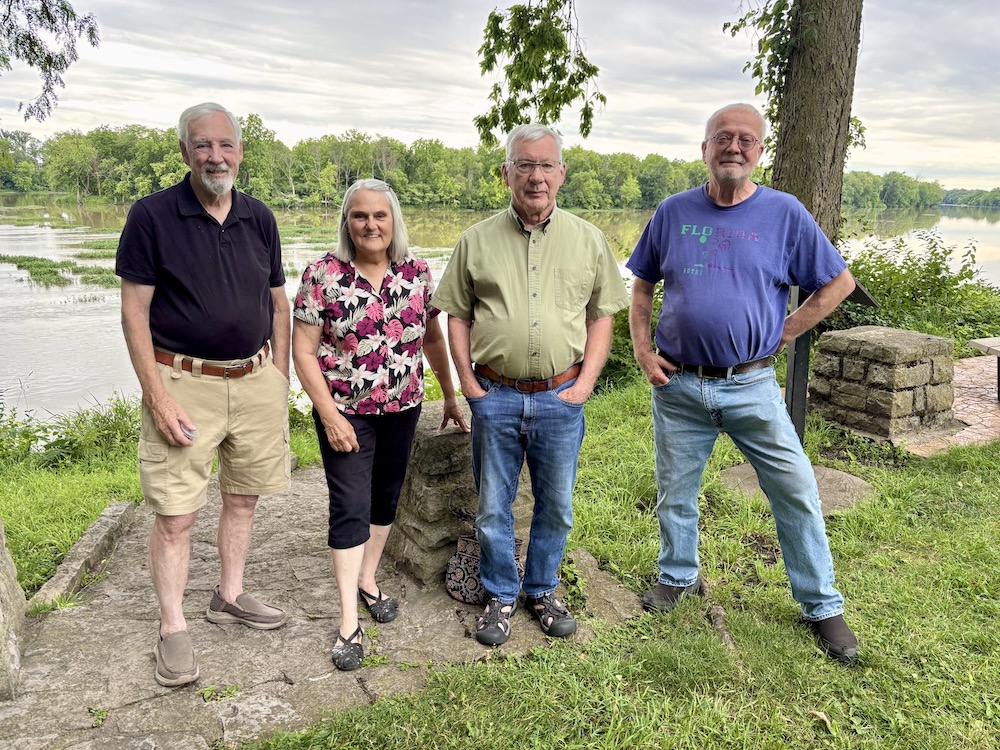
Gathering at the Roche de Bout Shelterhouse at Farnsworth Metropark on June 26, Waterville Mayor Tim Pedro (second from left) talks about the mission to safe the historic bridge and those who joined those efforts including (from left) Save the Bridge Association members John Wasserman, John Pautz II, Rex Childers and Ohio Department of Transportation District 2 Deputy Director Pat McColley. (AWFP photo by Karen Gerhardinger)
During a six-week period this spring, that plan gelled, thanks to new information from historic bridge engineer Bill Vermes on how to carefully remove just the parts that are failing – the spandrel walls and earthen fill – and stabilize the structure for future use.
On June 8, City Council unanimously approved the purchase of the bridge from the state, which in turn will take the $4 million set aside for removal and have Kokosing do the selective demolition work.
“I don’t know that it’s been done anywhere in the nation,” McColley said, adding that he’s confident in Kokosing and the expertise they bring.
Step one will be installing a causeway on the Lucas County half of the river, using stone from the nearby quarry. The top layer of dirt will be removed from the bridge, then the causeway will be flipped to the Wood County side. Once there, workers will remove the dirt, and the spandrel walls, which need to fall onto the causeway itself. Then work will flip back over to the Lucas County side for a second layer of dirt to be removed, along with the spandrels.
“We have to remove the layers of dirt on the tap carefully and watch to make sure we’re not unbalancing the arches,” McColley said, noting that engineers want to make sure that the lateral load of the arches isn’t affected during the process.
Most of the work will be done from the Waterville side, but an access road might be placed on the Wood County side, as the city now owns the 100-foot-wide right of way that was once a trolley line that connected along Forst Road.
“I’m very happy, personally and professionally, that we have a realistic, practical solution, so that we can preserve a major piece of history and everyone is walking away happy,” McColley said.
“We’re not out of the woods yet. Something could happen, and if it does, it would be a total demolition,” he added. “But I’m very hopeful and optimistic.”
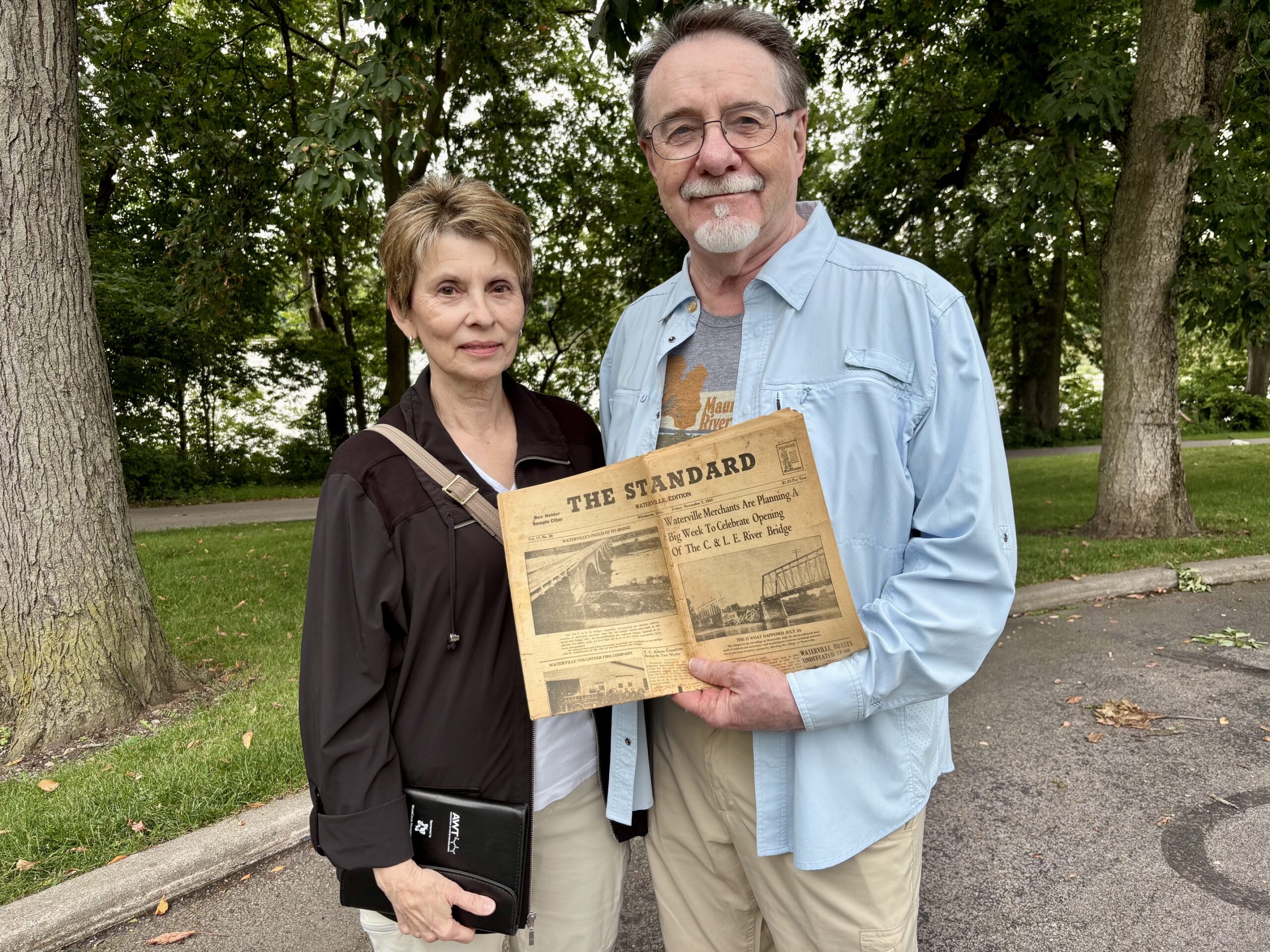
Paula and Steve Lauer arrived at the June 27 gathering with a November 7, 1941 copy of The Standard that described how the Roche de Boeuf Interurban Bridge was used temporarily for automotive use after a section of the Waterville bridge collapsed in July 1941 from a truck accident. (AWFP photo by Karen Gerhardinger)
Once complete, what will remain are the piers and arches, and STBA will begin raising funds to install a pedestrian and bike bridge on top of the arches but putting the weight onto the piers, which are embedded in three feet of bedrock. Waterville Mayor Tim Pedro said he’s already getting offers of donations toward that project, which is estimated at $6-7 million.
“We’ve got a lot of work in front of us. Do we have every answer? Do we have every question? No, but we got a chance to save the bridge,” Pedro said. “Now we can plan.”
Rex Childers, a STBA member and historian, said he can see how the new pedestrian and bike bridge will provide opportunities for sharing the stories of more than just Gen. Anthony Wayne, who had Fort Deposit built near the rapids just before the Battle of Fallen Timbers.
Bill Coder and Rebecca Jaessing stopped by to see the plans for the bridge. Coder was an assistant scoutmaster for Troop 95 in 1972 and took the Scouts on an overnight trip to Farnsworth – including holding a church service atop the bridge. (AWFP photo by Karen Gerhardinger)
The Miami tribe had a village that straddled the rapids that run under the bridge, and they guarded the Roche de Boeuf island in the middle. That rock, which was partially destroyed during construction of the trolley line, served as a sacred and functional place where the Shawnee, Delaware, Wyandotte, Ojibwe and Potawatomi tribes to come settle disputes.
“I think we will have a great opportunity to share a different story – about the Native Americans who lost their land,” Childers said.
Frank Butwin, secretary for the Maumee Valley Heritage Corridor, which collaborates with organizations to advocate and preserve resources with cultural, heritage and recreational value, said he’s excited to see what’s next for the bridge.
“We need to preserve and promote this so we can attract people to get on it, go across it and have it be part of a trail system,” Butwin said. “This could add more commerce to the area. We want to bring people not just from northwest Ohio but different states.”
Artist Teri Utz Bersée uses pure pigments to capture a scene of the Maumee River. (AWFP photo by Karen Gerhardinger)
Among the guests stopping into the Roche de Bouf Shelterhouse on June 26 was retired Waterville third-grade teacher Pollie Miller, who for 18 years took her students on a walk through history in the downtown area.
“I’m thrilled it’s going to be saved. History is important. I’m glad to see so many people on board to make this happen,” Miller said, noting that she’s thankful that Vermes came to Waterville several times to show that the bridge could be saved. “He really made a difference in the outcome.”
Richard Hagy said he likes the plans he sees for the bridge’s future.
“It will be a great walkway across there,” he said, motioning to the bridge.
Waterville Historical Society member Merle Wilhelm noted that saving the bridge will have another benefit.
“It would be terrible if the city of Waterville had to change their logo to the other bridge,” he laughed.
Among the visitors to the June 26 open house were (from left) RIchard Nagy, Pollie Miller, Dan Miller and Merle Wilhelm. (AWFP photo by Karen Gerhardinger)
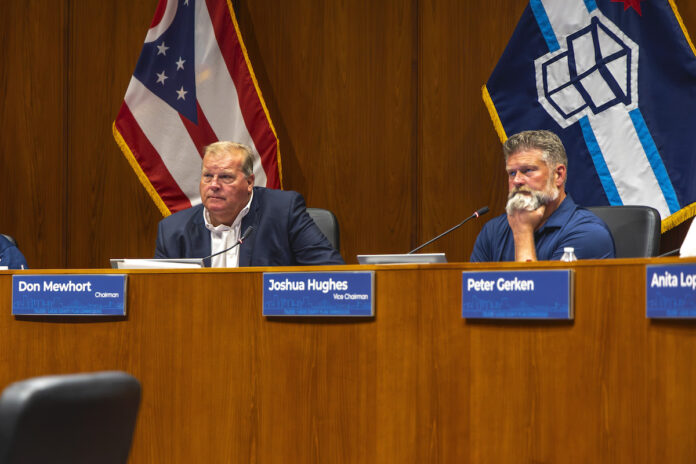
Lucas County Planning Commission members Don Mewhort and Joshua Hughes listen to testimony from Waterville Township trustee Toby Miller about proposed zoning text amendments governing data centers on June 24. (AWFP photo by Gaven Hafner)
WATERVILLE TOWNSHIP – A 67-page amendment to the Waterville Township zoning resolution – one that would change how large developments like data centers are handled – was passed back to the township by the Lucas County Plan Commission with no recommendations.
“Go in with your eyes wide open,” commission member and Lucas County Engineer Mike Pniewski said during the June 24 meeting. “As long as you understand the risks…god speed.”
The township forwarded the proposed amendments to the county last month. The amendments include the creation of an M-3 Campus Industrial District zoning designation and changes to the existing M-1 and M-2 industrial district regulations, adding tiered classification standards, and provisions related to phasing, development agreements, financial assurance, decommissioning and more.
Assistant Lucas County Prosecutor John Borell, at the podium, asks a question of Waterville Township trustee Toby Miller. (AWFP photo by Gaven Hafner)
Normally, the county planning staff would review the information and make a recommendation to the LCPC – either to approve with or without conditions, or deny, based on concerns. This time, however, the staff made an unusual “no recommendation” on its detailed report, mostly because Assistant Prosecuting Attorney John Borell has “significant concerns,” said Lisa Cottrell, LCPC director.
“It’s difficult to reconcile some of the provisions with the township zoning,” Borell told the commissioners. “I’m not going to say they’re not all enforceable. I’ve just not seen anything like this before. I would be a lot more comfortable if this was a conditional use, not a zoning change. Large portions of it are questionable. It’s data centers, so it’s a whole new ball game.”
Borell said he gives the township credit for trying to do something to control not only data centers but larger industrial-type developments.
“I know they’re in a hurry, and I understand why,” Borell said. “But this is such a new area that you don’t know with certainty what a court would do with it.”
Borell suggested that the county planning commission postpone any recommendations for 30 to 60 days to allow more time for review.
While Waterville Township Trustee Toby Miller said he understands Borell’s concerns – many of which were addressed in a six-page report earlier in the week – he said the trustees are in a hurry to get something in place before a large scale data center applies for a permit. The township trustees enacted a one-year moratorium on December 17, but Miller said that offers little protection from big tech developers.
“We’re trying to put this through because time is short for us,” said Miller, explaining that landowners have been approached by developers looking for a site for a large data center.
“We have counsel reviewing this. We believe the entities interested in the property out there are not going to wait until December. They don’t see our moratorium as an obstacle. If we have an applicant come in…they will be grandfathered in under our current zoning book, which is woefully inadequate.”
The changes to the zoning resolution came out of input from a Data Center Advisory Committee and the Columbus law firm of Brosius, Johnson and Griggs LLC, which has experience in representing clients facing large developers, Miller said.
Among the amendments under consideration would be to change the current requirement that a developer apply for a conditional use permit in A-Agricultural districts. Because a conditional use permit is an administrative process, it is not subject to referendum by the citizens. The text amendment would require a developer to apply for an M-1, M-2 or M-3 zoning change, depending on size. A zoning change is considered a legislative action and could be contested by citizens with a referendum.
Another concern addressed in the text amendment is the process. A conditional use permit would be decided by the Board of Zoning Appeals, which is made up of appointed members, while a zoning change requires approval from the three elected trustees. Kyle Hertzfeld has stated that he will not vote on the matter because of a perceived conflict of interest. That leaves the decision to Miller and Trustee Julie Theroux.
Miller said a 30- to 60-day delay would push changes to the zoning resolution back by six to eight months, but that he would be open to viable suggestions from the commission members and community in the time before the township Zoning Commission meets on July 20. He also noted that he would continue to work with Borell and Cottrell.
County Commissioner Anita Lopez suggested the township continue to work with outside counsel, but to use caution as any litigation from a developer could be costly.
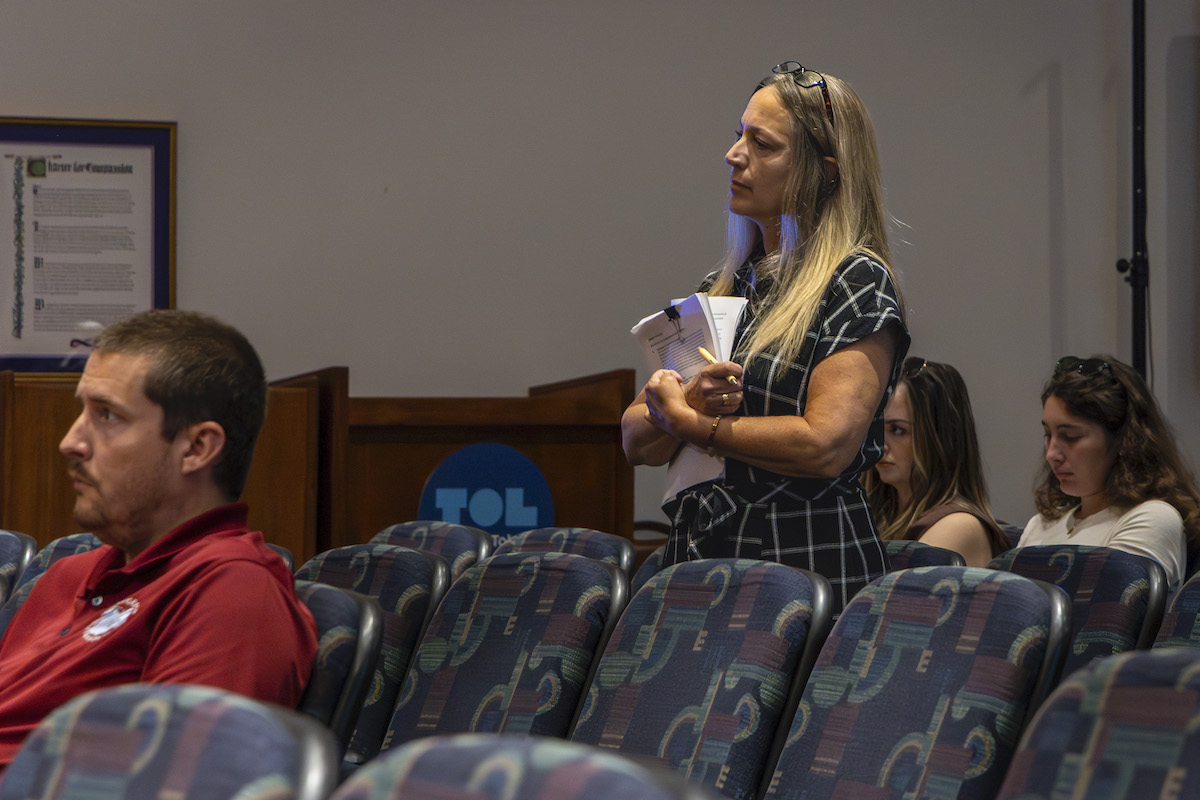
Waterville Township resident Karen Schneider, a former trustee, asks the LCPC to consider a 30-day delay in making any recommendation to the township on the zoning resolution changes. (AWFP photo by Gaven Hafner)
LCPC member Don Mewhort said it makes sense to send the matter back to the township, and moved to close the meeting, but resident and former township Trustee Karen Schneider stood up and asked for an opportunity to speak. She urged the commission to enact a 30-day delay, because she respects the expertise of Borell and the planning staff. She shared concerns about litigation from a data center developer possibly bankrupting the township, which doesn’t have deep pockets.
“Everything about this feels fast,” Schneider said, adding that the goal should be to protect the residents, not accommodate a schedule by trustees to push things through.
Schneider also noted that the change in zoning would open up the township to other large developments.
The commission then closed the meeting, until Risa Sindel urged them to reopen and allow time for comments from audience members who had signed up to speak. She then spoke about the detrimental impacts of data centers on water, the electrical grid, loss of farmland and lowered property values. Leatra Harper of Bowling Green spoke about a title 5 gas plant going in the Meta facility in Middletown Township, and urged the commission to look into how these impact the environment and health.
Lyn Cox takes an oath before speaking to the LCPC about her concerns with proposed changes to the township zoning resolution. (AWFP photo by Gaven Hafner)
Lyn Cox said she’s concerned that the tiers proposed in the amendment would be misused and give developers an opportunity to apply for a lower-tier use but then later expand to a higher-use facility without the same oversight. She cited several other concerns about the text amendments, providing in writing to the commissioners.
Cox also noted that Miller resides near land that is being eyed for a data center; that he organized an “exclusive” data center committee; and that he works for AI Logistics, which she said is a field with direct commercial interest in the expansion of data center infrastructure and AI computing capacity in the region.
While Miller acknowledged his work in the industry, he countered that he is not in favor of a data center in his back yard – which is one proposed location for a possible data center.
The commissioners agreed to punt the issue back to the township without further delay.
After the meeting, several residents cornered Miller, who set up an open time at the township hall later that afternoon, for those who wanted to suggest viable changes to the text amendments. One person showed up.
The next step is for the township Zoning Commission to review the proposed text amendments – which are posted on the township website – during the commission’s Monday, July 20 7 p.m. meeting. The Zoning Commission will then make a recommendation for the trustees to make a final decision, possibly as soon as their July 22 meeting, which begins at 6:30 p.m.
The proposed resolution is a text amendment only. It creates the M-3 zoning classification and related standards, but it does not apply M-3 zoning to any property. Any request to apply M-3 zoning to a specific parcel would require a separate zoning map amendment, public hearings, review under the township’s comprehensive plan, and compliance with Ohio zoning procedures.