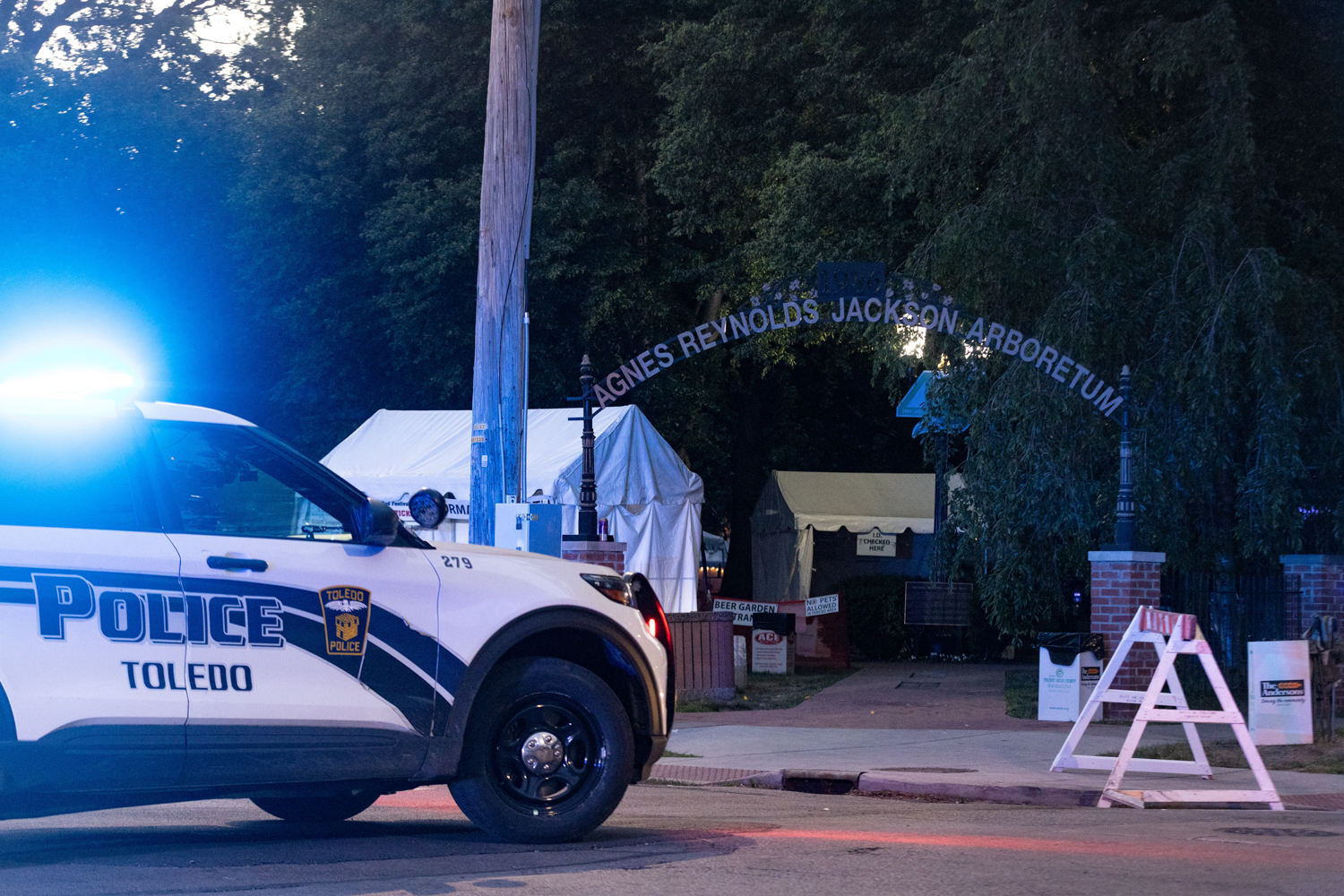
Toledo Police Department car with lights on at the at the intersection of Delaware and Robinwood Avenues after a shooting at the Agnes Reynolds Jackson Arboretum in the Old West End in Toledo on Saturday, June 6, 2026. (TFP photo by Stephen Zenner)
TOLEDO – Shoes, drinks and a baby stroller were left behind after a mad dash out of the Old West End’s Agnes Reynolds Jackson Arboretum, where gunshots were heard in the late afternoon on Saturday.
In the heart of the Old West End Festival (OWEF), halfway into the set of the local band Goalpost, a stampede of people fled the loud shots, and police responded around 5:37 p.m., according to Toledo Deputy Police Chief Joseph Heffernan.
A baby stroller left after the shooting at the Agnes Reynolds Jackson Arboretum. (TFP photo by Stephen Zenner)
12 individuals were struck by bullets, with two in critical condition as of the night of the shooting. The age range of the victims was estimated between 14 and 61 according to police Lieutenant Dan Gerken. Toledo Fire & Rescue and Police were quickly on the scene where police believe two individuals traded gunfire across the busy center of the Old West End Festival.
Goalpost’s perspective
“I saw a big wave of people running by,” said Matt Cashin, lead singer for Goalpost, who couldn’t hear what was going on over their band’s music. Unfortunately, it would not be long before the band saw for themselves what was happening.
“I ducked down, and then everybody was running,” said the band’s drummer, Daniel Price. “I looked over, and a girl fell down, like right here,” he pointed to a spot a little bit from where his drums were set up.
“She must have got shot like, what? Two feet away?” he estimated.
Price thought quickly when the woman was struck and, equipped with a box of spare band t-shirts, tried to apply a tourniquet to the wound on her leg.
Matthew Cashin, lead singer of the band Goalpost, packs up musical gear after a shooting at the Agnes Reynolds Jackson Arboretum in the Old West End. Goalpost was halfway through their set when the shooting happened. (TFP photo by Stephen Zenner)
Meanwhile, Cashin experienced something similar on the other side of the gazebo, where his sister was “grazed” by a bullet. And another friend, Seth Frontine, sustained a bullet through the foot.
Price reported Frontine in good spirits, despite the injury, and that Frontine had even tried to fist bump Price in solidarity after being shot.
From playing a musical set to experiencing gun violence, Price was not sure how to process what had happened.
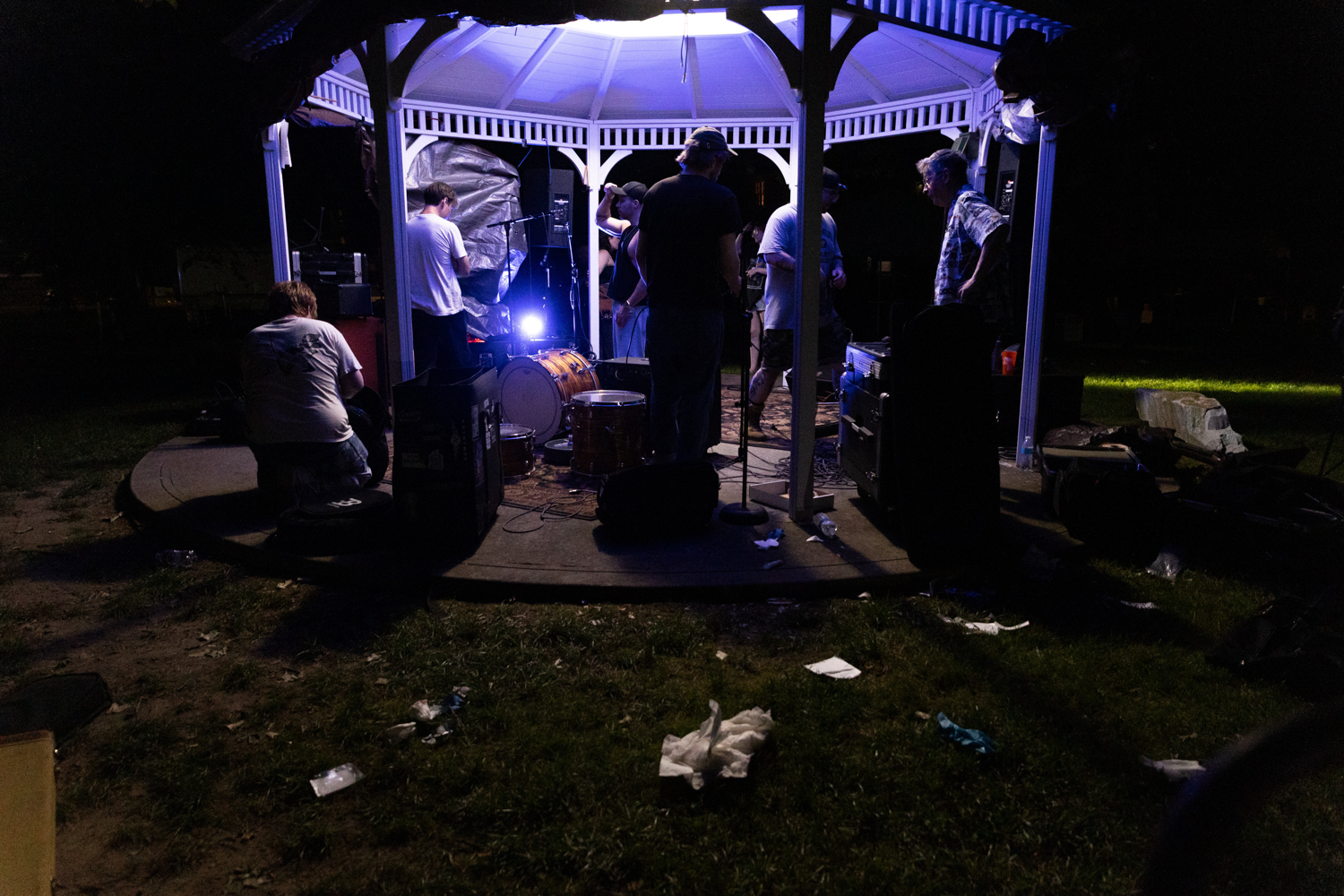
Daniel Price, the drummer for the band Goalpost, tears down his gear after the shooting. The band was in the middle of a set when the shooting started, and had to wait until police were done with the crime scene to collect their gear. (TFP photo by Stephen Zenner)
Later, Price learned his sister-in-law was shot.
“This sucks. Worst Fest of all-time. Zero out of ten,” Price lamented, trying to lighten the mood a bit with a half-joking, half-sincere tone.
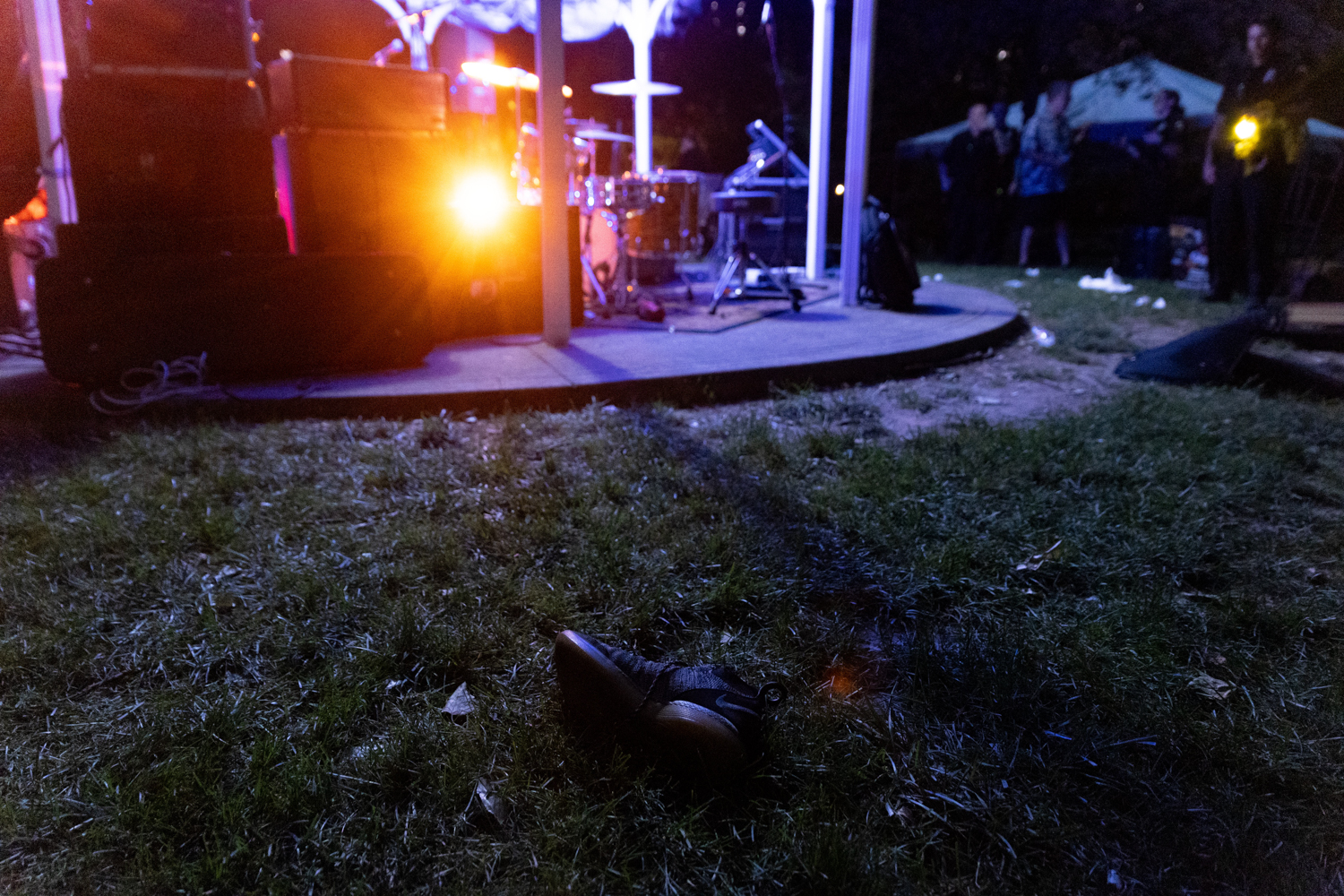
Goalpost’s full audio setup and the band’s instruments were all abandoned when the shooting started. Fearing thieves in the night, the audio engineers and the band came back to pick up the equipment around 9:45 p.m. after the police conducted their search and forensics in the area.
Band members tore down their routine setup to the backdrop of items strewn across the Arboretum.
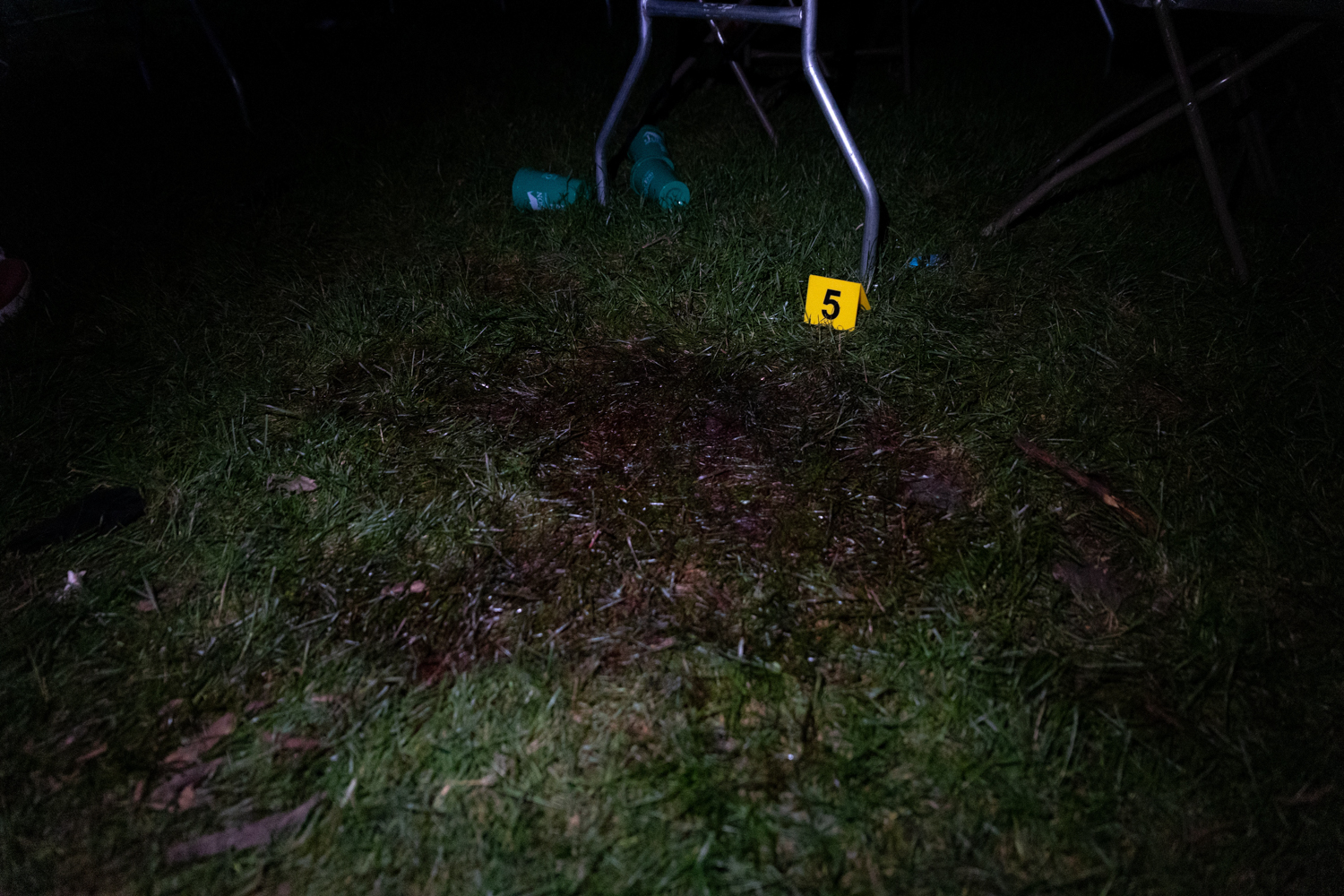
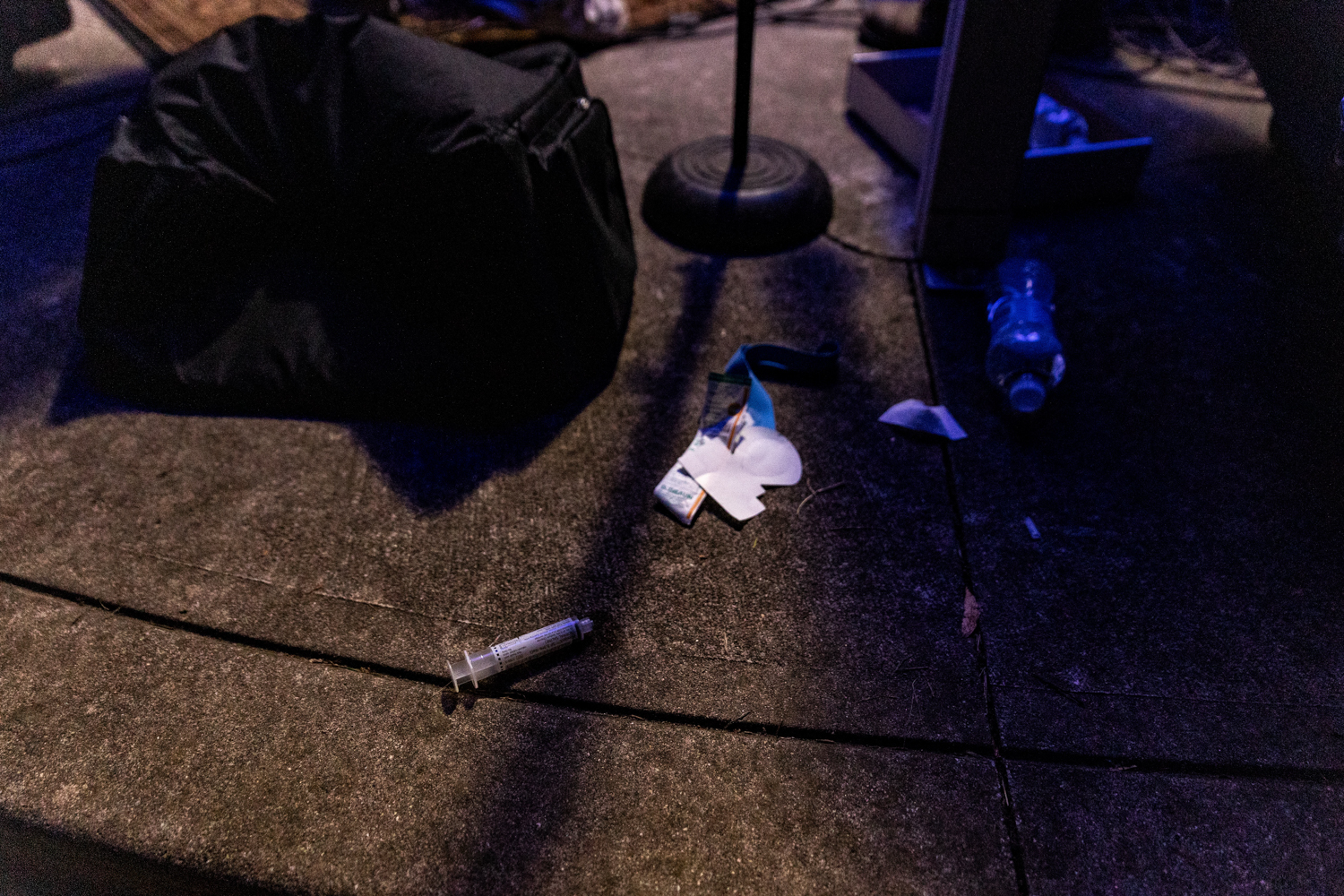
Bloody bandages, medical tourniquets and saline solution syringes were left behind along with a pool of blood, marked with number five, in the beer garden, where officers said one woman was found.
Together the band talked over what had happened, and kept an upbeat demeanor as they moved their items away from their unfinished set. Three of the four band members said they lived in the neighborhood.
A pool of blood left after the shooting. Police officers at the arboretum said a woman was helped from this location in the Beer Garden. (TFP photo by Stephen Zenner)
Ongoing investigation
“It’s really early in the investigation,” Gerken said, and assured the public that the police were talking with victims, witnesses and reviewing camera footage.
Multiple city officials, including District 1 Toledo City Councilman John Hobbs III, asked the public to assist the police in apprehending the suspects in any way possible.
Even so, Heffernan said, “There is a lot of evidence; it’s just a matter of going through a lot of that evidence.”
Trying to get a handle on the image of Toledo Hobbs pushed back against the darkness of the day.
“What happened today is not a reflection of what our city is and what we stand for,” Hobbs said.
A cigarette, tourniquet and some bloody bandages found on the ground after the shooting. (TFP photo by Stephen Zenner)
Canceled festival
Sunday events of the festival are canceled due to the shooting.
The public relations chair for the Old West End Association, Dan Finkel, made the announcement to the Toledo Free Press around 10:30 p.m. on Saturday, and sent this message:
“Too often we turn on the news and learn of a celebration somewhere that turns into a tragedy. Now, that news comes from our own neighborhood. We are heartbroken about those that were injured at the Old West End Festival. Many people want to know how we proceed from such a dark place.
“After discussion with festival organizers, law enforcement and the City of Toledo, we feel that it would not be compassionate, responsible or possible to continue festival; therefore, all festival events for Sunday, June 7 are cancelled.”
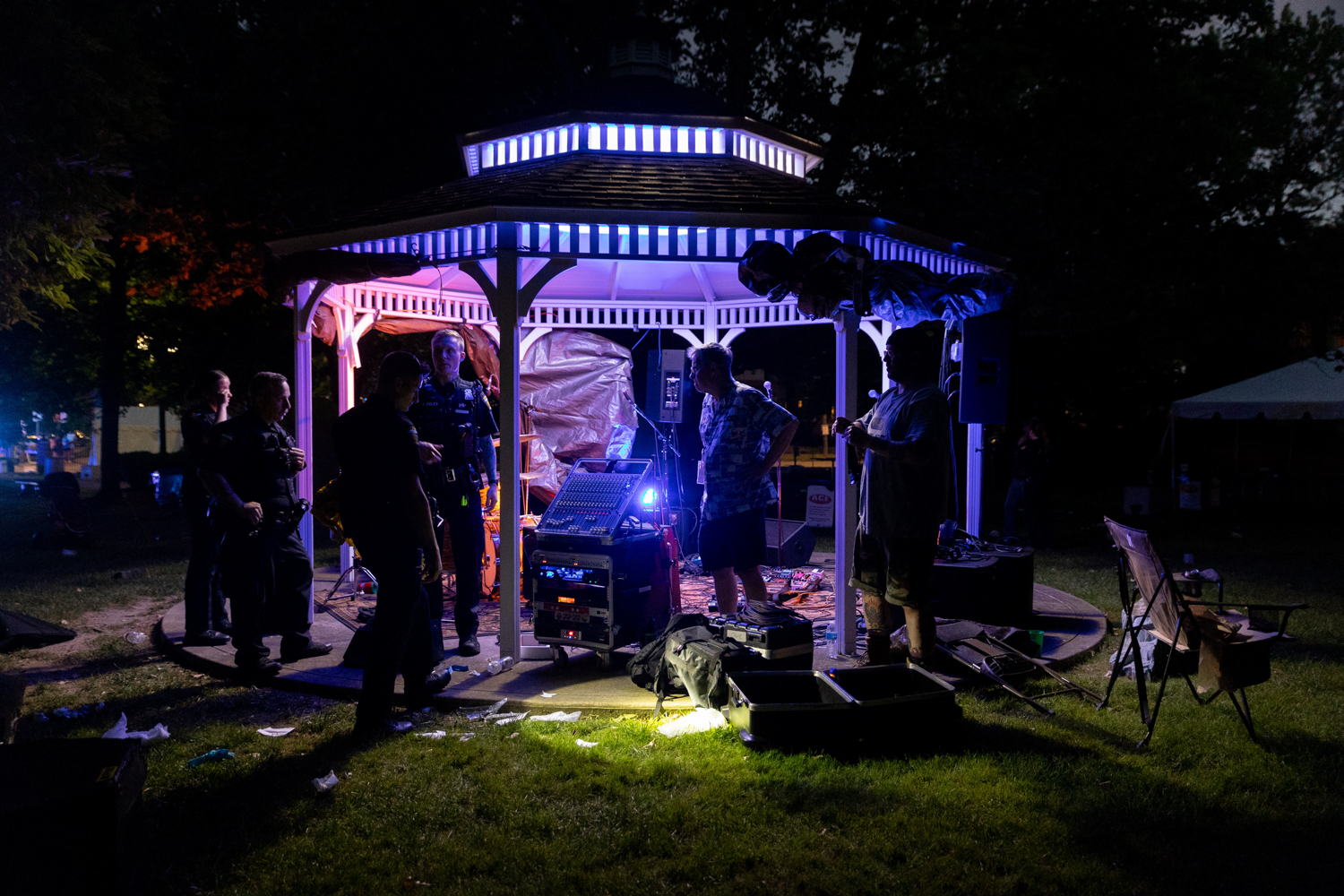
People cross Delaware Ave. by a Toledo Police Department car with lights on at the at the intersection of Delaware Avenue and Robinwood Avenue post shooting. (TFP photo by Stephen Zenner)Toledo Police officers stand in the gazebo with Old West End Festival sound engineers at the Agnes Reynolds Jackson Arboretum. (TFP photo by Stephen Zenner)Matthew Cashin, lead singer of the band Goalpost, packs up musical gear after the shooting at the arboretum. (TFP photo by Stephen Zenner)A full set of music gear and this shoe were left in the chaos after the shooting. (TFP photo by Stephen Zenner)The band Goalpost retrieves their gear along with festival sound engineers after the shooting. The band and engineers had to wait until the first responders did their work before they could retrieve their things around 9:45 to 10 p.m. (TFP photo by Stephen Zenner)People cross Delaware Avenue by a Toledo Police Department car with flashing lights at the intersection of Delaware Avenue and Robinwood Avenue near where the shooting occurred on Saturday night. (TFP photo by Stephen Zenner)Matthew Cashin, lead singer of the band Goalpost, packs up musical gear after a shooting at the Agnes Reynolds Jackson Arboretum in the Old West End. Goalpost was halfway through their set when the shooting happened. (TFP photo by Stephen Zenner)Emergency medical supplies dotted the Agnes Reynolds Jackson Arboretum after the shooting. (TFP photo by Stephen Zenner)Toledo Police Department car with lights at the intersection of Delaware and Robinwood Avenues after the shooting. (TFP photo by Stephen Zenner)
Carryout is Hasan Dudar’s debut book. (TFP photo by Allyson Ritchey)
PERRYSBURG – The bell above the door of a Toledo carryout rings out dozens of times a day. Factory workers on break, neighbors stopping for scratch-offs, traveling salesmen with a pitch…anyone might walk in. For Hasan Dudar, who grew up behind the counter of one, that doorway became the entrance to his debut book.
Published on May 5 by the University of Iowa Press, Carryout is a linked collection of 15 short stories following the Idilbis, a family of Palestinian and Lebanese refugees who open a corner store across from a General Motors plant in Toledo. It’s a space where the city’s Arab community and its working class share the same narrow aisles. Spanning from the late 1970s into the mid-2010s, the book tracks three generations through financial precarity, post-9/11 suspicion and the quiet heartbreaks of navigating two worlds.
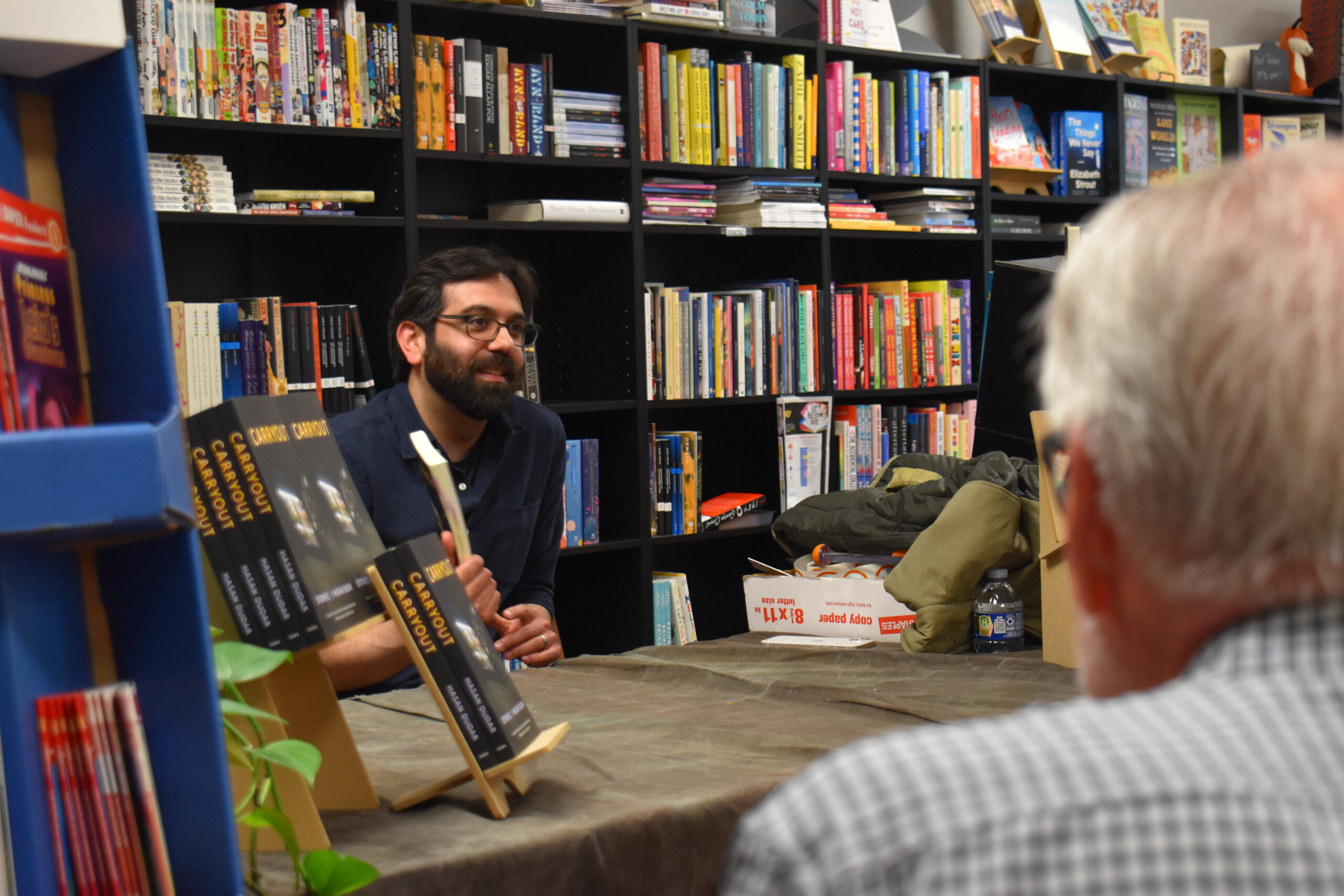
Dudar speaks about his book at Gathering Volumes. (TFP photo by Allyson Ritchey)
Dudar, who now lives in Washington, D.C., returned to northwest Ohio on May 17 for a reading at Gathering Volumes in Perrysburg. A packed room of former teachers, childhood friends, and community members gathered to hear him read from the collection for the first time in his hometown.
“We had a carryout in Toledo,” Dudar told the crowd. “It was a source of a lot of stress for my family, always trying to make the place work. But as a kid, it was also home.”
The store anchors the collection, serving as the place where neighbors linger for hours over lottery numbers, where a traveling salesman arrives in different cars and where the rhythms of the neighborhood play out shift by shift, day by day. Dudar read excerpts highlighting the everyday absurdity of the carryout counter. He started with “Love Rose,” introducing Ra’ed, a traveling salesman who shows up–once in a hearse–trying to peddle flowers to a skeptical store owner. When he moved to “The Super Lotto,” detailing a mysterious family friend who unplugs the lottery machine mid-transaction just to escape an indecisive customer, it drew knowing laughs from the crowd.
But that humor sits inside something heavier. These characters left everything behind to build something new, never quite sure if the foundation would hold.
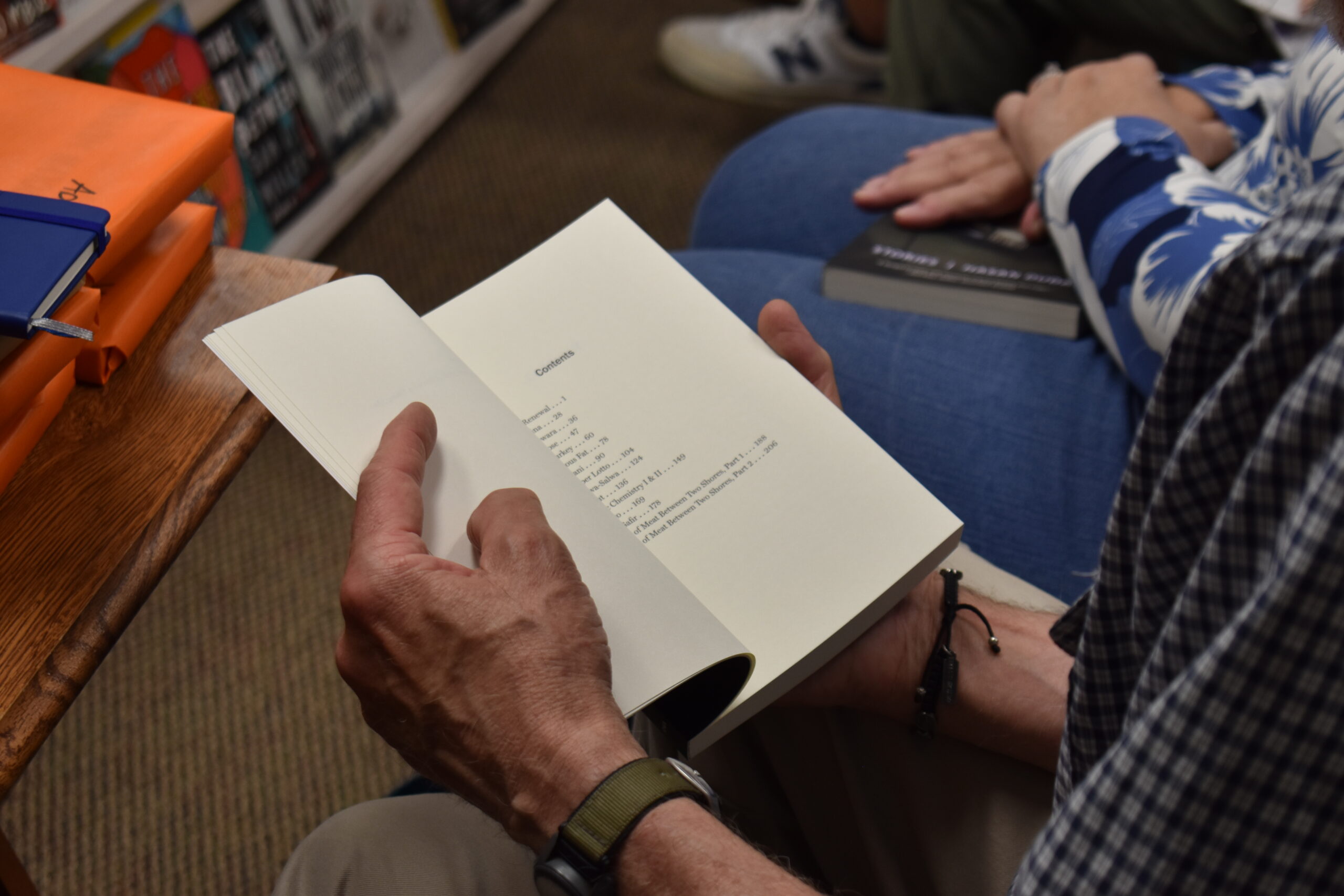
An attendee takes a glimpse at Carryout’s table of contents of 15 linked short stories. (TFP photo by Allyson Ritchey)
Before turning to fiction, Dudar spent most of his career in journalism –reporting for the Toledo Blade, USA Today, and Detroit Free Press. He also co-produced the 2015 documentary The Last of Little Syria, about Toledo’s historic Arab enclave. He sees a strong throughline between reporting and fiction writing, noting that both demand a focus on the subject rather than the author.
“Journalism forces you… It’s not about you,” he said. “The character kind of decides, and you have to take a back seat.” He added that reporting got him out of his own world in ways that directly fed the book, noting that in both fields, “you can’t really insert yourself.”
Carryout took roughly 12 years to piece together. Dudar wrote in stolen moments, typing on his phone’s notes app, waking up early and drafting between reporting assignments. He didn’t write chronologically; stories emerged months or even years apart. It was only when he assembled them into a single document that the overarching narrative took shape.
“When I started putting them into a manuscript and it starts adding up, it kind of started to feel a bit novel-like,” he said.
Gathering Volumes is a locally owned, independent bookstore in Perrysburg. (TFP photo by Allyson Ritchey)
A full-length novel might be his next project, but Dudar admits he’s pacing himself after the long process of finishing his debut. Ultimately, two major life events pushed him across the finish line.
The first was becoming a father. “No time is promised,” he said. “That pushed me big time.”
The second was the loss of his mother in 2023. While she knew he was working on a book, she passed away just months before his first story from the collection was published in the Gulf Coast journal. She never got to see it in print.
The Toledo in Carryout is specific, complete with references to Hinkle’s Donuts, Alexis Road and the shadow of the GM plant. Dudar said he kept the real place names because they carried weight he didn’t want to lose.
“Those names are emotionally loaded for me,” he said. “I needed them to feel my way on the page.”
As for what he wants his hometown readers to glean from the collection, Dudar prefers to leave that up to them.
“Whatever they bring to it on the page, whatever they take away from it – that’s theirs,” he said. “I can’t say I have any takeaways for them.”
The political storm in Ohio about reducing – or even abolishing – property taxes is not going to subside. Why would it? It is a real response to a real and growing problem. Property taxes are not just unpopular; they are politically corrosive.
Property taxes erode trust in our civic institutions, but they also damage something deeper: the idea that hard work leads to stability. The prospect of long-term homeownership. The belief that if you play by the rules, pay your mortgage, and stay in your home, the system will leave you alone. Property taxes punish the American Dream. They do not ask whether a family’s income went up. They do not ask whether a widow on a fixed income suddenly has more cash in her checking account. They do not ask whether an Ohio farmer, retiree, young family, or small business owner actually used more government services this year than last.
So the abolition crowd has some strong points. But let’s also be candid about a property-tax-free state. Cue the broken record: we can’t wave a wand, end property tax, and leave every township, school district, county, fire department, and sheriff’s office whole. That is not sound policy. That’s a bumper sticker. Still, defending a corrosive system simply because “it’s the way things have always been done” isn’t serious either. Ohioans demand relief. And the state needs a replacement strategy.
Think of it this way: our tax system right now is like an investor who put everything into one stock and now refuses to rebalance the portfolio, even as the risk becomes obvious. That’s not strategy. That’s denial. A smarter system would reduce exposure to property-based revenue, provide relief to homeowners, leverage existing income and sales tax without increase, and expand use-based funding.
Not a magic wand. Not a silver bullet. Not one giant tax swap – and certainly not a massive income tax hike or 20 percent sales tax that hammers families at the self-check-out. Ohio needs diversification, and we need a complete system reset in how we think about taxation overall.
Right now the State’s taxation model is simple, and flawed.
It goes like this: you own something; therefore you owe.
I propose that a modern system should look like this: you use the system; therefore you contribute. This is fairer, and far more transparent. It aligns with the way the real economy works.
A modern tax structure should shift the burden away from passive ownership and towards actual activity: transactions, filings, licenses, registrations, commercial use, high-volume institutional users, and those who utilize public systems to move money, enforce contracts, transfer property, finance vehicles, record liens, and access official records.
In plain English: we need to stop putting hardship on homeowners just because their names are on a deed. We can give homeowners relief by funding systems through those who actually use the machinery of government. This is not about growing government revenue – it is about shifting the burden off of homeowners and onto high-volume users of the system.
And here is the part that state policymakers are missing: Ohio already has the infrastructure to do this. And it sits in every county Clerk of Courts office.
As Ottawa County’s Clerk of Courts, I see it every day. Our office processes the quiet machinery of commerce: titles, cases, liens, judgments, garnishments, foreclosures, certifications, and the records that make private transactions enforceable and legally real. This is not hypothetical – it is constant, high-volume activity. It is commerce moving through public channels. That system has value and should be priced accordingly.
Title offices are the clearest example. Ohio already charges title-related fees by statute. Many counties list title fees, duplicate title fees, lien notations fees, salvage title fees, title search fees, and late filing fees in their public fee schedules. But those schedules were built for another time. They do not reflect the scale, speed or level of commercial utilization we see today.
A smarter, bolder approach is called for. If Ohio policymakers are serious about property tax relief, they need to look where the activity is. The skeleton is already there. Legislators should add muscle to it.
A serious property tax-relief package should include a dedicated, locally-retained title transaction surcharge. Not punitive. Not hidden. A modest, transparent surcharge of $5, $10, or $15 on high volume title transactions, dedicated to local property-tax relief or essential local services.
Then go further.
Create a higher tier fee for high-volume institutional users of the public systems. Public infrastructure supports private activity. Banks rely on enforceable liens. Dealers rely on clean title transfers. Finance companies rely on accurate records. Out-of-state creditors rely on Ohio’s court system to collect debts. These institutional users need to help sustain the system they rely on, and Ohio should shift the burden from passive ownership to active system usage.
This approach ensures balance, maintaining affordability for everyday transactions while aligning costs with volume, complexity and demand.
Ohio should also modernize lien fees. Notation, release, e-liens, bulk lender submissions, correction filings, expedited service – these are natural fee-for-service revenue points tied directly to activity.
The same logic applies to out-of-state title conversions. When a vehicle enters Ohio’s system, a modest intake or conversion fee – especially for higher risk titles – is reasonable. Title washing and title fraud are not imaginary problems. If a transaction requires more scrutiny, it should carry more of the administrative cost.
The same logic tracks with expedited services. Government should not nickel-and-dime people for ordinary service. Standard service stays affordable. Premium speed pays for itself. Optional pricing based on demand is how the private sector works. Government can learn the lesson.
The courts offer another path. Foreclosures. Garnishments. Judgment liens. Collections. These are not one-off citizen interactions. They involve banks, institutional creditors, commercial litigants, and other frequent fliers of the legal system. They represent repeat, high-volume use of public infrastructure.
If courts are used to enforce private financial claims, they draw on taxpayer-funded resources – and that should be priced accordingly.
Scaled filing fees. Targeted surcharges on foreclosure and collection actions. Higher-tiers for high volume users. Not to hinder commerce, but to allocate costs more effectively.
A one-time filer should not be treated the same as a high-volume institutional filer. Fee structures should reflect that reality through targeted, transparent surcharges tied to use.
Ohio should examine vehicle registrations. Existing permissive license fees already provide a foundation. A modern approach could expand locally retained, usage-based registration fees: modest for passenger vehicles, higher for fleets and high-impact users.
Greater use, greater contribution.
That is not radical.
That is arithmetic.
Consider the data economy. Yes, public records are public, but bulk commercial data extraction is different. If a company is mining public record at scale as a business model, a user fee can help fund maintenance, security, and modernization – without limiting individual access.
Now, critics will say: “Fees are regressive.” Sometimes they are. That is why structure matters. A serious framework should protect ordinary citizens and focus on institutional, high-volume, expedited, complex, or noncompliant activity. Keep ordinary access affordable. Charge more for speed, scale and intensity of use. That’s the difference between indiscriminate fees and a coherent system.
Others will argue that fees alone cannot replace the $24 billion the State currently brings on from property taxes. They’re right – and missing the point.
The goal is not a magical replacement. The goal is to stop overreliance on a broken system. Fees are the missing piece. They capture non-residents. They scale with activity. They reflect actual use. And they can be phased in without economic shock.
The political class loves to talk about reform until reform requires choosing who pays. Well, I say that is the job.
If the choice is between a retiree being taxed out of her home, or a commercial lender paying more to enforce a lien, I know where I stand. If the choice is between a family absorbing another valuation spike, or an out-of-state financial institution paying a surcharge to use Ohio’s courts and records system, I know where I stand. If the choice is between homeowners carrying the burden, or bulk data companies paying for profitable access to public systems, I know where I stand.
Matt Palka is an Otsego graduate, singer, songwriter, author and award-winning filmmaker. (Courtesy photo)
HASKINS – As America prepares to celebrate its 250th anniversary, Haskins, Ohio native Matt Palka – an author, singer, songwriter and award-winning filmmaker – is releasing his ode to America.
Moment in the Sun is an immersive audiobook that captures a life-changing cross-country solo bike ride that brought him closer to the soul of America. During that 2,361 mile trek from Haskins to Lake Tahoe, Palka faced challenges he never thought he would overcome, stripping himself of his ego while meeting ordinary Americans.
“I was a brazen young man who wanted to feel alive – to test himself and be out there, trying to be in touch with my maker,” he said.
Growing up, Palka was the captain of the soccer team at Otsego High School, where he also performed in musicals. So when he headed to Ohio University, he decided to major in theater, but he also picked up his dad’s guitar and began singing and songwriting. Palka fell in love with The Beatles, Bob Dylan, Tom Petty and Van Morrison, whose stream-of-consciousness Astral Weeks expanded his world.
As he was set to graduate from OU in 1999, Palka was dealt a blow: his plans to get an acting internship in Minneapolis evaporated. During a party, a friend suggested he visit her and her boyfriend in Lake Tahoe. He didn’t even know that was in California. When Palka said his car wouldn’t make it, she said, “Ride your bike.”
His parents suggested that he take over their Grand Rapids fudge shop. Instead, Palka paid $100 for a 40-pound steel bike, and spent a few weeks biking from Haskins to Grand Rapids and running five miles a day.
“I was not in shape for the trip. And my bike was so heavy I couldn’t lift it up,” he said, noting that his bike was 150 pounds with gear, including pots, pans, cans of beans and a guitar so he could busk for funds when his $600 ran out. His goal was to refill his water jug in each town.
“I thought I’d make it through Indiana that first day. I only made it to Kalida, pushing my bike into town with heat exhaustion,” he said.
As he was headed into a restaurant/truck stop in Kalida, Palka met a cyclist who was headed to Boston from San Francisco.
“He bought me a Gatorade and told me his story. That gave me enough encouragement that I knew I could make it,” Palka said.
He laughs about the many other cyclists he met along the way, who rode lighter bikes and headed east to take advantage of the tailwinds.
“Someone told me I had the most loaded bike he’d ever seen. I was going 11 mph into the wind,” Palka said.
Some days he rode 40 miles, other days 80 to 100, stopping along the way in towns to listen to stories from local residents or others who were passing through.
Plenty of times he thought he wouldn’t make it, like when he was riding on the highest roadway in America – 20 miles of 7,500- to 12,000-foot elevation in Rocky Mountain National Park. Along that route, a 40 mph wind could knock a cyclist off a sheer dropoff on either side of the road. He had motorists throw glass bottles at him; spent an evening with witches; faced off with a bull in Nevada; and played chicken with a car on an empty highway in the desert.
In his 2012 book, Moment in the Sun, Palka shared his experiences on the road through the character Riley Holiday – who is also the protagonist in upcoming books.
This audiobook version of Moment in the Sun is fully immersive, using Dolby Atmos – technology that adds dimension to sound, creating a 3D soundscape rather than just surround sound.
Moment in the Sun is a new audiobook and album by Haskins native Matt Palka. (Courtesy photo)
“In the 11 hours of this audiobook, you’re on the handlebars. You can hear the gears shifting, the wind blowing, the cars blowing by. You can put my headphones on and hear the music and, at night, you can almost hear the stars shooting by as you look at the Milky Way,” Palka said. “Think of it as a Netflix series without the picture. You can imagine being in Ohio in July with the locusts, the tree frogs and the hooting of owls.”
Dean Hovey, an award-winning supervising sound editor, mixer, designer and composer, went to great lengths for accurate sounds, even taking that original steel bike to an abandoned airfield to record the actual bicycle used on the trip. The audiobook soundtrack features 39 songs that Palka wrote and recorded using real musicians, sometimes incorporating full string and horn arrangements. No AI was used in any portion of the project.
“Think of this as an Netflix series or 11-hour movie without the picture. In talks with Dolby Atmos, they believe this is the first first-person narrative where it’s fully immersive,” said Palka.
“It’s a transformative world. Maybe you’re not brave enough to go out there. Maybe you’re not physically capable. This gets people as close as they can get to being on the bike and sharing my powerful journey and experience.”
The Moment in the Sun audiobook releases on June 25, but Palka also has an album with 11 original songs coming out June 19. Palka discusses the audiobook and music further on Americana Bohemia, a podcast that explores the adventurous and creative spirit thriving in America’s most unexpected places. Listen to it here.
Next up for Palka is book two of his Life of Riley Holiday series, based on the time he spent as a clubhouse manager taking care of 30 professional athletes in the Toledo Mud Hens.
“It’s a fish out of water story – a hippie musician trying to find his voice among the modern gladiator world,” he said of the 40-song soundtrack.
He is working on book three, based on a VW bus tour throughout America, stopping in college towns, doing background acting work for TV and commercials in LA, making his own films and creating soundtracks for himself and other artists.
And it all started with that decision to get on his bike and ride.
“I was so lucky to take a chance. Whatever you want to do, you can do it,” he said.
The wedding band, featuring Seth Aaron Johnson, Brian Matson, and Jacob Smith, pose with the cast during a group number. (Courtesy photo by Nicole Tuttle-Robb)
TOLEDO – As far as Brian Matson was concerned, he hit the theatrical jackpot when he found out he had earned the role of Robbie in the musical version of The Wedding Singer, the 1998 rom-com movie starring Adam Sandler and Drew Barrymore.
“I was extremely excited,” said Matson, 26. “I thought I had a shot, but I definitely wasn’t sure. People at the auditions were talented, and I was just happy to get invited to the production, no matter what the role was. I was excited to work with this production team and the theater company.”
The cast performs the opening number, “It’s Your Wedding Day.” (Courtesy photo by Nicole Tuttle-Robb)
The movie, set in 1985, follows Robbie Hart, New Jersey’s favorite wedding singer and a rock-star wannabe. Life is good until he’s left at the alter by his fiancee. Heartbroken, Robbie spirals, turning every wedding gig into a hilarious disaster.
Enter Julia, who works as a waitress where Robbie performs. She begins to restore his faith in love, but there’s one problem: she’s engaged to a slick Wall Street shark. Now, Robbie must pull off the performance of a lifetime to win the girl of his dreams before it’s too late.
The Wedding Singer: The Musical Comedy will be performed June 12-21 at The Village Players Theatre located at 2740 Upton Ave. in Toledo. Shows will be held Thursdays, Fridays and Saturdays at 7 p.m. and Sunday at 2 p.m.
The production promises to bring “big hair, bigger laughs and non-stop 1980s nostalgia to the stage.”
A Wedding Singer musical was performed on Broadway, for 284 performances and 30 previews, from late April through Dec. 31 2006.
Riley Runnells is the choreographer for The Wedding Singer: The Musical Comedy. The Sylvania Northview and 2022 Ohio University graduate started acting at age 4 and got her first gig as a choreographer in 2024 for the musical Seussical, based on the Dr. Seuss books.
“I’ve always loved theater and dance,” Runnells said. “I was on the dance team at Ohio University, and when I came back here, I had a friend who asked if if wanted to choreograph Seussical. The Wedding Singer will be my 15th show as a choreographer.”
The show’s villain Glenn Gulia, played by Zack Robb, leads the cast in his song, “All About the Green.” (Courtesy photo by Nicole Tuttle-Robb)
Runnells said director Nicole Tuttle-Robb assembled a team for the musical last summer and rehearsals began in late March.
“This show is really involved and has lots of moving parts, and there’s lots of fun stuff going on,” Runnells said. “It has lots of ‘80s influence. The musical is a fun production, and everyone has worked hard to bring this show to life.”
Runnells said the musical has 20 songs, 12 of which are choreographed.
“The movie has a similar plot, but the musical has its own songs written for it,” she said. “Some songs overlap, like ‘Somebody Kill Me,’ but the composer put together a full soundtrack of songs for these characters based on the story. The script is really well written.”
Tuttle-Robb, 30, said The Wedding Singer is her favorite Adam Sandler movie. She added that the production team -which includes Runnells – music director Kelly Frailly, stage managers JenniferDorrell and Eddie Bozanich, and intimacy director Jai Long, has assembled a cast whose talent is “mind-blowing.”
The initial cast read-through for the musical was April 1.
“I was so nervous we weren’t going to get enough people,” Tuttle-Robb said. “The theater community in Toledo is so rich with theaters and companies in the area; we needed 19 people to make this show work. It turned out there was no reason for me to be nervous.
“They are wonderful collaborators. This cast…I could go on and on, and they are truly the best cast I have ever worked with. Our team is creating it all from scratch – designs for lighting, sets, props, everything.”
Matson, who played baritone in the University of Toledo marching band, said he performed theater back in high school before taking a break.
“I got back into theater beginning in 2024,” he said. “I had done it through 2018 and stopped for about six years and then got back into the local theater scene. I definitely missed it a lot.”
Matson was asked how he wanted to portray Sandler’s character, Robbie, in the local musical version.
“I wanted to take some inspiration from the original source material, Adam Sandler,” he said. “I grew up watching a handful of his movies. That was one of the things that made me interested in the first place. I wanted to have the typical Sandler energy but bring a nice groundedness to it.
“There are a lot more scenes that are like genuine moments between Robbie and Julia. I play a little acoustic guitar, so I’m excited to bring it into the show. We are playing some acoustic guitar to flush out the character and make it my own.”
Matson said he knew of Cassidy Anderson, who plays Julia, but has never worked with her.
“I knew she was in a show at a theater company I worked with last year,” Matson said. “We get along really well at rehearsals – good vibes and good energy.”
Tuttle-Robb said this specific production “is going to be really unique,” in part because of the smaller [165-seat], intimate Village Players Theatre.
“We don’t have a large space,” she said. “Back stage is pretty tiny. We decided we were going to make this campy and lean into the comedy of this. We’re doing things that are born out of necessity, but they are fun, interesting ways to do things that other theaters may not have tried.
“We’re hosting an ‘80s costume contest encouraging the audience to come to the show in a costume to win a prize,” Tuttle-Robb added. “The audience can expect an ‘80s flashback, where we tried to capture a lot of nostalgia from the 1980s.”
For tickets to The Wedding Singer: The Musical Comedy call 419-472-6817. Tickets are also sold at the door, but the Theatre cannot guarantee seats will be available.
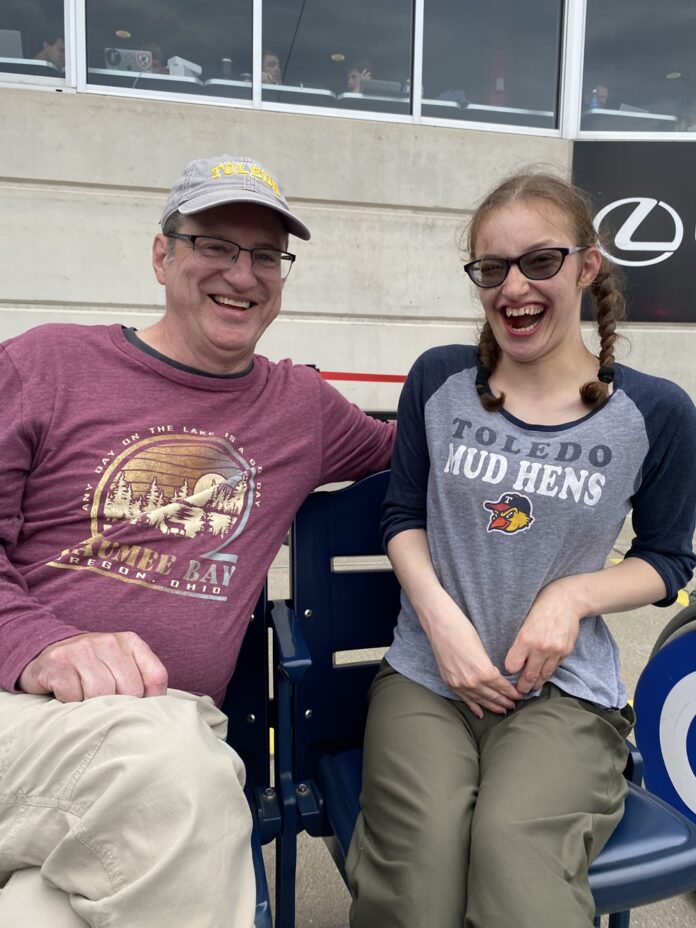
Phil and Lily at a Mud Hens game. (Courtesy photo)
MAUMEE – Phil Skeldon was living a dream – a bad dream.
A man who would spend most of his 35 years at St. John’s Jesuit High School working as the school’s Christian service director, Skeldon lost his wife, Gretchen, to breast cancer in 2010 at age 47. She had been diagnosed at age 32.
Well before she passed, Gretchen and Phil welcomed the birth of their only child, a daughter they named Lily.
“We didn’t think we could get pregnant because my wife had been through so much chemo,” Skeldon said.
Lily was 5 years old when her mother died.
Everything seemed fine with Lily at birth.
“She was basically born normal,” Skeldon said. “It wasn’t until at six or seven months that she started to have these infantile spasms. They are very subtle, and she contracts like she’s almost bowing. That turned into a seizure disorder, which she’s had her whole life.
“In terms of symptoms, if you saw her you would say she has muscular dystrophy. She has struggles walking and is cognitively delayed. She is vocal, but non-verbal.”
Lily was fully diagnosed with tubulinopathy at age 15.
Tubulinopathy is a spectrum of genetic neurological disorders caused by mutations in the genes that encode tubulin, the building blocks of microtubules. These structural proteins are critical for brain development.
“Most people who have her syndrome…it didn’t come from my side of the family or her mom’s side,” Skeldon said. “It happens at conception.”
Phil Skeldon and his daugher, Lily, at the Southview prom in 2022. (Courtesy photo)
Needless to say, working a full-time job and caring for a child with a disability eventually became overwhelming for Skeldon, who is now 63 and retired.
“My wife had sisters and a brother,” he said. “I had 11 siblings and [Gretchen] had many cousins and many friends. There was no problem taking care of Lily.
“After about six years of raising her by myself and working full time, I just couldn’t do it anymore.”
Skeldon’s job at St. John’s Jesuit required him to “place students out into the community, including Sunshine, for community service.”
Sunshine Communities, a Maumee-based nonprofit supporting people with developmental disabilities in northwest Ohio, was founded in 1950. Sunshine focuses on “creating opportunities for connection, independence and community for individuals with developmental disabilities.”
Skeldon said, “I sent [SJJ] students there for years, not knowing I would ever need Sunshine.”
He said work “became my refuge” after years of caring for Lily, who would typically have seizures nearly every night.
“I had to have a video and audio monitor at my bedside,” Skeldon said.
He reached out for help from Sunshine Communities, which contacted him when Lily was 11. Skeldon now says Sunshine has been “a godsend.”
On April 27, a documentary called All Access with Andy Garciafeatured Sunshine Communities. The eight–minute documentary was hosted by actor Andy Garcia and will air nationally across major cable news networks including CNN, Fox News, CNBC and more.
All Access highlights innovation, leadership and social change and includes perspectives from organizational leadership on the developmental disabilities sector as a whole and how Sunshine continues to meet the evolving needs of the community.
Phil and Lily, now 22, are featured in the documentary along with Michael Ann Feldkircher, who has lived at Sunshine since childhood. The video focuses on her growth, independence and participation in Sunshine Studios.
Kayden appeared in the All Access documentary about Sunshine Communities. (Courtesy photo)
The role of philanthropy
Shannon Bova has worked for Sunshine for nearly a decade, including the last five years as chief philanthropy officer. She said the All Access production team reached out to Sunshine for a potential feature.
“They found out about our services and wanted to highlight the health and human service field,” said Bova, who is interviewed in the All Access segment. “They came across our information and reached out to us to see if we wanted to share our mission and the work we do.
“We were humbled by the opportunity. It was a really neat opportunity to be seen nationally across the country.”
In addition to staff, Sunshine had 2,500 volunteers as of 2025, according to Bova.
Sunshine’s base facility, which has a capacity to house 59 people, is located in Maumee. Sunshine also has 10 group homes in the northwest Ohio community.
Lily now lives in of those group homes.
“That’s her home,” Skeldon said. “Initially, her first year she spent at the base facility; then they moved her into a group home. I really like the group homes. Early on she did not like it when I left, but now it’s become her home.”
Interacting with the community
Ann Michael was another Sunshine participant in the documentary. (Courtesy photo)
Bova said her team at Sunshine interacts with the community in many ways, such as volunteering engagements with donors, special events, and the media.
“We haven’t been able to do this for 77 years without the support of our community, whether through volunteer hours, connection visits, helping with our grounds, and weekend or friendship visits,” Bova said. “We raise between $1 million and $2 million every year for very important needs here that we don’t receive through the government funding through Medicare.
“We are 99 percent Medicare funded, and our donors help fill in that gap.”
Being around other people
In the All Access video, Skeldon points out that most children with disabilities want to be around other people.
“They want to experience life,” he said. “Sunshine allows that for me and my daughter to happen. I would say to other parents, don’t cut your child short. Know that they want to be like their typical peers and they want to engage in life. That’s what I’ve done for my daughter with Sunshine.
“I am a better dad because of Sunshine and the life they have given my daughter.”
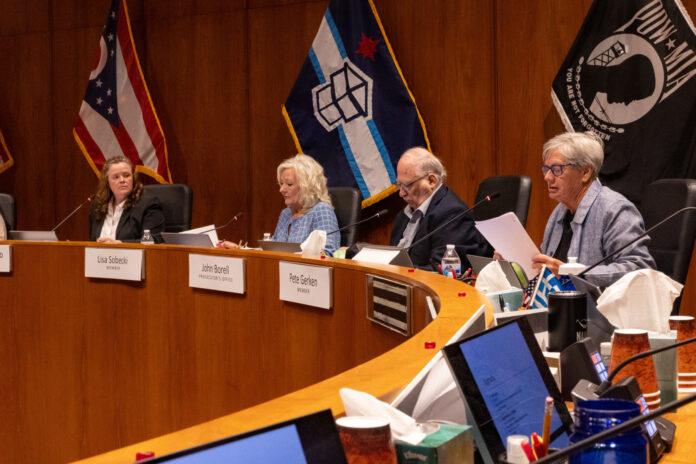
Pete Gerken, Lucas County Commissioner, unveils an amendment to Resolution 2026 - 001 after a failed attempt to table the resolution during the quarterly Lucas County Investment Advisory Committee Meeting in Toledo City Council Chambers on Friday, May 22. Gerken felt the resolution was redundant, and the language employed in the resolution might undo the previous recommendation back in August to divest from Israel bonds. (TFP photo by Stephen Zenner)
TOLEDO – Pressure continued to mount on Lucas County Treasurer Lindsay Webb over the roughly $5 million investment the county has in Israel bonds during the county’s latest Investment Advisory Committee (IAC) meeting on Friday, May 22.
Since the IAC meeting on Aug. 22, 2025, during which the IAC gave guidance to Webb to divest from Israel bonds, Pro-Palestine protesters have shown up to make their voices heard.
Protesters demanded Webb invest the 1 percent of county funds – $5 million, invested in Israel – elsewhere, but no action will take place until the bond reaches maturation in Dec. 2026.
Over the past three IAC meetings, Pro-Palestine protesters have clearly made the treasurer and members of the IAC uncomfortable, without significantly delaying the procession of the meetings or inhibiting their functions.
Regardless, a number of county sheriff officers were on hand at the meeting, yet the biggest delays were caused by elected officials, to the chagrin of those who would have expedited the formality of the IAC meeting itself.
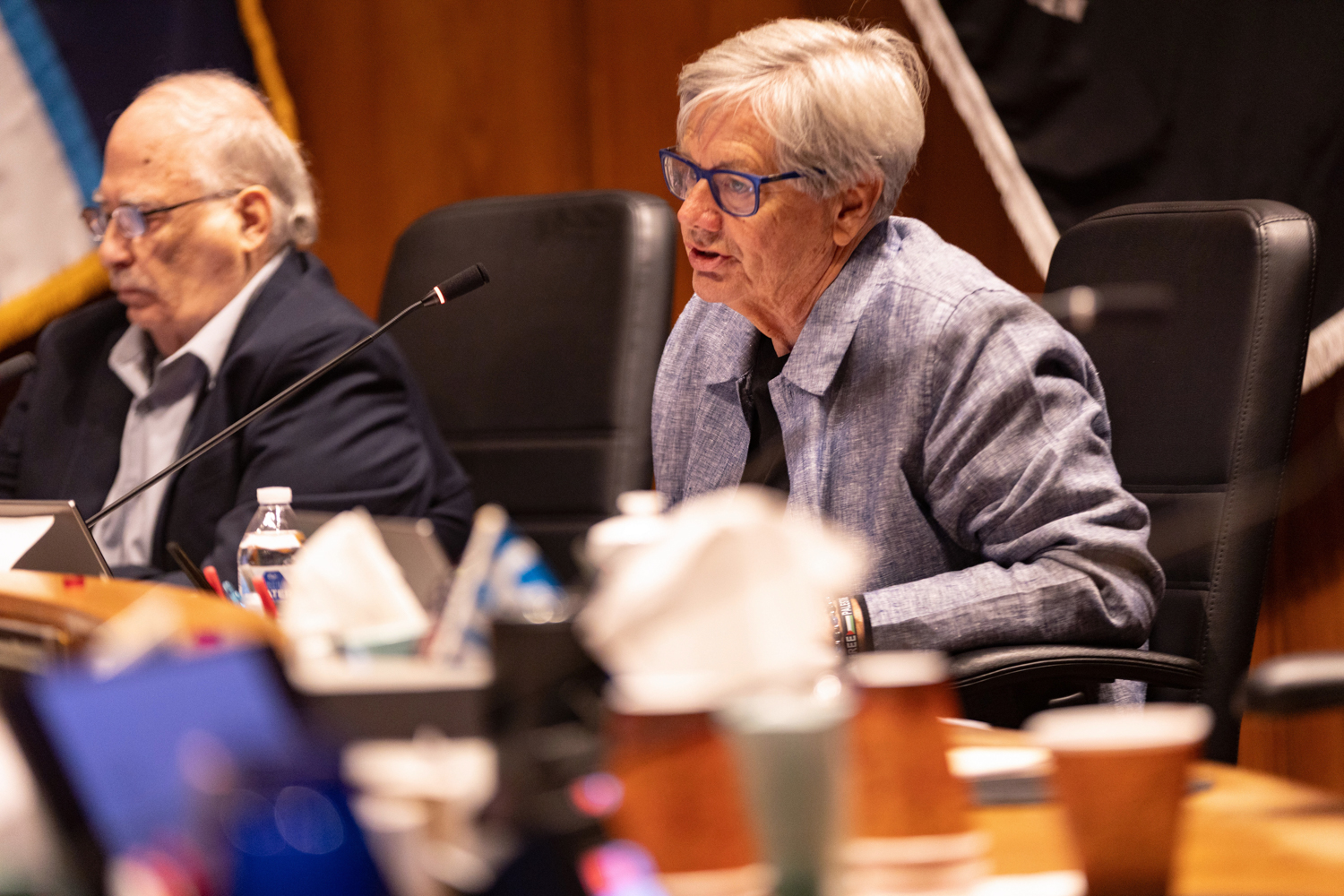
Pete Gerken, Lucas County Commissioner, openly showed support for Palestinians, and wanted the county to divest from Israel bonds. (TFP photo by Stephen Zenner)
DaveYost’s opinion
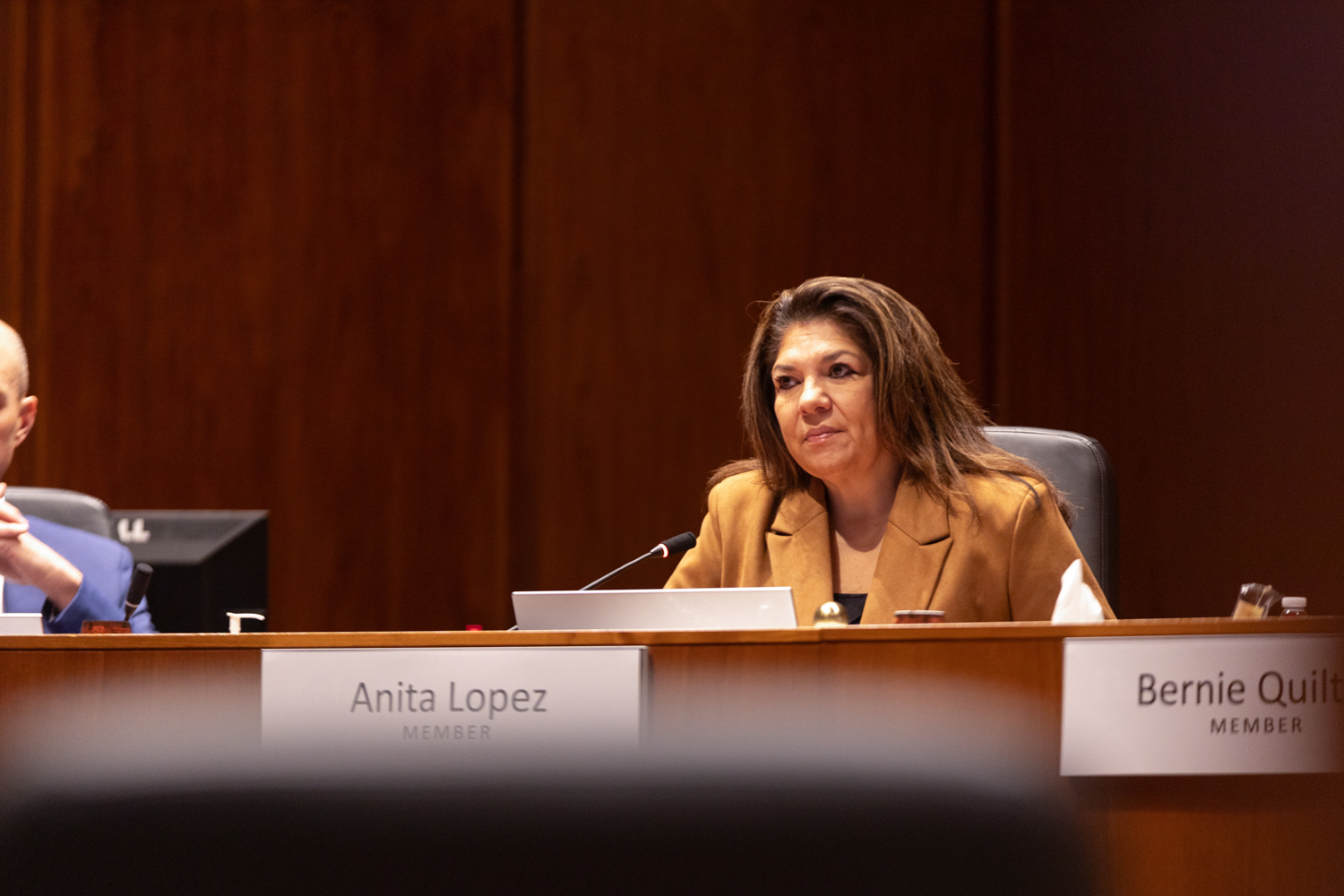
The 11 a.m. meeting dragged on for almost two hours because of an arduous back and forth between Commissioner Pete Gerken, Treasurer Webb and Commissioner Anita Lopez.
Much of the discourse between public officials was dominated by how Ohio Attorney General (AG) Dave Yost’s opinion, given on May 8, should be considered.
Yost’s 14-page opinion was requested to understand more about the legality of divesting from Israel after the IAC advised the treasurer to do so back in August.
Four main points emerged from the AG’s opinion, and foremost is that, “the county cannot make investment decisions ‘with the primary purpose of influencing any environmental, social, personal, or ideological policy.’ R.C. 135.35(O).”
Also highlighted by the AG was that the treasurer and IAC must “‘…ensure the best and safest return of funds.’ R.C. 135.341(C);” with their investments of county money.
Consequently the AG stated that the treasurer or investment power could not be stripped from Webb for her unwillingness to follow “unlawful” or “Ultra Vires” policy.
And finally, Yost cited the anti-boycott law in the Ohio Revised Code (ORC) 9.76, as it pertains to a state agency contracting with a company that actively has a policy of boycotting Israel.
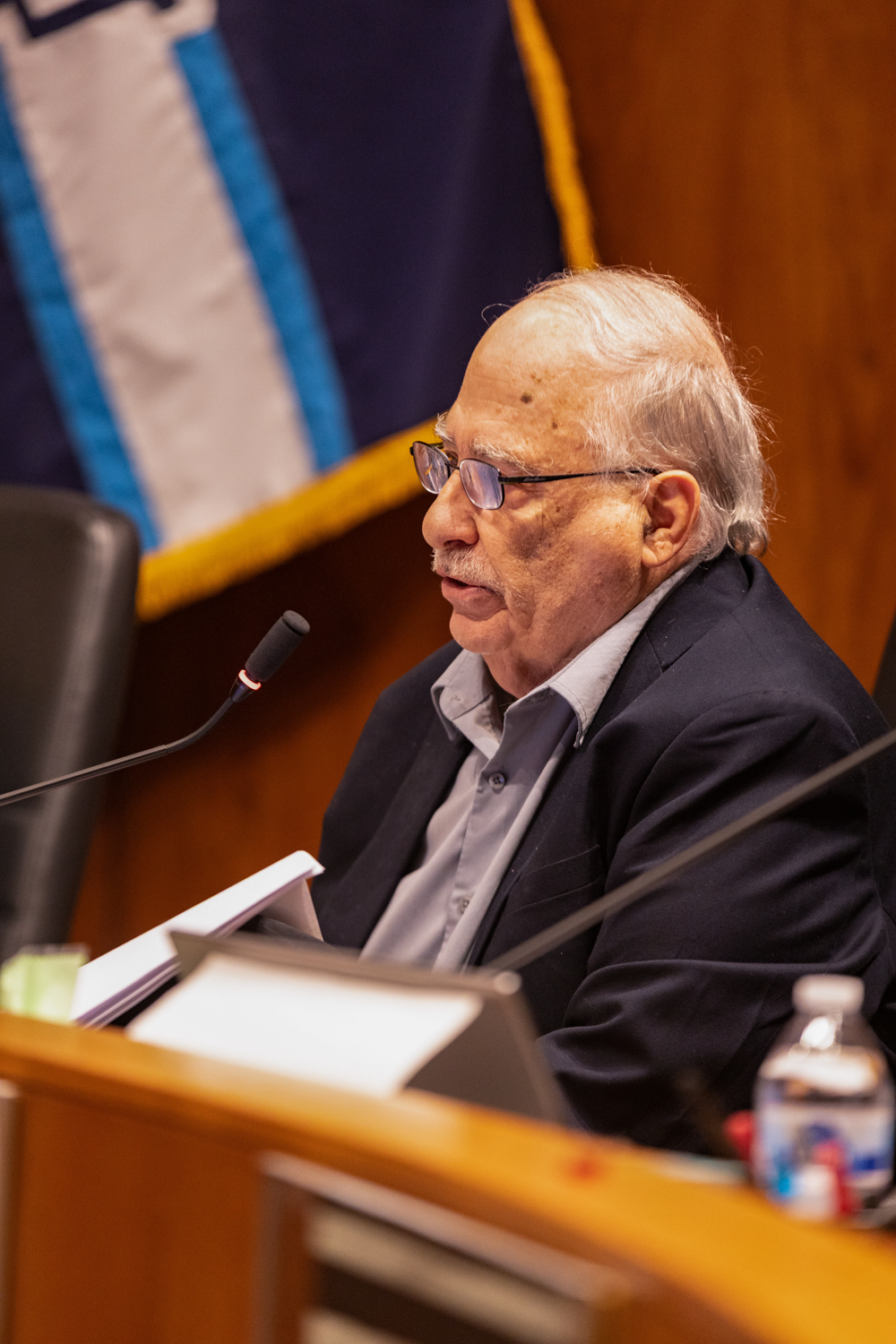
John Borell, assistant prosecutor from the Lucas County Prosecutor’s Office, was consulted multiple times to make sure the IAC did not divert from the Ohio Revised Code. (TFP photo by Stephen Zenner)
Statutes: what do they mean?
Treasurer Webb asked Assistant Prosecutor John Borell of the Lucas County Prosecutor’s Office to interpret Yost’s opinion. Borell replied that “noneconomic” factors could not guide the investment decision.
“Once again, that’s not David Yost’s opinion; he just quoted a statute,” Borell said, and told the IAC that this was part of a long tradition, going back at least four decades, of AG’s upholding this statute about investments.
Nothing explicitly advised the treasurer or committee to invest or not invest in Israel bonds, implying it may be lawful to do either, depending on the circumstances.
Borell explicitly disagreed with Yost on the final point dealing with the boycott, which he called “a red herring” and a “stretch” to claim the county as a “state agency.”
In the context of the county’s ability to invest its funds, Borell said the main guiding principle should be the viability of the financial investment, instead of minding a boycott law. He pointed to “safety, liquidity and yield” as longstanding investment determinants according to Ohio law.
“You don’t focus on what you can’t do; You focus on the three factors that the treasurer must use when determining an investment,” Borell said. “The boycott statute has always been to me a red herring, it’s never been a regulatory issue.”
Public comment
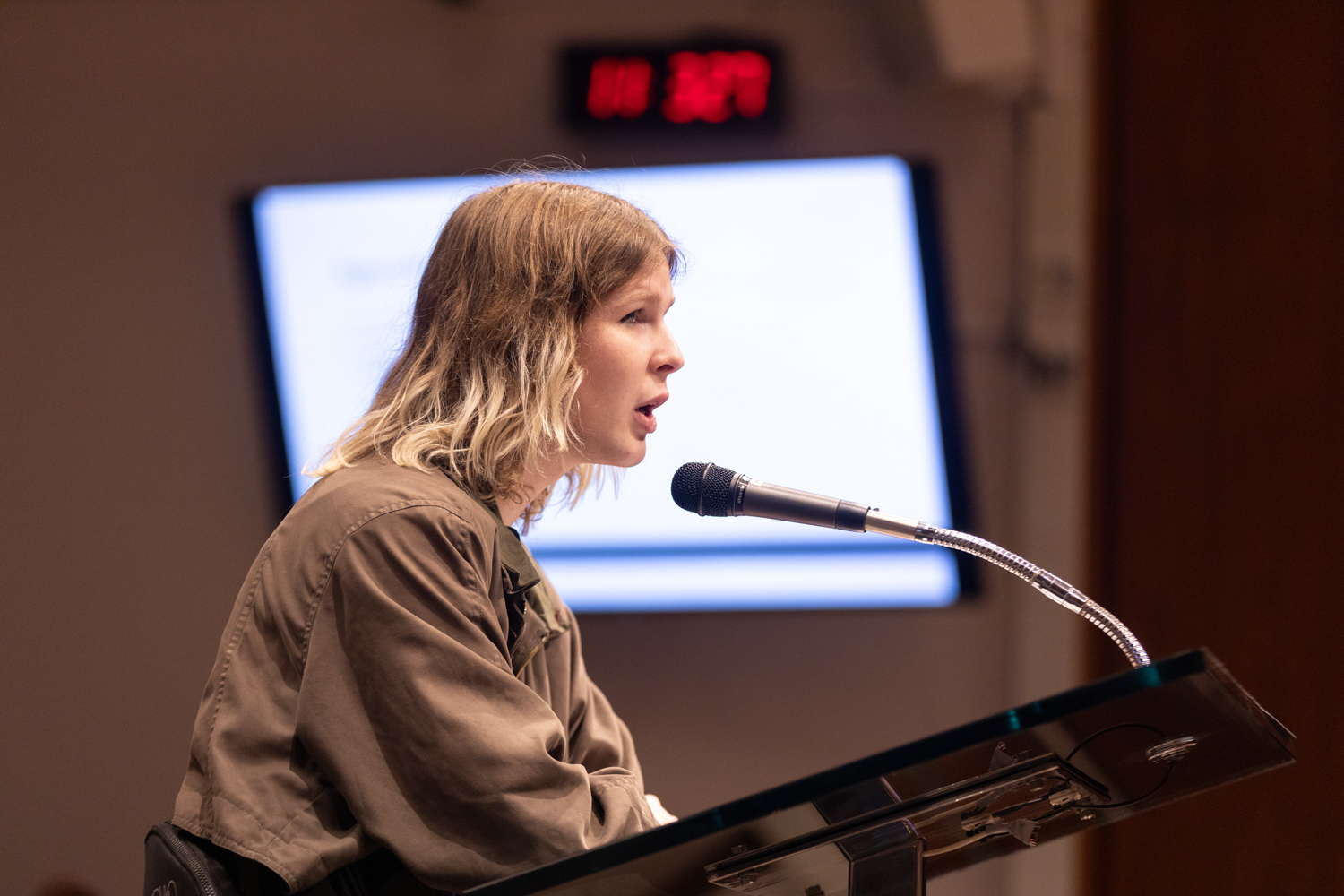
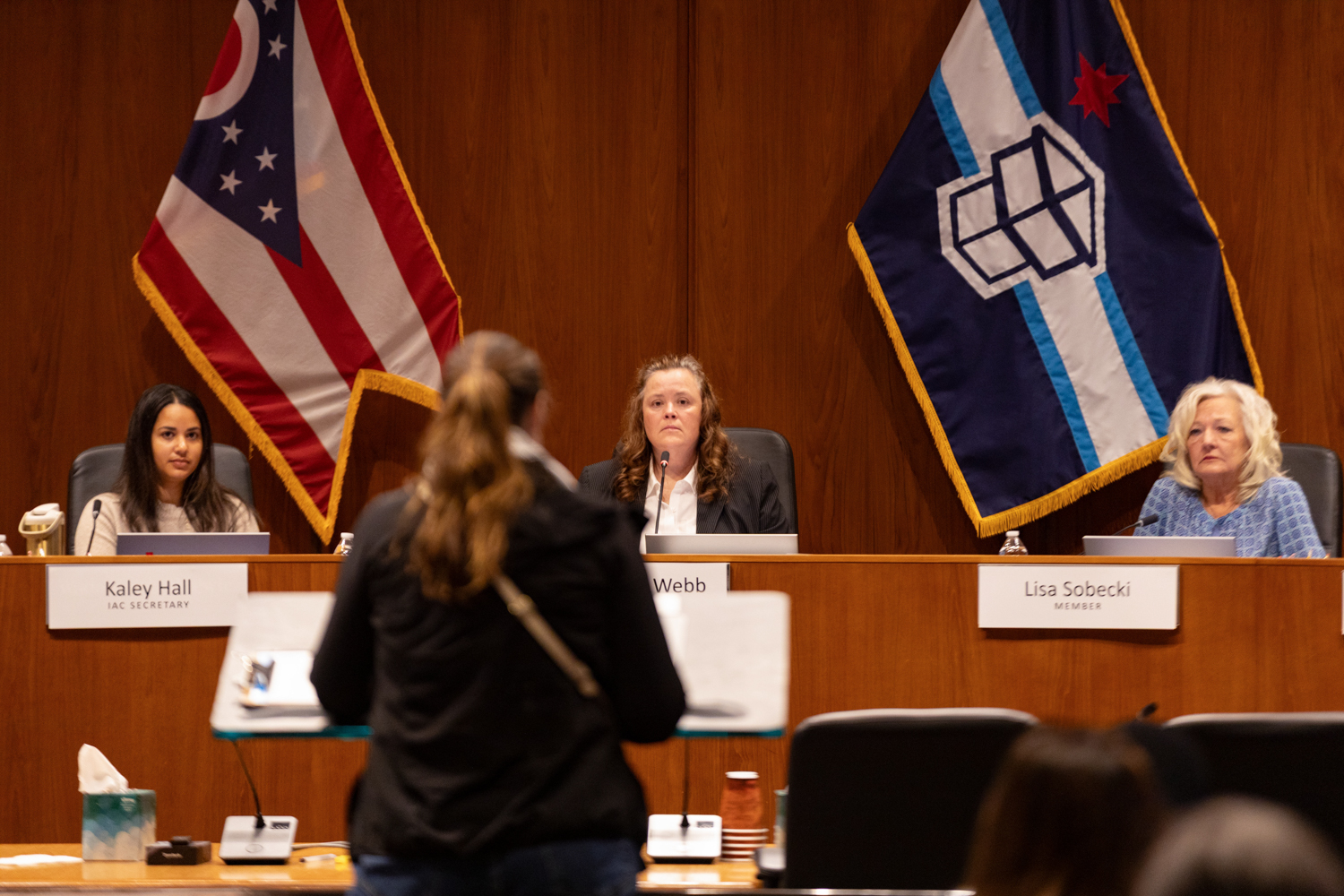
Preceding Borell’s assessment were five speakers from the Pro-Palestine camp, who were chosen at random by Webb and the Secretary of the IAC, Kaley Hall, to speak for three minutes each.
The random choices for comment did not change the viewpoint, because none in attendance were in opposition to the Pro-Palestine stance.
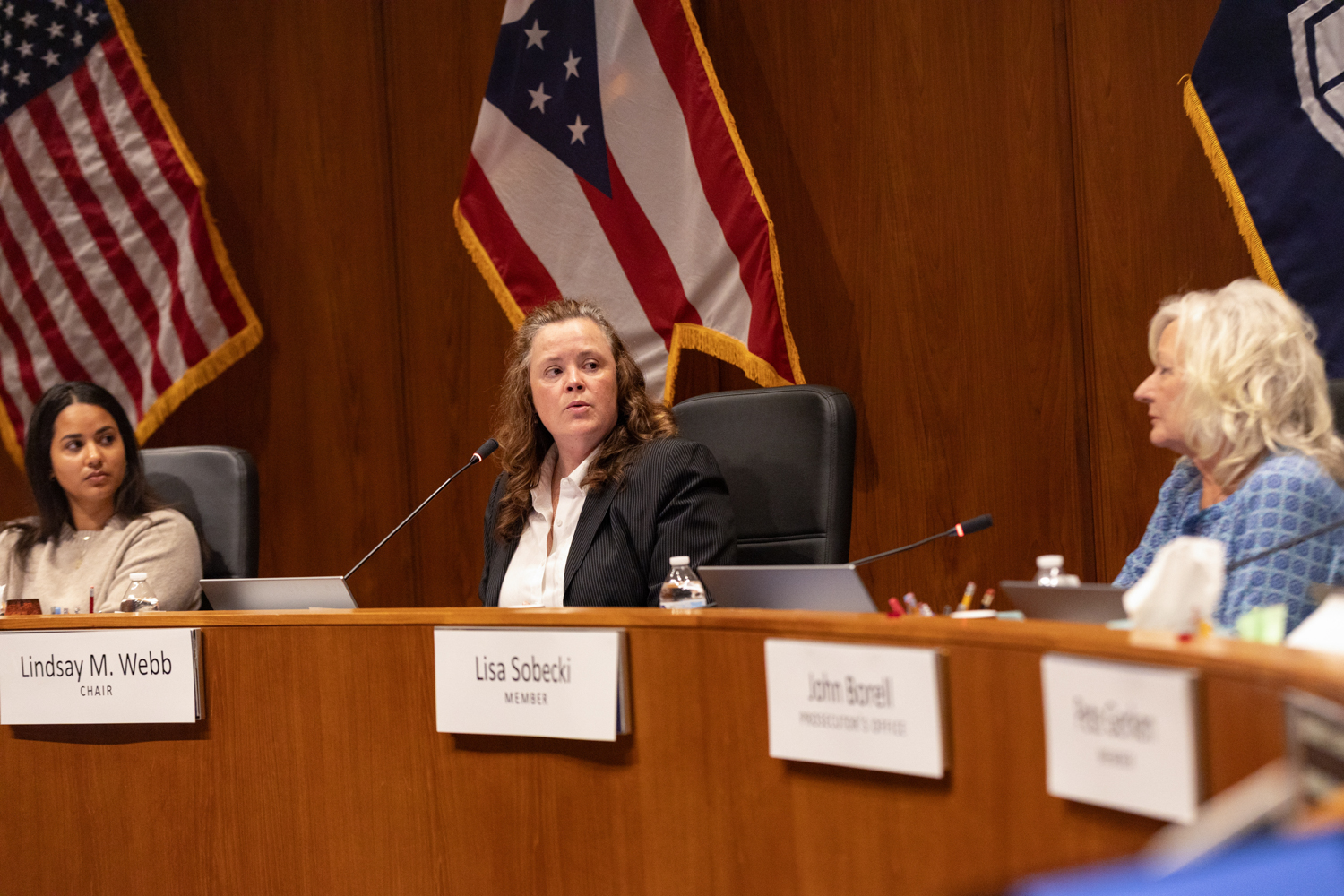
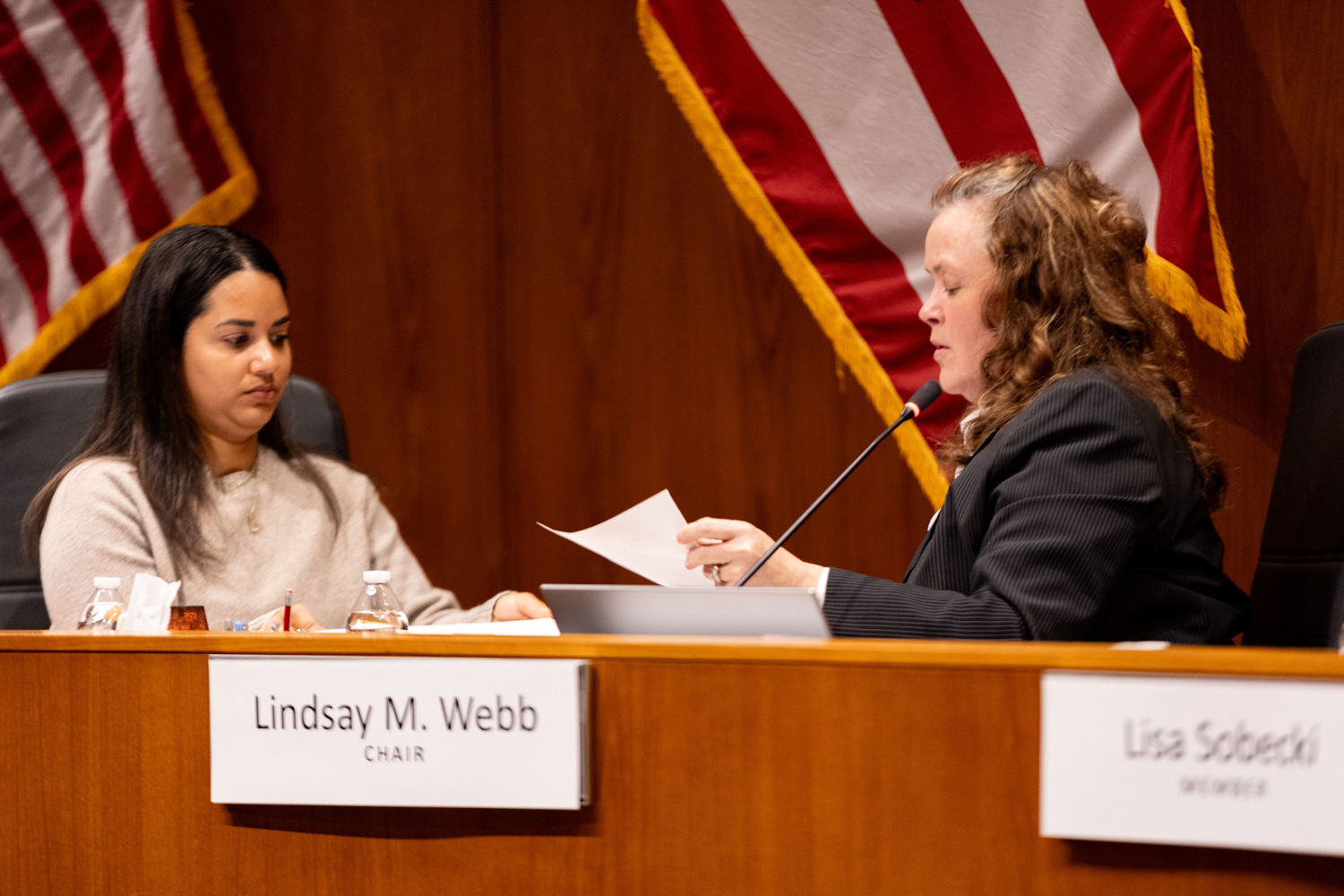
Lindsay Webb, Lucas County Treasurer, speaks to Commissioner Pete Gerken. (TFP photo by Stephen Zenner)
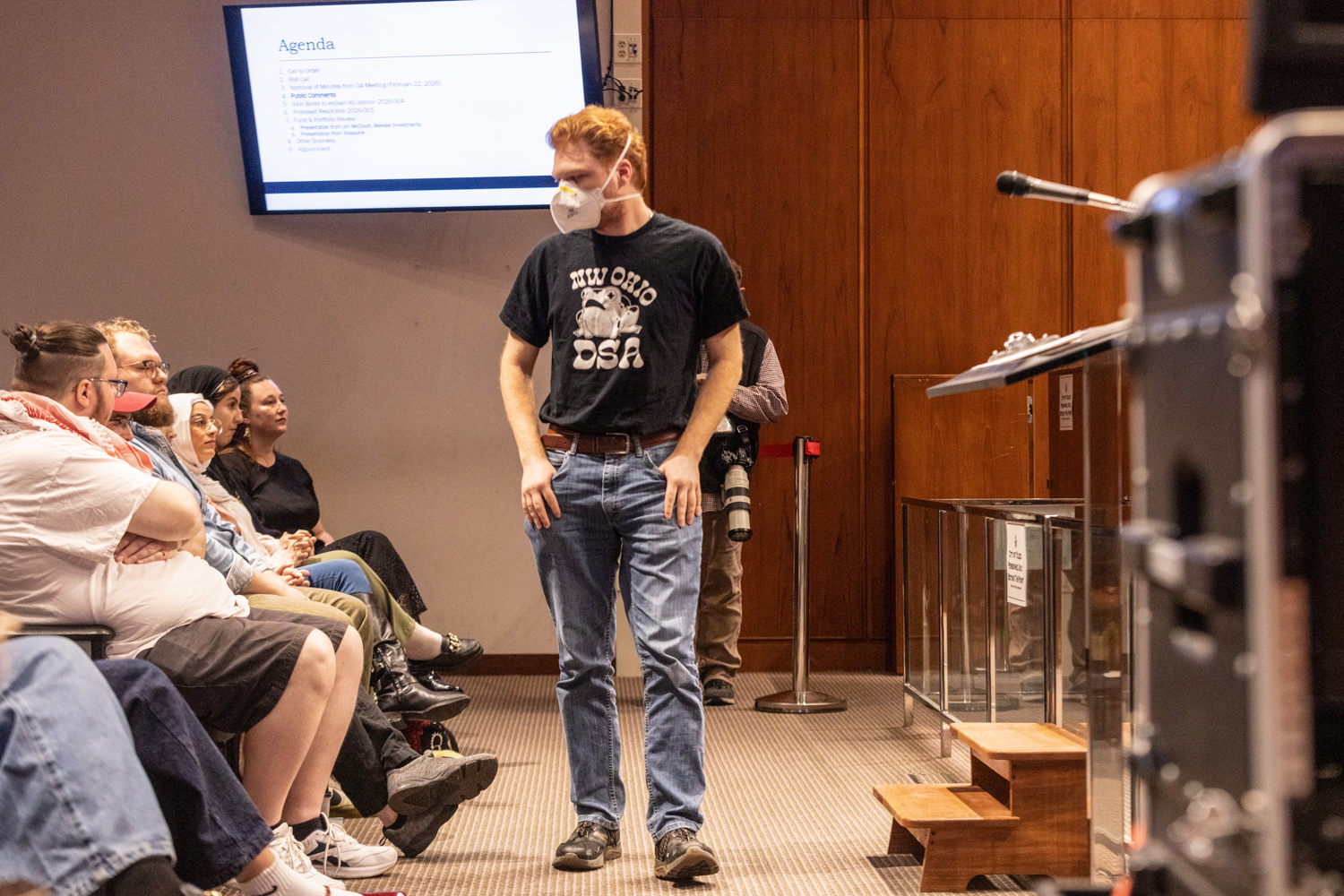
Patrick E. from the Northwest Ohio Democratic Socialists of America gave an incredibly brief comment, and said the county’s funds should be used for the community and not for “bombing civilians.”
Investment in the northwest Ohio community, rather than in a foreign country, seemed to be a strong through-line for all five speakers, including Selah Carter, who spoke about rising affordability costs, job options and homelessness, including their own experience with homelessness.
“Reinvesting $5 million into this foreign entity that is committing genocide and war crimes is not the best nor safest return available to Lucas County, especially in a time where SNAP and WIC benefits and housing resources and vouchers are not supported to the extent that they need to be,” said Nora Riggs.
Selah Carter, a Toledo resident, talked about investing funds into local initiatives rather than investing in Israel bonds. (TFP photo by Stephen Zenner)
A notable climax was reached during public comment with the fourth individual. “My name is Mike Stram. I am a Jewish resident of Toledo who proudly stands with the Palestinian people in their fight against ethnic cleansing and genocide. There is nothing apolitical about forcing the members of this community to pay for the wholesale slaughter of their family members.”
Then Stram talked about how history would look on people who did nothing to stop what is happening in Gaza, and how the decision to invest or not invest in Israel is inescapably political, regardless of the choice.
Stram called into question the financial viability of investing in Israel, and how the instability and war in the country had affected Israel’s economics. Most notably, Moody’s Investor Service downgraded Israel’s credit ranking from an A1 to A2 following Oct. 7, 2023, and Israel’s ranking was “Baa1 with a negative outlook,” in mid 2025.
Israel’s economy has been impacted negatively by the instability in the region, creating a high deficit due to military spending, and has increased volatility in its market, downgrading the credit ranking due to multiple conflicts and uncertainty.
Economists expect Israel to rebound with a 2-4.5 percent GDP growth for the next two years, with the main concern being escalations with the war with Iran destabilizing or destroying Israeli infrastructure.
Patrick E. with Northwest Ohio Democratic Socialists of America walks to podium. He was the first to give public comment during the meeting. (TFP photo by Stephen Zenner)
“Purely by financial standards, reinvestment raises serious concerns,” Stram said, and again appealed to the wider view of history. “History also judges public officials who ignore obvious warning signs and moments of instability, including financial warning signs, such as repeated rating fluctuations and shifting risk assessments that signal underlying uncertainty,” he said.
Finally, Stram pushed against AG Yost’s opinion, calling into question Yost’s morals. Three specific instances were referenced by Stram as to why the public should call his opinion into question:
*When Yost cast doubt on a 10-year-old rape victim whose perpetrator was later caught,
*When Yost tried to dismiss 77 cases of sexual abuse filed against Dr. Richard Strauss in The Ohio State University (OSU) Athletics Department,
*And when Yost attempted to stop a ballot measure to limit qualified immunity.
“No court has issued any order or injunction requiring counties to invest in Israel bonds, and no provision in the Ohio Revised Code obliges Lucas County to do so,” Stram said, ending his comment with a loud “Free Palestine!”
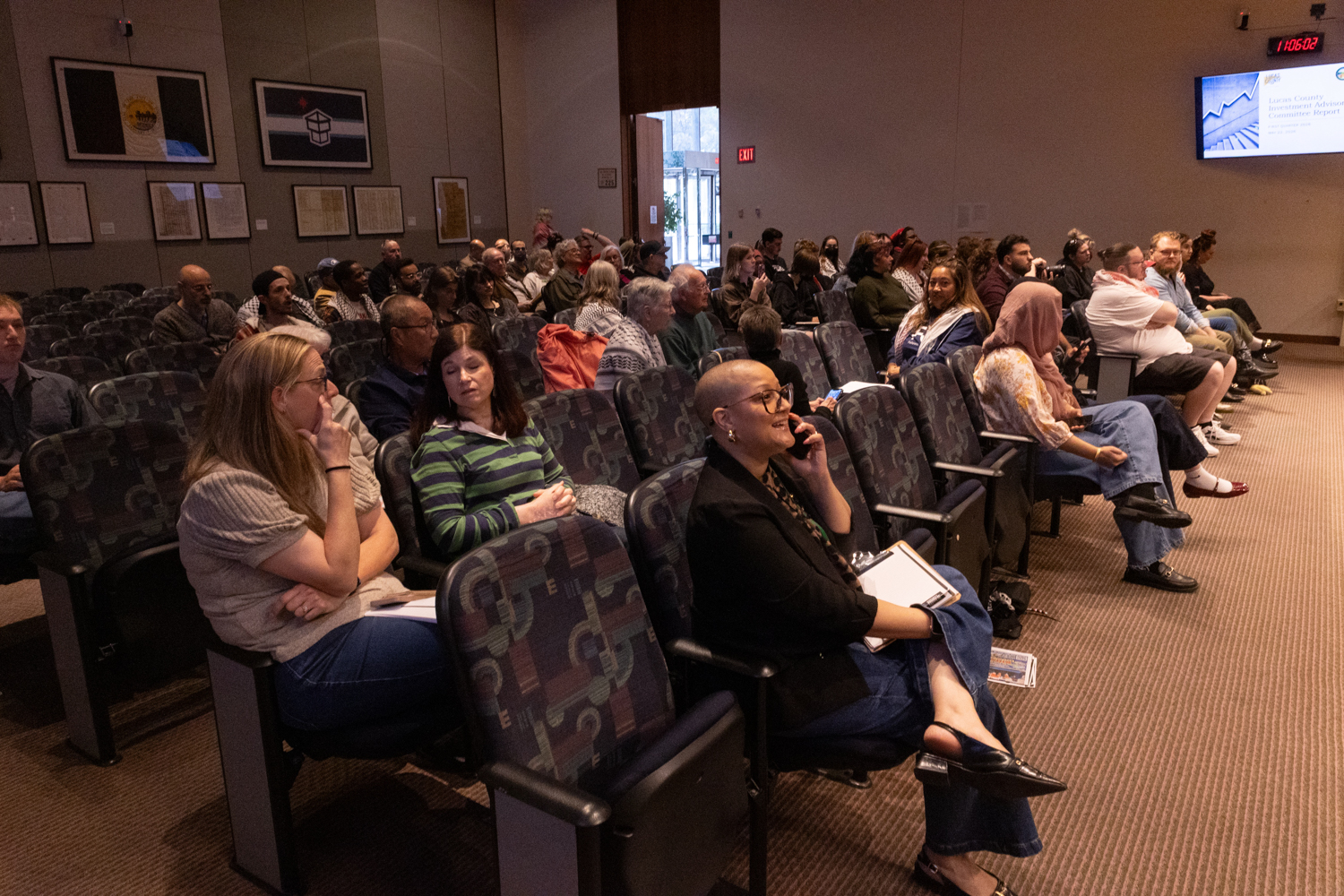
When he went to sit down, Stram was greeted with cheers and a standing ovation from the roughly 75-80 activists in attendance.
Most of the attendees were interested in supporting Palestinians and divesting from Israel bonds. (TFP photo by Stephen Zenner)
While not as passionate of a comment, Brianna F. presented a more detailed plan for local investment as an alternative to investing in a foreign country.
“I propose we place these funds into collateralized certificates of deposits or structured deposit accounts with local banks or credit unions that could then use our capital to support low-interest small business loans right here in Lucas County.
“We could expand the Lucas County Builds program, where these loans are paid back with interest, and the community benefits from more local jobs. We can invest into the state treasury asset reserve to maintain liquidity. This route has the highest possible investment rating, and often can outperform foreign bonds while being completely safe,” she said.
Notable attendees to the meeting included members of the Northwest Ohio Peace Coalition, Veterans for Peace, Democratic Socialists of America (DSA) and American Muslims for Palestine (AMP).
There were no overt supporters of Israel in attendance, like in previous meetings. Their arguments are laid out in previous reporting.
Nora Riggs, a Lucas County resident, addresses Lindsay Webb, Lucas County Treasurer, Kaley Hall, the Investment Advisory Committee (IAC) secretary, and Lisa Sobecki, Lucas County Commissioner and member of the IAC. (TFP photo by Stephen Zenner)
Officials question investments
Commissioner Gerken called into question Yost’s character, with some of the same points Stram made.
“Not investing cannot be considered a boycott,” Gerken said, and questioned the addition of the boycott statute in Yost’s opinion in light of Yost’s past actions. Gerken also rejected the premise that investments are purely fiduciary or purely political, and that the truth lay somewhere in-between.
“It’s ironic…to deny that the statutes on investment, BDS [Boycott, Divestment and Sanctions], socio-economical considerations are born from the fruit of a tree that’s entirely political.”
Webb’s rebuttal cited Yost’s opinion, that guidance from the IAC prohibiting investment in Israel bonds, without economic justification, would resemble a boycott, and could potentially open up the county to legal action.
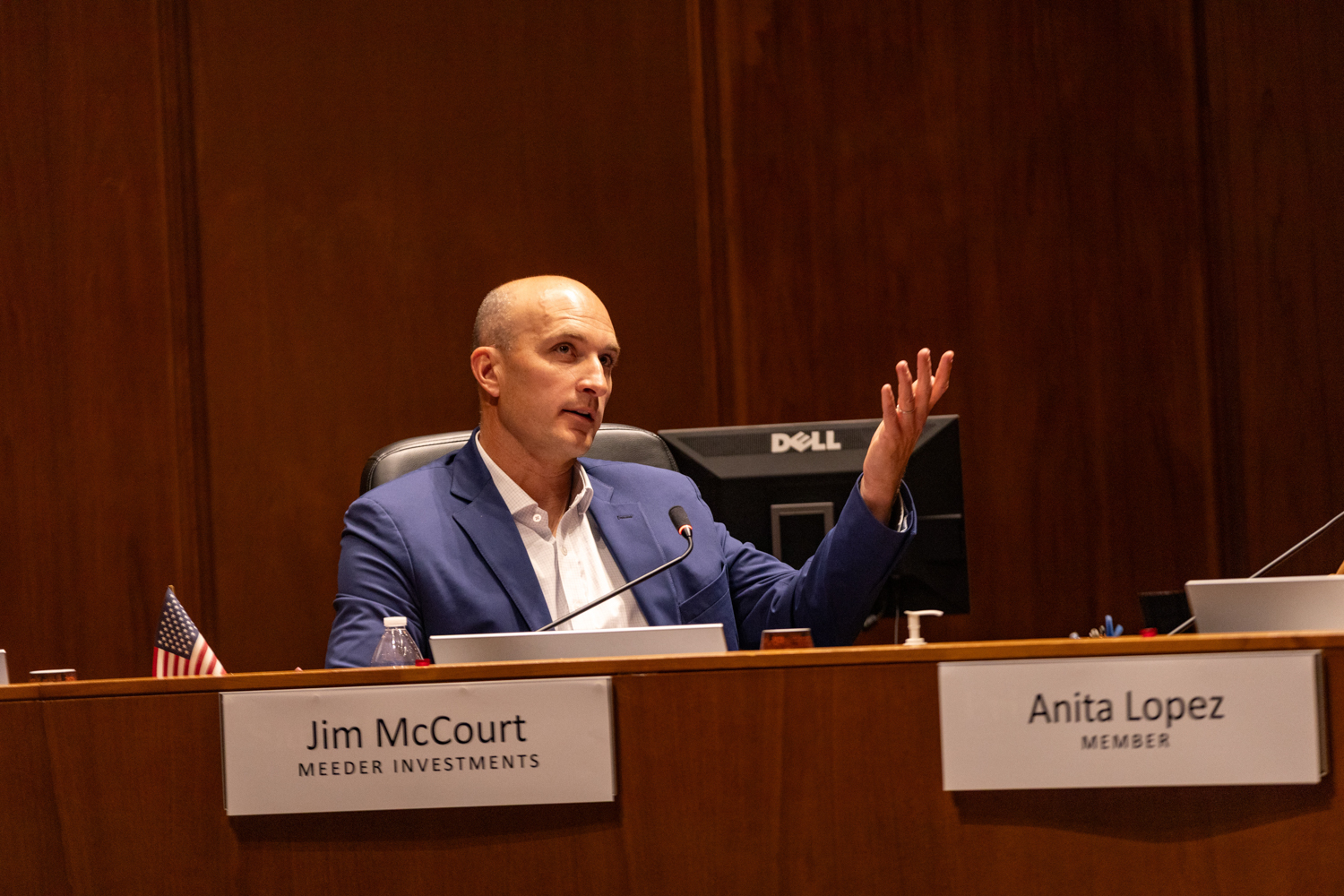
Jim McCourt, the representative from Meeder Investment, spoke on the county’s financial business. (TFP photo by Stephen Zenner)
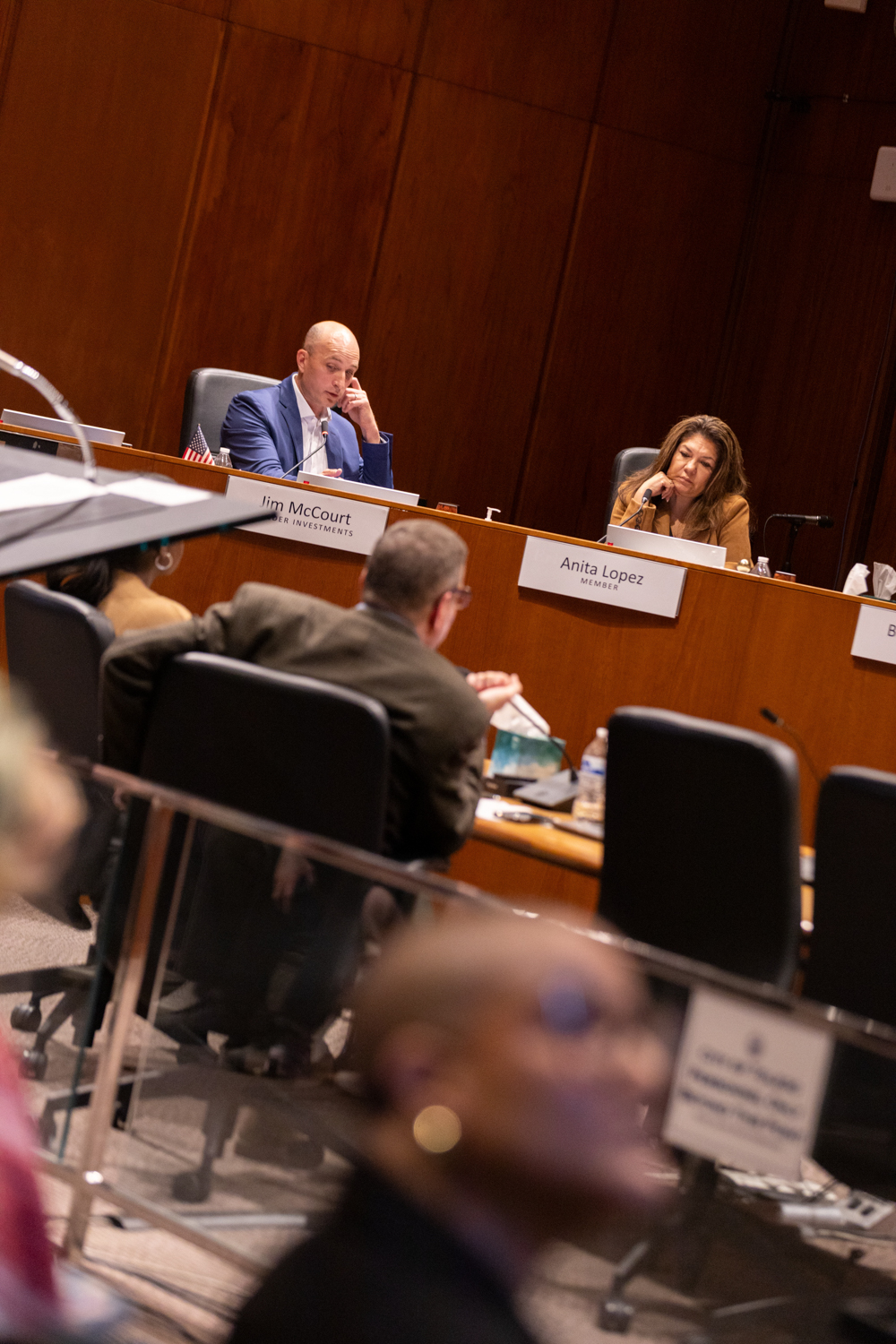
A quick detour by Lopez led her to ask Borell and Jim McCourt, the representative from Meeder Investments, what qualified as “best and safest return of funds,” from ORC 135.341, referenced in Yost’s opinion and resolution Webb would soon bring to a vote.
“Return on your principal is [the] number one [factor], the ability to get repaid by the issuer, McCourt said. “Then safety also refers to market risk or interest rate risk. So when you have investments tied up long term and interest rates move, the market value of your securities moves as well.
So you want to have safety in the sense that you have investments that will be returned fully, with the principle you put into them plus interest.”
Citing a former attorney general’s opinion from 1994, Borell backed up his statement on “safety, liquidity and yield.”
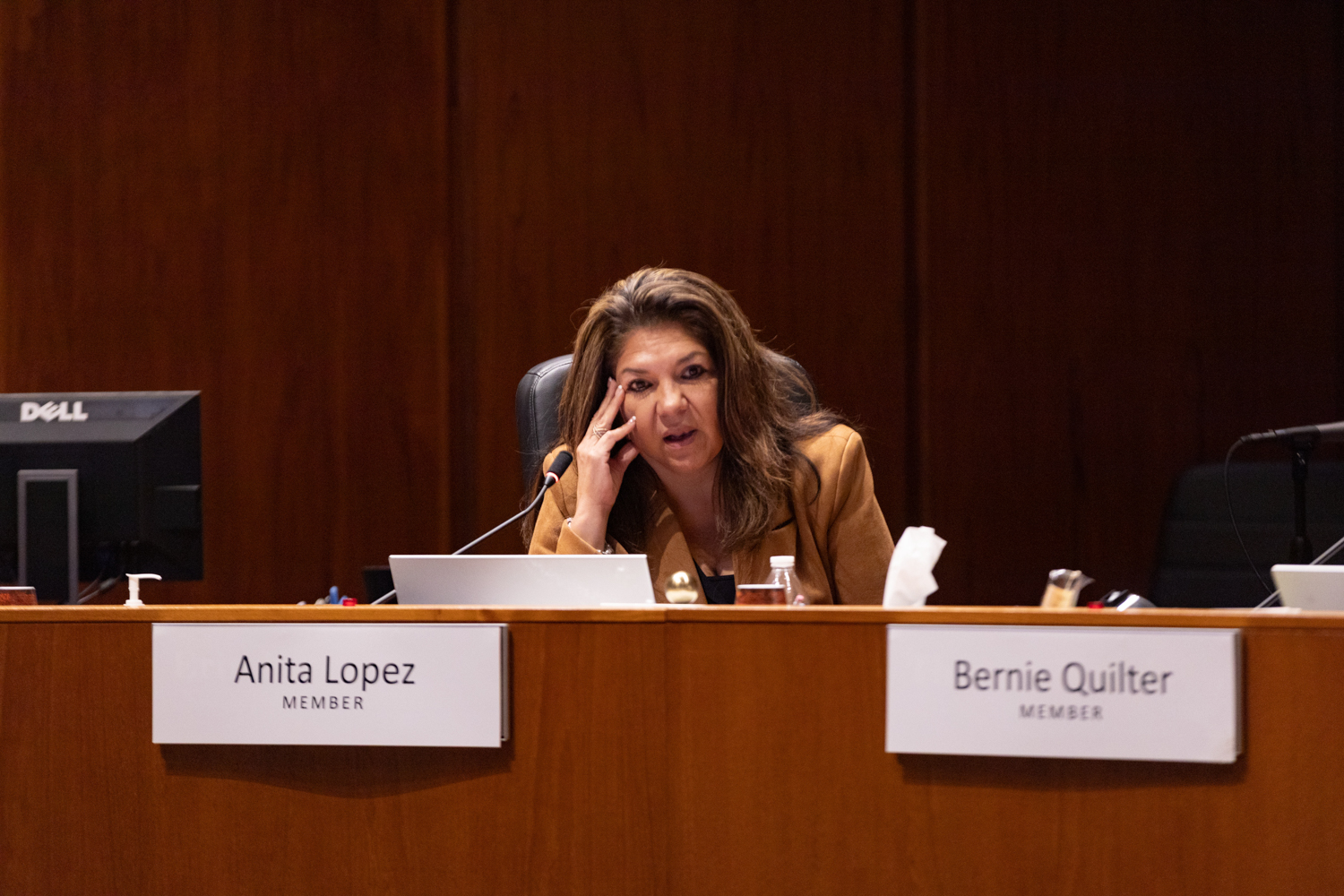
Lopez then asked about all of the investments by the county, and how they were evaluated.
Webb then said that she “constantly” engages in the “analysis” of all investments based on the criteria Borell and the ORC outlined, and further stated that since the investment in Israel does not mature until December, it is impossible to determine the safety, liquidity and yield at this time.
Commissioner Lopez then asked if there was a “written analysis” for the county’s investments.
Jim McCourt, the financial representative from Meeder Investments, speaks with Anita Lopez, Lucas County Commissioner. (TFP photo by Stephen Zenner)
And Webb said she was in regular communication with the Office of Management and Budget to understand the needs of the county, whether to liquidate, invest or reinvest assets, according to the ORC and the IAC’s guidance.
Gerken then asked McCourt if all of the counties and municipalities McCourt advised were recommended to invest in Israel bonds.
After some hesitation, McCourt said he could provide a comprehensive answer to the question after looking at the data, which seemed to satisfy Lopez, but not Gerken.
“Is it your business entity’s philosophy to guide municipalities into Israeli bond investments?” Gerken asked.
To which McCourt said that Israel bonds were “eligible,” and that the determination would be made at the time of investment.
“Is that a ‘yes?’” Gerken pushed.
“At times, yes,” McCourt answered.
The treasurer then asked if there were further questions for Borell regarding the Attorney General’s opinion.
Lopez asks clarifying questions during the quarterly Lucas County Investment Advisory Committee Meeting. (TFP photo by Stephen Zenner)
Resolution to affirm Yost
After a moment of silence, Webb introduced resolution 2026 001, which she said was “updating the investment advisory committee’s guidance regarding the investments in light of the Ohio Attorney General opinion 2026 004. It provides guidance for how the committee and the treasurer as investing authority should evaluate the lawful investment options going forward.”
She moved to vote on adopting the resolution, but Gerken immediately attempted to table the resolution.
“First of all, it’s unnecessary, and I believe, redundant,” Gerken said, and asked Borell to weigh-in. “This is an Attorney General’s opinion that you’re bringing into our policy,” Gerken said to Webb.
Webb attempted to silence Gerken.
“A motion to table is not debatable, Commissioner Gerken, so, I think I’ve given you enough leeway to express your opinion on this,” she said, trying to move past Gerken.
Gerken then made a motion to table, and Webb repeated that it was not debatable.
The Lucas County Clerk of Court and IAC Member Bernie Quilter then asked for clarification on the procedure of the meeting, because it seemed as though the IAC was going to vote to table and then vote on the resolution regardless of the motion to table.
A point of order was called by Gerken, who fought the claim by Webb that, “A motion to table is not debatable.”
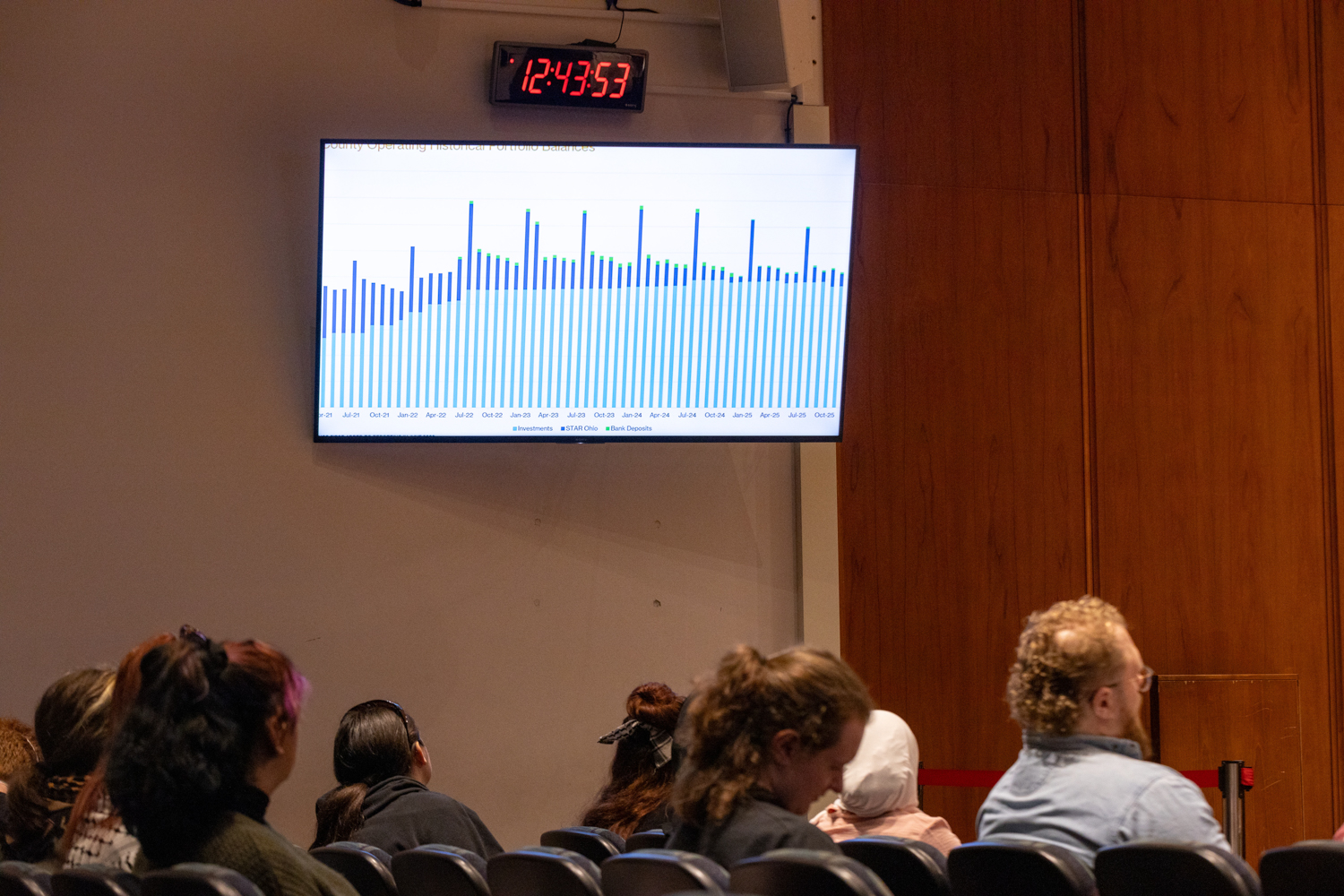
Jim McCourt, a representative from Meeder Investments, shows data for Lucas County’s investments. (TFP photo by Stephen Zenner)
Because the Committee never voted on accepting Robert’s Rules of Order, Gerken said the procedural stipulations of Robert’s Rules of Order did not apply, unless the Committee first voted on accepting the rules of order beforehand.
“Robert’s Rules of Order is a natural reliance,” Webb argued. “We have effectively, de facto, relied on Robert’s Rules of Order as a way to maintain order through the meeting.”
At the end of Webb’s justification the IAC began to vote on whether to table the resolution, but Lopez interrupted, asking if Webb’s justification was legally sound.
Borell then weighed in with a legal framework, “Public bodies in Ohio do not automatically use Robert’s Rules of Order.”
“There’s no statute that requires either the county commissioners or the IAC to use Robert’s Rules of Order, so Commissioner Gerken is correct.”
Even with this ruling, Webb attempted to stop debate.
“It’s my decision that the motion to table is not debatable,” Webb said, and Gerken challenged Webb’s decision.
Unnecessary and redundant were the beginning complaints Gerken had against the resolution, and then he added that the resolution hadn’t been put before the IAC or discussed sufficiently.
“If you want to have legitimate policy debates over our role as an advisory committee, and what the policies say, we should all have an opportunity to weigh into that,” Gerken said.
Proceeding formally, Webb attempted to follow Robert’s Rules of Order, and asked Gerken to challenge her decision so they could vote on whether to have a debate.
Another attempt at a vote was thwarted by Commissioner Lopez, who wanted clarification on Robert’s Rules of Order.
The Assistant Prosecutor repeated that the body was not bound by Robert’s Rules of Order.
Lopez listens to public comment during the meeting. (TFP photo by Stephen Zenner)
Lopez then asked Webb if she could ask Borell legal questions.
A noticeably frustrated Webb said, “The floor is yours. Ask your question.”
Trying to get clarity on the resolution, Lopez asked if the AG’s opinion and the resolution were the same legally, and if adopting the resolution might shield or open up the county to legal action.
Borell said the policy was a “summary of state law.” This answer created more questions for Lopez, and she asked Borell if he thought the IAC should adopt this resolution.
“Maybe this will be a good idea to pass this,” he said after telling Lopez he didn’t want to weigh in personally, but after multiple promptings, he relented. “Again, I wouldn’t have said that two years ago.”
“After listening to these meetings for two years, there seems to be a lot of misunderstanding about what this body does, what the treasurer’s obligation is, what her [Webb’s] duty is. For that reason, I would think it might be a good idea to pass this.”
Quilter then asked if Borell had helped draft the resolution, and Borell said he had.
Objecting to the resolution, Gerken pointed back to the boycott part of the AG’s opinion, and asked how the body could pass a resolution that upheld a portion of an opinion Borell disagreed with.
Bernie Quilter, an Investment Advisory Committee member, speaks during the quarterly Lucas County Investment Advisory Committee Meeting. (TFP photo by Stephen Zenner)
“With all due respect, Chair, we are in the middle of a vote,” said Lisa Sobecki, Lucas County Commissioner, trying to push the meeting forward.
Gerken interjected to explain himself. “We never took a vote, and she [Webb] shut down debate out of the false premise that they’re offering…” he said and then Sobecki and Gerken began talking over one another.
A call to order was issued by Webb.
In an attempt to clarify her objectives with the resolution, she said she put forth the resolution “to be very clear about what my responsibilities are as the treasurer.”
“Additionally, there was some preliminary discussion during the motion to advise me not to reinvest, that failure to reinvest could be construed as a rational basis to take my investing authority, which the voters have entrusted me with.”
“I just want to make it perfectly clear what my responsibility is under the code, and nothing more, and nothing less.”
At this, Gerken once again summarized his previous points of contention against the resolution, and again, made a motion to table the resolution.
The votes were counted, with a split: Quilter and Gerken for tabling, and Sobecki and Webb against tabling the resolution.
This gave the tie-breaking vote to Lopez, who had more questions before she voted.
“The resolution does not reference the boycott provision?” she asked the Assistant Prosecutor.
Borell told Lopez the resolution did not include the boycott provision, and Lopez voted not to table the resolution.
Kaley Hall, the secretary for the Lucas County Investment Advisory Committee, helps Lindsay Webb, Lucas County Treasurer, pick an individual at random to give comment. (TFP photo by Stephen Zenner)
Further clarifications
Once it was determined the resolution would be voted upon during the meeting, Gerken made a motion for discussion.
As soon as the motion was granted by Webb, he said, “I have several amendments I’d like to make.” He pulled out printed copies of the resolution with his amendments and passed them to other members of the Committee.
“Guidance” was changed to “policy and advice” throughout the document, as was “reinvestment decisions” to include “all decisions” and the final addition was, “the written county policies and resolutions established by the Committee should be a guiding factor [to the treasurer’s decisions].”
Webb pointed out a passage, in section three of the document that stipulated that every investment should have a “fiduciary rationale consistent with Ohio law and the county’s investment policy.” Worried about expanding duties for her office, Webb asked, “Are you going to expect me to send you an email with every decision that we make?”
Both heated officials began to talk over one another.
Gerken continued to explain the language choices in the amendments as related to the principles of the resolution, and Webb continued to ask if these amendments required procedural differences in her job.
Her main concern seemed to be if she would be taking on more work, exhaustively informing the commissioners on the minutiae of the county’s investments.
A few minutes later, Lopez broke the deadlock of back and forth, and said, “I do think it is important that an analysis is presented [so that] we understand as the public why you are doing those decisions.”
An exasperated Webb listed aloud the procedural details associated with investment choices, implying that the reasons for investing are complicated, varied and difficult to explain. Continuing, as if she were counting, Webb invited Commissioner Lopez to come to the Treasurer’s Office, where she assured the commissioner that her office was already providing daily and monthly analyses of the treasurer’s investment decisions.
“I am fine with every investment… but what I am not okay with is creating something in my policies and processes that doesn’t already exist,” Webb said, fearing more work for her office.
Gerken said his amendment was simply stipulating that the IAC help consult on all investments, not just reinvestments.
By this time, about an hour in, all members of the IAC seemed a bit aggravated with the contention in the room.
Quilter questioned what Gerken’s contention was about, and defended Webb’s discretion in making investment decisions.
“That’s for the voters to decide,” Quliter said of evaluating Webb’s investments for the county.
Back on the “investments vs. reinvestments” stipulation in his amendments, Gerken continued to explain he wasn’t attempting to change the treasurer’s power.
Quilter seemed to ask why the entire discussion was happening at all, to which Gerken explained he was trying to define the role of the committee in guiding investments.
An exhausted Quilter said, “I’ve been on this committee for like 24, 25 years. We have never run into this situation.”
In reply, Gerken said, “The world changes.”
Voting
Webb and Gerken negotiated the specifics of a few lines of the resolution for a number of minutes, which eventually gave way to some of the previous arguments reigniting.
Eventually, a vote on amending the resolution was called, and slowly, Webb inquired how each member wished to vote.
After hearing Quilter’s vote in favor of amending the resolution, Webb audibly sighed.
Sobecki and Webb voted against the amendments, with Quilter, Lopez and Gerken voting for the amendments.
“Your motion carried,” Webb said toward Gerken.
Much more quickly, Webb called the vote for adopting the resolution, and the sides voted the same: Sobecki and Webb vs. Quilter, Lopez and Gerken for adopting the amended resolution.
Webb leaned into the work of the moment. “The draft resolution is adopted, and I thank you all for your…” and she searched for the words for a moment “…lovely debate.”
From this point, McCourt began going over the general trends in the American market.
Excerpt from Resolution 2026 001 without the amendments
“Whereas the Committee desires to update its prior guidance so that future investment decisions are reviewed consistent with Ohio law, the county’s investment policy, and the Treasurer’s fiduciary responsibilities;” —Resolution Updating the Investment Advisory Committee’s Guidance Regarding Investments in Light of Ohio Attorney General Opinion No. 2026-004
The resolution outlined these ten steps for evaluating investments:
1. safety of principal
2. liquidity needs of the county
3. yield and available market alternatives
4. credit quality and applicable credit ratings at the time of purchase
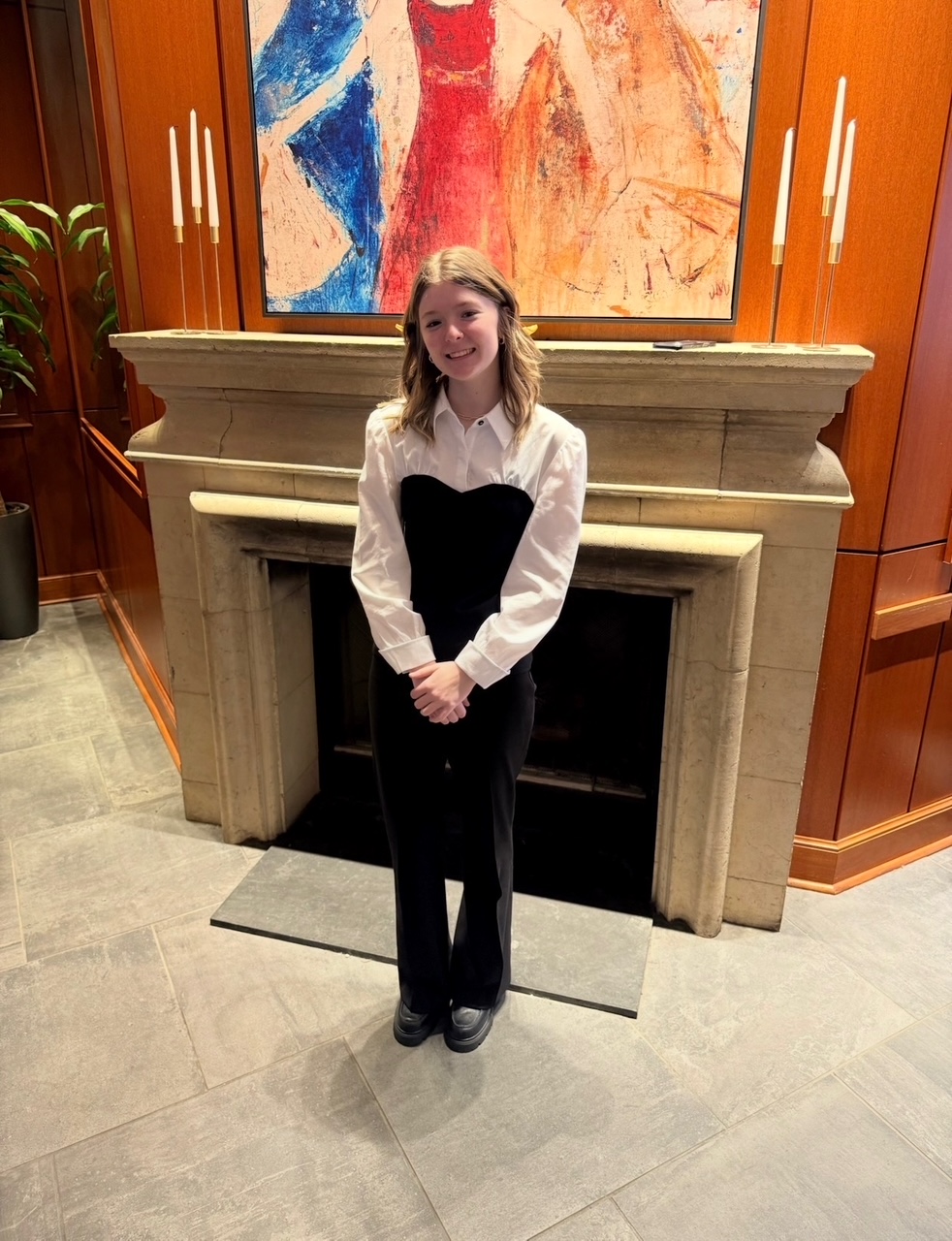
Olivia Ford of Point Place, left, a runner-up in the 2026 Ohio Youth of the Year competition, is pictured with Dominga Grace, program director of the Boys and Girls Club of Toledo. (Courtesy Photo)
TOLEDO — What started out as an obligation to meet her school’s graduation service requirements quickly turned into a much deeper commitment for Olivia Ford, who was named the 2026 Boys and Girls Clubs of Toledo Organizational Youth of the Year.
The Point Place resident has worked with the Boys and Girls Clubs of Toledo since 2023, when she started out as a summer program volunteer with the Ottawa River Club. She quickly surpassed the school requirement and ended up with somewhere between 160 and 180 hours of service just that first summer.
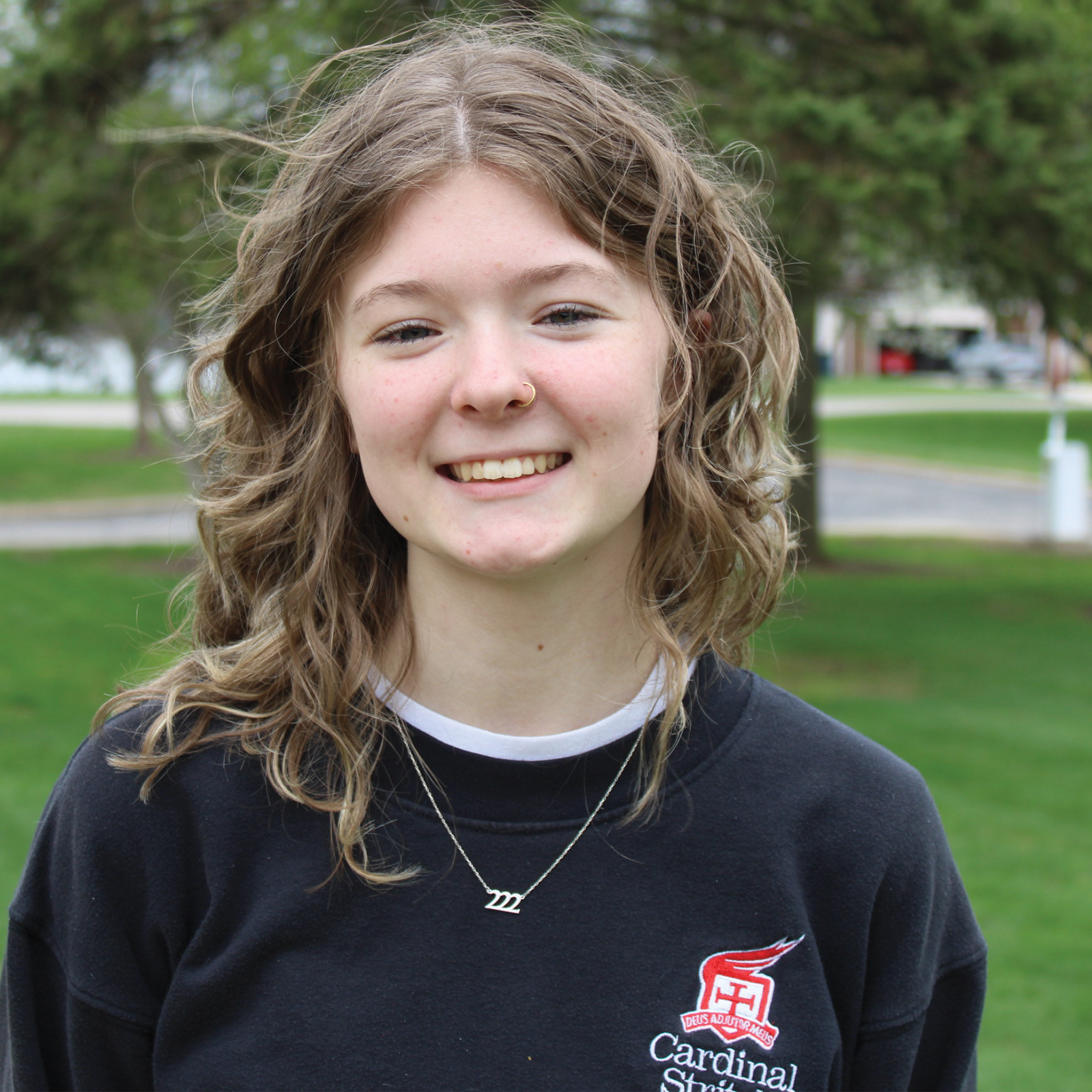
Olivia Ford. (Courtesy image)
“I just loved being with the kids and being in that environment. It was just really something special to me,” said Ford.
Boys & Girls Clubs of Toledo provides youth aged 7 through high school graduation with a safe place to learn and grow, fun and educational programs, caring mentors, and service and leadership opportunities at nine locations across the city.
Ford said it was the kids who captivated her and kept her coming back. She helped run a program called Brain Games where the volunteers read a featured book each week and led projects to engage the younger children in learning about different topics.
“It was just seeing what I could do to help bring these kids joy and happiness, and what projects I could come up with and lead with them, or what crafts I could do with them,” said Ford.
“Members connected well with Olivia right away,” said Hannah Fox-Lu, senior Club director at the Ottawa River Boys & Girls Club. “She is caring, compassionate and a great listener, which made her a strong leader who built meaningful and lasting relationships with members.”
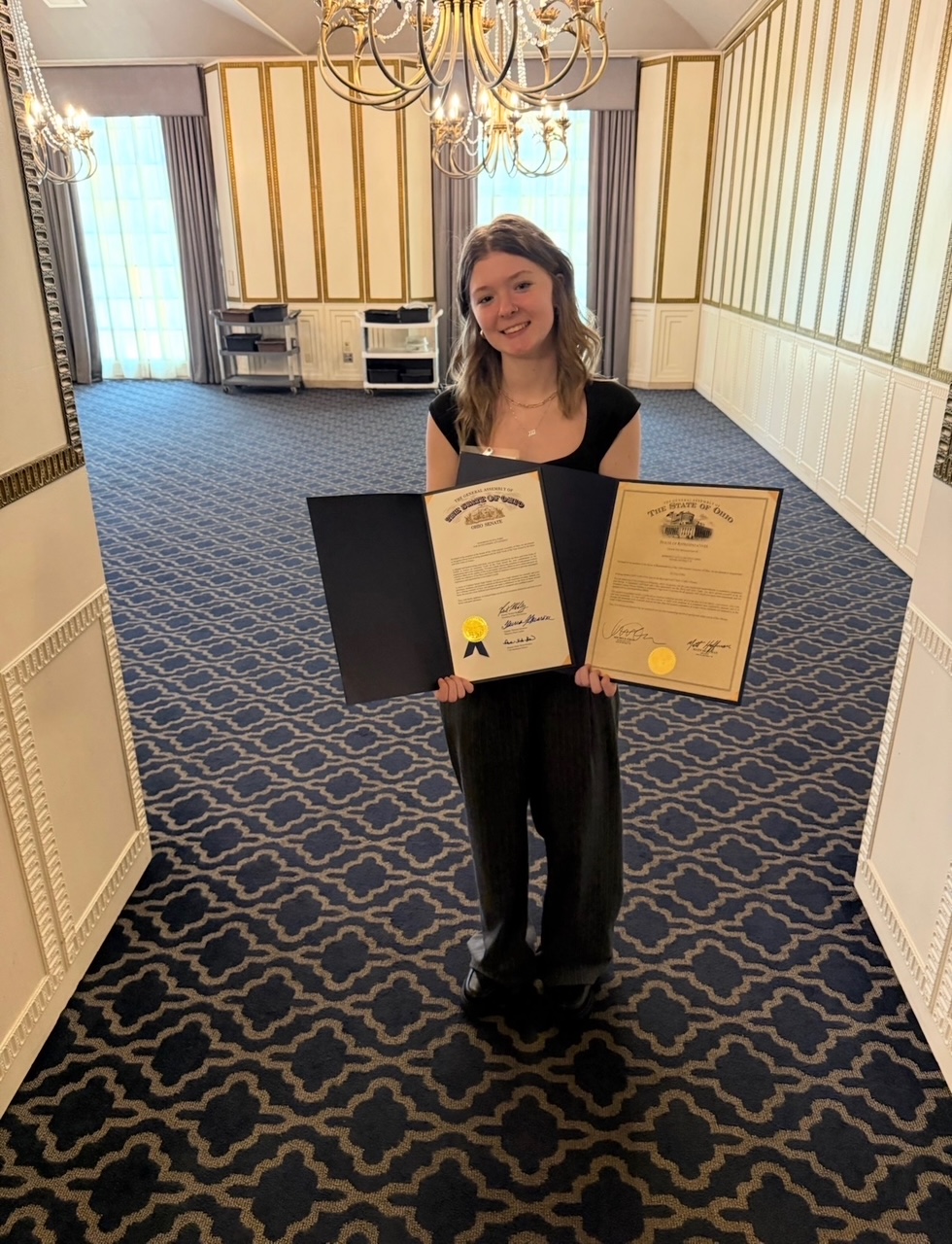
Olivia Ford received recognition from the Ohio House of Representative and the Ohio Senate for her achievements as a runner-up in the Ohio Youth of the Year Competition. (Courtesy Photo)
Ford later took on a paid position as a Teen Employment Corps junior staff member at the East Toledo Boys & Girls Club, where she mentors younger members and assists adult staff with implementing youth programs. In 2025, the Club recognized her with the John E. Gunckel Awardfor Service for community service, leadership and mentorship.
In April, the Point Place resident and recent graduate of Cardinal Stritch Catholic High School traveled to Columbus to represent Toledo at the 2026 Ohio Youth of the Year competition sponsored by the Boys and Girls Clubs of America.
Ford was named a runner-up in the competition, which required candidates to deliver a memorized speech of less than three minutes and answer questions about their club service in an interview with the judges. Ford was also asked to give her speech at a luncheon during the competition, and had the opportunity to visit the Statehouse and exchange ideas with other youth candidates from around Ohio.
Olivia Ford. (Courtesy photo)
Ford credits her experiences at the Clubs for helping her discover a passion for working with children, and she plans to attend Bowling Green State University to study education this fall. She envisions herself one day working in her own classroom where she can come up with “new and creative ways I can get them engaged and make an impact.”
“That’s really what I want to do is just leave an imprint on anyone I can,” said Ford, who plans to remain involved with the Boys & Girls Club as a part-time instructor while she attends school.
Ford said it is important for teens to get engaged in their communities. “Before I’d even got involved in volunteering, I just kind of moped around. I felt like I wasn’t doing anything,” she said. “This kind of gave me a sense of purpose.”
Along with working at the Club, Ford has served as a youth volleyball coach and was the Volleyball Team Captain at Cardinal Stritch. In her final season, the Toledo Area Athletic Conference recognized Ford as its Player of the Year. She was also involved with the National Honor Society, student council and the National Exchange Club.
Principal Malinda Siers described Ford as an exceptional student. “She has not only achieved academic excellence while inspiring and uplifting her peers, but has also left a lasting mark on our school community through her creativity, leadership, and athletic success,” said Siers. “We are incredibly proud of the impact she continues to make both inside and outside the classroom.”
TOLEDO – This is the season of high school graduations and the activities that go with it. As students, parents, and families enjoy the accomplishment, it is also time to think about the next chapters of life. Graduates, this marks the completion of the first major chapter of your lives; you have worked hard, overcome challenges, and reached an important milestone that deserves to be celebrated.
As you move forward, the next chapter will lead you toward college, skilled trades, military service, entrepreneurship, or the workforce. Each new opportunity ahead of you will help shape your future and open doors to new experiences and growth.
Another import chapter in life will be building meaningful relationships and creating a strong support system of family and life friends who will encourage and stand beside you through every season of life.
Dr. Stredrick, Superintendent of Maritime Academy, marches in the graduation procession. (Courtesy photo by Jim Rush)
I also want to say that parents, families, teachers, and mentors have given guidance, encouragement, and sacrifices to help you as graduates reach this point. Dr. Misha Stredrick, Superintendent of Maritime Academy, reminds us that many of our high school graduates are first-generation graduate students.
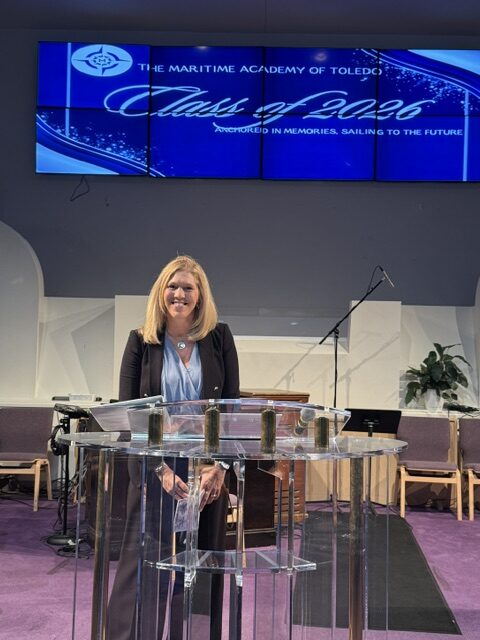
Kate Fineske, Executive Director of Museum of the Great Lakes, who was the graduation speaker for Maritime Academy told students that “success is rarely linear. Life is not a straight line; life is like water – you must navigate currents of change.”
Fineske went on to advise students not to let social media guide their lives. Most people on social media are no smarter than you, she said, adding details about her own life’s challenges as a way of saying to students that life is not perfect.
Kate Fineke, the keynote speaker at Maritime’s graduation. (Courtesy photo by Jim Rush)
Additionally, I cannot end this article without encouraging these new voters to make their voices heard. I heard Xernona Clayton (who the first Black TV show) speak in Atlanta, and she talked about the need to vote. She also said students should always do the right thing and treat people right. She said that, in the past, Grady Hospital in Atlanta would only let Black women have babies in that hospital on Tuesdays and Thursdays. This is the kind of issue that reflects what voting is all about. Clayton had an impact on the Ku Klux Klan by treating the Grand Dragon as a person and not someone to fear. Her message about voting and treating people right will help graduates in their life journey.
Graduates of all schools, continue pursuing your dreams with courage and determination. Believe in yourselves, work hard, and never stop striving for excellence, because you absolutely have the ability to achieve great things in life.
Dr. Stredrick said that 24 seniors graduated from Maritime this year. Their salutatorian was Fernanda Fernandez and their valedictorian was Dontae Osley.
Maritime Academy offers career paths in culinary arts, arts, business, college preparation, and health care.