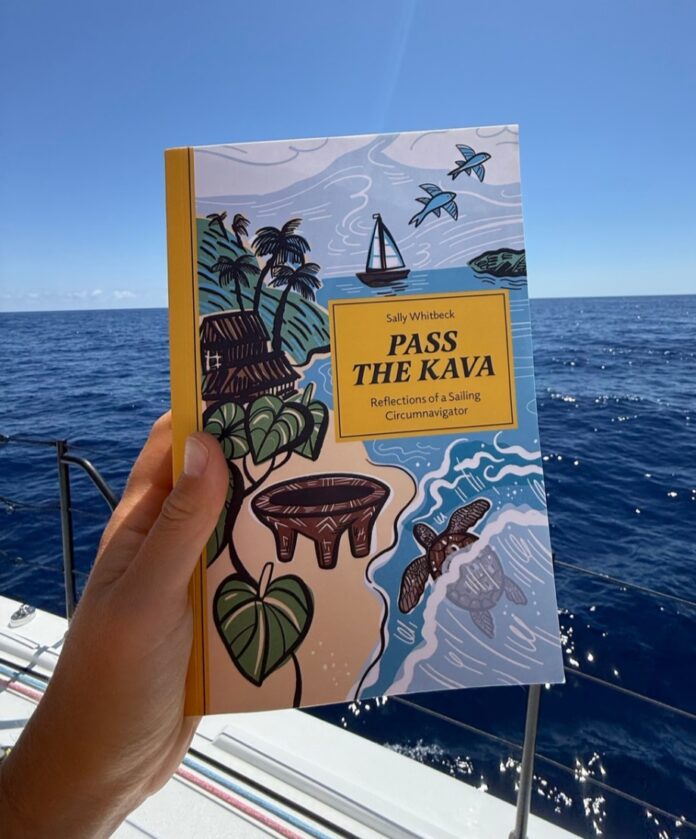
“Long before the existence of cell phones, laptops, YouTube, Instagram, Google Earth, Starlink, drones, weather apps, navigation software, email, texts, or even digital cameras, we went to sea in a small boat,” writes Sally Whitbeck in the preface of Pass The Kava – Reflections of a Sailing Circumnavigator.
In December 1993, Sally and her husband Jon left their careers, sold their home and possessions, and boarded a 37-foot sailboat, the Argonauta, to begin a four-year circumnavigation of the world. Pass the Kava takes readers on the first year of that journey: from the seasickness, sleepless nights, killer whales and failing equipment to the tranquil sunsets, locally-sourced meals, hikes to stunning vistas and the snorkeling and fishing from both the boat and the shore.
But what stands out most about Pass the Kava are the friendships Sally and Jon formed with the people living on remote South Pacific islands and in villages along the coasts of Central America, Mexico and New Zealand. With Sally’s limited French and Spanish and Jon’s universal language of humor, the two befriended not only fellow “cruisers” they would see on the water, but dozens of locals.
Pass the Kava tells of teenage brothers Roddy and Ismael who were working their father’s black pearl cultivation business on Toau, a small coral atoll in the Tuamotu Atolls of French Polynesia. The brothers’ constant giggling antics and contagious laughter provided hours of amusement, Sally wrote, but the brothers also led them on excursions to spearfish, harvest coconut and test “biere locale” with fermented bananas.
Often spending nights sleeping on the deck of the Argonauta, Roddy and Ismael became enthralled with the VCR tape of Beverly Hills Cop, even though they couldn’t understand English. The brothers also laughed hysterically when Sally recorded them on her camcorder and played it back for them to see.
On Mopelia, a Leeward atoll in the Society Islands, they met Teamo, Geneviere, Leon and Carl, who ran an oyster farm and shared meals with the Whitbecks aboard the Argonauta and in their home. With their new friends, Sally and Jon hiked and played bocci ball and shared stories about their lives. On Niuatoputapu, a volcanic island in Tonga, they learned the “Tongan way” of open-hearted hospitality, through Vatau, his wife Vika and their extended family, who invited Jon and Sally to feasts and celebrations – including a kava ceremony.
Kava is the root of a Pacific Islands shrub and is made into a drink that relaxes without alcohol. “Sharing a bowl of kava creates a calming sense of well-being, allowing one to fully engage in the present moment,” Sally explains. “This culturally valuable ritual can bring about profound contentment and an understanding of the interconnectedness of all beings.”
The daughter of Phyllis and Jim Witzler, Sally was four when the family moved to Waterville from Ann Arbor so that her father, known as Dr. Jim, could join the medical practice of Dr. Allen Borger. She recalls him building a tandem kayak from a kit, and using it on the Maumee River. In Pass the Kava, Sally reflects on the impact of her father’s death when she was 14 – a tragedy compounded by her only friend moving out of town.
As an Anthony Wayne High School student, Sally ran track, but didn’t get to engage in sports that taxed her mentally and physically, so after graduating in 1975, she took a course offered to incoming freshmen at Earlham College: wilderness survival training. The experience has carried her through some difficult experiences both on the boat and off, she said, explaining that at one point she had to spend three nights alone in the mountains with limited resources.
She recalls that at one point an instructor saw her struggling while ascending a mountain, weighed down by a heavy backpack.
“He told me that, even when I think I can’t go any further, ‘to push through and your mind and body will surprise you,'” she said.
Jon also grew up in the Anthony Wayne area, but graduated from Maumee Valley Country Day School in 1973. Their first dates hinted at their mutual love of adventure: climbing the water tower in Conrad Park and rappelling into the quarry by sneaking through the back of Wakeman Cemetery one night. It was Jon who introduced her to sailing.
“I might have sailed a little Sunfish at Camp Storer, but I had zero sailing experience before the Venture on Lake Erie,” she said, noting that later they took Venture to the Bahamas, and that gave them a taste of what it might be like to go further.
Stocking the Argonauta with food and equipment for departure on their circumnavigation took months of planning. On that first day, they visualized making it miles down the east coast from Annapolis. But driving winds, big waves and little visibility left them frozen and a little disheartened, as they made it only eight miles that first day.
In times of foul weather out on the sea, they often brought cushions out of the berth and slept on the floor of the main salon, near to the helm but further from the violent motions that would aggravate her nausea. Other times they didn’t sleep at all until the seas were more calm.

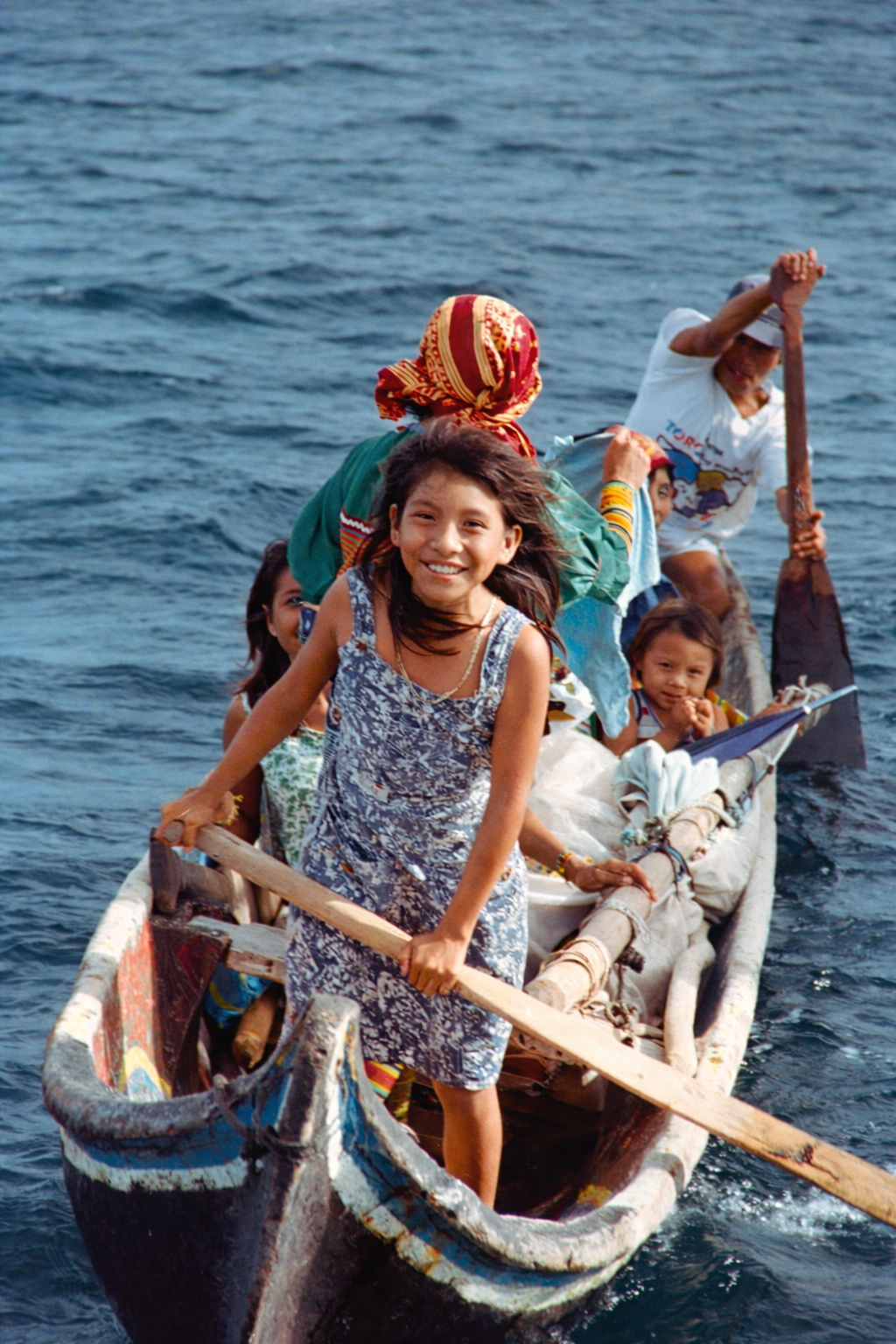
No matter what the weather, Sally always found time to journal the experiences – the sights, smells and sounds, along with interactions with other boaters and residents of islands and villages, where upon arrival they were often welcomed by boats with children, seeking a glimpse of the visitors and a chance to say hello. Often they were bestowed with gifts of food. In return, the couple shared food, drink, T-shirts and even some of Jon’s mechanical know-how.
In the process of that first year, they helped find a midwife for a woman in labor, a dentist for a teen with a broken tooth, and help for a young girl with an infected foot.
Sally tells of taking a bus across Antigua, Guatemala on a winding, hairpin-curved road, past roadside markers for those who had died. The bus broke down and the driver departed on a motorcycle without saying a word, leaving the riders by the side of the road, not far from the odor of a nearby rotting animal carcass. And no one complained. The driver returned an hour later with a repaired bus part.
“I have learned to be patient in situations where being impatient isn’t going to help anything,” she said. “When traveling, as in life, stuff happens. A sense of humor, perspective and the flexibility to roll with things do help. Also, our travels taught us that many of the problems we deal with in our wonderful country pale in comparison to what people in other countries experience.”
Upon returning from their four-year voyage, Sally and Jon sold the Argonauta to buy a home in Montague, Mich., which has the same small-town, community feel as Waterville – only with sailboats, White Lake and Lake Michigan, Sally said. They had a daughter, Phoebe, who grew up with sailing stories and a room filled with photos of boats and of children from around the world. When Phoebe was old enough to sail, they became involved in a youth racing club, and Jon bought a Laser sailboat to race on the weekends, and later they chartered catamarans in the Caribbean, Bahamas and Puerto Rico.
Through the years, Jon has worked as a software engineer while Sally has written for travel and sailing magazines. Phoebe, now 26, has degrees in marine biology and French, and was able to do coral restoration research through the University of North Carolina Wilmington’s Center for Marine Science. She’s certified in advanced open water SCUBA, earned her U.S. Coast Guard captain’s license and Royal Yachting Association yacht master certification and has worked all over the world, including captaining a 50-foot performance catamaran in the Bahamas last winter and New England this summer.
Jon and Sally are sometimes hired as temporary crew for Phoebe on multi-day, offshore passages when taking the boat back and forth between the Caribbean and East Coast. Phoebe is building experience to circumnavigate the globe just as her parents did in the early 1990s – only with more modern technology.
Sally plans to begin working on writing the story of the other three years of their experiences aboard the Argonauta, but for now, she’s enjoying the positive feedback from not only experienced sailors and boaters, but from those who want a mental escape on a trip that most will never make.
The book is available through Amazon, Barnes and Noble and at sallywhitbeck.com.