




Primary Election: Meet the 3 Toledo mayoral candidates

This is an introduction to all three mayoral candidates on the City of Toledo primary election ballot: Incumbent Wade Kapszukiewicz, Roberto Torres and Harold Harris.
On May 6, Toledoans will choose the top two candidates, who will then be placed on November general election ballot.
Incumbent Wade Kapszukiewicz
The office of mayor is defined in Toledo as nonpartisan, but Kapszukiewicz, 52, has been affiliated with the Democratic political party in the past.
Goals:
- Improve public safety by reducing crime, with a special focus on reducing homicides
- Provide economic development to Toledo
- Continue building infrastructure in the form of repaired roads
- Invest in housing for the city of Toledo
Proposed changes:
Since Kapszukiewicz is an incumbent, he made it clear most of his work would be focused on continuing the work he has already been doing, but offered a number of proposed continuations for what his third term might look like.
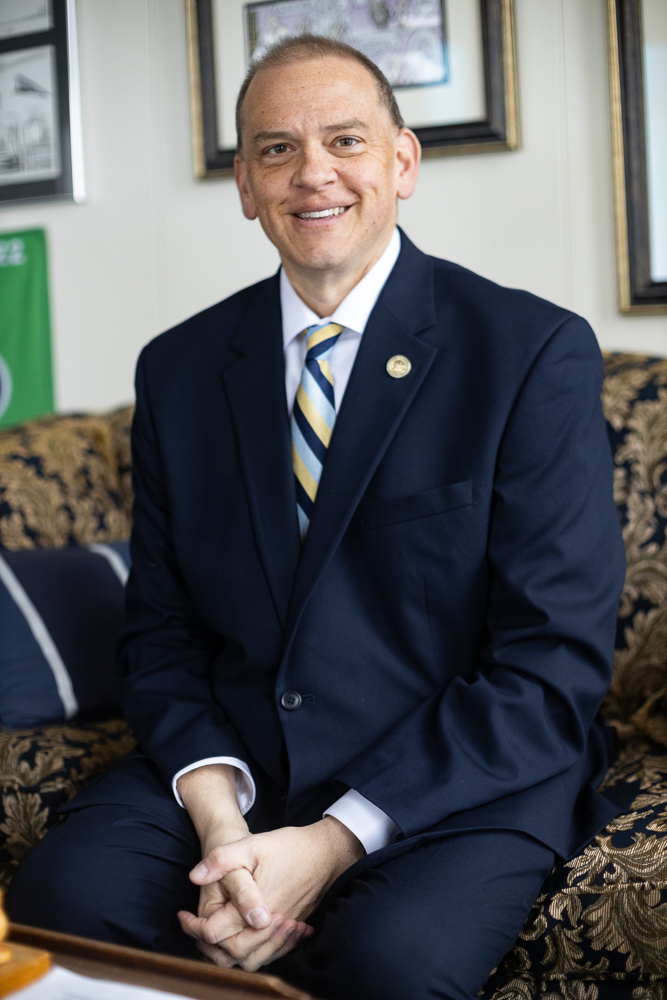
“The first thing we decided to do was to increase the size of the police class that we had budgeted this year,” Kapszukiewicz said.
Growing the police is a common goal the mayor has highlighted in the past, along with declining crime rates in Toledo. It should be noted that the declining rates are coming off of an all-time high during the 2020-21 pandemic, where most American cities experienced large spikes in crime.
Site Selection Magazine placed Toledo as the best mid-size city for economic development, and the city’s increased bond rating increased in 2025 following the submission of Kapszukiewicz’s city budget this year.
Kapszukiewicz raised road levies during his time in office to repair roads, and during his State of the City address, Kapszukiewicz focused on converting vacant commercial spaces downtown into housing.
Experience:
Kapszukiewicz took office as mayor of Toledo in 2018, is still in office, and he is up for reelection for his third consecutive term as mayor. There has not been a third term Toledo mayor since the introduction of its charter in 1916.
In 2024, the Toledo City Charter was amended by ballot initiative, Issue 9, to allow for a third term for mayors of Toledo. Right before the introduction of Toledo’s Charter, Brand Whitlock served four consecutive terms as the mayor of Toledo from 1906 to 1914.
Kapszukiewicz also served as a member of Toledo city council, beginning in 1999, and went on to serve as the Lucas County treasurer before becoming mayor.
In his time as treasurer, Kapszukiewicz founded the Lucas County Land Bank.
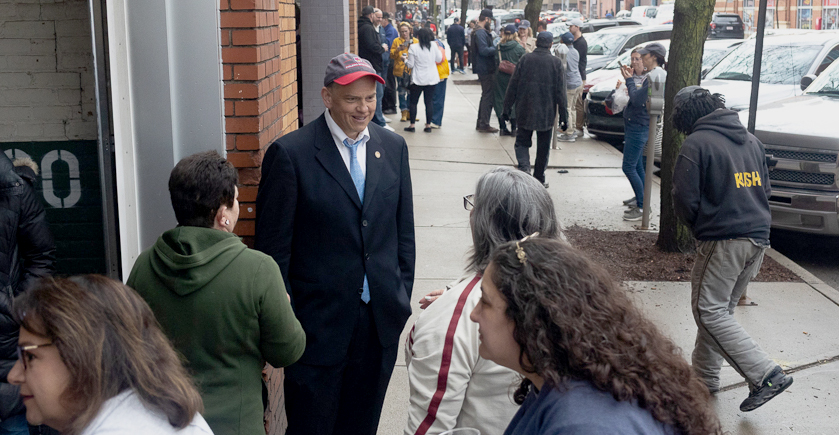
Roberto Torres
The office of mayor is defined in Toledo as nonpartisan, but Torres, 62, announced his candidacy as an Independent candidate.
Goals:
- Live within the means of Toledo’s revenues
- Community Development in the form of empowering local neighborhoods
- Attract new businesses to economically develop downtown
Proposed Changes:
“We need job creation if we’re losing population,” Torres said, and criticized the current mayor for growing the police force as population continues to decline. “What’s the rationale for keeping more police officers when you have less Toledoans?”
Torres worked under previous Toledo mayors Jack Ford and Carty Finkbeiner, and wants to restart the community Block Watches that were active during those mayors’ administrations to reduce crime.
“The more people that we support out in the neighborhoods…the less we have to employ with the city,” he reasoned.
Torres emphasized the need for economic development, stating that “we cannot be a city that’s just run on federal funding.”
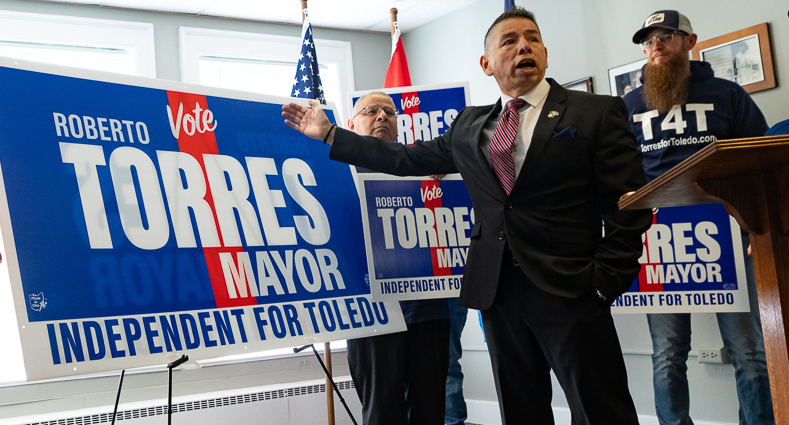
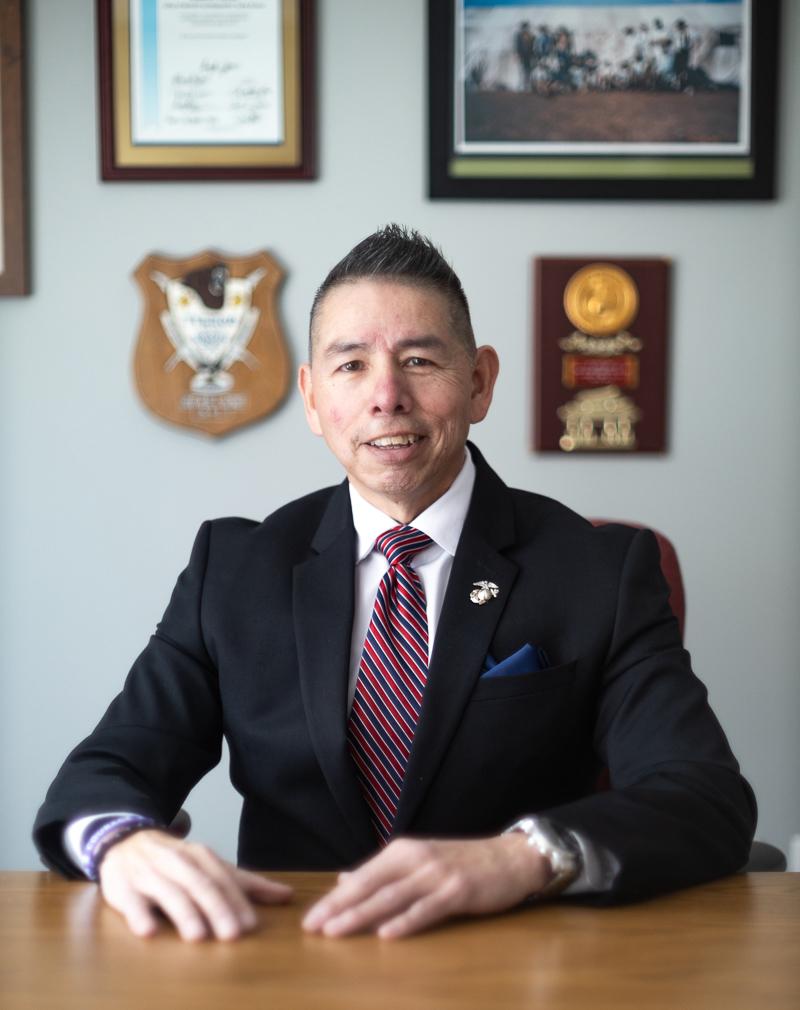
He also talked about the difficulties that may be ahead as the Department Of Government Efficiency (DOGE) continues to cut federal funding.
Massive amounts of federal funding have been procured by the Kapszukiewicz administration through competitive grants and the American Rescue Plan Act funds under the Biden administration. Most recently, grants and funding of this kind have been used to supplement projects like the Wayman D. Palmer YMCA.
“We need to have private investment,” Torres said, and pointed to his experience working with the governments in Detroit, Canton, Ohio and Grand Rapids, Mich., as proof of his ability to provide economic prosperity to cities.
If there is economic development in northwest Ohio, Torres said it generally goes to another municipality in the area, instead of Toledo. Torres blamed a labor agreement that is active within the city as the cause for slowing economic development in Toledo.
“Toledo is ripe for growth,” Torres said, adding, “We have, right now, a policy that’s supported by this administration [Kapszukiewicz’s administration] that prevents development, so it discourages people from coming here. The cost of development here is much higher because of that.
“What I would change is the threshold that qualifies individuals that are impacted by this agreement,” Torres said, and pointed to Detroit and Cleveland as cities with a similar labor agreement with higher thresholds. The criticism of this labor agreement deals with the low threshold affecting nonprofits and small businesses, instead of just affecting larger investors.
Experience:
Torres currently works as the director of the Mayor’s Office of Immigrant Affairs and Economic Inclusion in Detroit, and has worked in this capacity since 2018.
Torres served in the United States Marine Corps as a sergeant and a battalion legal chief.
Torres’ foray into politics began in Toledo in 1996 when he served as the director of the Board of Community Relations for the City of Toledo, then the director of the Toledo Youth Commission; director of the Office of Latino Affairs for the City of Toledo; and a development specialist for economic development for the City of Toledo, ending in 2008.
Venturing outside of northwest Ohio, Torres became the director of economic development, 2008-2012 for the City of Canton, Ohio.
From 2013-2015, he worked as the executive director of the Northwest Ohio Hispanic Chamber of Commerce.
In Grand Rapids, Mich., Torres served as the executive director of the Hispanic Center of Western Michigan from 2015-2018 until taking on his current role in Detroit.
Harold Harris
Harris, 69, announced his candidacy as an Independent, non-committed candidate. He explained the non-committed title he gave himself like this: “I’m not committed to the Republican Party. I’m not committed to the Democratic Party. I’m committed to the people.”
Goals:
- Reduce Toledo crime, specifically shootings and homicides
- Prevent incumbent Mayor Wade Kapszukiewicz from getting a third term as the mayor of Toledo
- Provide basic services to Toledoans in the form of road maintenance, tree removal, etc.
- Create an attentive city government that hears the people’s needs
Proposed Changes:
“The most important one [issue] is gun violence, homicides, shootings,” Harris said, and blamed Kapszukiewicz for a rise in crime.
“30 years ago, you never heard of drive-by shootings, never heard of murders and homicides [in Toledo]. We’re gonna bring those numbers down,” he said, referring to the crime involving deaths in Toledo.
How Harris said he would change Toledo for the better revolved mainly around his own ability and competency.
When asked how Harris would bring down crime in Toledo, he responded, “I think it’s pretty simple. I’m [going to] meet with the police chief, okay? I’m gonna give him my direction. He works directly for me, okay? And we’re gonna take care of it.”
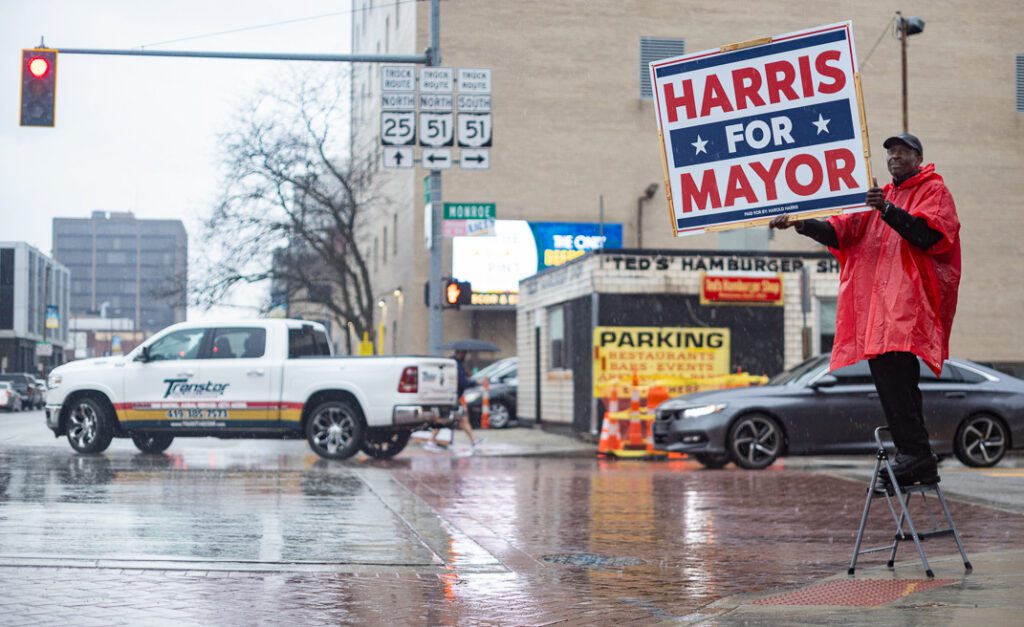
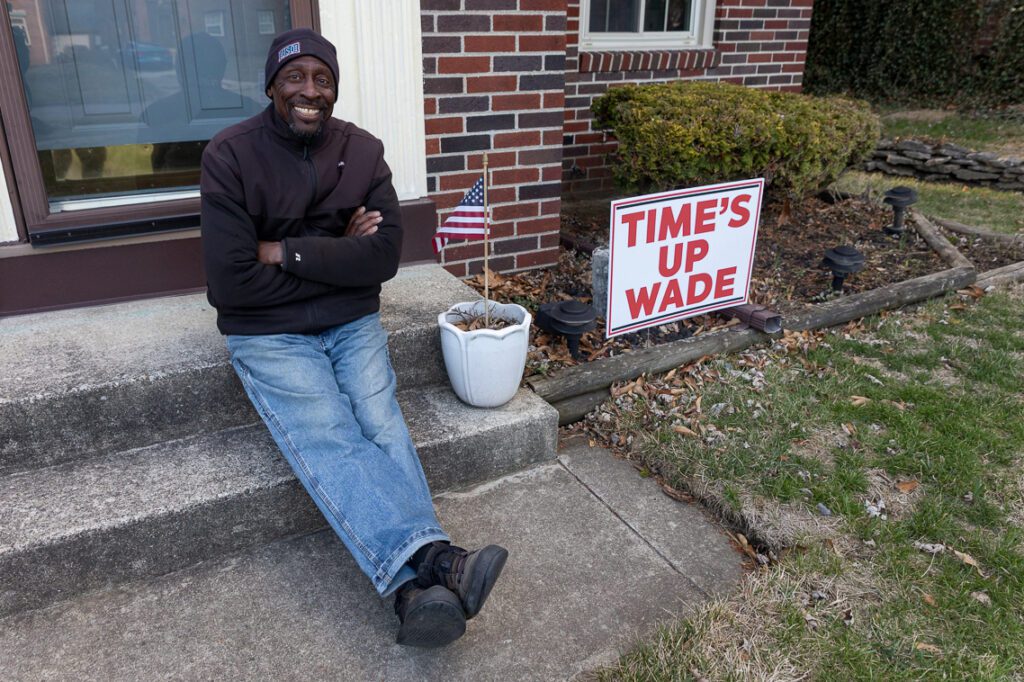
Face-to-face command ability, authenticity and military experience provided the bulk of Harris’ explanation on how he would run the city, reduce crime and fix up Toledo’s neighborhoods.
“I’m an action person. I’m not going to burn time talking about an issue,” he said, and clarified that he didn’t have much on his mind concerning legislation or policy. “My thing is, let’s keep it simple.”
Harris said he was interested in giving power back to the people, and felt Kapszukiewicz was purposefully ignoring the needs of everyday Toledoans.
“The guy on the 22nd floor has brought me out of retirement,” Harris said. “But that’s okay, because I’m fighting for the people; it’s all about the people, and, hopefully, I will do a good job for them.”
Because of his stated frustration with Kapszukiewicz, Harris refused to say Kapszukiewicz’s name during the interview. Instead, Harris alluded to Toledo’s current mayor as “the guy at 1 Government Center” or “the guy on the 22nd floor of 1 Government Center.”
Being among the people and listening to their needs was an utmost priority to Harris, and he sought to reconnect people with their government through the reinstatement of the Block Watch program.
“They’re [the Toledo city government is] not hearing these people cry out,” Harris said.
Experience:
Harris achieved the E-6 rank of Technical Sergeant in the United States Air Force.
He served in the Air Force for 20 years from the Vietnam War into the Gulf War era.
He is a disabled veteran, a combat veteran and Harris believes his grass roots organizing over the past six years is good preparation for Mayor.
“I’ve pushed everything from issue nine to issue 21 to voter registration, to voting, to police reform, you name it,” he said.
Toledo turns out for Hands Off!

TOLEDO – Normally, the Craig Street Bridge in Toledo carries vehicle traffic across the Maumee River to East Toledo. But on Saturday, it was carrying foot traffic – and a lot of it.
As part of the planned nationwide ‘Hands Off!’ protest against the Trump administration, people walked from one end of the bridge to the other. They held signs criticizing the role of billionaire Elon Musk in the federal government, while others criticized the president’s policies.
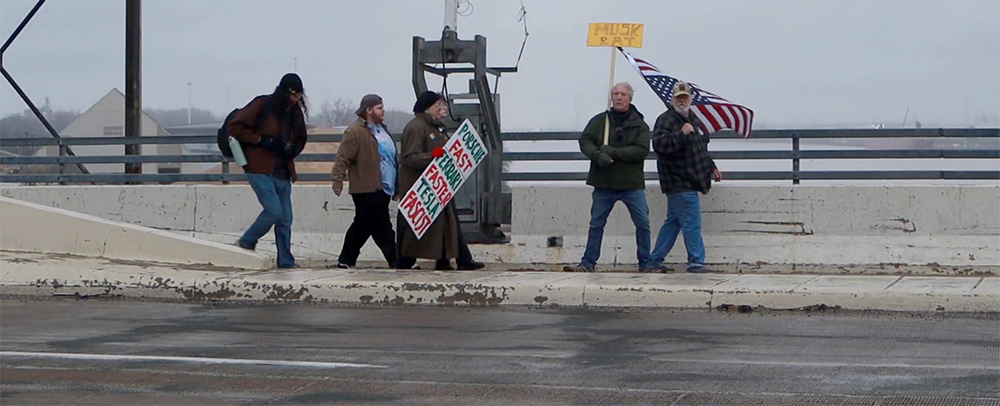
Demonstrations were held in large and small towns throughout all 50 states, and even included Canada, as protestors in Detroit and Windsor lined both sides of the Detroit River.
“This is a very diverse crowd. This is not left or right, this is right or wrong. We are out here with a lot of nonpartisan groups, a lot of people on all political stripes, that believe in democracy and believe in protecting our country.”
Melissa Portala is an organizer with the group Toledo Persists, which was behind the local demonstration.
“We were expecting a large crowd today, but this is even bigger than what we were expecting,” Portala explained.
She says over 3,000 people signed up to attend, but many more showed up from word-of-mouth, leading her to believe there were around 4,000 attendees. So, what is the message they’re aiming to send?
“We are here saying ‘no.’ We want to keep our Social Security; we want to keep our Medicare, we want to keep funding for our schools,” she said.
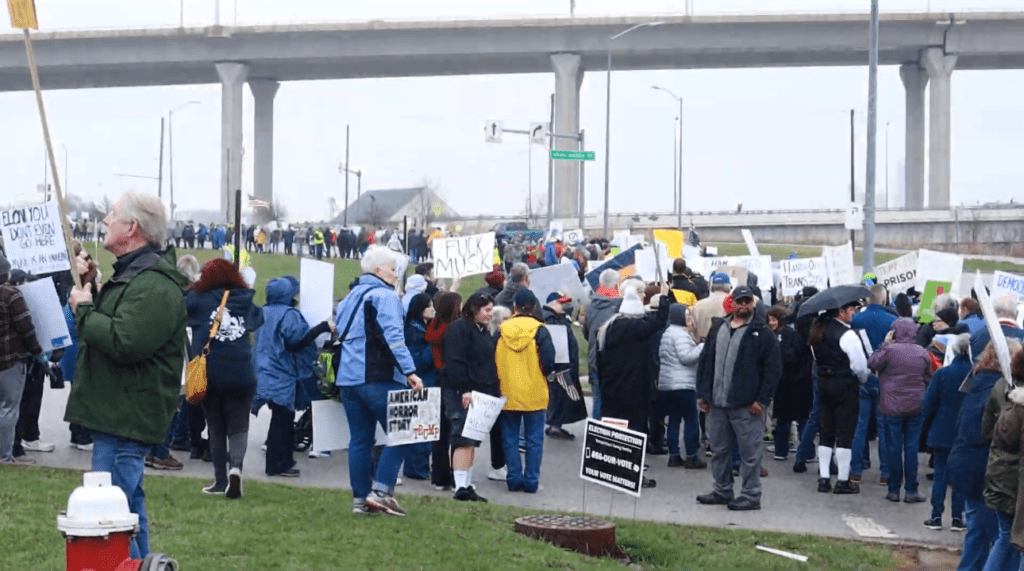
Deborah Wright attended the protest. In particular, Wright was opposed to the U.S. Agency for International Development – or USAID – having been dismantled.
“I’m really upset about the U.S. aid for all these countries that really, really need it. Medicine and the food- and he doesn’t care about anybody but his own pocket – and I don’t feel that way,” she said.
Asked if the demonstration will be effective in any way, Portala cited court orders blocking some of the White House’s agenda as examples of successes. She said the goal of the protest is to get elected officials to do the same.
“When the people that are ostensibly representing us in our government see this massive pushback, it makes them think twice about what they’re doing.”
Rocket Coach Ginny Boggess

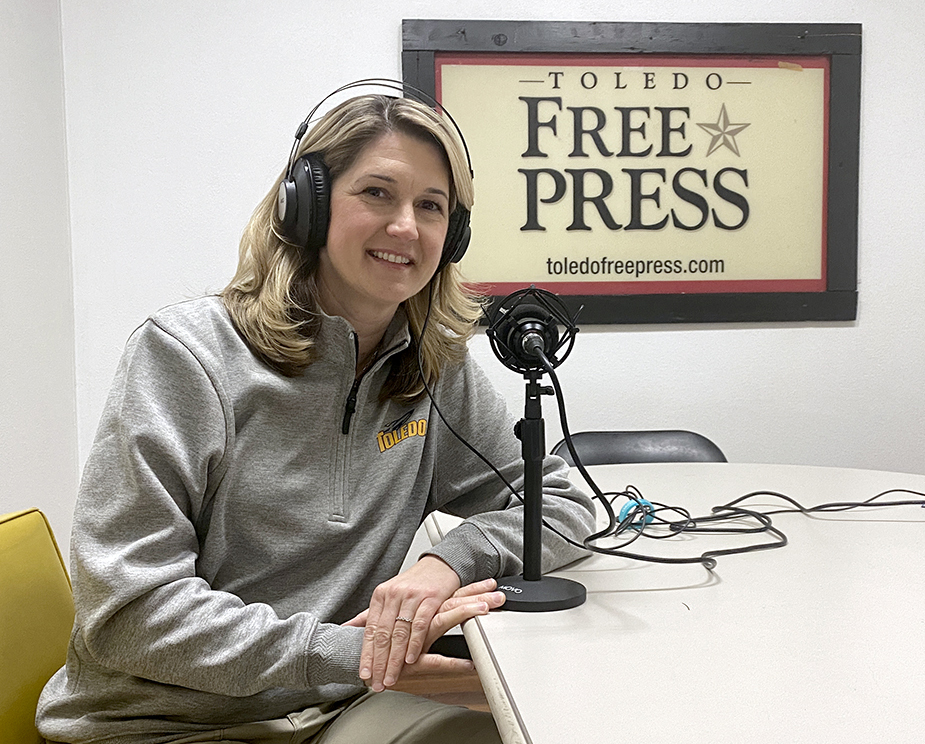
On this episode of the Flyby Sports Podcast, host Max Alfonso sat down with Toledo Rockets women’s head coach Ginny Boggess in the Toledo Free Press podcast studio on April 1 to chat about all things Toledo women’s basketball.
During her first season as head coach of the Rockets, she led the Toledo Rockets to a 24-9 record and a berth into the WBIT Tournament against Minnesota.
“Within the humility and the toughness and the grit these kids have, there is a collective ego, a Toledo mindset, if you will, of our standard for excellence. It’s a rare blend that I’m extremely committed to continuing,” she said in the podcast.
Listen as Boggess talks about:
- her time at Monmouth and other teams before coming to Toledo
- the MAC championship and WBIT games played in March
- the team’s rabid, educated fan base
- the transfer portal, and how she predicts she will gain and not lose players
- her seniors, especially Rossford native Sammi Mikonowicz, and the impact they had on the team
This interview took place three days before she signed a contract extension with the Rockets on April 4, continuing her reign in Toledo up until 2030.
New episodes of the The Flyby Sports Podcast drop every Saturday.
The Flyby Sports Podcast is a production of the Toledo Free Press.

Ohio’s (latest) Issue 2 will help fund local infrastructure projects

This story was originally published by Signal Statewide. Sign up for their free newsletters at SignalOhio.org/StateSignals. Statewide is a media partner of the Toledo Free Press.
By Andrew Tobias | Signal Statewide
Ohioans will vote soon on another Issue 2.
But rather than legalizing marijuana, the 2025 Issue 2 has to do with something far less controversial.
If voters approve this new Issue 2 on the May ballot, the state will be allowed to borrow billions of dollars over the next decade to fund local infrastructure projects. Think roads, bridges, water and sewer management systems — the nuts and bolts of local government.
What exactly does Issue 2 do?
Issue 2 reauthorizes the State Capital Improvement Program, which has existed in various forms since voters first approved it in 1987. Voters have renewed it three times since then, most recently in 2014.
Under Issue 2, the state would be allowed to sell up to $2.5 billion in bonds, spread out over the next ten years. This is larger than the $1.875 billion that voters were asked to approve in the 2014 vote. State lawmakers who back the measure are asking for the larger amount because they say construction is more expensive than it was a decade ago.
If voters approve Issue 2, the state must pay back the bonds over a 30-year period, sort of like a mortgage loan. With interest, the total cost will be $3.84 billion, according to an estimate from the Legislative Service Commission, the state legislature’s nonpartisan research arm.
If the measure fails, the state infrastructure program will lapse on July 1.
How did Issue 2 get on the ballot this year?
The Ohio constitution strictly limits the state’s ability to borrow money. So any borrowing program requires a constitutional amendment, which only can be approved through a statewide vote.
The Ohio General Assembly voted in December to put Issue 2 on the May ballot.
When is the primary election?
The election is on May 6, although general early voting will begin on Tuesday, April 8.
The voter registration deadline for the election is Monday, April 7. Voters can register or update their registration online at the Ohio Secretary of State’s website. They also can do so in person at their local Board of Elections. Local government offices, like libraries, commonly have voter registration forms.
Click here for a full list of early voting locations and here for a list of voting hours.
Issue 2 will appear on every ballot in the state. But some communities also will hold votes to decide things like municipal offices and local liquor options.
The Ohio Public Works Commission, the state agency that administers the State Capital Improvement Program, keeps records of every project the program has funded.
From 2017 to 2024, the state spent more than $2 billion on more than 4,000 projects in communities around the state via grants and loans to local governments.
Didn’t we just vote on Issue 2?
Yes. In November 223, Ohioans approved an Issue 2, which legalized recreational marijuana in Ohio.
But Ohio is reusing the number for this vote. The measures aren’t related.
The measure has widespread support including Republican and Democratic elected officials, labor unions, business groups and regional planning groups, according to a supporters list compiled by the Yes on Issue 2 campaign.
Backers say the program helps fund crucial local government infrastructure programs.
State Rep. Scott Oelslager, a North Canton Republican, said in a speech on the Ohio House floor in December the program is especially important for small communities.
“I’ve had examples where small township trustees have come up to me and said, ‘You know, there are some years where without this money, we’d have no money for road, bridges and sewer repairs,’” Oelslager said.
Here are the official arguments in favor of Issue 2, which are required as part of the state’s rules for ballot issues. They were written by a bipartisan group of four state lawmakers.
Who opposes it?
Issue 2 has no formal opposition. A few Republican legislators voted against placing it on the ballot in December but they didn’t explain their reasons.
The lack of official detractors left the job of writing legally required opposing arguments with state employees.
The arguments take issue with the new borrowing amount being larger than the old one and the long repayment period. They also point out that the program requires state taxpayers to pay for projects they likely don’t benefit from.
No, although the state would be obligated to pay the money back. The bonds the state would issue would be backed by the state’s general revenues, most of which come from state income and sales taxes.
These debt payments will cost between $19 million and $192 million annually, although the exact amounts could change based on interest rates, according to the Legislative Service Commission. Paying the debt could come at the expense of other state priorities.
(Andrew Tobias is the Statewide state government and politics reporter)
Signal Statewide is a nonprofit news organization covering government, education, health, economy and public safety.

Local businesses brace for tariffs
Higher costs of imported goods boosts expenses, prices
President Donald Trump called Wednesday, April 2, “Liberation Day,” claiming that the new tariffs he is imposing on imported goods will free the United States from its reliance on foreign products.
The tariffs, which are taxes charged on goods from other countries, are impacting businesses and consumers around the world and across the United States, raising prices on everything from automobiles and steel imports to paper products and groceries.
The goal, according to Trump, is to boost domestic manufacturing and cut down on the nation’s $1.2 trillion trade deficit by making it more expensive for firms to ship their products into the U.S.
On Feb. 10, the White House imposed a 25 percent tariff on all steel and aluminum products imported into this country.
Many foreign nations have been charging tariffs on imported U.S. products for decades, and Trump said he is setting “fair and reciprocal” tariffs on imports from about 60 countries starting April 9.
Trump’s plan, announced April 2 in a news conference in the White House Rose Garden, includes a 10 percent baseline tariff on goods from all countries effective April 12.
On March 26, Trump signed a proclamation imposing a 25 percent tariff on imported automobiles and auto parts.
The April 2 announcement included a 34 percent tariff on China, on top of a recently imposed 20 percent tariff on Chinese goods, effectively setting the total tariffs on Chinese products at 54 percent.
Trump had previously set 25 percent tariffs on all goods from Canada and Mexico, and those two U.S. neighbors were exempt from any further tariffs announced April 2.
Toledo-area firms have been watching and monitoring tariff news closely, hoping to gauge the impact on their businesses and their customers.
“I don’t think it will be catastrophic to our business, but it certainly would affect our margins and profitability,” said Greg Shapiro, a principal of two Northwood-based companies that are being impacted by tariffs.
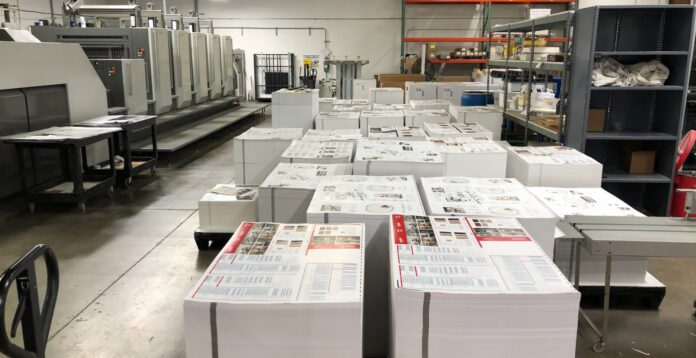
One of them, Envelope Mart USA, manufactures and prints millions of envelopes every day and distributes them to high-volume mailers across the U.S.
Shapiro’s other business, H.O.T. Graphic Services, is a regional printing company that serves corporate, creative and nonprofit clients.
“The tariffs are a concern but it’s not something we’re losing sleep over at the moment,” Shapiro said.
Most of the paper his companies buy is made in the United States, he said, but one of their U.S. paper suppliers notified him that some raw materials used to make their paper comes from Canada, Mexico and China.
“We’ve dealt with disruptions for years, not so much because of tariffs but because of supply and demand, when paper mills shut down facilities,” Shapiro said.
Some of the big mills have transitioned from plants making paper to making corrugated cardboard because of all the growth in packaging with Amazon and other retailers. There have been times when we’ve been put on allocation for the amount of paper we can buy.
Greg Shapiro
In addition to raising the cost of paper, Shapiro said tariffs on aluminum are impacting his businesses because they use aluminum plates for printing.
“It’s not a major cost for printers, but it’s significant. I’m sure we spend well into six figures every year on printing plates.”
The ink and glue used by Envelope Mart USA and H.O.T. are manufactured in the United States and should not be affected by tariffs, he said.
One of Envelope Mart’s main paper suppliers notified its customers in March that it plans to add a surcharge once the tariffs go into effect.
“That would not be a good development for us because of the high volume of paper purchased,” Shapiro said. “It’s kind of out of our control, but we would be forced to pass the added costs on to new business, new contracts. For contracts that are already in effect, we probably will have to absorb some of those costs.”
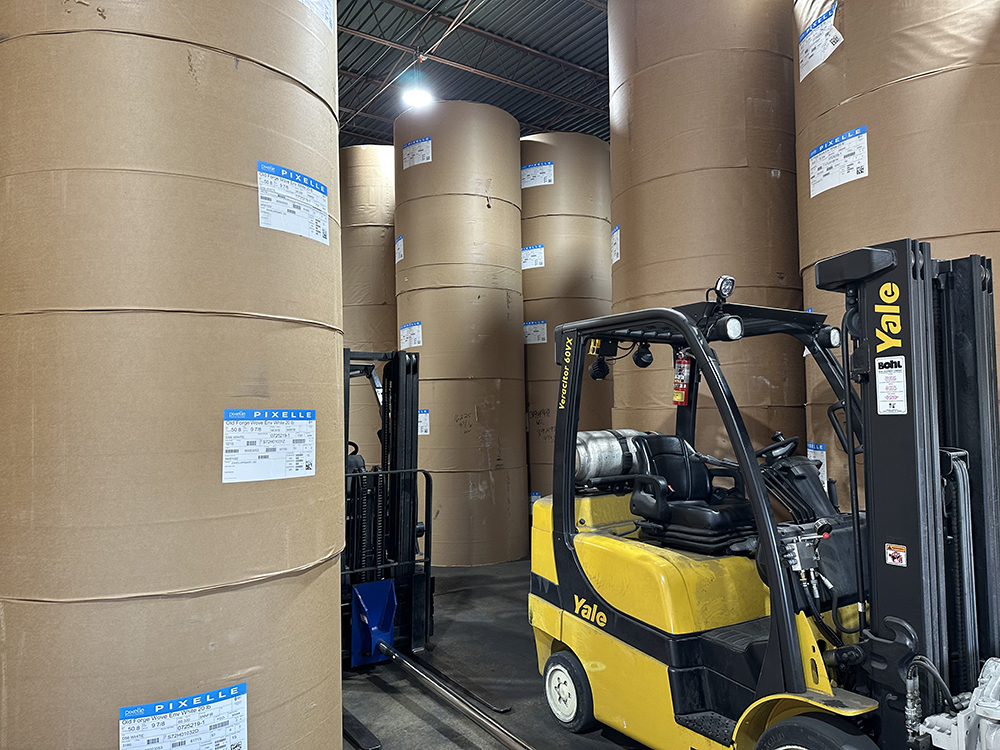
(Courtesy Photo/Greg Shapiro/Envelope Mart)
Jerry Hidalgo, president of Maumee-based Metric Metal/Parker Steel, said the majority of the steel and aluminum they purchase comes from Europe.
Metric Metal, as reflected in its name, specializes in metric-sized metals and sells bars, tubes, plates and sheets of steel, aluminum, copper, brass and carbon to firms across the U.S. and around the world.
“We’re a small company that buys relatively small quantities of a lot of different items,” Hidalgo said. “We’re not the target of the tariffs, but we’re collateral damage.”
Hidalgo said his company has been dealing with tariffs since mid-February.
“Everything we sell is manufactured to millimeters, and the majority of our products come from Europe, where metric is the standard.
The tariff on aluminum was 10 percent, and now it’s 25 percent. If the tariffs impact us, it makes it more expensive for our customers, certainly. If we’re selling into Canada, the tariff has to be included in the cost.
Jerry Hidalgo
“The tariffs will make it more expensive for our customers. Like most businesses, when you get an increase in your expenses, it has to be passed along to the consumer,” Hidalgo noted.
Hidalgo said Metric Metal/Parker Steel focuses on customer satisfaction. For example, he said that phone calls to the firm are answered personally by sales people, not a voicemail system. And when a customer calls to place an order, 96 percent of the time the product is shipped that same day.
Hidalgo said the tariffs on imported metals could have a silver lining for the American steel industry.
“Domestic steel mills will be in a position to be able to raise their price because the price coming from outside of the U.S. is being raised,” he said. “Tariffs will create more room for the domestic mills to be able to raise prices.”
Will your business be impacted by the tariffs? Let us know. Contact us at [email protected].
English Channel swimmer to take a dip in Maumee River for a cause

MAUMEE – Think of it as a two-for-one event and a healthy partnership. Partners for Clean Streams will have a kickoff meeting to train water quality monitor volunteers from 1-3 p.m. on April 19 in the Indianola Shelter at Farnsworth Metropark.
There will also be a special guest: A woman who is training to swim the English Channel, and she has a few things to say about the need for clean water and empowering women.
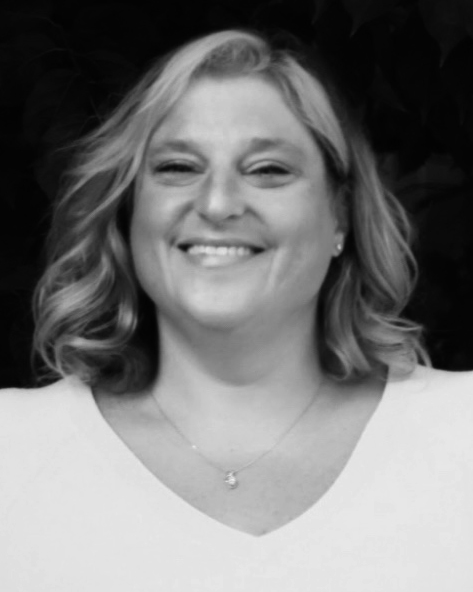
Oh, yes, and that woman, Amy Wamsley, will take a dip in the Maumee River to punctuate her messages, including why swimming is healthy in more ways than one.
Wamsley, 49, is a business consultant from the Dayton area who has been training for months to do the iconic marathon swim from England to France, considered by some to be Mount Everest of water-based endurance feats.
“I first dreamed of swimming the English Channel when I was 12,” Wamsley said. “I came across a magazine article about swimmers who completed the challenge. At the time, I was a competitive swimmer, and I remember thinking, ‘If they can do it, so can I.’”
Wamsley set a goal of completing the swim by age 50. “My swim window closes just three days before my 50th birthday. This is my chance to fulfill that promise to my 12-year-old self.”
There’s more to it than plunging in the water. Wamsley registered with the agency overseeing the swims and was assigned a timeframe during the channel swim season. She leaves for England May 14 – her swim window is May 30 through June 10. She’ll be accompanied by a piloted boat with two friends on board for medical and overall support.
She said typically there are several swimmers making the crossing at a time, spread out in the channel. The swim takes about 15 hours to cover the roughly 21 miles.
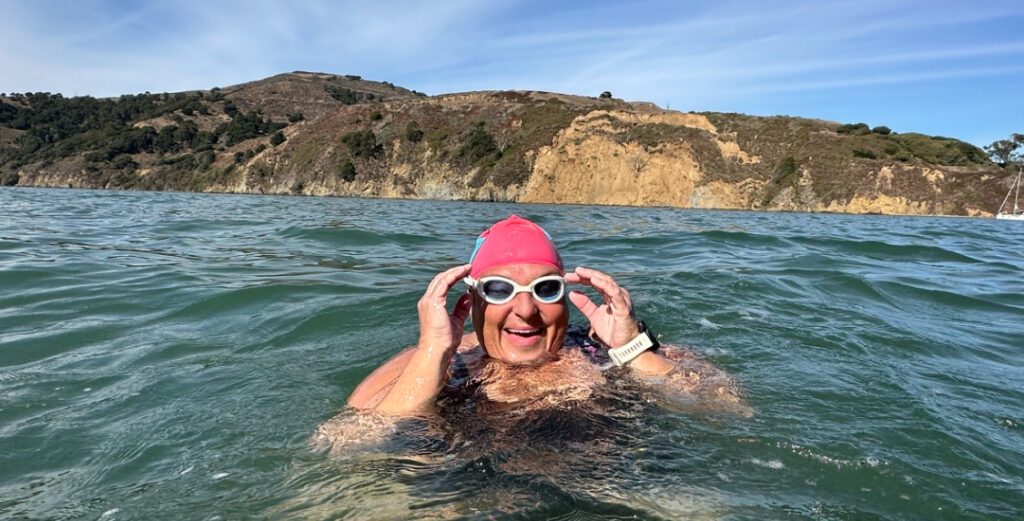
Why be in Northwest Ohio and connect with Partners for Clean Streams, based in Perrysburg? One of her goals of the channel swim is to raise awareness of the need for clean water.
“Clean water is essential, not only for swimmers, but for entire ecosystems,” she said. “Poor water quality can expose people to harmful bacteria, chemicals and pollutants, increasing the risk of infections and illness.”
Wamsley speaks from experience. On a training swim in what was thought to be clean water, she got a severe bacterial infection. She’s also seen trash and pollution in some swims.
“We drink this water. It’s what we’re swimming in, pulling fish out of,” she said, referencing the Maumee River’s famous Walleye Run.
To spread her message of water health, Wamsley has reached out to agencies connected to Ohio’s scenic rivers – of which the Maumee is one.
“Our organization built our mission around partnering with individuals and organizations who share similar missions,” said Kayla Kirkpatrick, Partners for Clean Streams program specialist. “When Amy came to us, she expressed her reasoning, which we were very excited to hear.
“We decided that our April 19 Water Quality Monitoring Training event would be a perfect way to tie in the two missions. We believe in having fishable, swimmable, drinkable waters. How could we say no?”
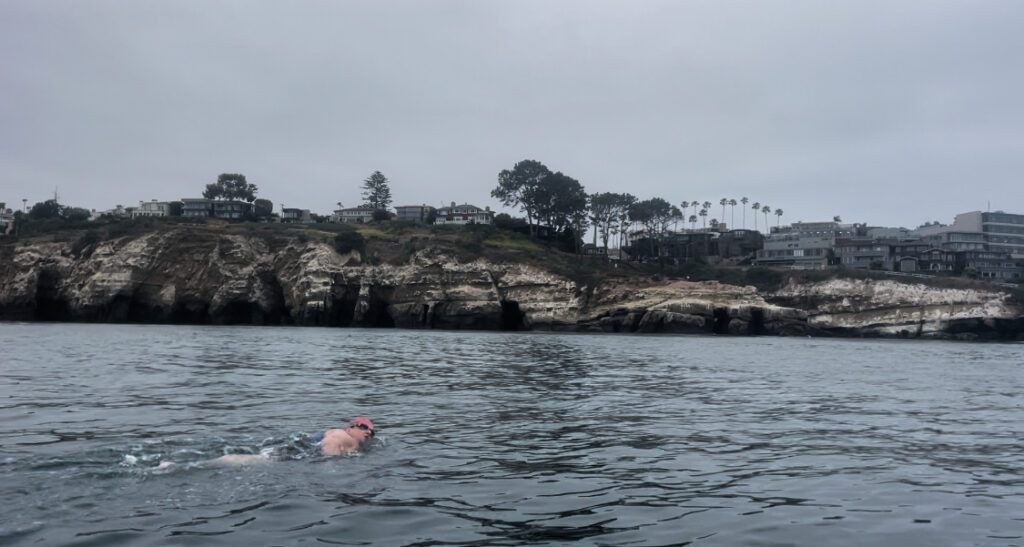
Kirkpatrick continued, “We felt that we could support each other’s mission by sharing our volunteer base to her efforts. In return, we felt that Amy’s swim would be a great way to spark the interest of people in our community to come join us, not just for the event itself, but continue to take part in the future.”
Wamsley addressed the health issue. “Swimming is one of the best full-body exercises, offering physical and mental health benefits. On a personal level, swimming has had a profound impact on my own health journey.”
There’s more to her undertaking than health and promoting clean water. “I don’t look like someone who’s going to swim the English Channel,” she said matter-of-factly.
“It doesn’t matter what our bodies look like. No matter how old we are, we can still try to [pursue dreams]. There’s a whole thing about women empowerment. We can still encourage each other to succeed in whatever it is that we want to succeed in.”
Wamsley added, “This past year has been one of the hardest of my life, and I truly believe that without swimming and a dedicated goal to work toward, it would have been much more difficult to navigate.”
Registration for the April 19 training is available here.
