
SEIU Local 1 janitors seek fair pay

TOLEDO — As negotiations continue between SEIU Local 1 and janitorial contractors, workers throughout Toledo say they’re scraping by while adhering to their duties of keeping essential buildings clean.
The Toledo Master Janitorial Agreement, which covers about 400 janitors, expires today, July 14. Camilo Villa, lead negotiator of SEIU Local 1, says that a new contract is being negotiated, with talks of an extension.

The SEIU Local 1 unites 50,000 workers across the Midwest, including five states and 10 cities. These workers include janitors, security officers, school service workers and more.
Local 1 began in Chicago in the early 1920s by residential maintenance workers with the goal of maintaining high labor standards for property service workers everywhere.
Tanya Staples, a Local 1 member who works at ProMedica’s Wildwood facility, said her current wages barely cover necessities. Staples has more than 25 years of experience in janitorial work – four years at ProMedica – and earns just under $15 an hour.
“I love my job,” Staples told the Toledo Free Press. “I give them my number one, but it’s sad because even with my number one I’m making pennies. My check sometimes makes me want to cry. I don’t even buy a full dozen of eggs.”


Union organizers are pushing for a $15 minimum wage as a baseline, though that figure still falls short in today’s economy.
“We know these institutions have the resources to pay the janitors a living wage,” Villa said about ProMedica. “They are not only very successful; they also receive a lot of public assistance for various things.”
For a workforce that is predominantly Black, the union is also hoping for the recognition of culturally significant holidays, specifically Juneteenth and Martin Luther King Jr. Day.
“Juneteenth represents the end of enslavement of black Americans,” Villa said. “If you’re making $13.75 or $14.90 trying to survive, you’re not really free, right? The symbols matter when we’re talking about the dignity of our members, and it’s tricky because often the buildings don’t close for those days, but they close for the Fourth of July.”
Staples disclosed she wanted to wear a Juneteenth shirt to work one day but didn’t for fear of offending coworkers and patients. “There’s no Black doctors, no Black nurses,” she said. “I didn’t want to offend anybody.”
Michael Evans, a janitor who works the evening shift at Owens Community College, cleans buildings from 6 p.m. to 2:30 a.m. Monday through Friday. He transports supplies across campus in his own vehicle, without mileage reimbursement. He makes $13.90 per hour.
“You better have some gas,” Evans said.


Evans, a single father who’s recovering from a surgery he had in June, said he provides for his daughter by working nights.
“She gets off at five and I try to get her,” Evans said. “I get her to my mom and then go in at 6. It’s just that I’m trying to keep her hair done, clothes, shoes, everything else to go along with that, and the financial end is really rough sometimes.”
Although working in schools and hospitals can make janitors like Evans and Staples more prone to illnesses, janitors like Evans can’t afford to get sick.
“You don’t even get your one paid sick day until you’ve completed your first year,” said Dana Sammour, SEIU Local 1 internal organizer and grievance representative. That’s the case for Evans, who has over 20 years of work experience in the janitorial field.
Amidst the struggles, Evans says he loves the work itself — especially when it comes to creating squeaky-clean floors.
“My work reflects who I am, what I am, what I do, and how I do it,” he said. “When you look at that floor, that floor represents me because it has a heck of a shine on it. I want you to wear sunglasses walking down that hallway because I want that floor to blind you, and if I was waxing the floor you’re gonna need hand rails because you’re gonna think it’s wet.”
He recalled restoring a classroom floor at a medical college that hadn’t been touched in 23 years. He was awarded by the hospital for his effort.
With all the hard work janitors like Evans and Staples put in, they say they still face unwanted stigma in the workplace.
“I always find that over the years I’ve done this job, they always treat the janitors like a lower class of people, unfortunately,” Sammour said. “If something comes up missing from the building, the first person they’ll suspect is the janitor.”
Under the current structure, wages vary by location and client contract, Sammour noted. While some members of the SEIU Local 1 make more than other janitors, they still need to be paid the minimum pay of the contract. The average remains below $15 an hour. Former employees from previous contractors may retain seniority and higher pay rates when accounts are taken over, but newer hires often start at the base.
The union’s next negotiation session is scheduled for July 22. Leaders, including Villa and Sammour, say they hope to finish contract talks, but will extend talks further if needed.
“Our members across the country and here have fought for a long time to get what they deserve,” Villa said. “There’s urgency — but also patience. We want to get this right.”
More information about the SEIU Local 1 can be found on their website.

Dragonfly species abound in NW Ohio

NORTHWEST OHIO — Dragonflies are out and about these days. Zipping, dipping and darting, performing high-speed maneuvers, feasting on thousands of insect pests — especially mosquitoes.
Look for them in flight or on open perches where they can scan and locate prey, all while monitoring other dragonflies entering their territory.
Thousands of species of dragonflies are known worldwide; 164 have been recorded in Ohio. Look for them in and around the typically still or slow-moving waters where most of them and their aquatic larva feed — often on mosquito larva. They’ll emerge to shed larva skin and take flight as adults.
The adults often sport beautiful iridescent colors and have great names to go with them.
There are dashers, dancers and darters. Skimmers, pondhawks, cruisers, forktails, pennants and gliders. And then there are meadowhawks. Great names for well-adapted predators.
Rocky Ridge creates dust up in S. Toledo

TOLEDO – Just west of the intersection of Byrne Rd. and Airport Highway, 30 acres of land is coming up on eight years worth of controversy.
“This was also slated to be the property for the jail,” said Kelly McKown, a resident who lives across from the contested area.
“Maybe that’d be quieter,” she said in jest, as empty trucks, one to three at a time, enter the driveway across from her home, and exit — full of materials—onto Byrne Road.

In 2017, the same parcel of land was part of a proposal for a new jail, which fell through. Then, four years later, Dennis Topsoil and Landscaping proposed to change the zoning to industrial for their mulch business. This attempt to rezone the area for industrial use was met with over 1,000 names from area businesses and residents petitioning against that rezone proposal.
Now, four years later, a different company — Rocky Ridge Development, LLC — has already started mining without the proper zoning, and the residents are unhappy, to say the least.
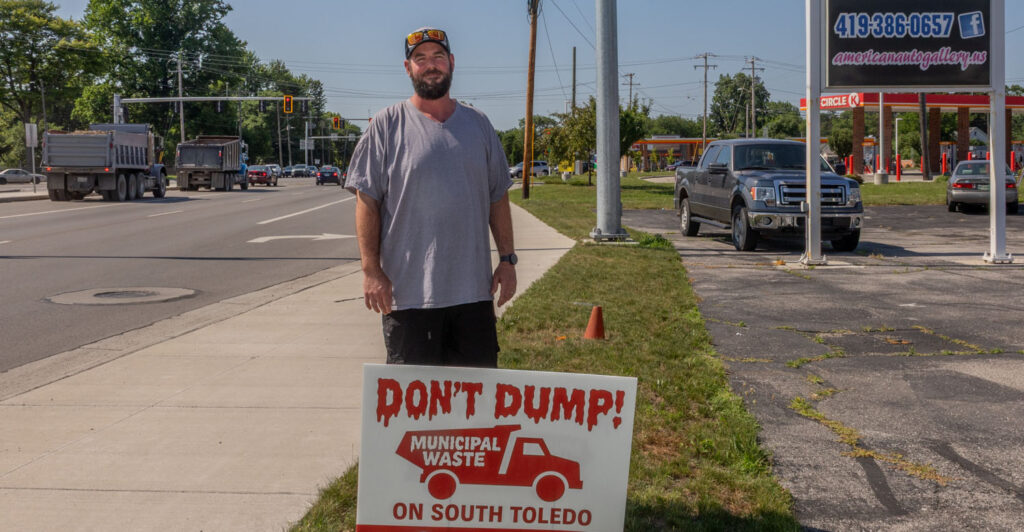
“It’s like they don’t care what kind of damage they do,” said Stephen Chenault, owner of American Auto Gallery on South Byrne Road.
“They widened this road out here, took a bunch of my property [through eminent domain], and then literally, you can see dump trucks lined up from the light all the way back to there,” he said, motioning beyond his car lot.
Chenault has been on S. Byrne since 2017, long enough to see the last attempt at changing the zoning to general industrial.
“It seems very odd. It seems like they get things done or don’t get the same kind of discipline [as other companies],” he said, referring to Rocky Ridge Development.
Another oddity is the two bedroom, one bathroom single-family home at 4004 Angola Road that sits on 30 acres and is currently used for the mining operation … without the proper zoning.
In 2021, Rocky Ridge Development bought the property and started mining on the land shortly thereafter, Chenault said.
But just recently, on May 14, Brandon Stansley, director of sustainability at Rocky Ridge Development, presented before the City of Toledo’s Planning and Zoning Committee a proposal to “…assist the city of Toledo and its regional partners, to provide high quality, safe, economical drinking water to consumers through the beneficial reuse of what we call DWTM — Drinking Water Treatment Material.”
Stansley was requesting the same parcel of land to be zoned for general industrial use so the company could continue to mine the land they admitted in the committee meeting they had been mining since somewhere around 2021-2022.
WTOL 11 reported that “a zoning approval from September 29, 2020, confirms the city only granted Rocky Ridge permission to establish a wetland — not a mining operation. An accompanying letter dated Sep. 30, 2020, explicitly states: ‘This letter does not grant approval for a mining operation.’”
During Toledo’s zoning and planning committee meeting in May, the cities of Toledo and Oregon were identified as the main clients associated with the mining operation, and Rocky Ridge proposed a plan to backfill the land with those cities’ waste product from water purification.
“Despite zoning issues, Rocky Ridge has received millions in city contracts to remove spent lime. One such contract, worth $11 million, was approved in December 2023. That contract was negotiated under then-director of public utilities Ed Moore, who retired just two months later. The city said that Moore would ‘continue to serve the city of Toledo in an advisory role,’” WTOL 11 reported.
Shortly after, Moore was hired as the managing director for Rocky Ridge Development LLC, and even represented Rocky Ridge before city council when they requested the zoning change.
“Current zoning does not allow for mining operations,” Stansley said during the committee meeting. “This is, in fact, the primary reason for asking for the zoning change.”
Regardless, residents have said the mining operation has picked up speed in the past year, and especially in the last few months.
“It seems like there’s been a significant uptick in the vehicles and the amount of stuff,” Chenault said. “I mean, the other day – I’m not joking – I don’t know how many trucking companies they would have had to hire, but we saw in the course of that day hundreds of semi dump trucks coming out of there, just nonstop.”
The Toledo Free Press talked with Kelly and Jason McKown, who live across from 4004 Angola Road, on their front porch.


“I’ve seen probably 10 to 15 trucks,” Jason McKown said during the 15-minute time frame that the Free Press had been speaking with the couple, who joked that the trucks come about every five minutes.
The McKowns and other residents in the area have voiced their displeasure with Rocky Ridge through a petition, steady involvement in public forums, and with yard sides reading, “Don’t Dump on South Toledo.”
Residents’ main concerns have been dust, effects on individual’s health, resale value of their properties, noise, and the viability of the land after it is mined and filled in with DWTM.
“Since I moved here I’m now on a maintenance inhaler,” Kelly McKown said. Her asthma symptoms have worsened since she and her husband moved to Angola Road two years earlier.
“Ever since we got here, it’s harder for me to breathe. And the dust? It’s incredible. It’s everywhere, like, you can’t have your windows open. You’ve power washed this,” she said speaking to her husband and motioning to the driveway, “I don’t know how many times.”


Toledo City Council members Nick Komives (at-large) and Adam Martinez (District 2) both had concerns with the development, mainly the potential health effects of the dust and any potential water contamination that could happen during the industrial actions on the land.
Moore said a five-point dust mitigation plan would solve the issue of dust, and would include rumble strips and street sweepers applying a synthetic polymer to the dust. In his statements to City Council, Moore assured the council the dust suppressant material was a non-petroleum product despite it feeling like “baby oil.”
Residents, including Bill Hoag, a local organizer in the area who owns a number of residential properties in the neighborhood, contradicted Moore after a city council meeting on June 3, emphatically claiming the dust suppressant contained oil.
“Byrne Road’s all oil,” he said, and complained of “an oil slick” left on Byrne Road from the suppressant.

Even with the use of street sweepers and the dust suppressant, some residents still complain of dust. Other individuals in the community, like Michael Schrickel, who owns Chop Machine Cycles, a custom motorcycle shop in the area, initially voiced concerns but said publicly at the committee meeting that the dust concerns had been solved with the dust mitigation measures put forth by Rocky Ridge Development.
Yet, for all Rocky Ridge’s efforts in the area to make good with neighbors, including helping to landscape a neighbor’s lawn, offering to give the land back to the city as a wetland when the project finishes, and the efforts of mitigating dust, many residents are still wondering how Rocky Ridge has been allowed by the City of Toledo to operate without the correct zoning.
“If I was out in the back of my yard right now building a deck without a permit, they’d shut me down,” Jason McKown pointed out, and then relayed that his brother-in-law tried to build a handicap ramp without a permit and was shut down.
Chenault said he had a similar experience when he tried to put a building up at the American Auto Gallery. “I have a laundry list of things they want me to do for Toledo, but it’s like it doesn’t seem to apply to them in the same way,” he said.
On Tuesday, July 15, Toledo City Council is set to vote on the three ordinances dealing with Rocky Ridge Development’s request for a zone change. The ordinances in question have already been delayed at the past two Toledo City Council meetings.



Exhibition highlights artwork by Sisters of St. Francis

Main Library’s gallery hosts ‘Journey of Beauty‘
TOLEDO — This summer, visitors to the Toledo Lucas County Main Library have the opportunity to browse a collection of 59 pieces of art by 20 Sisters of St. Francis of Sylvania, Ohio.
The exhibition, titled Journey of Beauty, has never before been displayed in a public gallery, and includes a diversity of media spanning more than a century. It began on June 14 and will run until August 2.
The oldest piece in the exhibition is an oil painting of red roses dating back to 1905, painted by Mother M. Adelaide Sandusky, OSF, the foundress of the Sisters of St. Francis of Sylvania. Her legacy is reflected in the wide array of artwork spread around the Lourdes University campus and the sisters’ motherhouse, which is a combination of Mother Adelaide’s large collection from traveling, along with original pieces by the Franciscan sisters whom she encouraged to follow their creative pursuits.
“She operated on the conviction that, if you surround yourself by beauty, it will affect you and change you, open your soul and spirit,” said Sister Magdala Davlin, OSF, the artist of seven pieces in the exhibit. She said her hope for her artwork is that “it will touch others in their search for beauty, truth and goodness.”
Davlin has been a Franciscan Sister for 59 years, the majority of which she spent as a nurse. In 2021, she completed a full-sized bronze statue of Mother Adelaide, and the exhibit includes her smaller statue of the foundress, as well. She is also the creator of the most recent piece of art—a ceramic mural of Our Lady of Perpetual Help, which she completed this year.

This piece caught the eye of Kelly O’Brien, a local artist from Toledo who visited the exhibit on July 3.
“It is interesting to see the styles and the different eras” of the artwork, O’Brien said.
Both the Sisters of St. Francis and the staff of the library felt that the artwork by the sisters ought to be shared with the wider community.
“Main Library’s gallery space provides the Toledo Library the opportunity to collaborate with partners from across Lucas County to showcase the rich and vibrant artwork that is created in the community,” said Jason Kucsma, executive director of the Toledo Library.
“Having works from the Sisters of St. Francis’ art collection—a true hidden gem in the Toledo region—on view for customers to enjoy has been a highlight of the library’s summer programming.”
For the sisters, nearly 40 of whom gathered for the gallery’s opening reception on June 21, the exhibition has provided an opportunity for them to see pieces they didn’t know about and to share a bit of their community’s spirit with people who may not visit their campus.
“It is very humbling to see that heritage, and to bring that message of the importance of beauty and hope to a broader community,” said Sister Barbara Vano, OSF, vice president for mission and ministry at Lourdes University. She has several photographs in the exhibit.
Vano noted that art is a subset of their wider Franciscan mission of acknowledging the beauty of creation and bringing more beauty into the world. She said it is the ability to capture a detail or a moment that people would ordinarily hurry by that inspires her photography.
“It allows me, and hopefully others, to spend a little bit more time in reflection to the goodness in our world and the times when we aren’t always as attentive to what is happening in our world,” she said.
Mary Hamann, a retired art teacher from Toledo, found herself drawn toward the exhibition because of what she described as a recent “spiritual awakening” that has happened in her life. While she has largely left the Catholic religion she grew up with, “I still go back to, there is something there.
“I wish we had more spaces where people could talk about science and spirituality without religion,” she said.
Even for those who might not connect with specifically religious imagery, the Sisters of St. Francis hope there is something there to inspire everyone.
“On the small scale, this is a very talented group of sisters that can compete with other artists anywhere,” said Christine Deemer, the art and rare book curator and congregational archivist for the Sisters of St. Francis.
“Their message is religious-based most of the time, but we are all looking for beauty.”

Lucas Camuso-Stall: People’s Library

Ohio library funding faces cuts amid growing community need
In this week’s Behind the Byline, host Jaden Jefferson sits down with Lucas Camuso-Stall, director of Government Relations and Advocacy at the Toledo Lucas County Public Library, to unpack major changes to Ohio’s library funding model.
For decades, Ohio’s public libraries have been supported by a stable portion—1.7 percent—of the state’s general fund. But in a significant shift, the new state budget replaces that model with fixed-dollar appropriations: $490 million in 2026 and $500 million in 2027. This change, Camuso-Stall says, will result in an estimated $1.6 million operational funding loss for the Toledo-Lucas County system alone, and potentially more across Ohio’s 257 library systems.
The new funding structure also introduces added strain, as statewide services like internet infrastructure and the State Library of Ohio must now be funded from the same pot. Meanwhile, the governor’s proposed increase in funding was rejected by the legislature—despite Ohio having the second-highest library usage in the U.S.
Camuso-Stall also addresses broader pressures on libraries, including political rhetoric and legislative attempts to restrict access to books on gender and sexuality. He applauded Gov. Mike DeWine’s veto of one such measure, calling it a win for intellectual freedom.
Despite financial uncertainty, there is still optimism. Lucas County voters recently approved a $153 million bond for capital projects, including the new Washington Branch Library set to open on Alexis Road.
“People love their libraries,” Camuso-Stall says. “We’re here to help them read, learn, connect—and that’s worth protecting.”

Toledo enforcement targets lead risk

TOLEDO – In a mobile clinic in a church parking lot, registered nurse Gloria Smith prepped Vibe Carswell, 7, for a finger-poke lead check.
“At any given time, there are 3,400 children with lead poisoning in Lucas County,” she said, stressing each syllable of the statistic. “That’s crazy.”
Smith is the lead case manager for the Toledo Lucas County Health Department. Of the health department’s three lead caseworkers, she is the one whose sole focus is on children who test positive.

“My goal is to educate the parents, to help them to get those levels down as quickly as possible,” Smith said.
One child at a time, Smith works to find those who are already poisoned. When they are, the environment is prime suspect.
“About 98 percent of our cases are due to old housing stock,” she said.
One at a time, certain houses are supposed to be checked and certified by the City of Toledo. Now, for the first time in years, the city has the legal authority to hold owners to that.
On paper, the city’s lead ordinance has been in effect since 2020, but a lawsuit put enforcement on hold in 2022. After two courts heard the case and sided with the city, the Ohio Supreme Court refused to hear an additional appeal earlier this year. That left the lower court’s ruling in place.
So, the deadlines now have teeth – misdemeanor charges and fines – with the end of this year marking the cutoff for owners to register buildings in certain parts of the city.



For any building older than 1978 – the ones most likely to have lead-based paint – rental properties with up to four tenants and daycares are required to be inspected. When they pass, they are issued a certificate that any prospective renters can look up.
That peace of mind is something Arselia Ruiz of Toledo wishes for. She rents a home in that risky category. It has not been inspected, and her kids are sneaky.
“They’re future assassins,” she said of Arryn, 4, and Alesanpra, 7. She also has a one-year-old.
“I have to watch my kids like a hawk,” she said. “I’m worried they’ll get a hold of it,” from peeling or chipping paint when she is not looking.
Ruiz brought the older two for tests at the same event, hosted by the Indiana Ave. Missionary Baptist Church, last month. They already get tests at annual pediatrician appointments, but until her house is checked – that’s not enough.

Lead inspectors agree with the health department – concerns like hers are valid. In the little over two years as an inspector, Tiffany Brown said she has met families whose children were poisoned.
“More than I ever expected,” she said.
A friend she met in the lead inspector training experienced it first-hand. Lead dust made it into the vents during a renovation, and several members of the family had dangerous levels in their blood, she said. When the house was closed up for winter, their symptoms were worse; that helped track down the cause.
But “there are hardly any [specific] symptoms, so you wouldn’t know unless you’re looking,” Brown said.
And there may not be any at all, according to the Environmental Protection Agency. Children under six years old are most at risk, and any symptoms that do appear can range from fatigue to learning and behavior problems.
In addition to being a lead inspector, Walden Wilson is also a landlord. He understood the concerns about the ordinance from that perspective, but the chance to prevent lead-related illness needed immediate attention. He is relieved the legal roadblocks are out of the way.
“Because of the homes I’ve seen, I am glad they are doing it because there are some homes that I would not want to see people moving into knowing that it’s not safe,” Wilson said.
He expects his business to ramp up as enforcement kicks in.
“The property owners for the most part have been very diligent as far as ‘what do I need to do to handle it? What do I need to take care of?’” he said. There are some who do not have that same attitude, at least at first.
“When they get the reality – ‘You’ve got lead on your property – that’s when they wake up,” he said.
Ruiz wants to move somewhere newer, or at least certified. But financially, it is impossible for her right now.
“I’m going on a needle and thread,” she said before listing the cost of her most recent grocery trip. “So I’m taking that risk with that apartment.”
Her situation is a familiar situation for many residents of the Central Toledo neighborhood that’s within walking distance of the church’s event.
There, and across the community, “African Americans and the Latino community” are falling through the cracks in lead prevention and detection, associate preacher C. Jerome Graham said.
Access and awareness were two main reasons he and the leadership put on the lead-testing event. With inflatables, a food truck and family-oriented vendors – they wanted it to feel more like an adventure as opposed to a trip to the doctor’s office.
“If you make it fun, they will come,” he said.
When they turned the corner into the parking lot, Arryn and Alesanpra rushed right over to the bounce house. It gave their mom a break from shouting at them to ‘stay close’ and to ‘get away from the street’ before their tests.
“My kids doing this – it’s important to me,” Ruiz said.
“I think everybody should do it, because there’s people out here whose kids could have a condition or illness and the whole time it’s because they’ve got lead in their system.”
Inside the mobile clinic, Nurse Gloria wrapped up the test but let young Vibe call the shots.
“You see the black line?” Smith asked. “When your blood gets to the black line, say ‘All done now!’ okay?”
When she shouted she was done, Vibe walked away with half-a-dozen stickers and kudos from the lead expert.
“Girl, you are good! You’re so brave. High five!”
Lead Resources:
∙ For Lead Screening & Prevention in Lucas County – or call the Toledo Lucas County Health Department at 419-213-2013
∙ Outside Toledo or Lucas County: Contact your county health department or your primary care provider.