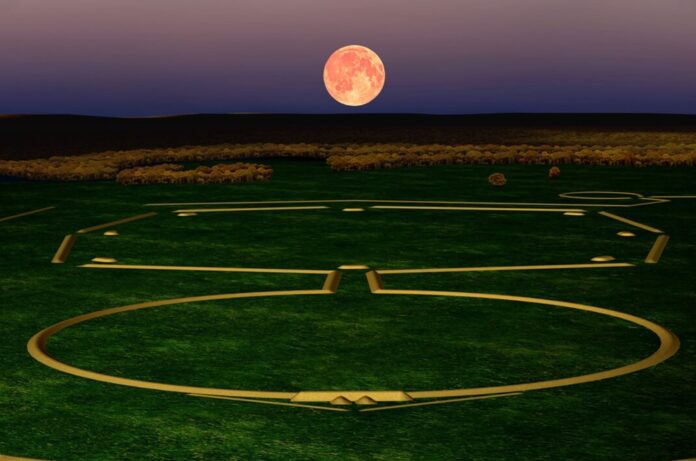
Upcoming lunar event offers unique connection to history and more
NEWARK, OHIO — Being in the presence of 2,000-year-old architecture is rare, especially in the U.S. This past January, that experience got easier for any Toledoan willing to take a day trip down to Newark, Ohio to visit the Octagon Earthworks, a complex of earthen barriers which create a unique connection to the natural world.
For the past 100 years, the site had been used as a golf course by the Moundbuilders Country Club, which limited the site’s visitors mostly to those willing to pay dues and play golf, only offering two days a year for public visitation.
In 2023, the Octagon Earthworks, along with five other sites called the Hopewell Ceremonial Earthworks, were deemed to be a World Heritage site by UNESCO, a designation shared by the Great Wall of China and the Pyramids at Giza. The activists, educators, academics and everyday citizens who made this possible went on to work with the country club to buy them out of the remainder of their lease on the land for $5.5 million in 2024.
Now the location is open to the public seven days a week, with guided tours provided Wednesday through Sunday.
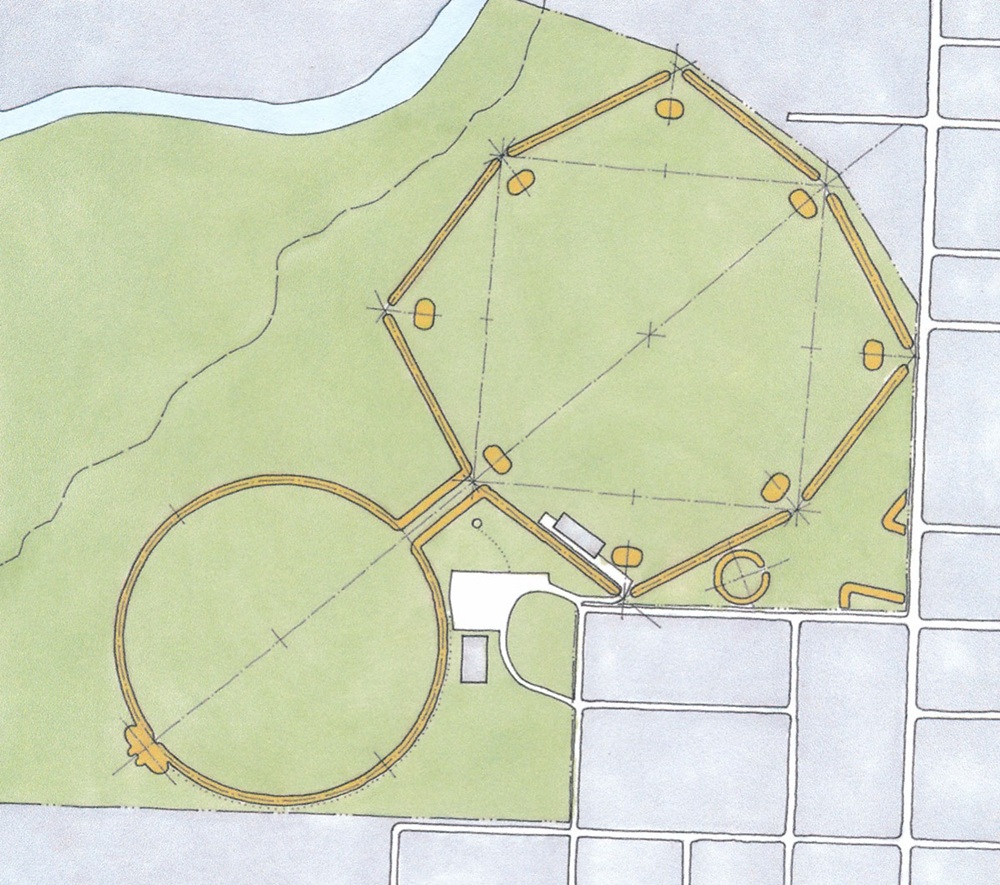
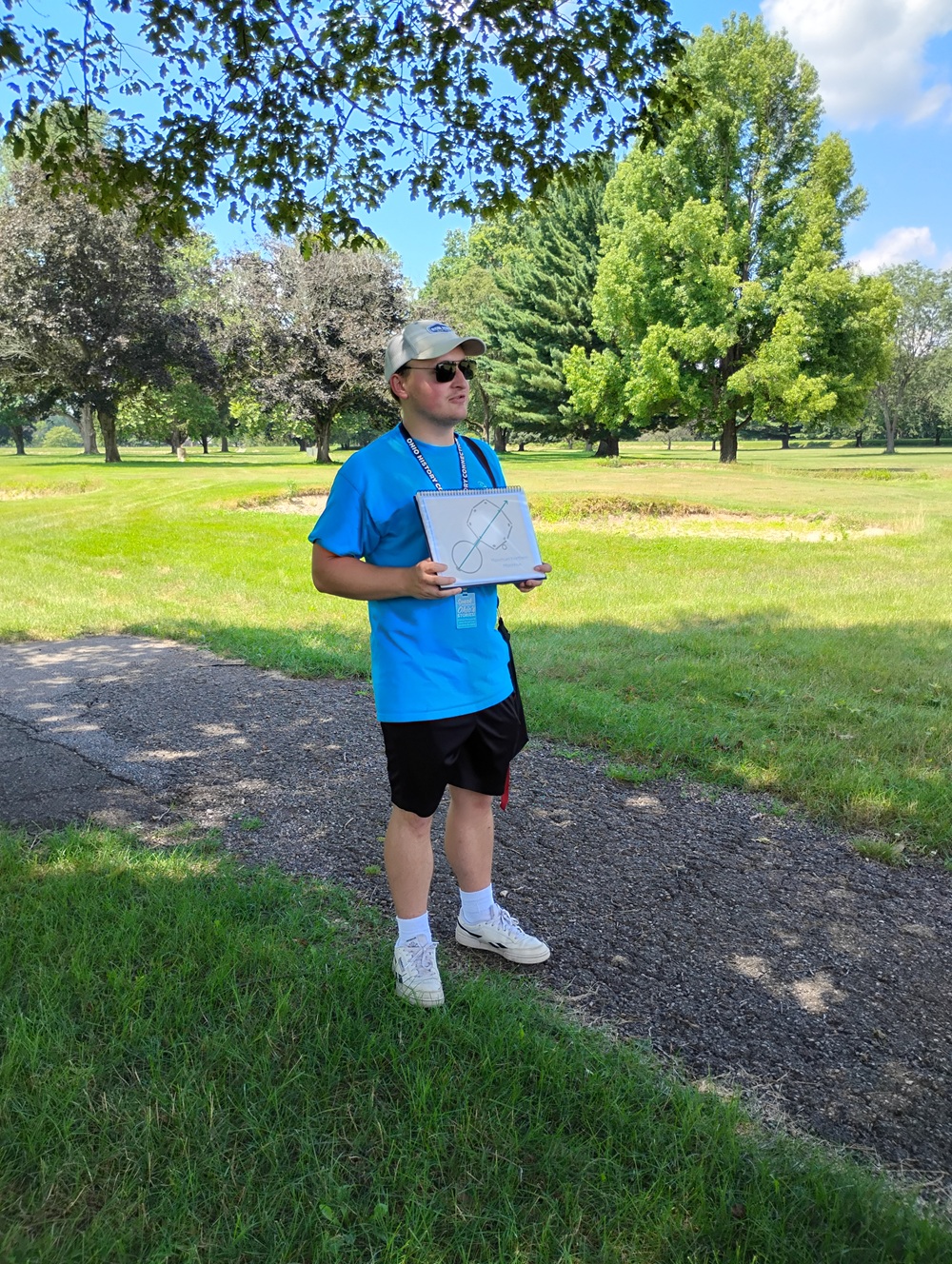
The site consists primarily of earthen walls approximately five feet high which form a 20-acre circle connected by a hallway to a 40-acre octagon. Six of the octagon’s walls are disconnected providing entrances, each of which has a smaller “barrier” or “loaf” mound which blocks the opening from view when a visitor stands in the middle of the structure, creating a consistent horizon line across the entirety of a visitor’s line of sight.
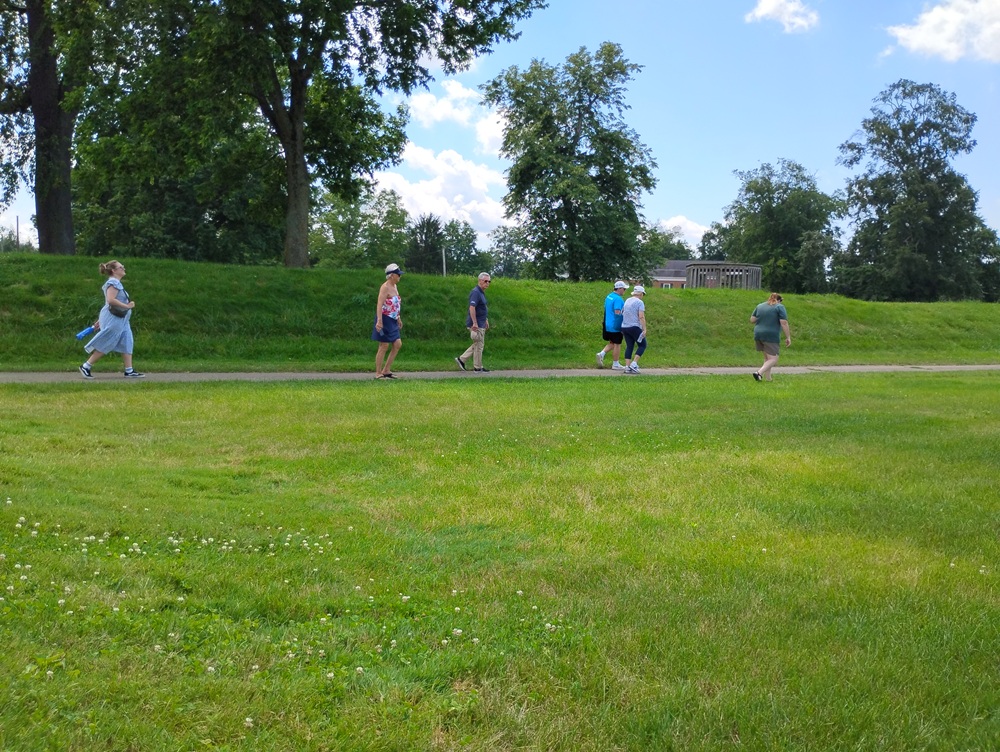
Pictured from left to right: Heather Liming, Adelle Faulkner, Ralph Slater, Andrew Selse, Cynthia Slater, and Becca Kelly.
(TFP Photo/Spencer Myers)
“When kids tour the site, I have them stretch out their hand and trace the tops of the mounds surrounding them,” said interpreter Becca Kelly on our tour of the Earthworks. Doing so shows that the designers measured the walls not from their base, but instead
by sea level.
This sense of a horizon, along with the entrances, is necessary to create a sense of an
interior.
“Looking around, you can feel that you are, in this moment, closed in by these walls,” Kelly said, encouraging the group to sit with that sense of being inside a structure despite it not being enclosed by walls leading up to a ceiling.
To maintain that interiority, visitors must not walk over or climb the mounds. Doing so also guides visitors along what interpreters believe are the intended pathways of the original Hopewell designers.
Working in collaboration with Indigenous partners, interpreters believe the earthworks were used as a gathering place for religious and cultural ceremonies. Artifacts like obsidian traced to a caldera in Yellowstone found in mounds in Chillicothe indicate that visitors came from all over the continent for these events.
Additionally, the Octagon Earthworks lack of items indicate that the site was revered.
“What’s interesting about these sites is that they were clean. We have little evidence of trash piles. They were pretty much cleaned out,” said Andrew Selse, a tour guide from Ohio History Connection. This sets the site apart from areas used for living or trade as those would have included more evidence of waste disposal and other signs of everyday life.
Evidence for the core events held at the earthworks is shown in its layout, as research has shown the walls, entrances, and corridor of the structure align with the 18.6 year cycle of the moon. At the core of this design is the structure’s alignment with the maximum northern moonrise, which runs through the entirety of its center.
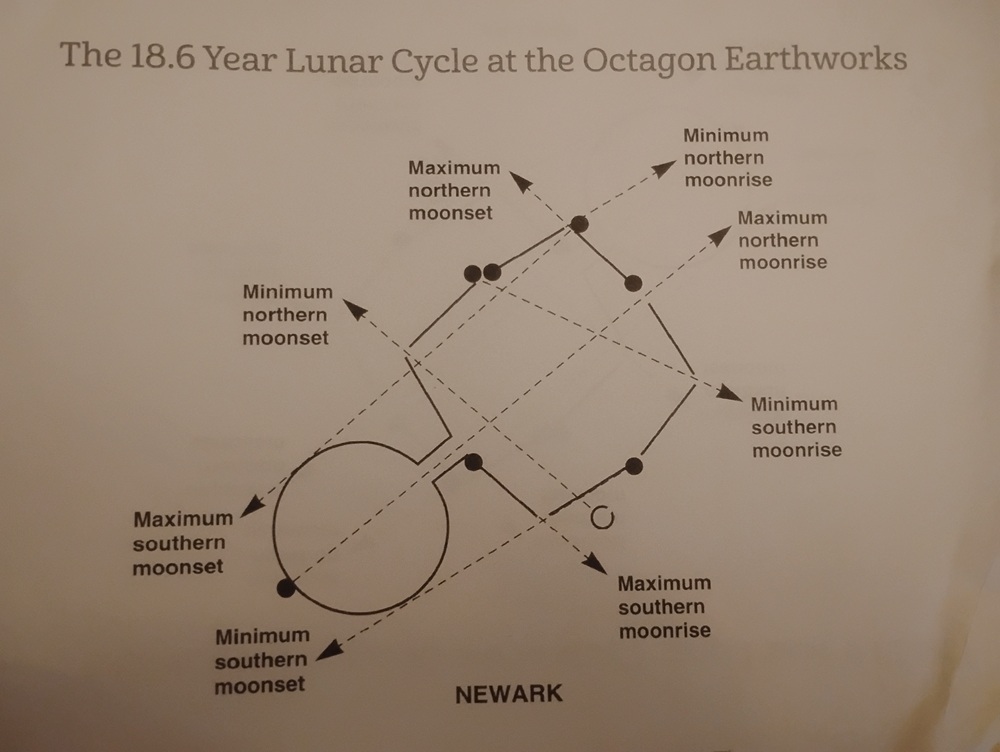
Because of the mathematical precision required for this design, UNESCO describes the site as “a masterpiece of human creative genius.”
In order to become a World Heritage site, the earthworks needed to meet only one of ten possible criteria. According to Jennifer Aultman, Chief Historic Sites Officer for Ohio History Connection, the easiest to prove for the earthworks was criteria 2: “to exhibit an important interchange of human values, over a span of time or within a cultural area of the world, on developments in architecture or technology, monumental arts, town-planning or landscape design.”
The site could have received the same World Heritage designation based on just this criteria, but Glenna Wallace, Chief of the Eastern Shawnee Tribe of Oklahoma, and other organizers worked with UNESCO auditors to ensure it also met criteria which connected it to the genius of its designers.
Visitors to the earthworks will notice vestiges of the country club including golf club patterned carpet lining the visitor’s center, raised earth to tee off, shorter varieties of grass of old putting greens, and sand traps dotting the premises.

(TFP Photo/Spencer Myers)
Before the transfer of ownership, the Country Club made those not interested in paying dues or playing golf less likely to visit, even if they grew up right next door like Selse.
“Growing up in the area, we knew that it existed, [but] the Octagon was much less talked about and much less visited because it was a private country club. So I’d never been here until I got the internship,” he said.
Despite spending time at the nearby Great Circle mound as an event space and recreation area, Selse still felt the connection to its Indigenous designers was not communicated.
“[Unlike the country club], the great circle, that’s a public park, and so growing up, I would go and eat my Chipotle in the parking lot there, throw Frisbees [and] have a grand old time hanging out. Graduation parties were done in the pavilions, but the history of it wasn’t really talked about or taught a whole lot at all, even in the schools. We knew there was a Native American presence in the area back in the day, but it wasn’t really taught in school at all, just how significant it was,” he said.
Ohio History Connection is hoping to change that by focusing resources on K-12 field trips and public education. According to Neil Thompson, Manager of Media and Public Relations with Ohio History Connection, “before January 1, there really were no school field trips to the Octagon.
“We have hosted many school field trips during the spring and will continue to do so whenever schools are in session or as part of summer camp/day care groups. We are
so excited to have students visiting the Octagon to learn about ancient Ohio history!” he
said.
Kelly, who also grew up in the area in nearby Dayton, appreciates being able to spread the story of the Earthworks to the public.
“Being the interpretive supervisor, I get to tell the story, right? And that is my job, to tell the story [to everyone] from cradle to grave. So I get to teach really young all the way up to old and I have the honor and privilege to be able to tell that story.”
Although it might be tempting to erase this troubling part of the Earthworks past, Ohio History Connection’s first order of business is ensuring everything is recorded.
“We’re first going to catalog everything on the property the same way we received. Every sand trap, bush, tree and putting green will be mapped before they are changed or removed,” said Kelly. This mapping process is being aided by two international interns from UNESCO: Subika Manandhar from Nepal and Marnie Davies from Australia.
This international coalition of researchers, architects, academics and educators parallels the global reach of those who choose to make the trip to see the Earthworks firsthand. According to Thompson, the Octagon Earthworks has seen visitors from Australia, Brazil, Canada, China, Ecuador, Germany, Italy, the Netherlands, Trinidad and Tobago and the United Kingdom in just the first five months of this year.
Cynthia Slater, a visitor who came from Connecticut with her husband Ralph to tour the site, was intrigued by the still unanswered questions surrounding the Earthworks and the people who made them.
“There are so many moving pieces to put together,” she said.
Slater, who has also traveled to see Stonehenge, recommends doing some research before visiting, but also allowing for some of the mystery to be a part of your enjoyment.
“The size of all this and the fact that so many people came here on the same day is amazing. I think you should try to know some things before you come here to really
appreciate it.”
Coincidentally, this year marks not only the transfer of ownership of the Octagon Earthworks, but also the maximum northernmost moonrise which comes only every
18.6 years.
According to Thompson, there will be two public events to appreciate and learn more about the moonrise on October 11 from 9-11 p.m. and November 7 from 5:30-7:30 p.m. Both will be at the Octagon located at 125 N. 33rd St., Newark, Ohio.
“The evening will begin with a talk introducing the Hopewell Culture and the period in which the earthworks were created and a brief explanation of the 18.6 year lunar cycle. After the talk, we will journey into the center of Observatory Circle to witness the moon rise at its northernmost point through the avenue and gateways that connect the Octagon to the Observatory Circle,” Thompson said.
Although the event will be open to the public, registration is required and attendance is
limited due to parking restrictions. Attendees are encouraged to carpool.
Because the event is focused on paying attention to the night sky, visitors should bring
lowlight or red light sources to preserve night vision and cut down on light pollution along with chairs, blankets, and other items to make themselves comfortable outside. There will be a short, quarter mile walk along uneven ground and pathways through the park at night.