Home Blog Page 56

Lucas County officials divided over divesting from Israel

0
Mona Abu Shaban, a Pro-Palestinian protester, talks about her experience of losing 42 members of her family in Gaza to Israeli bombing raids during a Lucas County Investment Advisory Committee Meeting on the 8th floor of 1 Government Center in Conference Room A in Toledo on Friday, Aug. 22, 2025. Commissioner Pete Gerken led an effort to get Lucas County Treasurer Lindsay Webb to divest the county from Israeli Bonds. (TFP Photo by Stephen Zenner)

A clash over the question of investing in foreign instruments

TOLEDO – Protesters packed a heated second quarter meeting where the Lucas County Investment Advisory Committee completed a motion that advised the Lucas County Treasurer against investing further in foreign instruments. 

“Foreign government bonds are code named for Israeli investment,” said Pete Gerken, a Lucas County Commissioner. “They’re the only government that we’re allowed to invest in.”

This was confirmed by Jim McCourt, the director of advisory services at Meeder, an investment advisory service that advises Lucas County in an official capacity. 
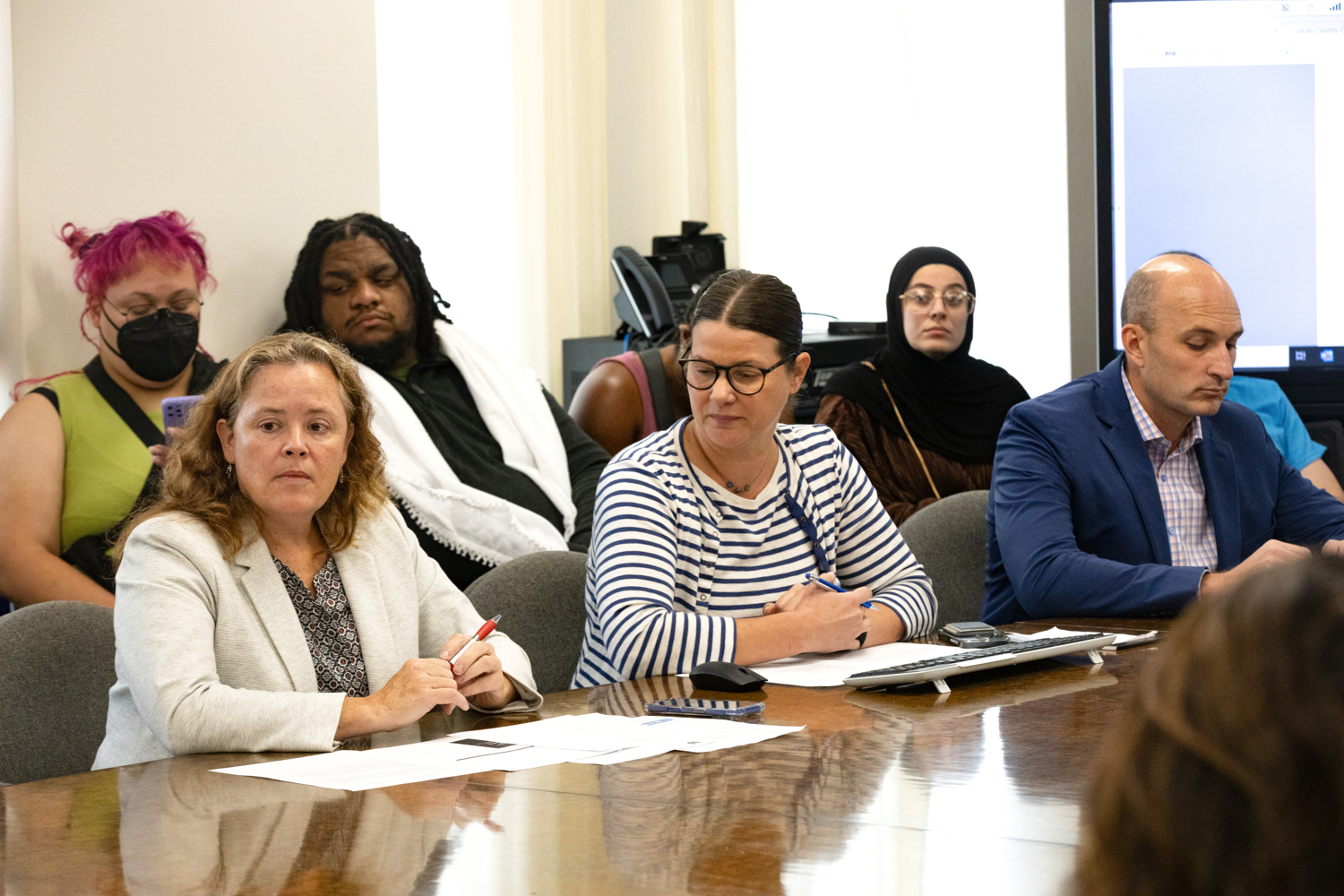
Lindsay Webb, the Lucas County Treasurer, Katie Clarke-Stumbo, the Chief Investment Officer at the Lucas County Treasurer’s Office, and Jim McCourt, the director of advisory services at Meeder, an investment advisory service that advises Lucas County in an official capacity, sit surrounded by Pro-Palestine protesters demanding divestment from Israel during a Lucas County Investment Advisory Committee Meeting on Friday. (TFP photo by Stephen Zenner)

Gerken was sure to clarify his speech for the investment advisory meeting, as there were many visitors to that meeting. 

About 20 Pro-Palestine protesters sat quietly as they held large pieces of paper demanding that Lucas County divest from Israel. Shoulder-to-shoulder, they took in McCourt’s PowerPoint report for the advisory committee in Conference Room A on the 8th floor of 1 Government Center.

“Thank you to our guests today. We don’t usually have this big of a crowd,” Gerken said before beginning to clarify his main points for the meeting. 

Lindsay Webb, the Lucas County Treasurer, clearly felt attacked by the coordinated pressure provided by Commissioner Gerken to divest Lucas County’s investments from Israel.

“I understand that you have a lot of power in this community, but this is the power that is mine,” Webb said, as she made known to the commissioner that she ultimately decides how the county invests its money. 

“Through both the voters and through the structure of county government, I’m the investing authority,” she said. 

1 percent of Lucas County’s investments, or as Webb said, one $5 million bond is invested in Israel from Lucas County, and will not reach maturation until December 2026. Until that time, it is not possible for Lucas County to divest from Israel. 

“But,” Gerken said. “I will not sit here and remain silent even if it’s a small piece of our pie, I’ll not sit here and remain silent without having community input on our investments. Even if it’s a penny or two in our investment, it’s still the idea our money is being invested there [Israel].”

Lucas County Commissioner Pete Gerken speaks about divesting from Israeli Bonds during a Lucas County Investment Advisory Committee Meeting on Friday. (TFP photo by Stephen Zenner)

Given the almost two years since the October 7, 2023 attack on Israel, Gerken said the Israeli government is now involved in a “…full blown genocide, starvation tactics by design, policies of violence, oppression and displacement” against the Palestinian people. 

And then Gerken took special care to clarify that these were the actions of Benjamin Netenyahu‘s government, and not indicative of Jewish or Hebrew people, stressing both Netenyahu and the government as the focus of his critique.

“Had this been done in any other country in the hemisphere or Europe, we would be outraged. We would not tolerate this” from any other country, he said. 

Members of the advisory board looked quizzically at one another, clarifying that the foreign investment bonds could not be divested until 2026. 

Gerken’s hardball attitude ruffled feathers across multiple advisory board members including Webb and Commissioner Lisa Sobecki’s proxy for this meeting, Chris Varwig, both of whom voted against the motion advising Webb to divest the county from Israel. 

Lucas County Commissioner Pete Gerken has a fiery back-and-forth with Lucas County Treasurer Lindsay Webb during a Lucas County Investment Advisory Committee Meeting on the 8th floor of 1 Government Center in Conference Room A in Toledo on Friday, Aug. 22, 2025. (TFP photo by Stephen Zenner)

Regardless, the motion passed, and did little in a direct way to change the county’s investments. But it seemed clear Webb felt this was a personal criticism from Gerken. 

“We can review the policy in the next six weeks,” Webb said. 

“The reality of the situation is I am doing my job very well. That’s the bottom line. I take issue that Commissioner Gerken wants to question that.”

Webb said she was doing her job to invest safely and legally, and raised the question of the legality of divesting from Israel.

“Directing me not to invest in instruments of a foreign nation by which the category is only Israel runs the risk of running afoul of state law, and I personally don’t think that that’s a wise move,” Webb said. “You’re setting the county on a collision course with the Attorney General of the State of Ohio. And I personally don’t think that that is a prudent use of time, resources or money.”

Gerken countered with the argument that they could divest based on Israel’s actions over the past two years, and Webb asked if Gerken wanted to be the test case for that line of thinking. 

“I would, absolutely! I think that’s what the county needs. It needs to be tested,” Gerken said. 

Mona Abu Shaban, a Pro-Palestinian protester, talks about her experience of losing 42 members of her family in Gaza to Israeli bombing raids. She spoke at a Lucas County Investment Advisory Committee Meeting on Friday, Aug. 22, 2025. (TFP photo by Stephen Zenner)

Members of the protest community, including Terry Lodge, a local attorney and peace activist, Dr. Jomana Al-Hinti, who went on a medical mission to Gaza in 2024, and Mona Abu Shaban, who said she had 42 members of her family killed by Israeli bombings in Gaza, all spoke for three minutes before yielding their time back to the meeting. 

Their statements, of which Abu Shaban’s seemed most impactful, were followed by Amichai Stout, the director of the Jewish Community Relations Council for the Jewish Federation of Greater Toledo. Stout mentioned he was not notified of the meeting until a half hour before, but said he was open to discussion.

“I hope that, next time an issue like this comes up, there would be a little bit more notice for our communities that maybe we could prepare something and have more to dialogue,” Stout said.

Gerken retorted that “people who lost 42 members of their family didn’t get notice of the bombs dropped on them.”

By the end of the meeting, Gerken and Webb were at an impasse, as it seemed she would not actively divest from foreign investments, though she agreed not to invest further. Anita Lopez, Lucas County Commissioner, assured Webb that the commissioners were not trying to attack Webb, and they agreed to review procedures in the next six weeks. 

But Gerken seemed to want more, and said he wished this could have been “collaborative.” The commissioner and treasurer left the issue as Gerken said he would use his authority as provided in the Ohio revised code to seek a different end to the dispute, and Webb encouraged him to do so. 

Ohio prisons to use AI to listen in on ‘all inmate’ calls

0
The Ohio Statehouse. (Photo courtesy of Jake Zuckerman / Signal Statewide)

The new state budget includes $1 million to fund a pilot program for AI software to record and analyze the hundreds of thousands of calls made by those incarcerated in state facilities.

This story was originally published by Signal Statewide. Statewide is a nonprofit media partner of the Toledo Free Press.

By Jake Zuckerman | Signal Statehouse

Starting next year, all phone calls involving some of the 45,000 men and women in state prisons in Ohio will be recorded and analyzed by new artificial intelligence technology. 

The recently passed state budget provided $1 million for the Ohio Department of Rehabilitation and Corrections to buy software that can “transcribe and analyze all inmate phone calls.” That data will be accessible to all law enforcement agencies in Ohio to support criminal investigations. The program is funded as a pilot through 2026 after the attorney general approves a location. 

State policy already allows state employees and private contractors to monitor or record calls of anyone incarcerated in state facilities, either at random or on a regular basis “for cause.” Those comments can lead to disciplinary or criminal consequences.  

However, manually combing through hours of calls is a tedious and time consuming process, naturally limited by the manpower to review it all. AI, via what vendors call “automated content analysis,” allows state officials to do the same thing, at a massive scale and a fraction of the cost. The technology is designed to flag for personnel any suspicious words and phrases it detects.

“Sometimes those reviews are getting information about crimes that are occurring in the prison, or outside the prison at the prisoners’ behest, threats against corrections workers, etc.” said House Finance Chairman Brian Stewart in an interview. “The potential to do what we’re already doing, in a more efficient way with less man hours and taxpayer expense, we thought was an intriguing idea.”

One vendor of such software, LeoTech, a Texas company, hired three lobbyists from two law firms to help make its case in the state budget, to House lawmakers especially. And Annette Chambers-Smith, director of the ODRC, met with state lawmakers and advocated for funding for the new system. ODRC spokeswoman Jenn Truxall said some Ohio prisons have already launched an “independent pilot program” using LeoTech software.

Lawmakers who support the technology, and the vendors themselves, say it’s a cost-effective way to cut down on drug flow into the prison and any ongoing crimes involving current inmates. But critics say it’s an invasion of privacy of both inmates and those in contact with them, leaving their data at risk of leaks or misuse by the vendors. 

Plus, several companies active in the industry have been accused of improperly recording phone calls between inmates and their attorneys – calls which are typically private affairs. 

Prison vendors join the AI rush

A handful of vendors nationally offer AI monitoring services for state penal systems. 

LeoTech sells its Verus product, powered by Amazon Web Services’ software. The company says Verus produces transcripts, can isolate “relevant communications” among high volumes of long phone calls, cuts through slang or coded terminology, and can “visually identify patterns and connections within your data to better understand complex communication networks.”

Aventiv, another Texas company, operates subsidiaries that offer a broader set of phone, video call, and GPS monitoring services. That includes Securus, which operates AI surveillance technology in prisons across multiple states. 

Rory McBryde, a prosecutor in Michigan, founded WireTap in 2019, a company that uses ChatGPT to transcribe jail calls and alert prison officials and prosecutors to possible criminal evidence. He described in a podcast his frustrations as a prosecutor that there was no easy way to surf through days worth of phone calls from suspects to get to the important stuff. 

“Almost every single felony domestic violence case where the guys are locked up, we know they’re calling their girlfriends, telling them not to testify or threatening them or saying, ‘Think about the kids,’” he said. “All of this stuff is illegal. That’s another felony.”

None of the vendors responded to interview requests. 

AI monitors accused of eavesdropping on attorney calls

Typically, communications between people and their attorneys are considered confidential. 

However, in some states that have deployed AI systems to monitor the calls in jails as well as prisons, the vendors have been dogged by accusations of eavesdropping on inmates’ calls with attorneys, which could give prosecutors a strategic advantage in trial or plea negotiations. 

For instance, the New York Department of Investigation issued a report determining that Securus inadvertently recorded about 324 privileged, attorney-client phone calls between late 2020 and early 2021. That’s a small subset of about 700,000 calls analyzed. 

Securus settled a class action lawsuit in 2020 for $880,000 with California prisoners who alleged their calls with public defenders had been unlawfully recorded. 

In jails in Maine, Securus’ surveillance systems recorded nearly 1,000 attorney phone calls recorded in four county jails in about a year. That affected nearly 200 defendants and 44 law firms, according to public records obtained by the Maine Monitor. The inmates and their attorneys filed a class action lawsuit against the company, later dismissed by a federal judge who found the plaintiffs failed to demonstrate the company intended to capture the attorney-client calls. 

And Securus and CoreCivic, a private prison operator, paid $5.3 million to settle two lawsuits in Kansas from 500 current and former detainees who say their calls with their attorneys were improperly recorded, according to the Kansas City Star. 

Privacy advocates weary of AI surveillance

Stephanie Krent teaches at Columbia University Law School and practices at the Knight First Amendment Institute there. She said there’s a yawning gap between old-fashioned call monitoring and omnipresent artificial intelligence creating a “permeating surveillance system.”

The recordings, she said, will sweep up not only the recordings of the inmates but law abiding people on the outside. From there, the vendors could sell or carelessly handle the data. And state prosecutors could gain a panopticon-level view of communication networks.

“I think those lawsuits are a lesson about trusting the intentions of these telecommunications companies and hoping that everything will work out as planned,” she said in an interview. 

Will Owen is a spokesman for STOP, a New York-based public interest nonprofit focused on limiting technological surveillance from law enforcement that has studied Securus’ rollout of the technology in New York facilities. 

There, he said, besides recording attorney phone calls, the technology has violated the privacy of innocent people contacting inmates, and its biased software produced disproportionate numbers of false positive flags on Black and other minority inmates. 

“This software is not just a threat to people who are incarcerated, but to their friends, family, children, their entire communities,” he said. “It deepens the reach of surveillance into already over-policed communities of color. And it’s very rife with racist biases, struggling with certain accents, tones that do not fit more Eurocentric standards. It’s just a really dystopian form of surveillance and expansion of surveillance.”

Lawmakers cite public safety interest 

The legislative text of the budget is vague in terms of how many facilities will be under the AI monitoring, but Stewart said his conversations with the ODRC suggested the agency would pilot the technology at one prison before rolling it out further. That’s Ross Correctional Institution, in Chillicothe. 

There, prosecutors say that Rashawn Cannon, a 28-year-old serving a sentence for felony assault and possessing a weapon while prohibited from doing so, murdered a 62-year-old corrections officer on Christmas Day last year. The death came amid reports from the guards’ union of understaffing, and a significant increase in use of force incidents between officers and inmates between 2013 (259) and 2023 (736). 

Stewart, an attorney, said he “assumed” the AI vendors have some means to screen out the lawyers’ calls with inmates. But he’s not worried about it, given the words would likely be found inadmissible as evidence.

Another supporter of the budget provision, Rep. Mark Johnson, a Republican whose district includes Ross Correctional, said he hadn’t heard about the attorney-client privilege problems and doesn’t think the state should be listening in on those calls. 

But he said he’s heard reports from corrections officers of drugs coming into the prison with ease, fueling a rash of overdoses from people with no ostensible contact with the outside world. The $1 million investment, he said, can help clean up the facility.

“There’s so many calls, a human being can’t do it,” he said. 

Late summer butterflies in Metroparks Toledo

0
Tiger swallowtail. (Photo by Art Weber, Metroparks Toledo nature photographer).

TOLEDO – Late summer is prime time for our largest butterflies, especially swallowtails and monarchs. Look for them in Metropark meadows and tallgrass prairies, as well as backyard gardens, where they are nectaring on summer blooms. Monarchs favor milkweeds, where they will also lay their eggs and their caterpillars will feed. It’s a wonderful time of year to enjoy the summer wildflowers swaying in the breezes of the season.

Midwest Travel: Put-in-Bay beyond the party

0
Erin Holden, Townes Sackmann (4) and Matt Sackmann pose in front of the Put-in-Bay sign near a playground.

PUT-IN-BAY – Though I’ve lived in Northwest Ohio since 2018, only this summer did I decide to make the relatively short journey to the party-right-of-passage destination of this region: Put-in-Bay (South Bass Island). It was Pyrate Fest, Saturday, June 28, when my family and I decided to make a day of it, donning our hastily put-together pirate gear.

Matt Sackmann donning a pirate hat for this summer’s Put-in-Bay Pyrate Fest aboard Miller Ferry. (TFP Photo by Erin Holden)

I had read that Pyrate Fest was a family friendly event, but also knew from plenty of informants that Put-in-Bay can be a wild ride, filled with drunken debauchery. As it turns out, both things can somehow be true! Here’s what our experience was like. 

Miller Ferry is one of two options for getting to the island (the other is Jet Express). If you plan on bringing your car to the island, Miller Ferry is the only option. For this trip, we were offered free tickets to this ferry (find their regular pricing here) and we opted not to take our vehicle, as we knew we had a golf cart from E’s Put-in-Bay Golf Carts reserved for us as well.  

Pyrate Fest/Other Events

We found a seat upstairs along the balcony where we could catch a nice breeze and people watch on the packed vessel, which was filled with families and pirates ready to party alike. We spoke to one such Pyrate Fest attendee from Powell, Ohio : Rachael Weis. It was her first time in Put-in-Bay, but she came fully prepared with a sword at her hip and a parrot on her shoulder.

“I’m here with some friends that have a condo on Marblehead. So they invited a big group of us to come up and enjoy the weekend,” Weis said, adding that she was most looking forward to seeing the diverse group of musicians that can be found at the local restaurants and bars during events like this.

“I think it’s just a cool event. I’m not really into pirate stuff, but we all wanted to dress up because it seemed like a way to get the spirit of the island,” she said.

Rachael Weis of Powell, Ohio on Miller Ferry, dressed for Pyrate Fest 2025 at Put-in-Bay. (TFP photo by Erin Holden)

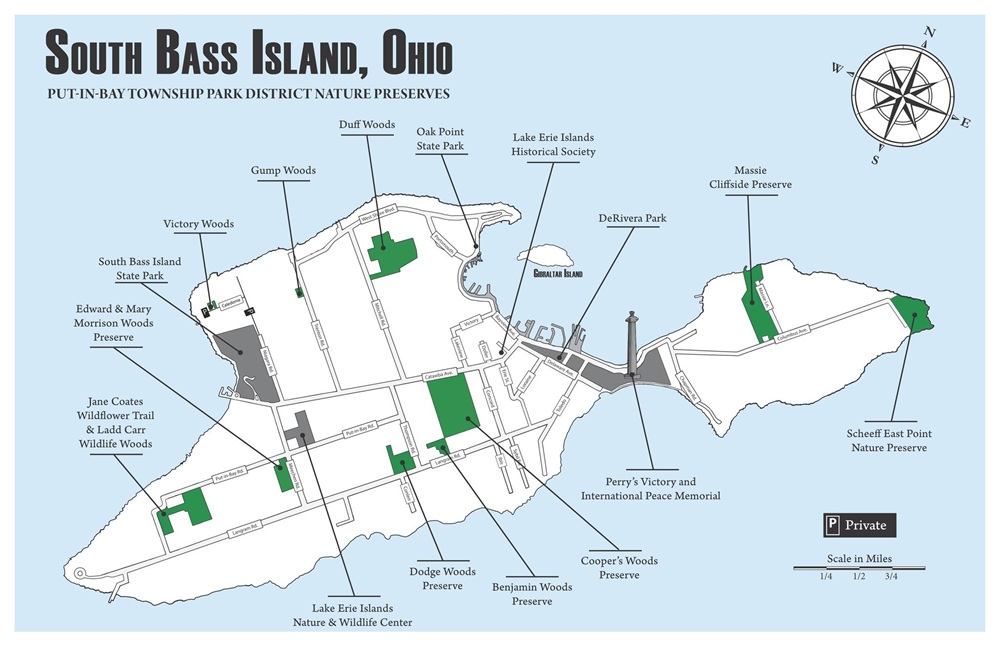
I expected Pyrate Fest to be in a concentrated area on the island, but because the island is so small – it’s 3.7 miles long and 1.5 miles wide – the festivities were everywhere we went. From the moment we departed the ferry to pick up our golf cart to the end of our visit when we’d circled the island at least five times, we found pirates everywhere. 

Even if you have to wait until next year for this event, there are several other events coming up during the warmer weather months. They include:

  • Annual Labor Day Bash at the Bay (August 29-September 1)
  • Put-in-Bay Historical Weekend (September 5-7)
  • Downtown Art at the Park (September 6)
  • Halfway to St. Patrick’s Day (September 13)
  • Vintage Sports Car Racing (September 16-18)
Boarding Miller Ferry to arrive at South Bass Island (Put-in-Bay). (TFP photo by Erin Holden)

I found the scene at Put-in-Bay to be a nice balance between partying, family fun, and educational activities. Obviously, you won’t have to look hard to find a local watering hole with live music and delicious food, but you will also find a delightful playground in the center of town, which our son Townes very much enjoyed; a nice selection of ice cream shops; easy access to beaches for a swim; and historical sites aplenty. 

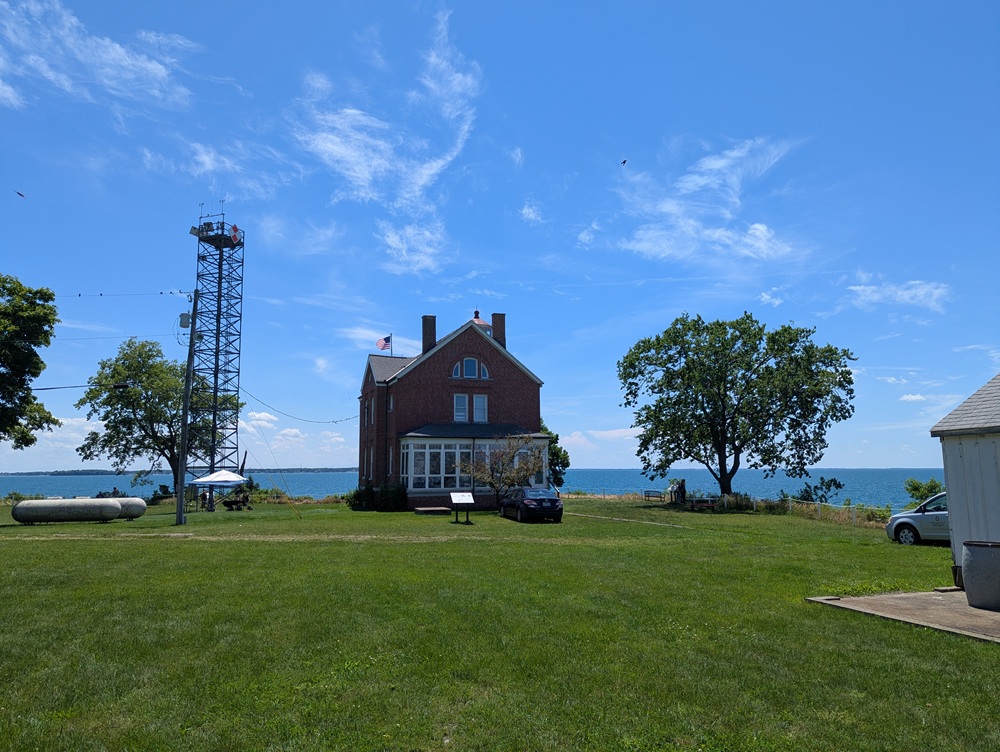
South Bass Island Lighthouse site. (TFP photo by Erin Holden)

South Bass Island Lighthouse

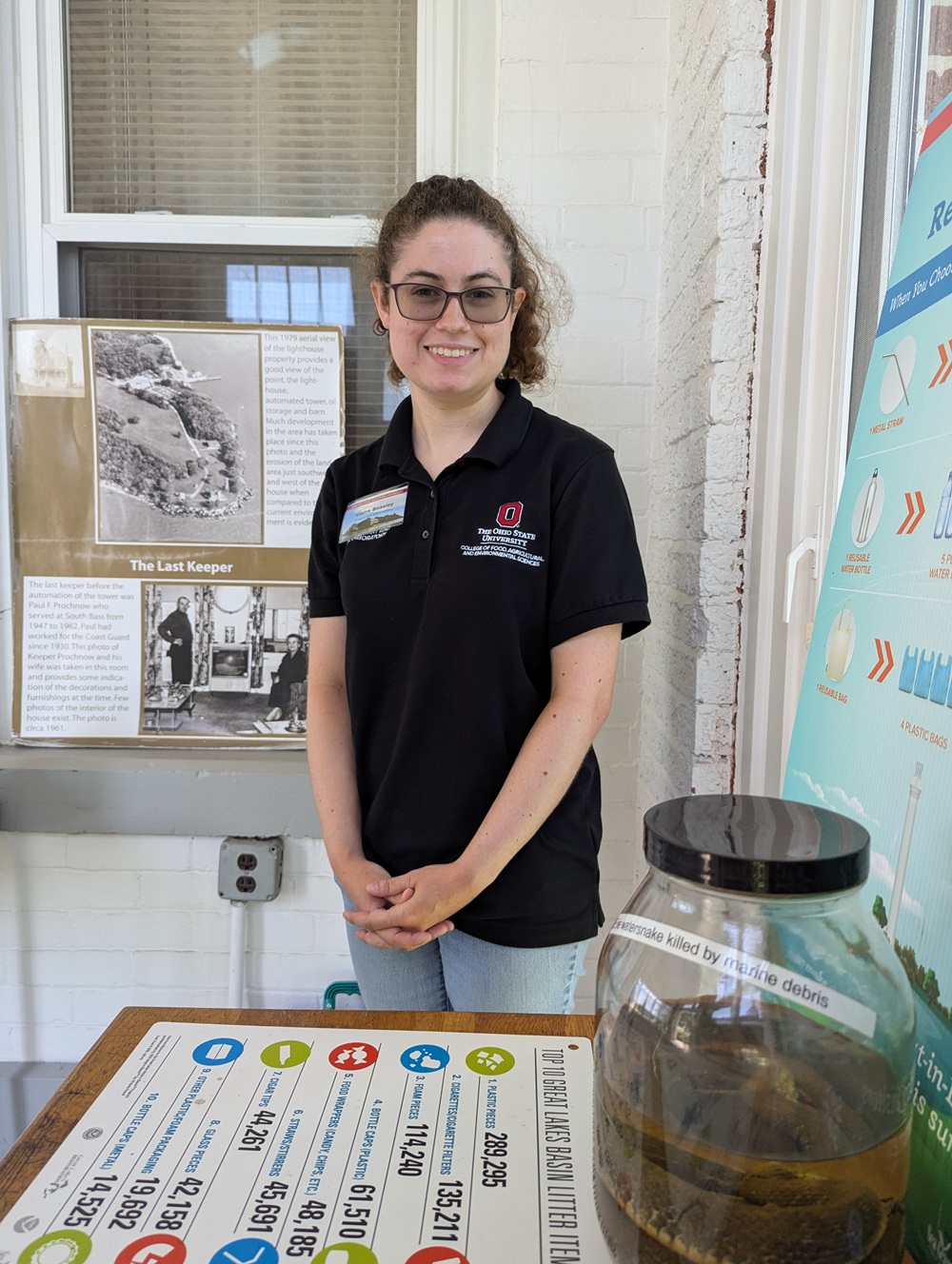
One of the latter wasn’t far from where the ferry dropped us off: the South Bass Island Lighthouse, owned by The Ohio State University’s Stone Lab. We spoke with one of the Stone Lab field station assistants, Claire Beasley, about the history and ecology of this site.

“The Ohio State University is the only university in America to own a lighthouse,” Beasley said. “Construction started on this lighthouse in 1895, and it was running and in use until 1962 when the National Oceanic and Atmospheric Administration, or NOAA, put in that tower over there, which is our automated lighthouse.”

I climbed the rather steep staircase up to the top of the lighthouse to meet my husband (Matt) and our four-year-old son (Townes), where we had an excellent view, including the nearby Green Island. It is off limits to visitors because it acts as a wildlife preserve for birds and the Lake Erie Water Snake.

“You can find them [the Water Snakes] on the Marblehead Peninsula over by Sandusky and up those rivers somewhat, but they do have a very small native range, to the point they were actually listed as endangered, but were removed from that federal list in 2011,” said Beasley. 

Claire Beasley of The Ohio State University’s Stone Lab, poses next to a Lake Erie Water Snake. (TFP photo by Erin Holden)

She said the snakes were endangered for two reasons: one of their food sources – the mudpuppy – was endangered, and water quality worsened.

“One of the researchers who used to be with us, Dr. Kristin Stanford, is now over at the Ohio Department of Natural Resources. She did a lot of work with the water snake, did population surveys, and she also did a lot of work with the public to educate them about the snakes, because they’re not exactly charismatic.” 

For anyone who is interested in learning more about these snakes, check out this Dirty Jobs episode with Mike Rowe, in which he works with Stanford to study them. He gets bit. A lot.

Heineman’s Winery

In the height of the summer heat, an indoor tour is sometimes called for, and there is none better than the Crystal Cave at Heineman’s Winery, the home of the World’s Largest Geode. We bought tickets to tour the cave – a brief, but spectacular tour – along with tickets to tour the winery and get samples (a grape juice made on-site for the minor). Two tours, plus wine/juice samples, for two adults was $30. 

Tour guide Garrett Geldine shows visitors the world’s largest geode at Crystal Cave. (TFP photo by Erin Holden)

Heineman’s wine, which you can order at the bar or purchase by the bottle, can be enjoyed in their charming courtyard. It was a fun diversion before getting back to our tour of the island.

Taking this trip to Put-in-Bay made me realize that there’s this subculture of lake island life that I had previously not tapped into. We’ll definitely go again soon, while also adding Kelly’s island and other lakeside stops to our bucket list before the warm weather fades. 

*This trip was partially funded by Miller Ferry and Visit Put-in-Bay.

For more Midwest Travel stories

A Love Letter to Shawshank and Octagon Earthworks

Inside Toledo City Council: Aug. 12, Part I

0
Vanice Williams, Toledo City Council Member for district 4, speaks about her personal interactions with Bruce Baumhower, and how he stood up for her when she was a Jeep employee with Local 12 on the engine line. Toledo City Council meeting on the first floor of 1 Government Center in Toledo, Ohio on Tuesday, Aug. 12, 2025. (TFP Photo/STEPHEN ZENNER)

Recognizing Bruce Baumhower, the three-decade president of Local 12

TOLEDO – A warm welcome filled the Toledo City Council chambers for two individuals recognized for their service to the city at last week’s meeting. 

About a half-hour was dedicated to honoring the former president of United Auto Workers (UAW) Local 12, Bruce Baumhower, who retired earlier this year, leaving Local 12’s leadership to the previous vice president, Brian Sims.

Resolution 287 recognized Baumhower for his 32-year career with the United Auto Workers (UAW) Local 12, starting at the Jeep plant in 1972, serving as the union president starting in 1993 and retiring in 2025. 

Bruce Baumhower, the retired president of UAW Local 12, during a Toledo City Council meeting on the first floor of 1 Government Center in Toledo, Ohio on Tuesday, Aug., 12, 2025. (TFP Photo/STEPHEN ZENNER)

Council Member At-Large, George Sarantou, credited Baumhower as one of three people, alongside former Toledo Mayor, Carty Finkbeiner, and former Ohio Governor, George Voinovich, responsible for preserving the Jeep legacy in Toledo by encouraging investment in the Toledo North Assembly Plant, built in 1997. 

“We really owe you a debt of gratitude because you’ve made such a stunning difference in those 32 years,” Sarantou said, and most of the council chimed in to thank Baumhower on a personal level. 

But no one council member’s testimonial stood out as much as Vanice Williams’ (District 4) story about working for Jeep when she was, in her own words, “Big Pregnant.”

On the engine while six months pregnant with her daughter Faith, Williams told the story of a manager who would not let her be relieved until Baumhower cursed out that manager on Williams’ behalf. 

At the time, Williams said she was homeless. “I was coming to work at Jeep every day pregnant to try to make sure that I was able to provide a home,” she said. “I want you to know how much I appreciated that. I had nobody defending me, not even my family. And you defended me.”

Council Members Sam Melden (District 5), Theresa Morris (District 6), Nick Komives (At-Large), Mac Driscoll (At-Large), Cerssandra McPherson (At-Large) and Brittany Jones (At-Large) all spoke of the legacy Baumhower left over his decades of investment in Toledo. 

“Dad bought a house,” McPherson said of her father, who retired from working at Jeep as a member of Local 12. “Jeep did that for us.”

Baumhower was short with his words, and expressed his thanks to Local 12 and to his wife, Kim Baumhower, for their support. 

“I got a lot of credit for work that a lot of other people did,” Baumhower said in summation, and highlighted the members of Local 12 that were there as well as his wife.

Local social worker weighs in on Medicaid change

0
Pexels photo by Karolina Grabowska

Beginning August 1, the Ohio Department of Medicaid (ODM) began denying all Fee-For-Service claims submitted without prior authorization. This sweeping bureaucratic policy change, which places an enormous administrative burden on providers, threatens to gut access to life-saving mental health and disability services for thousands of low-income Ohioans — and disturbingly echoes the logic of eugenics-era public policy.

The new rule arrives under the watch of a Republican-controlled legislature and conservative executive leadership in Ohio, part of a broader national trend of stripping public systems under the banner of “efficiency” and “cost control.” What remains unspoken is who pays the price.

Let’s call this what it is — structural violence. By making it nearly impossible for providers to serve Medicaid clients, this policy pushes people with mental illness, disabilities, and chronic conditions out of care — and possibly out of life.

A legacy of harm repeating in bureaucratic form

Though no one is openly using the language of eugenics, the impact is frighteningly similar. Eugenics movements of the past sought to reduce the reproduction and survival of those deemed “unfit.” Today, we see policies that disproportionately deny care to the very people eugenicists once targeted: the poor, disabled people, the mentally ill, and people of color.

This is not accidental — it’s engineered neglect. It doesn’t need violence to destroy lives; it only needs red tape.
 

The Conservative Policy Machine and the Politics of Exclusion

This shift aligns with a growing national conservative movement that:

  • Attacks access to reproductive and gender-affirming health care,
  • Criminalizes homelessness and mental illness,
  • Promotes privatization of public programs at the expense of the vulnerable.

In Ohio, these Medicaid changes are part of a pattern of policies that look “fiscally responsible” on paper but are morally bankrupt in practice.

A Public Challenge: Evaluate This Policy Ethically

I call on Ohio lawmakers, Medicaid administrators, and members of the public — regardless of political affiliation — to honestly confront the question:

If a policy systematically removes access to care from people who are poor, disabled, or mentally ill, and they die as a result — how is that not a form of modern eugenics?

I urge journalists, legislators, and watchdog groups to:

  • Investigate the real-world impacts of this policy on mental health and disability care.
  • Demand transparency on how many clients will lose services.
  • Hold accountable those who benefit politically or financially from the suffering of others.

Anthony Wayne area communities considering data centers

0
Vantage Data Center is building three data centers on a 70-acre campus in New Albany, Ohio. (Photo courtesy of Vantage)

Public meetings slated in Waterville, Waterville Township

ANTHONY WAYNE – With access to water, power and hundreds of acres of flat land, developers are eyeing western Lucas County for potential data center locations – as long as the community is welcoming.

“Every community is thinking about it. This is the soup du jour – the gold rush of the 2020s. Of the 21 subdivisions in the county, we are in constant conversation with the six or seven that are more interested,” said Matt Heyrman, director of the Lucas County Department of Economic Development.

Matt Heyrman. (TFP photo by Karen Gerhardinger)

The first step is to create zoning regulations that address data centers. Monclova Township and Spencer Township recently adopted new language into their zoning books. Waterville and Waterville Township will discuss the proposed language in public meetings over the next few weeks.

On Monday, August 18 at 7 p.m., the Waterville Township Zoning Commission will hold a public hearing at 621 Farnsworth Rd. to receive input on allowing data centers to operate on agriculturally zoned land with a conditional use permit. The commission will make a recommendation to the trustees, who will hold a separate public hearing on Wednesday, August 27 at 6:30 p.m.

The city of Waterville is considering a zoning language change to allow data centers in M-1 light industrial districts with additional setback requirements from residential areas, said municipal administrator Jon Gochenour. A second reading is slated for Monday, August 25 at 7:30 p.m. at City Hall, 25 N. Second St. 

“Step one is putting a conditional use in place. That doesn’t mean we’re bringing a data center in; it just means that when we’re approached, we will have the ability to control the process,” said Waterville Township trustee Julie Theroux, noting that the trustees hired Columbus law firm Albers and Albers to represent the township’s best interests in the event of a data center or another large project.

The county and Regional Growth Partnership (RGP) have teamed up to coordinate with developers, landowners and communities to attract centers that hold data for multinational corporations like Google, Chat GPT or Meta, Heyrman said.

“We’re targeting larger companies because they will make a more significant investment. That leads to more valuation and potential revenue for our community,” he said.

Gary Thompson (Photo courtesy of Regional Growth Partnership)

Attracting a data center is part of an overall strategy to diversify the economy so the county isn’t so reliant on manufacturing and distribution, said RGP executive vice president Gary Thompson. RGP focuses on attracting new business and industry to a 17-county northwest Ohio region. He envisions a healthy mix of manufacturing, construction, agriculture and technology so the economy is on sound footing and communities are able to bring in enough revenue to provide services such as police and fire.

“As AI and robotics advance, there will be fewer jobs for humans in factories. Still, people in the area need jobs and careers, and those are more likely to be in the tech field than the manufacturing field,” Thompson said. 

Data centers typically only employ 80 to 100, but bring in ancillary businesses like information technology, engineering and other firms, noted Mike Beazley, a consultant working with the county and RGP. In areas where data centers have been built – including Columbus, Ohio; Portland, Ore.; Cheyenne, Wyo. and Spokane, Wash. – companies making computer servers and steel casings have sprung up.

“The region is in position to take advantage and attract new jobs in a sector that is unrepresented,” Beazley said.

Data centers also bring in property and income tax revenue, Heyrman said. Providing a payment in lieu of taxes (PILOT) agreement will ensure that those taxes get to the schools and affected communities.

While the team working to bring in new business touts the benefits, the members are also aware of concerns from the public. Many of the problems from earlier models have been remedied, and the projects can be low impact, Beazley said.

One concern stated by residents has been water, which would come from the Toledo municipal water system, not wells or aquafers, which are unreliable. The older designs used a high level of water for cooling systems, but changes in technology have lowered that need to less than 1 million gallons per day for the largest data centers. Toledo has an excess capacity of at least 60 million gallons a day, Beazley said.

Any proposed data center would need to conduct a power study, which is a several-month process that looks at the potential impact on the electrical grid. Ohio is part of the PJM regional transmission organization, which last month announced an increase in wholesale costs that might be passed on to some of the 67 million consumers in 13 states. According to a PJM press release, electricity demand is growing rapidly, “driven largely by data center expansion, electrification and economic growth.”

“If there’s a criticism of the American electrical grid, it’s that it’s too conservative. There is more capacity than the transmitting authorities let us tap into,” Heyrman said. “I feel confident that PJM is not going to let anyone on their grid unless there’s the capacity to do so.”

Ohio is also filled with plenty of gas transmission pipelines, including legacy lines that add redundancy in the supply of natural gas in a way that’s uncommon elsewhere in the country, Thompson said.

Nexus Gas Transmission had previously obtained authorization to build a compressor station in Waterville Township on Moosman Drive, but that permit from the Federal Energy Regulatory Commission lapsed in August 2021, said Enbridge spokesperson Kristen Henson. Nexus has no current expansion planned, but is positioned to support future development, including escalating energy needs and data center buildouts, she said.

As communities begin looking at whether to adopt new zoning regulations to allow data centers, residents will have an opportunity to ask questions and share concerns. Richfield Township recently made it clear that data centers are not wanted, Beazley said. 

“A group said, ‘We are farmers and don’t want to be anything else.’ So we’ll focus on other communities,” Beazley said, noting that developers don’t want to spend time on communities that are not welcoming.

“Our role is to bring the opportunity to the region. If the citizens and the elected officials don’t want it, we’ll move on to the next community,” Thompson said. “They are in such a rush, they aren’t going to sit around waiting for people to be ready. This is a great opportunity for people to discuss if they want it.”

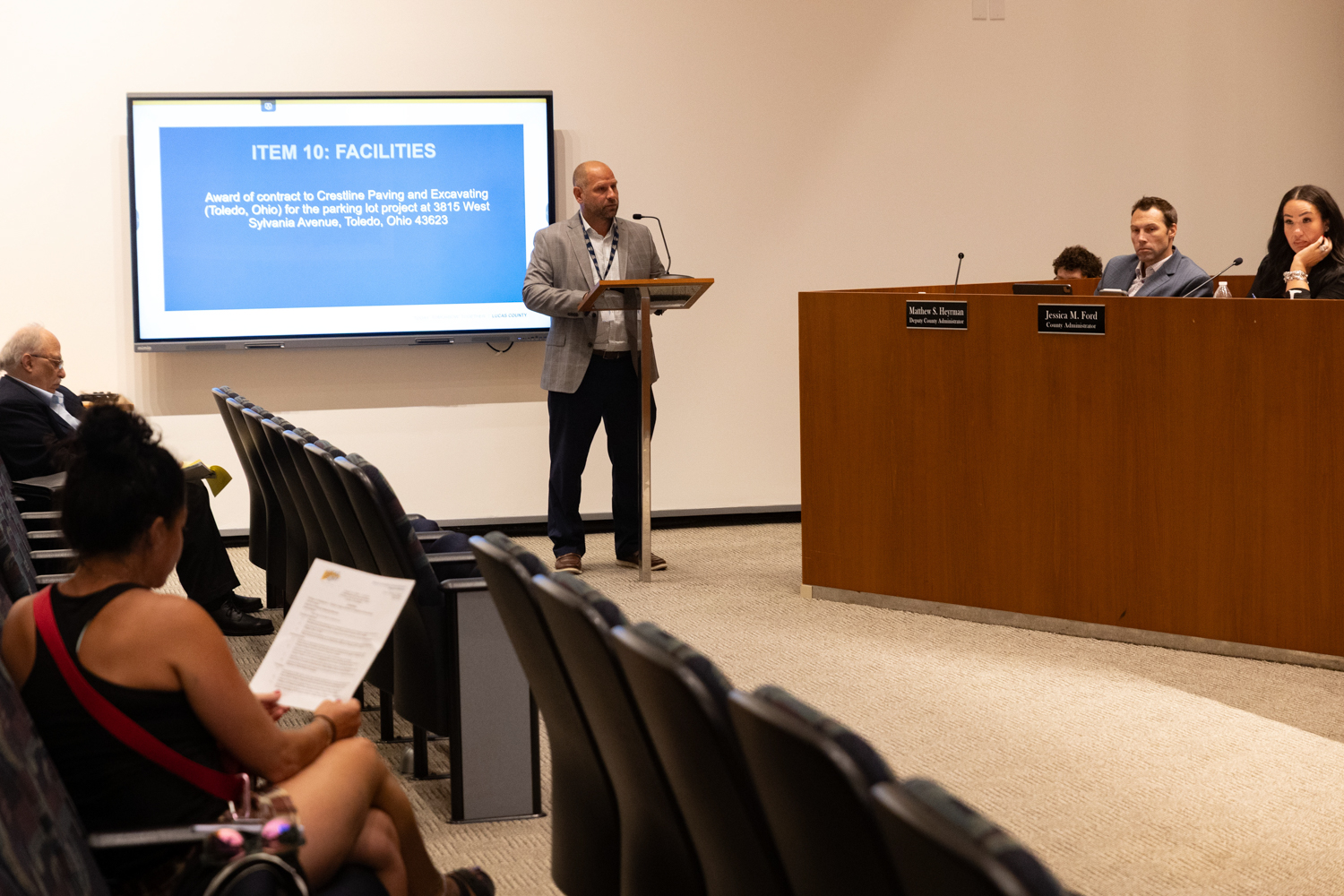
Inside Lucas County Commissioners Meeting: Aug. 12

0
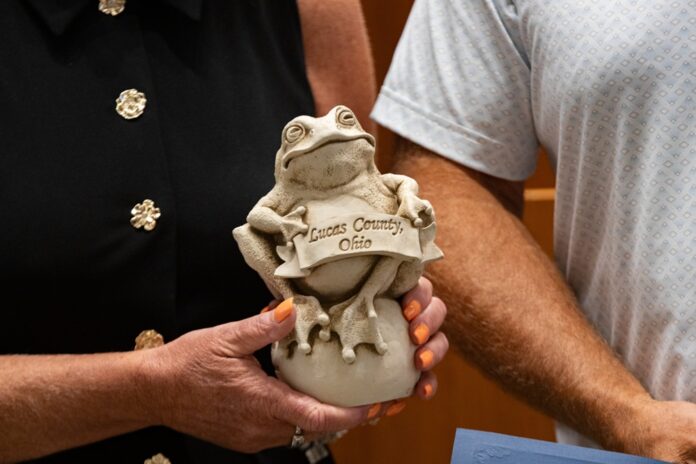
Lisa Sobecki, Lucas County Commissioner, holds a statue of a frog, a parting gift for Jim Shaw, the retiring Lucas County sanitary engineer, during a Lucas County Commissioners’ regular meeting inside the Commissioners’ Hearing Room at 1 Government Center in Toledo, Ohio on Tuesday, Aug. 12, 2025. (TFP Photo/STEPHEN ZENNER)

TOLEDO – By far the most outstanding moment during the Lucas County Commissioners meeting on Tuesday, Aug. 12 was the honor given to Jim Shaw as he entered retirement. 

Shaw served as the county’s sanitary engineer since 1994, and was avid in his love of football. 

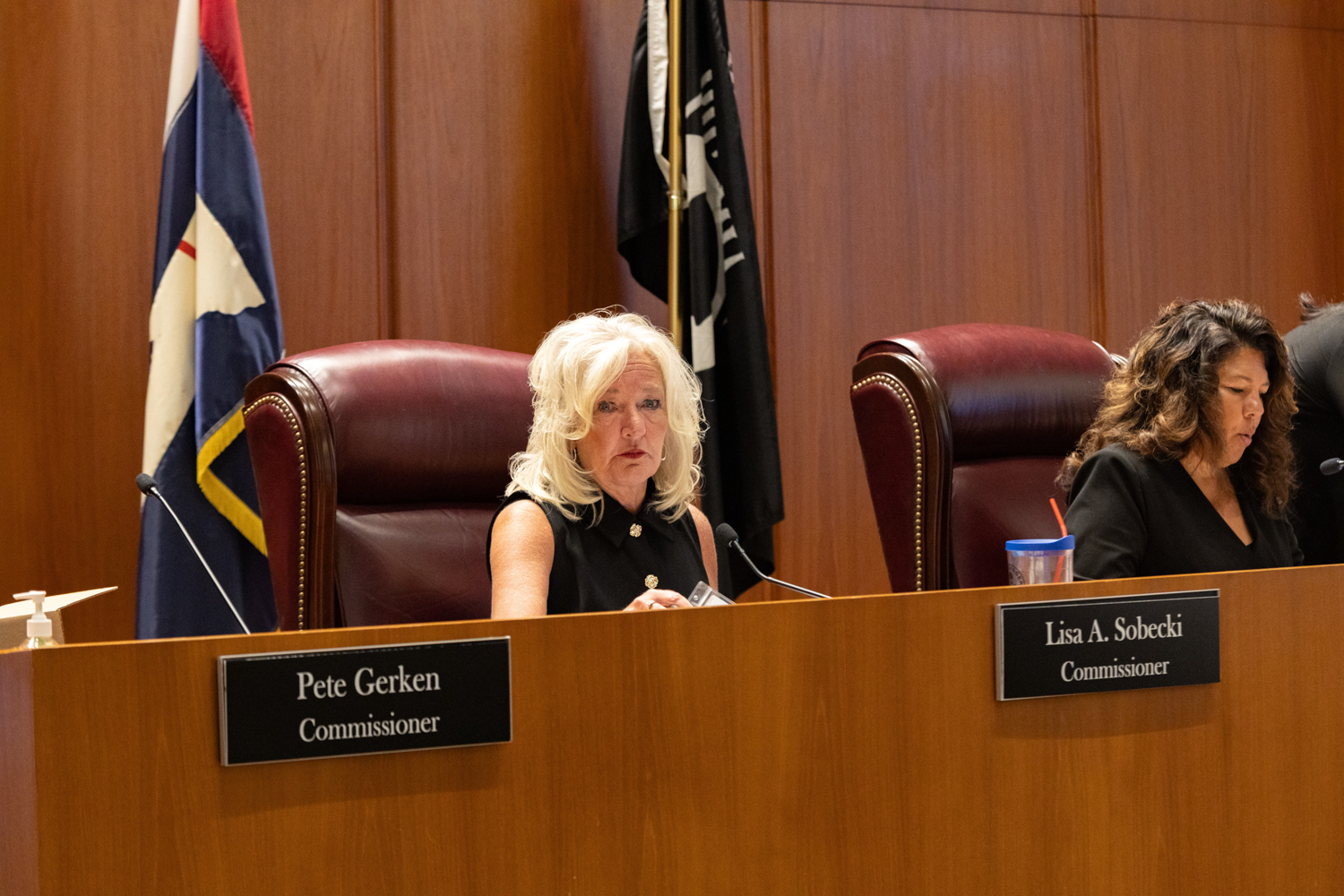
Lucas County Commissioner Lisa Sobecki said Shaw’s love of football landed him a place officiating in division one and eventually into the Big Ten Conference. 

Lisa Sobecki, Lucas County Commissioner, and Anita Lopez, Lucas County Commissioner, during a Lucas County Commissioners’ regular meeting inside the Commissioners’ Hearing Room at 1 Government Center in Toledo, Ohio on Tuesday, Aug. 12, 2025. (TFP Photo/STEPHEN ZENNER)

Sobecki thanked him for his “incredible impact” and said, “He’s not gonna’ skirt around the bushes; he’s gonna’ give you the facts. His institutional knowledge will surely be missed.”

Sobecki made sure to note that Shaw was the one that dealt with Toledo’s algal bloom problem in 2014, and thanked him for getting the county through that difficult time. 

As he addressed colleagues, friends and family from the podium in the commissioners’ hearing room, Shaw was moved to tears as he recited a poem by Saxon White Kessinger called the “Indispensable Man.”

The last stanza that seemed to affect Shaw the most was this: 

“The moral of this quaint example
Is do just the best that you can,
Be proud of yourself but remember,
There’s no indispensable man.”

After a few short words, Shaw said, “The best resource this county has is its staff.” Then he said, “I wanna’ thank my wife and go.” 

As Shaw walked to the back of the hearing room where his wife Marsha was, he received a standing ovation from all county employees including the two commissioners who were present, Sobecki and Anita Lopez

Nate Inkrott will take over for Shaw as the county’s sanitary engineer. 

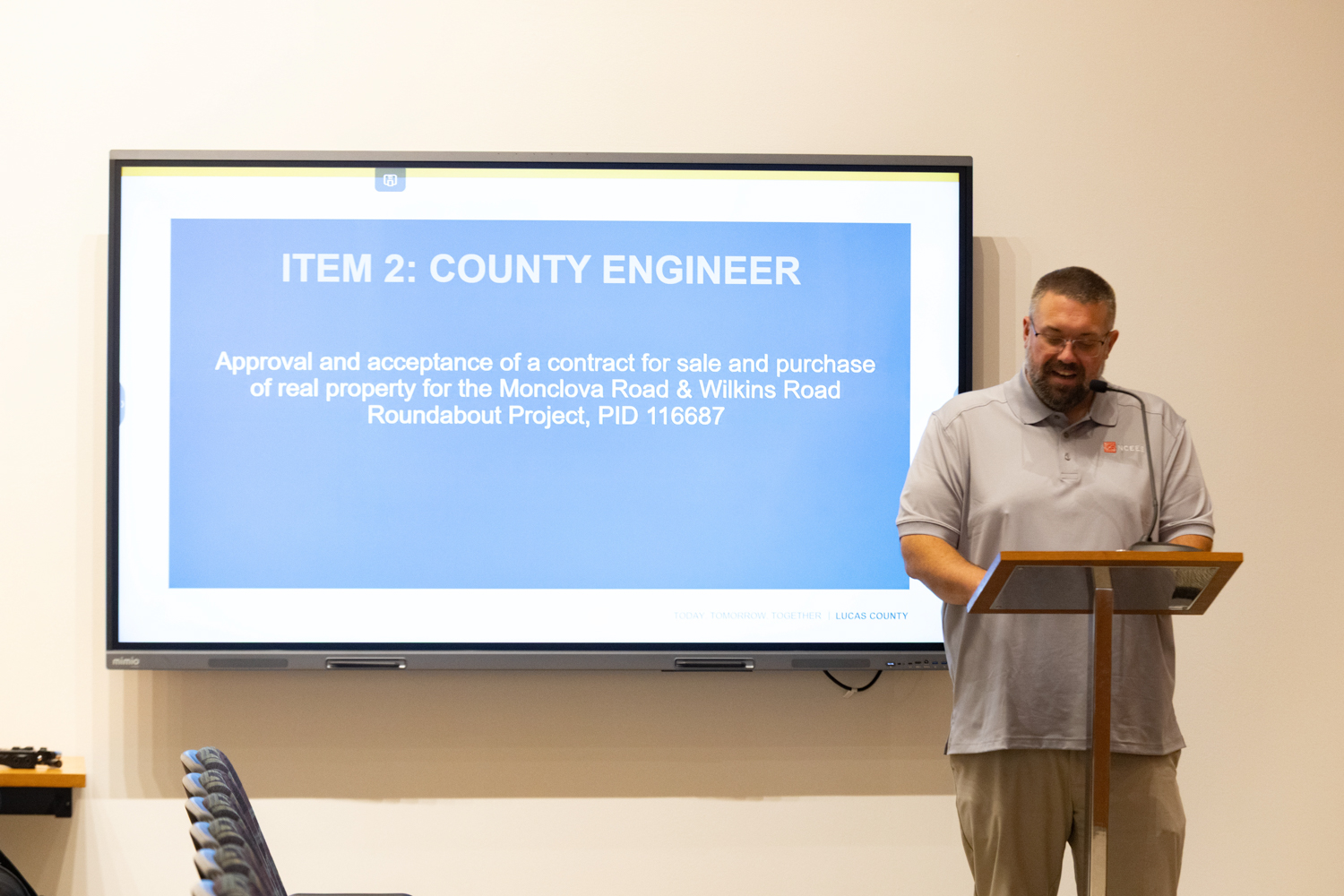
Mike Pniewski, the Lucas County engineer, speaks about the plans for roundabouts during a Lucas County Commissioners’ regular meeting inside the Commissioners’ Hearing Room at 1 Government Center in Toledo, Ohio on Tuesday, Aug.12, 2025. (TFP Photo/STEPHEN ZENNER)

County Engineer

Agenda items 2-4 all dealt with contracts and easements necessary to install roundabouts in Lucas County, and were brought before the commissioners by Lucas County Engineer Mike Pniewski. All items were approved. 

Court and Facilities

Items 5-8 on the agenda dealt with different collaborations and improvements to the juvenile court, including art programming for the community treatment center, art instruction at the youth treatment center and the Toledo bikes build-a-bike program. 

Aramark was given permission to use the juvenile detention center kitchen. 

Emily Simpson, general counsel for the county, brought these items before the commissioners. 

Items 9-11 dealt with facilities and were brought before the commissioners by Jeff Nowak, the Lucas County facilities director. 

Commissioners then rejected a bid for the west influent screen and grit chamber improvements to the water resource recovery facility at 5758 N. River Road. Inkrott presented this item on the agenda. 

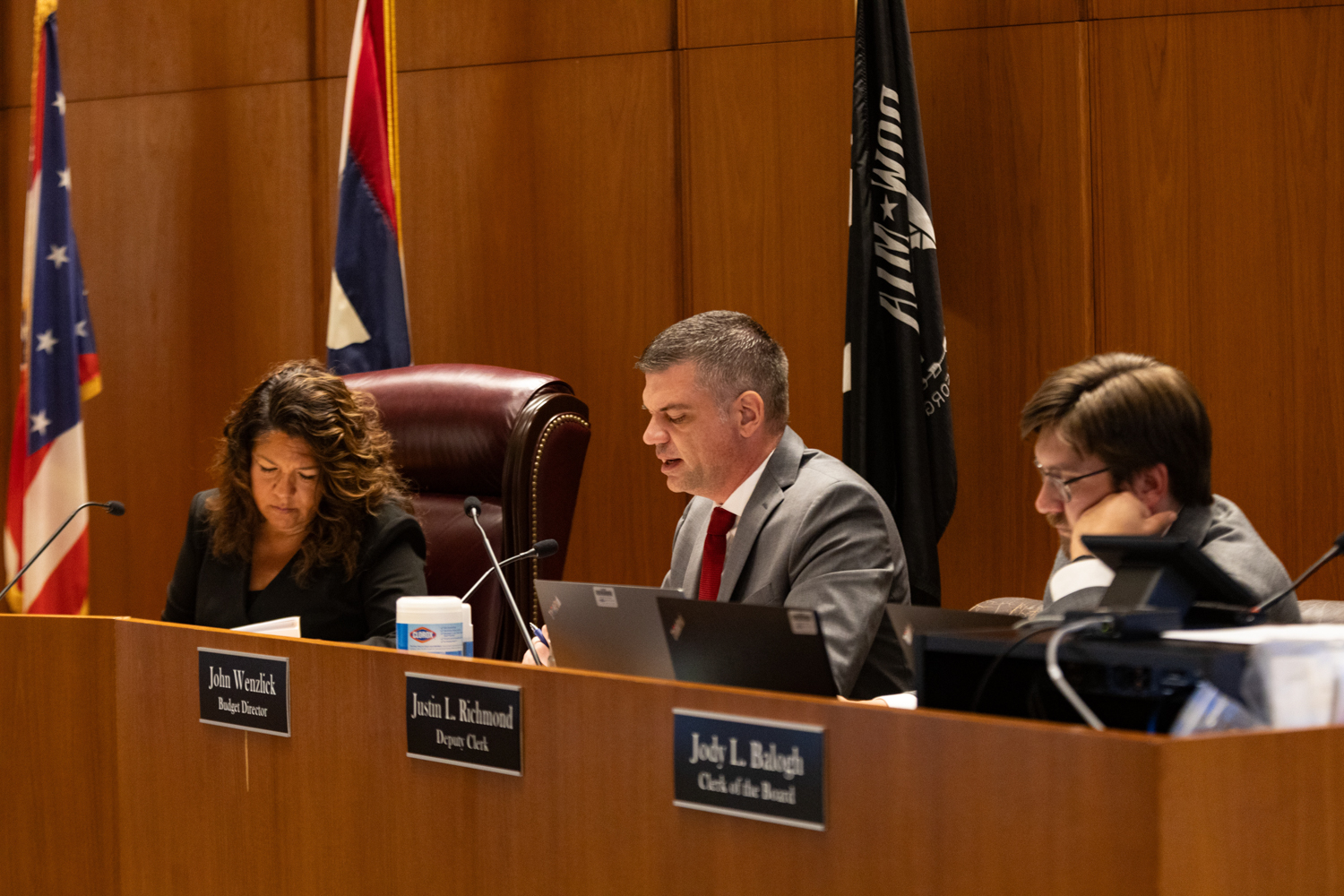
John Wenzlick, the budget director for Lucas County, presents items 13-15 during a Lucas County Commissioners’ regular meeting inside the Commissioners’ Hearing Room at 1 Government Center in Toledo, Ohio on Tuesday Aug. 12, 2025. (TFP Photo/STEPHEN ZENNER)

Budget & Administration

John Wenzlick, the budget director for Lucas County, then presented items 13-15 regarding the Office of Management & Budget.

County administrator, Jessica Ford, vouched for the work of Stifel, Nicolaus & Company, a financial services company out of St. Louis, Mo., as related to item 15, changing the company’s role with the county from underwriter to municipal advisor. Stifel, Nicolaus & Company have been working with the county since 2009, and are currently in transition to their new role as a municipal advisor for the county. Ford said the company would be fully in their new role as municipal advisor in 2026. 

Commissioner Lopez mentioned she wanted to be sure there were no SEC violations as the company transitioned to its new role. 

John Borell, the deputy chief for the civil division from the Office of the Lucas County Prosecuting Attorney, was on hand to explain that the proposed new contract with Stifel, Nicolaus & Company will have them serving as the municipal advisor for the jail bond and the hotel bond, but no longer serving as the underwriter for the county at all. 

In Borell’s opinion, there were no violations with the first contract, and there are no violations with the proposed new contract. 

“Whatever perceived conflict there was, I think that eliminates it,” Borell said to the commissioners. 

Both commissioners then approved amending the of the agreement with Stifel, Nicolaus & Company. 

Bridgette Kabat, the senior project manager, asked for and then was granted permission to contract with a firm to move the x-ray machine from the old Lucas County Canine Care & Control (LC4) location to the new one for $4,250. 

Kabat explained that the process for moving the x-ray machine involved disassembly, moving it, reassembling the machine, testing it and getting it back to “working order.” 

Jeff Nowak, the Lucas County facilities director, goes over facilities during a Lucas County Commissioners’ regular meeting inside the Commissioners’ Hearing Room at 1 Government Center in Toledo, Ohio on Tuesday, Aug. 12, 2025. (TFP Photo/STEPHEN ZENNER)

Executive Session

Then Brian Cunningham, the director of training for Lucas County Human Resources, asked for the commissioners to move into an executive session. 

After the executive session Cunningham asked for the appointments of Christina Myers, Kelly Stone Click, Dakota Bick, Tana Savage Riley, and Michelle Peters to vacant full-time regular permanent bargaining unit eligibility specialist II positions at the Department of Job & Family Services for $19.50/hour. It was approved. 

Related Story: Inside Lucas County Commissioners Meeting: Aug. 5

Dodging Sinkholes

0
(TFP cartoon by Don Lee)