TFP photos by Allyson Ritchey
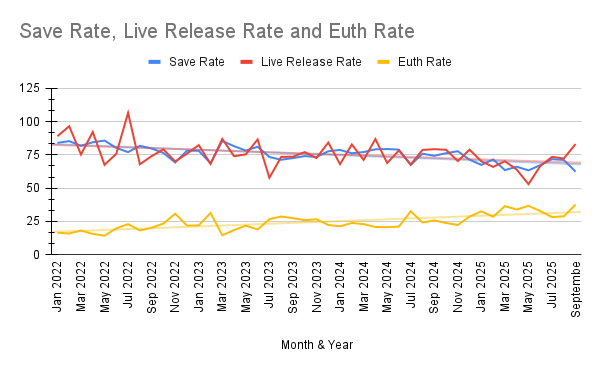
TOLEDO–For community members who find a stray dog in Lucas County, the decision to call animal control is an ethical dilemma with a stark statistical reality. According to publicly available kennel statistics, a dog entering the Lucas County Canine Care & Control (LC4) system during the period of January 2024 to September 2025 had an average 26.71 percent chance of being euthanized—meaning approximately one in four dogs was put down.
The crisis peaked in September 2025, the final month of operations in the old 410 S. Erie St. facility, when the euthanasia rate hit a record high of 37.65 percent.
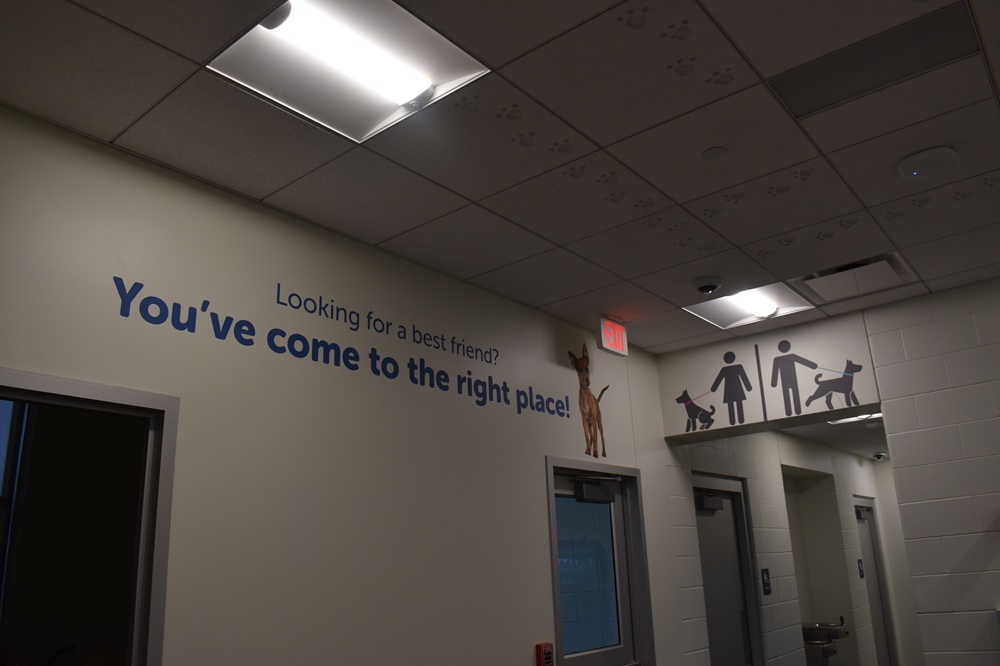
Now, LC4 has moved into a new $31.9 million, 39,300-square-foot facility that opened Oct. 4. The physical transformation is undeniable—modern kennels, outdoor play yards, natural light streaming through large windows. Leadership has changed too, with a new director appointed in March 2025, though he stepped down in October. The volunteer program, suspended after a 2024 abuse scandal, has been reinstated with stricter protocols.
But for community members like Katie – a Toledo resident who preferred to use only her first name, and whose experience with LC4 predates these changes – and Kevin Clapper, whose recent encounter occurred just last month, one question looms: Have operational practices truly evolved, or just the facility itself?
One year ago: Lucie’s story
In late October 2024, nearly a year before the new facility opened, a brindle pit bull began appearing in Katie’s backyard. Over nearly a week, the dog built trust, eventually taking treats from Katie’s hand and following her around the yard. Katie claimed the dog, whom she named Lucie, showed no aggression toward squirrels, her neighbor’s outdoor cats, or people. Katie and her neighbor suspected the dog had been abused and dumped, but they saw a gentle animal in need of help.
When LC4 wardens arrived with a catch pole, Lucie panicked. “Oh, I can still see it now, like I felt so bad,” Katie remembered. “She freaked, you know, she just panicked. And, like, what else do you do? Like, this was… We thought we were getting her help.”
That was a Friday. Katie had told LC4 staff she wanted to adopt Lucie if no owner came forward. By Tuesday—just four days after intake, with only three business days for an owner to claim her—Lucie had failed her behavioral evaluation. According to Katie, an LC4 employee called to say the dog could not legally be adopted out to the public and would be placed on a waitlist for euthanasia.
“They said that they would call local shelters and see if anyone would take her, and if not, she would be put on a wait list for euthanasia,” Katie said. One week later, when she called back, Lucie was dead. According to Katie, the facility claimed no shelter would take her. Lucie was only a year and a half old.
When Katie obtained Lucie’s file through a public records request, she found details that troubled her. Lucies’ intake notes from Oct. 25, 2004 described her as “very fearful in field” but noted “I think she will get better.” By the next day, staff reported she was “much less fearful at building” and “walked nicely.”
On Oct. 29—four days after intake—the behavioral evaluation was conducted. The notes describe Lucie being walked to a play yard when “a dog already in a different yard was at the fence barking at her.” Lucie responded with stiff posture and barking. The evaluation form states she was “stiff, piloerection, hyper focused, ears forward, weight forward, attempted to mount, would not listen to verbal correction or spray bottle correction.”
Lucie was euthanized that same day. The reason listed: “FBE: dog agg.”
Katie said an LC4 employee had assured her multiple times over the phone that Lucie “was not aggressive”—yet the file listed dog aggression as the reason for euthanization.
“It was only natural, Lucie being in an unknown place, faced with unknown people and dogs, not to listen to their verbal commands,” Katie said. “We don’t know if she had any training. I suspected she had been abused or neglected and was dumped.”

The euthanasia checklist shows signatures from two staff members as required by LC4 policy. However, one question on the form remains unanswered: “Did two employees decide euthanasia was the best course of action for this animal, one of which is the Veterinarian or Behavior Coordinator and the second a member of Management?” Whether this represented a conscious decision that Lucy was not transferable, or an oversight, is unclear from the documentation.
Katie’s assessment remains cautious nearly a year later:
“You can’t put lipstick on a pig and expect it to be anything but a pig. Until we see more proof that they’re being properly cared for and all the bad apples have been removed, I just can’t trust it.”
While her experience occurred under previous leadership at the old facility, her concerns about rushed evaluations and inadequate decompression time remain relevant as the organization transitions into its new space.

A pattern repeats
Nearly a year later, Kevin Clapper, another Toledo resident, found two friendly stray dogs running loose near Broadway and South Avenue. He brought them to LC4, assuming they’d be reunited or adopted. Days later, when he called to check, he learned one had already been euthanized for being “aggressive towards other dogs”—despite having been found with the other dog and the two animals riding calmly in his car together.
“When you put dogs under a high stress situation like that, things happen,” Clapper said. The fact that one dog was a female with visible signs of having had puppies led Clapper to suspect the decision was based on adoptability, not aggression.
The patterns highlighted by Clapper’s Sept. 2025 experience—occurring in the final month at the old facility before the move—raise questions about whether LC4’s behavioral evaluations adequately account for the extreme stress dogs experience in a shelter environment, particularly in the critical first days after intake.
LC4’s Response
Cassie Bloomfield, LC4’s Community Outreach Coordinator, said the facility has implemented significant changes, especially with the move to the new building. She emphasized that behavioral evaluations are never conducted by a single person.
“It’s never just one person saying, ‘Well, I didn’t like the way that looked,'” Bloomfield said. “It’s from start to finish, and lots of opinions of lots of people who have laid eyes on the dog.”
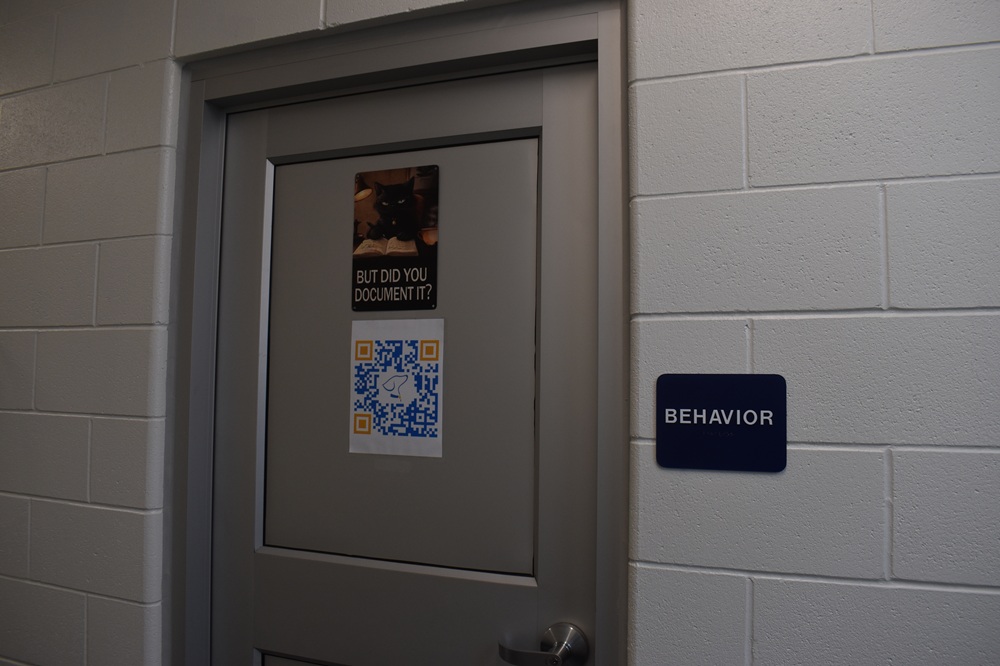
The facility employs a dedicated behavior coordinator who meets every dog daily and reviews QR code-based behavior reports submitted by staff and volunteers. “Every single day that she’s here, she walks around. She meets everybody,” Bloomfield said of the behavior coordinator. “She meets every dog that has come in.”

The new building’s design—with smaller, separated sections—allows fearful or reactive dogs to decompress away from the general population. Staff sometimes use short-term behavioral medications “as a tool” to reduce stress.
Bloomfield defended dog-on-dog evaluations as essential for public safety, noting that dog-aggressive animals can cause serious injuries even if they are not aggressive toward humans—from people getting hurt breaking up fights to owners being pulled into dangerous situations.
“We live in a society where kids exist, so if we know that a dog has a problem with children, that’s not a safe dog for us to adopt out,” she said, adding that transfer partners can work with dogs who have specific issues but that LC4 focuses on dogs who will “make good neighbors and good breed ambassadors.”
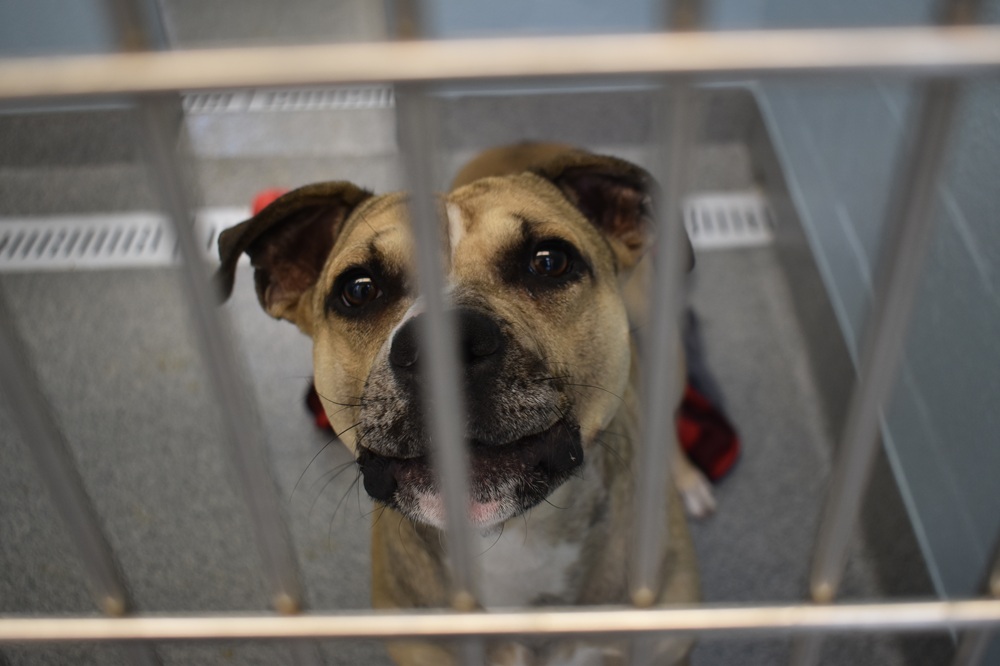
Most dogs at LC4 fall under the pit bull umbrella, Bloomfield noted. “We’re trying to break that stereotype that says that they’re aggressive, because you just saw all these dogs here, and they’re not.”

When asked about the upward trend in euthanasia rates, Bloomfield attributed it partly to increased intake and partly to irresponsible breeding practices that create dogs with behavioral or medical problems.
“If we keep breeding dogs that are not social with other dogs, they’re not okay with people, they’re not being appropriately socialized when they’re young, unfortunately we’re going to continue to have to say goodbye to dogs,” she said.
LC4 doesn’t maintain a target euthanasia rate, Bloomfield explained, because the population constantly changes. “We don’t want to keep dogs around to keep our numbers good,” she said.
She acknowledged LC4’s “checkered past” but insisted standards have evolved significantly. “We would never agree with hurting or mistreating what’s in our care,” she said. “We don’t want to warehouse dogs if it is affecting their quality of life or putting people in danger.”
Bloomfield said rebuilding trust after the 2024 abuse scandal remains a priority. “It’s really hard for people to ask us for help because of the negative publicity and how they were treated in the past,” she said. “Even if I’m going to give you an answer that you might not like, I’m still going to give it to you. Honesty is the best policy and education.”
Evaluations and Decompression Time Under Review
A central tension emerges from cases like Lucie’s from 2024: how much time is appropriate for behavioral evaluation? Lucie was evaluated and euthanized four days after intake under the old facility’s operations. LC4’s position is that multiple staff members observe dogs over their stay and that evaluations reflect genuine safety concerns. Katie’s perspective is that four days was insufficient time for a fearful, potentially traumatized dog to decompress.

Bloomfield, speaking about current operations in the new facility, acknowledged that the improved environment provides more opportunities for dogs to settle in.
“Especially now that we’re in a more appropriate facility and we have the means and the space and the people to give dogs a little bit more time, we don’t willy nilly run through,” she said. She shared that in the new facility, staff can now sit “crisscross on the grass with the dog” off-leash, which was not possible before.
The volunteer program has been reinstated with stricter protocols, and the “Dogs on the Town” field trip program just resumed last month. LC4 also offers a pet food pantry and vaccination clinic, which Bloomfield explained is part of the department’s goal to “stop that before we get to the point where it’s an emergency” and an owner is forced to surrender their dog.
But for Katie, the question remains whether the facility’s improvements will translate into different outcomes for dogs like Lucie, dogs who show fear-based reactivity in their first days but may have potential given more time and specialized support.
“If I had known this was what was going to happen, she never would have gone there. My neighbor and I both…we completely failed her,” Katie said of Lucie. The new building provides the opportunity. The challenge now is whether the organizational culture can shift fast enough to regain the trust of the community.