MONROE, Mich. — A Monroe family is heading to trial against Jeep’s parent companies, FCA US and Stellantis, after months of problems with their 2023 Grand Cherokee 4xe, including an incident they said left them coasting in fast-lane traffic when the SUV suddenly shut off.
PJ and Carley Phillips said they chose the hybrid Grand Cherokee last summer as a safe upgrade for their growing family.
“This is a family car and it’s unsafe, and I’m doing what’s best for my family,” PJ said.
Early glitches with the infotainment screen and backup camera gave way to bigger failures that winter, the couple said, including a loss of heat and repeated camera outages. The SUV then spent roughly 30 days at the dealership for repairs, according to the family.
Michigan’s lemon law generally deems a vehicle defective if it has four or more repair attempts for the same problem or is out of service for 30 or more days during the warranty period. The Phillipses said they began the arbitration process with FCA after compiling stacks of service invoices.
“I don’t know if people will think this is normal, but for a car that’s less than two years old, these are all the service invoices from all the work it’s had done,” PJ said.
The company first offered a “customer retention payment,” the family said, and they continued driving the SUV. But the problems returned, and in May, Carley said the vehicle lost power at highway speed near the Newport exit on I-75.
“I was going 70 miles an hour in the fast lane and then all of a sudden the car shut off on me,” she said. “It started showing me all of these error codes. Traffic was light, thank goodness, and I was able to get over to the right edge.”
After a second arbitration push, the family said the case was accepted, but the award appeared to include offsets tied to the earlier payment and mileage. A Michigan judge later vacated the arbitrator’s ruling, calling it an improper application of law, clearing the way for a jury trial.
The Phillipses said they’re seeking a full refund under the lemon law while still paying more than $700 a month on their lease.
“We haven’t seen it since May,” the Phillipses said, noting the SUV remains in the shop.
The legal fight comes as Stellantis last month announced a recall of about 92,000 Grand Cherokee 4xe SUVs from model years 2022 through 2026, citing software issues that can cause a loss of power while driving, including the same model owned by the Phillips family.
Stellantis provided WTOL 11 with the following statement:
“The safety of our customers is a top priority, and the Company is actively deploying a remedy for this campaign. FCA US is voluntarily recalling an estimated 91,787 U.S.-market vehicles to update their hybrid control processor (HCP) software.
An internal investigation determined that some 2022–2026 model-year Jeep® Grand Cherokee plug-in hybrid electric vehicles (PHEV) may experience an intermittent communication issue between the battery pack control module (BPCM) and the hybrid control processor (HCP). In certain instances, the HCP may misinterpret a signal from the BPCM. If this happens, it could result in the propulsion system shutting down without warning and increase the risk of a collision.”
The company said it is unaware of any related accidents or injuries.
Affected customers will be advised when they may obtain service, which will be provided free of charge. Customers with additional questions or concerns can call 1-800-853-1403.
MONCLOVA TOWNSHIP – Three candidates are on the ballot for two positions as Monclova Township trustee: Barbara Lang, Debbie Stevens-Laux and Trudy Yoder Vicary. The Free Press asked these candidates about their motivation to run, goals and priorities for the township.
Barbara Lang
Barbara Lang
Experience matters when it comes to representing a township of more than 15,000 residents, said Lang, who is seeking her sixth term in office.
After conversations with residents, county partners, fellow elected officials and her family about running for re-election, Lang said she found a consensus – that her experience and leadership are needed in guiding the township forward.
Lang first won a seat on the board in the 2003 election and, after a two year break, again in 2009 and every election since. Before she ran for office, Lang attended meetings for a year, and that provided her the knowledge of the issues and how government works. Residents want someone who will listen, be accessible and make decisions in the best interests of the community, she said.
“I have made it a priority to listen to residents and ensure their voices are represented in decisions,” she said. “I remain easy to reach, open to questions and concerns, and committed to building consensus.”
Lang said she regularly attends neighborhood meetings and answers calls and emails promptly. She also pointed out the township’s work to remain transparent – including the My Monclova app, newsletters, public postings and open dialogue in meetings that are recorded and shared at monclovatwp.org.
“Decisions about zoning, roads and safety services are made openly, with a focus on how they affect our neighborhoods and families,” she said, encouraging residents to attend meetings.
Lang said she remains focused on managing growth with vision and accountability, ensuring that new development strengthens the community.
Zoning is one of the most important issues, and Lang said she is committed to policies that welcome business growth while protecting neighborhoods and preserving the township’s rural character. She points to the recent update of the zoning resolution and land use plan as strengthening those policies. Public safety is also a priority, and she supports partnerships with the Lucas County Sheriff and ensuring the fire department has the resources it needs.
“I stand for a common-sense approach to taxes, guided by conservative fiscal responsibility,” she said.
Strengthening the Joint Economic Development District (JEDD) and Joint Economic Development Zone (JEDZ) agreements and leveraging tools like Tax Increment Financing will help secure resources for roads, safety and other services without burdening taxpayers, she said.
Data centers are a growing topic of interest, and Lang said it’s important that residents clearly understand what projects are proposed and how they affect the community. The township shares updates and makes zoning information easy to access, with public hearings for residents to ask questions and voice concerns.
“Under my leadership, we have taken steps to increase transparency, including posting signage at zoning change sites so the community can be informed. We mail letters to nearby neighbors, and broadly announce meetings. I am committed to making sure that no decision moves forward without residents having the chance to be informed.”
A Defiance native, Lang grew up in Swanton and attended St. Richard’s Catholic School and Notre Dame Academy. She earned a B.S. in communications from Miami University and has worked for Mercy Health Foundation for most of her career. She has lived in the township since 1994.
During her tenure as trustee, Lang graduated from The Ohio State Leadership Academy and Leadership Academy 2.0 and became a National Incident Management System (NIMS) certified professional, which helps understand the importance of safety preparation. She is an active member of the Lucas County Township Association and serves on the Ohio Township Association Board of Directors and is president of the Monclova-Maumee-Toledo JEDZ.
Debbie Stevens-Laux
Debbie Stevens Laux
Stevens-Laux, a third-generation Monclova resident and co-owner of Stevens Gardens on Weckerly Road, wants to bring a different perspective to the board of trustees.
“Being a lifelong resident, small business owner and farmer, I am able to weigh issues from several different points of view,” Stevens-Laux said. “Living and working at Stevens Gardens offers me a unique opportunity to be available to the community. I interact with many residents on a daily basis and look forward to meeting some new faces.”
Stevens-Laux believes that the community expects trustees to act in their best interest, and that means transparency – making public all issues before a decision is made.
“Monclova residents need to have an opportunity to voice their opinion. This is especially true for a major issue such as data centers. All the information needs to be made public – pros and cons. A data center is an issue worthy of an effort to inform the residents before any zoning changes are made,” she said. “Trustees are obligated to act on behalf of the residents that elected them; they should never have a personal agenda.”
One of the top priorities for the township should be ensuring that growth is in line with residents’ expectations, she said. Whether living rurally or in subdivisions, these residents need to have a voice, she added.
“Maintaining a small town atmosphere that led them to live here is paramount to our residents and to me,” she said.
Stevens-Laux is a third-generation resident of the township. Her grandparents moved to the area in 1951 and her father, Joe Stevens, attended Monclova School with his siblings. In 1970, Joe and his wife, Brenda Stevens, purchased the family farm and raised their four children there. Stevens-Laux was in the first kindergarten class to attend what is now Monclova Primary School.
After graduating from Anthony Wayne High School in 1987, Stevens-Laux worked for Buckeye Cable System for 27 years, retiring as a line technician in 2014. In the years since, she’s dedicated her time to running Stevens Gardens.
In 2004, Debbie and her husband, Dennis Laux, purchased an acre of the family farm and built their home. Together they raised their six children, with two remaining in the township raising children of their own.
“I live and work in Monclova Township and look forward to a great future for my children and grandchildren here. I hope to be part of the future of this wonderful community as a Monclova Township trustee,” she said.
As trustee, Stevens-Laux said she will strive to represent the will and interests of all township residents with complete transparency.
“Running a business here and interacting with many of the residents affords me the opportunity to garner public opinion on our local topics,” she said. “That interaction will enable me to gain the knowledge to act in favor of the community as a whole, and not the interests of a few.”
Trudy Yoder Vicary
Trudy Yoder Vicary
Yoder Vicary grew up watching her parents, Lowell and Marylin Yoder, be involved in their community.
“Coming from a civic-minded, service-oriented family, with my business background, I knew that I would be an asset to Monclova Township,” said Vicary, who is wrapping up her first term in office. “The steep learning curve of being an elected official is now behind me, allowing me to focus on challenges in the township.”
The duties of a trustee are specific: to maintain township roads, care for the cemeteries, and provide emergency services, she said. The trustees are also responsible for ensuring that the finances are handled correctly.
“About 11 percent of our Monclova property taxes go to the township. Trustees must account for the ‘where, why, who, what and how’ tax monies are spent. Fiscal responsibility is my priority,” Vicary said.
Among her goals in her second term are to see the completion of projects, including the upgrading of fire station facilities, parks and playground improvements budgeted for 2026, downtown Monclova connectivity, and plans that are in progress with the Toledo Area Metropolitan Council of Governments to identify priority corridors to boost safe connectivity.
She also wants to continue working with partners on the Monclova-Maumee-Toledo Joint Economic Development Zone, the Joint Economic Development District I with Whitehouse and the Toledo Express Airport JEDD with Swanton Township.
“Careful planning is necessary for the future oversight of Monclova Township,” she said.
Currently, Vicary serves as the trustee liaison for the Monclova Historical Foundation, which operates the Monclova Community Center. During her time as a trustee, she has been involved in the management of fire and maintenance equipment needs and in the decision to modify the scope of employment within the fire department to include full-time positions.
Vicary encourages residents to download the My Monclova app to find out what is happening in the township – from garbage pickup updates and meeting times to contact information for each person and department.
“The trustee meetings are open to the public, held on the first and third Mondays of the month at 5:30 p.m. They are also streamed live through the My Monclova app if you cannot make it in person,” she said.
Born and raised in Holland, Vicary graduated from Springfield High School and joined the family business, Yoder Machinery, where she handles all business aspects of the company. In addition, she holds a real estate license and helps manage their rental properties in the area. Married to Ken Vicary, they have two grown daughters who graduated from Toledo Christian School, where she is still involved. She attends CedarCreek Church in Perrysburg.
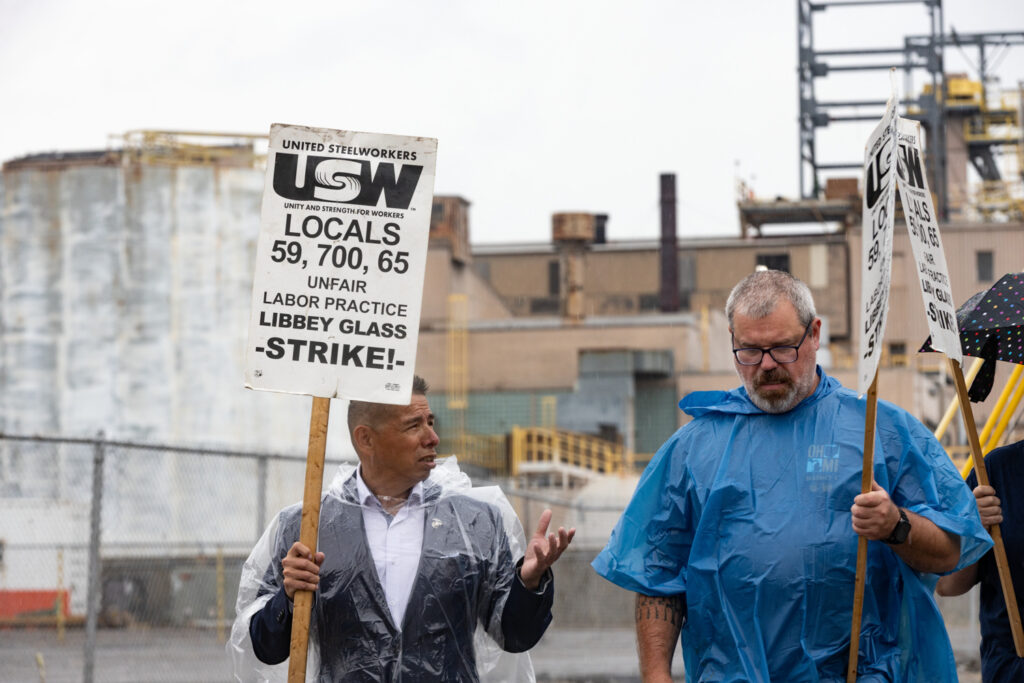
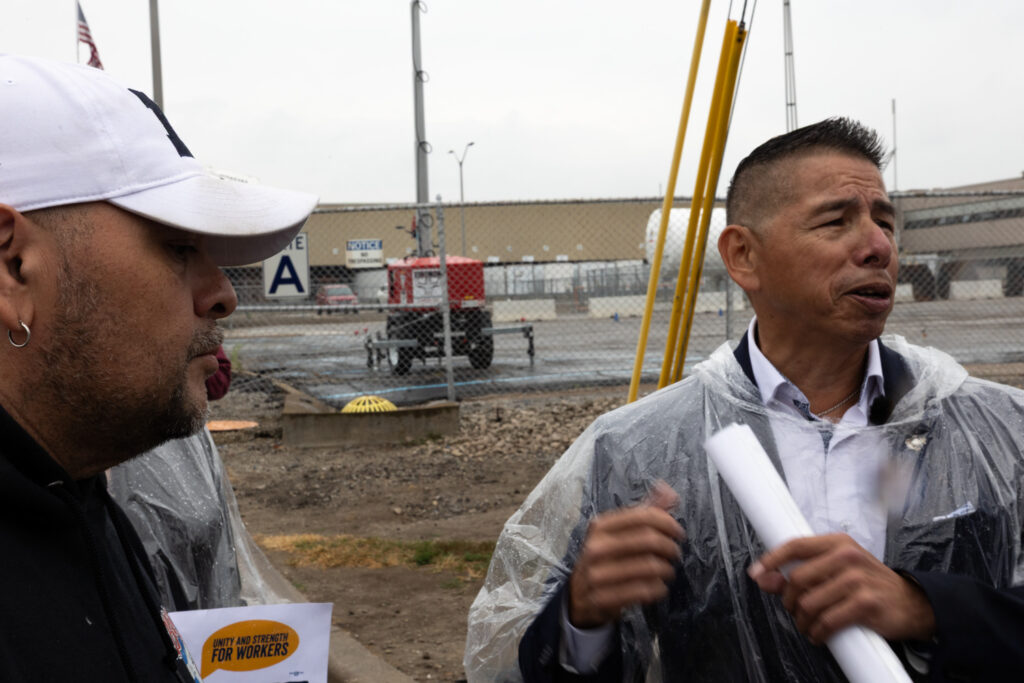
Bob Monday, a warehouse worker with Libbey Glass, walks with Roberto Torres, a mayoral candidate for Toledo, and other workers on the picket line during a strike at the Libbey Glass Toledo Factory & Distribution Center, 940 Ash St. in Toledo, Ohio on Monday, Sept. 22, 2025. (TFP photo by Stephen Zenner)
TOLEDO – A gray and drizzled day marked one month since workers at the Libbey Glass factory, 950 Ash Street, in north Toledo went on strike.
The looming edifice of glass production was a clear reminder for workers on the picket line of the power of their employer.
Strike captains managed workers walking in rain gear across the entrance of the mostly shut down production building.
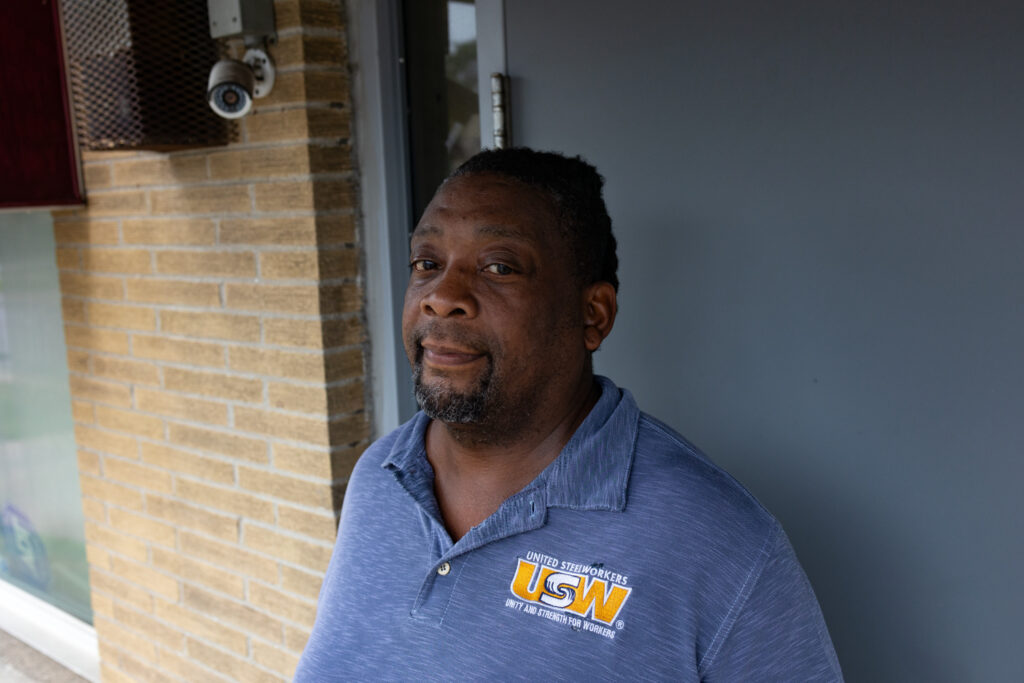
“The company was saying to us, ‘If you don’t come toward the items in our last, best and final offer, then there’s really no reason for us to meet,’” said Donnie Blatt, the director of United Steelworkers (USW) District 1, Ohio and Michigan, who was trying to find a way to avoid a shutdown.
*Video by Stephen Zenner and Gaven Hafner.
Management’s unwillingness to negotiate, Blatt said, left the union with no place to go except a strike.
“I gave them a proposal that would try to settle the issues, and was trying to find some middle ground,” he said. According to Blatt, after fifteen minutes of looking over the proposal, Libbey’s representation told him the company really only had one offer.
Union leadership said they could not accept Libbey’s offer, as it would dissolve the autonomy of the union and workers.
“We did take that back for a vote,” Blatt said. “We explained to everybody what was in that [offer], and the vote went down 302 to five [in favor of striking].”
Consequentially, at midnight on Aug. 23, workers from USW Locals 59, 700 and 65 went on strike along with workers from another union, the International Association of Machinists and Aerospace Workers (IAM) Local 1297.
Unmoved, both management and the locals maintain their opposed stances, but with one main difference: union members are eager to get back to the negotiating table.
Richard Barringer, a striking Libbey Glass worker in the mold shop, and Gabe Mason, a strike captain and a part of the skilled trades for Libbey Glass, walk the picket line during a strike at the Libbey Glass Toledo Factory & Distribution Center, 940 Ash St. in Toledo on Monday, Sept. 22, 2025.
The Contract
“For the last probably six meetings, they had that same little contract offer: ‘Take this or leave it,’” said Allen Chatman, the recording secretary for USW Local 700, recalling negotiations with Libbey.
“We can’t do that,” he said emphatically. “No, they want total control of our whole contract. You know, they want total control.”
Blatt backed Chatman on the nature of Libbey’s proposed offer.
“They want to unilaterally be able to contract out our work,” he said. “They want to unilaterally be able to change start times and end times of shifts. They want to be able to unilaterally say how many people are working, if they’re working on a different machine, which causes some safety concerns for us as well.”
“They want to unilaterally be able to make any discretionary decision that they deem necessary for production. You might as well not even have a collective bargaining agreement.”
These discretionary decisions include things like mandatory overtime, elimination of premium pay for shifts over 12 hours and sending workers home without pay if work is finished early. To make these changes, Libbey also proposed changing jurisdiction and seniority within the factory.
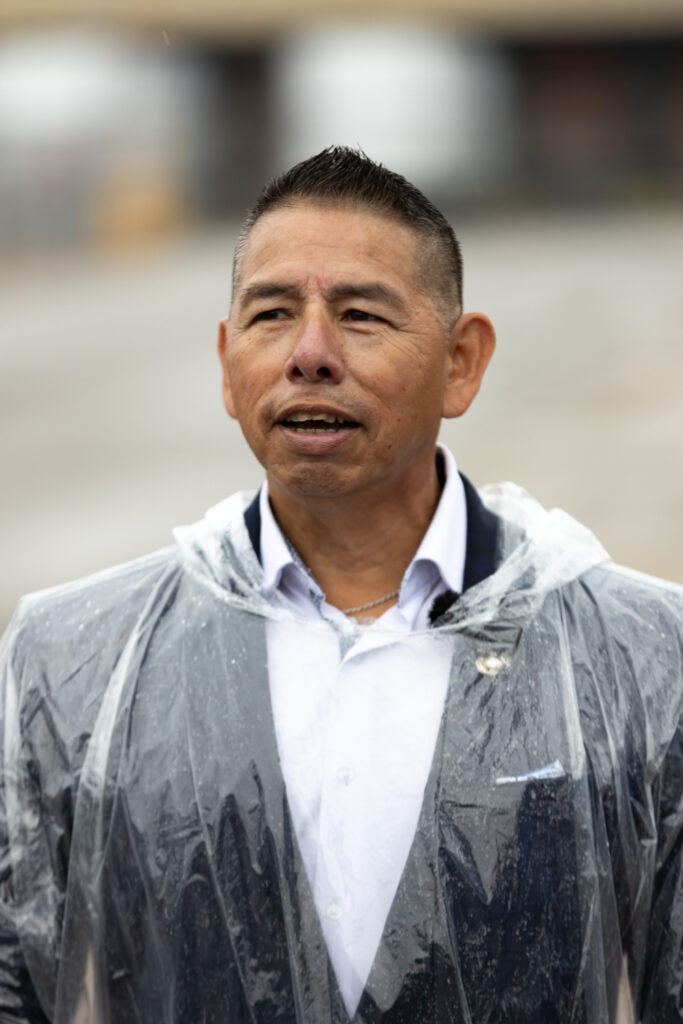
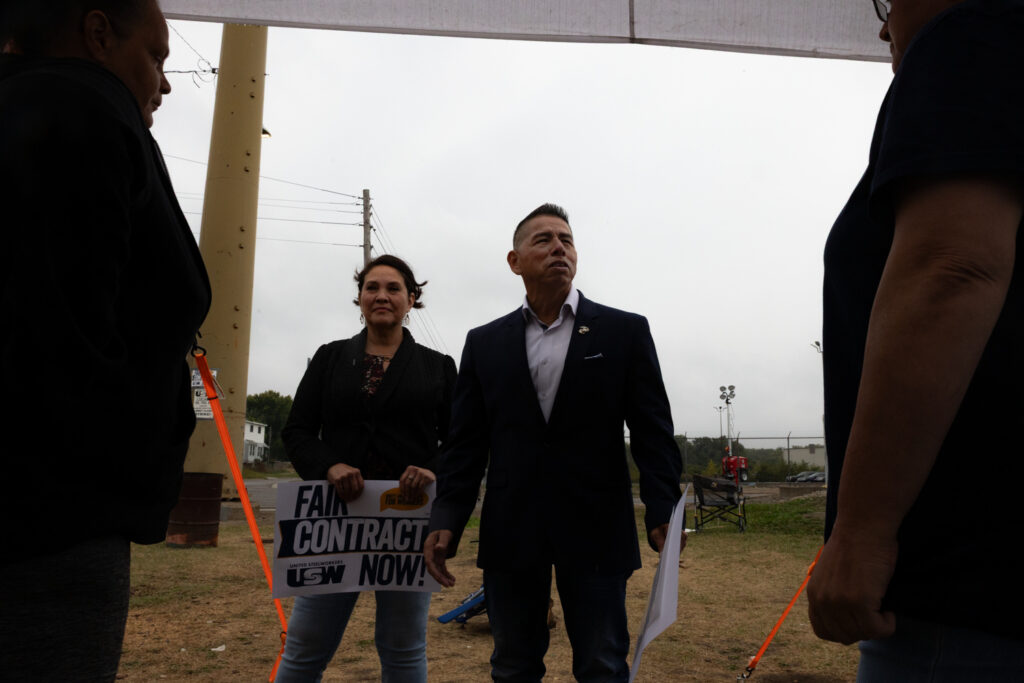
Roberto Torres, a mayoral candidate for Toledo, walks the picket line with Mason, Valerie Hummer and Amy Gill (both warehouse workers with Libbey Glass). Renee Clarke (left), the campaign manager for Roberto Torres.
Sacrifice
The overwhelming approval for a strike came on the heals of concessions the USW had already ceded during the Covid-19 pandemic.
“Back in 2019, the company came to us…saying that they were in trouble, and wanted us to help them stay out of bankruptcy and liquidation,” Blatt said. “So we bargained an agreement with them.”
“In 2020, the employees gave up a 2.5 percent wage increase that was already negotiated for them, and in 2021 they gave up another 2.5 percent wage increase. And then on top of that, [employees] took a 5 percent wage deduction until the end of the the extended agreement in 2024.”
“We also gave up retiree health care in that agreement that the retirees never did get back. We froze the defined benefit pension, and they [the workers] also agreed to pay more premiums for their health care,” Blatt said.
Workers did all this with a “snap back” provision that said workers would have parts of what they ceded restored when production hit a certain threshold.
“This is the first negotiation since the employees made that sacrifice,” Blatt said. USW international estimated these concessions were roughly $30 million in savings to the company.
“Now the company has come back, and they want more concessions,” he said.
Union workers are not eager to continue making concessions to Libbey.
“We’ve already dropped a lot of stuff that we really wanted. And we didn’t want to, but we did. And they’re still not, they’re not budging,” said Adrian Martinez, the recording secretary for Local 59.
“It could be another month. Could be another two months, I don’t know. First we got to get back to the table. That’s the first thing we’re trying to do.”
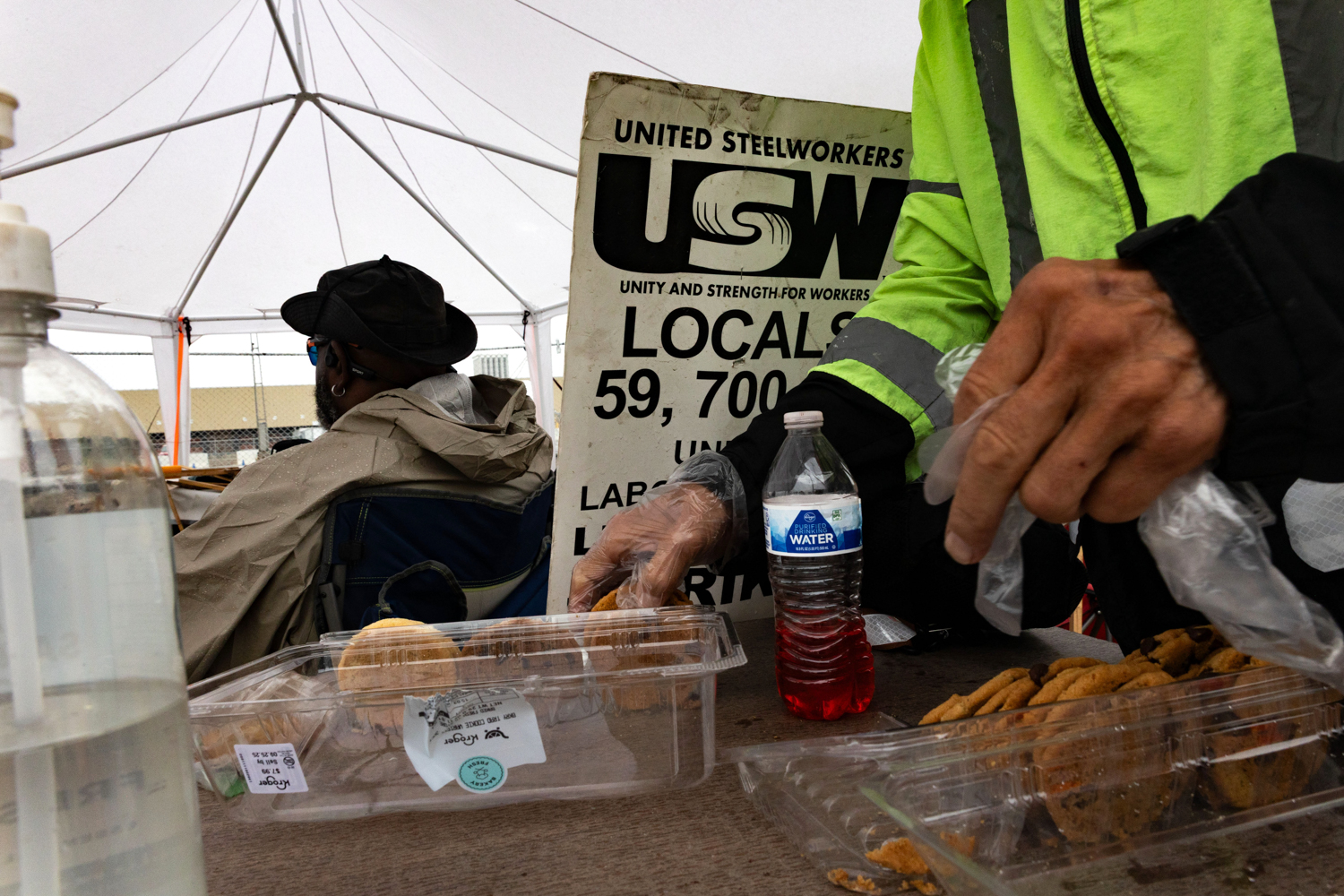
Scott Yglesias, change over specialist for Libbey Glass, moves food inside.
Political attention
One month into the strike, Toledo Mayor Wade Kapszukiewicz dropped off food supplies at USW Local 700 headquarters, 814 Ash Street, a brisk walk away from the Libbey factory and the picket line.
Later that day, Toledo Mayoral Candidate Roberto Torres met with workers on the picket line and delivered some political messaging ahead of the Nov. 4 election.
“We just stopped by there to drop off some food and water items for the workers and the families,” Torres said. “I ask for management to return to the bargaining table with a fair and equitable contract.”
Torres alleged Kapszukiewicz only stopped by earlier in the day because he heard Torres would be visiting the picket line that day.
This allegation resonated with some of the workers striking outside of the factory, who felt forgotten by the current mayor.
Strike Captain Gabe Mason was walking the picket line, and wouldn’t speak about the condition of the strike except that Kapszukiewicz hadn’t been to the picket line and had snubbed the USW strikers during the Labor Day Parade, turning away from the group during the march.
Chatman could not speak specifically to the events of Labor Day, but said he had heard the same story from other union members.
“We[‘re] on strike. We need all the help we can get,” Chatman said, and then asked the mayor for help. “Maybe you got some strings you can pull to get them [Libbey] to come back to the table with us.”
Mayor Kapszukiewicz later told the Toledo Free Press he would have walked with the USW if he had been asked to do so.
“I have a rule: I do virtually everything I’m asked, and nothing I’m not asked to do,” he said, and explained he came alongside other strikes in Toledo at roughly the same pace.
In terms of political pressure on Libbey, the mayor said, “Libbey certainly is risking their tax incentives from the City of Toledo,” but said it was likely the company calculated losing those incentives before allowing the strike to commence.
The long haul
Altogether, the roughly 650 workers at Libbey, not all USW, are now living off of their strike funds, and are accepting food donations.
Chatman and Blatt both mentioned a few stragglers who had crossed the picket line, and Blatt said he reached out to Libbey for a list of names of workers who were back to work already.
“The reason why we want to know that is because if we have members that have crossed the picket line, we don’t want them coming in and getting striking defense benefits during the strike from us,” Blatt said.
Regardless, Chatman said the workers who crossed were a “small fraction. It’s not hurting our drive at all.”
When asked why he thought management wasn’t budging on the negotiations, Chatman said, “Greed, corporate greed. That’s all I can say. For them to come, like they try to get a total rewrite of our contract. That’s greed.”
Workers said they are prepared to remain on strike for at least a few more months, but want to get back to the negotiating table.
“All we want is a fair and equitable agreement,” Blatt said, and finished talking with the Toledo Free Press by saying, “Libbey Glass didn’t make Toledo. The workers and the city of Toledo made Libbey Glass.”
“For this company to be so disrespectful to the history of glass making in Toledo, to be so disrespectful to the workers who saved them and kept them out of bankruptcy and liquidation and actually had them in a profitable financial position based on the sacrifices they made…I mean, it really is disrespectful.”
The Toledo Free Press reached out to Libbey for comment, but has not heard back as of the publication of this article.
And there does not seem to be an end to the strike for the time being.
Torres speaks to press at the picket line.Brigida Garcia (a selector at Libbey Glass), Monday, Barringer, Yglesias, and Antonio Simmons (warehouse worker).Adrian Martinez, a United Steelworkers Local 59 recording secretary, speaks with Torres.Allen Chapman, a United Steelworkers Local 700 recording secretary, stands outside of the USW Local 700 headquarters.
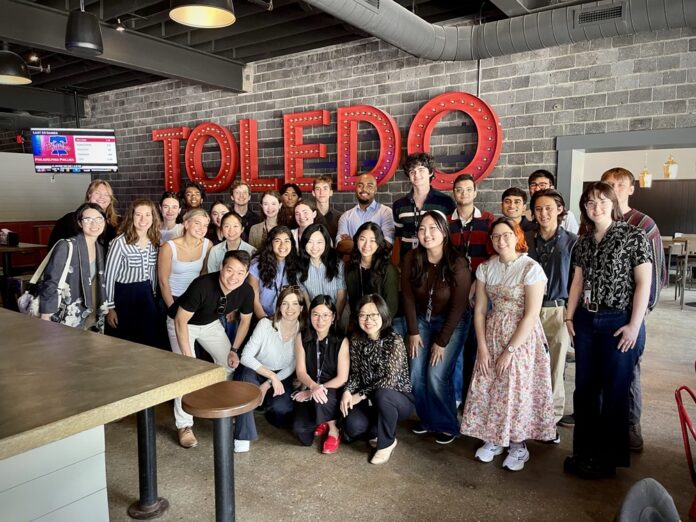
The 2025 Midstory interns and team. (Photo courtesy of Midstory)
TOLEDO – Some talk about bright, talented young people leaving Toledo – a brain drain, it’s called. Then there’s the four who left, earned degrees and started good jobs, but returned.
They’re on a crusade of sorts: to tell the story of Toledo specifically and the Midwest in general. Hence, in 2018, they formed Midstory. It’s not only “our” story, but theirs.
“We are a nonprofit. Our mission is to progress the Midwest narrative,” said Logan Sander, one of the four founding Midstorians. The other three are Samuel Chang, his sister Ruth Chang, and Alex Lim.
The four founders of Midstory after they moved back to Toledo in 2018. (From left) Ruth Chang, Logan Sander, Sam Chang and Alex Lim. (Photo courtesy of Midstory)
Sander explained the three branches through which Midstory does its work:
Multimedia storytelling, from podcasts to written journalism to graphics.
Solutions-oriented research, in partnership with universities and organizations on long-term projects.
Programing it calls ThinkLab, in which interns from universities nationwide and locally spend a summer with Midstory.
In a sense, the internships speak to the original concerns fueling the “brain drain” talk.
“Through the internship programs,” Sander said, “we’re cultivating, retaining, and attracting bright young talent to places like Toledo to invest themselves in our region and envision what regions like ours could be.”
She said the interns range from Princeton, Harvard, Yale, Duke, Northwestern to the University of Toledo and Bowling Green State University.
While those interns – around 20 to 25 each year and about 200 in total to date – are here for only a summer, “we’ve put Toledo on their map,” Sander said. So much so that some have returned for Midstory’s year-long fellowship program, in which they develop projects and gain experience in nonprofit and multimedia storytelling, she said.
Sander added that when Midstory began, it had a high school intern program. The 2020 pandemic brought that to a close; the collegiate one continued virtually. However, the high school program will be rebooted in 2026, drawing from local high schools and those across the Midwest.
Speaking of Midstory’s beginnings, the concept wasn’t immediate. Sander said she is a Toledoan, the Changs are immigrants from Taiwan who grew up in Toledo, and Lim is from Kalamazoo, Mich. Each went to universities on the East Coast, graduated, and in some cases began their careers. They all came to know each other – Logan and Sam married; Lim was Sam’s roommate in Boston.
Then they all came to question where they were and why. “We grew up, left, and experienced life elsewhere,” Sander said, feeling as though they were at a crossroads, as was the country at the time. “The epiphany was for us to give back to the place that raised us.”
So the four moved back to Toledo and began brainstorming. “What does our community need, how can we contribute to solving some issues, like the brain drain,” Sander said. Some people questioned why they returned, but “we wanted to make a statement. We wanted to be the first among many, that we’d be able to draw other young people to follow suit.”
The Midstory concept arose, and the four became their own grant writers to seek startup and operating funds. The University of Toledo Business Incubator provided an office, and the arrangement grew to the point where today Midstory has more-permanent space at the university’s incubator to also accommodate its interns.
In 2019, Midstory had a fundraiser in which it showcased its mission and its collaborative outreach, attracting about 1,000 visitors to the city’s Downtown Train Station.
Now, Sander said, instead of such fundraisers, Midstory banks on grants – local, regional, state, and national – and partnerships in conjunction with collaborations.
Midstory is in motion. “We’ve got a couple of really cool things upcoming,” she said. There’s an online exhibit with the Toledo History Museum highlighting local manufacturing and innovation, a new podcast looking into brain drain and population loss, and in the fall, an exhibit at the gallery space at the Main Branch of the Toledo Lucas County Public Library downtown on adaptive reuse sites – historic buildings that are being reused creatively.
“We’re changing the way people think about Toledo and the Midwest,” Sander said.
Toledo Mayor Wade Kapszukiewicz sits down with Toledo Free Press reporter Stephen Zenner to unpack his experience in politics, how faith led him to serve, economic development and other relevant local topics.
SWANTON TOWNSHIP – Four candidates are on the ballot for two Swanton Township trustee positions: Bill Anderson, Matt Beil, Kyle McPherson and Jeff Michael. The candidates were asked to weigh in on challenges and goals for governing the 2,800-resident township. Their profiles and answers are included below, in alphabetical order.
Bill Anderson
Bill Anderson
Swanton Township needs to get back to basics, believes Bill Anderson. The focus should be on solving problems, treating people with respect and keeping residents informed, he said. Whether it’s fire and EMS, zoning or communication, residents deserve straight answers and steady leadership.
“Too often, when leaders don’t want to face tough questions, they lean on rumors instead of answers. That’s not leadership – it’s distraction,” he said.
With nine years in the U.S. Air Force and two decades as a refinery mechanic, Anderson has spent his life solving problems and keeping people safe.
“I didn’t step up to run for trustee for power or position – that’s never been who I am,” Anderson said.
In addition to his service in the military and his career, Anderson has served in the schools, supported local Scouting organizations and volunteered with Team RWB – a community of veterans, service members, military families and supporters.
“Leadership isn’t about speeches – it’s about showing up, rolling up your sleeves, and doing the work. Just last month, a neighbor asked for help getting his horses in because they got loose. I didn’t make it complicated – I just got out there with a lead rope and help get his horses back in the pasture. That’s what service looks like to me,” Anderson said.
Accountability starts with showing up, and that’s how he’s lived his life, Anderson added.
If elected, he will make sure residents have easy access to township information, including a modern website, clear meeting notices and live-streamed sessions.
“I’ll respond to questions, not avoid them. Four years from now, I don’t want folks remembering drama – I want them to say: Bill was there, Bill listened, and Bill served this community with integrity.”
Matt Beil
Matt Beil
Swanton Township has faced and is facing a breakdown in trust between residents and their elected officials, believes Matt Beil.
“Many residents feel dismissed or targeted simply for asking questions. Instead of focusing on real priorities like fire and EMS coverage, communication, and basic services, the current administration has leaned into gossip and false accusations,” said Beil. “I’ve experienced this firsthand, having been publicly and wrongly accused of pushing annexation and water lines. I moved here for the rural way of life, and I will never support annexing our land into the village of Swanton or imposing city-style mandates. Our township has an opportunity now to restore accountability, protect its independence and strengthen communication with residents.”
Beil promises to bring a practical, no-nonsense approach to township leadership. That means restoring trust and making decisions transparently, ensuring that the direction of the community is determined by the residents, not outside interests.
“I’m not a politician – I’m a neighbor. I understand the challenges and priorities here because I live them every day,” he said.
If elected, Beil said he would rebuild trust by making township information accessible and meetings open to all. That includes a modern, user-friendly website with live-streamed meetings and clear updates so residents don’t have to guess when and where decisions will be made, he said. Records requests will be straightforward, and residents will always receive respectful responses. His goal: to ensure that every resident has a voice and knows their concerns are heard and valued.
“My life and career are built on hard work, honesty, and fairness,” said Beil, who is a senior project manager with more than 23 years of experience in environmental and engineering consulting.
Through his work, Beil has successfully led projects ranging from small community initiatives to multi-million dollar undertakings. He regularly collaborates with state and local officials to address complex challenges and deliver effective solutions, Beil said. He has also collaborated to secure funding for initiatives through grant writing.
While he’s lived in the township for a decade, Beil first got involved in township matters in September 2024, after learning of a 10-mill levy for fire and EMS.
“During that, it became clear to me that our township needed greater transparency, engagement and accountability,” he said. “Since then, I have attended nearly every township meeting. Those experiences have only strengthened my conviction that we can do better for our community.”
Beil is teaming up with trustee candidate Bill Anderson and fiscal officer candidate Mindy Curry to run on the goal to create a more open, responsive and community-focused Swanton Township.
Beil is married to Angie, and together they are raising three daughters and a son on their Oak Openings area property.
“I love township life and have a deep respect for the outdoors,” he said, noting that the Beil property is home to horses, donkeys, pigs and chickens as well as cats and dogs. He has also restored wetland and upland habitat on their property and continues to enhance the areas to ensure they thrive for the wildlife and future generations.
In his spare time, Beil is an active supporter of Anthony Wayne Local Schools and has volunteered with numerous organizations.
Kyle McPherson
Kyle McPherson
Taking care of the cemetery, staying within budget and preventing further annexation of township properties by Swanton or acquisition by the Metroparks are among the top priorities for Swanton Township trustee candidate Kyle McPherson.
“One of my goals is keeping it country for people who have ranches with horses, goats, cows, sheep and even alpacas,” said McPherson, noting that in the township someone can have more than two dogs – unlike in the village. “I would like to keep it country – we’re getting squeezed.”
She and the other trustees have fought to prevent additional properties from being annexed – most recently working with the Lucas County Commissioners to reduce the number of Scott Road properties proposed for annexation.
Like the other trustees, McPherson has areas that she handles – as the township doesn’t have an administrator for day-to-day business – and her duties include cemeteries. Currently the Swanton Township Cemetery on Scott Road is getting new foundations, and she’s also working on getting the records digitized from the original card files.
“Even in the afterlife, people should be entitled to dignity,” she said.
A Toledo native and Rogers High School graduate, McPherson enlisted in the Women’s Army Corps in 1968 and served four years. Her 25-year nursing career included 15 years in management. During that time she raised children, got involved with school athletics and boosters, and joined the American Legion Post 587 in Toledo.
After retirement, she earned her commercial driver’s license and did long-haul driving with her husband.
“That was an experience. We learned a lot,” she said, sharing how driving 13- and 18-speed semis across the country gave her a different perspective.
She moved to Swanton Township over 30 years ago but started attending trustee meetings around 2016, when Norfolk Southern began looking at adding a railroad siding near Fulton-Lucas Road. McPherson was later appointed to the township’s zoning commission and, after a few years on that board, to fill a vacancy from trustee Gary Schroeder’s resignation. When April Grajczyk resigned as trustee, McPherson was appointed to fill her position.
As she’s gotten involved in township government, McPherson said she hopes that others become more active and come to meetings so they can learn more how it works – including bills, expenses, income and joint economic development zones.
The meetings, she notes, are more relaxed than those of nearby Swanton village, where requests to speak need to be submitted ahead of time.
“Once the business meeting is done, we open the floor,” she said, adding that residents will always be listened to, as long as they’re being respectful and not arguing with one another.
She and the other trustees are always available by phone and, if she doesn’t know the answer, McPherson said she’ll find out. Sometimes she finds that it’s just someone who is lonely and needs to talk. And she doesn’t mind.
“I’ve always been the shoulder to cry on – and I think that comes from being in nursing,” she said.
While this will be McPherson’s first time on the ballot as trustee, she points out that she was elected to serve as the Republican Party’s district chairperson.
Jeff Michael
Jeff Michael
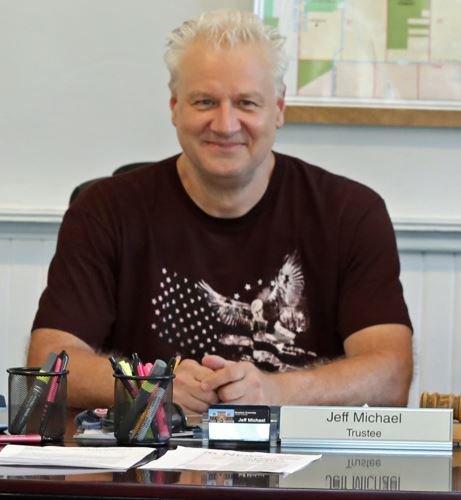
Jeff Michael is seeking re-election to the board of trustees, a position he’s held since 2010.
Growing up on his family’s Defiance County farm, Michael was involved in raising livestock, riding horses, farming and baling hay. He met Peggy in May 1996 and they were married a few months later, moving to their Swanton Township farm in 2000 to raise horses, cats, dogs and birds and to ride in nearby Oak Openings. Peggy Michael passed away on June 24, 2025.
“Peggy’s roots run deep in the Swanton area. Her grandmother, Jerrie Rinkel, lived in the area for over 50 years and served on the Swanton Fire Department’s rescue squad for over 25 years,” he said.
With a bachelor’s degree from Defiance College and an MBA with an emphasis on law and finance from Bowling Green State University, Michael serves as the executive in charge of information technology and cybersecurity for a large company.
Some of the key issues for the township include the consolidation of 911 services, which costs the township almost $37,000 more a year, but Michael said his audits of 911 calls have resulted in the township saving over $72,000 in the last five years.
He is also concerned about the Metroparks, which own almost 40 percent of township land, not paying any taxes to the township.
“I will be working with the Ohio General Assembly to have Metroparks pay the townships for lost tax revenue, services they use and wear and tear to shared roads maintained by the townships. He also wants to limit the amount of acreage that Metroparks can own in one township.
To enhance revenue, Michael said the township is utilizing alternative funding sources such as Joint Economic Development Districts (JEDDs) and other economic development tools that have no increase in property taxes but bring in revenue to help pay for services such as garbage pickup, yard waste drop-off, fleet replacement and more.
“I am committed to maintaining every other week trash pickup to township residents and township-provided yard waste service,” he said, adding that he would like to bring curbside recycling and pickup to the township.
Michael said he negotiated a joint cooperation agreement with the county to exempt and eliminate assessments from residents for the entire six-year Swan Creek Watershed project, saving the residents over $115,000 a year.
“Swanton Township residents will not have to pay this assessment tax on residential properties, which would have increased their property taxes substantially,” he said. “Additionally, I negotiated for the county to reimburse Swanton Township for cleaning its ditches yearly.”
Michael said he is committed to ensuring that all residents are informed of township business, by sending newsletters, emails and notices to make sure that all are aware, not just those who are online. He is encouraging residents to use the Lucas County Alerts system and plans to enhance the township’s online presence, branding and communication, but in a way that does not expose the township or its residents to “ransomware, malware, AI-powered attacks, social engineering and the data theft of residents’ information.”
As trustee, Michael is the director of the Toledo Express Airport JEDD board of directors and a member of the 911 Consolidation Regional Council of Government Administrators Technical Advisory Committee.
TOLEDO – Last week, the Vitality Arts Program hosted the Vitality Arts Show featuring work by 289 local senior center artists.
Jessica Mack, community outreach manager at TMA, said she is excited to help people gain more of an appreciation for art and become more connected throughout the program.
“A lot of people have never taken art classes before, and some may have, but it was kind of lost…We have just completed our second year with this program, which has been really incredible to see these artists really transforming in front of our eyes,” Mack said.
The Vitality Arts Program is for local senior residents who are 60 years old and older.
“We worked with five different local senior centers, and this was a way to bring art to the community,” Mack said.
(TFP photo by Sidney Robison)
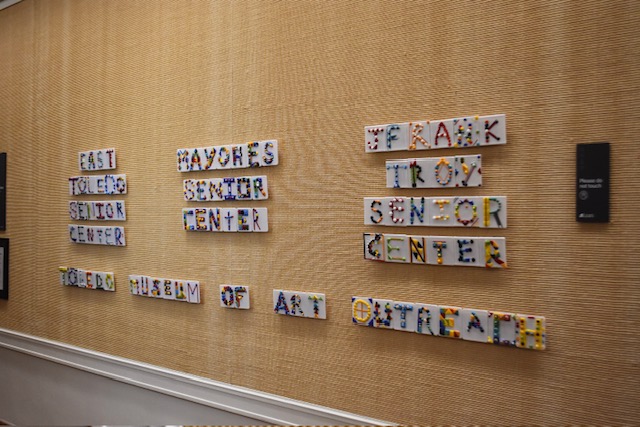
The five senior centers that participated in this show were the Zablocki Senior Center, East Toledo Senior Center, Mayores Senior Center, J. Frank Troy Senior Center and Lyman W. Liggins Senior Center.
The classes for the artists are held at TMA every Thursday.
“The artists look forward to their Thursday classes; it’s a way to start getting that creativity out, and it’s a way to get back out into the community,” Mack said, noting that the artists look forward to coming to the weekly classes and getting to visit the museum regularly.
“A lot of them had not been here [at TMA] for years. They didn’t think that this was accessible. They weren’t sure if they were supposed to dress a certain way to come. There’s a certain idea of what a museum is,” Mack said, indicating that many people think of museums as stuffy, formal affairs rather than a space for everyone.
The program has been successful in helping with creativity and community engagement among the senior artists.
“So this is truly not just a program, we’ve built a family out of this, and it shows in the success of the program,” Mack said.
She said there has been more of an interest in the program and that people who hadn’t come for years are now coming multiple times to the museum.
“I just think that it’s truly such a delight. We do a lot for the senior centers, but they’ve done so much for us. And it’s been a learning experience on both sides. It’s really just an incredible experience,” Mack said.
Stephen Zenner sits down with Independent mayoral candidate Roberto Torres to talk about his experiences working in Cleveland and Detroit, in addition to his work in Toledo. The two of them discuss the candidate’s philosophy on economic development, local political differences, and how his experience growing up in a northwest Ohio migrant camp shaped him.
The exterior of Solace Health & Wellness features a welcoming sign, showing a place of comfort and support for patients. (TFP photo by Sidney Robison)
TOLEDO – An inviting, bright red door welcomes you at 4231 Monroe St. in Toledo, waiting to be entered by community members looking for a new kind of care.
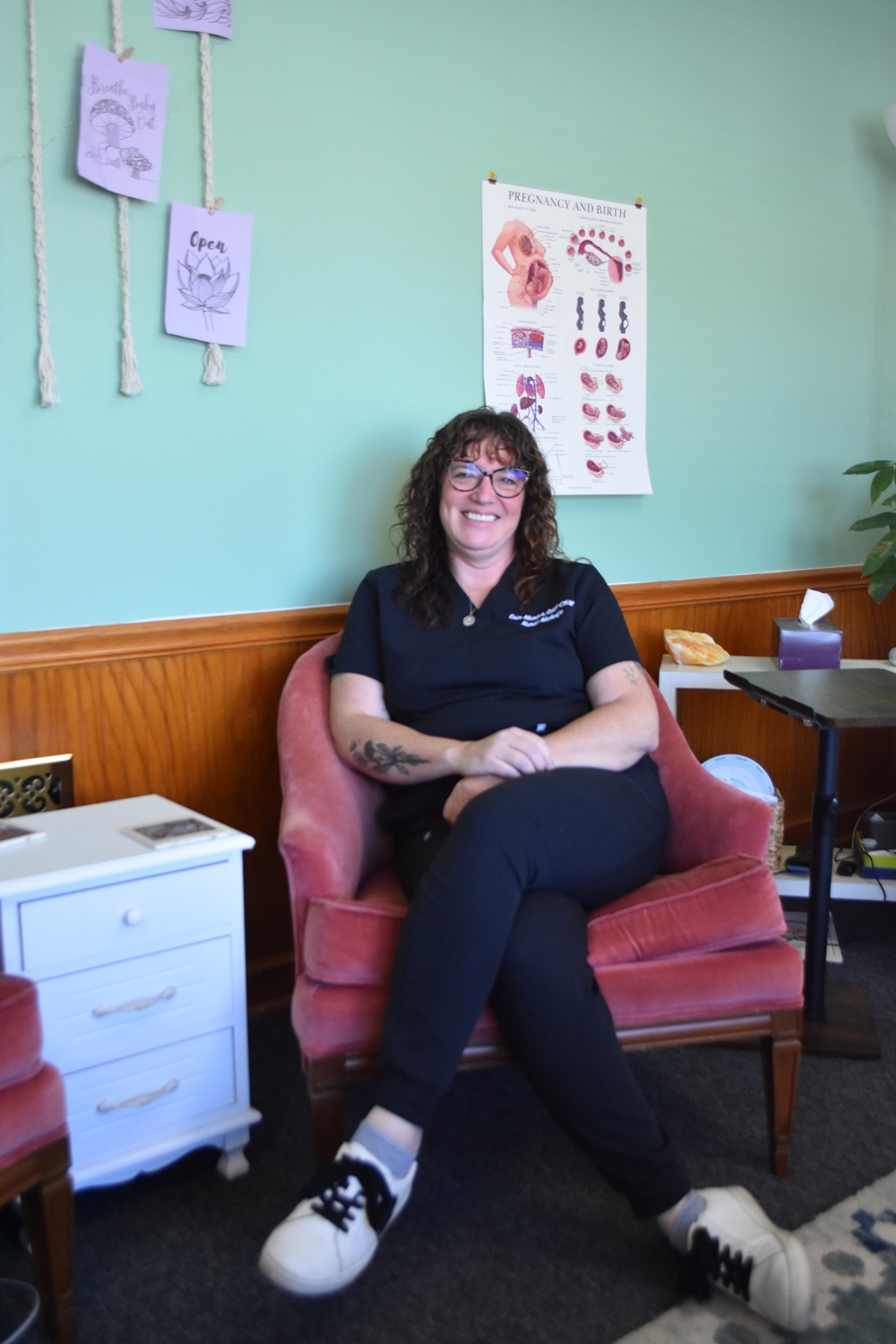
Erin Marten, certified nurse midwife of Solace Health, has been devoted to helping people since she started her career.
“I had an opportunity to just take really, really good care of people in the way that I want to, and I’ve been doing this long enough that a friend of mine was like, ‘Why don’t you start your own practice?’ And I was like, ‘No, why? I couldn’t do that,’” Marten said.
Erin Marten, executive director of Solace Health & Wellness. (TFP photo by Sidney Robison)
Solace Health opened in August of this year and offers services ranging from gynecological care, fertility support, menopause and hormone therapy, wellness counseling, pap smears and vaginal infection treatments.
Marten said she went to nursing school with the goal of becoming a midwife and eventually getting her own space.
She began her career as a nurse, then became a certified midwife in 2014.
“I have a public health degree in maternal and child health; sexual reproductive health is just kind of my life. It’s everything I do,” Marten said.
She explained that having a medical background helps her recognize the inequities in the healthcare system.
Marten also started Solace Menstrual Justice, which helps with reproductive justice and women’s health, educating people about menstruation.
Through this program, women are able to get packs full of 10 pads, 10 tampons, hand sanitizer, and wipes.
“What we started doing was collecting supplies from people [and] local businesses,” Marten said.
One of Marten’s initiatives, Seeking Solace Birthwork Justice Program, provides patients with a variety of different resources.
“We offer scholarships for people who want to be either a doula or a midwife, and we prioritize single parents, Black women, queer women, and we give out two of those scholarships twice a year,” Marten said.
A patient room at Solace Health & Wellness. (TFP photo by Sidney Robison)
Through the nonprofit Solace Health and Wellness, Marten also leads free childbirth classes once a month.
“When my patients come in, I can spend as much time as I want and take the time to get to know them and give them the care that they really deserve,” Marten said.
She said she strives to make sure each patient visit is 45 minutes to an hour long to make sure each person gets enough time and support.
“I really take the time to get to know my patients and not just talk about physical issues that they are there for that day, but also mental health because it all makes a difference,” Marten explained.
Marten said she is committed to restoring the idea that your healthcare providers do care about you and are listening.
“This is really my opportunity to show people what gynecological care can be, and that there are providers who do want to listen to you and who do want to take the time to give you the care that you deserve,” Marten said.