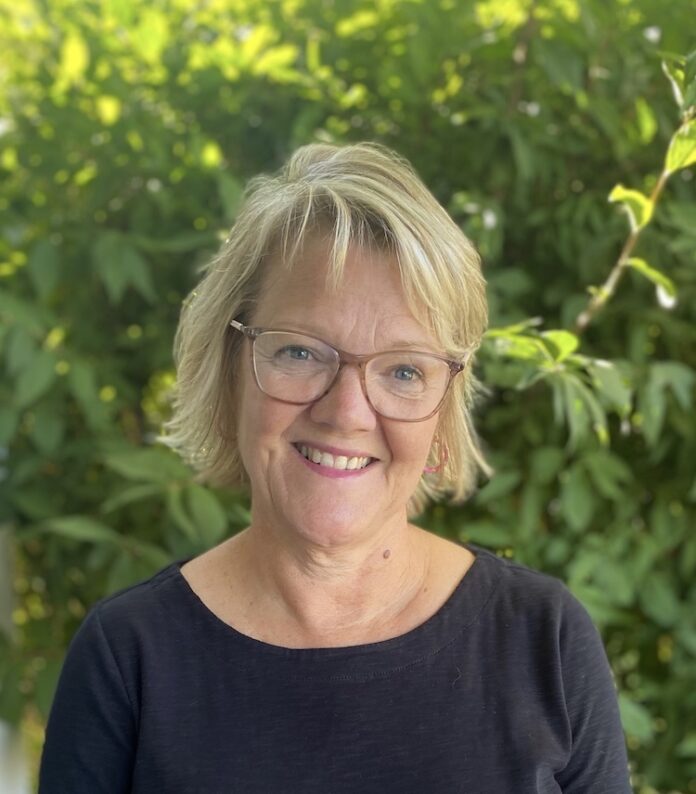
In today’s tight job market, we hear a common refrain: employers are desperate to hire.
Positions sit unfilled, help-wanted signs stay up for months, and companies compete for talent. With so much opportunity, it is easy to assume that the rules of job interviewing have loosened or disappeared altogether. They have not.
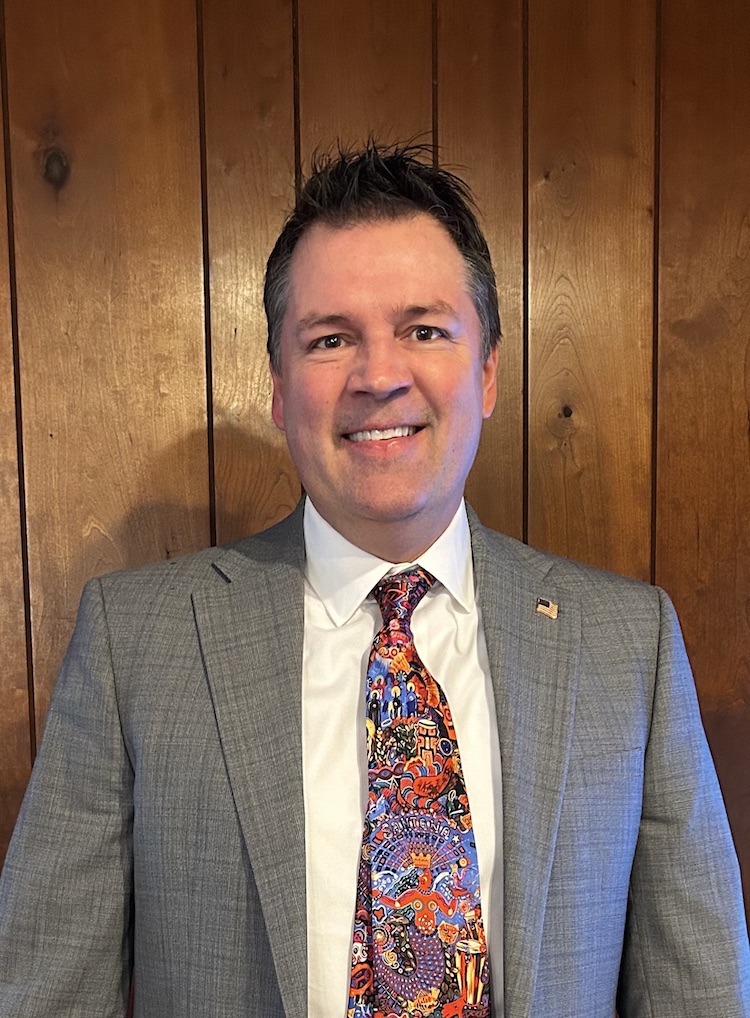
As an etiquette consultant, I often hear from employers who repeat the same message: they can teach skills, but they struggle to find candidates who demonstrate professionalism. In other words, while the job market has changed, expectations around respect, reliability, and courtesy have not.
Manners are not about being old-fashioned. Manners are about showing awareness of others, taking responsibility, and signaling that you can be trusted. In a job interview, those qualities are just as important as experience. They can make the difference between a “maybe” and a “yes.”
Consider the basics. Arriving fifteen minutes early communicates respect for the interviewer’s schedule. Making eye contact, listening without interrupting, and answering questions thoughtfully are not etiquette “extras.” These courtesies are signs of engagement and confidence. Each small choice in a professional interaction is an opportunity to show your best self, and it costs nothing.
Communication matters as well. A rushed email, a casual tone that borders on dismissive, or a failure to follow up after an interview can quietly remove a candidate from consideration. Courtesy is often the tie-breaker between two equally qualified applicants, and it is a skill every candidate can master.
Some job seekers worry that focusing on manners feels outdated or elitist. In reality, good manners are one of the most powerful tools anyone can use. Manners do not require advanced education, special connections, or expensive training. They require awareness, effort, and a commitment to showing respect. A polite greeting, a sincere thank-you, and a respectful tone are simple, universal ways to stand out.
Manners are especially important for young adults entering the workforce. Many are talented, capable, and eager, but they have grown up in a casual culture where texting replaces conversation and speed is valued over thoughtfulness. Teaching interview etiquette is not about stifling personality. Interview etiquette is about helping candidates translate their strengths into a professional setting, and seize the opportunities waiting for them.
Employers, too, have a role to play. Clear expectations, respectful interview processes, and timely communication model the same courtesy they hope to see in applicants. Professionalism works best when it flows both ways.
In a community like Toledo, where connections matter and reputations travel quickly, first impressions carry weight. A candidate who demonstrates kindness, attentiveness, and respect is remembered and often recommended. Manners build trust, and trust builds opportunity.
The job market may be competitive and fast-moving, but one thing remains constant: people want to work with people who make their day easier, not harder. Good manners signal exactly that, and can help any candidate rise, regardless of background, education, or experience.
Etiquette is consideration. In a job interview, consideration may be the most powerful qualification of all. Take the opportunity to show your best self. You never know which small act of respect could open the door to your next big opportunity.
The Cast of The North American Tour of SHUCKED (Photo by Matthew Murphy and Evan Zimmerman)
The Stranahan Theater is set to host Shucked, the Tony Award®-winning musical comedy that has been touring since 2024. Its score is written by the Grammy®-Award winning songwriting team of Brandy Clark and Shane McAnally (Kacey Musgraves’ “Follow Your Arrow”), and directed by Tony Award winner Jack O’Brien (Hairspray).
Just as corn pleases most diets, the genre-bending beats and hometown sets are sure to follow suit. Shucked is Broadway meets pop-country, playing on the best storytelling features of the mash up.
Maya Lagerstam heads the cast as part of the story-telling duo that takes the audience through the maize.
“We’re almost like a narrator, but we’re really communicating with the audience, and we guide you throughout the show,” Lagerstam said. “We also sometimes tend to hop into different roles, so sometimes we like to include ourselves into the story. We’re really right there having a dialogue with the audience.”
Maya Lagerstam as Storyteller 1 and Tyler Joseph Ellis as Storyteller 2 in The North American Tour of SHUCKED (Photo by Matthew Murphy and Evan Zimmerman)
The audience must build trust with Lagerstam and feel like they are in safe hands to be a part of the story, as the role intends. She said she takes a lot of her personal warmth and tucks it into the role to help engage folks. She also needs to put herself in several roles to make her dynamic character come alive on stage. Her approach to theater from the beginning of her career informs this ability.
“I was so excited to do theater in general when I was a kid. And any show that was happening, I was in. I wanted to play any role in any show. Wherever you need someone, I can play it, I’ll do it.”
Lagerstam’s experience in many roles plays a part in the versatility of Storyteller 1. She also comes into the role with eight off-Broadway shows under her belt, among popular titles like The Wiz and Rent. She said that this is her favorite role.
“One of the things that I really, really really love about this show is that we’re not ‘based on’ anything. Most shows that you see now on Broadway are either music that you’ve heard before on the radio, or by, or it’s a plot coming from a book or based on a movie. In Shucked, the music is original, and the plot is original.”
Shucked is a laugh for everyone.
“If you skipped the gym that day, it’s a really good ab workout. There’s at least one joke, if not 100 for anyone out there.”
When asked what advice she would give the audience, Lagerstam said, “Be ready to get shucked. I’m not much of a farmer, per se, but I do know a thing or two about shucking.”
TOLEDO – White sandy beaches, tropical blue water, warm weather and bright sunshine sound pretty good to most Ohioans this time of year. And that’s evident by the number of people who already have flown Allegiant’s new nonstop route from Toledo to Sarasota/Bradenton.
Allegiant Airlines plane. (Photo courtesy of Toledo-Lucas County Port Authority)
“We launched the Sarasota flight in November, and we just received data for our first full month, which was December, and we are just really excited to report a 93 percent load factor,” said Thomas Winston, president and CEO of the Toledo-Lucas County Port Authority. He explained that “load factor” is an airline industry term for the percentage of seats that are filled on each flight.
President and CEO Thomas Winston of the Toledo-Lucas County Port Authority. (Courtesy photo)
“We’ve demonstrated 20 years of the community supporting the service for Allegiant, and particularly for the kind of destinations for leisure and traveling like Sarasota/Bradenton.
With the addition of the Sarasota/Bradenton International Airport (SRQ), Allegiant now flies from Toledo to a total of four airports in central and Gulf Cost Florida.
“They launched the Orlando-Sanford flight in 2005, added the St. Pete-Clearwater flight in 2006, and then launched the Punta Gorda/Fort Myers flight around 2013,” Winston said. “So when you look at that Gulf Coast area of Florida, we’ve demonstrated the ability to support those leisure and travel opportunities for our residents.”
He noted that people from the Toledo area own more than 200 second homes in the Sarasota/Bradenton area.
“That’s the type of data that airlines, specifically Allegiant, will use and look at,” Winston said, adding that he and his staff meet regularly with airline and airport officials from around the country to discuss possible routes and services.
The Sarasota-Bradenton area already was a popular vacation spot for Toledo-area travelers, according to Paul Hoback, President and CEO of the Sarasota/Bradenton International Airport.
Sarasota, Fla. (Photo courtesy of the Toledo Lucas-County Port Authority)
He moved to the Sarasota area from Pittsburgh in October to take the SRQ job and said he meets so many people from Ohio, Michigan, Indiana and Pennsylvania that “it just feels like home down here.”
“It’s so exciting for people in the Toledo region to come on vacation down here, to paradise, to be able to enjoy the beaches that we have, the amazing arts and culture that we have here, you know, even the culinary experience, the foods and all of the opportunities you have with that. I mean, it’s just…it’s incredible,” Hoback said.
He said he really does consider the Sarasota-Bradenton area to be a paradise.
“I mean, it’s not just white sandy beaches. It’s boating opportunities, it’s golfing, it’s fishing, it’s the wildlife…. I’ve been exploring the state parks and seeing alligators and manatees and dolphins; it’s just unbelievable. It’s absolute paradise down here, and I think that’s why it’s so easy to sell this region to the rest of the world because it’s your chance to get away.”
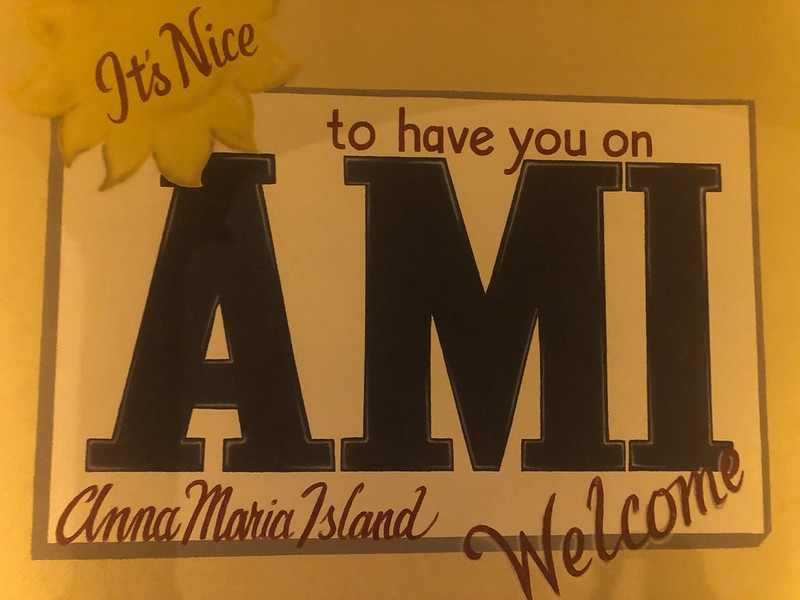
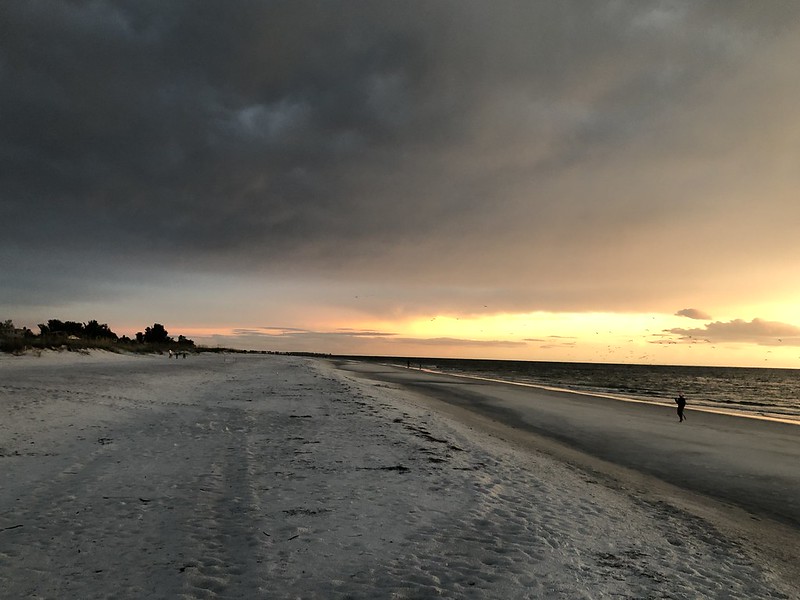
Anna Maria Island, just west of Bradenton, offers beautiful views of sunset on the Gulf of Mexico almost every day. (Courtesy photo)
Among the area attractions are the beaches of Anna Maria Island, Cortez, Longboat Key, and Siesta Key. In Sarasota, The Ringling is a museum that is “literally one minute from the airport,” Hoback said.
“There are large buildings that house a lot of memorabilia from the [Ringling Bros. and Barnum & Bailey] Circus, but it’s not just a circus museum,” he said.
The museum’s extensive art collection features Baroque masterpieces including four massive paintings by Peter Paul Rubens and an exact copy of Michelangelo’s statue of David, as well as other art from a variety of regions and eras.
Winston pointed out that Toledo Express and Allegiant have been steadily increasing their travel offerings.
“In December, we had 11 more flights than we had in December 2024. Because of the services with Allegiant and the support of the community, there were 1,800 more seats available last December than a year ago,” Winston said. He expects the new nonstop flights to Sarasota/Bradenton will continue to raise those numbers.
“At the beginning of May, we will have over 5,800 more available seats flying out of Toledo Express in the first five months of 2026 than we did in the first five months of 2025,” Winston said. And the increased numbers of travelers help the local job market in a variety of ways.
“There is certainly more of an indirect impact on jobs, like the ground handling services that service these aircraft, more opportunities for our car rental agencies, more fuel going into aircraft … there’s a ripple effect on getting this additional route,” Winston said.
Winston said it’s too early to know for sure, but the Jan. 10 announcement by Allegiant that it is acquiring Sun Country Airlines will likely be a boost for Toledo travelers.
“The future combined company airline will have over 170 destinations that they fly to, particularly around the U.S. but also in Mexico and the Caribbean,” he said. “The bottom line is that with the changes in the industry, with consolidation taking place, we believe there is clearly a niche for Toledo Express,” he said, mostly for trips to vacation destinations like Florida and Arizona.
“The community has supported that for 20 years, and we know we can continue to support that,” Winston said.
The Pale Horse, a horror-themed bar on N. Superior St. in downtown Toledo, will open on Friday, Jan. 16, at 6 p.m. (TFP photo by Steven Bieber)
Opening on Jan. 16 on Superior Street
TOLEDO — While there are already plenty of great watering holes in Toledo, one new bar aims to bring something fresh to the downtown area: The Pale Horse, Toledo’s first-ever horror-themed bar.
Owner Jessica Delgado has loved the horror genre for as long as she can remember.
“I love everything horror. I have been watching horror since I was a child, you know…Creepshow, Chucky…all those kinds of things,” she said. “I just grew up on it. I go to conventions every year – oddities conventions, horror conventions. I just love the genre, and I know there are a lot of people like me that like that too.”
Before setting her sights on opening a bar, Delgado worked as a quality technician for 10 years. During that time, she conducted her own research to determine whether there was enough interest among horror fans to pursue the project. She was also influenced by the emergence of other horror-inspired businesses, such as salons, tattoo parlors, and cafes.
Owner Jessica Delgado standing by some creepy artwork a week before opening. (TFP photo by Steven Bieber)
Any new business owner faces a series of challenges, and Delgado is no exception. Since she began planning for the January 2026 opening, she has had to navigate the many licenses and permits required to open. The most difficult license for her to obtain was the liquor license; without it, her dream would have been dead in the water. She also noted some staffing issues, as two of her chefs recently quit.
Fortunately, the process has not been all doom and gloom. Delgado said she has not had to look far to find people eager to work. When she received the keys to the building, she posted on Facebook and was met with a flood of messages from individuals seeking employment. She also offered advice to anyone looking to start their own business.
“Definitely have a plan going forward. Do all the research. Know everything that you want to know before you start, because if you’re in it and you’re learning those lessons, it’s going to be so hard. And I’d say network as much as possible because people are incredibly helpful.”
With her liquor license in hand, Delgado is free to serve drinks that are as unique as they are spooky. The Pale Horse’s menu features eight specialty cocktails, as well as slushies (alcohol optional) and six mocktails for people who don’t drink alcohol but still want to enjoy the experience. The food menu keeps things simple, with items such as burgers, chicken chunks, and sliders. Delgado also includes empanadas as an homage to her roots in Cleveland, which has a large Latin American community.
Along with food and drinks, The Pale Horse seeks to entertain its guests. In the main room, movies will play on screens throughout the space. Downstairs, guests can enjoy games such as pool, darts, and karaoke free of charge. Delgado also shared her ambition to eventually host live shows at the bar.
Delgado said her priority is for everyone to have a good time, even those who are not horror fans, and she encourages everyone to come out and try something new.
The grand opening for The Pale Horse will be held Friday,Jan. 16, from 6 p.m. to 2 a.m. at 319 N. Superior St. Learn more at The Pale Horse website.
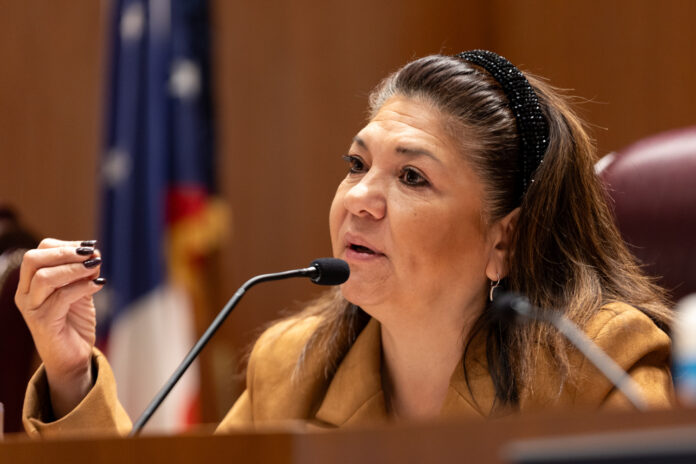
Lucas County Commissioner Anita Lopez speaks during a Lucas County Commissioners meeting at 1 Government Center in downtown Toledo on Tuesday, Jan. 13. (TFP photo by Stephen Zenner)
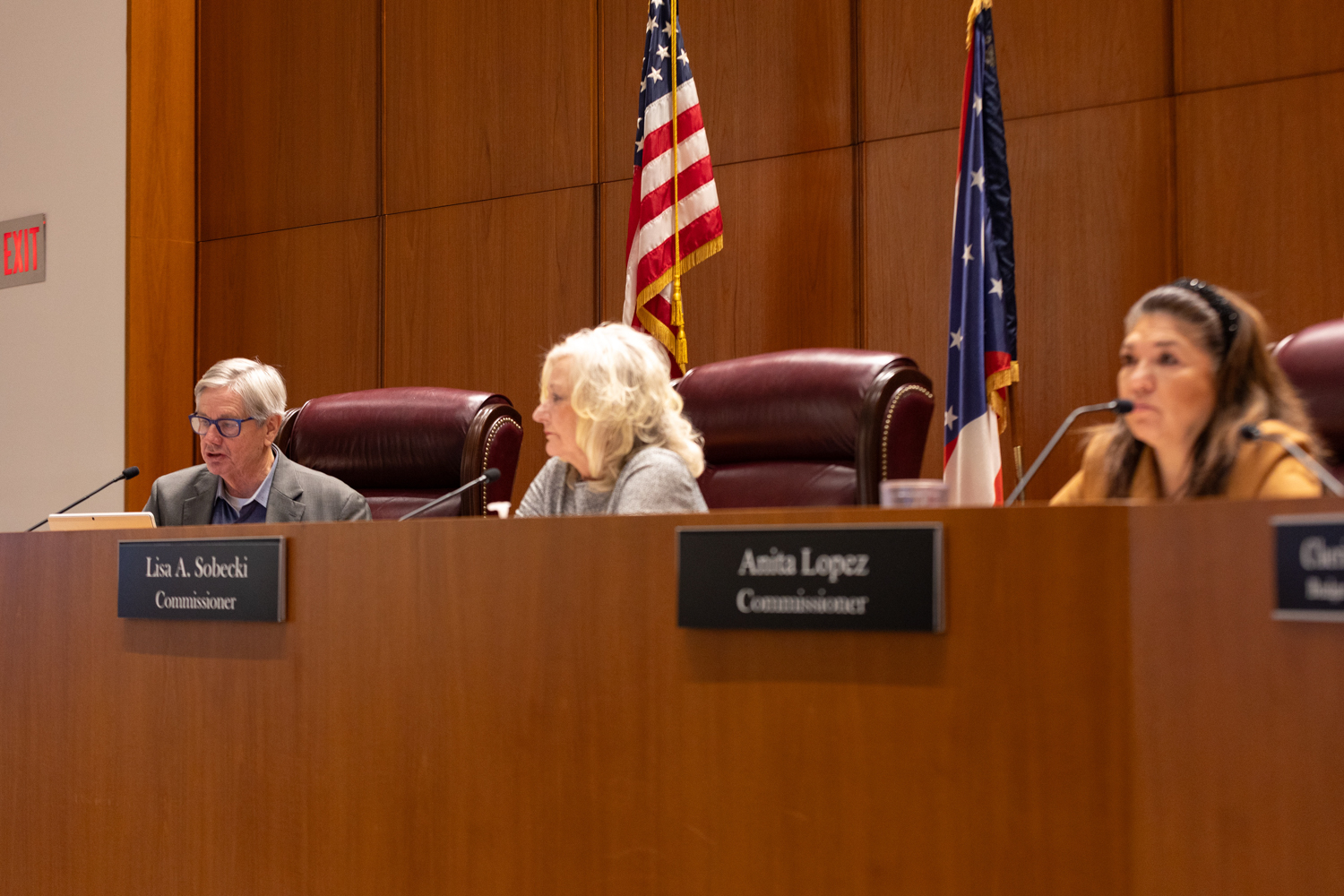
TOLEDO – Commissioners Lisa Sobecki and Anita Lopez appeared blindsided by their counterpart, Pete Gerken, as he made an impromptu attempt to vote symbolically against a Department of Homeland Security (DHS) grant during Tuesday’s Lucas County Commissioners Meeting at 1 Government Center in downtown Toledo.
Gerken said the grant was supposed to empower the county to stop drug runners coming down from Canada, but stated that “ICE, DHS and Border Patrol have devolved in front of the country’s eyes, as we saw clearly this last week.”
ICE in Minnesota
On Jan. 7, Immigration and Customs Enforcement (ICE) agents surged into Minneapolis, Minn. and, during neighborhood raids, killed Renee Good, a United States citizen.
A subsequent DHS action near Roosevelt High School later that same day led Minneapolis Public Schools (MPS) to close their district for “safety concerns” for the rest of that week.
Minnesota officials have claimed DHS agents are terrorizing the city and state, while DHS have maintained their actions are justified as part of their immigration raids.
Under the Trump administration, concerns about due process, detaining American citizens and other aggressive tactics used by ICE have been criticized more significantly, but the killing of Good has cemented a more intense opposition to DHS.
Operation Stonegarden
Lucas County Commissioner Pete Gerken. (TFP photo by Stephen Zenner)
For over a decade, Lucas County has received money from the Operation Stonegarden (OPSG) Grant, through the Federal Emergency Management Agency (FEMA), and the commissioners unanimously voted to receive the $70,000 grant back on Dec. 2, 2025.
An “administrative error” landed the grant back in front of the commissioners on Jan. 13, and they had to approve the amended amount, $68,250, before the Sheriff could receive the funds.
Gerken used the grant’s appearance on the agenda as an opportunity to speak on national politics, and stated outright that he began speaking without intent to rescind the grant.
“I understand this is not a rescinding of that resolution [OPSG],” he said towards the beginning of a political monologue against DHS, Customs and Border Patrol (CBP) and ICE.
“I’m not going to maintain my neutrality when it comes to taking any money for this county to do the purposes of DHS, ICE or Border Patrol…I think DHS, ICE and Border Patrol have gone from a legitimate law enforcement agency to a terrorist group.”
Then Gerken read the definition of a terrorist group: “A group who uses threats of violence to create fear, aiming to intimidate civilians or coerce governments to achieve political, religious or ideological goals, often by targeting noncombatants or property for maximum psychological impact.”
No DHS
Lisa Sobecki, president of the Board of Lucas County Commissioners. (TFP photo by Stephen Zenner)
Scrambling to pick up after Gerken’s impromptu speech, Sobecki said she agreed with Gerken, but the vote from December was still in place to receive the grant.
Sobecki stood by her vote in December to receive the funds, but said she did not condone the actions of DHS agents in Minnesota.
During both of the other commissioners’ speeches, Lopez’s face became quizzical.
When given an opportunity to speak, Lopez asked if the commissioners could turn Gerken’s symbolic words into real action, and asked if it was too late to rescind the grant in full.
Gerken responded with, “Oh, you’re going there.”
Noting that this was not a contract, like the previous Flock contract the commissioners tried to pull out of last summer, Gerken said, “This is a grant. We can un-accept at any point with the will of the board.”
A motion to right the administrative error to the OPSG was voted down, with Sobecki the only commissioner supporting the amendment to the grant.
And then Gerken made a new motion, not on the agenda, to rescind the Dec. 2, 2025 vote, unaccepting the DHS grant.
“Again, I voted for it” back in December, he said before taking the vote that would deny the funding from DHS. “Things have changed.”
Then and now
Back in December, the Toledo Free Press asked, in light of Gerken’s outspoken opposition to Trump’s immigration policy, why he accepted the grant, and received this answer from him on Dec. 8, 2025 in an email:
“This grant covers Lucas County Sheriff’s Office expenditures for overtime and vehicle use/maintenance related to border security. It is not a new grant; Lucas County has received federal funding for these operations for at least 20 years. It also is not a contract with ICE.
Lucas County is a border community. Monitoring our international border to combat drug trafficking, human trafficking, and other serious crimes is an important part of the Lucas County Sheriff’s Office’s work to keep our community safe.”
After stating things had changed, Gerken belittled the DHS patrol boat the federal government had supplied to watch Lake Erie, and said, “That was a waste of, probably, money to do that. It apprehended no drugs from Canada, but gave us a $300,000 boat to patrol Lake Erie on.”
“Given where we are today, in the history of our country, I don’t want to have monies co-mingled with our county funds,” he said, and made the motion to rescind the grant entirely.
“I don’t want the sheriff to be tainted by that, so I would make a motion to rescind the resolution for the Stonegarden grant.”
Lopez and Gerken voted to rescind the grant, while Sobecki voted to receive the grant, and the grant was rescinded.
Pete Gerken, a Lucas County Commissioner, speaks on the Department of Homeland Security next to his fellow Lucas County Commissioners Lisa Sobecki and Anita Lopez. (TFP photo by Stephen Zenner)
Sheriff’s response
Back in December, the Toledo Free Press asked Lucas County Sheriff Michael Navarre about Operation Stonegarden in relation to ICE and Border Patrol, and he said in an email,
“This grant was previously called the ‘Northern Border Initiative’ and has been in place for two decades. It was historically used for patrols on Lake Erie. It pays for overtime for deputies and is intended to stop illegal drug trafficking. It has nothing to do with enforcement of federal immigration laws.”
The Toledo Free Press reached out to Navarre for comment on the rescinding of OPSG, but did not hear back.
Navarre is quoted in The Blade, in an article by Alex Bracken, responding to the Board of Lucas County Commissioners’ decision:
“‘I think it is foolish to turn away free money from the federal government with no strings attached,’ Sheriff Navarre said. ‘We’re not working with the Department of Homeland Security, we’re not working with Customs and Border Patrol, and we’re not working with ICE — they’re just the providers of the money.’”
The report file for OPSG on hand with Lucas County reads:
“The goal of this project is to enhance cooperation and coordination between Customs and Border Protection, United States Border Patrol, and Lucas County to improve overall border security.
…Lucas County law enforcement agencies will work in coordination with USBP to serve as force multipliers in a combined effort to disrupt, dismantle, and interdict transnational threats while improving communication and intelligence sharing. Lucas County will utilize their own law enforcement authorities to support the border security mission and do not receive any additional authority by participating in OPSG.
…To accomplish the Operation Stonegarden mission, law enforcement sensitive information is shared between Federal, State, and local friendly forces. This information includes intelligence sharing, CONOPS/Applications, Operations Orders, Fragmentary Orders, Daily Activity Reports, After Action Reports, and more.”
The day before the Commissioners’ meeting, the Toledo Free Press spoke with Navarre concerning another matter, during which he clarified, “My issue [with ICE] was the family separation that the federal government still has not adequately addressed.”
Navarre went on to say he is in communication with DHS entities on a regular basis, and he said, “If we get a request from ICE to assist them, we’re going to assist them. We’re not going to tell them no.”
“We’re not going to turn our backs on law enforcement. They’re taking orders from their bosses just like we are.”
Dissent
Commissioner Sobecki corroborated the Sheriff’s assessment on the grant.
“It has nothing to do, in my opinion, in my vote, that I took today, that I also took in December— it had nothing to do with what was happening across our country with ICE,” she said. “I’m supporting the ability for the sheriff to be able to have a grant that came from the federal government, to be able to offset some costs…”
“I don’t agree with the fact that ICE can come into a community, wear a mask, and you don’t know what their names are and things like that,” Sobecki said, but upheld a difference between receiving the grant and directly supporting ICE.
Limits on federal power
Lopez, who turned the symbolic gesture by Gerken into real action said, “We don’t want any of those dollars under this culture that has developed under Homeland Security.”
“If we accept those dollars, does that mean we silently approve of their actions and operations? I think that’s what it comes down to,” she said.
Specifically, Lopez talked about the practice of wearing masks, “If we’re going to accept dollars, there should be parameters, so if our law enforcement are out there with no masks in operation with Homeland Security, then their law enforcement should also be transparent and be easily identifiable.”
At that moment, a group of county parole officers walked through the first floor of 1 Government Center, and Commissioner Lopez motioned to their un-masked example as to how law enforcement should carry out their duties.
When the grant comes around next year, Lopez said she would be happy to renegotiate, but wanted assurances from DHS about their conduct in Lucas County.
“I think we need to set some parameters when they’re in our county, and if not, we shouldn’t accept the dollars.”
Everywhere in Toledo, you’ll find people who play a role in making our city tick – from hospitals and factories to restaurants and art galleries – and behind every person is a story. Our program, Toledo Works, highlights those stories from workers’ firsthand accounts. Each week, Toledo Free Press hosts Jaden Jefferson and Stephen Zenner focus on a different topic within the Toledo workforce, exploring their day-to-day challenges and triumphs.
In this episode, Jaden sits down with two workers from organizations that help Toledo kids thrive: Abbie Spencer fromToledo Day Nurseryand Katie McGuckin from WIC.
Amy Barrett was voted in unanimously to the Anthony Wayne School Board. (Courtesy photo)
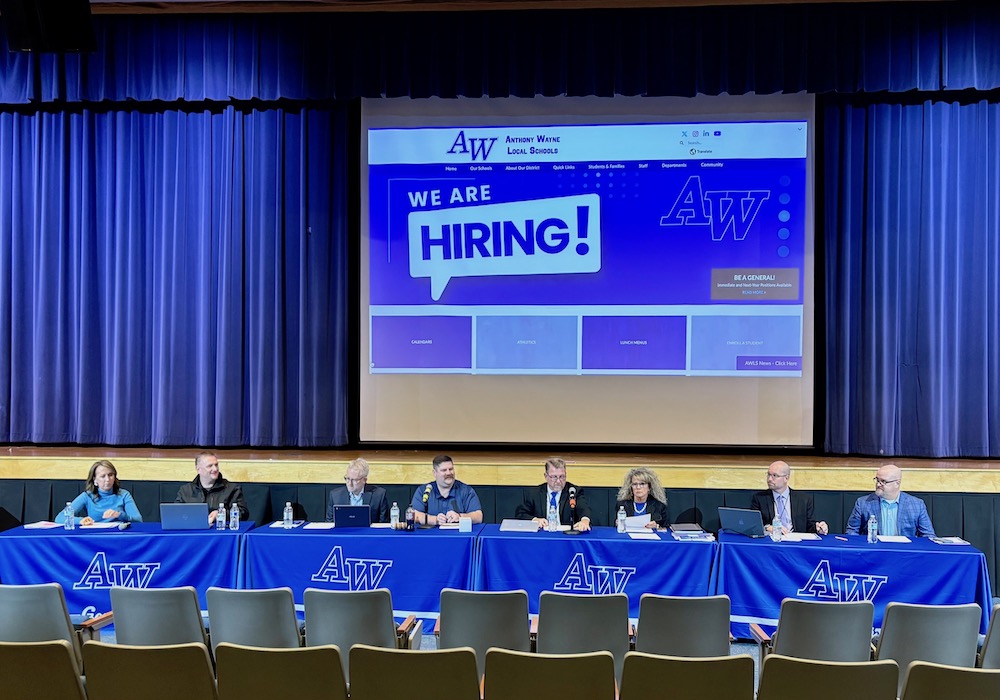
ANTHONY WAYNE – Amy Barrett is joining the Anthony Wayne Board of Education, filling out the remainder of Shellie McKnight‘s term. After a nearly 90-minute executive session on Jan. 13, board members Jeff Baden, Lindsay Hoipkemier, Kyle Miller and Mike Stamm returned to vote unanimously for Barrett, who ran for a seat on the board in a crowded 2023 election.
“We had a really good discussion. There’s so much talent. We really appreciate all 25 candidates who applied for this position,” Baden said.
Barrett has been involved in the district for over 28 years, including leading a drug prevention education, working as a substitute teacher, serving on parent-teacher organizations and founding a weekend food bag program. Currently Barrett is a self-employed grant writer and the volunteer coordinator for Anthony Wayne Neighborhood Bridges, which ensures that students have food, clothing and other resources.
“I am very honored to have been chosen to serve both the school district and our community in this capacity,” Barrett said.
She will be given the oath of office during the Monday, Feb. 9 board meeting.
The Anthony Wayne Board of Education approved the selection of Amy Barrett to serve out the remainder of Shellie McKnight’s term during its Jan. 13 meeting. (AWFP photo by Karen Gerhardinger)
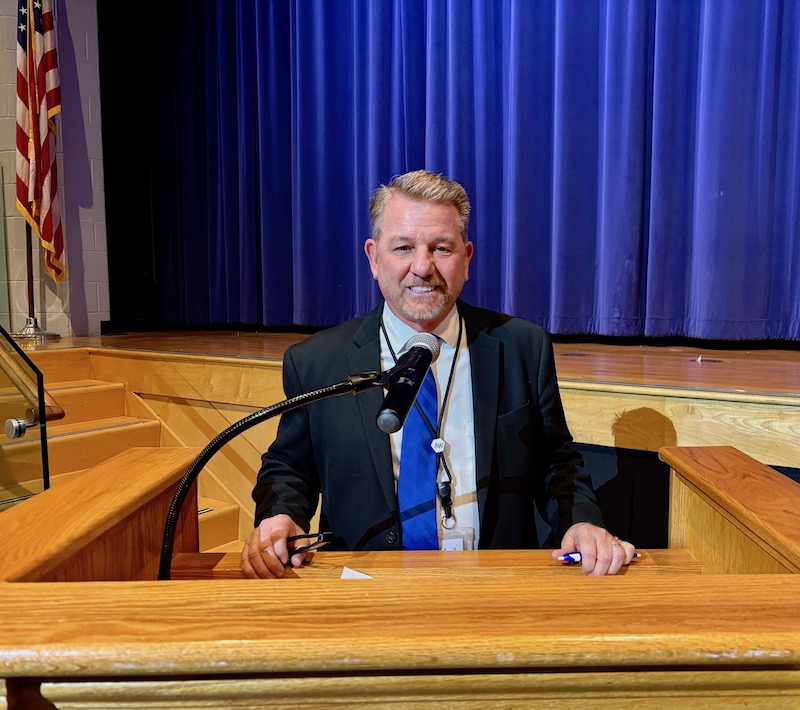
During the meeting, Superintendent Kevin Herman gave a state of the schools address that is available in full on the district’s website at anthonywayneschools.org.
He detailed the district’s financial health. While boosted with a $3.2 million revenue increase due to increases in property valuations, the district needs to be fiscally conservative to deal with increasing costs, Herman said, noting that the district is closely monitoring House Bill 335, which seeks to reduce the tax burden for property owners.
Student enrollment has declined over the past four years, with a total of 4,127 this year.
“That surprises people when they see the new houses going in,” Herman said of the growing district. “People feel that we should be busting at the seams.”
The district continues to perform well, ranking in the top five percent in the state for academic performance.
“We will continue to work and build on that,” he said. “But success is not just measured in test scores.”
Superintendent Kevin Herman gave a state of the schools address. (AWFP photo by Karen Gerhardinger)
In addition to strong academic performance, the district has excelled in the arts, athletics and other extracurricular activities – with a high percentage of student participation.
With the district’s five-year strategic plan set to wrap up in 2027, work will begin on updating the plan to incorporate changes in state laws and enrollment. Herman said the district’s other goals include deepening community partnerships and providing students with opportunities to gain the skills they need to thrive in an ever-changing environment.
Herman encouraged community members to contact the district with questions.
“Your voice is important,” he said.
During the meeting, the board also:
-Named Jeff Baden as board president and Miller as vice president, approved committee assignments and set meeting dates.
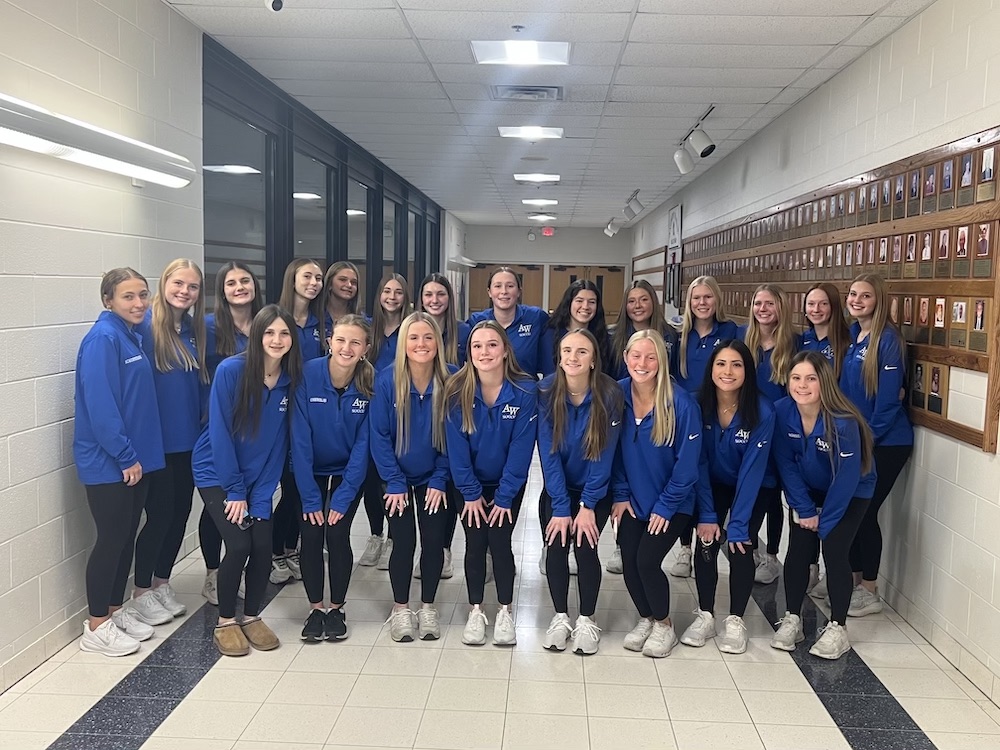
The Anthony Wayne High School girls soccer team was honored for its state title win. (Courtesy photo)
-Congratulated the state title-winning girls soccer team and coach Lori Williams, who noted that the 24 athletes also achieved a GPA of 4.16 while ending the season with a 19-0-3 record. Williams said the support from the community throughout the season was palpable.
-Listened to parent Roy Collaco share research about EdChoice vouchers, initially designed to give low-income families an opportunity to choose private schools. In the 2024-25 school year, 614 of the 3,802 students in the district used vouchers, although only 3 percent qualified as low-income, according to Ohio Department of Education and Workforce (ODEW) data.
That means that families who can already afford private schools received up to $8,408 for that education. The public school, by comparison, receives $813 per student. In Ohio, EdChoice Expansion gave out 69,000 new vouchers but private school enrollment grew by less than 3,700, meaning that the money was used to pay the tuition of students already attending. Continuing this practice will cause greater cuts in public school funding, said Collaco, who urged voters to pay attention to candidates and whether they support school vouchers.
-Encouraged Anthony Wayne graduates who are couples to sign up for a Saturday, Feb. 14 basketball game followed by a reception with refreshments, photo ops and tours. The AW True Blue SweetheartsReunion is a way of recognizing alumni couples – whether they met in school or later, Herman said.
Scott Jahns (left) and Nick Sargent (right) stand with Waterville Mayor Tim Pedro after being named to fill two open positions on Waterville City Council during the January 12 meeting. The two will be sworn into office on Monday, Jan. 26. (AWFP photo by Karen Gerhardinger)
WATERVILLE – Waterville City Council members Todd Borowski, Mary Duncan, Rod Frey and Wayne Wagner, along with Mayor Tim Pedro, unanimously selected Scott Jahns and Nick Sargent to fill two vacant council seats during the Jan. 12 meeting.
“It was a tough decision,” Pedro said, following nearly two hours in an executive session to interview the seven candidates, which also included Rob Allen, Karen Eboch, Tim Guzman, Michael Hampton III and Amy Self.
Jahns, a retired engineer, has lived in Waterville for 32 years, and first got involved with city government six years ago, when he had ideas and questions about a changeover in refuse and recycling collection, recalled Pedro. He then got involved in serving on committees, including Charter Review, Public Works, Waterville Comprehensive Plan and Architectural Review. In the past two years, Jahns has attended nearly every city council meeting.
“I started coming to Council so I could learn how government works. It became a passion of mine,” he said. “I believe I bring a positive outlook, fresh ideas and a common sense approach. I want to see the city prosper.”
Sargent, who moved to Waterville in 2013, is managing partner of S&L Cabling Solutions and brings a background in computer engineering and network infrastructure. He got involved with the city nearly a decade ago, serving on the Safety Committee and then chairing a levy that passed by 70 percent, funding the W3 Co-op – a collaboration between Waterville, Waterville Township and Whitehouse – which provides regular staffing, training and equipment for fire and EMS services in the area.
“Through those actions and the voters passing that legislation, we are able to save lives as firefighters are now physically in the building and responding to calls as opposed to responding from their homes,” he said.
Sargent said he feels like it’s time to give back and be part of the growth and prosperity of the community by working on ordinances that have a long-lasting impact.
Maumee Municipal Court Judge Daniel Hazard will attend the Monday, Jan. 26 meeting to swear in the newly appointed council members.
Todd Borowski was named vice mayor of Waterville. (Courtesy photo)
During the meeting, council also:
-Witnessed Pedro administer the oath of office to re-elected council member Mary Duncan.
-Unanimously voted to name Todd Borowski as vice mayor – a role that includes filling in for Pedro in representing the city in the event he is out of town or unable to serve.
-Learned that the city ended its year with a cash balance of $12.4 million.
-Listened to Dave Weber of the Save the Bridge Association ask council to write letters of support for their efforts to save the Roche de Boeuf Interurban bridge, which was issued a one-year reprieve from demolition in April 2024 by Gov. Mike DeWine. He also asked council to consider applying to become a certified local government to show its commitment to protecting historic sites. And he asked for the city to consider ownership of the bridge. Pedro said a meeting with the current bridge owner, the Ohio Department of Transportation, is slated for Jan. 15.
-Heard that Pedro was interviewed by WGTE for a Monday With Mayors program that aired on Jan. 12.
At the corner of Central and Secor, on Sunday, a protest was held by the group Toledo Persists. (TFP photo by Jaden Jefferson)
TOLEDO – The killing of 37-year-old Renee Nicole Good by an Immigrations and Customs Enforcement (ICE) agent in Minneapolis this week sparked protests – not only in Minnesota – but across the country. Good was a mother and U.S. citizen whose name is now at the center of a movement to put a check on ICE’s power. At the corner of Central and Secor on Sunday, a protest was held by the group Toledo Persists.
The Trump administration has defended the ICE agent. Officials claim he shot in self-defense as Good attempted to run him over. However, for many who’ve seen videos of the incident, they draw a separate conclusion. Among them is Christine Mesmer, a veteran of Afghanistan and member of Toledo Persists. She believes “it was murder.”
“Everybody knows you do not fire into a vehicle. Unless you are going to disable it, you fire at the wheels, you fire at the engine block – you do not shoot the person behind the wheel – that is dangerous. A real police officer knows that; anybody that’s done any sort of law enforcement knows that.”
She explained what drove her to be a part of this movement.
“We need to have our voices heard. As a member of this community, as a member of a lot of other communities, we need to have our voices heard,” said Mesmer, who added, “It’s horrible how the machine keeps chewing us up and spitting us out.”
At a time when many feel powerless, Mesmer agrees with the idea that protest is one way of reclaiming power.
(TFP video by Jaden Jefferson)
“Grassroots starts out here on the streets. This is an absolute grassroot movement. This is just the absolute beginning of what’s going to happen.”
She went on to explain that “at this point, we are going to band together and create community. We’re going to reach out. We’re going to make sure everybody has all the resources that they need, everybody knows where food banks are, where to get clothing, where to get emergency shelter.”
Mesmer said “our immigrant community is what makes this nation so great; diversity is what makes this nation great.”
Lucas County Commissioner Pete Gerken, who was among the demonstrators on Sunday, said that “ICE hasn’t been here yet, but we don’t wait until they get here.”
Gerken had a message for his fellow elected officials, the county sheriff, and police captains: that they should “keep us safe first” in the event ICE comes to Toledo.
“So they’re not here yet, but let’s let them know that ICE – and the system of deportation trauma they’ve imposed – doesn’t play in Toledo, Ohio.”
He said, “I’m proud of our community for doing this and I wanna be part of it. I’ve been doing this since 1968 – I’m not gonna quit now, and more people are joining in.”
The Corrections Center of Northwest Ohio in Williams County is one of the holding facilities for ICE detainees. According to Commissioner Gerken, “We just received 57 more detainees from ICE two weeks ago.” He said most of them, as Lucas County officials are finding out, have no criminal charges and “are just here because they didn’t have their papers with them.”
(TFP photo by Jaden Jefferson)
Immigration agents have recently been operating in Ohio’s capital city. When asked if he’s concerned that Toledo could be next, Gerken said, “We have great, strong immigrant roots here. We have many people from everywhere here. That’s to say they could come here, so we’re prepared.” He added that “the resistance will meet it when it comes.”
Lucy Frank, in addition to protesting Good’s death, was present to collect signatures on behalf of Amy Acton’s gubernatorial bid.
“I’m a local Democrat and I believe in rights for everybody. My husband, who just became a citizen this past summer – we both believe everybody has a right to be here. And so, I really appreciate everybody coming out today.”
Frank noted that Columbus, which has the second largest Somali community in the U.S. (after Minneapolis), has been feeling the presence of ICE – more so than Toledo has thus far. However, she believes that “we all have to stand beside our brothers and sisters and people who are scared.”
She said that, as an occasional protestor, Good’s death concerns her.
“The fact that I can’t go to a protest, and feel like I can come back alive…that’s not okay in the United States of America – it’s just not.”
There have been calls to abolish ICE, from Frank and others. It’s not something she expects to happen under the Trump administration, but believes the fact it’s a fairly new government agency – created in 2003 – means it’s not one that can’t be eliminated entirely.
(TFP photo by Jaden Jefferson)
Reverend TK Barger, senior minister at the First Unitarian Church of Toledo, spoke to the role of faith officials in activism.
“I don’t often wear a clerical collar, although my profession is minister. But, as I say, when you wear it for protest, you need to show that religion supports this type of action.”
He explained that “we are trying to live in ways that some of the great religious leaders have tried to demonstrate and advocate. Rather than to depend on some supreme entity to change us, it is up to the people to make that change.”
Jae Morales of central Toledo holds a sign protesting against Immigration and Customs Enforcement (ICE) prompted by an ICE agent shooting and killing a Minneapolis, Minn. woman, Renee Good. The protest was held at 1 Government Center in downtown Toledo on Thursday, Jan. 8, 2026. The protest was organized by the Party for Socialism and Liberation (PSL) Toledo, Ohio 50501, Northwest Ohio Democratic Socialists of America (NW Ohio DSA), University of Toledo Students for Justice in Palestine (UTSJP) and American Muslims for Palestine (AMP) Toledo. (TFP photo by Stephen Zenner)
TOLEDO – 80 to 100 people gathered in front of Toledo City Hall, 1 Government Center, Thursday evening to protest the actions of an Immigration and Customs Enforcement (ICE) agent, Jonathan Ross, who shot and killed Renee Good, a 37-year-old mother, in Minneapolis, Minn. Good was killed on Wednesday, Jan. 7.
Many videos, including different angles, of the shooting have spread across social media since the morning Good was killed while operating a vehicle with a number of ICE agents surrounding it.
Outrage and protests against ICE started the same day as the shooting, following Good’s death, and the protest action on Thursday is one small part of that movement.
Bryce Howard, a student at Bowling Green State University, speaks during the protest.
Nationally
President Donald Trump and Kristi Noem, the secretary of the Department of Homeland Security (DHS), immediately supported the ICE agent who shot Good saying that the agent acted in self-defense and denounced Good as a “domestic terrorist,” alleging Good was trying to attack the ICE agents with her car.
In reaction to the statements by the president and DHS, Minneapolis Mayor Jacob Frey called the claims of self-defense “bullshit” during a press conference, and said ICE was “causing chaos and distrust,” ultimately telling ICE to “get the fuck out of Minneapolis.”
Later, Minnesota Gov. Tim Walz backed Frey’s sentiments saying Trump and Noem had “done enough,” and issued a warning order to the Minnesota National Guard.
Throughout Jan. 7, ICE agents and protesters met in stalemates, and a large vigil of thousands was held for Good that night.
Nora Riggs of south Toledo holds a sign during the downtown Toledo protest against Immigration and Customs Enforcement (ICE). (TFP photo by Stephen Zenner)
Outrage over the shooting divided the country along party lines with supporters of the president largely arguing the claim of self-defense, and detractors from the president claiming the shooting was a murder.
The ongoing investigation of the shooting has been just as contentious as the federal and state leadership’s words to each other have been. The Federal Bureau of Investigation (FBI) has pushed local and state jurisdictions in Minnesota off the case, with Noem casting doubt on Minnesota law enforcement for not investigating protesters who harass ICE.
Walz has backed the state investigative bureau, and said that “Minnesota must be part of this investigation.”
Nora Riggs of south Toledo, Original Sub Shop owner Maureen Brogan, and south Toledo resident David Gedert (candidate for Ohio’s 9th Congressional District) all hold signs during the protest. (TFP photo by Stephen Zenner)
Local impact
A few Toledo Police cars actively watched the small crowd in front of city hall from 6 p.m. until it dwindled by 7 p.m., organized by Party for Socialism and Liberation (PSL) Toledo, Ohio 50501 (No Kings), Northwest Ohio Democratic Socialists of America (NW Ohio DSA), University of Toledo Students for Justice in Palestine (UTSJP) and American Muslims for Palestine (AMP) Toledo.
Toledo City Council Member At-Large Nick Komives attended the protest, but not as an organizer, speaker or leader of it. He told the Toledo Free Press he was there to “stand in solidarity against a government that will attack us in the streets.”
Bryce Howard, a student at Bowling Green State University, speaks during the protest. (TFP photo by Stephen Zenner)
Chants of “Fuck ICE” were intermittent with individual speakers from the crowd grabbing a bullhorn, and highlighting a number of different issues going on in the country.
One such speaker, LaMar Willis, pointed out that an off-duty ICE agent had shot and killed a Black father, Keith Porter, in Los Angeles, Calif. on New Year’s Eve, an incident still under investigation.
Other local community notables included the owner of the Original Sub Shop, Maureen Brogan, who said it was her patriotic duty to attend the protest. “The most patriotic thing you can do is want your country to be better,” she said, and called ICE a modern gestapo terrorizing communities.
David Gedert, made famous on the Food Network for his drag-queen-themed food truck (Maybe Cheese Born With It), announced his candidacy for Marcy Kaptur’s House seat early this week, and attended the protest.
“We do not gun down Americans in the street,” Gedert said. “This is not a partisan issue, and not up for debate.”
Other statements said Good’s death was a failure of capitalism and the two party system.
A local organizer of the event with PSL Toledo, Joshua Haggans of Point Place, told the crowd that ICE was connected to every problem in America, and emphasized that this was not a “singular issue.”
The event ended with a call to action to “do something” and get involved, as community members interacted organically.
(TFP photo by Stephen Zenner)
Nick Komives, Toledo City Council Member At-Large, stands in support of the protest. (TFP photo by Stephen Zenner)
(TFP photo by Stephen Zenner)
Joshua Haggans of Point Place speaks during the protest. (TFP photo by Stephen Zenner)
LaMar Willis, of downtown Toledo, speaks during the protest. (TFP photo by Stephen Zenner)
Bryce Howard, a student at Bowling Green State University, speaks during the protest. (TFP photo by Stephen Zenner)