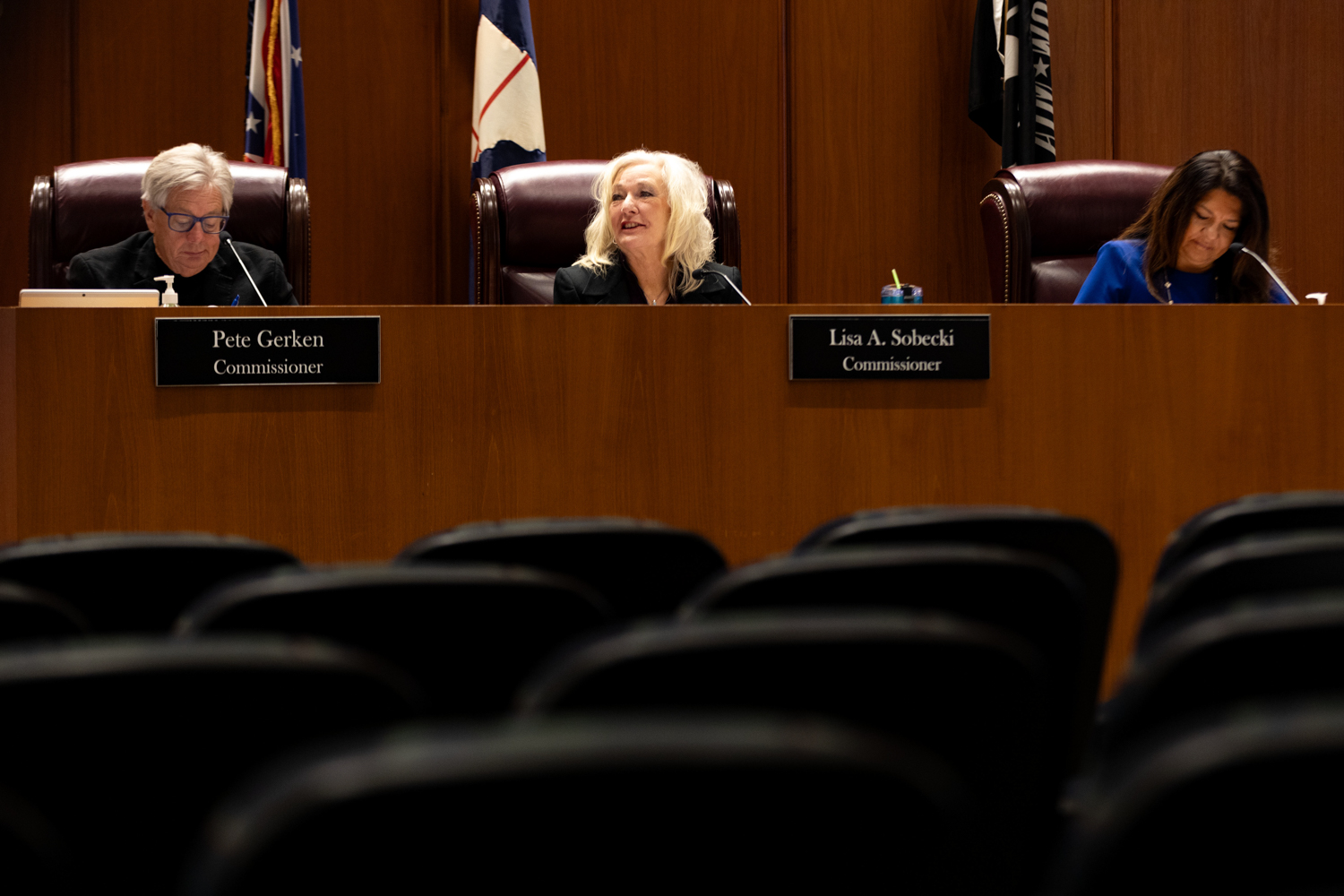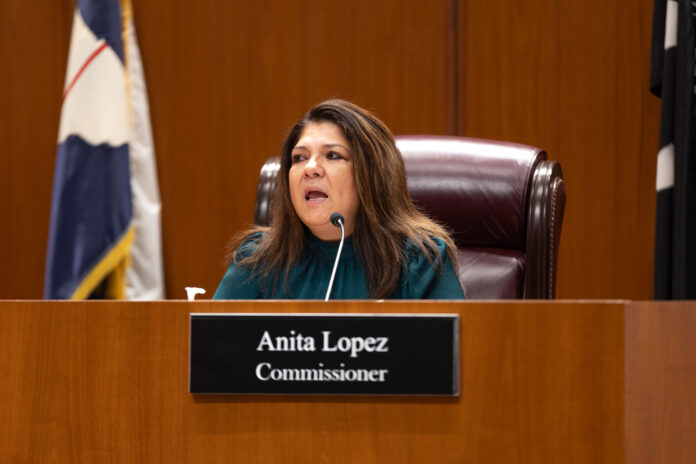
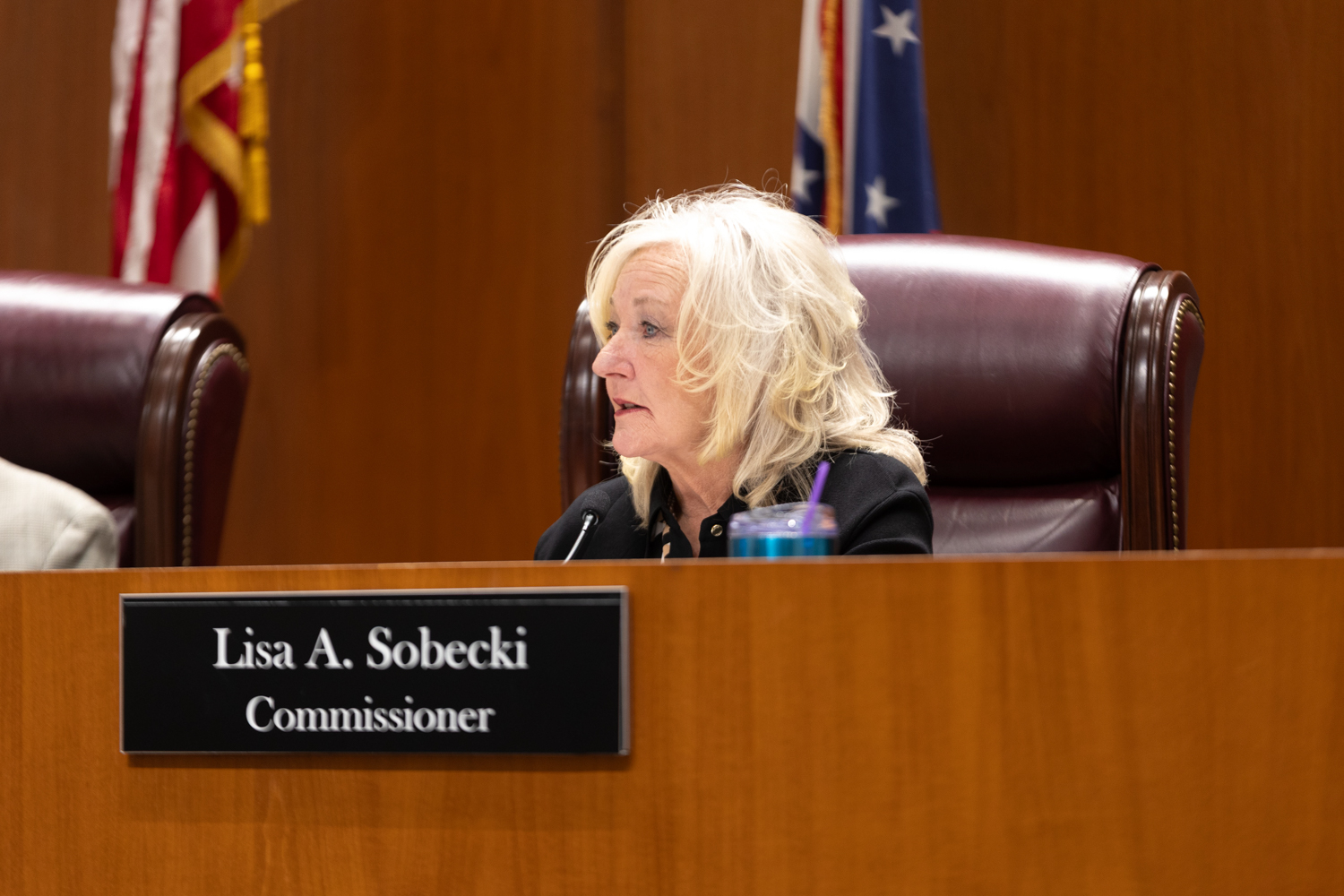
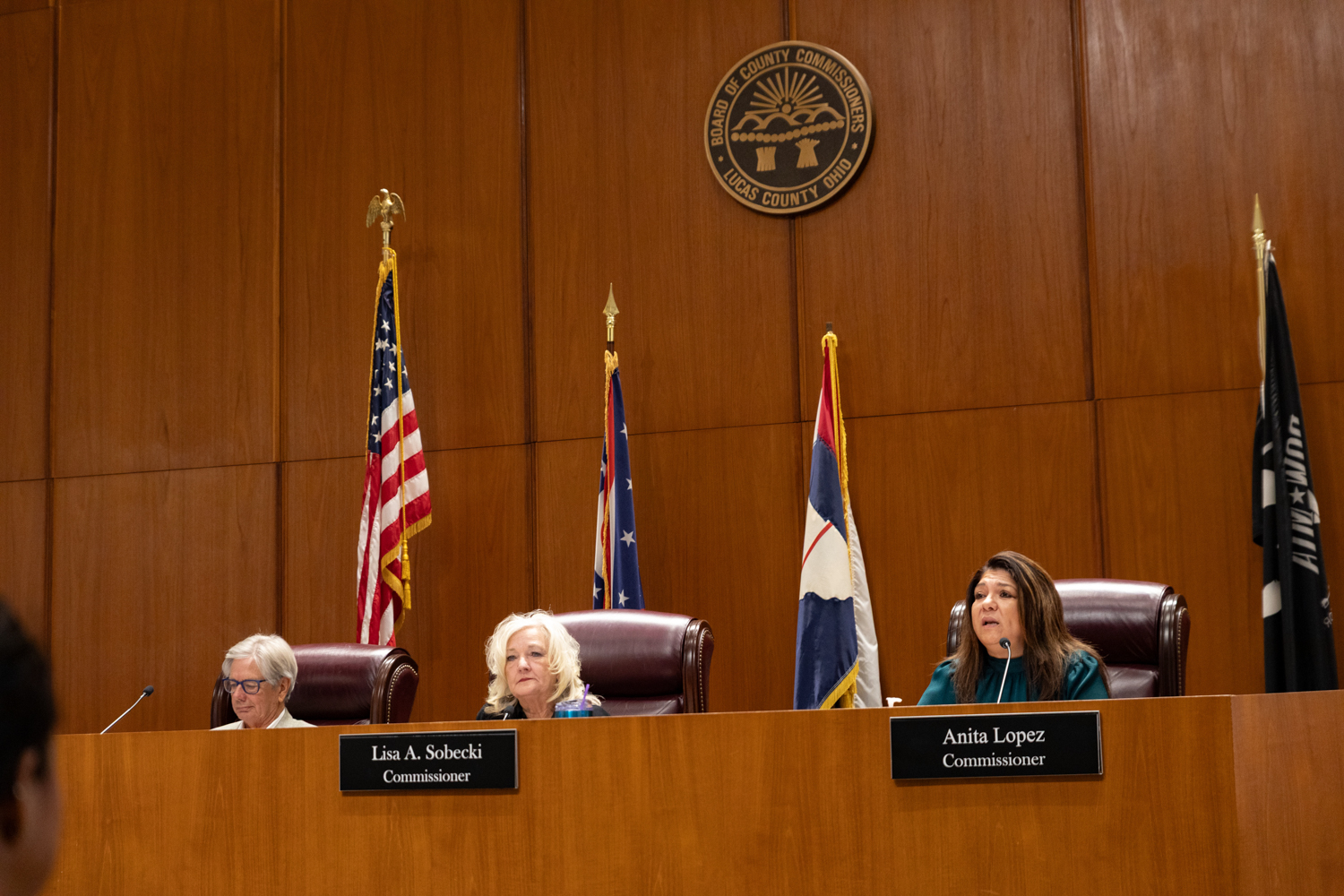
TOLEDO – There was a notable gulf between Lucas County Commissioners Lisa Sobecki and Anita Lopez during their Nov. 4 meeting.
Sobecki and fellow commissioner Pete Gerken formed a majority voting unit that stopped items 3 and 4 on the agenda, brought by Lopez.
“I make a motion to approve $1 million that will be identified for the agencies that Lisa Sobecki had recommended in her resolution, and I ask for my commissioners’ support,” Lopez said before the vote.
As the clerk called roll, Lopez voted first, delivering the only “yes,” followed by Gerken’s “no” and then Sobecki’s “no.”
Just before the vote, Lopez clarified her stance.
“I support Commissioner Sobecki’s selection of the food things. I just believe the money needs to be larger and should be substantial.”
Item 3. was a permission to enter into agreements with community organizations for emergency food services, and Item 4. was an appropriations resolution to allocate $1 million to help fill the gap of Supplemental Nutrition Assistance Program (SNAP) benefits that have been affected by the federal government shutdown.
Lopez presented these items together, and prefaced the vote by highlighting the need and gap left by the government shutdown, leaving people without SNAP benefits.
SNAP shutdown
On the 20th of October Sobecki led a coalition of different officials addressing the possibility of people in Lucas County losing SNAP benefits at the beginning of November. The full cost of funding Lucas County’s SNAP benefits was estimated at around $13 million for a month.
The total value of SNAP benefits for the whole country is roughly $8 billion, and two federal judges have ruled that the Trump administration has a duty to fund SNAP with an Agriculture Department contingency fund. $4.65 billion is in the fund, and so it was thought SNAP benefits will be funded at roughly 50 percent.
The Trump administration warned of delays in processing SNAP funds to families, as Sunday and Monday families were unable to access benefits.
Ohio Governor Mike DeWine designated $25 million towards the SNAP crisis, but only fulfills a portion of what Ohio uses monthly – $263 million.
Lopez said she wanted the $1 million to cut through the bureaucracy to help families immediately, and warned that the federal government’s fulfillment of SNAP could take up to a month to fulfill.
“So for me, the million dollars is enough to put in our budget so it’s readily available to get out as soon as possible,” she said.
This $1 million contingency may have merit, because on Tuesday, the same day as the commissioners’ meeting, President Donald Trump spoke of defying the federal judges’ order. He said SNAP “will be given only when the radical left Democrats open up government, which they can easily do, and not before!”
Congressional Democrats have taken a stand against Republicans who have cut subsidies provided by the Affordable Care Act (ACA). Democrats refuse to pass the funding bill required to run the federal government without Republicans reinstating the ACA subsidies.
Without these subsidies, it is estimated healthcare costs will roughly double for people who access healthcare through the ACA, and neither side has been willing to make a deal so far, leading to the longest government shutdown in United States history.
The longest government shutdown prior to this one was from 2018-2019, under Trump’s first term, and lasted 35 days.
And before that shutdown, Bill Clinton’s administration saw a 21 day shutdown in 1995-1996.
All three of the longest government shutdowns began with Republican majorities in both the Senate and the House of Representatives.
What’s the plan?
Regardless of whether partial SNAP benefits are restored or not, there is still a gap in funding that will affect Lucas County.
Lopez’s rejected items were followed by an agreement giving $50,000 to Connecting Kids to Meals, Inc. and another $50,000 to the Islamic Food Bank to provide emergency food assistance.
These funds were brought by Sobecki, and unanimously approved.
Gerken explained the $100,000 brought by Sobecki had a clear plan, while Lopez’s funds did not.
“I mean, they don’t have a plan for a million bucks,” he said. “Give us [$]100,000, work with what we established, we’ll get it where it needs, we’re gonna’ come back and get more if it’s necessary.”
After the meeting, the Toledo Free Press asked Lopez if she did have a plan for the million dollar allocation, and she said, “There was a plan. I think there is a plan. We know the United Way already identified the food pantries. We know that Toledo Public Schools have community hubs and community centers,” and she pointed out the Sofia Quintero Center as a community hub that could be involved in distributing food.
All commissioners mentioned their commitment to help people within Lucas County weather the loss of SNAP benefits. Gerken and Sobecki highlighted conversations they’ve had with local organizers, and their approach focused on working with organizations to allocate funds as the government is told about their need.
“There are people within our community that are working together, and we’re listening as commissioners on what is needed to be able to have out there,” Sobecki said.
Lopez called the $100,000 “a start,” but said the million dollars was necessary.
“Having the million dollars ready to go is what we need. We need to be ready to go,” she said, and warned that it might be too late by the time the need is known.
When asked about further withdrawals to meet the SNAP crisis, Sobecki said, “I’m going to look to those professionals that do this and understand that, and listen to them as they’re putting their plan together and how to be able to distribute [food/aid],” she said.
Sobecki cited her time as a caseworker as proof of understanding the current SNAP crisis, and Lopez cited her time working with Lucas County Children Services giving her a similar insight.
Toledo City Council
During their meeting on Wednesday, Toledo City Council unanimously passed Ordinance 508-25, giving $100,000 from the Local Fiscal Recovery Fund for the United Way of Greater Toledo’s 211 Services in 2026. Council Member At-Large Brittany Jones abstained from the vote, because she works for the United Way as a Survey & Evaluation Analyst.
The ordinance was brought by Council Members Nick Komives (At-Large), Cerssandra McPherson (At-Large) and Theresa Morris (District 6).
In a similar vein, Council Women At-Large McPherson and Jones presented Resolution 509-25, which passed.
The resolution urged the Ohio General Assembly and the United States Senate to Support Senate Bill 305 and House Bill 502 that strengthens access to SNAP, TANF, and WIC Programs, and Ensures food security for Ohio families.
Ohio Senate Bill 305 was brought by former Toledo Mayor, and current Ohio Senator, Paula Hicks-Hudson, and seeks to “appropriate funds for SNAP, TANF, WIC upon lapse in federal funds.” Ohio House Bill 502 has the same purpose and wording, but is being brought in the Ohio House by Latyna M. Humphrey, Ohio House Representative for Columbus, Ohio.
Local connections
Before leaving the commissioners’ hearing room, Sobecki wanted people to know they can call 211 to get connected to the United Way of Greater Toledo for help with their specific challenges.
Anyone can dial 211, or text their zip code to 898211 to reach the United Way of Greater Toledo, and get connected to a database of emergency food providers, food pantries or meal sites. The operator should be able to provide locations, hours of operation and eligibility requirements for each food site.
The United Way covers three counties in northwest Ohio: Lucas, Wood and Ottawa Counties.
And as the United Way braces for the impact of lost SNAP benefits, Jill Bunge, the vice president of impact and outreach for the United Way of Greater Toledo, said she attended a Zoom meeting a couple days ago with the food banks, Connecting Kids to Meals, the Area Office on Aging, the Health Department, Jobs and Family Services, the Lucas County Commissioners and some City of Toledo representatives.
“We are seeing a rise in calls,” Bunge said.
In September, the United Way received 1,111 calls concerning the need for food, the next month 1,607 and just in the first four days of November, Bunge said the United Way has already received 316 calls concerning access to food.
“The takeaway for our community is it’s past November 1, and people don’t have money on their EBT card. And they can’t go to the grocery store and feed their kids, so that’s our primary thing,” Bunge said.
In a similar vein, the President and CEO of Connecting Kids to Meals, Wendi Huntley, mentioned her organization had seen an 18-24 percent uptick in demand in October, when SNAP benefits were still working.
Huntley said they had not received data for the beginning of November, but said, “We’re anticipating we’re gonna see anywhere from 1,500 to 3,000 more kids.”
Connecting Kids to Meals is a nonprofit with 85 locations in the city of Toledo, and only feeds kids 18 years and younger.
Regularly, the nonprofit spends between $250,000 and $280,000 a month on meals for kids at $6.20 a meal, roughly 40,000-45,000 meals within a month.
Ceasing SNAP benefits is expected to impact 30,000 kids in Lucas County alone, and so Huntley has been preparing as best she can for the demand.
“The funding that is being provided is going to help us to cover some of the gap costs for some of those meals,” she said of the commissioners’ contribution of $50,000. “But most importantly, we reached out to our city, our county, our corporate funders, [and] individuals, because we’re already seeing an increase [in need] from the time that the government shut down.”
This year was already trending more difficult to make ends meet, Huntley said, and added, “We continue to see modest but impactful inflationary costs on food, and tariff impacts on our non-food items.”
As the shutdown drags on, Huntley said, “I anticipate that we’re going to need to go back. We’re going to need to reach out, not just to the county commissioners, but again, to various corporations, to our city.”
Colloquially, Huntley shared that the children they serve generally leave some food items behind when they eat, but now she said “The kids are eating everything, and, you know, kids are picky eaters.”
“So that’s telling us they’re hungry.”
Huntley anticipates needing to hire more workers to keep pace with the organizational needs. For now they’re going to hire a few more servers, but Huntley said they’ll increase their workforce as needed.
But still, she resolved, “We know the difference that we’re making in the lives of folks that just are struggling. You know, they’re just struggling. They’re just at a place where they need a little bit of help.”
If community members wish to help, ConnectingKidstoMeals.org has a signup to volunteer and various ways to donate.
“We have a very strong charitable network here,” Bunge said. “The food banks get the food. They have a lot of purchasing power. The food pantries receive that food from the food banks, and then the food pantries are serving directly to people.”
Volunteering time and donating food were the two top requests from the nonprofit leaders.
UnitedWayToledo.org/food is the link for the local United Way food resources, and includes sign ups, ways to donate and as well as informational resources.