This junco was photographed last winter after a nice snowfall by Metroparks Toledo nature photographer Art Weber.
Each year, it’s a jump ball which will arrive first, the first snowflakes or the first wave of juncos. Juncos are small songbirds that spend summers up north and usually return to our area just about the same time the first significant snowflakes start to fly. The coincidence has earned it the nickname of “snowbird.”
It was a tossup again this year with the juncos getting the winning nod. If you haven’t seen one already, it’s a safe bet you’ll be seeing one soon, especially if you maintain a bird feeder.
Christopher Harris owner of Black Frog Brewery served as a mechanic in the U.S. Army. (TFP photo by Gaven Hafner)
HOLLAND – At Black Frog Brewery, what began as a hobby for Toledo entrepreneur Christopher Harris has evolved into a community cornerstone, one built on the values of hard work, structure and camaraderie that he carried over from his years of service in the U.S. Army.
Beginning in 1989, Harris served in the U.S. Army for ten years as a mechanic, a time during which he took part in the first Persian Gulf War.
“Where I grew up, in the inner city [Toledo], everybody was getting into trouble, and it was just kind of a dead end, and I just knew that there was something better,” he said. “And so, I knew the army would provide that structure, stability. It probably turned out to be one of the best choices in my life. I want to say it just made me a way better person than when I was a kid.”
Harris described his time in the military as something both challenging and rewarding.
“I was really proud to serve during the Persian Gulf War,” he said. “Even though, during the time that it happened, you’re scared and you don’t know what’s going on, but when it’s all said and done, you served your country, and what better honor could there be than to serve your country during a war time?”
After leaving the military in 1999, Harris used his GI Bill to attend college before working at the Social Security Administration, where he remained until retirement. What began as a simple hobby after work became something more.
“I was really just looking for a hobby to do,” Harris said. “Initially I tried to make wine. I was really bad at making wine, so I was like, ‘Oh, let me try and make beer.’ And I found I had a knack to making beer, and then that hobby just really grew into a passion.”
That passion and love for beer making evolved into Black Frog Brewery. Harris first operated out of his garage in 2014, before opening a retail location in 2016.
“When we first started out of our garage, the state hadn’t seen anything like that. There wasn’t anybody that had started a brewery out of their garage in the state of Ohio,” he said. “And so, once everything was done, the state approved me to run the brewery out of my garage, and I did that for two years.”
Today, Black Frog Brewery operates in both Holland and Cleveland. The brewery offers a range of American and European style beers.
“We pretty much serve almost every style of beer there is,” Harris said. “I have a philosophy in beer making: If I really don’t enjoy drinking a style of beer, I don’t make that style of beer.”
Black Frog Brewery sells a variety of beers. “85 to 90 percent of our beers are American styles,” Harris said. (TFP photo by Gaven Hafner)
The Holland location has become a place for the community to gather. “This place has really turned out to be the Cheers of Holland,” Harris said. “A lot of people that didn’t know anybody, or that didn’t know people in Holland, became friends because of this location.”
In addition to running the brewery, Harris serves as a board member of the National Black Brewers Association. In 2023, the cities of Toledo and Cleveland, along with Lucas and Cuyahoga counties, recognized Oct. 10 as National Black Brewers Day. “That made me pretty proud,” Harris said.
Looking ahead, Harris hopes to expand distribution and eventually pass the business on to his family. “I have two children, and so I’m really just trying to build this up, to be able to leave that behind for them,” he said. “If we can start distributing throughout the state, it would just be fantastic.”
Black Frog Brewery stands as a testament to Harris’ passion for brewing and the core values he carried from his years in the military.
The new facility has a grooming room with fun wallpaper.
TFP photos by Allyson Ritchey
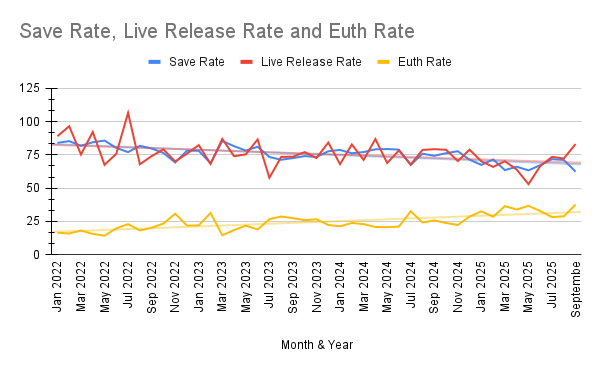
TOLEDO–For community members who find a stray dog in Lucas County, the decision to call animal control is an ethical dilemma with a stark statistical reality. According to publicly available kennel statistics, a dog entering the Lucas County Canine Care & Control (LC4) system during the period of January 2024 to September 2025 had an average 26.71 percent chance of being euthanized—meaning approximately one in four dogs was put down.
The crisis peaked in September 2025, the final month of operations in the old 410 S. Erie St. facility, when the euthanasia rate hit a record high of 37.65 percent.
Using publicly available kennel statistics from LC4’s website, these graphs show an overall upward trend in euthanasia and a downward trend in live releases and saves. (TFP graphic by Allyson Ritchey)
The facility now uses QR codes for everyone to document animals’ behavior.
But for community members like Katie – a Toledo resident who preferred to use only her first name, and whose experience with LC4 predates these changes – and Kevin Clapper, whose recent encounter occurred just last month, one question looms: Have operational practices truly evolved, or just the facility itself?
One year ago: Lucie’s story
In late October 2024, nearly a year before the new facility opened, a brindle pit bull began appearing in Katie’s backyard. Over nearly a week, the dog built trust, eventually taking treats from Katie’s hand and following her around the yard. Katie claimed the dog, whom she named Lucie, showed no aggression toward squirrels, her neighbor’s outdoor cats, or people. Katie and her neighbor suspected the dog had been abused and dumped, but they saw a gentle animal in need of help.
When LC4 wardens arrived with a catch pole, Lucie panicked. “Oh, I can still see it now, like I felt so bad,” Katie remembered. “She freaked, you know, she just panicked. And, like, what else do you do? Like, this was… We thought we were getting her help.”
That was a Friday. Katie had told LC4 staff she wanted to adopt Lucie if no owner came forward. By Tuesday—just four days after intake, with only three business days for an owner to claim her—Lucie had failed her behavioral evaluation. According to Katie, an LC4 employee called to say the dog could not legally be adopted out to the public and would be placed on a waitlist for euthanasia.
“They said that they would call local shelters and see if anyone would take her, and if not, she would be put on a wait list for euthanasia,” Katie said. One week later, when she called back, Lucie was dead. According to Katie, the facility claimed no shelter would take her. Lucie was only a year and a half old.
All dogs undergo an intake exam with the facility’s vet.
When Katie obtained Lucie’s file through a public records request, she found details that troubled her. Lucies’ intake notes from Oct. 25, 2004 described her as “very fearful in field” but noted “I think she will get better.” By the next day, staff reported she was “much less fearful at building” and “walked nicely.”
On Oct. 29—four days after intake—the behavioral evaluation was conducted. The notes describe Lucie being walked to a play yard when “a dog already in a different yard was at the fence barking at her.” Lucie responded with stiff posture and barking. The evaluation form states she was “stiff, piloerection, hyper focused, ears forward, weight forward, attempted to mount, would not listen to verbal correction or spray bottle correction.”
Lucie was euthanized that same day. The reason listed: “FBE: dog agg.”
Katie said an LC4 employee had assured her multiple times over the phone that Lucie “was not aggressive”—yet the file listed dog aggression as the reason for euthanization.
“It was only natural, Lucie being in an unknown place, faced with unknown people and dogs, not to listen to their verbal commands,” Katie said. “We don’t know if she had any training. I suspected she had been abused or neglected and was dumped.”
Inside the exam room.
The euthanasia checklist shows signatures from two staff members as required by LC4 policy. However, one question on the form remains unanswered: “Did two employees decide euthanasia was the best course of action for this animal, one of which is the Veterinarian or Behavior Coordinator and the second a member of Management?” Whether this represented a conscious decision that Lucy was not transferable, or an oversight, is unclear from the documentation.
Katie’s assessment remains cautious nearly a year later:
“You can’t put lipstick on a pig and expect it to be anything but a pig. Until we see more proof that they’re being properly cared for and all the bad apples have been removed, I just can’t trust it.”
While her experience occurred under previous leadership at the old facility, her concerns about rushed evaluations and inadequate decompression time remain relevant as the organization transitions into its new space.
The new facility has better sanitation and cleaning machines for their dishes and toys.
A pattern repeats
Nearly a year later, Kevin Clapper, another Toledo resident, found two friendly stray dogs running loose near Broadway and South Avenue. He brought them to LC4, assuming they’d be reunited or adopted. Days later, when he called to check, he learned one had already been euthanized for being “aggressive towards other dogs”—despite having been found with the other dog and the two animals riding calmly in his car together.
“When you put dogs under a high stress situation like that, things happen,” Clapper said. The fact that one dog was a female with visible signs of having had puppies led Clapper to suspect the decision was based on adoptability, not aggression.
The patterns highlighted by Clapper’s Sept. 2025 experience—occurring in the final month at the old facility before the move—raise questions about whether LC4’s behavioral evaluations adequately account for the extreme stress dogs experience in a shelter environment, particularly in the critical first days after intake.
LC4’s Response
Cassie Bloomfield, LC4’s Community Outreach Coordinator, said the facility has implemented significant changes, especially with the move to the new building. She emphasized that behavioral evaluations are never conducted by a single person.
“It’s never just one person saying, ‘Well, I didn’t like the way that looked,'” Bloomfield said. “It’s from start to finish, and lots of opinions of lots of people who have laid eyes on the dog.”
The facility employs a dedicated behavior coordinator who meets every dog daily and reviews QR code-based behavior reports submitted by staff and volunteers. “Every single day that she’s here, she walks around. She meets everybody,” Bloomfield said of the behavior coordinator. “She meets every dog that has come in.”
A curious dog plays outside in the rain.
The new building’s design—with smaller, separated sections—allows fearful or reactive dogs to decompress away from the general population. Staff sometimes use short-term behavioral medications “as a tool” to reduce stress.
Bloomfield defended dog-on-dog evaluations as essential for public safety, noting that dog-aggressive animals can cause serious injuries even if they are not aggressive toward humans—from people getting hurt breaking up fights to owners being pulled into dangerous situations.
A stray dog at the new LC4 facility.
“We live in a society where kids exist, so if we know that a dog has a problem with children, that’s not a safe dog for us to adopt out,” she said, adding that transfer partners can work with dogs who have specific issues but that LC4 focuses on dogs who will “make good neighbors and good breed ambassadors.”
Most dogs at LC4 fall under the pit bull umbrella, Bloomfield noted. “We’re trying to break that stereotype that says that they’re aggressive, because you just saw all these dogs here, and they’re not.”
Birdie, an 8-month old mix breed, poses for a photo in her bandana.
When asked about the upward trend in euthanasia rates, Bloomfield attributed it partly to increased intake and partly to irresponsible breeding practices that create dogs with behavioral or medical problems.
“If we keep breeding dogs that are not social with other dogs, they’re not okay with people, they’re not being appropriately socialized when they’re young, unfortunately we’re going to continue to have to say goodbye to dogs,” she said.
LC4 doesn’t maintain a target euthanasia rate, Bloomfield explained, because the population constantly changes. “We don’t want to keep dogs around to keep our numbers good,” she said.
She acknowledged LC4’s “checkered past” but insisted standards have evolved significantly. “We would never agree with hurting or mistreating what’s in our care,” she said. “We don’t want to warehouse dogs if it is affecting their quality of life or putting people in danger.”
Bloomfield said rebuilding trust after the 2024 abuse scandal remains a priority. “It’s really hard for people to ask us for help because of the negative publicity and how they were treated in the past,” she said. “Even if I’m going to give you an answer that you might not like, I’m still going to give it to you. Honesty is the best policy and education.”
Evaluations and Decompression Time Under Review
A central tension emerges from cases like Lucie’s from 2024: how much time is appropriate for behavioral evaluation? Lucie was evaluated and euthanized four days after intake under the old facility’s operations. LC4’s position is that multiple staff members observe dogs over their stay and that evaluations reflect genuine safety concerns. Katie’s perspective is that four days was insufficient time for a fearful, potentially traumatized dog to decompress.
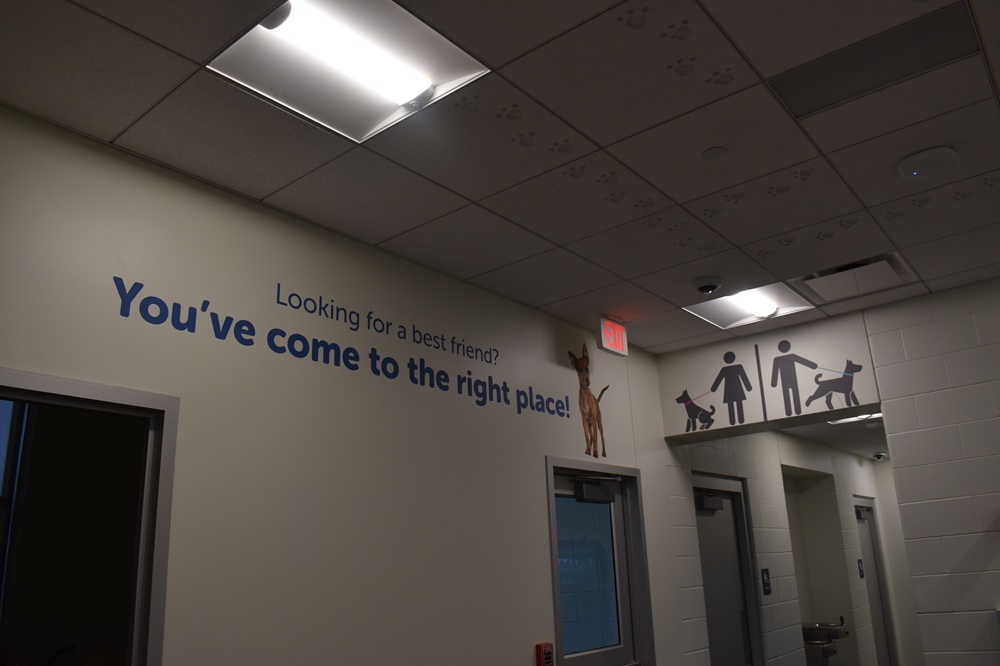
The ceiling features paw prints around the new facility.
Bloomfield, speaking about current operations in the new facility, acknowledged that the improved environment provides more opportunities for dogs to settle in.
“Especially now that we’re in a more appropriate facility and we have the means and the space and the people to give dogs a little bit more time, we don’t willy nilly run through,” she said. She shared that in the new facility, staff can now sit “crisscross on the grass with the dog” off-leash, which was not possible before.
The volunteer program has been reinstated with stricter protocols, and the “Dogs on the Town” field trip program just resumed last month. LC4 also offers a pet food pantry and vaccination clinic, which Bloomfield explained is part of the department’s goal to “stop that before we get to the point where it’s an emergency” and an owner is forced to surrender their dog.
But for Katie, the question remains whether the facility’s improvements will translate into different outcomes for dogs like Lucie, dogs who show fear-based reactivity in their first days but may have potential given more time and specialized support.
“If I had known this was what was going to happen, she never would have gone there. My neighbor and I both…we completely failed her,” Katie said of Lucie. The new building provides the opportunity. The challenge now is whether the organizational culture can shift fast enough to regain the trust of the community.
EBE Hall of Fame hosts its 37th annual induction ceremony to celebrate its new EBE Hall of Fame members. (TFP photo by Gaven Hafner)
MAUMEE – The Entrepreneurial & Business Excellence Hall of Fame celebrated its 37th annual induction ceremony on Nov. 6 at The Pinnacle, honoring a new class of outstanding business leaders and innovators. Amber Patterson of Auni Allergy & the ILIT Learning Network was honored with the Rising Star Award, while Don Feller of Feller, Finch & Associates and Brad Morrison of Maumee Bay Turf Center each earned a Business Excellence Award. Mike Deye of Hale Performance Coatings was recognized with the Excellence in Family Business Award, and Joe Napoli, President and CEO of the Toledo Mud Hens and Toledo Walleye, was honored with the prestigious Davenport Longenecker Lifetime Achievement Award.
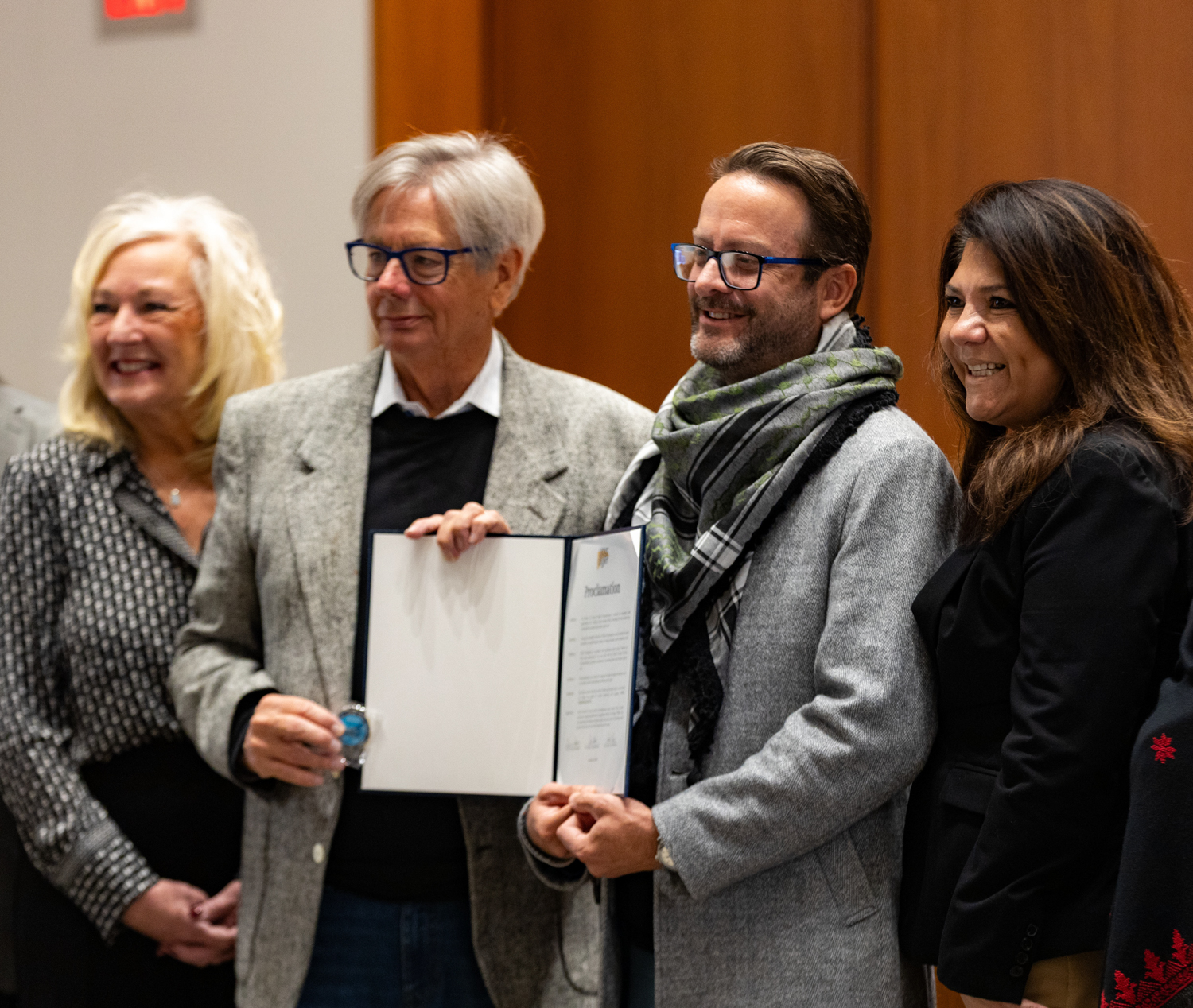
Philip Tottenham, an activist and marine corps veteran, speaks before being honored for his role in the Global Sumud Flotilla, trying to bring humanitarian aid to Gaza, during a Lucas County Commissioners meeting at 1 Government Center in downtown Toledo on Tuesday, Oct. 28, 2025. (TFP Photo by Stephen Zenner)
TOLEDO – Before Phil Tottenham was honored, Lucas County Children’s Services (LCCS) kicked off the Oct. 28 County Commissioners’ meeting.
Jeffrey Chesser, an Independent Living Youth Advocate, was awarded the 2025 Child Protections Support Advocate of the Year by the Public Children Services Association of Ohio (PCSAO), a statewide recognition.
All three commissioners sang Chesser’s accolades along with the director of LCCS, Randall Muth.
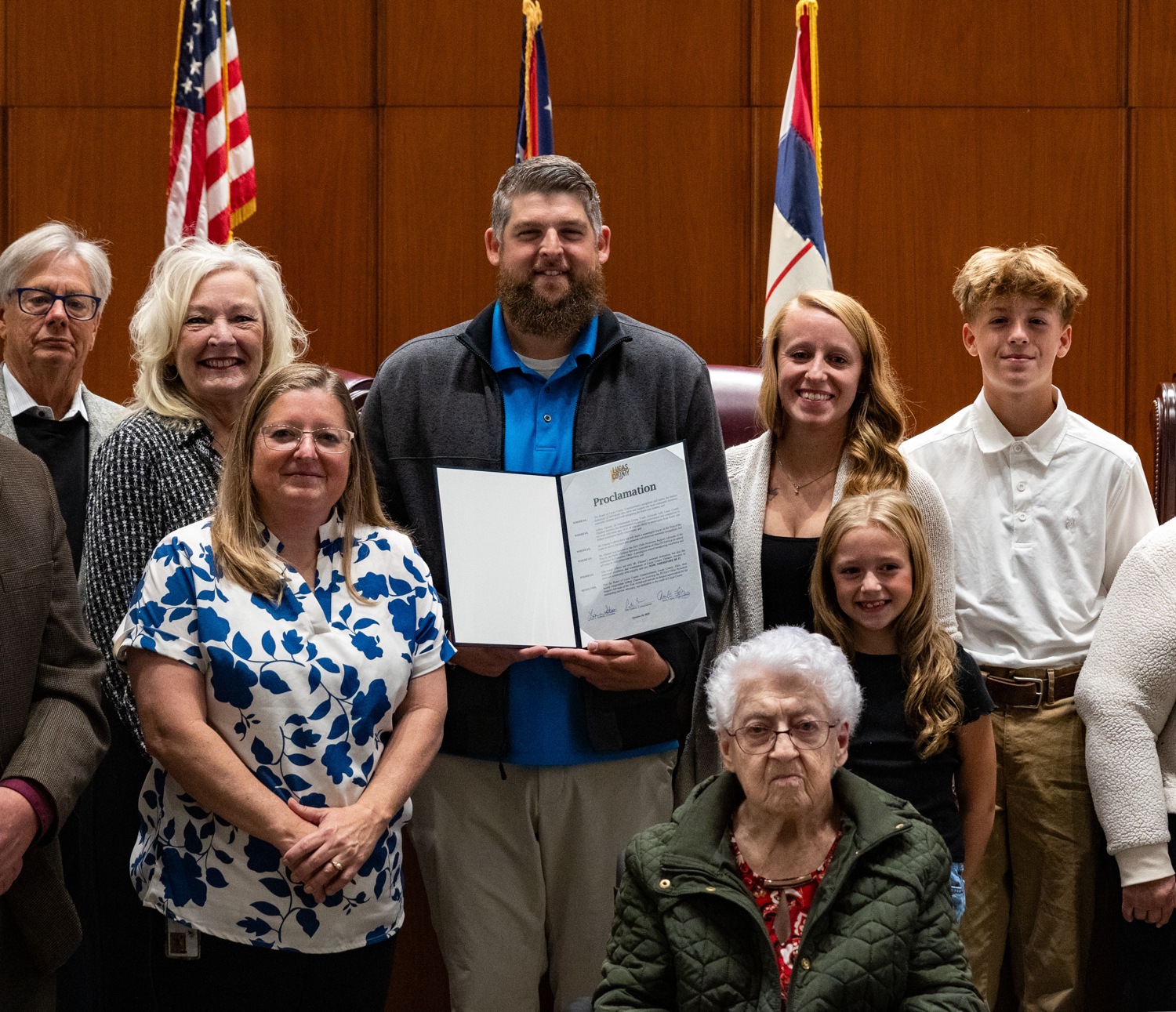
Before he recognized his accomplishment, Chesser chose to introduce the family, including his 101-year-old grandmother, who had come to support him before speaking on winning the award.
“I don’t look for recognition or all that fun stuff,” Chesser said, but appreciated the award. And he went on to say he derived motivation from trying to speak up for kids who had told him they didn’t feel like they had a voice or an advocate.
Jeffrey Chesser, an Independent Living Youth Advocate with Lucas County Children Services (LCCS), was awarded the 2025 Child Protections Support Advocate of the Year by the Public Children Services Association of Ohio (PCSAO), a statewide recognition, and here he is being honored by the Lucas County Commissioners for his work with LCCS. (TFP photo by Stephen Zenner)
Philip Tottenham speaks on Gaza
On a more politically charged note, commissioners recognized a local Toledoan and activist, Philip Tottenham, for his part on the Global Sumud Flotilla, an international activist effort to get aid to Gaza and create a humanitarian corridor.
All boats that were a part of the group were interdicted before being able to share aid with Gazans.
“Bravery and courage wrapped in humility,” is how Lucas County Commissioner Pete Gerken described Tottenham before Tottenham, a Marine Corp veteran, stepped up to the podium.
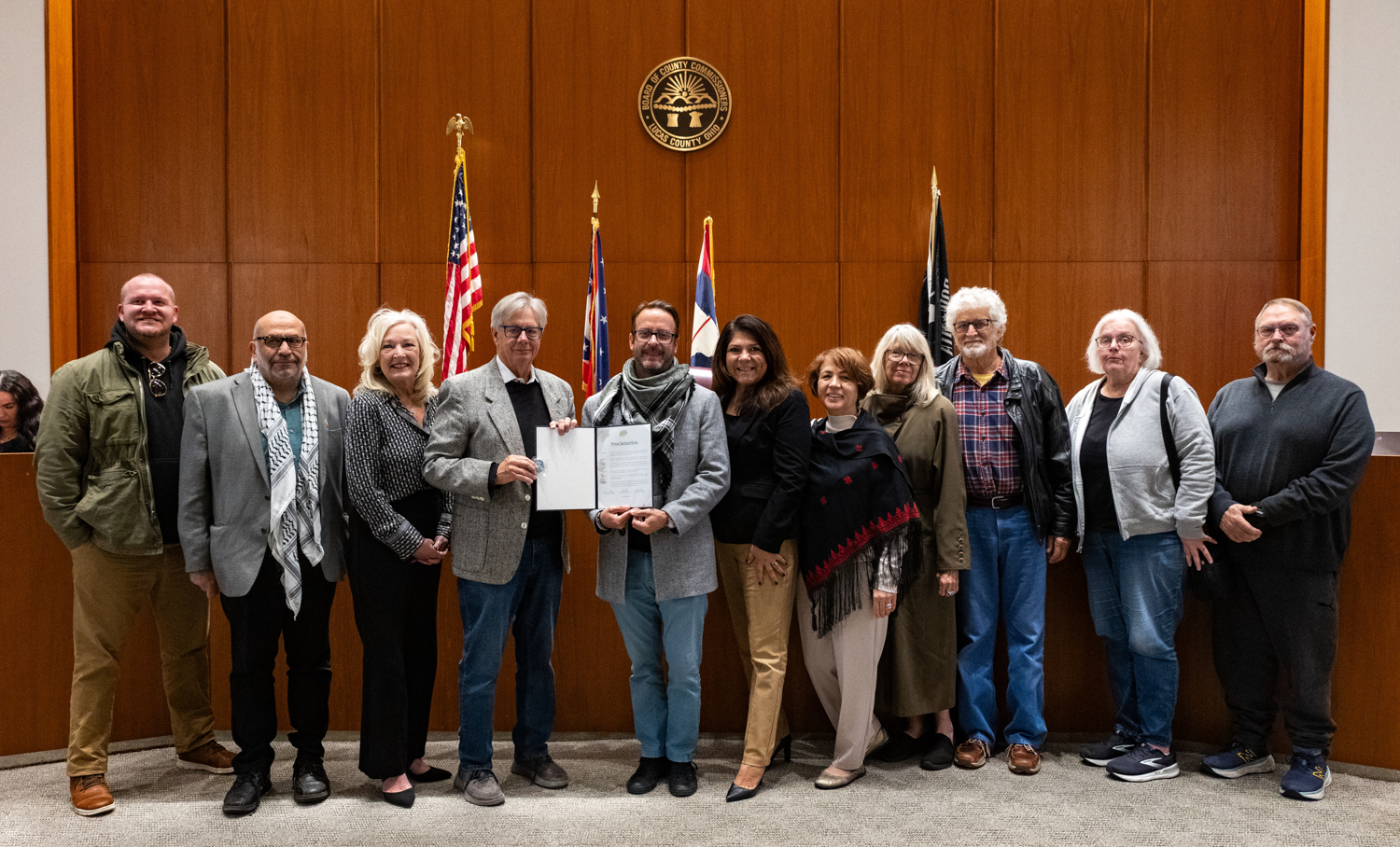
Philip Tottenham stands with Lucas County Commissioners, as he is honored for his bravery in trying to open up a humanitarian corridor to Gaza. (TFP photo by Stephen Zenner)
Tottenham spoke with a soft voice on harsh subjects.
“We’re a small voice among the veterans who have seen through the lies of war and the propaganda of war and the war machine,” Tottenham said, and continued to speak about Gaza, calling what Israel is doing there a genocide.
Almost as if he was preaching, Tottenham jumped from subject to subject, touching on the nature of unconditional love: “…we have to remember to see through the pride and the hate that nationalism causes,” he said.
“I don’t feel deserving of this award. I’m here to advocate for the end to this genocide, but also, one specific, immediate ask is to get an American 16-year-old boy, Mohammed Ibrahim, who is from Florida,” out of Israeli custody, Tottenham said.
Ibrahim, a Palestinian-American born in Florida, was arrested while in the West Bank this past February, and has been held without a trial in Israel since then.
Israeli forces claim the 15-year-old, at the time, was throwing rocks at Israeli vehicles, which the boy denies. But Ibrahim has not had a court date, and Tottenham pushed to get the word out in hopes that Ibrahim would be released.
“He has been held hostage for over eight months without a trial. His cousin was beaten to death by settlers…we’re trying to make a call and a push to get this poor child home,” he said.
Fellow activist and veteran Mike Ferner was present to support Tottenham with others in the anti-war community.
Lucas County Commissioners Lisa Sobecki and Pete Gerken stand next to Philip Tottenham, an activist and marine corps veteran, alongside Anita Lopez, Lucas County Commissioner. (TFP photo by Stephen Zenner)
Other items of interest from Oct. 28
Item 3. Commissioners approved a 2025 autopsy contract with Allen County, where Allen County requested the services of the Lucas County Coroner.
“Allen County desires that Lucas County perform certain necessary autopsies,” the contract read, and provided different Ohio codes that refer to the circumstances where one county might make use of another county’s coroner.
Juvenile Court
Item 4. Juvenile Court may receive reimbursements of up to $2,000,000.00 from the Ohio Department of Children and Youth over the period of the agreement based on actual, allowable expenditures. These reimbursements are part of a grant.
Item 5. The Board hereby approves the memorandum of understanding providing Behavioral Health Juvenile Justice (BHJJ) funding to the National Youth Advocate Program to provide Family Functional Therapy for youth and families for an amount to not exceed $97,190.34 for the time period of July 1, 2025 through June 30, 2026, and $97,190.34 for July 1, 2026 through June 30, 2027.
Job & Family Services
Items 6-10 were approved, and Gerken abstained from item 8 because he is on the Toledo Lucas County Homeless Board.
6. Permission to Enter into an Intergovernmental Revenue Agreement with Lucas County Children Services for Kinship Navigator Services
7. Permission to Enter into an Agreement for Kinship Services with the Area Office on Aging
8. Permission to Enter into an Agreement with Toledo Lucas County Homeless Board for Homeless Services
9. Permission to Enter into an Agreement with Harbor, Inc for CareerLink Program Services
10. Permission to Enter into an Agreement with Harbor Behavioral Healthcare Inc. for the Provision of Work Experience Program (WEP) Services
Support Services
Item 11. Mary Kunckel, director of support services, asked for approval to travel to Florida, so that she could attend the 2026 National Association of State Procurement Officials (NASPO) March 9-12.
Kunckel reported the conference is designed to strengthen relationships between government, procurement specialists and suppliers. She received a scholarship covering registration, hotel accommodations and reimbursement up to $700 in travel expenses. Commissioner Anita Lopez asked how much it would cost Lucas County, and Kunckel said she thought the whole cost would be covered by the scholarship.
It was approved.
Administration
Item 13. The Regional Combined Health Board intends to vacate its current premises located at 635 N. Erie St., Toledo and move into the old diocese, 1933 Spielbusch Avenue. Approved.
Office of Management & Budget
Item 12. An approved appropriations resolution.
Domestic Violence: $1,628.00 1st half 2025 disbursement for Bethany House
Senior Services: $609.00 2nd Half real estate Homestead and Rollback
Prosecutor: $50,000.00 salaries and benefits
APPROPRIATIONS FROM UNAPPROPRIATED FUND BALANCE
Budget Hearings
14. Economic Development
15. Lucas County Economic Development Corporation (LCEDC)
16. Arena/Convention Center
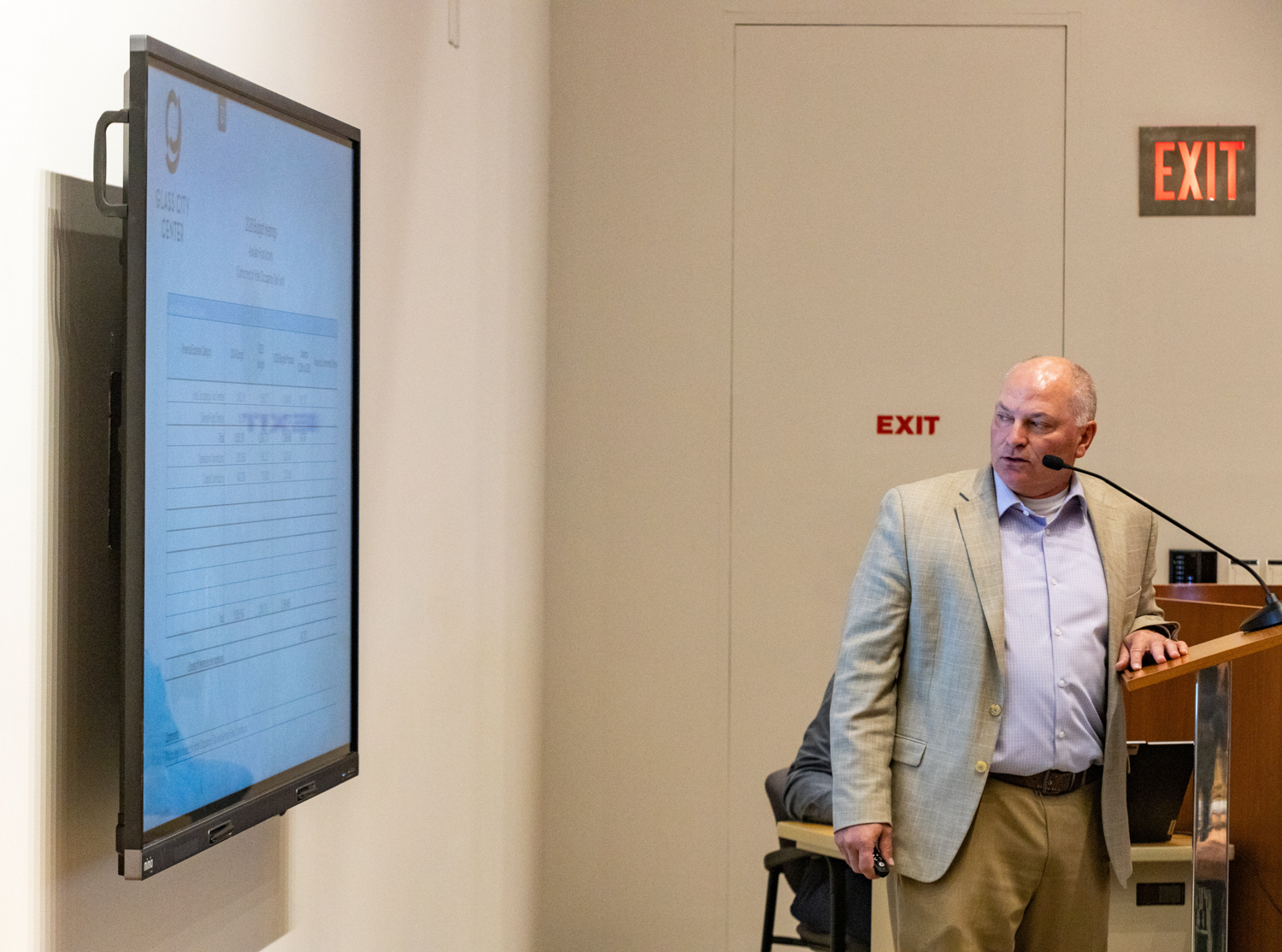
Legends Global presented upkeep for the Glass City Center and the Huntington Center.
Steve Miller, the regional general manager for Legends Global, presents upkeep and repair options for the Glass City Center and Huntington Center ahead of the 2026 budget. (TFP photo by Stephen Zenner)
Steve Miller, the regional general manager for Legends Global, was on hand to present a laundry list of repairs and upkeep costs for both structures.
The commissioners have been asking for most departments to keep their budgets flat this year. Miller said they are doing their best to meet the request.
$275,850 was put on the 2026 budget for the Glass City Center with an additional $161,800 requested for less imminent repairs/projects. The Huntington Center’s budget for 2026 was marked at $679,205 with an additional request for $787,400. Both buildings deferred modernizing their elevators, projects that alone would cost over a million dollars each.
Gerken approached the situation hopefully, and said that for every repair need he thought there could be a revenue-based solution, citing catering opportunities and unused parts of the buildings that could generate more money.
17. Recorder
Presentation
18. Lucas County Recorder’s Technology Fund Proposal.
Ohio Revised Code Section 317.321 allows money from fees collected from county recorders recording documents to be funneled back into the county recorder’s technology fund.
“$6.00 of the fee collected for recording a document be placed in the county treasury to the credit of the County Recorder’s technology fund for the calendar year,” reads the summary from Resolution No: 2025-795.
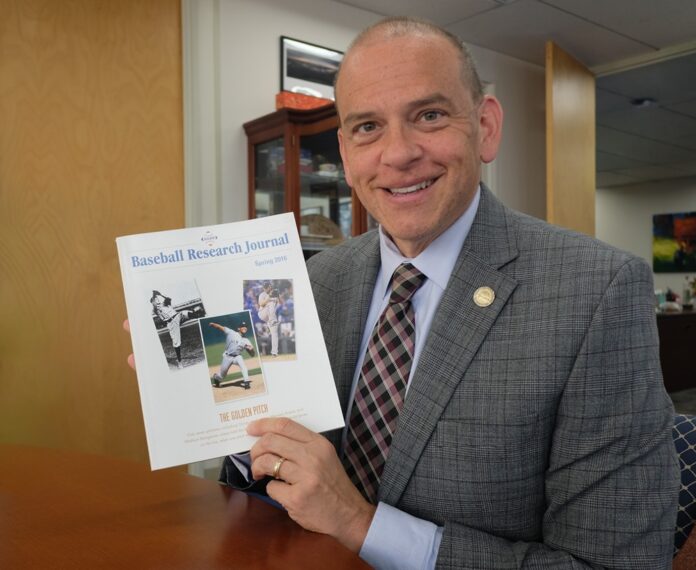
Toledo Mayor Wade Kapszukiewicz holds a copy of the Spring 2016 prestigious Baseball
Research Journal, where his conceptualization of "The Golden Pitch" first took root in the collective psyches of baseball fanatics. (TFP photo by George Tanber)
TOLEDO – Three days after his unprecedented reelection to a third term, Toledo Mayor Wade Kapszukiewicz sat in his office on the 22nd floor of One Government Center talking….baseball.
To those who know the man, they wouldn’t be surprised. Next to politics, sports is passion 1B.
We tabled the campaign-wrap discussion while the mayor explained how the most important post-election message he received was not from his defeated opponent Roberto Torres.
Instead, it came from the National Baseball Hall of Fame in Cooperstown, N.Y.
While the mayor runs the country’s 86th largest city, he’s Top 10 in the eyes of a select group of baseball writers and analytics nerds for conceiving a concept called the “Golden Pitch,” which loomed large in the just-completed 7-game World Series won by the Los Angeles Dodgers over the Toronto Blue Jays.
On Nov. 3, the day before the election, the mayor woke to a stack of text messages alerting him to an article posted that morning in The Athleticby its senior baseball writer, Tyler Kepner. Using four criteria, Kepner determined that Game 7 of the Dodgers/Jays series was the best ever played.
Criteria No. 4 was the Golden Pitch. Kepner identified Mayor Kapszukiewicz as its inventor.
He then explained the concept to his readers:
“Simply put, a Golden Pitch is the most dramatic situation possible in the sport, the rare instance when either team can win the World Series on a given pitch.”
The mayor was more impressed with Kepner’s description than the instant national notoriety he gained from the article.
“He described it better than I ever could – the rarest thing that could ever happen in a baseball game,” he said. “And he’s right.”
The origin
On Oct. 26, 1997, 24-year-old Wade Kapszukiewicz was tuned into Game 7 of the World Series from his West Toledo apartment. His team, the then-Cleveland Indians, stood three outs away from winning its first championship in 49 years. As the inning progressed and the tension grew almost unbearable, the game reached a point where any one of seven pitches thrown by Cleveland’s pitcher could have ended the series for either team. Somehow, Kapszukiewicz understood what was happening.
“It popped into my head at that time,” he recalled. “I don’t know why.”
The seventh Golden Pitch resulted in a long fly ball by an opposing player for the Florida Marlins, which scored a run from third and tied the score. Cleveland lost the game – and the series – in extra innings.
In 2001, Kapszukiewicz witnessed six more Golden Pitches in a Game 7 featuring the New York Yankees and Arizona Diamondbacks. This time, since his team was not involved, he viewed the circumstances with less emotion, but felt he was on to something.
The next time it happened, in 2014, in a Game 7 between San Francisco and Kansas City, he was so excited he woke his wife, Sarah, from a dead sleep.
“She told me to quit talking about it and do something,” he said.
Finally, the Golden Pitch was in play. He named it after the Golden Goal, a soccer term for a game-ending, extra-time score.
Nine years later, on Halloween night, the mayor tuned into the Dodgers/Blue Jays Game 7. As the innings moved along and the game grew tighter, he could feel a Golden Pitch situation develop.
When it arrived, the mayor was not alone in recognizing the fact.
“This officially is a Golden Pitch scenario,” tweeted a New York radio sports broadcaster, announcing the first of seven such pitches in a row.
Soon after, the mayor noticed that baseball geeks around the country referenced the term on social media forums such as X and Reddit. Some gave a shout out to him and his Baseball Research Journal article.
The reaction surprised Kapszukiewicz, who previously downplayed the Golden Pitch as nothing more than “having some fun.”
“I knew there were a handful of baseball insiders who knew about it,” he said. “But I didn’t realize until this game and seeing some of the tweets that were happening…what a big deal it had become,” he said.
Next question: “How did you have time to watch the World Series three days before the election?”
The campaign that wasn’t
Kapszukiewicz’s re-election carried none of the drama of the Golden Pitch. Toledo voters last year approved a referendum allowing mayors to serve three consecutive terms, paving the way for his third race.
In Torres, he was facing a novice opponent who had created little buzz during his campaign. So, during his pre-election weekend, he watched two World Series games, the Ohio State football game and, on Sunday, his Detroit Lions playing Seattle. Sunday evening.
The results were as predicted: Kapszukiewicz smoked Torres 60.5 percent to 30.2 percent. Four years earlier, he trounced an 82-year-old former mayor, Carty Finkbeiner, by an even greater margin.
Kapszukiewicz noted that incumbent mayors lost re-election races in New York City, Dayton, Youngstown and Oregon, Ohio, and that half of the members of Maumee City Council were turned out of office.
“Yet, in Toledo, Ohio,” he said, “not only did voters re-elect me by a 2-to-1 margin, they re-elected every single member of Toledo City Council. I see that as a sign Toledo is moving in the right direction.”
What Next?
During Kapszukiewicz’s initial run for mayor, in 2017, a more spirited campaign against incumbent Paula Hicks-Hudson, candidates staged a talent show. Some sang. A few played instruments. Kapszukiewicz had a different shtick. He stood in front of the audience and asked them to name a year, any year. When they did, he ticked off the best movie, U.S. president at the time and champion of every major sport. His score: 100 percent.
Eight years later, when asked what’s the No. 1 goal for his final term, the numbers guy quickly threw out a figure: 10,112.
That’s how many new housing units the city needs to guarantee population growth of 10,000 or more. It’s a longstanding part of his platform, but the mayor re-affirmed his belief that it’s vital for the city’s future for a number of reasons, including increased revenue from taxes.
“Yes, there is a limited amount of space,” he said. “But 70 housing units here, 70 there. You don’t need a ton of land to do that. It would get our city growing its population again. That would be a heck of a legacy.”
Speaking of legacy, the creator of the Golden Pitch has led a golden life as a politician. From his first race at 23 for the Lucas County School Board and including campaigns for Toledo City Council, Lucas County Treasurer and mayor, Kapszukiewicz holds a perfect 11/11.
He’ll turn 57 on Oct. 30, 2029 – still young for a politician – and facing life out of elected office soon after. What’s next?
The mayor, who enjoys touting his nerdy side and lack of charisma as a badge of honor, responded in sports-speak.
“I’ll be an unrestricted free agent, and I’ll have the ability to choose,” he said. “No one will believe me when I say this…but I don’t know what I’ll be doing four years from now.”
Congress? The Senate? Educator? The last one drew a maybe.
“I’m actually the happiest when I’m teaching,” he said.
Our discussion returned to baseball. The mayor said the recent Game 7 and the one played in 2016 included nine Golden Pitches, meaning he needs to update his research article.
He did some quick math and figured that in 122 years of baseball and 41 Game 7s there have been only 49 or 50 Golden Pitches thrown in nine of those games. Those Golden Pitches are out of a total of more than 50 million thrown in baseball since 1903, the year of the first World Series.
The rarity of it and the buzz on social media triggered the contact from the Hall of Fame. It said they are considering creating a display detailing the history of the Golden Pitch and including the ball from the Dodgers pitcher who threw seven of them on Oct. 31.
“I don’t know if they’re going to do anything about it,” he said. “And even if they do, there’s no guarantee they’ll give me credit for it.”
Considering the winning streak he’s on, it’s hard to imagine he’ll lose.
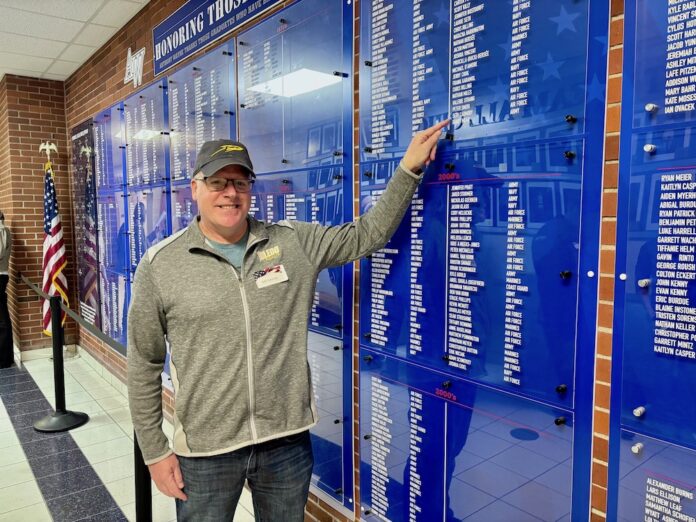
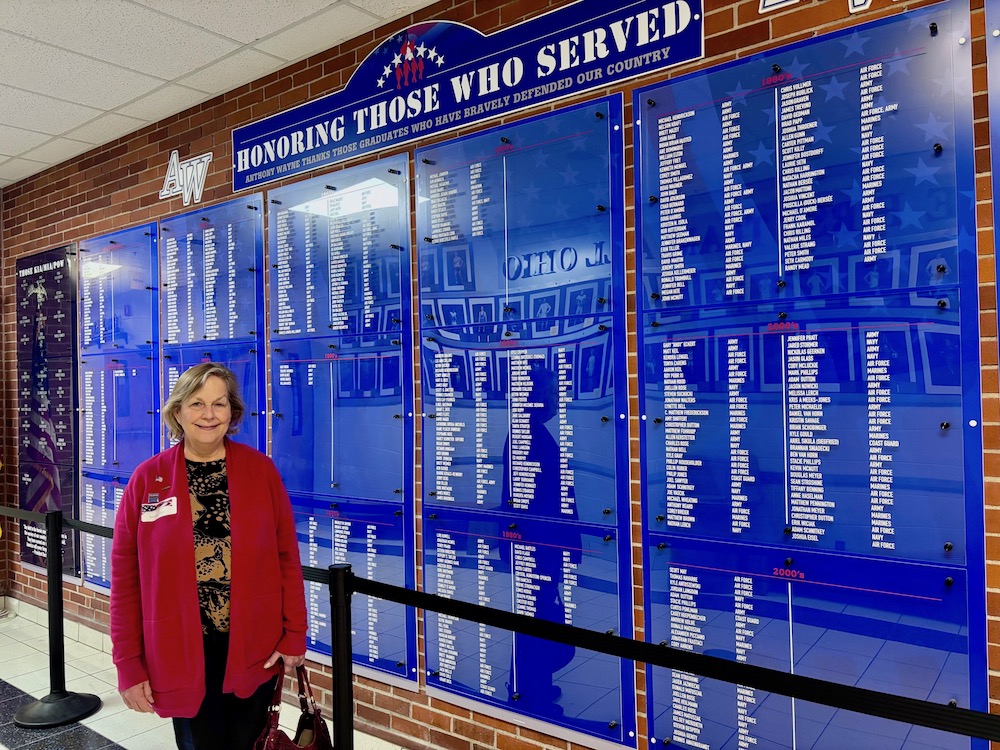
Seth Carmody, a 1992 graduate and Air Force veteran, points to his name on the school's Military Wall of Honor. (AWFP photo by Karen Gerhardinger)
It’s been over 60 years since Terrence Huebner was killed in action in Vietnam, but his fellow Anthony Wayne High School graduates – Doug Mold, Rick Myers and Ralph Whalen – remember him well.
“In a class of 150, we all knew each other,” said Myers, as he enjoyed a special Veterans Day breakfast sponsored by the school on Nov. 5. “He was a nice guy. He was quiet, taller than most, and well-liked.”
Huebner, who was in the Army, was killed in action in Vietnam in 1969. Mold, who joined the Navy and was selected for the Seabees, served a one-year tour in the Mekong Delta in Vietnam. Myers was in the Army National Guard.
“The general feeling among the young men at that time was that it was our duty to serve our country,” Mold said of the trend to join the military in the 1960s.
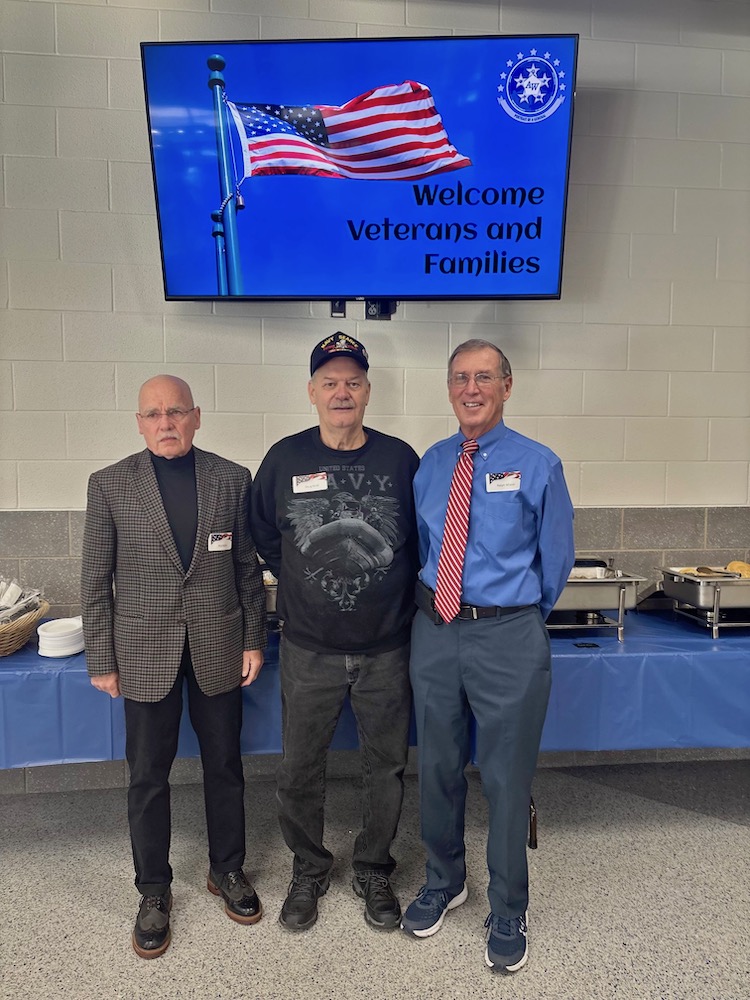
Friends of Terrence Huebner, who was killed in action in 1969 in Vietnam, gathered to see the 1961 graduate’s name added to the wall. Pictured are (from left) Rick Myers, Doug Mold and Ralph Whalen. (AWFP photo by Karen Gerhardinger)
While Whalen didn’t serve – as he was training to become a vascular surgeon – he did spend two weeks a year for five years on rotation at Landstuhl, Germany Regional Medical Center, treating soldiers who were fighting in the Middle East.
“This man supported the military and saved many soldiers’ lives,” Myers said, pointing to Whalen.
The Veterans Day ceremony hosted by the high school provided an opportunity for veterans to mingle over a hot breakfast while sharing stories of AW graduates whose names were added to the Military Wall of Honor this year.
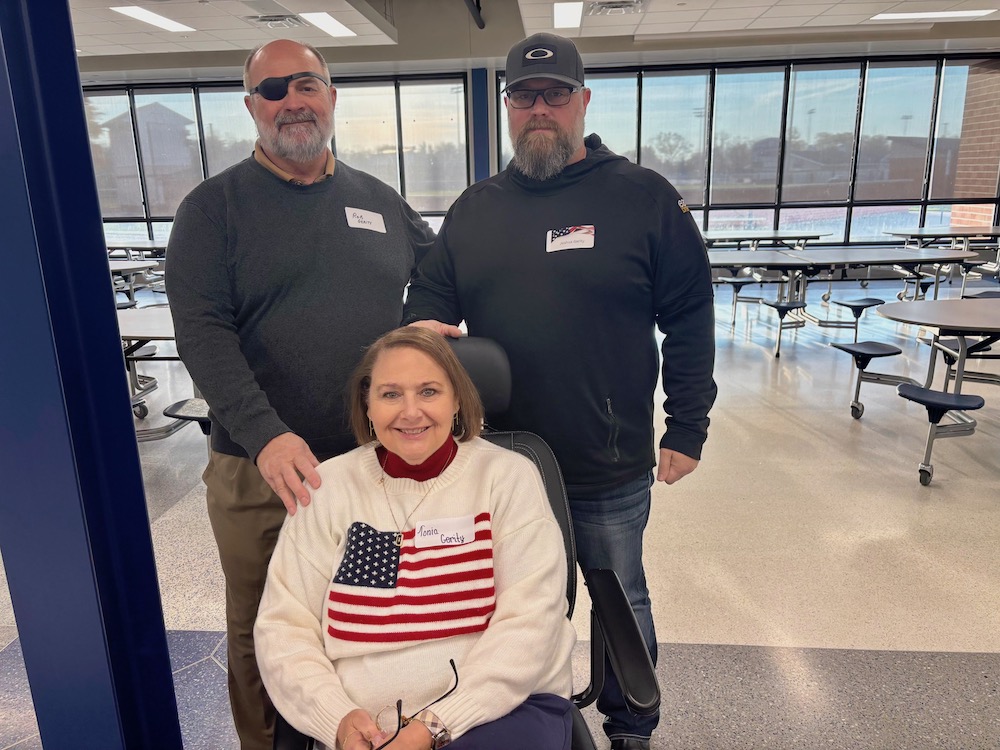
Sharon and LeRoy Roberts attended on behalf of their grandson, Garrett Mintz, a 2019 graduate who served in the Army National Guard and is now a teacher in Tiffin. Joshua Gerity, a 2002 graduate, joined the Army in 2010, and came to the breakfast with parents Rob and 1979 graduate Tonia (Young) Gerity.
Jake Cope wore a United States Marine Corps hat and vest as he stood with his son, Brian, and daughter-in-law, Sarah Cope in front of the wall that now bears the name of his grandson, 2024 graduate Jake Cope. The younger Cope must have been inspired by his grandpa’s stories of the Marines, and decided his sophomore year to join “the few, the proud, the Marines.” He is now training at Camp Pendleton in California.
Ronda (Whitaker) Cobb, a 1978 graduate, wanted to go to the U.S. Military Academy at West Point, but was selected as an alternate. Instead of waiting a year, Cobb joined the United States Merchant Marine Academy, graduating with a degree in marine engineering. While at the high school to see her name added to the wall, she shared a brochure about the USMMA with counselors, in order to inform students of the benefits – chiefly that graduates can then join any military branch as an officer.
Ronda (Whitaker) Cobb, a 1978 graduate, opted for the United States Merchant Marine Academy, graduating with a degree in marine engineering. Her name was added to the wall this year. (AWFP photo by Karen Gerhardinger)
Following the breakfast, the veterans were treated to patriotic music by the band and Close Harmony Choir and a reading of the names by Principal Jon Burke. Chris and Karen Brennan came to honor Karen’s late brother, Gary Buerk. A 1961 graduate, Buerk joined the Air Force for two years, and spent most of his life involved in community theater, including his own 3B Productions.
Seth Carmody, a 1992 graduate, was among those who stood as the band played his branch’s song. He joined the Air Force because he was in need of funding for college, Carmody said after the ceremony.
“It was a great avenue for tuition assistance. And after my first enlistment, I wanted to continue,” said Carmody, who is now the deputy director of sustainment at the 180th Fighter Wing – a place that he describes as “family oriented” and “full of ordinary people doing extraordinary things.”
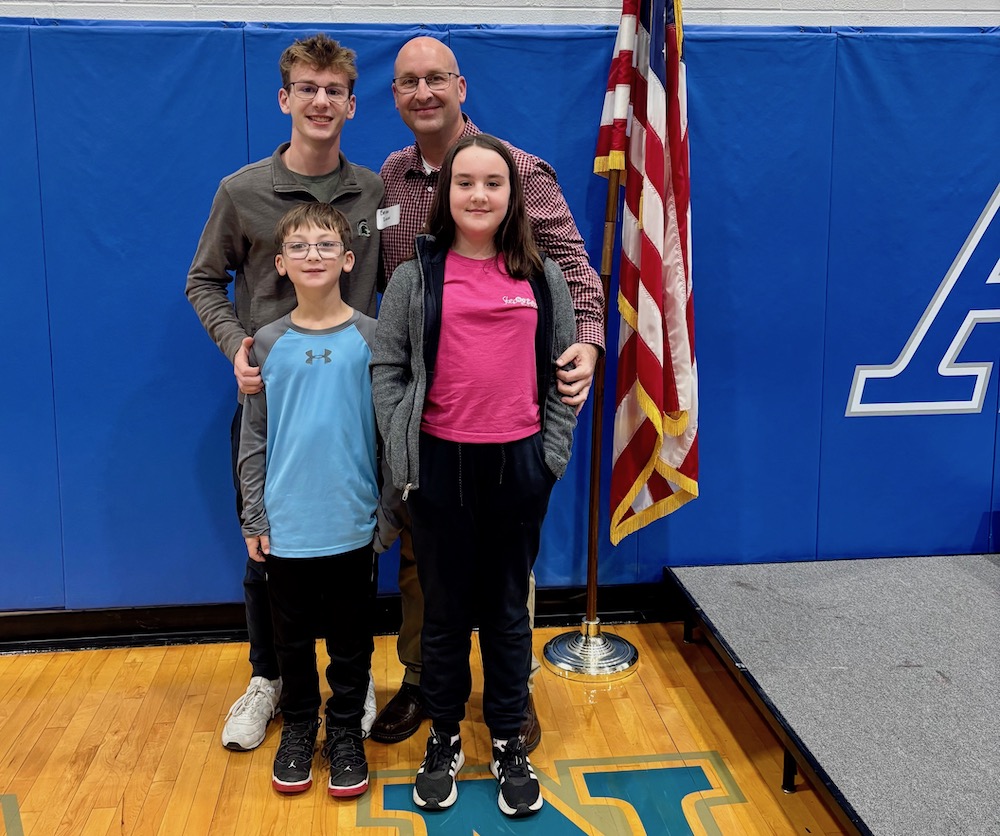
Master Sgt. Brian Rozick, the 180th Fighter Wing’s command chief, joins his children, including AW senior Ethan, sixth-grader Zoe and fourth-grader Zane after the November 5 program. (AWFP photo by Karen Gerhardinger)
The 180th Fighter Wing’s command chief, Master Sgt. Brian Rozick, was the guest speaker, telling the students his own story of military service that has taken him all over, eventually landing at the 180th as a firefighter, fire chief and now second in command. His job is to ensure that the 1,100 people are organized, equipped and ready to do their job at a moment’s notice, and that includes defending the nation.
“After traveling the world for 28 years, I have seen that the United States of America is by far the greatest country on the face of this planet. We have all been given a gift to be here. It doesn’t happen by accident. It happens by a lot of hard work,” Rozick said.
The United States is one of the few countries that has an all-volunteer force, and that means that it’s filled with people who want to serve. Even those who are not interested or able to serve in the military can do their part to give back, through volunteering, being politically active, being an educator – anything to keep the country moving forward, he said.
“You live in the greatest free country in the world. Work at it. Try to do something that makes this a better place,” he said.
The Anthony Wayne High School Military Wall of Honor, established in 2019 to recognize the sacrifices of AWHS alumni and employees who have served, or are actively serving in the armed forces, stands as a permanent testament to their dedication and courage, said assistant principal Stephanie Buckenmeyer. The wall now has 733 names of alumni or district staff who have served or are currently serving, arranged by decade and listing the names and branch of service.
The Gerity family, including Rob, 2002 graduate and Army veteran Joshua, and 1978 graduate Tonia (Young) Gerity, enjoyed a breakfast reception at the high school. (AWFP photo by Karen Gerhardinger)
“For all of their dedication and sacrifices, we thank them, their friends and their families,” Buckenmeyer said. “We also extend our gratitude to the troops that are currently serving both domestically and overseas.”
Names are being accepted for the 2026 Military Wall of Honor inductees. For information, email [email protected].
This year’s inductees, their graduation year and branch of service include:
TOLEDO- Daylight Savings Time ended on Nov. 2, bringing with it an extra hour of darkness in the evening. DST can bring more than just an adjustment to sleep schedules, especially for those living with Alzheimer’s disease and dementia.
Pam Myers, senior director, programs for the Alzheimer’s Association, oversees the Northwest Ohio Chapter and the Central Ohio Chapter.
“Our mission is to support families and caregivers and folks living with the disease, support research, advocate for all people living with dementia and their caregivers and eventually find a cure,” Myers said.
Pam Myers, senior director, programs for the Alzheimer’s Association Northwest and Central Ohio Chapters. (Photo courtesy of Alzheimer’s Association of Northwest Ohio)
With the time change, Myers explained the ways one can help support someone with Alzheimer’s or dementia.
“Folks that are living with dementia…they tend to get more tired, confused, irritable, and when it gets dark sooner or when the time changes, sometimes that tendency to have confusion and agitation increases,” Myers said.
The Alzheimer’s Association started on a national level in 1980 with the founder Jerome H. Stone.
“His wife was living with dementia and he [Stone] was just looking for resources and looking for other people that were on the same journey, because this is a progressive disease,” Myers said.
There is a wide range of services available at the association:
Community education programs about dementia and the symptoms
Awareness presentations about Alzheimer’s and dementia updates
Training for caregivers
Guidance for transitions for home care
Programs emphasizing early detection and diagnosis of Alzheimer’s
Support groups
A 24/7 Helpline
Care consultation to personalize support
All of the services provided at the Association are free of charge.
Myers said it’s helpful when caregivers can give individuals with Alzheimer’s and dementia structured schedules so that they know what’s coming next.
“A person living with dementia has to really think through all the different steps in a process. So in turn, they get very tired by the end of the day and so that kind of contributes to the confusion and they’re just tired after all of their day’s activities,” Myers said.
She recommends that people should keep the lights on longer at night to keep the space bright.
“Keep the house more well lit, keep people to their routines as much as possible, and try not to schedule over-stimulating activities late in the day, and you want to try to keep the person as calm as you can,” Myers said.
“Think about just when you go to work in the morning; you get up and you eat and you brush your teeth and you get in your car and you walk into the office. I mean, we do that just almost automatically. A person living with dementia has to really think through all the different steps in a process,” Myers said.
Adjusting to time changes is difficult for everyone, especially those with Alzheimer’s and dementia. If you need help finding resources, visit alz.org/nwohio. The 24/7 Helpline (800-272-3900) is available for anyone who needs it.
Kieffer has published two books and helped thousands of veterans with his work and through the website veterancareerjourney.org (TFP photo by Gaven Hafner)
ELMORE – For William E. “Bill” Kieffer, serving his country was never just a career, but a calling.
“I’ve always wanted to be a soldier,” Kieffer, an Elmore native who graduated from the University of Toledo, said. “I have a long family history. My dad was a veteran, my granddad was a veteran, my great uncle was a veteran…I had two uncles and an aunt that were veterans.”
Kieffer served nearly 12 years as an Army logistics officer, from 1985 to 1997, leading missions from Central America to Somalia.
“I supported the Panama invasion,” he said. “When the equipment that our forces in Panama captured [Manuel] Noriega’s equipment, they shipped much of it back to Fort Ord, California, and the unit that I was second in command of, we had the responsibility to demilitarize it. It was cool.”
His service also brought him into the heart of natural disaster.
“I was part of the military response to Hurricane Andrew in ‘92,” Kieffer recalled. “We set up in South Dade County and helped to do all the recovery and restoration work after that horrible nightmare of that hurricane.” He added, “When we went down there to do that work, I saw the best and worst in people; it was truly a society that had fallen apart, and seeing that firsthand and trying to do good work in that kind of an environment…it really left an impact.”
Throughout his 12 years in uniform, Kieffer commanded platoons, companies, and battalions, supporting up to 5,000 soldiers at a time.
“That was the most rewarding: knowing that I was working with and leading really good people to go do work that mattered.”
After his service, the transition to civilian life wasn’t easy.
“My transition out of the military came as a result of a divorce,” Kieffer said. “So, when I left the military, it wasn’t just leaving a job; it was loss of family, it was loss of career and loss of all that, not knowing what the future was going to look like. It was a very tough transition, and that experience motivated me to do what I do now.”
In 2018, after surviving a massive heart attack, Kieffer decided to leave corporate life to start his own business. Kieffer & Associates LLC is a leadership and career coaching firm that has a heavy focus on helping veterans transition to new careers. He later cofounded the nonprofit Veteran Career Journey, an organization dedicated to bridging the culture gap between veterans and employers.
“Employment-related issues are a contributor to veteran suicide,” Kieffer stated. “We not only want to close that culture gap, but we want to do what we can with our skill sets to help reduce veteran suicide.”
Since founding the nonprofit, Kieffer has trained and coached over 2,000 veterans worldwide, often without taking a salary.
“This is passion work for me,” he said. “The moments that I value most is when I get the calls, the emails, the LinkedIn messages from coaching clients that say, ‘Hey Bill, remember when we were talking about this opportunity? I got it,’ or, ‘You wrote something in your book and talked to me about this topic, and that made all the difference in my ability to transition.’ Those things are worth gold.”
In 2021, Kieffer’s book, “Military Career Transition: Insights from the Employer Side of the Desk” was a bestselling new release on Amazon in its category (TFP photo by Gaven Hafner)
“I think the work I do now as a veteran, and with veterans, is to help not just the veteran community succeed, but to help the business world succeed too, and overall society. It’s about helping people better understand each other and the value they bring and the opportunities they present; that’s really what I’m trying to do.”
When asked what he hopes his legacy will be, Kieffer paused before answering, “I hope when I’m gone, people say, ‘He helped.’”
At its core, Kieffer’s story is one of service to his fellow man that never stopped; he only changed battlefields.
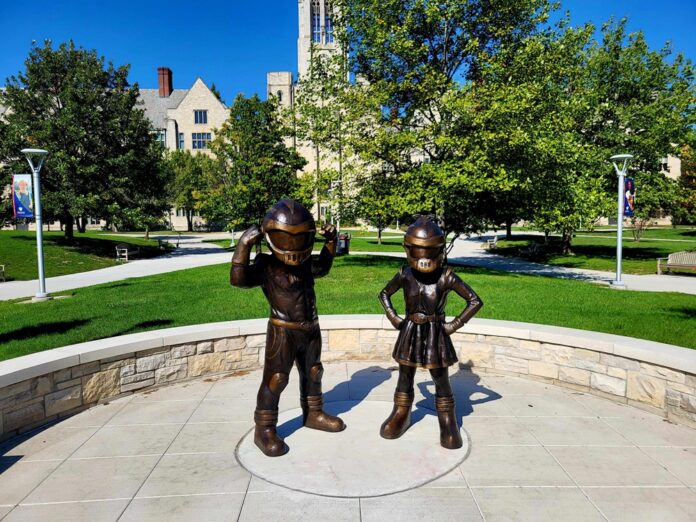
Statue mascots Rocky and Rocksy. (TFP photo by Steven Bieber)
Michigan enrollees now eligible for in-state benefits
TOLEDO – One of the most significant factors for students choosing selecting a college is cost. An overwhelming majority of students choose to attend college in their home state to take advantage of lower tuition rates. Thanks to a new policy change, students in Michigan will soon be able to study out-of-state while still paying reduced tuition.
The University of Toledo announced in September that starting in fall 2026, students from Michigan will pay the same tuition as Ohio residents. This initiative is expected to save students about $4,680 per semester.
Since 1978, students living in Monroe County have benefited from in-state tuition. Because of that program’s success, UToledo decided to expand it to all of Michigan, according to UToledo President Dr. James Holloway.
“It’s a great way to bring talented people into northwest Ohio and have them go to school here. Some of them will stay in the region and build their lives here, and that’s good for everybody.”
Holloway said there are no current plans to expand the initiative beyond Michigan. For now, the university is focused on attracting talent from Michigan and evaluating the program’s impact before considering expansion elsewhere.
The new tuition policy applies not only to incoming freshmen but also to transfer students and those returning to finish their undergraduate degrees. According to a press release, the university already partners with several Michigan community colleges, including Henry Ford College, Jackson College, Macomb Community College, Monroe County Community College, Oakland Community College, Schoolcraft College, Washtenaw Community College, and Wayne County Community College District.
These partnerships make transferring to UToledo easier. So far, Holloway said he has received a strong, positive response from prospective Michigan students.
New Rockets will not need to submit extra forms or applications to qualify; they will automatically receive a scholarship that covers the out-of-state surcharge.
Holloway said he hopes to see a gradual increase in enrollment from Michigan.
University Hall Tower at UToledo. (TFP photo by Steven Bieber)
“We’re hoping that in the first year of this, we get say between 50 and 100 additional students from Michigan with some growth in that number over time, and of course, that accumulates over multiple classes of incoming students, and so we’ll see how that works now, but again, we’re hoping for something in that 50 to 100 range, and if we get more than that, hey, that’s great.”
For any student in Michigan who is on the fence about enrolling at UToledo, Holloway offered some information to consider.
“Look at the programs the University of Toledo offers,” he said. “Look at the success of our students after they graduate. Our students are top five in earnings one, five, and ten years out after they graduate, Really, the University of Toledo is focused on helping students succeed, not just in college, but after they graduate, and this is a great place for a student to come who’s looking for that serious pursuit of a professional degree and the opportunities that come after they graduate.”
If a student from Michigan wants to enroll at UToledo, Holloway said the best place to start is the admissions website.