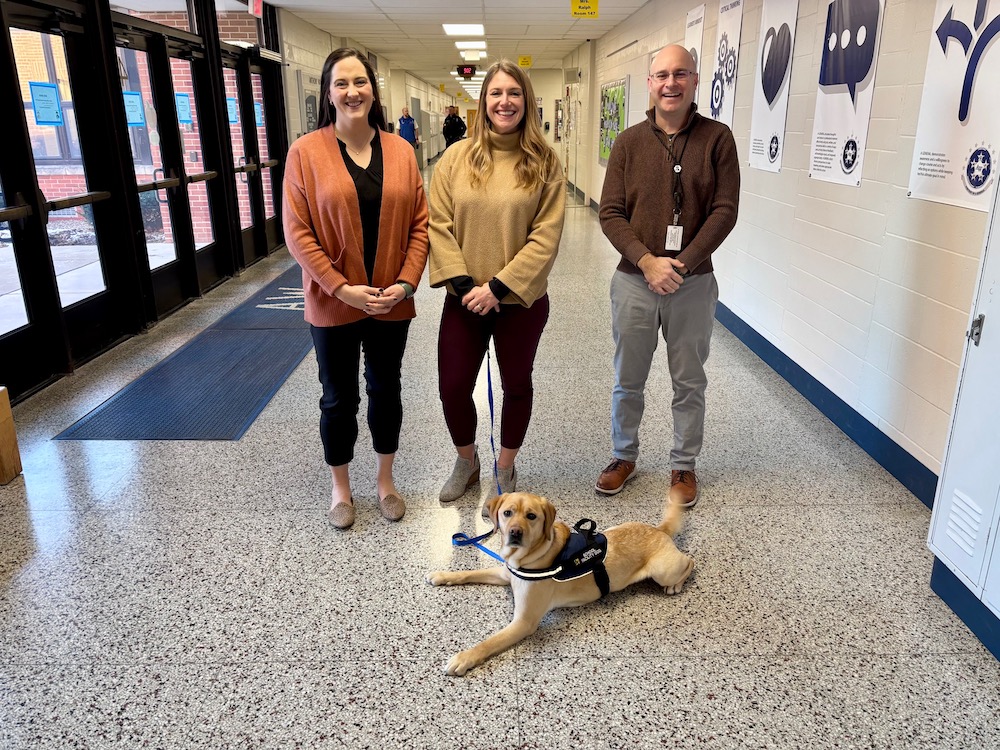
WHITEHOUSE – For his first week on the job, Jasper had it easy: delivering birthday wishes and kisses, watching a basketball game, accompanying his handlers through the hall and taking a lunchtime nap. But as Anthony Wayne High School’s first facility dog, the 49-pound, three-year-old yellow Labrador retriever is just beginning a career that will include consoling nervous students, encouraging academic, social and emotional growth, and reminding the humans in the room to “wag more, bark less.”
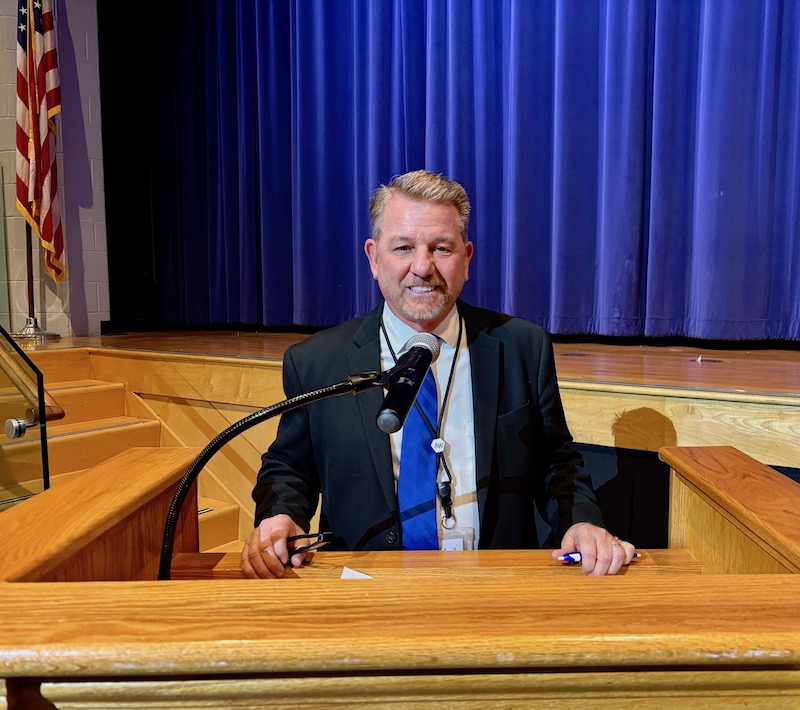
“He regulates the room really well,” noted Principal Jon Burke, one of three handlers for Jasper, who was thoroughly trained by The Ability Center before starting full-time at the school on Jan. 6.
Resting on a cot in the conference room earlier this week, Jasper’s ears perked up as Burke and the other two handlers – counselor Lauren Murawski and Assistant Principal Stephanie Buckenmeyer– spoke about how the school facility dog will benefit the students and staff.
The district welcomed its first dog in 2008, when Sara joined Waterville Primary School. She was replaced by Teila in 2019. Monclova’s first dog, Laney, served from 2017 to last May, when Dunkin joined the team. Luna was welcomed by Whitehouse Primary in 2019, Astro joined Fallen Timbers in 2021. It was the addition of Lorain to the junior high in 2024 that ramped up interest in having a facility dog at the high school, said Buckenmeyer, who was one of Lorain’s handlers.
“Watching the impact on the junior high students and staff was part of the catalyst. She helps a lot with emotional regulation and brings a lot of positivity. Students earn time with her as they learn appropriate behaviors in a school setting. And overall she built a sense of community in the building,” Buckenmeyer said.
Murawski, who worked with a facility dog while doing her master’s degree practicum with Tiffin City Schools, understands how a dog can help manage expectations in the classroom and hallway, lighten the atmosphere and provide emotional regulation in student and parent meetings.
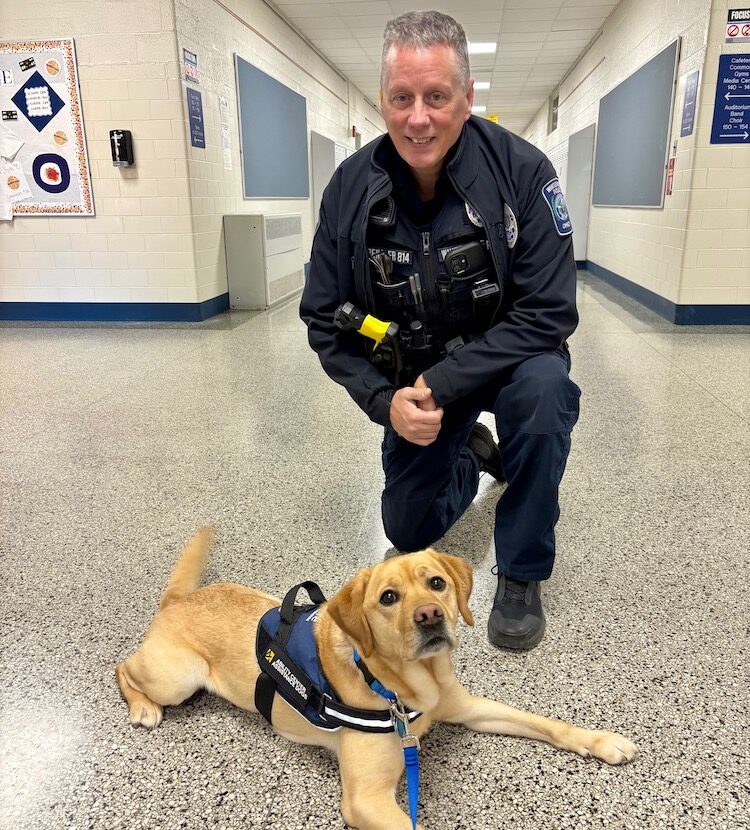
“Whether it’s in a crisis situation or more frequent visits, we can use commands like ‘lap,’ ‘hug’ or ‘place’ so that Jasper can provide support to students,” Murawski said. “I also love being able to take him into classrooms as a reward. And we can have him play games to address academic, social and emotional needs. We do have to be a little more creative in how we meet our upper level students – it’s different than how a facility dog is used at the primary level.”
With a command of “paws,” Jasper will put his paws on a desk to check a student’s work. And he can be utilized to play games with curriculum-focused questions, such as tic-tac-toe, four corners or rock, paper, scissors.
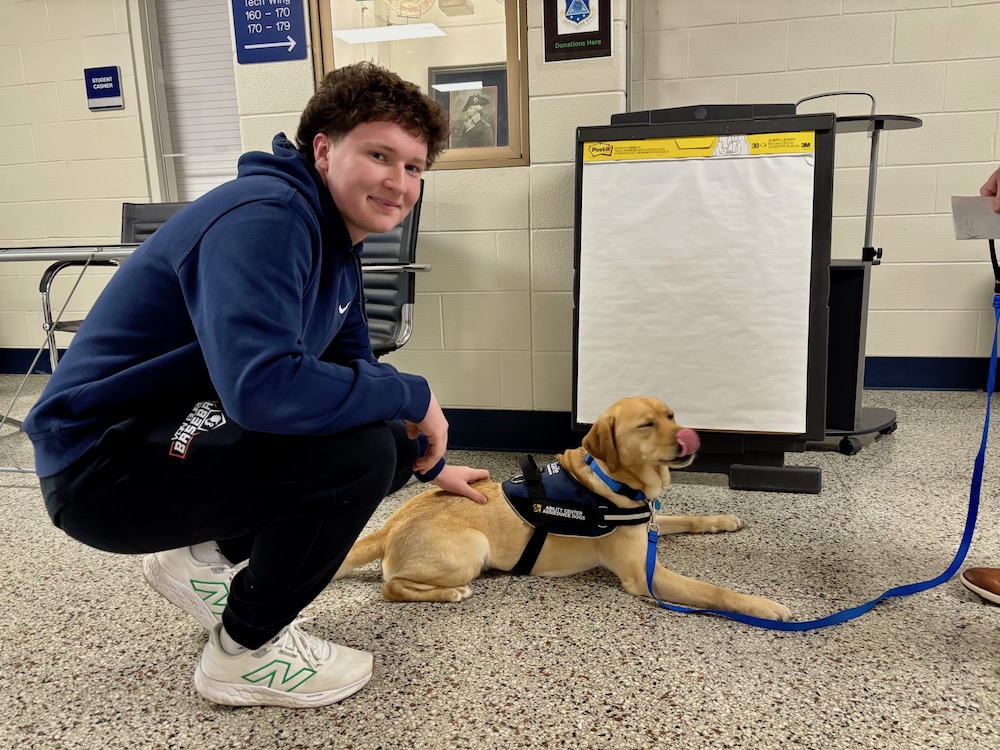
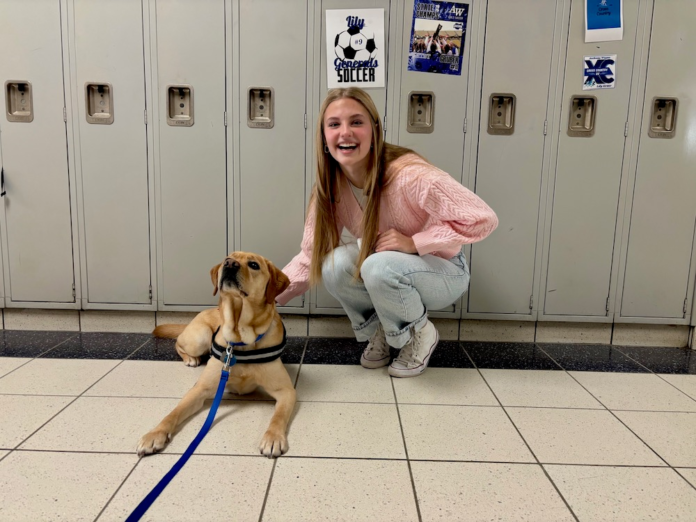
the point he scored during a recent lacrosse game. (AWFP photo by Karen Gerhardinger)
Jasper comes to the high school with a solid resume that includes Ability Center classes, training for four months – each with inmates at Gus Harrison Correctional Facility and Cooper Street Correctional Facility in Michigan – and then a semester of student teaching with St. Joan of Arc Spanish teacher Jennifer Kraus.
“Jasper thrived there,” Murawski learned, after speaking with Kraus about her experience. In November, the school informed the students, staff and parents of Jasper’s arrival, and sought input on any students with dog fears or allergies. Students were also asked about how they’d like to see Jasper utilized in the building.
“They came up with some creative ideas, but we also got some funny ones, like ‘let him run free in the halls’ or to let them schedule a naptime with Jasper,” Buckenmeyer said.
In early December, Buckenmeyer, Burke and Murawski spent a full week training at The Ability Center, to learn all of the commands and how to care for Jasper, before bringing him into the building while students were on winter break.
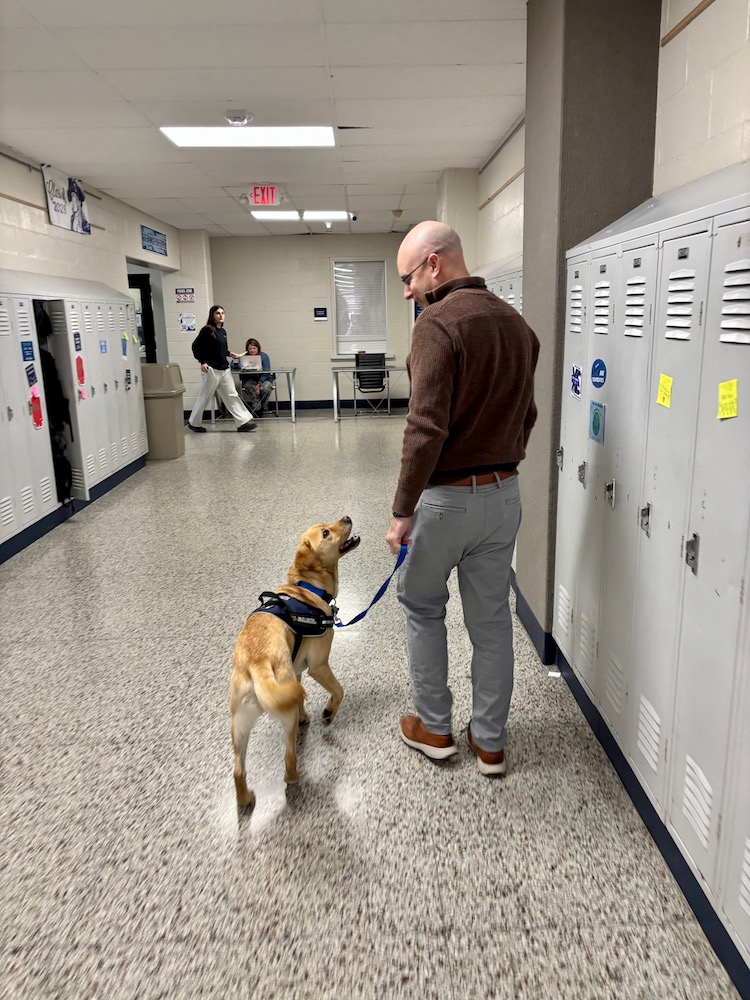
“We used that time for him to get used to the three of us and this space, and to learn that – out of the 1,500 people in this building – he needs to pay attention to the three of us,” Buckenmeyer said. “He does a lot of check-ins with us. He stares at us when walking down the hallway, and sometimes so much that he doesn’t look where he’s going.”
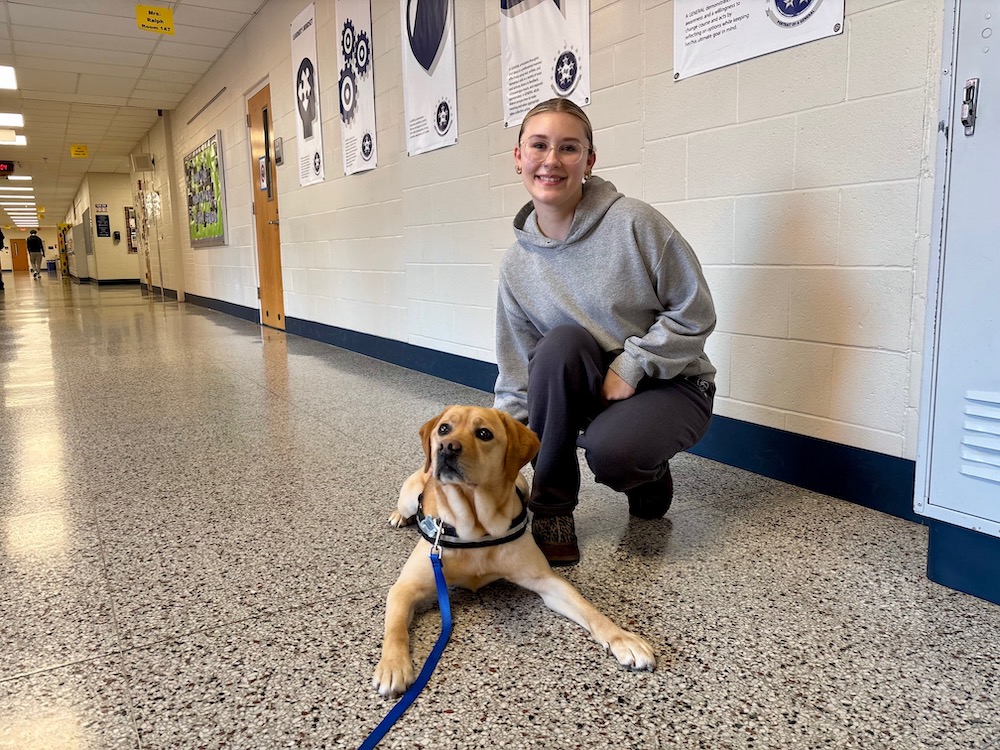
Walking through the school early this week, Jasper repeatedly looked up to Buckenmeyer and Burke as they led him to classrooms, looking for the signs indicating if the room is dog-welcoming. Depending on the schedules of students with allergies, Jasper might not be able to enter a classroom. But for those who were open, the rewards were many.
“I scored a point last night; can I pet the dog?” called out Beau Seelenbinder as he walked to the office. With permission, the teen knelt down to meet Jasper.
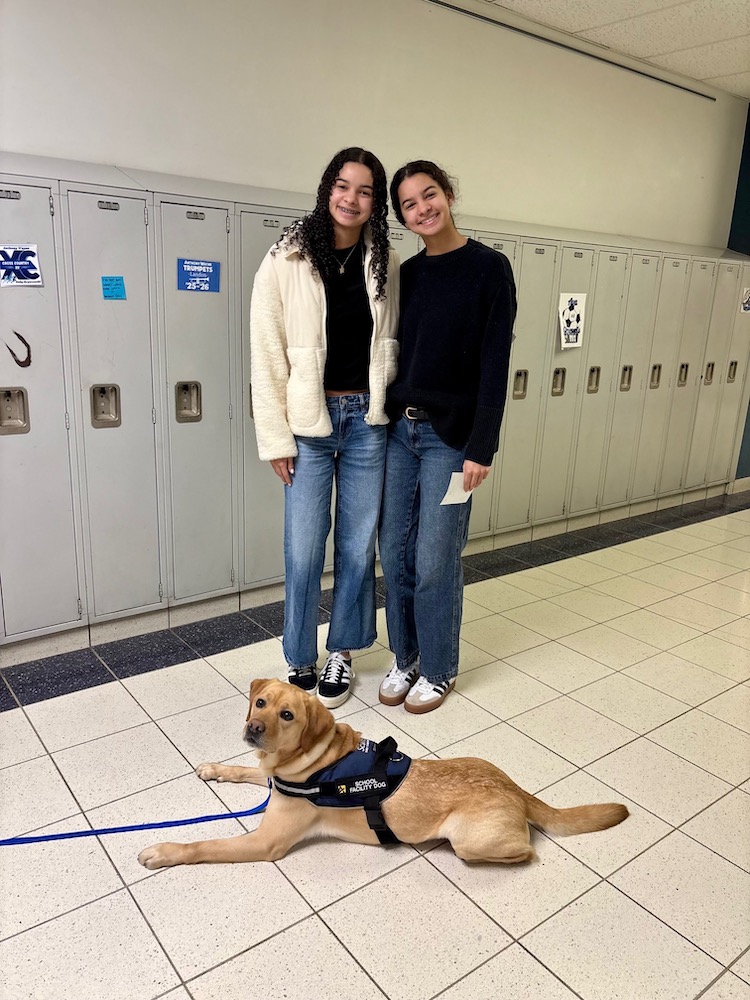
Twins Addison and Kennedi Hill were surprised when Jasper delivered a card wishing them a happy “half-birthday” – since they’re not in school on July 10 – along with an opportunity for a dog kiss.
While at school, Jasper will work most of the day but nap in a locked office in a crate during lunchtime. After school, as his energy level allows, he may attend athletic, arts and club events. On evenings and weekends, Jasper lives with the Buckenmeyer family, which includes eighth- grader Audra and sophomore CJ, along with Stephanie and her husband Mike. Jasper had a few weeks to get acclimated to the household and its routines.
Being a working dog, Jasper is eager for commands and being on the job. Too much downtime
isn’t good, and he can still display some typical dog behavior, like trying to sneak off with some “stuffies” when left unsupervised, or zooming through the back yard chasing sticks.
“Though he’s highly trained, he’s still a dog. He may randomly bark or get boisterous,” Murawski said. “When he puts his vest on, he’s working. He is always going to be learning and wants to be helpful.”
While the Buckenmeyers previously had a pug, taking care of Jasper is more rigorous. The Ability Center checks in regularly to make sure his weight is steady. Jasper’s morning and evening meals are smaller because he receives treats throughout the day as he obeys commands. The family is also in charge of giving Jasper regular baths, tooth brushing, ear cleaning and nail trims, as well as practicing commands.
Jasper’s care is not financed by the school district and requires fundraising for food, bedding, toys and veterinary bills. High Point Animal Hospital has generously offered a discounted rate on services, but Burke said he hopes to establish an emergency fund.
“We don’t have a parent-teacher organization to support our facility dog like they do at the primary schools,” Burke said. “So we’re doing a lot of fundraising ourselves. We’re open to sponsorships or donations.”
Those interested in assisting can call the high school office at (419) 877-0466.