Home Blog Page 302

Primary concerns

0
Editorial cartoon about the representation of the 9th Congressional District after the 2012 Primaries.

You can’t fool all the Lucas County voters all the time, but apparently Phil Copeland fooled at least 17,801 voters in the county recorder race. Copeland captured 57 percent of the March 6 Democratic primary vote to top James Seaman and Kevin Eff. Copeland will face Republican George Sarantou on Nov. 6.

Copeland did not attend the Feb. 27 recorder candidate forum to tell the public what he would bring to the office. Prior to his election victory, he told Toledo Free Press, “I want to go and be a part of it and I may have some ideas when I get in there.”

The recorder position is important beyond its modest level of public recognition; Copeland’s vague goals should be a red flag to informed voters.

Since we now have eight months to schedule it, Toledo Free Press is offering to sponsor and host any forum or debate between Copeland and Sarantou. Surely both candidates will agree to meet in public and discuss their specific plans for the office.

Copeland’s victory was just one discordant note in a primary that also saw local GOP aspirant Jon Stainbrook hijack Ronald Reagan’s legacy — and Jonathan Binkley’s surname — in his successful run for state central committee. We are confident that had Reagan spent five minutes in a room with Stainbrook, he would have left Stainbrook needing surgical help to remove a jar of jelly beans.

In other election news, Rep. Marcy Kaptur defeated Cuyahoga County-based Rep. Dennis Kucinich in arguably the most important contest of the night to people in Northwest Ohio. There were legitimate concerns over how much attention Kucinich would have given our region; though her territory is now much greater, Kaptur will never let her eye leave the Toledo area.

Conventional wisdom has the heavily Democratic District 9 backing Kaptur over Republican Samuel “Joe the Plumber” Wurzelbacher, but the stage is set for some interesting debates as the two battle for the seat.

Josh Mandel dominated the Republican primary for Ohio Senate, garnering more votes than all five of his opponents combined. He will not beat incumbent Democrat Sherrod Brown by that margin, but this is a race to watch as the GOP’s rising star takes on Brown, the career politician who defeated incumbent Mike DeWine in 2006.


Perrysburg opted out of TARTA service, a short-sighted decision that will have major ramifications for the people who depend on the bus service for transportation. Time will tell if the money the individuals save is worth the sacrifice to the community as a whole.

Toledo voters approved the “temporary” 3/4 percent payroll tax, taking one worry away from city leaders, allowing them to focus on issues like the promised (and much needed) street repairs and clearing the November ballot for a potential Toledo Public Schools levy attempt.

Disappointingly, but not surprisingly, the election in Lucas County was marred by reports of votes denied and voters given wrong ballots. The Kaptur campaign described the situation in the BOE as “sloppy” and “pathetic,” and will get no argument from us. Ohio Secretary of State Jon Husted’s policy of “give ’em enough rope to hang themselves” has saddled the Lucas County BOE with inexperienced leadership that needs to quickly demonstrate exponential quality-control improvement before the presidential election.

The primaries are history; the next few months will offer ample opportunity for Lucas County voters to educate themselves on the issues and candidates. If the Democratic recorder results are any indication, there is a great deal of educating to be done.

Thomas F. Pounds is president and publisher of Toledo Free Press and Toledo Free Press Star. Email him at [email protected].

Michael S. Miller is editor in chief of Toledo Free Press and Toledo Free Press Star. Email him at [email protected].
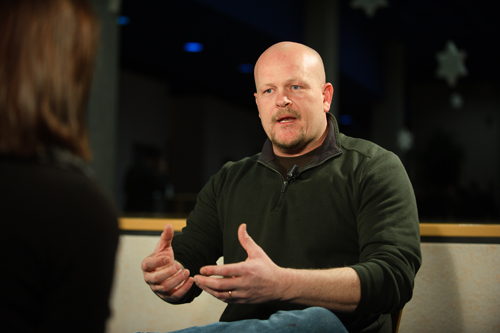
‘Joe the Plumber’ prepares to take on Kaptur

0
Samuel "Joe the Plumber" Wurzelbacher says states should have more power. Toledo Free Press photo -- Joseph Herr

Samuel Wurzelbacher’s first exchange with Rep. Marcy Kaptur happened when he was 17 years old, during an ROTC function for the representative.

The then-Springfield High School student cornered Kaptur and gave her a piece of his mind for voting for a bill that funded Planned Parenthood, a decision with which he disagreed.

More than 20 years later, Wurzelbacher has a far bigger audience than his mortified superior, who cut that conversation short. And, now known as “Joe the Plumber,” he is determined restart that conversation and carry it along the narrow corridor that wraps around Lake Erie to make Ohio’s 9th Congressional District.

He’s talking about jobs and taxes. And he’s talking about why Kaptur’s decades in office have yielded, in his opinion, negative results.

Samuel Wurzelbacher says states should retain more power.

“[She’s] bringing home the bacon and the pork, that only goes to certain individuals and groups,” Wurzelbacher said in a March 7 interview with Toledo Free Press.

Bloated bureaucracy, the federal deficit and the inability to balance budgets  are all elements within the federal government that plague average citizens, Wurzelbacher said. He blamed both Democrats and Republicans.

“[Kaptur] likes to tout experience and wisdom; I don’t see that as being a benefit to the American people,” he said. “Look how much money they have wasted. She’s been in there while all this has been in place.”

One of Wurzelbacher’s priorities includes cutting back on “waste” by scrutinizing the budget line by line and eliminating certain departments. The federal Environmental Protection Agency would be one of the first on his personal chopping block. He disagrees with a number of programs that the agency funds, particularly citing a grant that the EPA awarded to a dance troupe to educate children about pollution.

“It’s not that I don’t want clean air and clean water but the bureaucracy has gotten in the way of getting things done,” he said.

Adhering to the pursuit of stronger state sovereignty, he said each state should regulate its own environment, independent of any federal agency. Breaking down regulations and changing the tax code are his two other priorities. He supports former presidential candidate Herman Cain’s “9-9-9” plan, which urges the government to dump the present tax code and instate a 9 percent personal income tax, a 9 percent corporate income tax and a 9 percent national sales tax.

Wurzelbacher’s platforms were similar to his Republican opponent Steve Kraus’, who trailed him by three percent. Wurzelbacher’s campaign reportedly outspent Kraus 6-to-1.

“I expected to do well. I expected to win, but I wasn’t surprised at the results,” Kraus told Toledo Free Press on March 7. “It was the most exciting race out there. I wasn’t the highlight, but I almost upset the apple cart.”

Wurzelbacher said his national endorsements and near-celebrity status will help him against Kaptur.

He said the perception that he is anti-union is a falsehood. Of Senate Bill 5, which voters repealed and would have restricted union bargaining rights, he said, “I thought it was a huge step in the wrong direction.”

Of the thousands of homes he’s already visited, he said he spends up to 30 minutes chatting with each resident if they have the time. This includes Democrats and independents. By his calculations, about 60 percent of the Democrats he visited said they’d vote for him.

Just as he has for months, Wurzelbacher will continue to spend two days a week knocking on doors on the Cleveland side of the district, two days in the middle and two days in Toledo. For long car rides, he takes Charlie Daniels and Hank Williams Jr. albums along for the drive.

Door-to-door campaigning means deconstructing the image that the media created for him as “Joe the Plumber.”

“Some things are as simple as, ‘Your name’s really Joe?’ You really were a plumber?” he said. “Yes, in the United States Air Force I plumbed all over the world.”

Baumhower: Boycott blueprint

0

Oops, he did it again … last week, Rush Limbaugh created a media firestorm by referring to Sandra Fluke, a woman who testified in front of Congress about insurance companies and birth control mandates, as a “slut” and “prostitute.” Limbaugh then double-downed the following day when he suggested Fluke make a sex tape, “if taxpayers are going to pay for her birth control.”

Limbaugh has apologized but a reported 35 businesses have pulled their advertisements/money and two radio stations have dropped his show. In my career, I have been involved with a couple of these boycotts, so I have learned how they happen and where they go wrong. So I wanted to offer you the “boycott blueprint” for any media comments that offend you in the future.

1. Just cause: The most important thing in executing a boycott is the reason for the boycott. What has been said that has motivated you to leap into action? Who did it offend/hurt and why was it said? Limbaugh’s recent comments are the perfect just cause.

2. Organize: Once you have the reason, it’s time to find others who are equally offended by the host’s statements. To find offended parties one may want to use Facebook or Twitter.  Once your initial group is formed, it’s time to talk to bigger groups who would be offended — churches, political parties, unions, etc. Professional tip: The larger the group, the faster and easier the boycott will be. Getting multiple groups will increase the speed of this process.

3. Contact the station: You are organized and motivated; now it’s time to convey your anger toward the persons in charge at the radio/TV station. When asking for a meeting, make sure that all station higher-ups are in attendance. The No. 1 solution immediately and almost always offered is an on-air apology. In certain cases, management may agree with your just cause and suspend the host(s) for the comments. If the local management fails to meet your needs, contact the corporate offices, ask for titles like regional vice presidents, program directors, etc. Professional tip: Apologies and suspensions often boost ratings for the show and the station. If all you wanted was an apology or suspension, please stop reading.

4. Listen: If your concerns are not addressed to your satisfaction, start jotting down every company who advertises, locally and nationally, on the offending program. Holding a sign outside the station may get your group television coverage, but going after the advertising money is the crucial element. TV and radio stations are businesses first, and they need advertising money to operate. Solely boycotting the station always backfires, because it generates interest and interest translates into ratings. Boycotting the companies that advertise on the station is the most efficient way for your group’s message of discontent to be heard and acted upon (although there is a risk — one prominent Limbaugh advertiser, Carbonite, has seen its stock plunge dramatically since it announced it left Limbaugh’s show).

5. Contact sponsors: Once you know who’s advertising, the next step is to reach out to the person actually responsible for making the advertising decisions for each company. Inform the decision-makers of what happened and how your group has been handled, treating them like a future partner. Encourage them to reach out to the media entity and express their concerns. They may offer to remove their advertising from the show, but that means the station will reschedule their commercials, making its money during another program. Professional tip: Please remember to treat the advertisers with the greatest amount of respect, as they have done nothing wrong but marketed their businesses on the offensive show.

6. Contact media: Now that you’re organized and have given notice to the advertising businesses, it is the time to take your case to the public via the local media. News releases should be sent to every media entity stating the history of what happened and your group’s intentions. Ask for the public’s help with phone calls, emails, tweets and Facebook.

7. Take it national: If the above steps have not yet worked, taking the story national often will help.

8. Update: Here’s another crucial step: keeping the public notified of your success and momentum.  Constantly update the public as to what businesses have pulled their advertising, etc. You may want to start a Twitter #Hashtag like #StopRush.

9. Warning — Do not fail: If you fail to get the show removed, you may have inadvertently crowned a new king. Nothing breeds ratings success like controversy and outrage. Rappers are often judged by how many bullets they have survived; the same goes for local media.

Limbaugh’s ratings will be through the roof if he survives this latest controversy, as people are tuning in to hear what he will say next. That’s why TV/radio personalities say such controversial things — to generate interest, which equals ratings. There is a fine line between what’s accepted and what’s not. The broadcaster who can toe the free speech line the longest will be the richest as well.

When you cross the line, as many feel Limbaugh did, you face what he’s facing now.

Jeremy Baumhower tweets @jeremytheproduc.

Kaptur campaign: ‘Time for BOE to get its act together’

0

Despite a few incident reports and some voters potentially receiving the wrong ballots, the March 6 election went smoothly in Lucas County, one Board of Elections official said. But Rep. Marcy Kaptur’s campaign had harsh words for the Lucas County Board of Elections (BOE).

Voters who went to Reynolds Elementary School in Precinct 24-C before 1 p.m. may have received the ballot for District 5 instead of District 9, said Steve Fought, Kaptur’s campaign manager. The race for District 9 was the result of a much disputed redistricting that led to Kaptur facing fellow Democrat Congressman Dennis Kucinich. Democrat Angela Zimmann ran unopposed in District 5.

Deputy Director Dan DeAngelis of the BOE said the exact number of wrongly issued ballots hasn’t been determined yet, but Fought believed the number was about 70.

Reynolds Elementary was the location for Precinct 24-C, which is split between District 5 (24-C5) and District 9 (24-C9). However, there are no voters and mostly just trees in the portion that accounts for District 5, DeAngelis said.

The problem might have stemmed from poll workers switching encoders after the first one did not work properly. Instead of fixing the problem, the new encoder encoded ballots for 24-C5 instead of 24-C9.

“A voter or two brought that to [poll workers’] attention,” DeAngelis said. “They were wondering why Marcy Kaptur wasn’t on their ballot.”

The BOE sent two operatives to fix the situation and contacted the Ohio Secretary of State’s Office (SOS) to determine what the next step was.

The SOS advised that potentially affected voters return to Reynolds to recast their votes provisionally, said Matt McClellan, press secretary for the Secretary of State’s office. Only two or three voters came back as far as he knows, DeAngelis said.

DeAngelis and McClellan said their offices will continue to look into the situation. It has yet to be determined if any Republican votes were affected, DeAngelis added.

Sloppy work

On March 6, before results were in, Fought said the mistake could lead to legal action depending on the election’s results. However, with Kaptur’s large win over Kucinich, he said he doesn’t see much reason for legal action.

“It’s just sloppy work on the part of the Board of Elections. Voters in Lucas County have had enough of this; it’s time for the Board of Elections to get its act together,” he said.

“The only sure things in life are death, taxes and Lucas County having the worst election board in the State of Ohio,” Fought told WTOL-11.

Fought said the mistake may have been made because poll workers didn’t understand the new redistricting.

While that could have played a part in the confusion, the split precinct was a large factor, DeAngelis said. The BOE would like to get rid of split precincts for the November election, he added.

“That would be the main goal; beyond that maybe, better perhaps training,” he said.

Dennis Lange, a former booth official and BOE employee who recruited and trained Republican poll workers, said he was appalled at the mistakes he saw when he voted this cycle. He was fired last summer after Secretary of State Jon Husted ruled that he and another employee had “irreconcilable differences” with the two Republican board members.

Husted has chastised the BOE a number of times for being unable to make personnel and policy decisions. He appointed Meghan Gallagher as BOE director, a move approved by the BOE on March 2.

Lange said that ballot encoding was incorrect at his polling location, and that he and numerous other voters at the time were given the wrong party ballot.

“It’s a nightmare for me because the stuff that I taught them over the years, somebody just untaught,” he said.

DeAngelis declined to comment on Lange’s reaction, but said the number of incidents wasn’t particularly high and overall the election went “pretty smooth.”

Trouble at the polls

Michelle and Ronald Schnapp also had some difficulty at their polling location of Hawkins Elementary School. Ronald, retired, told two different people at the registration desk that he was voting Republican.

A third person programmed his card incorrectly, however.

One issue ballot appeared for Ronald when he started to vote, which he recorded, expecting the Republican candidates’ ballots to follow — however, nothing came up.

Since he had officially recorded his stance, Ronald was not able to recast his vote.

“It wasn’t my husband’s fault. All we kept getting was, ‘I’m sorry, but you recorded the vote,’” Michelle said.

“All they had to do was reprogram my card, [the worker] could stand there and watch me vote,” Ronald said. “I’d have signed anything to be able to vote.” Michelle also had issues with her card being continually rejected until a worker was able to reprogram it.

At press time, the Schnapps were still waiting to hear back from the BOE. DeAngelis said he was not familiar with the Schnapps’ case, but that he would look into it.

“I don’t take this lightly, but mistakes are going to happen and something like that is an isolated incident,” he said.

A sign informing him that his polling location was closed due to technical difficulties greeted engineer Brad Lowery when he went to the Heatherdowns Branch Library at 7:15 a.m. March 6.

“I thought it was odd that they had shut down first thing in the morning,” he said. “I don’t know if that’s necessarily the way it should have been done.”

Lowery was able to go back to that location and vote later that day when the issues had been resolved.

DeAngelis confirmed that there was a problem with polling machines that technicians were able to resolve. He said voters may have been able to vote on paper until the technicians arrived.

“We’ll be going through any and all incidents over the next few weeks,” he said. “You are going to have mistakes and errors and you never want to have any, but you look at the incidents and try to pinpoint it.”

Toledo Free Press Staff Writer Caitlin McGlade contributed to this report.

Kaptur wins primary in ‘powerhouse of a district’

0
Marcy Kaptur has represented Ohio's 9th District in Congress sine 1983. Toledo Free Press photo by Lad Strayer.

Ohio’s 9th District was radically altered, but Rep. Marcy Kaptur captured its votes, triumphing over fellow Rep. Dennis Kucinich on March 6.

“We just feel great gratitude; we feel elation; we feel a sense of completion of our campaign strategy we planned and executed, and I’m very pleased and I think we achieved our goals,” Kaptur told Toledo Free Press on March 7. The congresswoman, the senior-most woman in the U.S. House of Representatives, has been in office since 1983.

Kaptur will face Samuel Wurzelbacher, aka Joe the Plumber, in the November election.

In the Democrats’ race to represent District 9, Kaptur received 56 percent of the district’s votes while Kucinich had about 40 percent, according to unofficial results. Documentary company owner Graham Veysey took 4 percent.

Lucas County’s love for Kaptur was apparent — she received 94 percent of county votes while Kucinich took 4 percent and Veysey took 2 percent.

Steve Fought, Kaptur’s campaign manager, said she beat Kucinich about 21-to-1 in Lucas County.

“Usually in the political world, if you defeat somebody 2-to-1, it’s a landslide and if it’s 3-to-1, it’s a historic landslide — 21-to-1 is an avalanche,” he said.

Hard worker

“There are fewer voters in a primary, but she overwhelmingly won them. It’s a testament to what a hard worker she is,” said Toledo City Council President Joe McNamara.

Kaptur also won Erie, Lorain and Ottawa counties. In Kucinich’s  home turf of Cuyahoga County, he took 73 percent compared to Kaptur’s 24 percent and Veysey’s 3 percent.

The congresswoman said she was grateful for the support she received in Cuyahoga County.

“For those who are unfamiliar with us, we intend to work very hard to get to know them,” she said of her potential constituents.

Decreased population in Ohio resulted in the state losing two congressional districts. The newly drawn congressional map resulted in  the massive northern district that includes Toledo and Cleveland. The 2011 Ohio Apportionment Board, made up of Republicans Gov. John Kasich, State Auditor Dave Yost, Secretary of State Jon Husted and State Senator Tom Niehaus and Ohio House Democratic Leader Armond Budish, created the new map. Lucas County now includes two districts.

Kaptur said the shortened, unexpected campaign season was  “almost a physical impossibility.”

“It creates another level of complexity in a job that’s already very difficult,” she added.

Victims of circumstance

Marcy Kaptur

Toledo City Councilman D. Michael Collins, who is working with Kaptur on the Veterans Administration medical facility, slated to open this fall, said of the redistricting, “[Kucinich and Kaptur] really are victims of a very unfair set of circumstances and that’s politics at its worst. They carved a congressional district in order to kill one of them.”

Kaptur remained largely optimistic about the size and span of her newly designed district. It includes superior arts, rail and transportation systems and the automotive industry, she said.

“This is a powerhouse of a district — they’ve given us the crown jewels of Ohio,” Kaptur said.

Kucinich congratulated Kaptur in his concession speech March 6, but referred to Kaptur’s campaign as “lacking in integrity, filled with false truths.”

In response to his claim, Kaptur said, “He ran a spirited camp. We did as well; I’m going to give him time for reflection.”

At press time, Kucinich had not reached out to Kaptur and his campaign had not returned calls from

Toledo Free Press.

Kaptur did have positive things to say about her former rival.

“He had very good constituent service; we pride ourselves on equal service in that regard,” she said.

To continue providing that level of service over a wide area, reconfiguration of her offices and staffing is necessary, Kaptur said, jokingly adding that she may need a Jet Ski.

But before buying any water transportation, Kaptur has to face Wurzelbacher in the fall.

Kaptur has some concerns about her new opponent. “[Wurzelbacher] doesn’t live in the district. I don’t actually know what he’s achieved for our area,” she said.

Steve Kraus, Wurzelbacher’s opponent in the primary, said he would support his former rival against Kaptur.

“I don’t think we can afford two more years of Marcy Kaptur or four more years of President Obama,” Kraus said.

Of Kaptur’s large-scale victory, he said, “[Kaptur] really crushed [Kucinich]. Marcy’s a very formidable opponent. She’s a smart woman; she’s been at this a long time. I was actually a little surprised. I was hoping Dennis would pull it off,”he said, adding, “Hats off to her.”

Back to work

Kaptur did not get much time to relish her victory — as of March 7, she was back in Washington, D.C., and scheduled to attend a major defense briefing March 8. She is also seeking a leadership position on the Appropriations Committee, she said.

Her win and potential chairing of that committee mean a lot to Lucas County, McNamara said. The new, larger district could also have positive implications for the area.

“We now have a bridge between these two communities that have more similarities than differences,” he said.

Before continuing on her busy schedule, Kaptur had this to say about her win: “It means that our region will still have a voice, despite the district getting larger, we will not lose our voice.”

Libbey committee may have home for memorabilia

0
Warren Woodberry

The former principal of the closed Libbey High School met with about 10 alumni and community members March 5 to discuss the future of the school’s trophies and memorabilia.

Gayle Schaber, the last Libbey principal and current director of special projects and compensatory programs for Toledo Public Schools (TPS), arranged for the meeting. Roughly 350 pieces of Libbey memorabilia rest in 45 boxes at a TPS storage unit.

“I’m leading the charge with Toledo Public to let us do some things with our beautiful memories,” Schaber said. She invited to the meeting nonprofit Libbey High School Alumni Inc. (LHSA), members of the committee responsible for the last roundup event at Libbey and a group active with class reunions.

The meeting at Jones Elementary School was meant to create a potential plan for Schaber to present to the Ohio Schools Facilities Commission and the TPS Board of Education cabinet.

“I’m not here to tell you what to do,” Schaber emphasized.

Warren Woodberry

One of LHSA’s objectives has been finding a place in the community to showcase the trophies. The Toledo History Museum has indicated that it may have a 20-by-30-foot room available for Libbey memorabilia, said Warren Woodberry, community activist.  Schaber said she would take that idea to TPS.

Larrie Baccus, president of LHSA, has also been in touch with The African American Legacy Project about housing the trophies, he said.

Even though these items would be displayed at these potential locations indefinitely, TPS would retain ownership, Schaber said.

Reuniting about 25 individual trophies with winners or their families was another major concern for the group. There are also eight large portraits that Schaber and the group wanted to see reunited with the subjects’ families. She asked the group for help in locating these families.

One point of contention at the meeting was that an auction for items like the school’s lettering and sandstone medallions was taking place March 6. Although Schaber said an ad had run in The Blade, no one at the meeting was aware of the auction.

Alum Janet Mohamed in particular was interested in the sandstone, as she is part of an effort to create a memorial from the medallions. When news of the auction caused a stir, Schaber said she would try her best to stop a few medallions from being auctioned. Schaber was able to secure three pallets of medallions and the letters L, H and S before the auction, she confirmed.

The meeting was not without other moments of anger. “I can’t bring my mom down Western Avenue. She probably would die over it,” said Mohamed, who comes from a “Libbey family.”

“I’m kinda feeling like a piñata here,” Schaber confessed at one point. “I can’t answer for everything everybody does.”

The group also discussed the Lt. Robert Craig plaque, commemorating the Congressional Medal of Honor honoree, and a plaque listing the names of 106 Libbey alums who gave their lives in World War II. Sue Terrill, activist and Libbey alum, said she had been in touch with Councilman D. Michael Collins about where to potentially place the items.

Collins said the Craig plaque could go in the Veterans Administration medical facility, scheduled to open this fall on Detroit Avenue. He said One Government Center could be a potential home for the second plaque.

“It would be very fitting to be in our Council chambers, since we no longer have the school,” he said.

Woodberry also suggested getting a group together to better catalog the trophies. A list is available at www.site.toledolibbeyhsalumni.com/.

“I liked your idea tremendously, Mr. Woodberry. This is not something I can do by myself,” Schaber said. Although the trophies are packed, she said a moving company she worked with would be willing to temporarily open the boxes.

After Schaber presents the group’s ideas and worries to TPS at the upcoming board meeting, they are set to meet again and determine the next steps. The group will mostly operate from email as “I have no budget to do this,” Schaber said.

Of the first meeting, Baccus said, “I’m happy everybody got a chance to weigh in … but we want to see results before we start praising.”

Barhite: Help for grieving parents

0

First there were the grief-stricken parents of the young people killed in the shootings at Chardon High School on Feb. 27. Then, there were the parents of the Bowling Green State University sorority girls killed by the I-75 wrong way driver March 2.

The State of Ohio is still making national headlines for both tragedies, but eventually the media will move on and the parents will continue to grapple with one of the worst types of grief: the death of a child.

At Mercy, Media Relations Coordinator Sarah Velliquette said several services are offered to families who have lost a loved one.

✯ Mercy’s Remember Me: This program is put on in conjunction with Mercy St. Vincent’s and Mercy St. Charles. Th is is a support group for grieving parents that meets on the second Wednesday of the month from 7-9 p.m.

✯ A Time for You: This is specifically hosted at the Maternal-Child/ Pediatric Palliative Care (MaCPac) offices at St. V’s and takes place every Friday afternoon from noon until 1 p.m. This is a group that offers listening and support.

✯ Individual/one-on-one grief counseling: This is set up through the MaCPac offices and is open to individuals, couples and families who have experienced a loss and want one-onone services with a licensed counselor.

At ProMedica, Media Consultant Jared Meade said in an email that if a parent suffers the loss of a child, “we do have someone on staff available for them to talk with and then we would refer them to an outside organization.”

One of those outside organizations is the Cullen Center, which is affiliated with the Toledo Children’s Hospital. The center is a member of the National Child Traumatic Stress Network and offers counseling and group support to children, teens and families who have experienced a traumatic event.

The Cullen Center’s vision is “that children, adolescents and families who have experienced traumatic events will heal and reclaim their lives within communities that have the knowledge, resources and commitment to support them,” according to its website.

But everyone agrees that no matter the quality of support services available in Toledo or elsewhere, no one wants a parent to lose a child.

The first buckeye fort

0

One winter, when I was about 8, my buddy and I built the definitive snow fort. Our design strategy — buckeyes!

Buckets full were plugged into the walls of our fortress, certain to make it indestructible. Our snowball ammo hid a buckeye heart as well. That was until the neighbor kid went home crying from the one he took to the head. The little whiner caused our whole fort to be dismantled, and forced us to string up those buckeyes into ginormous rosaries as punishment.

There were several real forts in our area circa 1812. The earliest to be built in what became Ohio was Fort Miamis. Its subtle remnants are still visible as grass covered hills right there at the intersection of River Road and Detroit Avenue in Maumee.

Throughout several centuries, this property changed hands and appearances. Around 1680, the French built a military trading post there. It may have been the first real footprint of the white man in our region. Carefully selected for its broad river view, it offered early warning of approaching enemy threats.

In 1760 the post was surrendered to the British as spoils for winning the French and Indian War. The British quickly befriended the Native Americans in order to continue the lucrative fur trading that existed in the area.

In 1783 the American Revolution ended and the Brits were supposed to move on, but they remained. However, they only sporadically occupied the station and it soon fell into disrepair.

By 1794, fear of another war with the Americans was looming so the old post was transformed by the British into quite a grand fortress. Twenty-foot tall hand-hewn tree trunks, over a foot in diameter, made an imposing perimeter of defense. Historians say a ditch, I say a gorge, circled the palisade. (What would you call a two-and-a-half story deep channel?) Sharpened wooden spikes were planted in the bottom as well, just in case the fall wasn’t enough.

Inside, in addition to the military accoutrements of cannons and ammunition stockades, this place had a blacksmith and baker, probably even that candlestick maker!

First stumbling block

Fort Miamis was designed to be the first stumbling block to the oncoming forces of Gen. Anthony Wayne, who really wanted to get this territory back in U.S. hands.

In August 1794, just a few miles south of the fortress, Wayne engaged the Native Americans in what became known as the Battle of Fallen Timbers. The enemy was losing the fight. They opted to run for the protection of their friends, the British, at Fort Miamis. Despite their pleading and pounding on the gates, they were refused sanctuary and so dispersed into the woods, soured about their allegiance to the British, as the pursuing Wayne arrived on the scene.
Wayne’s fight at this time was with the Native Americans, not the British. Likewise, the British commander was not authorized to begin another war with the U.S. So Wayne soon left, after giving a disingenuous order for the Brits to abandon the fort — which they promptly ignored.

By treaty, the Americans took possession of the fort two years later, but soon vacated and allowed it to deteriorate. Not until the spring of 1813 was the site reoccupied, again by the British who made it their base camp while attacking Fort Meigs.

During that siege, a disastrous battle, later known as Dudley’s Defeat, saw American POWs brought back to Fort Miamis. There, the spineless British General Henry Proctor turned a blind eye to the Native Americans’ piqued appetite for torture.

Defenseless prisoners were cast into that spiked trough, stoned, beaten, stabbed and shot. Others were forced to run the gantlet. That was until Tecumseh arrived and stopped the massacre, famously thundering at Proctor to, “Go home and put on petticoats,” since he obviously wasn’t man enough to stop the slaughter.

Now maintained by the Toledo Metroparks, signage displayed at Fort Miamis acknowledges its presence on the National Register of Historic Places. The only activity these old hills have seen since 1813, however, has been the sledding adventures of generations of children. Perhaps you were one of them!

Pounds: Endorsements

0

Toledo Free Press endorses the following candidates:

For state representative in District 47, we endorse incumbent Barbara Sears over Jeff Bunck. Sears has been dedicated to fiscal responsibility, supports business-friendly legislation and provides information to constituents on a regular basis. Sears is a conservative, but she is moderate and she deserves another term in office. Her endorsements include the Ohio Chamber of Commerce and the Ohio National Federation of Independent Business.

For state representative in District 46, Republican Dave Kissinger’s emphasis on economic development catches our attention, but he has not made a strong enough case to unseat incumbent Matt Szollosi. Szollosi has reportedly started a quiet drive to run for mayor of Toledo in 2013, a factor voters might want to keep in mind as they choose who will serve the district.

Michael Ashford is running unopposed for state representative in District 44; more disappointingly, Teresa Fedor is running unopposed for state representative in District 45. This is one of the reasons people become apathetic about elections, when there are no opponents or opponents who stand no chance of winning. It is, however, one of the reasons why we have to vote. The respective political machines want us to stay home so that their choices face no real challenge.

Like many people, we believe the region would benefit from a representative reboot in the newly configured Congressional District 9, but the lack of fervor in Samuel Wurzelbacher’s campaign against Rep. Marcy Kaptur disappointed us and did not convince us that he will be the one to replace the long-serving Kaptur.

In District 5, we endorse incumbent Republican Bob Latta, but offer respect to the strong campaign run by Democrat Angela Zimmann.

The divisive race for U.S. Senator between Democrat Sherrod Brown and Republican Josh Mandel has not put either man in a good light. Brown is nothing resembling a centrist, and Mandel’s inaccessibility and his defense of what one of his ads describes as “normalퟀ�? marriage do not speak well for him. We endorse the third choice, nonparty candidate Scott Rupert, who may not have a high profile but who offers intelligent and clear ideas. What a wonderful comment it would be for voters to eschew the nastiness of Brown and Mandel and give Rupert a chance.

We expect Lucas County Treasurer Wade Kapszukiewicz to prevail over Republican Norm Witzler, but an expectation is not an endorsement.

Another place needing change is the Lucas County Commissioners Office. While we do not see a change coming this year, it certainly does not hurt incumbents Pete Gerken (facing John Marshall) and Tina Skeldon Wozniak (facing Brent McCormack and Kevin Haddad) to have opposition and be reminded that political offices are not meant to be permanent positions.

We also remind voters that in the Lucas County Recorder race, George Sarantou is the clear choice over Phil Copeland. Sarantou has the experience, vision and understanding to continue the solid work of Jeanine Perry.

See you at the polls.

Thomas F. Pounds is president and publisher of Toledo Free Press and Toledo Free Press Star. Contact him at [email protected].

TFP comic strip ‘Biff & Riley’ syndicated online

0

For the past four years, Toledo Free Press readers have followed the adventures of two dogs named Biff and Riley in the comic strip that bears their names.

Now, many more readers will have the chance to sample the duo’s exploits — the strip has been picked up for online syndication by Universal Uclick, the nation’s largest independent press syndicate. New strips will be posted on the GoComics.com website on Mondays and Wednesdays.

Creator Jeff Payden said the seeds of this new deal were planted when he first began posting “Biff & Riley” on a site named Comic Sherpa.

“Comic Sherpa is also owned by Universal Uclick — essentially, Comic Sherpa is a site for aspiring cartoonists. If you’re developing your own strip, or a daily panel, and you wanna get it out there and let people take a look at it, essentially you pay to post,” Payden said. “A little over a year after I’d been posting on Sherpa, I got an email from a lady by the name of Shena Wolf from Universal Uclick, saying, ‘We’ve been reading your stuff, and we really like what we see, and we’d be interested in offering you a contract to move over from Comic Sherpa to GoComics.’”

The move to Universal Uclick is the latest step in a lifelong journey for Payden, whose love for comics stretches back to childhood. He grew up loving “Peanuts,” Charles Schulz’s classic strip, and as he grew so too did his appreciation for other artists, from Garry Trudeau’s work on “Doonesbury” to Berkeley Breathed’s “Bloom County.”

Jeff Payden’s comic strip “Biff & Rily” appears in Toledo Free Press and is now syndicated by Universal Uclick.

“With comic strips, it’s kind of a combination of entertainment and art. I’ve read a little bit of the things that Bill Watterson, creator of ‘Calvin and Hobbes,’ has said before — it’s not just entertainment, it is an art form. If you look at his work, his line illustrations, his drawings, they’re just phenomenal, what he can do with just a few lines,” Payden said.

Despite his appreciation for the art form, Payden didn’t begin working on his own strip until he was in college.

“The other comic strip that appears in Toledo Free Press, ‘Dizzy,’ written by Dean Harris, is actually kind of an idol for me,” Payden said. “I was going to college for art, and Dean and I had a class or two together. And I just remember seeing his comic strip running in the college paper, and I thought, ‘Wow, that’s really cool.’”

Payden developed his first strip, “Our Times.” That ran for several years in the early 1990s in Spectrum, a University of Toledo campus newspaper headed by then student and current Toledo Free Press Editor in Chief Michael S. Miller.

“Most readers do not realize how much creativity and work goes into producing a consistently entertaining comic strip, week after week, year after year,” Miller said. “Jeff’s work is funny but anchored in the emotions and dynamics anyone who loves a pet immediately recognizes.”

But eventually, real life intervened, and Payden set comics aside for several years.

“From time to time, I thought, well, maybe I should dabble in that again. Maybe it’d be kinda fun to work on a comic strip again. At this point in time, my wife and I had had two or three kids. And I thought, well, I’m kinda busy right now,” Payden said.

He finally decided to develop a new strip as a creative release. The original idea for “Biff & Riley” was notably different from the strip that readers now know, featuring the two title dogs as part of a larger family, with parents, kids and a fellow pet — a cat for the pair to torment.

“I noticed as I was working on it that I really had a lot of fun working on storylines and gags with Biff and Riley, and I found that the storylines that involved the family or the cat were really hard for me to get into,” Payden said.

Eventually, the dogs took front and center, giving Payden, who is senior art director for the local marketing and communications firm Hart, the freedom to experiment more and more with the kind of gags he could use. It’s that spirit of experimentation and joy that he hopes to keep intact, even with the move to Universal Uclick.

“Obviously, you’re gonna be exposed to a bigger audience, more people are gonna be looking at it, you’re gonna have increased readership,” Payden said. “But one of the things I keep reminding myself is, put that out of your head, just go to the drawing board and have fun drawing and creating Biff and Riley all along — the way I’ve been doing it that just got me noticed in the first place.”

Payden also said that he has hopes for the future, but they are tempered by realism.

“I just have to take each day as it comes and see what develops. I’d be lying to say I wouldn’t be thrilled to have Universal Uclick or even one of the other syndicates reach out to me and say, ‘Hey, we really like what you’re doing, we’d love to offer you a development contract and syndicate you in newspapers and online’,” he said. “It’d be nice, but I realize that’s a tough road.”