Home Blog Page 301

Will your meter reader go the way of the milkman?

0
Sean Lynott reads meters for Toledo Edison. Toledo Free Press photo -- Caitlin McGlade

You probably don’t see them. You probably don’t hear them, either.

Perhaps the only evidence of their presence is the sudden cacophony of dog barks shaking the neighborhood. But once a month — whether the air chills or stifles — meter readers stop by your house.

Sean Lynott, who reads meters for FirstEnergy’s Toledo Edison, has been at it for nine years. He is one of about 35 employees who check 308,000 meters in the Toledo area.

A typical day starts at 7:30 a.m. It’s the time to don a bright yellow jacket with silver reflectors. He and three other readers gather for their safety briefing meeting. Some days they talk about preventing slips, trips or falls.

Today the talk covers the ultimate four-legged enemy: dogs. Meter reader Brent Throne recalls a dog busting through a screen door and chasing him down Nebraska Avenue. Bryan Wilber, another reader, tripped over a rock and broke his wrist in an attempt to escape from one once.

The meeting closes and the four are off to a full day of driving and parking. Walking and stopping. Entering numbers into their hand-held computers.

Today the crew canvasses the suburban neighborhoods sprawling away from I-280 in Northwood. Dog attacks are few and far between here, so the biggest hurdle is the frosty air. Or, for Lynott, the occasional grill that blocks the view of the meter. Or the shrub that shrouds the meter’s numbers. Or a wooden gate with corroded hinges, resisting any kind of movement. And don’t get him started on bungee cords that hold gates together.

By 8:40 a.m., Lynott is just miles from headquarters. On a 21 day cycle, he has basically memorized the neighborhoods he canvasses. It’s not that he has to; the computer device he carries tells him where the meter is located on each house and announces whether there is a dog on the premises.

These computers make his job easier. But other kinds of technology might make his job obsolete.

He pulls into a driveway and hops out of his vehicle. Crunching down the frozen grass, he passes a few fake deer that have nose dived under the weight of winter. A plastic pig watches from behind a low fence. A couple of lawn gnomes sit around the yard’s sidewalk, their painted cloaks scabbed and chipped. He likes to see these quirks — to observe the various ways that people lay out their souls on the lawn or hang up their habits on brick and mortar.

But the Bureau of Labor Statistics predicts that meter reading jobs will decline rapidly. In 2008, the job employed about 45,300 meter readers. By 2018, there might be 36,300 left . That’s a 20 percent decreases, according to the bureau’s website.

Automatic meter reader systems are being installed all across the country. Columbia Gas of Ohio has outfitted Toledo with the new technology as part of a project that began in 2009 that has brought 24 more employees on board to equip 1.4 million meters.

They operate on a lithium battery that lasts for 20 years and transmit radio signals to a device that a meter reader would have as he or she drives past, said Chris Kozak, communications and community relations manager for Columbia Gas of Ohio.

The idea is to cut back on expenses — the cost of reading each meter has decreased to 20 cents from 80 cents — and to improve accuracy.

When all is said and done, the company will be checking 1.4 million meters with 17 vans, Kozak said. Henry Mello, the president of a company that employs meter readers called Bermex, said the machines are just as accurate as human meter readers.

“And I say that tongue-in-cheek,” he said.

The company has had to downsize since the dawn of the new technology. He could not say how many workers have been laid off because the company is still in the process of announcing more.

FirstEnergy doesn’t have plans to install a similar system. The company is busy testing a different technology in Cleveland that charts peak energy usage for the customer to encourage energy conservation, said Jennifer Young, spokesperson for the company.

The company employs 191 readers in Ohio that check 2 million meters. Each reader might check 250 to 400 meters a day if not more.

Dogs are typically the only hurdle they sometimes can’t jump. In downtown Toledo, for example, guard dogs tend to keep meter readers from entering the premises, so the company then has to make estimates based on previous bills and other factors.

By 10:30 a.m. on Lynott’s route, the frost has melted. He’s been down one country road, through a few neighborhoods and weaved through a subdivision. He starts on his next subdivision. One house still has Christmas bulbs on a pine tree in the front yard. A sign that reads “Happy Birthday, Jesus” hangs from a fence post.

Another house on the route — with splintered wood littering the lawn, scuffed siding and a sunken roof — has the Monster Energy Drink symbol spray painted on a wall visible through the window.

Even if it means walking countless miles a day, meter reading is a job that puts dinner on his table and provides ample time to generate ideas for his short fictions.

“Eventually you’ll see the meter reader as a thing of the past,” he said.

“Like the milkman.” ✯

Retirement guys: Wills vs. Trusts

0

One of the most common questions regarding setting up an estate plan is, “Do I need a will or a trust?”

Many have heard about their friends setting up living trusts and wonder if that is what they need.

A will is instructions by a person who names one or more people to handle and distribute property and assets at death.

With a will you get the opportunity to say where you want all your stuff to go. If you do not, each state has a formula to decide for you. Wouldn’t you rather decide? Also, if you have minor children, you can decide who you want to care for them.

Obviously, this is a very important decision that may affect your child’s life forever. You should consider things like their appointed guardian’s proximity, child rearing philosophy, religious views and their financial ability to provide. Let’s clear up a few common misconceptions about wills.

1. An executor of a will is not a power of attorney. An executor has no power until aft er you die. They cannot handle financial affairs for you now. That is why you may need a durable power of attorney.

2. A will does not avoid probate. It is generally a one-way ticket to probate. Probate is not necessarily bad. It is a court supervised process to get your assets where you want them to go as stated in your will.

3. A will does not control where everything goes. Accounts like IRAs 401(k)s, life insurance, annuities or any other type of retirement accounts are generally controlled by beneficiary designations. If you are making your will, this would be a good time to make sure all beneficiary designations are up to date. If they are not, your money could end up somewhere you did not intend (Google the horror story “the pension pickle”).

How about a trust?

A trust is generally a “will replacement.” It has a plan of distribution just like a will.

One of the biggest reasons a trust may be used in place of a traditional will is probate
avoidance.

There are many other reasons for trusts, but this seems to be the most common.

The public has objected to the cost of probate and how long it takes to complete. Attorneys are usually paid a higher level of compensation for probate assets as opposed to non-probate assets. As a result, many have turned to setting up a trust to bypass the process.

This happens by re-titling certain assets now, so that later there is no probate required.

A trust is usually much more expensive than a will, but has the potential to save a substantial amount of money when the estate is settled. Let us address some common misconceptions.

1. They are all the same. No, they are not. There are many different kinds of trusts for many different purposes. You could almost compare it to buying a car. Some have the basic equipment, while others have more features and benefits.

2. If you set up a trust you automatically avoid probate. No, no, no. You have to “fund” the trust to avoid probate. This is the biggest mistake people make when it comes to a living trust. Not getting assets titled in the trust.

3. If I have a trust I don’t need a will. There is a special will that goes with the trust called the “pour-over” will. This “pours” any property you still own when you die into your trust (you still may have a probate, though).

A will or a trust? The best way to answer this question is to visit a qualified estate planner. As I heard a local respected estate-planning attorney say early in my career, “always a will, sometimes a trust.”

✯ For more information about The Retirement Guys, visit www.retirementguysradio.com. Securities and Investment Advisory Services are offered through NEXT Financial Group Inc., Member FINRA / SIPC. NEXT Financial Group, Inc. nor its representatives provide tax advice.

The Retirement Guys are not an affiliate of NEXT Financial Group. The office is at 1700 Woodlands Drive, Suite 100, Maumee, OH 43537. (419) 842-0550.

Red Cross helping people recover from violent storms

0

Communities across the Midwest and South are still recovering from a string of violent storms that barreled across the region in late February and early March.

The storms produced at least 70 tornadoes and left entire towns destroyed.

Since the night of the first storm, Red Cross volunteers and workers have operated shelters to offer food, emotional support and relief supplies to the thousands of people displaced by the tornadoes.

In all, the Red Cross has sheltered hundreds of people in 11 states. The Red Cross workers are people who trained in their free time so they can volunteer to set up shelters, either in their hometown or halfway across the country in the wake of a major disaster. At shelters across the affected region, families are doing their best to piece their lives back together. Many lost their homes, many lost their entire town, and many lost much, much more.

How do you bring comfort to families that have lost so much?

If you are the American Red Cross, you make a promise — a promise to be there for the community whenever, wherever disaster strikes.

You let the American people know that Red Cross workers and volunteers are available 24 hours a day, 365 days a year to provide shelter, food, water, counseling and more to those who suddenly find their world turned upside down by a disaster.

And if you are the Red Cross, you vow to never break that promise.

On the Monday following the storms, Red Cross Lucas County Disaster Services volunteer Terry Cluse-Tolar was deployed to Kentucky. The next day, volunteers Pearlia and Lawrence Kynard deployed as well.

Terry is in the Louisville, Ky., area as a mental health case worker, helping people cope with what, for many, will be the hardest experience of their lives.

Lawrence and Pearlia are in the southern Ohio/northern Kentucky region as caseworkers, providing technical guidance and support to teams of volunteers working to meet the direct needs of clients in the affected area.

For Terry, Lawrence and Pearlia, this was not their first time deploying to a major disaster. Th e Red Cross in Lucas County has a strong team of disaster volunteers that at a moment’s notice is ready to respond wherever disaster assistance is needed.

Last year, volunteers responded to hundreds of house fi res and deployed across the country, from flooding in Northeastern states after Hurricane Irene to wildfires in the West and a number of tornado relief efforts not unlike the one in which Terry, Lawrence and Pearlia are now taking part.

Our dedicated volunteers give their time and effort to provide people hope. What they give is often inspiring and astonishingly selfless.

One volunteer, Gary Betway, spent over 100 days deployed across the country last year, responding to tornadoes, floods and hurricanes across several states.

A lot can be said for what our disaster volunteers give. What they bring home can be just as important.

“When I started volunteering with the Red Cross following Hurricane Katrina, it really reinvigorated by faith in humanity,” said Kathy McVicker.

Kathy has volunteered for the Greater Toledo Area Chapter of the Red Cross for nearly seven years, and is one of the many disaster volunteers from Lucas County who has spent many months responding to large-scale disasters.

“It’s all about people helping people. The Red Cross continues to enrich my life with a variety of real-life experiences and provides me the opportunity to make a difference in the lives of others,” she said.

Kathy was one of the first volunteers to respond to the relief effort after an EF4 tornado struck Lake Township in 2010. It was an experience she, like so many in the area, remembers very well.

“It was devastating,” she said.

As a volunteer deployed to the relief effort, she began with water distribution and meeting the people directly affected by the storm.

“You just want to lessen their hurt. To share the load and do anything to make the process a little easier.”

Kathy said many people approached her that day to tell her that if it weren’t for the Red Cross, they wouldn’t know what to do. They told her that once they saw the Red Cross, they knew things would begin to get better.

“You don’t realize how much the Red Cross is a symbol of help and hope until you are in these kinds of situations,” Kathy said.

If someone would like to help people affected by disasters like tornadoes and floods, they can make a donation to support American Red Cross Disaster Relief by visiting www. redcross.org, calling 1-800-RED CROSS (1-800-733-2767) or texting the word REDCROSS to 90999 to make a $10 donation.

For more information on the Red Cross relief efforts, visit redcross.org.

For more information on the efforts of the local Red Cross or to become a volunteer, visit RedCrossToledo.org or call (419) 329-2741.

Pick a safe place

The Red Cross has safety steps people can follow to protect members of their household. “Pick a safe place in your home or apartment building where household members and pets can gather during a tornado,” said Rick Bissell, PhD, MS, MA, member of the American Red Cross Scientific Advisory Council and chair of the Preparedness Sub-Council. “Use a basement, storm cellar or an interior room on the lowest fl oor with no windows.”

Other steps people should take:

✯ Watch for tornado warning signs such as dark, greenish clouds, large hail, a roaring noise, a cloud of debris or funnel clouds. Secure outside items such as lawn furniture or trash cans, which could be picked up by the wind and injure someone.

✯ If a tornado watch is issued, it means tornadoes are possible and people should be ready to act quickly. If a tornado warning is issued, it means a tornado has been sighted or indicated by radar and people should immediately go underground to a basement or storm cellar or to an interior room such as a bathroom or closet.

✯ If a tornado warning is issued and someone is outdoors, they should hurry to the basement of a nearby sturdy building. If they cannot get to a building, they should get in a vehicle, buckle in and drive to the closest sturdy shelter.

If flying debris occurs, a person can pull over and stay in the car with the seat belt on, their head below the window, and cover their head with a blanket or their hands. If someone does not have a vehicle, they should find ground lower than the surface of the roadway and cover their head with their hands.

✯ If someone is in a high-rise building, they should pick a place in the hallway in the center of the building.

Jason Copsey is communications specialist for the Greater Toledo Chapter of the American Red Cross. Email him at [email protected].

Basketball Slam Sweepstakes to benefit Parker’s Purpose

0
Desmond Howard, UM football legend, with Parker Inks.

When football coach Todd Drusback chose one of his wife’s students as the ball boy for his team, he didn’t realize how many lives he would impact.

Parker Inks, now 13, has multiple sclerosis, but that doesn’t mean he can’t help out on the field or off . His namesake nonprofit, Parker’s Purpose, gives up to $1,000 in grants to families with a child who has a life-altering illness or disability.

“[Parker] doesn’t look at [multiple sclerosis] as an affliction, he looks at it as a positive,” Drusback said.

Drusback, then coach of Fremont’s St. Joseph Central Catholic High School football team, gave Parker the position and never regretted it. Before long, Parker was instrumental to the team, giving players pep talks. In March 2008, however, Parker was hospitalized with respiratory problems around the same time his mother, Patti Inks, was undergoing cancer treatment.

“His dad called me the next day and said Parker was struggling; ‘He’s not himself, he’s not motivated,’” Drusback said.

Parker’s father told his son not to give up because he still had to fulfill his life’s purpose. Drusback, now coach at Rossford High School, went to visit Parker only to have a life-changing experience.

Although his movement was limited because of medical tubes, Parker squeezed Drusback’s hand when he saw him.

“It was one of those moments if you believe in divine intervention, it happened,” Drusback recalled.

The coach was inspired to do more for the Inks family. He sent out an email chain “and you wouldn’t believe the checks and the different things that started coming in the mail from all over the country,” he said.

Drusback also organized a spaghetti dinner and auction, serving 1,100 people.

“Todd and his wife just really stepped up. It had a massive impact on us,” Patti said. “He cares for Parker as if he were his own son.”

After spending a month in the hospital and crashing three times, Parker was released. However, the Drusbacks and the Inks decided their mission had only just begun.

“Why should it end here? There’s so many families out there that need assistance,” Drusback said.

He is president of the nonprofit. Since deciding to help other families, Parker’s Purpose has given $54,000, raised through fundraisers and donations, to 100 families.

The nonprofit helps children with all sorts of illnesses and disabilities, ranging from those with Down syndrome or autism to families with premature babies.

“Our focus is really broad because we know there are a lot of disabilities out there,” Drusback said.

The executive committee has quarterly meetings to decide which families get the grant money, with Northwest Ohio being the first priority. More people are applying, however, and the foundation would like to help, Drusback said.

“Our applications are just really increasing; we need to keep up with the funding,” Drusback said, adding that none of the staff is paid at Parker’s Purpose.

Every little bit helps a family with a sick child, Patti echoed. “When someone is going through medical struggles, especially when it’s your child, their focus is so much on their needs, but financial bur
dens are there,” she said. “It’s such a stressful thing to have financial burdens, whether you have health issues or not. The fact that the foundation can offer these grants, that’s a lot of relief to a family.”

For his part, Parker loves spreading the word about the nonprofit with his name. Patti, also secretary of Parker’s Purpose, remembered her son going from table to table at McDonald’s telling people about it.

“He’s a terrible teenager now and knows everything; he’s no different than any other teen,” she said with a laugh.

Parker still helps out at St. Joe’s in addition to Rossford High School.

To learn more, apply for a grant or donate, visit parkerspurpose.net. ✯

City payroll tax renewal passes, Mandel to face Brown

0

Super Tuesday, saw Mitt Romney winning Ohio, but Rick Santorum winning Lucas County; Rep. Marcy Kaptur triumphing over Rep. Dennis Kucinich despite Lucas County Board of Elections snafus and the ¾ renewal income tax levy’s passage. All results below are unofficial and based on Lucas County Board of Election and Secretary of State figures.

Former Gov. Romney won 38 percent of Ohio votes while Former Sen. Santorum had 37 percent. Former Speaker Newt Gingrich finished with 15 percent and Congressman Ron Paul ended up with 9 percent. Gov. Rick Perry and former Gov. Jon Huntsman, who have both withdrawn from the race, finished around half a percentage point.

Romney, who visited Toledo on Feb. 29, ended up with 37 percent of the votes in Lucas County compared to Santorum, who visited Perrysburg on Feb. 28, receiving 38 percent. Paul received 13 percent and Gingrich gained 12 percent in the area.

Idaho, Virginia, Massachusetts, Alaska and Vermont also went to Romney on March 6. Santorum took North Dakota, Oklahoma and Tennessee and Gingrich won in Georgia.

In the Democrats’ race to represent District 9, unofficial results show Kaptur with 56 percent of the votes while Kucinich had about 40 percent. Graham Veysey took 4 percent.

Both candidates are longtime congress members while Veysey runs a documentary company. In Lucas County, Kaptur received 94 percent of the votes while Kucinich took 4 percent and Veysey took 2 percent. However, in Cuyahoga County, Kucinich’s turf, he took 73 percent compared to Kaptur’s 24 percent and Veysey’s 3 percent. Kaptur won Erie, Lorain and Ottawa counties. Veysey came in second in Ottawa County with 11 percent to Kucinich’s 8 percent.

Kaptur’s victory was not without its moments of drama—about 70 Lucas County voters may have received the wrong ballot March 6, said Steve Fought, Kaptur’s campaign manager.

“It’s just sloppy work on the part of the Board of Elections. Voters in Lucas County have had enough of this; it’s time for the Board of Elections to get its act together,” he said.

Samuel Wurzelbacher aka Joe the Plumber will face Kaptur in November, according to unofficial results. In a tight district race, he earned 51 percent versus Steven Kraus’ 49 percent. In Lucas County, Wurzelbacher finished with 65 percent and Kraus with 35 percent. Wurzelbacher also won Cuyahoga and Ottawa counties while Kraus took Erie and Lorain.

Holland resident Wurzelbacher gained fame when he asked Barack Obama about his tax plan in the 2008 campaign. Kraus is a real-estate agent and auctioneer.

Fifty-seven percent of Toledo voters were for Issue 1, the ¾ percent payroll tax renewal while 43 percent are against it. The temporary tax brings in about $51 million annually and has been on the books for 28 years.

Passage means the city can maintain its plan of graduating more police and fire classes in addition to a “robust” street repaving program, said Council President Joe McNamara on March 6.

“Had it failed, that would probably have been the first thing to go,” he said.

“I didn’t know what to expect because these have been challenging times in terms of the economy,” he added of the issue’s passage. “I’m just grateful that a majority continue to support the City of Toledo.”

In the race to face Sen. Sherrod Brown in November, Ohio Treasurer Josh Mandel took 63 percent of votes. Michael Pryce earned 14 percent and Donna Glisman earned 12 percent. David Dodt and Eric LaMont Gregory both took about 5 percent while Russell Bliss took .21 percent.

With 57 percent of the votes, Toledo City Councilman Phil Copeland will run against colleague Republican George Sarantou in the county recorder race, according to unofficial results. Oregon City Councilman James Seaman had 29 percent and attorney Kevin Eff had 14 percent.

“I want to go and be a part of it and I may have some ideas when I get in there,” Copeland has said of his plan for the office.

Miranda Lambert to blaze into town with On Fire Tour

0
Miranda Lambert was to sing at the Huntington Center. Photo by Randee St. Nicholas

“Revolution” spun Miranda Lambert into the superstar stratosphere. She won Album of the Year and was named Female Vocalist of the Year by the Country Music Association and the Academy of Country Music, and she picked up a Grammy Award for Best Female Country Vocal Performance for “The House That Built Me.”

How do you follow that?

Lambert packed a double-barrel blast, partnering with friends Ashley Monroe and Angaleena Presley for Pistol Annies’ 2011 debut, “Hell on Heels,” and fired another round with the solo album “Four the Record” in November.

“Working with Pistol Annies kept me excited about songwriting right after ‘Revolution’ was released [in 2009],” Lambert wrote in an email interview. “A lot of the time, artists will be burned out on writing once they finish an album, but I was so inspired by my friends Angaleena Presley and Ashley Monroe and our collaborations that I just couldn’t stop!


Miranda Lambert (photo by Randee St. Nicholas)

“I think their creativity and the idea to put out a trio project with ‘Hell on Heels’ definitely inspired me to write more and find great material for ‘Four the Record.’ I did feel pressure with my fourth album because everyone was wondering how it could possibly top the success of my last one.

“ ‘Revolution’ was a big milestone for my career, and I am so grateful for how the fans and my peers in the industry embraced it. So with ‘Four the Record,’ I decided that there was really only one way I could make sure I loved it as much as ‘Revolution,’ and that was by letting the music lead me.”

She co-wrote the disc’s first single, “Baggage Claim,” a brash, no-nonsense number about being tired of toting around a man’s ego: “If it ain’t obvious what has set me off today/ Behind every woman scorned is a man who made her that way.”

And there’s “Fastest Girl in Town,” a scorcher she and Presley penned with a classic line: “I’ll be wearing nothing but a tattoo and a smile.”

Lambert seems to be beaming since wedding country superstar Blake Shelton last year. “Four the Record” features “Oklahoma Sky,” a track written for the bride.

“Allison Moorer is one of those amazing songwriters who inspired me to start writing; I am a huge fan of hers,” Lambert, who grew up in Lindale, Texas, wrote. “I hoped to write with her for ‘Four the Record,’ but we didn’t get the chance due to our schedules being so busy, so she wrote this song for me about my new home in Oklahoma.”

With tours and Shelton’s gig on NBC’s “The Voice,” love is all about logistics.

“Blake and I make sure to get in real couple time at our farm in Oklahoma. Our relationship is really just about scheduling, and so far we have done a good job,” Lambert wrote. “At home, we’re just like any other normal couple; he’s out on the tractor and I’m playing with my dogs and planting flowers.”

How do the singer-songwriters spend a day off?

“We love being outside, so I like going fishing, four-wheeling, taking care of our farm animals — really anything to be out enjoying our land,” she wrote.

And everyone wants to know if a family is in their future.

“We have seven dogs, so we’re just taking care of them for now. They’re all rescues and all crazy-looking. Every animal is named after a song or an artist — Delta, Delilah, Cher, Jessi, Waylon, Virginia Bluebell and Black Betty,” Lambert wrote. “We have so much going on right now, we’re gonna wait a while. The dogs are really good birth control!”

A couple of furry friends even travel on the tour bus.

“I usually bring two of my smaller rescue dogs, Delta Dawn and Cher, out on the road with me,” she wrote. “They are great company and help me feel like I’ve got a little piece of home with me wherever I go!”

Lambert will play a 7:30 p.m. show March 22 at the Huntington Center. Only single seats ranging from $27.75 to $51.75 remain. Chris Young and Jerrod Niemann will open.

The feisty 28-year-old who gained fame as a 2003 finalist on “Nashville Star” has a reputation for kick-ass hits: “Gunpowder & Lead,” “Crazy Ex-Girlfriend,” “White Liar,” “Only Prettier,” “Kerosene.”

“I make music that I love, and maybe that’s not always music that speaks to everyone, but I feel blessed when my music does inspire fans. I’ve had women tell me that my songs gave them the courage to leave abusive relationships, and that is the highest compliment I can get as a songwriter,” Lambert wrote.

“Merle Haggard and Loretta Lynn are two of my favorite songwriters, and I try to follow their no-holds-barred approach to writing. Their songs have stood the test of time, and I hope mine will do the same,” she added.

Meanwhile, the spitfire loaded with talent continues to blow fans away.

“I am just trying to take my career one day at a time and really appreciate all the good things that are happening as they come my way,” she wrote. “I am so blessed to get to do what I love for a living, and I hope to continue making music I love for a long time.”

Osburn: Super Tuesday fails to clear up GOP field

0

On March 6, voters in 10 states went to the polls to cast their ballots. The day is called Super Tuesday because it is the day where the greatest number of states hold their elections and the most delegates are up for grabs. Yet compared to others, this Super Tuesday wasn’t so super. A relatively low number of states held their elections on Super Tuesday this year and after looking at the results, Republicans still look undecided as to who they want their presidential nominee to be.

The 10 states that held their primaries were Oklahoma, North Dakota, Tennessee, Alaska, Vermont, Massachusetts, Idaho Virginia, Georgia and our native Ohio. More than 400 delegates were up for grabs. Alaska, Idaho and North Dakota all use caucuses while the other states use primaries. Delegate allocation of the contests was convoluted. All competing states use proportionate delegation, aside from Virginia and Idaho, which use winner-take-all formats. Some states, like Ohio, will use a winner-take-all system only if a candidate gets more than 50 percent of the popular vote.

Make no mistake — after Super Tuesday’s results, one can make the argument that former Gov. Mitt Romney is going to be the eventual nominee; he won six of the 10 contests on Super Tuesday (Vermont, Massachusetts, Idaho, Ohio, Alaska and Virginia). He was awarded at least 210 of the delegates, bringing him to 415 and counting. His closest competition, former Sen. Rick Santorum, lags behind with 176. Romney has the best ground game, the most money and, quite frankly, the most experience, at least business wise, of all the candidates. Not only has he won the most states of any candidate, he has won states in every region of the country. On Super Tuesday he beat Santorum, 1.4 million to Santorum’s 819,000. Romney won here in Ohio, albeit by only 12,000. Ohio Republicans have correctly chosen the eventual Republican presidential nominee every four years since 1976.

Yet for Romney, the path to the nomination has been more difficult than anticipated. Let’s look at Ohio. The polls closed at 7:30 p.m. and the results did not come until around 1 a.m. What was the reason for this? It’s because, as usual, the state was too close to call. Going into the contest, the polls showed the candidates in a dead heat and as the results started to pour in, it was easy to see why. For most of the night, Santorum held a small percentage lead over Romney. His key areas were the rural parts of Ohio, like Wood, Defiance and Ottawa counties. Oddly enough, Santorum even won Lucas County, but only by 1 percent. The results from urban counties were what won the election for Romney. Cuyahoga and Franklin counties, which contain Cleveland and Columbus respectively, both went for Romney. The most important county of the night was Hamilton. Home to Cincinnati, Hamilton County has historically been a predictor of which candidate gets the win. It overwhelmingly went for Romney, who beat Santorum there by 20 points.

So why was it such a close race? One answer lies in Romney’s faults, more so than Santorum’s strengths. The demographic groups Romney lost in Ohio represent his weaknesses countrywide. For example, Romney has not fared well with young voters. This was true in Ohio as well, as Santorum won every age group younger than 65. Romney also has not fared well with voters who make under $100,000 a year, and this fact held true in Ohio.  Finally, Romney has not done well with evangelicals, a strong coalition of the GOP. In Ohio, 47 percent of evangelicals voted for Santorum, to Romney’s 30 percent. Combined with his decline of favorability with independents, these statewide statistics show what Romney needs to work on nationally.

Santorum’s lack of staff and ground game led to his demise in Ohio. In three of the congressional districts, he had no delegates tied to him, allowing Romney to win them even though Santorum earned them. Santorum will need more resources if he is to truly compete. He did not have a bad night though, and some may say he did better than expected. Given his plight in Ohio, he was still able to get 19 delegates and almost won the popular vote. His wins in Oklahoma and North Dakota were not momentous in terms of the delegate count, but certainly provided a boost to his campaign. Tennessee was the biggest win of the night for him, in terms of delegates and consensus. He won every region in the state. Santorum is favored to win the upcoming Kansas and Alabama primaries.

It was thought Ron Paul might have a chance to win North Dakota, but Santorum blocked him and Paul remains winless so far.

Former Speaker Newt Gingrich won Georgia, his home state. Despite only winning one state on Super Tuesday, Gingrich won the state with the most delegates. Calls from  fellow conservatives and the Santorum campaign to drop out have not fazed him, as he intends to wait to see how well he does in his native South.


Ben Osburn is a graduate student in political science at the University of Toledo. Email him at letters@toledo freepress.com.

Status update: Facebook changes rules, again

0

Facebook fan page owners have some work to complete before the end of the month.

Facebook, the beloved social media channel that blends paid media (advertising) and earned media (conversation on content), is an ad network powered by a deluge of data you donate every day.

This powerful contextual ad network gets eyeballs, and if you want to connect your brand influencers and ambassadors with other people, it’s perfect.

But Facebook needs a better ad canvas and has announced that fan page owners will be automatically upgraded to the new timeline-style by March 30. Here’s what anyone with a fan page or business page needs to know:

  • New banner canvas image size is 851 pixels by 315 pixels.
  • New tabs are 810 pixels wide (520 pixels was the old mark).
  • New tabs icons are 112 pixels by 75 pixels.
  • Page owners can pin a post to the top of a page for up to seven days.
  • Page administrators can hide or delete posts via the activity log.

The great thing about Facebook is the large number of unsolicited recommendations and general comments on brands and business. But because there are plenty of savvy online users who don’t know the difference between paid and natural search placement, Facebook is now soliciting “stories” to push into your view.

‘Sponsored stories’

“Sponsored stories” will be built around user interactions with your brand. Sponsored stories are the same type of content that already appears in the main news feed, only now brands can guarantee these posts are visible, with promotion to a position on the right side of the page. Sponsored stories follow the same pricing as Facebook ads.

Facebook, which had revenues of $3.7 billion in 2011, added sponsored stories to the main news feed in 2011. The company said that these ads would be clearly marked “sponsored” so as not to confuse them with other stories.

Facebook then changed its mind and decided to call the ads “featured.” How convenient.

Facebook also previewed a “reach Generator,” through its premium accounts. Brands can now select their highest potential posts, and then boost them through new ad placements (paid coupon news feed stories, sidebar ads, mobile news feed ads, Web news feed and logout page ads).

Do friends really influence?

So for all this effort, how much does Facebook really impact your purchasing decisions? Facebook advertisers tell people that what their friends have liked is hugely powerful. But what your friends like might not have a massive impact on your purchasing decisions.

Most friendship circles on Facebook are dense with old school friends, family members and work colleagues. You’re not friends with this group because they have awesome fashion sense and solid taste in music. They’re your friends because of who they are, not what they buy. Would you take fashion advice from people you went to school with? Probably not.

People are more influenced by experts than they are by their friends. A more accurate order of influence is experts, friends and then brands.

Good curators and savvy searchers will still be mining Facebook for great expert content, advice and detail. Your best discoveries online will be well-written and authoritative expert content shared by friends.

Kevin Cesarz is director of social media and Web project manager at Thread Marketing Group. He also helps create storytelling content for MrElshMedia. Find more ideas about social media at klcesarz.wordpress.com.

Primary concerns

0
Editorial cartoon about the representation of the 9th Congressional District after the 2012 Primaries.

You can’t fool all the Lucas County voters all the time, but apparently Phil Copeland fooled at least 17,801 voters in the county recorder race. Copeland captured 57 percent of the March 6 Democratic primary vote to top James Seaman and Kevin Eff. Copeland will face Republican George Sarantou on Nov. 6.

Copeland did not attend the Feb. 27 recorder candidate forum to tell the public what he would bring to the office. Prior to his election victory, he told Toledo Free Press, “I want to go and be a part of it and I may have some ideas when I get in there.”

The recorder position is important beyond its modest level of public recognition; Copeland’s vague goals should be a red flag to informed voters.

Since we now have eight months to schedule it, Toledo Free Press is offering to sponsor and host any forum or debate between Copeland and Sarantou. Surely both candidates will agree to meet in public and discuss their specific plans for the office.

Copeland’s victory was just one discordant note in a primary that also saw local GOP aspirant Jon Stainbrook hijack Ronald Reagan’s legacy — and Jonathan Binkley’s surname — in his successful run for state central committee. We are confident that had Reagan spent five minutes in a room with Stainbrook, he would have left Stainbrook needing surgical help to remove a jar of jelly beans.

In other election news, Rep. Marcy Kaptur defeated Cuyahoga County-based Rep. Dennis Kucinich in arguably the most important contest of the night to people in Northwest Ohio. There were legitimate concerns over how much attention Kucinich would have given our region; though her territory is now much greater, Kaptur will never let her eye leave the Toledo area.

Conventional wisdom has the heavily Democratic District 9 backing Kaptur over Republican Samuel “Joe the Plumber” Wurzelbacher, but the stage is set for some interesting debates as the two battle for the seat.

Josh Mandel dominated the Republican primary for Ohio Senate, garnering more votes than all five of his opponents combined. He will not beat incumbent Democrat Sherrod Brown by that margin, but this is a race to watch as the GOP’s rising star takes on Brown, the career politician who defeated incumbent Mike DeWine in 2006.


Perrysburg opted out of TARTA service, a short-sighted decision that will have major ramifications for the people who depend on the bus service for transportation. Time will tell if the money the individuals save is worth the sacrifice to the community as a whole.

Toledo voters approved the “temporary” 3/4 percent payroll tax, taking one worry away from city leaders, allowing them to focus on issues like the promised (and much needed) street repairs and clearing the November ballot for a potential Toledo Public Schools levy attempt.

Disappointingly, but not surprisingly, the election in Lucas County was marred by reports of votes denied and voters given wrong ballots. The Kaptur campaign described the situation in the BOE as “sloppy” and “pathetic,” and will get no argument from us. Ohio Secretary of State Jon Husted’s policy of “give ’em enough rope to hang themselves” has saddled the Lucas County BOE with inexperienced leadership that needs to quickly demonstrate exponential quality-control improvement before the presidential election.

The primaries are history; the next few months will offer ample opportunity for Lucas County voters to educate themselves on the issues and candidates. If the Democratic recorder results are any indication, there is a great deal of educating to be done.

Thomas F. Pounds is president and publisher of Toledo Free Press and Toledo Free Press Star. Email him at [email protected].

Michael S. Miller is editor in chief of Toledo Free Press and Toledo Free Press Star. Email him at [email protected].

‘Joe the Plumber’ prepares to take on Kaptur

0
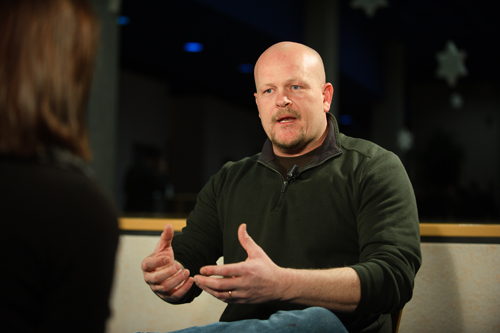
Samuel "Joe the Plumber" Wurzelbacher says states should have more power. Toledo Free Press photo -- Joseph Herr

Samuel Wurzelbacher’s first exchange with Rep. Marcy Kaptur happened when he was 17 years old, during an ROTC function for the representative.

The then-Springfield High School student cornered Kaptur and gave her a piece of his mind for voting for a bill that funded Planned Parenthood, a decision with which he disagreed.

More than 20 years later, Wurzelbacher has a far bigger audience than his mortified superior, who cut that conversation short. And, now known as “Joe the Plumber,” he is determined restart that conversation and carry it along the narrow corridor that wraps around Lake Erie to make Ohio’s 9th Congressional District.

He’s talking about jobs and taxes. And he’s talking about why Kaptur’s decades in office have yielded, in his opinion, negative results.

Samuel Wurzelbacher says states should retain more power.

“[She’s] bringing home the bacon and the pork, that only goes to certain individuals and groups,” Wurzelbacher said in a March 7 interview with Toledo Free Press.

Bloated bureaucracy, the federal deficit and the inability to balance budgets  are all elements within the federal government that plague average citizens, Wurzelbacher said. He blamed both Democrats and Republicans.

“[Kaptur] likes to tout experience and wisdom; I don’t see that as being a benefit to the American people,” he said. “Look how much money they have wasted. She’s been in there while all this has been in place.”

One of Wurzelbacher’s priorities includes cutting back on “waste” by scrutinizing the budget line by line and eliminating certain departments. The federal Environmental Protection Agency would be one of the first on his personal chopping block. He disagrees with a number of programs that the agency funds, particularly citing a grant that the EPA awarded to a dance troupe to educate children about pollution.

“It’s not that I don’t want clean air and clean water but the bureaucracy has gotten in the way of getting things done,” he said.

Adhering to the pursuit of stronger state sovereignty, he said each state should regulate its own environment, independent of any federal agency. Breaking down regulations and changing the tax code are his two other priorities. He supports former presidential candidate Herman Cain’s “9-9-9” plan, which urges the government to dump the present tax code and instate a 9 percent personal income tax, a 9 percent corporate income tax and a 9 percent national sales tax.

Wurzelbacher’s platforms were similar to his Republican opponent Steve Kraus’, who trailed him by three percent. Wurzelbacher’s campaign reportedly outspent Kraus 6-to-1.

“I expected to do well. I expected to win, but I wasn’t surprised at the results,” Kraus told Toledo Free Press on March 7. “It was the most exciting race out there. I wasn’t the highlight, but I almost upset the apple cart.”

Wurzelbacher said his national endorsements and near-celebrity status will help him against Kaptur.

He said the perception that he is anti-union is a falsehood. Of Senate Bill 5, which voters repealed and would have restricted union bargaining rights, he said, “I thought it was a huge step in the wrong direction.”

Of the thousands of homes he’s already visited, he said he spends up to 30 minutes chatting with each resident if they have the time. This includes Democrats and independents. By his calculations, about 60 percent of the Democrats he visited said they’d vote for him.

Just as he has for months, Wurzelbacher will continue to spend two days a week knocking on doors on the Cleveland side of the district, two days in the middle and two days in Toledo. For long car rides, he takes Charlie Daniels and Hank Williams Jr. albums along for the drive.

Door-to-door campaigning means deconstructing the image that the media created for him as “Joe the Plumber.”

“Some things are as simple as, ‘Your name’s really Joe?’ You really were a plumber?” he said. “Yes, in the United States Air Force I plumbed all over the world.”