Home Blog Page 298

Brookings Institution says Toledo economy improving in 2012

0

The Toledo Metropolitan Area is showing promising signs of economic improvement, according to a report released by the Brookings Institution, a think tank in Washington, D.C.

“Export Nation 2012,” released March 8, 2012, analyzes and documents the American growth rate of exported goods and services in 2010. The report states that U.S. export sales grew by more than 11 percent back in 2010 — the fastest export growth since 1997 — and the growth is expected to continue.

In 2010, the largest 100 metro areas produced approximately 65 percent of U.S. exports, 75 percent of the nation’s service export sales and 63 percent of its manufacturing export sales. Those same 100 metro areas were responsible for the majority of export sales in 30 states.

The Brookings Institute noted that Midwest metro areas generated the fastest growth in direct export-production jobs. Toledo’s own export growth increased by 17 percent from 2009 to 2010 and is now ranked third among the nation’s top 100 metro areas for export growth from manufacturing contributions. Toledo’s exports totaled $4.1 billion in value, which places the metro area (consisting of Fulton, Lucas, Ottawa and Wood counties) at the 58th ranking for exports value.

Brookings also placed Toledo in the top 10 metro areas for the city’s 15 percent increase in export share of metro gross domestic product (the overall market value of final goods and services) in 2010. This increase in exports is projected to double by 2015.

The statistics and economic terminology might sound confusing, but there is one change that everyone in the Toledo area can understand and appreciate: the likelihood of more jobs.

Toledo’s metro exports accounted for more than 11,000 jobs in 2010 that are directly related to the exporting industry and 25,600 more that are supported by it. If the area’s exports continue to climb, then more jobs will be created.

What is the cause of this significant export growth? Toledo’s work ethic, for one, said Paul Zito, vice-president of international development for the Regional Growth Partnership.

“When you have a good workforce, you have a good product,” Zito said. “There is a unique economic diversity in Toledo that maintains strength in both the old automotive industry and the new industry of renewable energy. Many of the other metro areas do not have that kind of diversity.”

Zito also believes that new international markets for Northwest Ohio’s exported goods and services have contributed to the growth. Regional Growth Partnership already has several plans to help small-business owners enter those export markets.

Although Canada and Mexico continue to be the largest markets for American exports, a rising interest in other foreign countries could also mean better business.

“From 2003 to 2008, the share of U.S. exports going to Brazil, India and China increased by 3 percentage points and by another 2 percentage points in just the two years from 2008 to 2010,” the Export Nation report states. “Metropolitan areas that produce what emerging markets consume are better-positioned to take advantage of the growth in these countries.”

The industry with the highest share of metro exports in Toledo is transportation equipment, with a 23.5 percent share of metro exports and a 36.4 percent growth increase between 2009 and 2010.

Several other industries in Toledo have flourished; Machinery has grown by 22.7 percent, fabricated metal products by 23.1 percent, and paper by 25 percent just to name a few.

Urban Planning Consultant Taron Cunningham attributes the rise in Toledo’s exporting industries to the area’s various educational institutions.

“Innovation, as part of the new economy, derives predominantly from research and development, which occurs at our area’s major universities and colleges and businesses,” Cunningham wrote in response to the report. “Innovation and technology transfer from the research and product developments that have occurred at the University of Toledo’s Clean and Alternative Energy Incubator and Bowling Green State University’s Center for Research and Development. Among the several initiatives, the universities have impacted innovation and growth expansion in the area.”

Education is one of the U.S. service exports that increased nationally in both 2009 and 2010, but not in Toledo. According to “Export Nation 2012” report, Toledo’s education service exports have decreased by nearly 18 percent.

“This may serve as a warning signal for state and local policy support,” Cunningham argues. “A strong indicator of an area’s economic strength is its citizens’ education attainment. Furthermore, education combats poverty as a tool to loosen its vice, in Toledo specifically, as problem-solvers address the challenge of one of the nation’s highest poverty-ridden cities. Education is an opportunity to advance the economic climate the new economy is ushering in.”

The 2010 decrease in growth for education could be the result of several factors, such as fewer students.

Despite its recent decline, the education industry remains resilient. Cunningham discovered in the Bureau of Economic Analysis of the 2010 fourth quarter that the universities and medical facilities in Lucas County displayed high exportability for education services and were specialized more in that particular area.

The travel and tourism industry in the Toledo metro area has grown by nearly 9 percent, which could also indicate a developing interest in the area’s education institutions.

According to Cunningham, now is the time for businesses to take action.

“Things are going well. It’s okay to spend. Let’s continue to boost the economy of our area.”

“Export Nation 2012” report can be accessed through the Brookings Institution website: www.brookings.edu. An interactive map of each state’s export data is also available.

Treece: Real World 101

0

In the past, this space has occasionally been filled with humble opinions on higher education in this country, how it has changed and how I now find it.

Others have probably heard a Treece on the radio echoing many of the same thoughts, talking about how the American educational system has gotten off-track and lost focus.

The attitude that has developed is that going to college is a must for any young person — many think graduate school is critical as well. The problem is that the educational system has invented a good many degrees that are mostly useless.

As a result, this country has raised a generation of liberal artists turned Occupy protesters. Still, many have dismissed my arguments out of hand with retorts like, “But Dock, how can you say that when you went to college?” or “Are you crazy? You have to go to college to get a good job in this country!”

While it’s true, I do have a bachelor’s degree, I completely deny the argument that all good jobs require a college education.

The reason for this generalization is simple — young people today believe that only white-collar jobs are good jobs, as if there is something inherently wrong with a person working with their hands. Recently, I received an email from a Toledoan who frequently hears us on radio and reads our columns. It is worth publishing here and I obtained their approval to do so.

They wrote:
Dock: I have heard you make mention about welders and other skilled trades in manufacturing being in short supply. As HR director at my company our business is expanding and we have been actively seeking qualified individuals with welding, tooling quality and fabrication backgrounds to fill positions in our plants.

In Toledo alone there has been for some time a short supply of qualified tool and die makers.

One of the biggest mistakes TPS did was close down Macomber and slowly let the skilled trades shop programs at all the public high schools dwindle to nothing. These were feeder schools that provided future apprentices and skilled trades candidates to most of the manufacturing companies in Toledo and NW Ohio.

Some of the brightest and talented individuals I know have come from trade schools and have progressed to leadership positions in many companies including ours, all without the so-called requirement to have a degree.

In our company alone the majority of our engineering staff including our director of engineering who I would put up against any degreed engineer started his career as a tool and die maker.

In fact, one of our design engineers holds several patents and his background is in tool and die.

As a tool and die maker by trade myself, the discipline and work ethic that were instilled in me during my apprenticeship allowed me to grow and provided me the position I have today.

The short-sightedness of academia that says everyone needs to go to college to get a good paying job is pure bunk. We have created a situation where young people who really are not suited for college are pressured to attend college and after a couple of years of pursuing a degree in philosophy or music drop out and are strapped with thousands of dollars of debt, with no degree and no future.

We need to remove the stigma of working with your hands as something to be ashamed of. It is quite obvious where these jobs will go if we do not have the people with the skills needed to fill these jobs.” — A. Listener

It isn’t worthwhile to pursue higher education without having some idea of a career path. To conclude, what follows are a few wise words from my boss: “Don’t confuse education with intelligence, or knowledge with ability.”

Dock David Treece is a partner with Treece Investment Advisory Corp (www. TreeceInvestments.com) and is licensed with FINRA through Treece Financial Services Corp. He provides expert content to numerous media outlets. The above information is the express opinion of Dock David Treece and should not be construed as investment advice or used without outside verification.

Rathbun: How not to invest in precious metals, Part III

0

This week I want to look at investing in precious metals through mining companies. Many years ago, people would invest in mining companies as a way of hedging the precious metals market because there wasn’t any other practical way.

There were no gold or silver ETFs and mutual funds were even more expensive than they are today. In the early 1980s, when gold and silver exploded in price, most of the investing was done with physical delivery or through futures contracts, both of which can be very expensive methods of investing in precious metals.

The alternative then became investing in companies that mined gold and silver because, as the price rose, so did their profits since many of the costs associated with mining were static.

Let’s look as some of the issues mining companies face, which you need to take into consideration before investing as an inflation hedge or simply a growth play.

Gold and silver are mined all throughout the world and oftentimes in very harsh conditions like in Alaska. If any of you have watched the Discovery’s show on gold diggers, you know that it is not the greatest thing to do in bad weather or in those latitudes.

Secondly, you have to consider the governmental conditions of the location of the mines. Is this a friendly and stable government to foreign companies and are the taxation policies favorable for profit?

Next are equipment costs. Equipment used to mine minerals is not cheap to purchase or transport. Parts are oft en difficult to obtain in remote parts of the world and repair people are not cheap, either.

Like oil exploration, you never know what you are going to get when you start digging. There are some very smart geologists out there who know what to look for in rock formations to give a company a good shot at a strike. But you can always dig a dry hole and dry holes cost just as much to dig as prosperous ones.

The cost of all this equipment and transportation of workers fluctuates with the cost of fuel. A mining operation uses a lot of fuel and the work is hazardous so wages need to reflect the work and the risk.

Finally, the cost of capital can be crucial for the mining company. Many times the capital dries up just before the final phase of mining and the payoff hits. This can become a death spiral since often the mining takes place where there is a short window of good weather to get the job done before one has to wait until next season.

All of this being said, there are some opportunities to invest in mining companies and make a good return on your money. If a company has proven reserves and the price of the commodity rises this creates an opportunity to cash in on getting those reserves out of the ground and making a good profit.

Most of the major mining operations in the world are incorporated in British Columbia. Many years ago, British Columbia essentially became the best place for companies to base their headquarters because of the favorable tax structure of the province and the stability of the government.

When investing in a mining company, look at all of the fundamental things you look at in any other public company — good earnings, manageable debt, stable and competent leadership, fair pricing of the stock and liquidity.

Additionally, you need to see what their known reserves are and if they hedge the ounces they have in the ground and what the hedging is in relation to the price of the metals.

Finally, is the company diversified with their mining operations or are they locked into just gold and/or silver? Many mining operations also have operations that mine some of the base metals like copper, zinc or lead. These metals will help the cash flow and profitability of the company.

✯ Gary L. Rathbun is the president and CEO of Private Wealth Consultants, LTD. He can be heard every day at 4:06 p.m. on “After the Bell with Brian Wilson and the Afternoon Drive” and every Wednesday and Thursday at 6 p.m. throughout northern Ohio on “Eye on Your Money.” He can be reached at (419) 842-0334 or email him at garyrathbun@ privatewealthconsultants.com.

Thomas Dolby to bring Time Capsule Tour to Royal Oak

0
Thomas Dolby

Some 20 years ago, Thomas Dolby vanished from the music business like one of the submarines he sang about on his 1983 debut, “The Golden Age of Wireless.”

He resurfaced in Silicon Valley as founder of Beatnik Inc.

“We actually created a software synthesizer technology, which Nokia licensed because they wanted to make their phones capable of doing polyphonic ringtones,” the entrepreneur said. “So we sent engineers to Finland to put our synthesizer into their phones; that was in 1999, and since then it’s been in every Nokia phone and most of their competitors, so it totals about 3 billion phones.”

A big fan of the Internet, the tech wiz created a Web-based game called “A Map of the Floating City,” which went online prior to the October release of the disc of the same name.

“The project started in earnest really when I moved back to England from the USA; I was keen to get my kids a taste of my home country. We live in a very, very secluded village on the east coast of England, and my garden looks out over the North Sea toward Holland and Germany, and there’s a huge container port near me,” Dolby said during a call from Houston.

“I have my studio on a restored 1930s life boat, which is powered by solar panels and wind turbine. And I would sit in the wheelhouse looking out via periscope at these massive container ships floating across the North Sea. And at different times of day, they look almost like floating cities, almost like the Manhattan skyline.

“But in my twisted imagination, this was sort of a dystopian future world in which the container ships were all that was left. And the survivors of the species had taken to the oceans to stay cool. And that sort of became a backdrop for an album.”

For his first CD since 1992, the singer-songwriter serves up jazz, bluegrass, rock and techno.

“I try to tell stories, which I think is a rarified thing in this day and age. And I will adopt whatever musical method is appropriate for telling the story,” Dolby said.

The British rocker will bring his Time Capsule Tour to the Royal Oak Music Theatre in Royal Oak, Mich., at 7 p.m. April 4. Tickets are $20.

And he’s bringing a silver trailer tricked out with an internal video production studio.

“We’re asking people when they go in: If you could imagine that you’ve got 30 seconds left to live, what message would you send, to whom and why? Or you could think about maybe what could go into the time capsule are your three favorite songs, your granny’s apple pie recipe — what part of today’s scene deserves to be preserved for the future?” he said.

“Or you could assume that we have no future, the species will not exist in 100 years or 1,000 years; the first alien spaceship that uncovers the time capsule, how do you explain to them what went wrong, where it went off the rails?”

Things started to click for Dolby when he was working as a synthesizer player and sent cassettes out in the early 1980s.

“One of [the cassettes] found its way to Mutt Lange, who was in New York producing ‘Foreigner 4,’ ” he recalled. “So they flew me over to try me out for a day, and we did ‘Urgent,’ which they were delighted with, and so they said could I stick around and do the whole album.

“And they gave me a free hand pretty much to do what I wanted, including putting the intro on ‘Waiting for a Girl Like You,’ which was their biggest hit and really stood out because it had 15, 20 seconds of somnambulate, emo music on the start of it, and for a hard-rocking ’80s hair band to have that kind of an intro was certainly quite adventurous.”

That gig financed Dolby’s debut, “The Golden Age of Wireless,” which featured “She Blinded Me With Science,” “Europa and the Pirate Twins” and “One of Our Submarines.”

“The MTV video really caused it to take off,” Dolby said. “It was an interesting time because most of the pop stars of the era were pin-up heroes. And I was sort of an anti-hero really, so my video was like a silent movie, people like Chaplin and Lloyd and Keaton, and they were the little guys, so that was pretty much my character in ‘She Blinded Me With Science.’

“It was a catchy song, a little bit different,” he said. “That’s really why you still hear it get played a lot these days, and you’ll see it on ‘Big Bang Theory’ or ‘The Simpsons’ or whatever because it sort of struck a nerve with that generation.

“I’m very lucky. It’s one thing to have commercial hits; it’s another thing to have them still get played 30 years later.”

Group aids unhoused

0

Veterans Matter, a program that aids unhoused veterans, is a collaboration of several local and state groups.

“[Veterans] lay their lives on the line and it’s become acceptable in America for them to get beaten or killed on the streets, but if that happened behind enemy lines, there’d be outrage,” said Ken Leslie, founder of 1Matters, a local nonprofit supporting the unhoused.

Government entities Department of Housing and Urban Development and the Department of Veterans Affairs Supported Housing Program (HUD-VASH) provide housing solutions and case management to veterans.

Ken Leslie

“The government’s really doing this program right,” Leslie said. However, one component is missing — rent deposits. Most unhoused veterans don’t have the means to pay the deposit or first month’s rent upon moving into new homes, something required for housing programs.

“We don’t really do anything, but respond to that need, which is the deposit,” Leslie said. “It’s clean and simple. HUD-VASH already successfully identifies, screens and qualifies the veteran family and housing then provides the case management. For just $700 or so, we the people can take out the delays and get our unhoused veterans into housing.”

Leslie and Shawn Dowling, coordinator of Healthcare for Homeless Veterans of the Ann Arbor VA Health System, realized the need for deposits while talking Feb. 6 and didn’t waste any time. Leslie approached ProMedica’s Advocacy Fund for $26,250 to fund the idea.

“ProMedica is proud to support the Veterans Matter program through the ProMedica Advocacy Fund because our veterans, like all individuals, deserve quality housing. Through these partnerships we can improve the health and well-being of our citizens by providing for their basic needs,” said Randy Oostra, president and CEO of ProMedica, in a statement. The fund was established in 2010 and is administered by the Toledo Community Foundation.

After ProMedica provided the funds, the first family was able to leave a shelter for their new home Feb. 17, just 11 days after the project’s conception. The couple’s deposit was $438. So far, five families have been supported by the fund.

About 35 area veteran families, who may need funds from Veterans Matter, qualify for HUD-VASH housing. It is crucial that Veterans Matter reaches these families soon because there are only so many vouchers and dollars per year, Leslie said.

Leslie emphasized that 1Matters will continue its mission of helping everyone affected by being unhoused. “Our focus has not gone away from all of the unhoused. … No matter where you come from, if you’re on the streets, it sucks,” he said. Still, Leslie stressed the importance of helping unhoused veterans.

“We owe the ones who have been the most hurt and damaged by what they experienced fighting for our rights,” he said. Visit http://1matters.org/?page_id=1917 to learn more.

Concert to raise awareness of child abuse prevention

0

The Blues Against Child Abuse event March 29 gives people a chance to not only hear some tunes, but to raise awareness of child abuse.

“We just wanted to find a way to bring attention to the issue and great music is a way to do it,” said Julie Malkin, public information officer for Lucas County Children Services (LCCS), the agency putting the event together.

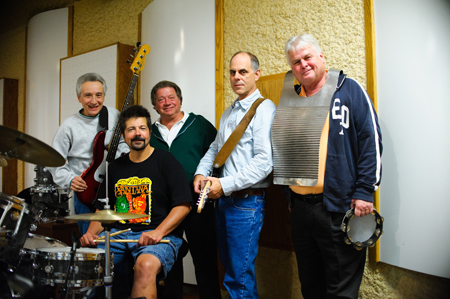
The band Voodoo Libido will bring “lots of good old rousing blues” to the party at Dégagé Jazz Café, Malkin said. Hors d’oeuvres and a cash bar will also be available.

LCCS hopes to draw a younger crowd with its first-time blues party, said LCCS Executive Director Dean Sparks. The agency hasn’t done as many activities in the area around Dégagé and wanted to reach a different part.

The agency is asking eventgoers to bring a personal care item like soap or shampoo to the party to be donated to a child in foster care.

Voodoo Libido

Many times, foster parents need to run out and purchase these small items when the child arrives, Sparks said. If the children come in with these items, they have more time to bond with their new foster family.

“Sometimes [the children] come with nothing and it might make it an easier transition,” Sparks said.

Sparks said the county needs more foster parents. It’s the job of foster parents “to keep a child safe and to nurture them and help them bond and thrive in the world despite the things that have happened to them,” Sparks said.

Currently, there are 550 foster children in foster/relative care and 270 foster homes in Lucas County. To become a foster parent, you must contact (419) 213-3336 and be put in touch with a recruitment specialist. Background checks are performed in addition to a reference check, home study and safety/fire inspection. The parents must complete 36 hours of training before placement, Sparks said. Adults older than 21, married or single, are eligible.

“You don’t have to own a home as long as it’s safe and you have room for the kid, you can be a foster parent if you meet those criteria,” Sparks said.

Some foster parents work with birth parents to potentially reunite families or help children move on to another permanent home. Other times, foster families become that permanent home, Sparks said.

The blues event also serves as the local kickoff for National Child Abuse Prevention Month. This year’s theme is “child abuse is preventable.”

In 2011, LCCS received 4,148 referrals of suspected child abuse involving 6,046 children and discovered 587 area children were abused or neglected. The agency’s hotline for reporting child abuse receives about 750 calls per month and 300-400 are investigated.

These numbers are about average if not a bit low for an area the size of Lucas County, Sparks said.

Sparks and Malkin recommended reaching out to young parents with advice, reporting suspected abuse and talking to legislators as ways to prevent child abuse.

“Child abuse is preventable if everyone puts their minds to it,” Malkin said. LCCS has several events planned throughout April including “Wear Blue to Work Day” on April 11. Workers are encouraged to wear blue to the office, photograph a group of co-workers wearing the color and post it via social media.

“We’re trying to get everybody aware and develop that sense of camaraderie,” Malkin said. “We want to have fun, get people involved and aware and take advantage of social media.”

Buttons for the day are available by calling (419) 213-3254.

LCCS and other agencies will present information at the  “We Care About Our Kids: Community Forum on Child Sexual Abuse” at 6:30 p.m April 18 at the University of Toledo Scott Park Campus. Admission is free.

A ceremony honoring local children who died as a result of street violence, abuse or neglect is 11:30 a.m. April 25 at the LCCS offices, 705 Adams St., Toledo. Since April 2011, no children have died in Lucas County from abuse or neglect, but Timothy Blair, 14, Deadrick Rocker, 17, and Montelle Taylor, 17, died as a result of violence.

Tickets for Blues Against Child Abuse are $10 and available at (419) 213-3254 or [email protected]. The event runs 7-10 p.m. March 29. Dégagé Jazz Café at 301 River Road, Maumee. Toledo Free Press is a media sponsor.

To report a case of suspected abuse, call (419) 213-CARE.

Baumhower: The winter that never was

0

Ask any Toledoan right now “What’s the biggest story happening here?” and you’ll get two answers —. the weather and the weather. We are one of the fortunate cities that has four distinct seasons: hot summers, beautiful crisp autumns, cold and snow filled winters and welcomed sunny and wet springs. However, this year it appears we had a longer fall that blended perfectly with spring. There was little snow, no school cancellations, no salt trucks, no Winter Storm Warnings, no White Christmas and no shoveling. It sounds like the Dr. Seuss book except the Grinch stole our winter.

Like most area residents, I have been waiting for the other snowshoe to drop, because we never have winters like these. We always get the snow eventually, right?

The paranoia started when The Blade published an Oct. 6 article, “Horrible winter is likely for Toledo,” warning citizens of the upcoming winter.

“The coming winter season could easily be one of the top 10 worst in Toledo history, according to AccuWeather Inc., the private weather forecasting service based in State College, Pa.,” the article began. AccuWeather was predicting the second worst winter ever for Chicago, and since we normally catch the same storms or the remnants of them, we were due to have an awful winter.

If the lack of snow wasn’t worrisome enough, now we are having a record hot March.  Eighty-plus-degree days have made our lawns green, our shorts come out and have my kids discussing when the pools will open. These beautiful days have somehow given us more stress.  Toledoans are acting like the Munchkins from “The Wizard of Oz” right after Dorothy dropped a house on the witch; we are scared to come outside because we can’t trust this weather — something bad is going to happen.

I called local TV weather personalities and demanded some truth.

The first call I made was to the man my family’s trusted with our weather forecast for as long as he has been on TV in Toledo, 13abc’s Stan Stachak. Stan has been supplying a weather forecast for 32 years, meaning I was 5 when he debuted. He has seen it all — the drought of 1988, the flooding of 1992, various mini-blizzards and tornadoes. The only thing missing from the Biblical Rapture prediction are the locusts, but we did have mayflies. I prodded Stan about the accuracy of the “Farmer’s Almanac” and he was skeptical of its “secret formula,” which was devised in 1792.

“The ‘Farmer’s Almanac’ predictions are often uncouched, unsettled generalities,” Stachak said. He said he has been asked numerous times lately “what was going to happen next weather-wise,” from people concerned about 150 degree summers or snow in May.

His response is, “Don’t panic.”

Here are the highlights from the various conversations.

  • FOX Toledo’s Doug Moats: “Another hot and wet summer. The early warm weather could increase the yields, but lessen the flowering period. March 21 set a record high of 85 degrees for the day; it was also the warmest March day on record for Toledo, and we have records going back to 1873.”
  • WTOL’s Robert Shiels: “This could continue through mid-May but I expect a cooler than normal rest of spring. I make it a policy not to make any long-term forecasts as far as summer is concerned.”
  • NBC24’s Norm Van Ness: “My grandmother’s neighbor’s aunt said that when this happened in 1905 they had a blizzard in July, so I fully expect a foot of snow to fall by July 15,” he said, laughing. “Climatology says Mother Nature loves balance. It should be a pretty busy spring for extreme weather.”
  • WTOL’s  Chris Vickers: “There is very little connection between spring and summer weather.  It always seems to balance itself out; look for a cool stretch at some point.”
  • 13abc’s Jay Berschback: “I don’t know. I don’t believe in long-term forecasting, because of the Butterfly Effect: One small forecasting mistake often multiplies into bigger ones.”
  • WTOL’s Ryan Wichman: “Why not enjoy this? Trade in some of the bad weather IOUs.”

The overall sentiment of Toledo’s weather community is to just stop thinking about the weather and simply enjoy it. Mother Nature is giving us this gift; why is it so difficult for us to accept it?  I will gladly accept another gift from her on April 4, but I fully expect to see salt and snow trucks clearing a path for the Tigers buses from Detroit, because that’s Toledo!

Barhite: Perrysburg woman adopts one lucky cat

0
Evie -- one lucky cat that went from nearly dying to a loving adoptive home.

If you are questioning whether to buy a perfect pet or adopt one with some baggage, a lesson reveals itself in this tale.

Linda Wilker of Perrysburg adopted Eve one year ago on St. Patrick’s Day. She credits me for bringing the special-needs cat into her and her husband’s lives.

When the black and white kitten was rushed into the veterinarian’s office on New Year’s Eve 2010, it wasn’t for a new beginning. She had gotten mangled in a car’s fan belt and ended up on someone’s front porch. The stranger took her to the vet to be euthanized.

But when the kitten reached her paws up toward the veterinary staff at the Anthony Wayne Animal Hospital, they knew she had eight lives left to go.

“Before we opened the box, she was peeking through the handles,” said Laurie Reece, who helped organize the adoption and whose husband, Steve, is a vet and owner of the animal hospital.

“She was such a trooper. She had the will to survive.”

They named her Eve because of the fateful day she arrived. The staff rushed to save her life. Her tail had been cut off and she had “horrific” injuries to her backside, Laurie said.

After surgeries, a lot of love and a few months of healing, I suggested Linda as a possible pet parent (my cats go to the Anthony Wayne Animal Hospital).

Eve had grown tired of living at the vet’s office. She wanted more freedom to roam and
she was lonely at night.

Linda had grown up with cats, but never owned a special-needs one. Linda researched what and how much Eve should eat to help with her lingering injuries, which ranged from constipation to a leaky behind.

Today Eve goes by “Evie,” and is happy, healthy and wholeheartedly devoted to running the household. She has toys in every room, beds stationed at most windows and treats placed in all corners.

She still needs a little extra medical attention every now and then, but compensates with extra snuggles and kisses.
“Anytime you adopt an animal, they know that you rescued them,” Laurie said. “Th ey are like, ‘I love you, I love you, I love you. Thank you for giving me this wonderful life.’”

Eve almost died on New Year’s Eve, but her life began again on St. Patrick’s Day. I guess you could say the luck of the Irish was with her.

Leaders from Kyrgyzstan visit with Toledo-area counterparts

0
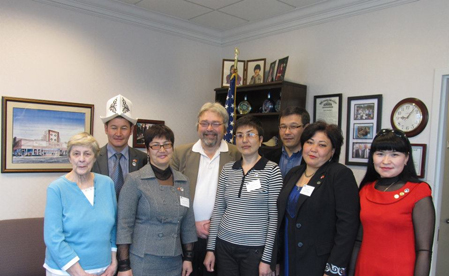
Pictured during a recent visit by leaders from Kyrgyzstan are former Maumee City Council President Barbara Dennis, Daniyar Aytkozhoyev, Ayzhan Chiletova, Maumee Mayor Tim Wagener, Nurzhamal Romanova, Sheradil Baktygulov, Nurgul Akimova and Zhyldyzkan Ysmanova.

Five officials from rural Kyrgyzstan spent a week in Ohio earlier this month, exchanging ideas and inspiration with their counterparts from the Toledo area.

The March 9-17 trip was hosted by the Great Lakes Consortium for International Training and Development with funding from the Open World program, an initiative started by the U.S. Congress that brings leaders from the former Soviet Union to the U.S.

“All of them came to learn how their counterparts at the local level are developing the local economy,” said Sheradil Baktygulov, who joined the delegates as a facilitator.

Pictured during a recent visit by leaders from Kyrgyzstan are former Maumee City Council President Barbara Dennis, Daniyar Aytkozhoyev, Ayzhan Chiletova, Maumee Mayor Tim Wagener, Nurzhamal Romanova, Sheradil Baktygulov, Nurgul Akimova and Zhyldyzkan Ysmanova.

Elizabeth Balint, project manager for the Great Lakes Consortium, said the group met with a variety of officials from different levels of government, including U.S. Rep. Marcy Kaptur, state Rep. Teresa Fedor, Lucas County Commissioner Tina Skeldon Wozniak and Administrator Peter Ujvagi, and city officials from Maumee, Fremont, Perrysburg, Bowling Green and Oregon.

Kyrgyzstan is a poor country, Balint said, but has beautiful mountains that create potential for the tourism industry. She said the country needs help with marketing to reach a wider audience; one challenge, she added, is that Internet access is more limited than in the U.S. and many organizations can’t afford to develop their own websites.

Balint said the delegates were glad to see the level of independence from federal and state authorities enjoyed by local governments in the U.S.

They took home a number of ideas, she said, both from their meetings with local officials and from cultural visits to places like the Toledo Zoo, Maumee Bay State Park, Marblehead Lighthouse and Toledo Museum of Art.

Balint said the delegates were especially impressed with the Northwest Ohio Cooperative Kitchen, a nonprofit commercial kitchen facility that serves as an incubator for food-related entrepreneurial ventures, and asked for help developing a similar program in Kyrgyzstan.

Balint said the visitors stayed with host families in Toledo, Sylvania, Perrysburg and Bowling Green.

Balint said the Great Lakes Consortium was established in 1999 and has hosted more than 850 visitors from 17 different countries in that time. The consortium is a collaboration between the University of Toledo, Lourdes University, Bowling Green State University and the WSOS Community Action Commission.

Miller: The Grand Rapids experience

0
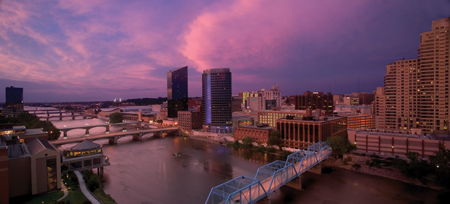
Most of the cultural attractions of Grand Rapids, Mich., are within a mile or so of each other. Photo by John Eisenschenk

Grand Rapids, Mich., has built a downtown with many of the same puzzle pieces we have in Downtown Toledo. It is on a river and close to one of the Great Lakes; it has an arena for concerts and hockey and a convention center; it has a world-class museum and a thriving arts scene; it has a children’s museum and a library; it has offices for a daily newspaper and city government; it has restaurants, an Irish pub and an Ottawa Tavern that calls itself the “OT.”

But while Toledo continues to leave many of its puzzle pieces in the box, Grand Rapids has taken advantage of geography and cooperation to build a true destination city and has pioneered an art event that in 2011 drew 325,000 people who spent $10 million in 19 days. There are lessons to be learned from Grand Rapids, but be warned: Some of those lessons contain hard truths that reveal a limit to the Glass City’s aspirations.

Apples to apples

Grand Rapids, 185 miles northwest of Toledo, is Michigan’s second-largest city — 192,000 people live within its borders; 600,000 live in its Kent County area. The Experience Grand Rapids website describes the city as “a remarkable combination of urban sophistication and small town warmth, known for its philanthropic and sustainable driven community.”

Sound familiar?

I have lived and worked in Toledo for 40 of my 45 years. I visited Grand Rapids from March 15-18, for about 45 hours. I recognize that the emotional thrill of infatuation with a new city and the adventure of travel demands the balance of intellectual perspective. I have no doubt that Grand Rapids has its problems and challenges, and that more time there would reveal some of those issues. But I noticed two themes that merit discussion and study for people invested in Toledo. Discussing these topics does not mean Grand Rapids is better than Toledo or that Toledo should aspire to be Grand Rapids (any more than it should aspire to be Columbus, Ann Arbor or Chicago), but when such a clear model for improvement presents itself, it is better to look it in the eye and face it than to bury one’s head in the sand and ignore the potential.

Proximity

The first advantage I observed in Grand Rapids can never be duplicated in Toledo. So why discuss it? Because understanding parameters and limitations is an important part of character and comprehension of reality. I opened this discussion by listing many of the things Grand Rapids and Toledo share in their downtown areas. The key difference is proximity. Every Grand Rapids attraction listed at the beginning of this commentary — the arena, convention center, museum(s), children’s museum, library, scores of restaurants, even that Irish pub — are within a one-mile radius, along with a major hospital and college. Even the John Ball Zoo is less than two miles from downtown Grand Rapids. For reference, it’s just under two miles from Imagination Station to the Toledo Museum of Art. It is four miles from Imagination Station to the Toledo Zoo. It is five miles from Imagination Station to the University of Toledo.

The Grand Rapids airport (Gerald R. Ford International, which is Michigan’s second-busiest airport) is 14 miles from downtown. Toledo Express is 16 miles from Imagination Station, unless you flew in to Detroit, in which case you must travel 50 miles to see Downtown Toledo.

Even the Frederik Meijer Gardens and Sculpture Park, which cannot be adequately described in this limited space, is only five miles from downtown. Elmore’s Schedel Arboretum and Gardens is 18 miles from Downtown, not exactly a long drive, but in Toledo-think, that’s “a hike.”

Toledo’s highlights can compete with any city’s, but they are scattered in a sprawling manner that prevents any sense of true destination and community, in terms of tourism and marketable identity. That lack of proximity is an immutable fact; Lloyd Jacobs is not going to move University Hall to the Berdan Building and Randy Oostra is not going to relocate a ProMedica hospital to the old Owens Corning building. But proximity is not Grand Rapids’ only advantage.

Attitudes and extras

My wife and I stayed at the Amway Grand Plaza Hotel, 24 floors above the Grand River. The service and aesthetic quality of the Amway are a reminder of one of developer Bruce Rumpf’s themes: Downtown Toledo lacks a hotel that can stand with the nation’s finest. The Amway valet captain asked if it was our first visit to Grand Rapids. We affirmed that it was, and he said, unabashedly, “Welcome to Grand Rapids. Make our downtown your playground.” That might look corny on the printed page, but he said the words with pride and warmth.

I wonder if any of the staff at Toledo’s hotels are welcoming guests with such a mixture of chamber-of-commerce gushing and true hometown pride.

Photo courtesy Experience Grand Rapids

That welcome set the tone for the weekend (a celebration of our 10th wedding anniversary), at restaurants, shops and with people we met on our travels. The Experience Grand Rapids Convention and Visitors Bureau arranged our hotel stay and one interview with ArtPrize organizers, but at no point in the weekend did I reveal my media identity and we paid for our own admissions and excursions; the “secret shopper” approach is the only honest way to evaluate an experience and avoid invoking Heisenberg’s Uncertainty Principle.

In addition to a walking-distance experience, Grand Rapids offers a nicety I observed in Washington, D.C., and Chicago: parks and greenspace. Our Metropark system is a marvel, but the Lorax would die if his life depended on living in the few trees our downtown harbors. Grand Rapids also makes the most of its riverfront with parks, boardwalks and building entrances up and down the downtown watersides.

Toledo is investing in Promenade Park; if it can generate a fraction of the waterfront activity Grand Rapids enjoys, it will be a worthy investment.

ArtPrize

The other great lesson from Grand Rapids is dangling like a ripe piece of low-hanging fruit: cooperation, embodied by the city’s ArtPrize event.

Far from the city, as one travels the highways leading to Grand Rapids, there are billboards that read, “Cool City, Hot Art,” followed by billboards for specific galleries and exhibits. The city works on branding itself as an art destination well before its borders. It would be like seeing billboards for Toledo Museum of Art exhibits and Toledo Symphony Orchestra events while driving in from Fort Wayne or Chicago or Cleveland or Columbus.

While in Grand Rapids, I met with ArtPrize Executive Director and COO Catherine Creamer and Public Relations Director Brian Burch.

ArtPrize was founded in 2009 as an open art competition. According to an economic impact study, the 2011 event (in just its third year) hosted 1,582 artists at 164 venues, competing for nearly $500,000 in cash prizes, determined by public vote. In its 19-day span, more than 325,000 attended the event, spending $10 million during their stay. It’s like the Arts Commission’s Art Walk series on steroids, with a major cash prize at the end.

“American Horse” at the Frederik Meijer Gardens and Sculpture Park.

“We have a unique ecosystem of partners,” Burch said. “The arts organizations, which traditionally competed with each other for funding, saw a need to do what was best for Grand Rapids. City leaders cooperated and ArtPrize came together in an unprecedented collaboration.”

Best of all, ArtPrize’s $2 million operating budget comes from sponsors, donations, event fees and sales, not from taxpayers. And of that $2 million, $1.9 million is spent in Grand Rapids on local goods and services.

Creamer said the public-voting element is also key to ArtPrize’s success: “The public vote is a function of engagement that, during ArtPrize, makes art impossible to ignore.”

Toledo arts organizations spend a tremendous amount of energy fighting for funds and territory, which results in the greatest of those institutions being stuck in old-model relationships, refusing to open their futures to newer ways of doing business. It’s ironic, but while I always hear that Toledo artists do not like to compete with each other, that’s standard operating procedure for the big-time Toledo arts institutions.

ArtPrize is not a blueprint that could be lifted whole and dropped in Toledo, but the concept is adaptable and with planning and cooperation could be a model for an event that would represent a seismic shift in Toledo’s tourism efforts.

Call for action

It would be beneficial for a Toledo delegation to visit Grand Rapids for the September ArtPrize. Toledo Free Press will take responsibility for arranging a night’s stay and a visit with ArtPrize officials, then for hosting a follow-up meeting to discuss the potential of emulating the event here. There should be an official from city government, someone from the Arts Commission, probably representatives from the Toledo Museum of Art, Toledo Symphony Orchestra, Tahree Lane from The Blade and a wild card or two.

I would love to see such a trip happen, but I am not going to hold my breath waiting. Cooperation is a far more flexible concept than proximity, but for Toledo arts organizations, it seems it is also a concept with as little hope for change.


Michael S. Miller is editor in chief of Toledo Free Press and Toledo Free Press Star. Email him at [email protected].