Home Blog Page 298

Leaders from Kyrgyzstan visit with Toledo-area counterparts

0
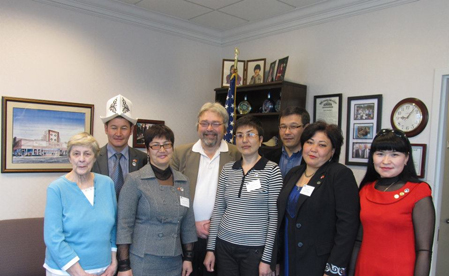
Pictured during a recent visit by leaders from Kyrgyzstan are former Maumee City Council President Barbara Dennis, Daniyar Aytkozhoyev, Ayzhan Chiletova, Maumee Mayor Tim Wagener, Nurzhamal Romanova, Sheradil Baktygulov, Nurgul Akimova and Zhyldyzkan Ysmanova.

Five officials from rural Kyrgyzstan spent a week in Ohio earlier this month, exchanging ideas and inspiration with their counterparts from the Toledo area.

The March 9-17 trip was hosted by the Great Lakes Consortium for International Training and Development with funding from the Open World program, an initiative started by the U.S. Congress that brings leaders from the former Soviet Union to the U.S.

“All of them came to learn how their counterparts at the local level are developing the local economy,” said Sheradil Baktygulov, who joined the delegates as a facilitator.

Pictured during a recent visit by leaders from Kyrgyzstan are former Maumee City Council President Barbara Dennis, Daniyar Aytkozhoyev, Ayzhan Chiletova, Maumee Mayor Tim Wagener, Nurzhamal Romanova, Sheradil Baktygulov, Nurgul Akimova and Zhyldyzkan Ysmanova.

Elizabeth Balint, project manager for the Great Lakes Consortium, said the group met with a variety of officials from different levels of government, including U.S. Rep. Marcy Kaptur, state Rep. Teresa Fedor, Lucas County Commissioner Tina Skeldon Wozniak and Administrator Peter Ujvagi, and city officials from Maumee, Fremont, Perrysburg, Bowling Green and Oregon.

Kyrgyzstan is a poor country, Balint said, but has beautiful mountains that create potential for the tourism industry. She said the country needs help with marketing to reach a wider audience; one challenge, she added, is that Internet access is more limited than in the U.S. and many organizations can’t afford to develop their own websites.

Balint said the delegates were glad to see the level of independence from federal and state authorities enjoyed by local governments in the U.S.

They took home a number of ideas, she said, both from their meetings with local officials and from cultural visits to places like the Toledo Zoo, Maumee Bay State Park, Marblehead Lighthouse and Toledo Museum of Art.

Balint said the delegates were especially impressed with the Northwest Ohio Cooperative Kitchen, a nonprofit commercial kitchen facility that serves as an incubator for food-related entrepreneurial ventures, and asked for help developing a similar program in Kyrgyzstan.

Balint said the visitors stayed with host families in Toledo, Sylvania, Perrysburg and Bowling Green.

Balint said the Great Lakes Consortium was established in 1999 and has hosted more than 850 visitors from 17 different countries in that time. The consortium is a collaboration between the University of Toledo, Lourdes University, Bowling Green State University and the WSOS Community Action Commission.

Miller: The Grand Rapids experience

0
Most of the cultural attractions of Grand Rapids, Mich., are within a mile or so of each other. Photo by John Eisenschenk

Grand Rapids, Mich., has built a downtown with many of the same puzzle pieces we have in Downtown Toledo. It is on a river and close to one of the Great Lakes; it has an arena for concerts and hockey and a convention center; it has a world-class museum and a thriving arts scene; it has a children’s museum and a library; it has offices for a daily newspaper and city government; it has restaurants, an Irish pub and an Ottawa Tavern that calls itself the “OT.”

But while Toledo continues to leave many of its puzzle pieces in the box, Grand Rapids has taken advantage of geography and cooperation to build a true destination city and has pioneered an art event that in 2011 drew 325,000 people who spent $10 million in 19 days. There are lessons to be learned from Grand Rapids, but be warned: Some of those lessons contain hard truths that reveal a limit to the Glass City’s aspirations.

Apples to apples

Grand Rapids, 185 miles northwest of Toledo, is Michigan’s second-largest city — 192,000 people live within its borders; 600,000 live in its Kent County area. The Experience Grand Rapids website describes the city as “a remarkable combination of urban sophistication and small town warmth, known for its philanthropic and sustainable driven community.”

Sound familiar?

I have lived and worked in Toledo for 40 of my 45 years. I visited Grand Rapids from March 15-18, for about 45 hours. I recognize that the emotional thrill of infatuation with a new city and the adventure of travel demands the balance of intellectual perspective. I have no doubt that Grand Rapids has its problems and challenges, and that more time there would reveal some of those issues. But I noticed two themes that merit discussion and study for people invested in Toledo. Discussing these topics does not mean Grand Rapids is better than Toledo or that Toledo should aspire to be Grand Rapids (any more than it should aspire to be Columbus, Ann Arbor or Chicago), but when such a clear model for improvement presents itself, it is better to look it in the eye and face it than to bury one’s head in the sand and ignore the potential.

Proximity

The first advantage I observed in Grand Rapids can never be duplicated in Toledo. So why discuss it? Because understanding parameters and limitations is an important part of character and comprehension of reality. I opened this discussion by listing many of the things Grand Rapids and Toledo share in their downtown areas. The key difference is proximity. Every Grand Rapids attraction listed at the beginning of this commentary — the arena, convention center, museum(s), children’s museum, library, scores of restaurants, even that Irish pub — are within a one-mile radius, along with a major hospital and college. Even the John Ball Zoo is less than two miles from downtown Grand Rapids. For reference, it’s just under two miles from Imagination Station to the Toledo Museum of Art. It is four miles from Imagination Station to the Toledo Zoo. It is five miles from Imagination Station to the University of Toledo.

The Grand Rapids airport (Gerald R. Ford International, which is Michigan’s second-busiest airport) is 14 miles from downtown. Toledo Express is 16 miles from Imagination Station, unless you flew in to Detroit, in which case you must travel 50 miles to see Downtown Toledo.

Even the Frederik Meijer Gardens and Sculpture Park, which cannot be adequately described in this limited space, is only five miles from downtown. Elmore’s Schedel Arboretum and Gardens is 18 miles from Downtown, not exactly a long drive, but in Toledo-think, that’s “a hike.”

Toledo’s highlights can compete with any city’s, but they are scattered in a sprawling manner that prevents any sense of true destination and community, in terms of tourism and marketable identity. That lack of proximity is an immutable fact; Lloyd Jacobs is not going to move University Hall to the Berdan Building and Randy Oostra is not going to relocate a ProMedica hospital to the old Owens Corning building. But proximity is not Grand Rapids’ only advantage.

Attitudes and extras

My wife and I stayed at the Amway Grand Plaza Hotel, 24 floors above the Grand River. The service and aesthetic quality of the Amway are a reminder of one of developer Bruce Rumpf’s themes: Downtown Toledo lacks a hotel that can stand with the nation’s finest. The Amway valet captain asked if it was our first visit to Grand Rapids. We affirmed that it was, and he said, unabashedly, “Welcome to Grand Rapids. Make our downtown your playground.” That might look corny on the printed page, but he said the words with pride and warmth.

I wonder if any of the staff at Toledo’s hotels are welcoming guests with such a mixture of chamber-of-commerce gushing and true hometown pride.

Photo courtesy Experience Grand Rapids

That welcome set the tone for the weekend (a celebration of our 10th wedding anniversary), at restaurants, shops and with people we met on our travels. The Experience Grand Rapids Convention and Visitors Bureau arranged our hotel stay and one interview with ArtPrize organizers, but at no point in the weekend did I reveal my media identity and we paid for our own admissions and excursions; the “secret shopper” approach is the only honest way to evaluate an experience and avoid invoking Heisenberg’s Uncertainty Principle.

In addition to a walking-distance experience, Grand Rapids offers a nicety I observed in Washington, D.C., and Chicago: parks and greenspace. Our Metropark system is a marvel, but the Lorax would die if his life depended on living in the few trees our downtown harbors. Grand Rapids also makes the most of its riverfront with parks, boardwalks and building entrances up and down the downtown watersides.

Toledo is investing in Promenade Park; if it can generate a fraction of the waterfront activity Grand Rapids enjoys, it will be a worthy investment.

ArtPrize

The other great lesson from Grand Rapids is dangling like a ripe piece of low-hanging fruit: cooperation, embodied by the city’s ArtPrize event.

Far from the city, as one travels the highways leading to Grand Rapids, there are billboards that read, “Cool City, Hot Art,” followed by billboards for specific galleries and exhibits. The city works on branding itself as an art destination well before its borders. It would be like seeing billboards for Toledo Museum of Art exhibits and Toledo Symphony Orchestra events while driving in from Fort Wayne or Chicago or Cleveland or Columbus.

While in Grand Rapids, I met with ArtPrize Executive Director and COO Catherine Creamer and Public Relations Director Brian Burch.

ArtPrize was founded in 2009 as an open art competition. According to an economic impact study, the 2011 event (in just its third year) hosted 1,582 artists at 164 venues, competing for nearly $500,000 in cash prizes, determined by public vote. In its 19-day span, more than 325,000 attended the event, spending $10 million during their stay. It’s like the Arts Commission’s Art Walk series on steroids, with a major cash prize at the end.

“American Horse” at the Frederik Meijer Gardens and Sculpture Park.

“We have a unique ecosystem of partners,” Burch said. “The arts organizations, which traditionally competed with each other for funding, saw a need to do what was best for Grand Rapids. City leaders cooperated and ArtPrize came together in an unprecedented collaboration.”

Best of all, ArtPrize’s $2 million operating budget comes from sponsors, donations, event fees and sales, not from taxpayers. And of that $2 million, $1.9 million is spent in Grand Rapids on local goods and services.

Creamer said the public-voting element is also key to ArtPrize’s success: “The public vote is a function of engagement that, during ArtPrize, makes art impossible to ignore.”

Toledo arts organizations spend a tremendous amount of energy fighting for funds and territory, which results in the greatest of those institutions being stuck in old-model relationships, refusing to open their futures to newer ways of doing business. It’s ironic, but while I always hear that Toledo artists do not like to compete with each other, that’s standard operating procedure for the big-time Toledo arts institutions.

ArtPrize is not a blueprint that could be lifted whole and dropped in Toledo, but the concept is adaptable and with planning and cooperation could be a model for an event that would represent a seismic shift in Toledo’s tourism efforts.

Call for action

It would be beneficial for a Toledo delegation to visit Grand Rapids for the September ArtPrize. Toledo Free Press will take responsibility for arranging a night’s stay and a visit with ArtPrize officials, then for hosting a follow-up meeting to discuss the potential of emulating the event here. There should be an official from city government, someone from the Arts Commission, probably representatives from the Toledo Museum of Art, Toledo Symphony Orchestra, Tahree Lane from The Blade and a wild card or two.

I would love to see such a trip happen, but I am not going to hold my breath waiting. Cooperation is a far more flexible concept than proximity, but for Toledo arts organizations, it seems it is also a concept with as little hope for change.


Michael S. Miller is editor in chief of Toledo Free Press and Toledo Free Press Star. Email him at [email protected].

Marketer has a personal connection to hospice care

0
Mary Schoen

EDITOR’S NOTE: On our second anniversary, Toledo Free Press launched the “Brain Gain” series, celebrating those who choose to make their home in Northwest Ohio. As we begin our eighth year of publication, we are returning to the series that symbolizes our intent: to show the world, and remind ourselves, why this is such a special place to live and work.

Toledoan Mary Beth Schoen absolutely loves her job as account director for Transcend Hospice Marketing Group, a part of R/P Marketing Public Relations.

Schoen, 61, joined Transcend in December after more than 30 years of working for the Lauerer Markin Group and also some time at Thread Marketing Group. She is passionate about working with hospices.

“That’s a big reason I made a career change and stayed in Toledo, because I was going to be working with people I considered to be the leaders in hospice marketing. There’s no one else in the country at this expert level,” she said.

Schoen has personal connections to hospice care. Her mother did not receive hospice care before her death; her father did, and it made all the difference.

“I tell everyone he had a blessed death,” she said. “There’s so much joy and preparation for the birth of a child. Can’t we bring that same preparation and joy and just positive, wonderful feeling to that next great passage in life?”

The St. Mary’s College grad grew up in West Toledo as one of 14 children, seven girls and seven boys. Now nine of her siblings and some of her 58 nieces and nephews live in the area, another reason she’s stayed in the Glass City.

“We’re close and we get together as often as we can,” she said, adding that she’s the go-to family member for borrowing clothes.

Although Schoen previously considered moving to Chicago, her love for her job at Lauerer pulled her back.

“I loved what I did. I loved the people I worked with. I loved the clients,” she said.

The account director also loves working with charities. Schoen serves on the board of Research Down Syndrome, a nonprofit that supports cognitive research. She also helps out at Shared Lives Studio, an art studio providing professional opportunities for adults with developmental disabilities. The studio’s art director, Lori Schoen, is her sister-in-law.

“Toledo just welcomes [the artists] with open arms, which is another thing about Toledo. Toledo is just a very warm city,” Schoen said.

Toledo’s art scene is important to Schoen, who said she goes to Toledo Symphony Orchestra performances as often as possible. Schoen, an avid gardener, also likes taking her nieces and nephews to the Toledo Zoo.

“Talk about gardening, that is a gardener’s delight there,” she chuckled, adding that the Toledo Botanical Garden is another treat for her.

Schoen also greatly enjoys the Art Walks, put on by the Arts Commission.

“It’s really helped bring the Downtown area more alive. We are going through a renaissance in the Downtown area,” Schoen said.

And what does Schoen bring to the area?

“I like to bring positivity. If I can do anything, I like to be able to open up conversations with people, talking about life experiences, talking about work experiences,” she said.

Schoen also boasts about Toledo’s attributes. “I love sharing with other people things I think they’ll enjoy. I tell them about things like the Art Walks, the wonderful things that go on Downtown. I like to spread the news. Don’t we all like to hear a good story?”

B-Bop Records leads vinyl resurgence with new store

0
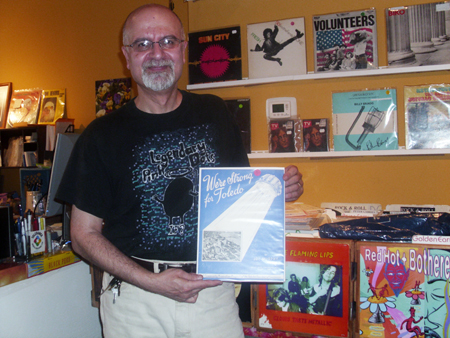
Amjad Doumani opened the first B-Bop Records location in 1987. Toledo Free Press photo -- Brigitta Burks

Amjad Doumani, owner of B-Bop Records, has tapped into what he calls the “vinyl resurgence” and opened a brick and mortar version of his online music store.

In the modern world of MP3s and iPods, Doumani said he still believes vinyl has a place.

“[Vinyl] involves some sort of interaction. Whereas on the computer with MP3 files, all you do is push a button and go about doing what you’re doing. People can easily stop listening to music and it just becomes a background noise,” he said.

B-Bop Records first started out as a brick and mortar store in 1987 before closing in 1994 and going online the following year. The first store mostly specialized in alternative CDs and vinyl records.

Best Buy and Media Play’s low-priced CDs were part of what forced B-Bop online.

“We could not compete with those kind of prices. It costs us more to buy wholesale a CD than they would be selling at retail,” Doumani said.

Amjad Doumani opened the first B-Bop Records location in 1987. A grand opening celebration for the new store is set for March 26-31.

Doumani kept his first store in mind throughout the years.

“In my heart and in the back of my mind, I always wanted to reopen the store,” he said. “What was driving me to reopen was that I missed the contact with the public, having a relationship with clientele.”

In late 2011, Doumani worked as the fundraising manager for the Lucas County Green Party’s city council candidates. He realized the space the group rented at 137 N. Michigan St., might be perfect for a store.

“When the campaign was over, we got to talking [and said] ‘This is a beautiful space, but it’s way too big for an office,’” Doumani said.

The result is Third Space, shared by B-Bop, the Lucas County Green Party and the Media Decompression Collective, which offers screenings of films on political, social and environmental issues. Third Space is also available for meetings, gatherings and events. The new, cheery yellow store now specializes in secondhand collectibles, vinyl, CDs and other memorabilia.

“In the very near future, we’re planning on delving into new vinyl, but vinyl only. We may order new CDs, most likely on a special order basis, and we’re not gonna carry any Top 40 stuff you hear on the radio,” Doumani said.

The store has been open since late January, but will have its grand opening celebration March 26-31. B-Bop Records will offer 20 percent off all purchases throughout the week. Doumani has also organized a lineup of artists for the week, made possible through his Toledo connections.

“Even though I closed the store in ’94, I never stopped being involved in the community. Through the arts and activism and over the years, I’ve built a lot of connections,” he said.

Donations are accepted, but the free events include:

  • Poet T. Miller will sell and sign copies of her new book “Coming Out of Nowhere” at an open mic event at 7 p.m. March 26.
  • Area DJs Todd Perrine and DJ Psycho will spin tunes 7 p.m. March 27.
  • The Media Decompression Collective and Miserable City present films celebrating Toledo’s art scene at “Toledo Art: Past, Present & Future” at 7 p.m. March 28.
  • Puppeteer Joyce Davis presents “Who’s in Rabbit’s House?” an interactive, all-ages story 7:30 p.m. March 29.
  • Slumberjack, a Toledo singer-songwriter, and Nadwy Auddy, an emcee, jam at 7 and 8:30 p.m. respectively March 30.
  • Artist Melanie Harris has her opening reception and exhibit kickoff 4 p.m. March 31 with light appetizers.
  • Soul Fingers, a jazz/blues act, plays at 7 p.m. March 31 followed by The Socialist Party at 8:30 p.m. and Phantom Limb Syndrome at 10 p.m.

B-Bop Records is open from 11 a.m. to 7 p.m. Tuesday through Saturday. For more information, visit http://www.thirdspacetoledo.org or www.bboprecords.com.

Ministry offers help for food assistance applicants

0

A representative from Toledo Area Ministries’ Supplemental Nutrition Assistance Program (SNAP) will be available to help clients fill out food assistance applications throughout April.

Three workers from the program operate a mobile unit that travels to food pantries and senior centers every month. Caseworker Glenna Berres estimates the unit helps about 100 people per month.

“We take the applications to the sites rather than have the people come Downtown,” Berres said. “There’s such a need out there and many of these people are the newly poor; they haven’t been through this before.”
Anyone who thinks they may qualify for SNAP or wants to fi nd out can visit the following locations:

✯ Zablocki Senior Center, 3015 Lagrange St., 10:45 a.m. to 12:15 p.m. April 2

✯ Providence Center, 1205 Broadway St., 2-3:30 p.m. April 3

✯ Zablocki Senior Center, 3015 Lagrange St., 9:30-11 a.m. April 5

✯ Oregon Center, 570 Bay Shore Road, Oregon, 10-11:30 a.m. April 9

✯ Eleanor Kahle Center, 1315 Hillcrest St., noon-1:30 p.m. April 10

✯ Providence Center, 1205 Broadway St., 2-3:30 p.m. April 10

✯ Mayores Center, 2 Aurora Gonzalez Dr., 10-11:30 a.m. April 11

✯ Blessed Sacrament, 4227 Bellevue Road, 7:30-11:30 a.m. April 12

✯ Wesley United Methodist, 2934 Stickney Ave., 9-10:30 a.m. April 14

✯ Kent Branch Library, 3101 Collingwood Blvd., 1-2:30 p.m. April 17

✯ Our Lady of Lourdes, 6149 Hill Ave., 10:30 a.m. to noon April 18

✯ Waterville Branch Library, 800 Michigan Ave., Waterville, 1-2:30 p.m. April 18

✯ Hunt Center, 2121 Garden Lake Pkwy., 12-1:30 p.m. April 19

✯ Maumee Center, 2430 S. Detroit Ave., 10-11:30 a.m. April 24

✯ Providence Center, 1205 Broadway St., 2-3:30 p.m. April 24

✯ Our Lady of Lourdes, 6149 Hill Ave, 10:30 a.m. to noon April 25

✯ Point Place Library, 2727 117th St., 1-2:30 p.m. April 26

To learn more, visit the website www.tamohio.org

Perrysburg bus riders express fear of rising fares, ADA compliance

0

Now that Perrysburg voters have voted down their present means of public transportation, a number of residents dependent on those services are coming to terms with the reality that their traveling might soon grind to a halt.

At least 40 Wood and Lucas County residents packed Perrysburg City Council chambers March 21 for a special transportation meeting, some expressing worries about the future system and others asserting unwillingness to subsidize others’ transportation costs.

City Council members Todd Grayson, Maria Ermie and Tom Mackin joined representatives from the transportation consulting firm Clear View Strategies to ask citizens what they want out of a public transit system.

Some expressed interest in bus routes that lead to and from popular venues in Toledo.

“I’m a property owner; I’ve been paying taxes for 40 years and I absolutely do not want to pay taxes for you to go to the Mud Hens, for you to the go to the symphony and for you to go somewhere else,” said Denny Barrett, a Perrysburg resident who spoke during the meeting. “Get yourself there — that’s not something the taxpayers should be paying for.”

City officials aim to draft a new system that takes the place of the Toledo Area Regional Transit Authority (TARTA). Voters opted out of the service in the beginning of March. The city plans to budget about $800,000 for new service costs, which would take about 1.25 mil in property taxes to levy, Grayson said.

The cost depends on what type of services the city and the consulting firm decides on. The group has already taken rides on TARTA to experience how routes work and the next step is to meet with TARTA officials to take stock of rider needs. In coming weeks, they will send out surveys and look for feedback from various organizations and businesses and read previous transportation reports.

Ultimately, requests for proposals will invite private companies to bid for a contract that would last five years. The issue would appear on the November ballot and if voters approve the measure, services would have to start by January.

But Mackin spurred a brief, heated debate about whether the city has the authority to levy property taxes for public transportation. He said he has not yet received a definitive answer from his lawyers.

Both Ermie and Grayson argued that the law permits municipalities to levy taxes for services that aid the elderly and people with disabilities. Grayson said he would hear within a few days whether the city can legally levy property taxes in this case, so he questioned why it was necessary “stir the pudding.”

Ernie Brancheau, a consumer advocate for the disabled community, questioned just how much a new, private service would benefit people with disabilities. He is wheelchair-bound and uses TARTA at least 30 times a week. Because TARTA receives federal funding, it must follow Americans with Disabilities Act (ADA) guidelines. Private businesses do not — one of the reasons Brancheau said he can never take a cab.

“It does really scare me; when you go private then you lose the federal backing and you lose your ADA designation, so a private contractor can do whatever they darn well please,” he said. “If you don’t have the federal oversight, if I have a problem, who am I going to call?”

Grayson and Lynn Colosi, the senior vice president of Clear View, said the city would require that the company that wins the bid follow ADA-like rules. If someone is discriminated against, they said, the individual could at first report it to the company and then report it to the city.

Grayson said he’s glad the federal government wouldn’t be able to touch the city’s transit deal.

“I don’t want their strings attached,” Grayson said. “I think that’s part of the goal here is to get out from underneath the 800-pound gorilla in the room.”

Gregory Symington, a Perrysburg resident, wasn’t convinced. He’s worried a switch to a private business will jack up the prices.

“When it comes down to public transportation, we have to subsidize this with our tax dollars because it’s public and they don’t have to make a profit,” he said.

Numerous other meeting attendees expressed the same concern. TARTA is affordable, many said, and they feared the new bus system would demand higher prices.

Grayson assured them that the goal is to keep bus fares from increasing over what riders pay now.

“The goal is not to recover costs, the goal is not to penalize riders, to make [citizens] pay $18 to go over to Levis,” Grayson said. “We understand this will be a heavy loss.”

Although TARTA runs on taxes collected last year to operate this year, the bus system will stop services to Perrysburg in October. Law requires the system to stick with a municipality for at least six months after voter rejection of the service is finalized.

TARTA pulls in about $1.5 million from Perrysburg from an annual levy. State Representative Randy Gardner (R), who presides over the 6th district, called the move “taxation without transportation” in a letter to James Gee, TARTA’s general manager.

Sandra Alden is a Perrysburg resident who commutes to North Toledo every day for work. She said she has a fixed income and TARTA gave her reliable and convenient transportation.

“This has caused a great imposition on me, as of the end of October, I will be buying a car, leaving a job or moving,” Alden said.

City code inspectors start ‘spring cleaning’

0
Inspector Paula Kozlowski hangs a notice on the door of a house on Packard Road. Toledo Free Press photo by Diane Woodring.

A baby seat that once bounced and spun lay abandoned in the driveway. Jagged glass hunks sprawled across the concrete. A wooden shed sagged into the ground in the backyard, before a forest of twisted blades of grass and weed skeletons. Balled-up underwear rested among them. Gutted Pringles tubes belched out a few potato chip shards.

The front of the house on Packard Road, covered in light green siding, didn’t look too shabby but its roof tiles curled up like blackened orange peels.

This is just the kind of house the city wants to target, said Paula Kozlowski, a code inspector, as she marched up the steps and hung a yellow tag around the doorknob.

This day, March 21, 2012, marked the second day for the city’s new “Spring Sweeps” initiative. It’s a proactive way to alert homeowners if they are violating maintenance codes and offer them a variety of financial aid programs to make home improvements more affordable.

And, if a homeowner is in compliance, there are door hangers to praise him or her.

Bands of code inspectors will focus on one neighborhood and then move to the next, visiting areas deemed on “the tipping point.” These are places that are not entirely consumed by blight but may be in danger of sinking into disrepair. Or, as Mayor Mike Bell put it, places that are “right on the edge of being great.”

“We do get a lot of people who think we’re just out here to cause trouble,” Kozlowski said. That is one of the reasons why Chris Zervos, director of inspections, wanted to launch “Spring Sweeps.”

Up until March 20, the city has responded to maintenance code violations based on complaints, which total about 28,000 a year, he said. A code inspector will check out the property drawing complaints and if the owner is violating code, he or she will issue a letter to address the problem.

Typically, the homeowner has about 30 days to reply or ask for an appeal if changes are not financially feasible. If nothing is done, the city can take the homeowner to court, where the judge might impose fines ranging from $75 to $250. Continuous infractions can incur fines up to about $600, Zervos said. The bulk of the complaints flow in from the central city.
“It’s never been cheap and it’s never been easy to own property but it is the American dream,” Zervos said.

He and other city officials suspect that a lot of these homeowners are not aware of the financial assistance that could help them. Thus, the packets that code inspectors hang on door knobs include information about a Habitat for Humanity repair program that sends insulation specialists to provide blown-in insulation for attics. This is free for homeowners whose incomes qualify.

Other programs listed include a down payment assistance grant for first-time home-buyers within 80 percent of the area median income — meaning that the annual income for a family of four could not exceed $50,100. Toledo residents within that range also qualify for loans or grants designated to fix code violations such as leaky roofs, faulty furnaces or crumbling foundations. Code inspectors will conduct the sweep until June 20.

Starting off in the Library Village neighborhood, the crew will later move to Arlington/Burroughs, Secor Gardens, Oakdale/Ravine Park and North Toledo/Point Place areas.

After June 20, the program will continue into other neighborhoods. The neighborhood that Kozlowski canvassed on the morning of March 21 was in relatively good condition, she said. Th e row of homes along Packard Street, off Sylvania Avenue, only needed a few notes for poor upkeep.

Kozlowski was mostly looking for egregiously chipped paint, cracked foundations and junk in the lawn or overflowing on the porch — one house had stacks of mangled wicker chairs and cardboard boxes stuffed behind its low porch wall.

She tends to give homeowners with minor infractions the benefit of the doubt.

“I try to keep in mind how I would feel,” she said. “If you really wanted to, you could go to any house and find something wrong — but you can’t be too overzealous.”

Canning: Mandate tramples liberty

0

With the enactment of the U.S. Department of Health and Human Services (HHS) mandate for “free” contraception coverage, religious liberty — the inherent natural right of every individual — has been trampled.

You’ve undoubtedly heard about the HHS mandate announced Jan. 20 that will require all insurance plans to provide coverage, at no cost to the subscriber, for:

✯ Abortion-inducing drugs

✯ Contraceptives

✯ Sterilization

✯ Patient education and counseling for women of reproductive age

When the Patient Protection and Affordable Care Act — aka ObamaCare — was passed in March 2010, the 2,700-page monstrosity was designed to have some provisions begin six months after the law’s passage. Then, piece by piece, more aspects of the law were rolled out, all of which have been burdensome, costly and confusing for employers who provide health plans to their employees.

The provision at issue now, defined in an August 2011 interim HHS ruling, required most new and renewing health plans to provide “preventive services” with no cost-sharing as of August 2012. The services were to include contraceptive coverage, but allowed some nonprofit religious employers the choice to refuse those services.

Then, on Jan. 20, HHS Secretary Kathleen Sebelius announced a “new element” to the interim but soon to be final rule: Religious employers must also provide contraception coverage by August 2013.

Wow! Religious employers get a whole year beyond secular employers to abandon their moral consciences and obey the un-elected bureaucrats’ orders.

The breathtaking arrogance is illustrated in this quote from Sebelius on the new element: “I believe this proposal strikes the appropriate balance between respecting religious freedom and increasing access to important preventive services.”

In other words: Religious employers have one year to get over themselves and realize they are unenlightened and discriminating against women. Bottom line: Religious employers such as Catholic hospitals, Christian schools and faith-based pregnancy centers will have to provide and pay for the coverage of these services regardless of the violation to their moral conscience. I suppose we should be grateful there is an exemption for houses of worship, albeit an exemption that is quite possibly the narrowest exemption in federal law to date. Even these houses of worship will be forced to certify their exempt status via cumbersome paperwork submitted on the government’s timetable.

You may be thinking: Why all the fuss? Wasn’t this conflict over religious liberty and moral conscience resolved with President Obama’s accommodation to religious groups announced at a Feb. 10 news conference?

Don’t be deceived. There was no accommodation. The president announced he would force insurance companies (also an abuse of power) to provide contraceptives for “free,” thus “relieving” the burden on the conscience of religious employers.

The truth of the matter is the proposal:

1. Does not resolve the moral issue at the core of the matter. There is no such thing as “free” contraception. Insurance companies will increase premiums for religious groups and therefore shift the cost for the morally offensive services back to them.

2. Is unworkable for the religious groups and other employers who self-insure and are in essence both employer and insurer.

3. Was contradicted that same afternoon when the administration filed the final regulation as written in August. No changes were made.

As expected, on March 1 the Democrat-controlled Senate voted 51-48 to table the Respect for Rights of Conscience Act as amended to the Transportation appropriations bill by Sen. Roy Blunt, (R-Mo). An excerpt from Blunt’s statement reads: “The Obama Administration’s health care mandate is an egregious violation of our First Amendment rights. Unfortunately, this is only a glimpse of what Americans can expect as a result of President Obama’s government health care takeover.”

✯ Joan Canning is the owner of HR Advocate LLC, a Toledo-based human resource and management consulting business. Find more information at www.hradvocate.biz.

Pounds: Wheels on the bus

0

When Tarzan swings through the jungle, he doesn’t let go of a vine until the next one is securely in hand. That’s the image that comes to mind as Perrysburg deals with its post-TARTA future.

Toledo Free Press took some heat a few weeks ago with an election summary comment that called Perrysburg’s opting out of TARTA service “a short-sighted decision that will have major ramifications for the people who depend on the bus service for transportation. Time will tell if the money the individuals save is worth the sacrifice to the community as a whole.”

A number of Perrysburg readers wrote to say we were the ones being short-sighted, and one wrote that “several years of research have gone into the efficiency and efficacy of the service received from TARTA and the options available to continue to provide public transportation to citizens who need it. Many meetings between the city and the provider have taken place, with unrealized promises of more timely and value-added service. For all these years of membership, the city has paid an inordinately high premium to TARTA in view of the limited ridership of its citizens.”

Toledo Free Press was invited to attend the March 21 public meeting about Perrysburg’s efforts to replace TARTA. While the respected city may have diligently researched its decision to ask voters whether to leave TARTA, it does not seem to have an option ready for people who depend on public transportation.

“I’m a property owner; I’ve been paying taxes for 40 years and I absolutely do not want to pay taxes for you to go to the Mud Hens, for you to go to the symphony and for you to go somewhere else,” said Denny Barrett, a Perrysburg resident who spoke during the meeting. “Get yourself there — that’s not something the taxpayers should be paying for.”

It is fair to wonder whether Barrett has considered that the system works both ways; the same buses that take people to Toledo also bring people to Levis Commons and other shopping destinations in Perrysburg.

Barrett and other Perrysburg residents may be subject to a property tax levy to replace TARTA (although the legality of that may be challenged), which may save residents money but is going to be a source of concern until those who use the service know more.

There were several questions raised at the meeting about service quality, cost and compliance with the Americans with Disabilities Act.

It seems odd that Perrysburg would spend so much time and energy preparing to let go of the vine that is TARTA without having a clear plan for a smooth transition to the next vine. It is one thing to negotiate with a private company that isn’t sure if it will face competition with a service like TARTA, but with that competition factor removed, Perrysburg may not find itself in such a favorable bargaining decision.

We were prepared to apologize for mischaracterizing Perrysburg’s decision to leave TARTA as “short-sighted,” but nothing at the March 21 meeting convinced anyone that the next transportation vine is in sight, much less in hand.

✯ Thomas F. Pounds is president and publisher of Toledo Free Press and Toledo Free Press Star.