Home Blog Page 295

Mercy Field marks firsts for many

0
Cleves Delp throws the first pitch at Mercy Field, March 14, 2012. Toledo Free Press photo by Joseph Herr.

Before a backdrop of winter’s bare trees against spring’s azure sky, they stood.

The young men, standing in a semicircle from first to third base, are the ballplayers who get to break in Mercy Field.

Hundreds of parents, baseball fans and school leaders alike gathered to celebrate a number of “firsts” the evening of March 14. This marks the first year that Lourdes University has a baseball team. This is the first year that Central Catholic High School will call a new field home. It is the first time that Mercy has named a sports facility.

Everything about the place is polished. The ground on the field is covered with state-of-the-art turf — the same material The Ohio State University and the Pittsburgh Pirates use. The bleachers, which can handle more than 400 people, have a sleek shine. Walk inside the brick building wrapping around the field and you’ll find a study room equipped with wireless Internet and a spacious locker room.

“It’s sort of unreal to walk out there and say ‘Yeah, this is my home field,’” said Austin Gunn, a junior studying education at Lourdes University.

The ground upon which he stood was planted years ago by a man named Cleves Delp. Delp runs The Delp Company, a consulting firm in Maumee that deals in wealth and risk management and employee benefits.

A couple of years ago, Delp approached Father Dennis Hartigan, president of Central Catholic, and asked him what he thought about building a baseball field for the school. The school’s administration took surveys of the community to determine whether the idea would catch, but Hartigan concluded that the school would have trouble finding enough donors to fund the project, Hartigan said.

Delp decided to pay for it himself.

He rented land on South Holland-Sylvania Road from the Diocese of Toledo, paid to have the facility built and drew in Mercy as a sponsor. Some 100 meetings later, Lourdes University and Central Catholic now rent the field from him.

Delp played baseball for Central Catholic as a teen and continued playing baseball during college. But, he said, this is not about baseball.

“This field is about the extension of the renaissance of Central Catholic High School,” he said. “It really isn’t about baseball; that is just the conduit to the real mission.”

The deed also extends the arms of Lourdes University. Under President Robert Helmer’s watch, who is leaving for Baldwin-Wallace College, the institution has added a men’s baseball team and men’s and women’s basketball and volleyball teams. Next year, the school will have a softball team, he said.

Delp said he feels close to Central Catholic because it is “uniquely” Catholic. For example, he said the entire tennis team must attend Mass on Fridays. He used to serve on the school’s board and his marketing director, Jesse MacDonald, is the school’s tennis coach.  He also cited the school’s quality of education; it was the first in the area to offer an international baccalaureate diploma.

Delp may have funded most of the operation, but the feat was not something he did alone. He credits his good friend and Central Catholic baseball coach Jeff Mielcarek, who is also the Catholic Youth Organization athletic director, with helping him foster the idea. As kids, he said they both played Little League, but not on the same team. As they grew up, their lives continued to intertwine. They worked for the Mud Hens together at one point. One day, Mielcarek suggested to Delp that the two should dream.

“Little did I know, [Mielcarek] delivered,” he said. “Here we are, a few hundreds of thousands of dollars later.”

The project also united four Catholic institutions that have never worked together on such a scale. Delp did not set out to only work with Catholic entities, but he said he was pleased that it turned out that way.

Hartigan and Helmer both said Wednesday that the deal is all about providing what is best for the students. That means seeing a student as a well-rounded individual in body, soul and mind. Athletic involvement stands for part of this, Hartigan said.

When ethical breaches abound in the national sports arena, such as the New Orleans Saints’ bounty scandal, anchoring sports in some kind of values is vital, Delp said.

“Athletics in the absence of a value-based system, whatever system that may be that you may choose, is dangerous,” he said. “Athletics for the purpose of athletics and not for the purpose of building character is dangerous and it causes people to do silly things. To put certain things like winning above what was really supposed to be happening, and that’s building character.”

Baumhower: How grounding a grown man saved his radio career

0

On Feb. 4, 2011, Wood County Common Pleas Judge Alan Mayberry forbid Andrew Zepeda, aka Andrew Z, from drinking and/or going to any place that sells liquor for the next two years … basically grounding him, but as it turns out, maybe saving his radio career. On March 12, Cumulus Broadcasting announced that Tim and Jeff were leaving Toledo for a syndication deal in Fayetteville, Ark., and that Andrew Z and his “People’s Show” would replace them. I was not shocked by the move as it seems that Andrew Z, like Stella, finally got his groove back.

I will publicly admit I was not a fan of Andrew Z’s show on KISS FM, because there was not much of a show.  I am a radio guy, who makes his living writing and producing radio morning shows across our great country, so I consider myself a sort of morning show purist, almost an obnoxious elitist.

Toledo has an outstanding history of great morning radio shows that have worked here and dominated, like Steve Mason/Diane, Jeff/Mark, Carlson/MacKenzie and Denny Shaffer. Those shows gave Toledoans great content to listen to every morning and it felt at times as if the entire city was listening. The previously mentioned shows also dominated in the ratings.

As I have mentioned before, the FCC changed the game in 1997 with ownership rules and Toledo morning radio really took the hit. What used to be numerous mom and pop stations were sold off to two radio conglomerates (Clear Channel, Cumulus) who were more concerned with cash than content. Although the Toledo radio landscape had changed, Toledoans’ need/desire for a great morning shows had not.

The downfall of Andrew Z’s KISS FM show began when he first announced he was opening his pizzeria. The show slowly transitioned from giving people a reason to listen, to giving constant promotional plugs for his restaurant. Andrew Z then became more focused on his outside business entities than his own radio show, but never once did he seem to realize it.

As his business grew, so did his opportunities; he put together a locally based traveling stand-up comedy show, he opened a restaurant location in Defiance, then another in Downtown Toledo. There are more businesses he opened that I am simply not listing here. With every new business, another portion of his show was dedicated to promoting it.

The last year of his KISS FM show was like a four-hour infomercial for Andrew Zepeda enterprises, yet people still listened. Clear Channel had known for some time that his content was being held hostage, because replacing Andrew Z meant they would have to pick up a corporately owned syndicated morning show, which Clear Channel calls “Premium Choice.”

If Clear Channel Toledo had fired Andrew Z any earlier than they did, Toledo would have lost another local radio morning show for good.

Everyone in Toledo knows that Andrew Z lost it all; they know he was arrested for making poor choices, his businesses were all closed by the banks, and finally he was not renewed with Clear Channel Toledo. Andrew is Toledo’s own VH1 “Behind The Music” story and this was the wake-up call he needed.

Cumulus Broadcasting made a very wise investment when it signed Andrew Z last July.  By signing him at a significantly lower salary and putting him on a nonexistent signal, they put his career in his own hands — put up or shut up.

In July, when Andrew Z launched his “People’s Show” on 100.7 The Vibe, his show sounded refreshingly different. Long gone were all his distractions as there were no businesses to plug. His show’s lineup had changed, as Sarah Hegarty,  Demetrius Nicodemus and Carlos Diaz stayed on with KISS FM, allowing for some dynamic changes.

His new lineup on the show features local musician Calen Savidge, comedians Donny Palicki and Brandon Doriot and Michelle Zepeda, former FOX Toledo reporter and Andrew’s wife. This change and the fact that Andrew Z has nothing else to do with his time due to the two-year “grounding” by Judge Mayberry has drastically improved the quality of the show; it may be his finest yet.

The show’s musical/comedic talents have been able to shine on a daily basis because the clutter of plugs are gone. You combine them and a focused/determined Andrew Z and you get a 60-watt FM station showing up in the ratings. Cumulus had no choice but to make a change.

Andrew Z’s fall from grace was not graceful. It was ugly and many would say deserved.

Although I was not a fan of his show at the end of his KISS run, I am a fan of him as a person. Andrew Z is one of the most genuine people in Toledo radio. He has been incredibly humbled and turned his humiliation into a reborn desire to perform and prove himself. He is a great Dickens character who almost ruined his life with his mistakes, but was given a second chance, like many Toledoans.

If he can continue to improve and grow the show, there will be a ratings shake-up.

Brain Gain series celebrates those who call Toledo home

0
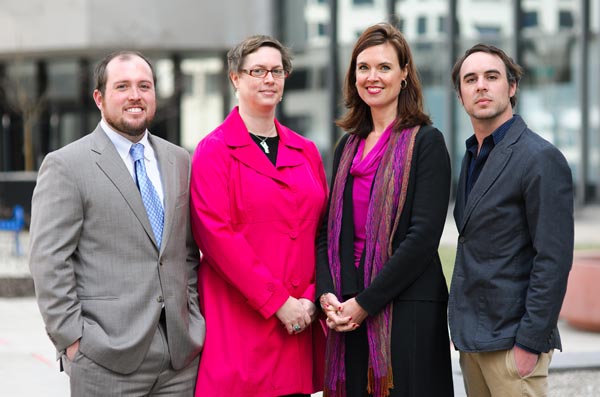
From left: John Smythe, Sarah Miller, Megan Coyle-Stamos and Nathan Steinmetz. Toledo Free Press photo/Joseph Herr.

They are four unique people, but they symbolize the initiative, creativity and success that characterizes countless people in the Toledo area.

The businessman, artist, mom/careerwoman and sports fan all make the most of the Glass City.

The first four subjects of the revived Toledo Free Press Brain Gain series have a lot to say about life around Lake Erie, and represent the reasons many of us call the region home.
.

John Smythe

When John Smythe took over Habitec Security, an electronic security company, he was 23 years old. Smythe’s father Jim called the University of Dayton graduate home in October 2005. Jim had started the company in 1972, not too long after college himself. Shortly after his son’s return, Jim died of leukemia and the company became John’s.

“It’s a scenario where you gotta buckle down and learn the business quick for the employees and the family,” Smythe said of taking the reins as president. His mother serves as CEO.

Growing up, Smythe, who graduated from St. Francis de Sales High School, didn’t think about whether he’d go into the family business.

“I imagine it was in my dad’s big dreams, but we didn’t really talk about it,” Smythe, now 29, said.

Smythe was able to win over employees, advisers and customers alike despite his young age.

“Obviously, the employees were glad we were continuing the business, but there’s that uneasiness,” he said.

Now the business is picking up as the economy improves; the company also went into medical alert alarms about two years ago.

The company president sees youth as a positive and thinks it could help Toledo grow even more.

“We need young people moving to Toledo to keep this going. Young people bring energy and creative ideas,” he said, referring to the boom of new businesses in Downtown.

A network of colleagues has also helped Smythe succeed in Toledo, something he attributes to the region’s friendliness.

“If you put yourself out there, people want to get to know you and you end up creating a big network of people in Toledo,” he said. “Toledo allows you to be somebody and make a difference and I think it may be more difficult to do that in a larger city.”

Smythe makes a difference through his work with the Boys & Girls Club of Toledo and the Toledo Leukemia & Lymphoma Society, where he served as chair last year. Serving Toledo was also important to Smythe’s father.

“His last words to us, and this sounds out of a movie or something, was, ퟀ�?Help people,’” Smythe said.

Besides charity, Smythe enjoys Toledo’s proximity to several waterways.

“I’m really an enthusiast for bodies of water. The Maumee River’s a fantastic asset as well as Lake Erie; there can be so much fun to be had on both bodies of water, fishing, skiing, whatever you like,” he said.

Smythe also likes going to Mud Hens and Walleye games.

“I absolutely love that we have these minor league teams that provide great entertainment, but at the same time, it’s in and out. You don’t need to be in an hour traffic jam and pay $40 to park,” he said.

But what really makes Smythe love Toledo is the people.

“People really care about one another; there’s a community feeling,” he said of the city. “I’m the biggest fan of Toledo. If anyone needs help to recruit someone, you bring them over to me and I’ll be talking to them for a while and I’ll get them sold on Toledo pretty quick.”


Sarah Miller

Artist and teacher Sarah Miller has traveled the world, but she calls Toledo home.

Miller, 44, grew up in Perrysburg, although her family moved to Arizona in 1978. Still, she spent summers in the area. “I’ve always maintained my roots here. I really feel that this is home,” she said.

At age 12, the multimedia artist had her first exhibit and even had an interested buyer. But Miller hung onto the piece instead of letting it go.

“I thought to myself, if [the customer] wanted to buy it, it must be pretty good; so I still have it,” she chuckled.

Since her debut, Miller’s pieces have been displayed across the country, including the National Gallery of Art Library in Washington, D.C.

Since 2005, when Miller went “digital,” much of her work has been centered around photography. One of the comments she frequently gets on her photos is that they look like paintings.

“I’m a painter at heart and that comes across in my photography,” she said.

Miller attended Rollins College in Florida for her undergraduate degree and Bowling Green State University for her graduate work. The artist lived in San Francisco, Santa Fe, N.M., and Washington, D.C.., after her schooling. During college, she had spent time studying in Europe.

In 2003, Miller began teaching art history and studio art at Owens Community College. In 2006, she left that job to pursue three teaching offers at the University of Michigan, Adrian College and Siena Heights University.

Soon however, Miller made an even more radical change and moved to San Juan, Puerto Rico, on sabbatical for two years.

“I liked [San Juan] because it was a combination of my three favorite places: the Caribbean, Spain and New Orleans. As an artist it really appealed to me, the colors, the architecture, the light,” Miller said of the city where she did several series of artwork.

Despite her love of San Juan, Miller returned to the Toledo area in September 2011.

“The world feels so unsettled and home is a very nice place to be,” she said. She joined the part-time faculty at the University of Toledo and considers teaching her greatest contribution to the area.

“The vast majority of my students seem to thrive in my classes,” she said. “If I can help another human being find a passion, that’s the most significant thing I can teach.”

While she was away, Miller missed what many others do about their hometown: food.

“The thing I really love about Toledo is our signature restaurants,” she said, naming Byblos in Toledo and Baidu in Perrysburg.

Additionally, there’s plenty to do for a single, working Toledoan, she said.

“It’s also what you make of it in terms of if you’re single and professional; what is important to you, who are the people you’re circulating with and what are you choosing to do with your free time? I think there’s plenty of things to do here with your free time,” she said, adding that she recently went to her first Walleye game.

“It comes down to quality of life, what’s it like to go to the grocery store,” Miller said simply.

Miller has established roots in the area. Her great-great-great-grandfather was Richard Peters who settled Petersburg, Mich., and her great-great-aunt was a Toledo concert manager and artist.

“She brought the best of the world in the arts to Toledo — the London symphony, the Russian ballerinas to the amphitheater at the zoo — so the arts are kinda in my family,” Miller said.


Nathan Steinmetz

Toledo is a sports fan’s dream come true, said Nathan Steinmetz, online marketing manager for the Mud Hens and Walleye.

“Toledo is an absolute gem for the sports fan when you think about it,” the Tiffin native said. “If you’re a sports fan, and I am, I can’t think of a better place to live, even how we sit right in between Ohio State and Michigan, arguably the biggest sports rivalry in the country.”

Steinmetz, 31, grew up loving sports and his father had season tickets for the Cleveland Indians.

“I was a big fan of the games and the teams, but going there as much as we did, we probably went to 15, 20 games a year, I really found myself becoming interested in how the team was run,” he said.

He attended Bowling Green State University, graduating with a marketing degree in 2003. During college, he ran marketing for the school’s recycling program before landing an internship with the Toledo Mud Hens during the winter of his senior year. Steinmetz stayed on after graduation to learn the ropes during baseball season.

A month after the internship ended, a sales position opened up and Steinmetz was selected. After working in that position for about five years, it was determined the Mud Hens needed an online marketing manager.

“I was the one who had done most of it, so it just became logical that I would continue to do more of it and then the hockey team became a real thing and it was realized that someone actually needed to have that position,” Steinmetz said. He has become an industry leader in terms of the number of fans and followers the teams’ pages have.

Despite a busy schedule, Steinmetz finds time to help out his hometown and orchestrates the social media for the Seneca County Museum and Heritage Festival.

“Both my parents are really involved in that sort of thing in Tiffin, so it’s nice to be able to help them out and use some of the things I’ve learned to promote their organizations,” he said.

Steinmetz, who bought his first home a year and a half ago, values his proximity to his family.

“I kinda get all the big-city things in Toledo, but I’m only an hour drive away from my family, which is great,” he said.

Although he’s moved out of Downtown, Steinmetz praised Toledo’s growing nightlife.

“It’s been neat to see how the nightlife Downtown has started to blossom,” he said. “Just to walk by Table Forty4, The Blarney and Pizza Papalis, and to see the people out on the patios, to see people in line waiting to get in, it’s something that just a few years ago, we didn’t have.”

Part of what brings the crowds to Toledo is the facilities for sports and concerts, he added. Attendance at Mud Hens games is still as high as it was 11 years ago when the team moved Downtown; Steinmetz attributed this to the phenomenon known as Toledo pride.

“There’s a lot of pride in this town. People are proud to be from here. They care about the community, they care about how other people view this community, and they support things when given the opportunity,” he said.


Megan Coyle-Stamos

Megan Coyle-Stamos’ love for Toledo is deep. The funeral director and prearrangement specialist’s family has owned and operated the Coyle Funeral Home for 125 years and Coyle-Stamos doesn’t see herself breaking that tradition.

“I wouldn’t want to live anywhere else, not in a million years,” she said. Despite her passion for her job and hometown, Coyle-Stamos, 40, had planned a different path originally.

The Bowsher High School graduate attended Indiana University in Bloomington for degrees in business management and fashion design. She landed a full-time job in Cincinnati with Parisian department stores after college. For the next several years, she lived in cities like Detroit and Indianapolis, opening new stores for the chain.

Eventually, Coyle-Stamos was ready for a change.

“I decided that industry was not for me. There was no fulfillment in it. It was not challenging for me,” she said.

Coyle-Stamos came home to Toledo one day to work on her resume. She found herself in a conversation with the woman who at that time held the prearrangement specialist position at Coyle Funeral Home. The woman pointed out that the job fit all the criteria on Coyle-Stamos’ list for job qualities.

Shortly after, Coyle-Stamos began doing prearrangement services for several family-owned funeral homes in Detroit before getting a job training other specialists through marketing firm Trust 100.

But another change was in store for Coyle-Stamos. About 11 years ago, she became pregnant with her first child and was ready to move back home. She joined the family business and never looked back.  She has now been married for 15 years and has an 11-year-old daughter and 8-year-old son.

“I’ve got a great boss (father, Joseph Coyle). If my kids are sick, I don’t come into work,” she said with a laugh. “[The staff] supports each other because we all have little kids or medium-sized kids. And that’s really key to quality of life — career satisfaction, but also flexibility.”

One of things she loves about Toledo is all the family-friendly activities it provides, listing the Toledo Zoo, Toledo Museum of Art, Metroparks of Toledo Area and  Imagination Station.

The pace of life and cost of living also appeal to Coyle-Stamos.

“One of the reasons I chose to live here is the pace of Toledo. It’s very comfortable; it’s not go, go, go, go,” she said, adding, “You can live comfortably here and you don’t have to make half a million dollars to own a home and to be able to go out for dinner once in a while.”

She gives back to the city she loves through her charity work. Coyle-Stamos is active in several organizations, including the advisory board for the Swan Creek Retirement Community. She also is in charge of the Cell Phones for Soldiers drive at Coyle Funeral Home, which has collected 1,500 phones. Each donated phone is sent to ReCellular Inc. for recycling, creating $5 that usually covers a 60-minute calling card.

Coyle-Stamos is also passionate about local foods and community-supported agriculture, in which customers can buy a share of land that farmers grow crops on and bring the food to the Toledo Farmers Market for pickup.

“It’s the whole idea of staying local and buying local, keeping the earth sustainable; just making these little kinds of choices and helping others understand they can make these little choices and if everybody makes the same little, local choices, then the whole community benefits,” she said.

The work she does at her job also gives her a sense of belonging to the community. “It’s a very deep and intimate service to others and to have true heartfelt thanks and appreciation and respect and hugs for a very much appreciated job well done, I really feel that’s very emotionally satisfying and fulfilling,” Coyle-Stamos said.

Democrats criticize Mandel for opposing auto bailout

0

Corey Fletcher credits Sen. Sherrod Brown with saving her job.

The lifelong Toledo resident stood before a group of reporters at the Lucas County Democratic Party Headquarters on March 13 for a news conference and talked about the years she has worked for Chrysler.

She worked for 10 years before the auto industry started to plummet. She was offered $75,000 to quit. She refused. Toledo, she said, is her home. She would have to move in search of other jobs.

But in 2008, she was one of the thousands of people employed by Chrysler and General Motors Co. who was laid off. She was jobless for 10 months.

“I remember how frightening it was, wondering how I would pay the bills, whether I would lose my home and how to continue to put my son through barber school,” she said. “To politicians like Josh Mandel (Brown’s opponent), I was a number on a sheet of paper, a statistic flashing across the TV screen.”

She was rehired after the government gave loans to the auto industry and Chrysler made a comeback, she said. Her voice wavered as she explained that both she and her son, who works at a plant that supplies parts for Jeeps, “owe their jobs to the auto rescue.”

Fletcher’s story is a testament to the Democrats’ plan to promote the government’s auto bailout as the savior of the industry.

Since the government lent billions to GM and Chrysler in 2009, the companies have declared bankruptcy, begun repaying loans, have started turning profits and have rehired and announced expansions.

Ron Rothenbuhler, the Lucas County Democratic Party chairman, joined County Commissioner Pete Gerken and UAW Local 12 President Bruce Baumhower to praise Sen. Brown for his efforts to rescue the auto industry.

They criticized Mandel for opposing the auto rescue, calling the state treasurer “out of touch” and a menace to the middle class.

Mandel, who was labeled a career politician by those in his own party who ran against him in the primaries, has been under fire from the Democrats for missing Board of Deposit meetings, not being open with the public and for his take on the auto industry rescue.

The Democrats cited Mandel’s comments to the Youngstown Vindicator this month as evidence that he would have voted against the auto recovery plan. He told the reporter that he disagreed that the bailout saved the American auto industry and that he was developing his own plan.

His press contact did not return repeated calls for comment, and Mandel has not provided details about his own auto rescue plan.

Mandel shouldn’t even have an auto rescue plan, said John McAvoy, a board member of the Northwest Ohio Conservative Coalition. He said that under no condition should the government bail out or save industries from failing. Mandel’s only “rescue plan” should be to refer failing companies to the bankruptcy system so they are forced to slim down and correct their problems in order to succeed, he said.

“When the government steps in and does what they did, that’s not fair to the competition,” McAvoy said. “The guys that run their company like crap, they fail, but in this case, the government stepped in and paid them for bad behavior.”

McAvoy he did not vote for Mandel in the primaries because of his elusiveness. The treasurer did not attend McAvoy’s organization’s candidate forum and later ducked out of a forum at the City Club of Cleveland.

“He didn’t show up or return phone calls and if a person is like that while they’re campaigning, how are they going to be when they’re sitting in Washington?” McAvoy said. “You’re never going to see him.”

Still, he said, he’ll vote against Brown. McAvoy said he has lost trust in GM and Chrysler because of the auto rescue that Brown heralded.

Baumhower, who lobbied Congress for the auto rescue along with other union leaders and city mayors, said he is experiencing improvements in Toledo because of the rescue.

The Jeep Wrangler plant, he said, hit a world record last year by producing 165,000 Wranglers. Hundreds of additional job openings have been announced and the company is making millions of dollars’ worth of expansions, he said.

He pointed out that the auto rescue was not a handout. The companies did have to undergo major restructuring. Plus, he said, new employees still only make $15 an hour, compared to the $28 an hour they might have made years ago.

The government still owns a portion of GM. Gerken also stressed at the podium March 13 that the rescue was not a bailout, but a loan. He said he worked for Jeep for 30 years.

“It’s not the ‘too big to fail,’ it’s that we’re too smart and too tough and too engrained to give up a legacy industry in our country,” Gerken said. “This isn’t about anybody failing. This is about giving these workers and these leaders, myself, a chance again to do it. There’s no fail here … give us a chance and we’ll work our way out.”

Website brands region as New Manufacturing Economy

0

A recently launched website is the fruit of a collaborative effort among a dozen area organizations to showcase the potential of the Toledo region and tell its story of becoming a leader in the New Manufacturing Economy.

The goal of the brand initiative, developed by the Northwest Ohio Brand Council, is to engage businesses, communities and organizations to position the Toledo region as a nationally and globally recognized leader in the “New Manufacturing Economy,” an identity creted specifically for this initiative.

“We want to showcase the Toledo region as the ‘New Manufacturing Economy’ to the entire world,” said Wendy Gramza, executive vice president of the Toledo Regional Chamber of Commerce and a member of the branding council.

The region is taking its place at the forefront of this new economy — described as a new industrial revolution that incorporates software development, open source product development and other imaginative new ways of doing business — because it has manufacturing in its DNA, according to the council.

The Northwest Ohio Brand Council was formed in 2009 as a group of 12 public and private organizations wanting to create a set of tools and messages that would promote the Toledo Region as a brand. Its mission is to raise awareness and preference for the region in support of its economic development, education, tourism and quality-of-life goals.

The council began the third phase of its branding initiative with the introduction of its newly created website, www.toledoregion.com.

The region’s story and assets were determined in the initial phase and that story was brought to life in the second phase, Gramza said.

“It’s the ultimate example of organizations coming together to get the job done. It’s all about the product and not the effort,” Gramza said.

Gramza said the council is looking for the business community’s input on content from all areas of the 12-county region established by the State of Ohio for economic development.

“Anyone who sees themselves as part of the story is welcome to become a part of it,” Gramza said. “We want all companies and organizations to use that theme in promoting their business around the world.”

The website provides a platform, content information and tools to assist in economic development efforts of the region. The goal for the site is to attract visitors, new residents, site selectors, conferences and conventions from industries related to the “New Manufacturing Economy.”

“We want the website to be the first source for people to go to for information about the Toledo region,” Gramza said.

Andi Roman was named brand manager for the council in December.

“It’s the true story about what the region is all about and now we have the platform to tell our story,” Roman said. “It’s a website for everyone to use to show people about the Toledo region.”

As brand manager, Roman will manage the communications and marketing for the Toledo Region brand with a strategic approach to furthering the mission of the council.

Roman, a Toledo native and a producer and news director for WTOL-11 with more than 20 years of experience in broadcast media, community and public relations, is based out of the Toledo Mud Hens offices in Downtown Toledo.

“Her knowledge, leadership and news background will prove to be invaluable assets, but her commitment and desire to truly make a difference in this community made her a perfect fit for the Toledo region brand,” said Joe Napoli, president and general manager of the Toledo Mud Hens, and chairman of the Northwest Ohio Brand Council.

The brand council is supported by organizations including the Toledo Regional Chamber of Commerce, Destination Toledo, Toledo Community Foundation, Greater Toledo Urban League, Toledo-Lucas County Port Authority, Regional Growth Partnership and Downtown Toledo Improvement District.

The City of Toledo, Lucas and Wood counties, Bowling Green State University and the University of Toledo are also represented on the brand council. The branding initiative is supported with funds from public and private organizations, and the State of Ohio. The Chamber Foundation acts at the fiscal agent for the brand council.

For more information, visit www.toledoregion.com. ✯

Rathbun: Precious Metals

0

For the next couple of columns I will cover what affects the price of precious metals and how not to invest in precious metals.

Today, I will start with some of the basics.

Hardly a day goes by where I am not asked about buying gold and silver. My answer is usually the same: I think everyone should own some precious metals both in physical form and in investment form.

I make a distinction between physical ownership and investment ownership for a couple of reasons. Today, if a person wants to own physical gold or silver it is usually because he or she worries the economy might tank and leave fiat money worthless. By owning gold and silver, they would at least have something of value to trade for food or other
necessities.

In this sense the ownership is not considered an investment, but rather insurance against a really bad thing. When buying physical metals it is important to know what you are buying and how much it is costing you compared to the market or spot price.

Most outlets that sell precious metals will charge a premium over the cost of spot. I have seen anywhere from 1 percent over spot to as high as 20 percent over spot. Also, some states will collect a sales tax on the transaction, adding an additional 5 percent or so to the cost.

Additionally, many of these dealers will also discount the price from spot for buying back your holdings.

For example, you may buy an ounce of gold (currently trading around $1,700 and pay an additional $49 to $150 premium. When you want to sell it to the same or a similar dealer they will give you $1,700 (assuming that the price of an ounce is still the same) less $49 to $150. This means that the price of gold must increase significantly before you earn a profit. Sometimes there is a storage fee if you decide to store your metals in a commercial facility, but most of us just use our own safe at home.

(By the way, never use a safety deposit box for storage. I will cover this in a future column.)

From an investment standpoint, I usually recommend investing in an Exchange Trade Fund (ETF) to invest in precious metals.

There are numerous reasons for using ETFs for this type of investment so I will just touch on a couple.

First of all, a metal ETF will very closely correlate with the underlying commodity without a large premium. There is some cost to an ETF but the internal expense is very small (usually 40 or 50 basis points) and has little impact on the performance of the fund.

Secondly and maybe most importantly, by using an ETF we are able to hedge our position and protect the downside. There are several ways of hedging the position. Two of the most widely used are trailing stop limits and option collars. Both of these techniques usually minimize the downside risk of the holding.

Thirdly, it is easy to short our position or invest from the thought of a metal going down. It is easy to short a precious metal on the futures market but there is a whole list of other conditions one must meet to use this venue. Shorting an ETF is easy and it can be done so that it carries very limited risk.

Shorting is a very misunderstood investment technique and is usually associated with “evil speculators” (talked about last time) but essentially every transaction in the investment world contains a person going long and another person going short.

No matter what you sell, whether it be gold, an acre of ground or a bushel of corn, you are speculating that you can do something more with the cash than the asset. Investments work the same way.

Finally, there are advisers and pundits who will make the case that a precious metal ETF does not really have the physical metal in a vault somewhere backing up the shares.

I have looked into this very carefully and feel very confident that the investments we use are properly backed and secured.

Next time, I will talk about the wrong way to invest in precious metals.

✯ Gary L. Rathbun is the president and CEO of Private Wealth Consultants, LTD. He can be heard every day at 4:06 p.m. on “Aft er the Bell with Brian Wilson and the Aft ernoon Drive” and every Wednesday and Th ursday at 6 p.m. throughout northern Ohio on “Eye on Your Money.” He can be reached at (419) 842-0334 or email him at garyrathbun@ privatewealthconsultants.com.

Will your meter reader go the way of the milkman?

0
Sean Lynott reads meters for Toledo Edison. Toledo Free Press photo -- Caitlin McGlade

You probably don’t see them. You probably don’t hear them, either.

Perhaps the only evidence of their presence is the sudden cacophony of dog barks shaking the neighborhood. But once a month — whether the air chills or stifles — meter readers stop by your house.

Sean Lynott, who reads meters for FirstEnergy’s Toledo Edison, has been at it for nine years. He is one of about 35 employees who check 308,000 meters in the Toledo area.

A typical day starts at 7:30 a.m. It’s the time to don a bright yellow jacket with silver reflectors. He and three other readers gather for their safety briefing meeting. Some days they talk about preventing slips, trips or falls.

Today the talk covers the ultimate four-legged enemy: dogs. Meter reader Brent Throne recalls a dog busting through a screen door and chasing him down Nebraska Avenue. Bryan Wilber, another reader, tripped over a rock and broke his wrist in an attempt to escape from one once.

The meeting closes and the four are off to a full day of driving and parking. Walking and stopping. Entering numbers into their hand-held computers.

Today the crew canvasses the suburban neighborhoods sprawling away from I-280 in Northwood. Dog attacks are few and far between here, so the biggest hurdle is the frosty air. Or, for Lynott, the occasional grill that blocks the view of the meter. Or the shrub that shrouds the meter’s numbers. Or a wooden gate with corroded hinges, resisting any kind of movement. And don’t get him started on bungee cords that hold gates together.

By 8:40 a.m., Lynott is just miles from headquarters. On a 21 day cycle, he has basically memorized the neighborhoods he canvasses. It’s not that he has to; the computer device he carries tells him where the meter is located on each house and announces whether there is a dog on the premises.

These computers make his job easier. But other kinds of technology might make his job obsolete.

He pulls into a driveway and hops out of his vehicle. Crunching down the frozen grass, he passes a few fake deer that have nose dived under the weight of winter. A plastic pig watches from behind a low fence. A couple of lawn gnomes sit around the yard’s sidewalk, their painted cloaks scabbed and chipped. He likes to see these quirks — to observe the various ways that people lay out their souls on the lawn or hang up their habits on brick and mortar.

But the Bureau of Labor Statistics predicts that meter reading jobs will decline rapidly. In 2008, the job employed about 45,300 meter readers. By 2018, there might be 36,300 left . That’s a 20 percent decreases, according to the bureau’s website.

Automatic meter reader systems are being installed all across the country. Columbia Gas of Ohio has outfitted Toledo with the new technology as part of a project that began in 2009 that has brought 24 more employees on board to equip 1.4 million meters.

They operate on a lithium battery that lasts for 20 years and transmit radio signals to a device that a meter reader would have as he or she drives past, said Chris Kozak, communications and community relations manager for Columbia Gas of Ohio.

The idea is to cut back on expenses — the cost of reading each meter has decreased to 20 cents from 80 cents — and to improve accuracy.

When all is said and done, the company will be checking 1.4 million meters with 17 vans, Kozak said. Henry Mello, the president of a company that employs meter readers called Bermex, said the machines are just as accurate as human meter readers.

“And I say that tongue-in-cheek,” he said.

The company has had to downsize since the dawn of the new technology. He could not say how many workers have been laid off because the company is still in the process of announcing more.

FirstEnergy doesn’t have plans to install a similar system. The company is busy testing a different technology in Cleveland that charts peak energy usage for the customer to encourage energy conservation, said Jennifer Young, spokesperson for the company.

The company employs 191 readers in Ohio that check 2 million meters. Each reader might check 250 to 400 meters a day if not more.

Dogs are typically the only hurdle they sometimes can’t jump. In downtown Toledo, for example, guard dogs tend to keep meter readers from entering the premises, so the company then has to make estimates based on previous bills and other factors.

By 10:30 a.m. on Lynott’s route, the frost has melted. He’s been down one country road, through a few neighborhoods and weaved through a subdivision. He starts on his next subdivision. One house still has Christmas bulbs on a pine tree in the front yard. A sign that reads “Happy Birthday, Jesus” hangs from a fence post.

Another house on the route — with splintered wood littering the lawn, scuffed siding and a sunken roof — has the Monster Energy Drink symbol spray painted on a wall visible through the window.

Even if it means walking countless miles a day, meter reading is a job that puts dinner on his table and provides ample time to generate ideas for his short fictions.

“Eventually you’ll see the meter reader as a thing of the past,” he said.

“Like the milkman.” ✯

Retirement guys: Wills vs. Trusts

0

One of the most common questions regarding setting up an estate plan is, “Do I need a will or a trust?”

Many have heard about their friends setting up living trusts and wonder if that is what they need.

A will is instructions by a person who names one or more people to handle and distribute property and assets at death.

With a will you get the opportunity to say where you want all your stuff to go. If you do not, each state has a formula to decide for you. Wouldn’t you rather decide? Also, if you have minor children, you can decide who you want to care for them.

Obviously, this is a very important decision that may affect your child’s life forever. You should consider things like their appointed guardian’s proximity, child rearing philosophy, religious views and their financial ability to provide. Let’s clear up a few common misconceptions about wills.

1. An executor of a will is not a power of attorney. An executor has no power until aft er you die. They cannot handle financial affairs for you now. That is why you may need a durable power of attorney.

2. A will does not avoid probate. It is generally a one-way ticket to probate. Probate is not necessarily bad. It is a court supervised process to get your assets where you want them to go as stated in your will.

3. A will does not control where everything goes. Accounts like IRAs 401(k)s, life insurance, annuities or any other type of retirement accounts are generally controlled by beneficiary designations. If you are making your will, this would be a good time to make sure all beneficiary designations are up to date. If they are not, your money could end up somewhere you did not intend (Google the horror story “the pension pickle”).

How about a trust?

A trust is generally a “will replacement.” It has a plan of distribution just like a will.

One of the biggest reasons a trust may be used in place of a traditional will is probate
avoidance.

There are many other reasons for trusts, but this seems to be the most common.

The public has objected to the cost of probate and how long it takes to complete. Attorneys are usually paid a higher level of compensation for probate assets as opposed to non-probate assets. As a result, many have turned to setting up a trust to bypass the process.

This happens by re-titling certain assets now, so that later there is no probate required.

A trust is usually much more expensive than a will, but has the potential to save a substantial amount of money when the estate is settled. Let us address some common misconceptions.

1. They are all the same. No, they are not. There are many different kinds of trusts for many different purposes. You could almost compare it to buying a car. Some have the basic equipment, while others have more features and benefits.

2. If you set up a trust you automatically avoid probate. No, no, no. You have to “fund” the trust to avoid probate. This is the biggest mistake people make when it comes to a living trust. Not getting assets titled in the trust.

3. If I have a trust I don’t need a will. There is a special will that goes with the trust called the “pour-over” will. This “pours” any property you still own when you die into your trust (you still may have a probate, though).

A will or a trust? The best way to answer this question is to visit a qualified estate planner. As I heard a local respected estate-planning attorney say early in my career, “always a will, sometimes a trust.”

✯ For more information about The Retirement Guys, visit www.retirementguysradio.com. Securities and Investment Advisory Services are offered through NEXT Financial Group Inc., Member FINRA / SIPC. NEXT Financial Group, Inc. nor its representatives provide tax advice.

The Retirement Guys are not an affiliate of NEXT Financial Group. The office is at 1700 Woodlands Drive, Suite 100, Maumee, OH 43537. (419) 842-0550.

Red Cross helping people recover from violent storms

0

Communities across the Midwest and South are still recovering from a string of violent storms that barreled across the region in late February and early March.

The storms produced at least 70 tornadoes and left entire towns destroyed.

Since the night of the first storm, Red Cross volunteers and workers have operated shelters to offer food, emotional support and relief supplies to the thousands of people displaced by the tornadoes.

In all, the Red Cross has sheltered hundreds of people in 11 states. The Red Cross workers are people who trained in their free time so they can volunteer to set up shelters, either in their hometown or halfway across the country in the wake of a major disaster. At shelters across the affected region, families are doing their best to piece their lives back together. Many lost their homes, many lost their entire town, and many lost much, much more.

How do you bring comfort to families that have lost so much?

If you are the American Red Cross, you make a promise — a promise to be there for the community whenever, wherever disaster strikes.

You let the American people know that Red Cross workers and volunteers are available 24 hours a day, 365 days a year to provide shelter, food, water, counseling and more to those who suddenly find their world turned upside down by a disaster.

And if you are the Red Cross, you vow to never break that promise.

On the Monday following the storms, Red Cross Lucas County Disaster Services volunteer Terry Cluse-Tolar was deployed to Kentucky. The next day, volunteers Pearlia and Lawrence Kynard deployed as well.

Terry is in the Louisville, Ky., area as a mental health case worker, helping people cope with what, for many, will be the hardest experience of their lives.

Lawrence and Pearlia are in the southern Ohio/northern Kentucky region as caseworkers, providing technical guidance and support to teams of volunteers working to meet the direct needs of clients in the affected area.

For Terry, Lawrence and Pearlia, this was not their first time deploying to a major disaster. Th e Red Cross in Lucas County has a strong team of disaster volunteers that at a moment’s notice is ready to respond wherever disaster assistance is needed.

Last year, volunteers responded to hundreds of house fi res and deployed across the country, from flooding in Northeastern states after Hurricane Irene to wildfires in the West and a number of tornado relief efforts not unlike the one in which Terry, Lawrence and Pearlia are now taking part.

Our dedicated volunteers give their time and effort to provide people hope. What they give is often inspiring and astonishingly selfless.

One volunteer, Gary Betway, spent over 100 days deployed across the country last year, responding to tornadoes, floods and hurricanes across several states.

A lot can be said for what our disaster volunteers give. What they bring home can be just as important.

“When I started volunteering with the Red Cross following Hurricane Katrina, it really reinvigorated by faith in humanity,” said Kathy McVicker.

Kathy has volunteered for the Greater Toledo Area Chapter of the Red Cross for nearly seven years, and is one of the many disaster volunteers from Lucas County who has spent many months responding to large-scale disasters.

“It’s all about people helping people. The Red Cross continues to enrich my life with a variety of real-life experiences and provides me the opportunity to make a difference in the lives of others,” she said.

Kathy was one of the first volunteers to respond to the relief effort after an EF4 tornado struck Lake Township in 2010. It was an experience she, like so many in the area, remembers very well.

“It was devastating,” she said.

As a volunteer deployed to the relief effort, she began with water distribution and meeting the people directly affected by the storm.

“You just want to lessen their hurt. To share the load and do anything to make the process a little easier.”

Kathy said many people approached her that day to tell her that if it weren’t for the Red Cross, they wouldn’t know what to do. They told her that once they saw the Red Cross, they knew things would begin to get better.

“You don’t realize how much the Red Cross is a symbol of help and hope until you are in these kinds of situations,” Kathy said.

If someone would like to help people affected by disasters like tornadoes and floods, they can make a donation to support American Red Cross Disaster Relief by visiting www. redcross.org, calling 1-800-RED CROSS (1-800-733-2767) or texting the word REDCROSS to 90999 to make a $10 donation.

For more information on the Red Cross relief efforts, visit redcross.org.

For more information on the efforts of the local Red Cross or to become a volunteer, visit RedCrossToledo.org or call (419) 329-2741.

Pick a safe place

The Red Cross has safety steps people can follow to protect members of their household. “Pick a safe place in your home or apartment building where household members and pets can gather during a tornado,” said Rick Bissell, PhD, MS, MA, member of the American Red Cross Scientific Advisory Council and chair of the Preparedness Sub-Council. “Use a basement, storm cellar or an interior room on the lowest fl oor with no windows.”

Other steps people should take:

✯ Watch for tornado warning signs such as dark, greenish clouds, large hail, a roaring noise, a cloud of debris or funnel clouds. Secure outside items such as lawn furniture or trash cans, which could be picked up by the wind and injure someone.

✯ If a tornado watch is issued, it means tornadoes are possible and people should be ready to act quickly. If a tornado warning is issued, it means a tornado has been sighted or indicated by radar and people should immediately go underground to a basement or storm cellar or to an interior room such as a bathroom or closet.

✯ If a tornado warning is issued and someone is outdoors, they should hurry to the basement of a nearby sturdy building. If they cannot get to a building, they should get in a vehicle, buckle in and drive to the closest sturdy shelter.

If flying debris occurs, a person can pull over and stay in the car with the seat belt on, their head below the window, and cover their head with a blanket or their hands. If someone does not have a vehicle, they should find ground lower than the surface of the roadway and cover their head with their hands.

✯ If someone is in a high-rise building, they should pick a place in the hallway in the center of the building.

Jason Copsey is communications specialist for the Greater Toledo Chapter of the American Red Cross. Email him at [email protected].

Basketball Slam Sweepstakes to benefit Parker’s Purpose

0
Desmond Howard, UM football legend, with Parker Inks.

When football coach Todd Drusback chose one of his wife’s students as the ball boy for his team, he didn’t realize how many lives he would impact.

Parker Inks, now 13, has multiple sclerosis, but that doesn’t mean he can’t help out on the field or off . His namesake nonprofit, Parker’s Purpose, gives up to $1,000 in grants to families with a child who has a life-altering illness or disability.

“[Parker] doesn’t look at [multiple sclerosis] as an affliction, he looks at it as a positive,” Drusback said.

Drusback, then coach of Fremont’s St. Joseph Central Catholic High School football team, gave Parker the position and never regretted it. Before long, Parker was instrumental to the team, giving players pep talks. In March 2008, however, Parker was hospitalized with respiratory problems around the same time his mother, Patti Inks, was undergoing cancer treatment.

“His dad called me the next day and said Parker was struggling; ‘He’s not himself, he’s not motivated,’” Drusback said.

Parker’s father told his son not to give up because he still had to fulfill his life’s purpose. Drusback, now coach at Rossford High School, went to visit Parker only to have a life-changing experience.

Although his movement was limited because of medical tubes, Parker squeezed Drusback’s hand when he saw him.

“It was one of those moments if you believe in divine intervention, it happened,” Drusback recalled.

The coach was inspired to do more for the Inks family. He sent out an email chain “and you wouldn’t believe the checks and the different things that started coming in the mail from all over the country,” he said.

Drusback also organized a spaghetti dinner and auction, serving 1,100 people.

“Todd and his wife just really stepped up. It had a massive impact on us,” Patti said. “He cares for Parker as if he were his own son.”

After spending a month in the hospital and crashing three times, Parker was released. However, the Drusbacks and the Inks decided their mission had only just begun.

“Why should it end here? There’s so many families out there that need assistance,” Drusback said.

He is president of the nonprofit. Since deciding to help other families, Parker’s Purpose has given $54,000, raised through fundraisers and donations, to 100 families.

The nonprofit helps children with all sorts of illnesses and disabilities, ranging from those with Down syndrome or autism to families with premature babies.

“Our focus is really broad because we know there are a lot of disabilities out there,” Drusback said.

The executive committee has quarterly meetings to decide which families get the grant money, with Northwest Ohio being the first priority. More people are applying, however, and the foundation would like to help, Drusback said.

“Our applications are just really increasing; we need to keep up with the funding,” Drusback said, adding that none of the staff is paid at Parker’s Purpose.

Every little bit helps a family with a sick child, Patti echoed. “When someone is going through medical struggles, especially when it’s your child, their focus is so much on their needs, but financial bur
dens are there,” she said. “It’s such a stressful thing to have financial burdens, whether you have health issues or not. The fact that the foundation can offer these grants, that’s a lot of relief to a family.”

For his part, Parker loves spreading the word about the nonprofit with his name. Patti, also secretary of Parker’s Purpose, remembered her son going from table to table at McDonald’s telling people about it.

“He’s a terrible teenager now and knows everything; he’s no different than any other teen,” she said with a laugh.

Parker still helps out at St. Joe’s in addition to Rossford High School.

To learn more, apply for a grant or donate, visit parkerspurpose.net. ✯