Home Blog Page 292

Children’s book illustrator depicts Titanic’s voyage

0

One might think that a children’s book on one of the greatest nautical disasters of all time is a somewhat awkward idea. But kids are often much more savvy and intelligent on such matters than adults give them credit for.

Artist Gijsbert van Frankenhuyzen — “Mr. Nick” as his young readers call him — has drawn illustrations for more than 25 books on a wide variety of subjects both fanciful and historical.

His latest, “T is for Titanic: A Titanic Alphabet,” examines the story of the legendary ocean liner in a way that curious young minds can relate to.

In an interview with Toledo Free Press, van Frankenhuyzen said he loves meeting with children to discuss the book, and that they frequently surprise him with the depth of their knowledge.

“For example, I told them, ‘Did you know that one of the smokestacks on the ship was not a real smokestack?’ And one little guy goes, ‘Yeah, but it still was used for ventilating the kitchen!’ And this is a second-grader. They know so much more than we think.”

A native of the Netherlands, van Frankenhuyzen gravitated toward art at a young age. “I was always painting and drawing, and I went to art school, but I could only go to art school if I learned a profession. I could not become a painter, my dad said, because I had to make a living. So, I went to art school and I studied graphic design.”

After a brief period working as a designer at an advertising firm in the Netherlands, he relocated to Michigan where he worked for the next 17 years, until the magazine he was employed at shut down.

“I took that time as a time to start painting for myself. And it worked — I was doing fine, I was doing work for museums, a little book illustration here and there — it kept me busy,” van Frankenhuyzen said.

“Then, in 1997, Sleeping Bear Press called me and wanted to know if I wanted to do their fi rst children’s book. And I said, ‘You bet!’ That’s really what I always wanted to be, was an illustrator. It was just something that’s really tough to get into. And here was the publisher, calling me! So that was great.”

Sleeping Bear Press, at the time, worked exclusively in books for older readers — their foray into children’s work was supposed to be a one-time deal. But the book, “The Legend of Sleeping Bear,” was a phenomenal success, putting both Sleeping Bear and van Frankenhuyzen on the map.

He’s worked with the publisher ever since, illustrating a wide variety of works.

“The Titanic book was book number 28,” van Frankenhuyzen said with pride. “When I started doing books, I wasn’t quite sure if I had to adjust my paintings for kids to make them kid-friendly. But I didn’t — I paint them the same way I paint my own stuff,” he noted. “I kept it all exactly the same, except I brightened my colors.”

That’s not to say that the artist’s work hasn’t evolved during his time working on the books.

“I pay more attention now to the little things than I did at the beginning of the books. And with an alphabet book, you kind of have to. Especially with this Titanic book. There’s a lot of stuff in there that I couldn’t mess around with. That’s the way it looked, and that’s what I had to paint.”

He joined the “T is for Titanic” project unexpectedly one day, while visiting his publisher’s office.

“I was at Sleeping Bear Press, delivering a book that I just finished. And as I walked in, one of the editors, the main woman, she was on the phone and she kind of waved at me coming in,” van Frankenhuyzen said. “And all of a sudden, she calls from her office, and she says, with her hand on her phone, she pulled it away from her ear and she says, ‘Nick, if we’re doing a book on the Titanic, would you be willing to do it?’ And I said, ‘Oh, sure, why not?’ And she puts the phone back to her head and says, ‘He’s in! He’ll do it!’”

The staff of the Titanic Museum in Branson, Mo., had seen his work. When they approached Sleeping Bear Press with the idea to do a children’s book on the ship, they specifically asked for him. Van Frankenhuyzen was a little nervous at first about dealing with them, especially since they weren’t giving him any guidance on his portraits.

“When the whole book was done, she saw the proofs — the woman from the Titanic museum — I finally did get an email from her. And it just said, ‘Nick,’ and in all capital letters: ‘I LOVE, LOVE, LOVE THE PAINTINGS!’ And that was it! They were very pleased.”

There is no rest for van Frankenhuyzen in the days to come. After all the exhausting research devoted to a subject on the ocean floor, his next project is going in the opposite direction — he’s illustrating a book about deserts.

“The deserts, there was not much hands-on, because I told Sleeping Bear, ‘Why don’t you send me to the Gobi or the Sahara for a while?’ And they, of course, wouldn’t do it. And they said, ‘Just Google it!’”

Pounds: Wear Blue to Work April 11

0

There are some causes that should not exist. Child abuse is one of those issues that, with education and evolution, should be relegated to the scrapheap of human history, with bubonic plague and scurvy.

But in 2011, Lucas County Children Services (LCCS) received 4,148 referrals of suspected child abuse involving 6,046 children and discovered 587 area children were abused or neglected. The agency’s hotline for reporting child abuse receives about 750 calls per month and 300-400 are investigated.

April is National Child Abuse Prevention Month. This year’s theme is “child abuse is preventable.” LCCS has worked with local media to spearhead a number of events, including a March 29 Blues Against Child Abuse concert, which drew nearly 150 people to Dégagé  Jazz Café in Maumee to hear Voodoo Libido and contribute to the cause.

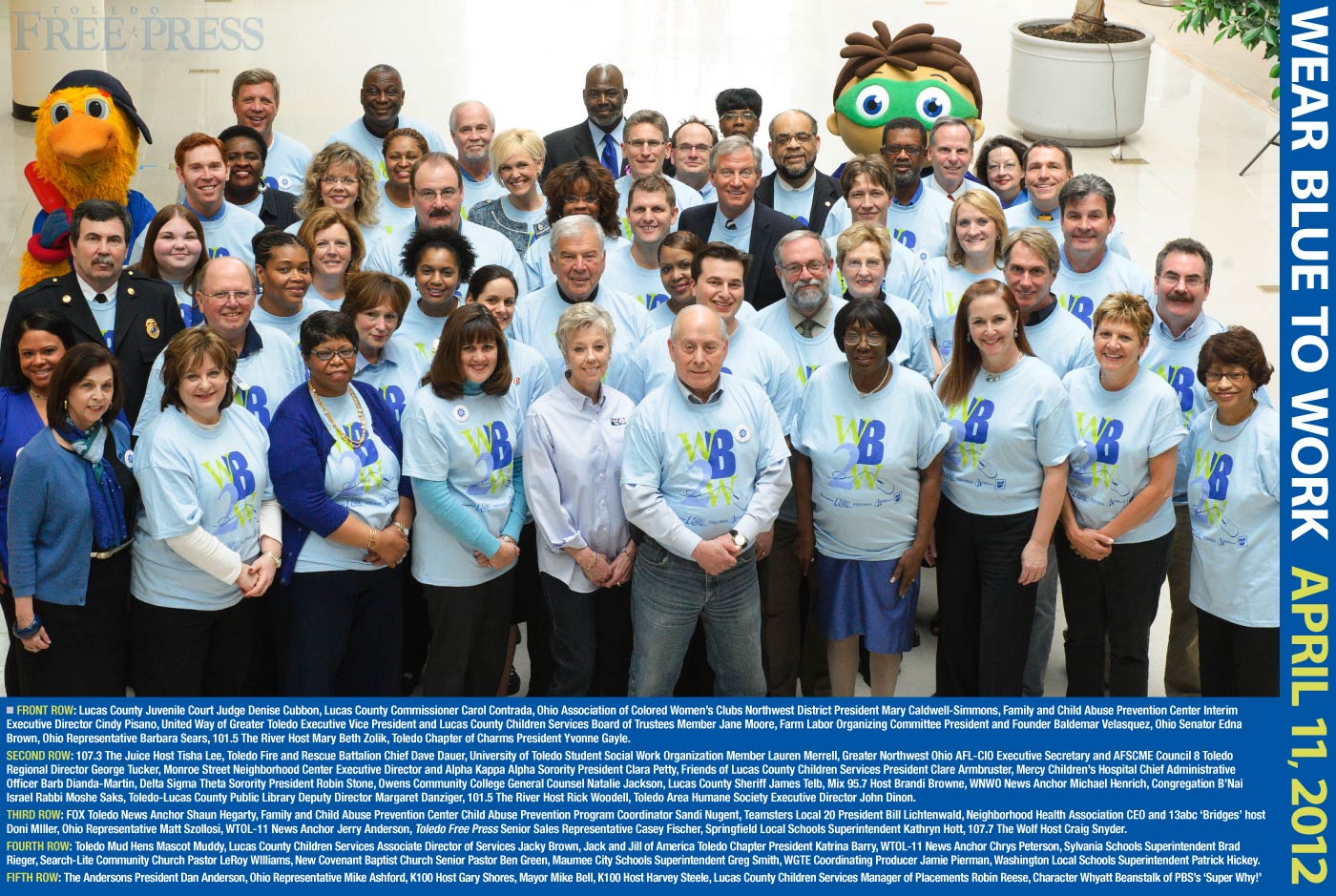
LCCS has more events planned throughout April, including Wear Blue to Work Day on April 11. As reported by Toledo Free Press Staff Writer Brigitta Burks, workers are encouraged to wear blue to the office, photograph a group of co-workers wearing the color and post it online via social media.

“We’re trying to get everybody aware and develop that sense of camaraderie,” LCCS Public Information Officer Julie Malkin said. “We want to have fun, get people involved and aware and take advantage of social media.”

Buttons promoting the day are available by calling (419) 213-3254.

LCCS and other agencies will present information at the  “We Care About Our Kids: Community Forum on Child Sexual Abuse” at 6:30 p.m April 18 at the University of Toledo Scott Park Campus. Admission is free.

A ceremony honoring local children who died as a result of street violence, abuse or neglect will take place at 11:30 a.m. April 25 at the LCCS offices, 705 Adams St., Toledo. Since April 2011, no children have died in Lucas County from abuse or neglect, but Timothy Blair, 14, Deadrick Rocker, 17, and Montelle Taylor, 17, died as a result of violence.

To help promote Wear Blue to Work Day, LCCS and Toledo Free Press invited dozens of community leaders to the Main Toledo-Lucas County Public Library for this week’s cover photo. Jim Walrod of the Image Group provided the blue T-shirts for people from every walk of local media, government, public services and nonprofit life. We profusely thank each and every individual who gave his or her time for the photo, taken by Toledo Free Press Photo Editor Joseph Herr.

Wearing a blue shirt to work is a minor gesture for such a crucial issue. We hope to see you in blue April 11.

To report a case of suspected abuse, call (419) 213-CARE.

Thomas F. Pounds is president and publisher of Toledo Free Press and Toledo Free Press Star. Contact him at [email protected].

Miller: Distracted driving

0

On my morning drive April 4, I ran a red light, grazed a deer, blew through a stop sign, clipped a pedestrian at a crosswalk, sideswiped a car and was ticketed for several traffic violations.

It was all my fault; I was chatting with a passenger, texting on my phone and checking messages while I was driving.

Fortunately, all of that happened during a session in a Distracted Driving Simulator in the lobby of Owens Corning. But it was a harsh reminder of a common sense principle we all ignore: You cannot safely drive if your attention is divided.

The simulator is a three-monitor setup with a steering wheel, gas pedal and brake on the floor. I drove through the realistic video for about seven minutes, trying to watch all the mirrors and environmental challenges, while a passenger voice gave directions and an on-screen cellphone flashed messages and asked for answers.

The simulator, an Ohio Department of Transportation project, has been touring Ohio, with stops this week at SSOE, the University of Toledo and Oregon’s municipal complex. It ought to be in every high school and workplace, to remind people that when they are driving, they are in control of a lethal torpedo that is one of the most effective instruments of murder ever invented.


According to Matt Schroder, senior leader of corporate communications, Owens Corning has gone beyond simply offering the simulator by recently making it official policy for employees to leave the cellphone alone when driving: “Drivers are prohibited from utilizing a cellphone (hand-held or hands-free) to conduct company business while the vehicle is in operation or while driving on company property.

  • Includes texting, checking emails, accepting incoming calls or placing a call unless the vehicle is completely stopped and properly parked in a safe location.
  • Including handheld, hands-free or an in-vehicle installed system.”

The statistics are brutal. According to the State Highway Patrol of Ohio, “Driving while texting or talking on the phone is considered more dangerous than driving at .08 blood alcohol content. Nearly 80 percent of crashes and 65 percent of close calls involve a driver’s lack of attention within three seconds before the event.”

A fact sheet handed out by SSOE, which has a similar policy prohibiting talking and texting on a cellphone to conduct company business while driving, contained these statistics:

  • Driver distraction is a contributor in 93 percent of rear-end collisions.
  • Driving while using a cell phone reduces brain activity associated with driving by 37 percent.
  • 18-to-20-year-olds are four times as likely to be involved in a distracted driving accident than drivers more than 35 years old.

The National Safety Council has also weighed in:

  • Communities that enact bans on hand-held devices but continue to allow hands-free devices see no reduction in the number of crashes after bans take effect.
  • Each year, more than 1.1 million crashes (25 percent of all crashes) are attributed to cellphone use, accounting for 500,000 injures and 5,000 deaths. This works out to more than 3,000 crashes, 1,300 injuries, and 13 deaths every day.
  • A new study of company vehicle fleet crash rates reveals the top safety performers are companies with policies enacting a total ban on cell phone use (handheld and hands-free) that enforce such policies.

Of course, it’s not just cell phones. People eat and drink in their cars, engage in personal grooming and distract themselves with navigation systems, videos, radios, CD and MP3 players and all kinds of curious behavior. When I lived in South Florida and drove I-95 every day (home to the rudest drivers I’ve ever encountered, although some of the people on Brint Road in Sylvania  and Secor Road in Toledo are pretty bad), I saw people engaged in reckless behavior that ranged from openly drinking from beer cans to makin’ babies, two activities which are reckless enough on stable, dry land.

I am a much better driver when my wife and kids are in the car than I am when I am driving solo. I am definitely guilty of talking on the cellphone and occasionally texting as I make my way to and from work.

It’s a hard habit to break, but after plowing through the streets of the distracted driving simulator like Homer Simpson fighting Peter Griffin for the steering wheel, I have a greater understanding of the dangers I am ignoring.

I signed the pledge to put the cellphone down when I drive, but the incentive of my family is all I need. Whether using the phone while driving gets me killed with or without them in the car, I’d be just as dead, and there is simply nothing on that BlackBerry that can’t wait.

I used to tell people that, like the bad guy in “Raiders of the Lost Ark” who grabs the burning medallion and sears its design into his hand, I have the BlackBerry “B” imprinted in my palm from holding it so much.

After failing the distracted driving simulator, I plan on working to make sure that “B” begins to fade from my grasp.

Michael S. Miller is editor in chief of Toledo Free Press and Toledo Free Press Star

Baumhower: Replacing Stan Stachak

0

On April 4, 13abc WTVG announced that longtime Chief Meteorologist Stan Stachak will be taking his Live Doppler 13,000 forecasts and jet streaming into retirement. Stachak, who has been the face of Toledo TV weather for 30-plus years, will step down from his full-time responsibilities April 23. 13abc President and General Manager John Christianson has selected Jay Berschback as Stachak’s successor.

13abc News Director Brian Trauring released the following comment:  “Stachak is a professional who cares deeply about the safety of viewers during severe weather situations.  The goal is to continue to build on the proud tradition of coverage that Stan has built at the station.”

Stachak has been part of the fabric of many Toledoans’ lives. As a child of the ’80s, Stachak’s face and easygoing demeanor always brought comfort to me while watching the news.  Stachak was always the fifth person at my family’s dinner table; I cannot tell you how many times I was shushed for his voice. His predictions brought both joy and disappointment to many Northwest Ohioans.

Former WTVG anchor and current WTOL 11 anchor Jerry Anderson shared his thoughts via email: “Stan and I started the same year [1980] at WTVG. I worked side-by-side with him until 1993. He was always a pro … I spent the first half of the ’80s being Ron Burgundy (remember the hair/’stache?). But what people may not get about Stan is just how funny he can be in a very cerebral way … a dry wit that can just crack you up … smart humor stuff. And then it’s all wrapped up in a great human being … a family man with a huge heart. In short, Stan is pure class (uh oh, I’m back to Burgundy). It was a privilege working next to him for so many years … I wish him only the best in retirement.”

Rob Powers, former 13abc sports anchor who is now at ABC’s No. 1 station, WABC  in New York, said via email, “It sure takes a special talent to not only survive, but thrive in this business, and to do it in one place for so long? Unheard of! I had so much fun working with Stan; such a pro. I feel fortunate to have worked with him, and WTVG’s viewers have been fortunate to have him on the job. Calm, levelheaded and so knowledgeable on the air … fun, light-hearted and such a good guy off the air. Take a well-deserved break, Stan … you sure as heck earned it!”

13abc anchor Lee Conklin said, “He is one of the most intelligent people I’ve ever met. I will always appreciate his professionalism,  sense of calm when the weather gets crazy and sense of humor, too. I was actually hired over here 21 years ago to do weekend weather,  while I was doing news and sports at WSPD. Despite the fact I was not a meteorologist, and had never done television,  Stan was patient with me while I learned the ropes (it couldn’t have been easy). I do remember calling him in the middle of the night from time to time when the weather computers went haywire. I imagine that ticked him off,  but he never showed it. He has truly earned his retirement. I’m happy for him that it’s taking place on his own terms.”

Vary rarely in medium-size markets do TV personalities stay longer than 10 years, especially those as talented as Stachak. The Toledo TV market is normally a proving ground for bigger and better things, but Stachak stayed.  Stachak dabbled and filled in at CNN in the 1990s, and I am sure he has turned down bigger offers with more money. He chose to stay here, to raise his family here, and for those choices, Toledoans will hold him in their hearts and minds.

Although there will always be a TV weather person sharing forecasts, trying to  make normal people understand the art and science of predicting weather, Toledo may never see another Stan Stachak.  It takes a special human being to turn down more money and bigger opportunities for more than 30 years to remain dedicated to one town — we call that a “Toledoan.”

Agency marks Child Abuse Prevention Month with several events

0
Community and media leaders wear blue to mark Child Abuse Prevention Month. Click on photo in story to see who's who.

Lucas County Children Services (LCCS) has a reputation as “bad guys” and “baby snatchers,” but nothing could be farther from the truth, said the agency’s executive director Dean Sparks.

“Many in the community look at us almost as quasi-law enforcement. They expect us to go out in our vans, take kids away and then tell parents what they need to do to get them back, and if they don’t do it quickly enough they will never get them back,” Sparks said. “I’ve heard people say we get money from the federal government for every child we bring into our care. Not true. We don’t get any rewards for removing kids. Our No. 1 priority is keeping kids safe and helping parents take better care of their children.”

LCCS does not actually have the authority to remove a child from a home; only a law enforcement officer, magistrate or judge can do that, Sparks said.

Removing a child is also LCCS’s last resort. Whenever possible, children remain with their families or a relative while steps are taken to improve conditions.

“Less than 10 percent of kids we come in contact with are going to get removed,” Sparks said.

In 2011, LCCS received 4,148 referrals of suspected child abuse involving 6,046 children and discovered 587 area children were abused or neglected. Forty-nine percent of the investigations were for physical abuse, 36 percent for neglect, 14 percent for sexual abuse and 1 percent for emotional abuse.

Thirty-two percent of children served stayed in their own homes, 31 percent lived with a relative, 32 percent were placed in foster care and 5 percent went to a group home or private institution.

When responding to an allegation of abuse or neglect, caseworkers immediately do a safety assessment to make sure the child or children are safe. The assessment includes checking the home environment, evaluating caretakers, making sure basic needs are being met, checking if utilities are turned on and medical and educational needs are being met. Caseworkers also look for signs of physical hazards, substance abuse, violence and sexual abuse.

If any concerns are found, a meeting between the agency and the family is called to discuss the issues and give the family an opportunity to offer solutions before recommendations are made.

Over the past several years, LCCS has been transitioning to a response method called “differential response,” meaning that except in cases of sexual or serious physical abuse, the agency no longer identifies a perpetrator and a victim. Instead, LCCS engages the family in a discussion of concerns and works with them to find a suitable solution.

“For more than 76 percent of cases, we’re going through a kinder and gentler way of engaging families,” Sparks said. “Rather than substantiate whether or not an incident occurred, we want to look at the whole family and how it’s functioning, identify where the problems and difficulties are and come up with a plan to solve them, empowering the family to make changes. We don’t want to just go in and say, ‘This is what you have to do,’ which is what we did for many years.”

The meetings, which are typically held at the LCCS offices in Downtown Toledo where security is present if needed, range from civil to heated, said caseworker Shannon Keefer.
Click to enlarge

“You’re talking about the possibility of children being removed from parents, so you can’t deny it’s tense for every person sitting at the table,” Keefer said. “It’s very intense. Feelings and emotions are sky high, but you have to keep that under wraps. The bottom line is this is a very traumatic situation for all involved, especially the children. We have to do our best to keep that meeting decent and civilized in trying to keep those lines of communication open and being honest with each other about what’s going on.”

Some parents know they are overwhelmed and are actually grateful for the help, Sparks said.

“We do occasionally get people turning tables over, threatening, storming out, kicking doors and breaking them. They are not happy with us,” Sparks said. “But you’d be surprised how many parents say, ‘Yeah, I can’t handle this right now. I need help.’”

Keefer said one mother hugged her in court after a judge ordered her children removed from her care.

“The mom hugged me afterward and said, ‘Thanks,’” Keefer said. “I didn’t know what to do at that point. It shocked me.”

Giving back

Another agency initiative, which Keefer has been working on since July, is developing community programs such as the Parent Partnership Program.

“We partner with parents who have previously been through our system and are today doing well and are successful in their lives. Some have gotten their children back into their care, some have not, but they want to come back and volunteer and give back to parents currently going through system,” Keefer said. “It’s very powerful. I’ve learned so much from the parent partners, opening my eyes to what they’ve been through and what that’s really like on their end. I know I’m going to continue to look to them for advice and guidance about what we’re doing with the program and where it can and should go.”

One of the parent volunteers is Tim. About five years ago, when his two young sons were removed from his ex-wife’s care because of unsafe conditions at her home, he assumed he would be given custody.

Instead, the Toledo man, whose last name is omitted to protect the identity of his children, was told his history of domestic violence against his ex-wife was a safety concern and the boys were sent to live with relatives.

“I was upset and angry because I had always thought of myself as a good dad,” Tim said. “I had already raised three older children [from a previous marriage] and I thought my children should be home with me.

“I never believed I was guilty of domestic violence because I never put my hands on my ex-wife and I never hurt my children. I thought, ‘They eat every day, they’re clothed, they have a roof over their heads, they’re OK.’ But until I started going through some of the agency programs they requested I go to, I never saw the mental abuse my children went through on a daily basis.

“I used to raise my voice and holler and scream a lot, or block the door when someone wanted to leave because I still had something to say, which not only caused my wife to be afraid, it caused my children to be afraid. I always thought I was doing the right thing because after everybody calmed down, I would ask my kids, ‘Hey, you love me?’ Well, what else were they going to say? Of course they’re going to tell me they loved me.

“Going through the batterers intervention program, I realized there was a whole lot more to domestic violence, that I didn’t have to physically attack someone to be guilty and that I did in fact need the program. No one wants to admit as a parent they need to make some changes in their child’s life, in their own life, but to me that was the first step of healing.”

Tim, who also went to counseling and enrolled in parenting classes, was eventually awarded full custody of his sons. Today, he is a parent volunteer, helping to facilitate the agency’s six-week Building a Better Future workshop for parents who have had children removed from their home.

“Knowing they are still going through services, it’s a reward to be able to pull the parents aside and say, ‘I’ve been there, done that and this will help you out,’” Tim said. “If I can stop one other family from going through the turmoil I’ve been through and help them navigate through the system, I’m happy. I tell them the quicker you successfully complete these services being asked of you, the quicker you’re going to have your prize back, which is your children back in your home with you.”

Even though it’s easier to blame others, part of the healing process is learning to take responsibility for your actions, Tim said.

“I was probably one of the biggest, hardest knuckleheads out there. I didn’t think I needed these programs. I think the biggest thing for me to conquer was admitting it was a problem and claiming ownership of it,” Tim said. “I’d like all parents to claim responsibility that something happened in their life to cause [LCCS] to come out and remove their children. They don’t just go through a directory and say, ‘OK, let’s go take their kids.’ Whether it’s their fault or someone else’s fault, something happened to cause the agency to go out there in the first place.”

The agency’s hotline for reporting child abuse receives about 750 calls per month and 300 to 400 are investigated. Fifty-six percent of referrals come from “mandated reporters” within the community with the remainder coming from private or anonymous sources.

Tim said his past is always there as a reminder, but he prefers to focus on the future.

“My drive and the reason I do these programs is to remind myself of where I was at and where I want to be at,” Tim said. “I try not to dwell on the past things. They are always there as a reminder, but I just try to look toward the future and where my life’s going with my children now. They’re both doing great now and I’m doing great now. I can tell you today the agency will never have a reason to come out to my house or to tell me as a father I can’t have my children at home.”

April is National Child Abuse Prevention Month. Upcoming events include:.

  • “Wear Blue to Work Day” on April 11. “Each individual person makes the decision that morning to put on a blue shirt, but think about all the blue shirts together,” said LCCS Public Information Officer Julie Malkin. “If he wears a blue shirt, and she wears a blue shirt and I wear a blue shirt, we’re unified as a community against child abuse.” Area residents are also encouraged photograph a group of co-workers wearing the color and post it via social media.
  • LCCS and other agencies will present information at the “We Care About Our Kids: Community Forum on Child Sexual Abuse” at 6:30 p.m. April 18 at the University of Toledo Scott Park Campus. Admission is free.
  • A ceremony honoring local children who died as a result of street violence, abuse or neglect is 11:30 a.m. April 25 at the LCCS offices, 705 Adams St., Toledo. Since April 2011, no children have died in Lucas County from abuse or neglect, but Timothy Blair, 14, Deadrick Rocker, 17, and Montelle Taylor, 17, died as a result of violence. Lucas County has not had an abuse- or neglect-related death for about two years, Sparks said. Nationally, about five children a day and 1,700 per year die from abuse and neglect.

“Child abuse is preventable,” Sparks said. “If we work together we can stop it.”

To report a case of suspected abuse, call (419) 213-CARE. For more information, visit www.co.lucas.oh.us/LCCS.


Get ready for The Temptations, Four Tops

0

Otis Williams was sitting in a restaurant recently and heard “Night and Day,” a song penned by Cole Porter in 1932.

“It’s a great song. And here it is 2012, so that’s the benchmark of a great song: It will transcend through time,” said the original member of The Temptations.

“We’ve been blessed to have songs that have been around 40, almost 50 years and still sound as fresh as the day we released them during the ’60s.”

In 1961, The Temptations formed when members of The Distants and The Primes merged.

“After we signed with Motown [Records], things started happening in a very big way for us,” Williams said.

When David Ruffin joined Williams, Eddie Kendricks, Melvin Franklin and Paul Williams, the singers began working with producer Smokey Robinson, who co-wrote their first big hit, “The Way You Do the Things You Do” and their first No. 1 record, “My Girl.” He also wrote “Get Ready.”

The Temptations

“Smokey was a notable songwriter and producer even before we started recording for him. He’s one of the best in the business; it was just magic with Smokey,” Williams recalled.

The quintet known for its dance moves had a chance to work with another producer who expanded the group’s sound. Norman Whitfield helped create “Ain’t Too Proud to Beg,” “(I Know) I’m Losing You” and “I Wish It Would Rain.”

“Norman and myself had known each other since we were teenagers,” Williams said. “So when he came over to Motown, that’s when he started becoming our producer, and we eventually worked with him and had a slew of hits with Norman.”

When Ruffin left to go solo, former Contours’ member Dennis Edwards joined The Temptations.

With Whitfield at the controls, the group churned out more hits: “I Can’t Get Next to You,” “Psychedelic Shack,” “Ball of Confusion,” “Papa Was a Rolling Stone,” “Just My Imagination.”

“It was a great feeling to have hit after hit after hit on the charts,” Williams said during a phone interview from his Los Angeles home. “We never would have imagined that we’d have that kind of longevity and a lot of hits going through a lot of musical changes.

“It’s wonderful because none of us had any idea that we would have — I have almost 40 gold and platinum CDs hanging in my home — it’s just been a very blessed event.

“Other than losing my original guys, The Tempts’ ride has been great.”

Williams, the only surviving member of The Temptations, continues to tour with Ron Tyson, Terry Weeks, Joe Herndon and Bruce Williamson.

The Temptations and The Four Tops will perform at 7:30 p.m. April 12 at Stranahan Theater. Tickets range from $29.50 to $49.50.

Since taking the stage together for a Motown anniversary show in 1983, the two marquee groups have bonded.

“We’re great friends first and have a wonderful rivalry. The Four Tops are known for all their great hits, and then here we are with ours, and you put the two together, it just takes you down memory lane,” Williams said.

“People always ask me, ‘How long are you going to do it?’ And I say I’m going to ride the hair off the horse; when I get off the horse, the horse will be bald,” he said. “I’m still enjoying the ride.”

Four Tops are still there

At age 9, Lawrence Roquel Payton Jr. and his friends formed a group called The Temptings.

“We did all Temptations songs,” he said and laughed. “No Four Tops for us at all, it was all Temptations. My dad sort of took a blind eye to the situation.”

The Four Tops

His dad was Lawrence Payton, who also was in a group with friends: Levi Stubbs, Abdul “Duke” Fakir and Renaldo “Obie” Benson. They were The Four Tops.

The Motown legends cranked out the hits: “Baby I Need Your Loving,” “I Can’t Help Myself (Sugar Pie, Honey Bunch),” “It’s the Same Old Song,” “Bernadette,” “Standing in the Shadows of Love,” “Reach Out I’ll Be There,” “Ain’t No Woman (Like the One I’ve Got).”

“I remember those songs being on the radio; I can remember other people making a big deal out of it, and it wasn’t a big deal to me,” Payton Jr. recalled. “It was just dad and his friends, they were always around, and now they’re just singing on the radio. Then I saw them on TV, and I was like, ‘Oh, they’re on TV.’

“They were so grounded as human beings and so regular. They didn’t have the ego or the attitude that goes along with the success. So they just stayed normal; they never changed.”

The Four Tops’ lineup remained intact for more than four decades until Payton died of cancer in 1997. Benson passed in 2005, and Stubbs succumbed to stroke-related complications in 2008.

Payton Jr. joined the Rock and Roll Hall of Fame members in 2005.

“I didn’t even see it coming. Duke, Obie, Levi and I had been working on a project that I was working on with a jazz band,” Payton Jr. said during a call from his Detroit home. “And during that particular time, Obie got sick. Nobody even thought that Obie’s not going to make it. Next thing you know, he’s in the hospital and I was asked to fill in for him, and he never got back on the stage.”

Fakir has kept the Tops going with Payton Jr., Ronnie McNeir and Spike Valone.

“I don’t take that lightly; it’s a lot of work, and I love the work. And I just want to be as great as [the original Four Tops] were,” Payton Jr. said. “Those guys, they were very special friends, they were great individuals, they were great vocalists. I just want to keep that part of it, the integrity of it.”

The Four Tops and The Temptations will perform in concert at 7:30 p.m. April 12 at the Stranahan Theater. Tickets range from $29.50 to $49.50.

And Payton Jr. said he is still a fan of The Temptations.

“I find myself on the side of the stage looking at their show every night,” the 51-year-old said. “It’s always new and always exciting. Otis [Williams] is very on top of his game; he likes to keep it fresh, he’s always adding new songs, new wardrobe, new choreography — that’s what I like.

“We have such a wonderful rapport with the guys that we have a real friendly rivalry. If we put something new in the show, they’ll put something new in the show; if they buy a new outfit, we’ll get a new one. We keep pushing ourselves to get better, better and better. It’s so much fun.”

Media couple’s pregnancy loss leads to March of Dimes collaboration

0
Shaun and Sara Hegarty and their daughter Leah. Toledo Free Press photo by Joseph Herr.

On the air, nothing is off limits for Sara Hegarty.

On any given day as co-host of the Morning Rush on 92.5 KISS FM, she might endure teasing about her sex life or participate in any range of shudder-inducing stunts. The perils of guessing the wrong “American Idol” finalist or a Super Bowl champ vary for this radio personality. She has shaved off her eyebrows, swallowed a mouthful of crickets and explored a bathroom with her tongue. (She has video proof for any skeptics.)

When she and her family faced the devastating loss of her pregnancy last year, sharing the experience with listeners felt natural to Sara. Her husband, Shaun Hegarty, an anchor for FOX Toledo and frequent guest on the Morning Rush, agreed. Just a week after the miscarriage, the couple went on the air together. They relived their loss for thousands of radio listeners, even describing the moment they noticed the absence of their unborn child’s heartbeat.

“I live my life on the radio,” Sara said of the decision to go public. “I feel it’s my job to share this. Shaun and I, we let people into our lives every day.”

A year later, she plans to broadcast her story again at the March of Dimes’ March for Babies at Fifth Third Field Downtown on April 15. When she shares her story with the public this time, the tale will have a bittersweet twist: after a year of mourning her loss, dwelling on the uncertainty of her health and coping with the unsettling suspense of various medical tests, Sara is pregnant again.

It’s a boy.

‘Mommy, you just have to be patient’

In the front yard of their West Toledo home on a recent Sunday afternoon, Sara and Shaun are chasing their 4-year-old, Leah. The toddler is gleefully winning as the game alternates between duck-duck-goose and freeze tag. Her 4-foot-long inflatable princess wand might be considered an unfair advantage if she were playing with anyone other than her doting parents.

Shaun and Sara Hegarty with daughter Leah. The Hegartys suffered a miscarriage in 2011 but are expecting a baby boy in the fall.

Leah has no qualms about her new role as big sister. She has volunteered to wash the baby’s face during bath time and to introduce her new brother to the coolest Disney princes during their next trip to Florida. She became chummy with the royalty during her princess makeover on her recent visit to Disney World. Leah is so prepared, she even named the kid. Just call him: “Handsome Santa’s-Good-Boy Hegarty.”

How did she learn so much about being a big sister?

“Because I’m big and I know how to be,” the 4-year-old said.

Imagine having to convince this confident little girl that her sibling wasn’t coming after all.

It was April 26, 2011. Just past the 17th week of Sara’s second pregnancy. Not so very long after she awoke Shaun at 3 a.m. to report they were expecting another child, but not long enough to know that it would be another girl. It was just a routine ultrasound.

Sara knew there was something wrong before she asked the technician why she couldn’t see the heartbeat.

Because the heart isn’t beating, the technician told her calmly.

At first, she argued. But the doctor had her convinced before the appointment was over.

“Things were just in my head, spiraling. And I looked at him, and said, ‘What am I going to tell my daughter?” Sara recalled asking. “I thought this question was going to bring my baby back. If they know that I have a 3-year-old who thinks Mommy is having a baby, I’ll magically be pregnant again. No one had answers.”

It was Shaun who explained to Leah that mommy’s baby went to heaven. When she insisted on singing to the baby in her mom’s belly, they knew Leah didn’t understand. They aren’t sure whether Leah even understood months later, when the family launched balloons into the sky to reach the baby and Shaun’s father in heaven.

Sara’s faith has her suspecting that Leah’s advice to her the day she learned of the miscarriage may have been borrowed wisdom.

“That first day I cried a lot. A lot. And she looked at me, and said, ‘Mommy, you just have to be patient. You’ll have another baby in your belly,’” Sara said. “And I looked at her, and I’m thinking, ‘That’s probably the wisest thing anybody’s ever said to me.’”

‘The beginning of the nightmare’

Two days later, Shaun and Sara returned to the doctor for her surgical procedure, a dilation and curettage, to remove the remains of her pregnancy. The complications began during the final steps of the surgery when Sara started to hemorrhage. The surgical team administered a coagulant injection in order to clot her blood and minimize her blood loss, but, instead, the drug worsened Sara’s hemorrhaging.

Recovery wouldn’t be easy. For starters, Sara’s loss of blood caused a pounding headache that lasted for days without relief. Healing would be slower. And, there would be months of tests before doctors could theorize whether it was a genetic autoimmune disease or a blood clot that killed the baby.

“We were not to try to have another baby until they figured out what was wrong with me. That was the beginning of the nightmare,” she said.

‘Our lives on the radio’

Though Sara felt no pressure from the radio station or her on-air companions to share her story, she had no doubt that she should do so. The first person Sara called after her miscarriage was the host of the Morning Rush, Sid Kelly.

“I think I was building the courage to call my parents,” she said.

Between 10 and 15 percent of pregnancies end in miscarriage, according to the American College of Obstetricians and Gynecologists. But there was little comfort for Shaun and Sara in statistics. Some comfort came from where they least expected: complete strangers. Radio listeners related to their heartache. Some offered poems to cope with the loss of a child, while others simply shared their own experience.

Kelly recalled the unusual absence of ringing phones as Sara and Shaun recounted their heartbreak. He counts that as evidence that listeners truly care about Sara, and her family’s ordeal.

“I think everybody (listening) stopped their day to hear what happened to Sara,” he said. “She is who she is on the radio, every time she’s been over to my house for dinner, or hanging out after the show. We share so much of our lives on the radio, maybe that is a surprise.”

After Shaun and Sara shared their story on the radio, she was overwhelmed by dozens of phone calls and hundreds of emails. Many of the messages were from formerly expectant parents who had experienced the pain of a miscarriage.

“When this happened to us I was surprised to hear as many people on the air talking to her that went through this,” Shaun recalled. “I guess the numbers just didn’t really hit me until you start hearing personal stories.”

Reaching out

Suzanne Weller, executive director for the March of Dimes in Northwest Ohio, was listening when Sara and Shaun shared their story. She reached out to explain the resources the organization could provide, and explained that the mission of the March of Dimes is for each woman to have a healthy pregnancy and healthy baby. Sara’s involvement and willingness to share her story with radio listeners have helped the organization’s largest annual event, the March for Babies, grow, Weller said. There are 3,000 participants registered for the event, which is a boost of 500 since last year.

“The beautiful thing about Sara is she is very honest and very clear,” the executive director said.

As Sara endured several months of inconclusive medical testing to determine the cause of her miscarriage, she learned that her baby had been a girl. Though she expected the news to help her cope with the loss, it created additional pain. What helped was for Sara and Shaun to name the baby she lost. They agreed on Hope, and Sara started wearing a bracelet and anklet with a “hope” charm. When the anklet broke during the family’s holiday trip to Disney World, she panicked. But Shaun had a feeling she didn’t need hope anymore.

On New Year’s Eve in Florida, Sara discovered she was pregnant again.

Though their luck and Sara’s health may be improving, they can’t help but be cautious until the baby comes in September. Sara’s pregnancy is considered high-risk, so she must inject herself daily with anticoagulants to avoid the blood clots that may have affected her previous pregnancy. But she’s going above and beyond doctor’s orders, by cutting out all the foods that any medical study or old wives’ tales suggest might be harmful. Shaun’s persistent superstitions have kept him from buying diapers or baby wipes.

“The last time, with the miscarriage, we didn’t imagine anything was going to happen. It didn’t enter my head that there would be an issue. And there was,” Shaun said. “So this time, we’re not taking anything for granted. I’m certainly not.”

A platform to transform

Since Sara and Shaun first accepted an invitation to host the charity’s annual Signature Chefs Auction this past fall, Sara now embraces additional responsibilities as a board member and active fundraiser for the local March of Dimes. She credits her newfound involvement in the nonprofit organization for helping her to move past the grief of her miscarriage. The charity gives her another platform to transform her grief into something positive, and meet other women who are learning how to do the same. She’s found healing in that.

“I’m such a high-strung person, and I stress out and I worry about everything. And I feel that I’ve really just started letting things roll off that I can’t fix,” Sara said. “There really are no words of wisdom, because everybody goes through this differently, but just for women to know they’re not alone. I think that’s the biggest thing. Not every woman gets an influx of one hundred emails when she shares her story. I feel like it’s my job to get it out there.”

Transportation funding discussed at 2012 TMACOG summit

0

Officials from the Ohio Department of Transportation (ODOT) led discussions on how to fund the infrastructure in the state at the 18th Annual Transportation Summit.

The event took place March 30, sponsored by the Toledo Metropolitan Area Council of Governments (TMACOG). More than 200 elected officials, engineers, planners, service providers and business people attended at the Grand Lobby of the Dr. Martin Luther King Jr. Plaza in Downtown Toledo.

“Infrastructure is critical to the prosperity of our communities, states and the nation. The transportation system impacts everybody’s life every day,” said Jerry Wray, ODOT director. “We’re in a crisis and facing a massive deficit. Funding for projects is far less than we’ve had in the past. We need to look at different methods to establish long-term financial solutions to fund a statewide transportation system that works.”

There is currently a $1.6 billion shortfall for the list of priority projects to meet the transportation needs in Ohio, according to ODOT.

Wray said state leaders will not give communities false hopes for projects that may be delayed or not get funded.

Two local projects that could be affected are the redesign of the I-75/I-475 exchange and widening of I-75 from Phillips Avenue to the I-280 exchange. There is a federal stalemate over funding of transportation.

Although Congress recently passed the ninth extension of transportation funding, it’s only for 90 days, Wray said. State officials are fighting for 100 percent return of the federal fuel tax as it now receives only 86 percent of each dollar of federal tax generated in Ohio.

However, Wray said that they can’t wait for that to happen.

ODOT has reduced its statewide staff by 300 workers, mostly by attrition, and is taking other cost-cutting measures across the board, Wray said.

“We’re exploring opportunities for alternative sources of revenue that could include private enterprises. We see a great value in engaging private investment for public transportation,” Wray said. “We have to have a different system and an open process to balance our revenue with the projects to be built.”

There are 101 rest areas in Ohio with 45 of them located on interstate highways, costing $150 million to maintain annually. Commercializing rest areas and turning some into service plazas along with seeking sponsorships for infrastructure projects could generate $100 million to $200 million for transportation projects.

ODOT officials are working with the Transportation Advisory Council and state planning people to determine what projects will be funded. A local member of that council, Richard Martinko, director of the University Transportation Center and Intermodal Transportation Institute at UT, was recognized for his contributions.

The Ohio Turnpike is possibly the largest asset of value in the State of Ohio with 241 miles of highway that generate $250 million in revenue annually, according to ODOT. It is currently operated by the Ohio Turnpike Commission, separate from ODOT.

“It’s an important asset that we need to leverage for the future,” said James Riley, deputy director of the Division of Innovative Delivery at ODOT. “The old model doesn’t work so what do we do?”

The state began a study early this year to review how the Ohio Turnpike is operated and maintained, but it isn’t expected to be completed until late 2012. The study is being conducted by KPMG, a national consulting firm and will explore a range of ownership and operating alternatives for the turnpike.

Those alternatives include moving control of the turnpike to ODOT, a mixed public-private lease option, or keeping it under the control of the Ohio Turnpike Commission, Riley said.

The team, led by KPMG, has held meetings around the state, including in Fremont and Sandusky, and met with the Teamsters union representing truck drivers to obtain input for the analysis. It will look at private investment markets and availability of funds as alternatives to the status quo.

“It’s all about value for money,” said Tim Wilschetz, a principal of KPMG who spoke at the summit. “You want to make sure the state is making a good decision involving the turnpike.”

Riley reported that 90 percent of the turnpike’s annual revenue is generated by traffic traveling across or through the state. Fifty percent of the total revenue comes from commercial vehicles using the turnpike.

Several people at the summit raised the possibility of increasing the gas tax in Ohio to offset the cost of the state’s transportation system.

“There’s a growing consensus in the country that the gas tax is no longer the proper vehicle to fund transportation in the future. There’s no interest in gas tax increases in Columbus or Washington at this time,” Wray said.

A panel of local and state transportation officials reviewed a number of major transportation projects that will be undertaken in the new construction season. The panel was led by Mike Gramza, planning and engineering administrator for ODOT District 2, and Robin Whitney, commissioner of the Division of Engineering Services for the City of Toledo.

The rebuilding of the northbound side of the I-475 bridge over the Maumee River will be undertaken this year with a completion scheduled by July 1 at a cost of $5 million. The southbound lane was rebuilt early this year.

The resurfacing of I-475/U.S. 23 from Central Avenue north to the Michigan line would result in the U.S. 23 northbound ramp to I-475 being reduced to one lane. The $4.7 million project would be completed this year.

Also scheduled for resurfacing in 2012 is I-75 from Perrysburg to the Maumee River.

The new four-lane highway for US 24 from Maumee to Waterville is scheduled for completion by September, according to ODOT.

The widening of I-475 from I-75 to Secor Road in Toledo will continue with the completion of the new ProMedica Parkway in 2012 and the $85 million project by the end of 2013.

The relocation of State Route 18 around North Baltimore to its exchange with I-75 will begin this year.

The rebuilding of the Anthony Wayne Bridge High-Level over the Maumee River, a 24-month project that will close the span to replace all decks and approaches as well as checking all cables, is scheduled to begin in 2013.

Food pantry, clothing program helping Owens students

0
Student Morgan Eisch greets visitors to the food pantry at Owens Community College's Toledo-area campus. Toledo Free Press photo by Sarah Ottney

After becoming aware of a need among students, staff at Owens Community College recently opened food pantries on its Toledo and Findlay campuses and a clothing initiative at its Toledo campus.

The pantries, which offer free, nonperishable food to Owens students with a valid student ID, have been well-utilized since opening in mid-February, said Krista Kiessling, director of service learning at Owens.

“It’s been wildly successful so far,” Kiessling said. “We had 129 students in February and we’ve already far surpassed that for March with 230. We’ve gone through several hundred pounds of food a month.”

The Career Closet, which opened in mid-March, offers professional men’s and women’s clothing for students who need clothes for a job, job fair or interview, Kiessling said. About 30 students have utilized the service so far. Available attire includes suits, jackets and blazers, professional shirts, blouses, sweaters, slacks, skirts, dresses, ties, belts, briefcases, portfolios, purses and shoes.

To use the services, people must show a valid student ID.

Students can come in once a semester for clothing and once a week for food, Kiessling said.

Most of the food items were donated by the Toledo Seagate Food Bank while the bulk of the clothing was donated by faculty and staff members, with donations also coming from students and community members, Kiessling said.

The pantry at Owens is the first of its kind in Northwest Ohio. Wright State University in Dayton and Cuyahoga Community College in Cleveland also have pantries. Michigan state University in East Lansing was one of the first in the nation to have a pantry on campus.

“We weren’t trying to be the first. We were trying to jump on the bandwagon of these others who are doing it and doing it well,” Kiessling said. “I’m just really excited about the project. I think it’s a wonderful project for any campus. I know UT is thinking about setting one up and I have been in conversations with BGSU about setting one up. It changes the culture of the entire college, in a good way.”

The idea for the pantry came last year after Owens started a community garden project.

“We had some students approach us about coming in after hours to pick food because they needed it,” Kiessling said. “We said, ‘Absolutely,’ but that was kind of the light bulb moment. As the growing season ended, we realized we needed an ongoing service.”

People don’t think of college students as going hungry, but many struggle to make ends meet, Kiessling said.

“Even at four-year schools where students are living on campus there are still students who are hungry,” Kiessling said. “It’s just one of those topics that isn’t talked about much. People don’t equate college students with poverty. Being able to go to college is a privilege, but many students are sacrificing more than we know to be able to get that education.”

The clothing project was spearheaded by a group of faculty members who approached Kiessling wanting to help.

“They came to me wanting to help the pantry, and I told them about a pipe dream I had been wanting to do [with the Career Closet] and they launched it, which I’m so grateful for,” Kiessling said.

In addition to providing a direct service to students in need, the projects offer service learning opportunities for other students, Kiessling said.

“We have marketing students creating a marketing plan, accounting students setting up a bookkeeping system, nursing students teaching dietary and nutrition awareness, students using it as a source of research,” Kiessling said. “Students really are able to apply any disciplinary framework through the pantry.”

Student Morgan Eisch, a psychology major, works the intake desk at the Toledo area campus.

“There’s been such a need,” Eisch said. “A lot of students have been utilizing it.”

The pantry is located in Heritage Hall Room 109 on the Toledo-area campus in Perrysburg and at the Maintenance/Department of Public Safety Building Room 106 on the Findlay campus.

The Career Closet is located within the pantry on the Toledo-area campus.

In Toledo, the pantry and Career Closet are open from 11 a.m. to 2 p.m. Tuesdays and 6-8 p.m. Wednesdays. In Findlay, the pantry is open from 11 a.m. to 2 p.m. Thursdays.

For more information, call 1-800-Go-OWENs, ext. 2275 or (567) 661-2275.

Professor chronicles life as “Katie’s Mom”

0
Barbara Holdcroft, professor at Terra State and adjunct professor at Lourdes, writes of life as "Katie's Mom." Toledo Free Press photo by Brigitta Burks

Barbara Holdcroft is a writer, assistant professor at Terra state Community College and an avid skier — but mostly, she’s just Katie’s mom.

Holdcroft, also an adjunct professor at Lourdes University, is the mother of 32-year-old Katie, who is disabled and cannot speak.

Holdcroft wrote a book “I’m Katie’s Mom: Pointers for Professionals and Parents of the disabled” on her experiences with her daughter. She is hosting a signing of the book April 14.

When Katie was little, there wasn’t much information on having a special-needs child available, Holdcroft said. Still, the mother was fearless.

“My motto with Katie was ‘Just take her everywhere’,” she said. At the encouragement of a friend, Holdcroft began writing what she called “Katie stories.”

“I started every one the same way and ended the same way. ‘Hello, my name is Katie, I’m disabled’ … and then at the end, ‘I may not have done X, Y or Z, but I sure had fun,’ because Katie has fun everywhere,” Holdcroft said.

However, Holdcroft found the stories didn’t go very far. Her son Kent had an idea.

“My son said, ‘Mother, look at all the things you’ve learned; you should start telling people about it’ because it was not easy 30 years ago to know where services were,” she recalled.

The resulting book, released in 2008, was “I’m Katie’s Mom.”

“There’s a lot of stuff in there that gives you a little insight into what kind of steps you need to take to deal with people or help them gain their independence; there’s a good deal of humor,” Holdcroft said.

The title comes from Katie’s near celebrity status in their community.

“Most people don’t know who I am. I only have relevance because I’m Katie’s mom, truly,” Holdcroft said.

Some of the wisdom in Holdcroft’s book was hard-won.

Katie was part of a group that wasn’t allowed to ride the attractions at the Lucas County Fair, an event that made the news in the late ’90s. The Holdcrofts sued Anthony Wayne Schools after the district said it wouldn’t allow Katie to attend a school in Maumee.

“[Acceptance in the community] runs the gamut. I mean, I’ve had family members uninvite us to things,” Holdcroft said.

Still, the family has found a community within its church. Katie, who plays softball, rides horses, skies and swims, won Special Olympic medals along with Holdcroft in a joint competition where the pair’s scores were added together. Katie and her mother wore their medals to deliver the gifts to the altar one day at Mass. The medal-winner
took the chance to show off her awards at the altar, complete with a thumbs up.

“I had to capture her to get her to sit down again; it was really funny,” Holdcroft said.

One couple from church approached Holdcroft afterward and said they were touched by the incident.

“It gave us a whole new meaning to what it means to take your gifts to the altar,” they told Holdcroft.

Holdcroft’s contract with her publisher has run out and now the remaining books are in her basement, but still available for sale.

“The books do me no good in the basement. The whole point of writing this was not to get rich but to get the information out to people who might want some answers,” she said.

The book signing is at J’s Bookshelf, 6377 Monroe st., Sylvania, 11 a.m. to 1 p.m. April 14. “I’m Katie’s Mom” is $11. To purchase a copy outside the signing, email [email protected].