Home Blog Page 292

Pounds: Titanic echoes

0

Some moments in history imprint themselves on our collective psyche so strongly that the echoes cut through decades, generations and time like an ocean liner cutting through calm seas.

The April 15, 1912, sinking of Titanic after it struck an iceberg is clearly one of those events. The luxury liner, known as the Ship of Dreams, has rested on the bottom of the Atlantic Ocean for exactly 100 years, but it continues to fascinate us, through novels, films and documentaries.

Locally, several people had direct connections to Titanic.

William Harbeck was a deputy sheriff of Lucas County  who was on the great liner as a filmmaker, capturing the maiden voyage on reels of film that were lost in the disaster.

Henry Michael Mitchell had a sister-in-law in Toledo, named Anna Jeffrey. On his way to visit her, a coal strike changed his travel arrangements and he died on Titanic.

The Vanderplancke family was traveling from Belgium to work on a Fremont beet farm. All four family members were lost.

Martha Kuskie, a maid at the Madison Hotel in Downtown Toledo, came here from Hungary and was waiting for Titanic to deliver her fiancé, John Andonis. He never arrived.

There are other connections, from a survivor who died in nearby Adrian, Mich., to a local man whose grandmother died on the ship. Those stories and many others are told in this special issue, which collects well-known stories and reveals many new ones.

As part of the observation of the anniversary, there are displays at libraries in Toledo and Perrysburg, the national touring artifact exhibit at the Henry Ford Museum in Dearborn, the film “Titanic 3D” at Rave Motion Pictures theaters and our Red Cross dinner, which re-created a dining and ballroom experience.

The images and legends of Titanic continue to hold our imaginations. As we move into the second century since the wreck, let us hope its twin lessons of hubris and heroism prevail in our thoughts and actions.

Thomas F. Pounds is president and publisher of Toledo Free Press and Toledo Free Press Star.

Miller: Ballard explores beyond Titanic

0
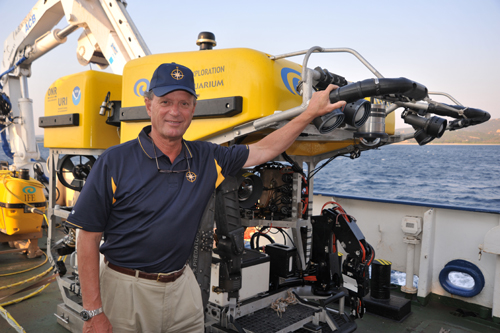
Deep-sea explorer Robert Ballard. Photo courtesy seasearch.com

One is a legendary explorer who now works in films. The other is a legendary filmmaker who now explores. Robert Ballard and James Cameron are woven into Titanic history, deep-sea exploration lore and each other’s lives.

Ballard is a marine biologist whose discoveries include such shipwrecks as the German battleship Bismarck, the USS Yorktown, John Kennedy’s PT-109 and most famously, Titanic. He has also discovered hot air vents 9,000 feet under the Pacific Ocean near the Galapagos Islands and helped develop the technology that allows deep-sea exploration without risk to human divers. He is also a documentary filmmaker, working on series and specials with National Geographic.


His friend Cameron is also known for developing technology, employing special effects advances on the world’s two highest-grossing films, “Avatar” ($2.8 billion worldwide) and “Titanic” ($1.9 billion worldwide  and counting with its current 3-D release). Cameron’s underwater explorations include visits to the Titanic wreck site and a recent one-man dive nearly seven miles deep into the Mariana Trench.

During a March 26 telephone interview, Ballard discussed Cameron, Titanic and how technology impacts deep-sea exploration.

Toledo Free Press: It’s interesting to speak to you just hours after your friend James Cameron made his dive to the Mariana Trench. Were you involved in that expedition?

Robert Ballard: He is an amazing guy. I just flew in from London so I have not seen any footage, but I have been well aware of the expedition. We are good friends, and we have been communicating about it for quite a while. We all know one another. It’s a big ocean and there is plenty of room for a lot of us.

TFP: How long have you collaborated with Cameron?

Ballard: Jim and I have been friends for a long, long time. He contacted me shortly after I found Titanic. He came and visited me and I helped plot his strategy. During the filming of “Titanic” he would call me. Remember, when the movie starts, the ship has already been found.

He was mostly interested in footage I had taken, how I got into the ship, because he wanted to film in it as well. It’s always been a close association. He invited me to the premiere in 1997 and we’ve remained good friends.

TFP: You have very strong feelings about preserving Titanic. When Cameron first contacted you, did you have misgivings?

Ballard: He shared my views on not taking things from Titanic. We shared the same philosophy and we collaborated. He just lent me some of his powerful lights for my next expedition.

Robert Ballard

TFP: There is an explorer in Cameron’s film named Bobby who resembles you. Will you see the new 3-D version of “Titanic”?

Ballard: Of course, I’m excited to see the 3-D version. I shoot in 3-D, so I am familiar with the technology.

TFP: What 100th anniversary observances are you involved in?

Ballard: We have quite a number of projects. There’s a cover story in the current issue of National Geographic, television shows about Titanic, an exhibit at Mystic Aquarium here in Connecticut and a huge project in Belfast, Ireland, we’ve been working on for four years — Titanic Belfast’s Ocean Exploration Centre — which will help enthuse people about our oceans. There will be a lot of activity, then we’ll move on.

TFP: You had relationships with some of Titanic’s survivors. Your choice to explore the ship but not take anything from it must have encouraged a bond.

Ballard: I knew a number of survivors, Eva Hart [who died in 1996] in particular. All the survivors, all the families who lost relatives, all felt the ship should be left alone. The Smithsonian felt it should be left alone, the British Museum felt it should be left alone, all of the people closely associated with the Titanic felt it should not be desecrated.

TFP: Your list of discoveries is legendary, but Titanic is your best-known find. When you discovered the wreck site, you could not have known how big a role Titanic would play in your life.

Ballard: When I first started looking for Titanic, I wasn’t that emotionally attached to it but when I found it the ballgame changed. The most important discovery was finding where the humans landed. Titanic sank fairly quickly, but hundreds of people went over without life jackets, succumbed to hypothermia and fell to the ocean floor. Their bodies were eaten by the animals, their bones dissolved, but their shoes are left there as their tombstones.

So all over the debris field you have pairs of shoes, and those are very powerful images. Titanic spoke to me.

TFP: We know now that your search for Titanic was almost a cover operation for a U.S. Navy project.

Ballard: Titanic gave me an opportunity to take some missions that were classified at the time. They dealt with finding two nuclear submarines that we lost during the Cold War, the Thresher and the Scorpion. We did not want the Soviet Union to know where those submarines were, so Titanic provided a convenient distraction while we found the submarines.

TFP: Very few people will ever experience a deep-sea dive on the scale you have made. How do you excite people about such exploration?

Ballard: It’s clearly like going to another planet. Most of our planet is covered by deep water, not meant for humans to live in; we can only make short visits. But there are tremendous resources and knowledge to be gained. That is why we go.

We may never live in the deep sea but we will most certainly one day move onto the ocean’s surface; we’re doing that now as thousands of people live on oil platforms. I see a day when more people will live on the ocean.

TFP: How has technology affected the adventurous elements of exploration?

Ballard: More and more often we’re using robots; I don’t physically go like I used to. I am more interested now in exploring and learning than I am in the experience of diving. It’s sort of like, I like horseback riding, but I don’t ride the horses to work. I’m looking at the most efficient way of doing it. I can do most of the robotic operations from land; I don’t even have to go to the sites. What I learn is more important than how I learn it.

TFP: With the adventures and dangers you have faced, do you find a hard time putting in an average day? After you’ve been two miles under the ocean surface, how do you approach a normal day in everyday life?

Ballard: It’s no different. My community is very nice and quiet; I was just at the store buying my salad for lunch, and no one treats me differently. I put my pants on one leg at a time, just like everyone else.

Michael S. Miller is editor in chief of Toledo Free Press and Toledo Free Press Star.

Local artist’s great-grandfather saw Titanic set sail

0
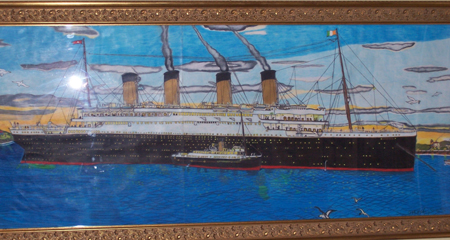
Titanic is depicted about to leave Cherbourg, France, in this painting by Ralph Henry titled "Floating City of Lights."

Local artist Ralph Henry has spent years chronicling the maiden and final voyage of the most famous ship in history. Working in colored pencil, Henry has drawn more than a dozen portraits of Titanic — depicted everywhere from the docks at Southampton, England, to its final resting place at the bottom of the sea.

His works have been displayed in various locations around the area since 2006, most notably in a regular exhibit at the Lucas County Fair. But as the great ship’s voyage came to a sudden end, so too will Henry’s work in tribute to it.

“I’ve drawn quite a few of them, and this will be the last one,” Henry said. He noted that this year’s portrait will be given away as part of the festivities at the Lucas County Fair. “I’m actually titling it, ‘Steal the Titanic.’

“Lucas County, I will say, since ’08 has been the best and most accommodating, as far as my artwork goes.

“They have really graciously enjoyed the Titanic and stuff. And this year, when I actually informed the board that this would be my last year, they were kind of disappointed. I went, ‘Look, since you guys have had it, this’ll be the fourth year of you running it, it’s the anniversary — let’s let it go after this.’”

Painting by Ralph Henry

Although Henry’s interest in art goes back to his childhood, his passion for all things Titanic goes much deeper — you could even say it is in his blood. His great-grandfather, a shipbuilder from Yugoslavia, was actually present the day Titanic sailed.

“I had to write a report in the fifth grade, and I was sitting at my grandma’s desk,” Henry, a native of Jackson, Mich., remembered. “And I was looking it up in a little encyclopedia I got from Kroger, and it had a little picture of Titanic, and just a teeny little article. And my grandfather just happened to walk by and said, ‘I can tell you a better story than that book will.’

“And he sat down and relayed how his father was there the day Titanic sailed. He met with the shipbuilders. My cousin has the documentation. … He met with [ship designer] Thomas Andrews the morning Titanic sailed to sign agreements with them to build their ships for Yugoslavia.”

His grandfather’s story helped inspire young Henry’s passion for things aquatic — in addition to Titanic, he has drawn portraits of numerous other noteworthy naval subjects (and disasters) such as the Bismarck and the SS Edmund Fitzgerald. In fact, it was the latter that reignited Henry’s passion for art after a break of nearly a decade.

“I stopped drawing in 1995, actually, for 10 years. In the ’90s, I was making a lot of artwork and giving them as gifts. I really didn’t do any ships, though, just odds and ends and everything,” Henry said.

“In 2005, a neighbor bet me that I could not draw the Edmund Fitzgerald. And I said, ‘Fine, I’ll do it.’ And when I gave him the picture, he’s like, ‘I can’t believe this.’ And I just started drawing them again.”

He soon returned to his childhood obsession, and began creating works dedicated to Titanic.

“I did three in 2006, and one of them won first place at the Wood County Fair. Unfortunately, I don’t have them — my ex does,” he said, noting that he was told via email the paintings had been burned.

In addition to the exhibits at local fairs, Henry’s work has been displayed in several local libraries, such as Way Public Library in Perrysburg and the Maumee branch of the Toledo-Lucas County Public Library, which is exhibiting his portraits of the Titanic this month in commemoration of the sinking’s 100th anniversary. He made clear that his muse is not limited to nautical subject matter, however.

“I draw just about anything — I’ve drawn John Lennon, the Last Supper, just basically anything  I can draw — I can try it. I’m not gonna promise nothing, but I’m going to try it. I believe every artist has their own style, their own techniques, and everybody does it differently.”

“I look at it like, I don’t like to compete with other artists. Even though that’s what you do in the fair,” he said.

And through all his work on the great ship, whether it be his more realistic pieces or his more recent works which depict it in neon, augmented by a black light — Henry said he takes great care to capture the essence of the luxury liner, down to the last detail.

“It’s kind of difficult to explain, because when I do a piece, no matter what it is — I get a photograph of it, and I study it, very carefully. I believe in detail. I look very closely at the detail, and how I want it to look. Titanic has a lot of detail.

“It’s almost like a puzzle you’re putting together.”

Local researcher raises questions about Titanic legends

0
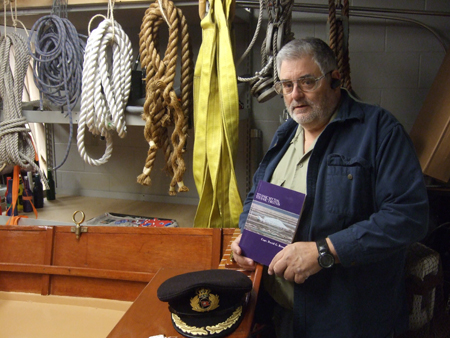
David Brown of Port Clinton, a Great Lakes captain and Maritime Academy instructor, has written two books about Titanic. Toledo Free Press photo by Erik Gable

What really happened the night Titanic went down? That question has become a passion for Northwest Ohio resident David Brown, whose research has led him to believe many of the traditional accounts of the unsinkable ship’s fateful wreck are wrong.

Brown, who lives in Port Clinton and teaches boat building at the Maritime Academy of Toledo, is releasing his second book about the disaster, titled “Titanic Myths, Titanic Truths.”

A licensed captain who has sailed all five Great Lakes, Brown also operated the Maumee River Water Taxi with a friend for about a decade. His interest in Titanic was piqued when he saw something in filmmaker James Cameron’s treatment of the disaster that didn’t seem right.

“I got into Titanic when I saw the scene where it strikes the iceberg in Cameron’s original version of the movie,” he said. “Bluntly, it’s impossible for a ship to do what was depicted in the movie and in most books and in most of the TV documentaries.”

Brown’s first book on the unsinkable ship, “The Last Log of the Titanic,” was published in 2000. He said he considers that book “a very good effort for when it was written,” but it has become dated as Titanic scholarship has advanced.

“I’m very proud of that book, but time has passed,” he said.

David Brown

For his new book, Brown said, he sat down and tried to figure out what it would take for every single statement Titanic survivors made in their testimonies to be true.

“What I’ve come to realize is that the classic version of the accident is not even close to what happened, nor could it be,” he said.

Brown said he’s no conspiracy theorist. There are any number of people with elaborate theories about the sinking — including one author who argued the doomed vessel was actually Titanic’s sister ship, sunk as part of an insurance scam — but Brown doesn’t buy into those.

The surviving crew members likely told the version of the story that was in their own best interests, he said.

Brown said the evidence suggests Capt. Edward Smith had been maneuvering the ship south in small increments to avoid ice, which ultimately was what placed the fatal iceberg in Titanic’s path. The conventional story of the ship scraping the iceberg while trying to pull away, he said, is physically impossible — as plausible as it might seem to someone who’s used to driving a car, not steering a ship.

“It’s a physical impossibility for them to have scraped the starboard bow while turning left,” he said.

In fact, Brown said, by the time the officer in charge of the bridge realized the iceberg was upon them, the only reasonable option was to accept the ship would strike it. Rather than steering from the front like a car, he said, a ship pivots around a point, and trying to move away from the iceberg at that point would only have worsened the damage.

Brown said he suspects even in 1912, with the automobile age in its infancy, most people’s land-based experience would lead them to see failing to pull away from the iceberg as foolish. That, he said, may be why some survivors described events the way they did.

“It didn’t sound logical,” he said. “Why would you deliberately run into something? But sailors are taught to take a glancing blow.”

Brown also theorizes that one of the biggest errors after the strike was engineers trying to start a bilge pump and mistakenly opening the wrong valve, letting water come rushing into boiler room No. 5.

The cause of this fatal mistake? Brown hypothesizes that when one of the engineers was injured and his superiors tried to help him, the result was the command structure falling apart.

As with many accidents, he said, there was no single cause that led to the deaths of more than 1,500 people.

“When two cars collide, 90 percent of the time both drivers had opportunities to avoid that accident and didn’t take them,” he said.

If the same thing had happened to the same ship as little as a decade later, Brown said, it probably would have ended differently — because the ship’s crew would likely have included many war veterans with firsthand knowledge of damage control.

“If Titanic had struck an iceberg after World War I, the engineers would have saved it,” he said.

Many Northwest Ohio families broken by Titanic disaster

0
Titanic sets sail on her ill-fated maiden voyage. AP file photo.

When the Atlantic Ocean swallowed all 46,328 tons of Titanic, a poor immigrant sat waiting thousands of miles away for her fiancé to join her at their new Toledo home.

She would never see him again.

Another local woman would soon have to identify her husband’s body — only to learn that he shared the last hours of his life with a mistress.

A woman who convinced her brother-in-law to visit her from England would discover she inadvertently coaxed him to his icy death.

And in Fremont, beet farms would forever lie waiting for the hands of workers from Belgium to unearth their produce.

The ship sank thousands of miles away but Northwest Ohio felt the waves.

Chaos through a porthole

The death and wreckage washed up in the nightmares of some Toledo residents for their entire lives. The sight left one woman, Flora Posan, almost too terrified to travel overseas again to visit her Hungarian parents.

Posan was born outside of Budapest, Hungary, and moved to Toledo with her husband and children for factory work. When her second husband died in an iron works accident, Posan, her sister and her three children boarded Carpathia to voyage to her homeland.

They never made it there. Instead, they ended up back in New York City with a ship full of heartbroken Titanic survivors and the ghosts of those who lay down to die on the Carpathia’s decks.

“The deck was a scene of chaos,” Posan told a relative during an interview conducted later in her life.

Posan’s grandson Jerry Bascuk lives in Maumee. He said she was a strong woman — she outlived three husbands, raised four children, endured the death of one and witnessed the human carnage of Titanic’s demise.

Posan and her family traveled in Carpathia’s steerage. She watched from the porthole of the deck at about 1 a.m. She saw lifeboats overturn, tossing 16 women and children into the water to drown.

Many of those pulled aboard Carpathia died on the deck, she said.

“The next morning I watched them bury some of them,” she said. “They put the bodies on planks, the priests came by and spoke over them and they dropped them in the water. I was young then and I watched them do it; I wouldn’t do it today.”

Posan was 25 years old at the time. Bascuk said he found during his research that Posan traveled to Hungary in 1914, but the incident with Titanic left her hesitant to commit to any further sailing. She stuck to her East Toledo home in the Birmingham neighborhood for the rest of her life. She raised chickens in her backyard and grew much of the family’s food in her garden. Bascuk, who lived with her during part of his childhood, remembers little rewards he’d receive for shoveling coal — the occasional 50-cent pieces waiting for him downstairs in the mornings.

Posan’s sister Barbara told Toledo News-Bee that she saw things that she’d never forget.

“We would like very much to see our father and mother again before they die,” she told a reporter through an interpreter. “They haven’t long to live. But my sister and I wouldn’t cross the ocean now for all the money in the world.”

Lost life, lost love

Others from Toledo would never get to make that choice.

Karl Harbeck, of Blissfield, Mich., has done a lot of digging to learn about his distant relative who died when Titanic sank. That relative, William Harbeck, had two children but they never had kids. Fortunately for Karl, researching him wasn’t too difficult because he was fairly famous.
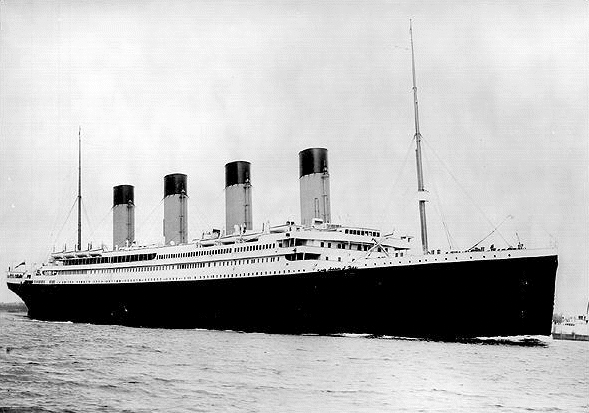
Titanic (AP)

William made movies. He was once the deputy sheriff of Lucas County. He marketed the 1890s version of Viagra, he ran a laundry business and edited a newspaper in Colorado. The Toledo native had his hand in a little bit of everything at the turn of the century.

Born in the 1860s (his exact birth date is disputed because it was recorded differently by various sources), William was the son of Lucas County Sheriff John Harbeck. After stints as the deputy sheriff and a laundry business manager, William sold “Long Life Sexual Power Wafers” from his Downtown office on Superior Street during the 1890s. These $3 packages would help “weak and impotent men and women secure healthy, powerful and vigorous development,” according to a pamphlet Karl found on eBay.

William’s film career took off in the late 1890s. He was one of the first motion picture photographers to catch the 1906 San Francisco earthquake on film. He worked as the official photographer of the Canadian Pacific Railroad. He worked for a company called Hale’s Tours that commissioned him to film cities and tourist attractions. The job took him to Yellowstone National Park, to Vancouver, Canada, and various other cultural hot spots. His career ultimately led him aboard Titanic, after he was hired to film the ship’s maiden voyage. He recorded events while en route and planned to depart from Titanic on a tugboat so he could film the ship’s arrival to the New York City harbor.

But the ship sank before that could happen. And all of his 110,000 feet of film went down with it. His body was found floating in a life vest.

William’s body was shipped to Halifax, Nova Scotia. When his wife Catherine arrived to identify the body, officials told her that records showed that his wife also died on the ship. She then learned that her husband had voyaged with a mistress — a French woman named Henriette Yvois. She was half his age. He booked her as his wife.

“One wonders what was going through her mind when she had his body picked up in New York and brought him back for burial and all of this came out,” Karl said.
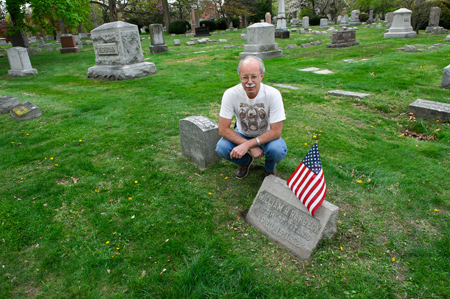
Karl Harbeck at William Harbeck’s grave in Toledo.

Regardless, Catherine continued to maintain William’s other residence in Seattle to handle her husband’s film business, Karl said.

The Harbecks are buried at Woodlawn Cemetery. William’s faded gray headstone is slightly sinking into the ground, marked with the words “Victim of Titanic.”

On the lam or lost at sea?

Just 40 miles south, in Findlay, another family got word they’d lost a relative. The Yates family received a handwritten note indicating Jay Yates had perished on Titanic. He too was famous … but for different reasons. Yates was wanted for arrest in seven states.

Newspaper accounts described the man as a gambler, confidence man and fugitive from justice.

“Thank God, I know where he is now,” his mother told the Toledo News-Bee in April 1912. “I have not heard from him for two years. The last news I had from him he was in London. I spent nearly a fortune getting him out of trouble some years ago. Then he was charged with forgery.”

But perhaps she still did not know where he was. No one by his name, or his alias J.H. Rogers, was listed as a passenger on the ship. Some family members claimed to have thought they saw him after 1912 and many historians believe the note was a ruse.

But newspapers at the time reported that he went down with the ship.

An article from the Chicago Inter-Ocean reported that the man borrowed $1,900 by having another woman forge his wife’s name to a mortgage. Yates was also charged with stealing $2,700 in postal money orders, according to a 1998 Findlay Courier article.

When Titanic sank, newspapers reported that all that was left of him was a note, scribbled on a page torn from a diary and handed to one of the many women he supposedly helped board lifeboats.

“If saved, inform my sister, Mrs. J.F. Adams, of Findlay, O. Lost. — J.H. Rogers,” the note said.

According to the News-Bee, the woman who took his note mailed it to his sister in an envelope labeled “Survivor.” She wrote that she didn’t know Yates but that she thought he was a card player. Before her boat lowered to the water, she saw him jump into the ocean, she wrote.

She also noted that she thought he registered to the ship with a fake name.

Even if Yates was on board, some doubt he died in the Atlantic in 1912. The Findlay Courier article states that some family members believed, as of the 1990s, that Yates might have secured a lifeboat by disguising himself as a woman.

Destination NW Ohio

Northwest Ohio was the destination for many Titanic victims, according to Toledo News-Bee archives. There were the Vanderplanckes, a Belgian family seeking farm work and Henry Michael Mitchell, a 71-year-old retiree from Guernsey Islands, England, who intended to visit his sister-in-law in Toledo. And there was John Andonis of Hungary.

The Toledo News-Bee reported that a woman named Martha Kuskie moved to Toledo from Hungary in March 1912. She worked as a maid at the Madison Hotel. She and her fiancé had planned for him to join her in April so he bought a ticket to board Titanic to travel to the United States. Kuskie’s fiancé, a third-class passenger, was never found.

The Vanderplanckes were four of many Belgians taking Titanic to America. They perished, along with all but six of their fellow countrymen aboard, according to a 1998 article in Voyage, the journal of the Titanic International Society.

According to the article, the Belgians came primarily from two areas: Denderhoutem in East Flanders and Zwevezele in West Flanders. Many of them were recruited by travel agencies to work seasonal agricultural jobs. Much like migrant farmers today, they could save money and sail back home to share some of their earnings with their families.

A Fremont  company attracted Belgians for this reason. The Toledo News-Bee reported that the Continental Sugar Company expected at least 100 Belgians en route to work in the company’s beet fields died when Titanic sank. Many of these employees had spent winters in Belgium and summers in America.

This was the case of the Vanderplanckes. Julius Vanderplancke, 31, was employed by the company for four years. He returned to Belgium in 1911 to marry Emilia Vandermootele of Pittem, Belgium. The couple boarded Titanic with Julius’ 18-year-old sister Augusta and her 15-year-old brother Leo. Another Zwevezele resident named Victor Vandercruyssen joined them, according to “Ohio Tales of the Titanic” by Janet White and Mary Ann Whitley, a Northeast Ohioan who is a copy editor at The Plain Dealer.

The group traveled in third class and their bodies were never recovered.

Another trip ended in tragedy for Henry Michael Mitchell. The 71-year-old retiree was on his way to visit his sister-in-law Anna Jeffery, of 1605 Collingwood Ave. Mitchell had originally booked a trip on Philadelphia, which would have left harbor April 6. But a coal miner strike rendered the ship incapable of traveling, so Mitchell’s ticket was transferred to Titanic, according to Whitley and White’s book.

Jeffery, a widow, reportedly never forgave herself for convincing her brother-in-law to visit her, according to Whitley and White’s book.

The guilt of Belfast

“Ohio Tales of the Titanic” includes information about the 55 Titanic passengers who were headed to Ohio. Twenty-eight of them died. Whitley and her co-author toiled for years, scouring census records and local history departments at libraries, conducting interviews and scanning any other documents that led to clues about passengers. Whitley described the last six months as nonstop. They finished just in time to release their findings before the 100-year anniversary.

Her dedication to the subject is rooted in her family history. Her grandfather Edward Whitley and his brother-in-law helped build the ship that sunk. Edward died when Whitley was young so she did not talk to him about his experience in Belfast, Northern Ireland, building Titanic. But she said her father, who was a young boy when the family moved to America, recounted his childhood overseas. The disaster left Belfast, where much of the ship was assembled, horror-struck.

“I think they almost felt ashamed in a way and felt that they were blamed that this ship that they built had caused this big loss of life,” she said.

Some 1,500 employees worked long hours to construct Titanic. Whitley’s grandfather, who was a machinist and worked on the ship’s engine, did not board the ship. One of his friends, Archie Frost, wasn’t so lucky. Frost was part of the troubleshooting team on board. He and the rest of the team didn’t make it, she said.

That guilt loomed for years, an unspoken sorrow harbored by so many who lived in Belfast. One of Whitley’s relatives told her his grandfather was evidence of this.

“(He) only cried about two things — World War II and Titanic.”

Titanic survivor lived in Adrian, Mich., 50 years after sinking

0
Sister Patrick Joseph Kelly, Titanic Survivor. Photo courtesy Adrian Daily Telegram

By DWIGHT LEONARD
(Adrian, Mich.) Daily Telegram

Titanic went down 100 years ago in the North Atlantic, but the events of that night were very familiar to one former Adrian resident.

Sister Patrick Joseph Kelly, an Adrian Dominican sister for 46 years until her death in 1969, was one of the relatively few people to survive the sinking of Titanic in 1912. Her journey began in County Mayo, Ireland, where she was born Anna Katherine Kelly, according to a paper written by her great-nephew John Kelly. At the age of 20 she decided to come to America where her sister and several cousins were living at the time.

On April 11, 1912, she boarded the RMS Titanic. Kelly made the voyage as a third-class passenger with a group of 14 others emigrating from County Mayo. Among this group were several members of Kelly’s family. At 11:40 p.m. April 14 the ship struck an iceberg in the North Atlantic and began to take on water.

An article from the Irish Independent reported in May of 1912 that people from the lower decks were kept from coming to the upper decks where they might have had a chance to board the lifeboats. The article goes on to say that Kelly was escorted through the crowd by a steward she met on board.

She was able to escape the sinking ship by getting into Lifeboat 16 just before it left. A seat opened in the boat when a young wife refused to leave her husband, choosing instead to stay on the sinking ocean liner.

More than 1,500 passengers died when Titanic went down. Less than one-third of those onboard survived, just more than 700 people. Of the 14 members of Kelly’s group, only three survived that night.

After being rescued by the Carpathia, Kelly was hospitalized in New York City then sent to Chicago with Ann McGowan, another survivor from the group.

Kelly remained in Chicago until 1921. She did not speak at all about her experiences despite encouragement to do so from her family.

Kelly even voted in a precinct other than the one in which she lived so that those who might be looking to talk to her about the experience would not be able to find her.

While in Chicago she became acquainted with the Adrian Dominican Sisters and in 1921 joined the convent in Adrian, taking on the name Sister Patrick Joseph Kelly.

Kelly spent time teaching in three schools in Chicago and two others elsewhere in Illinois. She also taught for a short while at four different schools in Michigan and one in Iowa.

In June 1969 she retired from teaching. She spent her retirement at the mother house in Adrian until her death in December of that year.

Lenawee connections

Another Lenawee County connection was announced in the Daily Telegram on April 17, 1912, when Hudson residents Harriet and Charles Halsted, siblings of passenger Catherine Crosby, feared their brother-in-law was lost after his name did not appear on preliminary lists of the saved:

“Grave fears are entertained here as to the fate of Edward G. Crosby, of Milwaukee, who with his wife and daughter were among the list of those rescued, but no mention is found of Mr. Crosby, and his relatives and friends here are very anxious for further news.”

Edward Crosby’s death was confirmed two days later.

Adrian resident Samuel B. Renington, who had sailed the North Atlantic several times, was the subject of an April 20, 1912, article in the Daily Telegram. He spoke about his observations and understanding of the presence of icebergs in the area where the sinking took place.

The county’s smaller, weekly newspapers, from the Addison Courier to the Tecumseh Herald and Tecumseh News, received full-page, pre-made templates between April 19 and 26 describing the disaster.

An advertisement published in the April 19 edition of that year’s Daily Telegram — and backed by insurance agents from Adrian, Addison, Morenci, Onsted and Tecumseh — was one of the first local ads to capitalize on the sinking:

“In Lenawee County, there are thousands of homes that are constantly in danger of meeting with as great a loss as those who lost their husbands and fathers on the Titanic. If the support of the family is taken away by death, that family not only suffers from grief, but too often from actual privation. We cannot expect a Carpathia to come along and rescue us, but a Life Assurance policy in the Northern Assurance Company of Michigan, will act as a life preserver for those who are left to care for themselves.”

(Adrian) Daily Telegram reporter Dan Cherry contributed to this report.

Ohioan among passengers retracing Titanic’s route

0
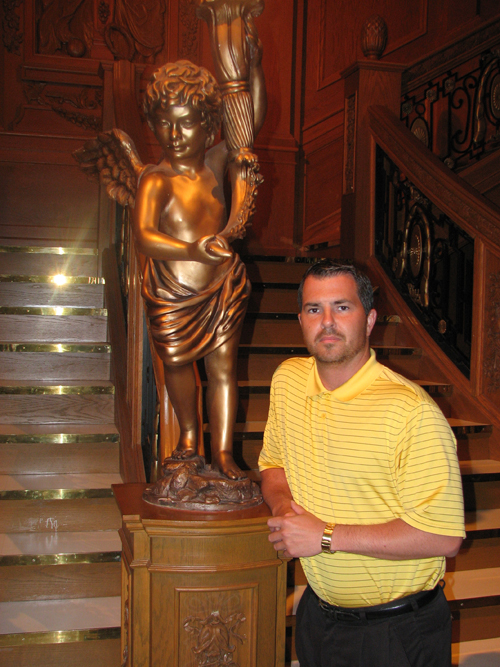
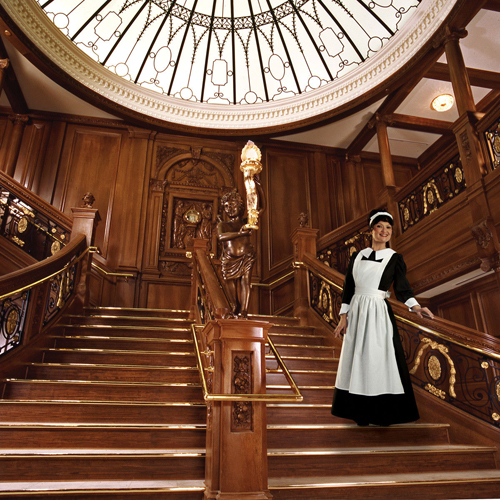
Todd Howell, a Titanic collector from the Columbus area, poses next to a replica of Titanic's grand staircase. Howell was among the passengers on a 100th anniversary cruise that was to retrace the intended route of Titanic. Photo courtesy Todd Howell.

At 2:20 a.m. April 15, Ohioan Todd Howell will be standing directly over the spot where, exactly a century earlier, Titanic foundered before slipping beneath the water’s surface, killing more than 1,500 of those aboard.

“Being over the wreck site could be somewhat eerie,” Howell said. “You think of the North Atlantic as being very rough and choppy, but they described that night as the seas being very calm. If the seas are calm, wow, that’s going to be a little eerie. I just expect it to be a solemn remembrance and am looking forward to completing the trip.”

The Columbus-area artifact collector and amateur historian is one of 1,309 passengers — the same number of passengers booked on Titanic — from more than two dozen countries participating in a 12-night memorial cruise retracing Titanic’s journey from Southampton, England, to New York City.

The trip was already fully booked several years ago when Howell, who works as chief financial officer at Seneca Medical Inc., in Tiffin, inquired. He was placed on a waiting list and jumped at the chance when a spot opened up.

“I’m viewing this as a once-in-a-lifetime experience,” Howell said. “I’m not sure which part I’m not looking forward to. Just being there firsthand — not reading about it, but experiencing it and talking to these family members and historians. It will be a very unique experience.”

Todd Howell

Among those on board will be relatives of Titanic victims and survivors as well as authors, historians and other experts who will speak as part of an on-board lecture series.

One of the lecturers will be author Philip Littlejohn, the only relative of a Titanic survivor to have dived to the wreck site. Littlejohn’s grandfather, first-class steward Alexander James Littlejohn, survived, rowing the lifeboat that carried 9-week-old Millvina Dean, Titanic’s youngest survivor.

Passengers will also include a woman who wants to drop a flower at the spot her great-grandfather died, a woman whose great-grandfather had tickets for Titanic but did not board, a woman whose relative died while his wife survived in a lifeboat and a man whose grandfather helped build Titanic, according to the website of British travel agency Miles Morgan Travel, which organized the cruise.

The memorial cruise departed from Southampton on April 8, making a stop the following day at Cobh, Ireland (formerly known as Queenstown), where Titanic picked up more passengers, before proceeding to the disaster site, where the ship will host a memorial service for the victims.

After the service, the cruise will detour from Titanic’s original route to visit Halifax, Nova Scotia, where many Titanic victims are buried.

Howell’s wife and son will meet him in New York City, the trip’s final stop and the intended destination of Titanic, on April 19.

Miles Morgan Travel also organized an anniversary voyage, which departed from New York on April 10 and will meet the memorial cruise ship, the Balmoral, at the disaster site before stopping at Halifax and returning to New York.

Miles Morgan, founder and managing director of the travel agency, said the memorial cruise is the first trip to retrace Titanic’s route and the trips have been five years in the making.

A five-piece band playing period music and a menu featuring meals served on Titanic are among the details Balmoral passengers will experience. The ship, leased by Miles Morgan for the memorial cruise, is owned by Fred. Olsen Cruise Lines, whose parent company, Harland and Wolff, built Titanic in Belfast, Northern Ireland.

“Every step of the way we have sought to make it authentic to the era and a sympathetic memorial to the passengers and crew who lost their lives,” Morgan said in a statement.

Howell’s interest in Titanic was first sparked by the 1997 James Cameron movie.

“Historians have poked holes in what Cameron’s movie depicted, but he spent $200 million to bring as much realism to the event as possible,” Howell said. “You can read about it, but here’s someone who attempted to bring the panic and the hysteria to the movie screen. This is what people were experiencing. This was the horror. I thought he just did a wonderful job.”

Howell has been collecting Titanic artifacts for about 15 years. Among the more than 500 artifacts in his collection are an issue of the April 16, 1912, New York Times that printed news of the disaster, a piece of cane from a Titanic deck chair, a piece of carpet yarn from a Titanic stateroom, a smoking room floor tile from Titanic and a copy of the 1912 U.S. Senate Reports and Hearings on the Titanic disaster.

For more information, visit titanicmemorialcruise.co.uk or Howell’s website at thermstitanic.com. O

Henry Ford exhibit brings Titanic experience to life

0
A replica of Titanic's Grand Staircase.

Titanic buffs, history buffs and movie buffs alike may want to make time for a trip across the state line to visit the Henry Ford Museum in Dearborn.

“Titanic: The Artifact Exhibition,” on display through Sept. 30, features more than 300 Titanic artifacts, 250 of which have never been displayed in Michigan. There are also several re-creations, including a first-class stateroom, first-class hallway, third-class cabin, an iceberg and the grand staircase, said Tom Varitek, senior manager of program operations.

The exhibit takes visitors chronologically through the history of Titanic, from its construction to its ill-fated voyage to the discovery of its wreck and artifact recovery efforts.

All the artifacts on display were collected from the debris field at the wreck site; none were taken from the ship itself, which is treated as a memorial, Varitek said.

Display items include a lump of coal, a collection of men’s travel items and a suitcase full of preserved papers.

“The exhibit uses everyday artifacts to create context of extraordinary historic events. The lump of coal is a touchstone to the boiler operators who, even though they knew the ship was going down, stayed at their stations and kept shoveling coal, which kept the lights on,” Varitek said. “You can imagine the terror if the lights would have gone off on top of everything else. Who can say how many lives they saved with people still able to see exits and stairs.”

Grand Staircase replica

The travel items include a shaving kit and instructions on how to work a new camera.

“That really brings the story home to me because those are things I would bring on a trip,” Varitek said.

The papers in the suitcase were preserved because the tanning oil in the leather kept out microorganisms, Varitek said.

“It’s amazing that after seven, eight, nine decades that paper didn’t disintegrate,” he said. “You can still read the writing on letters and postcards even though it’s been on the ocean floor.”

At the start of the exhibit, each guest is handed a boarding pass with the name of an actual Titanic passenger or crew member. At the end of the exhibit, visitors learn the fate of their person.

“If people can associate themselves with a historic event, it becomes a little more real,” Varitek said. “What the museum tries to do is create a touchstone for a historic event, so hopefully at the end it will become a little more real as a tribute to the people and the lives lost and history in general.”

The re-created portions of the ship and iceberg also help bring the story to life, Varitek said.

“We’re really happy to have the staircase. It’s the only traveling grand staircase that’s out there,” he said. “If you’ve seen the movie, it’s the famous ‘Meet me at the clock’ moment for Jack and Rose.”

Visitors can relive that famous on-screen moment in 3-D on the museum’s IMAX movie screen as James Cameron’s “Titanic: 3-D” will be showing through July 19 and again from Sept. 4-30 on the 62-foot-by-85-foot wide screen, the largest movie screen in Michigan. The IMAX theater will also screen filmmaker Stephen Low’s “Titanica,” featuring archival photos of the ship’s construction and footage of its wreckage on the ocean floor combined with recollections of Titanic survivor Eva Hart.

Even 100 years after it sank, people are still fascinated by Titanic, Varitek said.

“Part of it, I think, comes from the rumor that Titanic was unsinkable; at a time when the world was really changing, with the automobile and the airplane, it seemed like nothing could stop new technology, so a tremendous failure of technology really caught people’s attention at the time,” Varitek said.

“People are intrigued by moments where they can say, ‘If only we could have done this or that differently,’ and the fact this was the maiden voyage with some celebrities on board doesn’t hurt. Plus the movies — Hollywood has done such a good job of telling the story, it’s kept it fresh in everyone’s minds.”

Non-member exhibit ticket prices include admission to the museum and are $27 for adults (13-61), $22.50 for youth (5-12) and $25 for seniors (62 and older). Children 4 and younger are free. Admission for members is $10. The museum is open daily from 9:30 a.m. to 5 p.m. with extended hours until 9 p.m. on Tuesdays and for the IMAX theater.

Because the Titanic exhibit is timed, visitors are encouraged to make reservations to ensure a time slot is available when they plan to visit, Varitek said.

Other Titanic-related programming planned at the museum includes:

O “Titanic Remembered: 100th Anniversary Event,” a sold-out commemorative event set for 7 p.m. April 14, featuring hors d’oeuvres, a champagne welcome, dinner, dessert and exclusive access to the exhibit.

O Titanic Tuesdays, a speaker and author series set for the second Tuesday of each month. The lectures are free with admission to the museum. The series kicked off April 10 with author and historian Edward Tenner presenting “Thinking about the Unsinkable” about the unintended consequences of innovation. The series will continue May 8 with Low discussing his film “Titanica.”

For a full listing of events, visit the website www.hfmgv.org/events/titanicTuesdays.aspx.

For more information or to reserve tickets, call (313) 982-6001 or visit www.thehenryford.org/titanic.

Children’s book illustrator depicts Titanic’s voyage

0

One might think that a children’s book on one of the greatest nautical disasters of all time is a somewhat awkward idea. But kids are often much more savvy and intelligent on such matters than adults give them credit for.

Artist Gijsbert van Frankenhuyzen — “Mr. Nick” as his young readers call him — has drawn illustrations for more than 25 books on a wide variety of subjects both fanciful and historical.

His latest, “T is for Titanic: A Titanic Alphabet,” examines the story of the legendary ocean liner in a way that curious young minds can relate to.

In an interview with Toledo Free Press, van Frankenhuyzen said he loves meeting with children to discuss the book, and that they frequently surprise him with the depth of their knowledge.

“For example, I told them, ‘Did you know that one of the smokestacks on the ship was not a real smokestack?’ And one little guy goes, ‘Yeah, but it still was used for ventilating the kitchen!’ And this is a second-grader. They know so much more than we think.”

A native of the Netherlands, van Frankenhuyzen gravitated toward art at a young age. “I was always painting and drawing, and I went to art school, but I could only go to art school if I learned a profession. I could not become a painter, my dad said, because I had to make a living. So, I went to art school and I studied graphic design.”

After a brief period working as a designer at an advertising firm in the Netherlands, he relocated to Michigan where he worked for the next 17 years, until the magazine he was employed at shut down.

“I took that time as a time to start painting for myself. And it worked — I was doing fine, I was doing work for museums, a little book illustration here and there — it kept me busy,” van Frankenhuyzen said.

“Then, in 1997, Sleeping Bear Press called me and wanted to know if I wanted to do their fi rst children’s book. And I said, ‘You bet!’ That’s really what I always wanted to be, was an illustrator. It was just something that’s really tough to get into. And here was the publisher, calling me! So that was great.”

Sleeping Bear Press, at the time, worked exclusively in books for older readers — their foray into children’s work was supposed to be a one-time deal. But the book, “The Legend of Sleeping Bear,” was a phenomenal success, putting both Sleeping Bear and van Frankenhuyzen on the map.

He’s worked with the publisher ever since, illustrating a wide variety of works.

“The Titanic book was book number 28,” van Frankenhuyzen said with pride. “When I started doing books, I wasn’t quite sure if I had to adjust my paintings for kids to make them kid-friendly. But I didn’t — I paint them the same way I paint my own stuff,” he noted. “I kept it all exactly the same, except I brightened my colors.”

That’s not to say that the artist’s work hasn’t evolved during his time working on the books.

“I pay more attention now to the little things than I did at the beginning of the books. And with an alphabet book, you kind of have to. Especially with this Titanic book. There’s a lot of stuff in there that I couldn’t mess around with. That’s the way it looked, and that’s what I had to paint.”

He joined the “T is for Titanic” project unexpectedly one day, while visiting his publisher’s office.

“I was at Sleeping Bear Press, delivering a book that I just finished. And as I walked in, one of the editors, the main woman, she was on the phone and she kind of waved at me coming in,” van Frankenhuyzen said. “And all of a sudden, she calls from her office, and she says, with her hand on her phone, she pulled it away from her ear and she says, ‘Nick, if we’re doing a book on the Titanic, would you be willing to do it?’ And I said, ‘Oh, sure, why not?’ And she puts the phone back to her head and says, ‘He’s in! He’ll do it!’”

The staff of the Titanic Museum in Branson, Mo., had seen his work. When they approached Sleeping Bear Press with the idea to do a children’s book on the ship, they specifically asked for him. Van Frankenhuyzen was a little nervous at first about dealing with them, especially since they weren’t giving him any guidance on his portraits.

“When the whole book was done, she saw the proofs — the woman from the Titanic museum — I finally did get an email from her. And it just said, ‘Nick,’ and in all capital letters: ‘I LOVE, LOVE, LOVE THE PAINTINGS!’ And that was it! They were very pleased.”

There is no rest for van Frankenhuyzen in the days to come. After all the exhausting research devoted to a subject on the ocean floor, his next project is going in the opposite direction — he’s illustrating a book about deserts.

“The deserts, there was not much hands-on, because I told Sleeping Bear, ‘Why don’t you send me to the Gobi or the Sahara for a while?’ And they, of course, wouldn’t do it. And they said, ‘Just Google it!’”

Pounds: Wear Blue to Work April 11

0

There are some causes that should not exist. Child abuse is one of those issues that, with education and evolution, should be relegated to the scrapheap of human history, with bubonic plague and scurvy.

But in 2011, Lucas County Children Services (LCCS) received 4,148 referrals of suspected child abuse involving 6,046 children and discovered 587 area children were abused or neglected. The agency’s hotline for reporting child abuse receives about 750 calls per month and 300-400 are investigated.

April is National Child Abuse Prevention Month. This year’s theme is “child abuse is preventable.” LCCS has worked with local media to spearhead a number of events, including a March 29 Blues Against Child Abuse concert, which drew nearly 150 people to Dégagé  Jazz Café in Maumee to hear Voodoo Libido and contribute to the cause.

LCCS has more events planned throughout April, including Wear Blue to Work Day on April 11. As reported by Toledo Free Press Staff Writer Brigitta Burks, workers are encouraged to wear blue to the office, photograph a group of co-workers wearing the color and post it online via social media.

“We’re trying to get everybody aware and develop that sense of camaraderie,” LCCS Public Information Officer Julie Malkin said. “We want to have fun, get people involved and aware and take advantage of social media.”

Buttons promoting the day are available by calling (419) 213-3254.

LCCS and other agencies will present information at the  “We Care About Our Kids: Community Forum on Child Sexual Abuse” at 6:30 p.m April 18 at the University of Toledo Scott Park Campus. Admission is free.

A ceremony honoring local children who died as a result of street violence, abuse or neglect will take place at 11:30 a.m. April 25 at the LCCS offices, 705 Adams St., Toledo. Since April 2011, no children have died in Lucas County from abuse or neglect, but Timothy Blair, 14, Deadrick Rocker, 17, and Montelle Taylor, 17, died as a result of violence.

To help promote Wear Blue to Work Day, LCCS and Toledo Free Press invited dozens of community leaders to the Main Toledo-Lucas County Public Library for this week’s cover photo. Jim Walrod of the Image Group provided the blue T-shirts for people from every walk of local media, government, public services and nonprofit life. We profusely thank each and every individual who gave his or her time for the photo, taken by Toledo Free Press Photo Editor Joseph Herr.

Wearing a blue shirt to work is a minor gesture for such a crucial issue. We hope to see you in blue April 11.

To report a case of suspected abuse, call (419) 213-CARE.

Thomas F. Pounds is president and publisher of Toledo Free Press and Toledo Free Press Star. Contact him at [email protected].