After having rushed to countless scenes to help people in the snares of tragedy, two Toledo-area residents became victims.
Charlie Adair, 45, and Ron Lumbrezer, 64, were both struck by cars and killed last year.
Adair, a volunteer firefighter, had stopped to assist crews in a car crash Oct. 28 when a passing vehicle struck her.
Lumbrezer was hit Jan. 11, 2011 while he was crossing the road in front of his house.
Lumbrezer’s son, R.J., and Adair’s husband, Craig, planned a community track meet April 29 at Holy Trinity School. Tickets are $5, or 5 for $20, for a full day of dashes, runs, relays and mother/daughter and father/son competitions. There will be tug of war, baseball
throwing and hitting competitions, a corn hole tournament and a foul shooting contest.
Various fire departments will also play a tug of war for donations to their department and the Charlie Adair and Ron Lumbrezer Memorial Fund.
The Fulton County Sheriff’s Department will attend to fingerprint kids and the North Star BHP Steel company will discuss safety and demonstrate to children the differences between candy and medicine.
“It’s not just a track meet,” Craig Adair said. “It’s more a family get-together and have fun day and that’s what she would always want to do.”
Following Adair’s love for children and involvement with the Holy Trinity, the memorial fund will be split up among scholarships for students and teachers.
Present or future students who need financial help to attend the school will be eligible for scholarships from 75 percent of the memorial fund. The other 25 percent will go toward a teacher’s assistance fund, R.J. Lumbrezer said.
Adair taught sixth grade, coached volleyball and helped struggling kids get through their homework in tutoring sessions. She had started talking about wanting to become a volunteer firefighter in 2001.
Always known for getting things done, Adair made it happen a few years later. She was a volunteer firefighter for about six years, Craig said.
“If there was more of her in the world it would be a lot better place,” he said.
Lumbrezer also had a history of serving. He was in the National Guard and also the Metamora Fire Department years ago. He then worked in the insurance business for more than 40 years, starting with Prudential and later owning and operating Lumbrezer-Malone Insurance Agency until 2008.
He served musical tastes too. Lumbrezer played guitar in his band Sound Garden for 25 years. The group played covers of many genres, including country, pop
and rock, for weddings and other formal events. They also played for square dancers.
R.J. said the funeral was packed, with a two-and-a-half-hour wait to see the casket.
“He was very well-liked,” he said. “He was very good with people and it didn’t matter who you are, Dad could identify with you regardless of social differences on any end of the scale.”
April 22 Yell & Tell rally places focus on child abuse
When Yell & Tell: Stop Child Abuse Now, Inc. had its first rally in 2004, founder Pamela Crabtree wasn’t sure it’d ever have another. However, years later, the organization is planning its ninth rally.
“We’re not going anywhere. We’re not a threat to any of the big guys. We want to work in concert,” Crabtree said. Her group will have its ninth annual Yell & Tell: Stop Child Abuse Now Rally on April 22 at the Walbridge Park Shelter House. April is also National Child Abuse Prevention Month.
The first rally took place in Washington, D.C., and due to high costs, Crabtree wasn’t positive it would happen again. At her family’s encouragement, however, she brought the rally to Toledo where it has flourished. Throughout the years, keynote speakers have included Congresswoman Marcy Kaptur and State Rep. Teresa Fedor.
“Each year, since 2005, we have grown in stature and respect,” Crabtree said.
This year, University of Toledo head football coach Matt Campbell will give the keynote speech and Becky Shock of 93.5 WRQN will emcee the rally. For entertainment, the Distinguished Clown Corps and soloist Amy Gibson are set to perform.
Several local groups including Lucas County Children Services, Family and Child Abuse Prevention Center and Mercy Health Partners will be on site with more information. In addition, the Lucas County Sheriff’s Office will provide fingerprinting of children and give parents the records, Crabtree said. A silent auction gives eventgoers a chance to bid on Toledo Mud Hens tickets, car services and other prizes. Children will also receive a coloring book in English or Spanish that outlines inappropriate touching.
Crabtree, a survivor of abuse, was inspired to start her group after an experience on an Internet message board that she frequented with other survivors. The message board would occasionally get posts from young people who said they were being abused. Crabtree knew she had to do something.
“I got to the point where I posted a message where I said, ‘We’ve got to do more. We need to walk the walk,’” she said. “We have to tell [the children] to yell immediately. They have to yell and tell.”
Crabtree did not come forward with her story until she was in her mid-40s. “I did not feel comfortable telling anyone because I thought I had done something dirty. I was oblivious to the fact I was a victim of a crime,” she said. Crabtree also wrote a book based on her experiences “The Gift of Hurt,” available at www.pamelacrabtree.com.
“I know now of the importance of survivors, be it boys or girls, to come forth immediately,” Crabtree said, adding that some survivors can become depressed or turn to substance abuse so getting help is crucial.
Society should work toward ending child abuse and make sure to report cases of suspected abuse, Crabtree said. The average amount a family pays in taxes because of child abuse is $1,460 annually, she added.
“If you don’t want to go strictly for the compassionate side of helping kids because you’re afraid to report the abuser … Well, then look at the figure that’s taken out of your budget each year,” Crabtree said.
Some people don’t report suspected child abuse because they fear separating families, which is a misguided notion, Crabtree said.
“I can tell you that the police, Lucas County Children Services or any other child protection order, they don’t want to go in there and pull that child out; they want to help that child,” she said.
In 2011, Lucas County Children Services received 4,148 referrals of suspected child abuse involving 6,046 children. The agency learned that 587 area children were abused or neglected. Thirty-two percent of children served stayed in their own homes, 31 percent lived with a relative, 32 percent were placed in foster care and 5 percent went to a group home or private institution.
Crabtree also recommended that guardians keep open lines of communication so children feel comfortable talking to them. Parents and adults should also be careful to observe signs of child abuse such as changes in sleep patterns or even pregnancy.
In addition, parents should be certain it is safe to leave children with the parent’s boyfriend or girlfriend before doing so.
“Once we can protect our children, the ripple effect will be mammoth and we can stop child abuse, that’s something we do have control of,” Crabtree said.
The free rally is 1 p.m. April 22 at the Walbridge Park Shelter House on Broadway Street, across from the Toledo Zoo. For more information or to donate, visit www.yelltell.org. To report a case of suspected child abuse, call (419) 213-CARE.
Toledo woman worked on three Dick Clark shows
Barbara “Bobbie” John paused for nearly a minute when asked to recall her favorite memory of Dick Clark.
The 86-year-old Toledo woman was a personal friend to Clark for more than 50 years, having worked on three of his shows, including a Saturday night version of “American Bandstand” in New York City. She also worked on his music show “Where the Action Is” and created a music show called “Swingin’ Country” that he produced.
Clark died April 18 of a heart attack at a Santa Monica, Calif., hospital, a day after he was admitted for an outpatient procedure, according to his spokesman. He was 82.
Her favorite memory, she finally decided, was when she once called Clark, years after they had last spoken, asking for some old TV clips for a project she was working on.
“I hadn’t seen him in at least 10 years, but it was like we had talked two days before,” John said. “It wasn’t like, ‘I vaguely remember you.’ There was no hesitation. He said, ‘Sure, come on out. Anything in the library is yours.’ That to me personified him.”
John also treasures a letter she received from Clark in 2010 in response to a package of memorabilia she sent to him.
“I wrote quite a long letter reminiscing with him and he answered back,” John said. “His handwriting is wiggly, but he did it. It’s a lovely letter. The fact that just two years ago, he took the time to answer my letter and we’ve been in touch. That’s something. That’s a treasure.”
Letters and souvenirs from Barbara John’s friendship with Dick Clark.
The typewritten letter with a handwritten signature reads: “It was great to hear from you, Bobbie. Thank you so much for sending along the script, album cover, credit crawl from ‘Swingin’ Country’ and picture of Debbie [her daughter]. You sure brought back a flood of memories! Thanks once again. I really appreciate your thoughtfulness. Sincerely, Dick Clark.”
America’s oldest teenager
Known for his youthful appearance, Clark produced and hosted a number of television shows, most famously “American Bandstand,” which aired for more than three decades starting in the early 1950s.
He also produced and hosted the year-end countdown from Times Square on “New Year’s Rockin’ Eve,” a role he continued in part even after suffering a massive stroke in 2004 that affected his ability to speak and walk. Clark’s handpicked successor, Ryan Seacrest, became the main host.
Among John’s other “treasures” from her time with Clark are a typewritten script from one of the early New York City shows.
Clark hosted “American Bandstand” five days a week in Philadelphia and then filmed a Saturday night show at The Little Theater off Times Square in New York, officially called “The Dick Clark Saturday Night Beech-Nut Show” after its sponsor, Beech-Nut Gum.
John served as assistant to the producer, typing scripts and song lyrics for ABC to approve, as well as prepping the performers.
“Tony Mammarella booked the talent, but I had to make them presentable for TV,” John said. “They were all unknowns. I took Connie Francis and her hovering father shopping to buy her first formal to wear on the nighttime bandstand. I took Frankie Avalon shopping and tried to pick his brain about what looked good to him. I was the one who ended up deciding on white shoes and V-neck sweaters.”
Seeking fortune
A graduate of Libbey High School and Bowling Green State University, John went to New York City to “seek her fortune” several years after getting a divorce. She had been living in St. Louis, working as a writer and producer at a local radio and television station to support her two daughters. After five years there, John left her daughters with her mother in Ohio and moved to New York City.
Unable to find a job right away, she lived in a YWCA dorm room and sold jewelry at the Metropolitan Museum of Art before catching her big break — an interview with Charles Reeves, executive producer of Clark’s Saturday night show.
She met Clark for the first time when she and producer Louis Heyward went to Philadelphia to watch “American Bandstand.”
“I didn’t know anything about pop music and he didn’t either. Neither one of us really knew how we got hired,” John said. “We decided we’d better see what ‘Bandstand’ was all about. So he took me on a train trip to Philadelphia and that’s the first time I met Dick.”
John said she remembers Clark as kind, generous and honest.
“He was a gentleman,” John said. “He was very undemanding. He didn’t hover over your shoulder or make many suggestions or say, ‘That won’t work.’ He hired people because he believed they knew how to do the job. I have tremendous respect for him.”
After leaving the Saturday night show, John developed game shows with actor, comedian and ventriloquist Paul Winchell. However, their work was halted due to the payola scandal, which shut down production at major networks, so John moved to California, where there was an opportunity to air the shows on an independent station unaffected by the scandal.
Soon after, Clark moved to California as well. He wanted to get into game shows, but didn’t know where to start.
“He asked people all over Hollywood, ‘How do you learn to do this?’ and three different people told him to talk to me,” John said. “I was producing [country music show] ‘Melody Ranch’ for Gene Autry at a local station in LA and Dick hired me away from that.”
Although Clark later got into game shows, he and John started working together on a music show called “Where the Action Is.” John was the talent coordinator, booking performers, scouting locations and deciding when songs would air.
When Clark decided his next project would be a show featuring country music, he asked John to develop a concept.
“All these reports that say he stayed current, he stayed ahead of the times, they are very true. He knew country music was going to happen, so I created a show called ‘Swingin’ Country,’” John said. “It was typical Dick Clark. He sold the show [to NBC in New York] and then came back and said, ‘OK, what are we gonna do?’ So we built the show.”
The show featured Rusty Draper as host and Roy Clark as band leader.
“I don’t remember how I found Rusty. He was working at a country club in Lincoln, Neb.,” John said. “Roy Clark should have been host. The network turned him down, but I talked his manager into letting him come on the show as band leader. That was his introduction on national television and in four weeks he really was the star. That was the kickoff of his major career.”
John’s connections to country music were solidified when she served as Johnny Cash’s manager for seven years.
“Swingin’ Country” was credited as “Created by Dick Clark and Barbara John.”
“I had a big fight with Dick about it,” John said. “I said my name should be first. He said, ‘No, I’m better known.’ I said, ‘That’s why my name should be first, so I get to be better known.’”
John sued Clark over it; his name stayed first, but he gave her $100, she said.
“He and I have laughed about it since,” she said.
Staying in touch
John periodically stayed in touch with Clark after the end of their working days.
“I heard he still came to the office every day, even after his stroke,” John said. “He kept his finger on the pulse of everything.”
On the evening of April 18, John watched “American Idol,” where host Seacrest offered a short tribute to his mentor.
“You could tell Ryan’s face was just tight. That had to be the most difficult show he ever did. Dick signed off every show he ever did with a salute and a ‘So long’ and that’s what Ryan Seacrest did. He ended with the salute and said ‘So long, boss,’” John said, her voice cracking. “I didn’t cry when I heard the news. I wrote both my girls immediately and said, ‘I’m not sad. I’m glad he didn’t have to suffer anymore.’
“On all three shows, I felt I worked with him, not for him.
He never came on as, ‘I am the boss.’ I feel privileged to have worked with him.”
Victims of underreported crimes sought
She blamed herself.
She was 18. She was at a friend’s house drinking beer. She started getting so tired she could barely keep her eyes open. She remembered her friend leaving the room with a partner, leaving her alone with a man she hardly knew. Then, nothing.
She awoke the next morning naked. In bed next to the man she hardly knew. Fumbling to get dressed and still feeling woozy, she fled the room before he awoke. She never saw him again. But she hasn’t completely recovered nine years later. She doesn’t think victims really ever do.
Days later, her so-called friend approached her and admitted she had drugged her drink. She was too uptight about men, her friend told her, so this friend figured she’d make things a little easier.
Sharon (not her real name — Toledo Free Press does not identify rape or sexual assault victims) was “uptight about men” because she was molested as a child.
Victim blaming
Even still, Sharon said she fell victim not only to a man, but to her own self-doubt.
“Victim blaming — it is a huge reason why victims do not come forward and it starts long before the victim goes to court,” said Deborah Stoll, director of the YWCA H.O.P.E. Center. “Many people believe and accept the myths of rape. We accept as truth that somehow the victim is responsible for what happens to her; that she shouldn’t be out at night, shouldn’t be drinking, she shouldn’t flirt, she shouldn’t be wearing certain kinds of clothing.”
Fearing that type of reaction, Sharon didn’t talk to her friends or family. She did not report the rape to the police. She worried that she would get in trouble for underage drinking.
“At the time, I didn’t completely understand that it was rape,” she said. “I felt like I had that drink, I wasn’t able to say no, so if i didn’t say no was that really rape? In my mind, that was the process I was going through. It took me a while to come to the conclusion that what happened to me wasn’t my fault.”
It took nearly five years. One of Sharon’s friends had a similar experience and came to her to talk. Sharon found herself repeating to her friend that it wasn’t her fault. That she shouldn’t feel guilty. That she was a victim. And then it clicked.
“If I feel this way about her then why am I so hard on myself?” she wondered.
Reassuring a victim in the same way Sharon did to her friend is one of the most important offerings toward recovery you can make, Stoll said.
Reporting
Reporting a rape is intimidating, Sharon said. There’s the courtroom experience, in which the defense sometimes alleges a victim’s history of flirting or promiscuity or blurs the line as to whether the victim provoked sexual activity between herself or gave tacit consent to the alleged rapist. And prior to that, victims fear being charged with falsifying a police report if his or her story has any holes or discrepancies, Sharon said.
Fifty-four percent of sexual assaults are not reported to the police. And 97 percent of rapists will never go to jail, according to the National Crime Victimization Survey. Nationally, nine out of 100 rapes end up in prosecution.
According to the City of Toledo’s 2010 Annual Report, 140 rapes were reported in 2010.
That was down from 165 the year prior. The clearance rate in 2010 was reported at 34.3 percent, down from 37.6 percent the year before.
Sharon started volunteering at the H.O.P.E. Center a few years ago. She said she wished she would have used some of the services following her incident but that she feared to come forward.
The center will participate in the Victims’ Rights Survivor Night on April 25 with the goal to reach out to more men and women who have yet to seek aid.
The H.O.P.E. Center has a 24-hour crisis line, often used by individuals who have been raped in the past and are facing the depression, the insomnia and eating disorders after the assault. The organization also has a program that sends an advocate to emergency rooms to talk to victims who share what their options are if they want to report to the police. The center also has support groups for the victims. There are about 160 victims a year.
Misconceptions
Sharon grimaces when thinking about the common perception that rape victims are typically accosted by “that guy in the bushes” or in a “dark alley.”
Her assailant was an acquaintance. About two-thirds of rape victims across the country also know their aggressor, according to the Rape, Abuse and Incest National Network. Stoll has a theory as to why misconceptions about rape still exist despite the data.
“We believe them for self protection; if we say we can protect ourselves by not going out at night or watching where we park then we feel safer,” Stoll said. “And I think it also is why we point fingers at victims and we look for things that they did wrong so we can avoid those pitfalls.”
Victims’ Rights Survivor Night focuses on bullying awareness
She described it as a gray period of her life, a period when she scrutinized her friends, searching their eyes for contempt. A period when box cutters and hedge clippers and X-ACTO knives climbed from the drawers of the art room and crept into her nightmares.
She was in the sixth grade.
“A lot of light was sucked away” she said.
Now, Ruthanne Johnson is in the seventh grade. Her eyes, behind rounded glasses, drop to her lap as she reflects on the days following the heavy wrecking ball that nearly knocked her down. But the wrecking ball — which took the form of of a number of bullies at her her school — did not succeed.
Her sullen gaze lasts only a few seconds before her eyes shift upward and a broad grin spreads across her face. She drops her hands low to the ground and explains that back then, during that gray period, she was down there. Then she raised her arms high over her head and says, “Now, I’m up here.”
She and her parents have asked the media not to print the details of events that temporarily broke her apart. She had been bullied before, but the various name calling jabs she endured in years prior barely compared to what her friends and acquaintances did to her last year. She feared for her safety.
The Shift
Ruthanne said she leaned on her family to gain her strength back. She stood on the shoulders of supporters at church. She took walks in her backyard. She even found comfort in an abandoned baby raccoon that she nursed back to health. Lady Gaga empowered her to use her voice.
She later met Lady Gaga through Oprah Winfrey at the kickoff of Gaga’s Born This Way Foundation at Harvard University.
Ruthanne’s mother Becky said Ruthanne’s school, Toledo School for the Arts, handled the case well and has become a strong support system for Ruthanne. But she added that she thinks some schools seem fearful to admit bullying happens.
“We’ve got to shift the paradigm and say it’s OK that it happens; what isn’t OK is that you don’t have a program in place to try to teach these kids tolerance and empathy and respect for one another,” Becky said. “That you don’t have a proactive plan in place to teach these kids what they’re obviously not learning, that you don’t have something in place that says ‘You have people to talk to and you have resources.’”

Ruthanne Johnson
Not for schools in Wood County. Greg Bonnell leads the Safe School Healthy Initiative program for the nine school districts in the county. Both he and Ruthanne will talk about bullying at Victims’ Rights Survivor Night on April 25.
This is the first year that the event has included a program on bullying. Russ Simpson, of Parents of Murdered Children, said the decision followed a number of discussions about recent bully-prompted suicides that shook the national news last spring.
Bonnell will host a booth with information about the Olweus Bullying Prevention Program, an initiative started in Norway that Bonnell now implements in 24 Wood County schools. The program operates on a five-year grant that funds other school safety programs as well.
Last spring, about 4,970 male and 4,860 female students in Wood County schools responded to a survey about the prevalence of bullying. Nearly 27 percent reported having been victimized at least once within the past 30 days. About 94 percent responded that they felt safe at school while about 13 percent stated that they had gotten into a physical fight within the past 12 months.
The initiative has since hosted workshops that train teachers and staff to identify the victims, bullies and bystanders. One of the components includes teachers and students having weekly discussions about how to create a safe environment by analyzing why fights break out or what leads to student altercations.
“We’ve finally turned the corner with people becoming more sensitive and more compassionate and it’s a civil rights, an individual rights kind of an issue,” Bonnell said. “I was a principal and a teacher for 40 years and I spoke out against it and I had staff members that would tell me the typical, ‘Oh, that’s part of growing up, boys will be boys and we can’t do anything about it.”’
He said school leaders might be reluctant to address bullying when the families of the bullies have been rooted in that particular school district or private school for years.
School of fish
After the onslaught of Ruthanne’s fame as a result of Oprah’s attention and Ruthanne’s organization BeYou YouthEmpowerment, she has fielded countless emails from bullying victims.
People write to Ruthanne to tell her that bullying had once pushed them to drug addiction, gave them suicidal thoughts or even triggered attempts.
Ruthanne said she is often asked about whether one should embrace his or her sexuality.
Becky said she feels blessed that her family is so close and that Ruthanne could turn to a support base for help. But then she wondered just how often even loving parents of preteen kids might become part of the problem.
She described a typical scene when the child comes home after a long day of school and the parents start haranguing him or her for leaving shoes in the middle of the hallway, leaving the bathroom a mess or for missing homework assignments.
“So they think, ‘My parents are always yelling at me, they’re always disappointed in me, ‘I’m always in trouble,’” Johnson said. “They feel that at this age, and so they can feel alone even if they’re not.”
Ruthanne admits to having assumed the bully role before. She has also been a bystander.
Now she wants to provoke bystanders to act. Bonnell said his goal, too, is to empower the bystanders.
The Olweus program has apparently influenced the bystanders before. About 3,400 students in Pennsylvania high schools who participated in the program between 2008 — 2010 were surveyed about its impact.
The results charted a 41 percent drop in the number of kids who reported being bullied.
There was a 33 percent decrease in the number of students who said they would watch their peers be bullied.
“It’s like fish swimming in the sea. You have your sharks, you have your school of fish and you have the pretty rainbow fish at the top and the sharks are going to try to get through to the school of fish and of course they will because they are going to scare them and get to the other fish,” Ruthanne said. “Being in the school of fish is a lot easier because you’re hiding in your little huddle and there’s power in numbers.”
Going Global: Cause for encouragement
It has been painfully slow to come, but it does appear to be coming. I’m talking about an economic recovery. And, thankfully, this economic recovery includes Toledo and Northwest Ohio. For the first time in more than three years, there is genuine cause for encouragement.
There are some hard facts on employment that are difficult to refute. Unemployment in the Toledo Metropolitan Statistical Area is beginning to decline. Last year at this time the unemployment rate for the Toledo area was 10.1 percent; today it is 9.3 percent and slowly declining. While 9.3 percent is still much too high, we can be encouraged that it is moving in the right direction. Equally encouraging is the larger employment picture in Ohio. February brought decreased unemployment rates in 65 of Ohio’s 88 counties and a statewide reduction in the seasonally adjusted unemployment rate from 8.9 percent last year to 7.6 percent.

There are additional hard facts on exported goods and services that were reported in the March 25 Toledo Free Press, “Brookings Institution: Toledo economy improving.” These figures on the growth of Toledo exports alone give us reason to be even more optimistic. According to the Brookings Institution, Toledo “is now ranked third among the nation’s top 100 metro areas for export growth from manufacturing contributions.” This could very well be the new beginning of an important growth sector of Toledo’s economy — global trade.
There are many more subjective factors that give cause for encouragement. Among the most important is the leadership role of Mayor Mike Bell in exploring and attracting foreign investment in the Toledo region. This is a new role for Toledo’s mayor and one that we want to applaud and encourage. Foreign investment is critical if our city and region are to successfully compete with other progressive cities. Enlightened cities around the world are actively, even energetically pursuing foreign direct investment. Mayors must play a leadership role in these efforts if cities are to be successful in attracting international investment.
The mayor cannot do this alone. It requires a concerted, coordinated and collaborative effort from the region’s economic development agencies and organizations. I’m more optimistic today about our region’s economy than in previous years because of the growing levels of cooperation and collaboration among these agencies and organizations. At a recent event on international trade I overheard the leader of one of our economic development organizations refer to himself and his colleagues as the “Mayor’s team.” This is cause for encouragement.
Then there are the Toledo-area business leaders who are venturing into the global marketplace with their goods and services. This can be a daunting venture for first timers and even veterans of international marketing. There is much to know about international markets, business and trade policies, and cultural practices that vary considerably from country to country. I am also pleased and encouraged that our area institutions of higher education — University of Toledo, Bowling Green State University, Lourdes University and Owens Community College — are stepping up to the plate by offering courses and programs to help prepare newcomers to international marketing.
At UT the College of Business and Innovation is providing special training for those who want to break into the rapidly growing international markets through its program, Global Target. In addition, most of UT’s colleges — Pharmacy, Engineering, Medicine, Law and others — are expanding their outreach and engagement to include foreign countries through recruitment of international students, study abroad, faculty exchanges, and collaborative research. These efforts and the UT’s new strategic plan for global initiatives will be strongly supportive of the role Northwest Ohio will play on the global scene.
Those who have traveled to India, China, the Middle East, Africa and elsewhere know we have only scratched the surface of this opportunity. There is a vast global market for Toledo products and services waiting to be appropriately tapped.
For these and many other reasons, we have cause for encouragement as we look ahead to the remainder of 2012 and beyond. Are we out of the woods yet? Not quite, but we are headed in the right direction.
(For information on Global Target, contact [email protected])
Dan Johnson is director of global initiatives, president emeritus and distinguished university professor of public policy and economic development at the University of Toledo. Email him at [email protected].
Survivor Night offers help and hope to victims
A collection of leaders from local and state victims’ rights organizations are teaming to educate Toledo’s victims about resources that might lift them from the clutches of hopelessness.
Victims’ Rights Survivor Night will begin at 5 p.m. April 25 at the 911 Training Center on Jefferson Avenue. Until 7 p.m., those affected by crimes from rape to homicide to bullying can visit booths hosted by state and local agencies to learn where and how they can seek help. The free event will also feature a performance by the Toledo Youth Choir and presentations by the Victims of Crime Compensation and the Victim Information and Notification Everyday (VINE).
The idea is to make the confusing process of seeking aid more accessible, as well as to reach out to individuals who do not know what programs can help them, said Russ Simpson of Parents of Murdered Children.
Simpson and his wife, Pat, lost two of their four children to murder.
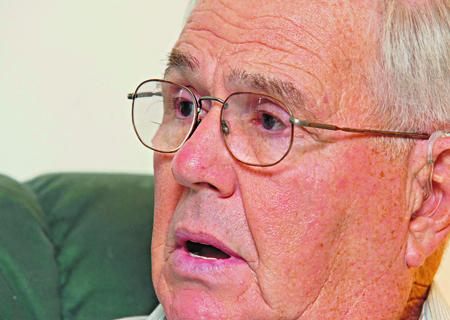
Russ Simpson
“In this field, everyone is protecting their little piece of the pie; we want to put down that line, like, ‘I have to protect my program, you have to protect yours,’” said Lynn Carder, program coordinator with the Victim Witness Assistance Program through the prosecutor’s office. “But the bottom line is that we have to provide services to the victims and when you gather everybody together, you’re much more likely to find someone that can help.”
By forming a coalition, the groups can guide more traffic to programs that are underutilized. Simpson said a lot of people are unaware that they might qualify for state funding to cover funeral expenses after a homicide. Or they might not realize that the government runs a victim notification program that tracks a perpetrator’s movements through the different steps of the legal processes. VINE alerts the victim when that perpetrator moves to different facilities or is up for parole, among other actions.
“So many people fall through the cracks,” Simpson said.
Falling through the cracks is easy if there are no formal charges made or if the victim’s aggressor is not indicted by a grand jury, never found or if the crime is a misdemeanor. Victims in these situations don’t end up in the system that puts them in touch with Carder’s program, so she is unable to educate them about their options, she said.
Events like Survivor Night helps to fill those cracks.
“Come on down and ask for services. It doesn’t make any difference whether the crime happened 15 years ago — there are people out there who haven’t seen help for 10 years,” Simpson said.
Cindy Dugan lost her son nearly four years ago. Matthew, known as a gentle and loving jokester with a deep, contagious laugh, was shot in 2008 at a BP station in Toledo. He was the store clerk at the time.
Her son’s killer Anthony Belton was sentenced to death this month.
Dugan uses VINE to easily track developments surrounding the convicted man. She also had the help of victim advocates during the trial.
“It would have been a lot more frightening without that and I don’t think I would have been able to carry on for as long as I did,” she said. “I would have felt very overwhelmed and very lost in the whole process.”
Victims’ Rights Survivor Night attempts to reach out to those who haven’t reported their crimes. She said she understands why people are intimidated by the justice system.
“All I can say is for people to be patient and strong,” she said. “It’s endurance — one day at a time. That’s the way we did it. We thought, ‘Oh, this would be the last day we go to court month after month after year after year.”
Woodberry: The facts about who saved Scott High School
“Just the facts, ma’am.”
— Joe Friday, “Dragnet” 1951–59
— Warren Woodberry,
Scott High School, class of 1956
Those on the March 17 tour of the newly renovated, nearly 100-year-old Scott High School witnessed a reminder of how history can be left out or altered. The new principal of Scott began by asking those present, starting with the class of 1940, to raise their hand. Before they could be acknowledged, a voice rang out from the side of the room with the following question: “What about the class of 1930?” The voice belonged to Martin, the son of 93-year-old Doris Sing Hedler, who was in the class of 1936. Ms. Hedler was in the honor society and was the baccalaureate chairperson for 1936. When I interviewed her she described how the old school looked in her day and how thrilled she was that it was renovated, not torn down.
Here are some economic costs for 1936:
- Average cost of new house: $3,925.
- Average wages per year: $1,713.
- Cost of a gallon of gas: 10 cents.
- Average cost for renting a house: $24 per month
- One loaf of bread: 8 cents.
- One pound of hamburger meat: 12 cents.
- Studebaker car: $665.
- Ladies Swimsuit: $6.95.
Just as Ms. Hedler was almost overlooked before her son spoke out, it is important to speak out and acknowledge those who really led the fight to save Scott High School from the wrecking ball. It was brought to my attention that in various newspaper articles and statements, Scott alumni are often given the back seat or not mentioned at all in the history of the fight to save Scott. The members of the Scott Alumni Association, under former president Robert Davis and spurred by Coach Ben Williams, began the fight to save Scott from the wrecking ball. Others, including the Old West End Association and Save Our Scott, came on board at a later date and played an equal role in strengthening the Scott alumni fight to save the school. It was not house parties that saved Scott. It was attendance at meeting after meeting and constant correspondence and appeals to the Toledo Public Schools Board of Education, the mainstream media, the Ohio State Facility Commission, Joyce Barrett of Heritage Ohio, and many other supporters, politicians and Scott alumni.
Credit must be given to The Toledo Journal and its education writer, Bob Stiegel, who wrote stories while some other papers were negative about the value of saving Scott and those who fought this battle. Also, the role of former TPS board member Darlene Fisher can never be diminished in the eyes of the those who fought, as she was there from Day One. Although her name, and many others, are completely absent from some articles about who saved Scott High School, those involved know the valuable role she played. People have a right to their opinions of who saved Scott High School but they do not have a right to ignore the leadership of the Scott Alumni Association.
A little history: Once, the Ohio State Facility Commissioner, Michael Shoemaker, received letters from members of the Scott Alumni Association (all of which I have archived) concerning their efforts to save Scott. A visit was arranged through TPS for him to visit Scott. After the building inspection, Mr. Shoemaker declared the building sound and strong, and stated that his commission would allow for renovation if the additional funds could be found.
The TPS board, under then-president Steve Steel, the Scott Alumni Association under president Robert Davis, and the public united behind the levy, which resulted in the $42 million renovation of Scott High School. Saving Scott resulted in saving the oldest high school in Toledo, recognition by historic preservationists throughout the United States, and the tradition of the nearly 100-year-old school was allowed to continue into history. Now the family legacy can continue. Also making history is Treva Jeffries, Scott’s first African-American principal, which would not have happened without the struggle waged by the Scott Alumni Association. Like the “Trail of Tears,” there are two sides or more to every story, but the fact of who lead the fight to save Scott only has one side and that story can be found in the body of this column.
On March 13, Toledo City Council recognized members of the Scott Alumni Association and its supporters who fought to save Scott by issuing a proclamation by City Councilman Tyrone Riley, a member of the Scott Alumni Association.
“Once a Bulldog — Always a Bulldog.”
“Just the facts, ma’am.”
Warren Woodberry is a community activist and Scott High School alumnus.
Historic-themed dinner set for Vistula House
Toledo’s Vistula District is inviting you to take a step back in time for a dinner party.
Set in the dining room of the 1865 Vistula house, the feast will be served surrounded by decor representative of the Victorian era. Among 14 course options, highlights will include teriyaki-style salmon with rice pilaf, a filet of beef with mushroom demi-glace and Cornish game hen a l’orange.
The house will host three dinners, all starting at 6 p.m., April 26-28, 2012. Ten people can attend each evening. Tickets cost $100 a person and can be reserved by calling (419) 389-3452.
Proceeds will go to the Historic Vistula Foundation, a nonprofit that aims to preserve historical properties.
The Vistula District predates Toledo’s incorporation and includes large homes, smaller dwellings, corner stores and ethnic churches.
Miller: Carrie Fisher: Self-acceptance run wild
As Princess Leia in “Star Wars,” actress Carrie Fisher inspired galaxy-shaking visions in millions of young men. As an author, Fisher inspired a generation of young women with her insightful prose about love and life. As a wife (and ex-wife) she inspired lyrics in some of Paul Simon’s most affecting songs. As a drug addict with bipolar disorder, Fisher inspired legions of fellow sufferers with her direct, raw testimony.
The many sides of Carrie Fisher, 56, coalesce in her one-woman stage show, “Wishful Drinking,” playing through April 22 at the Victoria Theatre in Dayton, Ohio. During the show, she gleefully takes the audience through her Hollywood childhood with parents Debbie Reynolds and Eddie Fisher, her explosive “Star Wars” fame, its toll on her relationships and her struggles with drug use and mental illness (“I’m a Pez dispenser and I’m in the textbook of Abnormal Psychology,” she enthuses).
During an April 12 interview on the stage set for “Wishful Drinking,” which replicates her Los Angeles home, Fisher was as direct and open as her onstage persona.
Toledo Free Press: Ricky Gervais was on CBS this morning and he made a comment that humor is an evolutionary tool to help us deal with ‘stuff.’ That really resonated after seeing your show last night.
Carrie Fisher: It’s the best alchemy you can do, to take something that’s really not funny and make it funny. That takes time and it takes a certain slant.
TFP: Watching the show last night, I couldn’t decide if what you were doing was courageous or self-loathing or a mix of the two.
CF: No self loathing.
TFP: It’s some raw, brutal stuff that you are putting out there for people to digest.
CF: Like what ?

Carrie Fisher, photographed April 12 by David Panian
TFP: Like the electric shock therapy experiences, talking about the drug use, the suicidal feelings, the parental issues; those are things that people usually do on couches with the doors closed. You’ve put it out there and it has to be punishing to relive night after night.
CF: I have processed a lot of it. I’m not really ashamed of it. Most of it though, me being in a mental hospital, me being in a rehab, that was out there so I just put my version of it out there.
TFP: With the electric convulsive therapy (ECT) effect on your memory, is your mom still making the scrapbooks and the photo albums to help your memory?
CF: Actually it is only short-term memory that goes. Long term I am really good at it, unfortunately. Or, I am as good at it as someone my age would be. You don’t know how much of your memory has been affected by age or drug use. It’s like I say, E-C-T, L-S-D or A-G-E. Those are your three choices.
TFP: I wanted to ask you about a couple of your movies, the first one being “When Harry Met Sally.” What a tight movie that is with the back-and-forth dialogue. You worked with Billy Crystal, Meg Ryan and Rob Reiner all at the top of their games. Were there a lot of rehearsals to master the script?
CF: Well, like you said, it was people at the top of their game, people who know what they are doing and they have done a lot of it. The dialogue it was really well written and anything that is well written, you are not going to have a problem with it. If you get a certain type of actor and they are well-cast they are going to be able to embellish on it a little bit if that is allowed.
The one scene that was very difficult was the four-way scene we did on the phone. We did that in real time. They were all gathered in sets on the other side of the stage and Bruno [Kirby] and I were on one side. They shot it 50-some times and after the 50th time Bruno said, “I want another one.” And I said. “You will be doing that one on your own.”
TFP: As a writer, how critical are you when someone sends you a script to read? Can you just read it and enjoy it or are you wanting to move commas around and make revisions?
CF: I can both read it and enjoy it and want to move commas around. If you see something that is kind of derivative, you know. Sometimes it can make you kind of sorry that they didn’t do anything braver but I also know as a writer how difficult that is, so it’s nice to be in the comfort zone of what is expected.
TFP: “The Blues Brothers.” Working with John Belushi and Dan Aykroyd had to be wild.
CF: Everybody was high. Especially John. I was 21 years old and I wasn’t really off and running with the drugs yet but that was a fertile environment for that kind of behavior.
TFP: Was it clear then that John had a problem or was it just part of the party at the time?
CF: It was clear he had a problem and he involved me. He said, “You and I are alike.” John was like, if it was there, he wanted it. If you could eat it, f**k it, snort it or shoot it John wanted it. That’s not really a good motto. That’s going to end up badly.
TFP: Did his comparing himself to you resonate with you at the time of his death?
CF: No it didn’t resonate with me, it scared the s**t out of me. I knew he wasn’t wrong. I actually spent a night with John and it was horrible. He started drinking sake and he was knocking things over and by the end of the night, he disappears and there was someone that he ended up doing coke with. I have always stayed so pissed at that person. He came back to me and he said, “I did coke.” And I said, “John, we can leave right now.” He just looked at me for a minute and said, “No.”
TFP: Your next movie is “It’s Christmas, Carol!” That’s your first holiday project since the “Star Wars Holiday Special.”
CF: If you go back and look at that it’s not so bad that it’s funny, it’s so bad that it’s boring.
TFP: Did you and Mark Hamill and Harrison Ford have an obligation to George Lucas to do the special?
CF: We would have signed on to do anything with him. But it did seem bad at the time.
TFP: The other thing that came out about that time was the Ringo Starr TV special where he had a look-alike and you were the love interest confused by the two Ringos.
CF: I have no recollection of that.
TFP: It wasn’t great, either.
CF: It sounds awful.
TFP: It is an interesting part of the show when you talk about the songs Paul Simon wrote about you. Are you Charlie the Archangel from the song “Crazy Love Vol. II” on “Graceland,” with the lyrics, “Fat Charlie the Archangel files for divorce?”
CF: No, that’s Lorne Michaels. I was from the title song, “She’s come back to tell me she’s gone/As if I didn’t know that, as if I didn’t know my own bed/As if I’d never noticed the way she brushed her hair from her forehead.” I feel privileged to be in one of his songs and certainly if the choice was, “Would you read one of my books or listen to one of his songs?” I would listen to him.
TFP: Did you do that a lot, brush your hair from your forehead?”
CF: (Brushing her hair from her forehead) Yes, just like that. I still do it if it’s down.
TFP: You have two iconic images in pop culture, the doughnut-braid hair and the metal bikini. What would the trifecta be? What would be the one additional thing that you would like to put in the Smithsonian to fill out the shelf?
CF: Probably the image [from the “Wishful Drinking” book cover] with me looking down, the stoned Princess Leia.
TFP: Are you looking forward to seeing yourself on the big screen in 3-D when the original trilogy comes out in 3-D?
CF: I am looking forward to doing that. Hyperspace should look cool in 3-D.
TFP: If I were to go to your house would I find “Star Wars” everywhere?
CF: Yes, you have to look but you would find it. It’s not obvious, except for one thing. On my birthday, George Lucas sent me a painting of me as Princess Leia in a metal bikini. I am sure it’s regifting. Someone gave him that and he was wondering, “Why is that in my house?” so I have it in my backroom now. And I am confused as to what I should ultimately do with it.
TFP: You mentioned that George Lucas came to see your show. Did you hold back on the jokes about him?
CF: Oh, no, I was worse. I’ve been making fun of that man forever. He invites it; he doesn’t talk a lot.
TFP: Your Democratic politics come through pretty strong in the show. Are you a big Obama supporter?
CF: I love Obama.
TFP: Have you taken any heat for getting into the politics? That is a different arena from the personal stuff, when you talk about Dick Cheney.
CF: I can’t imagine that Cheney is popular. Who donated that heart? He didn’t know where it was going to.
TFP: What is your next writing project?
CF: I am trying to adapt an earlier book of mine but I want to try to write something that has absolutely nothing to do with me. Fiction, I hope.
TFP: Thank you for your time.
CF: Thanks for coming and wondering if I have self-loathing.
TFP: That’s a fair question.
CF: Is it? I’ve never been asked that.
TFP: As I said, the things you choose to relive publicly seem to be as punishing as they are therapeutic.
CF: If I had self-loathing I wouldn’t talk about it. I make fun of it but it’s not self-loathing. It’s self-acceptance run wild.
Michael S. Miller is editor in chief of Toledo Free Press and Toledo Free Press Star. Email him at [email protected].
Victoria Theatre Association offers a special discount for fans of Carrie Fisher in Toledo. For 35% off any performance of WISHFUL DRINKING STARRING CARRIE FISHER. Go to www.ticketcenterstage.com and use coupon code BUNS at checkout.