Home Blog Page 287

Former Rocket Marrow running down a dream in Houston

0
Desmond Marrow said the Houston Texans like the fact he can play cornerback or safety. Toledo Free Press file photo.

The road to former University of Toledo cornerback Desmond Marrow’s dream of reaching the NFL has not been gone as he pictured it.

When he committed to UT in 2006, he had no idea that the Rockets would fall on hard times. The team failed to register a winning record until Marrow’s fifth year, after racking up two Mid-American Conference championships and two bowl victories in the five seasons prior to his arrival. He had no idea he would suffer two serious injuries that would cost him two full seasons at Toledo and finish his collegiate career in 2011 at 24-years-old and a sixth-year senior.

As a 24-year-old sixth-year senior during the NFL Draft last month, those themes of difficulty and perseverance continued for the Youngstown native. He watched the draft round by round with family and friends back home and never saw his name flash across the bottom of the TV screen.

“I remember, like, two or three times I just went upstairs, man,” said Marrow, who received First Team All-MAC honors in 2011 after leading the Rockets with 83 tackles, intercepting three passes and ranking fourth in the country with 15 pass breakups. “Just laid in my room; just waited for my phone to ring.”

Though he went undrafted, Marrow’s chance to fulfill his dream still came. The Houston Texans, whom Marrow had visited in early April, were interested in him and kept in touch throughout the draft. Then Houston’s defensive backs coach, Vance Joseph, finally gave Marrow a ring.

“They called me,” Marrow said. “They were like, ‘We want you.’ Then they told me that I was coming in with a chance to play right now and they couldn’t wait to get me down there, so it was pretty much a done deal after that.”
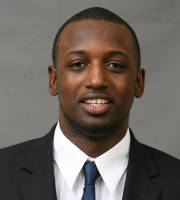
Desmond Marrow

Given all he’s been through in the past six years, the moment was emotional for Marrow.

“When they called me, it was just crazy, man,” Marrow said. “My mom started crying; my aunts were crying; my cousins were crying; then I started crying. I mean, you want to play in the NFL your whole life — then it happens — then it’s like, ‘Man, it’s here.’”

As one of 21 undrafted free agents Houston agreed to terms with, Marrow will have to prove his worth to the Texans, whom he reportedly chose over Dallas, Detroit, Jacksonville, San Francisco and Tampa Bay.

The 49ers were his favorite team growing up. But with two former Toledo teammates on the Cowboys’ roster in safety Barry Church and center Kevin Kowalski — and recent teammates Mike VanDerMeulen and Danny Noble heading down to Tampa Bay for a chance to play for the Buccaneers — Houston was ultimately where Marrow wanted to be.

“I mean, I’ve always been a person who will try to do everything, like, different from anyone else and try to leave my own legacy, pretty much,” Marrow said on choosing to sign with the Texans. “I just wanted to go up to Houston by myself, make my own mark and make a name for myself and help the team as much as I could.”

In addition to Houston not selecting any defensive backs in this year’s draft, another big factor in Marrow choosing the Texans was his initial impression after getting to spend time with some of the team’s brass during his visit last month.

“They’ve just got an overall great organization,” Marrow said. “I met [Houston head coach Gary] Kubiak. He’s a great coach. Then my position coaches [Vance Joseph and Perry Carter], both coaches were real good guys. I went out for dinner with them, and Houston’s just a nice city, man.”

Marrow said Houston likes that he can play either cornerback or safety, adding that he’s willing to compete wherever the team needs him. With his dream now in his grasp, Marrow’s ready to turn his opportunity into an NFL career.

“A lot of people want to play in the NFL, but they never get that chance,” Marrow said. “So I definitely just look at it as a blessing to have an opportunity.”


Owens Community College partners with Hollywood Casino for job training

0
Students practice dealing blackjack in preparation for job auditions at Hollywood Casino. Toledo Free Press photo by Sarah Ottney

Shortly after voters approved Penn National Gaming Inc.’s move into Ohio, Owens Community College offered to help the casino company with job training. College representatives have multiple corporate partnerships that typically involve visiting a business and training on site.

The Hollywood Casino Toledo partnership differed because the business didn’t have a training site readily available, considering the months of construction.

“We knew it would be an opportunity for members of the local community to be employed there,” said Michael Bankey, vice president of the college’s workforce and community services.

A wing of one of the buildings on campus was vacant, so the college constructed walls, laid down carpeting, installed ventilation and brought in tables to create a space for dealer training, he said.

Bankey and his colleagues then set out to find instructors to teach blackjack. As casinos are new in Ohio, Bankey had to look out of state and research curriculum. But the casino made a deal to send its own instructors.

Each job seeker enrolled in blackjack training paid the college $200, which the casino will reimburse if that employee stays with the company for at least six months, said Chrystal Herndon, vice president of human resources.

Herndon said dealer schools typically cost $400-$500.

Before enrolling, future blackjack dealers had to be approved by the casino team. The process began with a group interview among 20 to 25 people, which flowed like an informal conversation. If the hiring team liked an individual, it would set up a one-on-one interview.

Few applicants had any dealing experience, so the successful candidates were chosen based on personality, Herndon said.

“We can teach you the technical skills but we cannot teach you how to be nice,” she said.

From there, the college conducted registration and casino instructors kicked off classes. Blackjack dealing instructor Amy Marinov said the students had a 98 percent success rate.

“The drive was there; they really wanted to learn — it’s a new career move and it’s a good living,” Marinov said. “I’ve done this for years and these were probably some of the best students I’ve ever had.”

Irick Shikwana applied for the job for just that reason — a new career. He was working at Fifth Third Bank when the casino posted job openings.

“I’m an energetic person and I like talking, and in the bank we just sat down and cashed checks and did the same process over and over and I didn’t mind it but I just needed something more refreshing,” Shikwana said.

He learned blackjack within three days. He was promoted to a supervisor position. Most people in training catch on by the third week, Marinov said.

Blackjack dealers make about $16 to $22 an hour with tips, adding up to about $40,000 a year on average across Penn National Gaming’s 27 properties, Herndon said.

Fort Meigs: If you want it built right …

0

Years ago I undertook the building of a wooden barn in my backyard, from a kit consisting of nothing but raw lumber and nails. (Man-grunt!) After careful consideration, the best location was determined. The blueprints were reviewed and a couple construction-oriented friends were coerced to guide me through. They worked hard, even on rainy weekends, but if I ever left to run an errand, I’d often return to find them lounging rather than hammering. The construction of Fort Meigs proceeded in a somewhat similar fashion.

In late January 1813, Gen. Harrison was leading U.S. troops toward Monroe, Mich., to aid in a battle with the British and Native Americans. While marching through the soon-to-be Toledo area, a retreating survivor of the conflict ahead, announced the massacre of Americans along the Raisin River. Harrison turned and withdrew, realizing that a new defensive post needed to be established immediately, lest the enemy push south into Ohio.

The mouth of our Maumee River at this time was a pivot-point of transportation. It opened northward into Lake Erie for access to British-occupied Canada; and wove southward toward the frontier’s main artery, the Ohio River. As well, at least four major trails radiated out from the Maumee rapids area. So it was not on a whim, that as Harrison stood on the high bluff over the south side of the Maumee River, he declared, “This is the best position that can be taken to cover the frontier.” The garrison was named in honor of then governor of Ohio, Return J. Meigs Jr.

Capt. Charles Gratiot, the Northwest Army’s chief engineer, agreed on this location and designed the fortress accordingly. Construction began on Feb. 2, 1813. By the way, you’re right, that street you travel going to a ballgame in Detroit is named after him.

The 1,500-plus men were divided into units by Gratiot and assigned to build particular sections. After only a few days, however, Gratiot fell seriously ill so supervision was assigned to a young, fellow West Point engineering graduate named Eleazer Wood. For his heroic direction and patriotic service, the county in which the fort still stands was later named in his honor.

What became the largest wooden fort in North America had a circumference of well over a mile. Wood said, “With the exception of short intervals for blockhouses and batteries, this extent was picketed with timber fifteen feet long, from ten to twelve inches in diameter, set three feet in the ground.” The blockhouses were made of double timbers to withstand oncoming artillery. Wells were dug. Storage and ammunition houses were raised. Gun batteries were built. Even extra pickets and planks were piled inside the fort to replace any that might be blown apart by enemy fire.

Progress continued into March despite of adverse weather conditions. Snowfalls up to 6 inches were repeatedly cleared so the men could work, eat and sleep. The river was frozen, the ground was frozen, even one of the sentries was frozen – to death -while at his post. Really! Picks and shovels ricocheted off this tundra as they dug trenches along the perimeter. And can you hear the clatter of all those axes felling trees day after day?

In early March, Wood was ordered to coordinate construction of Fort Stephenson in Fremont, Ohio. During the few weeks he was gone, Fort Meigs was left in the command of an aging general named Joel Leftwich — a Revolutionary War veteran who was only weeks away from fulfilling his current military commitment and retiring to his Virginia home.

Upon Wood’s return, Leftwich was blasted as, “a stupid old granny who stopped the progress of the works entirely … (the men) were permitted to burn the timber, which had been brought into the camp with an immense deal of labor for pickets and blockhouses; not only did they burn this timber, but … the men (were) actually employed in pulling the pickets out of the ground, and conveying them off for fuel.”

Obviously, it was hotter under Wood’s collar that day than in the flames of those burning pickets! He retook command and the fort was completed well before the first attack of May 1, 1813.

Frank Kuron is author of the War of 1812 book, “Thus Fell Tecumseh.” Email him at [email protected].

Bugle Call: upcoming events

  • Fort Meigs will host the next in its monthly Bentley Lecture Series presentations on Thursday, May 17. Historian and author Anthony Yanik will speak on “William Hull and the Fall of Detroit.” The presentation is free and starts at 7:30 p.m. in the Fort Meigs Visitor Center, 29100 W. River Road in Perrysburg.
  • Visit Fort Meigs May 18-19 for “Drums at the Rapids,” a miniature war gaming conference. Tabletop battles include historical events and fantasy and sci-fi games. Come fight the Civil War, World War II, the War of 1812 and more!
  • Visit Fort Meigs May 26-27 and see recreated battles, musket and artillery demonstrations, and camp life demonstrations during their “1st Siege 1813: War of 1812 Re-enactment & Memorial Day Ceremony.” On Memorial Day, a wreath-laying ceremony will take place at 2 p.m. in front of the monument within the fort.

Visit www.fortmeigs.org or call (419) 874-4121 for complete details about all upcoming events.

Hickey: Putting a face on same-sex marriage

0

Same-sex marriage. We all have feelings about it, whether we are for it or against it. Politics aside, I want the Toledo community to put a face to same-sex marriage. I want the Toledo community to understand this is not just a fight for a law, this is a fight for me.

My American dream is to live a fulfilled life complete with a wife, children, a home, a career. A compilation of all the things I can be proud of when my life is over. I want to be married one day, yet my world is telling me I’m not worthy of being married.

My heart swells up with hope and confusion and disappointment and joy at all of the headlines today that speak of same-sex marriage.

I come from a strong and supportive family that has taught me the true meaning of what a family is meant to be. It’s meant to be an escape from the troubles of life, a place to run to when the times get tough. It’s meant to be a source of unconditional love that never wavers. It’s meant to be a model for society and to show just what greatness the feeling of love can create. My parents have taught me that a family can not be defined, it has to be felt.

Same-sex marriage. Take religion out of the fight and what do you have? You have a fight for love. You have a fight for what defines a family. A family should not be defined, it should be felt.

Allowing the ban that the State of Ohio has on same-sex marriage to continue to be lawful, denies my very right to recognize that feeling. Now let me tell you why I want to be married one day.

I want to be married because I want to share the rest of my life with one person like my parents have done.

I want to be married because I want my future children to have two parents who can equally protect them.

I want to be married so that my future wife will be legally and financially taken care of after I pass away.

I want to be married so that the children I do have with my future wife are not taken away from her just because she is not legally recognized as their parent.

I want to be married so that my future wife can be provided the same benefits as me to ensure whatever life brings our way I can be confident she will be taken care of just as well I am.

I want to be married for me.

I want an equal whom I can love and gain support from.

I do not want to be married to ruin society.

I do not want to be married for any God.

It was not my choice to be a lesbian; therefore I do not see it as fair that someone is able to choose to take away a right that every heterosexual American has the luxury of registering for Monday through Friday from 8 a.m. until 5 p.m.

In the argument of choice, ask yourself this: Who would choose to be something that other countries would kill you for? Who would choose to be something that entire religions condemn? Who would choose to be something that people automatically hate you for?

There is no excuse for you as an American citizen to pretend that you don’t know any gay person, because through this column you are getting to know me.

Should you still be against my fight for my American dream, I would like you to look me in the eye and tell me exactly why I, Emily Hickey, am unworthy.

Take religion out of the fight and what do you have?

You have a girl named Emily Hickey who was born and raised in Toledo, Ohio, who is fighting for a right that every heterosexual person has whether or not they have a desire to be married, whether or not they are religious and whether or not they have ever been in love.

You have a girl who is a hopeless romantic and just hopes that one day she can find someone to love and be with for the rest of her life, just like her parents who have been married for nearly 30 years.

You have a girl who wants to raise a family with another woman to ensure they are provided with the most fulfilling life.

You have a girl who wants to be married to make sure that her future wife will be legally and finally taken care of after she passes away.

You have a girl who just wants her wife next to her in her hospital bed after she’s had surgery.

You have a girl who wants her future wife to be provided the same benefits as me to ensure whatever life brings our way I can be confident she will be taken care of just as well I am.

You have a girl who is sick and tired of being told every single day that she is unworthy of the American dream she grew up believing she could attain.

You have a girl dreaming of her father walking her down the aisle.

Politics aside, when you choose to fight for equal rights or fight against them, you are directly fighting me.

Since 2004, the great State of Ohio has enforced a law stating that there is a ban on same-sex marriage.

To those that oppose, while I believe everyone is entitled to an opinion, when you have an opinion over my future I most certainly take every decision you make and voice very personally. To those that support, I encourage you to speak up even if your voice shakes. It is through our united fight that I am confident the State of Ohio will see the future of society, a future that will allow me to have the same rights as my older brother and my younger sisters.

Be brave, stand strong and help me fight for my future wife and the family that we will have together. Fight for my future children so that they will not feel unworthy as I have been made to feel unworthy for the past 24 years.

Many people I speak to are shocked by the laws that this state and this country have directly against me and how I hope to live the rest of my life. I ask those people to help me spread the word of our oppression and encourage those around them to stand up and fight.

For those that feel this social “issue” is worthy of being overlooked, I ask you to think again because it is the exception that you make and your choice to look past this social issue that cause me to feel unworthy of attaining my American dream.

We can’t all go directly to Congress and request a change but we can help to open the minds around us through conversation. Speak up in your college classes even if you become the minority. Speak up at your family parties even if you’re the only one. Speak up to the strangers behind you in line talking about why they deny me my right to live my American dream.

I will continue to fight until I am no longer a second-class citizen in my own country. Whether it takes five or 50 years, my desire for an equal life will not subside. Please help me fight for the right for my father to walk me down the aisle to my future wife, legally.

Singer-songwriter relearns guitar, working on Toad disc

0

Those who play in alternative rock bands shouldn’t sit on glass tables.

Just ask Glen Phillips.

“I was at Sean Watkins’ house, the guitarist from Nickel Creek and also Works Progress Administration, and I was just sitting there. They have this glass coffee table, whichimmediately sounds — you know exactly where the story is going from there. It had a thick metal rim that I thought was supporting my weight.

“I had been sitting on it for like 20 minutes and suddenly it just went crack,” the guitarist said. “It sliced my ulnar nerve on my left hand, so my fretting hand. My pinky and the outer side of that hand is completely numb and kind of pins and needles like when you hit your funny bone really hard, and then one half of my ring finger is numb, and there’s abunch of muscles that aren’t plugged in anymore.

“I had been asking for a challenge in my life — I’d been having this wandering around, I need something new, something to work at,” Phillips said and laughed about the 2008 incident. “I really wasn’t expecting it to come in that form.”

The frontman of Toad the Wet Sprocket usually jumps right into a new project, be it solo or with a band.

“With Plover and Remote Tree Children and Works Progress Administration and also with ‘The Secrets to a New Explorer’ EP, those were all — I had this huge burst of creativity a few years ago. I just decided to kind of leave any commercial aspiration behind and work with the people who made me the happiest and have the most fun I could,” Phillips said during a call from his home in Santa Barbara, Calif.

“I guess the problem with doing something that’s totally not commercially viable is that I did all of that and then I found that I was broke,” he said and laughed. “Back to trying to  finda balance between passion and work, which is always the issue.”

Phillips will play songs from Toad the Wet Sprocket, Works Progress Administration and his solo career at 8 p.m. May 18 at the Ark in Ann Arbor.Tickets are $20. Doors open at 7:30 p.m.

Jonathan Kingham will open and accompany Phillips.

The singer-songwriter is working on a new disc with Toad the Wet Sprocket, best known for “All I Want,” “Fall Down,” “Something’s Always Wrong” and “Walk on the Ocean.”

“We have most of it written, andwe’re recording a couple songs at a time. We’re hoping for later this year; chances are, it’ll be next year,” he said.

“The music I make on my own is somewhat recognizable as the guy from Toad, but it’s a really different thing. We only sound like Toad when we’re all doing it together.”

Job fair to educate expedited trucker hopefuls

0

If you’re looking for a job that will take you places, stop by the Quality Inn and Suites in Monroe on May 17, 2012.
ExpeditersOnline.com will host a career fair and educational session day starting at 5 p.m.
Fifteen of the expedited trucking industry’s top companies will be present and a few of them will be looking to fill some job openings.
FedEx Custom Critical and Panther Expedited Services are among the list of companies seeking drivers, owner-operators and married couples to haul freight in Sprinter vans,  straight trucks and tractor-trailers.
Job fair attendees can arrive at 5 p.m. to meet the carriers and truck dealers. People looking to enter the industry can attend an educational session called Expediting 101 from 5:45-6:15 p.m. A lecture about truck specification assessment will follow at 6:15 p.m. Appetizers, beverages and door prizes will be offered afterward, followed by a session onfinancial essentials and fundamentals of insurance.
Register for free at www.monroetruckingjobfair.com or call 888-862-9831. Quality Inn and Suites is located at 1225 N. Dixie Highway in Monroe, Mich.

Rathbun: Who’s looking out for your interest?

0

Every night I hear Bill O’Reilly say on his show, “The O’Reilly Factor,” that he is looking out for you, the folks.

Every night I also think, “Is he really? Is he looking out for me?” More importantly, do I want him looking out for me? Ultimately, the answer to all of the above questions is no, he is not looking out for me and no, I don’t want him looking out for me.

I can look out for myself just fine, thank you very much, but I do rely on people I trust to take care of things for me in a manner that I require.

The manner in which I require my things to be taken care of is classified as a fiduciary manner.

Having things taken care of in a fiduciary manner means that the person who is helping me must act in the best interest of me, personally, not a generic person like me. A fiduciary must know who I am and what I need and want in order to provide the best service for me.

Most financial advisers out there do not operate from a fiduciary standard. That is not to say they are dishonest, most aren’t, but they operate legally from a suitability standard.

They belong to an association that has a code of ethics that says they will put the best interests of their client ahead of their own, but it is not a legal requirement.

As a Registered Investment Advisor (RIA) who is under the watchful eye of the Securities and Exchange Commission (SE C), I am required to operate under a fiduciary standard in all of my dealings with clients.

The analogy I use most frequently is that of a builder. Let’s say I build houses for a living and you commission me to build you a home and I say, “OK. I will go build you a house and  I’ll call you when it’s completed. It will be up to code and it will keep you warm in the winter and dry when it rains. In other words, it will be suitable for you to live in. Actually, it will be suitable for virtually anyone to live in.”

Or you could hire me to build you a house and I would say, “OK, let’s sit down and draw out a set of blueprints. We will make the rooms the size you want, put doorways where you want and add custom features that you need or want. The house will not only be up to code and suitable to live in but it will also be the best home for you and your needs. I, as a builder, in this case will act as a fiduciary to you in building a home that best fits your needs.”

Which house would you rather have? Your financial house is no different.

The portfolio needs to be custom built for your needs and desires, not invested in the “flavor of the week.”

Just like building a house, it takes some time to draw up the blueprints and make the changes you want. Also, the plans need to be flexible enough to change quickly should circumstances or your needs change. The “buy and hold” strategy is dead and is being replaced with the “buy and manage” strategy.

Is your adviser legally serving as a fiduciary for you? Most are not. It iscritical that each and every one of your advisers act as a fiduciary on your behalf.

CPAs and attorneys are legally required to acts in your best interest, your investment adviser should also. You have a choice, and the choice is easily made with a simple question, “Are you considered a fiduciary when acting on my behalf with my portfolio?”

Gary L. Rathbun is the president and CEO of Private Wealth Consultants, LTD.

Miller: I H8 UR TXTNG @ MUVES

0

There are a lot of reasons to avoid going to see a film.

It can be a pricey and dicey proposition, laying down $10 or more for a film that may not provide a quality experience. There are usually people in the theater who think they are in their living room,feeling free to talk and behave as if they are the only people affected by their poor manners. With large screens, high-definition pictures and surround sound, many films can be enjoyed at home to their full impact.

So, yes, there are plenty of deterrents to going to the movies. I go anyway.

A dark theater is a doorway to creativity that opens up amazing opportunities for the imagination. The 24 frames spooling by each second offer alternative realities and artistic possibilities that television rarely matches.

Books and music offer specific platforms for unique artistry, but the movies take elements from both of those expressions and transform them into psycheshaking experiences.

MJR, the only first-run theater in our part of Lenawee County, and Rave Motion Pictures, which operates the Toledo-area theaters, are both to be commended for staying ahead of  the technology curve and for offering family incentives and special showings (Rave is showing The Beatles’ “Yellow Submarine” on the big screen this weekend). Rave has also brought a level of community cooperation and willingness to try new ideas that had been missing from the local cinema scene.

The obnoxious chatterboxes can be shushed or tuned out; even at kids’ movies, which make up the majority of our choices, the right movie can transport viewers far away from the “peas-and-carrots-peas-and-carrots-peas-and-carrots” white noise.

It pleases me a great deal that our sons Evan (almost  6) and Sean (almost 4) have learned how to behave at the movies. There may be an occasional potty break, but they know to respect the silence and they are the perfect audience to suspend disbelief and become lost in the story.

It is true, there are more underachievers like “Yogi Bear” and “G-Force” than winners like “Toy Story 3,” but I love the idea that the boys are growing to love movies as much as their parents. Because their television time is limited, movies are even more special to them.

But a dark cloud is gathering that may upset even my love for the movies (and I once sat through a full screening of “Casablanca” in a Washington, D.C., theater while some jerk sat smoking a few rows up. Theater management did not seem willing to take any action, so those in the rows behind him were forced to incorporate the smoke as a sensory addition to the scenes in Rick’s Café).

During a recent CinemaCon convention in Las Vegas, the possibility of allowing cellphoneand texting  were discussed. As reported on Nikki Finke’s Deadline.com, “Regal Entertainment CEO Amy Miles says that her chain currently discourages cell phone use ‘but if we had a movie that appealed to a younger demographic, we could test some of these concepts.’ For example, she says the chain talked about being more flexible about cell phone use at some screens that showed ‘21 Jump Street.’ ‘You’re trying to figure out if there’s something you can offer in the theater that I would not find appealing but my 18-yearold son’ might.

“IMAX’s Greg Foster seemed to like the idea of relaxing the absolute ban onphone use in theaters. His 17-year-old son ‘constantly has his phone with him,’ he says. ‘We want them to pay $12 to $14 to come into an auditorium and watch a movie. But they’ve become accustomed to controlling their own existence. Banning cell phone use may make them feel a little handcuffed.’”

There are already people who set off little squares and rectangles of glowing lights by checking their phones during the movie. That’s tolerable in small amounts but a nuisance as a repeat offense. I am guilty of being over-attached to my phone, but since the president has never called me to ask for anything, I am confident he won’t call during the two hours it takes to see a movie. I can shut the phone off or leave it in the car for two hours without getting the shakes.

Deadline.com reported that at least one theater owner agrees with me.

“Tim League is CEO of Alamo Drafthouse — a small chain that makes a point of throwing out customers who talk or text during a film. ‘Over my dead body will I introduce texting into the movie theater,’ he says. ‘I love the idea of playing around with a new concept. But that is the scourge of our industry. It’s our job to understand that this is a sacred space and we have to teach manners.’ He says it should be ‘magical’ to come to the cinema. But Miles shot back that ‘one person’s opinion of magical isn’t the other’s.’”

Perhaps Miles should find a field of work in which she can exercise her derision of other people’s opinion of magic, such as divorce lawyer or puppy kicker.

Rudeness is a big enough obstacle to keep some people away from the movies. Encouraging rudeness by opening the floodgates for texting and using the phone is a quick way to sour an art form that should be about communal experience, not individual boorishness.

Michael S. Miller is editor in chief of Toledo Free Press and Toledo Free Press Star.

Countertop Shop ‘decided not to participate’ in recession

0
Mike Langenderfer and his daughter, Melissa Langenderfer, run the Countertop Shop in Holland. Photo by Sarah Sobel-Poage

Mike Langenderfer, owner of The Countertop Shop, credits his business’ best year ever, in 2011, with one simple decision.

“We took a look at the recession and decided not to participate,” Langenderfer said. The shop’s success story is being featured in the June issue of Stone World, a trade magazine on stone usage.

The store increased sales from 2010 to 2011 by 29 percent, something Langenderfer credits to the business’ superior customer service. “That’s pretty much how we’ve grown the business. We harp about customer service. One in a 100 times, [a phone call] will ever go to voicemail,” he said.

The Countertop Shop is largely a family affair. Langenderfer’s wife Karen runs the administration, accounting and payroll while daughter Melissa orchestrates operations, scheduling and purchasing. Son Nick participates in the sales part of the operation.

This isn’t the family’s first foray into business. In the late ’80s, the couple had a small sign company and later a cabinet company. In 2001, the Langenderfers bought a small countertop business and slowly began to phase out the cabinet side of the business by 2003.

Langenderfer found that countertops were a unique business. “Countertops are not a need item. They’re a want. When people come in to buy a countertop, they’re here because they want to buy a countertop. They’ve already thought about it,” the owner said.


Mike Langenderfer and his daughter, Melissa Langenderfer, of The Countertop Shop.

The store offers an assortment of fabrication options from laminate to natural stone for wholesale, commercial and residential use. About 50 percent of business comes from remodeling, 25 percent from new homes and another 25 percent from light commercial work.

Despite the store’s recent successes, 2009 was a different picture. The Countertop Shop had been a major retailer’s go-to place for custom countertops in the area, but in 2009, that company began having countertops for the state made in Columbus. This resulted in a 25 percent loss of revenue for The Countertop Shop.

In spite of the tough times and through persistence and customer service, the store largely rebounded. Langenderfer credits some of that to his flexibility with clients. “We try to be as flexible as possible and work with the customer,” he said, adding that means long days and working weekends.

The shop also carries superior brands. “Part of it is we offer the name brand counters,” Langenderfer said, adding however, “We’re in the business to sell countertops, we’re not in the business to sell a brand.”

Even with 2011 being its best year ever, the store is already ahead of where it was financially last year at this time. “Our business has skyrocketed in the last couple months. We need more space. We need more help,” Langenderfer said of the shop that employs about 20 people. He said he is seriously considering moving to a bigger space near by and hiring five to six new people.

Langenderfer, a former U.S. Marine captain, is also thrilled about his business’ inclusion in Stone World.

“I’m excited about it. I get Stone World magazine every month and the best part is reading about other fabrication shops they get in there. That’s a big feather in our cap,” he said.

The Countertop Shop is located at 10406 Geiser Road, Holland. For more information, visit the web site www.countertopshop.net.


Toledo Free Press Senior Business Reporter Duane Ramsey contributed to this report.

ProMedica partnership with Miracle League is big hit

0
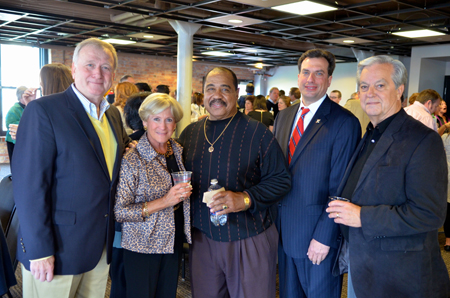
From left, Jim Murray, member of ProMedica Board of Trustees; Penny Staelin, wife of Stephen H. Staelin, chairman of ProMedica Board of Trustees; Willie Horton, former Detroit Tigers left fielder; Joe Napoli, Mud Hens president/general manager; and Larry C. Peterson, vice chairman of ProMedica Board of Trustees, at the April 26 ‘Take Me Out to the Ball Park’ event. -- Photo courtesy ProMedica

For Schyler Young, the 13-year-old daughter of Scott and Stacey Young, life is a wonderful adventure.

Schyler is a huge Mud Hens fan, and although she is developmentally and cognitively delayed with vision and hearing problems, nothing stands in the way of her rooting for the Hens.

“She can sit right up in front of the TV, with her face to the screen, and she can listen to the whole game,” her father  said. “It makes her happy. It’s a bright light in her life.”

And thanks to the Miracle League of Northwest Ohio, Schyler also enjoys playing baseball. Schyler is one of 70-plus special needs children who play an eight-week season at a baseball field about 500 yards behind Northwood Fire Department Station No. 1 in Northwood.

Take Me Out to the Ball Park

Schyler’s baseball season was celebrated a few weeks ago when, on April 26, ProMedica hosted its fourth annual sports night, “Take Me Out to the Ball Park.”

At the evening fundraiser attended by an estimated 270 people, former Detroit Tigers left fielder Willie Horton spoke about his life and the role baseball played in his development.

“He talked about our organization a little bit and how worthwhile a project he thought it was,” said Jeff Barton, Miracle League of Northwest Ohio president. “He knows the role baseball played in his life. He knows the type of development sports plays in a child’s life.”

Healthy lifelong development is important to ProMedica and the Miracle League organizations, said Janet Krzyminski, executive director of the Wildwood Orthopedic and Spine Hospital Foundation.

From left, Jim Murray, member of ProMedica Board of Trustees; Penny Staelin, wife of Stephen H. Staelin, chairman of ProMedica Board of Trustees; Willie Horton, former Detroit Tigers left fielder; Joe Napoli, Mud Hens president/general manager; and Larry C. Peterson, vice chairman of ProMedica Board of Trustees, at the April 26 ‘Take Me Out to the Ball Park’ event.

One of ProMedica’s goals with the fundraiser was to “find a partner charity that met our mission, which is to promote health and well-being,” Krzyminski said. “[Our support of the Miracle League of Northwest Ohio] is not a one-time thing. We have made a commitment to work with the children who are served by the Miracle League.

“Throughout the year, our employees will volunteer their time. This partnership helps our philanthropic mission, which is to promote volunteerism among our employees.”

The Miracle League

The Miracle League of Northwest Ohio was established in 2005, when Barton was moved by the birth of his and his wife Lisa’s first child, Vincent, 6.

At that time, Barton was working at a home for adults with mental retardation, where he  said he witnessed the frustration of the parents of special needs adults who didn’t have many extracurricular activities in which they could participate.

“I knew many of them growing up were never a part of a team, never played sports because they never had that opportunity,” Barton said. “So when my son was born, a healthy, typical kid, I started to think, ‘What if he was special needs?’ I would want him to have something to participate in, and one of those things I thought I’d want him to be involved in is baseball. It’s something I grew up with.

“When you have a special needs child, it’s almost like having a full-time job in itself, just in the care of that child. I didn’t think that just because I didn’t have a special needs child should prevent me from moving forward with this idea.

Barton convinced his wife and some of their friends to join him in the project.

“I had the time to pursue something like this,” Barton said. “Many of my friends who have special needs children say they would have done this a long time ago if they just had the time to devote to it.

“And in many cases, they simply don’t. My wife and I were blessed with two healthy boys, and so we decided to do something for kids that want to play baseball that may not have the opportunity to do so.”

The children in the program come from the Greater Toledo area, Oak Harbor, Findlay, Tiffin and Southeast Michigan. The special needs children in the program have both physical and cognitive disabilities.

“Special needs can be a broad term,” Barton said. “What I tell people is, ‘Hey, if they’re, for whatever reason, not being included in typical leagues in their hometowns, they can come to the Miracle League and play. We don’t exclude anybody.”

Participation in the baseball league is not limited to any one group of people. Barton’s children also play in the Miracle League.

“I think it’s important for them to grow up around people that are different or are perceived to be different,” Barton said. “It’s good for them. They have a blast doing it anyway, so it’s a league for everybody. Inclusion is a big message with our league.”

Scott Young  said he appreciates the volunteers who work with his daughter, especially baseball players from high schools like St. John’s Jesuit who volunteer their time and talents.

Other volunteers involve themselves in fundraisers like the 5K run/walk, which generates about $4,000 a year, and the golf outing, scheduled for June 8, which raises around $10,000 a year.

Although fundraising is an important activity of the Miracle League, the organization has been able to operate on a budget of just under $10,000 a year.

Barton said it’s most important to focus on the special needs children.

“It’s just about being a kid. A lot of kids grow up wanting to play sports, wanting to be included, wanting to be seen for their abilities. And that’s what this league allows them to do,” he said. “Rather than for these kids to be seen for their disabilities or their special needs, this league is a chance for them to come out and show people what they can do, and for a lot of them, it’s a thrill.

“What I tell people is, ‘Just remember what it’s like when you were a kid growing up playing in sports leagues. Think how different you’d be today if you didn’t have those opportunities.’

“I talk to the friends I grew up with, and I say, ‘You remember when we played baseball or football. They cherish those moments. And that’s what we’re trying to provide to these kids — just some memories of something they did in their childhood that they can look back on fondly.”

Barton is adamant that the Miracle League’s success is directly tied to ProMedica’s ongoing support.

“ProMedica has been a great supporter of the Miracle League. I approached them in 2007. When we initially met with them, I had no money. I had no major sponsors,” Barton said. “I was just some guy trying to get this field built. But I knew I had to get some major supporters involved, and ProMedica took a risk with us.

“When we got ProMedica’s support, things just seemed to fall into place. When they came on board with us, it gave us the legitimacy that we needed. They’ve been so great to work with, and we’re lucky to have them.”

ProMedica officials reported that the “Take Me Out to the Ball Park” event raised about $90,000 through sponsorships, ticket purchases, silent and live auction proceeds and vendor community partnerships. The foundation’s board of directors will meet in late May to decide how much money ProMedica will donate to the Miracle League.