Home Blog Page 285

Toledo Public Schools seeks 6.9 mill levy on November 2012 ballot

0

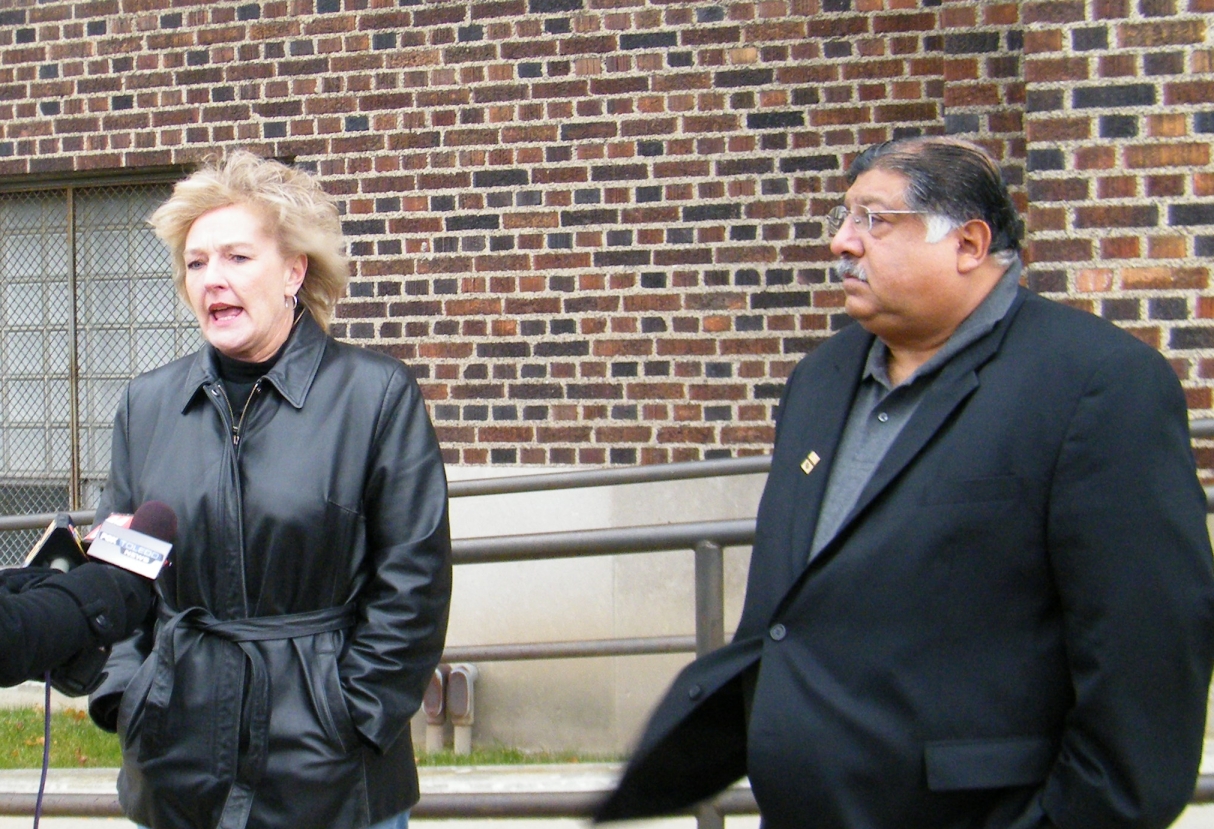
Officials gathered May 14 to support Toledo Public Schools’ (TPS) 6.9-mill levy. The levy will appear on the Nov. 6 ballot. The resolution for the levy was approved by the Board of Education at an earlier meeting, along with the decision to reinstate some junior high school and freshmen sports programs into the district.

If passed, the permanent levy will cost the owner of a $60,000 home $126.79 per year, or 35 cents per day. The money would fund the district’s current transformation program and balance the budget beyond the 2012-13 school year. While the 2012-13 budget is currently balanced, a failed levy in November would mean drastic cuts the following year.

“Without additional funding at this time, the district will have to cut an excess of $15 million before the beginning of the 2013-14 school year,” Toledo School District Superintendent Jerome Pecko said.

Lisa Sobecki and Bob Vasquez

Pecko said that the proposed levy would allow the district to pursue a new district-wide discipline program, a unified student data program for parents and teachers, and employee evaluations based on student performance.

School Board President Lisa Sobecki said the school district’s transformation program cannot be completed without the funding from the levy; its amount was chosen by the finance committee after a variety of millages were studied.

Sobecki said some highlights of the transformation program include the developments of a gifted and talented program for grades 3-6, extracurricular programs for grades 7-12, the continuation of early high school programs for grades 7-8, the implementation of online digital classrooms and electronic grade-books, and of thematic-based high schools.

The School Board’s plan of thematic-based high schools allows each school to concentrate on a specific area. Bowsher would focus on arts and medicine, Woodward on renewable and innovative sources of energy, and Rogers on sports medicine, among others areas of specialization.

University of Toledo President Lloyd Jacobs gave his “unqualified and unequivocal support” for what he believes to be “one of the best investments for the social fabric of our community.”

In addition to Jacobs, city council President Joe McNamara, Representative Fedor, TPS board member Bob Vasquez, Mayor Mike Bell and TAAP President Don Yates spoke at the news conference.

In November 2010, TPS proposed Issue 5, a 7.8-mill levy which voters rejected. That levy, which would have generated roughly $21.6 million, was the second to fail in 2010 as TPS attempted to meet its $40 million deficit.

Issue 5 would have been the highest millage amount passed for Toledo Public Schools in the past four decades, and the first levy passed for TPS since 2001.

$15.2 million elephant exhibit opens at Toledo Zoo

0
Toledo Zoo's Tembo Trail is home to four elephants: Louie, Lucas, Renee and Twiggy. Toledo Free Press photo -- Joseph Herr

Nine-year-old Louie picks on his little brother like many siblings do — by flinging dirt at him.

But unlike his human counterparts, who squirm and stretch to bend their bodies over the exhibit’s railing to watch him, Louie can wield a trunkful.

Perhaps in a few years Louie’s kid brother Lucas will fend off flying mud cakes, but the little guy has yet to even mark his first birthday. He’ll celebrate turning 1 year old June 3, a day made all the more exciting because of his family’s new home.

The Toledo Zoo’s elephant exhibit was set to open May 18. The Tembo Trail, which replaces the old African Savanna walkway, hugs the edges of the elephants’ enclosure. Zoo-goers can catch glimpses from three of the four sides of the mock-African environment.

Zoo officials began planning to move the elephants to a larger, more enriching area in 2007. $6.2 million and more than 175 workers later, phase one opened in 2009. Crews began constructing phase two in the spring of 2010. This second portion took $9 million and 145 employees to finish.

The Tembo Trail is set to open May 18.

The exhibit spreads across 37,680 square feet outdoors, pockmarked with uneven terrain and tree stumps and dotted with towering metal trees supporting leafy green canopies and dangling tires or sacks stuffed with hay.

If the elephants tire of the elements, they can choose to go indoors, where they have about 8,970 more square feet of space. During nice weather the glass windows of the indoor exhibit open like garage doors. At the old exhibit, zookeepers had to let them in or out.

“The reason that we care for animals at the zoo is that we need people to care about elephants and all other animals in the wild,” said Anne Baker, the zoo’s director. “Their habitat is disappearing and eventually it will disappear if nothing is done.”

Growing population

About 450,000-700,000 African elephants live in the wild, down from a few million at the turn of the 20th century, according to Defenders of Wildlife, a wildlife protection advocacy organization.

Toledo’s elephant population is growing. A couple of years ago, the zoo had only Renee, a 7,900-pound female, and Louie, her 4,690-pound son. In February of 2010, Twiggy joined in — brought to her new shelter after the U.S. Department of Agriculture confiscated her from poor conditions at a circus in Indiana. Although suspicious of others at first, the 27-year-old has become best buddies with Louie.

They stand side-by-side, drape their trunks over one another and take food from each other’s mouths. Baker said it is possible the two could mate, bringing the total number of elephants to five.

The zoo started its breeding program in the 1990s, and zoo officials knew then that they’d need to build a more expansive exhibit if the herd were to grow, said Andi Norman, the zoo’s public relations and marketing director.

The former exhibit was built 25 years ago and was intended for female elephants. Male elephants, as they grow into maturity, tend to fight each other for breeding access to the females. This can get chaotic and an exhibit primarily designed for females doesn’t provide the space and the strength needed to separate aggressive males from each other during this stage, Norman said.

Female elephants get aggressive, particularly when it’s time to push a young male from their circle, so the zoo had to draft plans for a new exhibit.

The Toledo Zoo is one of at least seven zoos across the country that have expanded or enhanced their elephant exhibits within the past two years, said Steve Feldman, spokesman for the Association of Zoos and Aquariums (AZA).

“The trend is that you see zoos elevating their game when it comes to the care and conservation of elephants,” Feldman said.

The emphasis is on “enrichment” — or activities that challenge elephants to problem solve to find food, along with terrain that exercises their physique, he said.

You’ll see this at the Toledo Zoo. Twiggy elicited a round of giggles May 16 when she poked her trunk through one of the holes in the exhibit wall facing her audience. She was searching for water, and she found it. The water could have been behind any of the other holes and the zookeepers switch it up to keep her and Louie guessing.

The tall metal trees are another aspect of enrichment. The tires and sacks filled with hay hang above an elephant’s eye level so the elephants have to reach for their snacks. Louie and Twiggy rolled a tree stump beneath one of the sacks so they could step on it to reach more easily, Norman said.

“Unlike people, who want our meals served on a platter, elephants spend most of their time in the wild foraging for food and water,” she said.

Elephant advocates

But some animal activists aren’t convinced. Catherine Doyle, the elephant campaign director for In Defense of Animals, said her organization advocates for zoos to close their elephant exhibits and send them to sanctuaries that offer dozens of acres to roam.

She tours zoos across the country and has legally advocated for elephants’ rights.

“You have all these artificial means of stimulating them, and these are highly intelligent animals so you have to do enrichment, otherwise these animals have nothing,” she said. “When enrichment is being done, I think unfortunately a lot of it is just something to take up the animal’s time.”

She said moving all the zoos’ elephants to sanctuaries is unrealistic, so the elephant campaign also pushes for AZA to tighten its standards on space. AZA accreditation standards recommend allotting no less than 5,400 square feet per elephant in an outdoor habitat. For indoors, the recommendation is no less than 400 square feet for females and 600 square feet for males or females with calves.

Between indoor and outdoor areas, the Toledo Zoo’s exhibit covers 46,650 square feet. The old exhibit covered 12,510.

“The public is so used to seeing elephants in smaller size exhibits, when there’s a minor expansion people think the elephants are in these huge exhibits now so everything is OK,” Doyle said. “To us it may look like a larger space but to elephants it may not.”

At least 22 zoos in the U.S. and Canada have closed their elephant exhibits since the 1990s, she said.

The Detroit Zoo sent its two Asian elephants to sanctuaries in 2005. The zoo will not open another elephant exhibit again, said Patricia Mills Janeway, spokesperson for the Detroit Zoo.

Providing the adequate physical and social environment had become unrealistic, particularly because of Michigan’s harsh winters. The two elephants had arthritis and foot problems, health issues common among captive elephants. Living in small areas or standing on concrete floors are believed to trigger these health problems, Janeway wrote in an email to Toledo Free Press.

“In the wild, elephants live in warm climates and roam vast areas, often walking many miles a day,” she wrote. “For these reasons, the Detroit Zoo decided in 2004 to no longer exhibit elephants.”

Doing well in winter

The African elephants at the Toledo Zoo do well in the winter, said Ben Whitebread, interim elephant manager. The elephants can go outside overnight if it’s no colder than 32 degrees. They also have a heated porch between their indoor shelter and the outdoor area, so they don’t have to spend all of their time inside during the winter months, he said.

He said he’s watched the elephants go outside during 25-degree days and amuse themselves by breaking the ice frozen over puddles.

“A lot of people feel that because these elephants are from Africa, that they can’t tolerate cold and that’s very far from the truth,” Whitebread said.

Baker said overheating is more of a problem for these animals because of their size.

“It’s hard for them to dump heat — the nights in Africa get very cold, so they warm up in the day and over the night they cool down,” she said.

Whether Twiggy, Louie, Renee and Lucas are inside or out, zoo-goers will be able to get a close look at these colossal mammals this summer, Norman said.

Tembo Trail opening weekend ceremonies

The Grand Opening for the Tembo Trail will kick off May 18 with a ceremony at 10:15 a.m. at the trail entrance.

Drums of Thunder will perform at 10:30 a.m., followed by a performance by I AM ART, with singing, dance, African drums and storytelling at 11 a.m. at the trail entrance.

Staff will host educational activities at the entrance from 11 a.m. to 2 p.m.

Otter keepers will talk at 1:15 p.m., followed by an elephant training demonstration at 2 p.m.

May 19 will be full of arts and entertainment from 11 a.m. to 3:30 p.m., including a performance by the Toledo School for the Arts Glass City Steel band.

The zoo will host events on May 20 as well, with African-themed education activities and crafts and more performances by the Glass City Steel.

Walk the Tembo Trail and see naked mole rats, African spotted-neck otters, African lions, African slender-snouted crocodiles, dromedary camels, meerkats, Nile hippopotami and white rhinoceroses.

Retirement Guys: Insurance needs and what you may be wasting money on

0

Insurance has been around since the days of the Greeks and Romans. For almost every American family having insurance is a must. Yet, just because your family has insurance doesn’t mean everything is covered when it counts. Sometimes, the best of plans a consumer buys turns out to be far less than expected and at worse worthless coverage. According to the Insurance Information Institute, each year Americans spend more than one trillion dollars on insurance premiums. Mark and I are no different than the average consumer; we both own multiple types of insurance coverage and are always looking for the best bang for our buck. So how does the average consumer or retiree really know what type of insurance they need and which insurances they might be wasting money on? Here are a few guidelines our roughly 40 years of combined licensed experience can share with you.

Policy owners should always read their contracts and make sure they understand what is and what isn’t covered. Let me share a story with you. Mary came up to me at a public workshop before the presentation started and pulled me to the side of the room. She came to the workshop because she wanted to share with the attendees what happened to her. What she told me and later the group is the fact that she lost her husband and got nothing from his life insurance. Come to find out her husband had only accidental life insurance, meaning that death benefits were only paid if her husband passed away in an accident. Since he died of natural causes, zero benefits were paid. Had she understood before the fact on how her husband’s life insurance paid out, a different type of life insurance policy could have been chosen years ago.

Another policy owner that I know had a terminal illness rider on his life insurance policy. Unfortunately, he was diagnosed with terminal cancer. But because his policy had the rider, he was able to use a portion of his life insurance benefits while he was alive to take time off work and spend time with his family. Thus, make sure you know how the life insurance policy you own works and what riders and benefits are included.

Protecting assets from a health care crisis is often a concern for many seniors and retiree’s, but is buying traditional long term care insurance the best option for your family? Many consumers assume that traditional long term care insurance is the only option, yet at least 4 other options are available. Along with buying traditional long term care insurance the other options are asset based planning, life insurance policies with LTC riders, Veterans benefits, and Medicaid planning. If a health care crisis happens having traditional long term care insurance can be a great benefit. Yet, if no crisis ever happens a policy owner could have paid in thousands of dollars and received zero benefits paid out. I would recommend that consumers should become educated all each of the options to protect their assets and then make a decision based upon their own individual situation.

Annuity guarantees are also a major focus by the insurance companies of America for seniors and retirees. Our company does recommend annuities for certain situations, but it has been our experience that this is an area the average consumer is very confused on how the guarantees really work. One problem is the vast difference in types of annuity guarantees. Not only do guarantees often vary depending upon fixed, indexed, or variable annuities, but they also vary based upon various products offered by the same insurance company. Knowing how benefits work can mean literarily the difference between a family having income for life or running out of money when they least expected it. If you have an annuity or are considering an annuity, make sure you read the contract and ask questions on how and when benefits will and won’t be paid.

New insurance rates and benefits change on a regular basis. Sometimes the policy that was purchased years ago still offers better guarantees than what a new product would offer. At other times, new product designs and benefits might offer the consumer more cost savings or bang for their buck. The best thing a consumer can do is every other year do a complete inventory of all of their insurance coverage and become educated on what is really covered and where there could be gaps in coverage. Just remember to read the entire contract for a complete understanding of coverage.

Study to examine post-traumatic stress in crash survivors

0
Drs. Marijo Tamburrino (in red dress) and Xin Wang set up functional MRI experiment with Cindy Grey (in white coat), on Andrew Cotton.

Assistant professor Xin Wang, Ph.D. in the psychiatry, neurosciences and radiology departments at the University of Toledo, is asking the public to volunteer for his group study of post-traumatic stress disorder (PTSD) related to motor vehicle accidents. The purpose of the study is to learn about the development of PTSD in the early post-trauma period in an effort to gain information that may contribute to finding early interventions.

Approximately 6 million Americans survive traumatic motor vehicle accidents every year, according to a report called “Psychological predictors of chronic posttraumatic stress disorder after motor vehicle accidents,” which was published by the Journal of Abnormal Psychology back in 1998. The traumatic stress of a motor vehicle accident is only temporary for most people; however, the report claims that about 17 percent to 25 percent of individuals in those accidents are likely to develop PTSD six weeks or more after the traumatic event.

“We’re basing our PTSD study around motor vehicle accidents, because they’re very common traumatic experiences,” Dr. Wang said. “After the accident, victims frequently get very nervous behind the steering wheel or while driving by the original crash area.”

These stressful reactions are just a few of the symptoms associated with PTSD. Generally, people with PTSD will experience hyperarousal, often repressing the traumatic event or obsessively recreating it in their minds.

Thirty-five patients have already been studied for the project. They were monitored for four months and were asked to fill out a survey before and after. A majority of the patients recovered fully from their motor vehicle accidents after three months, Dr. Wang said. Their stress levels decreased, the nightmares stopped, and they were able to return to a normal life. The other volunteers whose stress levels did not decrease after a few months were diagnosed with PTSD.

The University of Toledo, the Translational Research Stimulus Award from ProMedica Health System, and a William Bauer fMRI Research Fund are funding Dr. Wang’s project. By using UT’s cutting-edge neuroimaging technology, he hopes to explore the causes of PTSD by looking at the processes of the brain.

“We will repeatedly examine survivors of traumatic motor vehicle accidents with questionnaires and psychological assessments, recruited at the Emergency Departments of UTMC and Toledo Hospital, from the initial days to 12 weeks after the accidents,” Dr. Wang said in the group study outline. “Neural activity associated with the characteristic deficits of down-regulation of negative emotion of PTSD patients will be studied within initial days after the accidents and three months later, using a Reappraisal Emotion Regulation Task (RERT) during functional magnetic resonance imaging (fMRI).”

Xin Wang is not the only professor utilizing UT’s advanced neuroimaging equipment. The psychiatry department at the university’s medical center is using the technology to explore the genetic risk factors for PTSD in military veterans returning home. The neurosciences department is using UT’s MRI machine to research how limb amputations might cause changes in brain structure.

In order to complete his project, Dr. Wang is looking for subjects between the ages of 18 and 65 who have not experienced significant traumatic events within their lifetimes. Monetary compensation of up to $200 will be given to volunteers who complete all procedures at the University of Toledo Medical Center.

All study procedures are noninvasive and nonharmful, but pregnant women and individuals with metal devices in their bodies will not be allowed to participate due to safety concerns.

Anyone interested in participating in the study should contact the recruiter at (419) 383-4409 or at [email protected]. Once individuals have passed the screening process, they will receive further instructions.

Study 106928 has been approved by the University of Toledo Biomedical IRB.

ProMedica, UT form repository for samples

0
From left: Dr. Yasmin Isler, biorepository research specialist; Dr. James Willey, professor and director of the University of Toledo Cancer Research Center; Dr. Debra Gmerek, UT associate dean for research and director of the Center of Clinical Research; Dr. Michael McPhee, ProMedica surgical oncologist; Randy Oostra, ProMedica president and CEO; and Dr. Jeffrey Gold, UT chancellor and executive vice president for biosciences and health affairs. Photo courtesy ProMedica.

ProMedica and the University of Toledo announced May 9 the opening of a biorepository that could help researchers find treatments for cancer, Alzheimer’s disease, diabetes and more.

The Academic Health Center BioRepository (AHCBR) is the product of the Academic HealthCenter, the partnership between ProMedica and UT that began in 2010. The biorepository’s startup was funded through donations to the Toledo Hospital Foundation.

A biorepository serves as a bank for blood and tissue that can be used for research purposes. With patient approval, specimens can be collected from leftover tissue that resulted from medical procedures like biopsies. The biorepository is equipped with freezers to store the specimens, which would normally be discarded.

The blood and tissue will be collected at the Toledo Hospital to start, but expansion to the University of Toledo Medical Center and other facilities is anticipated.

Dr. Debra Gmerek, associate dean for research at UT, said she heardabout the need for a tissue-collection center when she began her job three years ago. “I kept hearing we need a biorepository and here we are,” she said at the opening reception.

“Once you start talking, you get ideas. You may not agree, but ideas lead to action,” said Randy Oostra, president and CEO of ProMedica. The Academic Health Center has mostly focused on education until now.

Oostra added that the biorepository could have a positive economic impact on the area, something Dr. Jeffrey Gold echoed. Gold, the UT chancellor and executive vice president of biosciences and health affairs and dean of the College of Medicine, said the economic
impact of academic health centers totals in at billions and that the centers are responsible for many jobs.

Still, he added that changes do need to be made in health care overall.

“Solutions are going to be found locally, not nationally,” Gold said.

These solutions could mean more individualized treatment of patients, something the biorepository could help facilitate.

The AHCBR gives researchers a chance to learn more about biomarkers, which are substances or molecules found in the tissue that can be used as clues to develop individualized treatments for cancer, said Dr. James Willey, professor and director of UT’s Cancer Research Center.

Dr. Michael McPhee, a ProMedica surgical oncologist, added that patients are also seeking out newer, progressive treatments.

“We’re in a new era now. It’s called participatory medicine,” McPhee said.

He gave an example of two patients he had with melanoma. The one who pursued standard treatment died while the other who researched the disease and participated in a clinical trial beat the cancer. Clinical trials could result from research done because of the
AHCBR, McPhee said.

Dr. Yasmin Isler will serve as the AHCBR’S research specialist. Isler heard about the upcoming center while finishing up her doctorate in chemistry at Kent State University and moved to Toledo in January.

“My day-to-day job is to find out everything there is to know about biorepositories. What they need, how they function,” she said.

Isler said she expects the first blood/tissue sample to be taken sometime during the summer.

The AHCBR, located in the department of pathology at ProMedica Toledo Hospital, is almost ready to open.

“We are ready to go. The only thing we have to do now is to resolve the standard procedures so that we know exactly what it is we’re going to do when it comes time to collect the tissue,” Isler said.

She does have plans in place.

When Isler learns a researcher needs a certain type of tissue and is able to connect with a patient meeting the criteria, she plans to meet with thatpatient to go through the informed consent process.

Once a signature and authorization is obtained, a blood sample will be taken and a tissue sample can be collected after a medical procedure.

Although some biorepositories use cadavers, Toledo’s will not, Isler said.

For more information, visit www.betterfuturetogether.org

Safe Boating Week kicks off with free festivities

0

National Safe Boating Week will kick off in Toledo with a free educational event for families on May 19, 2012.
The City of Toledo and the Western Lake Erie Safe Boating Council will host the event at the Skyway Marina and the Maritime Academy of Toledo. The Sandpiper boat will provide  free rides between the marina and the academy.
At the Maritime Academy, activities and tours go from 11 a.m. through 6 p.m. Guests can also steer the ship simulator at 1:15 p.m., 3:15 p.m. and 5:15 p.m. The Toledo Fire Department will conduct fire extinguisher and dive demos.

Sylvania mom represents Ohio at national conference

0
Kate Fineske with Nicholas, Elizabeth and Andrew. Photo courtesy Kate Fineske.

Kate Fineske has become adept at juggling her roles as mother, wife, career woman and active volunteer in the community.

For her efforts, the Sylvania resident was selected to represent Ohio at the 2012 Mom Congress on Education and Learning in Washington, D.C. Fineske was one of 51 delegates
representing their states (and the District of Columbia) at the third annual conference, held April 29-May 1, 2012.

The conference, sponsored by Parenting magazine, pairs mothers with educational leaders to exchange ideas on how to enhance the educational process. This year’s theme was “Teach Me Something New,” dedicated to strengthening relationships between parents and their children’s teachers.

“The trip was really inspiring,” said Fineske, mother to Elizabeth, 9, Andrew, 5, and Nicholas, 2. “It was amazing to meet up with so many powerful education advocates and other mothers that share the same interestsand passion in education. I learned a
lot about all the ways out there to be an advocate for your child in education.”

In addition to being a mother of three, Fineske is an adjunct instructor at Owens Community College, where she teaches three classes in commercial art and graphic design. She is also a staff member at the National Association of Mothers’ Centers, which serves as an advocate for mothers inthe United States, and serves as vice president of Sylvania Schools’ Parent School Council. In that role, she has assisted in organizing community
events to help educate parents on topics like political candidates, school policies and cyberbullying.

She was also the parent volunteer coordinator for Sylvania Schools’ 2011 levy committee, serves as parent room representative coordinator for her children’s elementary school parentorganization, has provided leadership to the Mothers’ Center of Greater Toledo and blogs weekly about parenting at onthegomomma.net and motherscenter.org/blog.

Fineske grew up in the education world, as both her mother and father were teachers. She continues to be surrounded by educators, with her husband, Adam, serving as executive director of curriculum and assessment for Sylvania Schools and her sister and mother-in-law also in the field.

Fineske said it is vital to have open communication with your child’s teacher.

“The more you communicate with a teacher, the more you understand what’s happening with your child when they’re away from you,” Fineske said. “It allows you to see your child
through somebody else’s eyes who iswith them. I think that was the biggest change for me when my children became school-age was they were withme all the time and then suddenly
they left and went to school for the whole day and I wasn’t able to control what they were doing.”

She knows it’s not easy and there are a lot of activities that pull parents away from their children’s educational process.

“A lot of parents are working. I’m a working parent,” she said.“Parental involvement is changing. I think I’m involved because I’m able to be involved in conversations in e-mail, I’m able to check out websites and see the calendars for what’s going on, I’m involved communicating over the phone with my teacher. Everybody has a different idea of what’s being involved. Do what you can to help out, and just understand every parent has a different tolerance level and time commitment for involvement.”

When it comes to juggling demands, Fineske said it’s all about planning.

“As long as I’m able to get it in my calendar, it works really well,” she said. “If you’re doing something you love, it’s much easier to balance things. It’s when you’re doing something that you really just don’t enjoy, it really starts to become stressful and it’s hard to balance.”

Still, she admits finding the elusive “perfect balance” in life can be unrealistic, even for those who keep their calendars within arm’s reach.

“I don’t think we’re ever really going to find the perfect balance,” Fineske said. “It’s always going to be a struggle. You’re always going to be juggling things. And as soon as you do feel balanced, something happens to throw it off balance. Taking a positive attitude and making sure you’re able to prioritize, it’s just huge.”

As any parent knows, a good support system can make the difference between feeling like things are manageable and pulling your hair out.

“My husband is a huge support,” Fineske said. “He really helps me out when I need it. I’ve been gone four or five days in Washington D.C. and he was here to tuck the kids in, get them to birthday parties, get them to soccerpractice and do everything else that needs to be done. He’s in education too and he gets how important it is for parents to be able to be involved and also to have their own passions they can go after outside of just parenting.”

For more information, visit www. parenting.com/momcongress. 

Census official to speak at Way Library

0

Way Library will host a talk on the recently released 1940 U.S. Census at 7 p.m. May 22 in the lower level auditorium of the library.

Timothy Sarko, data dissemination specialist from the U.S. Census Bureau’s Philadelphia Regional Office, will cover the background of the 1940 census, how to search for information about your family or area demographics, and general tips on conducting ancestry searches.

No reservations are required for this free event. Refreshments will be served. The library is located at 101 E. Indiana Ave. in Perrysburg. Call 419-874-3435.

‘Drive Time’ offers local take on sports radio

0
Mike Miller and Anthony Mellino. Photo courtesy Ralph Mahalak Jr.

“Drive Time,” a sports talk radio program that premiered April 30 on ESPN 106.5 FM The Ticket, broadcasts every weeknight from 5 to 7 p.m. Hosts Mike Miller and Anthony Bellino talk to guests about a variety of sports. What makes the radio show unique? For starters, “Drive Time” is broadcast from a car dealership, Monroe Dodge Chrysler Jeep RAM Superstore.

“We are very proud and excited to have two quality people like Mike Miller and Anthony Bellino,” Superstore owner Ralph Mahalak, Jr. said.  “Both have great resumes in the sporting and broadcasting world, but the emphasis of the show will be their interviews with great guests recognized both nationally and locally.”

The talk show hosts, both from Monroe, have a long history of sports broadcasting.

Miller began his career in 1980 as the play-by-play voice of the International Hockey League’s Toledo Goaldiggers and went on to spend nine seasons as the radio voice for the NHL’s New Jersey Devils. Occasionally, SiriusXM Radio will recruit Miller to broadcast various sporting events, including the Presidents Cup of the PGA Tour.

In the spring of 2011, Miller broadcast his 2000th game.

Bellino is the public address announcer for the Toledo Mud Hens and the University of Michigan’s Wolverines baseball. He is also a voice of Rockets football at the University of Toledo and a voice of both the men’s and women’s basketball programs at UT.

Together, Miller and Bellino will interview guests from all types of athletic backgrounds.

“‘Drive Time’ is going to be a multi-faceted show,” Mahalak said. “Miller and Bellino will be covering all sports, not just basketball and football.

“The goal of the show is to have three to four guests every night over the course of two hours.”


Mike Miller, left, and Anthony Bellino.

The radio show’s first guests were Mario Impemba, the play-by-play broadcaster for the Detroit Tigers, and Miami Heat television host and courtside reporter Jason Jackson. Audie Cole, an NFL draft pick from Monroe, was also interviewed.

A majority of “Drive Time” will broadcast from inside the Monroe Superstore, but a portion will come from remote locations at sporting or high-charity events.

“We want to get our listeners involved,” Bellino said. “We want to get out there and see the event firsthand, but we also want to be seen by our audience.”

In addition to being on the scene, Bellino also hopes to capture a larger audience by utilizing

social media.

“Drive Time” has its own Twitter account and works with 106.5 FM The Ticket’s Facebook page. By providing alternative methods of communication with the show, Bellino said he believes he can reach younger listeners.

“Since I am younger, I think I can stay on top of the social media and bring a younger demographic into the news sports show,” he said. “This will not be the typical sports radio with a group of 50-year-olds rambling about sports. We want to hear from everyone. If the phone lines get jammed, younger listeners can use social media as another avenue to contact us live on the show.”

Listeners who do not live in the Toledo area can still stream “Drive Time” live online or on their smartphones. The sports talk show will also be aired on 1470 AM in addition to The Ticket.

The Superstore is located at 15160 S. Dixie Highway in Monroe.

“People are always coming in and out of here,” Mahalak said. “We’re really excited for the show, because there’s going to be a lot of action and energy right here.”

Homeless shelters face budget cuts, changes in systems

0
Karen Fowler completed the Aurora House program and recently graduated from Owens Community College. Toledo Free Press photo by Joseph Herr

By the end of the month the verdict will be in: Homeless shelters and transitional housing agencies shocked by cuts will learn whether they can make up at least some of the loss through a different funding source that would push them to rethink how they operate.

About a month ago, shelters including the Aurora House, Family House, Bethany House, the Harbor House and La Posada Family Shelter discovered they might have to do without money they have depended on for decades. The city released community development block grant (CDBG) recommendations and the shelters were not on the list.

Toledo City Council has yet to approve the recommendations.

“We’re basically a skeleton crew already,” said Kathy Griffin, executive director of Bethany House, a shelter for domestic violence victims. “We don’t have a lot of fluff.”

Ken Leslie, founder of 1Matters and former Toledo Lucas County Homelessness Board member, said he is puzzled by the decision. The city’s citizen review panel and Department of Neighborhoods panel ranked Aurora House’s grant proposal the highest in quality and community need of all comparable homeless shelters.

The Bethany House also received a high ranking, along with La Posada. Family Outreach Community United Services (FOCUS), which ranked lower than these agencies, did not get cut from CDBG funding.

Lourdes Santiago, director of the Department of Neighborhoods, said the panel didn’t recommend those highly-ranked shelters for CDBG money because they could apply for Emergency Solutions Grants (ESG) funding. This is money sent from the U.S. Department of Housing and Urban Development (HUD) that has grown while CDBG funding has shrunk.

Many of these shelters are considered transitional housing projects, meaning that their residents stay for long periods of time and complete rehabilitation processes before their release. The Aurora House, for example, can house a woman and her children for up to two years before that woman is ready to move into a dwelling on her own.

HUD spokesman Brian Sullivan said ESG funding is intended for basic emergency shelter operations, prevention, rapid rehousing and limited transitional housing needs.

Rapid Rehousing

The goal is to measure agency success in part by reducing the average length of stay among shelters that use ESG funds. Deborah Conklin, director of the Toledo Lucas County Homelessness Board, said the board aims to achieve a 30-day average system-wide.

The funding shift will change how a lot of shelters do business. For the Family House, the 30-day goal is attainable but not ideal, said Renee Palacios, director of the Family House.

“Essentially, we are turning our shelter inside out,” she said.

The change is tasking her shelter to “rapidly rehouse” homeless people who enter the Family House, she said. This means that case managers must start planning an exit strategy the second someone walks in for help. Then, they would work with these individuals in their homes, as opposed to on-site, Palacios said.

People stay at the Family House for 38 days on average but the maximum time allowed is 90 days. There are people behind those numbers, Palacios said, and many of them come in with a variety of problems or ailments that must be addressed before they can move out and be successful on their own.

“People don’t come in here and pour out their hearts and souls. They don’t come in saying, ‘Yes, I’m bipolar,’” she said. “It takes weeks to get to know them to see that they’re presenting these issues and they have to accept it and accept the treatment.”

For now, when a homeless person walks through the doors, the staff gives him or her a week to adjust to shelter life before discussing rehabilitative services. Some newcomers might spend two to three days in their rooms crying. This is not the time to be forcing them out into their own apartments, Palacios said.

Recovery Time


Karen Fowler

At the Aurora House, which would lose about $74,390 in the aftermath of CDBG cuts, time could be the difference between healing and relapsing, said Denise Fox, executive director of the house. Many of the women who come in are referred by the court system or by Lucas County Children Services (LCCS). Many are addicted to drugs or alcohol.

The loss has left the Aurora House scrambling to replace 12 percent of its budget with ESG money. The shift will press the Aurora House to reduce the average stay to six months, Fox said.

Fox said this is particularly difficult to do because of the collaboration with LCCS and the court, which are not only on their own schedule, but can mandate lengths of time a woman needs to partake in rehab at the shelter.

“If we have a woman with chemical dependency, you aren’t going to get stabilized in six months; you don’t have the capabilities to start thinking clearly and making good decisions until at least six months,” Fox said. “The first year of recovery is very crucial — they are so readily susceptible to relapse.”

Karen Fowler, a 44-year-old mother, spent a few months in the Aurora House before giving up and leaving. She came back later and completed the program in eight months. She said she needed every minute of that period to recover.

She recently graduated with a certificate in Web design from Owens Community College, wielding a portfolio of site designs for a number of local agencies. She has tutored her peers in writing papers, is well versed in English literature and she keeps in tune with her guitar. She and her 11-year-old son Joshua live in a bright apartment in the Vistula district and she’s ready to take off to wherever the job market carries her.

Just six years ago she was on the brink of homelessness. Addicted to alcohol and drifting from one waitressing job to the next, Fowler could hardly turn to her parents in Perrysburg for help. She went to rehab. And then she found the Aurora House.

“I thought I’d be lucky to have a bed,” Fowler said. “But I recovered a sense of myself, a sense of what I can do. Finishing this place was probably the most important thing I’ve ever finished.”

That challenge took nearly a year of structure and authority — she had chores she was required to complete, classes she had to take and a curfew to follow. She had to designate a career goal, find ways to follow through and learn how to balance a checkbook again.

The Bethany House requires a lot of time to serve its residents, Griffin said.

The house is a safehaven for domestic violence victims. The residents stay about eight months on average, but the funding shift will push Bethany House to reduce that number to six, like the Aurora House, Griffin said.

Once a victim is moved out of the shelter, the idea is then to have services brought to them in their new homes. But Griffin said this plan does not take into consideration the fact that many of these victims need a safe hiding place from abusive partners.

Bethany House would lose about $27,412 of its $295,580 budget because of the CDBG cuts. In the past, the money has paid for a case manager.

The Harbor House, a transitional home for women with drug addictions, would lose about 5 percent of its budget through CDBG cuts. Women from as far as California come in for rehab services at the Harbor House.

“I’m just going to have to work harder for our fundraisers to make that up and reach out to corporate sponsors,” said Executive Director Donna Perras. “It’s going to be a burden on the business community absolutely because we’re going to be looking for sponsors and that’s going to trickle down to them.”

Embattled money

The embattled pot of money comes from the federal government, but decisions about how to use it are made locally, Sullivan said.

In 2010, Toledo received $8.8 million in CDBG money. This year, the city got about $6.8 million. At the same time, the ESG money increased to $610,000, compared to $353,000 a couple of years ago, Sullivan said.

The intent of the ESG boost was not to replace CDBG funding for homeless shelters, he said.

When the housing crisis struck, the American Recovery and Reinvestment Act allotted $1.5 billion to a three-year program called the Homelessness Prevention and Rapid Re-Housing Program. This money was not for the chronically homeless, but was for those people who were at risk of becoming homeless. Assistance came in the form of short or medium-term rent assistance, financial help with moving expenses or checks to cover security deposits. This helped at least 1.2 million people across the country, Sullivan said.

“The upfront cost of getting into an apartment can make all the difference of somebody falling into homelessness or not,” Sullivan said.

When Congress saw that this was working, members voted to allow traditional funding from HUD to be used for prevention and rapid rehousing. So the former Emergency Shelter Grant was changed to the Emergency Solutions Grant, with money added for rapid rehousing and prevention, Sullivan said.

The homelessness board is responsible for setting the parameters for ESG funding. The board will allocate 60 percent for essential services, after administrative fees, and the remainder for housing stabilization programs.

Conklin said an overlooked fact during the ESG funding discussion is that the county now has to operate with less money to prevent homelessness because that $1.5 billion stimulus program is ending.

The board could allocate less to essential services, but no more than what it already has, she said.

The board had also applied for its own CDBG grant but the panel rejected it, citing a vague objective, undefined community need, no fund balance and incomplete financial information.

“Having residential facilities is very costly to the community,” Conklin said. “These are expensive beds at the end of the day. The system will allow us to decipher those who need it the most.”

Fox isn’t convinced. Her program spends about $10,000 on each woman.

“I don’t know of anyone who can live on $10,000 a year; that’s pretty cost effective for those women,” she said.

City council will wait for ESG recommendations before voting on the CDBG recommendations. The council has the final say.

“I’m trying to do everything I can to make sure they have funding,” said Councilman George Sarantou. “I have no interest in turning people with needs out on the street.”

Leslie said the pressure to rapid rehouse in Toledo is misguided.

“They’re all about housing first housing first, but I believe it should be housing next,” Leslie said. “If you kill the shelters, you kill the very people who use those shelters.”